

How is AI used in retail when the real pressure is not innovation, but margin?
That is the question many retail leaders are asking now. Not “Can we add a chatbot?” Not “Should we test generative AI because everyone else is testing it?” The sharper question is more commercial: can artificial intelligence help a retailer buy better, price better, sell better, serve faster, reduce waste, and keep customers loyal when every percentage point of margin is under pressure?
Retail has always been a game of small differences. A late replenishment order. A weak forecast. A promotion that eats margin instead of growing demand. A loyalty campaign that feels personal to the marketing team but generic to the customer. One of these problems is annoying. Ten thousand of them across stores, channels, warehouses, and product lines become a profit leak.
That is where AI in retail starts to make sense.
McKinsey estimates that generative AI alone could create $240 billion to $390 billion in economic value for retailers, equal to a 1.2 to 1.9 percentage-point margin increase across the industry. For a sector where leaders often fight for basis points, that is not a side experiment. That is board-level money.
But the opportunity is not only about cost. It is also about a customer experience that clearly needs repair. IBM’s 2024 global consumer study found that only 9% of respondents were satisfied with in-store shopping, and only 14% were satisfied with online shopping. At the same time, over half of shoppers said they wanted AI improvements during the shopping journey, such as virtual assistants and AI applications. Luq Niazi, Global Managing Director at IBM, framed the problem neatly: customers are making buying decisions based on “the cost and the quality of experiences” retailers provide.
That line matters because loyalty is no longer just a points program. It is whether the retailer remembers the customer, has the product available, explains the product well, prices it fairly, handles the return without drama, and does not make the customer repeat the same issue across three channels.
Personalization shows the same gap. Deloitte found that 80% of surveyed consumers prefer brands that offer personalized experiences and reported spending 50% more with those brands. Yet there is a trust problem hidden within the numbers: 92% of retailers believe they deliver effective personalization, while only 48% of consumers agree. In other words, retail teams often think they are being relevant. Customers are not always feeling it.
This is why artificial intelligence in the retail industry should not be treated as a list of features. AI-powered visual search, automated replenishment, predictive inventory management, dynamic pricing, virtual agents, smart shelves, fraud detection, recommendation engines, and AI merchandising tools all sound useful. Some are useful. Some are expensive distractions when the underlying data is messy.
The difference is operating discipline.
A demand forecasting model is only valuable if it changes stock planning. A pricing engine is only valuable if it protects margin without damaging trust. A virtual agent is only valuable if it can resolve a customer issue, not just apologize in better grammar. A recommendation engine is only valuable if it helps customers find products they actually want, not only the product a retailer wants to push this week.
Google’s own content guidance is oddly relevant here. It says successful search content should be “people-first” and should leave readers feeling they have learned enough to achieve their goal. It also warns against pages that mainly summarize what others say without adding much value. For a serious article on AI in retail, that means the job is not to repeat that AI “changes everything.” The job is to show how AI affects demand, inventory, pricing, loyalty, fraud, supply chain, store operations, and decision-making in ways a C-level reader can actually use.
And retailers are not starting from zero. NVIDIA’s 2024 State of AI in Retail and CPG report found that 42% of surveyed retailers were already using AI, while another 34% were assessing or piloting AI initiatives. Among companies already using AI, 69% said AI had increased annual revenue, and 72% said it had reduced operating costs. The strongest AI use cases were not abstract either: store analytics, adaptive promotions and pricing, conversational AI, stockout and inventory management, loss prevention, personalized recommendations, and visual search.
So the real question is not whether AI belongs in retail. It already does.
The harder question is how to move from scattered pilots to a working AI layer across the business: one that connects customer data, inventory systems, pricing logic, product content, supply chain workflows, fraud controls, and human review. That is where the profit sits. Not in AI as a headline. In AI as a better way to run the retail machine.
What is AI in Retail
AI in retail is the use of machine learning, generative AI, natural language processing, computer vision, predictive analytics, and automation tools to improve how retailers plan, sell, price, serve, and protect their business.
That sounds tidy. Real retail is not tidy.
A retailer may have customer data in a CRM, product data in a PIM, sales data in the POS, inventory data in an ERP, web behavior in analytics tools, support tickets in a helpdesk, and loyalty activity somewhere else entirely. AI becomes useful when it can read these signals together and help teams act faster than a weekly report would allow.
IBM describes artificial intelligence in retail as systems that improve customer experience, business operations, and decision-making by analyzing data, automating processes, and creating more personal and efficient experiences. That definition is broad but accurate: AI in the retail industry is not a single tool. It is a decision layer across the whole retail machine.
For a C-level team, the most useful way to understand AI in retail is not by technology name. It is a business question.
Can we predict demand before we overbuy? Can we spot stockouts before customers leave? Can we recommend products that feel useful rather than random? Can we adjust prices without hurting trust? Can we detect fraud before it becomes a financial problem? Can we give store associates better answers while the customer is still standing there?
That is where artificial intelligence retail solutions become practical.
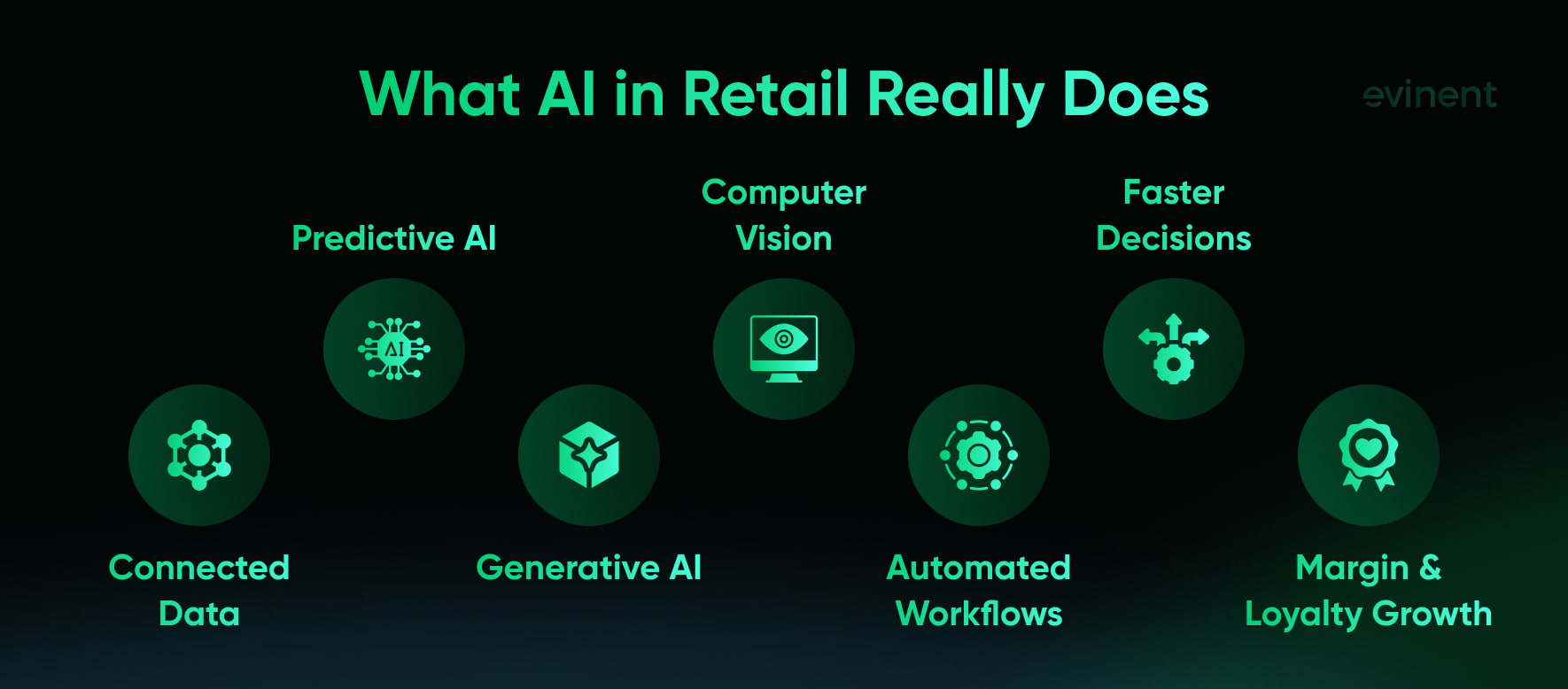
Most AI applications in retail fall into four groups.
First, there is predictive AI. This is the part that forecasts what may happen next. Demand forecasting, sales forecasting, churn prediction, inventory risk, return probability, and fraud scoring all fall under this category. Predictive analytics looks at historical sales data, customer behavior, seasonality, market signals, and operational data to help teams make better calls.
Second, there is generative AI. This is the part that creates, summarizes, rewrites, explains, or answers. It can draft product descriptions, summarize customer reviews, generate support responses, help merchandisers analyze product performance, create campaign variants, or power AI shopping assistants. McKinsey estimates that generative AI could create $240 billion to $390 billion in economic value for retailers, equal to a 1.2 to 1.9 percentage-point margin increase across the industry.
Third, there is computer vision. This is where AI reads visual information from images, shelves, cameras, receipts, product photos, or uploaded customer images. It supports visual search, shelf monitoring, checkout exception detection, loss prevention technologies, in-store analytics, quality checks, and product tagging.
Fourth, there is automation and orchestration. This is the less glamorous part, but often the most profitable one. AI notices something, then a workflow begins: replenish this SKU, this store, send this back-in-stock message, route this fraud case, update this customer segment, trigger this price review, assign this task to a store associate.
In plain English, AI helps retail teams move from “What happened?” to “What should we do next?”
That shift matters because retail data gets old fast. Yesterday’s demand signal may already be stale if a product goes viral, a competitor drops a price, a supplier misses a shipment, or the weather changes foot traffic. Real-time demand forecasting, dynamic merchandising, smart recommendations, and automated replenishment all exist because old planning cycles are often too slow for modern retail.
NVIDIA’s 2024 State of AI in Retail and CPG report showed how far this has already moved from theory. It found that 42% of surveyed retailers were already using AI, while another 34% were assessing or piloting AI initiatives. Among retailers using AI, common focus areas included store analytics, adaptive promotions and pricing, conversational AI, inventory management, loss prevention, personalized recommendations, and visual search.
That list is useful because it shows one thing clearly: the use of AI in retail is not limited to marketing. It touches almost every profit lever.
AI can help a planning team decide what to buy. It can help a category manager decide which products deserve more space. It can help a pricing team test promotion depth. It can help a support team answer customers faster. It can help an eCommerce team improve search results. It can help store teams spot empty shelves. It can help finance see where the margin is leaking.
Still, there is a trap here.
Retailers sometimes talk about AI as if adding a model automatically creates value. It does not. A recommendation engine trained on poor product data will recommend badly. A virtual agent without access to order data will frustrate customers. A demand model that no planner trusts will sit unused. A fraud system that creates too many false positives will punish good customers.
So, what is AI in retail really?
It is not just software. It is a way to turn retail data into better decisions, faster actions, and fewer blind spots. The technology matters, of course. But the operating model matters more.
A strong AI retail setup usually needs five things:
connected customer, product, sales, inventory, and supplier data;
clear ownership of decisions, especially pricing and customer-facing actions;
human review where money, trust, or compliance is at risk;
measurable targets tied to margin, loyalty, availability, and cost;
clean feedback loops so the system learns from real results.
This is also why AI in retail stores and AI in eCommerce should not be treated as separate projects. Customers do not think that way. They check a product online, visit a store, ask a question via chat, use a discount code, return an item through another channel, and expect the retailer to remember the whole story.
AI can help connect that story. But only if the retailer’s systems allow it.
For executives, that is the main point. Artificial intelligence in the retail industry is no longer about experimenting with a single chatbot or dashboard. It is about building a smarter commercial nervous system: one that sees demand, inventory, price, customer intent, fraud risk, and service friction early enough to act.
And the best part? AI does not need to replace retail judgment. It should make that judgment sharper.
A buyer still understands the category. A store manager still knows the local customer. A merchandiser still knows when a product has an emotional pull that a spreadsheet misses. AI just gives them better signals before the mistake becomes expensive.
AI-Driven Inventory and Demand Forecasting
Inventory is where AI stops sounding like a boardroom trend and starts touching cash.
A retailer can survive a weak email campaign. It can recover from a clumsy product page. But bad inventory decisions? Those hurt everywhere. Too little stock, and customers leave. Too much stock, and the margin gets buried in markdowns. Stock in the wrong region, wrong size, or wrong store turns into transfers, returns, storage costs, and very tired planners staring at spreadsheets on Friday afternoon.
This is why demand forecasting is one of the strongest AI applications in retail. It connects directly to availability, working capital, waste reduction, and customer loyalty. McKinsey notes that AI can reduce inventory levels by 20 to 30 percent in distribution operations by improving demand forecasting through dynamic segmentation and machine learning. That is exactly the kind of number that gets CFOs to listen.
And the problem is huge. IHL Group estimated that worldwide inventory distortion cost retailers $1.77 trillion in 2023, with out-of-stocks accounting for $1.2 trillion and overstocks for $562 billion. In plain language: retailers are losing money because products are either missing when customers want them or sitting around when they don’t.
AI-driven inventory management does not remove uncertainty. Retail will always have weird weeks, sudden trends, supplier drama, and weather that ruins a perfectly reasonable plan. What AI can do is read more signals, update faster, and help teams see risks before they become expensive.
Demand forecasting
Traditional demand forecasting often starts with historical sales data. That still matters. Last year’s numbers are useful, especially for seasonal categories, stable products, and mature stores.
But historical sales data is only part of the story.
A modern demand forecasting model can also read price changes, promotions, local weather, holidays, supplier s, social trends, competitor moves, search behavior, returns, product reviews, stockout history, and channel shifts. That gives planners a more honest view of demand.
Think about a fashion retailer. A basic spreadsheet may say a jacket should sell at a normal rate because similar jackets sold that way last year. A machine learning model may notice that a color is trending, online searches are rising, returns are low, and one region is selling through faster than expected. That is a very different planning signal.
NRF pointed out in its 2024 retail predictions that AI is already being used for demand forecasting and customer sentiment analysis. It also warned that AI results depend heavily on data quality, especially in categories where demand includes human taste, timing, and cultural signals.
That warning is fair. Demand forecasting is not fortune-telling. It is better probability.
Real-time demand forecasting
Retail data ages fast.
A product can go viral over a weekend. A heatwave can change grocery baskets in one afternoon. A competitor can cut prices before your merchandising team finishes the weekly report. A supplier can break a campaign that looked perfect in planning.
Real-time demand forecasting helps retailers react while the decision still matters. Instead of waiting for a monthly review, the system can flag sudden demand changes, unusual sales velocity, local stock risk, or promotion performance shifts.
For C-level teams, the value is not “real-time” for its own sake. The value is decision speed.
If a product is selling faster than expected, the retailer can move stock, adjust replenishment, shift marketing spend, update store tasks, or change fulfillment logic. If demand drops, the team can slow orders, adjust pricing, reduce exposure, or change promotional plans before excess inventory grows.
This is where predictive analytics becomes practical. It is not just a graph. It is an early warning system.
Hyper-local stock optimization
A national forecast can hide local truth.
One store may sell more sunscreen in March because tourists arrive early. Another may need more winter products because the local weather stays cold. One neighborhood may respond to premium bundles. Another may buy entry-level products. Online demand may rise in one city while store traffic drops in the same area.
Hyper-local stock optimization uses local demand signals to decide what each store, warehouse, dark store, or fulfillment node should carry.
This matters because retail availability is not only about total inventory. A retailer may technically have enough units across the network and still lose sales because the product is in the wrong place.
AI can help answer questions like:
Which stores need more stock before the weekend?
Which SKUs should move from slow locations to faster ones?
Which sizes, colors, or variants are under-forecasted by region?
Which products should be held for online orders instead of pushed to stores?
Which locations are likely to face stockouts during a promotion?
This is also where inventory management systems need good integration. AI cannot optimize local stock if store inventory, warehouse data, eCommerce orders, and supplier updates live in separate worlds.
Automated replenishment
Automated replenishment is one of the clearest ways to turn AI forecasts into action. The system sees demand, checks current stock, considers lead time, reviews supplier constraints, and recommends a reorder quantity.
In some cases, it can create the order automatically. In others, it sends the recommendation to a planner or category manager for approval.
The second option is often better at the start.
Retailers should not rush from manual chaos to full automation. A safer path is controlled automation: let AI handle stable, low-risk replenishment while humans review high-margin products, unusual demand spikes, supplier issues, or large financial commitments.
A strong automated inventory management setup usually includes forecast confidence, exception rules, reorder thresholds, supplier checks, and audit logs. If the system recommends a strange order, the team should be able to see why.
That one word, “why,” matters a lot. Retail teams do not trust a black box with their stock budget. They trust systems that explain themselves.
Stock planning
Stock planning is not just about having enough products. It is about balancing availability, cash, margin, space, and customer expectations.
Too little stock creates lost sales and weak loyalty. Too much stock creates carrying costs, markdowns, and waste. The awkward part is that both can happen at the same time. A retailer may be overstocked overall while still missing the products customers actually want.
AI helps stock planning by connecting demand forecasts with margin forecasts, supply constraints, product lifecycle, channel behavior, and store-level performance.
For example, the model may show that a product is likely to sell well, but only at a discount. Another product may sell fewer units but protect margin and pull other items into the basket. A third product may look strong until returns are included.
That is the kind of nuance retail teams need. Units sold are not enough. Gross demand is not enough. Healthy inventory planning should look at net margin, return risk, availability, and basket impact together.
Trend analysis
Trend analysis is where AI can help retailers catch early movement.
A search term starts rising. A product gets more saves than purchases. A color sells faster in one region. A review theme recurs. A competitor runs out of stock. A social trend pushes demand into a category that was quiet two weeks ago.
Human teams can notice these things too, but they usually do so only after the pattern becomes loud. AI can watch many small signals at once.
This is not only useful for fashion or beauty. Grocery, pharmacy, electronics, home goods, sports, pet care, and DIY all experience demand shifts that begin with small signals.
The point is not to chase every trend. That would be expensive and chaotic. The point is to separate noise from a signal worth acting on.
Reverse logistics
Many retailers treat returns as an after-sales process. AI should treat them as planning data.
Reverse logistics can reveal product quality issues, poor sizing, weak product content, misleading images, damaged packaging, delivery problems, or customer misuse. It can also show when sales numbers are lying.
A product with high sales and high returns is not the same as a product with high sales and low returns. One creates margin. The other creates motion.
AI can group return reasons, detect unusual patterns, predict return probability, and feed those insights back into stock planning. If one size is returned more often, the issue may be the fit guide. If one supplier’s products have high damage rates, the issue may be packaging. If one region returns a product at twice the normal rate, the issue may be local expectations or fulfillment quality.
Reverse logistics is not glamorous. But it is one of the places where AI can protect margins quietly.
What C-level leaders should measure
Inventory AI should be judged by business movement, not model elegance.
The most useful metrics include forecast accuracy, stockout rate, overstock value, full-price sell-through, inventory turnover, markdown cost, lost sales from unavailable products, order fill rate, return rate, planner time spent on manual fixes, and working capital tied up in inventory.
NVIDIA’s 2024 State of AI in Retail and CPG report found that retailers using AI were applying it to areas such as inventory management, store analytics, adaptive pricing and promotions, loss prevention, recommendations, and visual search. That mix matters because inventory does not exist in a vacuum. It connects to pricing, merchandising, supply chain, store execution, and customer experience.
The executive question is simple: did AI help the business put the right product in the right place at the right time, with less waste and better margin?
If the answer is yes, the model is doing useful work. If the answer is no, it is just another expensive dashboard.

AI-Powered Customer Service and Virtual Agents
Customer service is where many retailers first try AI because the pain is easy to see. Tickets pile up. Customers ask the same questions again and again. Delivery s create support spikes. Return policies confuse people. Store teams get dragged into online order issues they cannot fully see.
And customers are not exactly thrilled with the current state of retail service. IBM’s 2024 consumer study found that only 9% of consumers were satisfied with the in-store shopping experience, and only 14% were satisfied with online shopping. The report’s blunt line, “Customers won’t wait,” is a good summary of the pressure retailers face now.
This is why AI-powered customer service is becoming more than a cost-cutting tool. Yes, virtual agents can reduce support volume. But the stronger business case is loyalty protection. If a customer can track an order, change delivery, find the right product, store availability, start a return, or get a warranty answer without fighting the system, the retailer has removed friction from the relationship.
Gartner predicts that by 2028, at least 70% of customers will use a conversational AI interface to start their customer service journey. It also predicts that by 2029, agentic AI will autonomously resolve 80% of common customer service issues, with a 30% reduction in operational costs. Those are forecasts, not guarantees. Still, they show where customer service is heading: from scripted bots to AI agents that can understand, route, resolve, and sometimes act.
Virtual agents
The old chatbot answered questions from a fixed Sometimes that was enough. Most of the time, it was just a nicer-looking wall.
A modern virtual agent uses natural language processing to understand what the customer is asking, even when the wording is messy. “Where is my order?” “My package never came.” “The app says delivered but I don’t have it.” These are different sentences, but the same service intent.
Generative AI adds another layer. It can explain policies in plain language, summarize long support threads, draft replies for human agents, translate messages, and turn a chaotic complaint into a clean case summary. Gartner lists case summarization and agent assistance among the more feasible customer service AI use cases because they help human teams resolve cases faster without asking AI to take over everything at once.
That is an important distinction. The goal is not always full automation. Often, the better first step is agent assist: give the human support team faster context, better answers, and cleaner next actions.
AI shopping assistants
AI shopping assistants sit between customer service and sales. They help shoppers choose, compare, filter, and understand products.
A good assistant can ask the kind of questions a strong store associate would ask: What are you using this for? What size do you usually wear? Do you need it today? Is budget more important than premium features? Are you replacing something or buying for the first time?
This is especially useful in categories where customers need confidence before buying: electronics, beauty, home improvement, furniture, sports equipment, pet products, health and wellness, and fashion. Tractor Supply’s in-store AI assistant, Gura, is one example cited in competitor materials: store associates can use it to answer product questions, check inventory levels, and recommend items based on a customer’s needs.
For online retail, AI shopping assistants can reduce decision fatigue. Instead of forcing the customer to scroll through 200 nearly identical products, the assistant narrows the path. That matters because too much choice often creates no choice at all.
AI-powered visual search
Search boxes assume customers know the right words. Often, they don’t.
A shopper may want “that beige jacket from the photo,” “tiles like this hotel bathroom,” or “a lamp with this shape but smaller.” AI-powered visual search uses computer vision to read images and connect them to product attributes such as color, shape, style, texture, category, and similar items.
For retail, visual search is not only a customer convenience feature. It can improve product discovery, reduce search exits, and help customers find substitutes when the exact item is unavailable. It can also support store associates who need to identify a product from a customer’s photo.
But there is a catch, as always. Visual search depends on clean product data. If product images are poor, attributes are missing, and categories are inconsistent, computer vision will have less to work with. AI does not forgive bad catalog discipline. It exposes it.
Voice automation
Voice automation is not only for call centers. In retail, it can help customers check order status, ask store hours, find product availability, reorder frequent purchases, or get support while driving, cooking, working, or moving through a store.
For employees, voice interfaces can also help store associates check inventory, locate products, or retrieve policy details without leaving the customer. That sounds small, but small moments shape service quality. A customer waiting in aisle seven does not care whether the answer comes from POS, ERP, PIM, or a warehouse system. They just want the answer.
Voice automation works best when the task is narrow and the data is reliable. It works poorly when customers need emotional support, complex problem-solving, or negotiation. A ed wedding outfit, a missing expensive item, or a refund dispute should not be trapped inside a voice bot with no escape hatch.
Omnichannel integration
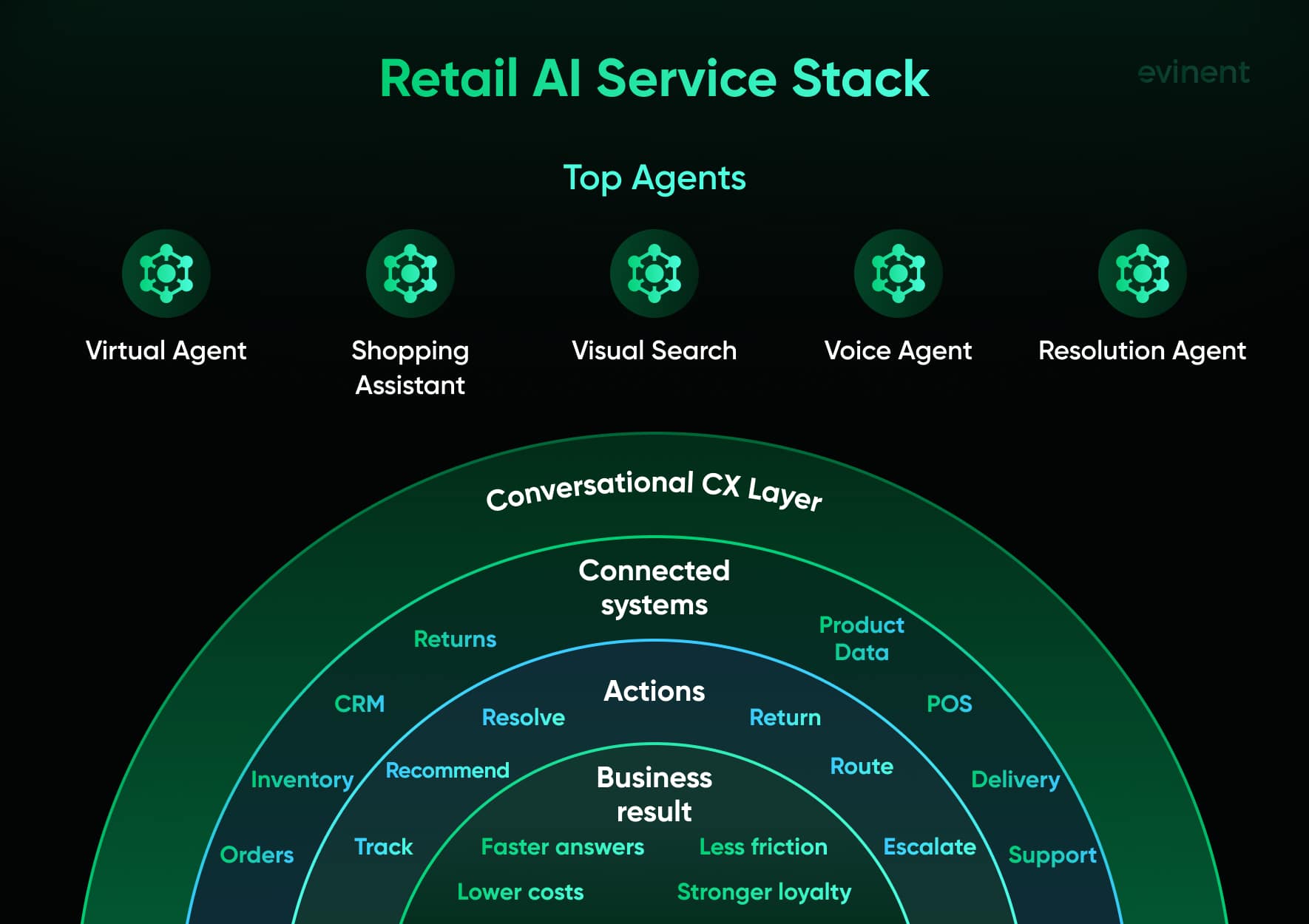
A virtual agent that cannot see order data is mostly decoration. A chatbot that cannot check inventory is limited. A store assistant that cannot see online browsing history, loyalty status, or delivery promises is working with half the picture.
Omnichannel integration is what turns AI customer service from “answer generator” into a real service layer.
For retail, that means connecting the conversational CX toolkit to:
order management;
inventory management systems;
CRM and loyalty data;
eCommerce platforms;
POS;
delivery and carrier systems;
returns systems;
product information management;
support history;
promotion and pricing rules.
Without those connections, the AI may sound confident and still be wrong. And a confident wrong answer is dangerous. It creates repeat contacts, refund pressure, customer anger, and more work for human agents.
Klarna’s 2024 AI assistant case shows both the scale and the seriousness of this shift. In its first month, the assistant handled 2.3 million conversations, or about two-thirds of Klarna’s customer service chats, and the company said it was doing “the equivalent work of 700 full-time agents.”
That kind of automation only works when the assistant is connected to the right data and the right workflows. Otherwise, it cannot resolve much beyond generic questions.
Agentic AI
Agentic AI is the next step after conversational AI.
A basic virtual agent answers. An agentic AI system can plan and act within defined permissions. It may check an order, eligibility, start a return, update an address, issue a replacement, create a store task, notify a carrier, or route a complex case to a specialist.
Gartner describes AI agents as autonomous or semiautonomous software that can make decisions and work with other AI or human agents to resolve customer issues. That matters for retail because many service problems are not “questions.” They are workflows.
A customer saying “My package arrived damaged” may trigger several steps:
verify the order;
check product type and warranty rules;
ask for a photo if needed;
determine refund or replacement eligibility;
check replacement stock;
create a return or disposal instruction;
update the customer;
log the reason for product quality analysis.
That is workflow automation and orchestration. It is not glamorous, but it is where service AI becomes useful.
Still, permissions matter. A retailer may allow AI to start a return for a low-value product but require human approval for high-value orders, suspected fraud, repeated refunds, or regulated categories. The point is controlled action, not chaos with a friendly tone.
Explainability and handoff
Customer service AI needs explainability because customers become angry when systems make decisions they cannot understand.
Why was my return denied? Why was my account flagged? Why can’t I use this promotion? Why did the assistant tell me one thing and the store another?
The AI should be able to show the reason behind an answer: policy rule, order status, delivery record, product condition, loyalty terms, or stock availability. Internal teams need that too. If a human agent receives an escalated case, they should see what the AI asked, what it answered, what data it used, and why it escalated.
A poor handoff is one of the fastest ways to ruin AI service. The customer explains the issue to the bot, waits, gets transferred, and then has to explain everything again. That is not automation. That is a maze.
A strong handoff gives the human agent a short summary, customer context, previous steps, sentiment, likely intent, and suggested next action. The customer should feel like the system remembered the conversation.
What C-level leaders should measure
AI-powered customer service should be measured by customer and business outcomes, not by how modern the chatbot sounds.
The useful metrics include first-contact resolution, containment rate, average resolution time, repeat contact rate, escalation quality, CSAT, NPS impact, cost per contact, conversion assisted by AI shopping assistants, return completion time, product discovery success, and the percentage of AI answers corrected by human agents.
There is one more metric worth watching: customer frustration. It can show up in rage clicks, repeated messages, negative sentiment, abandoned chats, public complaints, or sudden jumps to phone support.
For C-level leaders, the question is not “Did we automate support?” The better question is: did customers get better answers with less effort, and did the business reduce avoidable service costs without damaging loyalty?
Dynamic Pricing and Merchandising
Pricing and merchandising are where AI gets politically interesting in retail.
Inventory teams want sell-through. Finance wants margin. Marketing wants traffic. Category managers want supplier support and healthy category growth. Customers want a price that feels fair. And somewhere in the middle, a pricing team is trying to make all of that work without turning every promotion into a margin bonfire.
AI helps because pricing and merchandising are full of moving parts: demand, elasticity, competitor activity, stock position, supplier terms, campaign calendars, weather, seasonality, customer behavior, and product lifecycle. A human team can track a lot. AI algorithms can track more, faster, and with fewer “I missed that tab in the spreadsheet” moments.
But dynamic pricing is not just about changing prices more often. That is the lazy version. The better version uses machine learning, margin forecasts, competitive intelligence, and real-time insights to help retailers decide when to protect price, when to promote, when to mark down, and when to leave things alone.
McKinsey’s 2026 analysis of agentic AI in retail merchandising argues that AI agents can continuously tune assortments, adjust prices, refine promotions, and deliver real-time insights, while merchants could reclaim up to 40% of their time from manual tasks. The same survey found a less flattering reality: 71% of merchants said AI merchandising tools had limited or no business impact so far, mainly because the tools were not well integrated into daily work.
That is the tension. AI can change merchandising. But only if it gets close enough to the actual decisions.
Dynamic pricing
Dynamic pricing means prices change based on demand, supply, competition, customer behavior, time, or other market signals. Academic research from 2023 defines it as price changes ed by shifts in demand drivers, which is a useful way to keep the idea grounded.
In retail, those demand drivers may include:
stock levels;
competitor prices;
supplier cost changes;
local demand;
product age;
promotion calendars;
weather and seasonal events;
customer response to previous price points;
margin targets;
delivery or fulfillment cost.
The goal is not to make prices dance every five minutes. Customers notice that, and not in a good way. The goal is to make pricing decisions less blind.
For example, AI may show that a product is selling well even without a discount, so the planned promotion can be reduced. Or it may show that a slow-moving product needs a markdown before inventory ages past the point of recovery. Or it may flag that a competitor’s price drop is hurting one region but barely moving another.
That is useful. It is also more disciplined than “everyone is discounting, so let’s discount too.”
Pricing engines
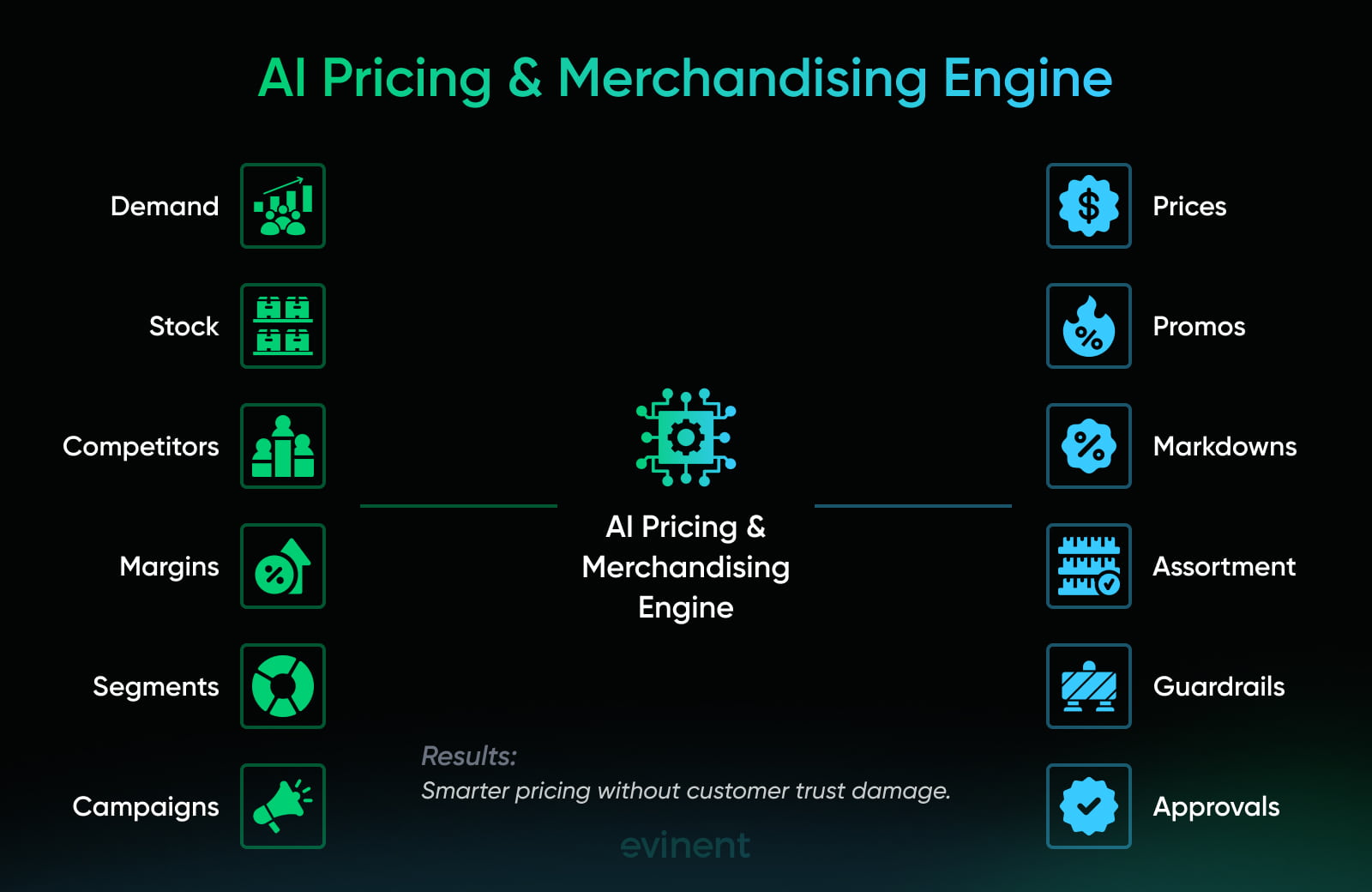
AI pricing engines can recommend price changes across thousands of SKUs by reading elasticity, demand shifts, competitor movement, inventory depth, and margin forecasts. They can run scenarios faster than a pricing analyst working manually.
But a pricing engine should not become the hidden boss of the business.
The strongest setup is usually decision support first, automation later. Let the engine recommend. Let category managers and pricing leaders review high-risk changes. Let the system explain which signals shaped the recommendation. Then, after enough trust is built, automate low-risk categories or rule-based changes.
This matters because price is not only a number. It is a brand signal.
A luxury retailer, a discount grocer, a pharmacy chain, and a marketplace seller do not have the same pricing rules. A price that protects margin in one model may damage trust in another. AI needs commercial guardrails: minimum margin, maximum price movement, promo exclusions, fairness checks, legal rules, and approval thresholds.
The simple rule: if no one can explain why the price changed, the price should not change automatically.
Competitive intelligence
Competitive intelligence helps retailers understand where their prices, promotions, assortment, and availability sit against the market. AI can monitor competitor prices, product descriptions, stock status, ratings, delivery promises, and marketplace behavior.
That is powerful. It is also a bit dangerous if teams overreact.
A competitor may cut price because they are overstocked. Matching that price may destroy your margin for no good reason. Another competitor may run a promotion on a different product bundle, making the comparison misleading. A marketplace price may exclude delivery fees or loyalty benefits.
AI can gather the signal. Humans still need to read the commercial context.
For a category manager, the better question is not “Are we cheaper?” It is “Where do we need to be price-competitive, and where do customers value availability, service, quality, delivery, or loyalty benefits more than the lowest price?”
That distinction saves margin.
Promotions
Promotions are one of the easiest ways to create fake growth.
Sales go up. Everyone relaxes. Then finance checks the margin, cannibalization, and post-promo dip. Less fun.
AI can help retailers forecast the real value of promotions before they go live. Not just gross uplift, but incrementality: what would have sold anyway, what shifted from another product, what pulled future demand forward, and what actually added profit.
A promotion engine can compare discount depth, timing, product combinations, customer segments, and channel performance. It can also catch conflicts, such as two campaigns targeting the same customer with different offers.
This is especially useful when promotions are connected to loyalty data. A blanket discount may attract bargain hunters. A more precise offer may bring back a high-value customer who has gone quiet. Another customer may need no discount at all; a back-in-stock message or better recommendation may be enough.
Deloitte’s 2024 personalization research makes this point from the customer side: 80% of surveyed consumers prefer personalized experiences and reported spending 50% more with brands that provide them, yet only 48% of consumers agreed that retailers deliver effective personalization, while 92% of retailers believed they did.
That gap is a warning. Personalization and promotions should feel relevant to the customer, not just profitable to the retailer.
Hyper-personalization
Hyper-personalization can improve product recommendations, email offers, loyalty campaigns, search results, homepage modules, and shopping journeys. Used well, it helps customers find what they actually want.
Pricing is different.
Personalized offers are common. Personalized prices are sensitive. Customers may accept a birthday coupon, loyalty reward, or abandoned-cart incentive. They are less likely to accept the idea that two people see different base prices because an algorithm guessed their willingness to pay.
The FTC’s 2025 surveillance pricing study found that consumer data such as location, demographics, browsing patterns, shopping history, mouse movements, and unpurchased cart items can be used to target different prices or discounts to individual consumers. FTC Chair Lina M. Khan warned that people deserve to know how private data is used to set prices and whether different people are charged different prices for the same product or service.
For retailers, the message is clear: dynamic pricing needs governance. Especially when customer-level data is involved.
A safer model is to use AI to improve product relevance, offer timing, promotion eligibility, and category-level pricing, while keeping base pricing rules explainable and defensible.
AI merchandising tools
A category manager already works with a messy pile of questions.
Which products deserve space? Which supplier is underperforming? Which line needs a refresh? Which promotion failed because of price, stock, placement, or product content? Which product looks weak but drives a valuable basket?
AI merchandising tools can pull those signals together. They can read sales, margin, inventory, competitor data, reviews, returns, search data, and campaign results. Then they can suggest actions: adjust assortment, protect price, reduce depth of discount, move inventory, change placement, update content, or renegotiate supplier terms.
BCG describes the next model as “always-on merchandising,” where specialized AI agents support pricing, promotion, assortment, and inventory decisions. In BCG’s example, a pricing agent monitors competitors' prices, costs, elasticity, category performance, and constraints; a promotion agent checks net incrementality and calendar conflicts; an inventory agent monitors shipments and availability.
The real value is not that AI replaces the merchant. It changes the merchant’s week. Less time assembling inputs. More time deciding what the business should do.
Agentic AI systems
Retail decisions often fail because systems act alone.
The promotion team launches a campaign. Inventory is not ready. The pricing team reacts to a competitor. Merchandising is not taught. Marketing pushes a product that stores cannot fulfill. Finance sees the damage later.
Agentic AI systems can help connect these decisions. A promotion agent may a campaign if the inventory agent sees a stockout risk. A pricing agent may recommend holding the price because demand is strong and the stock is in short supply. An assortment agent may flag that a low-selling item protects category completeness and should not be cut too quickly.
BCG puts the value of this coordination neatly: “The advantage of automated orchestration is the steady elimination of value leakage across thousands of decisions.”
That is the right way to think about AI merchandising. Not one huge miracle. Thousands of smaller leaks were closed earlier.
Real-time insights
Real-time insights are useful. Real-time chaos is not.
Retailers need rapid visibility into price movements, margin pressure, promotion performance, stock risk, competitor actions, and customer responses. But not every insight should trigger instant automation.
A price change may need approval. A markdown may need finance rules. A personalized offer may need consent checks. A promotion change may need supplier funding ation. A high-risk decision should leave an audit trail.
This is where the operating model matters as much as the model itself.
For C-level leaders, the question is not “Can AI change prices automatically?” It can. The better question is: where should AI recommend, where should it act, and where should a human stay in the loop?
The retailers that answer that well will use AI to protect margin without burning customer trust. And that is the whole game.
Ethical Considerations and Responsible AI Practices
AI in retail can improve margins, reduce waste, and make shopping feel more personal. It can also cross a line very quickly.
That line may be privacy. It may be unfair pricing. It may be biased fraud scoring. It may be a virtual agent making a decision no human can explain. Or it may be something quieter: employees being handed AI tools with no training, then blamed when the workflow changes around them.
So responsible AI in retail is not a legal footnote. It is part of the operating model.
The EU AI Act, Regulation 2024/1689, entered into force in 2024 and is described by the European Commission as the first comprehensive legal framework for AI worldwide. Its stated aim is to support trustworthy AI in Europe, with stricter rules for systems that create higher risks to rights, safety, and livelihoods. Retailers serving EU customers should treat this as a signal: AI governance is becoming a normal part of doing business, not a nice extra.
NIST’s AI Risk Management Framework gives a useful, practical lens here. It describes trustworthy AI systems as valid and reliable, safe, secure and resilient, accountable and transparent, explainable and interpretable, privacy-enhanced, and fair with harmful bias managed. That sounds formal, yes. But for retail, it comes down to one blunt question: can you defend how the AI behaves when customers, employees, regulators, or the board ask why?
Data governance
Retailers love the idea of AI reading customer behavior, inventory movement, support tickets, loyalty data, product reviews, and supplier performance. Fair enough. That data is useful.
But who owns it? Who can access it? Was customer consent collected clearly? Is the data accurate? Is it still valid? Can it legally be used for this specific AI use case?
Data governance is where many retail AI projects become either serious or risky. A personalization model trained on outdated customer profiles may send irrelevant offers. A pricing model using incomplete cost data may protect revenue while damaging margin. A fraud model trained on messy return codes may punish normal customers because the source data was lazy.
Data quality validation should happen before launch and after launch. Product attributes, customer IDs, stock counts, promotion history, return reasons, and consent records need regular checks. Not glamorous. Very necessary.
The rule is simple: if the business would not trust the data in a financial report, it should not trust the same data inside an AI model.
Customer consent and privacy concerns
Personalization works when customers feel understood. It fails when they feel watched.
Cisco’s 2024 Consumer Privacy Survey found that 75% of consumers said they would not purchase from organizations they do not trust with their data. The same survey found that 78% believe organizations have a responsibility to use AI ethically, while 63% said AI can be useful in improving their lives. That combination is the real mood of the market: customers are not anti-AI, but they are very much anti-creepy AI.
For retailers, customer consent cannot be buried in legal fog. People should understand when their browsing behavior, purchase history, location, loyalty data, chat interactions, or uploaded images are used for AI-driven personalization.
This matters even more for sensitive use cases: facial recognition technology, in-store analytics, fraud detection, personalized pricing, health-related retail categories, children’s products, or financial services connected to shopping.
A good test: would the customer still feel okay if the retailer explained the data use in one plain sentence? If not, the use case probably needs redesign.
Algorithmic biases
Algorithmic biases rarely arrive with a big warning label. They hide inside historical data.
A fraud model may flag certain locations too aggressively because past investigations were uneven. A recommendation engine may over-promote products from dominant suppliers and bury smaller brands. A delivery model may offer better availability to some neighborhoods because old logistics data already favored them. A customer service model may route certain complaints with less urgency because previous tickets were labeled poorly.
AI does not “mean well.” It learns patterns.
Bias detection should be part of normal model monitoring. Retailers should check false positives, false negatives, approval rates, offer distribution, complaint rates, refund decisions, and service outcomes across customer groups, regions, channels, and stores.
The goal is not to make every outcome identical. Retail has local differences. The goal is to catch unfair or unexplained differences before they become reputational damage.
Explainable AI models
Explainability matters most when AI affects money, access, trust, or customer rights.
A product recommendation does not always need a long explanation. But AI decisions around refunds, fraud flags, loyalty eligibility, personalized offers, credit-like services, return denial, pricing, employee scheduling, or loss prevention need a clearer trail.
Retail teams should be able to answer:
What data did the model use?
Which factors influenced the output?
Was there a human review option?
Can the customer appeal or correct the decision?
Was the decision logged?
Transparent AI does not mean exposing every technical detail. It means making the decision understandable enough for a human to review, challenge, and correct.
This is especially important with generative AI and agentic AI systems. A virtual agent that gives product advice is one thing. A virtual agent that approves refunds, changes orders, or blocks accounts is another. The more action the system can take, the more explainability it needs.
Job displacement
AI will change retail jobs. There is no honest way around that.
Customer service agents may handle fewer basic questions and more complex escalations. Store associates may use AI assistants for product advice and inventory checks. Planners may spend less time building reports and more time reviewing exceptions. Merchandisers may work with AI-generated recommendations instead of manually collecting inputs from ten systems.
That can be good work. It can also feel threatening if employees are not included.
The World Economic Forum’s Future of Jobs Report 2025 says employers expect 39% of key skills required in the job market to change by 2030. That makes reskilling and upskilling part of AI adoption, not a separate HR initiative.
Retail leaders should be very practical here. Train teams on what the AI can do, where it is weak, when to challenge it, and how decisions are reviewed. Store staff, support agents, category managers, pricing teams, and supply chain planners do not need the same training. They need training tied to their actual workflow.
Otherwise, adoption becomes performative. The software is launched. The slide deck looks good. People quietly keep using the old workaround.
Sustainability and waste reduction
Sustainability is one of the strongest ethical arguments for AI in retail, especially in grocery, fashion, consumer goods, and supply chain planning.
The UNEP Food Waste Index Report 2024 estimated that 1.05 billion tonnes of food were wasted in 2022 across retail, food service, and households, with the retail stage accounting for 131 million tonnes. That is a huge operational and environmental problem, not just a moral one.
AI can help reduce waste through better demand forecasting, automated inventory management, markdown timing, shelf-life prediction, route optimization, packaging optimization, donation planning, and reverse logistics analysis.
But sustainability claims need measurement. If a retailer says AI reduces waste, it should track the actual numbers: expired stock, markdown volume, disposal rates, return rates, shipment splits, packaging waste, fuel use, and donation recovery.
There is also a second side to sustainability. AI systems consume computing resources. Retailers do not need to over-engineer every small decision with heavy models. Sometimes a simpler model, a cleaner process, or a better rule engine does the job at lower cost and with less complexity.
Human review
The safest retail AI systems do not remove humans from every decision. They place humans where judgment matters most.
AI can rank fraud risk. A human can review borderline cases. AI can recommend a markdown. A category manager can approve it. AI can draft a customer response. A support agent can adjust the tone. AI can flag biased outcomes. A governance team can investigate.
This is not inefficiency. This is control.
For C-level leaders, responsible AI should be measured with the same seriousness as revenue impact. Track model accuracy, override rates, customer complaints, bias checks, consent coverage, incident reports, audit completion, employee adoption, and business outcomes.
The best retail AI programs will not be the ones with the flashiest tools. They will be the ones customers can trust, employees can use, and executives can explain without sweating.
Fraud Detection and Security
Fraud in retail used to feel like a back-office problem. A chargeback here, a suspicious return there, a few shrink reports at the end of the month.
Not anymore.
Retail fraud now spans the entire business: online payments, loyalty accounts, refunds, promo codes, self-checkout, store theft, employee abuse, marketplace sellers, fake accounts, bots, and data breaches. Some losses are visible. Others hide inside margin, customer service costs, inventory errors, and trust damage.
That is why AI-powered fraud detection has become one of the more practical uses of artificial intelligence in retail. Fraud moves quickly. Rule-based systems still matter, but they often catch yesterday’s pattern. Machine learning models can review large volumes of behavior, compare it with normal activity, and flag anomalies while there is still time to act.
The pressure is not theoretical. The National Retail Federation reported that retailers saw a 93% increase in the average number of shoplifting incidents per year in 2023 compared with 2019, along with a 90% increase in dollar loss due to shoplifting over the same period. This is why loss prevention technologies are increasingly integrated into store operations, checkout, inventory management, and customer identity systems.
And the digital side is just as serious. IBM’s 2025 Cost of a Data Breach Report puts the global average data breach cost at $4.4 million and warns that ungoverned AI systems are more likely to be breached and more expensive when they are. For retailers, that is a double warning: use AI to improve security, but do not let AI become another unmanaged risk surface.
AI-powered fraud detection
AI-powered fraud detection works by comparing behavior against expected patterns.
A single transaction may look normal. But when the system reads device data, location, basket size, payment method, delivery address, return history, loyalty activity, promo use, and account behavior together, the picture can change quickly.
For example, a customer buying an expensive item is not suspicious by itself. But a new account, unusual device, mismatched billing and delivery details, high-risk shipping address, multiple failed payment attempts, and a rushed delivery request may deserve review.
This is where predictive risk scoring helps. The system does not need to accuse anyone. It can assign a risk level, then route the case to the right workflow: approve, challenge, hold for review, request more verification, or escalate to a fraud analyst.
The commercial goal is balance. Catch more fraud, yes. But do not block good customers by mistake. False positives are not harmless. They create angry support tickets, abandoned carts, and loyalty damage.
Real-time anomaly detection
Fraud moves faster than monthly reporting. Sometimes faster than daily reporting.
Real-time anomaly detection helps retailers catch unusual patterns as they happen: sudden refund spikes, strange gift card purchases, repeated failed logins, abnormal promo code use, unusual self-checkout behavior, loyalty point transfers, or high-volume orders from suspicious accounts.
This is especially useful when fraudsters test systems in small steps before scaling the attack. One low-value order. Then five. Then fifty. A rule-based system may miss the build-up if each action sits below a threshold. A machine learning model can see the pattern forming.
Still, real-time detection should not mean automatic punishment. A good system creates different levels of response. Low risk can pass. Medium risk may need extra verification. High risk may need manual review. Very high risk may be blocked, but with a clear audit trail.
Retailers need speed, but they also need fairness.

Transaction monitoring
Transaction monitoring is one of the most mature uses of AI in fraud prevention. It reads payment behavior, account history, device signals, purchase velocity, basket composition, and past fraud outcomes.
In retail, this matters for more than stolen cards. AI can help detect account takeover, loyalty fraud, gift card abuse, refund abuse, marketplace seller fraud, and promo code exploitation.
Promo abuse is a good example because it often looks harmless at first. A discount code gets shared. A user creates multiple accounts. A bot farms referral credits. A return pattern turns a generous policy into a cost center. None of these may look dramatic alone, but together they eat margin.
AI helps connect the dots. It can show when the same device, address, payment method, or behavior pattern appears across many “different” accounts.
The point is not to make checkout hostile. The point is to protect legitimate customers and stop abuse without turning every purchase into an interrogation.
Loss prevention technologies
In physical retail, AI can support loss prevention through shelf monitoring, self-checkout exception detection, unusual movement patterns, inventory mismatch s, and smart camera systems.
For example, computer vision can help detect when high-risk products disappear from a shelf faster than sales data explains. Smart shelves can flag empty spaces. Self-checkout systems can detect mismatches between scanned items and visible products. Inventory systems can compare expected stock movement with actual sales and shrink data.
This is where AI-based surveillance needs careful design. A system that checks shelf gaps is very different from a system that identifies individual customers. The risk level is not the same. The governance should not be the same either.
Retailers should separate operational monitoring from identity-based surveillance. One helps teams manage stock and checkout friction. The other can create privacy, bias, and legal risk if handled badly.
Facial recognition technology
Facial recognition technology deserves its own warning.
It may sound attractive for loss prevention, especially when theft pressure is high. But the risks are serious: false matches, biased outcomes, privacy harm, unclear consent, and reputational damage.
The FTC’s 2023 Rite Aid case is the obvious cautionary example. The FTC said Rite Aid deployed facial recognition technology in hundreds of stores without reasonable procedures to prevent harm, and the settlement prohibited the retailer from using facial recognition for surveillance purposes for five years.
That does not mean every computer vision use case is off-limits. It means retailers need to know exactly what they are identifying, why, how long data is stored, who can access it, how false positives are handled, and whether the use case is legally and ethically defensible.
A simple rule works well here: if the use case cannot be explained to customers in plain language without sounding creepy, it probably needs to be redesigned.
Internal theft and employee-side fraud
Not all retail fraud comes from outside.
Internal theft can include unauthorized discounts, refund manipulation, fake returns, loyalty point abuse, inventory tampering, cash handling issues, supplier collusion, or misuse of employee access. It is uncomfortable to discuss, but ignoring it does not make it smaller.
AI can detect unusual employee behavior without treating every employee like a suspect. For example, it can flag repeated refunds by one account, discounts outside normal patterns, unusual voids, suspicious stock adjustments, repeated access to sensitive customer data, or mismatches between shift activity and transaction records.
This should be handled with serious care. Employee monitoring can become toxic fast if it is opaque or excessive. Retailers need clear policies, role-based access, audit logs, review procedures, and human investigation before action is taken.
The model can flag. A trained human should decide.
Data breaches
A data breach is not only an IT incident. For a retailer, it is a customer experience failure.
Customers trust retailers with names, addresses, payment details, loyalty history, purchase behavior, support conversations, and sometimes sensitive preference data. If that data leaks, the damage reaches far beyond the security team.
Retailers should use AI defensively, but with strong controls. AI can help detect unusual access, suspicious login patterns, abnormal data exports, bot behavior, and potential account takeover. It can also reduce fatigue by grouping related security signals and ranking incidents by risk.
But AI does not replace basic security hygiene. Identity access management, encryption, patching, vendor checks, secure APIs, data minimization, and incident response still matter. Actually, they matter more when AI connects more systems together.
If the AI layer can read customer, payment, loyalty, inventory, and support data, then the AI layer itself becomes a sensitive system. It needs the same security discipline as the systems it touches.
Compliance standards and responsible AI protocols
Fraud detection lives close to sensitive decisions. A system may an order, block a transaction, flag a customer, trigger employee review, or deny a return. That means compliance standards and responsible AI protocols cannot be vague.
NIST’s AI Risk Management Framework describes trustworthy AI as valid and reliable, safe, secure and resilient, accountable and transparent, explainable and interpretable, privacy-enhanced, and fair with harmful bias managed. Retailers do not need to turn every fraud meeting into a policy seminar, but these principles are very useful when AI affects customer trust.
A responsible retail fraud program should define:
what data the model can use;
which decisions can be automated;
which cases need human review;
how customers can appeal decisions;
how false positives are tracked;
how bias detection is performed;
how long data is stored;
who can access fraud signals;
how model performance is audited.
That may sound heavy. But the alternative is worse: a system that blocks real customers, misses real fraud, and leaves no clear explanation for either.
What C-level leaders should measure
AI fraud detection should be measured by both loss reduction and customer impact. One without the other is not enough.
Useful metrics include fraud loss rate, chargeback rate, false-positive rate, manual review volume, approval rate for legitimate transactions, account takeover incidents, refund abuse rate, promo abuse rate, shrink rate, internal investigation accuracy, time to detect anomalies, and customer complaints related to fraud controls.
For store security, leaders should also track shrink by category, shelf availability, self-checkout interventions, employee safety incidents, and the accuracy of AI-generated s.
The bigger point is simple: AI should help retailers catch real risk earlier without making honest customers and employees feel trapped inside a suspicion machine.
Future Trends and Innovations in AI for Retail
The next phase of AI in retail will not be about adding one more chatbot to the website. That part is already happening. The bigger shift is that AI is starting to sit between retail data and retail action.
A forecast does not only predict demand. It can trigger a replenishment review. A customer chat does not only answer a question. It can build a basket. A merchandising tool does not only show a dashboard. It can recommend price, promo, stock, and assortment changes together.
That is why the AI in retail market is growing so quickly. Grand View Research estimated the global artificial intelligence in retail market at $11.61 billion in 2024 and projected it to reach $40.74 billion by 2030, with a CAGR of 23.0% from 2025 to 2030. The money is moving because retailers are not treating AI as a lab experiment anymore. They are looking for systems that can improve margin, speed, loyalty, and operational control.
Still, the future is not one giant AI brain running the store. It is more likely to be a network of specialized tools and agents: one for pricing, one for inventory, one for customer service, one for product discovery, one for merchandising, one for fraud, one for campaign timing. The interesting part is what happens when they start talking to each other.
AI agents
AI agents are software systems that can understand a goal, plan steps, use tools, and act within set permissions. In retail, that could mean an agent that watches low-stock products, checks supplier lead times, reviews demand forecasts, drafts a purchase order, and sends it to a planner for approval.
That is different from a normal dashboard. A dashboard waits for someone to notice. An AI agent can monitor, reason, and start the next step.
Agentic AI is already moving into commerce infrastructure. McKinsey reported that Perplexity launched an agentic shopping tool in late 2024, OpenAI launched Operator in January 2025, Shopify is developing infrastructure that lets agents tap into its catalog, and Amazon, Google, PayPal, Mastercard, and others are developing agentic shopping services.
For retailers, this changes the competitive question. Soon, the shopper may not start with your homepage. They may ask an AI agent: “Find me the best waterproof hiking boots under $180 that arrive by Friday and have low return rates.”
That agent will compare product data, reviews, price, delivery, availability, return policy, and trust signals. So product information becomes more than catalog maintenance. It becomes sales infrastructure.
Agentic commerce
Agentic commerce means AI assistants help customers search, compare, choose, and sometimes buy products with less manual browsing.
That sounds convenient for shoppers. For retailers, it is a little uncomfortable.
If AI agents become the filter between customers and brands, then old acquisition tactics may lose some power. A clever ad may matter less if the agent ranks products by availability, price clarity, fit, sustainability details, return terms, and review quality. Brand still matters, of course. But machine-readable trust may matter more than it does now.
BCG reported in 2025 that more than half of consumers expected to use AI assistants for shopping by the end of that year, citing Adobe data. BCG also noted that customers arriving through AI agents were 10% more engaged than traditional visitors. That suggests agent-driven traffic may arrive with stronger purchase intent, not just curiosity.
The practical advice for retail leaders is not glamorous, but it is urgent: clean your product feeds, sync inventory accurately, improve product attributes, fix duplicate SKUs, structure return policies clearly, and make your product content useful enough for both humans and machines.
AI merchandising tools
Merchandising is heading toward a more continuous model.
In the older rhythm, teams planned assortments, reviewed performance, checked competitors, adjusted promotions, and prepared seasonal resets in cycles. That will not disappear. But AI merchandising tools can watch performance all the time and flag issues earlier.
BCG describes this shift as moving merchandising from siloed processes to “a more integrated, always-on system,” with merchants spending less time assembling inputs and more time overseeing AI outputs.
For a category manager, this could mean:
a pricing agent watching margin, elasticity, and competitor moves;
an inventory agent warning that a campaign may create stockouts;
a promotion agent checking whether a discount will add profit or just subsidize planned purchases;
an assortment agent flagging products with high returns, weak reviews, or hidden basket value;
a content agent suggesting which product pages need better images, specs, or explanations.
The human still makes judgment calls. Actually, the human judgment becomes more important. AI can point at the smoke. The category manager still decides whether there is a fire.
AI-augmented workforces
AI-augmented workforces are one of the most realistic near-term trends in retail.
This does not mean replacing retail teams with software. It means giving different teams better decision tools.
Store associates may use AI to answer product questions, check stock, compare items, or explain promotions. Customer service agents may get instant case summaries and suggested replies. Planners may review forecast exceptions instead of building manual reports. Merchandisers may get product-level insights before a weekly meeting. Fraud analysts may receive ranked cases instead of raw noise.
NVIDIA’s 2024 State of AI in Retail and CPG report found that generative AI in retail was moving beyond personalized recommendations into conversational AI, adaptive advertising, promotions and pricing, product tagging and cataloging, and brand avatars. Store analytics was also one of the major AI adoption areas in the report.
The workplace shift is not only technical. It is cultural. People need to know when to trust AI, when to challenge it, and when to ignore it completely. A planner who blindly accepts a forecast can create damage. A planner who rejects every AI signal wastes the investment. The value sits in the middle.
Predictive inventory management
Predictive inventory management will keep getting more precise. The future is not one general demand forecast. It is demand prediction by store, region, fulfillment node, product variant, customer segment, and time window.
A retailer will not only ask, “How many units will we sell next month?” It will ask:
Which stores need this product before Saturday? Which sizes will be short after this campaign? Which supplier will affect high-value customers first? Which products should be held for online orders? Which aging stock should be moved before markdowns become painful?
This is where predictive inventory management connects with back-in-stock campaigns and price drop notifications. If the system knows who wanted a product, where stock returned, and what margin is available, it can trigger a message at the right moment.
Not a random blast. A useful nudge.
Back-in-stock campaigns and price drop notifications become more selective
Back-in-stock and price drop notifications are simple on the surface. Customer wanted product. Product returned. Send message.
AI makes the logic more selective.
The system can check whether the customer still shows intent, whether they bought a substitute, whether the product is back in the right size or color, whether stock is deep enough to support a campaign, whether the customer prefers email or push, and whether a discount is even needed.
This matters because every message trains customer behavior. Too many price drop notifications can teach people to wait. Too many back-in-stock messages with weak availability can create disappointment.
AI should help retailers send fewer messages with better timing. That is not as loud as “hyper-personalization,” but it may be more profitable.
Visual search and computer vision technology
Visual search will keep growing because customers often shop from images, not exact words.
A customer may upload a photo of a sofa, a dress, a tile pattern, a sneaker, or a kitchen lamp and ask for something similar. Computer vision technology can identify shape, color, pattern, category, and style, then match the image to available products.
For store operations, computer vision can also support shelf checks, planogram monitoring, quality control, checkout exception detection, queue analysis, and inventory verification.
The same warning applies again: computer vision is only as useful as the process around it. If the system sees an empty shelf but no store task is created, the insight dies. If visual search finds similar products but product attributes are incomplete, results will feel random. If cameras are used in ways customers find invasive, trust takes the hit.
Good visual AI feels helpful. Bad visual AI feels like surveillance.
Generative AI and natural language processing
Generative AI and natural language processing will change how people interact with retail systems.
Customers will ask full questions instead of typing short keywords. Employees will ask systems for analysis instead of building every report manually. A category manager may ask, “Which products are hurting margin after returns?” A store manager may ask, “What should my team fix before the weekend rush?” A loyalty manager may ask, “Which churn-risk customers should receive a non-discount offer?”
This is where chat interactions become serious business tools. The interface becomes simpler, but the underlying system requires robust data connectivity, access control, and explainability.
A conversational interface is only valuable when the answer is grounded in real retail data. Otherwise, it is just confident text.
What leaders should prepare for now
The future of AI in retail is not waiting for a perfect moment. It is arriving through smaller changes: smarter product discovery, more precise inventory decisions, better customer service, faster merchandising analysis, more selective promotions, and agents that help teams act earlier.
For C-level leaders, the preparation is clear:
clean product, customer, inventory, and pricing data;
connect commerce, POS, CRM, ERP, loyalty, and warehouse systems;
define where AI can recommend and where it can act;
create approval rules for pricing, refunds, fraud, and customer-facing decisions;
train teams to work with AI outputs;
measure business impact, not tool adoption.
The retailers that do this well will not look “more AI” from the outside. They will simply feel faster, more relevant, and less wasteful.
And that is probably the real future trend: AI disappears into the work. Customers get better answers. Products show up where demand exists. Promotions become less blunt. Teams spend less time hunting for signals and more time making the call.
In-Store Automation and Smart Stores
Physical stores are not disappearing. They are changing job descriptions.
A modern store is no longer just shelves, staff, checkout, and a stockroom. It is becoming a live operating environment where cameras, sensors, RFID, mobile associate tools, self-checkouts, smart shelves, AI agents, and inventory systems all feed the same question: what needs attention right now?
That question matters because store experience is still underperforming. IBM’s 2024 consumer study found that only 9% of surveyed consumers were satisfied with in-store shopping, while 14% said the same about online shopping. The same report says shoppers want simpler experiences and better access to product information across channels. For retailers, smart stores are not about making the shop look futuristic. They are about removing the small frictions customers already hate: empty shelves, long queues, missing sizes, wrong prices, and employees who cannot access the answer.
The investment signal is strong too. Grand View Research estimated the global smart retail market at $43.13 billion in 2024 and projected it to reach $450.69 billion by 2033, driven partly by IoT-enabled technologies such as smart shelves, beacons, and RFID systems that give retailers real-time insight into inventory, footfall, and shopping patterns.
Smart shelves and automated restocking
Smart shelves help retailers see what is actually happening on the shop floor, not what the system thinks is happening.
That distinction is huge. A product may show as “available” in the inventory management system while the shelf is empty, the item is misplaced, or the right size is sitting in the stockroom. To the customer, that is still a stockout.
Smart shelves, RFID tags, shelf sensors, computer vision, and item-level tracking can detect low stock, wrong placement, pricing errors, and empty spaces. Once connected to automated restocking workflows, these signals can create tasks for store teams or trigger replenishment from the backroom.
Old Navy’s 2025 partnership with RADAR is a good example of where the market is going. The retailer announced a phased rollout of AI-powered RFID technology across its nationwide store fleet, giving store associates real-time inventory information to locate products anywhere in the store and improve customer service.
This is not glamorous AI. No one writes movie scenes about shelf gaps. But for retail margin, it matters. A shelf gap is a lost sale hiding in plain sight.
AI-enabled robots
AI-enabled robots make the most sense when they handle boring, repetitive, high-frequency store tasks.
Shelf scanning is a strong example. Robots can move through aisles, detect missing products, check labels, find misplaced items, monitor planogram issues, and send s to store teams. Simbe’s Tally, for example, is described as a retail shelf intelligence robot that identifies products and shelf conditions using computer vision, including misplaced products and promotion errors.
The point is not to replace the human associate. The point is to stop asking humans to manually hunt for shelf problems all day when customers need help, queues are forming, and online pickup orders are waiting.
Still, robots have to be designed around store reality. If a robot blocks aisles, annoys shoppers, or creates s that nobody acts on, it becomes expensive theater. The robot should feed a workflow: detect issue, assign task, verify fix, update inventory, measure impact.
No workflow, no value.
Self-checkouts
Self-checkouts are one of the most visible forms of in-store automation. Customers like speed. Retailers like lower checkout pressure. Everyone likes shorter lines.
Until the system starts creating new problems.
Self-checkouts can increase confusion, scanning mistakes, age-restricted product interventions, and shrink risk. AI can help by using computer vision and transaction monitoring to detect item mismatches, skipped scans, unusual basket behavior, repeated voids, or suspicious patterns.
But the design has to be careful. Nobody wants to feel accused while buying groceries.
A good AI-assisted self-checkout system should quietly reduce errors, call staff only when needed, and make honest mistakes easy to fix. It should not turn checkout into a suspicion machine. The National Retail Federation reported a sharp rise in shoplifting incidents and related losses between 2019 and 2023, so retailers do need stronger loss prevention technologies. But security cannot come at the cost of treating every shopper like a risk profile.
In-store analytics
Online teams have lived with behavioral analytics for years. They can see clicks, scrolls, search terms, abandoned carts, conversion paths, and product views.
Stores historically had much weaker visibility. Sales data showed what was bought. It did not show what customers looked at, could not find, picked up, abandoned, or asked staff about.
In-store analytics changes that.
Using sensors, cameras, POS data, mobile app signals, Wi-Fi, RFID, and associate task data, retailers can understand traffic patterns, dwell time, queue pressure, display performance, product availability, and service gaps.
This helps teams answer practical questions:
Which aisles create congestion?
Which displays attract attention but fail to convert?
Which shelves go empty before peak hours?
Where do customers need associate help?
Which stores need different staffing patterns?
Which products are searched online before in-store visits?
For C-level leaders, the value is not another dashboard. The value is that store decisions become less dependent on gut feel alone.
IoT and robotics
IoT and robotics are the plumbing of the smart store.
RFID tags, smart shelves, digital price labels, temperature sensors, beacons, cameras, handheld devices, robots, and edge computing all help the store report what is happening. Predictive AI then turns those signals into tasks, warnings, or recommendations.
In a grocery store, sensors can monitor chilled products. In apparel, RFID can locate sizes and colors. In electronics, smart displays can show product comparisons. In beauty, associate devices can connect customer preferences with smart recommendations. In home improvement, location-aware tools can help customers and staff find the exact aisle and bay.
The main challenge is integration. A sensor is not useful if it sits in a separate dashboard. The data has to reach store teams, replenishment systems, inventory records, and customer-facing availability.
Otherwise, the store becomes “smart” in name only.
Smart recommendations
Smart recommendations are not only for eCommerce pages.
In stores, AI can help associates recommend compatible products, substitutes, bundles, care items, or loyalty offers based on inventory, customer profile, purchase history, local demand, and current promotions.
This can work through associate apps, digital kiosks, shelf screens, mobile apps, or clienteling tools. A customer looking at a coffee machine may need filters, descaler, compatible capsules, or warranty support. A shopper trying on jeans may need another size that is in the stockroom. A customer buying paint may need brushes, tape, primer, and delivery advice.
The goal is not to make every store interaction feel algorithmic. The goal is to give staff better memory and better context.
A good store associate already does this naturally. AI helps more associates do it consistently, especially in large stores with huge assortments.
AI agents
The next smart-store step is AI agents that do more than report.
Imagine a shelf camera detects that a high-margin product is nearly gone. The AI agent checks backroom stock, sees that units are available, creates a task for an associate, adjusts online availability if needed, and warns the store manager if the task is not completed before peak traffic.
Or a pickup order is at risk because one item cannot be found. The agent checks nearby stores, suggests a substitution, s the associate, and prepares a customer message for approval.
That is where agentic commerce meets store operations. Stores are not only selling locations anymore. They are pickup points, return points, micro-fulfillment nodes, service hubs, and local brand experiences. AI agents can help connect those roles instead of forcing staff to jump between five systems.
The guardrails matter. An agent can create a task. It may not be allowed to change price, cancel an order, or deny a return without human review. Smart stores still need human judgment.
AI-powered surveillance systems
AI-powered surveillance systems can help with theft detection, safety s, queue monitoring, restricted-area access, and unusual behavior patterns. They can also create privacy problems quickly.
Retailers should separate operational computer vision from identity-based surveillance. Detecting an empty shelf is one kind of use case. Identifying a customer’s face is a very different one.
The more personal the data, the stronger the governance should be: customer notice, legal review, retention limits, access controls, bias testing, audit logs, and human review for any decision that affects a person.
Smart stores should feel helpful, not watched. That difference is not soft. It affects trust, brand, employee morale, and legal exposure.
What C-level leaders should measure
In-store automation should be judged by store outcomes, not novelty.
The useful metrics include shelf availability, inventory accuracy, time to restock, queue time, self-checkout intervention rate, shrink rate, task completion time, associate productivity, pickup order accuracy, customer satisfaction, sales per labor hour, and lost sales from out-of-stocks.
For smart recommendations, measure attach rate, assisted conversion, average order value, return rate, and customer feedback. For robots and smart shelves, measure issue detection accuracy, false s, task completion, and whether shelf gaps actually shrink.
Personalized Customer Experience
Personalization is one of the most overused ideas in retail. Everyone claims to do it. Customers are less convinced.
A first-name email is not personalization. A “you may also like” carousel filled with random leftovers is not personalization. A 10% discount sent to a customer two hours after they bought the product is definitely not personalization. That is just automation wearing a friendly hat.
Real personalization means the retailer understands enough context to make the next step easier: the right product, the right channel, the right message, the right timing, and sometimes the right silence. Because yes, silence can be personalization too. Not every customer needs another push notification at 8:03 a.m.
The commercial case is strong. Deloitte found that 80% of surveyed consumers prefer brands that offer personalized experiences and reported spending 50% more with those brands. But there is a nasty little gap in the middle: 92% of retailers believe they offer effective personalization, while only 48% of consumers agree. Retailers think they are being relevant. Customers often feel they are being sorted into a segment and blasted with slightly different copy.
That is the real challenge with AI in retail personalization. The technology can read browsing behavior, purchase history, loyalty data, product views, returns, reviews, chat interactions, and sentiment. But the business still has to decide how to use those signals without becoming annoying, creepy, or margin-destructive.
Customer data analysis
Customer data analysis is the foundation of personalized customer experience. AI can connect signals from purchase history, browsing behavior, loyalty activity, product searches, wish lists, returns, reviews, and support conversations.
But the word “connect” is doing a lot of work here.
A customer buying baby clothes may be a parent. Or an aunt. Or a colleague buying a gift. A shopper browsing premium coffee machines may be ready to buy, or they may be comparing ideas for later. A customer returning three sizes of the same item may not be abusing policy. Maybe the size guide is bad.
AI can spot patterns, but it still needs business logic. Without context, personalization becomes lazy inference.
A good customer intelligence layer should separate hard signals from soft signals. Purchase history is a strong signal. A single product view is weak. Repeated searches, saved products, and comparison behavior are stronger. A return reason adds another layer. A support complaint changes the story again.
This is where customer data analysis becomes useful for C-level teams. It helps retail leaders move from broad segments like “women 25–34” or “high-value loyalty member” to more useful commercial states: price-sensitive replenisher, gift buyer, churn risk, high-return shopper, premium browser, category loyalist, seasonal buyer, or service-frustrated customer.
That is a much better starting point.
Recommendation engines
Recommendation engines are one of the most common AI applications in retail. They suggest products based on customer behavior, similar shoppers, product attributes, purchase history, basket data, and current stock.
The weak version says, “People also bought this.”
The better version understands the customer’s task.
Someone buying a coffee machine may need filters, capsules, descaler, warranty support, or a milk frother. Someone buying running shoes may need socks, insoles, or weather-specific gear. Someone buying paint may need brushes, tape, primer, and delivery advice. The recommendation should feel like a good store associate saying, “You’ll probably need this too,” not a machine pushing whatever has the highest margin this week.
This matters because customers are drowning in choice. Salesforce reported that retailers in its survey were using AI to create conversational digital shopping assistants to help shoppers find the right products, with 55% using AI for that use case; 52% used digital models for product detail pages, and 51% used personalized product bundles.
For executives, the question is not whether a recommendation engine exists. Most retailers can buy one. The better question is whether it improves conversion, average order value, return rates, attach rate, and customer satisfaction without damaging trust.
A recommendation that sells more but increases returns is not a win. It is a ed cost.
Real-time personalization
Real-time personalization means the experience changes based on what the customer is doing now, not only what they did last month.
A shopper searches for “waterproof hiking boots,” filters by size, checks two product pages, leaves, then returns from mobile. The system can respond with relevant products, availability by location, a comparison module, reviews about waterproof performance, or a back-in-stock for the missing size.
That is useful.
But real-time personalization can also go wrong. A customer looks at one expensive handbag and suddenly the site behaves as if they are a luxury buyer forever. Another customer buys a gift once and gets trapped in recommendations for a category they do not care about. We have all seen this. The algorithm gets one clue and builds a whole personality around it.
Good real-time personalization needs memory and restraint. It should react to active intent, but not overfit to every click.
The strongest systems use multiple signals at once: session behavior, purchase history, inventory status, current promotions, margin rules, customer consent, device, channel, and service history. They also know when not to act. For example, a high-value customer with an unresolved complaint probably should not receive an aggressive upsell before the issue is fixed.
That is not just personalization. That is manners.
AI shopping assistants and conversational commerce
Conversational commerce brings guided selling into digital channels. Instead of forcing customers through filters and category pages, AI shopping assistants let them ask normal questions.
“Which laptop is best for school and light gaming?”
“Which skincare product works for sensitive skin?”
“Can you find a dress like this but in black?”
“Which washing machine fits a small apartment?”
Natural language processing helps the assistant understand the request. Generative AI helps explain the answer. Product data, reviews, inventory, pricing, and delivery data ground the recommendation.
This can be powerful because it reduces decision fatigue. It also makes eCommerce feel closer to a good in-store conversation.
But conversational commerce should not pretend to be human in a manipulative way. Customers should know when they are interacting with AI. They should also be able to move to a human when the issue becomes emotional, expensive, or complex.
There is already evidence that AI-assisted shopping is affecting real sales behavior. Reuters reported that Salesforce data showed $229 billion in global online sales during the 2024 holiday season were influenced by AI, with shoppers using chatbot services 42% more than the previous year. The same report noted that high returns remained a concern for retailers because of margin pressure.
That last part matters. AI can help customers buy faster. It also needs to help them buy better. Otherwise, the sale comes back as a return.
Omnichannel experiences
Customers do not think in channels. Retailers do.
A customer may discover a product on Instagram, compare it on the website, check availability in the app, visit a store, ask a question through chat, buy online, collect in store, return by mail, and then complain through email. To the customer, this is one relationship. To many retailers, it is eight systems trying to recognize the same person.
AI-powered personalization needs omnichannel experiences to work properly. Otherwise, the experience becomes fragmented.
The website recommends products the customer already returned. The email promotes an item that is out of stock nearby. The store associate cannot see the loyalty offer. The chatbot cannot see the store purchase. The app sends a price drop notification after the customer bought at full price.
This is how personalization becomes irritation.
A good omnichannel AI layer connects customer identity, product data, pricing, inventory, loyalty, order history, returns, and service context. It does not need to expose everything to everyone. Access should still be controlled. But the experience should feel coherent.
BCG’s 2024 loyalty research shows why this matters. Customers were members of 19 loyalty programs on average in 2024, up from 11 a decade earlier, but they actively engaged with only nine. Loyalty membership is not the same as loyalty behavior. The retailers that win attention will be the ones that use data to make the relationship easier, not noisier.
Predictive customer insights
Predictive customer insights help retailers see which customers are likely to churn, return, respond, upgrade, complain, or become more valuable.
This is where AI becomes useful for loyalty teams. Instead of waiting until customers stop buying, the retailer can detect early signs: longer time between purchases, lower basket value, fewer app visits, reduced email engagement, negative support sentiment, more returns, or switching to discount-only behavior.
The action should match the reason.
A customer who stopped buying because a favorite product is unavailable does not need a generic discount. They need availability, a substitute, or a back-in-stock message. A customer frustrated by delivery s may need service recovery. A customer showing interest in a new category may need education, not a coupon. A customer who buys only on discount may need a different margin strategy altogether.
Predictive customer insights are useful because they help teams stop treating all churn risk the same.
And honestly, that is where many loyalty programs go wrong. They throw points and discounts at every problem. Sometimes the problem is not price. Sometimes the problem is trust, convenience, product quality, or a bad return experience.
Sentiment analysis
Surveys are useful, but they are slow and incomplete. Most customers do not fill them out. Some only respond when they are extremely happy or extremely annoyed.
Sentiment analysis gives retailers a wider listening system. AI can read reviews, support tickets, chat transcripts, call summaries, social comments, product Q&A, and survey answers to detect patterns in customer emotion.
Maybe a new product line gets positive ratings but repeated complaints about packaging. Maybe delivery comments turn negative in one region. Maybe customers love the product but hate the setup process. Maybe a policy change creates anger before it shows up in sales.
This is especially useful when combined with customer data analysis. Sentiment without behavior is interesting. Sentiment plus purchase history, returns, support contact, and loyalty status is actionable.
A simple example: if high-value customers are using words like “again,” “still,” or “second time” in support chats, that is not just negative sentiment. That is loyalty risk with a timestamp.
Hyper-personalization
Hyper-personalization uses AI to adapt experiences at a more individual level: product recommendations, offers, content, timing, channel, and sometimes service journeys.
It can work beautifully. It can also become too much.
The safest version of hyper-personalization focuses on helping customers make better decisions: better search results, more relevant products, smarter reminders, useful replenishment s, clearer product comparisons, and service that remembers context.
The riskier version tries to squeeze each customer for maximum short-term value. That may show up as excessive discount targeting, manipulative urgency, over-personalized pricing, or messages that reveal the retailer knows more than the customer expected.
Retailers should set clear rules. Use personalization to reduce friction and increase relevance. Be careful when it affects price, eligibility, returns, or access. Be extra careful when using sensitive data.
The commercial goal is not to make the customer say, “How did they know that?” The goal is to make them say, “That was easy.”
What C-level leaders should measure
Personalized customer experience should be measured by more than click-through rate. Clicks are easy to buy. Loyalty is harder.
Useful metrics include conversion rate, repeat purchase rate, average order value, return rate, product discovery success, recommendation revenue, attach rate, churn reduction, loyalty engagement, customer lifetime value, service contact reduction, NPS or CSAT movement, and opt-out rates.
Opt-outs deserve attention. If personalization increases short-term revenue but also increases unsubscribes, app notification blocks, complaint rates, or return volume, the system is creating friction somewhere.
For C-level teams, the better question is not “How personalized are we?” It is: do customers buy with less effort, return less often, engage more willingly, and trust the brand enough to come back?
Retail Analytics and Data-Driven Decision Making
Retail analytics used to mean reports. Sales by region. Margin by category. Traffic by channel. Inventory by warehouse. Useful, yes, but mostly backward-looking.
AI changes the rhythm. Instead of waiting for the report to explain what already happened, retailers can use predictive analytics to ask better questions earlier: what is likely to happen, why it may happen, and what action would probably improve the result?
That is the real value of data-driven decision making in retail. Not “more dashboards.” Retail teams already have plenty of dashboards. The value is sharper decisions across pricing, assortment planning, inventory, marketing, product discovery, store operations, and loyalty.
Recent retail examples show how far this can go. Reuters reported in 2026 that Polish fashion retailer LPP uses AI to predict fashion trends through social media analysis, shorten the clothing design cycle from up to a year to 6–12 weeks, generate 80% of marketing visuals, and cut content production costs by 60%. The same report says AI-supported location analysis helps the company choose store sites and supports the profitability of 98% of Sinsay stores.
That is not analytics as reporting. That is analytics as operating speed.
Cloud data platforms
AI analytics needs connected data. Painfully obvious. Still often missing.
Retailers usually have sales data in one place, customer data in another, inventory in another, and campaign data somewhere else. Add stores, marketplaces, apps, loyalty programs, returns, call centers, suppliers, and warehouses, and suddenly the “single customer view” becomes a committee joke.
Cloud data platforms and data management systems help bring these signals together. They give analytics teams a cleaner base for customer behavior analysis, sales forecasting, price optimization, sentiment analysis, and assortment planning.
The hard part is not storing data. The hard part is making it usable.
Customer IDs need rules. Product IDs need consistency. Store inventory needs frequent updates. Returns need real reason codes. Promotions need clean start and end dates. Product attributes need structure. Consent data needs to travel with the customer profile, not sit forgotten in a legal archive.
AI analytics built on bad data does not become smarter. It becomes confidently wrong.
Customer behavior analysis
Customer behavior analysis helps retailers understand how people browse, search, compare, buy, return, complain, and come back.
This matters because customers rarely behave the way internal teams imagine. A product page may get high traffic but low conversion because the images are weak. A search query may show purchase intent, but the site returns irrelevant results. A loyalty segment may look “inactive,” but the real issue may be that a favorite SKU has been out of stock for three weeks.
AI can read patterns across browsing behavior, purchase history, search logs, support chats, reviews, returns, and campaign response. It can show where customers get stuck and what signals predict a sale, a return, or churn.
For C-level teams, this is where analytics becomes less abstract. It can answer:
Which journeys create the most profitable customers?
Which categories create repeat purchases?
Which products sell well but create too many returns?
Which offers bring real incremental revenue?
Which customers are drifting away before they stop buying?
That is much more useful than another “traffic is up 4%” slide.
Assortment planning
Assortment planning is a perfect AI use case because the answer is rarely obvious.
A product may sell fast because it was heavily discounted. Another may sell slowly but protect category credibility. One product may have a healthy margin but a high return rate. Another may drive basket attachment even if its own sales look modest.
AI helps category teams analyze sales, margin, stock position, reviews, returns, competitor assortment, search behavior, and local demand. This supports better decisions about which products to expand, cut, replace, localize, or reposition.
Dynamic merchandising works best when it combines product economics with customer behavior. A product should not be judged only by units sold. It should be judged by its full commercial role: margin, basket effect, loyalty impact, return risk, stock pressure, and fit with customer demand.
That is why assortment planning needs AI and human judgment together. AI finds patterns. The merchandiser decides what the pattern means.
A/B testing
Retail teams have opinions. Lots of them.
The homepage should feature premium products. No, bestsellers. No, promotions. No, personalized modules. Product pages need more reviews. Or fewer options. Or bigger size guides. Or more urgency.
A/B testing gives teams a way out of opinion fights. AI makes the testing cycle smarter by helping teams choose better hypotheses, segment audiences, predict likely impact, and read results faster.
Evinent’s material around ecommerce experimentation notes that A/B testing is used to compare versions of a page or experience against metrics such as conversions, average order value, revenue per visitor, and retention. It also describes Evinent Analytics as combining Bayesian and frequentist models with experimentation tracking built on BigQuery and GA4 integration.
That kind of setup matters because a test is only useful if the business trusts the measurement. A “winning” test that increases conversion but raises returns may not be a win. A test that increases clicks but reduces margin is not a win either.
Visual recognition
Visual recognition connects images to decisions.
In eCommerce, it can help tag products, improve visual search, detect missing attributes, group similar items, and support recommendation engines. In stores, it can help check shelves, monitor planograms, spot misplaced products, and detect availability issues.
This is especially useful for large catalogs where manual product tagging becomes slow and inconsistent. AI can read product images and suggest attributes such as color, style, pattern, shape, material, or category. That improves search, filters, recommendations, and merchandising.
But again, no magic. Visual recognition works better when the retailer already has clear taxonomy and clean product data. Otherwise, AI spends too much time trying to make sense of a catalog that humans never disciplined.
Sentiment analysis
Customers complain in support chats. They explain in reviews. They hint in social comments. They repeat the same issues in product Q&A. They leave clues in return reasons.
Sentiment analysis helps retailers read those signals at volume.
A product may have strong sales and weak sentiment. That is a warning. A delivery partner may create negative sentiment in one region. That is a logistics issue. A promotion may increase sales but trigger complaints about fairness. That is a loyalty issue.
AI can group themes, detect tone, compare sentiment across categories, and show when customer emotion starts shifting before sales decline. This is especially useful when linked to purchase history and customer value.
The trick is to avoid treating sentiment as a fluffy metric. Negative sentiment from high-value repeat customers should carry more weight than generic irritation from one-time bargain hunters. Context matters.
What C-level leaders should measure
Retail analytics should be judged by decision quality.
Useful metrics include forecast accuracy, campaign incrementality, experiment win rate, conversion lift, margin impact, return rate movement, customer lifetime value, churn reduction, assortment productivity, search success, product discovery quality, store-level availability, and time from insight to action.
The last one is underrated. If analytics finds a problem but it takes three weeks to act, the system is not helping enough.
AI analytics should make the organization faster without making it careless. Better signals. Shorter loops. Clearer accountability.
That is the point.
Supply Chain Optimization
Retail supply chains are where promises either hold or collapse.
A product page can promise delivery by Friday. A campaign can push a seasonal collection. A loyalty email can invite customers back. But if suppliers are late, warehouses are blind, transport is expensive, packaging fails, or inventory sits in the wrong place, the customer experiences the gap.
AI helps retail supply chain teams deal with complexity that has become too fast for manual planning alone. Demand forecasting, real-time visibility, supplier management, route optimization, packaging optimization, automated inventory management, and robotic process automation all connect to one practical goal: get products where they need to be with less waste, less , and less cost.
McKinsey reported in 2024 that AI can reduce inventory levels by 20–30% in distribution operations by improving demand forecasting through dynamic segmentation and machine learning. BCG also describes generative AI in supply chains as useful for simplifying interfaces, automating operations and decision-making, and generating insights from large data sets.
The big lesson: supply chain AI is not only a logistics tool. It is margin protection.
Demand forecasting
Supply chain efficiency starts with demand forecasting. If the demand signal is wrong, every downstream decision becomes harder: purchasing, warehouse labor, store replenishment, transportation logistics, packaging, and returns.
AI improves demand forecasting by combining historical sales, promotions, local demand, product lifecycle, weather, supplier lead times, web behavior, store traffic, and trend analysis. The forecast becomes more granular and more responsive.
For retail, that means planning by SKU, store, region, channel, and time window instead of relying on one broad forecast.
The business value is simple. Better demand forecasting reduces the two classic supply chain headaches: too much stock and not enough stock.
Real-time visibility
Retailers need to know where stock is, what is ed, what is at risk, and what options remain.
Real-time visibility connects suppliers, warehouses, carriers, stores, eCommerce orders, returns, and inventory systems. AI then helps interpret those signals. It can flag late shipments, predict delivery risks, detect warehouse bottlenecks, and show where inventory should move before the customer feels the .
Deloitte’s work on AI in supply chain management frames AI as a way to help supply chain managers preempt disruptions and improve operations in complex supply networks.
That word “preempt” matters. The earlier the warning, the cheaper the fix.
A ed shipment noticed after the campaign launches becomes a customer service issue. A ed shipment noticed early can become a stock transfer, supplier escalation, campaign adjustment, or substitute offer.
Route optimization
Route optimization uses AI to plan deliveries based on traffic, delivery windows, vehicle capacity, fuel cost, distance, carrier availability, weather, and service promises.
For retailers, this affects store replenishment, last-mile delivery, inter-store transfers, returns pickup, and warehouse-to-customer shipments.
A good route plan reduces cost. A better route plan also protects customer experience. Delivery promises are now part of the product. If the delivery fails, the product experience fails too.
Reuters reported in 2026 that AI tools can help freight logistics cut emissions by 10–15% through route optimization, better capacity management, and shifts to more efficient transport modes, citing World Economic Forum estimates. The same report notes that freight logistics accounts for 7–8% of global greenhouse gas emissions.
So route optimization is not only a cost issue. It is also tied to sustainability.
Supplier management
Supplier management often relies on relationships, negotiated terms, and periodic performance reviews. Those still matter. But AI gives procurement teams a clearer view of supplier behavior over time.
It can analyze delivery reliability, defect rates, cost changes, order accuracy, communication s, compliance issues, and product return patterns. It can also flag supplier risk before it appears in a formal review.
For example, a supplier may still meet average delivery targets, but late shipments may cluster around specific categories, locations, or promotion periods. That kind of pattern matters. It can help the retailer renegotiate terms, adjust safety stock, split suppliers, or change launch timing.
This is not about replacing procurement judgment. It is about giving procurement teams better evidence.
Packaging optimization
Packaging rarely gets the spotlight. But it affects shipping cost, product damage, return rates, warehouse labor, sustainability, and customer perception.
AI can analyze product dimensions, damage history, return reasons, shipping cost, delivery method, and customer complaints to recommend better packaging rules. It can also reduce overpacking and identify products that need stronger protection.
In categories like electronics, beauty, grocery, home goods, and furniture, packaging errors can create real costs. Too much packaging wastes money and materials. Too little packaging creates damage and returns.
Packaging optimization is one of those quiet improvements that customers may not notice when it works. They definitely notice when it fails.
Robotic process automation
Robotic process automation, or RPA, handles repetitive supply chain tasks: purchase order updates, invoice matching, shipment status checks, exception routing, supplier data entry, claims processing, and report preparation.
RPA by itself follows rules. AI makes it more useful by helping classify documents, detect anomalies, prioritize exceptions, and recommend next actions.
A practical example: AI reads supplier emails and delivery updates, identifies which shipments are at risk, and RPA updates internal systems or creates tasks for the supply chain team. Nobody wants a senior planner spending the morning copying shipment statuses from one system to another. That is not strategy. That is admin fog.
Sustainability and waste reduction
Supply chain sustainability is often discussed in big terms, but in retail it comes down to daily decisions.
Did we over-order? Did we ship half-empty trucks? Did we split one order into three deliveries? Did poor packaging create returns? Did a warehouse cause product expiry? Did we move stock twice because the first allocation was wrong?
AI supports waste reduction through better demand forecasting, automated inventory management, route planning, packaging choices, shelf-life prediction, return routing, and supplier performance analysis.
The key is measurement. Track expired stock, return-related waste, damaged goods, packaging use, fuel use, shipment splits, markdown waste, and disposal volume.
If AI reduces waste, prove it. If it only shifts waste from one department to another, fix the model.
What C-level leaders should measure
Supply chain AI should be judged by operational and commercial outcomes.
Useful metrics include forecast accuracy, stockout rate, inventory turnover, on-time delivery, order fill rate, supplier reliability, logistics cost per order, delivery cost per mile, return transport cost, damaged shipment rate, packaging cost, expired stock, waste volume, and time to respond to disruption.
The executive question is simple: did AI help the retailer see risk earlier, move goods smarter, and protect customer promises with less cost?
If yes, supply chain AI is doing its job.
How Evinent implements AI in Retail
Retail AI does not fail because the model is not fancy enough. It fails because the model sits outside the systems where retail actually happens.
Evinent’s approach starts with the business workflow: product discovery, inventory movement, customer behavior, pricing logic, loyalty activity, fraud signals, store operations, or supply chain planning. Then the AI layer is connected to the systems that hold the real data: eCommerce platforms, POS, ERP, CRM, PIM, WMS, loyalty tools, analytics platforms, support systems, and internal databases.
That is the practical difference between an AI demo and an AI system that changes numbers.
For retail and eCommerce companies, the most relevant Evinent pages to connect inside this article are:
Private AI Services for Enterprises, which describes private AI agents for workflows in areas including eCommerce and manufacturing, without sending data to external APIs.
AI Development Services, for custom AI, machine learning models, and intelligent automation.
Retail Software Development Services, for retail operations, stock management, customer engagement, and custom retail systems.
eCommerce Development Services, which covers solutions such as AI agents, AI chatbots, AI eCommerce site search, custom ERP, and custom CRM.
eCommerce Site Search Company, focused on AI-powered search, intelligent recommendations, autocorrect, and real-time indexing for product discovery.
Data Analytics Services, which covers sales performance, customer behavior, and operational metrics for data-driven decision-making.
Legacy Application Modernization Services, for retailers that need to modernize outdated applications before AI can run reliably on top of them.
Step 1: Start with the retail problem, not the model
Evinent should not start a retail AI project with “Which model should we use?”
The better starting point is: where is the business leaking margin or loyalty?
That might be poor search relevance, weak recommendations, slow demand planning, stockouts, excess inventory, manual reporting, fraud signals, return abuse, disconnected customer data, or old systems that cannot support real-time workflows.
From there, the AI use case becomes much clearer.
If search exits are high, the problem may be product discovery.
If markdowns are rising, the problem may be forecasting or stock allocation.
If loyalty engagement is weak, the problem may be poor customer segmentation.
If support volume is rising, the problem may be service automation and knowledge access.
If AI cannot access clean data, the problem may be modernization first.
Step 2: Prepare the data layer
Retail AI needs connected data, especially across customer, product, inventory, pricing, order, loyalty, and support systems.
Evinent’s work should include data mapping, data quality validation, integration planning, access control, and audit logic before the AI layer is pushed into production. This is where many projects become less glamorous but much more useful.
A recommendation engine needs product attributes.
A demand model needs sales and stock history.
A fraud model needs clean transaction and return data.
A virtual agent needs access to order status and policy rules.
A pricing model needs cost, margin, competitor, and inventory signals.
Without this foundation, AI becomes a smart-looking interface over unreliable data.
Step 3: Build private AI where data control matters
Retailers handle sensitive data: customer profiles, loyalty behavior, payment-related information, supplier terms, pricing logic, product margins, internal workflows, and sometimes employee data.
That is why private AI is a strong fit for many enterprise retail use cases. Instead of sending business data to external AI APIs by default, Evinent’s private AI approach focuses on controlled environments, internal infrastructure, permissions, logs, and business-specific workflows. The Private AI Services page is a natural internal link here because it speaks directly to secure AI agents and private deployment.
This is especially relevant for:
customer data analysis;
pricing and promotion intelligence;
product discovery;
fraud detection;
internal knowledge search;
HR and workforce automation in retail;
supplier and contract analysis;
private virtual assistants for employees.
The point is not “private AI” as a slogan. The point is keeping sensitive retail logic under control.
Step 4: Connect AI to the retail workflow
AI should not end at a dashboard.
For retail, Evinent can connect AI outputs to real workflows: replenishment review, product recommendations, customer segmentation, service routing, fraud review, campaign triggers, store tasks, pricing approvals, or supplier s.
This is where Evinent’s product and service ecosystem fits naturally.
Evinent Search can support product discovery through search results preview, faceted search, autocomplete, analytics, and product search intelligence.
Evinent’s Data Analytics Services can support sales, customer behavior, and operational analysis.
Evinent’s eCommerce Site Search Company page is useful for AI-powered search, real-time indexing, autocorrect, and intelligent recommendations.
The article can connect these naturally after sections on product discovery, retail analytics, personalization, and conversion.
Step 5: Modernize what blocks AI from working
Many retailers do not have an AI problem first. They have an architecture problem.
Old ERP logic, fragmented databases, monolithic commerce platforms, slow integrations, outdated inventory tools, and manual Excel processes make AI harder to use. If the AI system cannot reach clean data or trigger the right workflow, it will stay in pilot mode.
That is where Evinent’s modernization work becomes relevant. The Legacy Application Modernization Services page is a strong fit here because it covers re-platforming, refactoring, rebuilding, cloud migration, and integration with modern technologies.
For proof, the article can link to these Evinent case studies:
Legacy application migration for E-Commerce scalability and performance. This case covers a US eCommerce retail project involving platform modernization, UX/UI redesign, API integration, and system improvement.
Scaling E-Commerce for a Leading Central Asian Retailer. The case highlights Evinent’s experience with enterprise eCommerce platforms, complex integrations, performance, and cost-efficiency.
E-commerce platform case with Evinent Search implementation. This case notes that implementing Evinent Search improved search relevance and recommendations, driving higher engagement and conversions.
These are more useful than generic “we do AI” claims because they show the retail foundation: commerce systems, integrations, product discovery, performance, and operational reliability.
Step 6: Measure AI by business numbers
Evinent should frame retail AI around measurable outcomes:
higher conversion from better product discovery;
fewer search exits and no-result searches;
better recommendation performance;
lower support workload;
cleaner customer segmentation;
lower stockout rate;
lower excess stock;
faster reporting;
lower fraud losses;
lower manual workload;
better inventory accuracy;
higher repeat purchase rate;
lower return-related waste.
The safest message for C-level readers is this: Evinent implements AI as part of retail operations, not as a separate experiment.
AI should connect to the systems retailers already depend on. It should respect data permissions. It should fit the workflow. It should leave a decision trail. And it should be measured against margin, loyalty, availability, cost, and speed.
That is how AI in retail moves from “interesting pilot” to something the business can actually trust.
Share