
AI for HR Automates the Work — and Exposes What HR Was Actually Doing
Most HR systems were not originally built with a strategy focus. They were primarily designed to facilitate task execution. Hence, when AI takes administrative tasks away from HR, it does not necessarily make the function better; rather, it reveals how the function was really working before automation.
AI for HR is the automation of transactional HR tasks such as CV screening, onboarding workflows, leave processing, employee questions, and reporting. This operational focus is already visible in how organizations prioritize AI adoption. According to Gartner, the most common GenAI use cases in HR are employee-facing chatbots 43%, administrative task automation 42%, and recruiting support 41% ー all areas centered primarily around process execution rather than strategic workforce management.
In most industry narratives, the promise is consistent: remove routine work so HR can focus on strategy. But that promise depends on a hidden assumption that is rarely challenged — that strategic HR capability already exists and only lacks time to operate.
In fact, most HR departments had been designed as operational systems that narrowly focus on executing processes, maintaining compliance, running the hiring process, and providing employee support. If AI took away that operational level, what would be revealed is not the strategic side of HR, but the untapped potential tucked away in their daily work.
This is why many AI implementations deliver operational efficiency changes much quicker than organizational changes. According to Deloitte's 2026 Human Capital Trends research, 73% of organizations acknowledged that the manager's role is an aspect of the workforce that needs to be reinvented, but only 7% reported making strong progress in doing so.
As a result, the change will quickly affect how people expect things to be done. It is not enough for HR to be fast, responsive, and efficient at carrying out the processes. HR needs to be measured by how well it is able to influence decisions related to the composition of the workforce, measuring performance, managing risks, and the overall direction of the organization. Without a doubt, AI by itself does not turn HR into a strategic function. Instead, it exposes the difference between simply doing operations and being strategically expected.
What this article will cover:
How the structure of HR work will be transformed by AI after automation
What strategic HR truly needs, apart from administrative implementation
What AI changes in HR operations, and what aspects remain fundamentally human
Line of demarcation where AI is better at HR decision-making, and where it brings about risk
Changes in the day-to-day work of HR professionals after automation
Reasons why many HR transformations fail to progress beyond the initial implementation phase
Things HR Directors should rethink before launching AI, instead of afterward
What Strategic HR Actually Requires Once the Admin Layer Disappears
This part deals with the capacity gap that most HR departments identify when automation cuts down their operational work. The main point is that strategic HR needs totally different capabilities compared to administrative HR, and the majority of the teams were not designed structurally around them.
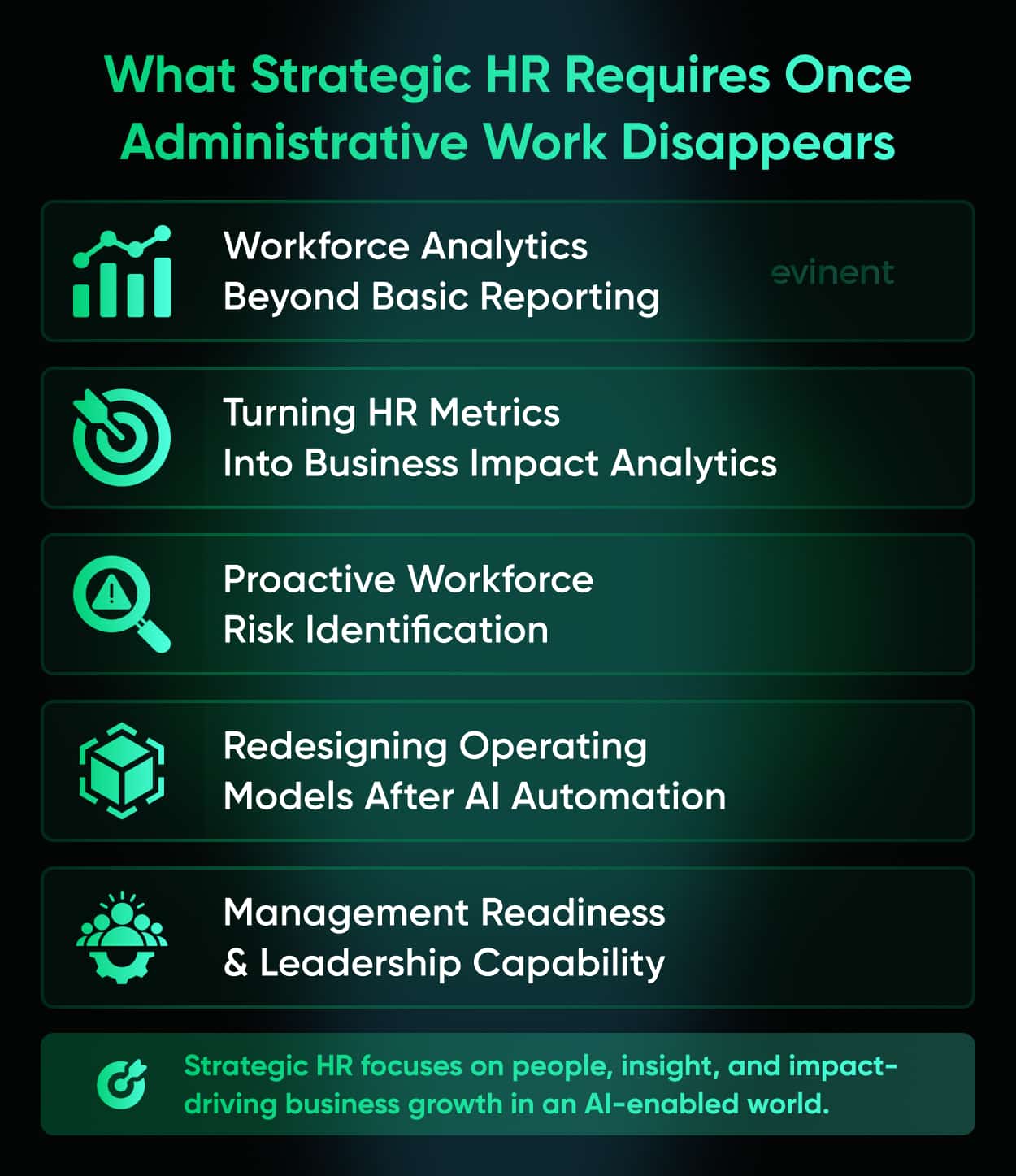
Workforce Data Interpretation Beyond Reporting
Explain the difference between generating HR reports and interpreting workforce patterns in a business context. Show how strategic HR is expected to connect attrition trends, hiring quality, performance distribution, absenteeism, and retention patterns to operational and financial outcomes.
Translating HR Metrics Into Business Risk
Bridge the gap between HR analytics and communication with executives. While most HR departments are able to make dashboards, only a few of them know how to tell a story from workforce patterns and explain their implications on delivery risk, productivity, leadership stability, customer impact, or future hiring pressure.
Proactive Talent Risk Communication
Emphasize the change of direction from reactive HR to predictive workforce management. Strategic HR is capable of pinpointing succession gaps, leadership dependency, retention exposure, and skill shortages ahead of time so that these factors do not create operational problems.
Operating Model Design After AI Changes Workflows
Point out that after AI alters the way work is carried out, it's the turn of a person to rethink jobs, hierarchies, authorizations, manager roles, and the combinations of human/AI work. Usually, in the majority of companies, this duty falls on HR.
Management Capability and Organizational Readiness
Demonstrate that strategic HR is gradually becoming more about changing management attitudes rather than only implementing HR procedures. Workflows can be carried out by AI; however, a bad manager who is not held accountable with a vague role definition cannot be compensated for it.
Don't end on a note about the mere enumeration of some points. Instead, you should show how these new practices actually come from strategic planning. If they are new, it's only because the leadership and HR frameworks have held the same concepts for a long time. Actually, one of the reasons that most HR departments didn't fully implement these strategies is that the daily, urgent operations always pushed the strategic work to the back of the line. Artificial intelligence, on the other hand, gets rid of that operational excuse and directly reveals the capability gap.
The Eight Things AI for HR Changes — and the Eight Things It Doesn’t
In most cases, conversations about AI for hr professionals unintentionally merge two very different things into one talk: operational automation and strategic transformation. This is why people end up having very high and sometimes unrealistic expectations. Some aspects of HR get changed quickly and noticeably by AI. On the contrary, some other areas hardly get affected even after a successful implementation.
This difference is important because quite a few HR Directors count on automation alone to make the function more strategic and elevate it. Typically, what ends up happening is that the manual and tedious tasks get reduced, but the major organizational issues that require more effort remain untouched, in the very same way they were before the deployment.
Area | What AI Changes in HR | What AI Doesn’t Change |
Candidate processing | AI dramatically increases screening speed, filters larger applicant pools, automates interview scheduling, identifies keyword and experience matches, and reduces manual recruiter workload. | Hiring quality still depends on human judgment. Managers can still prioritize politics, familiarity, bias, or short-term comfort over long-term fit and capability. |
Employee policy support | AI-powered chatbots for HR answer repetitive questions instantly, reduce HR inbox volume, provide 24/7 policy access, and improve response consistency across locations and teams. | Employees still escalate emotionally sensitive, ambiguous, or trust-related issues to humans. AI cannot replace credibility, empathy, or contextual judgment during difficult situations. |
Onboarding workflows | AI improves onboarding consistency, automates reminders, tracks missing documents, standardizes task completion, and reduces coordination failures between departments. | A technically complete onboarding process does not guarantee employee integration, manager support, cultural alignment, or a successful first-month experience. |
Workforce data access | AI powers up the workforce data processing by collecting it faster at a larger scale, revealing the trends earlier, spotting the anomalies, and making the HR reporting easier for the senior management. | Data visibility does not automatically create strategic influence. HR still needs the ability to interpret patterns and connect them to operational or financial business impact. |
Performance monitoring | AI can identify engagement risks, unusual productivity changes, ed reviews, or behavioral patterns across teams faster than manual review processes. | Managers still need to conduct performance conversations, resolve conflict, coach employees, and make difficult accountability decisions themselves. |
HR administrative workload | AI reduces repetitive coordination work, decreases manual follow-ups, automates scheduling and approvals, and compresses process cycle times. | Removing administrative work does not automatically create a strategic HR agenda. Many teams discover they have free capacity without a clear higher-value operating model. |
Organizational communication | AI enhances the uniformity and pace of internal communication in HR, policy dissemination, the reminder system, and the distribution of employee information. | AI cannot repair low-trust environments, leadership inconsistency, political behavior, or communication cultures that employees fundamentally distrust. |
HR leadership positioning | HR Directors get more workforce visibility, faster reporting, and more time previously spent on operations from AI. | Executive influence continues to rely on things like judgment, business acumen, credibility, and the capacity to guide decision-making rather than depending solely on automation |
The whole table shows the same pattern. AI helps in achieving higher throughput, consistency, and operational speed as well as visibility. On the other hand, the most valuable components of HR, such as judgment, influence, trust, leadership, organizational design, and difficult people decisions, remain firmly human.
Many ai for hr decision-making end up feeling like a half-done job after deployment for that reason. While the tech layer upgrades rapidly, the org layer changes at a much slower pace.
Using AI for HR Decision-Making: Where AI Helps and Where It Creates Risk
The top mistake that enterprises making use of HR AI is equating faster decisions with better ones. AI, after all, is a great tool for enhancing pattern recognition, increasing processing speeds, and expanding data visibility. However, when the use of AI extends to determining hiring, promotion, salaries, succession, or performance, then the matter of conversation changes from efficiency to accountability.
The real question that one has to be asking in practice is not if AI can be utilized for HR decisions anymore. Rather, it is to figure out in which areas AI enhances the quality of decisions and in which it poses new organizational, legal, and reputational risks.
HR Decision Type | Where AI Helps | Where AI Creates Risk |
Candidate screening | Processes large applicant pools quickly, identifies matching experience patterns, reduces manual recruiter workload, and prioritizes relevant profiles faster than manual review. | Bias amplification, weak explainability, over-reliance on keyword matching, rejection of unconventional but high-potential candidates, and regulatory exposure in hiring decisions. |
Performance ranking | Detects behavioral and productivity patterns across teams, identifies inconsistencies in evaluations, and highlights engagement or performance shifts earlier. | Oversimplified evaluations, reduction of complex performance into narrow metrics, and reinforcement of manager bias through historical data patterns. |
Attrition prediction | Identifies early retention risk factors, pinpoints turnover clusters, and detects engagement decrease before resignation becomes visibly apparent. | False positives, employee distrust, surveillance concerns, and damaged manager relationships if predictions are interpreted as certainty. |
Compensation benchmarking | Accelerates market salary comparison, identifies internal compensation inconsistencies, and improves benchmarking efficiency across locations and roles. | Weak contextual interpretation, over-standardization, inability to account for strategic talent value, market volatility, or internal political realities. |
Succession planning | They identify gaps in readiness, bring to light weaknesses in the leadership pipeline, and map the risks of concentrated capability across different departments. | Continuing to support historical leadership bias, favoring traditional career paths, and undervaluing the leadership potential of non-traditional paths. |
Learning recommendations | Making a development plan that suits a person by pinpointing the skills they lack quickly, and increasing the reach of the training programs across the large workforce. | Low-context recommendations, irrelevant training pathways, and excessive dependence on platform-generated development logic instead of managerial judgment. |
The EU AI Act Changes HR Accountability
For European organizations, the regulatory implications of AI in HR are becoming significantly more serious. Under the EU AI Act, AI-assisted recruitment and performance evaluation systems are classified as high-risk AI applications. That classification changes the accountability structure completely. Responsibility does not sit with the software vendor providing the model. It sits with the organization deploying the system and with the HR leadership overseeing how those systems influence decisions.
So, this is practically what many HR departments still quite often overlook, explainability: explainability. Making it clear and justifiable is a must for every decision that is aided by AI in HR. If a candidate were to question why they were rejected, or an employee were to argue their performance appraisal, simply saying "the AI scored them lower" would not be deemed a satisfactory reason.
HR Directors must be able to explain:
What data influenced the recommendation
How the recommendation was generated
Where human oversight existed
Why was the final decision made
That risk is far bigger than compliance. When managers put too much trust in AI advice, decision quality may suffer rather than get better. In fact, less capable managers may even give up their judgment to the machine rather than sharpening their own judgment. This is especially true in areas where things other than historical patterns really matter: hiring, performance management, and succession planning.
Strong HR functions use AI to improve preparation, visibility, and analytical depth. They do not treat AI as a replacement for judgment. AI can support decisions. Responsibility remains human.
What Daily HR Work Looks Like After AI Deployment
One of the most widely held mistaken beliefs about AI in HR is that the single use of technology is to speed up already existing HR tasks. Actually, AI even changes the whole setup of the working day itself. Usually, the operational part diminishes in the first place. Then the role demands change almost straight away.
Before AI
Monday morning in HR starts with operational backlog. Leave approvals accumulated over the weekend. Managers still have overdue performance reviews. Employees are waiting for answers to repetitive policy questions that HR has already answered multiple times before. A new hire is missing onboarding documents. Someone forgot mandatory training. Half the morning disappears into reminders, follow-ups, approvals, and coordination work.
After AI
The leave requests were already processed automatically. AI-powered chatbots for HR answered routine employee questions overnight. Missing onboarding tasks were escalated through automated workflows before HR logged in. Performance review reminders triggered automatically without manual follow-up.
The First 60–90 Days After Deployment
For many HR teams, the first months after deployment feel less like transformation and more like disorientation. The workload changes faster than the role itself. Capacity appears before the organization has decided what HR should actually do with it.
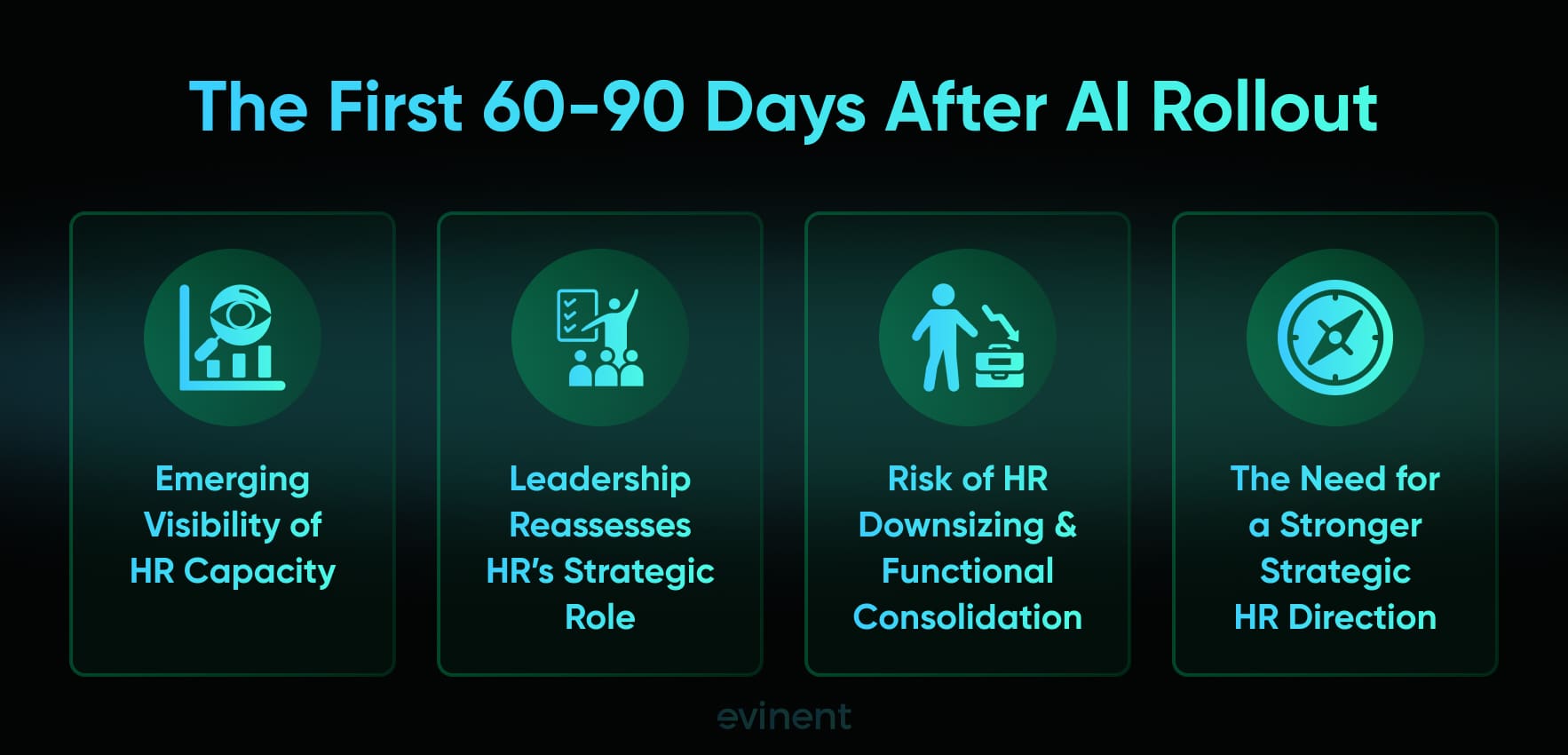
Visible HR Capacity
Admins no longer drag out their work all week long. The hidden capacity that was locked inside the continuous cycle of approvals, coordination, reminders, and employee support comes out in the open through each and every function of the organization. This newfound visibility is bound to shift the very expectations of the HR function.
Leadership Reevaluates the Scope of HR
Once the administrative layer shrinks, executives begin expecting broader contributions from HR. Conversations shift toward workforce planning, retention risk, management capability, succession exposure, and organizational performance. The expectation changes from “keep HR operations running” to “help the business make workforce decisions.”
The Risk of Downsizing or Consolidation
During this whole period of change, HR is actually at its weakest point in terms of the organization. For example, some companies see freeing up HR capacity as a chance to cut down on the number of HR people. Other companies integrate HR tasks with operations or finance. AI generally turns out to be just a tool for raising efficiency if there is no clear and well-defined strategic HR agenda in the organization.
The Need for a New Strategic Agenda
The HR teams that navigate this transition successfully usually redesign the function before automation fully removes the operational workload.
They define:
What HR should own after automation
Where the function contributes strategically
Which capabilities need to be developed internally
What leadership should expect from HR once administrative work decreases
Without that redesign, automation creates capacity faster than the organization knows how to use it.
With AI-powered chatbots, HR departments can efficiently handle repetitive FAQ queries. They not only lessen the CSR support for work effort through policy questions and administrative communications, but also through personal communications. These chatbots, however, cannot handle employee escalations, difficult conversations, manager coaching, conflict resolution, retention discussions, or working on building trust. The tasks that are still left after automation are typically those that require the highest level of judgment, emotional intelligence, organizational awareness, and credibility.
AI tackles transactional workload almost immediately. However, human capacity evolves at a much slower pace.

Is AI for HR Worth It for a 200–300 Person Company?
For HR departments in companies with 200 to 300 employees, AI mainly helps to get rid of the physical work done by people, but does not directly make HR strategic. It accelerates tasks, lessens manual labor, and releases capacity, but still, that doesn't change the function. True change is seen after the removal of automation. At this level, even minor efficiency improvements can result in a significant release of HR time. What remains is the question of what the company chooses to do with it: lower expenses, use for strategic work, or simply not use it.
Therefore, AI's contribution is not its implementation but the redesign of HR after the static work is removed.
Three possible outcomes after AI adoption
1. Cost reduction path
HR headcount is reduced
Focus stays on execution and compliance
AI is treated as an efficiency tool
Result: lower cost, same HR model
2. Capability expansion path
Freed time is redirected to the workforce strategy
HR focuses on retention risk, hiring quality, org design, and leadership gaps
AI becomes an analytical and operational multiplier
Result: Business case for AI in hr becomes a decision partner
3. Operational acceleration trap
Processes become faster
Workload decreases, but no role redesign happens
HR continues doing the same tasks at a higher speed
Result: no strategic transformation
Implementation reality in mid-market companies
1. Fragmented HR stack
HR data is split across multiple tools
HRIS, ATS, spreadsheets, and manual tracking coexist
No unified workforce data layer
AI works on incomplete or inconsistent inputs
2. Legacy HRIS limitations
Focus on administration, not intelligence
Weak cross-functional analytics
Limited support for decision-making workflows
AI becomes a “layer on top”, not a core system shift
3. ATS + spreadsheet environment
Recruiting data is often duplicated manually
Candidate evaluation is partially unstructured
Performance and hiring signals are disconnected
AI has no clean end-to-end dataset
4. SAP Business AI for HR limitations in the mid-market
SAP Business AI for hr built for enterprise-level process maturity
Requires standardized workflows and strong data discipline
Often too heavy for 200–300 employee organizations
Risk of overengineering without real transformation
5. AI integration layer approach
AI is introduced as a connective layer, not a replacement system
Integrates HRIS, ATS, and operational tools
Enables gradual data unification
Allows incremental transformation without full system rebuild
In medium-sized companies, the introduction of AI in HR is hardly a matter of choosing software only. The question is rather how the operating model is going to evolve and what, eventually, HR will turn into post-automation. In case the company is not offloading HR work after taking away the manual part, AI would simply accelerate the current system through efficiency improvements while not changing its role within the business.
When, on the contrary, HR is significantly changed to exploit the new time availability brought by AI, automation is a factor that can multiply its effects: it changes the function from one that is mostly doing the work of execution to an HR capable of making workforce decisions, organizational design, and business outcomes.
Why Most AI for HR Transformations Stall After the First Wins
Most AI in HR projects fail not because the technology doesn’t work, but because the organization doesn’t change around it. The first wave of results is usually positive: faster workflows, less manual effort, cleaner processes. But after that initial improvement, momentum slows or stops completely.
The fundamental problem is that many times automation is implemented in an HR function, where, in reality, no major structural changes are made. Artificial intelligence essentially eliminates jobs, but the operating model, responsibilities, and expectations of HR stay unchanged.
Several patterns explain why this happens:
Automation is deployed before HR is redesigned
AI is added on top of the already existing processes instead of HR rethinking how it should work without those processes.Freed capacity has no strategic destination
Once operational work disappears, there is no predefined shift toward workforce planning, organizational design, or talent strategy, so capacity either stays unused or gets absorbed by new admin tasks.Manager capability does not improve with automation
Many workforce problems are not HR execution problems but management problems. If managers remain weak in decision-making, coaching, and accountability, HR continues to compensate for them even after automation.Workforce structure is never revisited
AI changes how work is executed, but companies often fail to adjust roles, reporting lines, and responsibilities accordingly. As a result, the organization runs faster, but in the same structure.
This leads to the development of a common pattern: AI helps to reduce time spent on tasks; however, there is no big change at the organizational level. Instead of a new HR system, it is just a rapid one that works in a similar way to the old one that has been further enhanced with technology.
What HR Directors Should Do Before AI Deployment — Not After
Most AI-driven HR projects come to a halt even before the technology fails. Typically, the issue begins with organizations that opt for automation of workflows prior to making a determination on what role HR will play after automation has freed them from a significant portion of their operational tasks. HR leaders will have to clarify a few key organizational questions before the implementation of the project.
Before Deployment Question | Why It Matters |
What will HR do with freed capacity? | Prevents strategic drift |
Which HR work stays human? | Protects trust and accountability |
How will HR measure new value? | Avoids “same HR, faster” outcome |
What management gaps already exist? | AI exposes them faster |
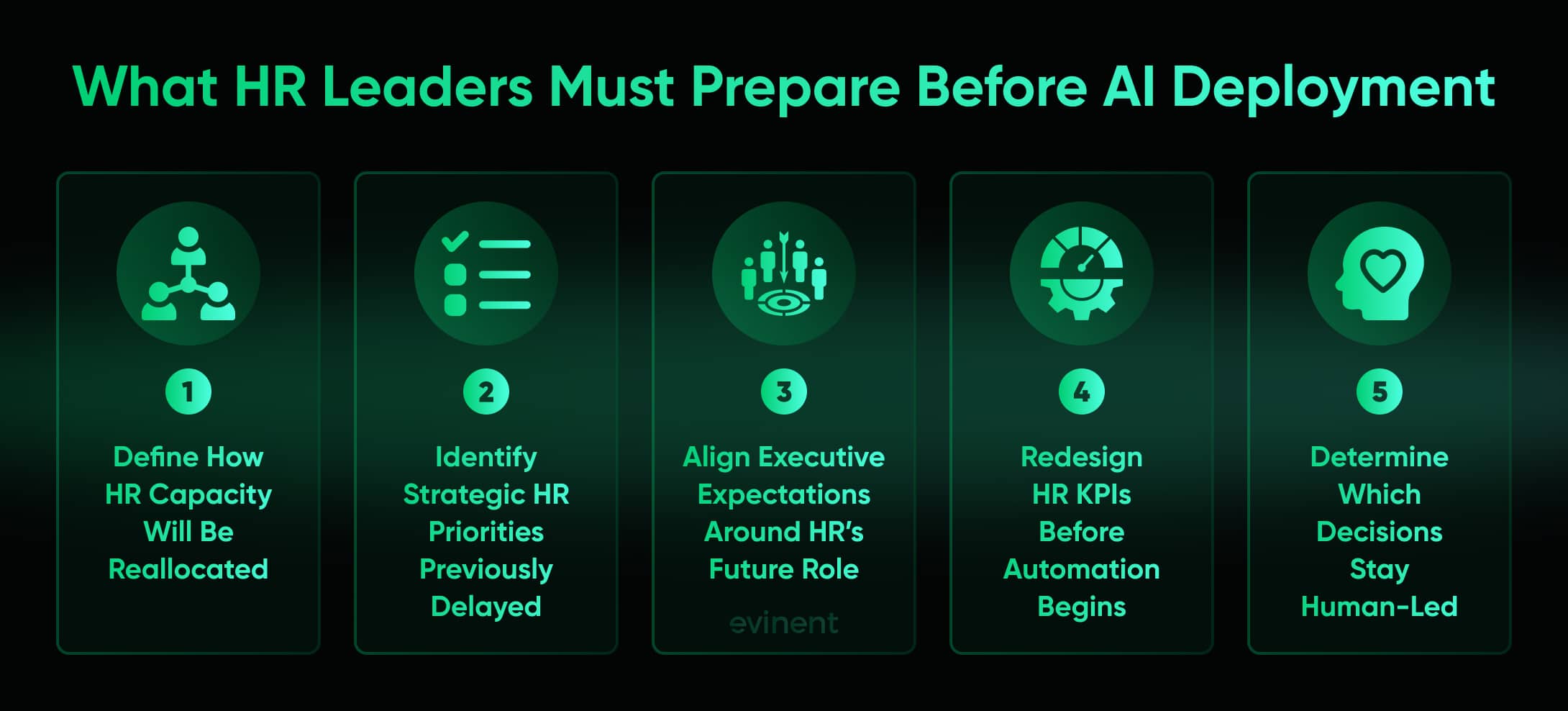
Define Where Freed Capacity Goes
AI takes away coordination work, approvals, follow-ups, reporting, and delivering the same type of support to employees time and again. However, if leaders don't figure out how to use that extra time, the department will either continue to perform operational work or be a target for cost-cutting.
Identify Strategic Work HR Never Had Time For
In many companies, strategic HR work was not absent because it lacked importance. It was pushed aside by daily execution pressure. Automation creates space for workforce planning, succession visibility, management capability assessment, retention analysis, and organizational design — but only if those priorities are intentionally defined beforehand.
Align Leadership Expectations
Executives often think that speeding up HR processes will automatically lead to strategic HR. This is not the case. Leaders must be on the same page about what different roles the department will play after less reliance on operations.
Redesign HR KPIs Before Automation
If HR continues to be measured mainly by response speed, process completion, and administrative throughput, AI will only optimize the same operational model. KPIs need to shift toward workforce stability, hiring quality, retention exposure, leadership readiness, and organizational effectiveness.
Decide Which Decisions Remain Human-Led
AI can support hiring, performance analysis, compensation benchmarking, and succession planning. But organizations still need clear boundaries around where human judgment remains accountable. Trust, credibility, and difficult people decisions cannot be delegated entirely to automated systems.
Implementing strong AI, first of all, requires that an organization prepare itself, not just install the software. Lack of redefinition of the role of HR before automation leads most companies, in fact, to merely an accelerated administrative function rather than a more strategic one.
How Evinent Helps HR Directors Navigate the Transition
Implementing AI in a human resources department is more than a technology project. The bigger problem is figuring out the new way of working of the human resources department after automation takes away most of the administrative work. Without making the change, gaps would be created between companies that will have the same operational limitations but faster workflows.
Thus, Evinent sees the implementation of AI not only through the lens of software delivery but as a systematic journey of transforming the operations of the human resources function into more scalable and strategic workforce processes.
Why Organizations Work With Evinent
Evinent brings more than 15 years of software development experience focused on complex enterprise systems, infrastructure modernization, and AI-driven automation.
The company maintains a 100% project completion rate.
Helps organizations reduce IT operational costs by up to 35% through modernization and process optimization initiatives.
This experience becomes especially important in HR transformation projects, where AI systems must operate reliably across fragmented HR environments, legacy systems, and sensitive employee data workflows.
Rather than forcing companies to replace their entire HR stack, Evinent focuses on practical integration approaches that work within existing HRIS, ATS, and internal infrastructure environments.
Relevant Experience: Private AI for Secure HR Automation
Evinent created a Private AI HR Assistant for a European company that not only automated recruitment workflows but also ensured that the client kept full control over sensitive HR data.
In this project, the team sought to enhance candidate-vacancy matching in a large hiring environment while at the same time guaranteeing that recruiting data would not be leaked outside the client's internal infrastructure. Unlike many AI HR implementations, which depend on the external LLM APIs, the solution was running entirely in an isolated enterprise environment.
The solution included two separate AI assistants:
A Recruiter Assistant for candidate filtering, matching, and shortlist generation
A Candidate Assistant who helped applicants identify relevant open positions based on skills, experience, and preferences
In an effort to cut down hallucinations and boost the reliability factor, Evinent came up with an atomic agent architecture in which individual AI modules were assigned a single, highly focused task such as search, matching, or summarization. Consequently, this made recruitment workflows more predictable, traceable, and auditable.
The system was designed specifically for enterprise HR environments where governance and compliance requirements are critical:
Isolated containerized deployment,
Role-based access control,
Encrypted internal data flows,
Customizable logic for different HR roles and departments,
Compatibility with GDPR and enterprise security standards.
Consequently, the company cut down manual screening of candidates, enhanced the relevance of the shortlists, and built a scalable base for development of AI-supported HR workflows in the future, all the while having complete internal control over recruitment data.
What Evinent Delivers
With support from Evinent, HR teams can introduce AI in a manner consistent with their daily operations, as opposed to adopting abstract transformation narratives.
This includes:
Integration with existing HR systems and databases,
Isolated and private AI deployment options,
Workflow automation for recruitment and HR operations,
AI architecture designed for governance and auditability,
Rapid pilot implementation with controlled rollout,
Scalable infrastructure that supports future workforce automation initiatives.
Our Approach
Rather than just viewing AI as a separate HR tool, Evinent views the whole scene and thinks about how automation can radically change the way HR is done. It is not only about automating the workflows that are done repeatedly, but also about helping organizations bring in AI without losing governance, decision accountability, workforce visibility, or sensitive employee data. So, it enables companies to slowly transition to AI-assisted HR functions without the need for a disruptive infrastructure overhaul or making far-fetched transformation assumptions.
FAQ
What Does AI Actually Change for HR Professionals?
AI mainly changes the operational side of HR by automating repetitive processes such as CV screening, onboarding coordination, scheduling, reporting, and employee support requests. However, the most strategic parts of HR — workforce planning, organizational design, leadership assessment, conflict resolution, and management accountability — still depend heavily on human judgment and business context.
Is AI for HR Worth It for a 200-Person Company?
Yes, but the value depends on whether the company uses automation only to reduce workload or also to expand HR’s strategic role. In mid-sized companies, AI can quickly improve efficiency and reduce administrative overhead, but long-term impact appears only when freed capacity is redirected toward workforce planning, retention strategy, hiring quality, and organizational development.
What HR Decisions Should Never Be Delegated to AI?
AI can support decision-making with analysis, pattern detection, and recommendations, but final responsibility should remain human-led in areas such as hiring, termination, promotions, compensation decisions, succession planning, and employee relations. These decisions involve ethics, trust, organizational context, and accountability that cannot be fully delegated to automated systems.
How Does the EU AI Act Affect HR AI Systems?
Recruitment, evaluation of employees, and making decisions about the workforce are considered to be high-risk uses of AI under the European AI Act. If an organization is using AI for hr, then those organizations should properly manage human oversight, explainability, and auditability, along with good governance processes. This stands for keeping the responsibility with the employer rather than transferring it solely to the software provider.
What Should HR Directors Do With the Time AI Saves?
The strongest HR teams use the additional time to step aside from administrative tasks and concentrate on understanding ai-powered chatbots for hr and workforce strategy, building leadership skills, assessing retention risk, planning succession, and improving organizational effectiveness. In fact, without a well-defined strategic plan, automation tends to increase efficiency but does not necessarily alter the role of HR in the business.
Can AI-Powered Chatbots Replace HR Teams?
Absolutely not. AI-driven HR chatbots perform excellently in automating support tasks like policy inquiries, onboarding guidance, and routine request handling. Yet, it is beyond their capabilities to hold trust-based conversations, manage conflicts, coach managers, engage in difficult employee discussions, or take on leadership roles in an organization.
Key Takeaways
AI in human resources mainly eliminates the operational workload it doesn't, by itself, make HR strategic.
Most HR functions were historically built around execution, compliance, coordination, and employee support rather than workforce strategy.
Once administrative work is automated, organizations quickly begin expecting HR to contribute to workforce planning, organizational design, leadership readiness, and business decision-making.
Strategic HR requires fundamentally different capabilities than administrative HR, including workforce analytics, risk interpretation, management assessment, and organizational planning.
AI improves speed, consistency, visibility, and process automation, but judgment, trust, leadership influence, and difficult people decisions remain human responsibilities.
Many AI for HR initiatives stall after early success because organizations automate workflows without redesigning the HR operating model around them.
Mid-market companies often face infrastructure challenges such as fragmented HR systems, legacy HRIS environments, and disconnected workforce data.
Successful AI implementation in HR usually depends more on organizational preparation than on the technology itself.
HR Directors need to define in advance how freed capacity will be used, which decisions remain human-led, and how HR success will be measured after automation.
Strong adoption of AI can really change HR a lot, turning it from a function that just does execution-heavy support into one that is more analytical and involved with strategy as a business capability, but this will only happen if the organization deliberately redesigns the function after automation starts.
Share