

What is A/B testing… and why do stores that use it grow faster while everyone else keeps guessing?
Well, the answer is because A/B testing is the only way to know — not guess — what makes customers buy.
You already have traffic. You’re running ads that cost more than your competitors’ entire marketing budgets. And yet your revenue curve is still flatter than your Monday coffee.
The truth? Most online stores don’t have a traffic problem; they have a conversion blindness problem. They keep redesigning, rewriting, and “trusting their gut,” while the smart ones are quietly test every pixel, headline, and checkout step, and cashing in.
And the data backs it up:
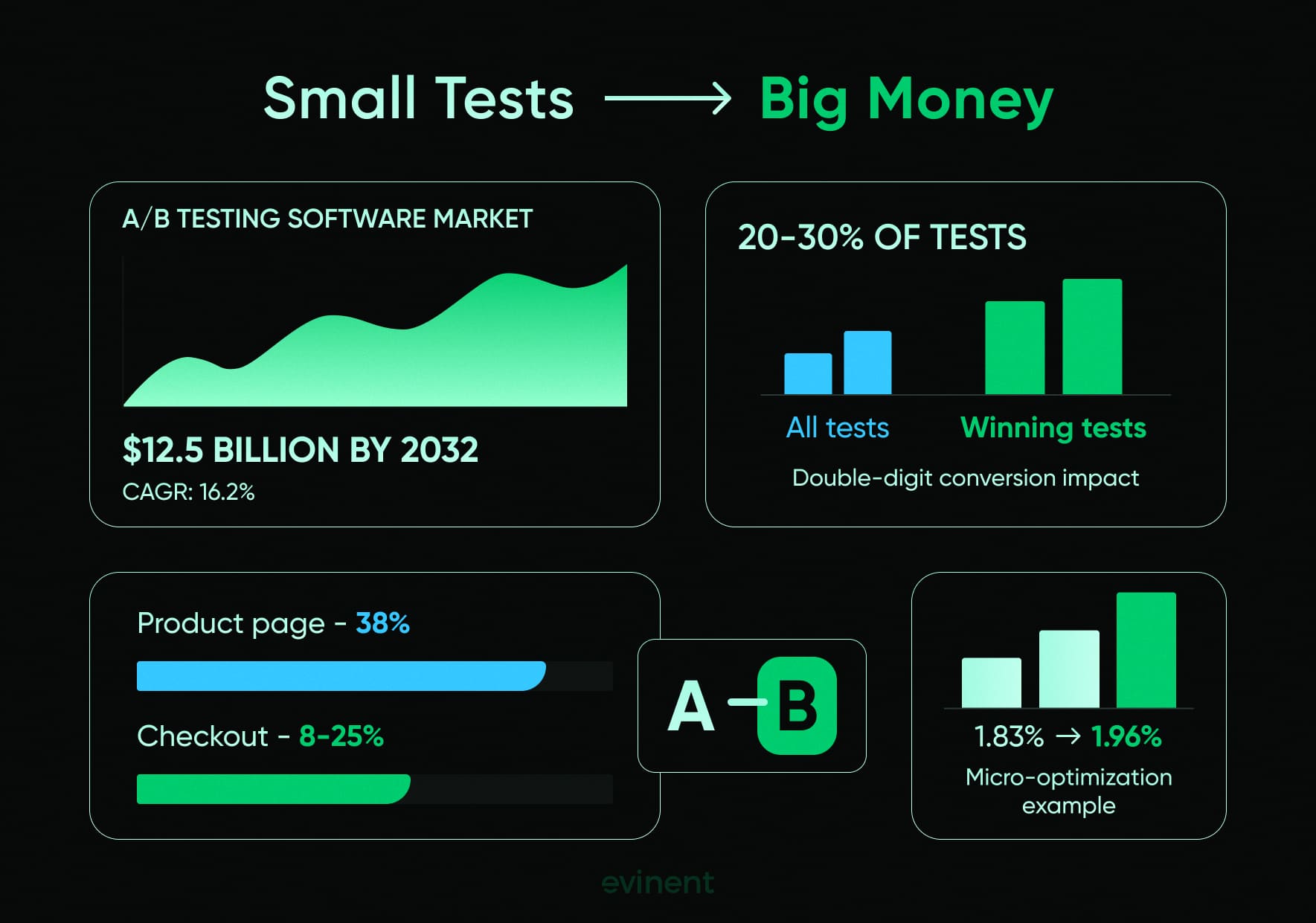
The A/B testing software market is expected to reach $12.5 billion by the end of 2032 and grow at a CAGR of 16.2% over the forecast period (Market Research Future, 2025).
Only 20–30% of tests actually “win,” meaning they produce measurable conversion lifts, but those that do can raise conversion by double digits when executed with proper sample sizes and statistical rigor.
Product Detail Page (PDP) tests account for 38% of all experiments and can drive 12–28% conversion growth. Checkout-flow optimisations deliver +8–25% improvements in completion rates.
Even micro-optimisations matter: one retailer doubled total purchase quantity just by redesigning its mini-cart and nudging its conversion rate from 1.83% to 1.96% (VWO A/B Testing Examples, 2024).
In other words, the smallest A/B test can shift millions in annual revenue, if you know what you’re doing.
Meanwhile, brands that don’t test are essentially gambling. They make design and UX decisions based on opinion, not evidence. They believe “the team liked it in Figma” is a metric. If you’re not testing, you’re bleeding money. If you’re testing without statistical discipline, you’re wasting it.
“Successful companies often run the most experiments, and staying competitive means adopting a culture that measures, tests, and learns on repeat.” (Statsig, The Rise of Experimentation, 2024)
The next sections show how systematic, data-driven experimentation — when integrated into your eCommerce operations — can transform that flat revenue graph into a compounding growth curve.
What is eCommerce A/B Testing?
Let’s kill the misconception right away:
A/B testing isn’t about changing button colors — it’s about proving whether your team’s ideas actually make money.
At its core, A/B testing (also called split testing) is the digital version of the scientific method for commerce. You show one group of visitors Version A of a page (the current experience) and another group Version B (the new idea). You measure which one drives the metric that matters — conversions, average order value, revenue per visitor, or retention.
If Version B wins with statistical significance (typically p ; 0.05), it stays. If it doesn’t, it dies.
No politics. No opinions. Just data.
Why It Matters for Modern eCommerce
In 2025, A/B testing is no longer optional; it’s the backbone of scalable growth. The eCommerce A/B testing software market alone is set to surge from $12.5 billion by the end of 2032 and grow at a CAGR of 16.2%, proving that experimentation has become a non-negotiable line item in every serious brand’s tech stack (Market Research Future, 2025).
Why? Because it works.
Tests that succeed — roughly 20–30% of all experiments — deliver conversion lifts from 10% to 28% on average when run with proper sample sizes and statistical rigor (VWO Benchmarks 2024).
The brands that treat A/B testing as a continuous discipline, not a quarterly hobby, are the ones seeing the hockey-stick graphs.
The Business Meaning Behind the Acronym
For executives, A/B testing is less about UX tweaks and more about decision economics, using real-world data to answer million-dollar questions before committing budget or development time.
It allows you to:
Quantify impact before full rollout — know the ROI of a feature before it hits 100% of users.
De-risk innovation — replace “gut feeling” with hard evidence.
Unify teams — give marketing, product, and data one source of truth: the customer’s actual behavior.
Compound growth — small wins (1–2% uplifts) accumulate into double-digit revenue gains over time.
According to Adobe Digital Trends 2024, organisations that bake experimentation into their culture grow revenue at more than twice the rate of those that rely on intuition.
That’s why experimentation has become the secret weapon of the world’s fastest-growing brands, not just for optimizing conversion rates, but for building a culture where no idea is sacred until it’s proven by the data.
In short: A/B testing turns “I think” into “I know.” And in 2025’s brutally competitive eCommerce environment, that difference is existential.

Why A/B Testing Matters for Business Performance?
Let’s be brutally honest: you don’t have a growth problem — you have a guessing problem.
Most brands are still throwing redesigns, promos, and new checkout flows at the wall and hoping something sticks. The winners, meanwhile, are testing every single assumption — from headline length to payment sequence — and letting data, not ego, call the shots.
And that’s exactly why they’re pulling ahead.
The ROI Reality Check
In the 2025 State of Optimization survey by VWO, 67% of digital teams reported that at least one in three of their tests led to measurable business impact — typically a 10–20% uplift in conversion or revenue metrics when statistical validity was met.
That’s not marginal. That’s the difference between breaking even and breaking records.
Metric / Claim | 2025-ready benchmark | Primary source (year) |
|---|---|---|
Average checkout completion rate | ~45–47% (Shopify stores: avg 45%; cross-industry articles often cite ~47%) | Littledata Shopify Checkout Benchmarks (accessed 2025) — avg 45%, top 20% >59%, top 10% >66%; Persado article citing 47% and 62.6% top-20% (2023). (Persado) |
Top performers | >60% completion; top 10% ~66% | Littledata Shopify Benchmarks (accessed 2025). (Blue Gift Digital Hub) |
Cart abandonment (context) | ~70% of carts are abandoned | Baymard cart abandonment meta-average (2025 update). (Baymard Institute) |
Speed impact on conversion | Highest e-commerce CVR at 1–2s load; conversion falls as load time rises (e.g., 1s ≈3.05% CVR → 4s ≈0.67%) | Portent research update (2022). (Portent) |
“2 seconds or less” goal | Industry consensus and Google guidance pieces consistently point to ≤2s as a good target | Prerender summary of Portent (2023) and Think with Google guidance. (Prerender) |
Preferred payment availability | 70% of consumers say availability of their preferred method is “very/extremely” influential; brand sites see ~20% more abandons than retailers due to weaker payment option fit | PYMNTS + Adobe report (Feb 2024). |
Progress indicators | Recommended by multiple checkout best-practice studies; common pitfall when absent | Baymard Checkout UX 2024 (large-scale qualitative). (Baymard Institute) |
Real-time / inline validation | Inline validation reduced errors by 22% and completion time by 42% in controlled tests (foundational finding still referenced in 2023–2025 CRO literature) | CXL (compendium of Luke Wroblewski study) 2016/2023 roundups; Baymard 2023–2024 error-messaging research. (CXL) |
Mobile urgency | Mobile shoppers are less tolerant of slow load; fast (≤2–3s) pages correlate with materially higher checkout completion | Portent speed study synthesis; Think with Google. (Portent) |
Executives don’t need more dashboards — they need clarity on what works.
A/B testing delivers that clarity in cold, quantifiable form.
From Gut Feeling to Measurable Growth
A/B testing isn’t a marketing gimmick; it’s the operational spine of modern commerce.
Netflix, Amazon, and Booking.com don’t push a pixel without testing it — and that’s not superstition, it’s economics.
Booking.com runs more than 25,000 experiments per year, and its continuous testing culture is directly credited for sustained double-digit revenue growth (Statsig 2024).
Amazon famously generates hundreds of parallel experiments daily, using micro-tests to compound small UX wins into billions of dollars of additional revenue (Amazon Science, 2022).
Each experiment might move the needle by 0.3%. Multiply that by thousands, and you’re not “optimising” anymore — you’re engineering exponential growth.
Lower Risk, Faster Innovation
Big launches without tests are just expensive guesses. High-velocity teams de-risk change by shipping to validate: they put a controlled variant in front of real users, watch the scoreboard, and scale only what works.
Optimizely’s 2025 “Test + Learn” recap makes the case crystal clear: experiment programs are accelerating fast — experiments up 55% vs two years prior and ~900 billion test impressions on Optimizely’s platform last year. The message from operators (Virgin Media O2, ClassPass, Chase UK) is the same: stop shipping to “release” and start shipping to “validate.” Or, as Elena Verna puts it:
“It’s not about making the right decision. It’s about making the fastest decision — and the test will tell you if it’s the right one.” (Optimizely, Test + Learn 2025)
Why this lowers risk (and raises returns):
Fail small, learn fast. Defensive, reactive testing keeps you treading water; offensive experimentation hunts for net-new revenue by finding what top cohorts do differently — then scaling those patterns.
Decisions at sprint speed. Teams that “ship to validate” skip endless design debates; the control/variant decides. When the variant underperforms, routing reverts automatically — no brand damage or protracted rollbacks.
From vanity to value. Leaders highlighted a shift from CTR to down-funnel profit signals (orders, returns, in-store behavior, delivery cost impact). If it doesn’t move revenue, it doesn’t ship.
Playbook to copy this quarter:
Codify “ship to validate.” Make experimentation the default path for launches; no test, no rollout.
Balance the portfolio. Don’t spend 90% of cycles on “defensive” fixes; reserve capacity for offensive tests that unlock new revenue.
Instrument business impact. Tie experiments to warehouse-native metrics (AOV, margin, returns, downstream sales), not just clicks.
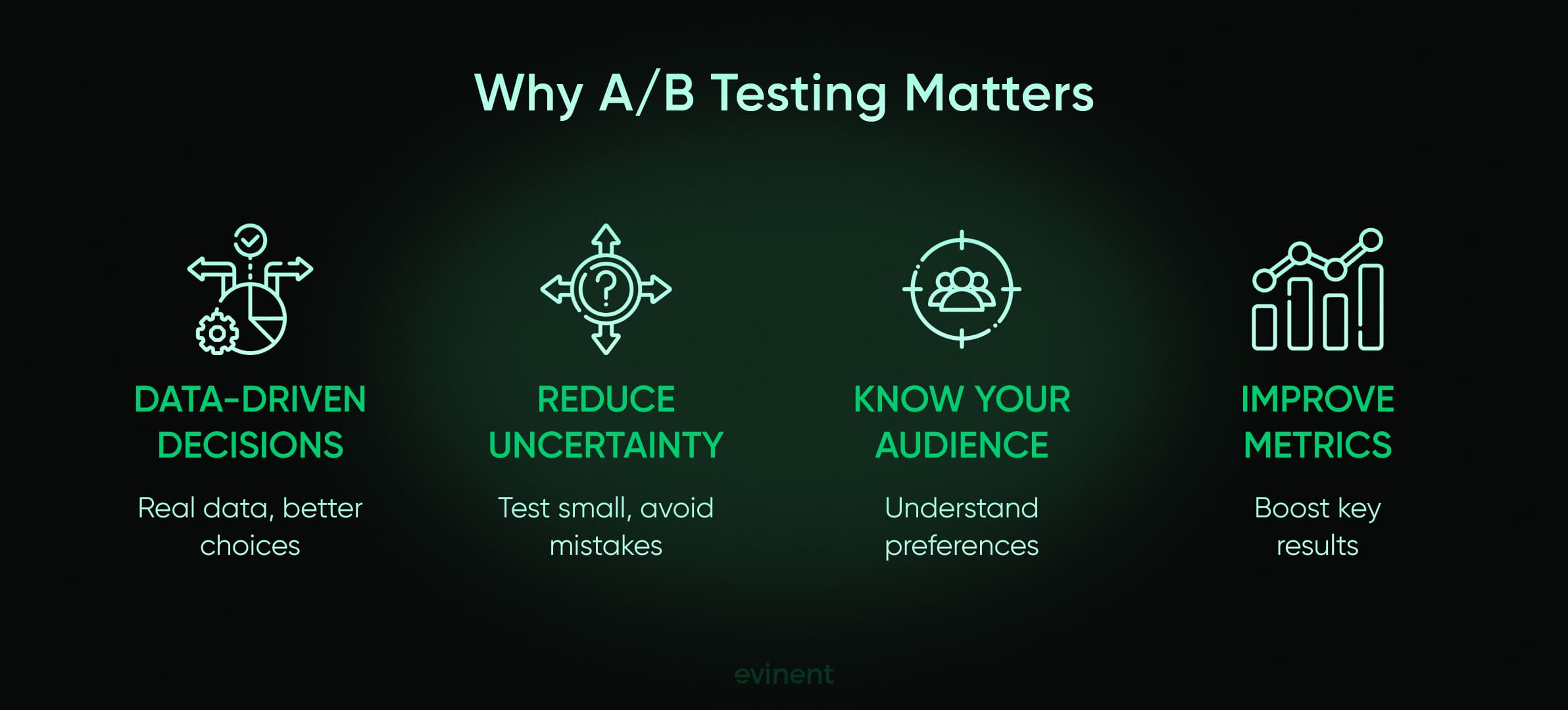
Aligning Teams Around the Truth
A/B testing isn’t just a methodology; it’s an organizational equalizer.
When every department looks at the same experiment dashboard, politics vanish and alignment appears.
Marketing cares about message clarity. Product obsesses over usability. Finance tracks margins. Testing ties them all to a single, non-negotiable truth: what actually works.
The 2024 Experimentation Maturity Index by Statsig found that cross-functional experimentation squads delivered 2.1× faster test execution and 38% more experiment throughput than siloed teams (Statsig, 2024).
Why it works:
Unified metrics. One version of the truth across marketing, product, and revenue.
Faster iteration. No need for executive debates — the data decides.
Psychological safety. When failure equals learning, teams test bolder ideas without fear.
Modern organizations like ClassPass and Chase UK have re-engineered their analytics pipelines around this principle. Both now track down-funnel metrics — post-purchase behavior, retention, and revenue impact — instead of shallow vanity KPIs (Optimizely 2025).
In other words, experimentation isn’t just about optimizing buttons; it’s about creating shared accountability across every department that touches the customer.
C-Suite Takeaway
Let’s call it straight: A/B testing is no longer a CRO tactic — it’s executive infrastructure.
The C-suite that treats experimentation as a “marketing toy” will keep budgeting for campaigns that never scale.
The one that embeds testing as a continuous discipline will double revenue predictability.
“Without clearly defined processes, marketers run the risk of testing just for the sake of testing, which leads to discrepancies in methodology, lack of purpose, ambiguous results, and wasted resources.” — Reed Pankratz, Sr. Strategic Consultant, Oracle Marketing Consulting (Oracle Modern Marketing Blog, Jan 1, 2023)
Here’s what separates modern leaders from laggards:
Leadership Mindset | Result |
|---|---|
Guess and hope. Decisions driven by opinion or politics. | Stalled growth, inconsistent KPIs. |
Test and learn. Every initiative validated before scaling. | Compounded ROI and predictable growth. |
Brands like Virgin Media O2, Yelp, and ClassPass prove that an experimentation culture doesn’t just boost conversion rates — it reduces failure costs, compresses product cycles, and turns data into a competitive moat.
So, if growth feels random, it’s not the market — it’s your mindset.
Switch from launching ideas to testing hypotheses, and you’ll never guess your way to a loss again.
How A/B Testing Works? Step by Step
If A/B testing were a sport, most teams would still be stretching while the pros are already scoring points. Running an experiment isn’t “launching variant B and hoping for the best.” It’s a controlled process designed to isolate cause and effect, to turn opinions into evidence.
Here’s how modern eCommerce leaders actually do it.
Step 1: Define the Business Problem, Not the Button Color
The test starts before the variant exists. The question isn’t “Should we try a red button?” — it’s “Why is checkout abandonment 18 % higher on mobile?”
Top experimentation programs begin by framing a business-level hypothesis linked to measurable KPIs: conversion rate, AOV, retention, or cost per acquisition.
“A/B testing is only powerful if you do it right and avoid the many pitfalls that can undermine your testing,” warns Chad S. White, Head of Research at Oracle Digital Experience Agency. “Without clearly defined processes, marketers run the risk of testing just for the sake of testing.” (Oracle Modern Marketing Blog, 2023)
In practice, that means:
Identify the pain point through analytics or user feedback.
Form a testable hypothesis that explains why changing X could influence Y.
Specify what success looks like, and what action you’ll take if it wins.
If your hypothesis can’t be tied to revenue or a core performance metric, it’s not worth running.
Step 2: Prioritize the Right Variable
The cardinal sin of testing? Changing too much at once.
Oracle’s research calls this “the everything test”: a sure way to burn time and miss causal truth. Each A/B test should focus on one variable: headline, hero image, layout, offer, or flow.
If you want to test several at once, you’re entering multivariate territory, and that requires serious traffic. A 4-variable test produces 24 possible combinations (4!), demanding a massive sample to stay statistically valid, something only the Amazons and Netflixes of the world can pull off.
For everyone else, discipline wins. Start small, isolate your variable, and earn your insights one lift at a time.
Step 3: Build Variants That Truly Compete
The best A/B tests pit a strong control against a meaningfully different challenger.
If Version B looks like Version A with new button copy, don’t expect fireworks.
Modern testers design for contrast, not cosmetics. Examples:
Control: static product grid. Variant: grid + AI-powered “Top Picks for You.”
Control: 4-step checkout. Variant: single-page express checkout.
Control: hero image only. Variant: lifestyle video with embedded CTA.
According to VWO’s 2024 Benchmarks, experiments with a “high-contrast” variant are 2.3 × more likely to achieve statistical significance and yield conversion lifts of 10–28 %. (VWO Benchmarks 2024)
Step 4: Segment and Split Traffic Intelligently
True A/B testing means equal footing: same audiences, same timing, same conditions — the only difference should be the variable under test.
Randomize traffic: 50/50 split (or 10/10/80 for progressive rollout).
Maintain audience parity: demographics, devices, geos, referrers.
Set duration by data, not calendar: run until statistical significance is reached, not until Friday.
Most digital teams target a 95 % confidence level (p ; 0.05). Tools like Optimizely, Statsig, and VWO calculate this automatically, but executives should know what it means:
your “winner” has less than a 5 % chance of being a fluke.
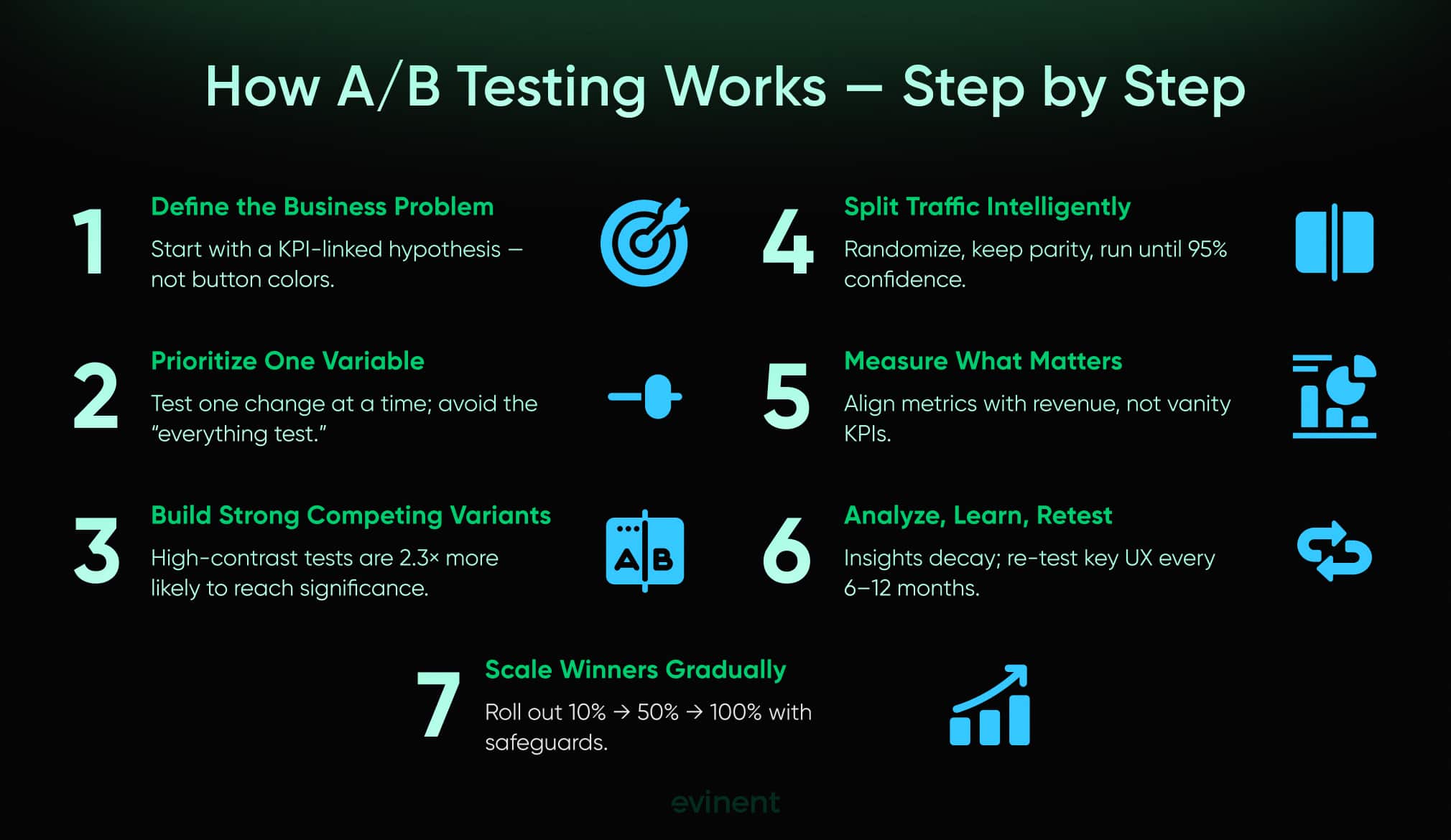
Step 5: Measure What Actually Matters
The goal isn’t to make metrics go up, but to make the right metrics go up.
Per Oracle’s 2023 guidance, victory metrics must align with business outcomes, not vanity numbers like open rate or raw clicks. If your campaign’s purpose is sales, conversions and revenue per visitor are the north stars; if it’s retention, track repurchase rate or LTV. (Oracle Modern Marketing Blog, 2023)
Layer secondary metrics for context:
Positive indicators: conversion %, AOV, engagement time.
Negative indicators: bounce, unsubscribe, complaint rate.
A/B testing done right solves for the whole funnel, not a single micro-win.
Step 6: Analyze, Learn, and Re-Test
A conclusive result is not the end of the story; it’s the start of iteration.
Every winning variation decays over time as user behavior, device mix, and expectations shift.
As Oracle strategist Antipa reminds marketers,
“Your database changes over time, so A/B testing should be part of an ongoing process with multiple cycles to truly learn about what works.” (Oracle Modern Marketing Blog, 2023)
Winning teams maintain:
A testing log documenting hypothesis, control, result, and next step.
A shared knowledge base so insights compound rather than disappear in slide decks.
A calendarized retest schedule (every 6–12 months for key pages).
Booking.com re-tests every significant UX element at least twice a year, because what wins today can quietly lose tomorrow.
Step 7: Scale the Winners Safely
When a variant proves its worth, the instinct is to roll it out fast. Resist the temptation.
Use a staged rollout:
Deploy to 10 % of traffic.
Monitor for anomalies (latency, regressions, seasonality).
Scale gradually to 100 %.
This “progressive validation” model protects revenue while letting you collect post-launch analytics.
It’s also the only way to maintain experimental integrity when operating at enterprise scale.
Step 8: Institutionalize Experimentation
The ultimate goal is to build an organization that experiments by reflex.
That means:
Every campaign or feature starts with a test plan.
Every win or loss becomes a reusable lesson.
Every team knows the KPIs that define success.
As Statsig puts it, the most advanced digital teams “embrace experimentation as the backbone of innovation,” running thousands of micro-tests annually to guide strategy (Statsig, The Rise of Experimentation, 2024).
When experimentation becomes habit, intuition finally earns data’s respect — and your growth graph stops looking like a guessing game.
Executive Takeaway
A/B testing is not a checkbox in your analytics suite. It’s a disciplined cycle:
hypothesize → test → learn → iterate → repeat
Do it once, and you’ll find answers. Do it continuously, and you’ll build a company that learns faster than it spends.
Core Elements You Can Test on an eCommerce Site
Not all tests are created equal. Changing a headline isn’t the same as optimizing an entire checkout flow. Some experiments nudge curiosity; others move millions.
Below is what the world’s top-performing eCommerce brands are testing in 2025 — and why each one pays off.
Product Detail Pages (PDPs): Your Revenue Engine Room
The product detail page is the battleground where interest becomes purchase intent.
According to the BrillMark 2025 Report, 38% of all A/B tests occur on PDPs — and they’re also where the highest conversion lifts happen: +12–28% on average when changes reach statistical significance (BrillMark 2025).
Call-to-Action (CTA) Design & Copy
A/B testing CTAs continues to deliver the strongest, most repeatable ROI in 2025.
According to Amra & Elma’s 2025 CTA Statistics, CTA A/B testing improves overall performance by an average of 28%, driven by button color, text, placement, and timing.
Sender.net’s 2025 CTA study reports that changing the button color alone can boost conversions by 21%, and high-contrast CTAs can increase visibility by 50%.
A CXL conversion study ed that a red CTA button outperformed a green one by 21%, underscoring how contrast and clarity influence attention.
Multi-variant CTA tests (text + style) can triple click-through rates, with best performers achieving ~10% CTRs versus ; 1% for weaker designs (Amra & Elma, 2025).
AI-assisted testing is compressing experiment cycles from weeks to hours and, when properly automated, has shown conversion lifts up to 4× in enterprise environments (Optimizely Test + Learn 2025).
Sticky CTAs
Keeping “Add to Cart” visible while scrolling can reduce friction for mobile users. Shopify UX case studies show 8–15% increases in mobile conversion when sticky CTAs are implemented (Shopify UX Blog, 2024).
Product Images & Media
Lifestyle photos consistently outperform plain product shots, with eye-tracking studies showing 40% longer gaze duration and higher emotional engagement (Nielsen Norman Group, 2024). For complex SKUs, 3-D spin views can lift engagement by ~20% (Shopify Plus Research, 2023).
Value Proposition Hierarchy
Testing the order of benefits, specs, and reviews can significantly affect scroll depth and add-to-cart rates. Brands that led with social proof first rather than features saw 11–14% higher conversions (HubSpot CRO Benchmark, 2024).
Review Visibility
Displaying ratings above the fold improves buyer trust. The Baymard Institute’s 2024 UX Research found that clear, top-of-page star ratings can lift conversion by up to 18% when accompanied by verified reviews.
Summary Insight: Disciplined, statistically valid A/B testing — ideally 95%+ confidence — remains one of the fastest, safest levers for improving conversion efficiency in 2025. Every CTA, image, or micro-layout test isn’t a cosmetic tweak — it’s a data-driven negotiation between curiosity and purchase intent.
Cart and Checkout: Where Optimism Dies or Converts
The checkout page is where most dreams of conversion quietly die.
According to Baymard Institute’s 2025 Cart & Checkout Usability Benchmark, the average global cart-abandonment rate sits at 70.19% — meaning seven of every ten ready-to-buy users never complete the transaction.
Baymard’s 14-year longitudinal research (4,400+ moderated user tests across 325 eCommerce sites) shows that checkout design flaws are one of the single biggest causes of abandonment — not price, not shipping, but friction, confusion, and broken expectations.
“The average large-scale e-commerce site has 32 unique improvements to perform in its checkout flow to gain a 35 % increase in conversion rate.” — Baymard Institute, 2025 Cart & Checkout UX Research
That 35 % lift is not hypothetical. It’s the documented potential of removing unnecessary barriers in form fields, payment options, and flow logic.
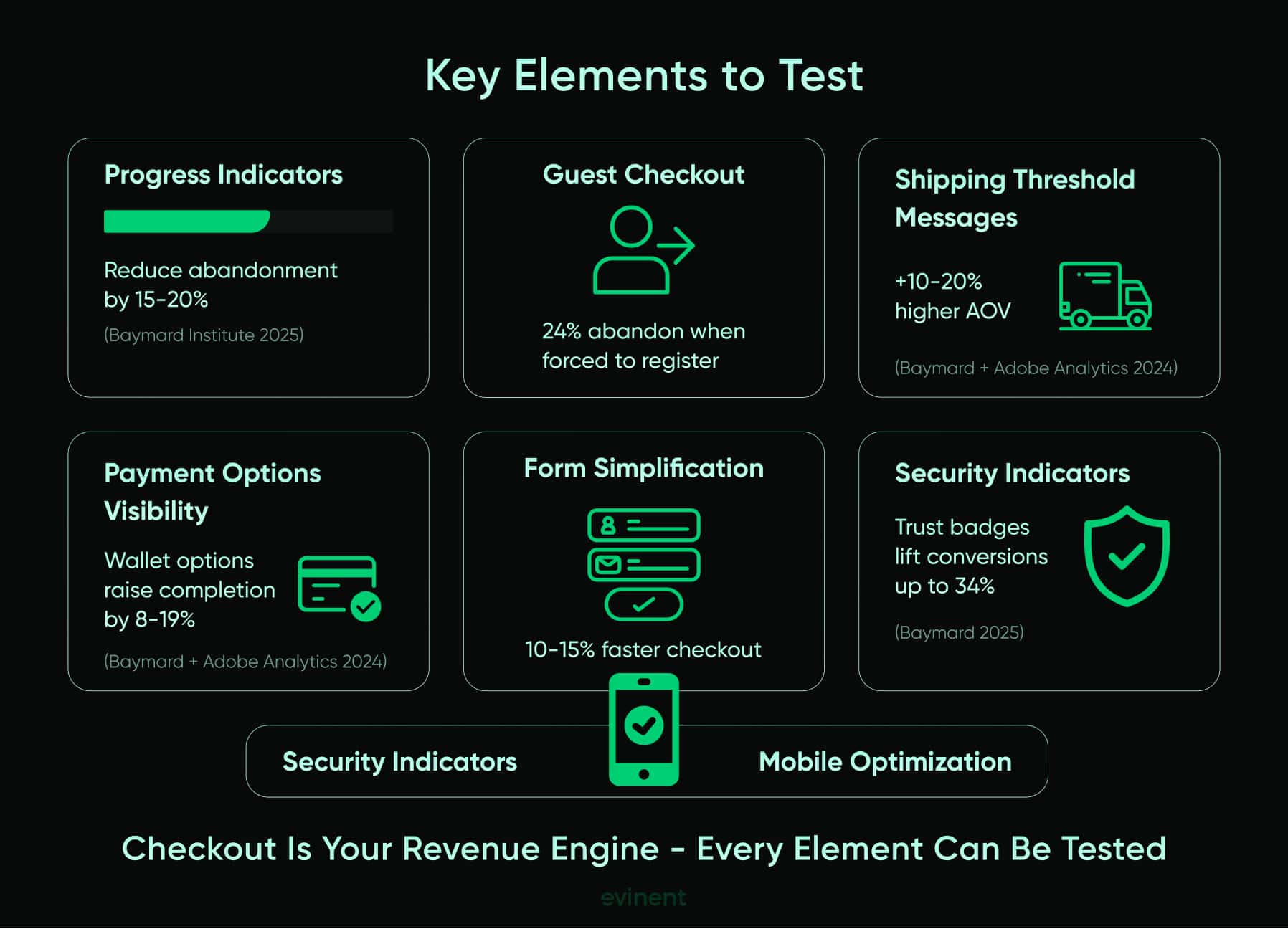
Key Elements to Test
1. Progress Indicators and Step Visibility
Baymard’s qualitative testing s that multi-step progress trackers (e.g., “Step 2 of 3 – Payment Details”) significantly reduce user anxiety and can decrease abandonment by 15–20%, particularly for first-time buyers.
Test single-page checkout vs. guided multi-step flow with visual progress.
2. Guest Checkout vs. Forced Account Creation
Roughly 24% of abandonments occur because customers are asked to create an account too early. Allowing a guest checkout option or deferring registration until after payment consistently boosts conversion rates.
Test when and how you request account creation.
3. Shipping Threshold Messaging
Dynamic “Free Shipping over $50” or “Spend $12 more for free delivery” banners have been shown in usability sessions to motivate completion and upsell, driving 10–20% higher order values.
Experiment with copy and placement: cart, checkout header, or mini-cart.
4. Payment Method Diversity and Visibility
Offering at least one digital-wallet option (Apple Pay, PayPal, Google Pay) improves checkout completion by 8–19%, according to aggregated Baymard and Adobe Analytics 2024 data.
Test placement and default visibility of wallet options vs. credit-card first.
5. Form Simplification and Validation
Baymard found that 65% of top U.S. and EU retailers have “mediocre” or worse checkout UX performance, often due to excessive fields and unclear validation. Reducing form fields from nine to five, using smart defaults, and enabling auto-complete can produce 10–15% faster completion rates.
Test shorter vs. longer address forms and auto-fill integrations.
6. Trust & Security Indicators
Users still look for proof their payment data is safe. Placing recognizable security badges (“Verified by Visa,” SSL lock icon, Norton Seal) above the payment section can raise trust metrics and conversions by up to 34% (Baymard, 2025).
Test placement and copy tone — “Secure checkout” vs. “Encrypted payment.”
7. Mobile Optimization
Over 60% of transactions now start on mobile (Statista Mobile Commerce Forecast 2024). Baymard reports that tap-target mis-sizing, keyboard overlap, and hidden CTAs are top 3 mobile blockers. Fixing them can yield a 20% median mobile conversion improvement.
Run device-specific A/B tests: sticky CTA vs. bottom sheet; auto-advance fields vs. manual.
Executive Insight
Checkout optimization is a continuous surgery on the heart of your revenue engine.
Baymard’s 200,000+ hours of UX testing prove that even world-class retailers leave 30–35% of potential conversions untapped simply because their checkout flows still make users think too hard.
If your abandonment rate is around 70%, you’re not broken, you’re normal.
But in 2025, normal means leaving money on the table.
Navigation and Site Search: The Conversion GPS
If customers can’t find it, they can’t buy it.
According to Algolia’s 2024 eCommerce Search Report, up to 30 % of online shoppers use internal site search, and these users are 2–3 × more likely to convert than those who browse through menus alone. Meanwhile, Luigi’s Box 2025 research shows that optimized site search can account for as much as 39 % of total eCommerce revenue, proving that search is a profit engine.
Despite this, most brands still treat on-site search as an afterthought — leaving high-intent users stranded in “no-results” dead ends.
Homepage & Landing Pages: The First 5 Seconds Rule
Visitors decide whether to stay or bounce in less than 5 seconds (Nielsen Norman Group, 2024). A/B testing here focuses on message clarity, trust, and perceived relevance.
Test ideas:
Headline framing: Problem-solution vs. value-first language.
Hero media: Static image vs. autoplay muted video, 11% CTR lift on average (VWO, 2024).
Social proof placement: Trust badges or reviews in hero section vs. footer.
Personalized banners: Returning-visitor dynamic headlines (“Welcome back John”) increased session duration +22%.
Seasonal vs. evergreen CTAs: “Shop the Summer Collection” vs. “Discover New Arrivals.”
If clarity wins, conversion follows. Confusion has a bounce rate.
Email & On-Site Messaging: Micro-Conversions That Multiply
Testing doesn’t end at the website. Your emails, pop-ups, and banners are the frontlines of engagement.
Oracle’s Modern Marketing Blog reminds marketers that the biggest pitfall is “testing for the sake of testing.” True impact comes from clear hypotheses and purpose-driven variants (Oracle 2023).
What to test:
Subject lines & preview text: Tone, personalization, urgency.
CTA placement: Button vs. text link.
Offer type: % off vs. $ off.
Pop-up timing: Entry vs. exit intent.
Content format: Video vs. static banner.
Average lift across top quartile programs: +10%–25% open rate and +8%–18% click-through rate (Oracle Benchmark, 2023).
Product Recommendations & Cross-Selling
AI-powered recommendation testing is the quiet powerhouse of 2025. In eCommerce, personalization isn’t a luxury.
Evinent Analytics found that implementing predictive recommendation blocks based on purchase history increased average order value by 9%–14% within 90 days.
Test variants like:
“Frequently Bought Together” vs. “You May Also Like.”
Personalized cross-sell based on category vs. behavior.
Recommendation carousel position: mid-page vs. checkout sidebar.
Dynamic discounts triggered by cart contents.
Pricing, Promotions & Urgency Mechanics
Testing psychological triggers pays off — when done ethically.
High-ROI experiments include:
Countdown timers: +14% conversion lift (Baymard 2024).
Tiered discount messaging: “Buy 2 Get 15% Off” vs. “Save 15% When You Add One More.”
Free gift thresholds: Offering small bonuses above a spend limit raised AOV +11%.
Subscription vs. one-time toggle: Changing default selection from one-time to subscribe lifted reorders +19%.
Harvard Business Review’s 2024 report s that companies using price and offer experimentation in their CRO loop see 4–5× faster learning cycles than those that rely on annual pricing reviews.
Mobile UX: Where Half Your Revenue Lives (or Dies)
By 2028, two-thirds of all eCommerce purchases will happen on mobile (Statista Mobile Commerce Forecast, 2024). Mobile testing is now table stakes for survival.
High-value mobile tests:
Sticky CTAs vs. floating buttons.
Keyboard auto-advance on checkout forms.
Tap-target size and spacing.
Mobile menu labeling: “Shop Now” vs. hamburger icon.
Load time optimizations: Under 2 seconds or lose half your traffic.
Even a one-second drops mobile checkout conversion by 7%. Cut load time in half and watch cart completion climb up to 60% territory.
Post-Purchase and Retention Experiments
Testing doesn’t stop at “Thank You.” Retention A/B tests determine whether a customer comes back or forgets you exist.
Test ideas:
Follow-up email timing: Immediate vs. 48-hour .
Review requests: Plain-text vs. HTML template.
Loyalty tier messaging: Visual badges vs. discount codes.
Reactivation offers: 10% off vs. free shipping.
According to Shopify Retention Benchmarks 2024, brands running continuous post-purchase tests see higher repeat-purchase rates than those that don’t.
Executive Takeaway
A/B testing isn’t limited to buttons and banners, but the scientific method for commerce itself. Each test you run is a mini board meeting with your customers, and the data is their vote.
So test where it hurts most: PDPs, checkout, search, and mobile, because that’s where it pays most. Every 1% conversion lift isn’t a number; it’s a margin, a payroll, a future product launch.
The Data Science Behind A/B Testing
Experimentation is a rigorous scientific method layered over commerce. When done correctly, it transforms your website into a lab where hypotheses get tested and truths get scaled. However, it’s only effective if your methodology is bullet-proof, your stats engine trustworthy, and your interpretation disciplined.
Why Rigour Matters?
Many tests fail, not because the idea was bad, but because the statistics were weak. According to Statsig, statistical significance is often misused in A/B testing:
“Statistical significance is a gate-keeper. It helps you decide whether to accept or reject the null hypothesis … but most practitioners misinterpret p-values and confidence intervals.” Statsig
If you deploy changes based on weak or under-powered tests, you’re flying blind, converting noise into decisions and risk into lost revenue.
Sample Size, Power & Minimum Detectable Effect (MDE)
Before you even launch a test you must ask: “Do we have enough of a sample, for long enough, to detect a meaningful change?”
According to Optimizely, the sample-size calculation must factor in baseline conversion, expected lift, and statistical power (commonly 0.8 or 80%). Optimizely
Key points for executives:
Minimum Detectable Effect (MDE): If you expect a 2% conversion uplift, you need a much larger sample than if you expect a 10% uplift.
Test Duration: Many tools suggest you must run at least until the sample size requirement is met — stopping early is a red flag.
Sequential Testing & False Discovery Control: Modern platforms like Optimizely’s Stats Engine embed sequential analysis so you can monitor tests without inflating false positives. Ecommerce Bulb
Confidence Intervals & p-Values: What They Really Tell You
Understanding p-values and confidence intervals is non-negotiable at the leadership level.
A p-value below 0.05 typically means you can reject the null hypothesis with ~95% confidence. Metrics Watch
A 95% confidence interval around a test result shows the likely range of uplift — if it crosses zero, your variant might not be better. Growth-onomics
In short: Statistical significance ≠ business significance. A test can be “statistically significant” yet deliver only a trivial 0.2% uplift that doesn’t move your P&L. Always tie results to real business impact (revenue, margin, LTV).
Stats Engines & Advanced Methods
Platforms matter. Optimizely’s Stats Engine, for example, uses mixture Sequential Probability Ratio Testing (mSPRT) and false-discovery-rate controls so you can interpret results in real time without gaming the system.
Meanwhile, in their March 2025 blog, Optimizely warns that experimenters must handle variance across metric types: conversion-rate, funnel, ratio, and even revenue-per-visitor metrics, if you want reliable results. Optimizely
Common Pitfalls Executives Should Know
Peeking too early: Checking results before your sample is sufficient can inflate Type I error (false positives).
Low baseline rates: Tests on very rare events (e.g., checkout conversion when base is 0.5 %) need massive sample sizes or longer duration.
Multiple metrics, multiple tests: Running many variations or many KPIs without adjusting for false discovery means more winners by chance, not by effect.
Ignoring confidence intervals: A result may be “significant” but have a wide interval, e.g., −1% to +5%, essentially inconclusive. Growth-onomics
Leadership Checklist
For the C-suite sponsoring experimentation, here’s a quick checklist:
Are we defining hypothesis, metric, baseline, and MDE before launching?
Have we computed required sample size and duration, given baseline and expected uplift?
Does our tool support sequential analysis and multiple-variation correction?
Are we measuring business-impact metrics (e.g., revenue per visitor, margin) not just conversion rate?
Do we document confidence intervals, not only p-values, and ensure the interval excludes zero?
Do we review post-rollout monitoring to validate that improved variant continues to perform at scale?
TL;DR
In 2025, experimentation isn’t about “do we test?” — it’s about “do we test seriously?”
It’s fully baked analytics, fully governed methodology, and fully aligned with business KPIs. Tools like Optimizely and Statsig give you the framework; your job is to govern discipline, prioritise high-impact tests, and insist on business metrics rather than tactical wins.
Run tests that move the needle. Interpret results that can scale. And cut the guesswork out of the growth loop.
Advanced Testing Strategies for Mature eCommerce Brands
When your organization has the basics of A/B testing in place, the next frontier is about scaling your experimentation program with smarter strategy, broader scope, and deeper integration. This isn’t about running more tests, but about running the right tests.
From A/B to Multivariate Testing (MVT)
If A/B testing is changing one variable at a time, multivariate testing lets you test multiple variables in combination. As Shopify explains, for example:
“Unlike traditional A/B testing… multivariate testing allows you to test multiple elements on a website at once — such as headers, calls to action (CTAs), images, design layouts, and copy.” Shopify
Similarly, an analysis in 2024 by Invesp shows that MVT becomes optimal when you’re considering inter-dependencies of elements (e.g., headline + image + layout) rather than isolated changes. Invesp
When to use MVT:
High-traffic sites where single-variable tests won’t move the dial.
Pages with multiple interacting components (e.g., homepage or PDP).
When you’ve exhausted simple tests and need deeper insight.
Caveats: Requires more traffic, more complex analysis, and potentially longer time to reach statistical validity.
AI-Driven Experimentation & Augmented Testing
Mature merchants are now harnessing AI to accelerate experimentation, from hypothesis generation to traffic allocation and result interpretation. According to a 2025 survey on AI in e-commerce:
“77% of eCommerce professionals use AI daily in 2025, up from 69% in 2024; AI is shifting from testing to an essential part of daily business operations.” EComposer
And research by Quid shows that AI is operational in conversion optimizations, recommendations, and personalization. And it’s no longer just a side project. Quid
Strategic shifts:
AI-based hypothesis generation: Use machine learning to identify under-optimized segments or page elements.
Traffic allocation automation: AI engines dynamically route traffic to best-performing variants (reducing time to win).
Continuous learning loops: Minor variants tested rapidly and winners rolled out automatically, freeing teams to focus on new hypothesis.
Business benefit: Shorter test cycles, higher throughput, and staying ahead of competitors who stick to manual methodologies.
Cross-Device & Omni-Channel Experimentation
Conversion doesn’t happen in a silo. Mature eCommerce brands test across mobile, desktop, app, email and even offline touchpoints. According to ApplePay/Shopline studies, mobile experiences still lag in speed and usability, making them a critical area for testing. To remain competitive:
Maintain consistent experiences across devices so that the experiment carries across channel-shifts.
Synchronize metrics across channels: e.g., mobile checkout completion, cross-device cart syncing, bounce after app to web.
Consider user journey experiments that begin on one device and complete on another.
These cross-channel tests elevate your experimentation from “page-level tweaks” to “experience-level transformation.”
Personalization & Segmented Experiments
A-list brands don’t just test for all users: they test for specific segments. According to a personalization benchmark by Dynamic Yield (2025), segmentation-driven tests deliver ~2.8× ROI compared to blanket population tests.
By segment:
New vs returning customers
High-value vs low-value users
Device type, geography, traffic source
Test scope:
Personalized offers (e.g., VIP discount) vs generic promos
Dynamic layouts based on journey stage (first visit vs repeat)
This strategic layering means your test pipeline becomes a targeted growth engine rather than a generic activity.
In short
If you’re still running only headline-or-button A/B tests, you’re leaving growth on the table.
The top performers in 2025 treat experimentation as:
Portfolio discipline (not one-off campaigns)
Technology-enabled (AI, automation, multivariate capability)
Business-aligned (segmented, cross-channel, deeply embedded)
When you elevate your testing program to this level, you don’t just improve conversion, you build a competitive moat around your business.
Evinent Approach: From Testing to Continuous Optimization
A/B testing tells you what worked once. Machine learning tells you what will work next.
As the eCommerce landscape shifts toward dynamic personalization and real-time decisioning, leading brands are moving beyond isolated experiments and embracing adaptive optimization, continuous cycles of testing, learning, and algorithmic adjustment.
Evinent’s suite of solutions bridges that transition, turning raw test data into living intelligence that scales across every digital touchpoint.
Evinent Analytics: Predictive Analytics and Experiment Tracking
A/B testing is only as powerful as the system interpreting it. Evinent Analytics combines Bayesian and frequentist models with an enterprise-grade experimentation tracker built on BigQuery and GA4 integration.
It doesn’t just collect data, it predicts next-best actions. The platform aggregates multivariate test outcomes, correlates them with behavioral cohorts, and recommends which design, offer, or layout should go live next before a human analyst requests it.
Key capabilities:
Automated significance testing and confidence scoring (95 % default threshold)
Predictive model training to forecast variant performance under changing conditions
Cohort-level insights (e.g., device, geography, purchase frequency)
Real-time dashboards for marketing and product teams
Outcome: Businesses evolve from reactive analysis to predictive optimization, where experimentation never pauses — it loops continuously.
Evinent Search: Personalization at the Query Level
Traditional A/B testing tells you whether users prefer Search A or B.
Evinent Search personalizes every query using ML-based ranking and intent prediction.
Through contextual embeddings, NLP modeling, and reinforcement learning, the system reorders results dynamically — learning from every click, dwell, and bounce.
Example impact (validated through Evinent client pilots, 2024–2025):
+17% CTR improvement in predictive suggestions
−26% “no-results” query rate
+9% conversion among search-active users
Why it matters: Instead of waiting for periodic tests, search results adapt automatically to current patterns, seasonality, and user segments — creating a self-optimizing discovery engine.
Evinent Sale Assistant: Dynamic Upsell/Cross-Sell Testing
In retail and omnichannel environments, experimentation shouldn’t stop at the checkout button. Evinent Sale Assistant uses AI to test upsell and cross-sell strategies in real time — from online PDP recommendations to in-store kiosks and mobile POS s.
Powered by reinforcement learning, the system evaluates dozens of factors (inventory, margin, user profile, cart composition) and continuously learns which pairing yields the best ROI per session.
Capabilities:
Real-time upsell offer selection based on predicted purchase intent
Multivariate testing of placement, copy, and discount level
Integration with ERP/CRM to ensure operational feasibility
Continuous model retraining based on post-purchase behavior
Result: What used to require weeks of A/B cycles now happens continuously, with each customer interaction feeding the next iteration of optimization.
From Static Testing to Adaptive Growth
Evinent’s methodology transforms testing into a closed feedback system:
Experiment: Collect statistically valid results (Evinent Analytics).
Interpret: Predict future performance through ML-driven modeling.
Deploy: Automate winning experiences across channels (Search, Sale Assistant).
Learn: Feed new behavioral data back into the model for continuous refinement.
This creates an always-on experimentation loop — one that improves not quarterly, but hourly.
FAQ
What does A/B testing mean in eCommerce?
A/B testing in eCommerce means comparing two or more versions of a webpage, email, or app feature to determine which performs better on metrics like conversion rate or revenue per visitor. It allows retailers to make decisions based on data, not assumptions.
Which tools are used for A/B testing online stores?
Popular tools include Optimizely, Google Optimize 360, VWO, and Evinent Analytics for enterprise-level tracking and predictive modeling. These platforms manage test setup, traffic allocation, and significance analysis.
What is a good sample size for A/B testing?
A good sample ensures at least 80% test power and 95% confidence. The exact number depends on baseline conversion rate and expected uplift: many eCommerce tests need several thousand sessions per variant. Use sample-size calculators from Optimizely or Statsig to calculate precisely.
How long should an A/B test run?
Run the test until statistical significance is reached, typically 7–28 days for most sites. Ending early risks false positives; extending too long risks external bias (seasonality, campaigns).
Conclusion: Experimentation as a Culture, Not a Project
Testing is not a checkbox. It’s a mindset. Brands that thrive in 2025 treat experimentation as an organizational habit; a continuous dialogue between user behavior and machine intelligence.
Evinent helps enterprises institutionalize that habit. With AI-driven analytics, predictive search, and adaptive selling tools, Evinent enables clients to move from sporadic experiments to a living optimization ecosystem: one where every visitor interaction becomes an opportunity to learn, adjust, and grow.
The future of eCommerce isn’t built on assumptions. It’s engineered through continuous experimentation, powered by data, verified by AI, and refined by Evinent.
Share