

What is AI Product Discovery
AI Product Discovery is an e-commerce method in which artificial intelligence helps customers select the right products by understanding their intent, not just matching keywords. It integrates the functionalities of search, product matching, and recommendation systems into one smart discovery layer.
“You'll be able to get to that point of decision faster, and with a higher intent to convert.”
ー Stephen Howard-Sarin (EMARKETER’s Commerce Media Summit, 2026)
The reason this is so important is that regular product searching cannot handle very large product lines. People often give unclear descriptions of the products they want, product information is usually not well organized, and simple keyword matching often returns irrelevant results to users. By understanding what customers really want, AI can link them with the most suitable products, which, of course, has the biggest influence on conversion, revenue, and customer experience.
In this article, we’ll cover:
Why Traditional E-commerce Search Fails To Deliver Relevant Results In Large Catalogs
How AI Understands Customer Intent Instead Of Just Matching Keywords
How Products Are Matched To Real Customer Needs Using AI
What Makes AI Product Search Fundamentally Different From Traditional Search
How Clean And Structured Catalog Data Impacts Discovery Performance
What Challenges Do Companies Face When Implementing AI in E-commerce
Why Public AI Tools Are Not Enough For Production Use
How Private AI Systems Give Full Control Over Search And Matching Logic
What Business Results AI Product Discovery Actually Drives
Why Product Discovery Breaks in Large E-commerce Catalogs
Massive e-commerce catalogs pose problems that the usual search engines aren't designed for. Shoppers want instant, appropriate results, yet a simple keyword search, lackluster filters, and disorganized data usually disappoint. Here are the major causes of product discovery failure.
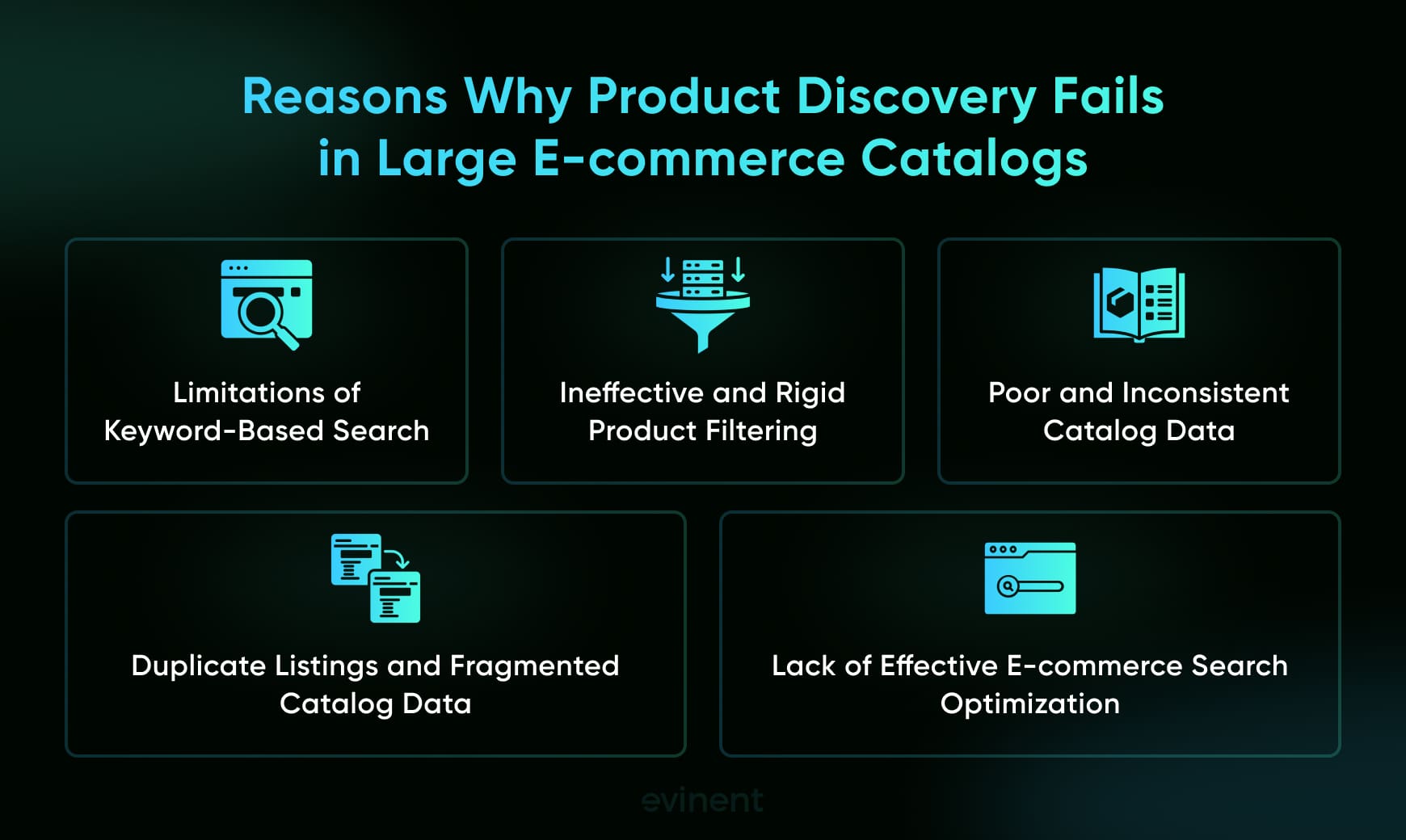
Keyword Search Limitations
A straightforward keyword search alone is not sufficient to reveal a user's intent. In fact, customers frequently enter vague or incomplete queries, and conventional search engines do not understand synonyms, mistakes in spelling, or context. Therefore, producing searches that are either irrelevant or that return no products at all.
Poor Smart Product Filtering
Filters are usually static and limited. Users cannot combine attributes effectively, and systems are unable to respond to complex queries or personalization needs, leading to customer frustration.
Inconsistent Catalog Data
Product attributes that are incomplete, mislabeled, or unstandardized can lead to inaccurate matching. For instance, inconsistent naming of sizes, colors, or technical specs can hinder proper filtering and ranking.
Duplicate Products and Fragmented Structure
When there are multiple listings for the same product or inconsistent categorization, it causes confusion not only for search engines but also for users. As a result, the correct products get less exposure, and the relevance factor gets reduced.
Weak E-commerce Search Optimization
Traditional systems hardly ever learn from user behavior. As they are not able to adjust ranking using clicks, conversions, or preferences, they often result in low relevance and have less revenue potential.
Large catalogs magnify the limitations of traditional search. Without AI-driven discovery, users face irrelevant results, frustration increases, and conversion drops. Understanding these breakdowns is crucial for designing effective AI product discovery solutions.
Now that we understand why traditional product discovery fails in large e-commerce catalogs, the next step is to explore how AI solves these problems. AI product discovery doesn’t just match keywords—it understands user intent, matches products intelligently, ranks results dynamically, and continuously learns from behavior.
How AI Product Discovery Works
AI Product Discovery has revolutionized how customers get product suggestions in vast online shopping inventories. People do not have to stick to precise keywords on search engines. AI recognizes their intention, finds products in a smart manner, orders them looking at the current situation, and keeps on acquiring knowledge from user behaviors. That is a neat formula for presenting accurate, tailored responses in complicated multi-category stores.
Input: Queries, Filters, and Behavioral Data
The first thing AI does is mount a thorough investigation and gather every bit of user data possible: from simple search queries to the selection of specific filters. It even considers user browsing history, clicks, and other kinds of behaviors. This mix of user-generated signals serves as a basis for AI to understand customers' intent.
Intent Analysis: NLP and Embeddings
NLP (Natural Language Processing) and embeddings enable AI to understand what the user really wants. This is done not only by looking for direct keywords but also by identifying synonyms, context, and subtle changes in the way a phrase is formed. This helps the system to get the actual meaning of each question.
Product Matching AI: Semantic Similarity
After figuring out the user's intent, the AI system finds products by comparing the user's needs to product features through semantic similarity. This phase makes certain that the products not directly referred to in the question will also be found if they correspond to the user's intention.
Ranking: Personalization and AI Merchandising
After the matching phase, the outcomes are sorted in order of priority through an AI merchandising system built on personalization signals and business rules. To put them in order, factors such as a person's previous behavior, general popularity, stock availability, and the degree of relevance play major roles. This way, the result becomes the perfect balance of satisfying the user's desires and achieving conversions for the business.
Feedback Loop: Continuous Learning
AI regularly updates its knowledge base by learning from user interactions, clicks, purchases, and engagement patterns, which are the feedback channels. It enables the product discovery engine to get better over time, becoming more accurate and more aligned with the changing behavior of users.
Breaking down discovery into input, intent analysis, matching, ranking, and continuous learning stages, AI turns product search from a very static and error-prone system into a dynamic, personalized user experience. This method not only overcomes the shortcomings of conventional search but also leads to higher conversion rates and greater user satisfaction.

AI Product Matching: How AI Matches Products to Customer Needs
Product matching is the heart of AI product discovery. This is the stage where AI changes the vague customer intent into a very tangible list of related products. Rather than only depending on exact searches, AI understands the user's meaning and links it to the best products from the catalog.
Mapping Customer Intent → Product Attributes
AI translates user intent into structured product attributes. For example, a query like “lightweight running shoes for summer” is mapped to features such as weight, material, breathability, and category. This structured mapping allows precise and scalable matching across large catalogs.
Handling Vague Queries → Clarifying What the User Means
People frequently use incomplete or unclear queries like "good laptop" or "comfortable chair" while searching. AI solves this problem by considering the context, users' past behavior, and collective trends to guess the intent and select relevant choices.
Smart Product Filtering → Constraints and Preferences
AI dynamically adjusts the filtering criteria according to the explicit constraints, such as price, size, brand, as well as the implicit preferences like style, past behavior. It is different from static filters, as these smart product filtering constraints keep changing in real-time to narrow down results, not even requiring the user to have perfect input.
Similarity-Based Matching → Semantic Product Discovery
Using embeddings and semantic similarity, AI identifies products that are conceptually related to the query even if they don’t share the same keywords. This enables the discovery of relevant alternatives and improves coverage across the catalog.
Dynamic Personalized Recommendations → Context-Aware Results
The matching process doesn't only look at relevance. AI keeps tweaking the results according to the user's context actions during the session, tastes, and intent signals, providing personal recommendations that change instantly.
AI product matching bridges the gap between what users say and what they actually need. By combining intent mapping, semantic understanding, and dynamic personalization, it ensures that customers are shown the right products even when their queries are imperfect. This capability is what makes AI product discovery fundamentally more effective than traditional search systems.
AI Product Search vs Traditional Search
The distinction between conventional and AI-based search goes beyond technology alone; it has a direct impact on the extent of user friendliness in discovering products and the probability of users making a purchase. While traditional search makes users conform to the system, AI changes the system according to the user.
Criterion | Traditional Search | AI Product Search |
Core Logic | Matches exact keywords entered by the user | Understands meaning using semantic AI search in e-commerce |
Query Understanding | Treats every word literally, ignores context | Interprets intent, context, and phrasing variations |
Handling Imperfect Queries | Breaks on typos, synonyms, or vague input | Handles ambiguity, synonyms, and incomplete queries |
Relevance Of Results | Often returns partially relevant or noisy results | Prioritizes truly relevant products based on intent |
Personalization | Same results for most users | Adapts results using personalized product recommendations |
Filtering Experience | Static filters that require manual effort | Smart product filtering that adapts dynamically |
Ranking Logic | Fixed rules or manual sorting | AI-driven ranking based on behavior and context |
Optimization Approach | Requires constant manual tuning | Continuous e-commerce search optimization via learning |
Adaptability | Does not improve unless manually updated | Improves automatically through feedback loops |
Traditional search is stiff, tedious, and restricted to keywords only. AI product search, on the other hand, is flexible, intent-based, and keeps getting better over time. In huge e-commerce product ranges, changing to this way of thinking is not something that you choose; it's the gap between customers having a hard time finding items and effortlessly finding exactly what they want.
Challenges of Using AI in E-commerce
AI product discovery promises better relevance and higher conversion, but implementation is not trivial. Many e-commerce companies underestimate the operational and technical challenges involved. Without addressing these risks early, even strong AI solutions can fail to deliver results.
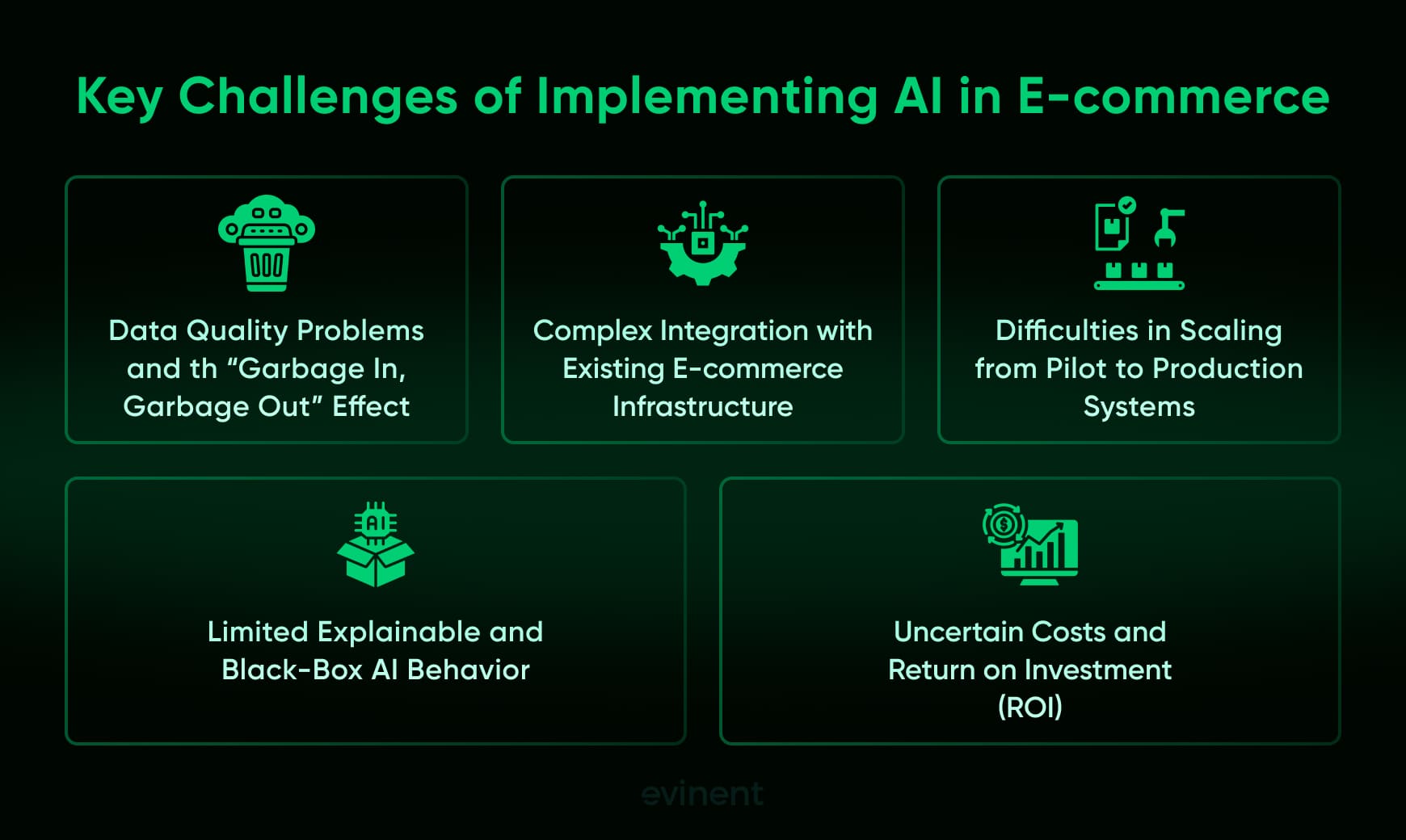
Data Quality Issues → “Garbage In, Garbage Out”
AI systems are entirely dependent on data. If product attributes are missing, inconsistent, or incorrect, the model will be unable to produce reliable results. A poor-quality catalogue directly leads to poor matching, irrelevant search results, and ineffective recommendations.
Integration Complexity → Connecting AI With Existing Systems
E-commerce sites usually base their operations on their old infrastructure. They undergo a major transformation when AI integration is done in features like search, catalog, and recommendation systems. The work generally includes redesigning data pipelines, APIs, and real-time processing capabilities.
Scaling AI Systems → From Pilot to Production
Constructing a working model is quite straightforward; what is really challenging is to scale it so that it can support thousands or even millions of products and users. Performance, latency, and cost of infrastructure are the main issues that one faces when dealing with large scale platforms.
Lack of Explainability → Black Box Decisions
AI models, especially those based on embeddings and deep learning, are often difficult to interpret. This makes it hard for teams to understand why certain products are shown, limiting control over merchandising and business logic.
Cost and ROI Uncertainty → Investment vs Impact
Implementing AI demands a considerable amount of funds for infrastructure, personnel, and upkeep. If the effects are not clearly measured, for example, through conversion rate or revenue uplift, it can be challenging to justify the ROI and decide which projects should have higher priority.
Using AI in e-commerce is very effective, but it's not simple. Getting the desired result involves not only getting good models but also ensuring data quality, proper system integration, scalability, and clear business alignment. Those brands considering AI as a whole product rather than just a feature are the ones that gain long-term benefits and results.
Benefits of Using AI in E-commerce
Although there are some difficulties in introducing AI in the e-commerce field, the potential benefits outweigh the challenges by far. An AI product discovery that is implemented properly can lead to a complete overhaul of customer interaction with catalogs, product presentation, and business operation efficiency, in addition to boosting customer search ability.
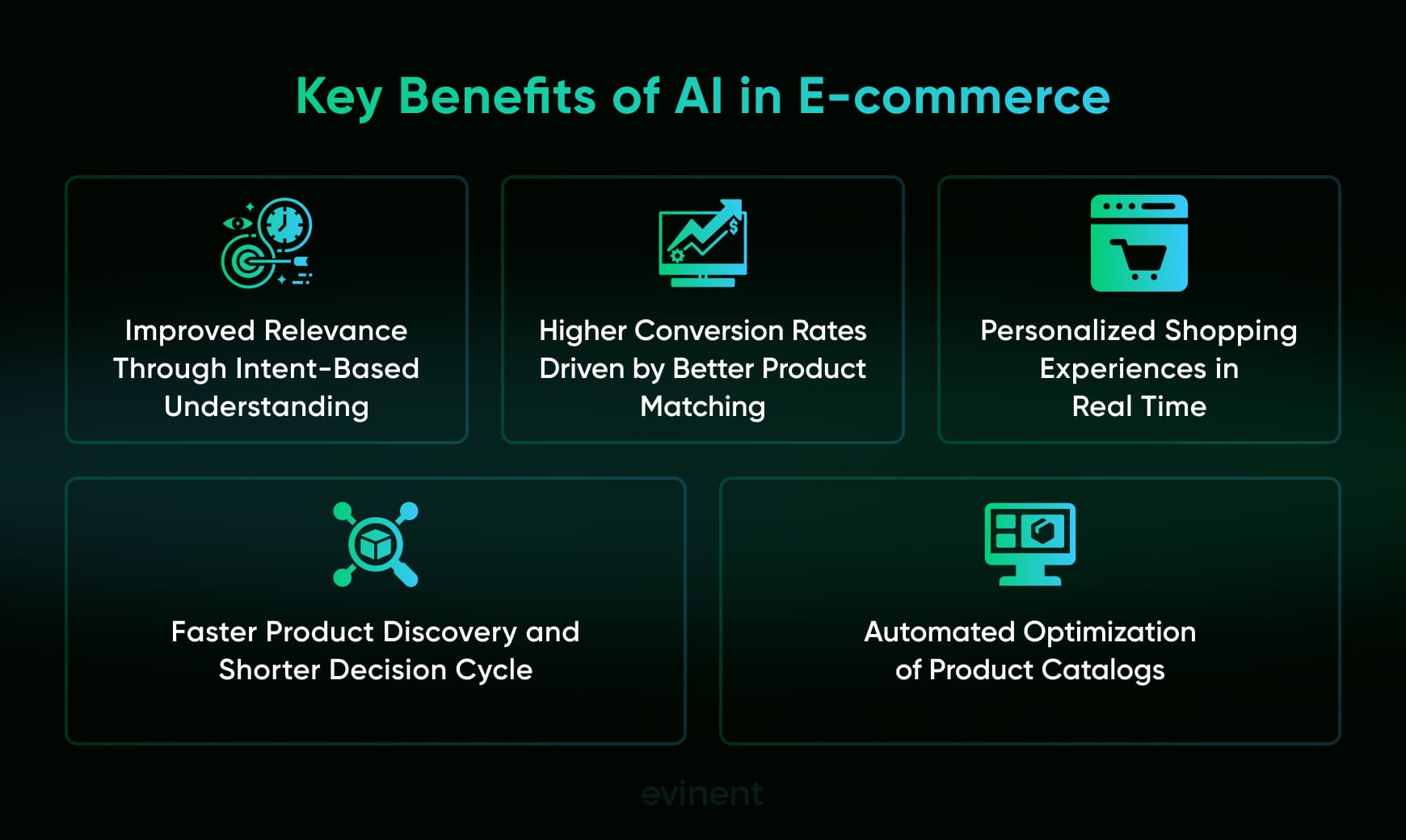
Higher Relevance
AI systems move beyond keyword matching and instead interpret user intent using semantic models. This allows the system to surface products that actually match what the user is trying to achieve, not just what they typed. As a result, irrelevant results are reduced, product visibility improves, and users are more likely to find suitable options without friction.
Increased Conversion Rates
Relevance directly impacts conversion. When users are shown the right products early in their journey, they require fewer interactions to make a decision. AI improves this by combining intent understanding, behavioral signals, and dynamic ranking, which leads to higher conversion rates, increased average order value, and better overall monetization of traffic.
Personalized Shopping Experience
AI makes it possible to personalize content in real-time by adjusting the results according to the user's behavior, preferences, and the situation. Rather than offering the same catalog to everyone, the product selection automation is different and personalized for each user. Therefore, the user is more likely to be engaged, is less likely to leave without making a purchase, and the customer is more likely to be retained in the long term.
Faster Product Selection
One of the biggest friction points in e-commerce is the time it takes to find the right product. AI reduces this by prioritizing the most relevant results and dynamically adjusting filters and rankings. Users can move from query to decision faster, which improves user satisfaction and significantly shortens the path to purchase.
Automated Catalog Optimization
AI can help businesses in their catalog management AI by automating the extraction of attributes, categorization of products, and ranking of products. Besides ensuring better consistency and higher quality of data, it also opens up the possibility of companies increasing their catalog size without the rise in operational complexity or costs.
AI transforms e-commerce from a fixed, human-operated system into a lively, smart one. As a result, it is not only a better search but also a more efficient business: increased conversion, accelerated discovery, and scalable operations. For extensive product ranges, these advantages are not incremental; rather, they are a total transformation.
Why Public AI Is Not Enough
The AI resources available to the public are quite powerful and easy to use. However, these are not really meant for production-grade e-commerce systems. Actually, with product discovery, control, consistency, and tight integration are what matter most to companies, and generic AI solutions are not able to ensure these things at all.
Reason 1: Data Privacy Risks
Most public AI systems rely on sending data to third-party services. This presents significant security risks in the case of e-commerce businesses, for example: details on products, price setting policies, and the behavior of users could be leaked or handled in environments that are not under one's own control.
Reason 2: No Control Over Ranking Logic
Public AI models operate as black boxes. Businesses cannot fully control how products are ranked or why certain results are shown. This makes it impossible to align discovery with business goals like margin, inventory, or promotions.
Reason 3: Lack of Domain Adaptation
Generic AI models are trained on a wide range of data and therefore don't have a strong grasp on the specifics of product domains. Uncustomized models have difficulties with product attributes, industry terms, and category-specific logic.
Reason 4: Unstable Results
Public AI might give quite different answers depending on the or even be changed through model updates. Therefore, the same question can produce different answers at different times, which makes it impossible to guarantee reliability in production systems.
Reason 5: No Integration with Catalog Management AI
Public tools are generally not extensively linked with the internal catalogs, attributes, or business logic that a company uses. If they don't have this link, they won't be able to provide accurate, real-time, or fully controlled product discovery.
Public AI can be handy for quick experiments, but building a reliable e-commerce system can't really rely on it. No control, lack of stability, and absence of integration make it an inadequate basis for serious product discovery.
9. Private AI for E-commerce Catalog and Discovery
If the control and reliability of public AI are not guaranteed, then private AI is the one that precisely addresses these two issues. Being constructed within a company's environment and closely integrated with its data, private AI solutions allow for completely controlled, scalable, and business-oriented product discovery.
Runs Inside Infrastructure
Private AI is deployed in the company's own infrastructure, either on-premise or in a tightly controlled cloud environment. As a result, the company is not dependent on external APIs anymore, experiences less , and retains complete ownership of the system and its performance.
Deeply Integrated with AI for E-commerce Catalog
Unlike standalone tools, private AI is directly connected to the product catalog. It works with structured attributes, categories, inventory data, and internal taxonomy, enabling accurate and context-aware product discovery.
Full Control Over Product Matching AI
Companies are able to customize how the matching operates: deciding which features are important, the method of calculating relevance, and the way results are ordered. Through this, they can align their strategies to business objectives like maximizing profits, managing inventory, or promoting certain products.
Secure and Compliant Data Usage
The entire data product, user behavior, and business logic are preserved within the controlled infrastructure only. It guarantees the fulfillment of data protection laws and, at the same time, removes concerns about exposing sensitive information to third-party systems.
Optimized for E-commerce Search Optimization
Private AI systems are designed specifically for e-commerce search optimization. They optimize search relevance, ranking, and discovery flows continuously based on real user behavior and business KPIs, rather than on generic model assumptions.
Private AI turns product discovery into a controlled, scalable system rather than a black box. By combining deep integration, customization, and data security, it provides the foundation for reliable, high-performing e-commerce search and matching at scale.
Business Impact of AI Product Discovery
AI product discovery has become a quantifiable driver of e-commerce success. According to recent 2026 industry research, AI affects not only the user experience but also the fundamental business metrics like conversion, revenue, user engagement, and operational efficiency.
Increased Conversion Rate
AI-driven product discovery improves conversion by aligning results with user intent instead of relying on exact keyword matches. According to aggregated industry data from AI commerce platforms, implementing AI-powered recommendations leads to an average 26% increase in conversion rates, as users are more likely to find relevant products early in their journey.
Faster Product Selection
AI helps lower the barriers in decision-making by bringing the most suitable items upfront. In other words, it cuts down the process of going from searching to buying because consumers don't have to keep changing their queries or checking irrelevant items. Therefore, AI leads to quick product selection and smoother buying journey in case of big catalogs.
Decreased Bounce Rate
The relevance is the main reason that the users continue their search session. AI increases the accuracy of the first-result and adjusts the results on the fly, which decreases the user frustration and early exits. Once the personalization becomes a norm, the bad discovery experiences are the main reason of churn the research by market.us reveals that 91% of users may leave if they have a bad shopping experience, so this figure clearly indicates how crucial relevance is when it comes to the reduction of the bounce.
Reduce Manual Catalog Labor
AI can be used to automate catalog work like product tagging, classifying, and ranking optimization. This decreases the reliance on manual merchandising and gives teams the ability to operate much larger catalogs with the same staff level, thereby enhancing operational efficiency and ensuring consistency of product data.
Improved Customer Experience
AI-powered discovery directly aligns with user expectations for personalization. According to McKinsey & Company, 71% of consumers expect personalized interactions, and the absence of personalization leads to frustration, making AI-driven discovery essential for retention and long-term customer satisfaction.
Across various studies, the evidences are telling a similar story: Inducing AI into the product discovery process not only boosts the conversion rate but also helps in eliminating the friction, enhancing the engagement levels, and enabling the business to scale operations. For a retail business on the web, particularly one which has an extensive range of products to offer, this is no longer a competitive advantage. Instead, it is evolving into the standard minimum requirement.
How to Implement AI Product Discovery
Implementing AI product discovery is a multi-step process that needs business goals, quality data, and technical infrastructure all working together. Companies that plan carefully and follow a set method will very likely see the results of their efforts in a quantitative manner.
Step 1: Define the Use Case
Start by clearly defining the problem you are solving. AI technologies for product search can be applied to search, product curation or recommendations, but each of these scenarios requires a distinct approach. By focusing on a specific scenario — for example, improving search relevance or increasing conversion rates through recommendations — you can avoid unnecessary complexity and ensure measurable results.
Step 2: Prepare the Catalog
AI performance depends directly on data quality. Before implementing any models, the product catalog must be cleaned, normalized, and enriched with consistent attributes. This includes standardizing categories, filling missing fields, and ensuring that product data is structured in a way AI systems can interpret.
Step 3: Choose the Right AI Architecture
Decide whether you want to use public AI tools or build a private AI system. Public options allow you to quickly test, but your control is limited. However, private AI gives you full customization, better integration, and strong data security. Therefore, the decision should be based on business scale, data sensitivity, and long-term goals.
Step 4: Integrate with the E-commerce Platform
AI needs to be thoroughly embedded into the present ecosystem including search, catalog, frontend, and analytics. Part of this involves the establishment of data pipelines, APIs, and real-time processing to make sure that AI-enabled results are delivered in a consistent manner at all user interaction points.
Step 5: Pilot, Optimize, and Scale
Start with a controlled pilot to measure the impact on key metrics such as conversion rate, bounce rate, and engagement. Based on the results, optimise models, adjust ranking logic, and refine data inputs. Once validated, scale the solution across the entire catalogue and user base.
Successful AI product discovery is built step by step: a clear use case, a strong data foundation, the right architecture, deep integration, and continuous optimisation. Companies that follow this process move from experimentation to scalable, measurable results.
How Evinent Can Help with Private AI for E-commerce Product Discovery
E-commerce companies are trying to implement AI product discovery, but just selecting the right AI models is not enough. The issues related to poor data quality, lack of infrastructure, integration with the product catalog, and inability to control the AI behavior are the ones that lead to the failure in moving from pilot to production for most companies.
Evinent's mission is to develop private AI systems for e-commerce product discovery that are dependable, secure, and completely integrated with the business logic. Rather than employing generic AI tools, the method is centered on controlled environments, predictable outputs, and extensive catalog integration.
Private AI Architecture for Product Discovery
Evinent builds AI systems that run entirely inside the client’s infrastructure. This means product data, user behavior, pricing logic, and catalog structure never leave the system. Such an approach is critical for e-commerce, where data sensitivity and performance directly impact revenue.
Deep Integration with E-commerce Catalog
AI is not something that runs separately. It actually works side by side with the product catalog, the attributes, the categories, and the search logic. Thanks to that, the product matching gets a lot more accurate, the filtering significantly improves, and the recommendations are way more relevant even when dealing with very extensive catalogs.
Full Control Over Product Matching and Ranking
Different from public AI tools, Evinent's solutions give total control over the product matching and ranking process. Businesses can set rules, priorities, and limits based on stock, profits, or merchandising strategies.
Predictable AI Behavior Without Hallucinations
Using an atomic architecture, where each AI component performs a single task (search, matching, ranking), ensures stable and explainable results. This is critical for product discovery, where inconsistent output directly affects user trust and conversion.
Scalable and Secure Infrastructure
The architecture is designed for high-load environments typical for large e-commerce platforms. Containerized deployment, role-based access, and internal data processing ensure both scalability and compliance with enterprise security standards.
Case Example: AI Matching System in a High-Volume Environment
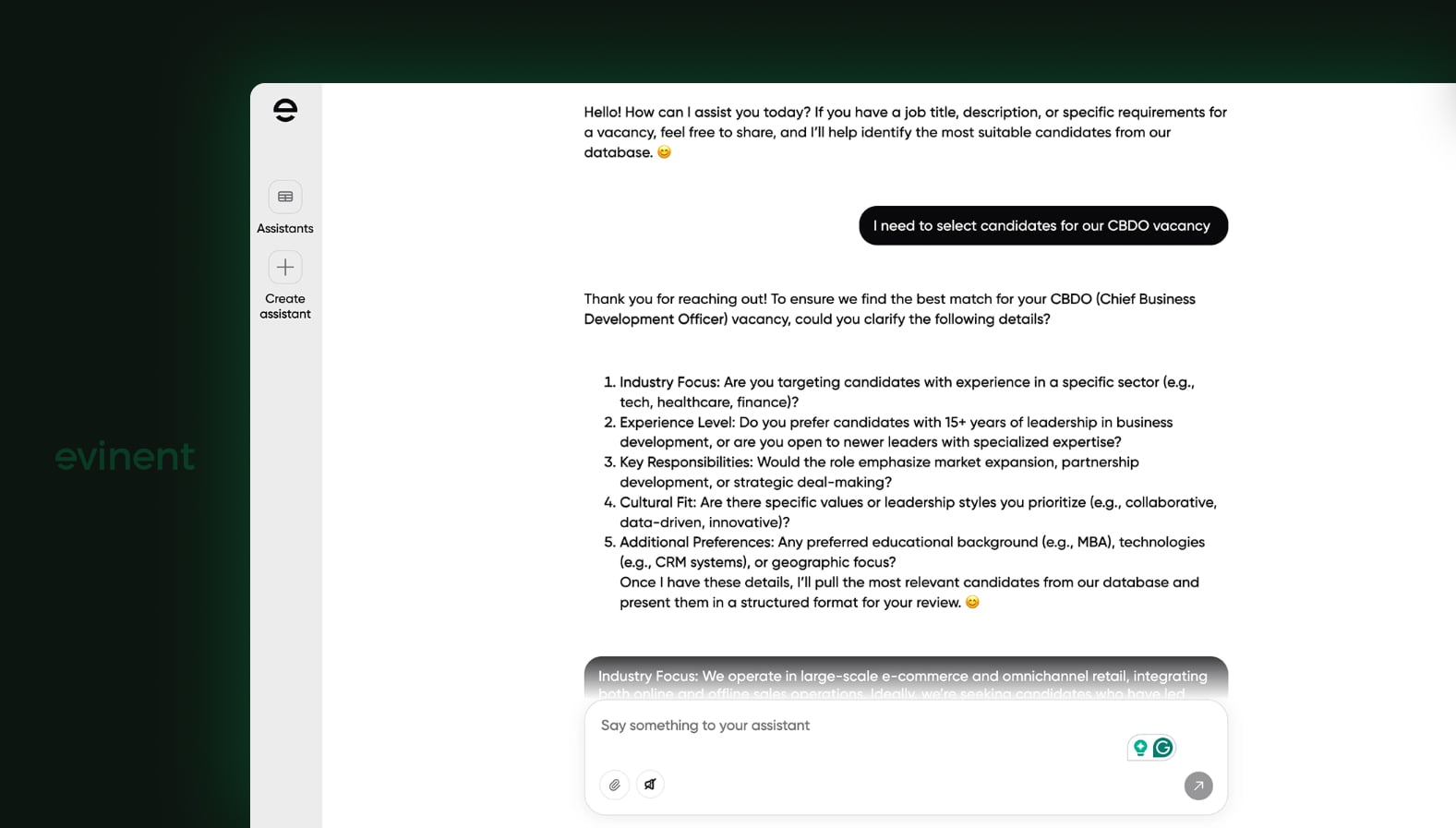
Background
Evinent implemented a private AI system in a high-load environment with large volumes of structured and unstructured data. The challenge was similar to e-commerce product discovery: efficiently matching entities (in this case, candidates and vacancies) across thousands of records.
Solution Approach
The system was built using isolated AI agents, each responsible for a specific function such as search, filtering, or matching. The architecture ensured full data isolation, no external API usage, and direct integration with internal databases.
Two main AI components were deployed:
a search and filtering agent,
a matching and recommendation agent.
This structure directly mirrors how AI product discovery systems operate in e-commerce.
Results
Within a short pilot phase (4–6 weeks), the system demonstrated:
Faster and more accurate matching,
Reduced manual workload,
Consistent and predictable AI outputs,
Full compliance with internal data policies.
Building AI product discovery is not just about the models one needs to have control, integration and scalability also. Evinent's approach to private AI makes sure that product search, product matching and recommendations can be trusted to operate smoothly within actual e-commerce environments as human beings continue to become more comfortable with AI technology rather than just isolated demos.
Key Takeaways
AI product discovery replaces keyword search with intent-driven matching and recommendations
Traditional e-commerce search fails in large catalogs due to poor filtering, messy data, and low relevance
AI works as a pipeline: input → intent analysis → product matching → ranking → continuous learning
Product matching AI is the core use case, connecting customer intent with product attributes
AI-powered search delivers higher relevance, personalization, and better user experience than traditional systems
AI improves catalog quality through normalization, attribute extraction, and automation
Main challenges include data quality, integration complexity, scaling, and lack of explainability
Public AI is not enough due to data risks, lack of control, and weak integration with catalog systems
Private AI enables full control, security, and deep integration with e-commerce infrastructure
Business impact includes higher conversion, faster product discovery, and reduced manual work
Successful implementation requires a structured approach: use case → data → architecture → integration → scaling
Share