How often should RFM segments be updated in retail?
That is the question more retail teams should be asking before they argue about scoring models, segment names, or whether "Champions" sounds too cheesy for a board deck.
Most retail RFM segmentation failures do not stem from bad logic. The logic is usually fine. Recency, Frequency, and Monetary value still give retailers a clean way to see who bought recently, who buys often, and who brings the most revenue. The problem starts after the scoring is done.
The customer keeps moving.
A loyal customer who looked safe on Monday can start drifting by Wednesday. A high-value buyer can miss their normal purchase cycle. A pharmacy customer can switch stores because their refill reminder came late. An electronics shopper can browse three times, compare prices, leave a cart, and buy from a competitor before the next weekly segment refresh even runs.
That is where RFM segmentation in retail gets uncomfortable. The model may be accurate, but the action can still arrive too late.
DigitalApplied captured the shift well in its 2026 customer segmentation research: "The forward signal is movement, not membership." In other words, the valuable signal is not only that a customer belongs to "Loyal," "At Risk," or "Lost." The valuable signal is that they just moved from one state to another.
This matters because modern retail campaigns are already proving that timing changes revenue. Omnisend’s 2025 ecommerce marketing report found that automated emails made up only 2% of total email volume but drove 37% of email-driven sales. Even more telling, one in three people who clicked an automated message made a purchase, compared with one in 18 for scheduled campaigns.
That does not mean automation magically fixes retention. Bad timing with automation is still bad timing, just faster and more confident. But it does show something C-level retail leaders should care about: triggered communication can drive significant revenue when it responds to real-time customer behavior.
And this is the point most RFM articles miss.
The real question is not "Do we have RFM segmentation?" Many mature retailers already do. The better question is: "How old is the segment by the time the customer receives the message?"
For large loyalty bases, that gap can get expensive. LatentView’s 2026 segmentation research notes that 20-30% of customers often drive 70-80% of revenue, while churn risk tends to cluster in specific behavioral groups rather than spreading evenly across the customer base. If a top customer starts sliding and the RFM refresh catches it days later, the is not just an analytics issue. It is revenue risk hiding under a clean dashboard.
Some platforms have already moved toward faster refresh cycles. Klaviyo’s RFM documentation says that profile RFM properties refresh every night rather than only once a month, so profile changes can appear within 24 hours. That is a useful step. But for enterprise retail, especially in grocery, pharmacy, beauty, pet supplies, and electronics, even daily refresh may not be enough for every trigger.
A customer does not care when your batch job runs.
They care whether the offer, reminder, product recommendation, or service message arrives while it still makes sense.
This article is not another basic RFM explainer. We are not going to spend 800 words defining Recency like nobody in the room has seen a CRM dashboard before. Instead, we will look at the hidden variable that decides whether RFM segmentation retail programs turn into retention revenue or just prettier reporting: refresh rate.
Because yes, your segments may be accurate, but late.
The RFM Problem Nobody Talks About In Retail
A retail chain with 200,000+ loyalty customers runs RFM segmentation every week.
Nobody sees this as a problem at first. Weekly feels responsible. It feels current enough. It is certainly better than the old setup, where someone from analytics exported customer groups once a month, sent them to the CRM, and everyone hoped the file would still be useful by the time the campaign went live.
So the weekly rhythm becomes part of the operating model.
Monday starts with the usual data checks. POS transactions from stores are in. Online orders are in. Loyalty IDs are matched. Returns are cleaned up. The analytics team recalculates Recency, Frequency, and Monetary value. Customers move into the usual segments: Champions, Loyal, Promising, At Risk, Lost.
The dashboard looks calm. But customers are not calm; they are chaotic little weather systems.
One customer who looked "Loyal" last week has missed her normal replenishment window. She usually buys skincare every 32 days. This time, day 38 passes with no purchase. She visits the site twice, checks the same serum, searches for a cheaper alternative, and leaves. The RFM report still treats her as fine because the weekly recalculation has not yet captured the behavioral change.
Another customer drops from "Champion" behavior into early decline. Not a dramatic decline. The dangerous kind: quiet decline. He still buys, but less often. His basket is smaller. He stopped adding accessories. He used to respond to product recommendations. Now he browses, compares, and leaves.
A third customer enters the "At Risk" window on Monday. The win-back audience is prepared on Wednesday. The campaign is scheduled for Friday. By the time the email arrives, she has already bought from another retailer because they had the product in stock and sent a reminder first.
The CRM report later says the win-back campaign had a modest conversion rate.
That sounds acceptable until someone asks a sharper question: how many of those customers were still truly at risk when the message arrived?
Most retailers treat RFM as a classification problem. Put each customer into the correct box. Make the box readable. Send a campaign to the box.
But retail retention is not only about the box. It is about the moment the customer changes boxes.
That is the part most batch-based systems miss.
A customer does not wake up as "At Risk" because a weekly report said so. They become at risk through behavior: one missed purchase cycle, one ignored reminder, one competitor visit, one abandoned cart, one quiet reduction in category spend. The segment label is just the ed translation of those signals.
And ed translation can be expensive.
The problem is not that RFM is outdated. Honestly, RFM is still one of the most useful customer analytics methods in retail because it is simple enough for business teams to understand and strong enough to guide action. The problem is that many retailers use it like a monthly financial report, not like a live retention system.
That creates a strange illusion.
The company has RFM. The CRM team has segments. The CMO has a dashboard. The loyalty team has campaign logic. Everyone can point to the process and say, "Yes, we already do customer segmentation."
And they do. That gap between customer behavior and segment action is RFM segmentation latency. It is not as catchy as "personalization" or "AI recommendations," but it often decides whether the campaign makes money or simply keeps the marketing calendar busy.
This is especially painful in enterprise retail because the base is large enough that even tiny s can become large losses.
With 200,000 loyalty customers, even a small timing error spreads quickly. If only 5% of the base receives a message based on stale segment data, that is 10,000 customers. If a portion of them gets an unnecessary discount, you lose margin. If another portion needed a message earlier and did not get it, you lose future revenue. If high-value customers are buried inside a broad segment that refreshes too slowly, the business may not notice the slide until the purchase pattern has already changed.
And this is the uncomfortable part for C-level teams: stale RFM rarely looks broken from the outside.
Campaigns still go out. Reports still fill up. Revenue still appears in dashboards. CRM can still say, "The segment converted."
But did the segment convert because the campaign worked?
Or because some customers were already coming back?
Did the discount save revenue?
Or did it subsidize revenue that would have happened anyway?
Did the win-back campaign recover customers?
Or did it arrive after the useful recovery window had closed?
These are not philosophical questions. They are margin questions.
RFM segmentation retail programs should not only ask who belongs in each group. They should ask when the customer entered the group, what changed before that, and how fast the business reacted.
Because a correct segment with late action is not really correct from a commercial standpoint.
It is just accurate history.

What Weekly RFM Actually Means For A 200,000-Customer Base
Let’s put numbers on it. A retail loyalty program has 200,000 active customers. Nothing wild for an established retail chain. If 15% of that base enters an "At Risk" window in a given week, that is 30,000 customers whose behavior is starting to deteriorate.
Thirty thousand. Not a segment or a color on a dashboard, but people with different purchase rhythms, margins, categories, habits, and reasons for slowing down.
Some of them are truly drifting. Some are just late or waiting for payday. Some could not find the product they wanted, and some checked the site, saw no discount, and decided to wait or had already bought from a competitor.
This is what "weekly RFM" often means in real retail operations. The customer acts first. The POS system or e-commerce platform records it. Data syncs overnight. The batch RFM analytics job runs once a week. The segment is recalculated. The CRM team prepares an audience. The campaign waits for the next available slot.
POS
nightly sync
weekly segment recalculation
campaign audience
message send
Each step makes sense when you look at it alone. Nobody is being lazy or trying to waste revenue. The process probably exists because it was stable, manageable, and good enough when the loyalty program was smaller.
But s stack.
A one-day sync turns into a three-day segment . A three-day segment turns into a five-day campaign . By the time the message reaches the customer, the behavior that triggered the segment may already be old news.
That is the part many RFM dashboards hide. They show the customer’s current label inside the system, not the customer’s current buying state in real life.
For a slow category, this may be acceptable. If a customer buys a refrigerator every seven years, nobody needs a real-time RFM trigger because they visited a product page twice before lunch. That would be silly.
A pharmacy customer may have a 30-day refill cycle. A pet owner may buy food every three weeks. A grocery customer may shop every few days. A beauty customer may replenish skincare every six to eight weeks but browse new products in between. An electronics customer may buy major devices rarely, yet purchase accessories, protection plans, cables, chargers, and services much more often.
So the right RFM refresh rate is not a technical preference. It is a category decision.
The faster the normal purchase cycle, the faster the segment needs to update.
This is why applying one refresh rule across the entire customer base can be quite expensive. Weekly RFM may be fine for large appliances. It may be too slow for consumables. It may be dangerous for high-value loyalty customers whose behavior changes before their revenue fully drops.
A simple example helps: If a customer usually buys contact lenses every 30 days and today is day 31, a reminder can still feel useful. It lands inside the customer’s natural need window. It may even feel helpful, like the retailer remembered at the right moment.
If that reminder arrives on day 39, the story changes. The customer may have already bought elsewhere. Or they may now need a stronger discount to return. Or they may ignore the message because the practical problem has already been solved.
Same customer. Same segment idea. Different timing. Different ROI.
That is why RFM refresh rate retail teams should not treat segmentation as a reporting setting. It is part of the commercial logic.
DigitalApplied made a similar point in its 2026 RFM segmentation research, arguing that the competitive edge shifts from simply having RFM segments to reacting to movement between them within hours, not at the next quarterly review. The wording is sharp because the problem is sharp: customer movement creates the opportunity, not the label itself.
The same logic applies to weekly cycles. A weekly refresh may sound far better than a quarterly one, and of course it is. But in a high-frequency retail category, "better than quarterly" is not the standard. The standard is whether the business can still change the customer’s next action.
If the customer had returned anyway, the campaign may have wasted margin.
If the customer has already left, the campaign may waste budget.
If the customer is actively deciding right now and the segment will not update until Friday, the retailer may miss the only useful moment.
This is where RFM batch vs real-time becomes less of an IT discussion and more of a revenue discussion.
A batch RFM pipeline answers the question, "Who belonged in this segment when the job ran?"
A live behavioral RFM setup gets closer to answering the question, "Who is changing right now, and what should we do before the moment passes?"
That difference can look small inside an architecture diagram. But inside a 200,000-customer loyalty base, it is not small at all.
The Three Scenarios Where Stale RFM Costs Real Money
A failed campaign is easy to see: low opens, clicks, and no revenue. Everyone frowns at the dashboard and moves on.
Stale RFM is sneakier because the campaign may still show revenue. The report may still look respectable, and someone may even call it a win in the weekly marketing meeting.
But when you look closer, the revenue is not always what it seems. Some customers did not need the message. Some needed it earlier. Some were already gone. And some received an offer that made sense in the segment but not in the moment.
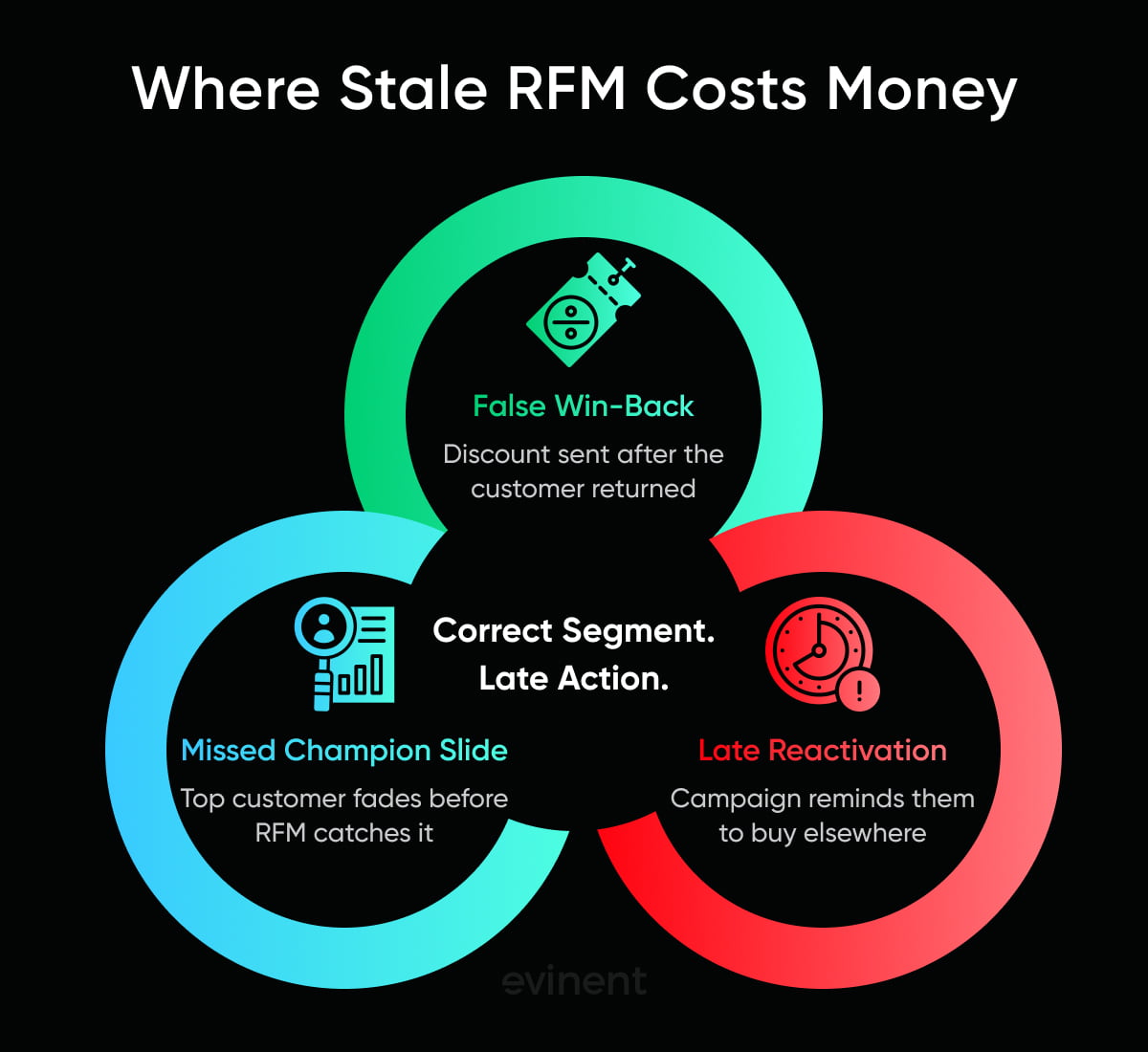
Let’s break down the three most common revenue leaks.
1. The Win-Back Campaign Fires After The Customer Already Returned
An electronics retailer runs a weekly RFM refresh.
On Monday, a customer drops into the "At Risk" segment. They have not bought anything for 70 days. Their previous pattern suggested they should have come back around day 45 or 50, usually for accessories, small appliances, or warranty-related add-ons.
The CRM team prepares a win-back campaign with a 10% discount.
The campaign goes out on Friday. But the customer bought on Wednesday. Not a huge order. Maybe a laptop sleeve. Maybe a charger. Maybe an HDMI cable because life is glamorous like that. Still, the customer came back before the win-back message arrived.
What RFM said: "At Risk." But what actually happened was that the customer had already returned. And the retailer paid for a discount that was no longer needed.
This is the classic false positive. The campaign treats the customer as inactive, but real behavior has already changed. At scale, this burns margin in a quiet, boring way. No drama. Just thousands of small discounts going to people who might have bought anyway.
It also makes campaign reporting messy.
The dashboard may credit the win-back campaign for revenue that was already happening. The CRM team sees a recovered customer. Finance sees discounted cost. Nobody sees the missing counterfactual: would this person have bought without the campaign?
Sometimes yes. Sometimes no. But stale RFM makes the answer harder to measure.
And there is also the brand signal. A customer buys, then gets a "we miss you" email two days later. It feels slightly off. Not terrible. Not enough to make them leave. But it tells them the retailer is not really paying attention.
In loyalty, that matters.
2. The Champion Segment Does Not Catch The Early Slide
This one is more dangerous because it hides inside your best customers.
A pharmacy chain has a customer who looks excellent in the RFM dashboard. High spend. Frequent purchases. Recent activity. They are in the top customer group, maybe "Champion," maybe "VIP," maybe whatever label the team agreed on after three meetings and one overly long naming debate.
For months, this customer has bought across several categories: prescription refills, vitamins, skincare, and some household items. The pattern is steady. Their basket is healthy. Their loyalty card activity looks strong.
Then the pattern starts to change.
They still buy, so the RFM score does not panic. But they buy a little later. Their basket gets narrower. They stop buying one category. They browse the site before making a purchase but do not add to their cart. They search for a specific product, check alternatives, and leave.
Nothing dramatic happens. The customer is not lost, but they are loosening. There is a difference.
A live behavioral layer might catch the slide early: fewer categories, longer gap, repeated browsing without purchase, lower basket value, fewer responses to previous recommendations. A weekly batch RFM model may keep them in "Champion" until enough damage has already happened.
This is where customer segment update frequency becomes a C-level issue, not a CRM detail.
A lost low-value customer hurts a little. A slipping top customer hurts a lot. And the pain is not only one missed transaction. It is future frequency, future margin, future cross-sell, and the habit that once belonged to your brand.
Retailers often obsess over acquiring new customers while quietly letting high-value customers fade because the system still calls them loyal.
3. The Reactivation Offer Hits When The Customer Is Already Mentally Gone
A customer has not purchased in 180 days. The weekly RFM refresh marks them as "Lost" or "Inactive." The CRM team builds a reactivation campaign around a seasonal promotion. The message lands on Saturday morning.
The copy is decent. The offer is decent. The product selection is fine.
But the customer is no longer in a relationship with the brand. They have already shifted their shopping habits elsewhere. They follow another retailer on Instagram. They downloaded a competitor’s app. They bought from that competitor twice in the last season.
Your message does not reactivate loyalty. The customer remembers they wanted a jacket, clicks, compares, and buys from the competitor that already has their attention.
This is one of the least discussed risks in stale RFM segmentation retail programs. A late campaign can still create demand. It just may not capture it.
That is why timing and offer strength have to work together. A customer who recently crossed into risk may need a small nudge: a relevant product, a replenishment reminder, loyalty points, free pickup, or early access. A customer who has been gone for months may need a stronger reason. Or they may not be worth paying for at all.
Treating both customers as one broad "win-back" audience is easy.
The same segment label can hide very different commercial realities. Someone who became At Risk yesterday is not the same as someone who has ignored the brand for six months. Someone who browsed twice this week is not the same as someone who has shown no signal anywhere. Someone who stopped buying because the product was out of stock is not the same as someone who moved to a competitor.
This is why stale RFM costs real money. It blurs the reason for action.
Live RFM Vs Batch RFM: What Changes Architecturally
"Real-time RFM" sounds like one of those phrases that gets thrown into a product deck and then quietly means six different things to six different teams.
Batch RFM means customer scores are recalculated on a schedule. Maybe every night. Maybe every week. Maybe once a month if the system is older and everyone has learned not to touch it too often. Data comes in from POS, e-commerce, loyalty, CRM, returns, and sometimes mobile app activity. Then a job runs. Customers are scored. Segments update. Campaign tools receive the new audiences later.
In a batch pipeline, the customer changes first. Live RFM works differently.
A meaningful customer action becomes an event. A purchase. A return. A product view. A category browse. A cart addition. A search query. A loyalty login. A store availability check. The customer profile updates near the moment the action occurs. If the action changes the customer’s state, the segment can change too.
In a live pipeline, customer changes trigger system responses while the signal is still fresh.
That does not mean every signal deserves an immediate message. Please, no. Nobody wants a push notification because they looked at a blender for eight seconds. Real-time RFM should not turn CRM into a nervous waiter hovering over the table.
A live RFM system may decide to send a reminder. It may decide to suppress a message. It may decide to reduce a discount because the customer is already showing buying intent. It may decide to move the customer into a higher-risk watch group but wait before contacting them. It may decide that a loyalty app push is better than email because the customer has been active in the app this week.
First, purchase data no longer carries the whole burden. Classic RFM is based on transactions because transaction data is clean, structured, and commercially meaningful. That is why the model became so popular in the first place. A purchase is hard evidence.
But in modern retail, purchase data is also late evidence.
Before a customer buys, they often browse. Search. Compare. Add to cart. Remove from cart. Check delivery options. Read reviews. Look at a product again from mobile. Then maybe buy in-store. Or maybe vanish.
If RFM only sees the purchase, it misses the decision path.
This is where behavioral RFM signals matter. Site visits, category views, product views, cart actions, search queries, wishlists, and store availability checks can all add context to Recency. Not as a replacement for purchases, but as a way to understand active intent before the transaction appears.
A customer who bought 40 days ago but browsed the same product category yesterday is not the same as a customer who bought 40 days ago and has shown no signal since. A batch RFM model may treat them similarly. A live behavioral model should not.
Second, customer identity becomes more important.
Retail journeys are messy. Someone visits the site anonymously during lunch. Later, they log in from a phone. The next day, they buy in a store using a loyalty card. If the analytics layer cannot connect those actions, the customer profile is fragmented.
That is why loyalty profile matching matters. Anonymous behavior should not disappear just because the customer was not logged in at the start of the journey. Once the customer identifies themselves, the system should be able to link earlier behavior to the known profile, where privacy rules and consent allow.
This is one of the places where enterprise retail is harder than textbook e-commerce.
A small online store may have a single customer ID and a single checkout path. A retail chain has loyalty IDs, online accounts, app users, card numbers, store receipts, phone numbers, email addresses, device identifiers, and sometimes several versions of the same person floating around different systems.
Messy, yes. But if identity matching is weak, RFM refresh rate only solves part of the problem. The segment may update quickly, but from incomplete data.
Third, trigger logic has to connect directly to the communication layer.
This is where many retailers get stuck. They calculate RFM segments in analytics, export them to CRM, rebuild campaign audiences, wait for approval, schedule the message, and only then contact the customer.
That is not live retention. That is batch retention wearing a nicer shirt.
For live RFM to affect ROI, segment movement needs to connect to action rules. Email, SMS, Viber, WhatsApp, web push, mobile push, and loyalty app messages should be able to respond to approved triggers without requiring manual campaign setup each time.
Of course, that does not remove control. It should not.
Retail communication needs rules: consent, frequency caps, quiet hours, channel preference, offer limits, margin thresholds, suppression after purchase, and exclusion from conflicting campaigns. Without those rules, automation becomes noise.
But once the rules are set, the system should not wait for a human to notice that a valuable customer crossed a risk threshold yesterday.
In a batch RFM setup, a customer buys from a competitor on Tuesday, your system updates the segment on Friday, and the win-back email arrives next Monday.
In an event-driven setup, the customer misses their expected purchase window, browses a replacement product, leaves without buying, and the system can react while they are still deciding.
That reaction might be a reminder. This is why live RFM is not just "faster scoring." Faster scoring is only one part.
The real change is that RFM becomes part of an operating loop:
customer signal
profile update
segment movement
trigger decision
communication or suppression
result tracking
timing adjustment.
That last step matters more than people think.
If the system can measure time from message to purchase, it can learn how long different segments need to respond. One segment may buy within six hours. Another may take three days. Another may need two reminders but only if the second one lands after payday. Retail behavior is rarely tidy, but patterns do appear when the data is connected.
Evinent Analytics is built around this broader view of customer behavior. The platform collects transactional data and customer interaction history, shows purchase timelines, tracks site actions such as product and category views, supports RFM reporting, and connects customer segments with communication through email, SMS, Viber, WhatsApp, and push notifications. Its product materials also describe automatic matching of anonymous site visitors after authorization, which is exactly the kind of identity layer live behavioral RFM needs.
That is the architectural difference in practical terms. Batch RFM tells you who the customer was when the report ran. Live RFM helps you act on what the customer is doing now. And in retail, it now has a short shelf life.
What Retail Chains With Large Loyalty Bases Actually Do
Enterprise retailers rarely have a clean starting point. That is the part consultants sometimes make too tidy. They talk about customer data as if it lives in one elegant place, waiting to be activated. In real retail, the data usually lives everywhere.
POS has one version of the customer. E-commerce has another. The mobile app has its own events. The loyalty system knows points, tiers, and card history. The ERP knows stock and store operations. The email platform knows campaign engagement. Store teams know things that never make it into the database at all.
So when someone says, "Let’s make RFM real time," the answer is not usually, "Great, let’s replace the whole stack."
That would be a fast way to create a very expensive mess.
What mature retail chains actually do is more practical. They keep the systems that still work, then add a live behavioral layer around them. The goal is not to throw away the loyalty database or rebuild every reporting process. The goal is to connect transaction history, customer identity, site behavior, and communication logic closely enough that the business can react while the customer is still in motion.
That sounds less glamorous than "AI transformation."
It is also much more useful.
For a 100-store or 500-store retailer, the first big change is campaign timing. The team stops treating campaigns as only calendar events and starts treating some of them as customer-state events.
A customer misses a normal purchase window. A high-value buyer suddenly narrows their basket. Someone checks the same category three times without making a purchase. A loyal customer browses a replenishable product but does not complete the order.
These are not just analytics facts. They are moments.
A batch setup waits until the next audience pull. A live setup can turn those moments into controlled triggers, with rules, caps, and suppression logic. That is how win-back stops being a broad Friday campaign and becomes a timed intervention.
The second change is offer depth.
This one matters to the CFO.
Retailers often use discounts as a blunt instrument because the segment is too broad. "At Risk" gets 10%. "Lost" gets 15%. VIP gets early access. Everyone nods because the framework is easy to understand.
But a live RFM setup can separate customers who need an incentive from customers who only need relevance.
If a customer is already browsing, adding to cart, and checking delivery options, they may not need a discount. They may need stock visibility, a product recommendation, free pickup, a reminder, or a better bundle. If a high-value customer has gone quiet across every channel, the retailer may justify a stronger offer. Same segment family, different signal strength.
That difference protects the margin. It also makes CRM feel less desperate. Not every retention problem needs a coupon. Sometimes the better answer is timing, convenience, or a message that proves the retailer understands the customer’s next likely need.
The third change is channel selection.
A slow, low-pressure message can go by email. A replenishment reminder may work better via SMS or push notifications. A VIP risk signal may need a loyalty app message. A service-related signal might belong to a store associate or a call center workflow. A price-sensitive customer may respond to a promo. A convenience-driven customer may respond to delivery speed.
This is where loyalty program analytics retail teams start to behave less like campaign factories and more like decision systems.
The segment still matters. But the trigger, channel, and timing matter just as much.
Sulpak is a useful example here because this is the kind of retail environment where theory either works under pressure or falls apart. Evinent’s case study materials describe work with a leading Central Asian retail and e-commerce business, including secure, scalable systems, real-time updates, personalized user experiences, and multichannel integration. Evinent also references a retail/e-commerce case where auto-scaling infrastructure, a mobile app, and AI-powered search helped drive a 320% increase in online sales during high-demand periods.
That kind of scale changes the RFM conversation.
When a retailer has a small base, stale segments are annoying. When a retailer has hundreds of thousands of loyalty customers, stale segments become operational debt. Not technical debt only. Commercial debt.
Because every slow refresh creates small wrong actions:
A discount goes to someone who has already come back.
A loyal buyer starts slipping without a timely trigger.
A campaign uses email when push would have worked better.
A broad win-back group includes customers with completely different levels of intent.
A high-value customer is still called "Champion" because the scoring window has not caught the slide.
None of these errors looks huge on its own. That is why they survive.
At scale, they compound. The mature move is not to obsess over a perfect RFM model. Perfect models are rare, and honestly, not always worth the wait. The mature move is to reduce the between signal and action, then measure whether that faster action improves margin, retention, and customer lifetime value.
That is the practical future of RFM segmentation retail teams should care about.
How Evinent Analytics Handles RFM Refresh For Retail
Evinent Analytics starts from a practical retail assumption: customer behavior is bigger than the last receipt.
That sounds obvious until you consider how many RFM segmentation retail systems still treat purchase as the only signal worth tracking. A purchase is clean. It has a date, value, product ID, store or channel, and customer ID if the loyalty match works. Finance trusts it. CRM trusts it. Analytics teams like it because it requires little interpretation.
But purchase data arrives after the customer has already made a decision.
Before that, there is usually a trail: product views, category browses, cart actions, search queries, repeat visits, stock checks, loyalty logins, and sometimes abandoned sessions that say more than a completed order. Evinent Analytics is built to work with that wider trail. The platform can build customer profiles from purchase history, total spending, rewards history, purchasing patterns, segmentation data, product predictions, and campaign results; it also includes behavioral analysis of users on the e-shop.
That matters for RFM refresh because Recency should not always mean "last purchase."
In classic RFM, a customer who bought 42 days ago appears less recent than one who bought 8 days ago. That is fair if purchase history is all you have. But in retail, a customer who bought 42 days ago and viewed the same product category yesterday is not cold. They may be comparing. They may be waiting for stock. They may be checking the price. They may be one reminder away from buying.
So the better question is not only "When did they last buy?"
Evinent Analytics tracks on-site behavior, including product and category views, with detailed timestamps. Its product materials also describe how even unauthenticated visitors receive a unique identifier that can later be automatically matched after authorization. That is important because much of the retail intent occurs before login. If that behavior disappears, the RFM profile is already incomplete.
This is where behavioral RFM becomes useful.
A retailer can separate customers who are inactive across all channels from those who are commercially active but have not yet purchased. Those two groups should not receive the same message. One may need reactivation. The other may need help completing a decision.
There is a big difference between "we miss you" and "the item you viewed is back in stock."
The next part is communication. Evinent Analytics connects segmentation with customer communication through email, SMS, and messaging apps. The public product page also says the platform can analyze the efficiency of advertising campaigns and communicate with customers via email, SMS, and other messaging apps.
This is where many RFM projects either start making money or stay stuck as reporting.
A segment that lives only in a dashboard does not change customer behavior. A segment that can feed a trigger, suppress an unnecessary offer, adjust timing, or select a better channel has a better chance.
And suppression deserves more attention than it usually gets.
Everyone likes talking about triggers because triggers feel active. Send this. Recommend that. Win back this person. Push that offer.
But a good retail analytics platform should also help teams not send the wrong message. If a customer already returned yesterday, suppress the win-back discount. If a customer is showing strong purchase intent, do not over-discount too early. If a customer has already received two messages this week, wait. If a segment is too stale, do not treat it as fresh just because the campaign calendar needs content.
Honestly, this is where ROI often hides: not only in better targeting, but in fewer unnecessary incentives.
Evinent Analytics also supports recommendation logic and predictive analysis. The platform describes product recommendations based on behavioral analysis, including suggestions for products and services each client is likely to buy. It also supports analysis of purchasing patterns and correlations between data sets.
That creates a more useful loop for retail teams.
A customer moves toward risk. The system checks recent behavior. It sees which categories they still browse. It chooses a relevant recommendation or message type. Then it tracks whether the communication led to a purchase, how long that took, and which segment responded.
The time part is easy to underestimate.
Evinent’s internal product materials describe campaign analytics that can show the time from message send to purchase, including examples such as a purchase happening after 3 days or 86 hours. That kind of pattern helps retailers calibrate trigger timing instead of guessing.
This is valuable because not every segment responds at the same speed.
A replenishment customer may make a purchase within hours. A big-ticket electronics shopper may need several days. A high-value loyalty customer may respond better to a recommendation than a discount. A nearly lost customer may need a stronger offer or may not be worth the margin sacrifice.
Without time-to-purchase analytics, all of that gets flattened into a campaign report.
With it, the RFM refresh rate can be measured. Retailers can see whether the message arrived inside the customer’s decision window or after it had already closed.
The Sulpak example gives this a real retail anchor. Public Evinent materials quote Alex Rumyantsev, Head of E-Commerce at Sulpak, saying that Evinent has been a partner and main developer of the Sulpak.kz website for 8 years, and that Evinent Analytics helps the team track sales conversion from recommendation blocks on the site. Evinent also publicly cites a case study on a scalable e-commerce platform in which auto-scaling cloud infrastructure, mobile applications, and AI-powered search and recommendations helped drive a 320% increase in online sales over 2.5 months of lockdown.
The better argument is more grounded: analytics infrastructure makes RFM, recommendations, campaign timing, and behavior tracking work together. And when those parts work together, the retailer can move from "who is in this segment?" to "what should we do now?"
That is the business shift.
For enterprise retailers, Evinent Analytics supports that shift through customer profile building, behavioral tracking, RFM reporting, segmentation, predictive recommendations, multichannel communication, campaign performance analytics, and integration with CRM, ERP, call centers, accounting systems, and online shops. For teams planning a broader analytics setup, Evinent’s data analytics services and retail software development services can also support the surrounding infrastructure.
How Often Should RFM Segments Be Updated In Retail?
There is no universal RFM refresh rate that works for every retailer.
A grocery chain, a pharmacy network, a fashion retailer, and an electronics store do not live on the same customer clock. That sounds obvious, but many retail analytics systems still apply one refresh cadence across the entire base because it is easier to manage.
Easy, yes.
Commercially precise? Not always.
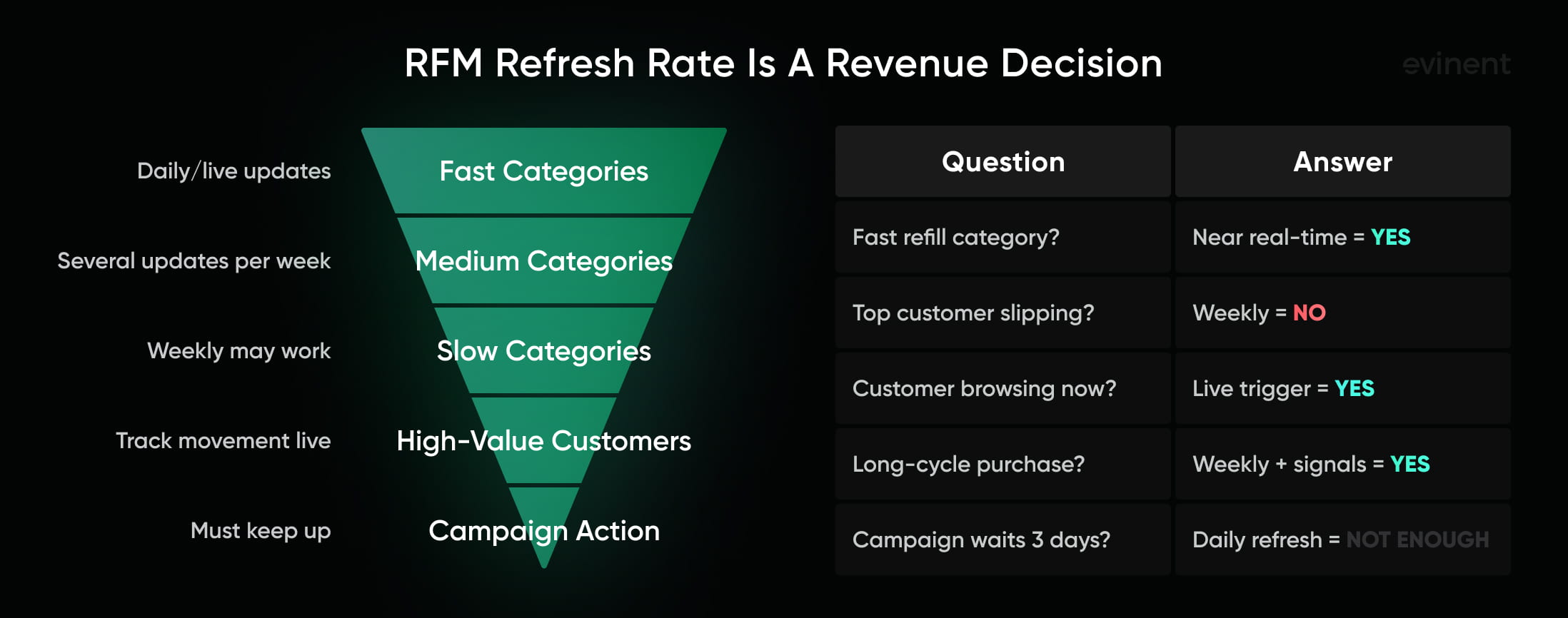
The right refresh rate depends on how fast customer behavior changes and how much money is at risk when the system reacts late. For high-frequency categories, daily refresh is often the minimum. In some cases, even daily is too slow for specific triggers.
Think about pharmacy. If a customer usually refills a product every 30 days, the difference between day 31 and day 38 is not just a number. It may be the difference between a useful reminder and a message that arrives after they have already bought somewhere else.
Pet supplies work the same way. So do contact lenses, baby products, grocery staples, beauty refills, and household consumables. These categories have natural rhythms. When a customer misses that rhythm, the retailer has a small window to act.
In slower categories, the window is different. A customer does not buy a refrigerator every month. Large appliances, furniture, high-end electronics, and luxury goods can tolerate slower RFM refresh because the purchase cycle is longer. But even there, behavioral signals can move quickly. A customer may research for weeks, then make a decision in one afternoon because stock, delivery, or price changed.
So the better rule is this:
RFM refresh rate should follow the customer’s decision window, not the company’s reporting calendar.
That means different categories may need different cadences.
For fast-replenishment categories, RFM segments should be updated daily or near real time when a customer crosses a replenishment, churn, or high-intent threshold. For medium-cycle categories, daily or several-times-per-week updates may be enough. For long-cycle categories, weekly refresh can work, as long as live behavioral signals still feed triggers when the customer becomes active.
This is also where customer value matters.
A low-value customer moving from "Promising" to "Inactive" does not need the same urgency as a top-spending customer moving from "Champion" to early decline. The segment name may look similar, but the revenue risk is not.
Retailers should not ask only, "How often do we update RFM?"
They should ask:
"How much customer value can change before the next update?"
That question changes the conversation. It moves the RFM refresh rate from a technical setting to a financial decision.
A weekly refresh may look harmless until you calculate how many high-value customers can change behavior inside that week. A daily refresh may look impressive until you realize the campaign layer still sends messages three days later. Real-time behavioral data may sound advanced until you check whether the system can actually suppress unnecessary discounts.
The refresh rate is only useful if the action layer can keep up.
That is why Klaviyo’s RFM documentation is interesting from a market direction point of view. It says RFM properties refresh every night rather than only once a month, with checks every 24 hours. That shows the industry is moving away from static monthly RFM. But for enterprise retail, especially with large loyalty bases and mixed purchase cycles, the more important question is not whether the segment updates daily.
A daily segment that waits three more days for campaign approval is not really daily in commercial terms. It is daily reporting with ed action.
The Metric Most RFM Dashboards Are Missing
How long has this customer been in this segment?
A customer who entered "At Risk" yesterday is not the same as a customer who has been sitting there for six weeks. A customer who just dropped from "Champion" to "Loyal" is not the same as someone who has been stable in "Loyal" for a year. A customer who became "Lost" last night after a missed replenishment window is not the same as someone who has ignored every channel for 180 days.
Same label. Different urgency.
This is why segment age should be visible in retail loyalty analytics.
Without it, teams treat customers as if they are frozen inside a category. But RFM is not a static identity. It is a current state. States have a duration. Duration changes meaning.
For example, an "At Risk" customer with a segment age of two days may need a gentle reminder. Maybe product availability. Maybe a category recommendation. Maybe loyalty points.
An "At Risk" customer with a segment age of 45 days may need a stronger offer, a different channel, or no offer at all because the margin does not justify the attempt.
This is where RFM segmentation retail programs can stop wasting money.
Segment age helps teams see whether a campaign is early, timely, late, or pointless.
It also helps clean up attribution. If a win-back campaign converts customers who entered the segment yesterday, it may be saving real revenue. If it converts customers who had already returned before the message landed, the campaign is getting credit it does not deserve.
That is not a small reporting issue. It affects budget decisions.
If CRM gets credit for revenue that would have happened anyway, the company may keep funding the wrong offers. If ed campaigns look successful because they catch natural returners, the retailer may never see the real leak: customers who needed action earlier and never came back.
A good RFM dashboard should answer at least four timing questions:
When did the customer enter the segment?
What behavior caused the movement?
How long did it take to trigger communication?
Did the customer buy before or after the message?
Those questions are simple. They are also surprisingly revealing.
If the average time from segment movement to message send is four days, weekly RFM refresh is not the only problem. The campaign workflow is also slow.
If many customers buy before the win-back message arrives, the retailer is over-discounting natural returners.
If high-value customers spend weeks in early decline before anyone acts, the VIP retention logic is too weak.
If customers receive reactivation campaigns long after they have shown no activity, the business may be spending money on people who are no longer commercially reachable.
Together, they tell you whether RFM is helping the business act or simply describing what already happened.
What C-Level Leaders Should Ask Before Trusting RFM ROI
C-level teams do not need to debate every RFM scoring rule.
They do not need to spend an hour arguing whether Monetary value should use revenue, gross margin, or average order value unless that choice changes a real decision. They also do not need a 60-slide explanation of quintiles. Please, spare everyone.
What they do need is a better way to challenge the system.
Start with the most basic question: "When was this segment last updated?"
If the answer is weekly, ask what happens during the six days between recalculations. If the answer is "daily," ask whether campaign actions also occur daily. If the answer is real-time, ask which signals actually update the profile in real time.
Then ask what counts as a signal. Does the model only use transactions? Or does it include product views, category browses, cart actions, searches, loyalty app sessions, store availability checks, returns, and service interactions?
If purchase is the only signal, the system is always learning after the customer decides. That may be acceptable in some categories. It is weak in others.
Next, ask how identity is handled.
Can anonymous website behavior be matched to a loyalty profile after login? Can online and offline purchases connect to the same customer? Can the system detect that the same person browsed online, bought in-store, and later interacted with a campaign?
If not, the refresh rate may be fast, but the customer profile may still be incomplete.
Then ask about the action layer.
When a customer moves segments, what happens next? Does the system trigger communication automatically under approved rules? Does someone export a file? Does CRM rebuild the audience manually? Does the campaign wait for Friday because that is when campaigns usually go out?
A fast segment update with a slow campaign workflow is still slow retail.
Finally, ask how ROI is measured. Does the report separate customers who bought before the campaign from those who bought after it? Does it show a margin after discounts? Does it compare segment age? Does it distinguish between customers who were likely to return naturally and those who needed the message?
This matters because RFM ROI can be inflated by lazy attribution.
If a customer was already on their way back, the campaign should not take full credit. If a customer had bought without a discount, the campaign did not create revenue; it would have reduced margin. If a campaign arrives after the useful decision window, the low performance is not a creative problem. It is a timing problem.
A mature retail analytics setup should survive these questions. It should show not only which customers belong to which RFM segments, but how those customers move, how quickly the business reacts, and whether the reaction changes behavior.
That is the difference between RFM as a dashboard and RFM as a retention engine.
So, What Actually Decides RFM ROI?
RFM segmentation in retail still works.
That may sound like a boring thing to say after an entire article about its timing problems, but it is true. RFM remains useful because it is simple, explainable, and tied to commercial behavior. Retail teams understand it. Finance can follow it. CRM can act on it. Executives can read it without needing a data science interpreter sitting in the corner.
The problem is stale RFM. A segment that updates too slowly can send the right message at the wrong moment. It can discount customers who have already come back. It can miss high-value customers who are starting to drift. It can treat recent risk and long-term disengagement as the same thing. It can make campaign reports look better than the actual business impact.
Refresh rate is the hidden variable.
Not the only variable, of course. Data quality matters. Identity matching matters. Offer logic matters. Channel selection matters. Creative still matters. But timing determines whether all those pieces arrive before the customer can still be moved.
For enterprise retailers, the next step is not necessarily to throw out the existing RFM model. In most cases, that would be overkill. The better move is to connect RFM to fresher behavioral data, visible segment movement, customer-level timing, and communication triggers that can act under clear rules.
It becomes a way to protect revenue before it leaks. And if your team already has RFM but cannot answer when each customer last moved segments, that is the place to start.
FAQ
How Often Should RFM Segments Be Updated In Retail?
RFM segments in retail should be updated as often as customer behavior can materially change. For high-frequency categories such as groceries, pharmacy, beauty refills, pet supplies, and other replenishable products, daily or near-real-time refresh is often preferable to weekly. For slower categories such as furniture or large appliances, a weekly refresh may work, but behavioral signals should still be tracked more quickly when customers become active.
What Is The Difference Between Batch RFM And Real-Time RFM?
Batch RFM recalculates customer scores on a fixed schedule, such as nightly, weekly, or monthly. Real-time RFM updates customer profiles when meaningful actions happen, such as purchases, product views, cart additions, search queries, loyalty logins, or category browses. The main difference is latency: batch RFM tells you what the customer looked like when the job ran, while real-time RFM helps you react to current behavior.
Why Does RFM Refresh Rate Affect ROI?
RFM refresh rate affects ROI because customer behavior changes between recalculations. If a segment updates too slowly, a campaign may reach the customer after they have already returned, churned, or bought from a competitor. That can waste discounts, distort attribution, and action on high-value customers who are starting to slide.
Can RFM Segmentation Use Behavioral Data Beyond Purchase History?
Yes. Classic RFM is based on purchase history, but modern retail analytics can include behavioral signals such as product views, category browses, search queries, cart actions, wishlists, stock checks, loyalty app activity, and campaign interactions. These signals add context to Recency and help retailers understand intent before the next purchase happens.
How Does RFM Segmentation Work With A Retail Loyalty Program?
In a retail loyalty program, RFM segmentation uses customer IDs, purchase history, frequency, spend, and loyalty activity to group customers by value and risk. When connected to live behavioral data, it can also detect when a loyal customer starts browsing less, buying later, narrowing their basket, or showing signs of churn before their purchase pattern fully drops off.
What Is Segment Age In RFM Analytics?
Segment age is the amount of time a customer has been in their current RFM segment. It helps retail teams understand whether a customer just became "At Risk" or has been sitting there for weeks. This matters because the right action changes over time. A recent risk signal may need a light reminder. An older risk state may need a stronger offer, a different channel, or no campaign at all.
Is Weekly RFM Refresh Enough For Enterprise Retail?
A weekly RFM refresh can be enough for slow-moving categories, but it is often too slow for high-frequency retail. Enterprise retailers should compare refresh cadence with purchase cycle length, customer value, and campaign response time. If customers can change their behavior faster than the system can update and respond, weekly RFM will likely leave revenue on the table.
What Retail Analytics Platform Supports Live RFM Segmentation?
A retail analytics platform for live RFM segmentation should connect transaction data, loyalty profiles, behavioral signals, communication triggers, recommendations, and campaign reporting. Evinent Analytics supports customer profiles, behavioral tracking, RFM reports, segmentation, predictive recommendations, multichannel communication, and campaign performance analytics for retail teams.
Does Real-Time RFM Mean Sending More Messages?
No. Real-time RFM should not mean more messages. It should mean better-timed messages and better suppression. A live system can send a reminder when it matters, but it can also avoid sending a discount when the customer already returned or when the segment signal is too stale to trust.
What Is The Biggest Mistake Retailers Make With RFM Segmentation?
The biggest mistake is treating RFM as a static report instead of a timing system. Many retailers know who their loyal, at-risk, and lost customers are, but they do not always know when those customers moved, what caused the movement, or whether the campaign reached them in time to change behavior.
Share