

Why Is AI Talent Acquisition Not Working In My Company?
Usually, because the AI is sitting on top of hiring systems that were never prepared to feed it properly. AI talent acquisition tools need structured job data, clean candidate records, consistent hiring stages, reliable hiring-outcome history, and real-time integration across ATS, HRIS, CRM, assessment tools, and scheduling systems. Most enterprise HR environments do not have that. They have duplicated candidate profiles, job descriptions written in 10 different formats, old requisition fields nobody wants to touch, and legacy HRIS APIs that behave as if they were designed for reporting exports rather than live AI workflows.
That gap is becoming harder to ignore because adoption is already moving fast. SHRM’s 2025 Talent Trends research found that recruiting is now the HR area where AI is used most often, with 51% of organizations using AI to support recruiting. The most common use cases are job description generation (66%), resume screening (44%), candidate search automation (32%), customized job postings (31%), and applicant communication (29%). Nearly 9 in 10 HR professionals whose organizations use AI in recruiting say it saves time or improves efficiency.
LinkedIn’s 2025 Future of Recruiting report tells the same story from the talent acquisition side. Seventy-three percent of TA professionals agree that AI will change the way companies hire, while 37% are already experimenting with or actively integrating generative AI into hiring. Recruiters using generative AI report saving 20% of their workweek on average, which LinkedIn translates into roughly one full working day per week. Useful? Absolutely. Magic? Not even close.
Here’s the awkward part. The business case for AI in talent acquisition often assumes the company already has the data foundation needed to support it. It assumes the ATS knows what a “qualified candidate” means across departments. It assumes the HRIS can expose clean employee and hiring-outcome data via modern APIs. It assumes job families, skills, seniority levels, rejection reasons, interview feedback, and offer outcomes are structured enough for an AI system to read and compare. In many companies, that assumption falls apart in the first integration workshop.
And the pressure is not only operational. It is also about trust and regulation. Gartner reported in 2025 that only 26% of job candidates trust AI to evaluate them fairly, even though 52% believe AI screens their application information. Gartner’s Jamie Kohn put it bluntly: “It’s getting harder for employers to evaluate candidates’ true abilities.” In the EU, recruitment AI is also explicitly listed as a high-risk use case under Annex III of the AI Act when it is used to place targeted job ads, analyze and filter applications, or evaluate candidates.
So, no, AI-driven talent acquisition does not usually break because the model is weak. It breaks earlier. Before go-live. Before recruiter adoption. Before the first clean dashboard. It breaks in the messy layer between enterprise HR data, legacy HRIS architecture, ATS fragmentation, compliance rules, and the AI tool that was sold as if it could simply plug in and start helping.
That is the real story of AI talent acquisition failure. The AI may be new. The problem underneath it is old.
The Gap Nobody Talks About: Between Decision And Working AI
A 350-person manufacturer signs a contract with an AI talent acquisition platform in Q1. The vendor demo looks clean. The budget is approved. HR expects faster screening, fewer scheduling headaches, better candidate matching, maybe even a tidy dashboard that finally shows where good applicants disappear. IT asks about integration, hears the usual answer, "Yes, we have connectors," and the launch target is set for eight weeks.
By Q4, the system is still in "data preparation."
Not canceled or openly failed, but stuck. The ATS export does not match the HRIS fields. Job titles vary by site. Candidate records from the last four years were imported badly because the company changed assessment vendors twice. Rejection reasons are half-structured, half-free-text, and sometimes missing altogether. The AI vendor says the connector is working. IT says the connector is only pulling the fields it can see. HR says the fields it can see are not the fields recruiters actually use to make decisions.
This is the ugly middle of AI talent acquisition implementation. The board approved AI. The vendor sold AI. The business case measured AI. But the project is now mostly about old data, old workflows, and old systems that were never designed to feed a live decision layer.
Vendors rarely show this part in demos, and honestly, why would they? A demo runs on clean sandbox data. Every candidate has a complete profile. Every requisition has a consistent title, location, department, seniority level, and skills list. Every funnel stage means exactly what it says. No one has to ask whether "Interview 2" means a technical interview, a hiring manager interview, a panel interview, or a ghost stage someone created in 2019 and forgot to delete.
Your real environment is not like that.
Your real environment has job descriptions copied from older job descriptions, with a few new lines added each time. It has "Data Analyst," "BI Analyst," "Reporting Specialist," and "Commercial Insights Analyst" used to describe almost the same role across different departments. It has candidates who applied through the career site, came in through an agency, joined a talent pool, and then reappeared through referral under a personal email. It has hiring managers who score interviews in the ATS, those who send feedback in Slack, and those who tell recruiters everything on a call and never write it down.
That does not mean the AI tool is bad. It means the tool is landing in a hiring architecture with debt.
And there is data behind this. HR.com’s 2024-25 State of People Analytics report found that only 22% of organizations rate themselves as "very" or "extremely" effective at designing and implementing processes to get value from people analytics. The same report found that 47% of respondents consider integrating disparate data sources fairly difficult or very difficult, making integration the hardest people analytics process measured. It also notes why: data from multiple unrelated systems is often inconsistent. That sentence could be printed and taped to the wall of every AI recruiting kickoff meeting.
This is where the decision-to-working-AI gap begins. Not in the model. Not in the . Not in the recruiter training deck. It begins when AI talent acquisition tools ask legacy HR systems for structured, current, trusted data, and the systems answer with a nightly export, a partial API response, or a field no one has governed since the last HR transformation project.
The gap also grows because the buying team and the delivery team often talk about different products without noticing. The buying team thinks it bought AI-powered talent acquisition. The delivery team discovers it has to build talent acquisition system integration first. Those are not the same thing. One is the visible layer. The other is the work under the floorboards.
This is why AI recruiting go-live s feel so confusing from the outside. The software may be installed. User accounts may exist. The connector may even show a green status. But a green connector is not a working hiring process. If the AI only sees part of the candidate history, it will compare people badly. If it cannot read the real job requirements, it will screen for the wrong things. If the ATS and HRIS disagree on status, the AI may recommend action on a candidate who has already moved, dropped, accepted, or been rejected.
Here’s the thing: AI talent acquisition tools do not need perfect data. No enterprise has perfect data. They do need data that is structured enough, complete enough, and fresh enough for the workflow they support. That is a much more practical standard. But many companies skip that question during procurement because the demo makes the system feel more ready than the company actually is.
The result is predictable. A project that was sold as an eight-week AI implementation turns into a six-month HRIS data quality enterprise project. Recruiters get impatient. IT gets blamed for "blocking innovation." HR gets blamed for messy process ownership. The vendor keeps asking for better data. Everyone is technically right, which is the worst kind of enterprise problem.
AI-driven talent acquisition does not fail because the AI is bad. It fails because the infrastructure feeding it was never built to support it.

What AI-Powered Talent Acquisition Actually Needs From Your Systems
AI-powered talent acquisition does not need "more data" in the vague, board-slide sense. It needs specific data in specific shapes, available at the right time, with enough context to make the output useful. That is where many projects get uncomfortable. The AI platform may be ready. The enterprise hiring data usually is not.
The first requirement is structured job data. A model cannot compare candidates against a role if the role is basically a long paragraph with half-forgotten copy from 2019. It needs consistent fields: job family, seniority, must-have skills, nice-to-have skills, location, work model, salary band, language requirements, certifications, reporting line, and deal-breakers. When those fields are missing, AI talent acquisition tools start guessing. Sometimes they treat a "nice-to-have" skill as mandatory. Sometimes they overvalue a keyword because it appears five times in an old job description. Sometimes they recommend candidates for a role nobody has clearly defined.
The second requirement is clean candidate identity. One candidate should be one candidate across ATS, CRM, referral tools, agency submissions, assessment platforms, and HRIS records after hire. Sounds simple. It rarely is. The same person may appear under a work email, a personal email, an agency profile, and an old application from three years ago. If the AI cannot resolve that identity, it may miss past interview notes, duplicate outreach, or treat a previously rejected candidate as a brand-new lead. That is how recruiters lose trust fast. Not because the AI sounds robotic, but because it says something obviously wrong.
The third requirement is linked hiring outcome data. AI in talent acquisition works better when it can see what happened after the hiring decision. Did the candidate accept the offer? Did they pass probation? Did they stay six months? Did the hiring manager rate the hire well? Did the employee move internally later? Without this connection, the AI is not learning from hiring quality. It is learning from surface-level process data: who moved forward, who got rejected, who had a polished CV, who matched old keywords. LinkedIn’s 2025 Future of Recruiting report makes the same tension visible: 89% of talent acquisition professionals say quality of hire will matter more, but only 25% feel highly confident that their organization can measure it well. That gap becomes a direct problem for AI recruiting systems.
The fourth requirement is standardized funnel data. "Recruiter screen," "HR screen," "phone screen," "TA review," and "initial interview" may all mean roughly the same thing in human conversation. To an AI system, they are different states unless someone maps them properly. If every department uses a slightly different hiring funnel, the AI cannot reliably compare conversion rates, time in stage, candidate drop-off, or recruiter workload. It may read a stalled candidate as active. It may compare early-stage candidates in one region with final-stage candidates in another. The dashboard will still look confident. That is the annoying part.
The fifth requirement is usable integration access. The AI tool has to read data from the systems where hiring work actually happens, and in some workflows, it needs to write back approved updates. That means reading requisitions, candidate profiles, interview schedules, notes, stage movements, rejection reasons, offer data, and outcome data. It also means writing back summaries, status changes, recruiter decisions, audit logs, and sometimes candidate communication records. HR.com’s 2024-25 people analytics research found that integrating disparate data sources was one of the hardest people analytics processes, with 47% rating it fairly difficult or very difficult. That is not an abstract analytics problem. It is exactly the wall AI talent acquisition hits when ATS, HRIS, CRM, and assessment data do not line up.
What Most Enterprises Actually Have When They Start An AI Talent Acquisition Project
Job descriptions stored as free text. Candidate duplicates across ATS and CRM. Missing rejection reasons. Hiring stages vary by department. Outcome data trapped in HRIS, performance tools, or manager notes. Nightly exports instead of live integration. Old custom fields nobody wants to own. And one very optimistic project plan.
The API Problem In Legacy HRIS
The API issue is where the implementation stops being a recruiting project and becomes an architecture project.
Modern AI talent acquisition tools expect clean access to hiring objects: candidates, requisitions, stages, interviews, offers, employees, permissions, and logs. They expect documented endpoints, stable field names, predictable authentication, and permission rules that allow the AI workflow to read the right data and write only what it is allowed to write.
Legacy HRIS environments often do not work like that.
Older PeopleSoft environments, for example, may depend on Integration Broker patterns built around web services, WSDL, WADL, and configured service operations. Oracle’s own PeopleSoft documentation describes Integration Broker as the mechanism for providing web services to PeopleSoft systems and external integration partners. That can be powerful, but it is not the same thing as a clean plug-in connector that a recruiting AI vendor can use without serious mapping and security work.
SAP-heavy environments can create a similar problem. Older SAP ECC or SAP HCM setups often rely on older integration approaches such as RFCs, BAPIs, IDocs, or SOAP-style services. SAP’s own integration guidance on modernizing RFC/BAPI-based integrations recommends replacing older patterns with standard APIs where possible, or exposing older logic via more modern protocols. That sentence sounds technical because the problem is technical: the AI tool may be asking for a modern API, while the HR system is answering in an older enterprise dialect.
So the AI platform calls an API that does not exist. Or it receives a response that lacks the custom fields recruiters actually use. Or it can read candidate data but cannot write back a recruiter-approved decision. Or it can access the ATS but not the HRIS outcome data needed to improve recommendations over time.
This is why "we have a connector" is not enough. A connector is only useful if it maps the right objects, handles exceptions, respects access rules, records decisions, and survives changes on both sides. Otherwise, it becomes a thin pipe between two systems that already disagree.
And when the pipe is thin, the AI talent acquisition project becomes thin too.
Three Ways Enterprises Get This Wrong — And What Happens Next
Most AI talent acquisition failures do not look dramatic from the inside. There is no single meeting where someone says, "This project is dead." It is usually quieter than that.
The tool goes live for a small group. Recruiters try it. The outputs are uneven. IT opens more integration tickets. HR asks for another data review. Legal asks for more documentation. The vendor says better data will improve the model. Everyone nods. Then the old workflow quietly returns.
That is how AI in talent acquisition dies: not with a hard stop, but with polite non-use.
Pattern 1 — The SaaS Overlay
This is the most common mistake because it feels so clean.
The company buys an AI talent acquisition SaaS platform and tries to place it on top of the existing ATS and HRIS. The vendor has pre-built connectors. Procurement likes the lower upfront effort. HR likes the speed. IT likes that it does not have to open a full modernization program just to test candidate matching.
On paper, this looks reasonable.
Then the connector meets the real system.
The standard fields import well enough: candidate name, email, job title, application status, maybe source. But the fields that actually carry decision context are messier. Custom screening notes do not map correctly. Historical rejection reasons are incomplete. Interview feedback sits in a different module. Older candidate records use outdated stage names. Internal mobility records live somewhere else entirely.
So the AI runs, technically. It just runs on a thin slice of the truth.
In one version of this failure, the model produces recommendations based on only 12% of the hiring data the company thought it had. Not because the other 88% does not exist, but because it is duplicated, inconsistently formatted, missing key fields, or inaccessible through the connector. The AI can only work with what the integration layer gives it. Everything else is invisible.
For recruiters, that invisibility shows up as bad judgment.
A candidate who was rejected last year for a clear reason appears as a strong match. A great internal candidate is ignored because their skills sit in the HRIS, not the ATS. The AI ranks applicants based on keyword overlap because it cannot read the hiring manager’s actual notes. Recruiters test the tool for a few weeks, see too many obvious misses, and stop treating it as useful.
Within 90 days, trust collapses.
The cost is not only the SaaS subscription. The bigger cost is internal credibility. Once recruiters decide the AI is "kind of random," it is very hard to win them back. The next AI project starts with skepticism before it even starts with data.
The right move would have been a readiness check before procurement. Take one role family, one department, and one year of historical hiring data. Test what the connector can actually read. Not what the vendor says it can read in theory. What it can read from your ATS, your HRIS, your custom fields, and your messy history.
If the AI cannot see the decision context, it cannot support the decision. Simple as that.
Pattern 2 — The In-House Integration Sprint
This pattern looks more mature at first.
The CTO sees the SaaS overlay problem coming and decides not to rely on a generic connector. Good instinct. The internal IT team builds a custom integration between the AI recruiting tool and the legacy HRIS. Three developers. Four months. Roughly $180K in internal cost once salaries, architecture reviews, QA, project management, security checks, and rework are counted.
The first release works.
That is the trap.
It works for the initial scope: maybe requisition data, candidate profiles, application stages, and interview feedback for one business unit. The AI tool can read what it needs. Recruiters start using it. The pilot looks much better than the SaaS overlay version.
Then the systems change.
The AI vendor releases a new scoring feature that requires additional data fields. The ATS changes its stage configuration. HR adds a new compliance field for a region. A department wants the workflow extended to internal candidates. The HRIS team patches an old module and breaks an undocumented dependency. Suddenly the "integration sprint" is no longer a sprint. It is a permanent product.
This is where enterprises underestimate the maintenance burden.
A custom HRIS-to-AI integration needs monitoring, error handling, access reviews, test environments, version control, documentation, data contracts, and someone who understands both recruiting operations and legacy HR architecture. If nobody owns that layer as a product, every change becomes a small emergency.
The AI vendor adds features, but the company cannot use them without changing the integration. HR asks for new workflow coverage, but the integration was not built for expansion. IT gets pulled into recurring fixes. Recruiters see s and blame the AI tool. The vendor blames the integration. The integration team blames the old HRIS. Again, everyone is partly right.
The cost is not only $180K. That is just the visible number. The real cost is ongoing drag. Every new hiring use case has to pass through the same fragile custom layer. The organization thought it was buying speed, but it built another dependency.
The right move would have been to design the integration layer as a reusable HR data layer from the start.
That means defining common objects: candidate, requisition, job family, skill, stage, interview, offer, rejection reason, hiring outcome, employee record, and decision log. It means documenting which system owns each object and how updates move between systems. It means building for change, because AI talent acquisition tools will change. ATS workflows will change. Compliance rules will change. The integration cannot be a one-off bridge held together by people who remember how it works.
A quick sprint can prove feasibility. It should not become the foundation for enterprise AI recruiting.
Pattern 3 — The Data Cleanup First
This one is painful because the company is not wrong.
The leadership team correctly identifies that data quality is the blocker. They do not want a weak SaaS overlay. They do not want a fragile custom sprint. So they say, "Let’s clean the data first."
Good idea.
Then the data cleanup project eats the AI project.
At first, the scope sounds manageable. Normalize job titles. Clean candidate duplicates. Standardize funnel stages. Fix rejection reasons. Connect hiring outcomes. Create a proper job taxonomy. Define skills. Agree on role families. Remove stale custom fields. Map regional variations.
Three months, maybe four.
Fourteen months later, the company is still debating definitions.
Because hiring data is not just data. It is politics, process, local habits, compliance rules, and old decisions nobody wants to reopen. One region uses a different interview stage because of local labor law. One department refuses to change job titles because they are tied to compensation bands. Recruiters have been using a free-text field for critical notes because the ATS never had a better place for them. Hiring managers disagree on what counts as a must-have skill. Legal wants retention rules reviewed before candidate records are merged.
The cleanup is valid. It is also too large to be the gate before any AI work begins.
By the time the dataset looks better, the original AI sponsor may have moved on. The vendor pricing may have changed. The business priority may have shifted. The budget may have been absorbed into another HR transformation program. The project does not fail loudly. It becomes "something we’ll revisit after the new HRIS roadmap is clearer."
A very corporate way to die.
The cost is , but also loss of momentum. AI talent acquisition needs enough early proof to keep business attention. If the first visible output is a year-long taxonomy exercise, people stop caring. They may still agree it matters. They just stop defending the budget.
The right move is not to skip data cleanup. The right move is to narrow it.
Pick the cleanest slice of the hiring process and prove the AI can work there. One department. One country. One role family. One hiring workflow. Maybe technical CV screening for engineering roles. Maybe job description normalization for sales roles. Maybe interview summary generation for high-volume support hiring.
Clean only the data required for that pilot. Map only the systems involved in that pilot. Define only the decision logs required for that pilot. Then measure whether recruiters trust the output, whether time is saved, whether candidates move through the funnel faster, and whether compliance can review the process without panic.
That pilot gives the larger cleanup effort a spine. It shows which data problems actually block AI value and which ones are annoying but not urgent. It also gives leadership something real to evaluate.
Because "we cleaned 40,000 candidate records" sounds useful.
"We reduced recruiter screening time for one high-volume role by 30% while keeping all AI decisions logged and human-reviewed" gets attention.
What AI-Ready Talent Acquisition Infrastructure Actually Looks Like
AI-ready talent acquisition infrastructure is not a prettier ATS screen. It is the system layer that lets AI read hiring data, compare it safely, act inside approved limits, and leave a clean record of what happened.
A useful test is simple: if a recruiter asks, "Why did the system recommend this candidate?", can your architecture answer without someone manually digging through four tools and a spreadsheet?
If not, the AI layer is not ready yet.
Not AI-Ready | AI-Ready |
Job descriptions stored as PDFs, Word files, or free-text blocks | Job data stored in structured fields: role family, seniority, skills, location, salary band, work model |
Candidate records duplicated across ATS, CRM, referral tools, and old imports | One candidate identity model with deduplication rules and stable IDs |
ATS and HRIS are synced once per day through batch export | Event-driven sync when candidate, requisition, stage, or offer data changes |
Hiring stages vary by department, with no shared mapping | Local hiring stages mapped to a common enterprise funnel model |
Rejection reasons stored as vague notes or left blank | Standardized rejection reasons with room for recruiter context |
Hiring outcome data disconnected from candidate history | Candidate, offer, hire, retention, and performance data linked where legally allowed |
AI recommendations are stored only inside the vendor platform | AI outputs, human reviews, overrides, and decisions logged in enterprise-controlled systems |
No clear owner for job taxonomy, candidate data, AI logs, or integration rules | Named owners for data definitions, system access, AI governance, and audit records |
The first thing to fix is the data model. Not every record. Not every historical field. The model. What is a candidate? What is a requisition? What is a skill? What is a hiring stage? Which system owns each field? Which fields can be updated by recruiters, which can be updated by AI after human approval, and which should never be touched outside the system of record?
This is boring work, but it prevents expensive confusion later. Without a shared object model, every integration becomes a translation exercise. The ATS calls something "application status." The HRIS calls it "candidate phase." The AI vendor calls it "pipeline stage." Recruiters call it "where the person is." Everyone thinks they are discussing the same thing. They are not.
The second thing to fix is the integration path for the first workflow. Do not start by connecting everything to everything. That is how an AI talent acquisition project turns into a multi-year HR transformation program. Start with one hiring workflow and ask what data it needs to work. For CV screening, that might include requisition data, job requirements, candidate CVs, screening questions, recruiter feedback, rejection reasons, and stage movement. For interview summaries, it may need calendar data, interview notes, role criteria, and approval logs.
The third thing to define is the audit trail. This is where many companies get caught late. AI-powered talent acquisition cannot be treated as a private assistant whispering suggestions into the recruiter’s ear without a record. If the system recommends, filters, ranks, summarizes, rejects, or flags candidates, the company needs to know what input was used, what the AI produced, who reviewed it, what changes were made, and what final decision was made. That record does not have to be dramatic. It just has to exist.
Some work can run in parallel. Data profiling, API assessment, privacy review, and pilot workflow design should occur simultaneously. If these workstreams wait for each other in a neat waterfall, the project will crawl. The useful sequence is messier but faster: profile the data, map the systems, choose the pilot slice, test the integration, then clean only what the pilot actually needs.
Some work can wait. Full historical cleanup can wait. Enterprise-wide taxonomy perfection can wait. A global hiring funnel redesign can wait unless the pilot depends on it. AI talent acquisition does not need your entire HR estate to be clean on day one. It needs one real workflow that is clean enough to produce trusted output.
That distinction matters. A company can spend a year preparing for AI and still have nothing recruiters use. Or it can spend 4 to 6 weeks proving one narrow workflow with real data, then use that proof to guide the larger cleanup. The second path usually teaches more.
The Build Vs. Integrate Decision
The build vs. integrate decision depends on how much old system debt sits under recruiting.
Middleware is often faster when the HRIS is old but stable, the pilot scope is narrow, and the AI workflow only needs a limited set of objects. For example, if the first pilot requires candidate profiles, job requirements, stage transitions, and recruiter feedback for a single department, a controlled integration layer may suffice.
Modernizing the HRIS layer is the better move when the AI use case spans multiple systems, writes back to core HR records, depends on historical outcomes, or requires simultaneous data from SAP HR, payroll, LMS, identity management, and performance systems. At that point, middleware can become a polite name for permanent patchwork.
SAP-heavy companies have an extra clock running. SAP says mainstream maintenance for SAP Business Suite 7 core applications runs until the end of 2027, with optional extended maintenance available until the end of 2030. That matters because many SAP ECC-era HR environments are already planning migration work, whether they want to or not. If AI talent acquisition depends on the same HR data layer, treating AI as a separate side project is risky. The integration questions overlap. The data questions overlap. The ownership questions overlap.
The other decision point is where AI inference will run. If inference runs outside the enterprise network, the architecture must package and send candidate data to an external system and then receive the output. That adds data transfer rules, vendor review, latency, retention questions, and extra logging work.
If inference runs inside the enterprise boundary, the AI can read approved data closer to where it already lives. That does not remove the need for governance, but it can reduce the number of moving parts. For private AI recruitment, especially in GDPR-regulated markets, that difference is not cosmetic. It changes the whole implementation shape.
Here’s the cleanest way to frame it for a CTO:
If the AI tool only needs a narrow recruiting workflow, build the smallest safe integration that proves value. If AI will become part of the wider HR decision layer, modernize the data and integration foundation before the company builds another fragile bridge.
The Hidden Variable: Where AI Inference Actually Runs
Most AI talent acquisition evaluations start with features.
Can it screen CVs?
Can it rank candidates?
Can it summarize interviews?
Can it draft outreach?
Can it explain why someone is a match?
Fair questions. But for a CTO, they are not the first questions. The first question should be: where does the AI actually run when it makes that recommendation?
That sounds like infrastructure trivia until candidate data starts moving.
In a standard SaaS AI talent acquisition model, AI inference typically occurs outside the enterprise network. Candidate CVs, job descriptions, interview notes, screening answers, recruiter comments, and hiring context may be sent to the vendor’s AI environment for processing. The output then comes back as a score, summary, shortlist, recommendation, or next-step suggestion.
That can work. Many SaaS vendors have serious security programs. But the architecture creates a data movement pattern that the business must govern every time the AI is used. Every screening request, every ranking action, every candidate summary becomes a transfer of hiring context outside the company’s direct environment.
And hiring data is not harmless data.
A candidate's CV can include location, employment history, education, disability-related gaps, immigration-status clues, salary history, union-adjacent roles, personal contact details, and sometimes sensitive information the candidate never expected to become part of model input. Add interview notes and hiring manager comments, and the risk profile changes again. This is why "where inference runs" is not a nerdy infrastructure detail. It is a compliance, trust, and architecture decision.
With external inference, the integration layer has to package data from the ATS, HRIS, CRM, assessment tools, and document storage, send it to the AI vendor, receive the answer, and then write the answer back somewhere. That means more sync logic. More mapping. More logging. More retention questions. More sub-processor review. More painful conversations about what exactly was sent and why.
With internal inference, the AI runs inside the enterprise boundary or in an isolated environment controlled by the client. The model reads approved data that already lives. It can connect to internal systems through approved access rules. It can write logs back into the company’s audit environment. Candidate data does not need to leave the network for every AI call.
This does not magically solve governance. Nothing does. But it reduces the number of places where candidate data travels, making the architecture easier to reason about.
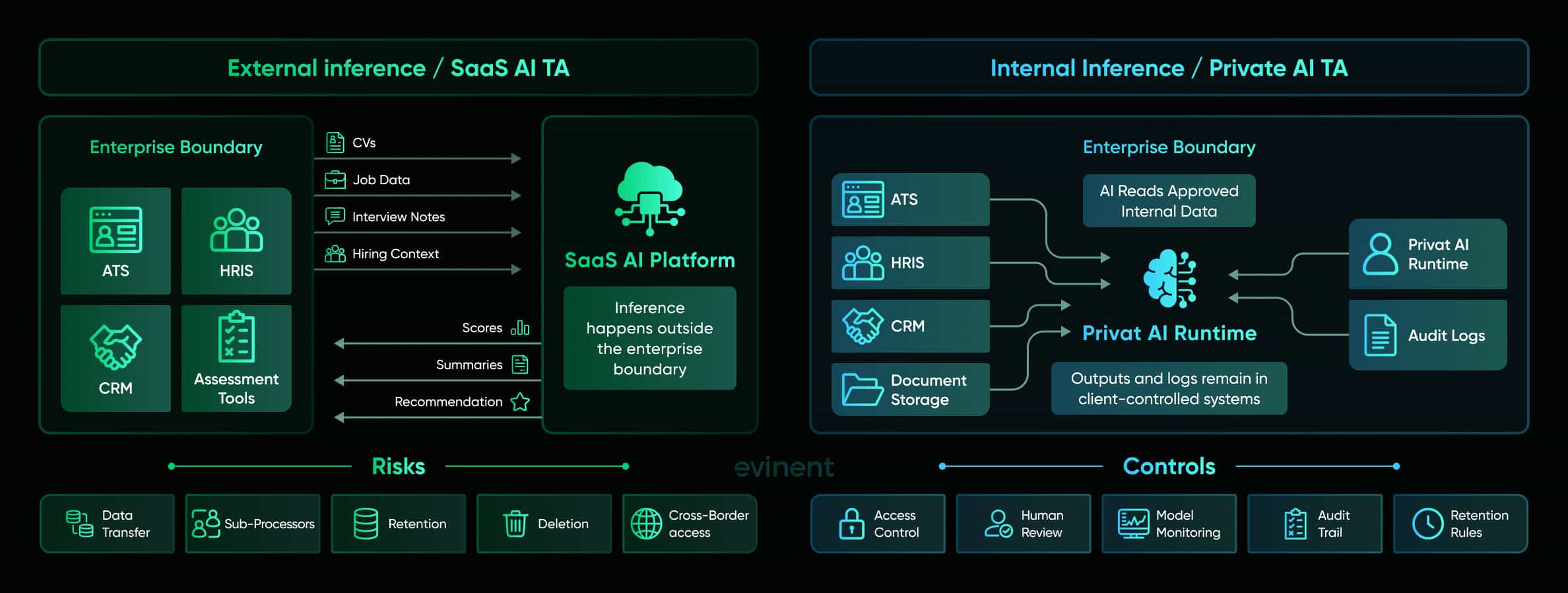
Architecture Snapshot: External Vs. Internal AI Inference
In a standard SaaS AI talent acquisition setup, candidate data moves outside the enterprise boundary to be processed. The ATS, HRIS, CRM, assessment tools, and document storage remain inside the company environment, but CVs, job data, interview notes, and hiring context are sent to the vendor’s AI platform. The recommendation then returns to the recruiter workflow.
In a private AI talent acquisition setup, the inference layer runs inside the client-controlled environment. The AI reads approved data from internal systems, creates summaries or recommendations within the same boundary, and writes decision logs back into enterprise-controlled audit systems.
The practical difference is simple: external inference asks the company to govern every data transfer; internal inference asks the company to govern access, logging, and oversight inside its own architecture.
Why This Matters More Under The EU AI Act
For organizations in Germany, Austria, Switzerland, Poland, France, Spain, or any GDPR-heavy market, inference location should be discussed before the vendor shortlist is closed.
The EU AI Act uses a risk-based model, and the European Commission’s AI Act guidance lists employment use cases as high-risk when AI is used "to place targeted job advertisements, to analyze and filter job applications, and to evaluate candidates." The same guidance states that providers of high-risk AI systems must demonstrate compliance with requirements such as risk management, data quality, documentation, traceability, transparency, human oversight, accuracy, cybersecurity, and robustness.
That has a very practical meaning for AI-driven talent acquisition.
If the AI screens candidates, ranks applicants, filters CVs, supports rejection decisions, or recommends who should move forward, the company needs more than a vendor security PDF. It needs to know what data was used, whether the input data was relevant and representative, who reviewed the output, how automation bias is mitigated, where the decision record is stored, and how a person can explain the decision later. The European Commission also notes that deployers of high-risk systems must monitor operations, assign human oversight, and ensure that input data is relevant and sufficiently representative of the system’s purpose.
That last phrase matters: relevant and sufficiently representative.
If your ATS sends only 12% of usable historical hiring data to the AI tool because the rest is duplicated, missing, or trapped in old HRIS fields, the issue is not just about quality. It can become a governance problem. The company may be using a high-risk AI system with input data that does not properly represent the hiring process it claims to support.
This is where legacy HRIS AI integration becomes a compliance concern, not just an IT .
External Inference Means More Sync Complexity
External inference usually needs a data export pattern. The AI tool asks for candidate context. The enterprise systems prepare the data. The vendor processes it. The output returns. The ATS or recruiter workspace shows the result.
That means the company must decide what data to send. Full CV? Parsed CV? Interview notes? Salary expectations? Assessment results? Hiring manager comments? Prior rejection history? Internal mobility status? Diversity fields should not be used for ranking, but are they visible anywhere in the data package? Who checks?
You can already feel the spreadsheet forming.
The more external calls the system makes, the more careful the sync has to be. If candidate status changes in the ATS but the AI vendor sees a stale copy, the system may recommend action on the wrong candidate. If a candidate requests deletion, the company must understand where the data exists outside its own systems. If a recruiter overrides an AI recommendation, the override must be logged in a location both HR and compliance can access.
This is not impossible. It is just heavier than the demo makes it look.
Internal Inference Keeps The AI Closer To The Hiring System
Internal inference changes the pattern.
Instead of exporting candidate context to the vendor each time, the AI reads approved data through internal connectors. The company can restrict what the model sees by role, workflow, geography, department, or use case. Logs can be written into internal audit systems. Human review can be built into the recruiter workflow. Data retention can follow the company’s existing rules rather than relying solely on vendor-side settings.
There is another benefit that sounds small but is not: fewer translation layers.
When AI runs close to the systems of record, the integration team can design cleaner access to ATS, HRIS, CRM, and document storage. It still has to map data properly. It still has to handle old fields and weird workflows. But it does not have to package a sensitive hiring context for repeated external processing on every inference call.
For a simple AI assistant that drafts job descriptions from public templates, external inference may be fine. For AI-powered talent acquisition workflows that analyze applications, compare candidates, summarize interviews, or support hiring recommendations, internal inference deserves a serious look.
The CTO Version Of The Decision
If the AI only helps recruiters write better job posts, external SaaS may be enough.
If the AI touches candidate filtering, ranking, evaluation, interview summaries, rejection support, or hiring recommendations, inference location becomes part of the risk model.
The decision is not only "Which vendor has the better feature set?" It is:
Can we prove where candidate data goes?
Can we show what data the AI used?
Can we keep a decision log outside the vendor black box?
Can human reviewers understand, challenge, and override the output?
Can we meet EU AI Act expectations without rebuilding the architecture six months after launch?
That is why private AI recruitment is not just a security upgrade. In legacy HRIS environments, it can be a cleaner architecture. The AI operates near the data. The audit trail stays with the enterprise. The integration layer becomes easier to govern.
And for AI talent acquisition, governance is not paperwork after the real work. Governance is part of the product.
How Long Does It Actually Take — Realistic Timelines By Starting Point
The honest answer is: AI talent acquisition takes as long as your hiring data and integration layer make it take.
That sounds annoying. It is also true.
A vendor can quickly configure the AI layer when the underlying systems are clean. But when the ATS, HRIS, CRM, assessment platform, and reporting tools each hold a different piece of the hiring story, the project timeline stops being about AI setup. It becomes about data repair, access rules, API gaps, and process ownership.
So let’s talk in real ranges, not demo ranges.
Scenario 1 — Modern Cloud HRIS With Clean Data
This is the best-case enterprise setup.
The company uses a modern cloud HRIS and ATS stack, such as Workday, SAP SuccessFactors, Greenhouse, Lever, iCIMS, SmartRecruiters, or a similar combination of platforms. The HRIS has documented APIs. The ATS has stable workflows. Job templates are structured. Candidate records are mostly clean. Hiring stages are used consistently enough that one department’s "screening" does not mean another department’s "final review."
In this case, AI talent acquisition implementation can move relatively fast.
The pre-AI work still matters, though. The team has to profile the data, check API access, define permissions, review privacy rules, decide where AI outputs will be stored, and test the workflow with recruiters. Someone also has to decide what the AI is allowed to do. Can it summarize? Can it rank? Can it recommend next steps? Can it update the candidate status after human approval? Those are not small questions.
A realistic timeline for working AI is 8 to 14 weeks. The internal team usually includes a TA operations lead, an ATS admin, an HRIS owner, an IT integration architect, a security reviewer, a legal or privacy contact, and a small recruiter test group. That sounds like a lot of people for a "simple AI pilot," but this is exactly why simple AI pilots get stuck. The model may be simple. The environment is not.
A specialist partner can usually handle workflow mapping, data validation, integration setup, AI configuration, test cases, audit logging, and pilot measurement. The internal team still needs to provide access, make business decisions, provide recruiter feedback, and obtain governance approval.
This is the scenario where an AI-powered talent acquisition rollout can look almost as clean as the vendor promised. Almost.
Scenario 2 — Legacy HRIS With Moderate Data Quality
This is the more common enterprise reality.
The company has an older HRIS, a customized ATS, or a hybrid setup that has grown through acquisitions, regional rollouts, and years of "temporary" fixes. Candidate data exists, but it is uneven. Some roles are well-structured. Others are copied and pasted into free-text fields. Some recruiter notes are useful. Others say things like "not a fit," which means everything and nothing. API access exists, but only for part of the data model.
This setup can still support AI-driven talent acquisition. It just needs more preparation.
The pre-AI work includes candidate deduplication for the pilot scope, job taxonomy cleanup, funnel stage mapping, integration design, API or middleware work, permissions, privacy review, and write-back rules. The company also needs to decide which historical data is sufficient to use and which data should be excluded, because some data will confuse the AI more than help it.
A realistic timeline for working AI is 16 to 28 weeks. That range assumes the company is not trying to clean the entire HR estate first. If leadership insists on full enterprise-wide remediation before the first pilot, the timeline can easily slide into a year. We already covered that trap.
The internal team is bigger here: HRIS specialist, ATS admin, IT architect, data engineer, TA operations owner, recruiter pilot group, security, legal, and someone senior enough to settle arguments about data definitions. That last person matters more than people think. Without decision authority, the project can spend weeks debating whether "screened" and "reviewed" should be treated as the same stage.
A specialist partner can handle the legacy HRIS AI integration layer, pilot data cleanup, middleware, AI workflow setup, logging, testing, and documentation. The company still needs to own the business rules. No outside team can decide what "qualified" should mean for your hiring process without HR and TA leadership.
This is the scenario where the project has to be brutally scoped. One department. One hiring workflow. One set of measurable outputs. Anything wider becomes a swamp.
Scenario 3 — SAP HR Monolith Or Custom Legacy System
This is the hard case.
The company runs SAP HR, SAP ECC-era HR processes, an old PeopleSoft instance, or a custom HR monolith. Recruiting data may sit partly in the ATS, partly in HRIS, partly in spreadsheets, partly in manager notes, and partly in reporting tools that only two people fully understand. APIs are limited. Some data is accessible only through older integration patterns. Writes may be blocked or risky. Business logic may be embedded in custom code.
Here, a full AI talent acquisition rollout isn't an AI project. It is an HR system modernization with an attached AI use case.
A full enterprise rollout can take 6 to 12 months, sometimes longer if the company needs to modernize its HRIS first.
But that does not mean AI has to wait a year.
A scoped pilot can still be completed in 4 to 6 weeks if the use case is sufficiently narrow and the integration path is carefully designed. For example, the pilot might focus on one department, one country, one role family, or one workflow such as CV screening support, job description normalization, or interview summary generation. The goal is not to solve enterprise hiring in six weeks. The goal is to prove whether AI can work with real legacy data without creating compliance or integration chaos.
The internal team usually includes an HRIS lead, an SAP or legacy-system specialist, an enterprise architect, a security contact, a privacy/legal reviewer, a TA operations lead, and a business-unit sponsor. The sponsor matters because a pilot without business ownership becomes a technical demo, and technical demos rarely survive budget season.
A specialist partner can handle architecture assessment, safe data extraction, custom connectors, middleware, private AI runtime setup, workflow instrumentation, and documentation. Evinent’s broader modernization work is already built around the exact kind of system problem that appears here: outdated systems, redundant data, database normalization, monolith-to-modern-architecture work, infrastructure optimization, and technical-debt reduction.
SAP-heavy companies also have a deadline sitting in the background. SAP says mainstream maintenance for SAP Business Suite 7 core applications runs until the end of 2027, with optional extended maintenance available until the end of 2030. That does not mean every HR team must panic tomorrow morning. It does mean that AI talent acquisition planning should not ignore the wider SAP roadmap. If HR data modernization is already underway, the AI pilot should help map the complexity, not create another side system that will have to be untangled later.
Timeline Comparison For Planning
Starting Point | Pre-AI Work Required | Realistic Timeline To Working AI | Internal Team Needed | What A Specialist Partner Handles |
Modern cloud HRIS with clean data | API access review, workflow mapping, permissions, pilot design, audit logging | 8–14 weeks | TA ops, ATS admin, HRIS owner, IT architect, security, legal/privacy, recruiters | AI configuration, integration setup, testing, logging, pilot measurement |
Legacy HRIS with moderate data quality | Data profiling, deduplication, job taxonomy cleanup, funnel mapping, middleware/API work | 16–28 weeks | HRIS specialist, ATS admin, data engineer, IT architect, TA owner, security, legal | Legacy integration, pilot data cleanup, middleware, documentation, QA |
SAP HR monolith or custom legacy system | Architecture assessment, data extraction, custom connector design, security model, scoped workflow | 6–12 months for full rollout; 4–6 weeks for scoped pilot | HRIS/SAP lead, enterprise architect, security, legal, TA sponsor, recruiters | Safe extraction, custom connectors, private AI runtime, pilot architecture, expansion roadmap |
The practical recommendation is the same in all three scenarios: start with the scoped pilot.
Not because pilots are trendy. Because they expose reality.
A scoped AI recruiting pilot shows whether your ATS data can be trusted, whether the HRIS can expose the right fields, whether recruiters understand the output, whether legal can review the decision trail, and whether the business gets enough value to fund the next phase.
A full platform rollout asks the company to believe.
A scoped pilot asks the systems to prove it.
How Evinent Closes The Integration Gap For AI-Driven Talent Acquisition
Not as the company that "adds AI to recruitment." That sounds like every vendor page on the internet. The stronger position is more specific: Evinent handles the layer that most AI talent acquisition projects underestimate: the integration layer between legacy HRIS, ATS data, candidate records, business rules, and the AI workflow itself.
That layer is usually where the project breaks.
The AI platform may be ready. Recruiters may be ready. The budget may be ready. But if the system cannot read clean job data, connect candidate history, write back approved outputs, and log decisions, then the AI stays trapped in pilot mode. Evinent’s core modernization work is already centered on outdated systems, data workflow repair, legacy database normalization, monolith restructuring, infrastructure optimization, and technical debt reduction. That is the exact foundation AI-powered talent acquisition needs before it can become useful in production.
Legacy HRIS Integration Without Pretending The Old System Is Modern
The first job is legacy HRIS integration.
In real enterprise environments, that means connecting AI workflows to SAP HR, older PeopleSoft instances, custom HR platforms, outdated ATS setups, recruiting CRMs, internal databases, and reporting tools that were never built with AI in mind. Some systems expose useful APIs. Some expose partial APIs. Some require middleware. Some still depend on exports, scheduled jobs, or custom connectors that only make sense after someone has carefully read the old system logic.
Evinent’s role is to map that mess into something AI can safely use.
That includes candidate objects, job requisitions, skills, hiring stages, interview notes, recruiter feedback, offer outcomes, rejection reasons, and access rules. It also includes the boring but necessary pieces: error handling, field validation, logging, fallback behavior, permission checks, and maintenance documentation. Without those, the integration works until the first system update. Then everyone remembers why shortcuts are expensive.
Evinent GmbH is certified under ISO 9001:2015 for software product development and software development services. For AI talent acquisition projects, what matters at the integration layer is that every connector, data mapping, access rule, test case, and handover note be documented well enough for IT, HR, and compliance teams to maintain the system after launch.
Scoped AI Pilot Design Instead Of Enterprise-Wide Data Cleanup First
The second job is pilot design.
A lot of companies make AI talent acquisition too large too early. They try to prepare every department, every role family, every region, and every historical candidate record before showing anything useful to recruiters. That feels responsible. It often kills momentum.
Evinent’s better angle is the scoped pilot: one department, one workflow, one hiring problem, one measurable result.
For example, the pilot might focus on CV screening support for one role family, candidate-vacancy matching within one department, job description normalization for one region, or recruiter-assistant workflows for a controlled hiring team. The point is not to fix the entire HR data estate in one move. The point is to prove that AI can work with real enterprise data, inside real access rules, with recruiter review and decision logs.
Evinent already has a relevant HR AI case here. In its secure private AI recruitment case study, the project was a 4–6 week proof of concept for a European enterprise client. The work included isolated AI agents for HR workflows, candidate-vacancy matching, recruiter and candidate assistants, integration with existing vacancy and candidate databases, validation of the matching logic, and a controlled rollout within an HR department sandbox.
That is the kind of proof C-level readers care about. Not "AI can improve recruitment." Fine, everyone knows the promise. The better proof is narrower: AI can read the company’s own HR data, follow its own hiring logic, operate within its own environment, and produce outputs that recruiters can test.
Small? Yes. But small is how serious enterprise AI usually starts.
Private AI Deployment For Sensitive Recruitment Data
The third job is private AI deployment.
For AI talent acquisition, this is not a nice extra. Candidate data is sensitive, and recruitment AI may fall into high-risk territory under the EU AI Act when it is used to analyze, filter, or evaluate candidates. That means the company needs control over input data, human review, logs, access rights, and decision traceability.
Evinent’s private AI recruitment case study shows the practical version of that architecture. The solution used isolated containers, role-based access control, encrypted data flow, custom REST APIs for communication between AI agents and HR databases, PostgreSQL, and Elasticsearch for candidate-vacancy matching, and deployment options including on-premises, private cloud, or hybrid setups. The case study also states that no external API calls or third-party data transfers were used, and all processing occurred within the client’s infrastructure.
That last part is the real differentiator.
In a standard SaaS AI talent acquisition setup, candidate data often needs to leave the enterprise boundary to be processed. In Evinent’s private AI approach, the AI sits closer to the hiring systems. It reads approved data from internal sources. It writes outputs and logs back into controlled systems. It does not depend on OpenAI, Claude, Gemini, or Azure OpenAI token billing for the core recruitment workflow.
This also changes the cost conversation. Token billing can look cheap in a pilot and become awkward in production, especially when recruiters start processing large CV pools, interview notes, job descriptions, and candidate communications every day. A private setup requires more upfront architectural work, but it gives the company greater control over data, cost behavior, and long-term ownership.
Why Building Both The Integration Layer And The AI Layer Matters
The reason Evinent can make a stronger claim here is that it does not treat AI as a separate layer floating above HR systems.
It builds the integration and AI layers together.
That matters because AI talent acquisition output depends directly on what the integration layer can provide. If the AI assistant needs candidate availability, but that field lives in a recruiting CRM, the integration has to know that. If it needs hiring outcome data, which sits in the HRIS after onboarding, the architecture has to account for that. If recruiters need to override AI recommendations, the workflow has to log the override somewhere useful. If legal asks why a candidate was filtered, the system has to produce a decision trail.
You cannot bolt that on at the end.
This is why Evinent should not be positioned as "another AI vendor." The better framing is:
Evinent helps enterprises test, build, and expand AI-driven talent acquisition in environments where legacy HRIS, ATS fragmentation, data quality issues, and compliance rules would normally block the project before go-live.
For organizations where SAP ECC is still in place and the 2027 migration deadline is approaching, the AI talent acquisition conversation and the HRIS modernization conversation are one and the same. Starting the pilot now maps the integration complexity before the SAP clock forces the decision.
A CTO’s Quick Test Before Approving AI Talent Acquisition Spend
Before approving another AI talent acquisition platform, ask a less exciting question first:
Can our hiring systems support the workflow we are about to buy?
Not in theory. Not in the vendor’s sandbox. In your real ATS, your real HRIS, your real recruiter process, with your old candidate records, your custom fields, your access rules, and your compliance requirements.
Because this is where the money either becomes useful or quietly turns into another software subscription nobody wants to defend next year.
Start with the data path. Pick one AI use case and follow the data from start to finish. For example, if the tool supports CV screening, where does the job description come from? Is it structured? Where does the CV come from? Is it parsed reliably? Where are screening questions stored? Where are recruiter notes stored? Where does the final decision go? If the answer crosses five systems and two spreadsheets, the project is not impossible, but it is not a plug-and-play rollout either.
Then check the write-back rules. Many AI recruiting tools can read data. That is the easy part. The harder question is whether they can write approved outputs back into the right system. Can the AI-generated summary be saved in the ATS? Can recruiter edits be logged? Can a rejected recommendation be stored as feedback? Can the system update a candidate stage only after a human s it? If the AI cannot write back safely, recruiters will copy, paste, edit, and eventually stop bothering.
Next, look at decision traceability. If a candidate later asks why they were screened out, or if legal asks how a shortlist was produced, can the company answer? A useful AI talent acquisition setup should record the input data used, the AI output, the reviewer, the override if there was one, and the final action. This does not mean every recruiter needs to read a technical log. It means the system should leave a trail that HR, IT, and compliance can inspect without performing archaeology.
The fourth test is recruiter trust. This one sounds softer, but it is brutally practical. Recruiters will forgive a new tool for being imperfect. They will not forgive it for being confidently wrong. If the AI recommends candidates based on outdated job data, misses internal applicants, duplicates records, or ignores real hiring context, recruiters will stop using it. Quietly. No revolt. Just non-use.
Finally, ask where inference runs. If candidate data leaves the enterprise boundary every time the AI screens, ranks, summarizes, or recommends, the company needs to govern that movement. If inference runs inside a client-controlled environment, the architecture changes. The data stays closer to the hiring system. Logs are easier to own. Access rules are easier to reason about. Neither option is automatically right for every company, but pretending the difference does not matter invites trouble.
Here is the quick version a CTO can use in a vendor meeting:
Question | Why It Matters |
Which systems does the AI need to read from for this use case? | Shows whether the vendor understands the real data path, not just the ATS surface layer. |
Which systems does it need to write back to? | Reveals whether the AI becomes part of the workflow or another copy-paste tool. |
What happens when candidate data is duplicated or incomplete? | Tests whether the tool handles normal enterprise mess, not just clean records. |
Can every AI output be reviewed, edited, rejected, and logged by a human? | Required for trust, governance, and high-risk hiring workflows. |
Where does inference run? | Defines the compliance boundary, data transfer model, and integration architecture. |
Who owns job taxonomy, candidate identity, and stage mapping after launch? | Prevents the system from degrading three months later. |
What breaks when the ATS or HRIS changes a field? | Exposes whether the integration is maintainable or fragile. |
Can we run this first on one department with real data? | Keeps the project grounded before a full rollout burns budget. |
A good vendor or integration partner should be comfortable with these questions. A weak one will drift back to features.
That is the tell.
The strongest AI talent acquisition projects do not start with "Which model is best?" They start with "Which hiring workflow can we safely improve first, using real data, with a clean audit trail and recruiter review?" That question is less shiny. It is also the question that saves the project.
FAQ
Why Is AI Talent Acquisition Taking So Long To Implement In Our Organization?
The AI implementation isn't the slow part.
The slow part is usually everything underneath it: fragmented ATS data, incomplete HRIS records, inconsistent job taxonomy, duplicate candidate profiles, missing hiring-outcome data, and integration paths built for reporting rather than live AI workflows. The AI tool may be configured in a few weeks, but if it cannot access clean hiring data, it cannot produce output recruiters will trust.
This is why an eight-week AI talent acquisition rollout can quietly become a six-month data and integration project. The platform is waiting for the surrounding systems to become usable.
What Data Does Our HRIS Need Before AI Recruiting Tools Will Work?
At a minimum, the AI needs structured job data, clean candidate records, consistent hiring stages, and linked outcome data.
That means the system should know what role is being filled, which skills are required, which candidate records belong to the same person, where each candidate sits in the funnel, and what happened after previous hiring decisions. Did the person accept the offer? Did they pass probation? Did they stay? Did the hiring manager rate the hire well?
Without that history, AI talent acquisition tools mostly rely on keyword matching and processed signals. They may still look impressive in a dashboard, but the recommendations will be thin.
Can We Run An AI Talent Acquisition Pilot Without Modernizing Our Entire HRIS First?
Yes, and in most legacy environments, that is the smarter way to start.
A scoped pilot does not need the whole HR estate to be cleaned first. It needs a single hiring workflow with sufficient reliable data to test whether AI can help. For example, a company can start with one department, one role family, one country, or one workflow, such as CV screening support, job description normalization, interview summaries, or candidate-vacancy matching.
The point is not to avoid modernization. The point is to stop guessing. A 4–6-week pilot can show which data problems actually block AI value and which can wait.
Does AI-Powered Talent Acquisition Require Candidate Data To Leave Our Network?
Not always.
In a standard SaaS setup, candidate data may leave the enterprise boundary to be processed in the vendor’s AI environment. That can include CVs, job descriptions, interview notes, screening answers, and hiring context. The company then has to govern data transfer, retention, deletion, vendor access, sub-processors, and audit logs.
In a private AI recruitment setup, inference can run inside the client-controlled environment. The AI reads approved internal data, produces summaries or recommendations within the same boundary, and writes logs back to enterprise-controlled systems.
For simple use cases like job post drafting, SaaS AI may be enough. For candidate filtering, ranking, evaluation, or hiring recommendations, inference location deserves much closer review.
How Does The EU AI Act Affect AI Recruiting Implementation In 2026?
The EU AI Act classifies many AI use cases in recruitment as high risk. The European Commission’s AI Act FAQ says Annex III includes AI systems used to place targeted job ads, analyze and filter job applications, and evaluate candidates. High-risk AI systems must meet requirements around risk management, data quality, documentation, traceability, transparency, human oversight, accuracy, cybersecurity, and robustness.
So if the AI only helps rewrite job descriptions, the risk profile may be lighter. If it filters candidates, ranks applications, recommends who moves forward, or supports rejection decisions, the organization needs a much stronger governance model.
For CTOs, this changes the implementation plan. You need decision logs, human review, input data controls, access rules, and a way to explain how AI output was used. Compliance cannot be added as a final checkbox after the pilot works. It has to be part of the architecture from the beginning.
What Is The Difference Between AI Talent Acquisition And Traditional ATS Automation?
Traditional ATS automation usually follows rules. Move a candidate to a stage. Send an email. Trigger a reminder. Create a task. Route an approval.
AI talent acquisition tries to interpret context. It may summarize CVs, compare candidates against role criteria, draft recruiter notes, identify likely matches, analyze hiring funnel patterns, or recommend next actions.
That difference is exactly why infrastructure matters. Rule-based automation can survive with simpler data. AI needs a richer context. If that context is incomplete, duplicated, stale, or trapped in disconnected systems, the AI output becomes unreliable.
Who Should Own AI Talent Acquisition Internally?
Not only HR. Not only IT. Definitely not only the vendor.
A serious AI talent acquisition project needs shared ownership. HR or TA should own hiring logic, recruiter workflow, job taxonomy, and candidate experience. IT should own integration architecture, system access, security, and maintainability. Legal or compliance should own privacy rules, high-risk AI obligations, retention, and audit expectations. Business leaders should define what success means beyond "we launched the tool."
The mistake is letting ownership sit in one function while the consequences spread across five.
What Should We Measure Before Calling AI Talent Acquisition Successful?
Do not stop at "number of candidates screened" or "AI recommendations generated." Those numbers are easy to inflate and hard to trust.
Better measures include recruiter time saved, recommendation acceptance rate, override rate, candidate-stage accuracy, time-to-shortlist, interview-to-offer conversion, quality-of-hire signals where legally and practically available, and the percentage of AI outputs with complete audit trails.
Also measure failure. Where did the AI get it wrong? Which data fields caused bad recommendations? Which roles produced weak matches? Which recruiters stopped using it? That feedback is not embarrassing. It is the map for the next iteration.
What Is The First Step Before Buying An AI Recruiting Platform?
Run an AI talent-acquisition readiness check on a single real workflow.
Pick a hiring process that matters, then map the data required to support it. Check where job data lives, where candidate profiles live, where hiring stages are stored, where recruiter feedback is stored, where outcomes are recorded, and which systems the AI would need to read from or update.
Then test whether that data is complete enough, structured enough, and accessible enough for AI to use. If it is not, the first project is not a vendor rollout. It is integration and data preparation.
The Practical Next Step: Prove One Workflow Before Buying The Full Story
AI talent acquisition becomes much easier to assess when the company stops treating it as a platform decision and starts treating it as an infrastructure test.
Pick one hiring workflow.
Not all recruiting. Not every region. Not every job family. One workflow where the pain is obvious and the data is at least partly usable. The company may have a high-volume support role where recruiters spend hours on first-pass screening. Engineering hiring may suffer because job requirements are written differently by every hiring manager. Maybe interview feedback is scattered across the ATS, email, and notes, so nobody can see why candidates drop between the technical interview and offer.
Start there.
Then ask what the AI needs to do to be useful. Which systems does it need to read from? Which fields does it need? Which records are duplicated? Which hiring stages are unclear? Which outputs need human review? Where should the final decision log live? What data cannot leave the enterprise boundary? What will recruiters accept as helpful, and what will make them roll their eyes after week two?
That small workflow will reveal more than a 40-slide vendor deck.
It will show whether the ATS data is structured enough. It will show whether the HRIS can expose the right fields. It will show whether candidate's history is usable or mostly decorative. It will show whether legal and compliance can review the process without stopping everything. It will show whether recruiters trust the AI when it touches real candidates, real roles, and real hiring pressure.
This is also the safest way to avoid the two bad extremes.
One extreme is buying AI talent acquisition software and hoping the integration problem solves itself. It won’t. The other extreme is launching a giant HR data cleanup program before proving whether the AI workflow is worth the effort. That can burn a year and still leave the business with nothing recruiters use.
A scoped pilot sits between those mistakes.
It gives the company a real answer to a real question: Can AI support this hiring workflow with our current systems, data, and compliance requirements?
If yes, expand carefully. Add another role family. Add another department. Add another workflow. Improve the data layer as the AI use cases grow.
If no, that is still useful. Maybe the job taxonomy is too weak. Maybe candidate identity is broken. The HRIS may not support the needed API access. Maybe inference should run within the enterprise boundary rather than in a SaaS vendor environment. Better to learn that in a controlled pilot than after a global rollout has been announced.
The companies that get AI-driven talent acquisition right will not be the ones that buy the flashiest recruiting AI platform first. They will be the ones who make the hiring system readable, connected, governed, and trusted enough for AI to work.
The Board-Level Takeaway: AI Hiring Fails As A System Problem
For a CEO, COO, or CTO, the main mistake is treating AI talent acquisition as an HR software purchase.
The recruiter sees the output: a shortlist, a CV summary, a candidate score, an interview note, and a suggested next step. But behind that output sits a chain of systems that either works or does not. ATS data. HRIS data. CRM history. Assessment results. Job taxonomy. Interview notes. Identity rules. API access. Audit logs. Retention policies. Human review. Security. Legal approval.
If one part of that chain is weak, the AI does not politely warn the recruiter. It just gives a weaker answer.
That is why AI talent acquisition can look fine in procurement and still fail in production. The buying process evaluates features. The implementation exposes architecture. Those are very different tests.
A board does not need to understand every API call between the ATS and HRIS. But it does need to understand the risk pattern:
If hiring data is fragmented, AI recommendations will be incomplete.
If job requirements are unstructured, AI screening will be inconsistent.
If candidate identities are duplicated, AI history will be unreliable.
If outcome data is missing, AI cannot learn from hiring quality.
If logs are trapped within the vendor platform, auditability suffers.
If inference runs outside the enterprise boundary, data transfer governance becomes part of the operating model.
This is not a reason to avoid AI in talent acquisition. It is a reason to stop buying it as if the enterprise were already ready.
The better board-level question is not, "Which AI recruiting platform should we buy?"
It is: "Which hiring workflow can we safely improve first, and what infrastructure must be fixed so the AI output is trusted?"
That question changes the project.
It moves the discussion away from generic AI enthusiasm and toward measurable readiness. It also protects the business from two expensive mistakes: signing a large SaaS contract before the data layer is ready, or launching a giant HR modernization program without proving where AI can create value.
A scoped pilot does both jobs. It tests the AI use case and the underlying infrastructure. It shows whether the HRIS can expose the right data, whether recruiters trust the recommendations, whether legal can review the workflow, and whether the company can maintain the integration after the first release.
And yes, this is less exciting than a vendor demo.
But enterprise AI does not fail because nobody got excited. It fails because nobody checked whether the systems could carry the weight.
Share