

Should You Build or Buy Marketplace Software? Let's Get to Grips With It
For the vast majority of marketplace founders and CTOs, the initial question they ask is the wrong one: Is it better to build everything ourselves or take an existing platform as the base?
Actually, successful e-commerce marketplace software development is hardly ever a black-and-white decision. The biggest marketplaces employ a mix of methods, taking advantage of well-established third-party solutions to cover the standard functionalities and doing custom developments only for those parts of the business processes that add significant value to the business.
As a rule, components such as payment processing, shipping integrations, email delivery, authentication, and basic analytics are usually better purchased or integrated from established providers. These features are difficult to build well, require ongoing maintenance, and rarely provide a competitive advantage.
On the other hand, marketplace-specific functionality often benefits from custom development. Supplier portals, catalog management systems, moderation workflows, onboarding processes, and proprietary business logic directly affect operational efficiency, supplier experience, and long-term scalability. These are the areas where off-the-shelf software often becomes a limitation as the marketplace grows.
Often, the trouble lies in determining where the boundary should be set. If you do too much construction, the costs, schedule, and maintenance requirements of the development will be out of control very soon. On the other hand, if you buy a lot, your marketplace might be limited by the features of third-party software, and it can be hard to support unique workflows or distinguish your business from competitors.
We will dissect the main elements of a marketplace tech stack and show you how to make the right decision for each one with a build-vs-buy tool. We will see which software is best purchased, when a custom-built marketplace can give you a competitive edge, and how to decide what to develop first when you are launching a new marketplace.
What you'll learn in this article
How to evaluate marketplace components using a build-vs-buy framework.
Which marketplace features are usually best purchased from third-party providers?
Which systems typically require custom development?
Why supplier portals often become the core operational component of a marketplace.
How to structure an MVP to reduce risk and accelerate launch.
Common marketplace development mistakes and how to avoid them.
A real-world example of marketplace scaling through custom content management and supplier workflows.
Why “Just Use Shopify” Is the Wrong Approach to Building an E-commerce Platform
When founders start planning an e-commerce marketplace development project, the discussion often revolves around platforms. Should you use Shopify, Magento, a dedicated marketplace platform, or invest in custom marketplace development?
The problem with this question is that it assumes marketplace software to be a single product. But, actually, a marketplace is a compound of different systems that operate different business functions. The main problem lies not in the selection of a platform but in the identification of components to be built from scratch and those supported by familiar software.
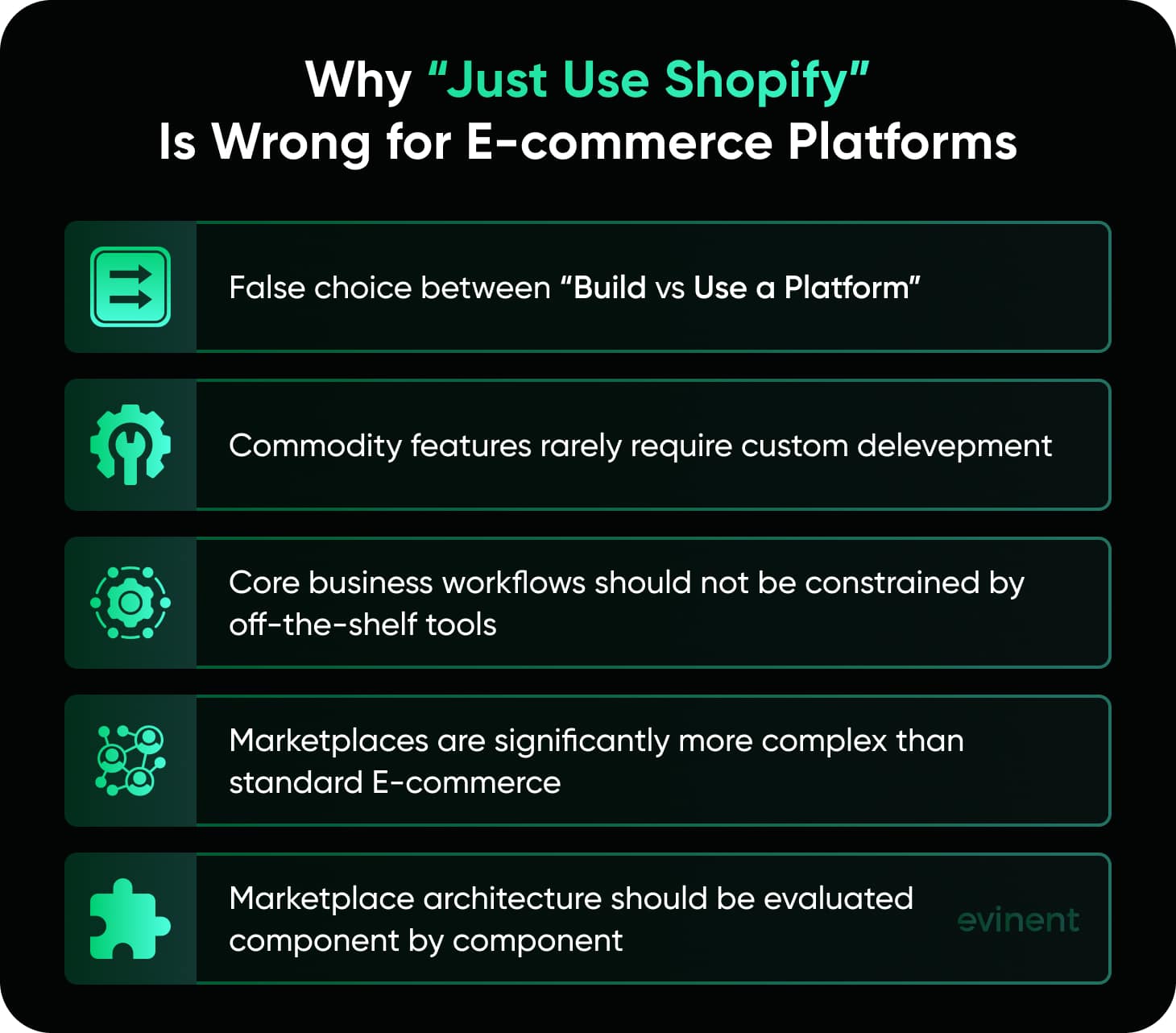
Reason 1: “Build vs Platform” Is a False Choice
The majority of teams treat the decision to build or buy marketplace software as an either-or decision. Either the whole thing is built from scratch, or a platform is expected to handle every problem. In reality, great marketplaces are the result of a combination of the two. They take advantage of the software that is already good while their internal developers work on figuring out ways to tailor the workflows to the specific business. A powerful digital marketplace plans its technology strategy with more than one platform.
Reason 2: Commodity Features Rarely Justify Custom Development
Don't think payments, shipping integrations, auth, email delivery, and basic analytics are the things that bring a marketplace to success. That stuff is all handled by mature vendors pretty well, and in general, you can integrate them quickly, at a good price, and with little to no risks when compared to making them internally. Most companies should, therefore, make their marketplace platform choice in a way that the existing solutions for the standard functionalities are used, not that they are reinvented.
Reason 3: Strategic Workflows Should Not Be Limited by Software
The opposite mistake is relying too heavily on off-the-shelf tools. Supplier onboarding, catalog management, moderation processes, and marketplace-specific business logic often evolve as the business grows. These workflows are frequently what differentiate one marketplace from another. When they are constrained by generic software, growth and operational efficiency can suffer. This is where custom marketplace development often delivers the greatest return.
Reason 4: Marketplaces Are More Complex Than Traditional E-Commerce
While typical ecommerce stores only manage their own products and operations, a marketplace has the additional responsibility of coordinating multiple suppliers, product catalogs, approval processes, and operational workflows at the same time. This extra layer of complexity is the main reason why the development of multi-vendor ecommerce requires a completely different approach to architecture, integrations, and scalability than traditional ecommerce projects.
Reason 5: Marketplace Architecture Should Be Evaluated Component by Component
The most effective marketplace architecture is built through a series of component-level decisions. Instead of looking for a platform that does everything, companies should evaluate each system individually and determine whether it is a strategic asset or a commodity service. That approach leads to better technology decisions, lower development risk, and a more scalable foundation for long-term growth.
It's the first thing to do in learning what constitutes a technology stack for a modern marketplace and how each part should be assessed in a build vs buy context.
The Marketplace Technology Stack: What Are the Components?
One of the biggest errors in developing an e-commerce marketplace is considering the marketplace as one whole application. But a contemporary marketplace tech stack is actually made up of several interconnected systems, each handling a particular aspect of the business.
Understanding this marketplace technology stack is essential when making build-vs-buy decisions. Some systems can be supported by existing software, while others often require custom development to support unique operational workflows. At a high level, marketplace architecture can be viewed as a flow of information between suppliers, marketplace operators, customers, and external services.
Component | Primary Purpose | Main Users | Typical Build vs Buy Approach |
Storefront | Product discovery and purchasing | Customers | Usually Buy or Headless |
Supplier Portal | Supplier onboarding and management | Vendors | Often Build |
Catalog Management System | Product data validation and publishing | Suppliers, Operations Team | Often Build |
Order Management System | Order processing and fulfillment tracking | Operations Team, Suppliers | Hybrid |
Payment Infrastructure | Payments, commissions, payouts | Customers, Suppliers | Usually Buy |
Analytics and Reporting | Performance monitoring and insights | Management Team | Usually Buy |
Content Management System | Website content and SEO | Marketing Team | Usually Buy |
ERP/PIM Integrations | Data synchronization | Internal Teams | Usually, build or customize |
The main point is that a marketplace is not one platform but a series of different specialized systems working in combination. The next big question is deciding which of these systems should be bought as ready-made software and which ones should be turned into strategic assets through development to support the long-term competitive edge.
A Simple Framework for Deciding What to Build and What to Buy
A failure in ecommerce marketplace software development that is so common is deciding at a platform level when decisions should be made at a component level. Teams work for months to decide between Shopify, Magento, or other marketplace platforms, not realizing that the real complexity situation is inside individual systems, such as supplier onboarding, catalog management, and order workflows.
It makes the result very predictable: either too much infrastructure is built, which could have been bought, or the reliance on platforms that cannot support unique marketplace workflows is too much.
Research in software delivery consistently shows that complexity is one of the main drivers of failure in large IT initiatives. The Project Management Institute (PMI) reports that a significant share of projects fail to meet their original goals due to poor requirements definition, scope changes, and complexity overload. This is especially relevant in marketplace systems, where multiple interconnected components must evolve together.
Instead of asking whether to use a platform or build everything from scratch, a more accurate question is: which components should be built internally, and which should be delegated to existing systems?
The Five Questions Framework
When judging any element in marketplace software architecture, a choice should be made on five clear criteria.
Does this component create a competitive advantage?
Custom marketplace software development is often considered if a system directly impacts supplier experience, catalog quality, or operational efficiency.
Is the workflow unique to your business?
In multi-vendor ecommerce development, quite a lot of workflows are vertical-specific. General-purpose tools usually don't fit when changes in supplier behavior, validation rules, or catalog structures are so significant.
Will requirements change frequently?
Online marketplace platforms are changing every day. Supplier onboarding guidelines, moderation rules, and catalog verification usually change over time as the platform grows.
Is mature SaaS software available?
Where stable, well-supported SaaS products exist, building from scratch rarely creates additional value. Gartner has repeatedly emphasized that organizations often underestimate the long-term complexity and lifecycle cost of customizing packaged software, particularly when integrations and workflow adaptations are required over time (Gartner IT Glossary, 2026)
Does this component affect scalability?
Scalability constraints often emerge not from customer-facing systems, but from operational layers such as supplier onboarding, catalog processing, and moderation workflows.
Build, Buy, or Hybrid Decision Matrix
Most e-commerce technology decisions fall into three categories: build, buy, or hybrid.
Component | Recommended Approach |
Payment Infrastructure | Buy |
Shipping Integrations | Buy |
Authentication & Security | Buy |
Analytics & Reporting | Buy/Hybrid |
Storefront | Hybrid |
Order Management System | Hybrid |
Supplier Portal | Build |
Catalog Management System | Build |
Moderation Workflow | Build |
Marketplace Business Logic | Build |
Essentially, the main message is very clear: the right marketplace design is not about deciding whether to make or buy. Rather, it is about using a well-organized marketplace build vs buy framework on each part and cutting down on added complexity as much as possible.

Then, we'll discuss which parts of the marketplace you can usually trust to be outsourced and which ones will need you to do custom development if you want to stay competitive.
What Marketplace Components Are Usually Better to Buy
Some marketplace components look deceptively simple to build. A payment form, a shipping rate calculator, a search bar — these seem like a few weeks of development at most. In practice, they represent years of iteration by specialized teams solving problems most marketplace founders haven't encountered yet. The rule of thumb: if a component's core value is reliability and compliance rather than business logic, buy it.
Payment processing
Stripe and PayPal aren't just payment forms — they're PCI DSS compliance, fraud detection, dispute resolution, multi-currency support, and payout logic for multiple vendors baked into one integration. Building equivalent infrastructure from scratch takes a minimum of 12–18 months and requires ongoing maintenance as regulations change across markets. The cost of a data breach or a failed payout at scale dwarfs any licensing fee.
Shipping integrations
Carrier APIs keep changing, rate structures are evolving, and new carriers are entering the market. A custom-developed shipping module will start to deteriorate on the very day it is dispatched. Services such as EasyPost or Shippo carry out the inevitable task of maintaining connections to a large number of carriers, handling label generation, tracking webhooks, and return flows, and even making updates when UPS changes its API for the third time this year without anyone noticing.
Tax calculation
Tax laws are complicated and constantly changing. VAT laws differ in every EU country. US nexus is a going concern, with each state drafting new laws to tap into e-commerce sales. Marketplace facilitator legislation is also a recent innovation. These are not things any business can handle independently if tax software is not its main product. That is why companies like Avalara and TaxJar came into existence.
Email delivery
Deliverability, quite frankly, is an infrastructure specialty. Things like IP reputation, SPF/DKIM/DMARC configuration, bounce handling, unsubscribe compliance, all that is basic stuff for a marketplace. SendGrid, Postmark, or Amazon SES can do it, but at a price that makes creating another option completely unreasonable.
Authentication and security
Auth0 and similar services provide MFA, SSO, OAuth, session management, and security monitoring. The alternative is maintaining a custom auth system — which means your team owns every CVE, every token rotation, every compliance audit. For a marketplace handling supplier and buyer accounts simultaneously, this is especially high-risk territory to own.
Basic analytics
Standard funnel metrics, retention cohorts, revenue dashboards — these are solved problems. Mixpanel, Amplitude, or even a well-configured GA4 covers the reporting needs of most marketplaces through Series B. The exception is analytics tied to proprietary business logic: supplier performance scoring, catalog quality metrics, and custom moderation reporting. That's where standard tools hit their ceiling.
Search infrastructure
Years of work in distributed systems engineering are well reflected by Elasticsearch, Evinent Search, and Algolia. For an e-market with an increasing catalog, it is still very challenging to make relevance tuning and faceted filtering efficient without giving attention also to index sharding and cluster uptime. So, get the infrastructure and then spend your engineering time on the search experience built on it.
The real cost of building any of these isn't the initial development — it's the ongoing maintenance, the security patches, the compliance updates, and the engineering attention permanently diverted from the components that actually differentiate your marketplace. Every sprint spent maintaining a custom email delivery system is a sprint not spent on supplier onboarding, catalog management, or moderation workflows where custom logic creates a real competitive advantage.
What Marketplace Components Usually Require Custom Development
Not all marketplace features must be tailored. In fact, many parts of the workflow, supplier experience, and the potential to scale in a marketplace are so interconnected that one day, standard ready-made software solutions may be the very thing holding you back rather than pushing you ahead. Usually, these are the very points at which in-depth custom marketplace software development produces the highest long-term value.
Supplier Onboarding Workflows
Supplier onboarding is rarely as easy as gathering company information and giving account approval. Different marketplaces demand different types of validation, documentation, approval chains, and product standards.
Usually, generic marketplace platforms offer very basic onboarding functionalities, but when workflows become industry-specific, they struggle. For example, a B2B marketplace may need to check for compliance, review contracts, or obtain approval to sell in certain categories before a supplier is allowed to start selling.
As the supplier network grows, onboarding efficiency directly affects marketplace growth. Custom workflows make it possible to automate approvals, reduce manual reviews, and ensure consistent supplier quality without increasing operational overhead.
Supplier Portal Functionality
The supplier portal is often the operational heart of a marketplace. While most platforms offer standard vendor dashboards, marketplaces frequently outgrow them as supplier requirements become more sophisticated. Vendors may need custom inventory workflows, product validation tools, bulk upload capabilities, content approval tracking, or integrations with their internal systems.
That is the reason why lots of successful marketplaces end up having their own supplier portal marketplace developed from scratch instead of just using off-the-shelf marketplace software. Actually, the supplier portal ends up being the main channel through which suppliers and the platform interact with one another; therefore, it has an immediate impact on supplier satisfaction, productivity, and retention.
Catalog Validation Rules
Product data is one of the most valuable assets in any marketplace. Unfortunately, it is also one of the most difficult to manage at scale.
Suppliers often submit incomplete, inconsistent, or inaccurate information. Different categories may require different attributes, naming conventions, media standards, and compliance checks. According to Gartner, poor data quality costs organizations at least $12.9 million per year on average, highlighting the business impact of inaccurate and inconsistent information across enterprise systems. (Gartner, 2024)
For marketplaces in a growth phase, catalog validation is more than just a content management issue. It poses a scalability challenge as well. With the help of custom catalog management systems, companies can set up category-dependent criteria, carry out product quality assessments automatically, and ensure uniformity of product information across a vast number of suppliers and SKUs.
Product Content Enrichment
Apart from authentication, a lot of e-commerce platforms also have to make product details more appealing and clearer before publishing them to the shoppers. This might be different aspects of one product laid out in the same format, product classification done by machines, written assistance from AI to create the product descriptions, image-related features, search engine optimization, or the addition of content coming from other data sources.
Such activities rely heavily on the type of business the marketplace is running, the way their catalog is set up, and what the customers are expecting. Therefore, the basic functionalities that come with the platform may not be sufficient for a long time. Personalized content enrichment processes enable online stores to raise their search standards, boost their conversion rates, and lessen the dependency on the internal teams for manual work.
Moderation Workflows
Content moderation becomes increasingly complex as marketplaces scale. Products may require approval before publication. Certain categories may trigger additional reviews. Some suppliers may need stricter oversight than others. In regulated industries, moderation requirements can become a critical compliance function. Most marketplace platforms offer basic approval mechanisms, but few support the nuanced rules that emerge in real-world operations.
Custom moderation workflows provide the flexibility needed to manage risk, maintain quality standards, and reduce the workload on internal teams.
Marketplace-Specific Business Logic
Eventually, every thriving marketplace formulates a set of processes that are distinctive to its model. The way commission is shared, the method of ranking suppliers, the pricing system, the process of scoring content, the eligibility of products, and the incentives of the marketplace are some of the features that, over time, have become proprietary marketplace features impacting performance directly.
Since these systems represent a competitive edge in the marketplace, replicating them using off-the-shelf software is quite challenging. They are, in fact, the main reasons why suppliers and customers decide on one platform as opposed to another.
Internal Operational Tools
One of the most overlooked areas in marketplace architecture is internal tooling. Operations teams often rely on dashboards, review queues, exception management tools, supplier support interfaces, and reporting systems that are invisible to customers but critical to day-to-day operations.
As marketplaces grow, these internal systems frequently become more important than customer-facing functionality. Well-designed operational tools allow teams to manage larger catalogs, support more suppliers, and maintain quality standards without proportional increases in headcount.
Why Off-the-Shelf Solutions Eventually Reach Their Limits
Marketplace platforms work great for speeding up the launch and lowering the initial development work. The problem is that the majority of them are created to accommodate the "average" marketplaces only.
But the development of a business is seldom according to an average set of requirements. When supplier networks get larger, product catalogs become more complicated, and the range of operating procedures changes, marketplaces often realize that the biggest issues they face are no longer payments, storefronts, or checkout flows. Instead, it is the business processes that differentiate them that are the major pain points.
That is why the most successful marketplace software architectures typically combine off-the-shelf infrastructure with custom-developed operational systems. Standardized components handle commodity functionality, while custom development focuses on the areas that drive marketplace competitive advantage and long-term scalability.
The MVP Approach to Marketplace Software Development
The most expensive mistake in marketplace development isn't choosing the wrong technology — it's building too much before you've validated anything. A marketplace with six months of development behind it and no proven supplier-buyer liquidity is not an asset. It's a liability with a six-month burn rate attached.
The MVP principle for marketplaces is straightforward: launch the minimum scope that lets you validate the core transaction loop — a supplier lists a product, a buyer finds and purchases it. Everything else is a hypothesis that real usage will either or invalidate.
MVP Marketplace Scope
A marketplace minimum viable product for a working business requires five elements: supplier onboarding, product listings, search, checkout via a third-party integration, and simple order management. Nothing else. Review systems, fancy analytics dashboards, tools for bulk catalog importing, loyalty programs, recommendation engines, all of these are not part of the first release. They are in the backlog, waiting to be prioritized according to the requests of early users.
The supplier portal deserves special attention here. It's the component most teams underscope at the MVP stage and then rebuild under pressure six months post-launch. A self-service supplier portal — even a minimal one — removes a bottleneck that otherwise requires internal team involvement for every new vendor onboarded.
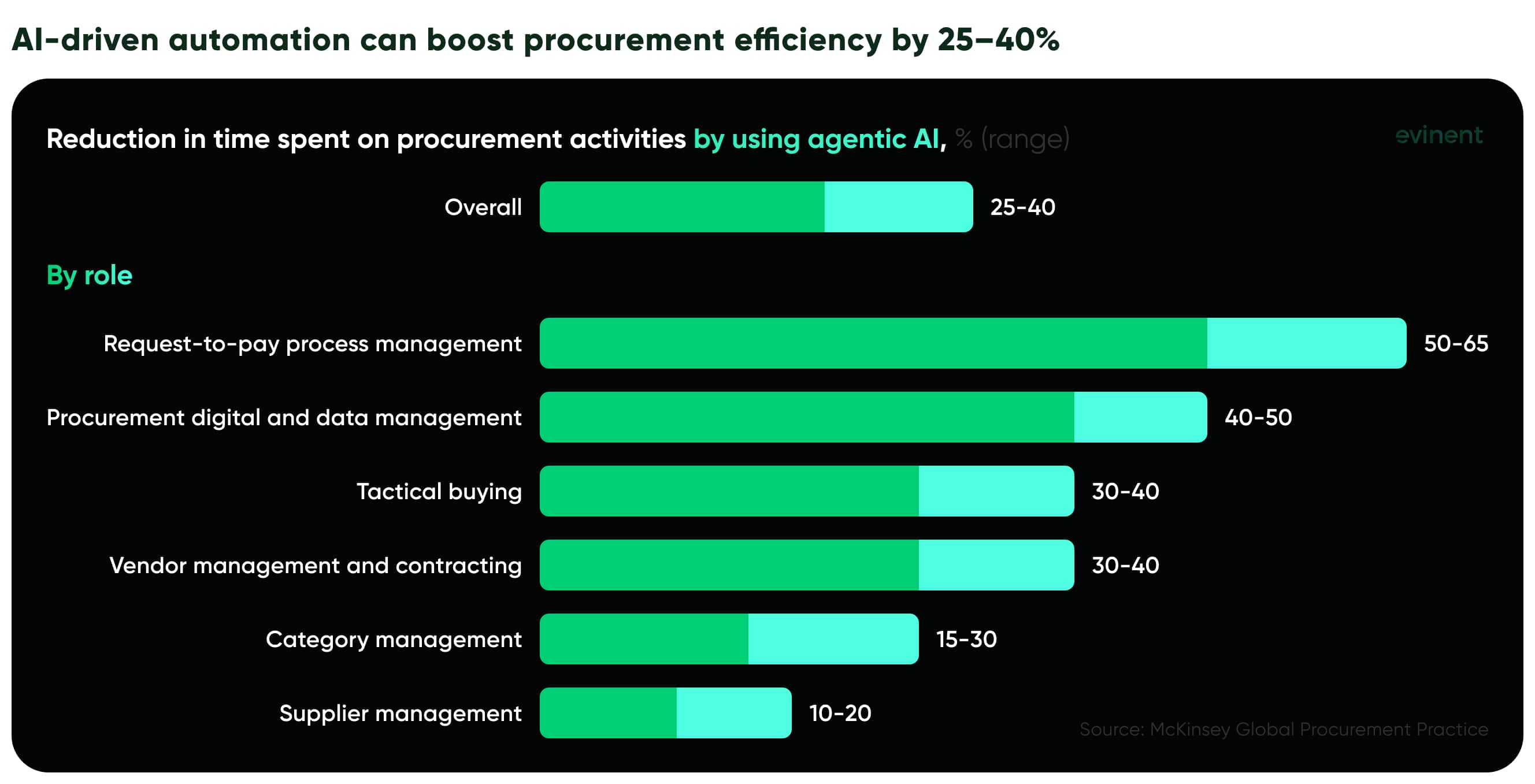
McKinsey's research on procurement transformation shows that AI-enabled automation can make procurement functions 25–40% more efficient while shifting team activity from routine tasks to strategic work. The same logic applies to marketplace operations: when suppliers manage their own onboarding, listings, and updates, the internal team stops being a bottleneck and starts being a growth function. (McKinsey, 2025)
What to Launch First
The build order follows the dependency chain, not the feature wishlist:
Supplier portal — without it, the catalog stays empty, and the business model can't be tested with real suppliers
Catalog and listing management — defines the data structure that search, checkout, and analytics all depend on
Search and browse — even a basic keyword search with category filtering is enough to validate buyer behavior
Checkout — integrate Stripe or equivalent; don't build payment logic at MVP stage
Order management — minimum viable: order ation, status tracking, supplier notification
What to Postpone
Features that consistently don't belong in a marketplace MVP:
Advanced supplier analytics and performance dashboards
Bulk import and catalog syndication tools
Automated tax calculation across multiple jurisdictions
Custom commission tiers and payout scheduling
Review and reputation systems
Mobile apps — a responsive web experience is sufficient for validation
The deciding factor for ing a particular feature is whether the market can do its main transaction cycle without it. If the answer is yes, then it gets postponed.
Early Validation Goals
An MVP isn't a launch — it's a structured experiment. The questions it needs to answer:
Will suppliers complete onboarding without hand-holding?
Can buyers find and purchase products without support intervention?
Where does drop-off happen in the supplier listing flow?
What does the repeat purchase rate look like in the first 60 days?
Answers to these questions can only come from real users; they can't be figured out even by running a staging environment test. Starting with five to twenty suppliers can give you a good enough signal to help you figure out what you want to build next and what you want to cut.
Technical Debt Considerations
MVP-stage technical debt is acceptable when it's intentional and documented. Shortcuts with manageable cost: hardcoded commission logic, manual payout processing, simplified search without relevance tuning. Shortcuts with compounding cost: a data model that doesn't account for multi-currency from day one, an auth system that doesn't support role separation between supplier types, a catalog schema that assumes a single product taxonomy.
The distinction is reversibility. Swapping out a commission calculation module is a sprint. Migrating a production catalog schema with 50,000 SKUs is a project.
Scaling After Product-Market Fit
Once the core transaction loop is validated, the build priority shifts from scope to depth. The components that typically need significant investment post-MVP: supplier portal self-service capabilities, catalog management with custom validation rules, moderation workflows, and ERP or PIM integration for larger suppliers. These are the areas where standard solutions create a ceiling — and where the build vs buy decision becomes most consequential.
Timeline Benchmarks
Timelines vary significantly based on approach and scope:
Scope | Approach | Timeline |
SaaS-based MVP (Sharetribe, Mirakl) | Platform | 2–6 weeks |
Custom supplier portal MVP | Custom build | 3–4 months |
Marketplace MVP with core custom workflows | Custom build | 8–16 weeks |
Full marketplace with ERP integration and advanced payment flows | Full custom | 6–8 months |
Fully functional marketplace with split payments, commission logic, and vendor onboarding | Custom build | 12–19 weeks |
The difference between a SaaS MVP and a fully customized product is not only the timeframe but also the level of customization limitation that comes with each approach. A platform-based launch can get you to market within weeks; a custom supplier portal developed for your specific onboarding logic may take 3-4 months. However, even if your supplier base grows to 500, you will not need to rebuild the second one.
Common Marketplace Development Mistakes That Increase Costs
Most marketplace projects don't fail because of bad code. They fail because of decisions made before a single line of code is written — or because the wrong things get built in the wrong order.
Building Payments Instead of Integrating Them
Developing your own payment system from scratch is a complex task that involves addressing PCI DSS standards, handling fraudulent activities, managing disputes, and dealing with vendor payouts simultaneously. With Stripe Connect, you get rid of all these issues after just a few weeks of coding. It's common for teams that create their own payment logic during the marketplace MVP development stage to switch to a third-party solution later, since they waste a lot of time (three to six months) on the payment infrastructure that does not add value to their product.
Ignoring Supplier Onboarding Until Launch
The common scenario goes like this: marketplace goes live, first suppliers get on board, and the internal team faces the reality that for each and every step of the onboarding process, manual intervention is necessary. What seemed like a mere operational bit has now turned into a major task that obviously correlates the seller number and work time. A self-service supplier portal is not the touch-up done after the MVP stage; rather, it is the element that decides if a marketplace can expand its supplier base without a proportional surge in the size of the operations staff.
Underestimating Moderation Complexity
What exactly is considered a duplicate listing? How do you find the prohibited items among 50, 000 SKUs from 200 suppliers when the suppliers' data quality is so inconsistent? Actually, these situations are not even the rare cases; they are the regular operational matters. Those teams that neglect to create content moderation workflows before the go-live will inevitably be constructing them in a completely reactive manner due to the mounting pressure, simultaneously accumulating technical debt at all layers of the system.
Choosing Technology Before Defining Workflows
If you make technology-related decisions first, you'll be inclined to bend your workflows so that they match the system. The price will be evident in six to twelve months when you'll realize that a workflow, which was never modelled properly, will have to be fitted into an architecture that it was not originally designed for.
Overbuilding the MVP
Each feature, when taken separately, doesn't seem unreasonable. However, when combined, they collectively the validation moment even more. The primary role of the MVP is to find out one thing: whether suppliers will be willing to list their products and whether buyers will be interested in purchasing them. Any feature that is not aligned with this question ultimately prolongs the time to first answer.
Building Custom Where SaaS is Sufficient
For search infrastructure, email delivery, tax calculation, and authentication, the question isn't "could we build this?" — it's "what would we learn by building this?" In most cases, nothing. Every sprint spent maintaining custom commodity software is a sprint not spent on the supplier portal or catalog management, where custom logic actually matters.
It's the same pattern running through all these mistakes: resources are directed towards components that seem flashy or technically complex, instead of being directed towards the components that actually determine if the marketplace can operate and scale. Defining what to build, what to buy, and in what order is not a mere planning exercise; it's the decision that determines the cost path of everything down the line.
How to Choose the Right Marketplace Development Strategy
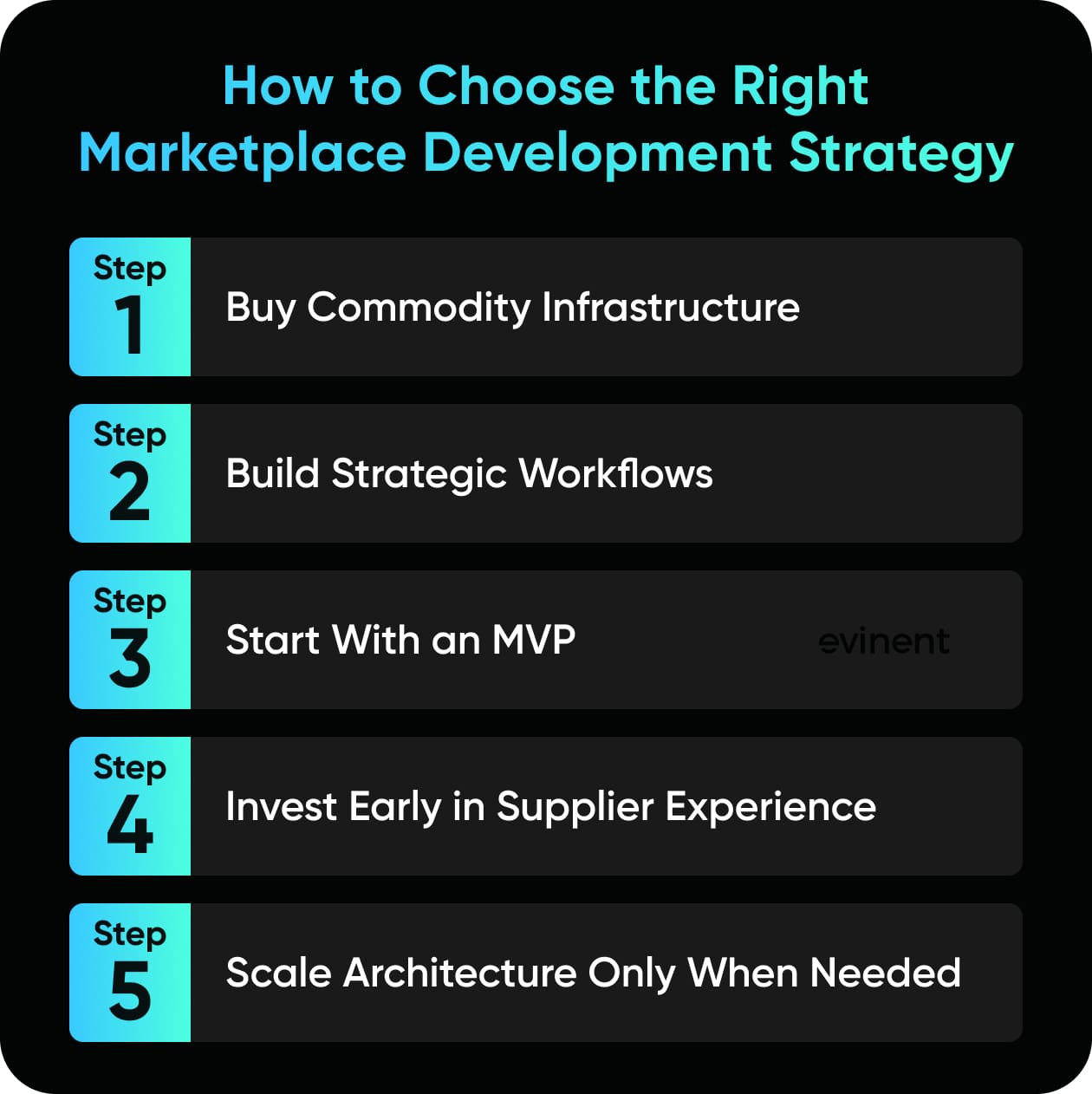
Step 1: Buy Commodity Infrastructure
Making payments, handling shipping, tax, authentication, and email delivery are known issues with established solutions. Getting SaaS products that have been tried and tested rolled in here won't be a shortcut; it'll be the right architectural decision. The time made available to the engineering team can then be devoted to the elements that actually set the business apart from others.
Step 2: Build Strategic Workflows
Supplier onboarding logic, catalog validation rules, moderation workflows, and custom commission structures — these are the areas where a standard solution creates a ceiling. This is where custom development creates compounding value, because the logic built here is specific to the business model and can't be replicated by plugging in a third-party tool.
Step 3: Start With An MVP
The main transaction cycle of a supplier listing a product and a buyer purchasing is the only hypothesis that should be tested at launch. All other things are assumed. Develop and release the smallest version that will verify that cycle with the actual users, and then use the user data for the following build cycle.
Step 4: Invest In Supplier Experience Early
The supplier portal is the engine of catalog growth. Teams that treat it as a post-launch feature discover this the hard way when manual onboarding becomes the bottleneck that limits how fast the marketplace can scale. Getting supplier self-service right in the first build cycle is cheaper than rebuilding it under operational pressure.
Step 5: Scale Architecture Only When Business Needs It
Premature optimization costs in the development of the market are just the same as in any engineering project. ERP integrations, advanced analytics systems, multi-region infrastructures, and activities like these are a part of the plan and not to be included in the MVP. For the scale, build on the one you have evidence for, not the one you are looking forward to.
The marketplaces that scale efficiently are not necessarily those that begin with the most sophisticated architecture. They are the ones who made the correct buy vs build decision at every stage, checked and validated quickly, and only invested in-depth where their business models called for it.
Case Study: Scaling Marketplace Operations Through Product Content Management
As marketplaces grow, product content management often becomes a bigger operational challenge than storefront development or payment processing. One of Evinent's clients, a large ecommerce company in Eastern Europe, experienced this firsthand while scaling its online business.
The Challenge
The company experienced a considerable growth in its ecommerce, yet its catalog management internally was very difficult to keep up with the speed.
There were a lot of different sources for the product info; it took a lot of manual work to update the catalogs, and catalog teams had to spend increasingly more time to maintain data consistency. When the number of products increased, these disadvantages started to have an effect on both the productivity of the internal teams and on the customer experience.
The business needed to support:
A rapidly expanding product catalog
Higher traffic volumes during seasonal peaks
Faster product updates
Improved search and product discovery
Sustainable operational scaling
While many companies in this situation focus on redesigning the storefront, the client identified product content management as the primary bottleneck.
Why a Standard Solution Was Not Enough
Off-the-shelf ecommerce platforms provided basic catalog functionality, but they were not designed around the company's operational processes.
The client required:
Custom catalog workflows
Flexible product data structures
Integration with existing business systems
Improved search relevance
Better operational visibility
These rules were deeply associated with the way the company handled products internally. Setting generic software to work would have meant major compromises and limitations as the company kept expanding.
Therefore, managing product content became a strategic element instead of just a simple feature.
Evinent's Solution
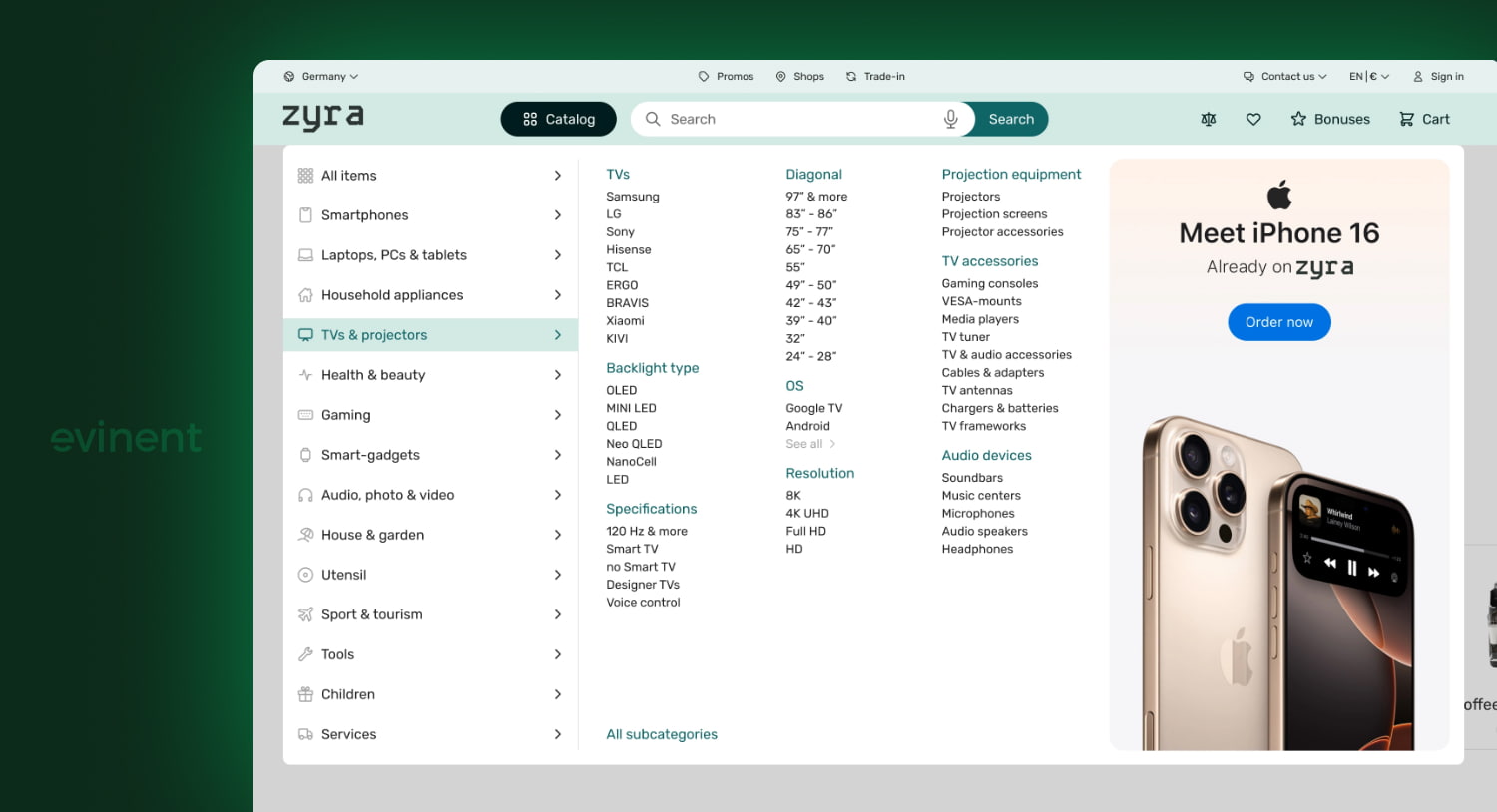
Rather than reconstructing the entire ecommerce environment from scratch, Evinent decided to concentrate on the systems that had a direct impact on scalability.
They transitioned the platform to a more modern architecture and set up a sophisticated product content management environment, which served as the business's operational base.
Among other things, the platform:
Streamlined product catalog management
Facilitated better product content control
Strengthened search and product suggestion functions
Seamless link-up of shop management and operational systems
Cloud infrastructure for easy and reliable scalability
Live data tracking and analytics
The company improved its customer experience and efficiency by focusing its development resources on catalog management rather than standard functions.
Results
The project delivered measurable business outcomes:
Search conversion rates increased by 23%
Online sales grew by 320% during a 2.5-month high-demand period
E-commerce revenue became responsible for 60–70% of total company revenue
The share of ecommerce in total company turnover doubled to 23%
The platform successfully handled significant traffic growth without service disruptions
More than just figures, the business secured a scalable operational platform that could serve ongoing growth without meaninglessly raising the internal workload.
Key Point
This project is a good illustration that marketplace software development decisions should be made at the component level instead of the platform level.
Building payments, checkout, or other standard e-commerce functionality didn't generate the highest return on investment. That came from enhancing a product content management system that had a direct impact on catalog quality, operational efficiency, and scalability.
In the case of expanding marketplaces, catalog management is rarely only an administrative tool. More often than not, it becomes the key business system that defines the scaling capability of the marketplace.
FAQ
Should I Build or Buy Marketplace Software?
The answer is contingent on the component rather than the marketplace in general. Commodity infrastructure involving payments, shipping, tax, and authentication should invariably be purchased from reliable SaaS vendors. Strategic elements such as supplier portal, catalog management, and moderation workflows are the areas where custom development unleashes the competitive advantage and scalability. Applying a single solution for the whole stack is an error.
What Components Of a Marketplace Should Be Custom-Built?
Components carrying business logic that is unique: supplier onboarding flows, catalog validation rules, moderation workflows, and custom commission structures. These are the types of things where a generic solution leads to limitations at a large scale. Things without any proprietary logic, payment, search infrastructure, email delivery, and analytics should be more integrated than built from scratch.
How Long Does E-Commerce Marketplace Software Development Take?
You can get a SaaS MVP ready in as little as two weeks, and no more than six weeks. A custom supplier portal MVP will take you 3-4 months to launch. The roll-out of a full-fledged marketplace with tailor-made workflows, ERP integration, and sophisticated payment flows will generally need 6-8 months. What really affects the timeline is not the marketplace idea itself but rather the amount of custom business logic that has to be created, developed, and tested.
What is The MVP Approach for Marketplace Development?
The main purpose of an MVP is to check just one thing: whether suppliers are willing to add products and buyers are willing to buy them. The least amount of work needed to prove this loop is supplier onboarding, product listings, basic search, third-party checkout, and order ation. All other features, bulk import, advanced analytics, review systems, and mobile apps, should be kept in the backlog and get prioritized according to real usage.
How Do You Choose Between a Marketplace Platform and Custom Development?
Three scenarios apply. Platform-first works when the business model is standard and speed to market matters more than flexibility. A hybrid platform for commodity components, custom for strategic ones, works for most growth-stage marketplaces. Full custom is justified when the core workflows are genuinely unique, and no platform can accommodate them without significant workarounds. The deciding factor is always whether a standard solution creates a ceiling on the specific workflows that drive the business model.
How Much Does It Cost to Build a Multi-Vendor Marketplace?
Cost goes up as you add more to the scope. A platform-based MVP might have low initial cost, but the licensing fees increase with the volume. A custom supplier portal MVP is about three to four months of the development cost. A full custom marketplace with ERP integration and advanced workflows is a six to eight-month engagement. The better question is cost per validated learning, which method delivers a testable product the fastest without spending too much on unverified assumptions.
Can Shopify Be Used For a Multi-Vendor Marketplace?
Shopify can support a multi-vendor marketplace development through apps like Shopify Markets or third-party solutions, but it has meaningful limitations at scale. Supplier portal customization, catalog validation logic, complex commission structures, and moderation workflows quickly hit the ceiling of what the platform can accommodate without significant workarounds. Shopify works well as a starting point for standard models, but marketplaces with proprietary business logic typically outgrow it and face a costly migration later.
Key Takeaways
Rather than picking Shopify, Magento, or any other platform, the biggest marketplace technology decision is figuring out what things to actually build and which ones to buy.
Marketplace architecture consists of many independent systems, such as storefronts, supplier portals, catalog management, order management, payments, analytics, and integrations.
Commodity components such as payments, shipping integrations, email notifications, and authentication are typically better purchased from proven providers.
Custom development delivers the most value in supplier portals, catalog management, moderation workflows, and marketplace-specific business logic.
Creating a detailed build-vs-buy framework is essential for deciding on each component by considering potential competitive advantage, workflow uniqueness, scalability impact, and whether a SaaS solution is available.
It is quite uncommon for the most successful marketplaces to start their operation with a completely custom platform. Using an MVP strategy helps to minimize the risk since it focuses on the main operational components first and then introduces other features gradually.
One of the most common marketplace development mistakes is investing in custom versions of commodity functionality while underestimating the complexity of supplier operations and catalog management.
As demonstrated in Evinent's ecommerce platform case study, investing in strategic operational systems can significantly improve scalability, conversion rates, and long-term marketplace growth.
Share