

What is multi-vendor catalog management, and why does it break as soon as a marketplace starts to grow?
That question sounds simple. Almost too simple. Multi-vendor catalog management is designed to help marketplace teams collect, review, approve, and publish product data from multiple suppliers within a single, controlled system. Titles, images, attributes, prices, stock, variants, category mapping, product IDs, descriptions, compliance fields, search data, feed data. All of it.
In a small marketplace, this feels manageable. Ten suppliers send a few thousand SKUs. Someone from operations cleans up the spreadsheet. Someone from ecommerce fixes the category names. A moderator checks the images. A developer patches a weird import because launch is close and, well, launch is always close.
Then the vendor count grows.
And suddenly the catalog starts acting like a badly packed suitcase. You can still close it if you sit on it hard enough, but everyone knows the zipper is one bad pull away from snapping.
The problem is not only volume. Volume is obvious. The real problem is variation. Every supplier has its own product data habits, naming rules, image standards, attribute logic, and export format. One vendor sends "grey." Another sends "graphite." Another sends "Gris." One uses centimeters, another uses inches. One includes GTINs. Another sends internal SKUs and hopes for the best. One updates inventory through an API. Another emails a spreadsheet every Friday afternoon.
That is when multi-vendor catalog management stops being a content task and becomes an operating risk.
Poor product content is no longer a small UX flaw. It affects conversion, returns, paid shopping feeds, organic visibility, internal search, AI recommendations, supplier trust, and the workload of every marketplace team that has to clean the mess by hand. Syndigo’s 2025 Product Experience report found that 75% of consumers form a negative opinion of a brand when they see incomplete or inaccurate product information online, up from 62% in 2023. That is not a tiny irritation. That is trust damage at the product page level.
Returns tell the same story from another angle. NRF and Happy Returns projected that retail returns would reach $890 billion in 2024, with retailers expecting 16.9% of annual sales to be returned. NRF’s Katherine Cullen put it politely when she said returns "play an important role within the retail ecosystem." True. But for marketplace operators, many returns are also a warning sign: the product page did not set the right expectation before the customer clicked buy.
And product content is often part of that warning sign. 1WorldSync reported in 2024 that 56% of returns were attributed to misleading or poor product content. The same analysis broke the issue down further: 30% were linked to misleading or inaccurate descriptions or features, 29% to inadequate product photography, and 34% to inaccurate product specifications. That is catalog quality showing up as reverse logistics cost.
Google is also tightening the screws around product data quality. Its Merchant Center specification tells merchants to "accurately describe your product" and make titles and descriptions match the landing page. That sounds basic, but at marketplace scale, basic becomes hard. If supplier data is inconsistent in the catalog, it usually becomes inconsistent everywhere else too: product pages, structured data, shopping feeds, search indexes, and ad platforms.
This is where many enterprise marketplaces get caught off guard. They invest in vendor acquisition, category expansion, checkout, payment splitting, and order routing. All good things. All needed. But the catalog submission process is treated like admin plumbing until it starts leaking into revenue.
A messy catalog does not always look broken from the outside. SKU count may still rise. New vendors may still join. Product pages may still go live. Leadership may still see a growing assortment.
But inside the team, the cost is already there.
Moderators spend more time fixing supplier data than reviewing it. Category managers argue with duplicates. Search teams complain that filters do not work. Paid media teams see disapprovals or weak feed performance. Customer support gets questions that should have been answered on the product page. Buyers compare three near-identical listings and wonder which one is real.
That is the quiet failure of multi-vendor catalog management. Not a dramatic crash. More like a slow clog.
The fix is not "hire more moderators." That helps for a month, maybe. The real fix is a structured supplier catalog submission process from day one: controlled data entry, category-specific validation rules, AI-assisted content checks, human moderation where judgment matters, supplier feedback inside the workflow, and centralized synchronization with the CMS.
Multi-vendor catalog management breaks down at scale when supplier submissions are unstructured. It holds up when the marketplace treats product data as a core operating system rather than a file-upload problem.
That is the part that too many marketplaces learn too late. And late is expensive.
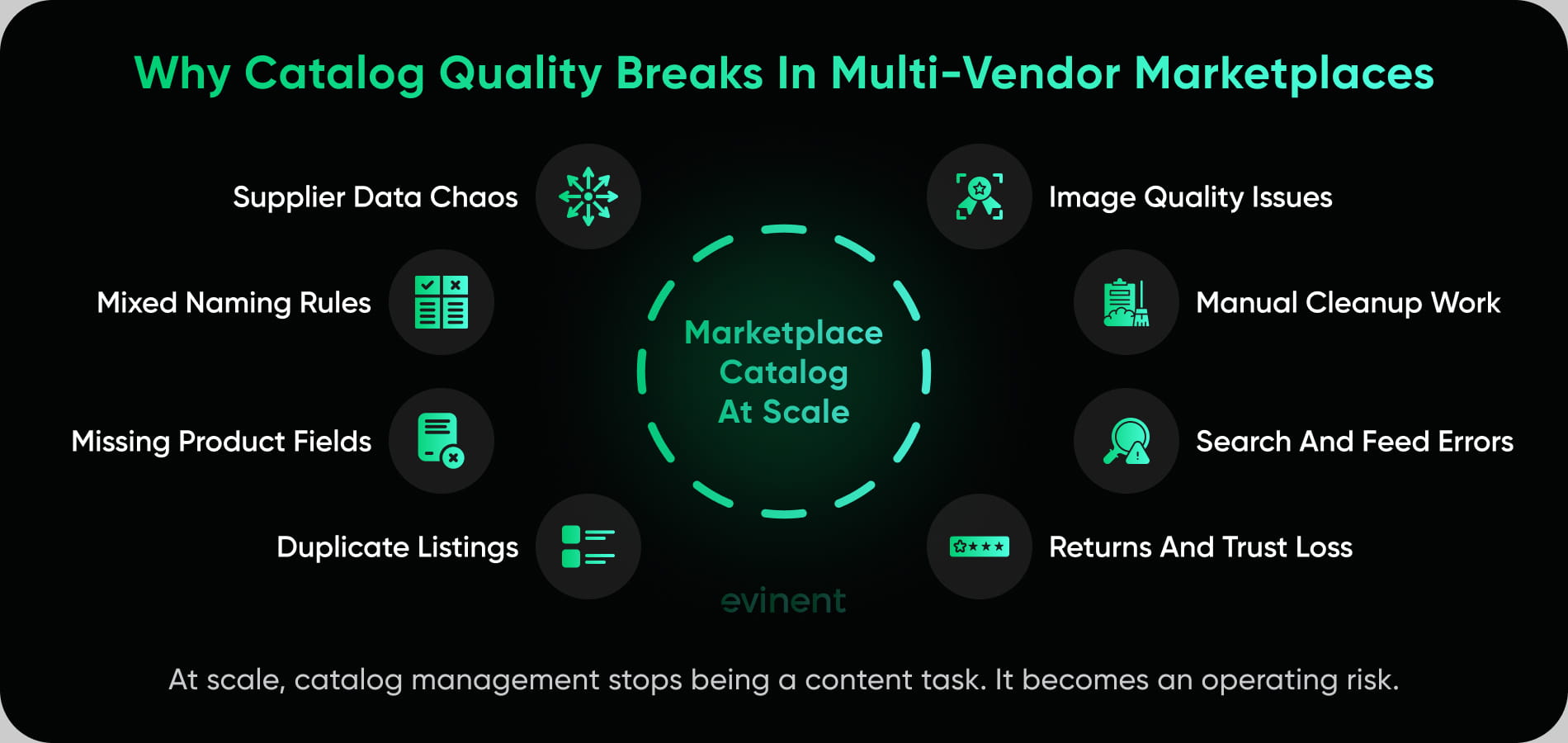
The Math No One Does Before Launching A Multi-Vendor Marketplace
At launch, marketplace catalog work usually looks harmless.
10 suppliers x 500 SKUs = 5,000 products.
That is nothing, of course. But it still feels like a workload a small operations team can wrestle into shape. One person reviews titles. Another checks categories. Someone cleans the spreadsheet. Someone rewrites awkward descriptions. A product manager notices that half the images are too small and asks suppliers to resend them.
Now stretch the same model.
50 suppliers x 500 SKUs = 25,000 products.
100 suppliers x 500 SKUs = 50,000 products.
200 suppliers x 500 SKUs = 100,000 products.
At that point, the marketplace no longer has a catalog task. It has a catalog factory. And if the factory has no rules, no quality gates, and no clear ownership, every new supplier adds more than products. They add exceptions.
That is the math many marketplace teams skip.
They calculate SKU growth but not review capacity. They calculate vendor acquisition, but not supplier data quality. They calculate assortment expansion, but not how many fields, images, variants, duplicates, revisions, and failed imports the internal team will need to process.
Let’s make it more concrete.
A single product submission may include:
product title;
supplier SKU;
marketplace SKU;
brand;
category;
product description;
technical attributes;
variant data;
price;
stock;
shipping data;
images;
warranty details;
compliance fields;
SEO metadata;
search attributes;
product identifiers such as GTIN, EAN, UPC, or MPN.
Even if your marketplace asks for only 20 fields per product, 25,000 products already create 500,000 field-level data points.
And that is before revisions. If 30% of submissions have missing, inconsistent, or low-quality data, the team is not reviewing 25,000 products. It is reviewing 25,000 products plus 7,500 cleanup loops. If each cleanup loop takes only 5 minutes, that is 37,500 minutes of repair work.
625 hours. For one round.
And honestly, 5 minutes is generous. A duplicate investigation can take longer. A bad image set can lead to three supplier messages. A category mismatch can trigger a taxonomy discussion. A missing technical attribute can remain unresolved for days because no one on the supplier side knows who owns the data.
This is where catalog management becomes a bottleneck. Not because the marketplace platform cannot technically store 50,000 SKUs. Most platforms can. Storage is not the problem.
The problem is operational friction. A marketplace may have sufficient infrastructure to support growth but insufficient structure to control what enters the system. So the product count rises, while product information consistency drops. More vendors join, while moderation queues get slower. The business celebrates assortment growth, while the internal team quietly spends its week fixing supplier content.
You know what? This is the exact moment when leadership starts hearing weirdly vague updates.
"Catalog is taking longer than expected."
"Some suppliers need more guidance."
"We’re seeing a few duplicate issues."
"Search filters need cleanup."
"Product pages need another review before launch."
None of those sentences sounds dramatic by itself. But, together, they mean the same thing: the marketplace is growing faster than its catalog governance.
Here is how the workload usually changes as the marketplace grows.
Marketplace Stage | Vendor Count | Approx. SKU Count | What The Team Thinks Will Happen | What Usually Happens |
Early Launch | 10 | 5,000 | Manual review will be enough | The team fixes issues manually and learns supplier habits by memory |
Growth Phase | 30 | 15,000 | More vendors will mean more assortment | Attribute inconsistency starts hurting filters, search, and product comparison |
Expansion Phase | 50 | 25,000 | A bigger catalog will improve buyer choice | Moderators spend more time repairing supplier data than approving products |
Enterprise Phase | 100+ | 50,000+ | The catalog process can be optimized later | Catalog debt is already live across CMS, search, feeds, and reporting |
That last row is the expensive one.
Once low-quality product data enters the live catalog, it spreads into other systems. It gets indexed by search. It appears in category filters. It reaches Google Merchant Center or other product feeds. It appears in recommendation blocks. It shows up in customer support tickets. It gets copied into localized versions. It becomes part of analytics.
Bad product data is sticky.
Fixing it later is possible, but it is slower because every correction has dependencies. A change to a product title may affect SEO. A category change may affect filters. A merged duplicate may affect reviews, seller offers, and analytics history. A corrected attribute may need to sync with the CMS, search index, product feed, and reporting layer.
That is why "we’ll clean it later" is such a dangerous sentence in marketplace operations.
Later usually means after the bad data has already cost money.
The real issue is that many teams confuse catalog upload with catalog management. Uploading is just the moment data enters the system. Management is everything that keeps that data usable after it enters.
A proper marketplace catalog system needs to answer questions like the following:
Who can submit products?
Which fields are required for each category?
Which values are accepted?
Which image formats are allowed?
Which data is supplier-owned, and which data is marketplace-owned?
What happens when two suppliers submit the same product?
Who approves product changes after publication?
Can the team see what changed, who changed it, and when?
How does approved product data sync with the CMS, search engine, and external feeds?
Without these answers, the team builds its process out of habits. A spreadsheet here. A Slack message there. A "temporary" importthat becomes permanent. A moderator who knows how Supplier A formats variants but goes on holiday right before a large upload.
That is not a process. That is tribal knowledge with a login. And tribal knowledge does not scale to 100 vendors.
For a Head of Marketplace or COO, the hard question is not "Can we add more suppliers?"
The hard question is: Can we add more suppliers without increasing manual catalog repair at the same speed?
Because if every 10 new vendors require another operations hire just to clean product data, the marketplace model starts losing part of its economic advantage. The business may still grow, but the cost of growth becomes heavier than expected.
This is where structured multi-vendor catalog management changes the math.
Instead of treating each supplier submission as a manual review task, the marketplace creates controlled entry points:
suppliers submit products through a portal, API, or guided import;
category-specific templates define required fields;
validation rules catch missing or malformed data before review;
AI-assisted checks flag duplicates, weak descriptions, and image issues;
moderators review exceptions instead of every basic mistake;
suppliers receive field-level feedback in context;
approved content syncs with the CMS and other systems from one controlled source.
The goal is not to remove humans from the process. That would be risky and, frankly, a little naive.
The goal is to stop wasting human judgment on problems the system can catch earlier.
A moderator should not spend their morning finding out that 300 products have missing dimensions. The system should block those submissions before they enter the review queue.
A category manager should not compare five near-identical listings by eye. The system should flag likely duplicates and show why they match.
A supplier should not wait three days for an email that says "please add required fields." The portal should show the missing fields before the product can be submitted.
That is what catalog management looks like when it is designed for scale. Not glamorous. Not flashy. Just a lot less painful.
And that matters because marketplace scale is not only about how many products you can publish. It is about how many products you can publish without degrading the catalog.

Five Ways Catalog Quality Degrades In Multi-Vendor Marketplaces
Catalog quality does not usually collapse in one big, dramatic failure.
It gets weaker in small, boring ways.
One supplier skips a material field. Another uploads product photos with text across the image. A third uses "XL" in one file and "Extra Large" in another. Nobody panics. The products still go live. Sales may even look fine for a while.
But then buyers start filtering by attributes, and half the products disappear from the results. Google Merchant Center flags a batch of listings because the title or description does not closely match the landing page. Customer support gets questions that should have been answered on the product page. A category manager finds five versions of the same item. A moderator says, very calmly but with tired eyes, "We need to clean the catalog before we add more suppliers."
That is usually the first visible symptom.
The deeper issue is supplier content quality. Every marketplace wants more vendors, but every new vendor brings its own habits. Some are disciplined. Some are not. Some have strong product data in their own PIM or ERP, but that data was never designed for your marketplace taxonomy. So it arrives technically correct, yet operationally useless.
Here are five ways catalog quality usually degrades when supplier submissions are not structured from the start.
Inconsistent Attribute Structures Across Suppliers
Attributes look like small fields. They are not small.
They are the logic behind search, filters, comparison tables, product recommendations, ad feeds, category pages, and customer confidence. When attributes are inconsistent, the catalog may still contain the right products, but buyers cannot reliably find or compare them.
Take a simple electronics marketplace.
One supplier sends:
Field | Value |
RAM | 16GB |
Storage | 512GB SSD |
Screen Size | 15.6 in |
Another supplier sends:
Field | Value |
Memory | 16 GB |
Hard Drive | 512 SSD |
Display | 15.6" |
A third supplier sends everything inside the description: "Fast laptop with 16 gigabytes of memory, a 512 solid-state drive, and a large 15.6-inch display."
To a human, these products may look comparable. To the marketplace system, they may look like three different structures.
That breaks product information consistency.
The filter for "16GB RAM" may catch one product and miss two. The comparison table may show blank fields. The recommendation engine may struggle to group similar items. The analytics team may undercount the category because the attribute data is fragmented.
And the buyer? The buyer just sees a messy experience.
Baymard’s 2025 product list and filtering UX benchmark found that 58% of desktop ecommerce sites and 78% of mobile ecommerce sites had "mediocre" or worse product list UX performance. That is broader than catalog data alone, of course, but poor filters and weak product listing information often start with poor attribute structure.
In a multi-vendor marketplace catalog, attribute inconsistencies usually come from three sources.
First, suppliers use different internal field names. What one calls "material," another calls "fabric," "composition," or "main component."
Second, suppliers use different value formats. "Cotton 100%," "100 cotton," "100% Cotton," and "cotton" may all mean the same thing, but your system needs one normalized value.
Third, suppliers have different levels of detail. One vendor sends full technical specs. Another sends only a title, image, and price.
This is why supplier catalog submission cannot be a generic upload form. It needs category-specific rules.
A fashion product should not have the same attribute template as an industrial spare part. A laptop should not have the same required fields as a chair. A cosmetics product should not be reviewed with the same rules as a phone case.
The fix is not to ask suppliers to "be consistent." That sounds nice and changes almost nothing.
The fix is to make consistency hard to avoid:
predefined attributes by category;
controlled value lists where possible;
unit normalization;
required fields based on product type;
validation before submission;
clear supplier guidance inside the portal;
automated mapping for known supplier field names.
Without that structure, every new vendor adds another dialect to the catalog.
At some point, the marketplace is no longer managing product data. It is translating product data all day.
Missing Mandatory Fields That Slip Through Manual Review
Missing fields are sneaky because the product page can still look complete.
A title, price, image, and short description may be enough to publish the listing. But enough to publish is not the same as enough to sell.
A dress without fabric composition may increase returns.
A replacement part without compatibility data may create support tickets.
A laptop without processor generation may lose buyers who are comparing models.
A B2B product without a minimum order quantity may confuse procurement teams.
A product without GTIN, MPN, or brand data may perform worse in external channels.
Google Merchant Center’s product data specification tells merchants to accurately describe products and match titles and descriptions to the landing page. It also gives specific title rules, including using relevant titles, avoiding promotional text, and distinguishing between variants.
That sounds obvious when you read it in the documentation. It becomes less obvious when 30 suppliers submit product data in 30 formats.
Manual moderation often catches visible problems. It is less reliable with field-level completeness, especially when the required fields differ by category. A moderator may notice a bad image faster than a missing voltage field. They may approve a product because it looks fine, only for the search team to later discover that it does not appear in key filters.
And there is another issue: manual review gets tired.
Nobody likes saying that part out loud, but it is true. A person reviewing 40 products can be careful. A person reviewing 400 products under deadline will miss things. Not because they are bad at their job. Because the process is asking humans to act like validation scripts.
That is a poor use of people.
A structured marketplace catalog system should block submissions with missing mandatory fields before they reach human review. The rule should be simple: if the field is required for that category, the supplier cannot submit the product without it.
But the real maturity comes from making mandatory fields smarter.
For apparel, mandatory fields should cover size, color, material, fit, care instructions, and a proper image set. Without them, the buyer is left guessing, and guessing usually ends in returns.
For electronics, the catalog needs brand, model, product identifiers, technical specs, warranty details, and compatibility data. A laptop page without processor generation or storage type may still look publishable, but it will not help a serious buyer compare options.
Furniture has its own headaches: dimensions, material, weight, assembly details, delivery constraints, and packaging information. Miss one of those, and the problem may not show up until the product is already in someone’s hallway and does not fit through the door.
Beauty and personal care products need ingredients, volume, usage instructions, warnings, and country-specific restrictions. Here, incomplete content is not just annoying. It can create trust and compliance issues.
B2B equipment is even less forgiving. Buyers need technical specs, minimum order quantity, lead time, documentation, and compliance data before they can make a decision. If those fields are missing, the product page becomes a support ticket waiting to happen.
One mandatory field list for the entire marketplace is usually too weak. It either misses important category data or forces suppliers to fill irrelevant fields with nonsense.
Both create bad data.
The better model is category-specific validation. It asks for what matters, blocks what is missing, and explains the requirement to the supplier before a moderator has to get involved.
Duplicate Listings From Different Vendors For The Same Product
Duplicate listings are where marketplace trust starts to wobble.
A buyer searches for a product and sees four versions of what looks like the same item. Same brand. Similar title. Similar image. Different seller. Slightly different price. One has reviews. One has better shipping. One has a typo in the model name. One is listed in the wrong category.
The buyer pauses.
That pause is not good.
Duplicate product listings happen naturally in a multi-vendor marketplace. Several suppliers may sell the same item. Some may sell bundles. Some may sell regional versions. Some may use different product identifiers. Some may upload the same product twice by mistake. And yes, some may try to create extra listings for visibility.
The trouble is that duplicates distort almost everything. And internally, they make reporting messy. Is the marketplace selling one strong product through several vendors, or five weak products that happen to look similar? Without a canonical product model, that question gets annoyingly hard to answer.
At 5,000 SKUs, moderators may catch obvious duplicates by memory.
At 50,000 SKUs, memory is not a system.
Duplicate detection needs to combine several signals:
GTIN, EAN, UPC, MPN, or other identifiers;
brand and model;
normalized product title;
category;
technical attributes;
image similarity;
description similarity;
supplier SKU patterns;
price and packaging differences.
This is also where AI validation starts to make practical sense. Not as a final judge, but as an early warning layer.
The system can say:
"Possible Duplicate: Brand And Model Match Existing Product. Image Similarity Is High. Supplier SKU Differs."
That one flag saves the moderator from opening ten tabs and playing spot-the-difference with product pages.
Still, the final decision should stay with humans. Duplicate logic can get messy. A product can look identical but have different warranty terms. A bundle can share the main product image but include accessories. A regional model can have the same title but different voltage, packaging, or compliance rules.
AI can point to the problem. A marketplace operator decides what to do with it.
The mature catalog setup usually separates "product" from "offer."
One canonical product page can hold the approved product content, while several vendor offers sit under it with their own price, stock, shipping, and seller terms. That prevents duplicate pages from multiplying every time a new supplier submits the same item.
Without that model, vendor product data management becomes a pile of near-identical listings.
And nobody enjoys shopping in a pile.
Image Quality And Format Inconsistencies
Images are the quickest way for a catalog to look unprofessional.
Even if the data underneath is decent, inconsistent images make the marketplace feel patched together. One product has a clean white background. Another has a blurry warehouse photo. Another has a watermark. Another has text across the image. Another shows three accessories that are not included in the box.
Buyers notice. They may not describe it as "image standard inconsistency." They will just trust the page less.
1WorldSync’s 2024 product returns analysis found that 29% of returns were linked to inadequate product photography, while 34% were linked to inaccurate product specifications. That is exactly the kind of thing that starts as a catalog quality issue and ends as a margin issue.
Image standards matter because product images do several jobs at once. A multi-vendor marketplace should not rely on "please upload good images" as a policy. That is not a policy. That is a wish.
The system should define image rules by category and channel.
Some image checks are rule-based. The system can check resolution, file size, format, and dimensions.
Other checks need AI assistance. Is the image blurry? Does it contain text overlay? Does it show the product clearly? Does it look like the right product category? Is the same image used across several unrelated listings?
These are perfect pre-moderation checks because they reduce obvious failures before a human reviewer opens the product.
Again, no need to over-romanticize it. AI is not "understanding your brand." It is catching visual problems faster than a team can do manually across thousands of SKUs.
That is useful enough.
No Version Control: Who Changed What And When
Version control sounds boring until something breaks.
Then it becomes the only thing anyone wants.
A supplier changes a product description and removes a safety warning. Who approved it?
A moderator edits a title and organic traffic drops. What changed?
A vendor updates a warranty field. When did it go live?
A duplicate product gets merged. Which reviews, offers, and attributes moved with it?
A category manager overrides supplier content. Did the supplier see the change?
Without product data versioning, the marketplace team has to reconstruct history from emails, exports, Slack messages, CMS logs, and someone’s memory. That is not fun. It is also not reliable.
Product data versioning should show:
what changed;
who changed it;
when it changed;
why it changed;
whether it passed validation;
who approved it;
where it synced;
whether it affected the live product page.
This matters for operations, but it also matters for risk.
If the marketplace sells regulated, technical, healthcare-adjacent, automotive, industrial, or expensive products, field-level history becomes more than a convenience. It becomes a control mechanism.
Version control also helps teams improve the process.
If one supplier repeatedly changes approved titles into keyword-stuffed titles, you can see it.
If one category repeatedly fails validation because required fields are unclear, you can see it.
If AI validation keeps flagging false duplicates in one product family, you can see it and tune the logic.
If moderators override the same supplier field every week, maybe the supplier template is wrong.
That is the practical value of version history. It turns catalog chaos into patterns the team can actually manage.
And this is where many marketplaces realize catalog governance is not only about preventing bad listings. It is about learning from every submission, every rejection, every correction, and every supplier habit.
Without version control, the catalog has no memory.
With version control, the marketplace can finally answer the question leadership always asks after a problem appears: "How did this happen?"
What Structured Catalog Management Actually Looks Like
Structured catalog management is not just "make suppliers fill in a form."
That is the beginner version.
A form can still produce chaos if the fields are vague, the rules are loose, and the moderation team has to interpret every submission manually. A supplier portal with no validation is just a prettier spreadsheet. An admin panel with no workflow is just a place where problems wait in a queue.
Real structure means the marketplace controls how product data enters the system, how it gets checked, how suppliers fix issues, how moderators approve or reject content, and how approved listings move into the CMS, search index, product feeds, and analytics.
In other words, structured catalog management is not one feature. It is a chain.
And every weak link becomes someone’s manual work.
Structured Product Submission Starts Before The Upload
The old way usually looks like this: suppliers send product files in whatever format they have. One sends Excel. Another sends a CSV. Another sends XML exported from their ERP. Another sends a PDF catalog and says, "Can your team take the data from here?"
Lovely.
The internal marketplace team then becomes a translation office. They rename columns, clean values, crop images, ask for missing fields, and manually adapt supplier data to fit the marketplace catalog model.
That may work with five or ten suppliers. It does not work when the marketplace starts onboarding suppliers every month.
A structured supplier catalog submission process starts before the upload. It tells suppliers exactly what the marketplace needs, in what format, and why.
For example, a supplier should not see one generic "Product Description" field and guess what to write. They should see guidance tied to the category. A furniture supplier should know that dimensions, material, assembly details, delivery restrictions, and packaging size are required before submission. A beauty supplier should see the ingredient, warning, volume, and usage fields. A spare parts supplier should see the compatibility and technical documentation fields.
That sounds strict, but it is actually easier for suppliers. Bad structure makes suppliers guess. Good structure removes the guessing.
The submission flow should also adapt to supplier maturity. A large vendor may use an API. A mid-sized supplier may prefer CSV import. A smaller supplier may use a manual portal. That is fine. The important part is that every path leads through the same validation logic.
If an API submission skips mandatory fields, it should fail. If a CSV upload uses the wrong unit format, it should fail. If a manual portal entry includes an image that is too small, it should fail before moderation.
This is where the quality of marketplace product content starts to improve. Not because everyone suddenly becomes more careful, but because the system stops accepting messy data as normal.
Validation Layers Catch The Boring Problems First
Human moderation should not be the first quality gate.
That is where many marketplace teams go wrong. They let all supplier submissions enter the moderation queue, then expect people to catch every missing field, malformed value, duplicate listing, weak image, and suspicious category choice.
That is not moderation. That is manual QA at catalog scale.
Validation should happen before a human reviewer spends time on the listing. Some checks are simple and rule-based. Is the required field filled? Is the image large enough? Is the price in the accepted format? Is the GTIN the right length? Is the category allowed for this supplier? Is the description too short? Are prohibited words present?
Other checks need more context. Does the product title match the category? Does the description contradict the attributes? Does the image seem to show the right product? Does this look like a duplicate of an existing listing? Is the supplier using the same image across unrelated products?
That is where AI-assisted validation becomes useful.
The point is not to make AI the final judge. The point is to keep obvious or likely problems away from the human review queue until they are fixed, ed, or at least flagged.
A good validation layer might tell the supplier:
"Dimensions are required for this category."
"Main image is below the minimum resolution."
"Material value must be selected from the approved list."
"Possible duplicate found. Please whether this is a new product, a variant, or an offer for an existing product."
"Product title mentions 'wireless,' but connection type is listed as 'wired.' Please review."
That kind of feedback saves everyone time. The supplier knows what to fix. The moderator receives cleaner submissions. The marketplace avoids publishing weak product pages just because nobody had time to check every detail.
And yes, suppliers may complain at first.
That is normal. People usually dislike new rules until the rules start saving them from email chains, rejected products, and ed publication.
A Moderation Workflow Gives The Catalog A Spine
A marketplace catalog needs a clear moderation workflow. Otherwise, listings float around in vague states like "sent," "checked," "almost approved," "waiting for someone," and "I think we published that one."
No serious marketplace should run on "I think."
A proper catalog moderation workflow gives every product a status, every status an owner, and every owner a next action.
A product may start as a draft. The supplier fills in the required data. The system runs validation. If anything is missing, the product is returned to the supplier with clear comments. If the automated checks pass, the product enters human review. A moderator checks content quality, duplicate risk, category fit, and marketplace rules. If needed, the product goes to a category manager or compliance reviewer. Once approved, it moves to publishing and syncs with the CMS.
That flow may sound formal. Good. Catalog operations need formality because informal processes create hidden work.
The important thing is that the workflow should not be binary. "Approved" and "Rejected" are not enough.
Real catalog work needs more nuance.
A product can be technically valid but needs supplier fixes. It can be approved for staging but not for public publishing. It can be published in one region but blocked in another. It can be ready for the CMS but not ready for Google Merchant Center because a feed attribute is missing. It can be approved as an offer under an existing product rather than published as a new page.
That is why the moderation workflow should reflect how the marketplace actually operates, not how a simple admin panel wants it to operate.
For C-level teams, this workflow also creates visibility.
Instead of asking, "Why is the catalog ed?" leadership can see where products are stuck. Maybe suppliers are slow to fix validation errors. Maybe moderators are overloaded. Maybe one category has unusually high rejection rates. Maybe CMS sync keeps failing. Maybe duplicate checks are creating a large review queue.
Once the workflow is visible, the bottleneck becomes fixable.
Before that, it is just a feeling.
Supplier Feedback Should Live Where The Error Lives
One of the most underrated parts of structured catalog management is supplier communication.
Most catalog cleanup failures do not stem from people being lazy. It fails because feedback is scattered.
A moderator finds a missing field and sends an email. The supplier replies with a new spreadsheet. Someone uploads it. Another moderator reviews a different version. A category manager comments in Slack. The supplier asks which product the comment refers to. A week later, nobody is sure which file is final.
This is how small catalog issues become operational mud.
Supplier feedback should live inside the product submission workflow. Field-level comments should appear next to the field that needs fixing. Rejection reasons should be standardized where possible. Suppliers should see what blocks publication and what is only a recommendation. Moderators should not have to write the same explanation twenty times.
For example, if an image is rejected, the supplier should see why: it's too small, has the wrong aspect ratio, has a watermark, shows an unclear product, is a duplicate, has a text overlay, or shows the wrong product.
If an attribute is missing, the supplier should determine whether it is required for the category or recommended to improve product discovery.
If a duplicate is suspected, the supplier should determine whether to submit the item as a new product, a variant, or an offer under an existing listing.
That level of clarity reduces back-and-forth. More importantly, it teaches suppliers how the marketplace works.
Over time, good suppliers improve because the system trains them through the workflow. Bad suppliers become visible because their submissions keep failing for the same reasons.
That is useful information for vendor managers. Supplier quality is not only about delivery and pricing. Content quality is part of supplier performance too.
Catalog Governance Needs Ownership, Not Just Tools
A tool cannot fix unclear ownership.
A marketplace can buy a supplier portal, add validation rules, build AI checks, and still struggle if nobody owns the catalog model.
Someone has to decide which fields are required. Someone has to maintain category templates. Someone has to review validation performance. Someone has to define image standards. Someone has to decide how duplicates are handled. Someone has to decide when supplier content can override marketplace content, and when it cannot.
That "someone" should not be a random person who happens to care.
For enterprise marketplaces, catalog governance usually needs shared ownership across operations, ecommerce, product, engineering, and sometimes legal or compliance. But shared ownership does not mean vague ownership. There should be a clear business owner for catalog quality and a clear technical owner for the catalog system.
Catalog governance is where marketplace operations becomes serious. It turns product data from "content we upload" into "rules we run the business on."
Centralized CMS Sync Keeps Approved Data From Splitting Apart
A product can pass moderation and still break later if approved data does not sync cleanly.
This happens more often than teams like to admit.
The supplier portal has one version. The CMS has another. The search index has an older one. Google feed data comes from a separate export. The analytics system uses category names from last quarter. Customer support sees a different warranty field in the CRM.
Suddenly, the product record is no longer a single record. It is five stories about the same product.
Centralized CMS synchronization prevents that split.
Once product content is approved, the system should push the correct version to the right places: the product page, category listing, search index, feed system, recommendation engine, and reporting layer. If sync fails, the team should know. If a field is changed after approval, the system should determine whether it requires revalidation, reapproval, or resync.
This matters a lot for SEO and paid channels.
Product pages, structured data, and product feeds should not contradict each other. If the page says one price, the feed says another, and the structured data has an outdated availability status, the marketplace is creating problems for itself.
It also matters for internal trust. Teams stop trusting the catalog when they keep finding different values in different systems. Once that happens, they go back to spreadsheets. And once teams go back to spreadsheets, the "central catalog" becomes more of a suggestion than a source of truth.
A structured marketplace catalog system should make the approved product record the source of truth, then control how that record moves downstream.
That is not glamorous work.
But neither is fixing 8,000 product pages because the wrong attribute format reached production.
The Before-And-After Is Pretty Simple
Before structured catalog management, the marketplace team spent most of its time reacting.
A supplier sends messy data. A moderator catches some issues. A category manager fixes others. A search problem appears later. A duplicate gets found after publication. A feed error creates another cleanup task. Supplier communication happens across email, spreadsheets, and chat.
After structured catalog management, the process becomes less dramatic.
Suppliers submit data through controlled paths. The system checks routine issues. AI flags likely quality problems. Moderators review cleaner listings. Suppliers fix errors in context. Approved content syncs with the CMS and downstream systems. Version history shows what changed.
Catalog operations will always have edge cases. Suppliers will still make mistakes. Some categories will still be weird. Someone will still upload a product photo that looks like it was taken in a basement during an earthquake.
But the difference is this: the system catches most of the mess before it becomes everyone’s problem.
That is what structured multi-vendor catalog management really does.
The Role Of AI In Product Content Validation
AI in catalog management is useful when it acts as a sharp assistant, not an overconfident boss.
That distinction matters.
A marketplace should not let AI freely approve supplier listings, invent missing specs, rewrite compliance claims, or decide that two products are "probably the same" and merge them without review. That is asking for trouble.
But using AI to check product content before it reaches a human moderator? That is a different story. That is where AI starts to make practical sense.
Because the painful part of multi-vendor catalog management is not that every product requires deep human judgment. Most product issues are repetitive. Missing fields. Weak descriptions. Wrong category. Bad image. Suspicious duplicate. Attribute mismatch. Supplier copied the wrong specs. Supplier submitted five variants as five separate products. Supplier used a title that looks more like an internal warehouse label than something a buyer would understand.
A human can catch those problems.
A human should not have to catch them one by one across 50,000 SKUs.
AI product content validation works best as a pre-moderation layer. It reviews supplier submissions before they enter the main approval queue, flags likely issues, explains what looks wrong, and sends the product either back to the supplier or forward to human review with context.
That does not remove people from the process. It gives them cleaner work.
And honestly, that is the sweet spot.
AI Can Check Completeness Before A Moderator Opens The Product
Completeness sounds simple, but it is not the same across all categories.
A product can be "complete" in one category and dangerously thin in another. A phone case may need only a few core attributes. A medical device, industrial component, or automotive part needs much more detail before a buyer can make a safe decision.
A rule-based system can check whether required fields are filled. AI can go a little further and ask whether the submitted content actually explains the product well enough for the category.
For example, a supplier may technically fill the description field with:
"High-quality product for daily use. Reliable and modern."
The field is not empty. Great. But the content is useless.
AI can flag that as thin, vague, or not category-specific enough. It can also compare the description with the required attributes and notice gaps.
If the category is office chairs, AI may flag that the listing mentions comfort but provides no dimensions, material, weight capacity, or adjustment details.
If the category is replacement laptop chargers, AI may flag that the product lacks information on wattage, connector type, compatible models, and safety certification.
If the category is skincare, AI may flag missing ingredients, volume, usage instructions, and warnings.
This is where content completeness scoring becomes useful. The system does not need to say "approved" or "rejected." It can say:
"Completeness Is Low. Missing Compatibility Data, Dimensions, And Required Image Angles."
That gives the supplier a clear task. It also saves the moderator from opening a half-empty listing and writing the same feedback again.
There is a small psychological benefit too. Suppliers tend to fix issues faster when the system tells them exactly what is blocking publication. Vague feedback creates frustration. Specific feedback creates action.
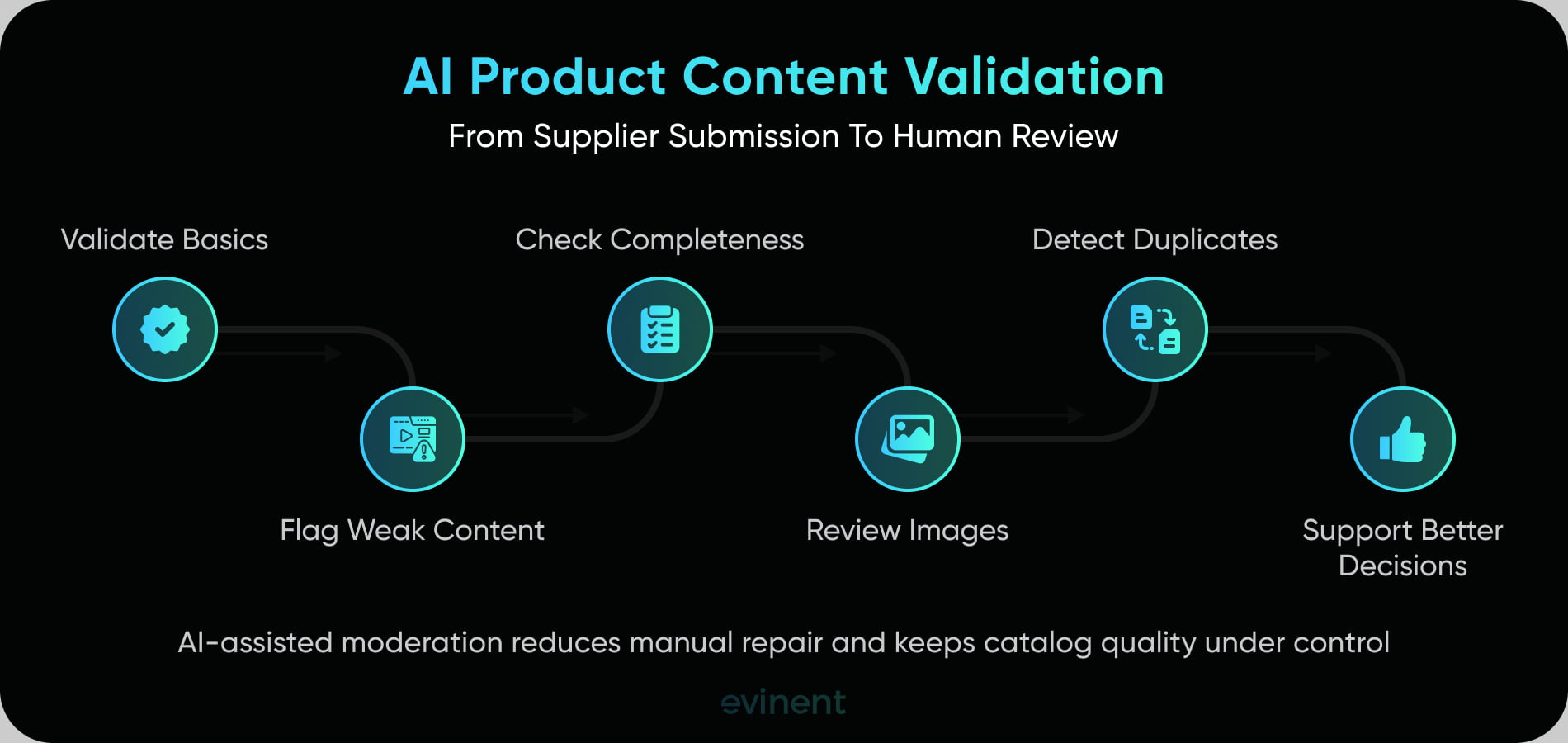
AI Can Catch Attribute Contradictions Humans Miss Under Pressure
Some catalog errors are not missing data. These errors are easy to miss during manual review, especially when the moderator is reviewing hundreds of products. They are also exactly the kind of errors that annoy buyers because they create doubt at the worst possible moment: right before purchase.
AI can compare fields and flag contradictions before publication.
This is not glamorous AI. Nobody is writing keynote speeches about "the model that noticed the charger wattage did not match the product title."
But in marketplace operations, that is valuable.
A catalog system that catches contradictions early reduces returns, support tickets, moderation rework, and buyer confusion. Small checks. Big effect.
Google's Merchant Center guidance tells merchants that product titles, descriptions, and landing pages should accurately describe the same product. In practice, that means the product record must be internally consistent before it ever reaches a feed or product page. If your own catalog fields conflict, every downstream channel inherits the confusion.
AI Can Flag Duplicate Listings Before They Pollute Search
Duplicate detection is one of the strongest AI use cases in marketplace catalog operations.
Why? Because duplicates are often obvious to humans but hard to catch through exact matching.
Two suppliers may submit the same product with different titles:
"Samsung Galaxy S24 256GB Black"
"Samsung S24 Smartphone, 256 GB, Onyx Black"
"Galaxy S24 5G 256GB, Black, EU Version"
A simple exact-match rule will not catch all of that. AI can compare titles, model numbers, brands, attributes, images, and descriptions, then flag likely duplicates.
The important word is "likely."
AI should not silently merge products. That can create a mess, especially when products have regional versions, bundles, warranty differences, refurbished status, or supplier-specific packaging.
Instead, AI should create a duplicate review queue.
A moderator sees the suspected match, the confidence level, and the reasons behind the flag. Maybe the product should become a new offer under an existing listing. Maybe it should become a variant. Maybe it really is a different product. The human decides, but the system has already done the boring comparison work.
This is especially important for marketplaces that want strong SEO performance.
Duplicate product pages can split ranking signals, fragment reviews, confuse buyers, and make category pages feel repetitive. They can also worsen internal search because the same product appears repeatedly, pushing other relevant products down the page.
A marketplace with 100+ suppliers needs a canonical product strategy. AI helps enforce it before duplicates multiply.
AI Can Review Images Before They Reach The Live Catalog
Image quality is one of those things everyone notices, and nobody wants to manually police forever.
A marketplace can write image rules. Minimum size. Clean background. No watermark. No text overlay. Product must be visible. The main image must show the main product. Lifestyle images allowed only after the primary product image. Fine.
But rules need enforcement.
Some image checks are easy. The system can check resolution, aspect ratio, format, and file size.
AI can help with the more visual checks:
Is the image blurry?
Does it contain a watermark?
Does it have text across the product?
Does the image show a product or a document?
Does the main image match the selected category?
Does the uploaded image look identical to another supplier's image?
Does the image show a bundle while the listing describes a single item?
This matters because product images set expectations faster than copy. A buyer may skim the description, but they look at the image first. If the image is misleading, the product page is already working against itself.
Poor images also make the marketplace feel inconsistent. One supplier's polished packshot next to another supplier's dim warehouse photo makes the whole category look less trustworthy.
AI image review does not need to be perfect. It just needs to catch enough obvious issues before they become moderator work or, worse, customer disappointment.
AI Can Help Suppliers Fix Content, Not Just Reject It
A weak validation system says, "Rejected."
A better system says, "Rejected Because Main Image Is Too Small And Dimensions Are Missing."
A stronger system says, "Rejected Because Dimensions Are Missing. Please Add Product Height, Width, Depth, And Package Size. These Fields Are Required For Furniture Listings."
AI can make supplier feedback more useful.
It can suggest clearer product titles, point out vague descriptions, recommend missing attributes, and explain why a field matters. It can also translate internal marketplace rules into supplier-friendly language.
That last part is underrated.
Marketplace teams often write rules in operational language. Suppliers need practical guidance. AI can help convert "attribute completeness failure for category template 18B" into "Please add material, dimensions, and assembly details before submitting this chair."
Much better. There is a careful line here, though. AI suggestions should not become fake certainty.
For low-risk improvements, such as cleaning a messy title or suggesting a missing attribute based on the description, AI can be helpful. For factual claims, safety details, compliance data, compatibility, ingredients, or warranty terms, AI should request supplier ation rather than inventing answers.
That rule is simple: AI may suggest, but the supplier or marketplace must own the truth.
AI Can Score Supplier Content Quality Over Time
AI validation becomes even more useful when it does not only review products one by one.
It can also show patterns.
Which suppliers submit the cleanest data?
Which suppliers repeatedly miss required fields?
Which categories create the most validation failures?
Which image rules fail most often?
Which product types generate the most duplicate risk?
Which suppliers need onboarding support?
This turns catalog quality from a moderation problem into a supplier performance metric.
That is important for C-level teams because supplier quality is usually measured through commercial and operational metrics: price, assortment, delivery reliability, return rate, stock availability, and margin. Product content quality should sit beside those metrics.
A supplier that sends poor data creates hidden costs. The marketplace team spends time fixing it. Products launch more slowly. Buyers see weaker pages. Search and filters suffer. Returns may rise. Paid feeds may underperform.
In other words, bad supplier content is not free.
AI-assisted validation can make that cost visible.
For example, a marketplace may find that Supplier A has a 92% first-pass validation rate, while Supplier B has 41%. Supplier B may still be commercially valuable, but the vendor management team now has evidence. They can train the supplier, adjust onboarding, create stricter templates, or renegotiate responsibilities.
That is much better than relying on the moderation team's general feeling that "this supplier is always messy."
Feelings may be right. Data gets budget.
What AI Should Not Do In Catalog Management
AI is useful, but it should have boundaries.
A marketplace should be very careful about letting AI:
Approve high-risk products without review.
Invent missing specifications.
Rewrite legal or compliance claims.
Merge duplicates automatically.
Change supplier-owned commercial terms.
Publish content directly to the CMS.
Override marketplace taxonomy without review.
Create product identifiers.
Guess compatibility for technical products.
This is where some teams get carried away. They see AI catching content issues and jump straight to full automation.
That is risky. Product content is not only copy. It is a commercial record. Sometimes it is also a compliance record, a support record, a feed record, and a promise to the customer.
If AI gets a blog intro slightly wrong, someone edits it. If AI gets a product compatibility field wrong, a buyer may order the wrong item. If AI invents a certification, that is a much bigger problem.
So the healthier model is AI-assisted moderation.
Let the system do the repetitive scanning. Let it flag issues. Let it suggest improvements. Let it route products based on risk. Let it prioritize the review queue.
But keep humans responsible for final judgment where accuracy, policy, compliance, and customer trust matter.
That is not less advanced. It is just more mature.
The Practical AI Validation Workflow
A strong AI validation workflow usually starts the moment a supplier submits a product.
First, the system checks hard rules: required fields, accepted formats, image dimensions, allowed categories, and value lists.
Then AI reviews softer quality signals: vague descriptions, contradictions, duplicate risk, image relevance, title clarity, and category fit. Once approved, the product syncs to the CMS and downstream systems. If the supplier later edits a critical field, the product may go back through validation before the change reaches the live page.
This is the difference between using AI as a gimmick and using AI as infrastructure.
For marketplace leaders, the second one is far more valuable.
Because the goal is not to produce more content. The goal is to publish better product data with less manual repair.
And that is where AI earns its place in multi-vendor catalog management.
Architecture: How To Build A Catalog System That Scales To 100+ Vendors
A marketplace catalog that works for 10 suppliers can be completely wrong for 100.
That sounds harsh, but it is true.
The early version of a catalog system is usually built around getting products live. The mature version has to control who submits data, how that data is checked, which parts become the official product record, how duplicates are handled, how changes are approved, and how everything syncs across the marketplace stack.
Different job. Different architecture.
At 100+ vendors, multi-vendor catalog management needs to stop behaving like a content admin panel and start behaving like a controlled product data system. Not bloated. Not over-engineered for fun. Just clear enough that growth does not turn every supplier into a custom exception.
The key is to design around one uncomfortable truth: suppliers should be able to manage their own product data, but they should not be able to damage the marketplace catalog.
That is the line.
Start With The Product Data Model, Not The Screen
Many teams start with the interface.
What should the supplier portal look like? Where will the upload button go? How many steps should product submission have? Can we make the dashboard look clean?
Those questions matter, but they should come later.
The first serious question is: what is a product in this marketplace?
That sounds painfully basic. It is not.
In a single-vendor ecommerce store, one product record may be enough. In a multi-vendor marketplace, the system may need to separate the product itself from the supplier’s commercial offer.
For example, the same phone can be sold by five suppliers. The product content should include: brand, model, images, specs, description, attributes, category, compatibility, and maybe reviews. But each supplier may have different price, stock, delivery time, warranty terms, return policy, and seller rating.
If the architecture treats every vendor submission as a separate product page, duplicates multiply fast.
If the architecture treats every vendor submission as the same product without proper checks, it may merge things that should stay separate.
The cleaner model usually separates a few layers. This separation prevents a very common mess: vendor data overwriting marketplace-approved content.
A supplier may submit a poor title. The marketplace improves it. Later, the supplier updates stock and accidentally overwrites the title again through a bulk upload. If the system does not separate supplier-owned fields from marketplace-owned fields, that problem will keep recurring.
The product data model should define ownership at field level.
Some fields belong to the supplier. Some belong to the marketplace. Some can be suggested by the supplier but require approval. Some can be enriched by AI but must be ed. Some should never be edited after approval without re-validation.
That is the boring foundation that saves months later.
Use Role-Based Access Before It Feels Necessary
In the early phase, marketplace teams often give internal users broad access because it is faster.
The supplier manager can edit products. The category manager can approve listings. The moderator can change attributes. The developer can fix records directly. The supplier admin can invite teammates. Everyone moves quickly.
Until someone changes the wrong thing.
At 100+ vendors, role-based access is not a security extra. It is catalog hygiene.
Suppliers should only see their own submissions, offers, comments, validation errors, and performance data. They should not see other suppliers’ products in draft, pricing, private notes, margin information, moderation history, or commercial terms.
Inside the marketplace team, roles should be just as clear.
A moderator may approve copy and images, but not change marketplace taxonomy.
A category manager may adjust attribute templates, but not edit supplier banking or payout data.
A compliance reviewer may block a product in one country, but not change price or stock.
A supplier admin may update product content, but not publish directly to the live CMS.
A marketplace admin may override fields, but every override should be logged.
This may feel heavy at the start. It is not. It is much lighter than cleaning up accidental edits after the catalog is already public.
Role-based supplier access also helps with accountability. When every action has a user, a role, and a timestamp, the team can answer simple but important questions.
Who submitted this product?
Who changed the title?
Who approved the image?
Who rejected the compliance field?
Who pushed the product to publishing?
Without those answers, catalog operations becomes a detective story. And not the fun kind.
Supplier Isolation Keeps One Vendor’s Mess From Becoming Everyone’s Mess
Supplier isolation is not only about permissions. It is about containing errors.
One supplier may upload a broken CSV. Another may send duplicate SKUs. Another may update prices in the wrong currency. Another may accidentally map a category incorrectly. If the catalog system is built poorly, one supplier’s bad import can pollute shared records, overwrite good data, or create hundreds of broken listings.
A mature marketplace catalog system should isolate supplier data before it is added to the shared catalog.
That means raw supplier submissions should land in a controlled area first. They should be validated, mapped, and reviewed before they touch canonical product records or live CMS data.
Think of it like a receiving dock in a warehouse.
Suppliers do not drive straight into the sales floor and start placing boxes wherever they want. Goods arrive, get checked, labeled, sorted, and only then move to the right place.
Catalog data needs the same discipline.
Supplier isolation also matters when multiple vendors sell the same product. A new vendor may submit an item that already exists in the catalog. The system should not automatically create a new product page unless the product is truly new. It should detect a possible match and route the submission into a duplicate or offer review process.
That is how the marketplace keeps assortment growth from turning into product page inflation.
More vendors should mean more buying options, not more duplicate clutter.
A Moderation State Machine Turns Chaos Into Visible Work
A moderation state machine is one of those terms that sounds more technical than it needs to.
Really, it just means every product has a clear status, and the system controls what can happen next.
A weak catalog process has vague statuses. Submitted. Pending. Approved. Rejected. Maybe Draft if someone remembered to add it.
A stronger process has statuses that match real operational work.
A product may be in draft while the supplier edits it. It may move to submitted when the supplier is ready. It may go through automated validation. It may return to the supplier because required fields are missing. It may enter duplicate review. It may go to a moderator for content approval. It may require category manager approval. It may need compliance review. It may be approved but waiting for CMS sync. It may be published. It may be archived.
The point is not to make the workflow look complicated. The point is to stop work from disappearing into a grey zone.
Every status should answer three questions:
Who owns this now?
What is blocking progress?
What can happen next?
That is the spine of the catalog moderation workflow.
For leadership, it also creates better reporting. Instead of hearing "catalog is ed," a Head of Marketplace can see that 38% of pending products are waiting for supplier fixes, 22% are stuck in duplicate review, and 14% failed CMS sync.
That changes the conversation.
If products are stuck with suppliers, vendor managers need to act.
If products are stuck in moderation, the team may need better validation or more reviewers.
If products are stuck in duplicate review, the product identity model may need work.
If products are stuck after approval, the CMS synchronization layer may be the bottleneck.
Without a state machine, everything is just "pending."
And "pending" is where accountability goes to die.
Build Validation As A Shared Service, Not A One-Time Import Check
Many marketplace systems validate data only during upload.
That is useful, but not enough.
Catalog data changes all the time. Suppliers update prices. Stock changes. Images get replaced. Titles are edited. Attributes are corrected. Products move categories. Variants are added. Compliance rules change. Search teams request new filter values. Marketing updates product copy for seasonal campaigns.
If validation happens only at first submission, the catalog can degrade after publication.
Validation should be a shared service used across the system.
This keeps quality from depending on one review moment.
It also avoids a common enterprise problem: different teams creating different validation logic in different systems. The portal checks one thing. The importchecks another. The CMS checks something else. The feed generator has its own rules. Search indexing has another set of assumptions.
That creates contradictions.
A better architecture has one validation logic layer that other parts of the system can call. Portal, API, CSV import, moderation panel, CMS sync, and feed export should all respect the same rules.
Not the same interface. The same rules.
That is how the marketplace maintains consistent product data standardization across channels.
Design AI Validation With Guardrails From The Start
AI validation should be part of the architecture, not a shiny feature bolted on later.
If AI sits outside the workflow, it becomes another dashboard people forget to check. If it sits inside the workflow, it can route products, flag risk, explain issues, and reduce manual review before bad content reaches the live catalog.
But it needs guardrails.
The system should define what AI can do automatically, what it can suggest, and what always requires human approval.
AI output should be stored as validation results, not hidden comments. Moderators should be able to see the reason for each flag. Suppliers should get clear feedback when AI-assisted checks block or warn on a submission. Admins should be able to review false positives and tune the rules.
In other words, AI validation needs governance too.
Otherwise, the marketplace replaces human inconsistency with machine inconsistency. That is not progress. That is just faster confusion.
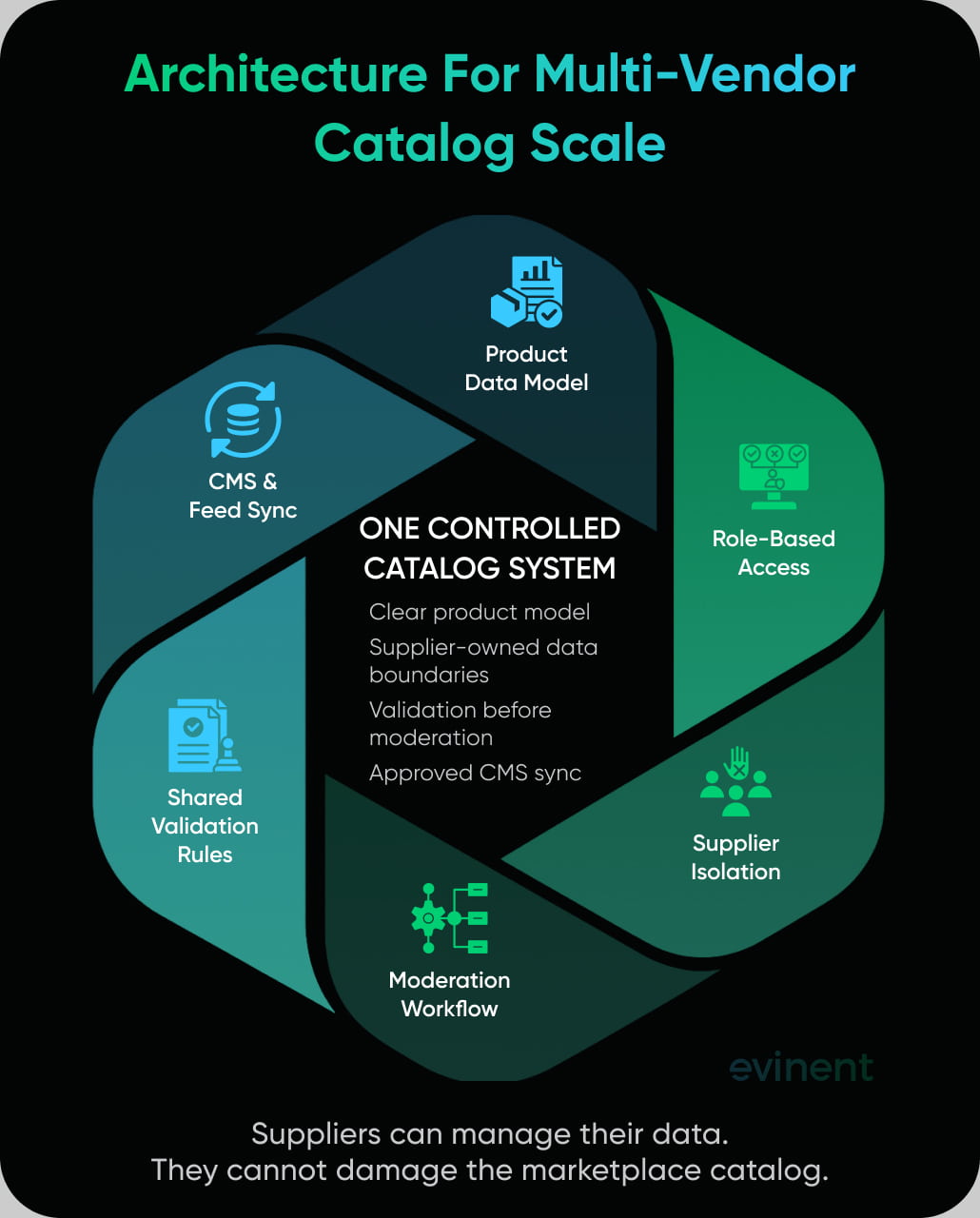
CMS Synchronization Has To Be Treated As A Product Data Contract
Approved catalog data needs to move somewhere.
Usually, it goes into a CMS, ecommerce engine, search index, product feed system, recommendation engine, analytics stack, or all of them at once.
This is where many catalog systems get fragile.
The moderation system approves one version. The CMS receives another. The search index is updated later. The feed export pulls from a different table. The product page shows old availability. The structured data uses stale price. Customer support sees a warranty value from last month.
Now the marketplace has several versions of the truth.
That is dangerous because buyers, search engines, ad platforms, and internal teams may all see slightly different product data.
A strong architecture treats CMS synchronization as a product data contract.
The system should define which approved fields sync to which destination, how often sync happens, what happens when sync fails, and which changes require re-approval before sync.
For example, changing stock may sync automatically.
Changing price may sync automatically but remain logged.
Changing product title may require validation.
Changing category may require moderation.
Changing compliance text may require compliance review.
Changing images may require automated image checks.
This is how the marketplace prevents random changes from moving downstream without control.
CMS sync should also include error handling. If a product is approved but fails to publish, the team needs to know why. Maybe the CMS rejected an attribute. Maybe the search index failed. Maybe a feed field is missing. Maybe the product has no canonical URL. Maybe the system cannot map the category.
Silent sync failures are awful because they create fake confidence. The product looks approved internally but never appears correctly on the live site.
That kind of gap wastes time and creates awkward conversations.
API-First Does Not Mean Supplier-Friendly By Default
Enterprise teams often say they want an API-first marketplace catalog system.
Good. They probably should.
But API-first does not automatically mean supplier-friendly.
A clean API helps mature suppliers integrate faster. It supports high-volume updates, inventory sync, pricing changes, and large catalog submissions. For major vendors, that can reduce manual work dramatically.
But not every supplier is technically mature. Some will need CSV import. Some will need a portal. Some will need onboarding support. Some will use API for stock and price but manual portal submission for new product content.
The architecture should support different supplier maturity levels without weakening catalog governance.
The same rules should apply whether data arrives through API, CSV, or manual entry. Required fields are still required. Image rules still apply. Duplicate checks still run. AI validation still flags issues. Critical changes still need approval.
The interface can differ. The governance should not.
This is where marketplace teams need to avoid a common trap: building custom exceptions for big suppliers that bypass quality controls.
A strategic supplier may ask to publish directly through API. That may sound efficient, but if their data does not pass the same validation as everyone else, the marketplace is basically giving them permission to damage the catalog faster.
Speed is good.
Uncontrolled speed is expensive.
Search, Filters, And Recommendations Should Influence The Data Model
Catalog architecture should not be built in isolation from product discovery.
The way buyers search and filter should influence which attributes the marketplace collects, how values are normalized, and which fields become required.
If buyers filter by compatibility, compatibility data cannot be optional.
If buyers compare by material, material cannot be a free-text mess.
If buyers search by model number, model number needs its own field.
If recommendations depend on brand, category, price band, and use case, those fields need to be clean enough for the model to use.
This is where catalog management connects directly to revenue.
A product with weak attributes may still be published, but it may not appear in the right filters, recommendations, or search results. It is technically live, but commercially half-hidden.
That is one of the most frustrating types of catalog failure because leadership sees SKU growth, but buyers do not experience better choice.
The marketplace has more products, yet discovery does not improve.
A strong catalog architecture should feed search, filters, recommendations, and analytics with normalized product data. It should also send signals back.
Product discovery should not be treated as separate from catalog governance. They are tied together. Same room, same argument.
Analytics Should Show Catalog Health, Not Just Catalog Size
A marketplace dashboard that only shows total SKUs is dangerous.
SKU count is useful, but it can hide bad quality. A catalog can grow while becoming less searchable, less trustworthy, and harder to operate.
Architecture should include catalog health analytics from the start.
The team should be able to see first-pass validation rate, rejection reasons, duplicate risk, missing attributes, image quality failures, supplier revision cycles, moderation backlog, average approval time, CMS sync failures, and content completeness by category.
This data helps leaders make better decisions.
If supplier submissions fail often, vendor onboarding needs work.
If one category has low completeness, templates may need revision.
If image failures are common, supplier documentation may be unclear.
If moderation backlog rises, validation may need to catch more issues earlier.
If duplicate risk spikes, the product identity model may be too weak.
If CMS sync failures increase, engineering needs to look at integration reliability.
Catalog health metrics turn "the team is overwhelmed" into specific operational signals.
And specific signals are what get fixed.
The Architecture Should Assume The Catalog Will Change
Marketplace catalogs are not static.
New categories launch. Suppliers change formats. Product regulations shift. SEO requirements change. Google feed rules change. Buyers search differently. AI tools are starting to use product data in new ways. The business expands to new regions. A simple category suddenly needs variants, bundles, subscriptions, or custom pricing.
The architecture should expect that.
That means category templates should be configurable. Validation rules should be adjustable. Attribute models should support change without breaking old records. Supplier roles should be flexible. CMS sync mappings should be versioned. AI validation rules should be tuned over time. Audit logs should preserve history when fields change.
Hard-coded catalog logic may feel faster at first. It usually becomes a tax later.
A marketplace that plans to reach 100+ vendors needs room to change its product model without having to rebuild the entire catalog system every time the business adds a new category.
That is the difference between a launch solution and an operating platform.
What This Looks Like When It Works
When the architecture is right, catalog operations feel calmer.
Not easy. Catalog work is never easy. But calmer.
Suppliers submit products through the channel that fits their maturity. The system validates data before moderation. AI flags duplicates, contradictions, weak content, and image issues. Moderators review products with context. Supplier comments stay attached to the field or listing. Approved records sync to the CMS and downstream systems. Every change is logged. Analytics show where quality is improving and where it is slipping.
The marketplace can add vendors without multiplying manual repair at the same pace.
That is the real architectural goal.
Not just more SKUs.
More controlled SKUs. More reliable SKUs. More products that buyers can actually find, compare, trust, and buy without sending the operations team into cleanup mode every Monday morning.
How Evinent Solved Multi-Vendor Catalog Management For A Growing Marketplace
The most dangerous catalog problems are rarely technical at first.
A supplier sends the wrong file. A moderator fixes it manually. Another supplier forgets required attributes. Someone from the marketplace team sends a reminder. A duplicate listing appears. The category manager merges it by hand. Product images do not meet the standard. The team rejects them, then waits for the supplier to resend better ones.
Each issue is manageable alone. Together, they create a slow, expensive process where the internal team becomes the catalog cleaning department.
That was the core problem Evinent had to solve for a growing marketplace: product content was moving through too many manual paths before it reached the live catalog. Supplier submissions lacked structure. Moderation depended too much on human checking. Product quality issues were discovered too late. CMS updates required too much manual handling. And as the vendor count grew, the team could feel the process getting heavier.
That is an important distinction because many enterprise systems do not fail all at once. They keep working, but every new supplier, SKU, and category adds more friction. Eventually the team is spending its best people on low-value repair work instead of marketplace growth.
Evinent’s approach was to rebuild the catalog process around one idea: supplier content should be checked, corrected, approved, and synced before it becomes part of the live marketplace catalog.
The Starting Point: Supplier Data Was Arriving Too Loosely
The marketplace had the kind of catalog challenge that shows up when growth starts to work.
More suppliers wanted to join. More products needed to be added. More categories were planned. The business wanted catalog expansion, but the internal team needed control.
A marketplace cannot ask every supplier to work like an enterprise data team. Some suppliers have clean exports. Some have messy spreadsheets. Some have strong internal systems but weak marketplace-ready content. Some understand product attributes. Some mostly understand price, stock, and "please publish this quickly."
So the first challenge was not only to collect product data. It was to make supplier submission predictable.
Evinent designed the process around a supplier portal where vendors could submit product content through a controlled flow. That meant suppliers did not simply throw files over the fence and wait for the marketplace team to clean them. They worked inside a structure that told them what data was required, which fields mattered, and which issues blocked publication.
The portal gave suppliers a clear place to manage submissions, see errors, and respond to feedback. It also gave the marketplace team a controlled entry point for vendor product data management.
Once supplier data enters through a structured portal, the marketplace can enforce category-specific rules. It can standardize field names. It can run validation. It can track submission quality by supplier. It can keep comments tied to the product instead of scattered across email threads.
A supplier portal is not just a convenience feature. In multi-vendor catalog management, it is the front door to catalog governance.
This is exactly the type of operational problem Evinent solves in ecommerce projects. The team works with custom ecommerce platforms, B2B and B2C systems, catalog-heavy products, integrations, and marketplace logic, so catalog quality is treated as part of the platform architecture, not as a side task for content managers. For companies planning a new marketplace or rebuilding an existing one, Evinent’s eCommerce development services are a natural starting point.
The same logic applies to B2B marketplaces, where product data is often even more complex. Buyers may need technical specs, contract pricing, supplier-specific terms, bulk ordering rules, lead times, compatibility data, and documentation before they can make a purchasing decision. That is why Evinent’s B2B eCommerce development services connect directly to multi-vendor catalog management: the catalog has to support real procurement workflows, not just nice-looking product cards.
The Second Step: Moderation Became A Workflow, Not A Pile Of Tasks
Before a proper moderation workflow exists, product review usually depends on people remembering what to do.
Check title. Check image. Check category. Check required fields. Check duplicate risk. Ask supplier for missing information. Approve if everything looks okay. Reject if not.
In practice, that turns into inconsistent review quality because different moderators notice different things. One person may be strict about images. Another may focus on attributes. Another may approve faster because a category launch is late. Another may catch duplicate listings by memory because they know the supplier well.
Evinent built the catalog approval process as a moderation workflow. Each product could move through clear stages instead of floating in a vague "pending" state. Supplier submissions could be checked automatically, returned for fixes, reviewed by moderators, approved, rejected, or prepared for CMS synchronization.
The marketplace team could see where products were stuck. A listing waiting for supplier fixes was different from a listing waiting for human review. A product blocked by validation was different from a product approved but not yet synced. A duplicate candidate was different from a normal new submission.
That is a big operational improvement. If 200 products are waiting for supplier correction, adding more moderators will not fix the bottleneck. If 200 products are stuck in human review, better supplier training will not help much. If products are approved but not published, the issue may be CMS sync or integration logic.
A moderation workflow gives the team the map. Without the map, people just work harder.
The Third Step: AI Validation Started Catching Problems Earlier
The AI layer was not added to make the process look fashionable. It was added because the review workload had too many repeatable checks.
Completeness checks. Format checks. Duplicate signals. Attribute inconsistencies. Image issues. Thin descriptions. Category mismatch. Products that looked suspiciously similar to existing listings. Fields that technically had values but did not help the buyer.
Evinent added AI-based content validation before human review. The goal was not to replace moderation. The goal was to make moderation less wasteful.
AI validation could review supplier submissions and flag problems such as missing required details, weak descriptions, possible duplicate listings, image quality issues, and mismatches between product fields. A moderator would then see the product with context instead of starting from zero.
This is the difference between "please review this listing" and "please review this listing; the system already found a possible duplicate, a missing compatibility field, and an image that does not meet requirements."
The second version is much more useful. It also changes supplier behavior. When suppliers receive clear, immediate feedback, they learn what the marketplace expects. If the portal tells them that dimensions are required for furniture, or that the image resolution is too low, or that the product may already exist as a canonical listing, they can fix the issue before a human moderator spends time on it. Not "AI will run your marketplace." More like: AI will stop your team from reviewing the same missing-field problem 700 times.
This AI validation layer also connects with a broader product discovery problem. Evinent has written about why marketplace teams need cleaner data in Marketplace Product Data Quality, and the same logic applies here: AI can only improve catalog operations when the data model, submission rules, and moderation workflow are already under control.
For marketplaces that want to improve search, filtering, and recommendations, Evinent’s article on AI Product Discovery In E-Commerce is also relevant. AI product discovery depends on clean product titles, attributes, categories, and identifiers. If supplier data is messy, AI has to work around the mess instead of helping buyers find the right product faster.
The Fourth Step: Approved Content Synced With Evinent CMS
A clean moderation workflow is not enough if approved content still has to be copied manually into the CMS.
That would only move the bottleneck downstream. Evinent connected the approved catalog workflow with Evinent CMS synchronization so product content could move from supplier submission to validation, moderation, approval, and publication without being re-created by hand in another system.
That matters because every manual transfer creates risk.
Someone copies the wrong value. Someone uses an older spreadsheet. Someone updates the CMS but not the product feed. Someone fixes the product page but forgets the search index. Someone changes a title and loses the approved version.
CMS synchronization protects the approved product record.
Once content passes validation and moderation, the system can push the right version into the live catalog and related systems. The team no longer needs to treat the CMS as a separate island where product data gets reworked again.
For marketplace operations, this is a big shift. The catalog workflow becomes connected instead of fragmented.
Supplier portal.
Validation.
Moderation.
Approval.
CMS sync.
Publication.
That chain is what lets a marketplace grow without turning every product update into manual handling.
Catalog Quality Also Affects Product Discovery
Catalog quality does not stop at the product page.
It affects search, filters, recommendations, paid feeds, category pages, SEO, and analytics. If product attributes are inconsistent, even a strong search engine will struggle because search can only work with the data it receives.
That is why Evinent’s eCommerce site search solutions are relevant here too. Advanced search, filtering, multilingual search, autocomplete, synonym management, and product recommendations become much more effective when supplier product data is clean and structured.
This connection is easy to underestimate.
A marketplace may invest in a better search experience, but if half the supplier catalog has inconsistent attributes, missing product identifiers, vague titles, or duplicate listings, the search layer has to compensate for poor inputs. It may still improve the experience, but it will always be fighting the catalog.
Clean catalog data gives search something solid to work with.
Messy catalog data turns search into damage control.
The same idea appears in Evinent’s content on Ecommerce Site Search, Ecommerce Search Filters, and Internal Site Search Optimization. Search quality, filter quality, and catalog quality are not separate problems. They feed each other.
A marketplace with poor attribute consistency cannot build strong filters.
A marketplace with duplicate listings cannot build clean search results.
A marketplace with vague product titles cannot expect great internal search performance.
This is why catalog management needs to be treated as part of the discovery architecture, not just as supplier admin work.
What Changed During Alpha Testing
The alpha testing phase was less about proving that the interface worked and more about proving that the operating model made sense.
Could suppliers submit products through the portal without constant support?
Could validation catch enough issues before human review?
Could moderators understand AI flags and act on them?
Could products move through statuses clearly?
Could supplier feedback stay attached to the right listing?
Could approved content sync into the CMS without manual rewriting?
That is the kind of alpha testing that matters for enterprise catalog systems. Not just "does the button work?" but "does this reduce the mess?"
The early results showed that the new structure made the catalog process easier to control.
Suppliers had a clearer submission path. Moderators received cleaner product records. Duplicate risks became visible earlier. Missing fields were caught before review. Feedback moved into the workflow. CMS sync reduced repeated manual transfer. The team gained better visibility into where products were stuck and why.
Why This Case Matters For Enterprise Marketplaces
This case matters because it reflects a problem many marketplaces face after the first growth phase.
At launch, the goal is to get suppliers and SKUs live.
After growth starts, the goal changes. The marketplace has to keep expanding without letting product data quality fall apart.
That requires a different system. A growing marketplace needs to know which data belongs to suppliers and which data belongs to the marketplace. It needs validation before moderation. It needs AI checks that support human review. It needs approval logic. It needs supplier feedback in context. It needs CMS synchronization. It needs version history. It needs role-based access. It needs reporting that shows catalog health, not just SKU count.
This is where Evinent’s broader experience matters.
Evinent works with modernization, data workflows, platform architecture, ecommerce systems, and business-critical integrations. That background is directly relevant to catalog systems because multi-vendor catalog management is, at its core, a data workflow problem with business consequences.
Evinent’s ecommerce modernization experience also fits this type of challenge. In the Legacy Application Migration For E-Commerce Scalability And Performance case, the team modernized an outdated retail platform, improved integrations, strengthened performance, and supported multi-language and multi-currency functionality. The project also included AI-powered search and filters, which is especially relevant for marketplaces where catalog structure directly affects product discovery.
Another useful reference is Evinent’s Custom Ecommerce Website Development For A Leading Central Asian Retailer. It shows Evinent’s experience with complex ecommerce environments, enterprise platform requirements, and performance-focused development. For a growing marketplace, that background matters because catalog management is rarely isolated. It touches supplier workflows, CMS logic, search, integrations, analytics, and customer experience at the same time.
The Scalable E-Commerce Platform case is also relevant for marketplace teams thinking about catalog and order management under pressure. Catalog growth usually brings more traffic, more product relationships, more supplier updates, and more operational dependencies. A platform that cannot handle those dependencies cleanly will eventually slow down the business.
For readers who want to see more examples, the broader Evinent portfolio includes ecommerce, retail, logistics, healthcare, and modernization projects. That gives this article a stronger proof layer: Evinent is not talking about catalog governance as theory, but from the perspective of teams that build and modernize real business-critical systems.
The Practical Outcome: Less Manual Repair, More Controlled Growth
The best outcome of structured catalog management is not that everyone suddenly talks about catalog governance in leadership meetings.
Hopefully they do not have to.
The best outcome is that the marketplace team can add vendors without multiplying manual repair work at the same speed. A marketplace does not win because it has the most SKUs sitting in a database. It wins when buyers can find the right product, trust the information, compare options, and complete the purchase without friction.
Multi-vendor catalog management is the machinery behind that experience.
When it works, nobody notices.
When it breaks, everyone does.
If your marketplace is already growing faster than your catalog team can control, this is usually the right moment to review the submission workflow, moderation logic, CMS sync, and supplier data model. Evinent can help assess the current catalog process, modernize the platform architecture, and build the supplier-facing tools needed to keep product content clean at scale. Explore Evinent’s ecommerce development services, review Evinent’s B2B ecommerce development services, or browse the portfolio for relevant ecommerce and modernization work.
What C-Level Teams Should Measure Before The Catalog Breaks
A marketplace catalog can look healthy while the operation behind it is quietly burning.
That is the annoying part.
SKU count goes up. Vendor count goes up. Product pages go live. The board deck looks fine. Everyone sees assortment growth, and assortment growth feels like progress.
But underneath, the team may be spending more time fixing supplier data than expanding the business. Moderators may be drowning in avoidable checks. Search may be losing quality because attributes are inconsistent. Customer support may be answering questions that should have been answered on the product page. Returns may be rising because the content set the wrong expectation.
So the question for leadership is not only: how many products do we have?
The better question is: how much work does each product create before and after it goes live?
That is where catalog health metrics matter.
Measure First-Pass Supplier Submission Quality
The first metric every marketplace should track is how many supplier submissions pass validation on the first attempt.
This tells you whether suppliers understand your catalog requirements, whether your templates are clear, and whether your onboarding process is doing its job.
If a supplier sends 500 products and only 120 pass the first validation round, the problem is not just "bad supplier data." That is too vague. The real problem may be unclear requirements, weak onboarding, missing field guidance, poor supplier tooling, or category templates that do not match how suppliers store product data.
First-pass quality also helps separate good suppliers from expensive suppliers.
A supplier may offer strong prices and broad assortment, but if every product submission creates cleanup work, the real cost of working with that supplier is higher than it looks. Vendor managers need to see that.
Track how often supplier submissions fail because of missing fields, invalid values, weak images, duplicate risk, wrong categories, or format issues. Over time, this creates a supplier content quality score.
That score does not need to be punitive. It can be used for training, onboarding, and workflow changes. But it should exist.
Without it, the marketplace team is stuck with feelings like "Supplier B is always messy."
Feelings may be true. Data gets action.
Measure Manual Repair Time Per Product
This is the metric that usually wakes leadership up.
How much human time does it take to get one supplier product from submission to publication?
Not in theory. In reality.
A product may need field cleanup, image rejection, duplicate review, supplier clarification, category correction, moderation, CMS sync, and post-publication edits. Each step may look small, but small work multiplied by thousands of SKUs becomes a staffing problem.
Manual repair time shows whether the marketplace model is actually becoming more efficient as it grows.
If every new supplier adds a proportional amount of manual catalog work, the operation is not built for growth. It is just hiring people to absorb mess.
This metric should include all avoidable correction work, not only formal moderation time. That means supplier emails, spreadsheet fixes, internal comments, duplicate checks, CMS corrections, and rework after publication.
The goal is not to eliminate human review. That would be unrealistic.
The goal is to reduce low-value repair.
Humans should handle judgment, policy, supplier disputes, category decisions, and edge cases. They should not spend their week correcting units, chasing missing images, or finding out that 300 products have no dimensions.
If manual repair time is high, the fix may be better validation, clearer templates, AI-assisted checks, stronger supplier onboarding, or tighter CMS sync.
Hiring more moderators may help temporarily.
But if the process is weak, more people only make the weakness more expensive.
Measure Moderation Backlog By Status
A large moderation backlog is not one problem.
It can mean several different things.
Products may be waiting for supplier fixes. They may be waiting for automated validation. They may be waiting for duplicate review. They may be waiting for a category manager. They may be waiting for compliance review. They may be approved but not synced to the CMS.
If all of that sits under one label called "pending," leadership cannot manage it.
The catalog workflow should show backlog by status.
That way, the marketplace team can see where work is stuck and why.
If most products are waiting for supplier correction, the issue is supplier readiness or unclear submission rules.
If most products are waiting for human review, the moderation team may need better pre-checks or more capacity.
If many products are stuck in duplicate review, the marketplace may need a stronger canonical product model.
If approved products are not going live, the CMS sync or publication process may be the bottleneck.
This is how the conversation changes from "catalog is ed" to "42% of blocked products are waiting for supplier image fixes."
That is much easier to fix.
Measure Catalog Completeness By Category
Average catalog completeness can hide serious category problems.
A marketplace may report that 86% of required fields are filled across the full catalog. Sounds good. But if one high-margin category has weak attribute coverage, buyers in that category may still struggle to compare products.
Catalog completeness should be measured by category, supplier, product type, region, and channel.
For apparel, incomplete size, fit, material, and care fields can increase returns.
For electronics, missing model numbers, technical specs, warranty data, or compatibility fields can hurt comparison and search.
For furniture, missing dimensions and delivery constraints can create buyer frustration.
For B2B products, missing documentation, lead times, MOQ, or compliance data can stop a purchase before procurement even starts.
The same completeness score should not be applied blindly across the whole catalog. Each category has its own decision-making logic.
That is why category-specific completeness matters. It tells leadership whether the catalog is strong where the business needs it to be strong.
A marketplace does not need perfect content everywhere on day one.
But it does need the right content in the right categories.
Measure Duplicate Risk And Canonical Product Coverage
Duplicate listings are one of the easiest catalog problems to ignore until buyers start noticing.
They look harmless at first. Another supplier submitted the same product. Fine. More choice, right?
Not exactly.
If duplicate pages are published separately, reviews split across pages. Search results become repetitive. SEO signals get diluted. Product performance reporting becomes messy. Buyers may not understand which page to trust. Category pages feel cluttered.
The marketplace should track suspected duplicates, ed duplicates, duplicate resolution time, and the percentage of products connected to canonical product records.
Canonical product coverage is especially important for multi-vendor marketplaces.
If five suppliers sell the same product, the marketplace should usually have one approved product record with multiple supplier offers attached to it. That gives buyers a cleaner experience and gives operators cleaner data.
Without a canonical product model, every supplier upload can create new product pages. The catalog grows, yes, but in a messy way.
That kind of growth is not healthy.
It is product page inflation.
Measure Product Content Impact On Returns
Returns should not sit only in the logistics dashboard.
They belong in the catalog quality conversation too.
If buyers return products because "item not as described," "wrong size," "wrong color," "missing compatibility," "image was misleading," or "specs were unclear," those are product content signals.
A marketplace should connect return reasons back to catalog fields.
Which categories have the highest return rate tied to content?
Which suppliers create the most content-related returns?
Which attributes are most often missing on returned products?
Which product pages had low completeness scores before return rates increased?
Which image issues show up repeatedly in return feedback?
This is where the cost of weak catalog governance becomes visible.
Poor product data is not just a pre-sale issue. It creates post-sale cost through returns, refunds, support tickets, reverse logistics, and customer trust damage.
And the worst part? Some of those costs get blamed on logistics, customer behavior, or supplier performance when the real problem started on the product page.
Measure Search And Filter Failure
Marketplace teams should track no-result searches, low-result searches, filter drop-off, filter usage, products missing important filter attributes, and conversion by search query type.
For example, if buyers often search for "waterproof hiking jacket" but many jackets do not have waterproofing as a structured attribute, the search system has to guess from descriptions. Some products will appear. Others will not. Buyers may miss relevant items.
That is not only a search issue. It is a catalog issue.
The same applies to filters. If buyers use a filter and suddenly the product set drops from 600 to 14 because most suppliers did not fill the attribute correctly, the filter is not helping. It is exposing weak data.
Search analytics can become a catalog improvement engine if teams use it properly.
No-result queries can reveal missing synonyms or missing product types.
Filter drop-off can reveal weak attribute coverage.
Search refinements can show where titles and categories are unclear.
Recommendation performance can show where product relationships are poorly structured.
This is why catalog, search, and analytics teams need to talk to each other. Otherwise, each team fixes its own symptoms while the root problem stays inside product data.
Measure CMS Sync Reliability
Approved product content is only useful if the right version reaches the live systems.
That sounds obvious, but many marketplace teams still struggle with sync issues.
A product may be approved in the catalog workflow but not appear in the CMS. A field may update in the supplier portal but not in the search index. A price may change in the offer layer but not in the product feed. A corrected description may appear on the product page but not in structured data.
These issues create confusion for buyers, internal teams, and external channels.
Leadership should track CMS sync reliability as part of catalog health.
How many approved products failed to publish?
How many products published with missing fields?
How long does it take for approved changes to reach the live site?
How often do CMS records differ from approved catalog records?
How often do product feed errors come from catalog data problems?
How quickly can the team roll back a bad product update?
These metrics matter because a marketplace catalog is not one database anymore. It feeds product pages, search, filters, recommendations, ads, analytics, and customer support tools.
If synchronization is weak, the catalog loses its role as the source of truth.
And once teams stop trusting the catalog, they build side spreadsheets.
That is usually the beginning of another mess.
Measure Supplier Fix Cycle Time
When a product is rejected or sent back for correction, how long does the supplier take to fix it?
This metric is useful because catalog s often happen outside the internal team.
A moderator may review a product in one day, but if the supplier takes nine days to provide missing images or specs, the listing still goes nowhere.
Supplier fix cycle time shows which suppliers slow the catalog down after feedback.
It also shows whether feedback is clear.
If many suppliers take a long time to fix the same type of issue, the marketplace should not immediately blame suppliers. Maybe the requirement is confusing. Maybe the portal does not explain it well. Maybe the supplier does not know where to find that data. Maybe the field name makes sense internally but not to vendors.
Good supplier feedback reduces fix time.
Bad supplier feedback creates email loops.
The goal is not to shame suppliers. The goal is to make the submission process easier to complete correctly.
Because a product that sits in correction for two weeks is not inventory. It is potential revenue waiting in a queue.
Measure Change Quality After Publication
Catalog governance does not end when a product goes live.
In fact, post-publication changes are often more risky than initial submissions because everyone assumes the product has already been approved.
Suppliers may update titles, images, descriptions, attributes, stock, price, warranty terms, or variant data after publication. Some changes are harmless. Some should trigger re-validation. Some should trigger human review.
A marketplace should track how often live products are changed, which fields are changed, who changes them, and whether those changes create issues.
For example, if suppliers often edit titles after approval and add keyword stuffing, the marketplace needs stricter title controls.
If image replacements frequently fail standards, the system should run image validation on post-publication edits too.
If category changes break filters, category edits should require review.
If warranty or compliance fields change, those updates should be routed to a reviewer before publication.
This is where version control matters.
Leadership should be able to see what changed, when it changed, who changed it, and whether it affected product performance.
Without that history, the team cannot connect catalog changes to business impact.
A product’s conversion rate dropped. Was the price changed? Did the title change? Was the main image replaced? Did the product move categories? Did a supplier overwrite marketplace-approved copy?
The catalog should be able to answer.
Measure Catalog Debt
Catalog debt is the backlog of known product data problems that the team has not fixed yet.
It may include missing attributes, duplicate candidates, weak images, outdated descriptions, unmapped categories, unresolved supplier comments, old products without canonical records, products missing feed fields, or live listings that fail current standards.
Every marketplace has some catalog debt. That is normal.
The problem starts when nobody measures it.
Catalog debt should be visible, grouped by severity, and tied to business impact.
Some issues are cosmetic. Some block product discovery. Some increase return risk. Some affect paid feeds. Some create compliance exposure. Some confuse buyers in high-margin categories.
Not all catalog debt needs to be fixed immediately. But leadership should know what exists and what it costs.
A healthy marketplace has a plan for catalog debt.
An unhealthy one keeps saying "we’ll clean it later" until later becomes a migration project, a search rebuild, or a painful supplier re-onboarding effort.
The Executive Dashboard Should Be Boringly Clear
A good catalog dashboard for leadership does not need 60 charts.
It needs a small set of signals that show whether the marketplace can grow without losing control.
The useful questions are simple:
Are suppliers submitting cleaner data over time?
Is manual repair time going down?
Where are products stuck?
Which categories have weak completeness?
Are duplicates under control?
Are content-related returns rising?
Are search and filters suffering because of poor attributes?
Is approved content syncing correctly?
Are suppliers fixing issues quickly?
Is catalog debt shrinking or growing?
If the dashboard can answer those questions, leadership can manage catalog quality before it becomes a crisis.
And that is the whole point.
Multi-vendor catalog management should not wait for a full cleanup project, a search failure, or a return spike before it gets attention. By then, the catalog has already trained the business to work around bad data.
C-level teams do not need to review every product field. They do need to know whether the catalog operation is getting stronger or weaker as the marketplace grows.
Because growth that makes the catalog worse is not clean growth. It is just more work wearing a revenue costume.
How To Fix Multi-Vendor Catalog Management Before It Turns Into Cleanup Work
The good news is that catalog chaos is fixable.
The less good news: it is much easier to fix before the marketplace reaches 100 suppliers, not after.
Once bad product data has already spread into the CMS, search index, feeds, analytics, support tools, and customer-facing pages, every correction becomes slower. The team is no longer fixing one product field. It is fixing one product field and every place that field traveled.
That is why marketplace leaders should treat catalog management as an operating model, not a later admin feature.
A strong multi-vendor marketplace catalog does not need to be perfect from day one. That would be unrealistic. Suppliers will still make mistakes. Category templates will still need revision. Some product families will still be weird. Anyone who has ever worked with spare parts, fashion variants, medical-adjacent products, or B2B equipment knows that catalog work has a way of humbling people.
But the system should be designed to improve over time.
That is the real difference.
A weak catalog process gets messier as the marketplace grows.
A strong catalog process learns as the marketplace grows.
Start With The Supplier Submission Contract
The first fix is simple, but not small: define what suppliers must submit.
Not just "product data."
Actual fields. Actual formats. Actual rules. Actual examples.
Every category should have a clear submission contract. Suppliers should know which fields are required, which values are accepted, which image standards apply, which product identifiers matter, which documents are needed, and which mistakes will block publication.
This removes a lot of unnecessary back-and-forth.
If a furniture supplier knows from the start that dimensions, package size, assembly details, material, and delivery constraints are required, the marketplace team does not have to ask for them product by product.
If an electronics supplier knows that model number, GTIN or MPN, warranty details, compatibility, and technical specs are mandatory, fewer weak listings enter moderation.
If a B2B supplier knows that MOQ, lead time, datasheets, and compliance documentation are required, procurement buyers get better product pages faster.
The supplier submission contract should be visible inside the portal, import template, and API documentation. It should not live only in a PDF someone sent during onboarding.
Suppliers forget PDFs. Systems enforce rules.
Build The Canonical Product Model Early
If several vendors can sell the same product, the marketplace needs a canonical product model early.
Without it, duplicate pages multiply. Every supplier upload becomes a potential new product page. Buyers see near-identical results. Reviews split. SEO signals weaken. Category pages become noisy. Internal reporting gets weird.
A canonical product model separates the product from the seller offer.
The product record contains the approved content: title, brand, identifiers, attributes, images, description, category, and other shared information.
The supplier offer contains seller-specific data: price, stock, delivery time, shipping terms, warranty terms, seller rating, and other commercial details.
This is especially important for marketplaces that want to grow through supplier expansion. More suppliers should give buyers more purchasing options, not more duplicate product pages.
The earlier the marketplace defines this model, the easier it is to keep the catalog clean.
Trying to merge thousands of duplicates later is possible.
It is also painful.
Put Validation Before Moderation
Human review is expensive. Use it where it matters.
A moderator should not be the first person to discover that a required field is missing, an image is too small, or a product title is 12 characters long. The system should catch those issues before the listing enters the review queue.
Validation should happen at every entry point:
Supplier portal submission.
CSV upload.
API import.
Bulk edit.
Post-publication update.
CMS sync.
Feed export.
That last part matters. Many teams validate only at first upload, then let the catalog degrade later through edits and integrations. A supplier changes images after approval. A bulk update overwrites attributes. A category move breaks filters. A CMS sync sends outdated data downstream.
Validation should not be a one-time gate.
It should be part of the catalog’s nervous system.
Some validation will be rule-based: required fields, accepted units, allowed values, image dimensions, file format, SKU logic, GTIN structure, and category restrictions.
Some validation can be AI-assisted: duplicate risk, vague descriptions, title clarity, image relevance, attribute contradictions, and category mismatch.
Together, they reduce the amount of weak content that reaches people.
That is the point.
Not "remove moderators."
Make moderation worth the moderator’s time.
Use AI Where It Reduces Rework, Not Where It Creates Risk
AI can help catalog teams a lot, but only when its role is clear.
The safest and most useful role is pre-moderation support.
AI can flag thin descriptions, missing context, likely duplicates, image quality issues, inconsistent attributes, and fields that contradict each other. It can help suppliers understand what is wrong. It can give moderators a better starting point. It can rank the review queue by risk.
That is valuable.
But AI should not freely invent specs, approve compliance claims, merge products, publish sensitive listings, or rewrite factual product details without review.
Product data is not just content. It is a promise to the buyer. In some categories, it is also a compliance record.
So the better model is AI-assisted catalog moderation. AI checks. AI suggests. AI flags. Humans decide where judgment matters.
That balance is what makes AI useful in enterprise marketplace operations.
Keep Supplier Feedback Inside The Workflow
One of the fastest ways to slow a catalog team down is to move feedback outside the system.
A moderator comments in email. A supplier replies with a spreadsheet. A category manager comments in Slack. A file gets renamed. Someone uploads version six instead of version seven. Now nobody knows what is final.
This is how catalog teams lose time.
Supplier feedback should live where the issue lives.
If the problem is a missing attribute, the comment should appear next to that field.
If the image is rejected, the reason should be attached to that image.
If a product is flagged as a duplicate, the supplier should see whether they need to submit it as a new product, a variant, or an offer under an existing listing.
If a product cannot publish because of a feed requirement, the reason should be visible in the product workflow.
Clear feedback reduces supplier fix time. It also trains suppliers. Over time, good suppliers submit cleaner data because the system keeps showing them what "clean" means.
And if a supplier does not improve, the marketplace can prove it with data.
Make The CMS Sync Boringly Reliable
Approved product content needs one controlled path into the live catalog.
Not copy-paste.
Not side spreadsheets.
Not "I updated it in the CMS, but I’m not sure whether the feed picked it up."
A marketplace catalog should have a clear source of truth. Once a product record is approved, the system should sync the right fields into the CMS, search index, product feeds, recommendation layer, and analytics tools.
If sync fails, the team should see the failure.
If a critical field changes, the system should know whether re-validation or re-approval is required.
If a bad update goes live, the team should be able to see what changed and roll it back.
This is the kind of infrastructure work that nobody praises when it works. That is fine. Nobody praises plumbing until the ceiling leaks.
Treat Catalog Quality As Supplier Performance
Supplier performance is usually measured through price, availability, delivery, return rate, margin, and sales.
Product content quality deserves a place in that list.
A supplier that sends messy data creates cost. The cost may not appear on the supplier invoice, but the marketplace pays for it through moderation time, ed publication, weaker search, customer support, returns, and cleanup projects.
A supplier that sends clean data helps the marketplace move faster.
That should be visible.
Track first-pass validation rate, missing field rate, image rejection rate, duplicate risk, average fix time, post-publication correction rate, and content-related returns by supplier.
The point is not to punish suppliers. The point is to stop pretending all suppliers create the same operational cost.
They do not.
Connect Catalog Work To Revenue Outcomes
Catalog quality can feel like an internal operations topic until it is tied to business outcomes.
So tie it.
Measure how product completeness affects conversion.
Measure whether products with better image sets return less often.
Measure whether clean attributes improve filter usage.
Measure whether canonical product pages perform better than duplicate product pages.
Measure whether content-related support tickets drop after supplier validation improves.
Measure whether products approved through the structured workflow publish faster than products handled manually.
Once catalog quality is connected to revenue, leadership stops seeing it as admin hygiene.
It becomes part of marketplace growth.
Because that is what it is.
A cleaner catalog helps buyers find products faster, compare them with less doubt, trust the information, and complete the purchase. It also helps internal teams spend less time repairing preventable issues.
The Catalog Is Not A Back-Office Detail Anymore
Multi-vendor catalog management breaks at scale when product data is treated as a supplier upload problem.
It holds up when product data is treated as marketplace infrastructure.
That is the whole difference.
A growing marketplace does not only need more vendors. It needs a way to absorb more vendors without letting every supplier bring their own data chaos into the customer experience.
The catalog is where that fight happens first.
If submission is loose, moderation becomes cleanup.
If attributes are inconsistent, search and filters suffer.
If duplicate logic is weak, product pages multiply.
If images are unchecked, trust drops.
If CMS sync is fragile, approved data splits across systems.
If version history is missing, nobody knows what changed.
And if nobody measures catalog health, leadership sees growth while operations feels friction.
The answer is not to slow down marketplace growth. Nobody wants that. The answer is to make growth cleaner.
Structured supplier submission.
Category-specific validation.
AI-assisted content checks.
Human moderation where judgment matters.
Canonical product records.
Supplier feedback in context.
Reliable CMS synchronization.
Catalog health metrics.
That is the operating base a serious marketplace needs before the vendor count gets too large.
Because once the catalog breaks, the business does not just have a content problem.
It has a search problem. A conversion problem. A returns problem. A supplier management problem. A reporting problem. A trust problem.
And all of those are more expensive than building the right catalog workflow earlier.
So the practical question for leadership is not "Do we have enough SKUs?"
The better question is:
Can our catalog process handle the next 50 suppliers without turning the operations team into a repair shop?
If the answer is no, the catalog is already telling you something.
Listen before it gets loud.
FAQ
How Do Marketplaces Manage Product Content From Multiple Suppliers?
Marketplaces manage product content from multiple suppliers through structured submission workflows. Vendors usually submit product data through a supplier portal, CSV import, or API, but every submission should pass through the same validation and moderation logic before it reaches the live catalog.
A strong process includes category-specific templates, required fields, image standards, duplicate checks, supplier feedback, and CMS synchronization. Without that structure, internal teams spend too much time cleaning supplier data manually.
What Causes Catalog Quality Problems In Multi-Vendor Marketplaces?
Catalog quality problems usually come from unstructured supplier submissions. Each supplier may use different field names, attribute formats, image standards, product identifiers, category logic, and description styles.
At a small vendor count, teams can fix these issues manually. At scale, the same issues create missing attributes, duplicate listings, weak filters, poor search results, inconsistent product pages, and avoidable customer confusion.
Why Does Multi-Vendor Catalog Management Break At Scale?
Multi-vendor catalog management breaks at scale because every new supplier adds more than SKUs. They also add new data formats, product naming habits, image quality issues, duplicate risks, and update patterns.
If the marketplace does not have structured submission, validation rules, moderation workflows, and CMS sync, the internal team becomes the cleanup layer. The catalog may grow, but quality drops and manual repair increases.
How Does AI Help With Product Content Validation In Marketplaces?
AI helps by checking supplier submissions before they reach human moderation. It can flag missing information, weak descriptions, duplicate risks, image issues, category mismatches, and contradictions between product fields.
AI should not fully replace human review. It works best as a pre-moderation assistant that reduces repetitive checks while humans keep control over final approval, compliance details, duplicate decisions, and supplier disputes.
What Is A Catalog Moderation Workflow?
A catalog moderation workflow is the process a product follows from supplier submission to publication. A typical workflow may include draft, submitted, auto-checked, needs supplier fix, in review, approved, published, synced, and archived.
The goal is to make every product status clear. Teams should know who owns the next action, why a product is blocked, and what needs to happen before it can go live.
How Do You Scale Catalog Management To 100+ Suppliers?
To scale catalog management to 100+ suppliers, marketplaces need controlled supplier access, category-specific templates, automated validation, AI-assisted checks, canonical product records, human moderation, version history, and reliable CMS synchronization.
The key is to prevent bad data from entering the live catalog. Once poor product data spreads into search, product pages, feeds, and analytics, cleanup becomes much slower.
What Is Supplier Catalog Submission?
Supplier catalog submission is the process vendors use to send product data to a marketplace. This can happen through a supplier portal, spreadsheet import, API integration, or manual entry.
A strong supplier submission process defines required fields, accepted formats, image rules, product identifiers, and validation checks before the product reaches moderation.
How Can Marketplaces Reduce Duplicate Product Listings?
Marketplaces reduce duplicate product listings by building a canonical product model. This means one approved product record can support multiple supplier offers, instead of creating a separate page for every vendor selling the same item.
Duplicate detection should combine product identifiers, brand, model, title similarity, attributes, images, and supplier data. AI can flag likely duplicates, but humans should review final merge or offer decisions.
Why Is Product Data Quality Important For Marketplace SEO?
Product data quality affects marketplace SEO because search engines need clear, accurate, and consistent product information. Weak titles, duplicate pages, missing attributes, and mismatched structured data can hurt organic visibility.
Clean catalog data also improves internal linking, category pages, product snippets, filters, and product discovery. In marketplaces, SEO quality often starts inside the catalog model.
What Should C-Level Teams Track In Marketplace Catalog Management?
C-level teams should track supplier submission quality, manual repair time, moderation backlog, category completeness, duplicate risk, CMS sync reliability, content-related returns, search and filter failure, supplier fix cycle time, and catalog debt.
These metrics show whether the catalog operation is ready for growth or whether every new supplier is adding more manual work.
Share