

Retail has always been about conversation — understanding what a customer wants and helping them get it. For decades, that meant training staff, writing scripts, and hoping the experience scaled. It didn't.
Conversational AI shifts that equation completely. Fundamentally, it is a technology allowing a brand and its customers to have a natural two-way conversation via chat, voice, email, and in-store touchpoints that is powered by natural language processing (NLP), machine learning (ML), and generative AI. Unlike the rule-based chatbots of five years that customers actually disliked more than found them useful, the current ecommerce conversational AI is able to understand context, recall preferences, manage complexities, and get better at every interaction. These conversational commerce solutions are indeed what they are designed for.
This article serves as a guide for retailers to assess how well this technology suits their business:
The business case and what measurable impact retailers are experiencing.
Examples of use cases where conversational AI is most effective at creating value throughout the customer journey.
How personalization and omnichannel are not just buzzwords, but work in practice.
The realities of implementation and common mistakes to avoid.
The risks and challenges that are most relevant to the situation should be prepared for before starting.
The future development of technology and why timing is important.
The Business Case: Key Benefits Retail Leaders Care About
Most retailer leaders are not asking "whether conversational AI works" anymore; their question is "what can it do for my business?" The answer is revealed through all parts of the business: income, expenses, client connections, and information. Here is where the influence is most tangible.

1. More Revenue and Fewer Abandoned Carts
Reducing cart abandonment is a top priority for most businesses and is also one of the quickest and easiest ways that conversational AI can help. For example, if a shopper assistant chatbot is able to help a buyer who is in a dilemma by answering their question, showing them a different product that meets their needs, or just reminding them of the item they left behind, it will be able to convert the buyer's intention into an actual purchase. Retailers who put AI chatbots at wait spots of the customer journey report conversion rate increases that are quite significant.
2. Customer Support at Scale — Without Scaling the Team
Order & returns management, product questions, and delivery updates; these interactions are frequently with a large volume, and mostly repetitive. Virtual assistants work on them 24/7 without incurring any additional personnel costs, while feedback and CSAT surveys are triggered automatically after each interaction. The outcome is quicker resolution, lower operational cost, and maintaining support quality even during the busiest season.
3. Turning One-Time Buyers Into Loyal Customers
Customers don't just get satisfied and loyal with a one-time purchase. It's actually built up over time through every interaction a customer has with the brand. Offering personalized product recommendations, doing follow-ups before the customer even asks for it, and providing consistently good experiences across different channels are some of the ways that customers get convinced to come back. Thanks to conversational AI, this sort of constant attention can be extended to a very large number without a human team that can sustain it.
4. First-Party Data: The Strategic Advantage Hiding in Plain Sight
Each interaction acts as a new piece of data. With continued customer interaction, conversational ai ecommerce gradually gets a complete understanding of customer likes, buying behaviors, and difficulties faced, etc. And this is entirely the first-party data advantage that the retailers own. In the scenario where not only third-party cookies are vanishing but also the cost of acquiring customers is increasing, this is a valuable competitive resource that keeps increasing in worth.
5. Employee Enablement: Freeing Your Team for Higher-Value Work
Employee enablement is often the underappreciated benefit. When AI handles routine queries, store associates and support staff shift their focus to complex situations, relationship-building, and in-store interactive kiosks that require a human touch. The technology doesn't replace people ー it removes the work that was never the best use of their time.
6. Real-Time Multilingual Support as a Growth Lever
For retailers operating across regions or targeting diverse customer bases, real-time multilingual support removes a barrier that previously required significant investment to overcome. Customers interact in their preferred language, and the experience remains consistent ー whether the market is domestic or international.
The argument supporting the use of conversational AI in retail is quite convincing and clearly evident in shopping conversion rates, customer support expenses, the frequency of customers coming back to purchase, and the depth of customer data that retailers can collect and use. The next sections will guide you through the process and provide clear examples of these benefits.
Conversational AI in Action: Use Cases Across the Retail Journey
Conversational AI isn't just one tool with one function. It actually works through every stage of the retail experience, from when a customer first sees a page to the follow-up after a purchase that encourages them to return. The types of situations where it can be used are quite varied. Still, their common factor is the core ability: recognizing what someone means, answering appropriately to the situation, and doing things live. Retailers are using it for the following purposes.
Use Case | What AI Does | Business Impact |
Product discovery and recommendation | Understands shopper intent and surfaces relevant products through natural dialogue. | Higher conversion, larger basket size |
Customer support | Handles queries around orders, deliveries, and account issues 24/7. | Lower support costs, faster resolution |
Returns and refunds | Guides customers through return processes automatically. | Reduced friction, improved satisfaction |
Abandoned cart recovery | Re-engages shoppers who left without buying via personalized outreach. | Recovered revenue, improved conversion rate |
Inventory management | Provides real-time stock visibility and flags availability issues. | Fewer lost sales, better operational decisions |
Intelligent routing | Directs complex queries to the right human agent with full context. | Faster resolution, better e-commerce agent efficiency |
Real-time assistance at checkout | Addresses last-minute hesitations and questions at the point of purchase. | Reduced drop-off, higher completed transactions |
Product Q&A | Answers detailed product questions that would otherwise stall a purchase. | Increased buyer confidence, fewer returns |
Order tracking | Delivers proactive, real-time updates on order status. | Reduced inbound support volume |
Fraud detection | Identifies unusual patterns in transactions and flags them instantly. | Reduced financial exposure, faster response |
Real-world example: Saks Fifth Avenue
Saks Fifth Avenue offers one of the most well-documented examples of conversational AI deployed at scale in luxury retail. The brand expanded its partnership with Salesforce to deploy Agentforce, an AI-driven customer service platform that integrates with Customer 360 and Data Cloud to deliver personalized shopping experiences across digital and in-store channels. (Salesforce)
Saks uses Salesforce Data Cloud to unify browsing, purchase, return, and service data into a single customer profile. From this unified view, both AI and human agents gain full context on every customer — enabling what the brand describes as a "VIP-level" experience at scale. (CX Today)
The scenarios mentioned above are not imagined. This is exactly where conversational AI is already helping the retailers, who have implemented it, not just experimented with it. Next, we shall discuss how personalization, the element that connects all of them, can be effective on a large scale.
Personalization: How Conversational AI Enhances the Shopping Experience
Customers don't really want to be treated just as another sales figure. In fact, they want to be truly known, that is, remembered, understood, and relevantly served. For years, the main way of personalizing retail was to divide a mailing list into segments or simply to recommend "customers also bought". However, new Conversational AI brings a whole new level. It can enable real-time personalization on a massive scale, way beyond human team capabilities, thereby making each customer interaction a chance to further the relationship.
1. Reading Customer Intent Before They Finish Typing
The most powerful moment in a shopping is the one before a customer has fully articulated what they want. NLP allows conversational AI to interpret partial queries, ambiguous phrasing, and implicit signals — understanding customer intent not just from what is typed, but from how it is typed, what was searched before, and what was ignored. A shopper who types "something for dinner" is not looking for a keyword match. They are looking for a recommendation from someone who understands context. That is exactly what a well-trained AI delivers.
2. Context-Aware Conversations That Adapt in Real Time
Static scripts break the moment a customer goes off-path. Context-aware dialogue means the conversation adjusts continuously — based on what the customer has said, what they have done, and what the data suggests they need next. If a shopper mentions a budget halfway through a conversation, the AI recalibrates every subsequent recommendation. If they express frustration, tone shifts accordingly. This is not rule-based branching — it is machine learning applied to every exchange in real time.
3. Loyalty Programs That Feel Personal, Not Automated
Loyalty and reward programs have long suffered from the same problem: they feel transactional. Points accumulate, emails go unread, and customers churn anyway. Conversational AI changes the dynamic by making loyalty interactions feel like a conversation rather than a notification. Proactive engagement, a reminder about expiring points, a reward tied to a recent purchase, an exclusive offer surfaced at exactly the right moment, lands differently when it arrives through a channel the customer is already using, framed in language that reflects their history with the brand.
4. CRM Integration for a Unified View of Every Customer
Personalization can only be as effective as the data you have to back it up. When you integrate a CRM with a conversational AI system, you give the AI access to the complete customer record, purchase history, service interactions, preferences, and loyalty status. So, every interaction is rooted in context rather than starting from scratch. This single view is the key difference between truly personalized product recommendations and mere generic suggestions. It's also what empowers human agents, on their intervention, to continue seamlessly from where the AI stopped without having to make the customer repeat themselves.
5. Behavioral Signals: How AI Learns What Customers Want Next
Every action a customer takes, what they browse, what they skip, how long they hover, what they abandon, is a behavioral signal. Conversational AI aggregates these signals continuously, building a dynamic picture of preference and intent that updates with every session. Over time, this allows the system to anticipate needs before they are expressed: surfacing a product the customer did not know they were looking for, or flagging a replenishment moment before the customer thinks to reorder. This is the compounding advantage of agentic AI — it does not just respond, it learns.
6. Customer Segmentation That Goes Beyond Demographics
Traditional customer segmentation puts people in buckets: age, location, and income bracket. Conversational AI makes segmentation dynamic and behavioral. A customer is not just a 34-year-old in a major city; they are someone who browses on mobile late at night, responds to scarcity messaging, and abandons carts when shipping costs appear at checkout. That level of granularity built from real interaction data rather than demographic proxies is what makes personalization genuinely effective rather than merely present.
Personalization is not a feature. Actually, it is the bedrock of every conversation that AI-powered retail enables, starting from a product suggestion, all the way to the post-purchase follow-up that results in a customer's return. The next part will discuss how this is really happening in every channel a retailer operates.

Omnichannel Retail: Delivering Consistent Experiences Online and In-Store
Nowadays, customers don't view retail in terms of "online" and "offline" experiences separately. They switch from websites, mobile apps, to physical stores, support channels, and all these steps constitute one buying journey for them. Their expectation is that each interaction remains connected. Conversational AI assists retailers in building that flow. By integrating customer conversations with CRM, inventory, loyalty, and support systems, retailers are capable of providing a more seamless and consistent omnichannel customer experience across all their touchpoints.
1. Why the Online/Offline Divide No Longer Works for Customers
Today, customers expect that their preferences, carts, purchase history, and support interactions will be accessible to them on any channel. Experiences get fragmented really fast when systems are not connected. Conversational AI tackles this problem by remembering customer context even when changing from digital to physical settings, thus giving one of the great reasons why retailers might want to pick up AI to increase customer satisfaction, retention, and conversion rates.
2. In-Store Kiosks and Voice Assistants: The New Shop Floor Experience
In-store kiosks and AI voice assistants are slowly turning into elements of the contemporary retail environment. Even without help, consumers could check stocks, compare products, and get personalized suggestions. Meanwhile, retail staff get involved with the customers more deeply since they spend less time dealing with repetitive tasks.
3. From Checkout to Follow-Up: Post-Purchase Engagement That Sticks
Conversational AI is a great way of extending customer engagement even after the sale has been made. To a great extent, retailers rely on AI-powered assistants for managing order tracking, returns and refunds, providing delivery updates, loyalty engagement, and feedback collection. Besides making processes more transparent, these interactions also ease the support workload, thereby deeply enhancing customer loyalty over the long term.
4. Omnichannel Integration as a Long-Term Competitive Advantage
Behind the scenes, the success of omnichannel retail relies heavily on the quality of integration. Conversational AI can only be significantly enhanced if it is integrated with inventory systems, CRM platforms, payment infrastructure, and customer support operations. This enables retailers to provide better recommendations, quicker support, and consistent experiences across all channels.
5. Unified Customer Profiles: One View Across Every Channel
Unified customer profiles combine behavioral signals from e-commerce, in-store purchases, loyalty programs, and support interactions into a single operational view. This enables conversational AI systems to deliver more context-aware recommendations, personalized engagement, and better customer segmentation across the retail journey.
6. Multimodal AI: When Text, Voice, and Visual Come Together in Retail
Retail interactions are becoming increasingly multimodal. Customers now use text chat, voice search, image uploads, and visual product discovery interchangeably. Multimodal AI allows retailers to combine these inputs into more adaptive and personalized shopping experiences, creating a more natural form of conversational commerce across channels.
Omnichannel retail does not just mean opening more channels anymore; it is more about the seamless integration of these channels. The major change in the customer experience occurs when all interactions triggered by the customer (whether in the store or through a website) are elements of one single ongoing conversation.
Conversational AI is the tool that actually enables such a flow without interruptions. When done right, it can take isolated points of customer contact in a retail setting and create a unified system that knows the customers, keeps the context, and gives timely responses through all communication means.
Implementation Strategies: How to Roll Out Conversational AI Without the Risk
Most of the time, new technology isn't the factor that makes a difference between a deployment that succeeds and one that fails. It actually depends on the sequencing, integration decisions, and the extent to which the people involved are prepared. Here's what a well-planned execution actually looks like.
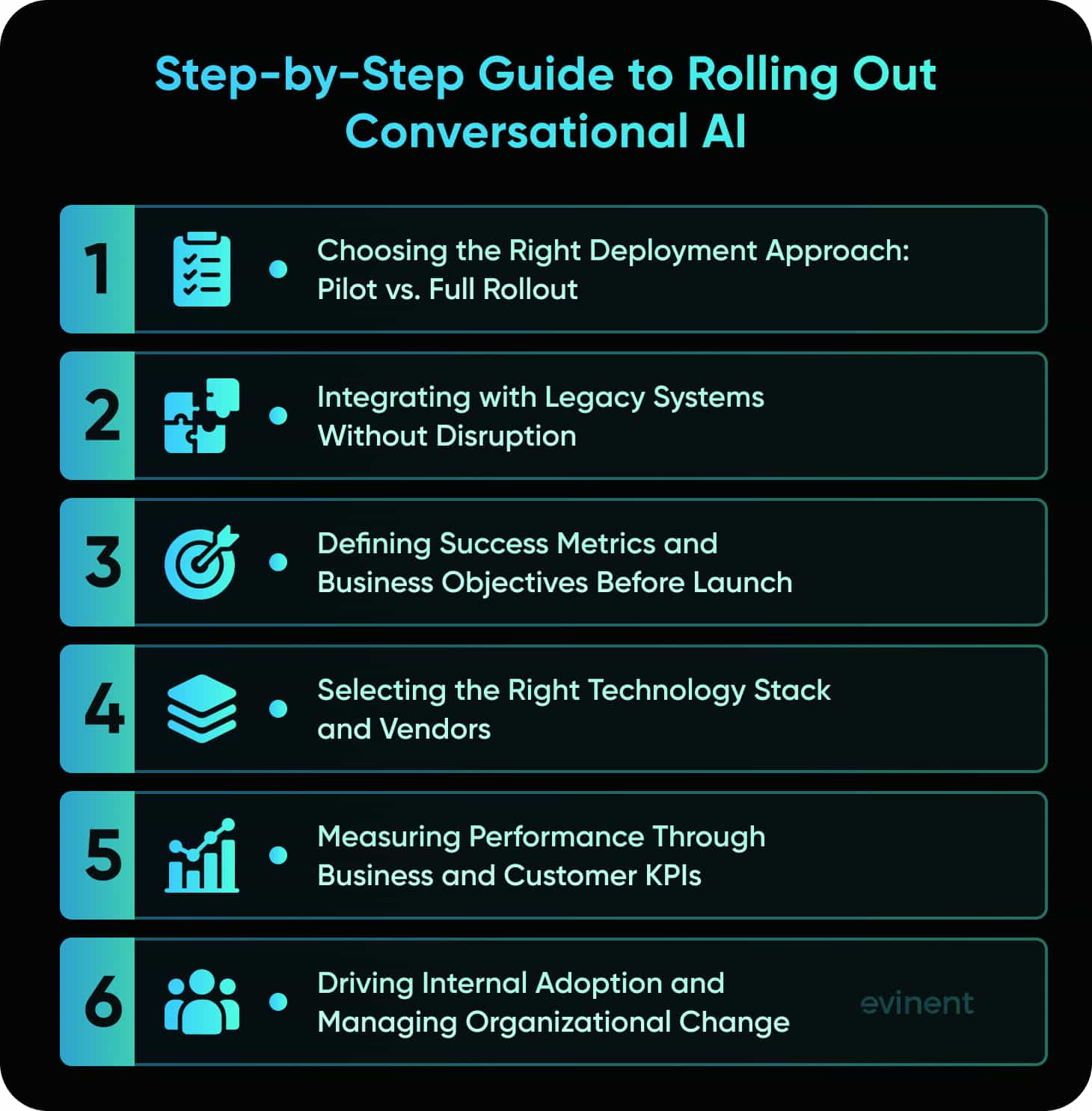
1. Start Small or Go All-In: Choosing the Right Deployment Approach
A pilot makes sense when the organization needs to build internal confidence or demonstrate ROI before committing further. A full deployment makes sense when the use case is well-defined, the data infrastructure is mature, and the business outcomes are clear. The mistake most retailers make is designing a pilot too narrowly to produce meaningful results. It should be small enough to move quickly and large enough to tell you something real.
2. Integrate Without Disruption: Working With Legacy Infrastructure
Older legacy systems, like CRM databases, order management platforms, and POS infrastructure, were not designed to work with conversational AI. In fact, the main goal should not be to replace those systems, but rather to connect them. A thoughtfully designed integration layer enables AI to access data from existing systems without them getting a complete revamp. Bringing in AI professionals prior to making architectural choices always distinguishes a neat integration from a costly retrofit.
3. Define Success Before You Start: Objectives and Clear Goals
Identifying the desired business results has to happen before the developers even start coding. What would be a successful outcome in three months? Which customer experience indicators are of the highest priority for resolution rate, CSAT, and conversion lift? The criteria for success should be a shared decision made by commercial, operations, and technology leaders across the board before launching the project.
4. Choose the Right Tools: What to Look For and What to Avoid
The right platform is the one that fits the existing stack, scales to the required volume, and can be maintained without vendor dependency. Look for native integration capabilities, transparent model behavior, and strong multilingual support. Avoid platforms that require full data migration and vendors who cannot demonstrate retail-specific deployments. If in-store or phone-based interactions are on the roadmap, AI voice assistant capability should be evaluated from the start.
5. Measure What Matters: KPIs and Benchmarks That Resonate With Leadership
Leadership conversations should focus on business results such as raising revenue, lowering cost per contact, or maintaining support headcount even if volume grows. Other than that, Customer experience metrics, like Customer Satisfaction Score (CSAT), Net Promoter Score (NPS), or first-contact resolution, can help in connecting operational performance to customer impact. Set baseline metrics before launch so that you can measure the changes you made instead of just discussing them.
6. Bring Your Team Along: Managing Change and Building Buy-In
Implementations fail for human reasons as often as technical ones. Staff who feel threatened by conversational AI will undermine it. The framing matters: AI removes the work that was never the best use of their time. Involve the people closest to the customer early, incorporate their feedback into conversation design, and make the transition something that happens with them rather than to them.
Getting it right is changing the business approach, not a technical landmark. It is the retailers who see it in that light that become the ones from pilot to scale without losing momentum.
The Real Challenges of Conversational AI in Retail — and How to Address Them
Conversational AI delivers real results — but only for retailers who go in with a clear picture of what can go wrong. The challenges below are not reasons to avoid the technology. They are the variables that separate implementations that scale from ones that stall.
Risk № 1: Your Existing Systems May Not Be Ready
Most retail businesses have various systems running simultaneously, such as CRM, OMS, loyalty programs, POS, and e-commerce platforms, which in most cases were not originally intended to communicate with one another. Disconnected marketing technology stacks not only make the integration process complicated but also hinder the rollout of the conversational AI and even restrict its capabilities. System, human, and data misalignment is the main cause why many pilots fail to be fully implemented.
How to address it: Audit your integration landscape before selecting a platform. Prioritize vendors with proven experience connecting to legacy systems, and treat integration as a first-class design requirement — not a post-launch fix.
Risk № 2: Customer Data Creates Real Regulatory Exposure
Conversational AI runs on customer data — and that creates genuine legal risk. GDPR and data protection regulations set strict requirements around data collection, storage, and use. Data privacy and security concerns are not just a compliance issue; a breach or misuse erodes customer trust in ways that outlast any fine.
How to address it: Build data governance into the architecture from day one. Establish explicit consent mechanisms, define data retention policies early, and schedule regular compliance audits before and after launch.
Risk № 3: Customers May Not Trust It — or Use It
Customer acceptance and trust are never automatic. A significant share of shoppers remains skeptical of AI-driven interactions, particularly for sensitive tasks like payments or returns. Retailers who hide the AI or oversell its capabilities erode trust faster than those who are straightforward.
How to address it: Be transparent about what the system is and what it can do. Design for usefulness first — an AI that solves a real problem earns trust faster than one that merely exists. Offer a seamless handoff to a human agent whenever the customer wants one.
Risk № 4: Performance Degrades After Launch Without Ongoing Maintenance
Going live is just one step. Product listings change, customers start to talk differently, and new questions come up that the model has never seen. If a model is not regularly trained, both the response time and resolution rate will silently decrease and become apparent to customers over time.
How to address it: Build a structured retraining schedule into the operational plan from the start. Monitor resolution rates, escalation triggers, and customer satisfaction scores continuously, and treat model maintenance with the same discipline as any core business system.
Risk № 5: What Works at Pilot Scale May Break Under Real Load
Scalability is both a technical and operational challenge. Infrastructure decisions made early have a direct impact on how the system performs when handling peak volumes. Retailers who do not stress-test for scale before launch often discover its limits at the worst possible moment.
How to address it: Define scalability requirements before selecting infrastructure. Run load testing before go-live and build headroom into capacity planning — particularly ahead of peak trading periods where demand can spike unpredictably.
These problems can be tackled indeed. But what is common to all of them is that, from a big-picture perspective, they become quite a bit easier if one takes the approach of addressing them pre-launch instead of post-launch. As a continuation, we explore the current direction of conversational AI in retail and the reasons why the choices made at this point will determine one's market positioning in the future.
The Future of Conversational AI in Retail: Trends Worth Watching
The retailers that are making implementation decisions now are not simply addressing a problem of today; they are also preparing themselves for a future market that could be very different in three years. These trends are not the stuff of speculation. They have been in motion for some time, supported by several data and firsthand examples of large retailers making the first moves.
1. Voice Shopping and the Rise of Multimodal Retail Experiences
Voice recognition is moving from a novelty to a transactional channel. The number of voice assistant users in the United States is expected to reach 157.1 million by 2026. At the same time, the experience is becoming multimodal — combining voice, visual, and conversational interfaces into a single interaction.
Retailers that adopt AI early will be best positioned to lead in a rapidly evolving landscape that combines voice, visual, and conversational interfaces. For in-store environments, particularly, voice shopping removes friction at exactly the moments it costs the most, at the shelf, at the kiosk, at checkout. (Salesforce, 2024)
2. Conversational Commerce
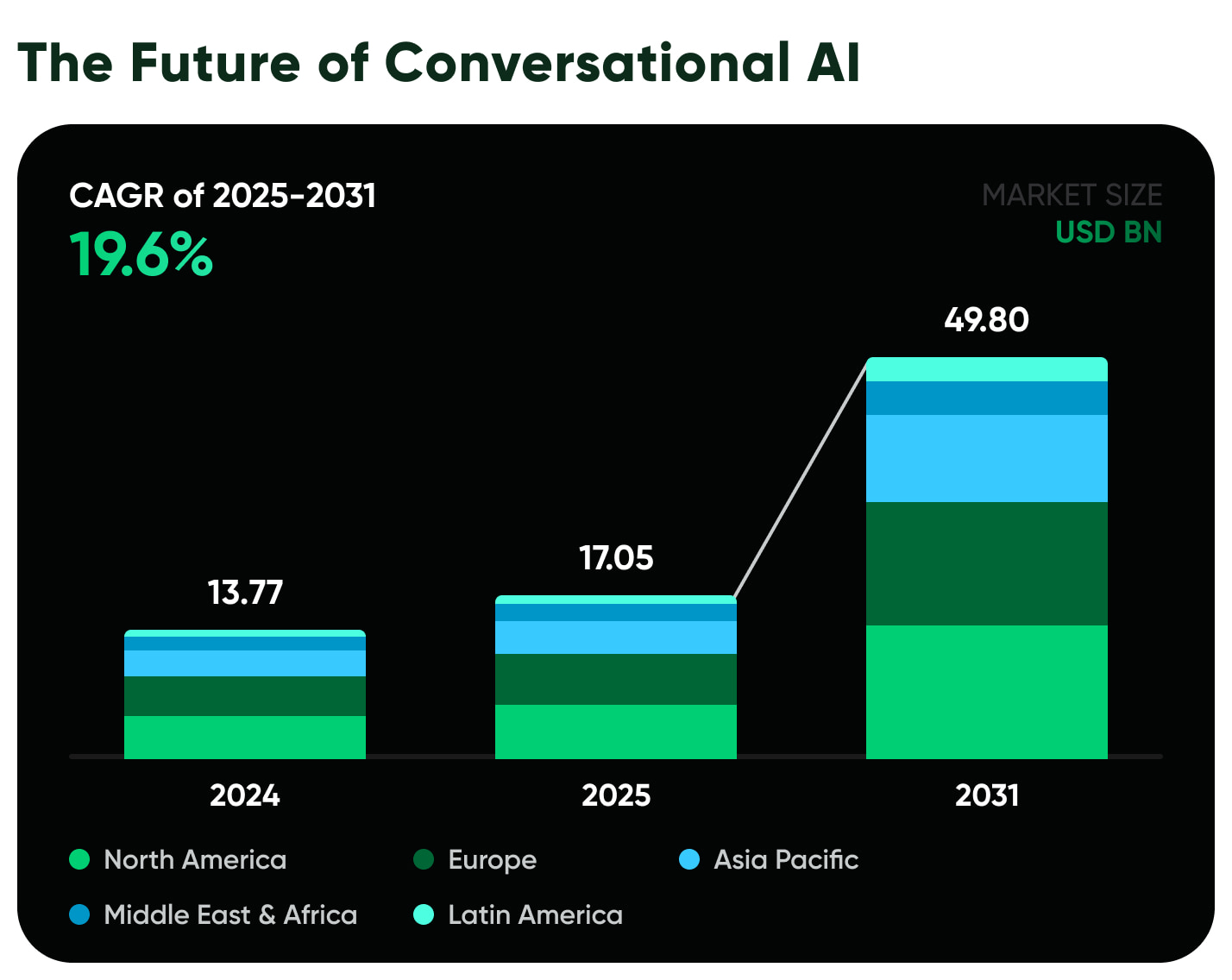
Conversational commerce is collapsing the distance between discovery and purchase. Shoppers now discover products on Instagram, ask questions via direct message, and complete purchases without ever visiting a website. The data from brands already operating this way is striking: when an AI agent recommended a product, 80% of the resulting purchases happened the same day. The U.S. conversational commerce market is projected to reach $10.1 billion by 2026, making chat and voice a real revenue channel, not a sidecar. (MarketsandMarkets, 2025)
3. Hyper-Personalization in Real Time
In 2026, AI enables deep, real-time personalization at scale using behavioral, transactional, and contextual data to deliver tailored content, messaging, and offers across all channels. The gap between retailers who have built the data infrastructure to support this and those who have not is widening quickly. Hyper-personalization and trust are emerging as core differentiators, with AI-powered recommendations and transparent data practices driving loyalty and revenue. Retailers who building the personalization foundation today will find it significantly more expensive to close the gap in two years. (Salesforce, 2024)
4. AI Search
The search bar is giving way to the conversational shopping agent. Brands that previously focused on search engine optimization now must become experts in answer engine optimization (AEO), as consumers are turning away from standard searches and using more complex, conversational AI-driven queries. Perplexity has already launched a conversational product discovery experience with personalized product cards and instant checkout powered by PayPal. The implication for retailers is direct: product data quality, structured content, and AI-readable catalogue architecture are becoming as important as SEO was a decade ago. (Grand View Research, 2026)
5. End-to-End Automation
The scope of automating processes from start to finish with conversational AI is much broader than just customer interactions. AI assistants that the brand owns can assist a customer in finding products, selecting offers, handling carts and checkout procedures, and even directing customers through various promotions and loyalty programs. All these could be done in one conversation only.
Behind the scenes, the same AI infrastructure connects to inventory, fulfilment, and logistics systems, turning what was once a multi-step manual process into a seamless automated flow. Gartner estimates that by 2026, conversational AI integration in customer interaction could cut agent labor costs by $80 billion — a figure that reflects not just front-end efficiency, but the full operational value of end-to-end automation. (Gartner, 2025)
The path is laid out. Conversational commerce platform AI in retail is evolving from being merely a tool helping in support to becoming the main channel for customers to discover, evaluate, and make their purchases. Those retailers who realize and act on this change now and adapt their business accordingly will be the ones shaping the next phase of the industry. The last part discusses how Evinent supports retail businesses to make such changes.
How Evinent Implements Conversational AI for Retail
Conversational AI delivers the most value in retail when it is directly connected to commerce systems, customer data, and operational workflows rather than existing as an isolated chatbot layer.
Today, retail ecosystems are comprised of e-commerce platforms, CRM Systems, ERP, inventory management, payment gateways, loyalty programs, and offline retail infrastructure. Conversational AI, in such an environment, not only changes the way customers are communicated with but also affects revenue generation, conversion efficiency, and the cost structure of operations.
Evinent specializes in conversational AI solutions that are deeply integrated with retail systems, and the performance of the solutions is measured with tangible business KPIs.
Why Organizations Choose Evinent
15+ years of enterprise software development experience;
Expertise in AI-driven workflow automation;
Experience with legacy and modern Retail ecosystems;
Production-focused architecture for scalability, monitoring, and compliance.
A Retail-Focused Conversational AI Strategy
Evinent creates conversational AI that is focused on achieving specific, measurable retail results rather than generic automation.
Common areas of business impact are:
Enhancement of conversion rates via product discovery flows
Decreasing cart abandonment with the help of real-time guidance
Boosting average order value by means of personalized recommendations
Lowering support ticket volumes via automated resolution
Increasing customer retention and repeat purchase rate
Shortening resolution time in customer service workflows
Enterprise Integration Across Retail Systems
Conversational AI performance depends directly on the quality and availability of enterprise data.
Evinent integrates AI systems with:
E-commerce platforms and product catalogs
CRM and customer loyalty systems
ERP and pricing engines
Inventory and warehouse systems
Payment providers and checkout flows
Customer support and ticketing systems
This enables real-time capabilities such as:
Up-to-date product availability and pricing
Personalized recommendations based on purchase history
Context-aware responses during checkout
Automated order tracking and returns handling
Unified customer interaction history across channels
From a business perspective, this reduces operational friction and improves end-to-end customer journey efficiency.
Relevant Experience: Scaling E-Commerce for a Leading Central Asian Retailer
Evinent collaborated with one of the top retail and e-commerce companies in Central Asia to help them expand and optimize their platform over the long term.
This client runs a vast electronics and home appliances retail business, including a very large store with high seasonal traffic fluctuations and quite complex omnichannel operations.
Engagement scale:
10+ years of continuous collaboration
15-person dedicated engineering team (developers, QA, PM)
Enterprise-level commerce platform evolution and support
Core business objectives addressed:
Handling peak traffic loads during seasonal sales events
Enabling real-time inventory and pricing updates across thousands of SKUs
Improving personalization through AI-driven recommendation systems
Integrating multiple payment and credit comparison providers
Unifying online and offline retail customer experience
Measurable Business Outcomes
The implemented platform and AI-driven enhancements led to quantifiable operational and business improvements:
Sales capacity increase during peak campaigns due to improved system scalability and reduced checkout friction
Reduced checkout time through optimized flows and real-time data synchronization
Higher customer retention rate driven by improved personalization and reliability of customer interactions
Improved platform uptime during high-load events, maintaining stable performance under peak traffic conditions
Reduced infrastructure and operational costs through system optimization and architecture modernization
Improved conversion efficiency across product discovery and recommendation flows
These outcomes demonstrate how integrated AI and commerce systems directly influence revenue performance and operational efficiency at scale.
FAQ
What is conversational AI in retail?
Conversational AI in retail is technology that enables customers to interact with brands through natural language (chat, voice, messaging) to discover products, get recommendations, track orders, and receive support. It connects customer intent directly with commerce systems like catalog, pricing, inventory, and CRM.
How is conversational AI different from traditional chatbots?
Traditional chatbots usually rely on predefined scripts and handle limited support scenarios. Conversational AI uses natural language understanding and contextual data, allowing it to support complex tasks like product discovery, personalized recommendations, order management, and omnichannel interactions.
Can conversational AI reduce customer support costs?
Yes, definitely. Most of the requests that retail support receives, like order status, returns, and product questions, can be largely automated. This lightens the load on the support teams and also enables human agents to dedicate their time and skills to more complex issues, which in turn leads to overall operational efficiency.
Does conversational AI work across online and offline retail?
Yes, if properly implemented, it can be used to interface an online store, mobile applications, CRM systems, and physical retail locations to form one singular customer experience through unified profiles and omnichannel data synchronization.
How does conversational AI personalize customer experience?
It leverages behavioral signals, purchase records, browsing data, and contextual intent to change recommendations, offers, and responses instantly. This enables retailers to transition from static segmentation to dynamic personalization.
Key Takeaways
Conversational AI in retail has evolved from being a mere support tool to a commerce layer that ties customers, products, and enterprise systems together.
The real business value comes from integration with ERP, CRM, inventory, and payment systems, not from standalone chat interfaces.
Retail impact is measurable through core KPIs: conversion rate, cart abandonment, average order value, and customer retention.
Personalization at scale is a key competitive advantage, driven by behavioral signals, purchase history, and real-time intent detection.
Conversational AI enables end-to-end customer journeys, from product discovery to checkout, order tracking, and returns.
Having an omnichannel capability is a must; a modern retail environment demands that the customer experience be seamlessly integrated across the web stores, mobile applications, and brick-and-mortar stores.
Besides helping to reduce workload on human agents, support automation also contributes a lot towards enhancing operational efficiency.
The main implementation challenges are not AI-related, but system-related: legacy integration, data quality, and orchestration across fragmented retail infrastructure.
Retail is shifting toward intent-driven commerce, where users describe needs in natural language instead of using filters and search bars.
Successful implementations require an enterprise-grade approach combining AI, system integration, and production-ready architecture, not isolated chatbot deployments.
Share