

So where exactly does your data go when AI makes a decision on your behalf?
That question used to sound abstract. Now it’s operational.
Enterprise AI systems no longer sit quietly behind dashboards, waiting for a . They schedule meetings, summarize contracts, screen candidates, answer customers, flag transactions, and route internal work across systems that contain personal, financial, and sometimes regulated data. Increasingly, they do this without a human explicitly asking for each step.
“Ten years ago, most people thought about data privacy in terms of online shopping. They thought, “I don't know if I care if these companies know what I buy and what I'm looking for, because sometimes it's helpful.” Stanford University HAI, Privacy in an AI Era: How Do We Protect Our Personal Information? (2024)
That shift changes the privacy conversation entirely.
AI privacy concerns are no longer about whether a model was trained on the wrong dataset or whether a chatbot stored a conversation. They’re about what happens when AI systems act continuously, combine data across domains, and make decisions that affect people who may never realize an AI was involved.
For executives, this creates a new kind of risk. Not theoretical. Not future-facing. Present, measurable, and tied directly to trust, compliance, and business continuity.
Before discussing regulations, controls, or solutions, it helps to be precise about what “AI privacy concerns” actually mean in an enterprise setting.
What Are AI Privacy Concerns?
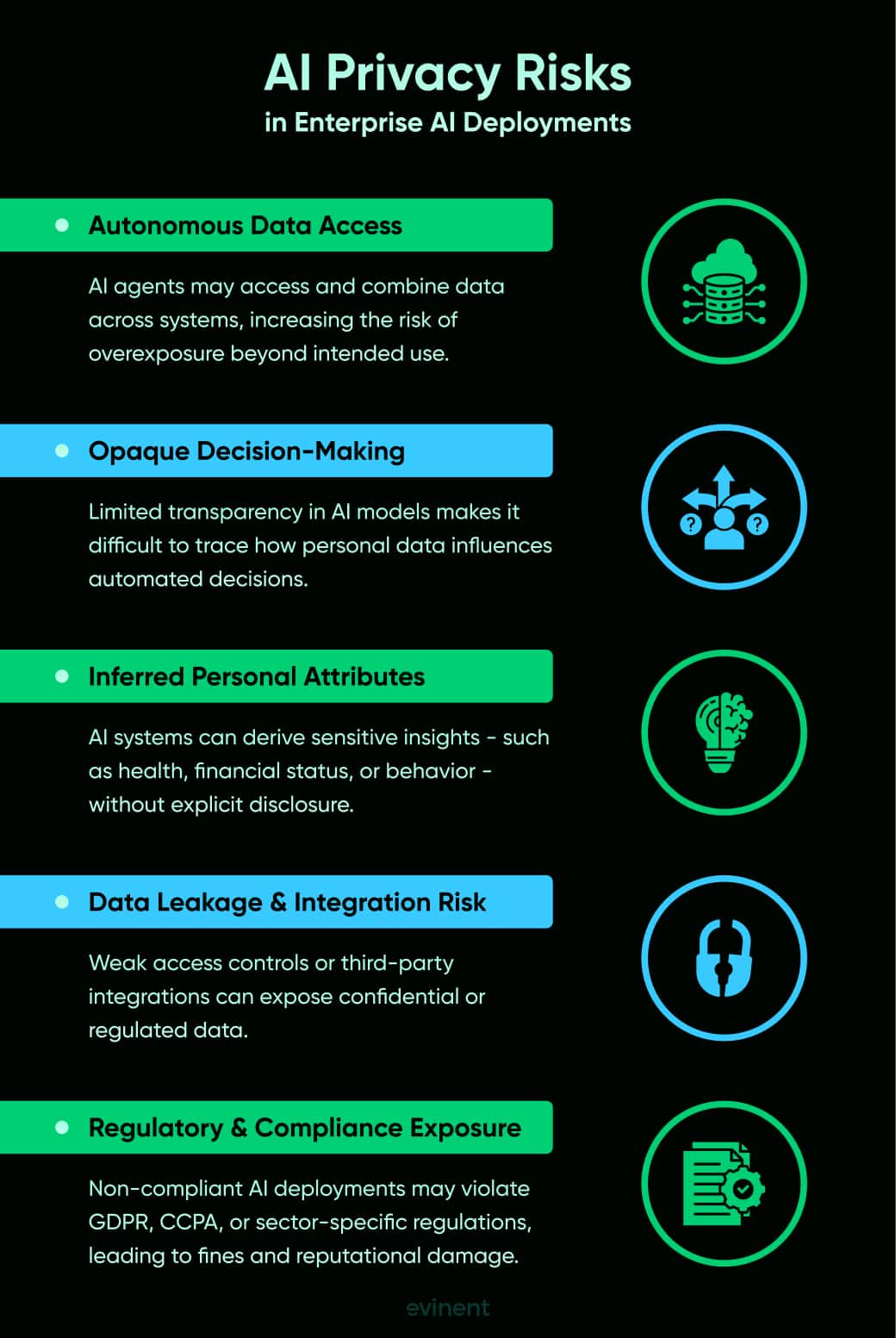
AI privacy concerns refer to the ways artificial intelligence systems can collect, infer, use, retain, or expose personal and sensitive data in ways that exceed user expectations, legal boundaries, or organizational intent.
That definition sounds broad, but the distinction matters.
Traditional software privacy risks are mostly static. A database stores data. An application reads it. Access is logged. Violations usually involve unauthorized access or leaks.
AI systems behave differently.
They don’t just store data. They derive new information from it. They connect fragments that were never meant to be combined. They generate profiles, predictions, and classifications that may never appear in a database field, but still influence real decisions.
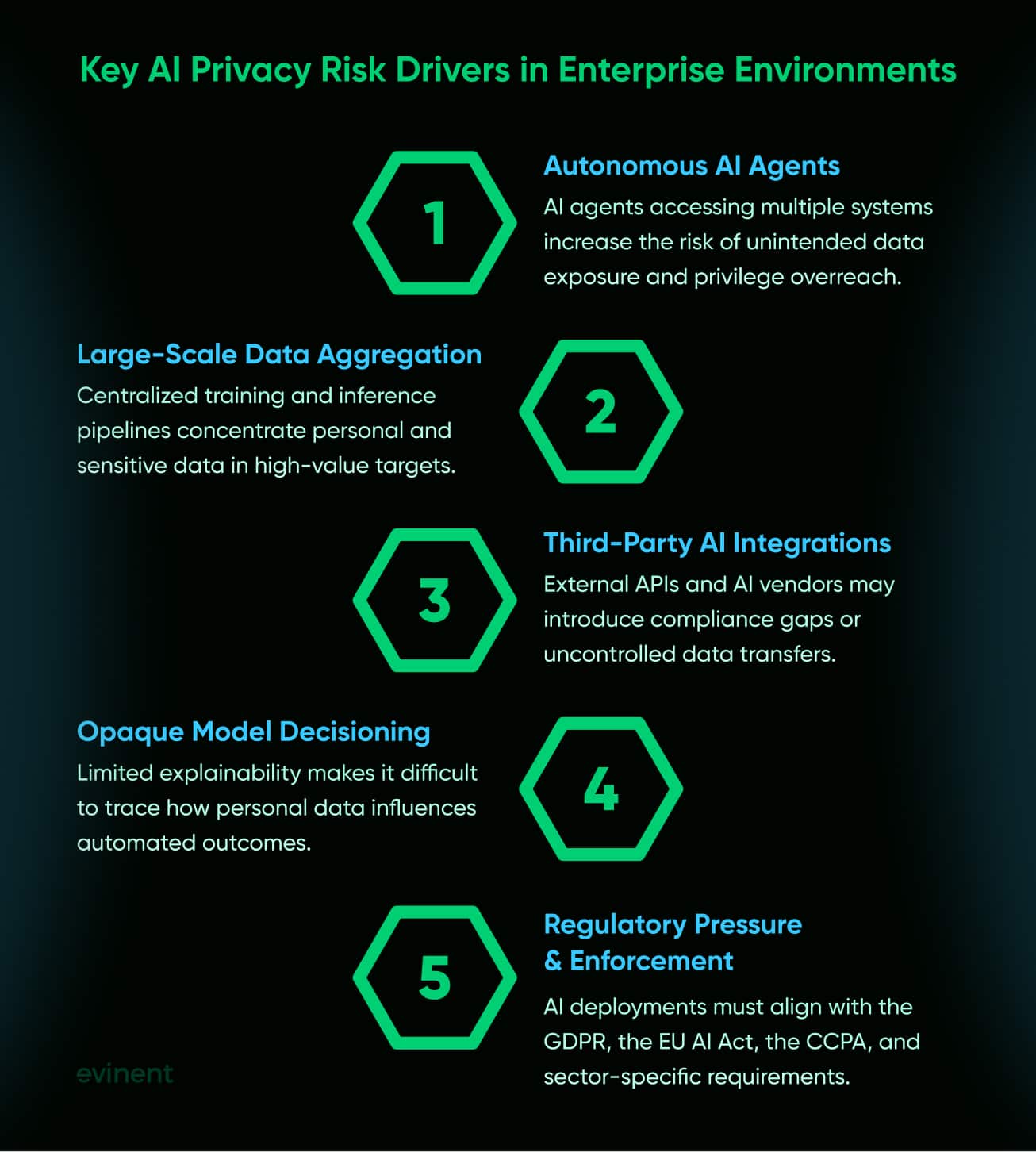
When AI systems operate as agents — running workflows, triggering actions, or coordinating across tools — privacy risk becomes structural rather than accidental.
A few characteristics make AI privacy concerns harder to control than conventional data risks:
Inference over explicit storage
AI systems can infer health status, intent, emotional state, or financial stress without those attributes being explicitly provided.
Persistence beyond a single interaction
Outputs, embeddings, logs, and fine-tuning artifacts may retain traces of personal data long after the original interaction ends.
Opacity of decision paths
It’s often unclear which data points influenced a specific outcome, making accountability and explanation difficult.
Scale without proportional oversight
One misconfigured model or agent can affect thousands or millions of users simultaneously.
Regulators have started to reflect this shift. The UK Information Commissioner’s Office, for example, has repeatedly emphasized that AI systems raise privacy risks not only through data collection, but through how they combine and repurpose information across contexts.
From an enterprise perspective, this means privacy is no longer only a legal or compliance issue. It’s a system design problem.

AI data collection and usage
Most organizations think they understand how data enters their AI systems. In practice, the reality is messier.
AI systems interact with data through multiple channels, often simultaneously:
Training data used to build or fine-tune models
Operational data processed during inference
Interaction data generated through user s, feedback, or behavior
Metadata and logs created by the system itself
Each layer introduces different privacy risks, and they rarely align neatly with consent models or data governance policies.
Training data vs. operational data
Training data tends to receive the most scrutiny. Enterprises ask whether datasets include personal data, whether consent was obtained, and whether sensitive domains like healthcare or finance are involved.
Operational data is more often overlooked.
When an AI system processes live inputs — customer messages, internal documents, voice recordings, transaction histories — those inputs may be transient in theory but persistent in practice. Logs, embeddings, caches, and monitoring tools can all retain fragments of personal data.
This is where many AI data privacy issues originate, not because organizations are careless, but because traditional data governance models weren’t built for probabilistic systems.
Explicit consent and its limits
Consent remains a cornerstone of privacy law, but AI stretches the concept.
Users may consent to their data being used for a specific service. They rarely consent to:
their data being combined with other datasets,
inferred attributes being generated,
or decisions being automated based on patterns derived from similar users.
In enterprise settings, this is especially problematic in areas like HR, customer support, and personalized pricing, where AI systems may profile individuals without a clear moment of informed consent.
This gap between legal consent and practical understanding is a recurring source of privacy concerns with AI, particularly when decisions feel opaque or irreversible.
Data scraping and indirect collection
Not all data enters AI systems directly.
Some models rely on scraped data, third-party sources, or intermediaries. Even when enterprises don’t scrape data themselves, they may deploy models trained on datasets whose provenance is unclear.
This creates downstream risk.
If personal data was collected unlawfully at an earlier stage, enterprises using the resulting model may still face legal and reputational consequences. Recent regulatory guidance in Europe has made it clear that “distance from collection” does not eliminate responsibility.
Sensitive domains and compounded risk
Certain types of data magnify privacy risks when processed by AI:
biometric data, including facial and voice patterns
health and medical information
financial behavior and credit indicators
location and movement data
When AI systems operate across departments, these domains can unintentionally intersect. A customer support agent powered by AI may have access to transaction data, communication history, and inferred sentiment — a combination that would raise concerns if handled manually.
This is how AI invasion of privacy often occurs in practice. Not through a single breach, but through quiet aggregation.
AI Governance and Ethics
When executives hear “AI ethics,” the reaction is often mixed.
Some see it as abstract philosophy. Others see it as legal overhead. A few treat it as branding.
In practice, AI governance is much simpler — and more uncomfortable — than any of those interpretations.
It’s about answering three questions:
Who is responsible for what the system does?
Can we reconstruct how it made a decision?
Do we have the authority to stop it if something goes wrong?
If those answers are vague, you don’t have governance. You have exposure.
Governance is not a document. It’s an architecture.
Most enterprises already have data governance policies. They define ownership, classification levels, retention schedules, and access controls.
AI systems complicate that model.
An AI agent doesn’t just access data; it may:
Combine datasets across silos
Trigger downstream actions in other systems
Generate new derived attributes
Make recommendations that humans execute without questioning
Traditional data governance assumes relatively predictable data flows. AI systems introduce probabilistic behavior. Two identical inputs may not always generate identical outputs. That unpredictability is precisely where privacy risk hides.
Effective AI governance therefore requires:
Dataset curation discipline
Knowing what data is used, why it is used, and whether it is still necessary.
Model lineage tracking
Being able to trace which model version processed which dataset at a given time.
Action logging for AI agents
Not just logging access, but logging decisions and triggered actions.
Defined accountability roles
Someone must be explicitly responsible for model behavior in production — not “the AI team” in general.
According to research from Stanford’s Institute for Human-Centered AI (2023–2024), one of the most consistent governance gaps in enterprise AI deployments is the lack of decision traceability. Organizations often cannot reconstruct the exact reasoning path that led to a specific output.
For privacy, that’s not a minor issue. It determines whether you can defend your system under audit.
Ethics becomes operational under automation
When AI systems are advisory, ethics discussions feel theoretical. A human still makes the final call.
When AI systems become semi-autonomous — screening candidates, approving low-risk transactions, prioritizing service queues — ethical concerns become operational constraints.
Consider profiling.
An AI system may classify customers into behavioral segments to optimize marketing. That seems harmless. But if those segments correlate strongly with sensitive attributes — health status, ethnicity, financial vulnerability — the system may effectively discriminate without explicitly using protected data.
This is how artificial intelligence privacy issues move from abstract debate to measurable harm.
Governance mechanisms that help reduce this risk include:
Regular AI audits (internal or third-party)
Bias testing on outputs, not just inputs
Stress-testing models with edge cases
Requiring explainability for high-impact decisions
The European Commission’s draft guidance around the EU AI Act emphasizes risk classification and oversight obligations for high-risk systems. While the final regulatory details continue to evolve, the direction is clear: systems affecting employment, credit, healthcare, or public services require stronger governance controls.
In other words, privacy and ethics are no longer optional layers. They are design constraints.
Balancing Innovation and Privacy
There’s a tension executives don’t always admit out loud.
On one side: pressure to adopt AI quickly. Competitors are deploying copilots, automation tools, and AI agents in operations, analytics engines in marketing.
On the other side: rising regulatory scrutiny and internal concern about AI and privacy risks.
The instinctive reactions tend to fall into two camps.
Camp one says: move fast, fix governance later.
Camp two says: restrict everything until it’s perfectly controlled.
Both approaches fail in practice.
The first exposes the organization to regulatory and reputational damage. The second quietly kills innovation and pushes teams toward shadow AI usage outside official channels.
The workable path sits in between.
Privacy by design, not privacy as an afterthought
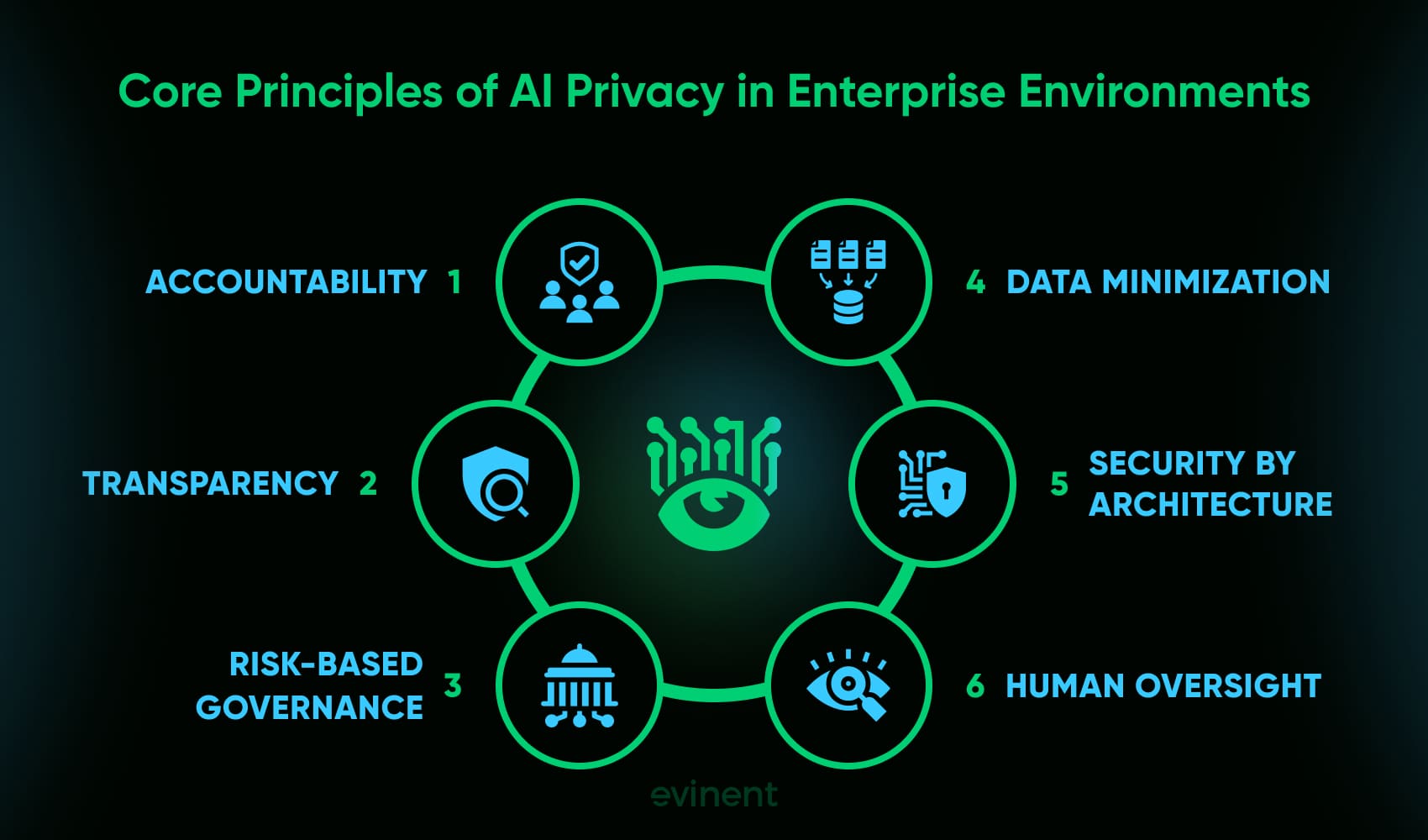
Privacy by design means embedding data protection measures into the system architecture from the beginning.
For AI deployments, that includes:
Data minimization
Feeding models only what is necessary for the task. Not “all available data.”
Scoped access controls
Limiting what each AI component can see, even inside trusted environments.
Encryption at rest and in transit
Particularly when models process personal or sensitive domains.
Purpose limitation enforcement
Preventing secondary uses of data that were not originally authorized.
In enterprise AI agents, this often translates into architectural decisions like:
Running agents in isolated environments
Using retrieval-based systems instead of model retraining
Separating personal data from model fine-tuning pipelines
Applying differential privacy techniques when feasible
These controls don’t eliminate risk. They reduce blast radius.
Regular audits as routine, not crisis response
Many organizations only review AI systems when something breaks.
A better model treats AI audits as recurring checkpoints.
This can include:
Reviewing logs for unusual data access patterns
Testing whether outputs reveal unintended personal data
Evaluating whether data retention policies are being respected
Verifying that consent records match actual system usage
The cost of regular audits is measurable. The cost of a privacy incident is often exponential.
ENISA’s 2023 cybersecurity threat landscape report notes that AI-driven systems increase the attack surface for data leakage, particularly when models integrate with multiple enterprise systems. That’s not an argument against AI. It’s a reminder that integration depth increases exposure.
User control as a strategic asset
Privacy regulations increasingly emphasize user rights: access, correction, deletion, and portability.
AI complicates each of these.
If a user requests deletion, does that include:
Raw stored data?
Derived features?
Model weights influenced by their data?
Cached embeddings?
Organizations that cannot answer those questions struggle under GDPR and similar laws.
Providing meaningful user control — transparent notices, opt-in mechanisms, and accessible data-deletion processes — may feel operationally heavy. But it builds something executives care about: trust.
And trust is increasingly tied to whether people believe your AI systems respect their autonomy.
Best Practices for AI Privacy Protection
There’s no single control that “solves” AI privacy. If someone tells you there is, they’re oversimplifying.
What works in enterprise environments is layered protection. Technical controls, governance discipline, and operational monitoring reinforce each other. Remove one layer and the system may still function, but the margin for error shrinks.
Below are the core approaches that consistently reduce AI data privacy concerns in real deployments.
Privacy by design for AI systems
Privacy by design sounds obvious. It isn’t.
In practice, many AI deployments begin as pilots. A team experiments with a model, connects it to internal data, sees promising results, and then expands its use before the architecture catches up.
Embedding privacy early changes that trajectory.
For AI systems, privacy by design means:
Defining clear data boundaries before integration
Separating personal data from model training pipelines where possible
Avoiding full-dataset ingestion when retrieval-based methods are sufficient
Designing explicit data retention limits for logs, s, and outputs
It also means documenting why each category of personal data is required. If the purpose isn’t clear, the data probably shouldn’t be there.
Risk assessments before deployment
A privacy impact assessment for AI should not be a box-ticking exercise. It should force uncomfortable questions.
For example:
Does the system process biometric data?
Does it operate in sensitive domains such as healthcare, employment, or finance?
Could it generate new inferred attributes about individuals?
What happens if outputs are wrong at scale?
Under GDPR, Data Protection Impact Assessments (DPIAs) are required for high-risk processing. Under the EU AI Act framework, high-risk AI systems face additional obligations.
But beyond legal compliance, structured risk assessments help executives see trade-offs clearly. They reveal where privacy risks of AI intersect with operational ambition.
Limiting data exposure by task
AI systems often perform specific tasks: summarization, classification, recommendation, routing.
Not every task requires full access to a user’s profile.
Limiting exposure at the task level means:
Passing only the relevant data fields to the model
Masking unnecessary identifiers
Using tokenization to decouple identity from attributes
This principle aligns with data minimization requirements in privacy regulations and also reduces practical risk. A model cannot leak what it never sees.
Data encryption and anonymization techniques
Encryption remains foundational. AI systems do not replace the need for established security practices.
Core measures include:
Encryption at rest for databases storing interaction logs
Encryption in transit for API calls between AI components
Strong key management policies
Certificate pinning for secure communication
Anonymization and pseudonymization can further reduce exposure. However, true anonymization is difficult when AI models can reconstruct identity from patterns. What appears anonymous may still be re-identifiable when combined with auxiliary data.
This is why many privacy experts now treat anonymization as a risk-reduction measure, not an absolute protection.
Differential privacy and federated learning
Privacy-enhancing technologies (PETs) have matured in recent years.
Differential privacy introduces statistical noise to datasets, limiting the likelihood that any individual record influences outputs significantly. It is widely discussed in academic literature and increasingly applied in production systems.
Federated learning allows models to train across decentralized devices or environments without centralizing raw data. Instead, model updates are aggregated.
Both approaches reduce central data concentration. Neither eliminates privacy risk entirely. They introduce complexity and may affect model performance. The trade-off must be evaluated case by case.
Defending against adversarial and supply-chain attacks
Privacy risk is not only internal.
AI systems face:
Adversarial attacks designed to extract sensitive data
Model poisoning attempts that corrupt outputs
Supply chain vulnerabilities in third-party models or libraries
ENISA and other cybersecurity agencies have highlighted the growing overlap between AI security and data protection.
Enterprises deploying AI agents must treat model supply chains with the same scrutiny as software dependencies. Version control, validation testing, and restricted update channels reduce the likelihood of compromised components introducing hidden data leakage pathways.
Robust access controls
Role-based access control remains essential, but AI systems require nuance.
It’s not enough to restrict which employees can access AI tools. You must also restrict what the AI tool itself can access.
This often involves:
Separate credentials for AI services
API-level permission scoping
Regular review of access logs
Automated anomaly detection for unusual data requests
The more autonomous the system, the more carefully its permissions must be constrained.
Role of Individuals in Safeguarding Privacy
It’s tempting to frame AI privacy as purely institutional. But individuals — employees and users alike — play a meaningful role.
AI systems amplify the consequences of small decisions.
Employees using AI tools
Internal copilots and AI assistants are increasingly embedded in daily workflows. They summarize meetings, draft emails, and generate reports.
Without clear policies, employees may:
Paste sensitive client data into public tools
Upload proprietary documents for convenience
Use AI services outside approved environments
This is how many early enterprise AI incidents occurred — not through malicious intent, but through ambiguity.
Organizations reduce this risk by:
Providing approved AI environments
Training employees on data handling expectations
Making secure tools easier to use than unofficial ones
Clarity matters. If people don’t know the boundaries, they will guess.
User consent and awareness
From the user side, privacy depends on transparency.
Individuals should be able to understand:
When AI systems are making decisions
What data is being processed
Whether profiling is involved
How to exercise privacy rights
Mechanisms such as Global Privacy Control signals and opt-in frameworks under laws like the California Consumer Privacy Act (CCPA) give users formal leverage. But those mechanisms only work when systems are built to honor them.
Automated decision-making disclosures under GDPR require organizations to explain logic and impact. For AI systems that are difficult to interpret, this becomes challenging.
Data deletion and the “right to be forgotten”
Deletion in AI systems is not straightforward.
If a user invokes their right to deletion:
Removing stored records is manageable.
Removing influence from a trained model is harder.
Research in machine unlearning is ongoing, but most production systems are not designed for granular retraining on demand.
This gap between legal rights and technical feasibility is one of the more complex artificial intelligence privacy concerns enterprises must address openly.
Ignoring it invites regulatory friction.
Legal and Regulatory Frameworks
AI privacy doesn’t exist in a vacuum. It operates inside overlapping legal systems that were not originally written for probabilistic models, autonomous agents, or generative outputs.
That creates friction.
Enterprises don’t face one unified AI privacy law. They face a patchwork of data protection laws, sector-specific regulations, and emerging AI-specific frameworks. Compliance, therefore, is not about satisfying a single standard. It’s about designing systems that can withstand scrutiny across jurisdictions.
Below are the regulatory pillars shaping enterprise AI deployments today.
1. General Data Protection Regulation (GDPR)
The GDPR remains one of the most influential data protection laws globally.
Its relevance to AI privacy concerns is immediate:
Lawful basis for processing
Organizations must justify why personal data is processed. “AI improvement” is not automatically sufficient.
Purpose limitation
Data collected for one reason cannot be repurposed freely for model training or inference.
Data minimization
Systems should not ingest more personal data than necessary.
Automated decision-making (Article 22)
Individuals have rights when decisions are made solely by automated means and significantly affect them.
For enterprise AI agents that screen candidates, approve transactions, or adjust pricing, Article 22 becomes operational. It requires either human oversight or meaningful safeguards.
The GDPR also grants rights to access, correction, portability, and deletion. Each of these becomes more complex when AI systems generate inferred attributes.
2. EU Artificial Intelligence Act (EU AI Act)
The EU AI Act introduces a risk-based framework specifically for AI systems.
While implementation details continue to evolve, its structure is clear:
Prohibited AI practices (e.g., certain forms of social scoring)
High-risk AI systems (e.g., employment, credit, healthcare, critical infrastructure)
Transparency requirements for certain AI interactions
Enterprise AI systems operating in sensitive domains often fall into the high-risk category.
High-risk systems face obligations such as:
Risk management systems
Data governance measures
Technical documentation
Record-keeping and logging
Human oversight mechanisms
For privacy, the logging and documentation requirements are particularly important. They reinforce the need for traceability and structured accountability — areas where many enterprises are still maturing.
3. United States and sector-specific laws
The U.S. does not have a single federal privacy law equivalent to GDPR, but several frameworks intersect with AI deployments.
California Consumer Privacy Act (CCPA) and CPRA
These laws grant California residents rights regarding personal data, including access, deletion, and opt-out of certain data uses. AI systems processing personal data for profiling or targeted advertising may fall under these obligations.
Health Insurance Portability and Accountability Act (HIPAA)
AI systems processing protected health information (PHI) must comply with HIPAA’s strict safeguards. In healthcare AI deployments, privacy and security are inseparable.
Financial regulations
Financial institutions face obligations under frameworks such as the Gramm-Leach-Bliley Act (GLBA). AI-driven credit scoring or fraud detection systems must align with both privacy and anti-discrimination requirements.
Emerging state laws
Additional U.S. states have introduced privacy regulations in recent years. Enterprises operating nationally must monitor evolving requirements.
The practical challenge for executives is not memorizing every statute. It’s ensuring their AI systems are designed with flexibility. Regulatory interpretation changes. Architecture is harder to change after deployment.
Privacy Risks and Harms of AI
Privacy risks are often framed as catastrophic breaches. In reality, harm more often accumulates quietly.
AI systems can generate risk in subtle ways long before a headline appears.
Data leakage
Large language models and other AI systems can unintentionally reproduce fragments of training data. If sensitive information was included during fine-tuning or stored in logs, outputs may reveal it indirectly.
Even without memorization, systems integrated with internal databases may retrieve and display personal data beyond what a user should see.
Data leakage can occur through:
Misconfigured access controls
Overly broad retrieval queries
Insufficient output filtering
Adversarial s designed to extract hidden data
As AI systems become more capable, adversarial attacks grow more sophisticated. The intersection between cybersecurity and AI privacy and security is tightening.
Profiling and predictive harm
AI systems excel at pattern recognition. That strength becomes a liability when patterns correlate with sensitive traits.
Predictive models may infer:
Health conditions
Financial vulnerability
Employment stability
Behavioral tendencies
Even if these inferences are statistically accurate, their use may raise ethical and legal concerns.
Group privacy is another dimension. A model may not target an individual unfairly, but it may treat a demographic group differently based on aggregated data.
This is how bias and discrimination risks intersect with privacy. The harm arises not only from exposed data, but from decisions shaped by inferred attributes.
Surveillance expansion
AI systems reduce the cost of monitoring.
Facial recognition, voice analysis, behavioral tracking — each becomes more scalable with automation. What was once impractical at scale becomes feasible.
In enterprise environments, surveillance creep can occur internally. Productivity monitoring tools, sentiment analysis of communications, and behavioral analytics may extend beyond reasonable oversight.
This raises broader privacy issues with technology, not limited to AI but amplified by it.
Model poisoning and manipulation
AI systems can be manipulated.
Adversarial attacks may introduce malicious inputs designed to alter model behavior. In collaborative or federated learning environments, poisoning attacks may corrupt shared models.
While this is often framed as a security issue, privacy consequences follow. Corrupted models may expose or misclassify personal data, creating downstream harm.
Re-identification risks
Data that appears anonymized may be re-identified when combined with auxiliary datasets.
Research over the past decade has repeatedly shown that seemingly anonymized records can often be linked back to individuals using minimal additional information.
AI systems capable of pattern reconstruction may increase re-identification risk if anonymization techniques are weak.
Real-World Cases and Examples
Concrete examples clarify abstract risk.
Biased hiring algorithms
Several high-profile cases in recent years have demonstrated that AI systems trained on historical hiring data can replicate and amplify existing biases.
While not always explicitly framed as privacy violations, these cases illustrate how AI systems that process personal data can produce discriminatory outcomes.
When personal attributes influence automated screening decisions without transparency, individuals lose both fairness and control over their privacy.
Facial recognition in public spaces
Regulatory pushback against facial recognition has intensified across Europe and parts of the United States.
Concerns center on:
Biometric data collection without consent
Persistent tracking across locations
Chilling effects on civil liberties
Biometric data is explicitly categorized as sensitive under GDPR. AI systems processing such data must meet higher thresholds for legality and proportionality.
Enterprise AI data leaks
In 2023, several organizations reported incidents where employees entered confidential information into public generative AI tools. That data became part of system logs or training pipelines outside corporate control.
These incidents were not sophisticated cyberattacks. They were workflow shortcuts.
They illustrate a simple truth: privacy failures often begin with convenience.
Predictive analytics in finance
AI-driven credit scoring models have faced scrutiny for opacity and potential bias.
When individuals are denied credit based on automated systems, they are entitled in many jurisdictions to explanations. If models cannot provide meaningful reasoning, legal exposure increases.
Predictive analytics, when applied without transparency, can create AI privacy issues examples that regulators use to justify stricter oversight.
Emerging technologies and solutions for privacy
There’s a persistent myth in AI discussions: that a single breakthrough technology will resolve most privacy concerns.
It won’t.
What we are seeing instead is a set of complementary approaches — technical, architectural, and procedural — that, when combined, reduce risk. None of them eliminates artificial intelligence privacy concerns outright. But together, they make enterprise AI deployments defensible.
Differential privacy
Differential privacy introduces controlled statistical noise into datasets or outputs. The goal is to ensure that no single individual’s data meaningfully changes the model’s behavior.
In practical terms, this means:
Limiting the impact of any one data record
Reducing the risk of reconstructing individual contributions
Providing mathematical guarantees about privacy leakage thresholds
Large technology companies have implemented differential privacy in certain analytics systems. However, applying it to enterprise AI deployments requires careful calibration. Too much noise degrades performance. Too little offers weak protection.
It works best when:
Aggregated insights are more important than individual precision
The system operates at a large scale
Clear privacy budgets are defined and monitored
Differential privacy reduces risk. It does not remove the need for governance.
Federated learning
Federated learning avoids centralizing raw data. Instead of moving data to a central server, models are trained locally, and only parameter updates are shared.
For sectors such as healthcare or finance — where data cannot easily leave institutional boundaries — federated learning offers a compelling path.
Its strengths:
Reduced central data accumulation
Improved compliance with data residency requirements
Lower exposure to large-scale breaches
Its constraints:
Increased operational complexity
Synchronization challenges
Potential vulnerability to poisoning if updates are not validated
Federated approaches help address AI data protection requirements, especially when cross-organization collaboration is involved.
Homomorphic encryption
Homomorphic encryption allows computation on encrypted data without decrypting it first.
In theory, this is ideal for AI: models could process sensitive information without exposing raw data.
In practice, full homomorphic encryption remains computationally expensive for many real-time AI workloads. Partial implementations and hybrid approaches are more common.
For high-sensitivity use cases — such as medical diagnosis models — homomorphic encryption may be justified despite performance costs.
Secure enclaves and isolated AI environments
One of the more practical approaches in enterprise settings is architectural isolation.
This includes:
Running AI systems in dedicated, segregated environments
Restricting outbound data flows
Preventing training on client data by default
Controlling integration points with external services
Isolation reduces the risk that AI systems unintentionally transmit or reuse personal data outside authorized boundaries.
For enterprises concerned about AI and data protection, isolation is often more immediately actionable than advanced cryptographic techniques.
Privacy-enhancing technologies (PETs)
The OECD and other international bodies increasingly reference Privacy Enhancing Technologies (PETs) as part of modern governance.
PETs include:
Secure multi-party computation
Trusted execution environments
Zero-knowledge proofs
Advanced anonymization tools
These technologies are not theoretical curiosities. They are gradually entering production environments, particularly in regulated sectors.
However, they introduce trade-offs. Increased complexity demands stronger operational discipline. Without skilled oversight, complexity itself becomes a risk factor.
Defensive AI and monitoring systems
Emerging AI systems are now used to monitor other AI systems.
Examples include:
Output filtering models that detect personal data leakage
-injection detection mechanisms
Behavioral anomaly detection in AI agents
This “AI supervising AI” pattern reflects an evolving reality: static rules are insufficient for dynamic systems.
Monitoring must be continuous.
Sector-Specific Privacy Challenges
Privacy risks are not evenly distributed. They intensify in certain sectors where data sensitivity and regulatory oversight intersect.
Healthcare
Healthcare AI systems process medical diagnoses, imaging data, genetic information, and patient histories.
Risks include:
Exposure of protected health information (PHI)
Re-identification of anonymized patient records
Inference of undisclosed medical conditions
Under HIPAA and GDPR, healthcare information is categorized as highly sensitive. AI deployments in this domain require strict access controls, encryption, and documented governance.
In healthcare, even minor privacy failures can have lasting consequences for patients.
Finance
AI models in finance are used for:
Credit scoring
Fraud detection
Investment recommendations
Risk modeling
Financial data reveals patterns about income, behavior, and lifestyle. Automated decisions in this domain directly affect access to capital and opportunity.
Privacy concerns intersect with fairness. Profiling models must not discriminate indirectly based on protected characteristics.
Financial regulators increasingly expect explainability from AI systems influencing credit decisions.
Employment and HR
AI-powered recruitment tools analyze resumes, video interviews, and behavioral data.
Privacy risks include:
Biometric data collection (facial analysis, voice patterns)
Behavioral profiling
Inference of protected attributes
Under both GDPR and emerging AI regulation, employment-related AI systems are often classified as high-risk.
Organizations deploying these systems must ensure transparency and human oversight.
Law enforcement and the public sector
AI used for predictive analytics, facial recognition, or risk assessment in public services raises acute privacy concerns.
Surveillance systems can scale monitoring capabilities dramatically. Misclassification or bias may disproportionately affect vulnerable communities.
This sector illustrates how AI invasion of privacy concerns extend beyond corporate settings into societal structures.
Education
EdTech platforms increasingly use AI to personalize learning paths and monitor engagement.
Data collected may include:
Academic performance
Behavioral patterns
Communication data
When minors are involved, privacy protections must be especially rigorous.
How Evinent can minimize AI privacy concerns
Enterprise AI does not need to be reckless to be effective. Reducing AI privacy risks requires architectural discipline, controlled environments, and governance embedded into system design.
Evinent approaches AI deployment with privacy as a structural requirement rather than an afterthought.
Isolated corporate AI environments
AI systems can be deployed in isolated environments, separated from public infrastructure.
This allows organizations to:
Retain full control over data flows
Prevent unintended external data sharing
Restrict training and fine-tuning pipelines
Isolation reduces exposure to external data scraping and uncontrolled reuse.
No automatic model retraining on client data
One of the most common enterprise fears is that proprietary or personal data entered into AI systems becomes part of broader training datasets.
By default, enterprise deployments can ensure:
Client data is not reused for external model improvement
Training datasets are curated and documented
Clear boundaries exist between inference and model development
This directly addresses AI data privacy concerns related to unintended secondary use.
Controlled integration with internal systems
AI agents often need access to CRM, ERP, ticketing systems, or document repositories.
Controlled integration includes:
Scoped API permissions
Role-based access mapping
Detailed logging of system interactions
This ensures that AI agents only access what they are authorized to access — no more.
Governance-first implementation model
Before deployment, organizations can conduct structured risk assessments aligned with GDPR, CCPA, and sector-specific regulations.
This includes:
Mapping personal data flows
Identifying sensitive domains
Defining retention and deletion processes
Establishing accountability roles
Privacy becomes measurable, not rhetorical.
Continuous monitoring and auditing
AI systems evolve. So must oversight.
Regular audits, output testing, and access reviews help detect drift, misconfiguration, or unexpected data exposure before incidents escalate.
Frequently Asked Questions About AI Privacy Concerns
How does AI violate privacy?
AI violates privacy when it processes, infers, stores, or exposes personal data beyond what individuals reasonably expect or legally consent to.
This can happen through:
Profiling individuals without transparent disclosure
Inferring sensitive attributes such as health or financial vulnerability
Retaining interaction logs longer than intended
Combining datasets across contexts without clear purpose limitation
Allowing unauthorized access through misconfigured integrations
In many cases, AI privacy violations do not stem from malicious intent. They emerge from architectural gaps, unclear governance, or excessive data access in autonomous systems.
What are common AI data privacy issues in enterprises?
The most common AI data privacy issues in enterprise environments include:
Over-collection of personal data during model training
Uncontrolled logging in generative AI systems
AI agents accessing broader internal systems than necessary
Inability to delete personal data from trained models
Weak oversight over third-party AI vendors
A recurring problem is the assumption that AI tools behave like traditional software. They don’t. They derive new data and combine information in unpredictable ways, which increases exposure.
Are AI systems compliant with GDPR by default?
No. AI systems are not automatically GDPR compliant. Compliance depends on:
Lawful basis for processing personal data
Data minimization and purpose limitation
Transparency in automated decision-making
Ability to honor user rights (access, correction, deletion)
Appropriate technical and organizational safeguards
Organizations deploying AI must assess compliance at the system level. A powerful model does not guarantee lawful processing.
What is the difference between AI privacy and AI security?
AI privacy focuses on the lawful and ethical handling of personal data.
AI security focuses on protecting AI systems from unauthorized access, manipulation, or attack.
The two overlap significantly.
For example:
A model poisoning attack (security issue) may cause exposure of personal data (privacy issue).
Weak encryption (security weakness) increases the likelihood of data breaches (privacy harm).
Effective AI governance treats privacy and security as interdependent.
Can anonymized data still create AI privacy risks?
Yes. Data that appears anonymized may be re-identified when combined with other datasets. AI systems capable of pattern reconstruction increase this risk.
Additionally, even fully anonymized datasets may generate outputs that:
Profile demographic groups
Produce discriminatory outcomes
Reveal patterns linked to specific communities
Privacy protection must therefore consider both individual and group-level impacts.
Why do AI agents increase privacy risks compared to traditional AI tools?
AI agents operate continuously and autonomously. They:
Trigger workflows
Access multiple systems
Make chained decisions
Retain context over time
This increases exposure because:
More data is accessed per task
More systems are interconnected
Monitoring becomes more complex
The autonomy of AI agents magnifies small architectural weaknesses into large-scale privacy problems.
How can organizations reduce AI privacy risks without slowing innovation?
Organizations reduce AI privacy risks by embedding controls into architecture rather than restricting AI use entirely.
This includes:
Isolated deployment environments
Task-scoped data access
Strong access control and logging
Regular audits and monitoring
Clear accountability roles
Innovation and privacy are not mutually exclusive. However, innovation without boundaries creates compounding risk.
What industries face the highest AI privacy concerns?
While all sectors face exposure, the highest-risk industries include:
Healthcare (medical records, biometric data)
Finance (credit scoring, transaction profiling)
Employment (hiring algorithms, behavioral analysis)
Public sector and law enforcement (surveillance systems)
These sectors process sensitive domains of personal data and often operate under stricter regulatory frameworks.
Will AI privacy regulations become stricter?
Yes, and gradually.
Recent developments such as the EU AI Act, expanded state-level privacy laws in the U.S., and increased regulatory scrutiny signal a shift toward more formal oversight of AI systems.
Enterprises that build governance and transparency into AI deployments now will adapt more easily as regulatory expectations evolve.
The Executive Reality
Here’s the uncomfortable truth: privacy failures in AI rarely happen because someone intended harm.
They happen because systems grow faster than controls.
Enterprise AI agents amplify this effect. They connect systems, automate actions, and generate inferences at scale. Without clear boundaries, those capabilities can quietly extend beyond acceptable limits.
Addressing AI privacy concerns does not require abandoning innovation. It requires discipline.
It requires acknowledging that:
AI systems create new categories of data, not just process old ones.
Inferred attributes carry privacy weight even if not explicitly stored.
Autonomy increases both efficiency and exposure.
Executives who treat privacy as a constraint to manage — rather than an obstacle to remove — position their organizations more sustainably.
Trust compounds. So does risk.
The difference lies in architecture, governance, and clarity of responsibility.
And that difference becomes visible long before regulators arrive.
Share