

What are enterprise AI agents, and why are so many companies suddenly rebuilding their operations around them?
That’s the question people type into Google when budgets get frozen, headcount stops growing, and leaders realize something uncomfortable: adding another dashboard, chatbot, or automationwon’t fix how work actually gets done.
Here’s the uncomfortable truth: most enterprises don’t have a technology problem; they have a coordination problem. Decisions are scattered across systems, processes stall between teams, data exists, but no one is accountable for acting on it in real time. Humans compensate by chasing tickets, copying data between tools, and sitting in meetings that feel important but change nothing.
And then AI agents enter the conversation, not as helpers, but as operators.
“AI agents represent a new era in artificial intelligence, far surpassing traditional software.” — Boston Consulting Group
Because enterprise AI agents don’t just support work, they challenge the way organizations are structured. They blur the line between software and decision-maker. They raise questions most leadership teams haven’t fully answered yet: Who is allowed to act? On whose behalf? With what authority? And what happens when speed beats comfort?
Private enterprise AI agents — often called agentic AI — are not chatbots with better s. They are autonomous, goal-driven systems that observe environments, reason over enterprise data, plan next steps, and execute actions across CRM, ERP, HR, finance, IT, and operations. Quietly. Continuously. Without waiting for permission at every step.
That’s why this topic keeps resurfacing in boardrooms, strategy offsites, and late-night Slack threads. Not because it’s trendy, but because it forces a reckoning.
If AI can do the work, not just suggest it… Then the real question isn’t what enterprise AI agents are. It’s how long can your organization afford to operate without them?
Let’s talk about what these systems really are, and what they change when they move from experiments to infrastructure.
What Are AI Agents, and Why Do Enterprises Mean Something Very Specific by That
Let’s clear up the confusion early, because this term gets abused fast.
An AI agent in an enterprise context is not:
a chatbot with a long ,
a prettier RPA
a copilot that waits for humans to click “approve.”
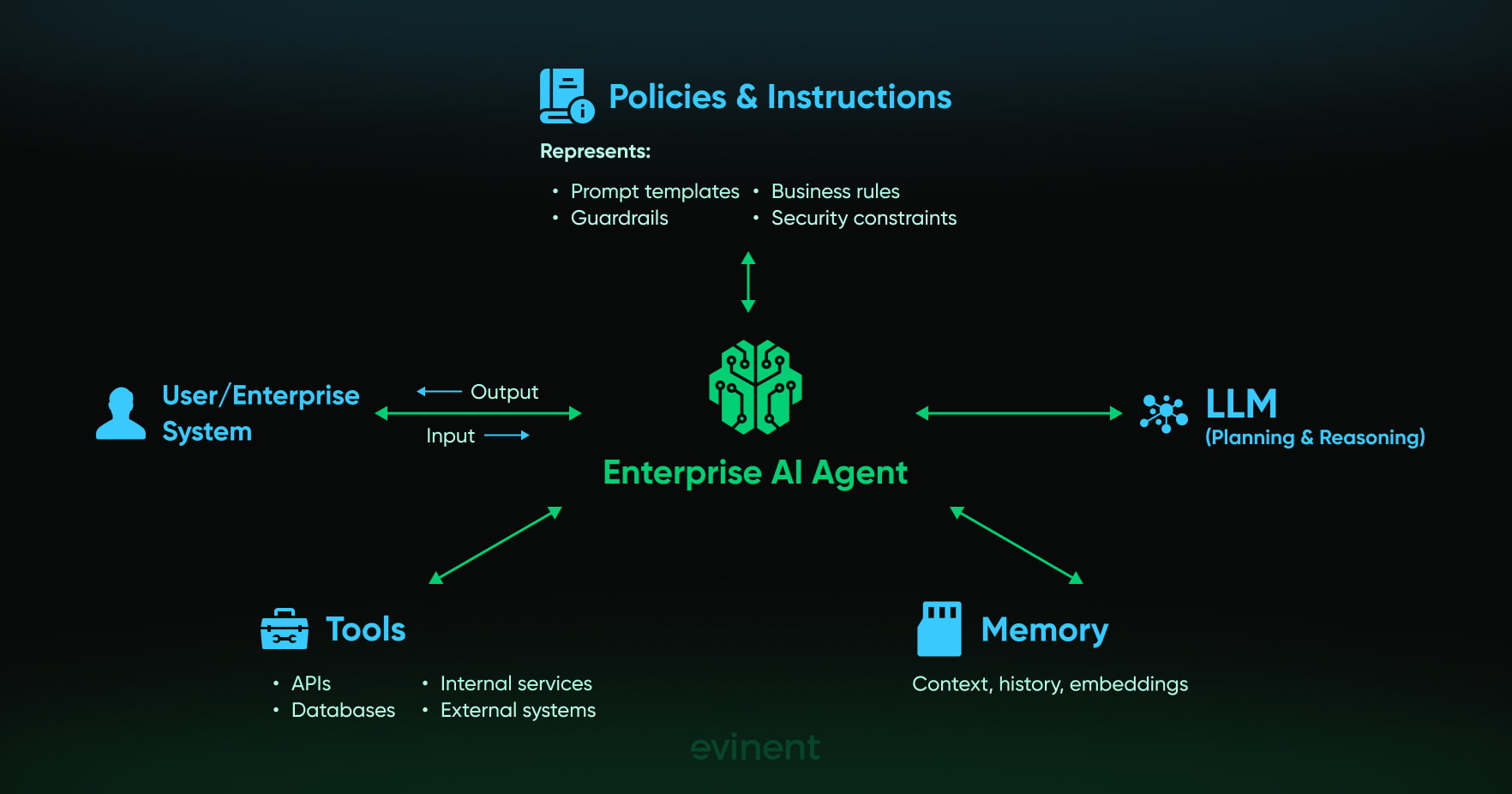
An enterprise AI agent is a goal-driven software entity that can perceive, reason, plan, and act across systems with limited human intervention and clearly defined boundaries.
That distinction matters more than it sounds.
Most enterprise software today is still reactive. Something happens, a human notices, and a workflow starts. AI agents flip that sequence. They notice first. Then they decide whether action is needed. Then they act or escalate, based on policy.
This shift is why firms like Boston Consulting Group describe agentic AI as a structural change, not a feature upgrade.
From static automation to goal-oriented systems
Traditional automation follows rules:
If X happens, do Y.
AI agents follow intent:
Given this goal, what should happen next?
That difference is subtle on paper and massive in practice.
A rule-based system can’t adapt when inputs change. An agent can. It decomposes objectives into tasks, selects tools, evaluates outcomes, and adjusts its behavior through feedback loops. That’s how enterprises move from brittle workflows to systems that can survive real-world messiness: supply chain s, customer behavior shifts, system outages, and regulatory constraints.
This is why agentic AI shows up most often where complexity lives: finance operations, customer service, IT incident management, logistics, compliance-heavy environments.
The core anatomy of an enterprise AI agent
Under the hood, enterprise agents are modular by design. Not because engineers like complexity, but because governance demands it.
Most production-grade agents include:
Foundation model
The reasoning engine. Often a large language model or a task-specialized model fine-tuned on enterprise data.
Goal initialization and planning
A mechanism for translating business intent (“reduce churn,” “resolve incidents faster”) into executable steps.
Task decomposition
Breaking complex objectives into smaller, ordered actions that the agent can evaluate and execute.
Action agent & action modules
Controlled execution layers that interact with real systems: CRM updates, ticket creation, inventory adjustments, notifications.
Tool calling and reasoning
The logic that decides which internal or external tool to use, when, and why.
Knowledge agent
Access to enterprise context: policies, historical data, contracts, customer profiles, operational constraints.
Profile module
Role awareness. What the agent is allowed to see, decide, and do — and what it must never touch.
Feedback mechanisms
Continuous evaluation of outcomes, enabling learning and correction over time.
Agent-centric interfaces
Not dashboards for humans, but control surfaces for monitoring, auditing, and intervention.
Multi-agent systems
Groups of specialized agents coordinating tasks instead of one overloaded “super-agent.”
Agentic AI mesh
The architectural layer that allows agents to operate across domains while remaining governed and observable.
None of this exists to make systems smarter for the sake of it. It exists to make decision latency disappear.
Observe, plan, act (and repeat)
At the heart of every enterprise AI agent is a simple but powerful loop:
Observe
Monitor data streams, system events, and signals across the organization.
Plan
Evaluate options, constraints, and priorities against defined goals.
Act
Execute tasks autonomously or escalate when confidence thresholds aren’t met.
Then the loop starts again.
This cycle is why agentic systems don’t behave like traditional software. They don’t wait. They don’t stall between handoffs. And they don’t forget context halfway through a process.
Why enterprises care, and why they hesitate
Executives care because agents promise speed, consistency, and scale without adding headcount.
They hesitate because autonomy forces uncomfortable questions about control, accountability, and trust.
That tension is not a bug. It’s the point.
AI agents don’t just automate tasks. They reveal how much of enterprise work exists only because systems can’t coordinate themselves.
And once leaders see that clearly, there’s no going back.
Next, let’s talk about how enterprises actually deploy these agents, and why most early attempts quietly fail before reaching production.
Approaches and Strategies for Implementation
If “AI agents” are the headline, implementation is the part that decides whether this becomes real operations or another pilot that quietly expires. The gap is bigger than most teams expect.
A lot of leaders assume agents are “just an AI layer” on top of existing systems. Then they try to roll out a few assistants inside one department, realize nothing connects cleanly, and discover the awkward truth: agents are an operating capability. If you don’t design for governance, identity, data access, and execution control, you get chaos (or a system so locked down it can’t do anything useful).
This matters even more in 2025–2026 because regulatory and security pressure is rising at the same time enterprises are pushing for faster automation. The EU’s AI Act rollout and guidance around general-purpose AI models have added real compliance questions for any organization deploying or integrating powerful AI systems at scale. And cybersecurity agencies are increasingly explicit that AI systems create new attack surface: not “maybe,” but already, through model and integration vulnerabilities.
Below are the three implementation approaches that show up most often inside enterprises, and what each one tends to get right (and wrong).

Centralized management: one control plane, many agents
This is the “enterprise-grade” instinct: build a central program, define rules once, deploy agents through a governed pipeline, keep everything observable.
Where it works
You need consistency across business units (finance, HR, IT, customer operations).
You expect audits, vendor risk reviews, and formal change management.
You want an AI asset registry and a clear inventory of what exists, who owns it, and what it’s allowed to touch.
What makes it break
Central teams become a bottleneck. Every agent request turns into a ticket queue.
Business units start building in the shadows anyway (hello, agent sprawl, but we’ll hit that later).
What “good” looks like in practice
A governed classification system for agents (assistive vs action-capable vs high-risk).
Non-negotiable activity logs (inputs, outputs, tool calls, approvals, exceptions).
Embedded policies that travel with the agent (data access, tool access, escalation rules), not just a PDF everyone ignores.
This is also the approach that maps cleanly to formal governance frameworks. ISO/IEC 42001 — the AI management system standard — is designed for organizations that need auditable controls around how AI is created, used, monitored, and improved.
DIY solutions: fast experiments, fragile production
This is how most organizations start, whether they admit it or not: a team builds an agent using whatever framework looks convenient, plugs it into a few tools, and proves a local win.
Where it works
You’re trying to validate a use case quickly (procurement intake, vendor onboarding, internal knowledge retrieval).
The impact is isolated and reversible.
The data involved is low sensitivity.
What makes it break
Each team creates its own patterns for identity, logging, tool calling, and approvals.
You end up with incompatible “mini-platforms,” and nobody can answer simple questions like:
How many agents do we have? Who can they impersonate? What systems can they change?
This is exactly where security teams get nervous, and not because they’re anti-innovation. ENISA’s 2025 threat landscape explicitly discusses how AI-related tooling and infrastructure introduce additional vulnerabilities and exploitation paths, especially when systems become interconnected and fast-moving.
DIY often turns into a governance rescue mission later. And that rescue is expensive.
Unified approach: governed autonomy without central paralysis
This is the model that tends to survive real enterprise complexity: a shared “agent operating layer” (policies, identity, observability, tool gateways) plus domain-specific agents owned by the teams closest to the work.
Think of it like this:
The central team defines how agents must behave (guardrails, logging, approvals, risk tiers).
Domain teams define what agents should do (use cases, workflow logic, outcomes).
Where it works
Your business units genuinely operate differently, but leadership needs shared control.
You want quick deployment without losing governance.
You need multi-agent orchestration (several specialized agents coordinating, rather than one overloaded mega-agent).
A strong research theme across 2025 work on agentic systems is exactly this: orchestration beats isolation. Multi-agent frameworks that coordinate within a cohesive system tend to be more robust than standalone “one-agent-does-everything” designs.
What makes it break
You don’t define escalation rules. Agents either act too freely or ask humans for permission every five seconds.
You skip observability. Then you can’t prove why a decision happened, which becomes a compliance nightmare.
This is where “agentic AI mesh” thinking appears in real architecture: not as hype, but as a way to manage distributed execution without losing centralized control of policy, identity, and auditability.
The practical infrastructure choices hiding under every approach
No matter which model you choose, the same technical and operating questions appear:
Automated pipelines: How does an agent move from prototype to approved deployment?
Lightweight deployment: Can teams ship small agents quickly without reinventing the entire stack?
Escalation mechanisms: When uncertainty rises, who gets paged, and what context do they receive?
Observability: Can you replay an agent’s decisions and tool calls during an incident review?
Compliance posture: Can you demonstrate controls that match your regulatory environment, especially in the EU, where guidance and obligations around AI systems are actively evolving?
One more thing: adoption momentum is not slowing down. OECD work prepared for the 2025 G7 Presidency notes that AI uptake among smaller firms has been rising sharply, highlighting widening gaps between fast adopters and everyone else. Even if your organization isn’t “small,” the pattern is the same: early movers build operating capability; laggards get stuck in pilot loops.
Benefits and Value Proposition
If you’re a C-level leader, you don’t care that agents can “reason” or “plan.” You care about three things:
Where do we get measurable lift?
What does it replace — work, , cost, risk?
What’s the catch?
The honest answer is that private enterprise AI agents create value in a very specific way: they reduce coordination overhead, the back-and-forth, waiting, copying, reconciling, and escalating that quietly eats a chunk of your organization every week.
This is also why the upside is real but uneven. Broad AI adoption is rising quickly, but impact varies wildly based on workflow integration and governance maturity. Stanford’s 2025 AI Index reports that AI use in organizations rose sharply (e.g., 78% of organizations reported using AI in 2024, up from 55% the year before), yet the report also stresses that realized productivity depends on how AI is embedded into work, not merely “used.” OECD analysis similarly frames AI productivity benefits as tied to diffusion and implementation capabilities, not just access to tools.
Now, what does that look like in practice?
Decision-making support that removes latency, not responsibility
In most enterprises, decisions are not blocked by lack of data. They’re blocked by time:
time to pull the numbers,
time to validate them,
time to get someone to act.
Agents help when they can monitor signals continuously and surface actionable options fast with context attached (why it happened, what it affects, what it would change if you act now).
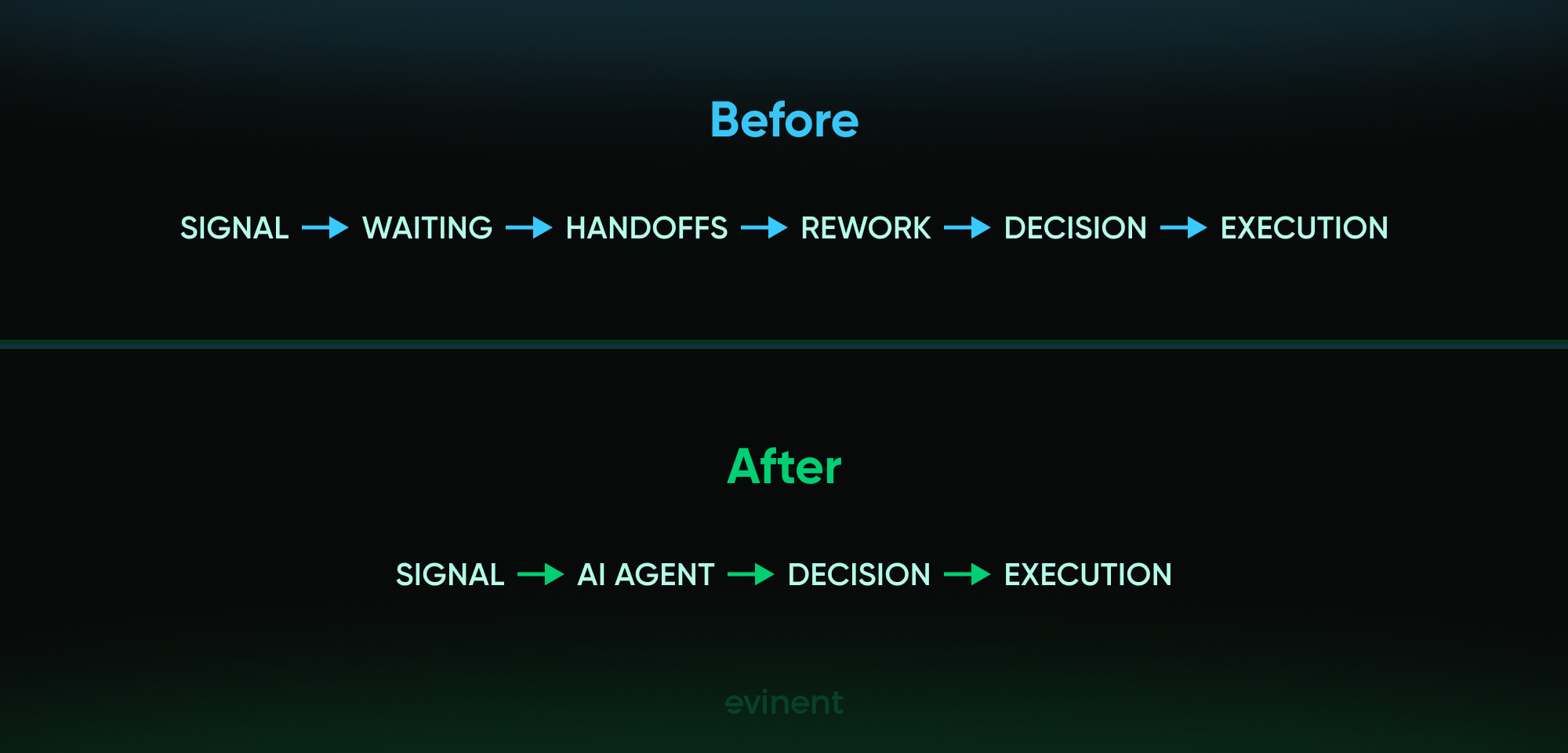
The value isn’t “AI makes decisions.” The value is AI shortens the path from signal to decision to execution, while leadership keeps the boundaries.
This matters because workforce capability is currently a bottleneck. The World Economic Forum’s Future of Jobs Report 2025 points to rapid shifts in skill needs and adoption pressure across functions, meaning many teams are being asked to operate faster with skills they’re still building.
Workflow automation that goes beyond scripts
Traditional automation covers the parts you can predict. Agents become useful the moment work stops being predictable.
They handle the messy middle:
intake that arrives in dozens of formats,
exceptions that require policy interpretation,
multi-step processes that cross systems and teams.
OECD research on AI adoption in firms repeatedly comes back to this point: value comes when AI is integrated into business processes and supported by complementary investments (data, skills, organizational capacity).
A strong tell that agents are doing real work: you see cycle-time compression across workflows that previously depended on handoffs.
Parallel processing across teams (the hidden superpower)
Enterprises still run like single-threaded machines: a request moves through queues, approvals, meetings, and ticket backlogs.
Agents can run work in parallel:
pull data from multiple systems at once,
draft actions for different owners simultaneously,
escalate only what needs human judgment.
This sounds technical, but the impact is painfully human: fewer “can someone send me…” messages, fewer status calls, fewer stalled projects waiting on one person who’s already overloaded.
Real-time processing inside the perimeter
Real-time is where private agents get interesting.
Public tools are fine for generic drafting, but operational agents need:
secure access to internal events and records,
controlled execution,
auditable outputs.
That’s why private enterprise agents tend to show up where decisions are time-sensitive: operations, IT, finance ops, customer support, supply chain monitoring.
It also explains why governance and cyber hygiene become part of the value story, not a side quest. ENISA’s 2025 Threat Landscape highlights how vulnerability exploitation and phishing remain dominant intrusion vectors, and it flags AI as a defining element of the evolving threat environment. If your agents can act, your controls must be real.
Resource allocation that stops “guessing season”
Most orgs allocate people and budgets based on lagging indicators: last month’s performance, last quarter’s outcomes, last year’s assumptions.
Agents improve allocation when they can:
monitor operational load in near real time,
predict where bottlenecks are likely to occur,
recommend redistributions with clear rationale.
This is less about “AI forecasting” and more about keeping your operating model from drifting.
Observability that turns AI from magic into something you can run
Executives are allergic to black boxes for good reason. If a system impacts customers, money, risk, or compliance, you need to explain what happened.
Agent observability (logs, tool-call traces, approval history, exception paths) is what lets you:
audit decisions,
investigate incidents,
prove controls,
scale agent usage without losing trust.
And here’s the tension: when organizations skip observability, they still “use AI,” but they pay for it twice: once for the tool, and again for the cleanup.
A 2026 Zapier survey highlights this cleanly: many enterprise users report productivity improvements, yet employees still spend significant time correcting AI output (an average of 4.5 hours a week in that survey). Agents only create net value when the system reduces rework, not adds a new kind of it.
Customer experience and personalization without the chaos tax
Personalization often dies in implementation because it requires coordination between:
data teams,
marketing,
product,
compliance,
IT.
Agents can operationalize personalization by turning it into controlled actions:
segmentation refreshes,
offer logic execution,
consistency checks across channels,
policy-aware content decisions.
The value isn’t “more personalization.” It’s less friction between intent and execution.
Risk mitigation as a measurable outcome, not just a promise
This sounds counterintuitive: “autonomous agents” and “risk mitigation” don’t belong in the same sentence. Yet in controlled private environments, agents can reduce risk by:
enforcing policy consistently,
maintaining activity trails,
detecting anomalies earlier,
escalating faster with context.
But only if controls exist and are tested. ENISA’s 2025 reporting is a reminder that attackers are not waiting for enterprises to get comfortable.
The pattern across all these benefits is simple: agents pay off when they change the throughput of work, not when they generate prettier text.
Challenges and Considerations in Deployment
This is the part most vendor decks rush through, and the part executives end up dealing with six months later.
Because the moment AI agents move from “interesting pilot” to “system that actually does things,” a different class of problems shows up. Not theoretical ones. Operational ones. Political ones. Occasionally, uncomfortable ones.
And here’s the thing, many organizations learn the hard way: most agent initiatives don’t fail because the AI is wrong. They fail because the organization wasn’t ready to let software act.
Let’s walk through the real friction points.
Agent sprawl: when autonomy spreads faster than control
Once teams see early wins, agents multiply. Fast.
One team builds an intake agent. Another adds a reconciliation agent. A third wires an agent directly into production systems “just for speed.” Suddenly, no one can answer basic questions:
How many agents are active?
Which ones can write to core systems?
Which identities do they assume?
What happens if one behaves unexpectedly at scale?
This isn’t hypothetical. Multiple 2025 governance and security analyses point to AI system proliferation as a growing risk category, because organizations lose visibility over interconnected automation. The UK National Cyber Security Centre’s 2025 guidance on AI systems explicitly flags unmanaged AI components as an emerging operational risk in complex environments.
Agent sprawl is shadow IT with execution privileges. Treat it that way.
Fragmented data pipelines quietly sabotage agent intelligence
Agents are only as useful as the data they can observe, and enterprises are still very good at fragmenting their data across systems, formats, and ownership boundaries.
Common failure mode:
The agent has partial visibility.
It acts confidently anyway.
Humans lose trust when decisions don’t match reality.
OECD research published in 2025 on AI diffusion in firms highlights this exact issue: data fragmentation and weak interoperability are among the top barriers preventing AI systems from delivering productivity gains at scale. Organizations that invested in AI without parallel data integration saw significantly lower returns.
This isn’t a model problem. It’s plumbing.
Infrastructure investment is real, and often underestimated
There’s a persistent myth that agents are “cheap because they’re software.”
In practice, enterprise-grade agents require:
secure execution environments,
controlled integration layers,
logging and replay infrastructure,
identity and access management alignment,
monitoring and ing that humans can actually use.
The European Union Agency for Cybersecurity (ENISA), in its 2025 threat landscape, stresses that AI-enabled systems expand the attack surface primarily through integration points and automation layers, not through models alone. That has direct cost implications, especially in regulated environments.
If your infrastructure budget assumes agents are “just another API consumer,” it’s probably wrong.
Observability and traceability: the line between confidence and panic
When an agent takes an action that affects customers, money, or compliance, leadership will ask two questions immediately:
Why did this happen?
Can it happen again?
If you can’t answer those within minutes with logs, decision paths, and tool-call history, trust evaporates.
This is why observability and traceability aren’t “nice to have.” They’re what separates:
a system leaders defend, from
a system leaders quietly turn off after the first incident.
Regulators are moving in the same direction. Guidance accompanying the EU AI Act rollout in 2025 emphasizes traceability and human oversight as core requirements for higher-risk AI systems. Even organizations outside the EU are paying attention, because these standards increasingly shape vendor and partner expectations.
Compliance agents don’t replace compliance thinking
There’s growing interest in “compliance agents”: systems that monitor, enforce, or report on regulatory adherence.
They can help. But they don’t absolve responsibility.
A recurring mistake is assuming agents can interpret ambiguous rules the same way legal or compliance teams do. They can’t; not without carefully defined guardrails and escalation paths.
The more realistic pattern:
agents handle detection, monitoring, and documentation,
humans handle interpretation, judgment, and exceptions.
Anything else creates a false sense of safety, which is arguably worse than having no automation at all.
Ethical guardrails aren’t abstract, but operational
Bias, fairness, and unintended consequences stop being academic the moment agents act at scale.
Questions enterprises face sooner than expected:
Should an agent be allowed to deprioritize certain requests?
Can it deny service?
Can it trigger actions that affect employment, pricing, or access?
The World Economic Forum’s 2025 work on responsible AI adoption stresses that ethical considerations become operational risks when AI systems act autonomously. Organizations that don’t formalize guardrails early often end up retrofitting them under pressure, usually after something goes wrong.
That’s expensive, public, and avoidable.
Human oversight: too much kills value, too little kills trust
One of the hardest balances to strike is how much autonomy is enough.
If agents ask humans to approve every step, you get:
no speed gain,
frustrated teams,
and eventual abandonment.
If agents act freely without escalation thresholds, you get:
nervous stakeholders,
emergency shutdowns,
and frozen programs.
Successful deployments define:
confidence thresholds,
escalation triggers,
clear ownership for intervention.
Not “human-in-the-loop” as a slogan, but as a designed operating model.
Workforce readiness is the silent constraint
Finally, there’s the people factor.
Agents don’t just change workflows. They change roles:
managers move from coordination to oversight,
operators move from execution to exception handling,
teams need to understand how to question, not just follow, automated decisions.
The World Economic Forum’s Future of Jobs Report 2025 underscores that AI adoption without parallel skill development creates friction, not productivity. Organizations that invest in upskilling and role clarity see smoother adoption and higher trust in AI-supported systems.
Ignore this, and even the best-designed agent system will face resistance.
The pattern across all these challenges is consistent: agent initiatives fail when autonomy outpaces governance, and succeed when governance enables autonomy instead of blocking it.
Enterprise Use Cases and Applications
This is the moment where theory either holds up or collapses.
Because no executive signs off on AI agents for architectural elegance. They approve them because something painful finally stops hurting: backlogs shrink, response times fall, errors stop repeating, teams breathe again.
What’s changed since 2025 is not imagination. It’s credibility. Independent research and large-scale deployments now show where private enterprise AI agents actually work, and where they still don’t.
Let’s walk through the use cases that consistently survive first contact with reality.
Enterprise-wide copilots (that actually do something)
Early “copilots” mostly talked. They summarized. They suggested. And then humans still did the work.
The newer generation of enterprise copilots is different. They operate as assistive agents with execution rights, within defined limits:
updating records,
triggering workflows,
coordinating between systems,
escalating only when confidence drops.
According to IBM’s 2025 analysis of enterprise AI agents, organizations that deployed agents with controlled action capabilities, not just advisory roles, saw material reductions in operational friction, especially in IT operations, HR service delivery, and internal support functions. These weren’t moonshots; they were quiet wins that removed thousands of low-value interactions per week.
The lesson is blunt: copilots that can’t act become reference tools. Copilots that can act become infrastructure.
Customer service: from queues to coordinated resolution
Customer service is where agents prove their value fast or get exposed.
Private agents work well here because:
data is structured but messy,
outcomes are measurable,
s are expensive.
Modern agents don’t just answer questions. They:
classify intent,
retrieve customer context,
propose resolutions,
trigger backend actions,
hand off to humans only when needed.
Independent case reviews summarized by BCG in 2025 show customer-facing agent deployments reducing cart abandonment by up to 40% and improving conversion where agents could resolve issues in-session instead of deferring to follow-ups.
What matters is not the conversational layer. It’s the coordination between systems: billing, inventory, logistics, and CRM that happens behind the scenes.
Lead scoring and revenue operations
Sales teams drown in signals. Agents thrive on them.
In revenue operations, private AI agents monitor:
inbound activity,
account behavior,
pipeline movement,
engagement patterns.
They don’t replace sales judgment. They prioritize it.
Agents continuously update lead scores, flag risks, and suggest next actions, sometimes triggering them automatically (routing, follow-ups, task creation). This reduces lag between intent and response, which matters more than most sales decks admit.
A 2025 synthesis of enterprise AI deployments by OECD highlights that firms using AI for sales and customer analytics saw stronger conversion improvements when AI systems were embedded directly into operational workflows, rather than used as reporting tools.
In other words: when agents act, revenue moves faster.
Inventory optimization and demand forecasting
Supply chains don’t fail because people are bad at planning. They fail because reality changes faster than planning cycles.
Agents help by:
monitoring demand signals in real time,
correlating external disruptions,
adjusting reorder logic dynamically,
escalating when thresholds are crossed.
Case analyses referenced by IBM show predictive, agent-driven approaches reducing downtime and improving stock availability, not through perfect forecasts, but through faster response when forecasts break.
That distinction matters. Agents don’t predict the future. They react to change without waiting for a meeting.
IT operations and incident management
IT is one of the most mature environments for agentic systems, and one of the most unforgiving.
Agents monitor logs, metrics, and events across infrastructure, applications, and networks. They correlate anomalies, suppress false s, and initiate remediation steps.
Independent reporting compiled in 2025 points to:
significantly faster incident resolution,
large reductions in noise,
improved mean time to recovery.
This works because IT already operates on structured signals and defined runbooks. Agents don’t invent policy; they execute it consistently.
And when something falls outside known patterns? Escalation happens with context attached, not a flood of s.
Finance operations and risk monitoring
Finance is cautious by design. That’s exactly why agents fit here when done privately and with strict controls.
Common agent-driven tasks include:
transaction monitoring,
reconciliation,
anomaly detection,
reporting preparation,
exception handling.
According to 2025 projections referenced by IBM, AI-driven automation in contact centers and finance operations is expected to drive tens of billions in cost savings globally by reducing repetitive work and error correction.
But the real win is not cost. It’s consistency. Agents apply rules the same way, every time, at a scale humans can’t sustain.
HR and workforce operations
HR teams quietly run some of the most complex workflows in an organization, onboarding, access provisioning, policy interpretation, and employee support.
Agents help by:
coordinating between HRIS, IT, payroll, and compliance,
answering policy questions with context,
triggering access or documentation workflows,
tracking exceptions and approvals.
The World Economic Forum’s 2025 report on AI and work emphasizes that organizations using AI to support operational HR tasks, rather than replace human judgment, see higher acceptance and smoother adoption.
In plain terms: agents handle the paperwork; humans handle the people.
Healthcare and sensitive data environments
Healthcare shows what happens when autonomy meets constraint.
Agents are used for:
patient record management,
scheduling coordination,
administrative workflows,
documentation support.
What they don’t do: make clinical decisions independently.
This split is intentional, and instructive for other regulated sectors. Agents reduce administrative burden while escalation thresholds protect human authority where stakes are highest.
Regulatory guidance across Europe and the US in 2025 consistently reinforces this pattern: automation where risk is procedural; human oversight where risk is moral or clinical.
AI centers of excellence and orchestration layers
Finally, some enterprises use agents not to automate frontline work, but to manage AI itself.
These meta-level agents:
monitor other agents,
track usage and drift,
flag policy violations,
surface performance anomalies.
This is where AI centers of excellence evolve from governance committees into operating units. Instead of reviewing slide decks, they oversee living systems.
And yes, this is where things get interesting.
Across all these use cases, one theme keeps repeating: agents succeed when they are given responsibility within boundaries, and fail when they are treated like clever toys.
Future Trends and the Evolution of AI Agents
If the last few sections felt grounded, this one may feel slightly unsettling in a good way.
Because once private enterprise AI agents become part of daily operations, the question quietly shifts from “Should we deploy them?” to “How do we run an organization where software initiates work?”
That shift is already underway.
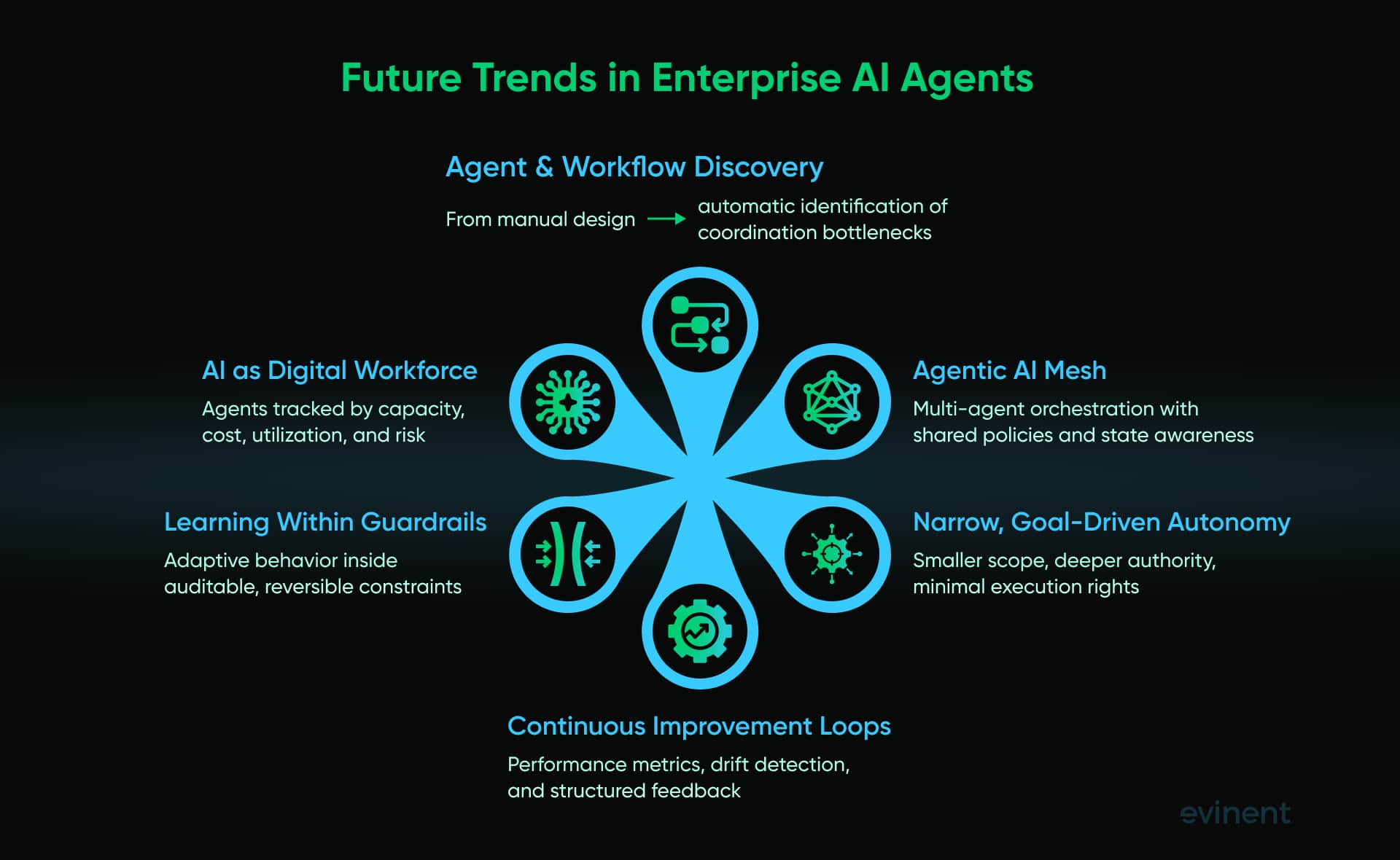
From isolated agents to agent and workflow discovery
Right now, most enterprises design agents intentionally: someone defines a use case, builds an agent, and wires it into systems.
That won’t scale.
Research published in 2025 by MIT Sloan Management Review points to an emerging pattern: organizations are moving toward agent and workflow discovery, where systems identify repetitive coordination patterns and propose new agents automatically. Not writing code — surfacing opportunities.
Think less “build an agent” and more “why does this process still need people in the middle?”
This is where executives start seeing uncomfortable truths about how much work exists only because systems never learned to cooperate.
Agentic AI mesh becomes operational, not conceptual
The phrase agentic AI mesh sounds academic until the first time three agents disagree.
As enterprises deploy dozens, then hundreds, of agents, coordination becomes the problem:
Who has priority?
Which agent owns the outcome?
How do conflicts resolve without human arbitration every time?
The answer emerging in 2025 architecture research is structured orchestration, not central command. Agents negotiate, escalate, and defer based on shared policies and state awareness.
This mirrors what distributed systems learned years ago: control doesn’t disappear, but becomes protocol-driven.
Organizations that treat agent coordination as a first-class design concern report more stable systems and fewer emergency shutdowns, according to 2025 field studies summarized by IBM Research.
Autonomous, goal-driven execution with narrower scope
Here’s a counterintuitive trend: autonomy is increasing, but scope is shrinking.
Early excitement pushed teams to build agents that “handle everything.” That failed fast. What’s working now are narrow, goal-driven agents with deep authority inside well-defined domains.
This approach matches guidance published in 2025 by the UK National Cyber Security Centre, which stresses that AI systems with execution rights should operate under the principle of minimal authority, not because autonomy is dangerous, but because diffuse autonomy is unmanageable.
The future belongs to specialists, not generalists.
Continuous improvement replaces static deployment
Agents don’t “go live” and stay the same.
They adapt, sometimes in ways teams didn’t predict.
Enterprises are now designing continuous improvement loops around agents:
performance metrics tied to outcomes, not usage,
drift detection in behavior and decision patterns,
structured feedback management from humans back to agents.
The 2025 AI Index from Stanford HAI highlights this as a key maturity marker: organizations that treat AI systems as evolving operational components see higher sustained returns than those that treat them as finished products.
This sounds obvious. It isn’t. Many companies still deploy AI the way they deploy software releases.
Learning agents inside constrained environments
Learning used to scare enterprises. For good reason. Private enterprise agents increasingly learn only within:
defined datasets,
approved feedback sources,
bounded performance metrics.
They don’t “improve freely.” They improve within fences.
This model aligns with 2025 regulatory guidance across Europe and North America, which increasingly recognizes that learning systems are acceptable: expected, even when improvement mechanisms are documented, auditable, and reversible.
In other words, learning is fine. Unobservable learning is not.
The digital workforce stops being a metaphor
The phrase digital workforce used to feel like marketing.
Now it feels literal.
Organizations are beginning to track:
agent capacity,
agent utilization,
agent cost,
agent risk exposure.
Just like human teams.
A 2025 analysis by the OECD notes that firms treating AI agents as operational labor, with accountability and lifecycle management, outperform those treating AI as tooling alone.
This doesn’t replace people. It reshapes what “work” means.
Ethical dilemmas move from theory to scheduling
Ethics used to live in whitepapers.
Now it lives in escalation queues.
As agents make decisions faster, ethical questions appear operationally:
Which requests should wait?
Which customers get priority?
When is speed unfair?
The World Economic Forum has been explicit in its 2025 guidance: ethical decision-making in AI must be encoded into workflows, not debated after incidents.
That’s a leadership problem, not a model problem.
Observe–plan–act becomes a management pattern
Finally, something subtle but profound is happening.
The observe–plan–act cycle that powers agents is starting to influence how leadership teams operate:
dashboards shift from reporting to monitoring,
planning becomes continuous,
action thresholds get codified.
Organizations that internalize this rhythm adapt faster, not because AI tells them what to do, but because AI exposes .
And is the enemy now.
The future of enterprise AI agents isn’t about replacing humans. It’s about compressing the distance between intent and execution: safely, visibly, and under control.
Organizational Transformation and Leadership
Here’s the part that no architecture diagram prepares you for.
Private enterprise AI agents don’t just change how work happens. They force organizations to rethink who decides, who owns outcomes, and how authority flows when software can initiate action.
That’s why the hardest work isn’t technical. It’s organizational.
Why leadership becomes the bottleneck (before technology does)
In early deployments, AI agents usually outperform expectations.
Then everything slows down.
Not because the agents can’t act, but because leadership hasn’t agreed on:
how much autonomy is acceptable,
where escalation should land,
who carries accountability when software initiates change.
This is where many initiatives stall. Not loudly. Quietly.
A 2025 governance-focused analysis from World Economic Forum notes that organizations adopting agentic AI struggle most with decision ownership, not model capability. When authority remains ambiguous, teams default to caution: approvals multiply, agents wait, and value evaporates.
In other words, the system works, but no one lets it.
From hierarchy to orchestration
Traditional enterprises are hierarchical by necessity. Decisions move up, instructions move down.
AI agents don’t respect that shape.
They operate laterally:
across departments,
across systems,
across time zones and business hours.
This creates friction unless leadership reframes control as orchestration, not command.
Successful organizations define:
agent autonomy boundaries (what agents can decide independently),
agent orchestrators (systems or teams that coordinate agent activity),
exception ownership (who steps in when uncertainty crosses a threshold).
Research published in 2025 by MIT Sloan Management Review shows that firms treating AI agents as part of an orchestrated operating model, rather than isolated tools, report faster adoption and fewer internal conflicts.
Hierarchy doesn’t disappear. It becomes less visible and more intentional.
The rise of strategic AI councils (and why they matter)
Many enterprises now form strategic AI councils. Some are effective. Many are ceremonial.
The difference is mandate.
Effective councils:
define AI principles that actually constrain behavior,
approve agent risk tiers,
arbitrate autonomy disputes,
own shutdown authority when something goes wrong.
Ineffective ones review decks and debate hypotheticals.
The OECD’s 2025 work on AI governance frames this clearly: AI oversight bodies must be decision-capable, not advisory-only, or they fail to influence real outcomes.
If your AI council can’t say “yes,” “no,” or “stop,” it’s not governance. It’s theater.
Lighthouse projects: proving change before scaling it
One pattern that keeps working is the lighthouse transformation project.
Instead of spreading agents thin across the organization, leadership selects:
one high-friction workflow,
one cross-functional area,
one clearly measurable outcome.
Then they allow agents real authority there, with full visibility.
These lighthouse projects do two things:
Prove value without betting the company.
Expose organizational resistance early, when it’s still fixable.
The second point matters more than the first.
Human–agent collaboration becomes a design problem
“Human-in-the-loop” sounds safe. It’s also vague.
In practice, leaders must decide:
which decisions remain human by design,
which decisions are delegated by default,
how humans challenge or override agents.
This creates new roles:
human-in-the-loop designers who define escalation logic,
managers who supervise outcomes instead of tasks,
operators who handle exceptions instead of routine execution.
According to the World Economic Forum’s 2025 workforce research, organizations that clearly redesign roles around AI collaboration face less resistance and achieve faster productivity gains than those that “add AI” without redefining jobs.
People resist ambiguity more than automation.
Data productization changes who owns truth
Agents force another uncomfortable shift: data stops being passive.
When agents act on data, the question “who owns this dataset?” turns into “who owns the consequences?”
Leading organizations respond by treating data as a product:
with clear owners,
quality expectations,
usage contracts,
and escalation paths when data causes harm.
Without data productization, agents amplify inconsistencies instead of insight.
Engineers fade - operating model designers rise
Early AI teams hired engineers. Mature ones hire operating model designers.
Why? Because s don’t govern systems. Models don’t set boundaries, but people do through structure.
By 2025, multiple enterprise studies (including work summarized by OECD) show that organizations succeeding with AI focus less on tuning and more on:
workflow design,
decision rights,
escalation mechanics,
accountability mapping.
That’s not glamorous. It’s decisive.
Leadership discomfort is a signal, not a problem
If AI agents make leadership uncomfortable, that’s not failure. It’s feedback.
They expose:
slow decision cycles,
unclear ownership,
hidden dependencies,
cultural resistance to delegation.
Ignoring that signal leads to cosmetic AI adoption. Listening to it leads to organizational change.
And that change doesn’t happen automatically.
Private enterprise AI agents don’t replace leadership. They demand better leadership, clearer decisions, sharper boundaries, and faster accountability.
Security and Privacy in Enterprise AI Agents
This is where optimism meets reality.
The moment an AI agent gains the ability to act inside enterprise systems, not just read, summarize, or suggest, security and privacy stop being “risk considerations” and become operating conditions. If they’re weak, everything else collapses.
And unlike many earlier waves of enterprise software, agentic AI doesn’t fail quietly. When it fails, it does so at speed.
Why AI agents change the security equation
Traditional enterprise systems are mostly reactive. A user logs in, performs an action, logs out. Security teams design controls around that rhythm.
AI agents break it.
Agents:
run continuously,
interact with multiple systems in parallel,
operate through service identities rather than human accounts,
and can trigger chains of actions faster than a human can notice.
That’s not inherently dangerous, but it reshapes the threat model.
The European Union Agency for Cybersecurity highlighted in its 2025 threat landscape that AI-enabled automation increases exposure primarily through integration points and privileged machine identities, not through the models themselves. In other words, attackers don’t need to “hack the AI.” They exploit what the AI is allowed to touch.
Private vs public agents: the real dividing line
A critical distinction for enterprises is where reasoning happens and where data flows.
Public or shared AI services:
operate outside your security perimeter,
mix workloads across tenants,
rely on contractual assurances for data handling.
Private enterprise AI agents:
run in isolated environments,
use enterprise-controlled identity and access management,
enforce internal data residency and retention policies.
This is why regulated industries gravitate toward private agents first. Not because they distrust AI, but because they distrust uncontrolled data paths.
According to 2025 guidance from National Institute of Standards and Technology, organizations deploying AI systems with operational impact should treat them as high-risk digital components, subject to the same controls as financial or identity systems.
That guidance is shaping procurement standards well beyond the US.
Identity: the most underestimated risk surface
Humans have identities. So do agents.
The difference is scale.
A single misconfigured agent identity can:
access dozens of systems,
execute thousands of actions,
propagate errors or abuse instantly.
That’s why mature deployments enforce:
least-privilege access at the agent level,
strict separation between read-only and action-capable agents,
scoped, time-bound credentials,
and mandatory rotation and revocation mechanisms.
The Cloud Security Alliance has been explicit in its 2025 AI security guidance: unmanaged machine identities are one of the fastest-growing enterprise attack vectors. AI agents amplify this risk because they operate continuously and autonomously.
If your identity model assumes “users log out,” it’s already outdated.
Data governance stops being theoretical
Privacy failures rarely come from malicious intent. They come from overreach.
Agents don’t “know” when data usage feels inappropriate unless you tell them.
Effective enterprise deployments define:
which datasets an agent can observe,
which fields are masked or excluded,
how long context can persist,
and whether data can be reused across tasks.
The OECD’s 2025 work on AI governance stresses that data minimization and purpose limitation are not just regulatory concepts, they’re technical requirements for trustworthy AI systems.
Without them, agents become very efficient at doing the wrong thing.
Observability is a security control, not just an ops feature
When something goes wrong, the question is never “did the agent do it?”
The question is “how did it decide to do it?”
Security-grade observability means:
full logs of inputs and outputs,
traceable tool calls,
recorded decision paths,
clear attribution to agent identities,
and immutable audit trails.
This is not optional.
In 2025, multiple regulatory bodies made it clear that traceability is a prerequisite for accountability in AI-driven systems. If you can’t reconstruct an agent’s behavior, you can’t defend it, legally or operationally.
Kill switches, rollback, and graceful failure
Every autonomous system needs a way to stop.
Not metaphorically. Literally.
Enterprise-grade agent deployments include:
global and scoped kill switches,
rollback mechanisms for reversible actions,
confidence thresholds that force escalation,
and circuit breakers when anomaly rates spike.
The UK National Cyber Security Centre emphasizes in its 2025 recommendations that AI systems with execution authority must be designed to fail predictably, not creatively.
Graceful failure is a security feature.
Human oversight as a security boundary
Security teams sometimes hear “human-in-the-loop” and think “slow.”
In reality, human oversight is a boundary condition, not a speed bump.
Well-designed systems:
let agents act within confidence ranges,
surface exceptions with full context,
and allow humans to intervene once, not repeatedly.
This prevents two dangerous extremes:
blind trust in automation,
or total paralysis through over-approval.
The balance is architectural, not philosophical.
Privacy-by-design is no longer optional
Privacy regulation didn’t pause for AI. By 2025, privacy authorities across Europe and beyond made it clear that AI systems must:
respect data minimization,
support deletion and correction,
limit secondary use,
and document decision logic affecting individuals.
Private enterprise AI agents can meet these expectations, but only when privacy is embedded at design time. Retrofitting privacy after deployment is expensive and fragile.
The uncomfortable truth
AI agents don’t create new security problems out of nowhere. They expose the ones enterprises already had: excessive access, unclear ownership, weak observability, and slow response paths.
Handled well, agents can reduce risk by enforcing policy consistently and surfacing issues early.
Handled poorly, they compress failure into minutes instead of months.
Which brings us to the final question executives eventually ask:
If we accept the risks, who helps us do this right?
That’s where Evinent enters the picture.
How Evinent Helps Organizations Build Private Enterprise AI Agents Without Losing Control
By the time enterprises reach this point in the conversation, the question is no longer “Should we use AI agents?” It’s “Who can help us do this without creating operational debt, security exposure, or organizational chaos?”
That’s the gap Evinent works in.
Not as an AI vendor pushing pre-packaged agents. Not as a lab chasing experiments. But as an engineering partner helping organizations turn agentic AI into a governed, production-grade capability inside their own environments.
Here’s what that looks like in practice.
Private, isolated AI environments by design
Evinent focuses on private enterprise AI agents: systems that operate entirely within a client’s controlled infrastructure.
That means:
no data leakage to public model endpoints,
no shared tenant risk,
no opaque third-party execution layers,
full control over data residency, retention, and access.
Agents are deployed where enterprises already run sensitive workloads: private clouds, dedicated environments, hybrid architectures. The AI works inside the perimeter not around it.
This matters most in finance, healthcare, industrial operations, and regulated digital platforms, where “we’ll secure it later” is not an option.
Proof in practice: Evinent has already delivered a production-grade example of this approach — a secure, private AI environment designed for enterprise recruitment workflows. See the case: Secure Private AI for Enterprise Recruitment.
Agent architecture that survives audits, not just demos
Many agent prototypes look impressive until security, compliance, or internal audit teams get involved.
Evinent designs agent systems with those conversations in mind from day one:
explicit agent identity models,
least-privilege access controls,
immutable activity logs,
traceable decision paths,
clear escalation and override mechanisms.
In other words, agents are built as auditable actors, not magical black boxes.
This approach aligns with modern governance expectations coming from regulators, cybersecurity authorities, and enterprise risk teams, without turning innovation into gridlock.
From single agents to multi-agent orchestration
Most real value doesn’t come from one clever agent. It comes from coordinated systems.
Evinent helps organizations move from isolated use cases to:
domain-specific agents (finance, IT, ops, customer service),
shared orchestration layers,
controlled inter-agent communication,
centralized observability across the agentic AI mesh.
The result is not a swarm of disconnected automations, but a coherent operating layer where agents collaborate under shared rules.
This is especially important for enterprises scaling beyond a handful of use cases, where agent sprawl becomes a real risk.
Embedded governance, not bolt-on controls
Governance fails when it lives outside the system.
Evinent embeds governance directly into how agents are designed and deployed:
policy-aware action modules,
confidence thresholds tied to escalation,
environment-based permissioning,
built-in kill switches and rollback logic.
This allows leadership teams to answer hard questions clearly:
What can agents do on their own?
When do humans step in?
How do we stop or change behavior instantly?
Control doesn’t slow agents down. It makes autonomy safe.
Use cases grounded in enterprise reality
Evinent doesn’t start with “AI can do everything.”
It starts with where coordination is breaking today.
Typical engagement areas include:
internal operations and service workflows,
IT incident and change management,
finance ops and reconciliation,
secure enterprise knowledge agents,
cross-system process automation where handoffs dominate cost and .
Each use case is evaluated for:
business impact,
data readiness,
risk exposure,
and organizational readiness.
Not every process needs an agent. Evinent helps identify the ones that do, and the ones that shouldn’t.
Leadership-level partnership, not just delivery
Perhaps the most underrated part: organizational readiness.
Evinent works with leadership teams to:
define agent autonomy boundaries,
clarify decision ownership,
design human–agent collaboration models,
support AI governance councils with technical grounding,
and structure lighthouse projects that prove value without betting the company.
This is where technology meets operating model, and where many initiatives either accelerate or stall.
A final, honest positioning
Evinent is not promising “AI that replaces your workforce.”
And it’s not selling hype about autonomous enterprises running themselves.
What Evinent helps build is something far more practica, and far more powerful:
Private enterprise AI agents that remove friction, act within rules, and give organizations speed without surrendering control.
For leadership teams facing pressure to move faster, without breaking trust, security, or compliance, that balance is the difference between experimentation and transformation.
And it’s the difference between AI as a headline… and AI as infrastructure.
FAQ
Below are the questions executives, architects, and risk teams ask most often — the ones that show up repeatedly in Google searches, board discussions, and internal reviews once agentic AI becomes more than a slide.
What is a private enterprise AI agent?
A private enterprise AI agent is an autonomous, goal-driven software system that operates inside a company’s controlled environment. It can observe enterprise data, reason over it, plan actions, and execute tasks across internal systems such as CRM, ERP, HR, finance, or IT platforms — all without sending sensitive data to public AI services.
The “private” part matters. These agents run within enterprise infrastructure, follow internal security policies, and respect data residency, access controls, and audit requirements.
How are enterprise AI agents different from chatbots or copilots?
Chatbots respond. Agents act.
A chatbot or copilot typically waits for human input and offers suggestions or summaries. An enterprise AI agent is designed to initiate actions, coordinate workflows, and handle multi-step processes on its own — escalating to humans only when confidence thresholds or policies require it.
That difference changes everything: governance, security, accountability, and business impact.
Are enterprise AI agents safe to use with sensitive or regulated data?
They can be if designed correctly.
Private enterprise AI agents are specifically built for environments where sensitive data is unavoidable. Safety depends on:
isolated deployment (no shared tenants),
least-privilege access,
strong identity management for agents,
full observability and audit trails,
clear escalation and kill-switch mechanisms.
Without these, agents introduce risk. With them, they often reduce risk by enforcing rules consistently and reacting faster than manual processes.
Do AI agents replace employees?
No, and organizations that frame it that way usually fail.
AI agents replace coordination overhead, not human judgment. They take on repetitive, multi-system, low-value tasks that slow teams down: routing requests, reconciling data, monitoring signals, triggering workflows.
Humans remain responsible for:
judgment calls,
ethical decisions,
complex exceptions,
relationship-driven work,
and accountability.
In practice, roles change before headcount does.
What business functions benefit most from AI agents?
AI agents show the fastest return where:
work crosses multiple systems,
s are expensive,
exceptions are common,
and decisions depend on real-time signals.
Common areas include:
customer service and support operations,
IT operations and incident management,
finance operations and reconciliation,
sales and revenue operations,
supply chain and inventory monitoring,
HR service delivery and onboarding workflows.
Creative or purely strategic work is usually a poor fit.
How long does it take to see value from enterprise AI agents?
Early value often appears within 8–12 weeks, if the scope is realistic.
Organizations that succeed usually start with a lighthouse use case:
narrow in scope,
measurable,
high-friction,
and safe to automate.
Trying to deploy agents everywhere at once s results and increases risk.
What are the biggest risks of deploying AI agents?
The most common risks are not technical failures, but organizational ones:
unclear decision ownership,
excessive agent permissions,
lack of observability,
weak data governance,
over-automation without escalation rules.
Technically, the largest risks involve identity misuse, uncontrolled integrations, and insufficient auditability — all solvable with proper design.
How do you control or stop an AI agent if something goes wrong?
Production-grade enterprise agents always include:
scoped and global kill switches,
rollback mechanisms for reversible actions,
confidence thresholds that force escalation,
and real-time monitoring.
If an agent can’t be stopped cleanly, it shouldn’t be deployed.
Are enterprise AI agents compliant with regulations like the EU AI Act?
They can be, but compliance is architectural, not automatic.
Compliance depends on:
traceability of decisions,
documented oversight mechanisms,
clear risk classification,
human accountability,
and privacy-by-design controls.
Private enterprise deployments make compliance easier than public or shared AI services, but responsibility remains with the organization.
What skills does an organization need to run AI agents successfully?
Less engineering. More systems thinking.
Successful organizations invest in:
workflow and operating model design,
data ownership and quality management,
AI governance and risk oversight,
human–agent collaboration design,
and incident response for automated systems.
The skill gap is organizational, not just technical.
When is an AI agent the wrong solution?
AI agents are a bad fit when:
the process is simple and static,
errors are unacceptable and irreversible,
data quality is extremely poor,
or the organization is unwilling to grant any autonomy.
In those cases, traditional automation or human-driven workflows are often safer and cheaper.
How do companies usually start with enterprise AI agents?
The most successful path looks like this:
Identify one coordination-heavy workflow.
Define clear success metrics.
Design strict autonomy boundaries.
Deploy in a private, observable environment.
Learn, adjust, then expand.
Skipping steps usually stops progress entirely.
Share