

That question — “What is Private AI?” — has climbed sharply in enterprise search over the past year. Not because executives are confused about what AI can do. But because many teams have already tried public AI systems and hit the same moment of discomfort.
The demo works, and the model performs. Then someone asks a practical question: Where does our data go? That’s usually where things slow down.
Legal wants clarity on data usage. Security wants guarantees around access. Compliance asks whether decisions can be audited six months from now. And suddenly, the excitement around AI meets the reality of operating inside a regulated, risk-aware organization.
This isn’t theory. It’s the point where many AI initiatives stall — not because the technology failed, but because no one could clearly explain who controls the system once real data is involved.
Independent breach data shows the average global data breach cost was USD 4.44 million in recent reporting, even as AI-assisted defenses helped contain impacts. These breaches underscore why enterprises are wary of uncontrolled AI data flows. (Cost of a Data Breach Report 2025: The AI Oversight Gap, IBM, 2025)
Private AI exists for that exact moment. Instead of sending enterprise data into shared platforms, Private AI keeps AI workloads inside approved infrastructure — on-premises, in a private cloud, or in a tightly governed hybrid setup. Data stays within the company’s security perimeter. Model access is restricted. Outputs can be logged, reviewed, and explained.
This doesn’t make AI safer by default. It makes it governable.
For leadership teams accountable to regulators, customers, and boards, that difference matters. Private AI allows organizations to move forward with AI adoption without quietly accepting risks they wouldn’t tolerate elsewhere in the business.
For many enterprises, it’s not a philosophical choice. It’s the point where AI becomes usable beyond pilots.
What is Private AI?
Private AI is an AI deployment model where data, models, and access live inside a company’s own controlled environment, not inside shared public platforms and not exposed to third-party training or reuse.
That’s the clean definition. But it doesn’t explain why enterprises care.
Private AI is less about where the servers sit and more about who stays in control when AI starts touching real business decisions.
In a Private AI setup, an organization decides:
which data can be used for training,
where models are hosted,
who can access outputs,
and how every decision can be traced back later.
Nothing is assumed. Nothing is shared by default.
This is fundamentally different from public AI services, where data handling, model behavior, and access rules are defined outside your organization, often in ways that are hard to explain during an audit or a board review.

What Private AI is not
Private AI is often misunderstood, so it helps to clear this up early.
It is not:
a single product you “install”
a promise of perfect security
a slower or weaker version of public AI
a rejection of generative AI or modern models
Private AI can still use advanced models, automation, and large-scale learning. The difference is where control lives.
The controlled environment matters more than the model
One of the biggest mistakes teams make is focusing on the model first.
In reality, Private AI is defined by its controlled environment:
on-premises infrastructure,
private cloud environments,
or tightly governed hybrid setups.
These environments enforce:
access controls,
data residency rules,
encryption standards,
and auditability from day one.
That’s why Private AI is common in regulated environments, not because regulators demand specific models, but because they demand accountability.
A practical comparison: Private AI vs public AI
Aspect | Public AI | Private AI |
|---|---|---|
Data exposure | Shared environment | Zero external exposure |
Model training | Vendor-controlled | Organization-controlled |
Access control | Limited | Role-based and auditable |
Compliance alignment | Indirect | Designed in |
Customization | Generic | Organization-specific |
Strategic differentiation | Low | High |
This isn’t about one being “better.” It’s about fit.
Public AI works well for experimentation, content generation, and low-risk tasks. Private AI becomes relevant when AI outputs start influencing pricing, risk, medical decisions, or customer treatment.
Why enterprises adopt Private AI later, not first
Most organizations don’t start with Private AI.
They start with public tools because:
they’re fast,
cheap to test,
easy to demo.
Private AI usually appears later, right after the first serious questions are asked:
Can we explain this decision?
Can we prove where the data came from?
Can we limit access without breaking workflows?
Can we keep this system long-term?
Private AI is the answer when AI stops being a tool and starts becoming infrastructure.
Benefits and advantages of Private AI
Private AI isn’t adopted because it sounds safer on paper. It’s adopted because, in practice, it removes blockers that stop AI from being used in real operations.
For most enterprises, the value of Private AI shows up after the first AI pilot: when systems meet legal review, security assessment, or compliance sign-off. This section breaks down where Private AI consistently delivers advantages, and why those advantages matter beyond theory.
Data protection without losing operational flexibility
A security study of 461 professionals showed that 83% of organizations lack automated AI controls (e.g., DLP scanning) to prevent sensitive data from reaching public AI tools, leaving proprietary information continuously exposed.
Private AI gives organizations direct control over how sensitive data is stored, processed, and accessed.
That matters when working with:
enterprise data that cannot leave internal systems,
regulated datasets subject to data residency rules,
proprietary information that creates competitive advantage.
Unlike public platforms, Private AI environments eliminate third-party access by default. Data isn’t reused for external model training. There’s no ambiguity about where it lives or who can see it.
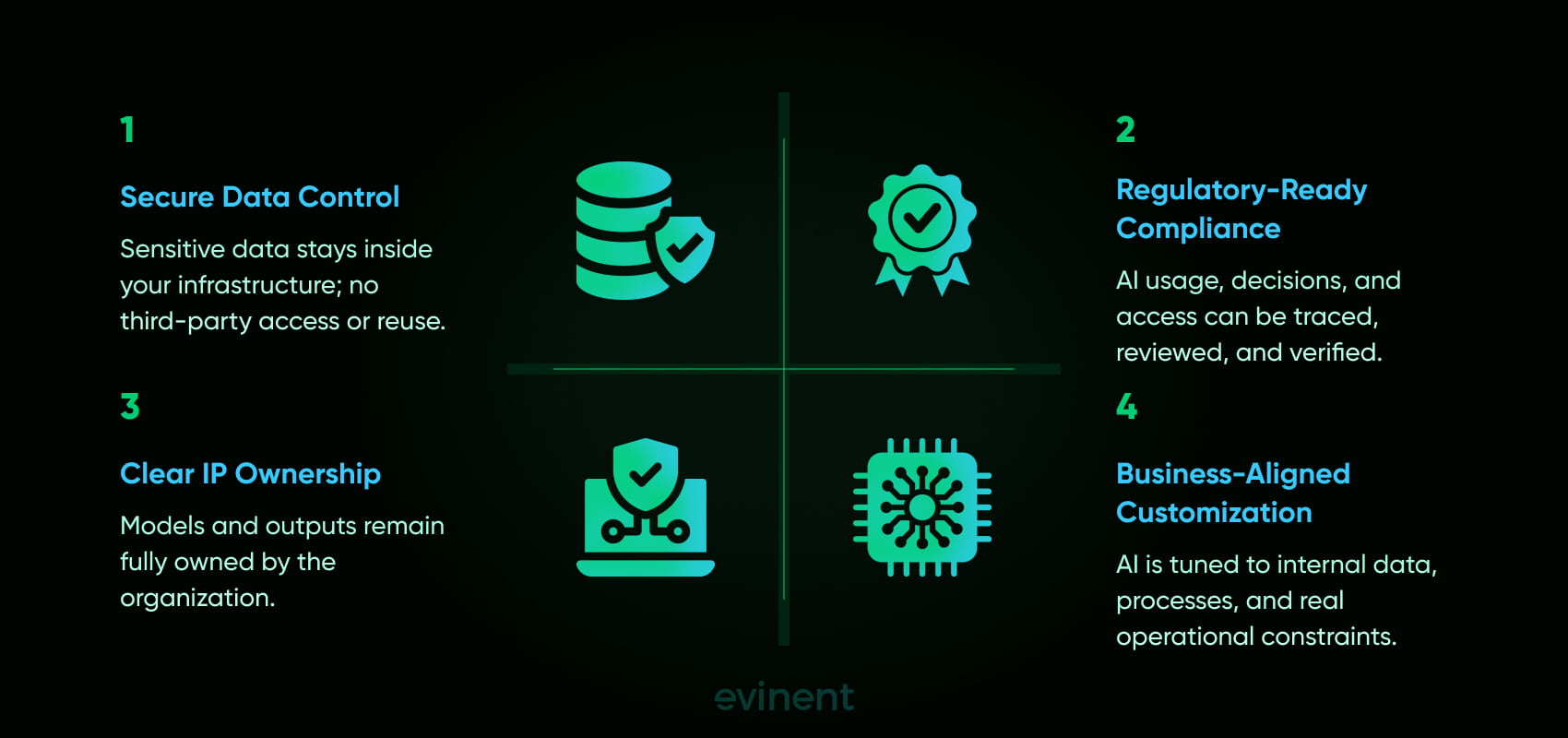
For security and legal teams, this isn’t a “nice to have.” It’s often the minimum requirement for approval.
Compliance that fits how enterprises actually operate
Compliance rarely fails because technology is missing. It fails because accountability is unclear.
Private AI supports regulatory standards by making control explicit:
access policies are defined internally,
model usage can be audited,
decision logic can be traced after the fact.
This is especially relevant in regulated environments where organizations must demonstrate:
how decisions were made,
which data was used,
and who had access at a specific point in time.
Private AI doesn’t guarantee compliance on its own, but it makes compliance achievable without redesigning the business around the tool.
Clear ownership of intellectual property
One concern comes up repeatedly in executive discussions around AI:
Who owns the output?
With Private AI, the answer is straightforward. Models are trained on enterprise data. Outputs remain internal. No external reuse, no blurred ownership boundaries.
This protects:
internal knowledge,
operational insights,
proprietary processes,
and long-term strategic differentiation.
For organizations where data is the product — or closely tied to it — this clarity matters more than raw model performance.
Customization that reflects real business context
Public AI systems are built to serve millions of users. Private AI systems are built to reflect your environment.
That allows organizations to:
tune models to internal terminology and processes,
incorporate exclusive datasets,
align outputs with real operational constraints.
This is where many AI initiatives finally move beyond generic recommendations and start producing results teams actually trust.
Predictable performance and cost structure
At scale, unpredictability becomes a problem.
Private AI environments provide:
consistent performance,
controlled resource allocation,
fewer surprises in latency or availability.
While upfront investment is higher, many enterprises prefer predictable costs over usage-based pricing that grows quietly as AI adoption expands across teams.
Stronger customer and stakeholder confidence
Customers, partners, and regulators increasingly ask how AI is used — not just whether it is used.
Private AI allows organizations to answer clearly:
where data is processed,
how it is protected,
and how AI decisions are governed.
That transparency builds confidence, especially in industries where trust directly affects brand and revenue.
In short: why enterprises choose Private AI
Private AI is most valuable when:
data sensitivity is high,
decisions carry real consequences,
accountability matters as much as innovation.
It doesn’t replace public AI experimentation, but replaces uncertainty when AI becomes part of core business systems.
Best practices and recommendations for deploying Private AI
Private AI rarely fails because the model is weak. It fails because organizations treat it like a software install instead of a long-term system.
This section focuses on the approaches that actually hold up once Private AI moves past pilots and into day-to-day operations — where audits happen, teams change, and requirements evolve.
Start with infrastructure reality, not AI ambition
Before talking about models, enterprises need an honest view of their IT infrastructure.
That includes:
where sensitive data already lives,
how workloads are segmented,
which systems are allowed to connect — and which aren’t.
Many organizations discover that their current setup can support Private AI with modest changes. Others realize they need colocation data centers, private cloud infrastructures, or stricter network boundaries before AI enters the picture.
Skipping this step usually leads to fragile deployments that work in isolation and break under real load.
Treat governance as a system, not a policy document
Governance is where Private AI either becomes sustainable — or quietly risky.
“Organizations must deeply understand and structure their data to ensure every automated decision is explainable. It’s not just for compliance, but a necessary scaling engine for AI innovation.” (ITPro, 2026)
Effective deployments define governance across:
data ingestion rules,
model access permissions,
auditability and logging,
retraining triggers and approval flows.
Role-based access controls are critical here. Not everyone who can use AI should be able to change models, datasets, or configurations.
Frameworks such as the NIST AI Risk Management Framework are often used as reference points, not because they prescribe technology, but because they force clarity around accountability.
Plan for model retraining from day one
AI systems drift. Data changes. Business context shifts.
Private AI deployments should assume:
models will need retraining,
inputs will evolve,
outputs will require periodic review.
This means defining:
who approves retraining,
how new data is validated,
and how updated models are tested before release.
Organizations that skip this planning often end up freezing models in time, which quietly erodes trust and performance.
Design for auditability, even if no one is asking yet
If AI influences decisions, it will eventually be questioned.
Auditability shouldn’t be retrofitted. It should be designed into the deployment lifecycle:
decision logs,
data lineage tracking,
versioned models,
and clear access histories.
Even in industries without strict regulatory oversight, auditability becomes essential once AI outputs affect customers, pricing, or risk scoring.
Expect evolution, not a “final” architecture
Private AI is not a one-off deployment.
Successful organizations plan for:
system upgrades,
changing compliance requirements,
new data sources,
and expanding use cases.
This is why custom configuration matters. Private AI environments should allow components to be updated independently — without forcing a full rebuild every time something changes.
In short: what makes Private AI hold up over time
Private AI works when organizations:
anchor decisions in infrastructure reality,
embed governance into operations,
treat models as living systems,
and assume scrutiny will come later — even if it hasn’t yet.
This mindset matters more than any single technology choice.
Challenges and limitations of Private AI
Private AI solves real problems. It also introduces new ones.
Most organizations don’t struggle with the idea of Private AI — they struggle with the operational weight that comes with owning the system end to end. Ignoring that reality is how projects stall quietly after initial approval.
Infrastructure complexity is real — and unavoidable
Private AI runs on your infrastructure. That’s the point. But it also means your organization is responsible for capacity planning, reliability, and security hardening.
Compared to public AI services, Private AI environments require:
more deliberate system design,
closer coordination between IT, security, and data teams,
and ongoing infrastructure maintenance.
This complexity isn’t a flaw. It’s the trade-off for control. But teams that underestimate it often discover late-stage bottlenecks around performance or scalability.
Scaling Private AI is different from scaling software
Scaling AI isn’t just about adding servers.
As Private AI adoption grows, organizations face:
increasing model tuning demands,
rising compute requirements,
and more complex data flows across systems.
Without AIops capabilities in place, these systems become hard to monitor and even harder to optimize. What worked for one use case may not hold once five teams rely on the same models.
This is where many enterprises pause expansion — not because AI failed, but because scaling responsibly takes planning.
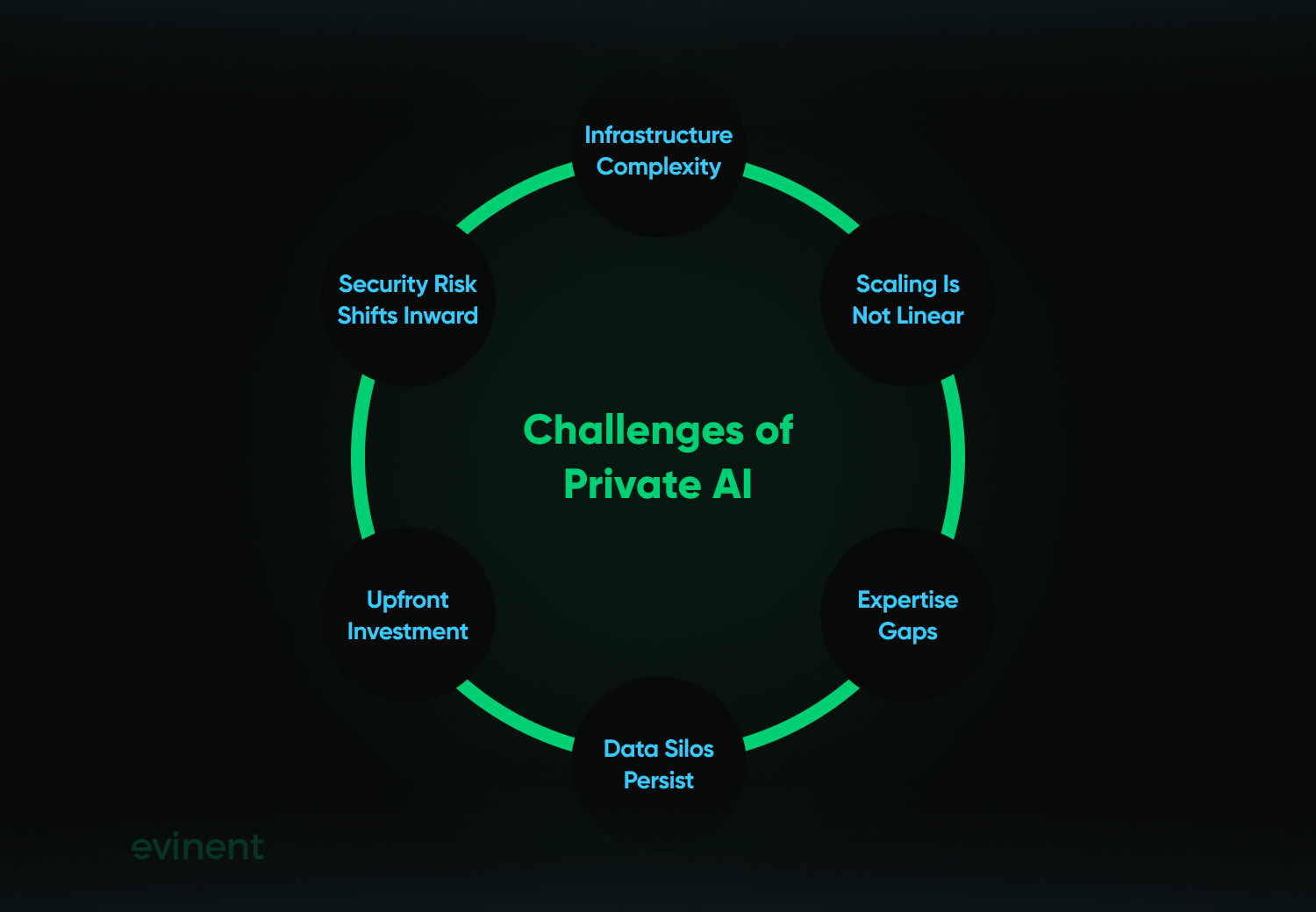
Expertise gaps slow momentum
Private AI shifts responsibility inward.
That means organizations need:
engineers who understand model behavior,
teams who can manage data pipelines,
and stakeholders who can interpret outputs correctly.
Relying entirely on open-source services without internal expertise increases the risk of misconfiguration, security vulnerabilities, or poorly tuned models that look accurate but drift quietly over time.
Many enterprises address this by building hybrid teams, combining internal ownership with external specialists during critical phases.
Data silos don’t disappear on their own
Private AI doesn’t magically fix fragmented data.
If enterprise data lives across disconnected systems, AI models inherit that fragmentation. This leads to:
incomplete context,
inconsistent outputs,
and models that perform well in isolation but fail in broader workflows.
Resolving data silos often becomes a prerequisite — and sometimes the most time-consuming part of Private AI deployment.
Upfront investment can’t be avoided
Private AI usually requires a higher upfront investment than public alternatives.
Costs typically include:
infrastructure upgrades,
security controls,
governance tooling,
and initial model development.
For organizations used to pay-as-you-go services, this shift can feel uncomfortable. But many accept it in exchange for predictable long-term costs and reduced risk of data leakage or IP exposure.
Security risk doesn’t disappear — it changes shape
Private AI reduces third-party exposure. It does not eliminate security risk.
Instead, the risk shifts inward:
misconfigured access controls,
poorly isolated environments,
or insufficient monitoring.
Organizations still need robust security practices, continuous assessment, and regular reviews — especially as systems evolve.
In short: why some Private AI projects stall
Private AI struggles when:
infrastructure readiness is overestimated,
expertise gaps are ignored,
data quality issues are postponed,
or governance is treated as paperwork instead of practice.
None of these is a deal-breaker. But all of them need to be acknowledged early.
Enterprise use cases for Private AI
Private AI doesn’t succeed because it’s abstractly “more secure.” It succeeds when it solves problems that public AI struggles to touch without introducing risk.
Across industries, Private AI tends to appear in the same kinds of scenarios: places where data sensitivity, regulatory pressure, or business impact make shared platforms uncomfortable.
Healthcare: using AI without breaking trust
Healthcare organizations deal with some of the most sensitive data in any industry. Patient records, diagnostic images, clinical notes, and real-time monitoring data are tightly regulated and often fragmented across systems.
Private AI enables healthcare providers to:
analyze proprietary sensor data and medical images,
support clinical decision-making without exposing patient data,
apply federated learning across institutions without centralizing raw data,
and meet strict data protection and audit requirements.
In these environments, AI adoption isn’t blocked by a lack of models. It’s blocked by the inability to guarantee data control. Private AI removes that barrier.
Financial services: accountability over raw speed
Banks, insurers, and fintech organizations already use advanced analytics. The challenge with AI is less about capability and more about explainability.
Private AI supports:
real-time transaction analysis inside secure environments,
fraud detection using exclusive datasets,
credit and risk modeling with clear decision trails,
and compliance guardrails that align with multi-jurisdictional requirements.
Public AI may generate insights faster. But when decisions affect approvals, pricing, or regulatory exposure, Private AI provides the accountability these organizations need to move forward confidently.
Retail and eCommerce: personalization without data leakage
Retailers sit on large volumes of behavioral data: purchase histories, browsing patterns, and real-time transaction logs. That data is valuable. It’s also risky to share.
Private AI allows retailers to:
deliver personalized customer interactions without exposing data externally,
apply on-device personalization for mobile experiences,
optimize pricing and promotions using internal signals,
and protect customer trust while still improving performance.
This is especially relevant for organizations operating across regions with different data protection rules.
Manufacturing and industrial operations: learning from proprietary processes
In manufacturing, AI value often comes from highly specific operational data:
machine telemetry,
production line metrics,
quality inspection imagery,
and process optimization signals.
Private AI enables organizations to train models on proprietary sensor data without sharing process knowledge outside the company. For many manufacturers, this data is their competitive advantage.
Enterprise operations and internal decision support
Beyond industry-specific use cases, Private AI increasingly supports internal functions:
forecasting and planning,
document analysis across internal systems,
automation of compliance-heavy workflows,
and decision support tools that rely on sensitive enterprise data.
These systems often don’t need public-scale models. They need context, reliability, and trust.
Why do these use cases repeat across industries
Private AI appears wherever three conditions overlap:
sensitive or regulated data,
decisions with real consequences,
and the need for long-term system ownership.
When those conditions exist, organizations tend to move away from shared platforms, not out of fear, but out of responsibility.
Implementation and deployment of Private AI
Private AI doesn’t fail at the idea stage. It fails when implementation is treated like a one-time setup instead of a system that needs to live inside the organization.
This section walks through how enterprises typically deploy Private AI — from data ingestion to long-term governance — without pretending there’s a single “right” architecture.
Start with data ingestion and boundaries
Every Private AI deployment begins with a boundary decision: what data is allowed in, and what is not.
Enterprises usually define:
approved data sources (databases, internal APIs, logs),
data classification rules for sensitive data,
and ingestion pipelines that enforce these rules automatically.
This step is often underestimated. If boundaries aren’t clear, teams either over-restrict access and stall progress — or under-restrict and introduce silent risk.
Private AI works best when data inclusion is explicit, not assumed.
Model training inside a controlled security perimeter
Once data pipelines are in place, models are trained inside a defined security perimeter.
That perimeter may be:
an on-premises stack,
a private cloud (VPC),
or a hybrid infrastructure with strict isolation rules.
What matters is not the hosting label, but enforcement:
no external data transfer,
controlled model access,
encrypted storage and compute.
For organizations handling regulated data, this approach aligns AI workflows with existing security and compliance practices instead of creating exceptions.
Privacy-preserving techniques are part of the design
Private AI does not rely on secrecy alone.
Many deployments incorporate privacy-preserving techniques such as:
differential privacy to limit exposure of individual records,
federated learning to train across datasets without centralizing raw data,
encryption-in-use to protect data during computation.
These techniques allow organizations to extract value from sensitive or distributed data while maintaining compliance and minimizing leakage risk.
Deployment environments: stability over novelty
Private AI environments prioritize stability and predictability.
Most enterprises deploy models using:
containerized services,
secure Kubernetes-based environments,
and tightly controlled release pipelines.
The goal is not rapid experimentation at any cost. It’s reliable behavior under real workloads — especially when AI outputs affect customers, operations, or financial outcomes.
Continuous monitoring, not periodic check-ins
Once deployed, Private AI systems require continuous oversight.
Effective implementations include:
monitoring of model performance and drift,
logging of access and decisions,
s for unusual behavior or degradation.
This isn’t about micromanagement. It’s about catching small issues before they turn into business incidents.
Governance doesn’t stop after launch
One of the most common mistakes is treating governance as a pre-deployment task.
In reality, governance continues across:
model updates,
data source changes,
access reviews,
and compliance reporting.
Organizations that succeed with Private AI embed governance into everyday operations — not quarterly reviews.
In short: what makes implementation work
Private AI implementations succeed when:
data boundaries are clear,
security is enforced, not implied,
privacy techniques are designed in,
and governance continues long after launch.
It’s less about choosing the “perfect” architecture and more about building something that holds up under scrutiny.
Platform and technology support for Private AI
Private AI isn’t enabled by a single tool. It’s enabled by an ecosystem of technologies that work together to keep data controlled, models usable, and systems manageable over time.
Most enterprises don’t build everything from scratch. They assemble a stack that balances open technologies with enterprise-grade controls.
Infrastructure foundations: where Private AI lives
Private AI platforms typically run on one of three foundations:
on-premises data centers,
private cloud environments (VPCs),
or hybrid infrastructures that combine both.
What matters is isolation. These environments enforce clear security boundaries and prevent unintended third-party access. For regulated industries, this is often a non-negotiable requirement.
Colocation data centers are also common, especially for organizations that need physical control without maintaining their own facilities.
Secure orchestration and model management
Most Private AI environments rely on:
containerized workloads,
secure Kubernetes-based environments,
and controlled deployment pipelines.
This setup allows teams to:
manage multiple models,
version deployments,
and roll back changes safely.
Model access is governed through role-based access controls, ensuring that usage, tuning, and retraining privileges are clearly separated.
Open-source AI with enterprise guardrails
Open-source AI plays a major role in Private AI adoption.
Organizations often use:
open-weight models,
open-source AI frameworks,
and internal tooling built on top of them.
The advantage isn’t cost alone. It’s transparency. Open-source systems allow enterprises to inspect model behavior, adapt configurations, and avoid black-box dependencies — while still operating inside secure environments.
Privacy-preserving analytics and encrypted collaboration
Advanced Private AI platforms increasingly support:
homomorphic encryption for computation on encrypted data,
secure multi-party computation for collaborative analytics,
and encrypted collaboration across teams or business units.
These technologies allow organizations to extract insights from sensitive or distributed datasets without exposing raw data — a growing requirement in multi-jurisdictional environments.
Private AI platforms in practice
Some enterprises adopt integrated platforms that combine:
data science tooling,
model training environments,
and governance features in one place.
Others assemble modular stacks that fit existing workflows.
The choice often depends on:
internal expertise,
compliance requirements,
and long-term scalability goals.
What matters is not the brand name, but whether the platform supports:
secure model sharing,
auditability,
and controlled collaboration.
In short: technology enables control, not the other way around
Technology alone doesn’t make AI private. But without the right platforms, Private AI becomes fragile, expensive, or unmanageable.
Enterprises that succeed focus on:
isolation,
transparency,
and long-term operability — not novelty.
How Evinent helps enterprises implement Private AI
Private AI initiatives tend to fail for predictable reasons. Ownership is unclear. Architecture looks fine on paper but doesn’t survive real constraints. Governance exists as documentation, not as a working system.
What enterprises usually need isn’t another model. They need an AI environment that behaves like enterprise infrastructure — controlled, isolated, and defensible.
This is where Evinent typically gets involved.
Starting from business reality, not AI ambition
Evinent’s work on Private AI begins with how decisions are actually made inside the organization.
Before any model is selected or trained, teams clarify:
which decisions AI is expected to influence,
which enterprise data can be used safely,
and where legal, security, and compliance boundaries already exist.
This avoids a common failure mode: building AI systems that perform well in isolation but never reach production because they don’t fit operational reality.
Building isolated corporate AI environments, not shared platforms
Evinent’s Private AI is designed to operate inside a fully isolated corporate environment.
That means:
no external API calls to public AI services,
no third-party model training on enterprise data,
no token-based usage dependencies,
and no silent data exposure outside the security perimeter.
Deployments can run:
on-premises,
in private cloud or VPC environments,
or in hybrid setups where data must remain segmented.
The result is an AI system that enterprises actually own — not one they temporarily rent.
AI that works with internal systems, not around them
Evinent designs Private AI to integrate with existing enterprise systems instead of bypassing them.
This includes:
internal document repositories,
enterprise search and analytics,
structured databases and unstructured content,
and organization-specific workflows.
Because models operate inside the same environment as enterprise data, AI outputs reflect real context — not generic assumptions.
Governance and compliance are embedded into the system
One of the biggest risks in Private AI projects is treating governance as an afterthought.
Evinent embeds governance directly into the AI environment:
role-based access controls define who can use, modify, or retrain models,
audit logs track data usage and model decisions,
model lifecycle management ensures traceability over time.
These controls align naturally with frameworks such as the NIST AI Risk Management Framework, but they are implemented as working mechanisms — not policy statements.
Designed for long-term ownership, not short pilots
Private AI doesn’t stand still. Models drift. Data changes. Regulations evolve.
Evinent helps enterprises plan for:
controlled model retraining inside isolated environments,
system upgrades without breaking compliance,
continuous monitoring of performance and behavior,
and gradual expansion across teams and use cases.
Knowledge transfer to internal teams is part of this process — with external support remaining available when complexity increases.
When enterprises typically involve Evinent
Organizations usually reach out when:
public AI pilots stall due to data or risk concerns,
sensitive or regulated data is involved,
AI needs to scale beyond one team or department,
or leadership needs confidence that AI adoption won’t create hidden exposure.
The goal isn’t speed for its own sake. It’s building Private AI systems that remain usable, defensible, and valuable years later.
A final note for decision-makers
Private AI isn’t about rejecting innovation. It’s about making AI compatible with responsibility, ownership, and long-term accountability.
Enterprises that treat AI as infrastructure — not just a tool — are the ones that manage to use it at scale without losing control of their data, decisions, or reputation.
If you’re evaluating how Private AI fits into your organization, the most useful next step is often a structured conversation — not a demo.
FAQ: Common questions executives ask about Private AI
What is Private AI in simple terms?
Private AI refers to artificial intelligence systems that run inside a company’s own controlled environment, keeping data, models, and access internal rather than relying on shared public platforms.
Is Private AI more secure than public AI?
Private AI reduces third-party exposure and improves control, but security still depends on proper configuration, governance, and monitoring.
Does Private AI mean on-premises only?
No. Private AI can run on-premises, in private cloud environments, or in hybrid setups, as long as access and data boundaries are enforced.
When does Private AI make sense for an enterprise?
Private AI becomes relevant when AI systems use sensitive data, affect regulated decisions, or need long-term ownership and auditability.
Share