

What is Corporate AI?
Corporate AI is the use of AI across a whole company to support, automate, or improve main business processes and decision-making on a large scale. It is quite different from separate experiments or proofs of concept that happen in organizations. In fact, corporate AI acts in operational environments, uses enterprise data, and is forecasted to give tangible business results and a predictable return on investment.
AI in a corporate environment goes beyond being just a technical feature. It represents a confluence of:
The state of data and the way it is handled
The set of rules, moral standards, and risk monitoring
The backbone of technology and the linking of systems
The preparation of the organization, the level of expertise, and the embracing of the culture
The business strategy and the pursuit of its goals.
This is an article about the reasons why corporate AI implementations most of the time fail, even though there is a significant investment, the executives are paying attention, and the technology is already mature in the market. The failure that has been discussed does not only refer to model accuracy or algorithm selection, but it comes from systemic issues across data, governance, strategy, people, and operations.
“For organizations ready to execute at scale, this is the moment to shore up data foundations to confidently scale AI to its full potential to deliver real value and ROI.” — Salesforce Chief Data Officer Michael Andrew, Techradar.
Throughout this article, we will examine:
The root causes of corporate AI implementation failure and recurring enterprise failure patterns.
How data quality, accessibility, and governance directly impact AI outcomes;
The role of AI governance, ethics, and executive oversight in reducing risk and enabling scale.
The importance of strategic alignment and value planning before launching AI initiatives.
Technology infrastructure and integration challenges that prevent AI from succeeding in production.
Organizational, cultural, and skills-related factors that influence adoption and effective human–AI collaboration;
Methods for measuring success and ROI, including business KPIs, operational efficiency, and user engagement.
The goal is to achieve more than just vague AI promises and give a clear, enterprise-focused perspective on the ways organizations can steer clear of common mistakes and establish AI projects that truly bring business benefits that are both sustainable and measurable.
Root Causes of Corporate AI Implementation Failure
Most of the time, corporate AI projects do not fail due to just one technical error. It is usually the case that failure is a result of systemic and repeatable patterns that occur across different industries and organizations. Therefore, it is crucial to understand these root causes, as without a proper diagnosis, lessons learned will be shallow and corrective actions will be aimed at symptoms rather than the root of the problems.
Here is a failure map for corporate AI that this section forms. Each reason mentioned below is a common breakdown point and, if it is not dealt with, it will lead to a great reduction in the chances of achieving sustainable value and predictable ROI.
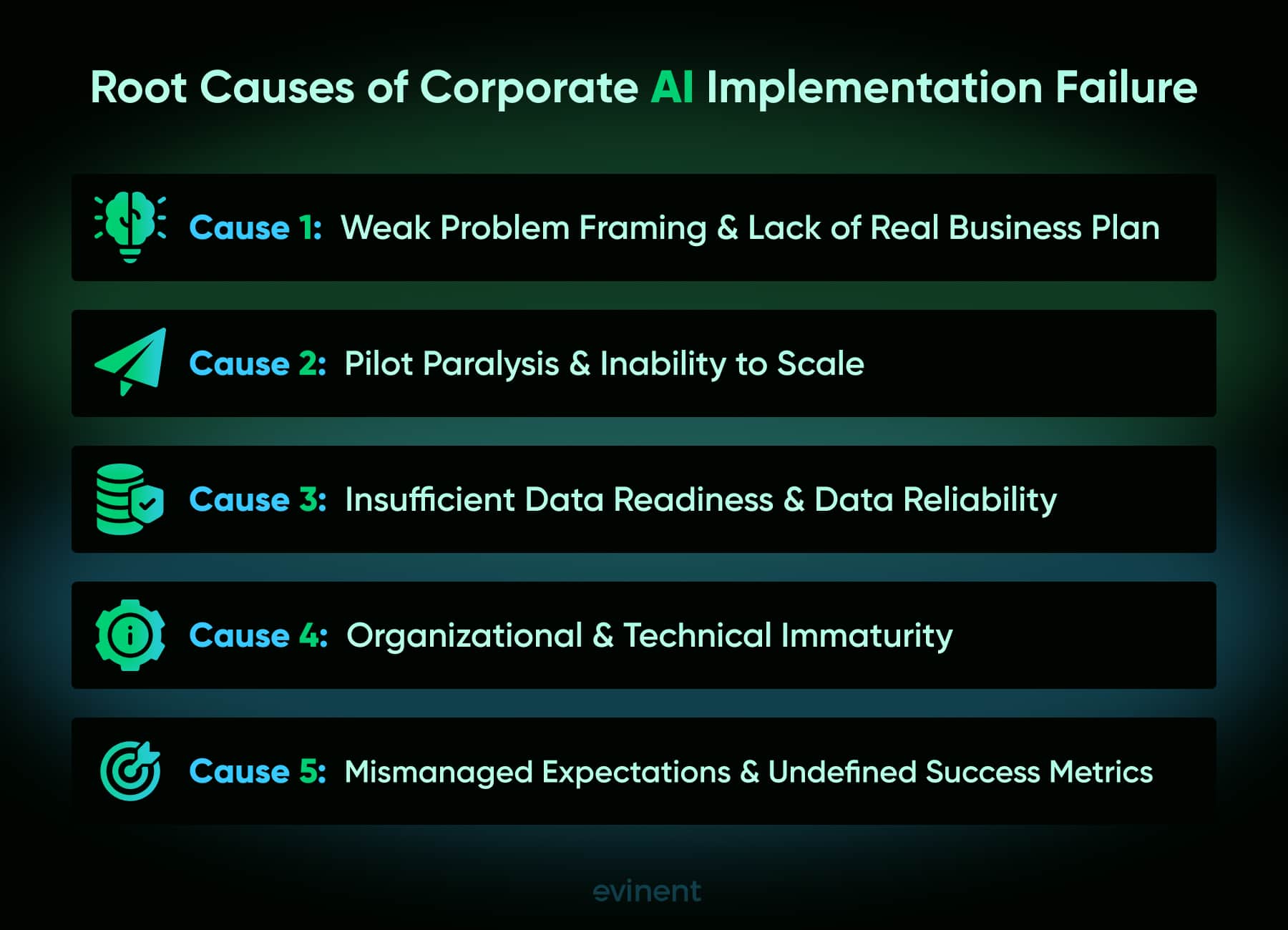
Poor Problem Selection and Weak Business Pain
Hundreds of AI projects start with identifying a solution before the problem. Sometimes, businesses pick cases merely by looking at what can be done technologically, where there is data, or machine buzz, i.e., they don't base the decision on the real business pain. Hence, technically great models can still fail materially. Even if the fundamental issue does not significantly affect the company's performance, the results of AI will be negligible, the usage will be low, and the support from the top will fade out.
Pilot Paralysis and Lack of Scalability
A common failure pattern in corporate AI is getting stuck at the pilot or proof-of-concept stage. While initial experiments may demonstrate promise, organizations struggle to transition these pilots into production-ready, scalable solutions. This “pilot paralysis” is often caused by missing production infrastructure, unclear ownership, or unresolved integration challenges. Without a deliberate path to scale, AI initiatives accumulate as isolated experiments that consume resources without generating enterprise-wide value.
Inadequate Data Readiness
Limited data readiness is still one of the most common and least recognized reasons for AI failure. Companies are frequently overly optimistic about the quality, availability, and consistency of their data and expect that modeling will somehow fix the problem of bad data at the source. However, the reality is that scattered data sources, unconsolidated data, poor data governance, and unreliable pipelines eventually compromise model performance and trustworthiness. AI technologies cannot run efficiently in real-world situations without having data readiness as a prerequisite.
Organizational and Technical Immaturity
Corporate AI requires a level of organizational and technical maturity that many enterprises have not yet reached. This includes clear decision-making structures, defined roles and responsibilities, stable technology platforms, and cross-functional collaboration between business, IT, and data teams. When organizations lack this maturity, AI initiatives suffer from slow execution, unclear accountability, and misalignment between stakeholders. Technical immaturity further compounds the issue, limiting the ability to deploy, monitor, and maintain AI systems over time.
Mismanaged Expectations and Unclear Success Metrics
Unrealistic expectations about what AI can do often cause people to be disappointed and to lose their trust in AI. If the success criteria are not established or are only technical, it is hard for the business stakeholders and the users to see the value of the work. When success criteria are not clearly linked to business outcomes, it is not possible to measure progress, convince the management to give more funds, or change the direction of a project that is not successful. Efficient enterprise AI initiatives set quantifiable success benchmarks right from the start and align the expectations of all organizational levels.
These root causes are very close to each other, and if one of them happens, it is very likely that the other causes will be triggered. If these causes are not dealt with early enough, corporate AI projects run the risk of becoming fragmented, sidelined to the pilot stage, and ultimately failing to generate measurable business value. The subsequent parts of this paper will look at the roles that data, governance, strategy, technology, and people play in either contributing to or helping to avert these recurring failures.
Why Poor Data Management Dooms AI Projects
It's usually not the bad models or algorithms that cause most corporate AI failures. The deep-rooted problem is that the data has been badly managed, fragmented, or left insecure. If the data is not prepared, accurate, or well governed, AI systems cease to create any real business value, get stuck at the pilot stage, or bring about unforeseen risks.
Here, we take a look at the major data-related factors that lead to the failure of corporate AI projects, each being numbered as a distinct cause.
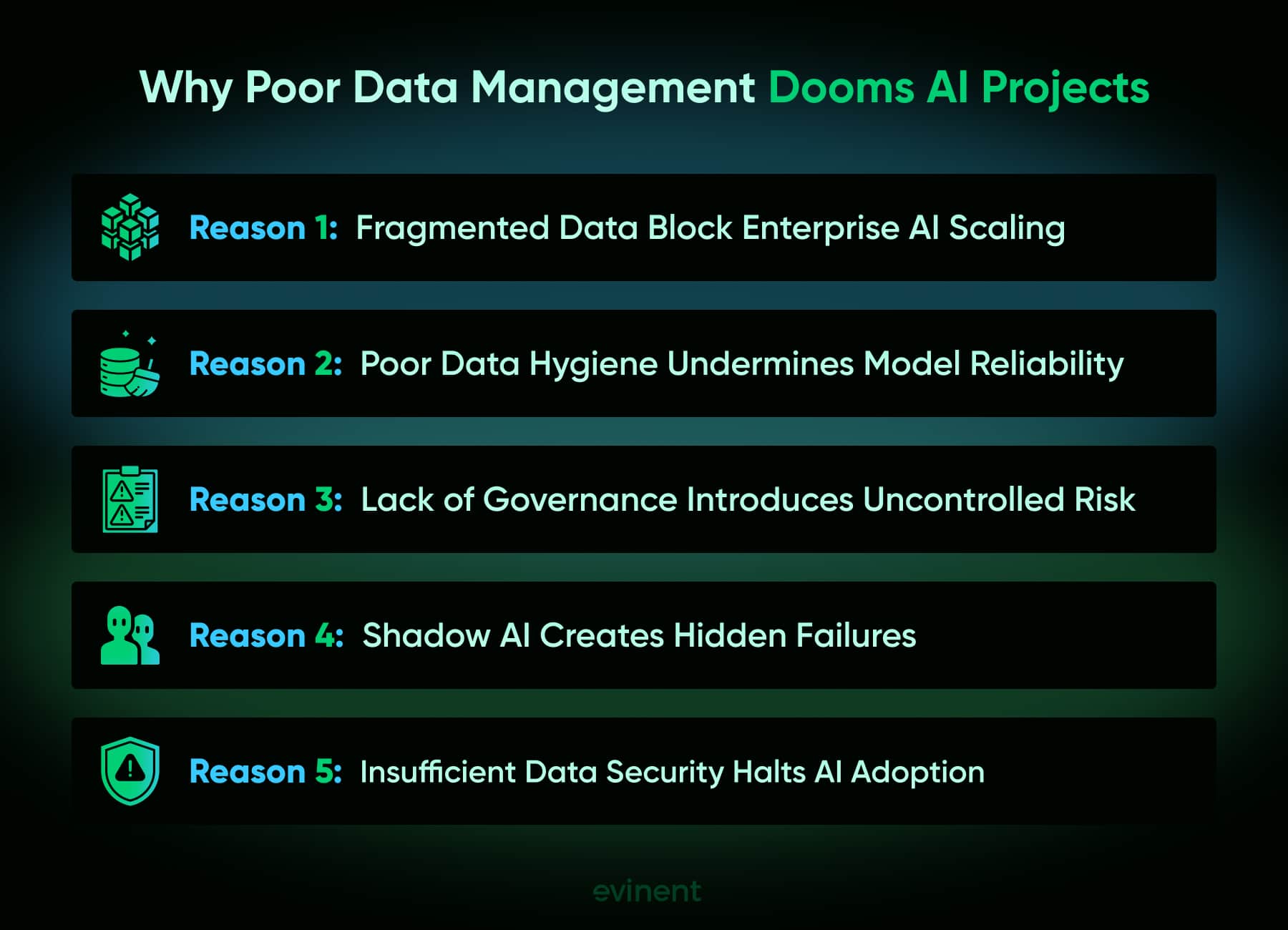
Cause 1: Fragmented Data Prevents Enterprise AI from Scaling
Enterprise data is often scattered across departments, systems, and platforms with limited interoperability. Fragmented datasets prevent AI models from gaining a complete and consistent view of business processes, making scaling beyond pilots extremely difficult. This also increases integration complexity and slows down iteration.
Cause 2: Poor Data Hygiene Undermines Model Reliability
Organizations cannot assure data quality, lineage, or accountability if they lack clear data ownership, policies, and operational controls. Poor governance makes it impossible to keep track of data drift, enforce usage standards, and handle incidents effectively, thus leading to a decrease in trust in AI outputs.
Cause 3: Lack of Governance Creates Uncontrolled Risk
Organizations cannot assure data quality, lineage, or accountability if they lack clear data ownership, policies, and operational controls. Poor governance makes it impossible to keep track of data drift, enforce usage standards, and handle incidents effectively, thus leading to a decrease in trust in AI outputs.
Cause 4: Shadow AI Introduces Hidden Failures
When teams cannot use official data processes, they tend to create unofficial pipelines and models. Such "shadow AI" skips controls and thus adds inconsistent logic, security holes, and compliance risks. It might give immediate results, but in fact, it generates invisible long-term breakdowns that are hard to discover.
Cause 5: Poor Data Security Can Stop AI in Its Tracks
Inadequate privacy and security measures expose AI projects to regulatory violations, reputational damage, or forced shutdowns. AI amplifies these risks because it often reuses and moves sensitive data extensively. Security and privacy must be embedded in data governance from the start.
These five causes are very much intertwined: fragmented data amplifies hygiene problems, weak governance invites shadow AI, and poor security can stop whole projects. It is essential to tackle these problems at an early stage if one wants to build corporate AI systems that are scalable, reliable, and compliant.
Why Weak Governance Turns AI into an Enterprise Risk
AI initiatives do not only fail due to data or technology issues but also because organizations do not put in place the necessary structures to control risk, enforce accountability, and scale smartly. When governance is weak, AI is not just inefficient; it gets to be uncontrollable, untrustworthy, and, sometimes, harmful to the business. Rather than enumerating abstract governance ideas, this part concentrates on how governance failures show up in real corporate AI breakdowns.
When No One Owns AI, Nothing Scales
In a lot of companies, AI projects are a kind of balancing act among business, IT, data, and risk departments. When there's no clear executive ownership, decisions get ed, priorities clash, and accountability gets weakened. As a result, AI turns into a set of disconnected projects rather than a smoothly functioning capability of the whole enterprise, and hence, to a long-term investment and scaling of the AI, it becomes unrealistic.
Governance by Convention Instead of Frameworks
Organizations often depend on informal ways of working rather than formal AI governance frameworks. The roles, the approval processes, and the paths for escalation are not only undefined but may also differ from one team to another. This absence of framework causes uneven quality of developments, repetition of work, and even the state of floundering about who should be held responsible, particularly when it comes to a large-scale issue.
Models Are Deployed Without Being Truly Validated
Without formal validation and bias review processes, AI models are deployed based on technical performance alone. Ethical risks, fairness concerns, and edge cases remain unexamined until they surface as business or reputational problems. Once trust is lost, AI systems are either restricted or abandoned, regardless of their potential value.
Compliance Is Treated as a One-Time Check
Many AI projects pass an initial compliance review and then operate without continuous monitoring. As regulations, data sources, and use cases evolve, compliance gaps emerge unnoticed.
When violations are eventually detected, organizations are forced into reactive measures — freezing models, rolling back deployments, or shutting down initiatives entirely.
AI Performance Degrades Silently in Production
AI systems are not static. Changes in data, processes, or user behavior gradually degrade model performance. Without structured oversight and monitoring, this degradation remains invisible.
The result is “working” AI that quietly delivers incorrect or suboptimal outcomes, undermining confidence and business results.
Weak governance does not simply slow down AI adoption — it turns AI into an unmanaged enterprise risk. Clear ownership, structured frameworks, continuous validation, and active oversight are essential to ensure AI remains trustworthy, compliant, and scalable as it moves into core business operations.
Strategic Alignment and Value Planning
Something that can seriously prevent a company's success with AI is when the strategy is off. If you don't have clear goals, use cases that are prioritized, and success metrics that can be measured, then AI projects will either just stop working, go over budget, or not bring the value that was expected. In this part, we identify the major strategic reasons for failure and illustrate how each one can be seen in reality.
Vague Business Objectives
Failure chain
Trigger: Projects begin with broad ambitions like “automation” or “innovation.”
Escalation: Teams focus on technical progress without measurable business outcomes.
Outcome: AI initiatives fail to produce ROI and cannot justify continued investment.
Assumption → Reality → Consequence
Assumption: General goals are enough to guide AI efforts.
Reality: Teams struggle to prioritize initiatives or define success.
Consequence: Resources are wasted on low-impact projects; executives lose confidence.
Scenario
A retailer initiated an AI project to "enhance customer engagement," but didn't define the KPIs. They created several models simultaneously, but none of them was used as it was not clear which business problems they solved. The project was scaled back.
Selecting Use Cases Without Economic Justification
Failure chain
Trigger: AI use cases chosen based on data availability or technical interest.
Escalation: Teams invest in low-value or peripheral problems.
Outcome: Projects consume time and money without producing measurable business benefits.
Assumption → Reality → Consequence
Assumption: Feasible AI solutions automatically create value.
Reality: Many use cases solve minor problems or duplicate manual work.
Consequence: Business impact is minimal; initiatives are deprioritized or canceled.
Scenario
A bank deployed an AI for internal reporting because data was readily available. The model improved the report speed but did not influence decisions. ROI was negligible, and funding for other AI projects was reduced.
Ignoring Data and Organizational Readiness
Failure chain
Trigger: Strategic plans assume that data quality and skills will improve over time.
Escalation: s, bottlenecks, and rework accumulate as teams struggle with unprepared infrastructure.
Outcome: AI models fail to meet deadlines, and pilot projects stall.
Assumption → Reality → Consequence
Assumption: Organizational capabilities will catch up with AI ambitions.
Reality: Data silos, poor training, and lack of skills slow adoption.
Consequence: Projects are scaled back or abandoned despite promising results.
Scenario
A logistics company decided on AI-driven routing optimization without first checking the quality of the data. After several months, the models could not be used as there was no data available for the most important operations. The project was put on hold until a complete data preparation program was carried out.
Defining Success Metrics Too Late
Failure chain
Trigger: Success metrics are introduced after AI models are deployed.
Escalation: Metrics reflect what the system measures, not business outcomes.
Outcome: Teams cannot prove value, justify scaling, or decide to stop failing initiatives.
Assumption → Reality → Consequence
Assumption: Metrics can be defined once the AI is running.
Reality: By the time metrics are set, resources are already spent, and performance is misaligned.
Consequence: ROI remains unproven; executive support diminishes.
Scenario
A company's online retailer made an AI launch to optimize product recommendations. After six months, KPIs were set, and the main focus was on clicks rather than impact on revenue. Although there were many clicks, sales remained low, and the project was disregarded.
Disconnect Between AI and End-to-End Business Workflows
Failure chain
Trigger: AI models are developed in isolation from operational workflows.
Escalation: Outputs are underused or ignored.
Outcome: Even technically accurate models fail to influence decisions or generate value.
Assumption → Reality → Consequence
Assumption: AI outputs will naturally be adopted by users.
Reality: Lack of integration into processes limits usability.
Consequence: AI is sidelined, and organizational adoption stalls.
Scenario
A manufacturing company built predictive maintenance AI but did not integrate it with maintenance schedules. s were ignored, downtime remained high, and executives questioned the utility of AI. The system was re-engineered to connect directly to workflows.
Strategic misalignment fails AI incrementally but predictably: unclear objectives, poor use-case selection, unreadiness, late metrics, and lack of workflow integration combine to prevent measurable value. Addressing alignment from the outset ensures AI initiatives are actionable, scalable, and deliver tangible ROI.
When AI Never Reaches Production: Infrastructure and Integration Failures
Many corporate AI projects go wrong not fundamentally because the models are wrong, but because the technology and integration are not production-ready, i.e., they are not ready for a real-world production environment. The table below illustrates the most typical infrastructure-related failure patterns and how they hinder the realization of AI value.
Failure Area | What Happens in Practice | Why It Escalates | Business Outcome |
|---|---|---|---|
Non-scalable infrastructure | AI is deployed on pilot-grade or fixed infrastructure | Growing data volumes and user load overwhelm compute and storage | Pilots cannot scale; costs rise; ROI remains unrealized |
Integration debt with legacy systems | AI operates outside core enterprise platforms | Data mismatches and workflow gaps require manual intervention | Adoption slows; errors increase; AI remains isolated |
Weak monitoring and operational management | Models run without continuous performance tracking | Drift and failures go unnoticed over time | Trust erodes; AI usage declines or stops |
Security and authentication gaps | AI services lack consistent access control and identity management | Sensitive data exposure and compliance risks grow | Deployments are ed, paused, or shut down |
Pipeline fragility | Data pipelines lack validation, redundancy, or recovery | Pipeline breaks disrupt training and inference | Outputs become unreliable; decisions are ed |
Infrastructure and integration issues are of a typical nature:
The AI is successful technically, but there is an operational failure. AI needs scalable infrastructure, frictionless integration, on-the-go monitoring, secure yet user-friendly authentication, and resilient pipelines. Only then can AI thrive in production environments.
The Human Factors Behind Corporate AI Failure
AI adoption fails when organizations treat readiness, people, and skills as secondary concerns. These are not soft factors — they are structural failure points that determine whether AI becomes operational or quietly disappears.
Organizational Readiness
Cause 1: Lack of organizational readiness for AI-driven change
Organizations often deploy AI without adapting decision-making processes, escalation paths, or accountability models. AI outputs enter workflows that were never designed to absorb automated or probabilistic recommendations. This gap is structural rather than incidental. Industry research shows that only 9% of organizations consider their AI governance mature, indicating that most enterprises attempt AI-driven change without the organizational foundations required to absorb it (Medium, 2025). As a result, AI insights conflict with existing processes instead of reinforcing them.
Cause 2: Weak change management and leadership signaling
If leadership does not clearly explain why AI is brought in and how it should be utilized, the adoption will be scattered. Some groups will try it, while others will simply disregard the system. AI will still be an option rather than a part of the whole process; thus, the impact on the entire enterprise will be prevented.
Cause 3: Fragmented adoption across departments
AI adoption ends up unevenly without coordinated rollout and shared standards. Different departments may have different understandings of AI, use it in different ways, or even fight for the ownership of AI. Such fragmentation is a barrier to scaling, and trust in AI output is broken.
People, Roles, and Ownership
Cause 4: Lack of clear ownership for AI systems
After an AI system has been deployed, the accountability of its outcomes is often left unclear. The issue of performance of the model, feedback loops, or continuous enhancement is not owned by any one role. Problems inevitably pile up without being fixed, which results in the lowering of the effectiveness of the system over time.
Cause 5: Undefined roles in human–AI decision-making
Employees are not told when AI recommendations should be followed, challenged, or overridden. This ambiguity creates defensive behavior: users bypass AI to avoid accountability or rely on it blindly to shift responsibility.
Cause 6: Fear of accountability and job displacement
AI is often seen as jeopardizing one's skills and employment. Workers react with refusal or sabotage of AI implementation instead of teaming up with it. Such opposition seldom comes out directly, yet it always leads to a significant decrease in real adoption.
Skills and Capability Development
Cause 7: Low AI literacy across business users
Many users lack a basic understanding of what AI can and cannot do. Outputs are misinterpreted, overtrusted, or dismissed entirely. This leads to poor decisions and erodes confidence in the system.
Cause 8: One-time training instead of continuous upskilling
Organizations regard the training of AI as a one-time event rather than a continuous activity. When models get updated and data changes, users gradually lose their competence. The knowledge becomes obsolete, and the use of the product remains the same.
Cause 9: Lack of performance support in daily workflows
Currently, AI tools lack integrated guidance, feedback, or contextual explanations. People find it challenging to use these tools effectively in real-life situations and, therefore, go back to the familiar manual ways that they know, thus ignoring AI even when it is available.
Organizational readiness, people, and skills form a single failure system. When organizations fail to prepare structures, clarify ownership, and invest in continuous capability development, AI does not fail loudly — it simply stops being used.
Measuring AI Impact and ROI
After the introduction of AI, it is no longer the assumptions or intentions that matter. The only thing that counts is whether AI is able to provide measurable, sustainable business value. This part deals only with the ways in which companies actually assess the effects of AI, and the common points of failure in measurement.
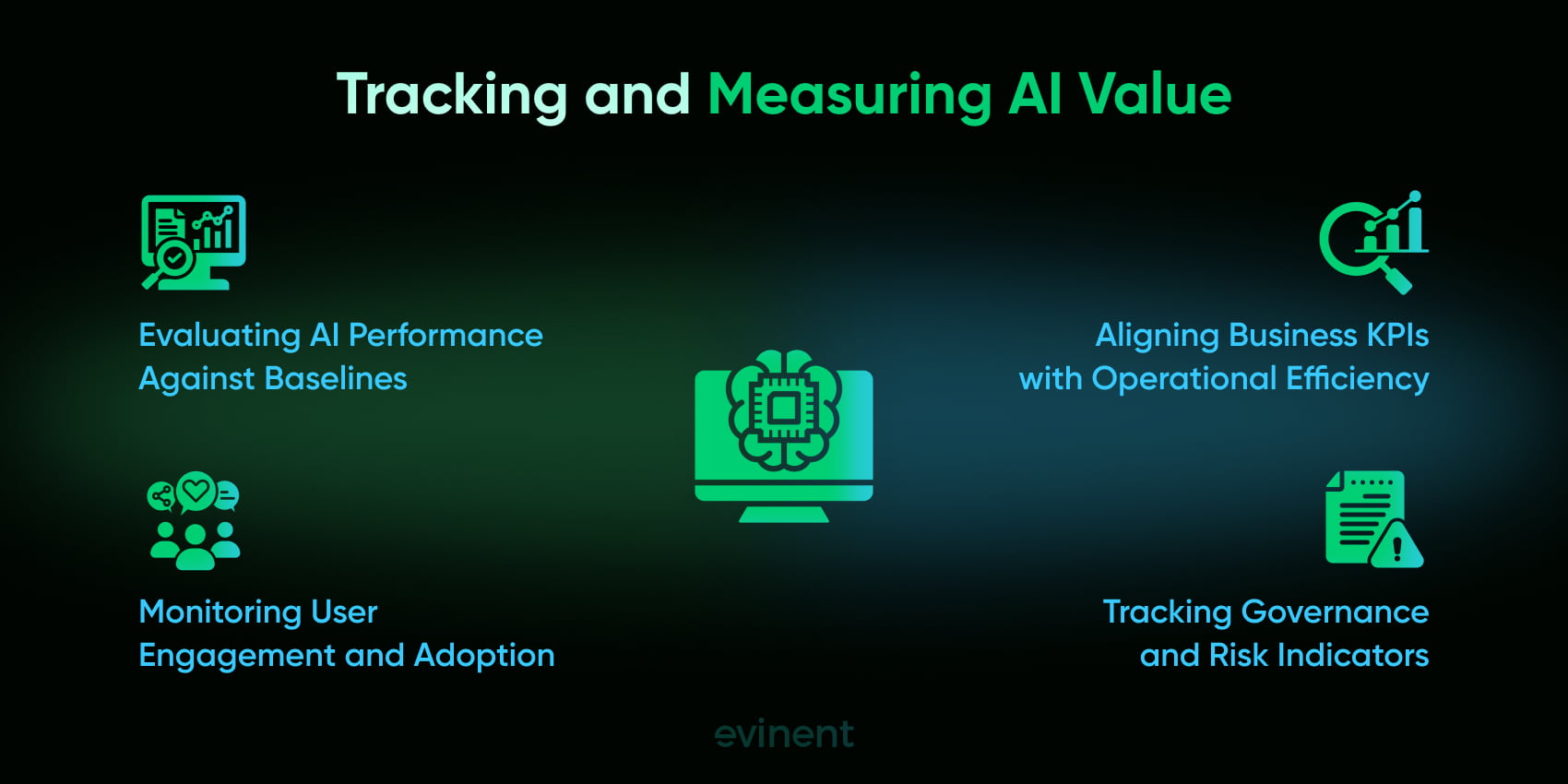
Pre- and Post-AI Implementation Metrics
AI impact must be measured against a clearly defined baseline. Without pre-AI metrics, organizations have no reference point to assess improvement or regression. In many cases, teams attempt to evaluate AI performance only after deployment. This makes it impossible to distinguish real gains from normal operational variation. As a result, AI success becomes anecdotal rather than measurable, weakening the business case for scaling.
Business KPIs vs Operational Efficiency
AI systems often optimize operational efficiency—speed, throughput, or automation—while business KPIs focus on revenue, cost, risk, or customer outcomes. When these two measurement layers are not aligned, AI appears productive but fails to move core business metrics. This mismatch leads to false positives: models perform well operationally, yet executives see no tangible business impact. Over time, AI initiatives lose priority despite technical success.
User Engagement and Adoption Signals
The value of artificial intelligence lies in its continuous use rather than just its installation. By measuring user engagement, it can be understood if the AI is really integrated into the work processes or just accessible. There is often a lack of trust, difficulty in usability, or poor integration when low user engagement is seen through manual overrides, rarely usage, or selective adoption. If one disregards these signs, the outcome will be AI systems that are technically working but not being used to their full potential.
Feedback Loops and Continuous Improvement
AI systems require structured feedback to remain relevant. Without feedback loops, models cannot adapt to changing data, user behavior, or business conditions. Many organizations lack mechanisms to capture user input, performance drift, or downstream impact. In such cases, AI performance slowly degrades while metrics remain static, masking declining value until failure becomes visible.
Governance Metadata and Risk Indicators
Beyond performance, AI impact must be evaluated through governance signals: model versions, data lineage, access logs, bias indicators, and compliance status. 73% of enterprise data leaders identify data quality and completeness as the top barrier to AI success, ranking it above model accuracy and talent. (Medium, 2025). When governance metadata is absent or disconnected from performance metrics, organizations cannot assess operational risk alongside value. This creates blind spots where AI appears successful but accumulates hidden regulatory, ethical, or security exposure.
It is not a reporting exercise to measure AI impact, but a control mechanism. If organizations lack baselines, aligned KPIs, adoption signals, feedback loops, and governance indicators, they will be unable to tell successful AI from costly experiments. In reality, bad measurement leads to a in recognizing failure and thus, not being able to make informed scaling decisions.
Preventing Corporate AI Failure: Turning Risks into Predictable Value
Even the most technically advanced AI projects risk failure if the organizations remain unable to detect, correct, and adapt to the early warning signs. This part highlights how companies keep failure at bay, not by trying to guess success, but by developing structures, processes, and habits that make their AI initiatives resilient and predictable.
Early Detection of Failure Signals
Not often do AI failures happen all of a sudden and overnight. The majority of failures actually indicate their coming through the AI not being adopted fast enough, existing processes going around AI suggestions, or outputs being misunderstood.
Preventive approach:
Monitor usage patterns continuously rather than relying solely on post-implementation KPIs.
Track manual overrides, exception rates, and divergence from recommended actions.
Use early warning signals to intervene before degradation affects business outcomes.
Result: Small issues are corrected before they escalate into enterprise-wide failures.
Clear Ownership and Accountability
Many AI projects are either abandoned without a word or gradually lose their energy simply because of a lack of responsibility/personal ownership.
Preventive approach:
Assign explicit ownership of models, integrations, and operational outcomes.
Define decision rights for human–AI collaboration: when to follow AI, when to override, and who escalates problems.
Make accountability actionable, not symbolic—owners must intervene when signals indicate risk.
Result: Teams can act proactively rather than waiting for problems to accumulate.
Iterative Lifecycle Management
Checking only once for correctness when the system is deployed is not enough. Artificial Intelligence models, databases, and their respective workflows change all the time.
Preventive approach:
Establish a regular review and retraining cadence.
Build pipelines that allow safe model updates and rapid testing.
Incorporate changes in data, user behavior, and business context continuously.
Result: AI adapts to the real world, avoiding obsolescence or drift.
Adoption by Design
It is not the culture alone that hinders AI adoption; rather, it is a problem in the way the architecture is designed.
Preventive approach:
Embed AI directly into workflows with clear usage points.
Provide explainable outputs sufficient for operational decisions.
Allow human oversight without creating confusion or bypassing.
Clarify the AI’s advisory versus decision-making boundaries.
Result: Employees use AI as intended, increasing ROI and reducing the risk of idle or ignored systems.
Governance that Enables Intervention
Governance fails when it is nothing more than a formal committee or a reporting exercise.
Preventive approach:
Integrate governance into day-to-day operations, not just strategic oversight.
Track performance, risk, compliance, and deviations continuously.
Enable teams to pause, rollback, or update models safely when necessary.
Result: Governance supports real-time correction rather than post-factum review.
Corporate AI failure is predictable, detectable, and preventable. Recognizing failure patterns, building operational safeguards, and designing for human adoption are three things that consistently turn AI projects into lasting business value.
How Evinent Can Help with Corporate AI Implementation
One of the most common reasons for failure of an AI initiative in an enterprise is not the AI models themselves but rather the underestimation of factors such as governance, infrastructure, data control, and human adoption by the organizations. Evinent is a partner in the AI implementation in corporates, and it works to eliminate these failure patterns by design from the very first step. The story below demonstrates the working of this method.
Case Study: Preventing AI Failure in Enterprise HR Automation
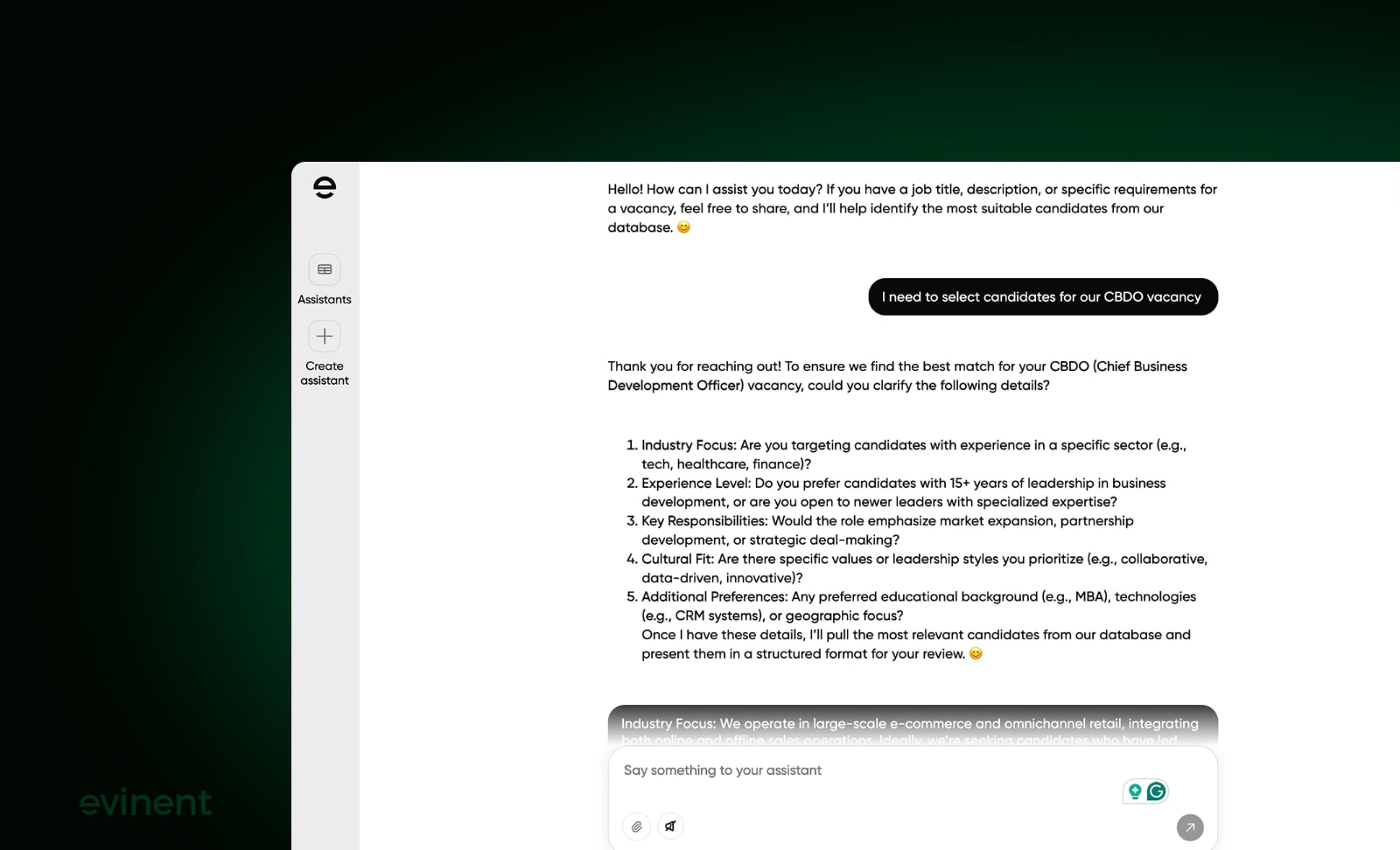
Background
A large-scale business based in Europe that operates in the recruitment sector with a high volume of activities was increasingly experiencing operational inefficiencies in the screening of candidates and the matching of vacancies. Members of the HR team had to hand-pick through resumes and job openings in the thousands, which resulted in ed hiring cycles and unsatisfactory shortlists in terms of consistency.
Previous attempts to explore AI-based assistance stalled early due to concerns around:
data privacy and regulatory exposure,
unpredictable behavior of conversational AI,
and uncertainty about deploying AI safely inside enterprise infrastructure.
Rather than pursuing a broad AI rollout, the organization decided to validate feasibility through a controlled, risk-aware pilot.
Failure Risks Identified Early
Before implementation, several well-known corporate AI failure risks were explicitly acknowledged:
Security and compliance exposure if recruitment data is left in internal systems.
Variable data quality, including unstructured resumes and inconsistent vacancy descriptions.
Hallucination risk in chat-based AI interactions.
Pilot paralysis, where experiments never reach production viability.
Low trust and adoption risk among recruiters.
Evivnent’s Implementation Approach
The solution was deliberately designed to neutralize these failure modes upfront. Key architectural and organizational decisions included:
A fully isolated deployment model, with no external API calls to OpenAI, Claude, or Gemini.
Containerized AI agents, each operating in its own secure environment inside the client’s infrastructure.
An atomic agent architecture, where each agent handled a single, clearly defined responsibility such as searching, filtering, or summarizing data.
Separation into two role-specific agents: a Recruiter Assistant and a Candidate Assistant, aligned with real HR workflows.
An iterative, fixed-scope pilot, allowing early validation, fast feedback, and controlled adjustment without scope creep.
This helped the pilot to test not only the AI logic, but also governance, infrastructure, and operational fit.
Results of the Pilot
Within a 4–6 week timeframe, the pilot of Preventing AI Failure in Enterprise HR Automation delivered:
faster candidate filtering and more relevant shortlists,
reduced manual workload for HR specialists,
consistent and predictable AI behavior without hallucinations,
full compliance with internal data protection and security policies.
More than that, the project illustrated enterprise-grade AI capabilities operating totally within a client's highly secure perimeter while still maintaining usability.
Closing Perspective
Evinent applies over 15 years of experience in high-load enterprise systems, data analytics, and complex integrations to AI delivery. Instead of promising AI success, the focus is on making failure unlikely.
That's the way artificial intelligence projects move from fragile pilot stages to scalable, reliable systems within companies.
Share