

What is customer lifetime value (CLV)?
So? what is customer lifetime value? Customer Lifetime Value (CLV) is a key business metric that represents the total revenue a company can expect to generate from a single customer throughout the entire duration of their relationship with the business. In simple terms, CLV answers the question: how much is one customer worth to your company over time?
Unlike short-term metrics such as single purchase revenue or average order value, CLV focuses on long-term customer relationships. It takes into account not only how much a customer spends, but also how often they purchase and how long they remain active. Because of this, CLV provides a more realistic and strategic view of customer profitability.
By understanding customer lifetime value, businesses can transcend the transactional mindset and embrace a customer-focused growth strategy. Rather than simply optimizing for immediate sales, companies can identify the customers who contribute most profitably over time, set limits on customer acquisition costs, and determine the most effective retention and engagement investments.
“CLV provides a different framework for running a business — focusing on what customers truly contribute over their lifetime.” — Peter Fader. (Retail TouchPoints)
CLV is a frequent tool utilized by marketing, product, and finance teams that serve as a basis for next-level data-driven decision-making. When companies measure it in the right way and limit its use to the areas they can influence, it is one of the great enablers in facilitating a business to keep two horses, i.e., growth and profit, with the least compromise on one side and at the same time create stronger and longer-lasting customer relationships.
What this article will cover
An explanation of what Customer Lifetime Value (CLV) is and why it matters for modern businesses.
How CLV is applied in marketing and business strategy to support acquisition, retention, and customer segmentation decisions.
The most common methods for calculating Customer Lifetime Value include historical, cohort-based, and predictive models.
Key challenges companies face when implementing and using CLV effectively.
The relationship between CLV and core business KPIs such as CAC, retention rate, churn, and ROI.
The differences between Customer Lifetime Value (CLV) and Lifetime Value (LTV), and when each term is used.
Why lifetime value of a customer critical for long-term business growth and profitability?
Practical strategies for improving CLV through retention, average order value optimization, and churn reduction.
An overview of the main Customer Lifetime Value models used in data-driven organizations.
Applications of Customer Lifetime Value in Marketing and Business Strategy
Customer Lifetime Value is a key consideration that can influence marketing activities and overall business strategy in the long run. Through a clear understanding of the value different consumers produce over a given period, businesses can move from relying on gut feeling to using data to decide which resources, channels, and customer segments should be prioritized.
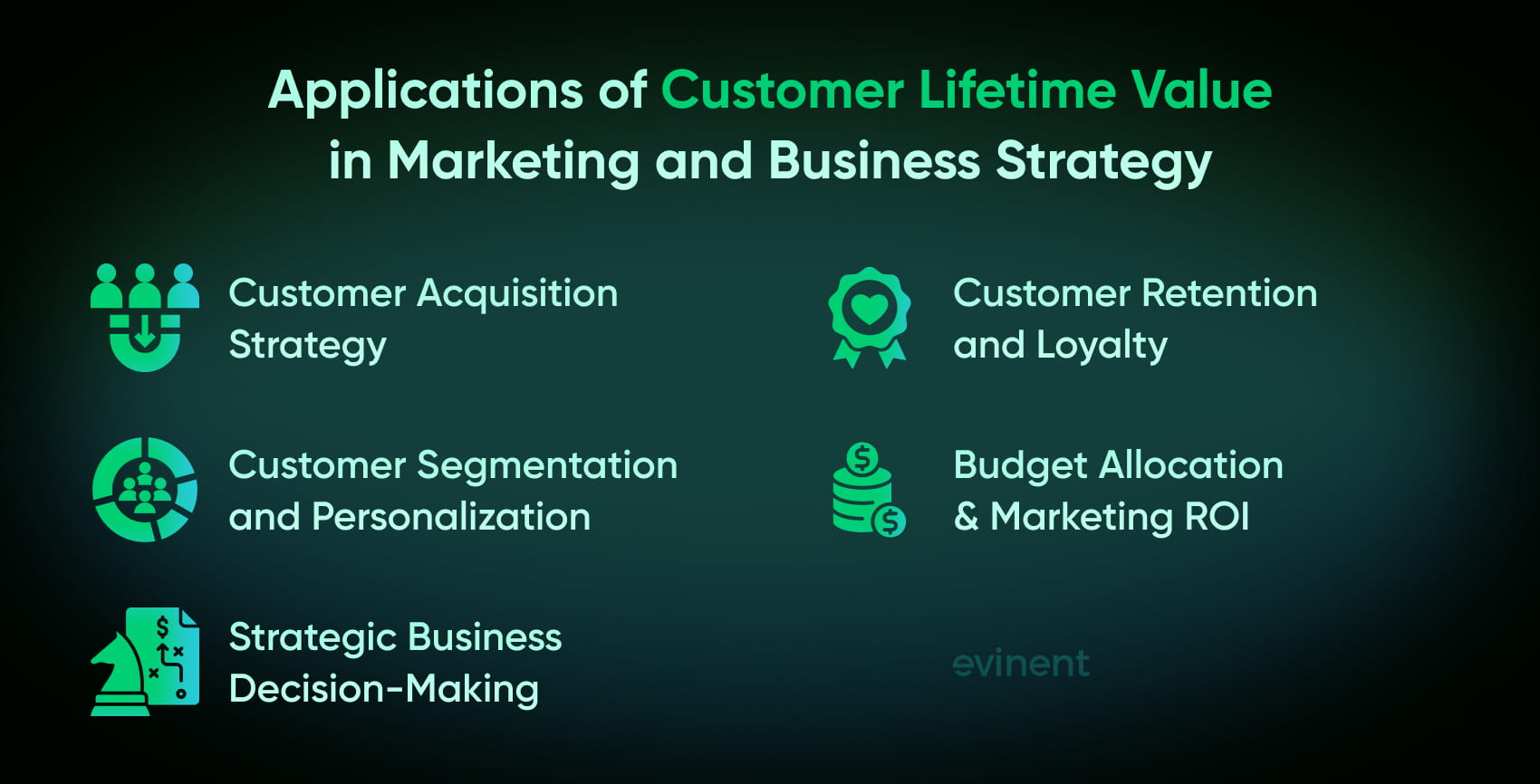
Customer Acquisition Strategy
CLV helps businesses determine how much they can afford to spend on acquiring new customers while remaining profitable. Instead of relying solely on short-term metrics such as cost per click or first-purchase revenue, marketers can evaluate acquisition channels based on the long-term value of the customers they bring in. This allows companies to scale high-quality traffic sources and reduce investment in channels that attract low-value or high-churn customers.
Customer Retention and Loyalty
One of the key reasons why retention strategies gain a great deal of effectiveness is when they are guided by CLV. When companies focus on customers with high lifetime customer value, they can better decide on loyalty programs, personalized communication, and proactive support for the most valuable segments. Generally, improvement in retention rates leads to a compounding effect on the revenue. Hence, retention initiatives based on CLV usually provide a greater return compared to acquisition-focused methods only.
Customer Segmentation and Personalization
CLV makes customer segmentation more insightful by classifying customers according to their lifetime value of customer instead of their immediate behavior. Thus, businesses can customize their marketing communication, deals, and customer experiences depending on the different value segments. For instance, customers with higher CLV might get luxurious treatments and special offers, whereas those in lower-CLV categories can be reached through low-cost engagement strategies.
Budget Allocation and Marketing ROI
By integrating CLV into marketing analytics, businesses can allocate budgets more effectively across campaigns, channels, and regions. Marketing ROI can be measured not just by immediate revenue, but by the future value generated by acquired and retained customers. This perspective supports smarter budget planning and helps justify investments in initiatives that drive sustainable growth.
Strategic Business Decision-Making
CLV can be used not only for marketing but also for other business decisions at a higher level, such as pricing strategy, product development, and customer support investment. Recognizing the segments of the customers who will generate the highest long-term value enables the management teams to integrate the product plans and the operational priorities with the objectives of profitability and growth.
Customer life time value provides a unifying framework for aligning marketing activities with long-term business objectives. By incorporating CLV into acquisition, retention, and segmentation strategies, companies can focus on attracting and nurturing customers who generate sustainable value over time. When used consistently across marketing and business strategy, CLV shifts decision-making from short-term performance metrics to a long-term growth mindset, enabling more efficient resource allocation and stronger competitive positioning.
Calculating Customer Lifetime Value
There is no single universal formula for calculating Customer Lifetime Value. The correct approach depends on data availability, business model, and analytical maturity. In practice, CLV is calculated using several commonly accepted methods, each serving a different purpose. Below are three widely used approaches, presented from simplest to most advanced.
Simple Historical CLV Formula
The historical CLV method calculates customer value based only on past behavior, without forecasting future activity. It is most useful for quick assessments and businesses with limited data.
Formula:
CLV=Average Order Value×Purchase Frequency×Customer Lifespan
Example:
If a customer spends $50 per order, makes 4 purchases per year, and remains active for 3 years:
CLV = 50 × 4 × 3 = $600
When to use:
Early-stage analytics
Simple reporting
Historical performance evaluation
Limitations:
Does not account for churn probability
Ignores future behavioral changes
Cohort-Based / Average CLV
Cohort-based CLV groups customers by shared characteristics—such as acquisition month, channel, or campaign—and calculates average client lifetime value for each group. This approach improves accuracy by capturing behavioral differences across customer segments.
Basic approach:
Group customers into cohorts (e.g., by signup month)
Track revenue generated by each cohort over time
Calculate average CLV per cohort
Example:
If a cohort of 100 customers generates $40,000 in total revenue over its lifetime:
Average CLV = 40,000 / 100 = $400
When to use:
Subscription businesses
Marketing channel comparison
Retention and churn analysis
Advantages:
More realistic than simple averages
Highlights performance differences between acquisition sources
Predictive CLV (with Discounting)
Predictive CLV estimates the future value of a customer, taking into account expected retention, purchase behavior, and the time value of money. This is the most advanced and strategically valuable approach.
General formula:
CLV = Σ (from t = 1 to T) [ Expected Revenueₜ × Retention Probabilityₜ / (1 + d)ᵗ ]
Where:
ttt = time period
ddd = discount rate
Example (simplified):
If a customer is expected to generate $120 per year, with an annual retention probability of 80%, and a discount rate of 10%, future revenues are discounted to reflect uncertainty and time value.
When to use:
Mature analytics teams
Long-term forecasting
Strategic budgeting and valuation
Advantages:
Most accurate representation of long term customer value
Supports high-stakes strategic decisions
Determining Customer Lifetime Value depends on selecting a formula that fits the company's objectives and the quality of its data. Historical CLV is the easiest, cohort-based CLV provides a segment-level understanding, and predictive CLV is the most valuable in strategy terms as it simulates future customer behavior. Each of the three methods indicates a company's potential to use CLV to achieve its goals without unnecessarily complicating its case.

Challenges in Utilizing Customer Lifetime Value
While Customer Lifetime Value is a powerful metric, many companies struggle to use it effectively in practice. These challenges often stem from data limitations, organizational gaps, and methodological issues, which can reduce the accuracy and usefulness of CLV calculations.
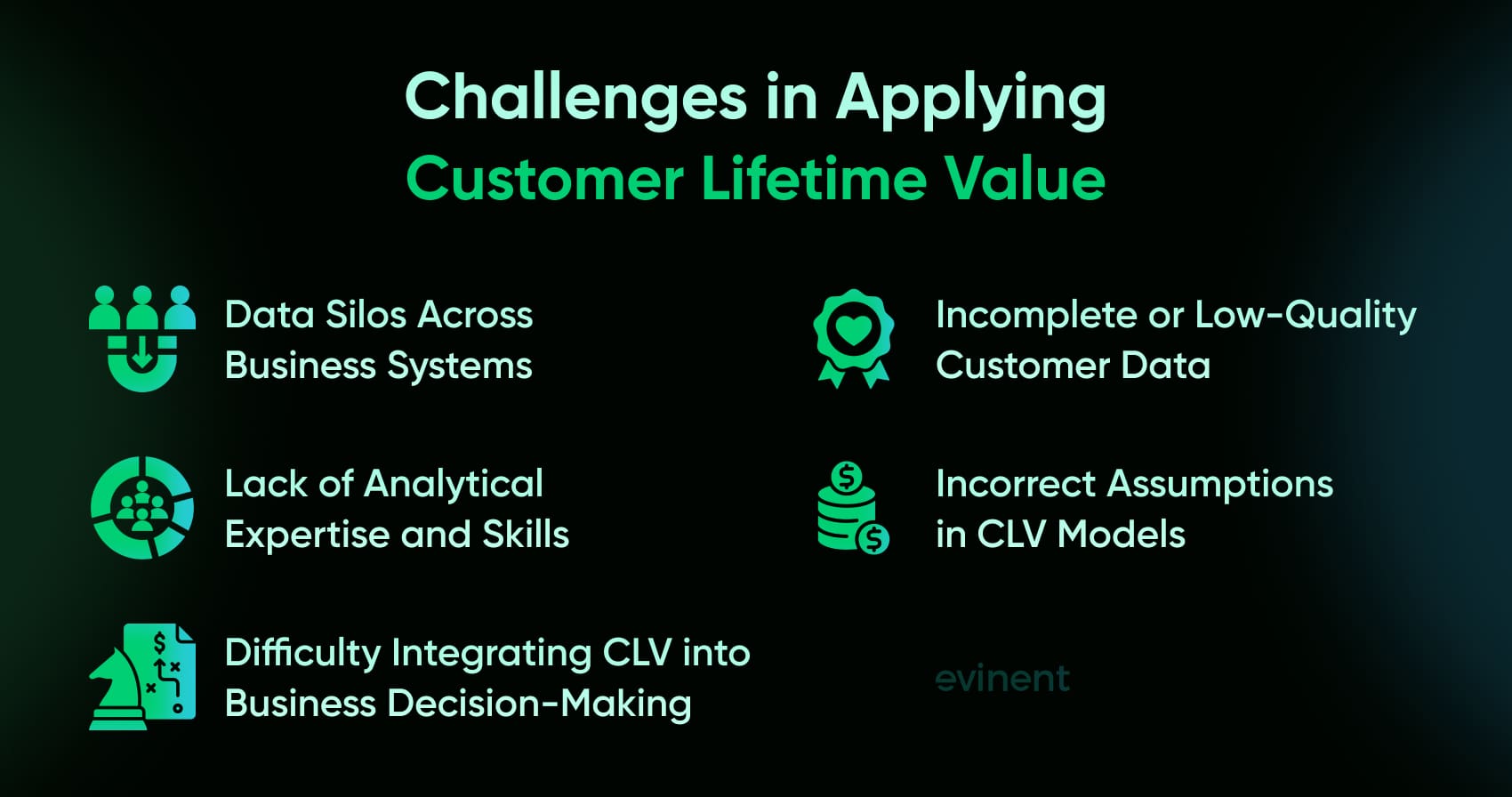
Data Silos Across Systems
Customer information is often scattered among a variety of platforms including CRM systems, marketing tools, payment providers, and customer support software. Lack of proper integration between these systems makes it challenging to obtain a comprehensive customer behavior profile. Consequently, CLV calculations might be derived from incomplete or inconsistent data.
Incomplete or Low-Quality Customer Data
Accurate customer lifetime value (CLV) projection heavily depends on past data that is reliable. If there are missing sales, wrong time of sales records, or unaccounted customer interactions, it can highly affect the predicted lifetime value. This problem mainly arises in those businesses that have offline sales channels or have outdated systems where data collection standards are not followed consistently.
Lack of Analytical Expertise
Many companies do not have experts in their teams who are skilled enough to design, validate, and maintain customer lifetime value models. In the absence of sufficient analytical capabilities, teams often fall back on simplistic formulas or draw incorrect conclusions from the results, thereby undermining the strategic value of customer lifetime value.
Wrong Assumptions in CLV Models
CLV models rest upon assumptions about customer behavior, retention and revenue patterns. Wrong assumptions—like retention rates being constant or spending behavior being uniform—can cause the models to give misleading results. This risk is further increased if the models are used without getting regularly validated or updated.
Difficulty Integrating CLV into Decision-Making
Even when CLV is calculated correctly, companies often struggle to embed it into everyday decision-making. Marketing teams may continue to optimize for short-term metrics, while leadership may hesitate to rely on forward-looking estimates. Without organizational alignment, CLV remains an analytical metric rather than a strategic tool.
Customer Lifetime Value (CLV) can only be effective if it is calculated correctly. However, it also depends on the degree to which the calculation is backed up by data infrastructure, skills, and corporate processes. It is critical to address these issues if you want CLV to become not just a theoretical measure but also a practical instrument for guiding your long-term business decisions.
Customer Lifetime Value and Business KPIs
Customer Lifetime Value (CLV) is a lot more than just a number tied up with the business's main KPI performance indicators, and it practically influences the strategic decisions. When companies align CLV with the major metrics, they can see their accomplishments from a much wider perspective, and thus, they are able to channel their resources to long-term, steady growth rather than to fast profits.
Customer Lifetime Value (CLV) is not merely a hypothetical number that is closely linked to the key performance indicators (KPIs), which decide if a business is growing sustainably and profitably. When businesses add CLV to their performance measures, besides gaining revenue potential insights, they also get long-term financial health and strategic investment decisions.
Below are how CLV relates to core business KPIs, supported by authoritative research and recognized business analyses:
Retention and Profitability
One of the clearest and most frequently cited connections is between customer retention and profit impact:
Research associated with Bain & Company, widely referenced in business strategy literature, finds that increasing customer retention rates by as little as 5 % can boost profits by approximately 25 % to 95 %, depending on the industry and business model. This effect stems from long-term customer relationships, reducing the need for costly new customer acquisition and increasing repeat purchasing. (Bain)
This is a relationship that is also elaborated in business and strategic analyses, e.g. Fred Reichheld, a Bain Fellow and author of The Loyalty Effect, whose work explains how loyalty practices amplify profitability over time.
CLV and Marketing ROI
When customer lifetime value (CLV) serves as a marketing key performance indicator (KPI), it affects the decision-making around the budget and performance assessment:
Instead of optimizing campaigns merely for short-term conversions, marketers aligned with CLV shift focus toward long-term value generation — optimizing channels that deliver customers lifetime value with higher engagement and revenue. (Bain)
This aligns with retention economics emphasized by Bain & Company’s research: retaining an existing customer typically costs significantly less than acquiring a new one, and greater retention increases the predictability and efficiency of marketing spend.
CLV and Cost Metrics
CLV also interacts with important cost metrics such as Customer Acquisition Cost (CAC):
A rising CLV while keeping CAC stable or declining leads to improved profitability and stronger unit economics. This is especially critical in subscription, SaaS, and e-commerce models where long customer tenure multiplies the return on acquisition investments.
Although not always presented with a single universal benchmark, many growth-oriented businesses use a CLV to CAC ratio (e.g., 3:1) as an internal KPI to guide sustainable scaling decisions.
CLV and Customer Engagement
High CLV correlates with loyalty and deeper customer engagement — both recognized predictors of future revenue growth:
Loyal customers tend to repeat purchases, spend more over time, and cost less to serve, all of which lift CLV and downstream financial KPIs such as revenue per user, gross margin contribution, and churn rate. (enterprise engagement)
Several business strategy frameworks, some of which include the Service Profit Chain disclosed in Harvard Business Review, go so far as to link customer satisfaction and loyalty to profit growth, thereby indirectly ing the central insight of CLV.
Customer Lifetime Value interacts with multiple fundamental KPIs that drive business success:
Retention rate and profitability — small improvements can yield outsized profit increases.
Marketing ROI and budget allocation — CLV prioritizes long-term value over short-term gains.
Cost metrics like CAC — balancing acquisition costs with lifetime value- improve unit economics.
Customer engagement and loyalty — deeper relationships lead to higher CLV and better financial outcomes.
Together, these connections show that CLV is not an isolated metric, but rather a strategic KPI that reflects and influences business performance across marketing, finance, and customer experience.
Differences Between Customer Lifetime Value (CLV) and Lifetime Value (LTV)
Customer Lifetime Value (CLV) and Lifetime Value (LTV) are terms that are so closely related that people often confuse them. In fact, in most cases, they practically mean one and the same. However, depending on the level of the analysis, business context, and industry practice, they can have slightly different uses. The table below shows the main differences between them.
Aspect | Customer Lifetime Value (CLV) | Lifetime Value (LTV) |
|---|---|---|
Full term | Customer Lifetime Value | Lifetime Value |
Primary focus | Long-term value of an individual customer | Long-term value of a customer or customer group |
Level of analysis | Customer-level or segment-level | Often aggregate or average |
Typical use cases | Strategic planning, forecasting, and advanced analytics | Marketing reporting, high-level performance tracking |
Modeling approach | Can be historical, cohort-based, or predictive | Commonly historical or averaged |
Use of predictions | Frequently includes future revenue and retention modeling | Often based on past or current data |
Discounting of future revenue | Common in predictive CLV models | Rarely applied |
Business functions using the term | Analytics, finance, and strategy teams | Marketing and growth teams |
Terminology precision | More precise and analytically rigorous | Broader and sometimes loosely defined |
How the Terms Are Used in Practice
For many businesses, customer ltv serves as a simplified or abbreviated form of CLV, mainly for marketing dashboards and growth reporting. When people talk about forecasting, valuation, and strategy in the long run, they use CLV more frequently.
It is crucial to understand that no universal industry standard exists to separate these two terms rigorously. It is more important to understand the metric's definition, calculation, and application than to focus on which label is used.
Although Customer Lifetime Value and Lifetime Value are two closely connected notions, CLV is generally considered a more granular and predictive assessment of the value of a customer, while LTV is most commonly applied as a wider or less detailed measure. Grasping the difference is helpful in making sure that there is clear communication between different departments and a consistent application of the customer value metrics for business decision-making.
Importance for Businesses of Customer Lifetime Value
Customer Lifetime Value is a very important metric for companies that wish to increase their profits sustainably. Instead of concentrating only on sales today, CLV enables companies to comprehend the long-term financial value of their customers and thus, make more informed decisions not only in marketing but also in finance and operations.
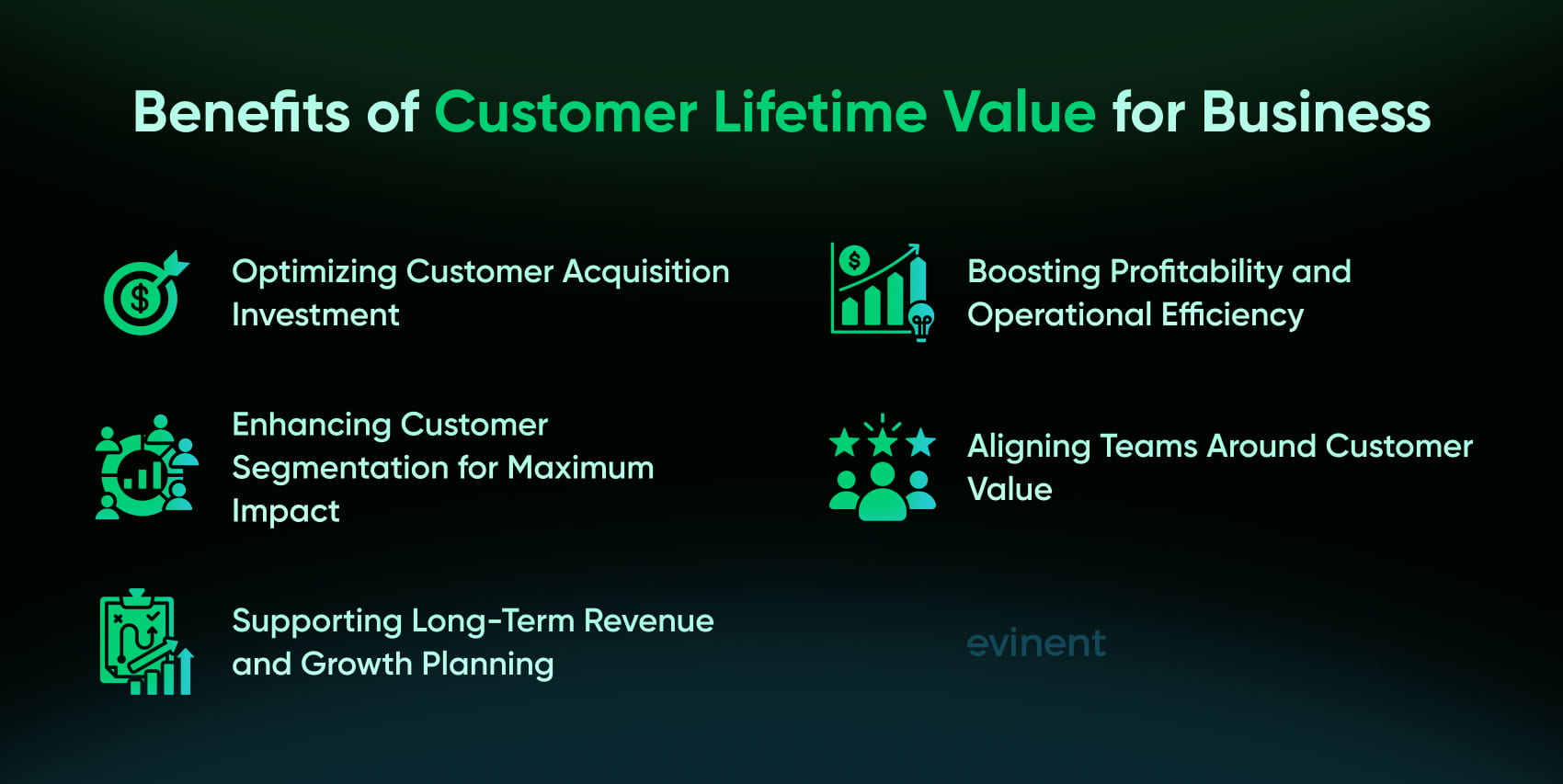
Optimizing Customer Acquisition Spend
One of the most important roles of CLV is defining how much a business can reasonably spend to acquire new customers. By comparing CLV with Customer Acquisition Cost (CAC), companies can identify which acquisition channels generate profitable customers over time. This prevents overinvestment in growth strategies that deliver short-term volume but low long-term value.
Improving Customer Segmentation
CLV helps businesses to group customers according to the value they will bring in the future, and not only based on their past behavior. This gives the opportunity for teams to focus on high-value segments, customize their messages and offers more effectively, and create different experiences. Thus, the resources are directed to those areas where they can make the most significant impact over the long term.
Supporting Long-Term Growth Planning
Because CLV reflects expected revenue over the customer lifecycle, it provides a more stable foundation for forecasting and strategic planning than short-term sales metrics. Businesses that incorporate CLV into planning can better predict revenue, evaluate growth scenarios, and assess the long-term impact of pricing or product decisions.
Increasing Profitability and Efficiency
Higher CLV is closely associated with lower churn, stronger retention, and higher repeat purchase rates — all of which contribute to improved profitability. Serving returning customers typically involves lower marginal costs, meaning that growth driven by CLV improvements often results in healthier profit margins.
Aligning Teams Around Customer Value
CLV acts as a unifying metric that aligns marketing, sales, product, and customer success teams around a shared objective: maximizing customer value over time. This alignment encourages a shift from siloed, short-term optimization toward coordinated efforts that support long-term customer relationships.
Understanding Customer Lifetime Value is essential for any company since it links the customer's actions to the company's financial results over a longer period. Besides allowing companies to use their resources wisely, CLV, through its role in customer acquisition, helps make market segmentation more accurate and hence supports strategic planning, eventually leading to successful business growth in an efficient manner, along with the creation of lasting, high-value customer relationships.
10 Effective Strategies to Improve Customer Lifetime Value
Customer Lifetime Value may be elevated by intentional efforts that lengthen customer relationships, raise revenue per customer, and lower churn. Here are ten effective and commonly used strategies that have a direct impact on CLV in various business models.
Improve Customer Retention
Keeping existing customers has both a direct and compound effect on Customer Lifetime Value (CLV). If a company enhances product quality, customer experience, and service consistency, I think customers will stay longer, and the company will keep earning money from them in the long run.Reduce Customer Churn
Customer churn signals are actively monitored, and the root causes of customer drop-off are identified and addressed to prevent premature termination of the relationship. Lowering churn leads to longer customer lifespan, which is a major factor of lifetime value.Increase Average Order Value (AOV)
Upselling, cross-selling, bundles, and value-based pricing encourage customers to spend more per transaction. Even small increases in AOV can significantly raise CLV when applied across the full customer base.Increase Purchase Frequency
Encouraging customers to buy more often through reminders, subscriptions, replenishment programs, or time-based incentives increases total lifetime revenue without additional acquisition costs.Improve Customer Onboarding
Effective onboarding helps customers understand and realize value faster. Customers who reach early success are more likely to remain active, reducing early churn and increasing long-term value.Personalize Customer Communication
Personalized messaging, offers, and recommendations increase relevance and engagement. Customers who feel understood and valued tend to remain loyal and spend more over time.Implement Loyalty and Rewards Programs
Loyalty programs are a great way to encourage customers to buy again and stick around for the long haul. Each time you reward someone for using your product, you're not only making them feel more emotionally connected but also raising the cost for them to switch to another brand.Optimize Pricing and Packaging
If a business has well-organized pricing tiers and product bundles, it makes it possible for customers to increase their spending as their needs develop. This keeps customer growth and revenue growth synchronized and helps to increase CLV organically.Strengthen Customer Support and Success
A responsive and proactive customer support team will greatly reduce the frustration level of a customer and help build their trust. If a support experience is good and satisfying, it will most likely encourage the customer to continue doing business with the company and eventually contribute more to the customer's lifetime value.Use Customer Feedback to Drive Improvements
Collecting and acting on customer feedback helps identify friction points and unmet needs. Continuous improvement based on real user input leads to higher satisfaction, retention, and lifetime value.
Enhancing Customer Lifetime Value is not a matter of one off tactic, but a continuous process of refining the way customers are attracted, served, and kept. By emphasizing retention, engagement, spending behavior, and customer experience, companies can achieve growth that lasts without having to depend entirely on acquisition.
10 Types of Customer Lifetime Value Models
Customer Lifetime Value can be modeled using different analytical approaches depending on data availability, business maturity, and strategic goals. Below are ten commonly used CLV models and frameworks applied in modern marketing and business analytics.
Historical CLV: Determines customer lifetime value (CLV) based solely on previous customer transactions and without predicting future customer behavior.
Predictive CLV: Predicts the future value of a customer using statistical or machine learning models, which usually involve retention probabilities and discounting of customer value.
Cohort-Based CLV: Measures the customer lifetime value by creating customer groups (cohorts) based on similar characteristics, like time of acquisition or channel.
Average Revenue-Based CLV: Employs the average revenue per customer over the customer lifespan for customer lifetime value calculation, a method often used in the initial phase of data and customer lifetime value analysis.
Gross Margin CLV: Changes the focus from revenue to contribution margin, which is a measure of profit, thereby giving a more accurate picture of profitability.
Subscription CLV Model: Is primarily about the recurring revenue from a customer, the churn rate (percentage of subscribers who stop subscribing within a given time period), and the average duration of a customer, typical for SaaS and subscription businesses.
Probabilistic CLV Model: Uses probability theory to assess the chances of customers making future purchases and remaining customers.
Discounted Cash Flow (DCF) CLV: Converts the value of money at different times by adjusting the expected future cash from a customer to the present, considering money's time value and risk.
Segment-Based CLV: Determines customer lifetime value at the segment level rather than at the individual customer level, which is beneficial for strategic planning.
Machine Learning Based CLV: Utilizes sophisticated algorithms such as neural networks and decision trees that can learn and adapt to complex customer characteristics in order to accurately predict customer lifetime value using vast amounts of data and behavioral cues.
Customer Lifetime Value must be considered basically as a model driven metric rather than a single formula or static number. Choosing the right CLV model mainly depends on business objectives, the data one has, and analytical capabilities. Grasping these methods helps firms to utilize CLV more precisely and consistently in marketing and business strategy.
How Evinent Helps Businesses Apply Customer Lifetime Value in Practice
Finding out your customer lifetime value only marks the start. In order to make CLV really helpful, companies should incorporate it into their data architecture, analytics workflows, and even decision-making within marketing, product, and operations. Kicking off with one figure is insufficient; what is needed are trustworthy data pipelines, behavior analysis, predictive models, and the capacity to execute insights swiftly.
Evinent helps businesses move from theoretical CLV calculations to practical CLV-driven strategies by designing analytics and automation solutions that align with business goals, scale, and existing systems.
We at Evinent stand behind the entire customer lifecycle value implementation, from data consolidation and modeling to predictive analysis, segmentation, and operational use in marketing and sales decisions.
Why Businesses Choose Evinent
Evinent is not a boxed analytics product provider. We work as a technology and analytics partner, helping companies build systems where Customer Lifetime Value becomes a core business metric rather than a static report.
Our experience includes:
Over 15 years of software engineering and data analytics for complex, high-load digital platforms
Large-scale eCommerce environments with millions of users and transactions
Deep expertise in integrating analytics with CRM, ERP, accounting systems, call centers, and online stores
Proven delivery of enterprise-grade solutions across different regions and industries
Such a background sets the stage for us to develop CLV-focused systems that are not only technically sound but also commercially significant.
From Customer Data to CLV-Driven Decisions
Evinent Analytics enables businesses to build a solid foundation for CLV analysis by unifying and enriching customer data. The platform supports:
Creation of detailed customer profiles, including purchase history, total spend, behavioral patterns, and engagement signals
Analysis of purchasing behavior and correlations across products, channels, and time
Customer segmentation based on value, behavior, and predicted future activity
Predictive analytics to forecast future sales trends and customer value
These enabled the companies to go beyond history-based customer lifetime value and to use predictive CLV models for customer retention, personalization, and marketing budget allocation.
CLV as a Driver for Personalization and Marketing Automation
One essential practical application of CLV is prioritization, figuring out which customers to focus on, how much, and through which go-to-market channels. Evinent Analytics supports this by integrating CLV insights with marketing automation tools.
Businesses can:
Personalize product recommendations and offers based on customer value and predicted behavior
Optimize communication strategies across email, SMS, and messaging platforms
Measure the effectiveness of marketing campaigns through a CLV lens rather than short-term conversion metrics
Identify high-risk churn segments and proactively address them
When companies embed CLV in their daily operational workflows, it becomes a growth mechanism over time, rather than just an analytical metric.
CLV in a Broader Business Context
Evinent Analytics is designed to operate as part of a broader business ecosystem. Seamless integration with existing systems ensures that CLV insights are available wherever decisions are made — from marketing and sales to finance and risk management.
This approach helps businesses align Customer Lifetime Value with strategic objectives, enabling smarter investments, better customer experiences, and sustainable revenue growth.
Key Takeaway
Understanding CLV gives businesses clarity on the financial value each customer contributes over time.
Applying CLV in marketing and business strategy ensures that resources target high-value customers and channels effectively.
Accurate calculation methods — whether historical, cohort-based, or predictive — make CLV actionable.
Awareness of challenges like data silos, incomplete records, or wrong model assumptions prevents misleading decisions.
Linking CLV to KPIs aligns business performance metrics with long-term customer value.
Distinguishing CLV from LTV ensures precision in analytics and avoids misinterpretation.
Recognizing CLV benefits — from optimized acquisition spend to higher profitability — guides strategic investments.
Improving CLV through retention, upselling, personalization, and churn reduction maximizes long-term revenue.
Choosing the right CLV model allows businesses to forecast accurately and plan actionable strategies.
Leveraging platforms like Evinent Analytics transforms CLV insights into practical, data-driven decisions that drive measurable growth.
Share