

Why do so many real estate fraud cases look perfectly legitimate right up until the money disappears?
That question comes up again and again after the fact, after a wire transfer cannot be recalled, after a property fails to hold its appraised value, after a title issue surfaces months into ownership. By then, the transaction is already closed, approved, and documented. On paper, everything checked out.
Real estate fraud rarely announces itself. It does not usually involve fake properties or obviously forged identities. More often, it appears inside ordinary transactions, using real homes, real buyers, real professionals, and documentation that looks correct when reviewed step by step.
Most organizations affected by real estate fraud did not ignore controls. Income was verified. Titles were searched. Appraisals were signed off. Compliance boxes were ticked. The fraud moved through it.
What matters is not spotting fraud after the fact, but understanding how it survives the process in the first place. How a deal can move from application to closing without triggering alarms, even when the outcome is almost guaranteed to go wrong.
The patterns repeat. The same types of documents. The same pressure points in the workflow. The same assumptions about who has already checked what. Once you start looking at transactions this way, fraud stops feeling random and starts feeling predictable.
That perspective is especially important for people who sit closest to the risk. If you’re responsible for financial exposure, operational decisions, or regulatory accountability, hindsight is expensive. The only useful question is where the warning signs appeared, and why they were easy to miss.
Property Flipping Fraud: When Value Is Manufactured, Not Discovered
Property flipping fraud is often described as a simple scheme: buy a property cheaply, inflate its value, sell it at a higher price, and walk away with the difference. That description is technically correct, but it misses why the scheme keeps working.
In real transactions, fraudulent flips rarely look aggressive. They look tidy.
The property exists. The renovation looks plausible. The appraisal includes comparables from the same neighborhood. The buyer qualifies for financing. Nothing jumps out as obviously false. Each step has a document attached to it, and each document appears to support the next.
The manipulation usually sits inside the appraisal process.
Comparable sales are selected carefully, not randomly. Renovation costs are overstated, but not absurdly. Timing matters too. A short gap between purchase and resale can raise suspicion, so the transaction is paced just slowly enough to look normal. Sometimes the same appraiser appears across multiple deals, sometimes different ones. The variation is intentional.
What makes this type of fraud difficult is that appraisals are opinions, not facts. As long as the opinion can be defended on paper, it passes.
Regulators have been warning about this for years. The Federal Housing Finance Agency has repeatedly pointed out that losses from fraudulent flipping often surface only after default, when the inflated value collapses under market pressure. By then, the loan has already been issued and securitized.
From an organizational perspective, the risk is not that an appraisal is “wrong.” It’s that no one asks whether the pattern of appraisals across transactions makes sense.
Straw Buyers and Hidden Ownership
Straw buyer fraud is another scheme that survives because it relies on paperwork that looks complete.
A straw buyer is someone who appears to be a legitimate purchaser but is acting on behalf of someone else. Sometimes the real beneficiary cannot qualify for financing. Sometimes they are trying to stay invisible. Sometimes the goal is simply to extract funds quickly and disappear.
On paper, the straw buyer looks fine. Income is documented. Credit history exists. Employment is verified. The loan closes.
The deception sits outside the documents.
The straw buyer may be compensated quietly. Mortgage payments may be covered by someone else. Occupancy claims may be false. In many cases, the buyer never intended to live in or manage the property.
Law enforcement agencies still see this pattern frequently, especially in clusters where the same intermediaries appear repeatedly. Local district attorney offices describe cases where entire networks of straw buyers are rotated through transactions, each one used once and then discarded.
The problem for lenders and operators is that identity checks do not reveal intent. A person can be real, documented, and verified—and still be acting as a front.
This is why straw buyer fraud often survives compliance review. The system s who the buyer is. It does not ask why they are there.
Title Fraud and Equity Theft
Title fraud is less common than application fraud, but when it succeeds, the losses are severe.
In these cases, criminals assume the identity of a property owner and transfer ownership without the real owner’s knowledge. The property is then sold or leveraged for loans, and the proceeds are extracted quickly.
Mortgage-free properties are especially attractive. There is no lender watching closely, no monthly payments to trigger s, and often no reason for the owner to monitor title records regularly. Seniors are disproportionately affected, particularly those who own homes outright.
District attorney offices across the United States have documented cases where forged deeds were recorded cleanly, followed by rapid refinancing or sale. By the time the real owner discovered the fraud, the money was gone.
Title insurance provides some protection, but it does not prevent the fraud from occurring. It only shifts who absorbs the loss.
What makes title fraud difficult to detect early is that recording systems are built for trust, not suspicion. If a deed appears properly executed and notarized, it is accepted. Verification often stops there.
Document Forgery That Survives Review
Not all forged documents look forged.
Modern real estate fraud relies heavily on documents that are internally consistent. Employment letters match pay stubs. Bank statements align with declared income. Closing statements differ slightly between parties, but each version looks reasonable on its own.
One common tactic involves dual settlement statements. The seller receives one version. The lender sees another, inflated version that supports a higher loan amount. Both statements appear legitimate in isolation.
Legal professionals have described how these discrepancies often surface only during disputes or audits, long after closing. At that point, reconstructing intent becomes difficult.
Again, the issue is not that no one reviewed the documents. It is that no one compared them across roles.
The Financial Impact Is Uneven, Not Rare
Real estate fraud is often discussed in terms of total losses, but averages hide what actually hurts organizations.
Across reported mortgage scam cases from 2015 to 2025, total losses reached approximately $1.38 million, averaging $16,829 per case. That number seems manageable until you look at wire fraud tied to real estate transactions, where median losses exceed $70,000 per incident. Recovery is rare once funds move.
Geographically, losses concentrate in specific states:
State | Total loss | Average loss | Cases |
|---|---|---|---|
Georgia | $423,550 | $105,887 | 28 |
Florida | $141,309 | $11,776 | 49 |
Pennsylvania | $107,831 | $17,972 | 32 |
Texas | $60,191 | $30,096 | 30 |
Source: BackOffice Pro, Mortgage Fraud Statistics 2025 (analysis of 670 BBB cases through April 2025).
Georgia stands out for the severity per case, not the volume. Florida’s higher case count reflects volume and senior-targeted equity theft. California, Florida, and Connecticut all saw double-digit increases in reported cases since mid-2023.
For executives, this distribution matters. Fraud need not be frequent to be material. A small number of missed cases can wipe out a year's margin.
Why Traditional Controls Keep Approving Bad Transactions
Most real estate fraud does not break the rules. It works around them.
Controls are typically designed to answer narrow questions:
Does this document exist?
Does the signature match?
Does the database return a record?
They are less effective at asking broader ones:
Does this sequence make sense?
Have we seen this pattern before?
Why does this transaction resemble others that failed?
Checks happen at fixed points in time. Once a step is approved, it is rarely revisited. Responsibility is distributed across brokers, lenders, title companies, and external vendors, each focused on their own slice.
This fragmentation creates space for fraud.
No single team has full visibility, and no one feels accountable for the transaction as a whole. When something goes wrong, every step can point to a completed checklist.
That is why fraudulent transactions often look compliant until they collapse.
Why Fraud Signals Are Explainable in Isolation
Most real estate fraud does not look like fraud when you encounter it the first time.
A slightly inflated income statement can be explained by commission-based compensation
An unusual wire instruction might be blamed on a rushed closing
A last-minute document change is often written off as a clerical fix
Individually, none of these signals are alarming. In fact, most of them are familiar to anyone who has worked in lending, title, escrow, or brokerage operations. The problem is not that warning signs are invisible. It’s that they are structurally designed to look reasonable when viewed alone.
Fraud exploits how work is divided.
One team verifies identity. Another reviews income. A third s the title. A fourth releases funds. Each group sees only a slice of the transaction, and each slice passes basic checks. The risk lives in the connections between those slices, not inside any single one of them.
This is why post-incident reviews are always uncomfortable. Once the full timeline is laid out, the pattern becomes obvious. The same data points that were dismissed as “edge cases” suddenly align into something coherent and clearly intentional.
That clarity only exists in hindsight.
Before losses occur, organizations tend to ask the wrong question: “Did each step meet policy requirements?”
The more useful question is: “Did the overall transaction make sense when viewed as a whole?”
Most fraud slips through because no one is tasked with answering that second question.
Why Traditional Safeguards Keep Missing Coordinated Fraud
Real estate transactions are built around procedural compliance, not behavioral analysis.
Checklists work well when risk is static. Fraud is not static. It adapts to the checklist.
Over the past decade, fraud schemes have shifted away from crude document forgery toward process-aware manipulation. Modern actors understand approval thresholds, audit triggers, and escalation paths. They know which inconsistencies will be questioned and which ones will be ignored because “someone else already reviewed that.”
This creates a dangerous illusion of safety.
Each department assumes that another team has already validated the risky part
Each reviewer assumes earlier approvals reduce the need for scrutiny
Each system s only what it was explicitly designed to check
As a result, fraud does not break controls. It moves between them.
This is especially visible in mortgage and title fraud cases, where losses often occur despite full KYC, verified appraisals, and compliant documentation. Regulatory boxes were checked. Risk was still transferred.
From an executive perspective, this exposes a structural gap: controls optimized for compliance are not the same as controls optimized for loss prevention.
How Organizations Detect Fraud Earlier Without Slowing the Business
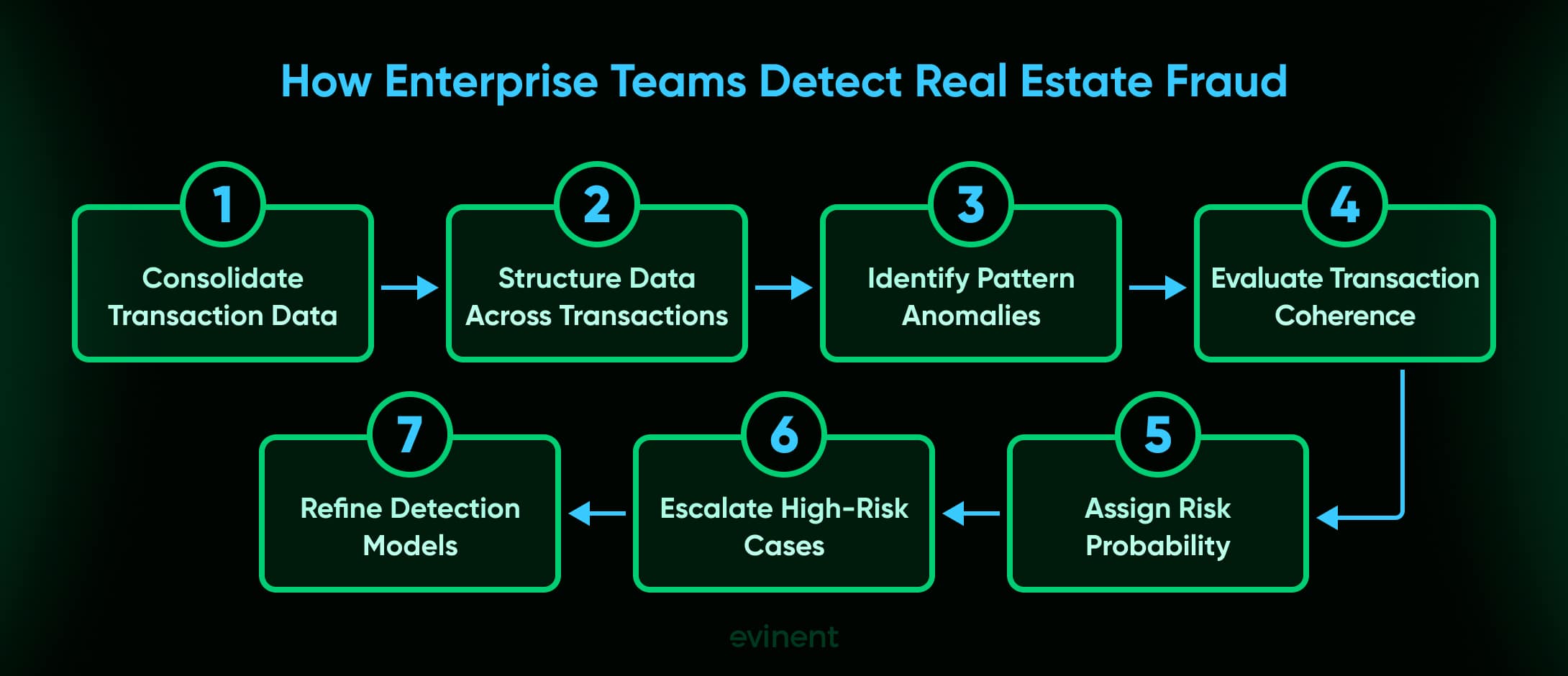
Early detection does not come from adding more checkpoints. It comes from changing what gets compared.
The organizations that reduce losses consistently do three things differently:
They stop evaluating documents in isolation
They stop treating anomalies as binary pass/fail events
They stop assuming that clean inputs guarantee clean outcomes
Instead, they focus on relationship-level signals.
Examples include:
Income claims that technically qualify but do not align with employment history patterns.
Appraisal values that match comparables on paper but diverge from transaction timing norms.
Title transfers that are valid individually but suspicious in sequence.
Wire instructions that are correct but statistically unusual for the counterparty profile.
None of these require new regulations. They require context.
Importantly, early detection does not mean earlier rejection. Many organizations flag transactions silently, allowing them to proceed while additional verification runs in parallel. This avoids unnecessary friction for legitimate deals while still creating an intervention window before funds are irreversibly released.
The shift is subtle but critical: from “Is this allowed?” to “Is this typical?”
That change alone catches a significant percentage of high-impact fraud.
What Actually Reduces Losses in Practice
Loss reduction rarely comes from a single breakthrough. It comes from boring, disciplined changes that compound over time.
Across financial institutions, title companies, and large brokerages, the same levers show up repeatedly in successful programs:
Cross-stage visibility
Teams can see how earlier data points influenced later decisions, not just their own step.
ed finality
Funds are not released instantly when a checklist is complete, but after a short risk-weighted buffer.
Escalation based on pattern strength, not rule violation
Transactions are reviewed because they look wrong in aggregate, not because a single rule failed.
Post-close learning loops
ed fraud cases are fed back into detection logic instead of living only in legal reports.
What does not reduce losses:
Adding more manual reviews without context.
Increasing documentation requirements across the board.
Treating fraud as a compliance issue instead of an operational one.
Executives often underestimate how much damage is caused by overcorrecting. Excess friction pushes good customers away while sophisticated fraud adapts anyway.
The goal is not to eliminate risk. It is to interrupt fraud early enough that losses remain containable.
What Executives Should Be Asking Their Teams
Most leadership conversations about fraud focus on volume and totals: number of cases, total losses, regulatory exposure. Those metrics matter, but they are lagging indicators.
The more revealing questions are simpler and harder:
Where in the transaction lifecycle do we still lack visibility?
Which approvals rely most heavily on assumptions about earlier checks?
How often do we review fraud cases outside of audits or litigation?
What signals do our teams routinely explain away?
How long after approval do we still have the ability to intervene?
These questions tend to surface uncomfortable answers. That discomfort is useful.
Fraud is rarely a technology failure. It is usually a coordination failure — between teams, systems, incentives, and timing. Until that is acknowledged, losses will keep repeating in slightly different forms.
Wire Fraud: Where Speed Turns Into Irreversibility
Wire fraud sits at the intersection of trust and urgency, which is why it has become one of the most damaging forms of real estate fraud over the past few years.
The mechanics are simple. The execution is not.
An email arrives that looks familiar. The sender name is correct. The signature block matches. The timing makes sense because closings are chaotic by nature. Wire instructions change, or appear to change, at exactly the moment when everyone involved wants the transaction to be finished.
By the time someone realizes the funds went to the wrong account, there is nothing left to investigate. The money has moved. Jurisdiction is unclear. Recovery is unlikely.
What makes wire fraud particularly effective is that it does not require deep access to internal systems. It relies on surface-level credibility and predictable behavior under pressure. People follow instructions because the instructions look like the ones they have followed dozens of times before.
Median losses in real estate wire fraud regularly exceed tens of thousands of dollars per incident. Some are far higher. What almost never happens is a clean rollback.
From an organizational standpoint, the mistake is treating wire instructions as an administrative detail instead of a risk event. Most processes assume that if identity was verified earlier, the payment stage is safe. In practice, the payment stage is where fraud concentrates because it is the last moment of leverage.
Speed helps deals close. It also removes the last chance to stop a bad one.
Title Fraud And Equity Theft: The Quietest High-Impact Scheme
Title fraud does not generate the same volume as wire fraud, but when it works, the consequences are disproportionate.
The pattern is disturbingly consistent. Properties with no outstanding mortgage. Owners who are not actively transacting. Public records that are technically correct but rarely monitored. The fraudster assumes the owner’s identity, records a forged deed, and either sells the property or extracts equity through loans.
Nothing looks wrong until the real owner tries to do something with the property.
What makes title fraud difficult to detect early is that recording systems are designed for legitimacy, not skepticism. If a document meets formal requirements, it is accepted. There is no built-in mechanism for questioning intent.
Title insurance helps after the fact. It does not stop the transfer from happening.
Organizations involved in title and escrow often discover these cases long after the money has moved, during disputes or unrelated transactions. At that point, the fraud has already done its damage.
For executives, the uncomfortable truth is that ownership itself is often treated as static, even though the mechanisms that define ownership are dynamic and vulnerable.
Why Fraud Clusters Instead Of Spreading Evenly
Fraud does not distribute itself randomly across markets.
It clusters where volume is high, where transactions are remote, where ownership is fragmented, and where speed is rewarded. States with large populations, active investor markets, and high proportions of cash or mortgage-free properties see different fraud profiles, but they all share one trait: complexity.
Georgia’s losses stand out because of severity per case. Florida’s because of volume and senior-targeted equity theft. California’s because scale amplifies small failure rates into large absolute numbers.
This clustering matters because it reveals something structural. Fraud follows opportunity, not regulation. Tight rules do not eliminate fraud; they redirect it to places where enforcement is slower or coordination is weaker.
Organizations operating across multiple jurisdictions often underestimate this effect. They apply uniform controls to environments that are not uniform. The result is uneven exposure that only becomes visible after losses are reported.
The Role Of Human Judgment In Fraud Detection
Automation catches repetition. Humans catch contradictions.
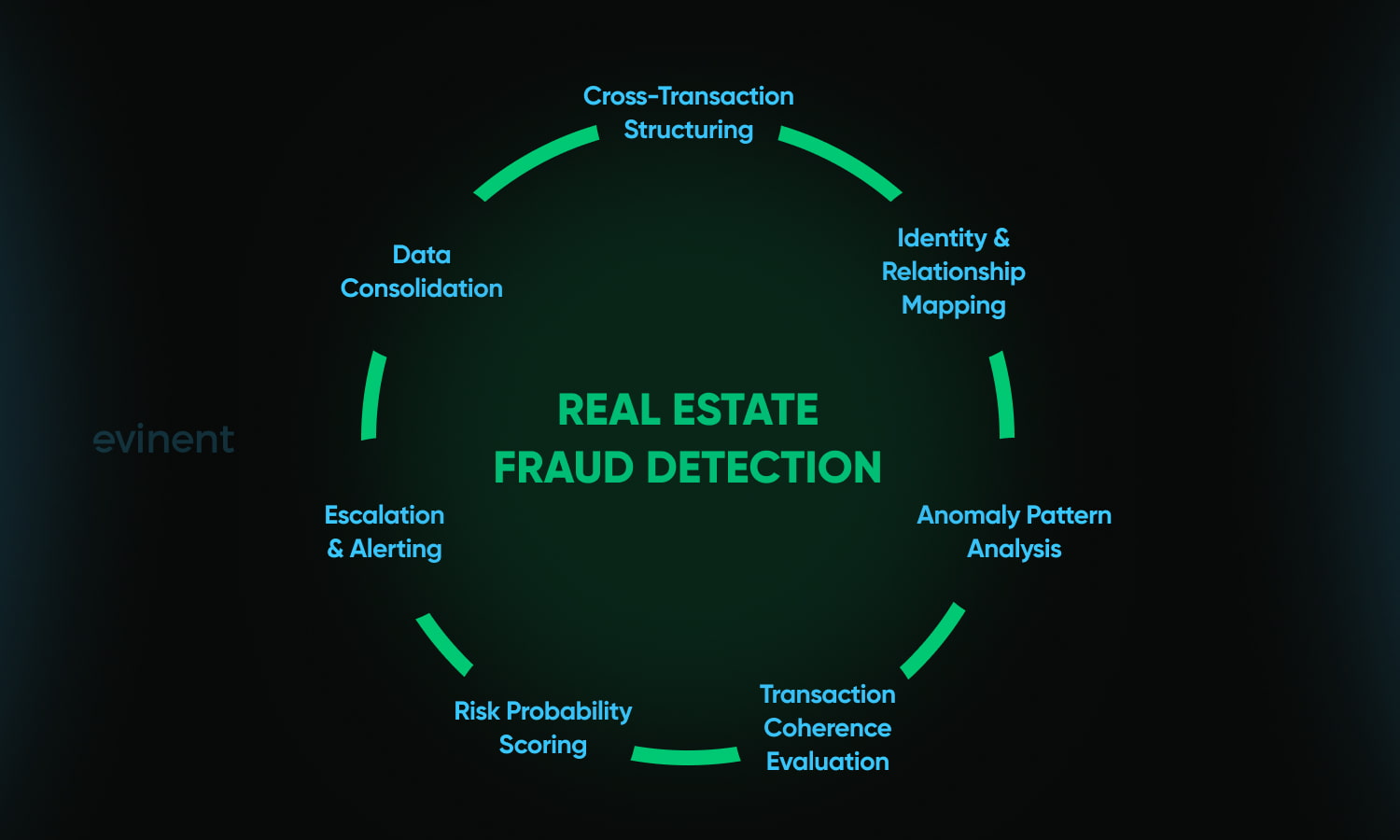
The most effective fraud detection environments do not replace judgment. They reserve it for the right moments.
Human reviewers are not good at scanning thousands of transactions for weak signals. They are very good at recognizing when a story does not add up once it is assembled. The mistake many organizations make is exhausting human attention on low-risk work and leaving no bandwidth for the cases that actually deserve it.
Fraud reviews that work tend to share a few characteristics:
Reviewers see the full transaction timeline, not just their assigned step.
They are encouraged to question plausibility, not just compliance.
Escalation is treated as neutral, not punitive.
Feedback loops exist between ed fraud and future reviews.
None of this requires heroics. It requires permission to slow down briefly when something feels off.
That permission is often missing.
Why Overcorrecting Creates New Risk
After a significant fraud loss, the instinctive response is to tighten everything.
More documents. More approvals. More manual checks. Longer turnaround times.
This response feels responsible. It is often counterproductive.
Excessive friction pushes legitimate customers away and creates workarounds that are harder to monitor. Meanwhile, organized fraud adapts. It always does. The result is a system that is slower, more expensive, and not meaningfully safer.
The organizations that reduce fraud sustainably resist the urge to blanket the process with controls. Instead, they focus on precision. They accept that most transactions are legitimate and concentrate effort where signals cluster.
Fraud prevention is not about building walls. It is about placing gates where they matter.
A Pattern Worth Paying Attention To
Across cases, markets, and fraud types, one pattern keeps repeating.
Fraud succeeds when:
Responsibility is fragmented.
Assumptions replace verification.
Speed overrides reflection.
Signals are evaluated separately instead of together.
None of these are criminal behaviors. They are operational habits.
That is why fraud feels so personal after the fact. The systems did what they were told to do. The failure lives in how the system was designed to think.
What This Means Going Forward
There is no final fix for real estate fraud. Markets evolve. Tools change. Incentives shift.
What changes outcomes is how early organizations are willing to look at discomfort. The sooner a transaction is allowed to feel strange, the cheaper the lesson tends to be.
Executives who reduce losses are rarely the ones who add the most controls. They are the ones who ask better questions earlier and accept that not every answer fits neatly into a checklist.
Fraud does not disappear. It moves. The task is not to chase it endlessly, but to shorten the distance between signal and response.
Recent Numbers That Change How The Risk Should Be Read
Headline numbers about fraud tend to flatten the story. They tell you how big the problem is, not how it behaves.
What matters more is where growth is happening and at which stage of the transaction losses now appear.
Since 2022, mortgage- and real-estate–related fraud reports have increased sharply, but the composition of that growth is the important part. Application fraud still exists, but it is no longer the fastest-moving risk. The sharper increase has been in transaction-stage fraud: cases where identity, income, appraisal, and title checks all passed, and losses occurred only after approvals were granted and funds were released.
This shift explains why many organizations feel caught off guard. Their controls are strongest where fraud used to concentrate. The damage has moved downstream.
Another detail that often gets overlooked is severity. Average loss figures look manageable until you examine the distribution. Most cases are small. A minority are not. Those few cases account for a disproportionate share of total losses, especially in wire fraud and equity theft scenarios.
This is why year-over-year fraud growth can look modest while financial impact jumps sharply. The risk is becoming less frequent in some categories and far more expensive in others.
For executives, this changes the question from “How many cases do we have?” to “How exposed are we to the worst ones?”
Why Fraud Investigations Almost Always Start Too Late
Internal fraud reviews tend to begin with a closed file.
The transaction is complete. Funds have moved. Ownership has changed. The review happens because something has already broken: a default, a dispute, a missed payment, a complaint.
By that point, the investigation's goal is rarely prevention. It is attribution. Who missed what? Which step failed? Whether liability can be shifted.
That framing is understandable. It is also limiting.
When teams work backward from a loss, they often identify the same root causes:
assumptions made under time pressure
reliance on prior approvals
signals dismissed as explainable
lack of cross-team visibility
What gets less attention is how early those signals appeared.
In many cases, the first warning signs showed up well before closing. They just did not look urgent at the time. The transaction still fit policy. The risk still felt abstract. There was no single reason to stop.
Fraud investigations that only ask “What went wrong?” tend to miss the more useful question: “At what point could we have slowed this down without breaking the business?”
That question is harder. It requires revisiting incentives, timelines, and authority, not just rules.
Where Organizations Usually Underestimate Their Exposure
Most organizations misjudge their fraud exposure in the same places.
They overestimate the protection offered by front-loaded checks.
They underestimate the risk introduced by handoffs.
They assume that compliance equals safety.
One of the most common blind spots is post-approval complacency. Once a transaction clears a formal review stage, scrutiny drops. The remaining steps are treated as execution. That is exactly where some of the most expensive fraud now occurs.
Another blind spot is role diffusion. When no single team owns the transaction end to end, no one feels responsible for questioning the full narrative. Everyone does their job. No one challenges the story.
This is not a people problem. It is an organizational design problem.
Fraud does not exploit incompetence. It exploits gaps between responsibilities.
A More Useful Way To Think About Fraud Readiness
Fraud readiness is often framed as a maturity model. More controls, more tools, more checks.
A more practical way to think about it is in terms of reaction distance.
How far does a suspicious signal have to travel before it reaches someone empowered to act?
In many organizations, that distance is long. Signals are logged, categorized, deprioritized, or explained away before they ever reach a decision-maker. By the time they do, the transaction is finished.
Reducing reaction distance does not require perfection. It requires clarity.
Who can pause a transaction? Under what conditions? For how long? With what consequences?
Organizations that answer those questions explicitly tend to intervene earlier, even with the same underlying data.
What Executives Should Actually Be Measuring
Loss totals are easy to report. They are also late.
Executives who want earlier insight tend to track different signals:
Time between anomaly detection and escalation
Percentage of escalations that occur before funds move
Repetition of similar fraud patterns across transactions
Volume of “near misses” that never became losses
How often teams override their own concerns
These metrics feel uncomfortable at first because they expose uncertainty. Over time, they become more useful than raw case counts.
They also change behavior. When teams know that early escalation is visible and acceptable, they escalate earlier.
That alone reduces losses.
A Final Observation That Keeps Showing Up
Across markets, fraud types, and organizational structures, one observation keeps repeating.
The transactions that cause the most damage are rarely the ones that look worst at the beginning. They are the ones that feel slightly off but are still acceptable.
Fraud lives in that space between acceptable and wrong.
Systems that only react when something is clearly wrong will always be late. Systems that allow uncertainty to surface earlier have a chance to act while the outcome is still flexible.
That difference is not technical. It is cultural.
Closing Perspective
Real estate fraud is not a failure of vigilance. It is a consequence of how modern transactions are designed to move.
Speed, distribution of responsibility, and trust between parties are not flaws. They are what make large-scale real estate markets possible. They also create predictable points of weakness.
The organizations that reduce losses over time are not the ones that try to eliminate those weaknesses entirely. They are the ones who learn where the pressure builds and intervene before it releases.
Fraud will keep adapting. That part does not change.
What can change is how quickly uncertainty is allowed to matter.
How Fraud Adapts Faster Than Controls
One reason real estate fraud feels persistent is that it evolves faster than the systems meant to stop it.
Controls tend to be reactive. A scheme is discovered, a rule is added, a threshold is adjusted. Fraud adapts by shifting emphasis, not by disappearing. When income verification becomes stricter, manipulation moves to appraisals. When appraisals are scrutinized, pressure shifts to timing, intermediaries, or payment instructions.
This is not an arms race in the usual sense. Fraud does not need to defeat every control. It only needs to find the least coordinated point in the process.
That is why many of the most damaging cases do not involve sophisticated technical attacks. They involve procedural familiarity. Fraudsters know how long approvals usually take. They know when teams are overloaded. They know which last-minute changes are most likely to be accepted without resistance.
In other words, fraud learns how organizations behave under normal conditions and waits for moments when those behaviors become predictable.
Why Compliance Success Can Mask Operational Risk
High compliance scores often coexist with high fraud losses. This is not a contradiction.
Compliance answers the question of whether rules were followed. Fraud risk asks whether outcomes were protected. Those are related, but not identical.
In real estate transactions, compliance frameworks are typically focused on documentation, disclosures, and formal verification steps. They are not designed to detect coordination across legitimate-looking actions. As long as each step meets requirements, the transaction passes.
Executives sometimes assume that strong compliance performance implies low fraud exposure. In practice, it can mean the opposite. Highly standardized processes are easier to model and manipulate.
This does not argue against compliance. It argues against treating compliance as a proxy for safety.
Organizations that reduce fraud losses tend to treat compliance as a baseline, not a shield. The real work happens above it.
The Hidden Cost Of Treating Fraud As An Exception
Many teams approach fraud as an edge case. Something rare. Something handled by specialists when it happens.
The cost of this framing is subtle. When fraud is seen as exceptional, early signals are more likely to be normalized. Reviewers assume they are looking at another variation of a legitimate deal. Escalation feels disproportionate. s feel unjustified.
Over time, this creates a bias toward continuation.
Fraud cases that succeed often involve several moments when someone hesitated, noticed something odd, and then moved on. Not because they were careless, but because stopping felt heavier than proceeding.
Organizations that reframe fraud as an operational risk, rather than an exception, behave differently. They expect ambiguity. They build pauses into the process. They allow people to raise concerns without proving wrongdoing.
That shift alone changes outcomes.
Why Speed Is Both A Feature And A Vulnerability
Speed is not the enemy. Without it, real estate markets stall.
The problem is not speed itself, but unexamined acceleration. When transactions move faster than the organization can interpret them, risk accumulates quietly.
The most expensive fraud cases often occur at the highest velocity points: rapid resales, compressed closings, last-day changes, and end-of-quarter pressure. These moments concentrate incentives and reduce tolerance for interruption.
Fraud does not need to create urgency. It waits for urgency to appear on its own.
Organizations that acknowledge this pattern treat high-speed transactions differently. They do not block them outright. They recognize that speed amplifies the cost of mistakes and adjust scrutiny accordingly.
This is not about slowing everything down. It is about slowing down selectively.
A Practical Distinction That Matters
There is a useful distinction between complex transactions and merely busy ones.
Complex transactions involve real uncertainty: unusual structures, atypical assets, nonstandard financing. Busy transactions are standard deals executed under time pressure.
Fraud is far more common in the second category.
Busy transactions invite shortcuts. Complexity invites caution. Teams expect complexity to require thought. They expect busy work to be routine.
Understanding that difference helps explain why some of the simplest-looking deals cause the most damage.
Where Accountability Breaks Down
In many organizations, accountability for fraud is distributed so widely that it becomes abstract.
Each team is accountable for its step. No one is accountable for the outcome.
When fraud occurs, responsibility is reconstructed after the fact. At that point, the discussion focuses on errors rather than design. The underlying structure remains unchanged.
Organizations that reduce repeat losses tend to assign explicit ownership of transaction integrity. Not ownership of compliance, not ownership of speed, but ownership of coherence.
That role does not replace existing teams. It connects them.
An Executive Lens That Changes The Conversation
Executives who shift outcomes often change the way fraud is discussed internally.
Instead of asking, “Why did we miss this?” they ask, “Where did our process encourage us to look away?”
Instead of asking, “Who approved this?” they ask, “Who had the ability to pause it?”
Instead of asking, “How do we prevent this exact case from happening again?” they ask, “What similar cases would this control still miss?”
These questions move the conversation from blame to structure. They also surface hidden trade-offs.
Fraud prevention always competes with growth, speed, and customer experience. Pretending otherwise leads to brittle systems. Acknowledging the trade-offs leads to intentional ones.
Where This Leaves The Organization
There is no final state where fraud is solved. There is only a moving balance between trust, verification, and response time.
Real estate fraud will continue to evolve as the market itself evolves. The organizations that fare better over time are not the ones that eliminate risk. They are the ones who notice when risk changes shape and respond before losses harden into facts.
That requires more than tools. It requires a willingness to treat uncertainty as information rather than noise.
How Fraud Signals Get Normalized Inside Healthy Organizations
One of the most uncomfortable patterns in real estate fraud is that it rarely relies on broken systems. It relies on functional ones.
Teams that handle high transaction volume develop instincts for efficiency. Over time, those instincts become heuristics. Heuristics become habits. Habits become defaults.
This is where normalization happens.
A reviewer notices a discrepancy, but it resembles three others they saw last week that turned out fine. A coordinator accepts a late document because closings are always messy. A manager approves an exception because the deal is already emotionally “done” for the parties involved.
None of these decisions are irrational. In isolation, they are reasonable responses to workload and pressure. In aggregate, they create a tolerance zone where fraud can sit comfortably without triggering alarms.
Healthy organizations are particularly vulnerable to this effect because success reinforces confidence. When most transactions close without issue, teams learn that caution is usually unnecessary. Fraud benefits from that learning curve.
The danger is not negligence. It is pattern fatigue.
Why Post-Mortems Rarely Change Behavior
After a fraud loss, organizations almost always conduct a review.
The findings tend to be accurate. Missed signals are identified. Process gaps are documented. Recommendations are made.
What changes less often is day-to-day behavior.
That is because post-mortems typically focus on what should have happened, not on why it did not feel necessary at the time. They analyze the transaction with full knowledge of the outcome, which removes the uncertainty that shaped decisions in real time.
As a result, lessons are framed in hindsight logic:
“This should have been escalated.”
“This inconsistency should have been questioned.”
“This approval should have been ed.”
Those statements are true and still incomplete.
Unless organizations understand what made escalation feel excessive, questioning feel awkward, or feel risky in the moment, the same dynamics will repeat under slightly different conditions.
Behavior does not change because a rule exists. It changes because the environment makes different behavior easier.
The Quiet Role Of Incentives In Fraud Exposure
Incentives rarely encourage fraud directly. They encourage speed, throughput, and resolution.
These goals are not wrong. They are essential to competitive markets. The issue is what happens when they are unbalanced.
When teams are rewarded primarily for closing volume, preventing fraud becomes invisible labor. A transaction that does not close generates no metric. A loss that happens months later belongs to another department.
Over time, this misalignment trains organizations to optimize for visible success and discount invisible risk.
The most resilient organizations address this by making risk-aware behavior observable. Early escalations are tracked. Near-miss prevention is recognized. s that prevent loss are treated as positive outcomes, not failures.
This does not require punishing speed. It requires acknowledging that not all value is immediate.
What Makes Coordinated Fraud Harder To See
Coordinated fraud is rarely dramatic. It is quiet, distributed, and incremental.
Different participants handle different pieces. Each action is small enough to avoid scrutiny. The scheme only becomes visible when the pieces are assembled, which usually happens after the damage is done.
This is why coordinated fraud thrives in ecosystems with many legitimate intermediaries. Brokers, appraisers, lenders, title companies, escrow agents, and service providers all interact without full visibility into one another’s context.
The system works because trust exists. Fraud exploits that trust by staying just inside its boundaries.
Detecting coordination requires looking for repetition across roles, not just anomalies within them. The same names, timelines, addresses, or transaction structures appearing across unrelated deals are often more telling than any single discrepancy.
Organizations that reduce coordinated fraud losses make this type of comparison routine rather than exceptional.
Why Senior Leadership Involvement Matters Earlier Than Expected
Fraud is often delegated to specialists. That delegation makes sense, up to a point.
What senior leaders uniquely control is not detection logic, but organizational tolerance. They set expectations about when it is acceptable to slow down, escalate, or challenge momentum.
In organizations where leadership treats any as failure, teams learn to minimize friction. In organizations where leadership signals that protecting outcomes matters more than protecting timelines, teams behave differently.
This influence is subtle and powerful. It does not appear in policies. It appears in reactions.
When a deal is paused and leadership asks, “Why did this take so long?” escalation becomes costly. When leadership asks, “What did we learn?” escalation becomes safe.
Fraud prevention lives in that difference.
The Cost Of Waiting For Certainty
Many fraud losses occur because teams wait for certainty that never arrives.
Clear proof is rare before funds move. Fraud is probabilistic by nature. It presents as discomfort, not evidence.
Organizations that require definitive proof before acting almost always act too late. Those that allow intervention based on reasonable doubt preserve optionality.
This does not mean canceling transactions lightly. It means building processes that allow questions to be answered before irreversibility.
Once funds move or ownership transfers, the range of outcomes collapses. Before that moment, flexibility exists.
Reducing fraud losses is largely about protecting that window.
How High-Performing Teams Treat Uncertainty Differently
Teams that consistently intervene earlier share a mindset shift.
They do not treat uncertainty as a weakness. They treat it as a signal.
When something does not align, the goal is not to immediately classify it as fraud or legitimate. The goal is to understand why alignment is missing.
This approach produces better outcomes because it keeps inquiry alive without forcing premature conclusions. It also reduces defensive behavior. People are more willing to raise questions when those questions are framed as exploration rather than accusation.
Fraud rarely announces itself. It reveals itself when uncertainty is allowed to persist long enough to be examined.
Where This Leaves The Executive Agenda
For executives, the most meaningful decisions about fraud are not technical. They are structural and cultural.
They involve:
How pressure is distributed
How uncertainty is treated
How accountability is assigned
How learning is reinforced
Technology supports these choices. It does not substitute for them.
Organizations that treat fraud as an external threat tend to focus on barriers. Those who treat it as an internal design challenge focus on flow, timing, and coordination.
The latter approach is quieter. It is also more durable.
When Fraud Becomes A Reporting Problem Instead Of A Risk Problem
In many organizations, fraud only becomes visible once it enters a report.
By the time numbers are aggregated, categorized, and presented upward, the underlying events are already settled. Losses are booked. Recovery options are limited. The discussion shifts from prevention to explanation.
This reporting lag creates a false sense of control.
Executives see stable quarterly figures and assume risk is contained. What those figures often hide is volatility. Fraud losses do not rise smoothly. They arrive in spikes. A single coordinated event can erase months of otherwise clean performance.
Organizations that rely exclusively on periodic reporting tend to be surprised not because data was missing, but because timing was wrong. Information arrived after leverage was lost.
This is why leading indicators matter more than totals. They surface discomfort early, before it hardens into an incident.
The Difference Between Visibility And Oversight
Visibility is knowing what happened. Oversight is knowing when to intervene.
Many systems provide excellent visibility. Dashboards are complete. Logs are detailed. Audit trails exist. None of this guarantees oversight.
Oversight requires three conditions:
information arrives while action is still possible
someone is empowered to act on it
acting is culturally acceptable
Remove any one of these and fraud detection becomes retrospective.
In real estate transactions, the oversight gap often appears near the end of the process. Earlier stages generate signals, but authority to pause or challenge is concentrated elsewhere. By the time decision-makers are involved, options are narrow.
This is not a failure of tooling. It is a failure of decision timing.
Why “Low False Positives” Can Be A Dangerous Goal
Many fraud programs optimize aggressively to reduce false positives. The intent is reasonable: avoid friction, protect customer experience, preserve throughput.
The unintended consequence is that systems learn to tolerate ambiguity.
Fraud signals that are not decisive are gradually de-emphasized. Over time, the threshold for concern rises. Only the most obvious cases trigger intervention.
This works well for high-volume, low-severity fraud. It works poorly for low-frequency, high-impact events, which now represent a growing share of real estate fraud losses.
Organizations that reduce major losses accept a higher level of early discomfort. They allow some friction in exchange for optional pauses. They understand that the cost of a ed legitimate transaction is often lower than the cost of an irreversible fraudulent one.
This is a strategic choice, not a technical one.
The Role Of Time As A Control Mechanism
Time is an underused fraud control.
Not artificial . Intentional timing.
Short holding periods before fund release. Mandatory verification windows after instruction changes. Cooling-off intervals for ownership transfers under specific conditions.
These measures do not rely on prediction. They rely on irreversibility management. They protect the organization’s ability to respond when something changes.
Fraud thrives in moments where actions are final and immediate. Introducing even small buffers can collapse entire schemes without requiring perfect detection.
Time does not stop fraud. It limits damage.
Why Repetition Matters More Than Novelty
Fraud cases that attract attention are often unusual. The ones that cause the most damage are repetitive.
The same structure appears across transactions. The same intermediaries surface repeatedly. The same timing patterns recur. The same explanations are used to dismiss concerns.
Novelty distracts. Repetition reveals intent.
Organizations that track repetition across otherwise legitimate deals see risk earlier. Those that treat each transaction as unique miss the cumulative signal.
This is particularly important in coordinated fraud, where no single deal looks extreme, but the sequence tells a different story.
The Illusion Of Neutral Processes
Processes are often described as neutral. They are not.
Every process reflects priorities. What it accelerates, what it slows down, what it ignores.
When fraud slips through repeatedly, it is rarely because the process failed accidentally. It is because the process consistently prioritized something else: speed, volume, certainty, convenience.
Recognizing this does not mean dismantling the process. It means acknowledging what it was designed to optimize and whether that optimization still aligns with risk tolerance.
Fraud prevention is not about fixing broken systems. It is about rebalancing successful ones.
What Changes When Fraud Is Treated As A Design Constraint
Organizations that materially reduce fraud losses tend to treat fraud not as an exception, but as a design constraint.
Just as systems are designed around latency, cost, or scalability, they are designed around adversarial behavior.
This changes the conversation:
from “How do we catch fraud?”
to “Where would fraud succeed if it tried?”
That perspective surfaces weak points earlier and more honestly. It also removes moral framing. Fraud is not a personal failure. It is a predictable outcome when incentives, speed, and trust intersect.
Designing for that reality produces quieter, more resilient systems.
A Final Structural Insight
Fraud does not require broken trust. It requires misplaced trust.
Real estate transactions depend on trust between parties who may never meet. That trust is essential. The risk lies in assuming that trust is evenly distributed and consistently deserved.
The strongest systems do not eliminate trust. They contextualize it. They ask where trust is appropriate, where it should be provisional, and where it should be earned repeatedly.
This is not cynicism. It is realism.
Executive Closing Perspective
For C-level leaders, the most important realization is this: fraud outcomes are shaped long before fraud is detected.
They are shaped by:
how pressure flows through the organization
where authority sits
how uncertainty is handled
what behavior is rewarded or discouraged
Technology supports these choices. Policy formalizes them. Leadership signals determine whether they work.
Real estate fraud will not stop evolving. Markets will not slow down. Complexity will increase.
The organizations that remain resilient will not be the ones that chase every new scheme. They will be the ones that shorten the distance between discomfort and action, and treat uncertainty as an operational input rather than an inconvenience.
That shift is quiet. It is also decisive.
Executive Takeaways That Actually Change Outcomes
Executives rarely need another definition of fraud. What they need is clarity on where to intervene without breaking the business.
A few conclusions keep proving themselves across markets and cycles.
Fraud exposure is shaped earlier than most leaders expect.
Losses are decided long before funds move or ownership changes. They are shaped by how pressure, authority, and timing are arranged upstream.
Compliance success does not equal fraud resilience.
Organizations with clean audits still experience major losses because fraud exploits coordination gaps, not missing documents.
The most damaging cases are not the most obvious ones.
They are the transactions that look acceptable but feel slightly off — and are allowed to proceed because no single rule is violated.
Time is leverage.
Once funds move or titles transfer, options collapse. Even small buffers before irreversibility reduce losses dramatically.
Culture determines escalation speed.
If raising concerns feels costly, concerns arrive late. If uncertainty is treated as information, intervention happens earlier.
For leadership, the practical implication is simple: fraud outcomes are governed less by detection tools than by organizational design choices.
A Practical “What To Change First” Framework
For organizations reassessing their exposure, a full overhaul is rarely necessary. What matters is sequence.
First: Reduce Reaction Distance
Map how long it takes for a weak signal to reach someone who can pause a transaction. If the answer is “after closing,” risk is already locked in.
Second: Clarify Authority To Pause
Uncertainty needs an owner. If no one is explicitly empowered to slow a transaction briefly, momentum will always win.
Third: Shift Attention From Documents To Patterns
Single-document validation catches errors. Pattern comparison catches fraud. This requires looking across transactions, not deeper into one.
Fourth: Treat Speed As A Variable, Not A Constant
High-velocity transactions deserve different scrutiny. Uniform timing rules create uneven risk.
Fifth: Make Near-Misses Visible
Losses teach late. Near-misses teach early. Organizations that track prevented fraud learn faster and lose less.
None of these changes requires new regulations. They require rebalancing existing priorities.
Recent Data That Reframes The Risk Landscape
Since 2022, reported real estate and mortgage fraud has not only increased — it has shifted.
Industry reporting shows a sharp rise in transaction-stage fraud, where identity, income, appraisal, and title checks passed, yet losses still occurred. Mortgage scam reports grew several hundred percent year over year in some reporting channels, but the more important change was a shift in severity concentration.
A minority of cases now account for a majority of losses. Wire fraud incidents routinely exceed $10,000 per event. While fewer, equity theft cases can erase an entire property's value in a single transaction.
Geographic concentration also matters. States with high transaction volume, investor activity, and senior homeownership exhibit distinct fraud profiles, yet all show clustering rather than even distribution. This reinforces a core insight: fraud follows opportunity density, not regulatory strictness.
For executives, this means exposure cannot be inferred from averages. Tail risk now dominates outcomes.
Why Tail Risk Is The Real Executive Problem
Most organizations can absorb small, frequent losses. They struggle with rare, catastrophic ones.
Tail risk in real estate fraud is driven by:
irreversibility of payment mechanisms
ed detection
coordination across legitimate actors
compressed timelines
Traditional controls are optimized for common cases. Tail events slip through because they sit just outside normal thresholds.
Reducing tail risk requires a different mindset: protecting optionality until the last responsible moment.
This is why timing, authority, and escalation culture matter more than additional verification steps.
What A Resilient Organization Looks Like In Practice
Resilient organizations share a few traits that are easy to describe and hard to fake.
They allow pauses without panic.
They reward questions without requiring proof.
They treat uncertainty as a design input.
They learn from prevented losses, not just reported ones.
They revisit process incentives after incidents, not just controls.
None of this eliminates fraud. It changes where it fails.
Fraud that fails early is cheap. Fraud that succeeds late is not.
A Closing Observation Worth Remembering
Real estate fraud is not a sign that trust has broken down. It is a sign that trust is unevenly distributed.
Markets need trust to function. Organizations need skepticism to survive. The balance between the two is not fixed. It is designed.
Executives who accept that reality stop asking how to eliminate fraud and start asking how to contain its impact. That shift, more than any single tool or policy, determines long-term outcomes.
The organizations that fare best are not the ones that promise certainty. They are the ones that preserve the ability to act while certainty is still forming.
That is where losses are quietly prevented early and often, without anyone outside the organization ever noticing.
Research Anchors And Recent Evidence (2022–2025)
The patterns described above are not theoretical. They align with how regulators, enforcement agencies, and industry analysts describe recent loss dynamics.
Federal housing regulators have consistently warned that fraud risk has migrated downstream, surfacing after approvals rather than at application. The Federal Housing Finance Agency notes that appraisal manipulation, misrepresentation, and transaction-stage interference remain among the most persistent threats because they exploit otherwise compliant workflows rather than bypassing them outright.
Source: FHFA Fraud Prevention Program (updated guidance and s, 2022–2024).
Law enforcement units focused on real estate fraud report a similar shift. County-level fraud task forces describe an increase in coordinated schemes where identity, income, and title checks pass independently, yet losses occur through wire diversion or post-transfer equity extraction.
Source: Riverside County District Attorney Real Estate Fraud Unit; Los Angeles County District Attorney Senior Fraud advisories
Industry monitoring s the same trend quantitatively. Mortgage fraud risk indicators rose year over year through 2024, but the most notable increase came from transaction fraud, not borrower misrepresentation. Analysts observed that while overall application fraud growth slowed, high-severity events tied to payment and closing stages accelerated.
Source: National Mortgage Professional reporting on Cotality/CoreLogic risk indices, 2025
Consumer-facing reporting also reveals a severity skew. Real estate wire fraud incidents, though fewer than other scam categories, continue to produce median losses that far exceed most consumer fraud types. Once funds are transferred, recovery rates remain extremely low.
Source: Better Business Bureau Scam Tracker summaries and mortgage scam analyses, 2023
Taken together, these sources point to the same conclusion: modern real estate fraud survives not by evading controls, but by operating inside them.
Expert Perspectives That Reflect The Shift
A recurring theme across regulatory commentary is the importance of explainability and structure, not just verification.
One widely cited observation captures the operational challenge clearly:
“Organizations must deeply understand and structure their data to ensure every automated decision is explainable. It’s not just for compliance, but a necessary scaling engine for risk management.” – Cisco Reports, 2026
This perspective reflects a broader shift in how fraud risk is framed. Explainability is no longer treated as a regulatory obligation alone. It is increasingly understood as a prerequisite for detecting coordination, repetition, and narrative inconsistency before losses occur.
Similarly, enforcement officials emphasize that most cases they prosecute did not involve a single forged document or false identity. They involved plausible transactions assembled in harmful ways.
That distinction matters for leadership because it points away from stricter gatekeeping and toward better connective insight.
How To Read The Numbers Without Being Misled
Statistics around real estate fraud can be misleading if taken at face value.
Aggregate loss figures appear modest relative to transaction volume. Case counts fluctuate by jurisdiction and reporting method. What remains consistent is concentration: a small share of cases accounts for a large share of losses.
This concentration explains why some organizations experience long periods of apparent stability followed by sudden, material hits. It also explains why traditional trend monitoring often fails to timely intervention.
Executives who focus exclusively on averages miss tail risk. Those who track distribution and escalation timing see exposure earlier.
What Makes This A Leadership Issue, Not A Departmental One
Fraud prevention is often assigned to compliance, risk, or security teams. Those teams matter. They do not control the most influential variables.
Leadership controls:
how much friction is acceptable
how uncertainty is interpreted
where authority sits when pressure rises
whether slowing down is treated as failure or judgment
These signals shape behavior long before any fires.
This is why organizations with similar tools and policies experience very different outcomes. The difference is not technology. It is tolerance for early interruption.
Why You Need To Choose Evinent To Detect And Prevent Real Estate Fraud
Modern real estate fraud rarely breaks individual rules. It exploits patterns across transactions.
Evinent Analytics addresses this structural gap by focusing on:
Cross-transaction pattern detection
Identity and intermediary repetition analysis
Anomaly clustering across time and geography
Transaction-sequence modeling
Explainable AI risk scoring aligned with regulatory requirements
Instead of reviewing documents in isolation, Evinent’s analytics layer evaluates how transactions relate to each other — surfacing coordinated fraud that traditional compliance checks miss.
For organizations operating at scale, this means:
Earlier detection before funds move
Reduced exposure to tail-risk losses
Clear audit trails for regulators
Actionable risk signals without operational slowdown
Learn more about Evinent Analytics here: https://analytics.evinent.com/
Final Synthesis
Real estate fraud today is quieter, more coordinated, and more expensive when it succeeds.
It does not rely on obviously false information. It relies on believable sequences assembled under pressure. It passes checks because the checks were never designed to evaluate coherence across time, roles, and incentives.
The organizations that reduce losses do not chase every new scheme. They redesign how uncertainty is handled, how authority is exercised, and how timing is managed.
They intervene earlier, not because they are certain, but because they understand the cost of waiting.
That understanding — more than any control, tool, or checklist — is what separates resilient organizations from surprised ones.
Share