

What are E-commerce Product Recommendations?
Among the different types of e-commerce product recommendations, the personalized or contextual product suggestion delivered to a customer is one kind. Recommendations at the different stages of the customer's buying journey are made possible by analyzing a wide range of data, such as the customer's browsing history, purchase history, search queries, product features, and current context. In this way, the customers can be assisted in finding the products they are most likely excited to buy.
In practice, product recommendations appear as blocks like “You may also like”, “Frequently bought together”, or “Recommended for you”. Their primary goal is to reduce choice overload, improve product discovery, and guide customers toward relevant products faster than manual navigation or search alone.
From a business standpoint, product recommendations are one of the essential factors of the consumer journey in today’s online shopping environment. Through personalizing the shopping experience, these tools assist internet shops in raising their conversion rates, ramping up average order value, and enhancing customer satisfaction, consequently making consumers feel more at home and understood rather than dealing with a faceless brand.
This level of recommendation system is a smart combination of data, algorithms, UX design, and continuous optimization. Today, they have evolved from merely being a “nice-to-have” feature to a must-have for any competitive.
What This Article Covers
In this article, we will explore product recommendations ecommerce from both business and technical perspectives. Specifically, we will cover:
The business impact and value of product recommendations,
Where and when recommendations should appear across the customer journey,
Personalization approaches that improve relevance and engagement,
Proven recommendation strategies used by leading e-commerce brands,
Best practices for designing high-converting recommendation interfaces,
Methods for continuously improving recommendation for e commerce performance,
The main types of recommendation algorithms, from basic filtering to AI-driven models.
By the end, you will have a clear understanding of how personalized ecommerce product recommendations work, why they matter, and how they can be implemented and optimized to drive measurable e-commerce growth.
Business Value of E-commerce Product Recommendations
Product recommendations are one of the most important revenue streams in the e-commerce business. They have a great impact on how users discover the products, on what they consider buying, and, thus, become customers. When recommendations are spot on and delivered at the right moment, they can grow a business's revenue without the need for more traffic or a bigger advertising budget.
Done right, e-commerce product recommendations can help your business a great deal illustrated below.
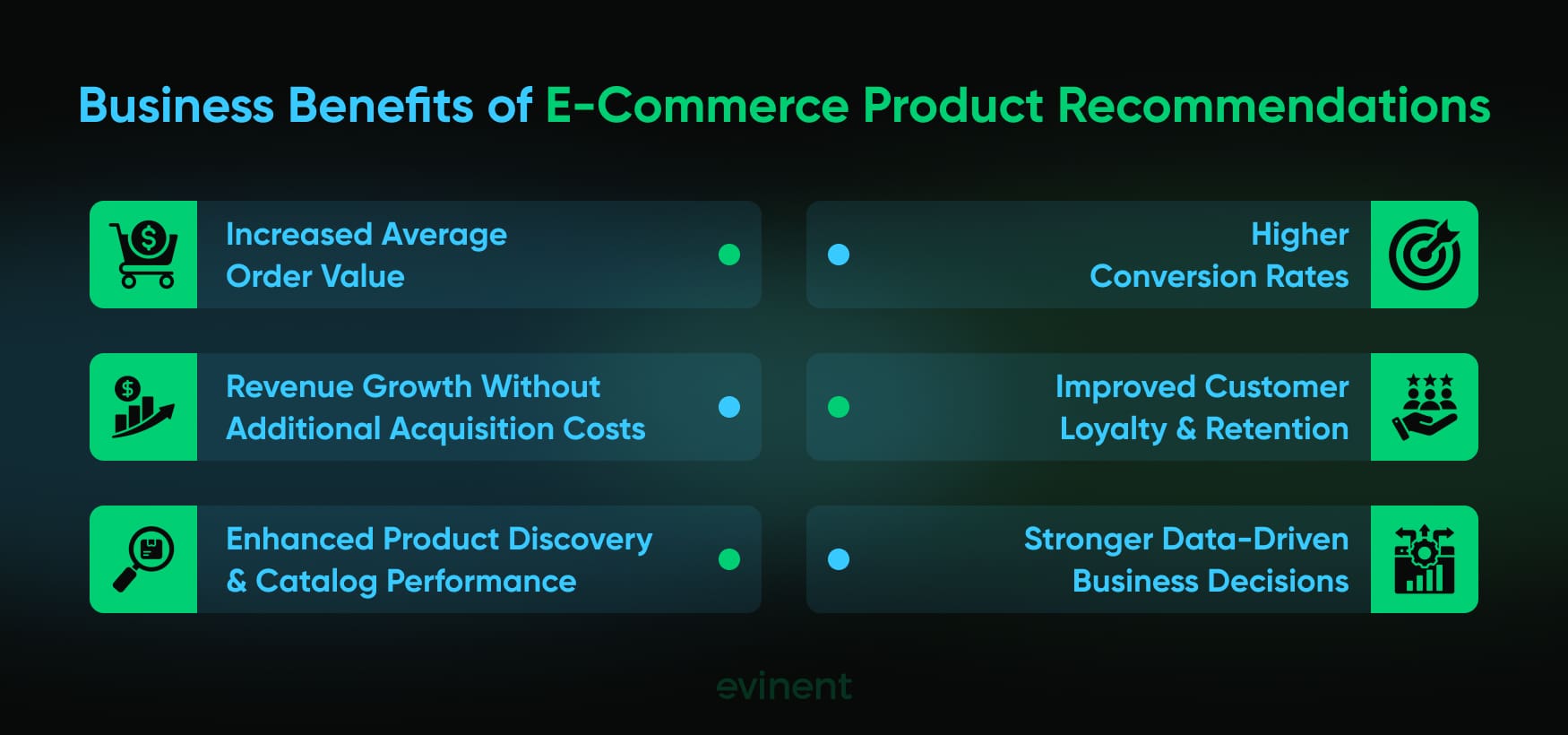
Increased Average Order Value (AOV)
Product recommendations drive up-sell and cross-sell by suggesting complementary or higher-value products. Blocks like “Frequently bought together” or “You may also like” encourage customers to add more items to their cart, increasing the total order value without disrupting the shopping experience.
Higher Conversion Rates
Relevant recommendations are capable of effectively easing the customer's decision-making process. They allow customers to quickly locate the right product, experience a lesser degree of choice overload, and have a higher level of confidence in their purchase decisions. Consequently, both product pages and entire sessions see a higher conversion rate.
Revenue Growth Without Higher Acquisition Costs
Product recommendations, on the other hand, monetize existing traffic instead of relying on paid channels. They are able to increase the average revenue per visitor through the use of behavioral and transactional data, thus enabling companies to expand their sales without the need to increase their marketing budgets.
Improved Customer Loyalty and Retention
Personalized recommendations make shopping feel tailored rather than generic. When customers consistently see relevant offers, they are more likely to return, buy again, and build long-term relationships with the brand, increasing customer lifetime value.
Better Product Discovery and Catalog Performance
In the case of extensive product catalogs, a sizable proportion of goods tend to remain unobserved. Recommendation engines bring to the surface not only topically relevant but also long-tail and niche items that customers, without the engine's help, would hardly find through search or navigation, thus leading to increased catalog usage and faster inventory turnover.
Stronger Data-Driven Business Decisions
Recommendation systems transform user behavior into actionable insights. The collected data helps businesses understand customer preferences, demand patterns, and trends, supporting smarter merchandising, pricing, and marketing strategies.
Product recommendations in e-commerce have evolved from just being an add-on feature to becoming an essential driver of business growth. By leveraging existing customer and traffic data, they impact major metrics like average order value, conversion rate, customer retention, and overall revenue generation efficiency.
By guiding shoppers toward relevant products at the right moment, recommendation systems reduce friction, improve product discovery, and create more personalized shopping experiences. Over time, this leads to stronger customer relationships, higher lifetime value, and a sustainable competitive advantage in increasingly crowded e-commerce markets.
For modern online retailers, investing in effective product recommendation ecommerce is no longer optional. It is a strategic decision that connects data, technology, and user experience to drive measurable and long-term business results.
Where and When to Show Recommendations
How effective your product recommendations are depends on what you recommend and also on where and when you show those recommendations. Customer journey stages demand a change in recommendation logic and objectives — starting from discovery and inspiration, through conversion, and finally to order expansion. Sense placement makes it so that recommendations are helping user intent rather than leading to a distraction.
Below are the key touchpoints across the e-commerce funnel where product recommendations deliver the highest impact.
Homepage Recommendations
The homepage is often the first interaction point, especially for returning visitors. Recommendations here focus on discovery and personalization, helping users quickly see products aligned with their interests. Common use cases include recently viewed items, personalized product selections, trending products, or recommendations based on past behavior.
Category and Listing Pages
On category pages, recommendation sections support users in narrowing down their selection without getting out of the browsing flow. Such e commerce recommendations may feature popular products, substitutes, or items suitable for users' browsing behavior thus increasing engagement and decreasing bounce rates while users are looking through extensive catalogs.
Product Page Recommendations
Product pages are one of the most valuable locations for recommendations. Suggestions such as similar products, complementary items, or alternatives help users compare options, discover add-ons, and move closer to a purchase decision. This placement directly supports both conversion and upsell strategies.
Cart Page Recommendations
Cart page recommendations are primarily aimed at raising the value of the order rather than at product discovery. Cross-sell suggestions, accessories, or frequently bought together products are used to customers to include the items that match their purchase before the checkout without breaking the purchase flow.
Checkout and Post-Purchase Recommendations
Recommendations at checkout should be few and very relevant so as not to cause friction. Recommendations post-purchase can be used to suggest related products for the next order, subscription, or replenishment, thus assisting repeat purchases and long-term engagement.
Search Results and Zero-Result Pages
When users search, recommendations can complement results by highlighting relevant products, popular alternatives, or personalized suggestions. On zero-result pages, recommendations prevent dead ends by guiding users toward relevant categories or products.
Scattering product recommendations strategically throughout the consumer journey allows them to be in line with the user's needs at every phase—from the first discovery to the final buying and even the continuation, thus enhancing both customer experience and business results greatly.
Personalization Techniques That Turn Browsers Into Buyers
Personalization transforms product recommendations into a source of revenue growth by making them more suitable to individual user behavior, intent, and context. The best personalization tactics emphasize relevance, timing, and constant learning through user interaction.
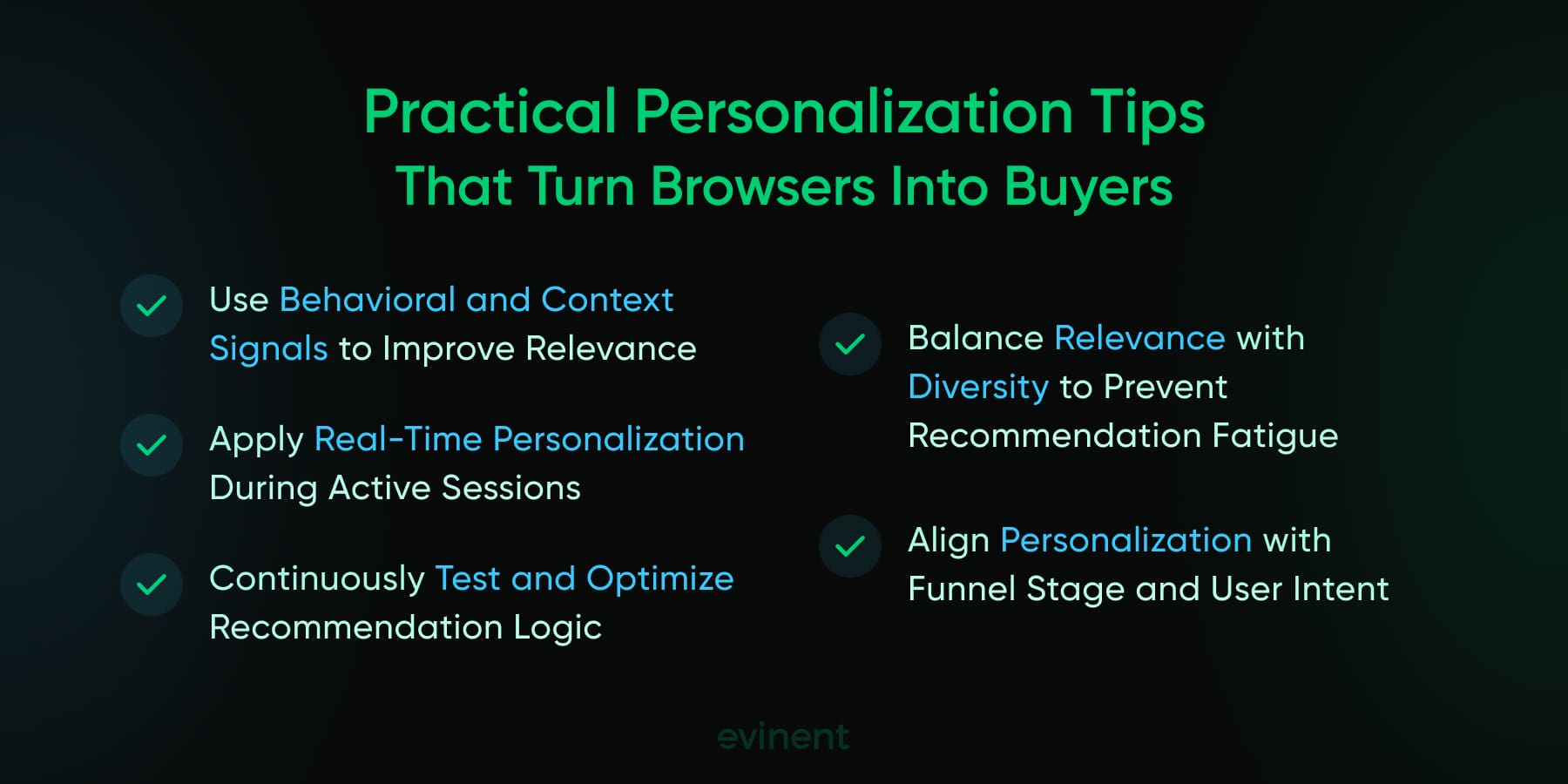
Behavioral and Contextual Relevance
Personalization starts from an analysis of the user's behavior and context. A user's clicks, views, searches, purchase history, device type, and session signals are all indicators of which products the user would be interested in at that moment. By taking into account the user's current context, the system can not only filter out irrelevant products but also strongly point users toward the products that would satisfy their present needs.
Real-Time Personalization
Static recommendations quickly lose effectiveness. Real-time personalization updates recommendations instantly based on current user actions, such as newly viewed products or shifts in browsing patterns. This keeps recommendations aligned with evolving intent and increases engagement during active sessions.
Continuous A/B Testing and Experimentation
Effective personalization depends heavily on continuous experiments. Trying out different algorithms, placements, recommendation logics, and presentation styles helps companies figure out what really converts and generates revenue. Ongoing A/B tests keep the game from getting stale and make sure the recommendations follow the changes in user behavior.
Recommendation: Diversity and Fatigue Prevention
If a brand keeps presenting the same products over and over again, people might stop engaging and lose trust in the brand. Introducing diversity into recommendations helps avoid overexposure, supports recommended product discovery, and keeps the experience fresh. Balanced personalization aims at combining relevance with variation in such a way that the user does not get tired of the recommendations.
Timing and Funnel-Aware Personalization
Different stages of the customer journey require different ecommerce recommendation goals. Early-stage users benefit from discovery-focused recommendations, while cart and checkout stages require high-confidence cross-sell suggestions. Funnel-aware personalization ensures recommendations support the user’s decision-making process rather than disrupt it.
Personalization makes the product recommendations relevant, timely and effective. When the recommendations are in agreement with a user's behavior, context and intent, they eliminate the buying process friction and thus, directly influence the conversions and revenue.
If e-commerce businesses treat personalization as a continuous, data-driven process, they will be able to improve their performance over time, deepen their customer relationships and keep a competitive advantage.
High-Performing Product Recommendation Strategies Used by Leading E-commerce Brands
Leading retail brands sell online use smart recommendation systems that blend personalization, data, and context to effectively increase customer engagement and sales. The following are real, extensively documented instances of the strategies of the leading brands.
1) Amazon’s Predictive Personalization
Amazon integrates its recommendations everywhere, such as homepages, search results, product pages, and even checkout. Its system forecasts which products each user will probably buy from their browsing histories, purchase histories and behavior patterns. (Forbes, 2025)
2) Item-to-Item Collaborative Filtering
Amazon’s “Customers who bought this also bought” and “Customers who viewed this also viewed” suggestions are two typical instances of item-to-item collaborative filtering. This method takes advantage of real purchase and browsing patterns to offer the most suitable products, thus enhancing the relevance without a necessity for extra user input.
3) Hybrid Recommendation Systems
Hybrid methods refer to a mix of collaborative filtering and content-based filtering. Companies employ this tactic to merge the patterns of users' behaviors with the features of products in order to generate more precise recommendations. Although Netflix mainly uses these techniques to suggest movies, nowadays the hybrid systems are being used more and more in online shopping to enhance personalization and lower the issue of no initial data. (Research Gate, 2025)
4) Email and Omnichannel Triggered Recommendations
Some brands take their recommendations beyond the website and even into emails and push notifications. Triggered campaigns—like follow-ups for an abandoned cart or products that were viewed—these combine web personalization with retargeting to increase engagement and sales.
5) Loyalty-Segment Driven Recommendations
Advanced e-commerce brands segment their audience and customize recommendations based on customer type. New users see popular or trending products, repeat buyers receive personalized picks based on past purchases, and VIP customers are offered premium or exclusive products.
These examples demonstrate that effective product recommendations combine algorithms with a business product recommendation strategy and user understanding. Successful e-commerce companies use a mix of personalization, real-time data, segmentation, omnichannel triggers, and hybrid models to turn browsing into purchases while building long-term customer loyalty.
Designing High-Converting Recommendation UI: Widgets, Layouts, and Display Formats
Designing a high-converting recommendation UI is a process, not a one-time design decision. It combines user intent, visual hierarchy, timing, and continuous optimization to ensure recommendations feel helpful rather than intrusive. The goal is to integrate recommendations naturally into the shopping experience while maximizing engagement and conversion.
Below is a structured view of the recommendation UI design process used in effective e-commerce systems.
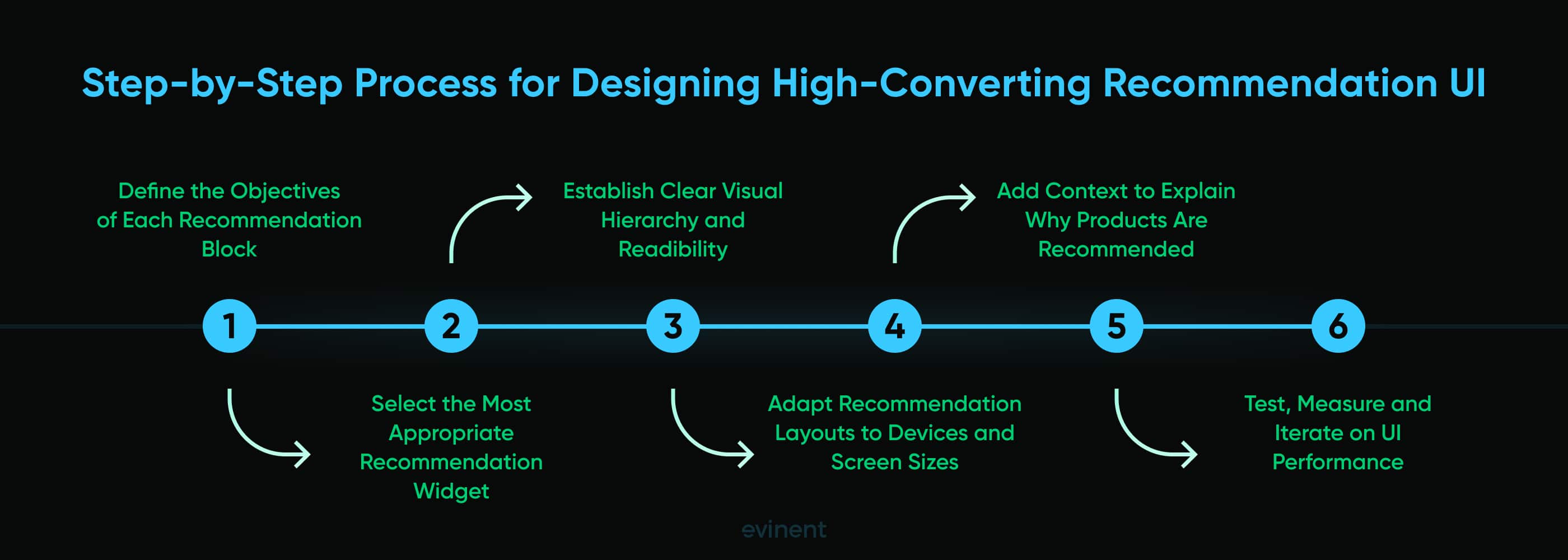
1) Defining the Goal of Each Recommendation Block
The design process starts with defining why a recommendation is shown at a specific point. Homepage widgets focus on discovery, product pages on comparison and upsell, and cart pages on increasing order value. Clear goals prevent overloading users with irrelevant suggestions and guide decisions about layout and content.
2) Choosing the Right Widget Type
Different types of widgets are used for different things. Carousels are great for discovery, static grids are best for comparison, and compact horizontal lists are ideal for cart or checkout pages. The widget type should align with both the context and the user's cognitive load at that point in the funnel.
3) Designing for Visual Hierarchy and Clarity
Recommendations should support the main page content, not compete with it. Proper spacing, typography, image size, and call-to-action placement help users quickly understand what is recommended and why. A clean visual hierarchy increases interaction without distracting from the primary conversion goal.
4) Adapting Layouts to Devices and Screen Sizes
Recommendation UI with high conversion rate should be completely responsive. For mobile layouts, items should be reduced, touch targets made bigger, and navigation simplified, whereas desktop layouts are able to provide richer comparisons. Device-aware design maintains consistent usability across channels.
5) Providing Context and Explanation
Users tend to respond more positively when they can grasp the reason behind the recommendation. Tagging shares such as “Recommended for you,” “Frequently bought together,” or “Similar items” not only increases clarity but also encourages trust. Contextual clues enable users to see recommendations not as advertisements but as a kind of assistance.
6) Testing and Iterating on UI Performance
Recommendation UI design is never final. A/B testing different layouts, widget sizes, item counts, and positions helps identify what drives clicks, conversions, and revenue. Continuous iteration ensures the UI evolves alongside user behavior and business goals.
Recommendation UIs with high conversion rates are typically the outcome of a purposeful and iterative design process. When e-commerce businesses sync their widget formats, layouts, and visual structure with user intent and funnel stage, they can not only boost engagement and conversion rates but also enhance the overall shopping experience significantly.
How to Continuously Improve Product Recommendation Performance
Recommendation systems for products provide great value over time only if they are regularly checked, fine-tuned, and adjusted for changing user behavior and business conditions. Enhancement is always a progressive activity that results from a mixture of data analytics, experiments, and the rigor of operational discipline and is not a single-time setup.
Below are key practices that help e-commerce businesses continuously improve recommendation performance over time.
1) Define Clear Success Metrics
Continuous improvement starts with clear and measurable KPIs. Common metrics include click-through rate (CTR), conversion rate, average order value (AOV), revenue per session, and engagement with recommendation blocks. Defining success metrics ensures optimization efforts focus on business impact rather than vanity metrics.
2) Run Ongoing A/B and Multivariate Tests
Constant experimentation should be a key part of your routine. By trial-testing different algorithms, recommendation logics, placements, layouts, and messaging, one can discover the actual factors that influence performance. Regular testing also helps keep the team from getting stuck in old ways and enables them to adjust recommendations in line with changing customer behavior and inventory.
3) Monitor Data Quality and Freshness
The precision of suggestions heavily relies on the quality and timeliness of the input data. To maintain a high level of trust and relevance, the consumer behavior data, product availability, pricing, and inventory updates should be accurate and in real-time. If the data is of low quality or old, the relevance and user trust will diminish very fast.
4) Incorporate Feedback and Performance Signals
User actions like clicking, buying, skipping and time spent are very good ways of giving feedback. Recommendation logics can be improved by using the feedback signals in the systems to learn what works and then adjusting the rankings, relevance, and diversity accordingly.
5) Optimize for Different Funnel Stages
Recommendation performance should be evaluated separately at different stages of the customer journey. Discovery-focused recommendations require different optimization strategies than cart or checkout recommendations. Funnel-aware optimization ensures recommendations support user intent at each step.
6) Balance Relevance, Diversity, and Business Rules
Over-optimizing for relevance alone can lead to repetitive or narrow recommendations. Introducing diversity, freshness, and business constraints—such as promoting new or strategic products—helps maintain engagement while still supporting commercial goals.
It is essential to have a solid, data-led approach to constantly enhance product suggestions. E-commerce companies that integrate well-defined metrics, continuous testing, top-notch data, and funnel-aware optimization can maintain product recommendations that are not only attractive and effective but also in harmony with the changing customer demands.
Product Recommendation Algorithms Explained: From Collaborative Filtering to AI Models
Product recommendations in the online retail sector are driven by various algorithmic solutions, each catering to a particular need for personalization or business objective. Since there is no universal algorithm that fits every situation, the majority of the platforms use a combination of different models.
Here is a table that outlines the primary recommendation algorithms, their mechanisms, and the situations in which they perform best:
Algorithm Type | How It Works | Key Advantages | Limitations | Best Use Cases |
|---|---|---|---|---|
Collaborative Filtering | Uses behavior patterns of similar users or items (views, purchases, clicks) to generate recommendations | High relevance, proven effectiveness, improves with scale | The cold-start problem requires sufficient interaction data | Large catalogs, returning users, “also bought / also viewed” blocks |
Content-Based Filtering | Recommends products based on the similarity of product attributes and user preferences | Works for new users, transparent logic, no dependency on other users | Limited discovery can become repetitive | Niche catalogs, personalized recommendations for logged-in users |
Hybrid Models | Combines collaborative and content-based approaches | Higher accuracy, reduced cold-start impact, balanced recommendations | Higher complexity, more data, and tuning required | Enterprise e-commerce platforms, large-scale personalization |
Rule-Based Recommendations | Uses predefined business rules (e.g. category, price range, margins) | Simple, predictable, easy to control | Low personalization, not adaptive | Promotions, seasonal campaigns, and new product launches |
Session-Based Recommendations | Uses real-time session behavior without relying on long-term history | Works for anonymous users, reacts to current intent | Limited long-term personalization | First-time visitors, short browsing sessions |
AI / Machine Learning Models | Applies machine learning or deep learning to predict user intent and preferences | Highly adaptive, scalable, and supports real-time personalization | High implementation cost, requires quality data | Advanced personalization, large traffic volumes, and enterprise systems |
Nowadays, most e-commerce platforms don't depend on only one recommendation algorithm. The best systems integrate several methods—trying to find a good balance between the personalization accuracy, scalability, and business control—to be able to propose relevant recommendations to different users, contexts, and stages of the customer journey.
How Evinent Helps You Build High-Performance Product Recommendation Systems
Simply picking algorithms or throwing in a few widgets is not enough to develop ecommerce product recommendation systems with great performance. One needs to consider many things, such as data architecture, scalable infrastructure, real-time decision logic, and a clear understanding of how users discover and decide on products. Evinent assists eCommerce businesses in designing and creating recommendation systems that are totally compatible with their data, scale, and business goals.
At Evinent, we cover all phases of the lifecycle of recommendation systems, from strategy and architecture to implementation, optimization, and evolution in the long term.
Why Choose Evinent
Evinent doesn’t just sell products in a box; we are a technology partner. Our expertise is in complex, high-load eCommerce systems where personalization and recommendations should deliver consistently at scale.
Our experience includes:
15+ years of software and analytics engineering for complex eCommerce platforms
20M+ active users interacting daily with recommendation, search, and decision systems we build
100% project delivery success rate, including large, multi-regional deployments
78% of our portfolio is focused on enterprise eCommerce across the US, EU, and MENA
This background provides us with the opportunity to create recommendation systems that are not only technically robust but also commercially successful.
Custom Recommendation Systems Built for Your Business
We design recommendation systems specifically for your catalog, users, and business model. This includes:
selecting and combining appropriate algorithms (collaborative, content-based, hybrid, real-time),
designing data pipelines and feedback loops,
implementing business rules, constraints, and personalization logic,
ensuring scalability, performance, and reliability under high traffic loads.
Every system is built to evolve as user behavior, inventory, and business priorities change.
Search as a Critical Signal for Recommendations (Our Practical Experience)
In many projects, site search becomes one of the strongest sources of user intent for recommendation systems. As part of our experience, we have built and evolved Evinent Search — a high-performance site search solution used in large-scale eCommerce environments.
This experience informs how we:
Capture real-time intent from search queries and interactions,
Use search behavior to improve recommendation relevance,
Handle zero-result scenarios with intelligent product suggestions,
Operate recommendation and discovery logic under high request volumes.
While Evinent Search is a concrete example of our work, the same principles are applied when we build custom search and recommendation systems from scratch for our clients.
By focusing on architecture, data quality, and adaptability, we help businesses turn product recommendations into a sustainable growth capability rather than a short-term feature.
Evinent helps eCommerce businesses build high-performance product recommendation systems tailored to their unique needs. Whether developing solutions from scratch or modernizing existing systems, we combine deep engineering expertise with practical experience to deliver scalable, data-driven personalization that drives long-term business results.

Key Takeaways
Product recommendations are a core growth mechanism in modern eCommerce, directly influencing conversion rates, average order value, customer retention, and revenue efficiency.
Effective recommendations combine multiple components: data quality, algorithm selection, UI design, personalization logic, and continuous optimization. No single element works in isolation.
The impact of recommendations depends heavily on where and when they are shown. Placement across the customer journey must align with user intent at each stage.
Personalization is an ongoing, data-driven process. Relevance, real-time adaptation, experimentation, and funnel-aware logic are essential to maintaining performance over time.
High-performing eCommerce platforms use multiple recommendation algorithms together, balancing collaborative, content-based, session-based, and AI-driven approaches to handle different scenarios.
Recommendation UI design is not cosmetic. Widget formats, layouts, and contextual explanations significantly affect engagement and conversion.
Continuous improvement requires clear metrics, reliable data pipelines, ongoing A/B testing, and feedback loops that allow recommendation systems to learn and adapt.
Intelligent search and recommendations work best as a unified product discovery system, where search behavior provides critical intent signals that strengthen personalization.
Building scalable recommendation systems requires solid architecture and engineering discipline, especially in high-load, multi-market eCommerce environments.
Successful recommendation systems are not off-the-shelf features but long-term capabilities that evolve with customer behavior, business goals, and market conditions.
Share