

What Is Retail Loss Prevention?
Retail loss prevention (LP) is all about a smart, well-organized plan that helps figure out where losses might happen, stop them, and lower the losses in all areas of the retail business, such as stores, distribution centers, supply chains, and digital channels. The major goal of loss prevention is to preserve the profit, safeguard the physical security, and protect the assets without detrimentally influencing the customer experience.
It is important to clearly distinguish loss prevention from related but not identical concepts:
Loss prevention in retail stores refers to preventive and strategic actions designed to stop losses before they occur through policies, technology, analytics, and employee training.
Loss control is a reactive function focused on managing and mitigating the impact of losses after an incident has occurred, such as investigations, recovery efforts, and corrective actions.
Asset protection is a broader discipline concerned with safeguarding people, property, inventory, and infrastructure. Loss prevention is a core component of asset protection, but it does not fully encompass it.
Today's retail stores regard loss prevention as a cross-functional business area, leveraging operations, security, data analytics, and organizational processes together, instead of merely isolating it as a security function.
How well a retail loss prevention program works is usually gauged through key performance indicators (KPIs). Here are two widely used instances:
Shrinkage rate — loss of inventory caused by theft, fraud, administrative errors, or operational failures, expressed as a percentage of total sales or the inventory value.
Case resolution rate — the percentage of cases of loss that were identified, thoroughly investigated, and ended with a successful outcome, including recovery, disciplinary action, or referral to law enforcement.
By using these KPIs, a retailer can assess the level of risk, measure the effectiveness of a program, and make informed decisions concerning strategy.
In this article, we will explore:
The common causes of retail loss and inventory shrinkage;
What is loss prevention in retail strategies and best practices used by modern retailers?
The role of technology and loss prevention software solutions
Physical security measures and effective store layout design;
Employee training, organizational structure, and role accountability;
The importance of audits, assessments, monitoring, and external collaboration;
Real-world examples and case scenarios from retail environments.

Strategic Partnerships and External Expertise in Loss Prevention
Thescope of retail loss prevention services has been widened to include threats that not only come from the stores and internal teams, but also from beyond them. Externally, theft, organized retail crime, and complex fraud schemes often operate across several locations, channels, and jurisdictions, making them hard to find and sort using the resources of the house.
Strategic collaboration with law enforcement agencies, external investigators, auditors, fraud professionals, and specialized third-party providers enables retailers to expand investigative reach, improve evidence quality, and respond more effectively to high-impact loss events. When properly integrated, external expertise not only supports internal investigators but also directly contributes to higher case resolution rates and more resilient loss prevention programs.
Area of Collaboration | Who Is Involved | Primary Purpose | Impact on Loss Prevention |
|---|---|---|---|
Law Enforcement Cooperation | Law enforcement agencies, organized retail crime teams | Investigation of large-scale shoplifting and ORC cases | Higher case resolution rates and disruption of repeat offenders |
External Investigations | External investigators, fraud professionals | Independent analysis of complex or sensitive cases | Reduced bias, improved evidence quality |
Audit and Compliance Support | External auditors | Identification of process gaps and policy violations | Lower administrative errors and inventory shrinkage |
Third-Party Loss Prevention Services | Third-party professionals, security consultants | Scalable expertise and specialized knowledge | Faster deployment of advanced loss prevention measures |
Technology and Security Partners | Security technology providers | Deployment and optimization of LP technologies | Improved detection, monitoring, and incident response |
Cross-Organizational Intelligence Sharing | Internal investigators + external partners | Pattern recognition across locations and regions | Early identification of organized theft and fraud schemes |
External collaboration takes the internal loss prevention efforts one step further by adding more eyes, know-how, and power to enforce beyond the internal ones. Those retailers who really bring in and use third-party help in their loss prevention plan are the ones most capable of dealing with external, theft, organized retail crime situations, and complex fraud that only full in-house teams cannot quite handle.
Key Causes of Retail Loss and How to Prevent Them
Reducing retail losses can be most efficiently achieved by first exploring each reason and then addressing it with a specific preventive measure. Besides considering shrinkage as one problem only, retailers need to figure out how various loss drivers come about—and which loss prevention strategies in retail are therefore suited to each loss type. Here are the typical causes of retail loss and the prevention methods that are commonly used for them.

Shoplifting and Organized Retail Crime
Cause:
External theft varies from simple shoplifting by an individual who just happens to be there to a more serious organized retail crime with criminal groups, repeat offenders, and networks for reselling the stolen goods. In many cases, these actions take advantage of the fact that stores have predictable layouts, inadequate staffing, and defences against theft that are not very strong in real-time detection.
Prevention approach:
Retailers neutralize most of the threats through installing a range of security measures, such as a combination of visible deterrents, surveillance technologies, exception-based reporting, and also work closely with organized retail crime teams and law enforcement agencies.
Internal Theft and Unauthorized Access
Cause:
Employee theft and misuse of access privileges may result in hidden inventory losses, fraudulent transactions, and data manipulation. Weak role-based access control and insufficient monitoring further increase the risk.
Prevention approach:
Preventive measures involve background investigations, implementation of stringent access control policies, division of duties, monitoring of transactions, and regular training for loss prevention which emphasis on responsibility and high ethical standards.
Administrative Errors and Pricing Mistakes
Cause:
Incorrect data entry, pricing discrepancies, and system mismatches between POS and inventory platforms result in inventory inaccuracies that contribute to shrinkage without any criminal activity.
Prevention approach:
These issues are reduced through standardized procedures, automated data validation, POS integration, regular audits, and analytics tools designed to flag anomalies and inconsistencies early.
Inventory Mismanagement and Operational Errors
Reason:
Counting mistakes, inefficient restocking, and receiving, stocking, and returns errors lead to a discrepancy between the physical stock and the records in the system.
How to prevent:
Retailers solve these problems by using inventory management systems, RFID tracking, cycle counting, and well-defined workflow, along with accountability at each operational handoff.
Delivery, Logistics, and Vendor Fraud
Cause:
Losses may occur during transportation, warehousing, or supplier interactions due to weak delivery controls, incomplete verification, or intentional vendor fraud.
Prevention approach:
Mitigation strategies include delivery verification processes, secure logistics workflows, third-party audits, inventory reconciliation, and tighter controls over vendor access and documentation.
Suspicious Transactions and Process Abuse
Cause:
Fraudulent returns, refund abuse, and exploiting the policy loopholes seem to be isolated incidents; however, when these events are not actively monitored, they stack up and result in huge losses.
Prevention approach:
By using exception-based reporting, transaction analytics, and real-time s, as well as having clearly defined and enforced returns policies, it is possible to recognize suspicious behavior and thereby reduce the financial harm that can result over time.
Analysing the connection between specific loss causes and corresponding preventive measures helps the development of a loss prevention program to be effective from its very inception. In the following part, we have a look at loss prevention strategies that pair the best practices that bring these measures to frameworks at the scale of whole companies.
Loss Prevention Software Solutions
Modern retail loss prevention focuses on using integrated software platforms that combine data, monitoring, and response workflows from both physical and digital environments.
In contrast to single tools, loss prevention software solutions offer centralized visibility into the incidents, transactions, inventory movement, and security events, which allows quicker detection and more regular decision-making. These platforms help to decrease shrinkage, provide assistance to the investigation process, and expand the loss prevention capacity across a number of locations.
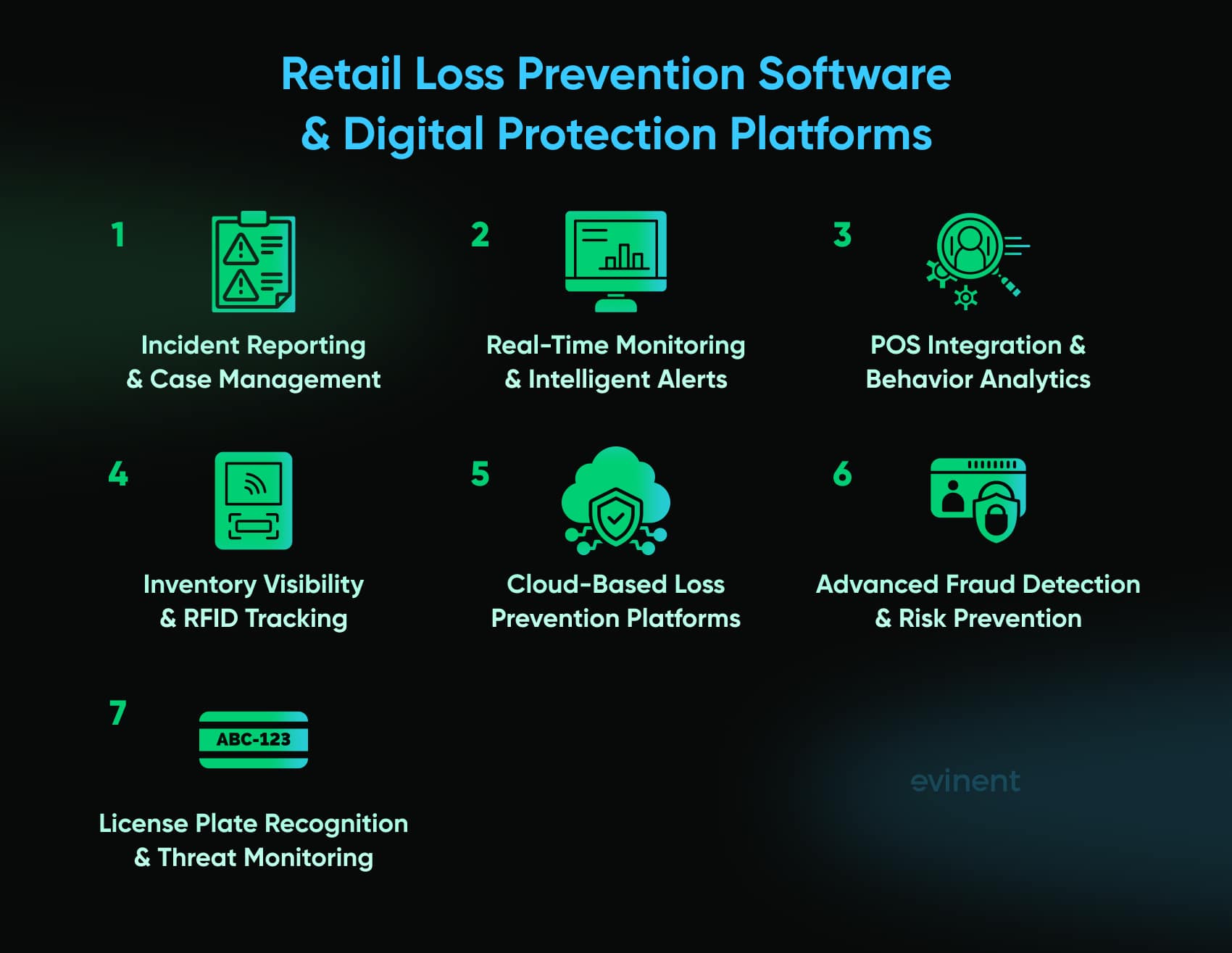
Incident Reporting and Case Management
Centralized incident reporting allows retailers to document theft, fraud, and policy violations in a consistent format. Integrated case management workflows support evidence collection, collaboration between internal investigators, and structured escalation, including data sharing with law enforcement agencies when required.
Real-Time Monitoring and Automated s
Real-time monitoring integrates continuously updated data from outlets, systems, and sensors to immediately recognize deviations. With automatic s, security teams get informed of unexpected customer behavior, unusual transaction patterns, or security violations in such a way that the reaction time is shortened and the possible damages are minimized.
POS Integration and Transaction Analytics
POS integration makes it possible to have transaction-level visibility for sales, returns, and refunds. With the help of data analytics and reporting tools, retailers can spot exception patterns, suspicious transactions, and fraud indicators that would be difficult to notice in high-volume environments.
AI Video Analytics and Visual Intelligence
AI video analytics enhances traditional surveillance by detecting behavioral patterns associated with theft, internal misconduct, or unauthorized access. When combined with security cameras and access control systems, video intelligence provides actionable insights rather than passive footage.
Inventory Tracking and RFID Technologies
Inventory tracking software improves visibility into stock movement from receiving to point of sale. RFID tags support accurate counts, faster reconciliation, and early detection of inventory discrepancies, helping reduce inventory shrinkage caused by misplacement, theft, or process errors.
Cloud-Based Management Platforms
Cloud management platforms centralize loss prevention operations across multiple locations. They enable scalable deployment, remote access, consistent policy enforcement, and seamless updates without the limitations of on-premise infrastructure.
Advanced Fraud Detection and Prevention
There are specialized fraud detection tools that scrutinize behavior records, transaction history, and past data to recognize refund abuse, return fraud, and misuse of the policy. Such systems help in foreseeing and preventing the problem by detecting the high-risk area that is generating losses even before it gets out of hand.
License Plate Recognition and External Threat Tracking
License plate recognition (LPR) technologies help in identifying a vehicle of a suspect or an offender who had committed a crime at a certain store, and such identification can be made even when the vehicle is not in the store. If Attachment Loss Prevention Software, LPR can aid in the analysis of the pattern and can also be a point of collaboration with external partners and law enforcement.
Loss prevention software solutions serve as the operational backbone of modern retail security and loss prevention programs. By integrating incident reporting, real-time monitoring, transaction analytics, inventory tracking, and fraud detection into a single environment, retailers gain the visibility and control needed to address both internal and external loss drivers at scale.
When effectively implemented, these platforms not only reduce inventory shrinkage but also improve case resolution, support collaboration with external partners, and enable data-driven loss prevention strategies. As retail environments grow more complex, centralized and intelligent software solutions become essential for sustainable loss prevention performance.
Loss Prevention Roles Across the Retail Organization
Retailers who want to prevent losses most effectively should have a clear definition of roles along with specific responsibilities for each level of the organization. When tasks are clearly delineated from the execution of the store-level to the oversight of the executive, retailers gain stronger accountability, quicker incident response, and more reliable safeguarding of their inventory and assets.
In-Store Loss Prevention Roles
LP Associate/In-Store Agent
Responsible for carrying out front-line activities in loss prevention. This includes regularly checking high-risk areas, spotting possible shoplifting or internal theft, helping with incident report and making sure store-level loss prevention procedures are followed.
Investigation and Case Management Roles
Investigator/Internal Investigator
He deals with the departments that investigation of internal theft, fraud, and organized retail crime. His/her responsibilities are the collection of evidence, writing of reports, working with the organizers of retail crime, and liaising with law enforcement on cases where the involvement is necessary.
Regional and Operational Management Roles
Regional LP Manager
This position is responsible for the overall loss prevention management at multiple stores or within the whole region. It involves making sure policies are followed uniformly, keeping an eye on performance metrics, continuously updating loss prevention action plans, and mobilizing resources according to the risk profile of the region.
Risk and Enterprise Governance Roles
Risk Manager / Enterprise Risk Manager
The main focus is on the overall risk exposure of the enterprise through the integration of loss prevention into broader risk management frameworks. Collaborates with teams responsible for inventory security systems, audits, and operational leadership to coordinate loss prevention efforts with compliance and financial controls.
Executive Leadership Roles
Director of Safety and Security
Defines strategic loss prevention priorities, oversees security technologies, and ensures alignment between physical safety, asset protection, and operational requirements.
Vice President of Operations, Loss Prevention and Risk
Provides executive oversight of loss prevention strategy, investment decisions, and cross-functional coordination. Ensures that loss prevention supports business performance, scalability, and long-term risk reduction.
Organizational Coordination and Systems
Shared will be the coordination, transparency, and data-driven decision-making in the incident reporting and management systems among all roles. A crisp ownership of inventory security systems and reporting workflows undoubtedly guarantees regular performance and accountability.
A well-defined loss prevention organizational structure transforms loss prevention from a reactive function into a scalable, accountable business capability. By assigning clear responsibilities to specific roles and aligning them through shared systems and governance, retailers can improve incident response, increase case resolution rates, and sustain long-term reductions in inventory shrinkage.
Real-World Loss Prevention Case Studies in Retail
Retailers around the world are deploying advanced technologies and systematic strategies to reduce shrinkage, improve inventory accuracy, and enhance asset protection. Below are select real-world examples that demonstrate measurable results from specific retail loss prevention software.
AI-Driven CCTV and Video Analytics Reducing Shrinkage
It has been demonstrated by retailers who have used AI-driven video analytics that their inventory loss problems were drastically solved. For example, a top retail brand using AI-powered security cameras that detect suspicious behavior patterns in real time managed to reduce shrinkage by nearly 30% over a year.
Some implementations of advanced analytics even achieved up to a 70% reduction in shrinkage compared to traditional surveillance methods. Moreover, such systems have also bolstered employee accountability as well as operational visibility. (Facit, 2025)
Walmart AI-Powered Self-Checkout Loss Detection
Walmart implemented an AI-based surveillance system developed with Everseen to monitor self-checkout lanes and automatically identify instances where items were not scanned or scanned incorrectly. The system flags suspicious behavior in real time, enabling staff intervention before loss occurs. Within the first year of deployment in targeted locations, Walmart reported approximately 20 % reduction in shrinkage linked to self-checkout fraud and scan errors. (Research Gate, 2025)
Macy’s RFID Deployment for Inventory Visibility and Loss Phases
Macy's has further increased the use of RFID tagging in high-theft areas like cosmetics and electronics. Besides that, Macy's gains visibility into the items leaving the store without being purchased by reading RFID tags at the store exits and combining the data with inventory systems.
The company's top management expressed that RFID has been very impactful in improving inventory accuracy and loss prevention. In fact, alongside lost sales, the retailer can now identify with great accuracy and thus prevent and shrink retail loss prevention events, and the patterns of these events which were previously undetectable. (Rfid Journal, 2024)
Evinent Analytics — Fraud and Risk Analytics for Loss Prevention
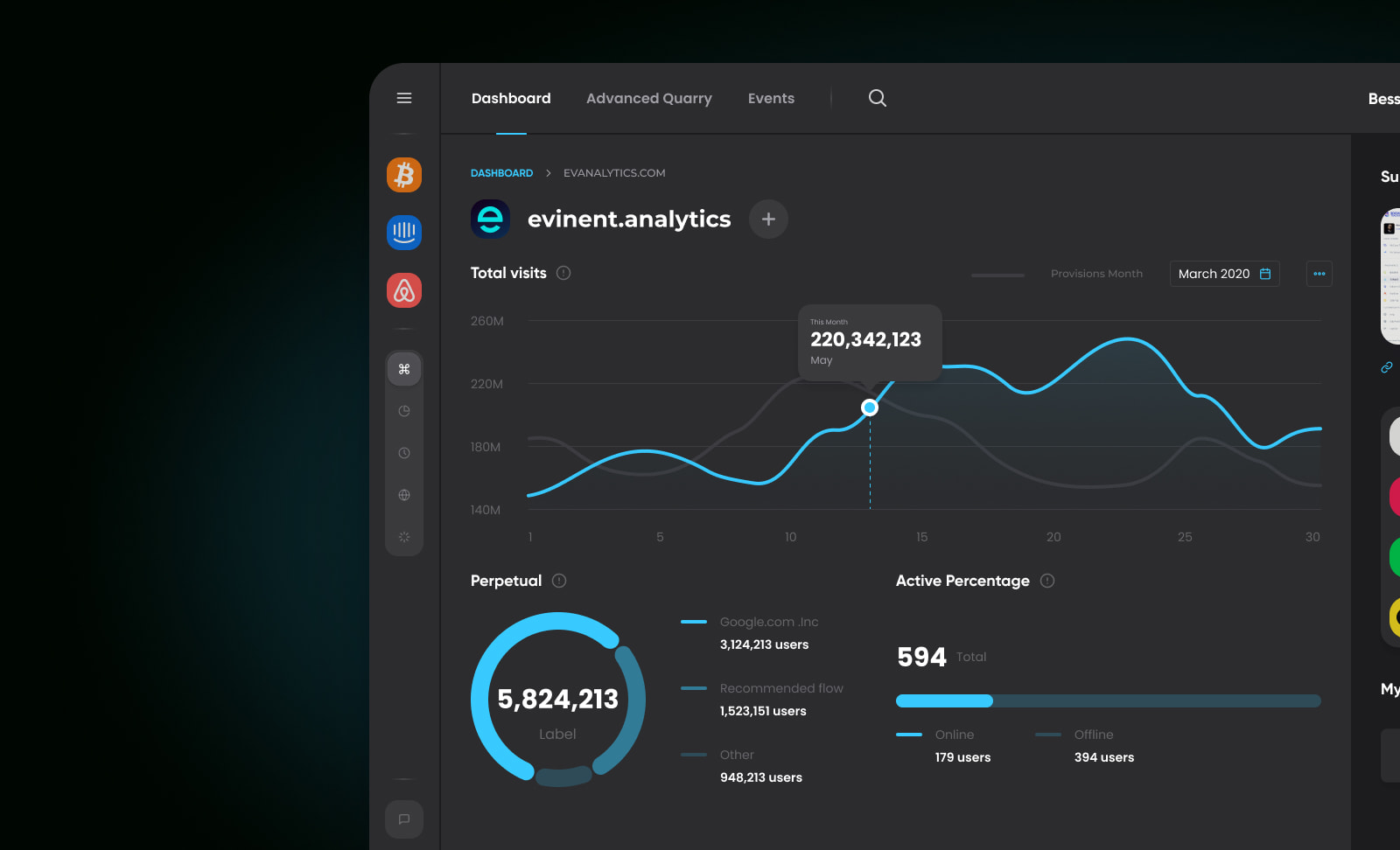
Evinent Analytics supports retail loss prevention by analyzing transactional and behavioral data to detect fraud signals, suspicious purchasing patterns, and policy abuse before they result in financial loss. The platform enables exception-based reporting and risk-focused analytics, helping retailers proactively address issues such as fraudulent returns, refund abuse, and other forms of digital loss in e-commerce and omni-channel environments.
By integrating data from e-commerce platforms, CRM, ERP, and accounting systems, Evinent Analytics provides a consolidated view that strengthens preventive decision-making without replacing existing loss prevention systems.
These case studies prove that loss prevention is effective when different components like technology, data, and systems work together. Major retail markets in all continents have witnessed that leveraging AI video analytics, RFID systems, and exception-based reporting can lead to a significant drop in shrinkage, better operational visibility, and a more impactful loss prevention program.
In fact, each of the instances demonstrates how technology supports strategy to a greater extent, rather than taking it over, and thus empowers teams to spot, look into, and solve in the moment the causes of loss. The proper deployment of the technologies, along with the tracking of progress through key performance indicators, should never be under-estimated and are indeed necessary for the achievement of long-term success.
Key Technologies Supporting Retail Loss Prevention
Technology plays a central role in the modern strategies used for loss prevention to deter theft, identify suspicious behavior, and enhance the speed of responses. Not only are the latest technological retail loss prevention solutions helping retailers to cut down on shrinkage and safeguard their assets, but they are also providing them with real-time insight into their risk levels in both their physical and digital environments.
Core Loss Prevention Technologies and Their Purpose
Technology | Purpose in Loss Prevention |
|---|---|
AI Video Analytics | Detects suspicious behavior, loitering, concealment, and unusual movement patterns using automated video analysis. |
Smart CCTV/IP Security Cameras | Provides continuous visual monitoring of stores, entrances, exits, and high-risk areas for deterrence and evidence collection. |
Video Security Software | Centralizes video review, incident tagging, and investigation workflows to support faster case resolution. |
Electronic Article Surveillance (EAS) Devices | Prevents shoplifting by triggering alarms when tagged merchandise exits the store without deactivation. |
RFID Tags | Enables real-time inventory tracking, improves stock accuracy, and helps identify inventory shrinkage points. |
POS Systems Enhancements | Identifies suspicious transactions, refund abuse, and cashier fraud through transaction monitoring and analytics. |
Role-Based Access Control | Restricts access to sensitive areas and systems based on employee roles, reducing internal theft and unauthorized entry. |
Real-Time Sensor s | Provides instant notifications for forced entry, unauthorized access, or after-hours activity. |
Cloud-Based Management Systems | Centralizes security data, video feeds, s, and reports across multiple locations for scalable loss prevention management. |
Intelligent Loss Prevention Systems | Combines video, transaction data, and analytics to enable proactive detection and coordinated response to loss events. |
Retail loss prevention technology has become an essential part of today's retail loss prevention. Tools like CCTV, RFID, POS monitoring, and access control systems might not be able to stop losses by themselves, but they certainly help a lot in improving the overall visibility, consistency, and speed of response throughout the retail operation.
The biggest difference is made when these technologies are used as one integrated loss prevention ecosystem, where video data, transaction analytics, and real-time s combine their strengths to help make the best decisions. Properly involved with thoroughly written processes and well-educated personnel, technology turns loss prevention into a firm, steady, and measurable business skill rather than reactionary function.
Monitoring, Audits, and Risk Assessment in Loss Prevention
Regular audits, structured risk assessments, and continuous monitoring help firms to identify their weaknesses and areas of vulnerability, validate their controls, and ensure that the operating level continuously adheres to the loss prevention policies. Such activities are different from one-time security measures in that they create an ongoing feedback loop that enables retailers to identify problems early and change their strategies before the losses become high.
Inventory Audits
Inventory audits are essential to find the differences between the stock levels that are recorded and the actual ones. Both scheduled and surprise audits are a great way of spotting the shrinkage patterns and procedural loopholes as well as the identifying the internal theft issues, thus they can serve as a solid foundation for taking corrective actions.
Risk Assessments
Risk assessments evaluate exposure across stores, warehouses, and supply chain environments. By analyzing threat vectors, historical incidents, and operational weaknesses, retailers can prioritize high-risk areas and allocate loss prevention resources more effectively.
Real-Time Monitoring
Real-time monitoring combines security camera systems, inventory tracking, and AI analytics to detect anomalies as they occur. This enables faster incident response and reduces reliance on post-incident investigations.
Automated Reporting and Analytics
Automated reporting and data analytics tools consolidate audit results, incident reports, and monitoring data into actionable insights. These systems improve transparency, support compliance tracking, and reduce manual reporting errors.
Internal and External Audits
Internal audits verify whether the company follows its own policies or not. On the other hand, external auditors examine controls and procedures from an independent perspective and provide validation. The two types of audits together make the company accountable and help it to pursue continuous improvement.
Audits, assessments, and ongoing monitoring are key elements that shape the control backbone of a comprehensive loss prevention program. These tools turn individual incidents into identifiable patterns, provide the basis for data-driven decisions, and make sure that the methods employed to prevent losses are always in line with the actual risks. Coupled with analytics and automation, these measures help retailers transition from a reactive loss detection approach to a more proactive and organized risk management one.
Physical Security Controls and Store Layout Design
Physically securing the premises and thoughtful store layout designs are very significant in decreasing theft, raising store visibility, and aiding frontline loss prevention team members. Synchronizing security facilities and layout concepts not only discourages crimes of opportunity but also enables the employees to spot unusual behaviors at an early stage.
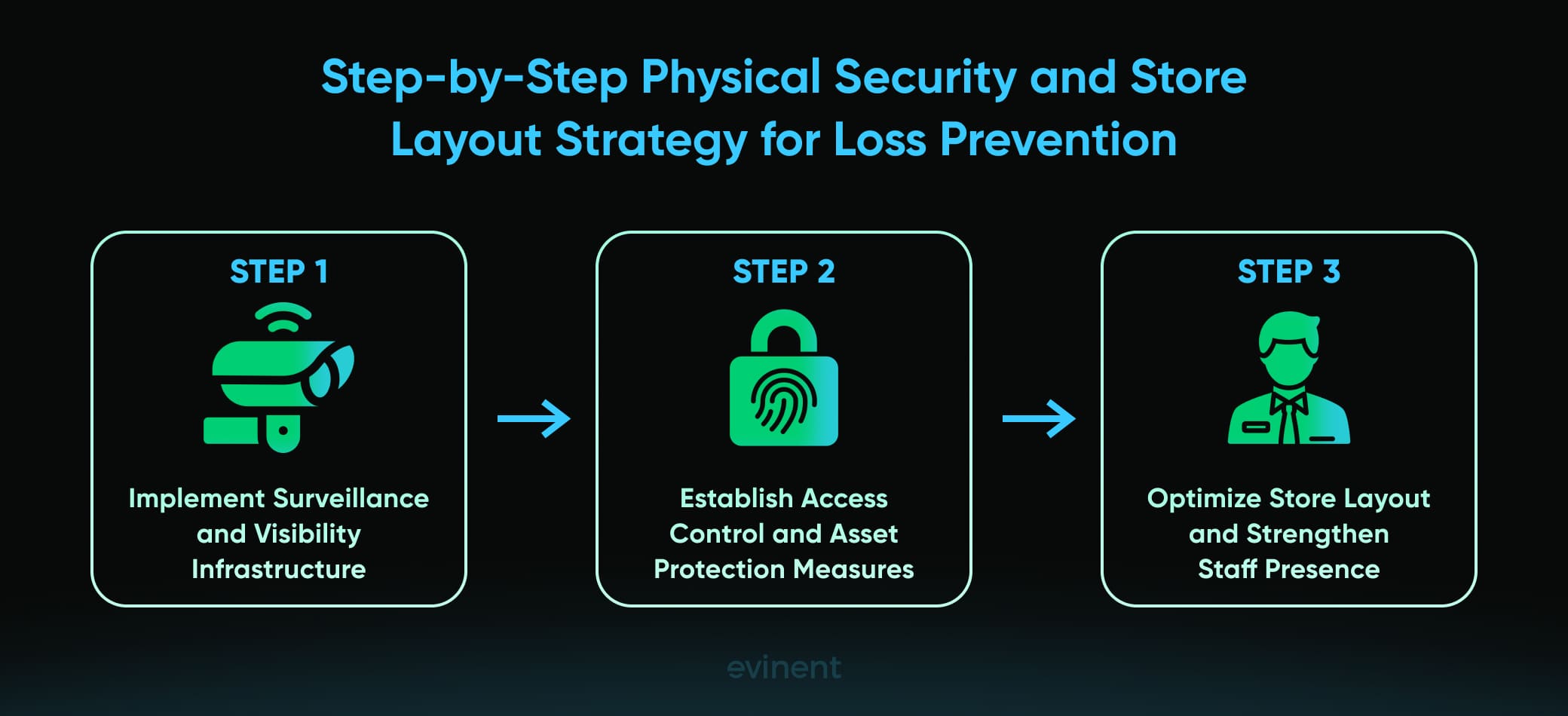
Surveillance and Visibility Controls
Security cameras, AI video analytics, and corner mirrors increase visibility across high-risk areas such as entrances, self-checkout zones, and high-value product displays. Clear sightlines reduce blind spots and enhance both deterrence and incident detection, while visible security signage reinforces the perception of active monitoring.
Access Control and Asset Protection
Access control systems restrict entry to stockrooms, offices, and receiving areas, limiting unauthorized access and reducing internal theft risks. Technologies such as RFID tags and electronic article surveillance (EAS) devices provide an additional layer of protection by monitoring item movement and triggering s when theft attempts occur.
Store Layout and Staff Presence
A carefully planned store layout contributes to loss prevention strategy in many ways: it directs customer flow, places high-risk products in locations that are visible to staff, and facilitates good staff coverage. Besides, the presence of trained security personnel and sales staff enhances deterrence and makes it possible to deal with any suspicious activity immediately.
When we talk about preventing crime, effective physical security and store layout design are the two main things that go hand in hand. With the help of surveillance technologies, controlled access, and layout best practices, retailers can limit the opportunities for theft, increase their response time, and generally strengthen their protective measures without compromising customer experience.
Employee Training and Organizational Governance in Loss Prevention
Of course, a lot of the work in loss prevention is to be done with helping technology and good procedures, as well as well-trained, responsible, and engaged employees. Good organizational practices that encourage employees to be watchful, honest, and follow the rules will go a long way in reducing shrinkage and operational risk.
1. Comprehensive Training Programs
Employees receive structured training to identify suspicious behavior, follow proper procedures for high-risk activities, and respond appropriately to incidents. In-store programs, simulations, and step-by-step instructions ensure that staff understand loss prevention policies and retail loss prevention best practices in their daily operations.
2. Clear Policies and Standardized Procedures
Well-documented loss prevention policies, combined with detailed procedures for returns, inventory handling, cash management, and incident reporting, create consistency across all locations. Background checks, defined roles, and accountability measures reduce internal theft risk and reinforce compliance.
3. Promoting a Culture of Integrity and Engagement
A positive work environment where employees are encouraged to report suspicious behavior and rewarded for being vigilant contributes to the strengthening of security. If workers have the feeling that they are given power and supported, a culture based on integrity will be created, and the actions of the staff will be in line with the organization's objectives of preventing losses.
4. Continuous Monitoring and Feedback
Payroll audits, check-ins and feedback sessions are among methods that help employees perfect their skills and follow safety procedures. It has been observed that by incorporating monitoring with coaching and redress, retailers effectively bring about training of staff and implementation of policies which results in sustained preventive behavior of the employees.
Employee training and organizational governance represent the human element that losses prevention depends on to be effective. When the company combines extensive training, clear guidelines, an integrity-centered culture, and constant feedback, it makes sure that preventive actions are always put into practice, that risks are foreseen and managed, and that losses are kept to a minimum in the entire retail setting.
How Evinent Helps Retailers Strengthen Loss Prevention Through Data Analytics
Evinent is mainly involved in the concept, development, and implementation of data-driven solutions that enable the conversion of scattered operational and transactional data into usable risk and fraud insights. With the help of Evinent Analytics, retailers have the capability to recognize unusual behavior patterns, spot fraud signals at an early stage, and back loss prevention measures on the point of sale system and other sales channel strategies.
We utilize a blend of sophisticated analytics, system integration, and real-time data handling techniques to enable companies to switch from merely checking incidents after they happen to being able to foresee and avoid risks.
Why Partner with Evinent
1. Advanced Fraud and Risk Analytics
Evinent Analytics helps identify abnormal transaction behavior, refund abuse patterns, suspicious purchasing activity, and potential policy exploitation. By supporting exception-based reporting and transaction analytics, retailers gain early visibility into risks before losses accumulate.
2. Scalable Data Architecture and Integration
Our platform integrates with e-commerce systems, CRM, ERP, accounting platforms, and customer service tools, creating a unified data environment. This enables cross-channel risk analysis and improves visibility across the full customer and transaction lifecycle.
3. Real-Time Data Processing and s
Evinent Analytics enables teams to track transactional and behavioral signals almost in real-time. This way, teams can respond to suspicious activities more quickly and hence reduce financial risks in the long run.
4. Data-Driven Decision Support
The platform offers statistical reporting, pattern recognition, and correlation analysis features that help in loss prevention investigations, fraud analysis, and operational risk assessments.
5. Enterprise-Level Security and Compliance Approach
Evinent is a set of solutions that are designed with robust access control, thorough protection of data, and auditability to assist retailers in keeping their data environments secure and reliable.
Evinent Analytics in Practice: Supporting Fraud and Loss Risk Prevention
Retailers often encounter issues like splitting up transaction data, not having enough insights into customer behavior, and recognizing fraud or policy abuse cases a long time after they happened.
Solution:
Evinent Analytics consolidates data from multiple systems, applies behavioral and transactional analysis, and enables proactive identification of suspicious activity patterns across customer journeys.
Result:
• Earlier fraud signal detection
• Improved visibility into transaction risks
• Reduced financial impact from refund abuse and policy exploitation
• Better data support for loss prevention and risk management teams
Real-World Delivery Experience
15+ years of software development experience
20M+ users interacting with products built by Evinent
100% project success delivery rate
Enterprise solutions delivered across the US, EU, and MENA regions
Transform Your Data Into Preventive Loss Intelligence
Disconnected data systems limit visibility into fraud risks and operational loss signals. Whether improving an existing analytics ecosystem or building a new data-driven risk intelligence layer, Evinent helps retailers unify data, activate insights, and support measurable loss prevention outcomes.
Key Takeaways
Retail loss prevention needs a multi-layered strategy.
One single tool or policy can't eradicate shrinkage. The best programs are those that integrate technology, well-trained staff, planned processes, and constant monitoring.Knowing exactly why loss occurs helps you pick the correct prevention strategy.
Different loss causes — like shoplifting, employee theft, operational errors, or fraud — need specific and effective measures to be countered.Tech is just one piece of the puzzle.
Loss prevention software, AI video analytics, POS analytics, and RFID tracking are great for visibility and detection, but without proper training and clear procedures, they won't give optimal results.Data-driven loss prevention is quickly becoming the norm in the industry.
Retailers using integrated platforms that mix transaction data, behavioral analytics, and incident reporting can spot risks earlier and make faster, evidence-based decisions.Physical security and store layout still considerably influence retail crime reduction.
Features such as good visibility, limited access areas, and placing products tactically decrease theft situations and help the frontline loss prevention team.Workforce training and company culture have a direct impact on loss results.
Major employee risks are mitigated when management lays out clear rules, trains rigorously, and fosters a culture of responsibility. Besides, incident reporting quality vastly improves.Continuously auditing, assessing risks, and monitoring in real time helps retailers improve and evolve their loss prevention strategies.
They can spot loopholes early on and stay up to date with the latest threats.External collaboration strengthens loss prevention effectiveness.
Besides improving the resolution rate of the cases, a close partnership with law enforcement, auditors, and third-party specialists also brings support for large-scale fraud and organized retail crime investigations.Today’s loss prevention goes beyond reactive investigation and leads to predictive risk detection.
Utilizing advanced analytics allows you to catch high-risk patterns before the losses become huge.Data analytics platforms like Evinent Analytics are perfect allies for implementing preventive loss tactics.
With transactional and behavioral data analysis, retailers have an opportunity to spot suspicious activities faster and make better decisions in loss prevention and fraud risk management.
Share