

What is Private LLM?
A Private LLM refers to a large language model that is maintained within the secluded infrastructure of an organization, for example, on-premises servers, hybrid servers, or a private cloud, where all the data processing is done locally without depending on third-party cloud services. This arrangement enables the organization to have complete ownership of internal and proprietary data, minimizes the risk of an attack, and facilitates compliance with regulatory requirements. Private LLMs may rely on open-source LLMs such as the llama model, h2ogpt, or privategpt or can be developed entirely in-house.
Advantages:
You have full control over sensitive and proprietary information.
Security is tightened, and the risk of data leaks to the outside is minimized.
Internal integrations and customizations can be done very flexibly.
Limitations:
There is a need to invest more in infrastructure and conduct ongoing maintenance.
High-level system administration and security expertise are required.
Public cloud models can be easier when it comes to scaling.
What we’ll cover in this article:
Advantages and disadvantages of Private LLMs: explore security, cost, scalability, and operational trade-offs.
Building your own llm: outline steps for architecture selection, data handling, and secure deployment.
Customization with proprietary or sensitive data: discuss fine-tuning, knowledge management, and privacy considerations.
Federated and privacy-preserving training methods: cover federated learning, homomorphic encryption, and privacy-focused techniques.
Industry use cases and applications: highlight sectors like healthcare, legal, supply chain, and predictive maintenance.
Key challenges and considerations: examine technical, operational, and ethical hurdles in Private LLM adoption.
Privacy challenges and solutions: review data exposure risks and strategies like encryption, TEE, and split computation.
Role of open-source tools and ecosystem: explain how platforms like Hugging Face and Airbyte facilitate private LLM development.
Security architectures and access controls: discuss trusted execution environments, authentication, and encryption practices.
Comparison with public and hybrid models: analyze trade-offs between private, hybrid, and cloud-based LLMs.
How Evivnent can help with Private LLM implementation: guide enterprise adoption and integration.

Advantages and Disadvantages of Private LLMs
Private and locally deployed large language models are becoming a strategic choice for organizations that need stronger control over data, security, and compliance. Unlike public cloud-based models, private LLMs run on on-prem servers or hybrid servers, allowing companies to manage how internal data and proprietary data are stored, processed, and protected. At the same time, this approach introduces higher costs and operational responsibility. This section breaks down the real advantages and disadvantages in a clear, practical way.
Advantages of Private LLMs
1. Full control over sensitive data
Private LLM gives organizations complete data control. All s, documents, and outputs stay inside the company’s infrastructure, eliminating dependence on third-party data processing. This is especially critical for industries that work with intellectual property, financial records, or personal data.
2. Stronger security and smaller attack surface
Local operation of models drastically lowers the risk of being attacked when compared to utilizing public APIs and shared cloud services. By implementing well-configured access controls, network segmentation, and encryption, an organization can greatly reduce its vulnerabilities to outside threats and data breaches.
3. Easier regulatory compliance
Privately deployed models make regulatory compliance easier to handle for firms that operate under tight regulations. When the model and all the supporting systems are kept under the direct control of the organization, it is much simpler to comply with data residency, audit trails, and governance policies.
4. Flexibility through open-source models
Using open-source LLMs such as llama model, h2ogpt, or PrivateGPT allows teams to customize models for domain-specific needs. This enables building tailored solutions like a private LLM-powered chatbot that reflects internal terminology, workflows, and business logic.
5. Safe integration with internal systems
Private LLMs can be seamlessly integrated with the company's tools, document repositories, and a vector database for RAG (Retrieval-Augmented Generation). So, employees can ask about internal knowledge securely without leaking data to outside platforms.
Disadvantages of Private LLMs
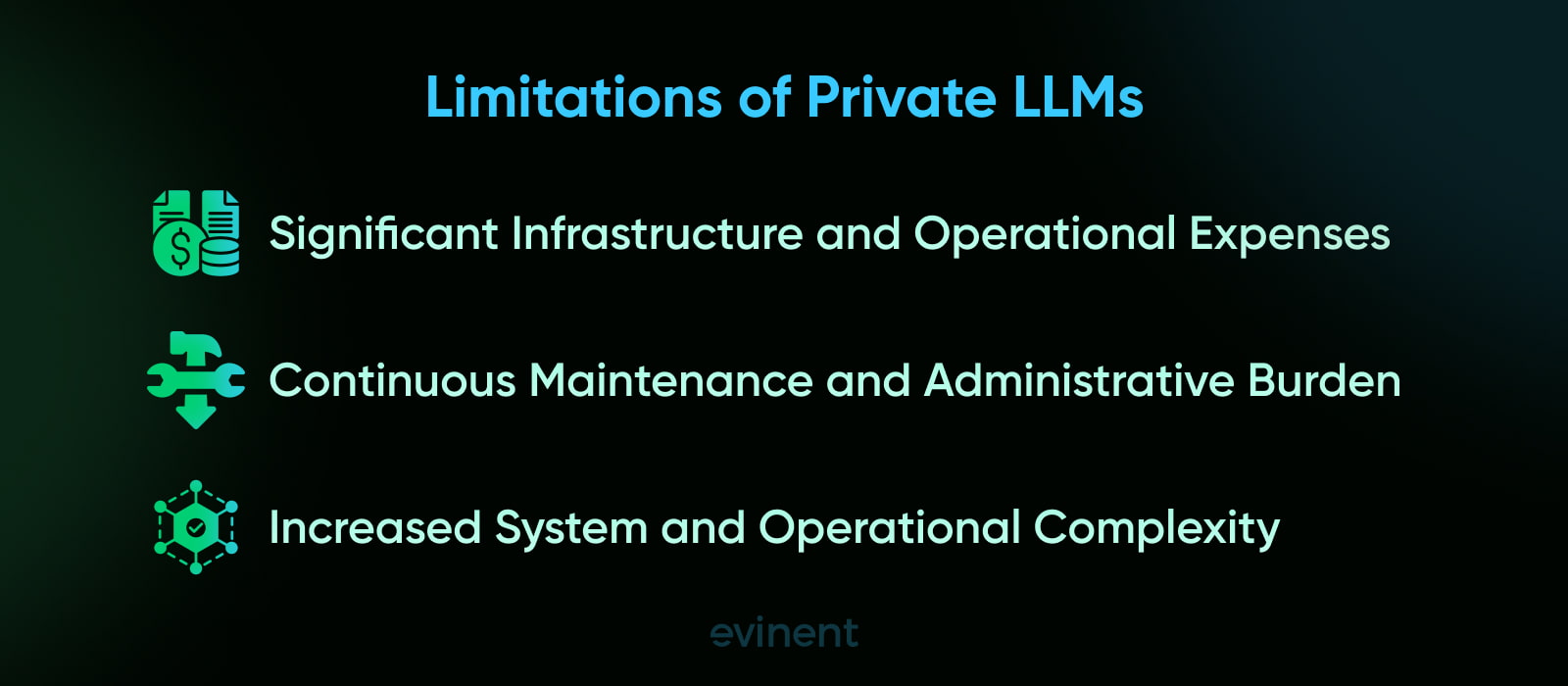
1. High infrastructure and operating costs
Keeping the private LLM infrastructure available depends on having extensive capital resources. This is especially true for GPUs, storage, networking, and redundancy. The costs incurred for such requirements are generally far above those of pay-as-you-go cloud services.
2. Ongoing maintenance and administration
Organizations need to take care of infrastructure maintenance, system administration, security patching, and performance tuning without any external help. Consequently, this entails significant long-term operational overhead and the necessity to have specialized personnel.
3. Greater operational complexity
From managing model updates to monitoring performance and ensuring uptime, private deployments introduce higher operational complexity than managed cloud solutions. Integration with existing systems can also create additional engineering challenges.
Private LLMs provide clear strategic advantages: enhanced data control, better security, regulatory compliance, and very advanced customization of open-source technologies. They provide a great deal of value to companies that, for one reason or another, are unable to share sensitive information with third-party cloud providers.
But these benefits also have their downsides, including the need for larger budgets, more time-consuming maintenance, and more tightly controlled operations. Adopting a private LLM mindset is a move that goes deeper than technology and requires planning for infrastructure, governance, and the development of internal skills.
How to Build and Deploy a Private LLM: Step-by-Step Guide
This is a practical guide that outlines the steps of building, training, and deploying a Private LLM, including setting up business goals, choosing architectures, and securely managing data, and providing controlled access in production environments.
Step 1. Define objectives and use cases
The first step is to explicitly define the problem the Private LLM will address. You should make a decision on whether you require a general assistant, a domain-specific LLM, or simply a private LLM-powered chatbot for your internal knowledge management. Also, at this point, set up the criteria for success: accuracy levels, performance requirements, and regulatory limitations.
Step 2. Assess compute power and infrastructure
Assess your current computer processing capabilities and decide where you want the model to run - on your on-premises servers or hybrid servers. This also entails planning for GPU capacity, storage, networking, and redundancy. The choices you make regarding your infrastructure will have a direct impact on your performance, scalability, and cost over time.
Step 3. Select model architecture and training strategy
Choose between adapting existing transformer architectures or building on open-source LLMs. Decide on the learning approach:
fine-tuning with curriculum learning for gradual skill development,
or full retraining using distributed training strategies for large-scale models. Apply regularization techniques such as weight decay to improve model stability and generalization.
Step 4. Prepare and manage data
Arrange in-house and proprietary datasets that are subject to strict governance regulations. Plan and execute appropriate tokenization workflows and guarantee data quality ahead of the start of the training. If it is necessary to retrieve, link the model to a vector database so that it can have safe and efficient access to internal knowledge.
Step 5. Choose the development approach
Choose whether you want a full engineering workflow or a low-code one for faster prototyping. Low-code platforms are faster for initial iterations, but full-code gives you more control when handling complex enterprise deployments.
Step 6. Implement secure deployment practices
Start by defining security through the implementation of network segmentation, the use of strong authentication methods, and the enforcement of strict access controls. Among other measures, secure deployment should also entail the use of encryption both for data in transit and data at rest so that sensitive information remains protected during the entire system lifecycle.
Step 7. Enable controlled access and monitoring
Implement role-based access control so that only authorized teams can use or manage the system. Start continuous monitoring of performance, security events, and system health to detect problems early and keep the service reliable.
Step 8. Optimize and scale responsibly
After deployment, track inference times, resource usage, and user feedback. Refine training pipelines, update models carefully, and scale infrastructure only when business demand justifies the cost.
So, how to build your own llm? Creating and launching a Private LLM is not just one technical task but a well-structured, thorough process. Companies that keep to a methodical plan—merging well-defined goals, comprehensive infrastructure planning, robust security measures, and ongoing supervision—have greater chances of obtaining a product that is not only safe but also meeting the regulations and capable of lasting over time.
Customizing Private LLMs with Proprietary and Sensitive Data
Organizations often need to adapt Private LLMs to handle proprietary datasets and sensitive internal information while maintaining privacy, compliance, and operational control. Customization enables models to generate relevant outputs for domain-specific applications, enhance internal knowledge management, and support informed decision-making without exposing sensitive data externally.
Various Approaches to Customizing Private LLMs
Approach | Data Requirements | Compute Needs | Privacy & IP Protection | Use Cases | Advantages | Limitations |
Fine-tuning existing LLM | Proprietary datasets | Medium | Can enforce IP and sensitive data controls | Domain-specific adaptation | Faster, lower cost | Limited control over base model behavior |
Training from scratch | Large proprietary datasets | High | Full control over knowledge and IP | Highly specialized models | Full customization | Costly, complex infrastructure |
Vector store integration | Processed embeddings | Low-medium | Data stays internal, secure retrieval | Knowledge management, RAG | Efficient access to internal data | Needs structured data, additional engineering |
Tokenization and preprocessing | Internal datasets | Low | Ensures sensitive info is correctly represented | Any NLP task | Improves model quality, privacy compliance | Extra preprocessing effort |
Training Private LLMs with exclusive or sensitive data can give a great deal of advantages in terms of being relevant, efficient, and increasing the value of the enterprise. Achieving this requires attention to data governance, a well-planned fine-tuning process, safe integration with internal systems, and strong privacy protection. Done right, companies can roll out very targeted models that facilitate knowledge management, meet regulatory requirements, and safeguard valuable intellectual property.
Federated and Privacy-Preserving Training Methods for Private LLMs
Federated and privacy-preserving approaches enable organizations to improve Private LLMs without exposing sensitive data. These methods, including federated learning and federated fine-tuning, allow models to learn from distributed datasets while maintaining strict encryption and data isolation. By combining secure aggregation strategies, trusted execution environments, and privacy-focused protocols, organizations can enhance performance and domain-specific accuracy without compromising confidentiality.
Federated learning for distributed data
In federated learning, the model is trained across multiple internal or partner datasets without centralizing the data. Only model updates or gradients are shared, often with gradient aggregation strategies to ensure that sensitive information cannot be reconstructed. This approach allows organizations to leverage knowledge from diverse sources while keeping raw data private, supporting compliance and data sovereignty requirements.
Federated fine-tuning of base models
Organizations can perform federated fine-tuning on existing LLMs, allowing domain-specific adaptation without transferring sensitive datasets to a central location. Fine-tuning in this manner can improve task-specific accuracy, align the model with internal knowledge, and reduce training costs compared to full retraining. Hyperparameter optimization and careful validation are critical to ensure convergence and maintain model quality.
Privacy-preserving training techniques
Homomorphic encryption and secure computation in trusted execution environments are techniques that allow operations to be performed on encrypted data or on the hardware in isolation. Subset participation protocols can also be used to minimize the data that goes into each training step, thereby lessening the possibility of leakage. Together with strict monitoring and validation metrics, these methods establish a solid framework for privacy-preserving training.
Integration with knowledge retrieval systems
Federated or privacy-preserving models may be bridged to vector databases or other secure knowledge stores. A model can thus access, internally at least, and from the corporate data for retrieval-augmented generation without any data leaking outside the company premises by continuously enforcing access control.
Federated and privacy-preserving training methods provide an equal advantage for enhancing Private LLMs and at the same time protecting personal data. By leveraging federated learning, fine-tuning, and encryption through trusted execution environments, businesses are able to attain higher-quality domain-specific performance, stay compliant, and safeguard their intellectual property. These techniques are especially useful for companies that require working together on distributed data sets without revealing confidential information.
Industry Applications and Sector-Specific Use Cases of Private LLMs
Private LLMs are a major step forward in a wide range of sectors, as they facilitate secure, domain-specific language comprehension and automation. Such models help companies derive insights from their in-house knowledge, assist in making the right decisions, and ensure they meet the regulations without exposing their proprietary information. Healthcare, legal, customer service, pharmaceuticals, manufacturing, and enterprise knowledge management industries are the main ones reaping the benefits.
Use Cases Table
Industry / Sector | Key Applications | Example Tasks | Unique Requirements |
Customer Service | Automated customer service | Chatbots, FAQ handling, ticket routing | Fast response, high accuracy, integration with CRM |
Healthcare | Clinical decision support, diagnostic support, treatment recommendations | Predictive analytics, patient data insights | Privacy, regulatory compliance (HIPAA/GDPR), secure handling of sensitive data |
Legal | Contract analysis, legal research, regulatory document analysis | Review contracts, extract clauses, and analyze regulations | Accuracy, auditability, regulatory compliance |
Pharmaceuticals | Drug discovery | Literature review, molecular property prediction | Scientific precision, confidentiality of research data |
Manufacturing / Industry | Predictive maintenance, supply-chain optimization | Equipment failure prediction, inventory forecasting | Real-time processing, integration with IoT systems, and reliability |
Enterprise Knowledge Management | Internal knowledge management | Document search, internal chat assistants | Secure access, data sovereignty, integration with internal systems |
Privacy Risks and Protection Strategies for Private LLMs
This part looks at the main privacy issues that come up with large language models and lays out what organizations can do to reduce these risks by employing technical and organizational measures such as federated learning, homomorphic encryption, and local deployment. Emphasis is on a balance between data security, system efficiency, and legal conformity.
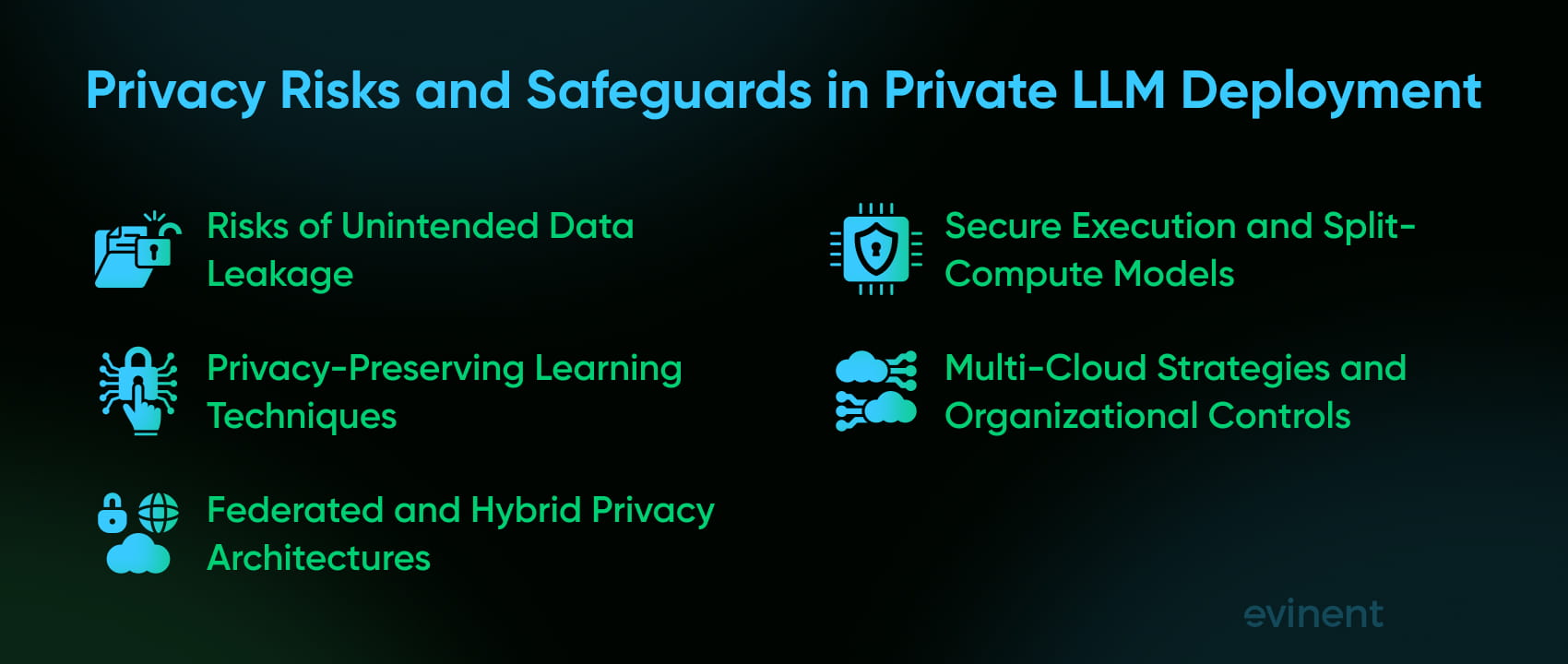
Uncontrolled data exposure
One of the biggest privacy risks in LLM usage is unintended data exposure through logs, s, or model outputs. This becomes especially critical in environments that handle personal, medical, or financial information. Organizations address this risk by enforcing strict encryption for data in transit and at rest, limiting access rights, and applying continuous monitoring to detect abnormal usage patterns and potential leaks.
Privacy-preserving machine learning techniques
Nowadays, privacy-preserving machine learning largely depends on techniques like differential privacy and homomorphic encryption to lower the risk that private data can be recovered from the model's behavior. This way, the models can be trained on data without exposing the contribution of individual records to the end result by a mathematical limitation, which is a key requirement for compliance-oriented sectors.
Federated and hybrid privacy architectures
In many enterprises, privacy challenges are addressed through federated learning hybrids, where models are trained across distributed datasets without centralizing sensitive information. Combined with hybrid architectures and edge-to-cloud deployments, this approach allows organizations to process data locally while still benefiting from shared intelligence and coordinated model improvements.
Secure execution and split computation
Advanced deployments make use of trusted execution environments (TEEs) and split computation to separate sensitive workloads. Major segments of inference or training can be executed in secure enclaves; no one, not even system administrators, will have access to the raw data. Such a move dramatically increases the level of trust in cases where absolute confidentiality is required.
Multi-cloud and organizational safeguards
For large enterprises operating across regions, multi-cloud strategies add another layer of resilience. By distributing workloads and enforcing consistent privacy policies across environments, organizations reduce dependency on a single provider and strengthen operational control. These technical measures must be supported by clear governance, staff training, and incident-response procedures.
Privacy risks constitute a significant impediment to the mass adoption of LLMs, especially in settings dealing with sensitive or regulated data. Nevertheless, the integration of technical safeguards like encryption, differential privacy, federated learning, TEEs, and split computation, along with organizational controls, i.e., governance, monitoring, and incident response, allows for the secure deployment of Private LLMs. If privacy is kept as a fundamental design principle and not just an afterthought, organizations stand to gain from advanced language models without having to sacrifice data protection, regulatory compliance, or user trust.
Role of Open-Source Tools and Ecosystem in Private LLM Development
Open-source tools and ecosystems form a backbone of freedom for organizations to innovate, shape, and run Private LLMs as per their needs. One of the ways such tools help is through platforms like Hugging Face that offer an immense library of pre-trained models and leverage the power of community contributions to fast-track development. Meanwhile, internal data can be securely ingested and processed with the help of data-integration tools such as Airbyte.
The open-source vector databases like Weaviate that perform similarity search, knowledge retrieval, etc., very efficiently, thus help in setting up private deployments. First and foremost, the open-source world is about community resources, developers and researchers collaborating, as well as enterprise deployment tools, hybrid and on-prem environments, etc. Ecosystem research reveals that there are over a hundred LLM-related open-source repositories and model downloads running into millions, pointing to the use of these tools being quite common.
The Hugging Face Model Hub alone houses more than 100,000 models, and open models like Meta’s LLaMA variants have been downloaded hundreds of millions of times mainly via Hugging Face.
Open-Source Ecosystem Table
Tool/Component | Role in Private LLM Workflow | Typical Use Cases | Key Benefits |
Hugging Face | Model hub and toolkit | Model selection, pre-trained weights, transformers library | Large library of models, active community, versioning, and evaluation leaderboards |
Airbyte | Data integration platform | ETL/ELT pipelines from internal sources to vector stores | Secure ingestion of internal datasets, synchronization |
Weaviate | Vector database | Store and search embeddings | Scalable semantic search for RAG and internal knowledge queries |
LangChain | Application framework | Chaining LLM calls and retrieval | Orchestrating RAG, handling multi-step processes |
Community tools | Observability, agents, governance | Metrics tracking, monitoring, and agent orchestration | Enhances the reliability and visibility of LLM systems |
The open-source ecosystem significantly lowers barriers to building Private LLMs by offering reusable components, community-driven innovation, and flexible deployment options. Tools like Hugging Face serve as central hubs for models and datasets, supported by frameworks such as LangChain for application logic and vector databases like Weaviate for efficient knowledge retrieval. Data integration platforms such as Airbyte help bring internal proprietary data into private workflows securely.
The sheer volume of open-source activity — with tens of thousands of models and many active repositories — demonstrates that open tools are essential for both experimentation and production-grade private large language models deployments, enabling organizations to balance privacy, performance, and governance without reinventing core capabilities. (Medium, 2025)
Security Architectures and Access Control Strategies for Private LLMs
This section delves into the advanced security architectures and access-control mechanisms that are utilized to secure and make your own llm. It centers on the strategies of organizations in protecting sensitive data during inference, which is achieved by merging confidential computing, trusted execution environments, and enterprise-grade identity and access management.
Confidential computing and secure enclaves
Currently, most Private LLM deployments use confidential computing to ensure the safety of data during its processing. These techniques involve AMD SEV, Intel TDX, ARM TrustZone, and NVIDIA’s H100 confidential computing, allowing the execution of jobs within secure enclaves. In these enclaves, memory is both isolated and encrypted so that even the host operating system cannot access it. So, the likelihood of insider threats and attacks at the infrastructure level is greatly lowered in this way, particularly if the data in question is very sensitive or regulated.
Trusted execution environments for sensitive inference
Trusted execution environments (TEEs) provide a hardware-based foundation for running critical parts of LLM inference in isolated conditions. By ensuring that only verified code can execute inside protected memory regions, TEEs help prevent data leakage, model tampering, and unauthorized inspection of s or outputs. This is particularly important for personal llm-powered applications that handle intellectual property, legal documents, or medical records.
Encryption for data in transit and at rest
In-house deployments rely on strong encryption for data in transit and at rest as a key security layer. Transport-level encryption safeguards model services, vector databases, and user interface interactions, whereas storage-level encryption protects logs, embeddings, and training artifacts from unauthorized viewing even in the case of infrastructure compromise. These two sets of measures combined provide a foundational defense against both external and internal threats.
Identity management and access control
Effective identity management is critical in determining who has the privilege to interact with Private LLM systems. Enterprises deploy authentication and authorization systems along with role-based access controls as a measure to coerce users, developers, and administrators to access only those resources that they have been explicitly authorized for, thereby minimizing chances of inadvertent data exposure and at the same time, facilitating compliance to governance and audit requirements.
Audit logging and security monitoring
Comprehensive audit logging enables organizations to track all interactions with LLM systems, including usage, data access, and administrative actions. These logs support incident investigation, regulatory audits, and continuous improvement of security policies. When combined with automated monitoring and ing, audit trails become a critical tool for maintaining trust and accountability in private AI environments.
Strong security architectures are the foundation of any successful Private LLM deployment. By combining confidential computing, trusted execution environments, and hardware-level protections such as AMD SEV, Intel TDX, ARM TrustZone, and NVIDIA’s H100 secure enclaves, organizations can protect sensitive data even during active processing.
When these technologies are reinforced with encryption, robust identity management, role-based access controls, and continuous audit logging, Private LLM systems achieve a level of protection that is difficult to match in public environments. This layered approach ensures not only technical security but also regulatory compliance, operational trust, and long-term resilience.
Comparing Private, Public, and Hybrid LLM Models
Picking an LLM approach, organizations have to decide between private, public, and hybrid deployment models. Each choice comes with different trade-offs regarding data control, cost structure, scalability, compliance, and operational complexity. Public LLMs, which are based on paid APIs and external cloud services, are contrasted with private ones, which utilize more local infrastructure and proprietary data protection. Hybrid architectures are a combination of both, where edge-to-cloud, split computation, and federated learning hybrids are utilized, providing enterprises with a means of balancing flexibility with control.
Deployment Models Comparison
Dimension | Private LLMs | Public LLMs | Hybrid LLMs |
Data control | Full control over proprietary data and internal workflows | Data processed by third-party providers | Sensitive data stays on-prem, general tasks handled in the cloud |
Infrastructure | Local infrastructure, on-prem or private cloud | Provider-managed cloud infrastructure | Mix of on-prem + cloud using hybrid architectures |
Security & compliance | Strong fit for regulated industries, easier regulatory compliance | Depends on vendor policies and contracts | Compliance for critical data, flexibility for non-critical workloads |
Cost model | High upfront infrastructure costs, lower long-term usage fees | Ongoing paid APIs and usage-based pricing | Balanced: infrastructure for core + API costs for scale |
Scalability | Limited by internal compute capacity | Virtually unlimited scalability | Elastic scaling through edge-to-cloud strategies |
Customization | Deep customization, domain-specific tuning | Limited control over model internals | Core logic private, extensions in the cloud |
Deployment tools | Enterprise deployment tools, internal MLOps | Vendor-provided tooling | A combination of enterprise and cloud-native tools |
Typical use cases | Finance, healthcare, legal, government | Customer support, content generation, and general assistants | Large enterprises with mixed security requirements |
Advanced techniques | Secure inference, vector databases for private RAG | API-based RAG, hosted embeddings | Split computation, federated learning hybrids |
When one needs to choose between private, public, or hybrid LLM models, there is not a single option that can be considered as the best for everyone - the right choice totally depends on business priorities, regulatory constraints, and the long-term AI strategy.
Private LLMs provide the highest level of data control and security, which is why they are perfect for companies that have to deal with sensitive or proprietary information. Public LLMs provide fast, easy, and scalable solutions, but you have to trust the external providers.
Hybrid models increasingly emerge as a pragmatic middle ground, combining local infrastructure with cloud flexibility through multi-cloud strategies, split computation, and federated learning hybrids. For many enterprises, this balanced model provides the optimal path toward scalable, compliant, and future-proof AI adoption.
How Evivnent can help with Private LLM implementation
Evinent has a track record of helping enterprises develop complex, secure, and scalable data-driven platforms for years. With the rising adoption of Private LLMs by organizations aiming to retain ownership of proprietary data and comply with regulations, Evinent is a reliable partner for the entire lifecycle — from the planning of the architecture to the implementation in production stages.
We focus on embedding private LLM infrastructure into real business workflows, integrating internal data from multiple sources, and enabling AI-driven insights without exposing sensitive information to third-party data processing or public cloud risks. Our approach emphasizes data control, security, and operational reliability, ensuring that private LLM-powered solutions deliver measurable business value.
Why Organizations Choose Evinent for Private LLM Implementation
Deep experience with secure enterprise systems
Hands-on implementation of software platforms in tightly controlled environments where data security, regulatory compliance and system reliability are paramount.
End-to-end Private LLM expertise
Everything from locally deployed LLMs and on-prem servers to hybrid architectures utilizing hybrid servers and edge-to-cloud strategies.
Strong focus on data governance and control
Guaranteeing the complete ownership of proprietary data, embeddings, and outputs, with a minimal attack surface and well-defined access permissions.
Integration-first mindset
Integration with the existing enterprise systems, vector databases, internal APIs, and analytics tools — enterprise operations remain undisturbed.
Evinent Private AI in Practice: Enabling Secure Enterprise HR Matching and Recruitment Automation
Large enterprises frequently struggle with fragmented HR data stored in various internal systems, inefficient candidate-to-vacancy matching processes, hardly any automation in screening workflows, and rigorous data privacy regulations that exclude the usage of external AI services.
Solution:
Evinent implemented a fully isolated Private AI environment using open-source LLMs and containerized agent architecture. The system integrates internal HR databases, applies semantic matching and rule-based validation, and automates candidate screening and recommendation workflows without any external API calls. The solution is deployed within the enterprise infrastructure with RBAC, encryption, and monitoring to ensure full data control and compliance readiness.
Result:
• Faster and more accurate candidate-to-role matching
• Reduced manual workload for HR and recruitment teams
• Full data isolation with no third-party processing
• Improved auditability and compliance with enterprise security standards
• Scalable AI foundation for future internal automation use cases
Evinent Capabilities for Private LLM Projects
Private LLM architecture design
Selection and deployment of open-source LLMs (including LLaMA-based models), secure inference pipelines, and scalable private LLM infrastructure.Secure data ingestion and retrieval
Integration of internal knowledge sources into vector databases to power private LLM-powered chatbots and RAG workflows.Enterprise-grade security and compliance
Implementation of encryption, role-based access controls, audit logging, and support for regulatory compliance requirements.Operational reliability and lifecycle support
Monitoring, model updates, infrastructure maintenance, and performance optimization to reduce operational complexity.Custom-built, not off-the-shelf
Every solution is tailored to the organization’s data sensitivity, compliance obligations, and long-term AI strategy.
We at Evinent do not offer generic AI products. We create and carry out tailor-made Private LLM solutions that match your security posture, data governance model, and business goals. We combine enterprise engineering discipline with cutting-edge AI capabilities to help organizations implement private language models that they can rely on and scale — the next day.
Key Takeaways
Private LLMs provide full data control and stronger security
Unlike public models, private LLMs run in controlled environments, ensuring that proprietary data, internal knowledge, and sensitive inputs never leave the organization’s infrastructure. This makes them a strong fit for regulated and high-risk domains.Security and compliance are primary drivers, not optional features
Private deployments enable the use of confidential computing, trusted execution environments, encryption, and access controls, helping organizations meet regulatory requirements while minimizing attack surface and third-party data exposure.Private LLM implementation requires significant technical and operational investment
Costs of infrastructure, system administration, model updates, and maintenance, in general, bring one's operational model to a higher level of complexity which should be planned for right from the starting point.Customization delivers real business value when aligned with domain data
By means of fine-tuning, retrieval-augmented generation, and vector databases, private LLMs can undoubtedly provide domain-specific applications and internal knowledge management solutions that are more accurate and relevant.Privacy-preserving training methods enable collaboration without data sharing
Techniques such as federated learning, federated fine-tuning, and homomorphic encryption make it possible to improve models while preserving data sovereignty and confidentiality.Open-source ecosystems accelerate private LLM development
Essentially, tools such as Hugging Face, Airbyte, and Weaviate shorten the time to come to the market and offer flexibility across on-premise, hybrid, and multi-cloud environments.Hybrid models often offer the best balance for large enterprises
Combining local infrastructure with cloud scalability through split computation and edge-to-cloud strategies allows organizations to optimize cost, performance, and compliance.Successful private LLM adoption depends on system-level thinking
The most effective implementations treat private LLMs as part of a broader enterprise architecture — integrating security, governance, data pipelines, and monitoring from day one.
Share