

Why are companies investing in CDP integration?
Despite record spending on CRM systems, analytics tools, and marketing platforms, most organizations still cannot see or act on a single, reliable view of their customers in real-time.
That gap has become impossible to ignore. Enterprises today collect customer data across dozens of systems: websites, mobile apps, CRM, ERP, loyalty programs, call centers, email platforms, ad networks, and in-store systems. Each tool works well in isolation. Together, they often create fragmentation, s, and conflicting customer signals.
CDP integration emerged as a response to this problem. Not as another marketing tool, but as a way to connect existing systems into a unified, operational customer data layer that supports real-time personalization, accurate measurement, and AI-driven decision-making.
Everything changed because of pressure, not only due to the technologies.
Privacy regulations limit third-party data. Customers expect consistent, personalized experiences across every channel. AI models require clean, unified first-party data to deliver meaningful results. And leadership teams are increasingly accountable for turning data investments into measurable business outcomes.
That is why CDP integration has moved from a marketing discussion to a C-level concern. Yet interest alone does not guarantee success. Many organizations invest in CDPs and still struggle to activate them. Others see fast ROI and treat CDP integration as foundational infrastructure for growth.
The difference is not the platform. It is how CDP integration is designed, governed, and connected to real business objectives.
This guide is written for executives who need clarity: it explains what CDP integration actually involves, how it differs from adjacent systems, what architecture and integration models work in practice, and why some implementations deliver strong ROI while others stall.
What a Customer Data Platform Really Is — and What It Is Not
At a high level, a Customer Data Platform (CDP) is designed to unify first-party customer data from multiple systems into a single, persistent customer profile that can be used across marketing, analytics, personalization, and customer experience.
But that definition alone is no longer sufficient, or accurate, for how CDPs are actually used in 2026.
The reason CDPs are gaining executive attention is not that they store data. It is because they connect data in ways traditional systems were never built to handle.
This distinction matters because many failed CDP initiatives start with a misunderstanding of what a CDP is supposed to replace, and what it is not.
CDP vs CRM, DMP, and Data Warehouses (Executive Reality Check)
Most enterprises already operate several data-heavy systems:
CRM systems manage known customers and sales interactions
Data warehouses store large volumes of structured data for analysis
DMPs historically focused on third-party audience activation
Analytics platforms track behavior, but rarely resolve identity fully
None of these systems was designed to continuously unify customer identity across channels and activate it in real time.
That gap explains why CDPs have emerged as a separate category rather than a feature inside existing tools.
A CDP does not replace a CRM or a data warehouse. Instead, it acts as a connective layer that:
ingests data from multiple sources,
resolves identities across devices and touchpoints,
maintains an always-updated customer profile,
and makes that profile usable across downstream systems.
This capability is precisely why CDP adoption has accelerated, even in organizations with mature data stacks.

Why CDPs Are Being Adopted Faster Than Ever
CDP adoption is no longer driven by experimentation. It is driven by operational necessity.
Industry data shows a clear shift:
In 2017, only 10% of consumer businesses reported having a unified customer database
By 2021, that figure more than doubled to 24%
By 2024, approximately 32% of consumer businesses operate with a unified customer data infrastructure (CDP Institute Member Survey: The Path to CDP Success, 2021)
This growth reflects a fundamental change in how organizations view customer data: not as a reporting asset, but as core operational infrastructure.
CDPs Are No Longer “Marketing Tools”
One reason CDPs are often underutilized is that they are still framed internally as marketing technology.
That framing is increasingly inaccurate.
According to industry research:
91% of CDP adopters link CDP initiatives directly to broader digital transformation goals, not just marketing optimization.
90% of CDP users report high satisfaction with their investment, but only when CDP integration extends beyond campaign execution into data governance, analytics, and experience orchestration.
This shift explains why CDP ownership is moving upward in organizations: from marketing teams toward shared ownership between marketing, IT, and data leadership.
Market Growth Signals Long-Term Strategic Confidence
The rapid expansion of the CDP market reinforces this trend.
The global CDP market is projected to grow from $7.4 billion in 2024 to $28.2 billion by 2028, representing a 39.9% compound annual growth rate (Customer Data Platform (CDP) Market Size, Share, Growth, Trends & Opportunities, 2024)
This level of growth significantly outpaces the broader martech sector and reflects sustained enterprise confidence that:
First-party data will remain the foundation of personalization,
Privacy and consent management will require dedicated infrastructure,
And AI-driven customer engagement depends on clean, unified data.
In short, CDPs are no longer viewed as optional enhancements. They are increasingly treated as foundational systems, comparable to CRM adoption in the early 2000s.
The Critical Distinction: CDP Software vs CDP Integration
This is where most CDP initiatives succeed or quietly fail.
Purchasing a CDP does not create value on its own. CDP integration is where ROI is either unlocked or lost. The data is clear on this point.
Across industries, more than half of organizations achieve CDP payback within six months and see ROI within 12 months. On average, companies begin realizing tangible value in approximately eight months. In mature implementations, particularly in retail and digital commerce, ROI can reach 300–800%, driven by higher conversion rates, stronger retention, and more efficient acquisition
However, these results are not evenly distributed.
Organizations that realize fast, outsized returns tend to integrate CDPs deeply into their data and activation stack. Those who struggle usually encounter the same structural problems:
Incomplete data integration, leaving critical customer signals siloed
Weak identity resolution, resulting in fragmented or duplicate profiles
Unclear governance and ownership, slowing adoption across teams
Limited activation, where CDPs are used only for email or basic segmentation
The CDP itself is rarely the limiting factor.
Evidence from real-world deployments shows that when integration is done well, the impact is measurable across core business metrics:
Conversion rates increase by ~13% in personalization-driven use cases (Treasure Data, Subaru Case Study)
Customer acquisition costs drop sharply, with 93% of organizations reporting reductions
Sales cycles shorten by ~20% in B2B environments
Churn declines by 10–15% in enterprise and subscription models
Cost is often cited as a concern, but the data suggest the opposite. While training, maintenance, and optimization typically add 40–60% to initial implementation budgets, these costs are consistently offset by improvements in ROAS, customer lifetime value, and retention. As a result, nearly 90% of CDP users report high satisfaction with their investment.
The conclusion for executives is straightforward: CDP ROI is not a platform question. It is an integration question.
In short
A Customer Data Platform is not a database, a dashboard, or a campaign engine.
It is an operational data layer designed to unify first-party customer data and make it usable across systems, teams, and channels in real time.
Understanding this distinction is essential because every architectural, organizational, and ROI decision that follows depends on it.
How CDP Integration Actually Works: Architecture, Data Flows, and Identity Resolution
At an executive level, CDP integration is often described as “connecting data sources.”
In reality, it is the design of a continuous data flow system that determines whether customer data becomes actionable — or remains fragmented.
Understanding this architecture is critical because most CDP ROI issues stem from how data moves, not from what tools are used.
The Core CDP Integration Architecture
A modern CDP integration typically consists of four interdependent layers:
Data Ingestion Layer
Identity Resolution Layer
Profile & Processing Layer
Activation & Analytics Layer
Each layer introduces both opportunity and risk.
1. Data Ingestion: Where Fragmentation Begins (or Ends)
The ingestion layer connects a CDP to upstream systems, such as:
websites and mobile apps (behavioral data),
CRM and sales systems (known customer data),
ERP and transactional platforms,
marketing and advertising tools,
customer support and offline systems.
Data enters the CDP through multiple mechanisms:
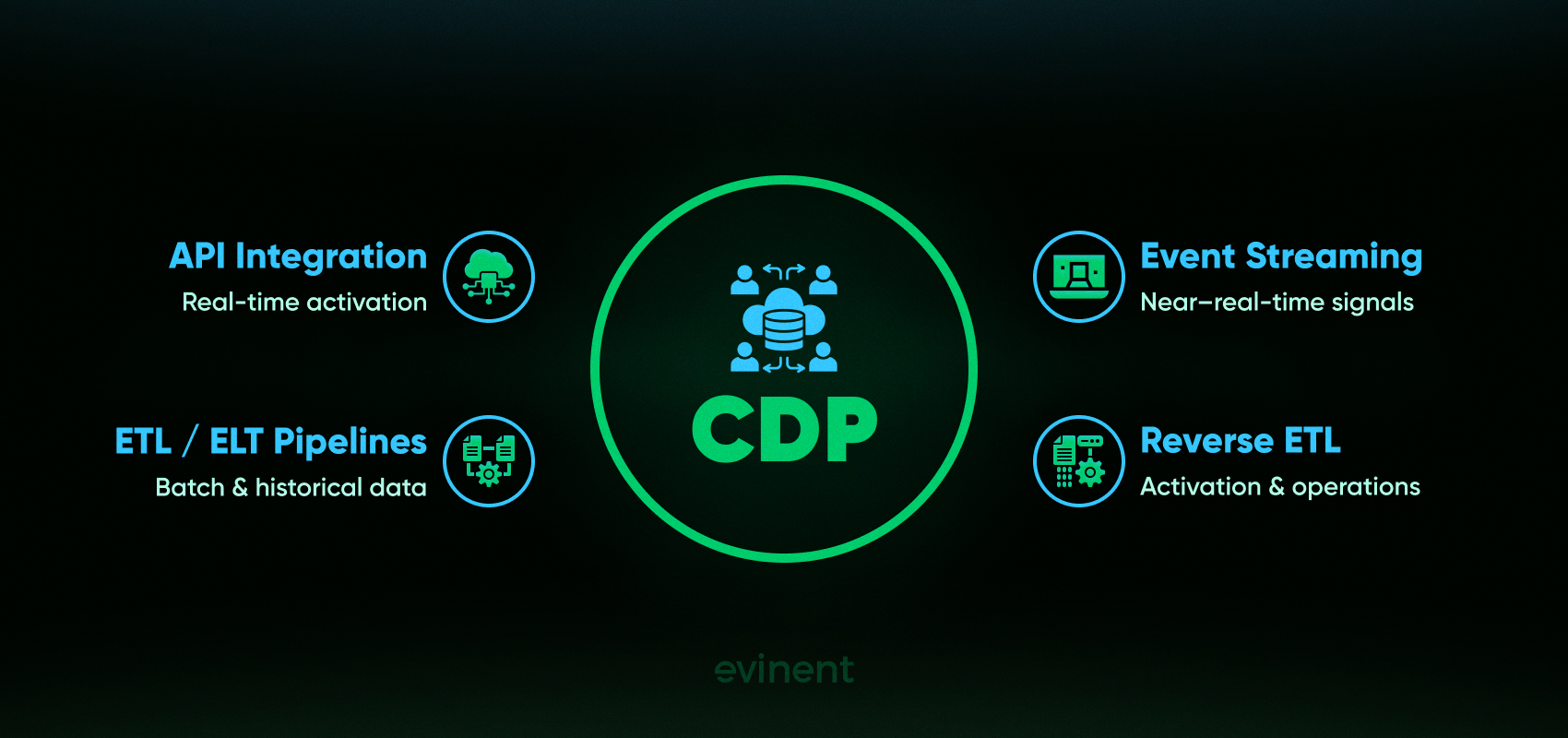
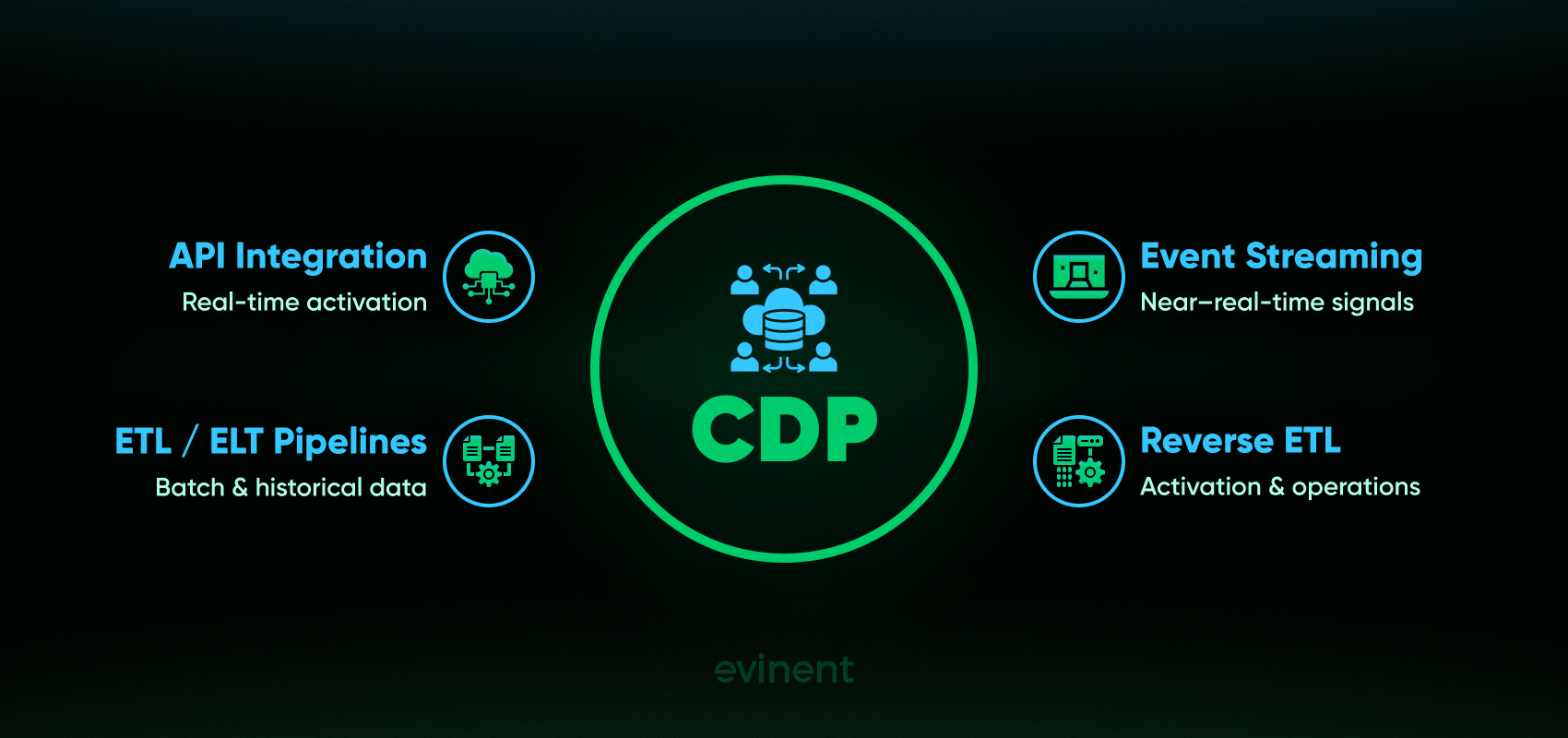
APIs for real-time events (e.g., product views, cart actions),
ETL / ELT pipelines for batch and historical data,
Webhooks or event streams for near-real-time updates.
The most common integration mistake happens here: treating ingestion as a one-time setup instead of a living system.
Incomplete ingestion leads to blind spots that propagate downstream — affecting identity resolution, segmentation, and activation accuracy.
2. Identity Resolution: The Engine Behind “Single Customer View”
Identity resolution is the technical core of CDP integration.
Its purpose is to determine when multiple data points — across devices, sessions, and systems — belong to the same individual or household.
This process typically combines:
Deterministic identifiers (email, customer ID, phone number),
Probabilistic signals (device data, behavioral patterns),
Consent and privacy constraints (what data can legally be linked).
When identity resolution is weak:
customer profiles fragment,
personalization becomes inconsistent,
attribution models break,
AI outputs degrade in quality.
This is why organizations with mature CDP strategies often report data reliability improvements from ~65–70% to over 90% after overhauling identity resolution logic.
For executives, the key takeaway is simple: If identity resolution is inaccurate, every downstream insight is compromised.
3. Profile Unification and Processing: From Raw Data to Intelligence
Once identities are resolved, the CDP builds unified customer profiles that continuously update as new data arrives.
This layer is responsible for:
normalizing data formats,
resolving conflicts between systems,
enriching profiles with calculated attributes,
maintaining historical and real-time views simultaneously.
Modern CDPs increasingly support:
event-based timelines,
behavioral scoring,
predictive attributes powered by machine learning.
This is also where data governance and quality rules are enforced — another frequent point of failure.
Without clear ownership and validation logic, profiles degrade over time, leading to mistrust among business teams and reduced adoption.
4. Activation and Reverse Data Flow: Where ROI Is Realized
A CDP only creates value when unified data is activated.
Activation means pushing enriched customer profiles back into:
marketing automation platforms,
personalization engines,
analytics tools,
CRM and sales systems,
AI-driven recommendation or decisioning layers.
This often requires reverse ETL — sending CDP intelligence back into operational systems in formats they can use.
High-performing organizations activate CDP data across multiple functions, not just marketing:
marketing uses real-time segmentation,
sales benefits from enriched lead context,
product teams analyze behavioral patterns,
executives gain more accurate attribution and forecasting.
This is why organizations that fully integrate activation layers report:
faster time to ROI (often under 8 months),
higher conversion lifts,
sharper CAC reductions,
and sustained gains in customer lifetime value.
Why Architecture Quality Predicts ROI
The relationship between architecture and ROI is not theoretical — it is measurable.
Organizations with mature CDP integration strategies consistently report:
ROI realization within 6–12 months, versus stalled results beyond 18 months,
300–800% long-term ROI in high-maturity implementations,
significantly higher internal trust in customer data.
Conversely, weak architecture leads to:
underutilized CDP capabilities (often below 50%),
duplicated effort across teams,
and the perception that “the CDP didn’t work.”
In reality, the architecture failed — not the platform.
In short
CDP integration is not a plug-and-play exercise. It is a systems design challenge that sits at the intersection of data engineering, privacy governance, and business activation.
The companies that succeed treat CDP integration as:
shared infrastructure,
continuously optimized,
and tightly aligned with measurable business outcomes.
Those who don’t often mistake software acquisition for transformation.
CDP Integration Models: API, ETL, Real-Time Streaming — and When to Use Each
Once executives understand how CDP architecture works, the next question is unavoidable:
How should a CDP actually be integrated into the existing technology stack?
There is no single “best” integration model. High-performing organizations choose integration approaches based on data velocity, business use cases, and operational maturity. Poor outcomes usually stem from forcing the wrong model onto the wrong problem.
In practice, CDP integration relies on four primary integration models, often used together rather than in isolation.
1. API-Based Integration: Real-Time, High-Impact Use Cases
What it is
API-based integration enables real-time data exchange between a CDP and other systems. Events such as page views, cart actions, logins, or support interactions are sent immediately to the CDP and reflected in customer profiles within seconds.
Best suited for
Real-time personalization
Trigger-based messaging
On-site recommendations
Dynamic pricing or content
Strengths
Enables instant decision-making
Supports real-time customer journeys
Critical for eCommerce and mobile-first businesses
Limitations
Higher engineering complexity
Requires strict performance and error-handling controls
Not ideal for large historical datasets
Executive insight
API integration drives short-term ROI acceleration. Organizations using APIs for activation-heavy use cases are far more likely to achieve ROI within six months — but only if upstream data quality is already controlled.
2. ETL / ELT Pipelines: Foundation for Scale and Accuracy
What it is
ETL (Extract, Transform, Load) and ELT pipelines move large volumes of data from source systems into a CDP in scheduled batches. This is the most common method for onboarding historical and transactional data.
Best suited for
CRM and ERP integration
Historical data ingestion
Analytics and reporting
Data normalization at scale
Strengths
High reliability
Easier governance and validation
Lower operational risk
Limitations
Latency (data is not real-time)
Slower feedback loops for personalization
Executive insight
ETL-based integration is the stability layer of CDP architecture. Organizations that skip this foundation often struggle with data accuracy, even if they invest heavily in real-time activation.
3. Event Streaming and Webhooks: Near–Real-Time Intelligence
What it is
Event-driven integration uses streams or webhooks to push behavioral data to the CDP as events occur, without requiring synchronous API calls.
Best suited for
Behavioral tracking at scale
High-frequency digital interactions
Systems where API coupling is impractical
Strengths
Scales efficiently
Reduces system coupling
Supports near–real-time updates
Limitations
Requires careful event schema design
Debugging and observability can be challenging
Executive insight
Event streaming is often the hidden driver of CDP success in high-traffic environments. When designed well, it enables responsiveness without overloading core systems.
4. Reverse ETL: Where CDP Insights Become Operational
What it is
Reverse ETL pushes enriched customer data from the CDP back into operational systems such as CRM, ad platforms, personalization engines, or customer support tools.
Best suited for
Sales enablement
Marketing activation
Customer service personalization
Attribution and forecasting
Strengths
Turns CDP data into daily operational value
Increases adoption across teams
Improves ROI visibility
Limitations
Requires strong data contracts
Risk of inconsistency if governance is weak
Executive insight
Most underperforming CDPs fail not at ingestion, but at activation. Reverse ETL is often the difference between a CDP that “exists” and purely one that delivers value.
How High-Performing Organizations Combine These Models
Successful CDP implementations rarely rely on a single integration method.
Instead, they follow a layered approach:
ETL pipelines establish reliable historical and transactional foundations
APIs and event streams support real-time engagement and personalization
Reverse ETL operationalizes insights across teams
This hybrid model explains why mature CDP deployments consistently outperform early-stage implementations in both speed to ROI and long-term returns.
It also explains why organizations that invest heavily in CDPs but limit integration to one or two systems rarely see sustained impact.
Choosing the Right Model: Executive Decision Framework
The right integration mix depends on three factors:
Business urgency
If personalization and conversion are immediate priorities, real-time models matter.
Data complexity
If customer data spans many systems, batch pipelines are non-negotiable.
Organizational readiness
Without governance and ownership, advanced integration only amplifies chaos.
The strongest results come from treating CDP integration as infrastructure, not a marketing experiment.
In short
CDP integration is not a technical checkbox. It is a design decision that determines:
how fast value appears,
how reliable customer insights become,
and whether AI and personalization efforts scale or stall.
The wrong integration model slows ROI. The right combination compounds it.
CDP Integration by Industry: How Leading Organizations Apply It in Practice
While the core principles of CDP integration are consistent, successful implementations look very different by industry. The reason is simple: customer behavior, data velocity, regulatory pressure, and value creation models vary widely.
Executives evaluating CDP integration should not ask “What does a CDP do?”
They should ask, “What problems does CDP integration solve in my industry?”
Below are the most common and proven patterns.
eCommerce and Retail: Real-Time Personalization at Scale
In eCommerce, CDP integration delivers some of the fastest and most visible ROI. Digital commerce environments generate dense behavioral signals and allow personalization decisions to affect revenue immediately.
Typical data sources
Website and mobile app events
Product catalogs and inventory systems
Transactional and order data
Loyalty programs and promotions
Customer support interactions
Integration priorities
Real-time APIs and event streaming for behavioral data
Strong identity resolution across devices and sessions
Reverse ETL into personalization engines, email platforms, and ad networks
Primary business outcomes
Higher conversion rates through behavioral recommendations
Lower CAC via better audience targeting
Increased AOV and repeat purchases
Faster experimentation and optimization cycles
This is why many organizations use eCommerce as the proving ground for CDP ROI before expanding CDP-driven decisioning into other departments.
B2B and SaaS: Shorter Sales Cycles and Better Lead Quality
B2B CDP integration focuses less on instant personalization and more on context, timing, and attribution across longer buying journeys.
Typical data sources
CRM and sales pipelines
Website engagement and content consumption
Marketing automation platforms
Product usage and trial data
Account-level enrichment data
Integration priorities
ETL pipelines for CRM and revenue systems
Account-based identity resolution
Reverse ETL into sales and marketing tools
Primary business outcomes
Shorter sales cycles (often 15–25%)
Higher conversion from MQL to SQL
Improved attribution across long journeys
Better alignment between sales and marketing
In B2B environments, CDPs act less like personalization engines and more like revenue intelligence layers.
Fintech and Financial Services: Risk, Trust, and Compliance
In fintech, CDP integration extends beyond marketing into risk management, fraud prevention, and customer trust.
Typical data sources
Transactional systems
Mobile and web behavior
KYC and onboarding data
Customer support and dispute systems
Third-party risk and enrichment data
Integration priorities
High data accuracy and auditability
Consent-aware identity resolution
Secure, governed data flows
Near–real-time event processing
Primary business outcomes
Improved onboarding and activation
Better fraud and anomaly detection
Reduced churn through lifecycle insight
More compliant personalization
Here, CDPs support decision intelligence, not just engagement.
Healthcare and Regulated Industries: Secure Unification Without Exposure
Healthcare CDP integration operates under strict regulatory and ethical constraints, which significantly shapes architecture.
Typical data sources
Patient portals and appointment systems
CRM and communication platforms
EHR / EMR systems (where applicable)
Digital engagement data
Consent and preference records
Integration priorities
Strong governance and access controls
Data minimization and consent enforcement
ETL-heavy architectures with limited real-time exposure
Separation of clinical and engagement data
Primary business outcomes
Better patient engagement and adherence
Reduced operational friction
More personalized communication within compliance boundaries
Higher trust and satisfaction
In regulated environments, precision and governance outweigh speed — and CDP success is measured in reliability, not just conversion uplift.
Why Industry Context Determines CDP ROI
Across industries, one pattern holds:
Organizations that align CDP integration with industry-specific value drivers achieve faster ROI and higher long-term returns. Those that copy generic “best practices” often overbuild some areas while underinvesting in others.
This is why:
eCommerce CDPs emphasize real-time activation,
B2B CDPs prioritize attribution and pipeline intelligence,
fintech CDPs focus on trust and risk signals,
healthcare CDPs prioritize governance and compliance.
CDP integration succeeds when architecture reflects how value is actually created in the business.
In short
There is no universal CDP blueprint.
The strongest implementations adapt integration models, identity resolution strategies, and activation layers to industry realities, not vendor templates.
For executives, the question is not “Which CDP should we buy?”
It is “Which integration strategy fits how our business creates value?”
A Step-by-Step CDP Integration Framework: From Data Audit to Activation
Most CDP failures are not technical. They are procedural.
Organizations jump into integration before defining ownership, data priorities, and success metrics. High-performing companies do the opposite: they treat CDP integration as a phased transformation program, not a tooling project.
This framework reflects how mature enterprises implement CDPs in practice.
Phase 1: Data Audit and Business Alignment
Before any system is connected, leading organizations answer one question:
What business decisions should CDP data improve in the next 6–12 months?
This phase focuses on alignment, not architecture.
Key activities
Inventory all customer data sources (digital, transactional, offline)
Identify data owners and access constraints
Map data to business use cases (e.g., conversion uplift, churn reduction)
Define executive KPIs (CAC, CLV, conversion rate, retention)
Why this matters
CDP projects fail early when integration is driven by availability of data rather than value of data. Mature teams integrate only what they can activate.
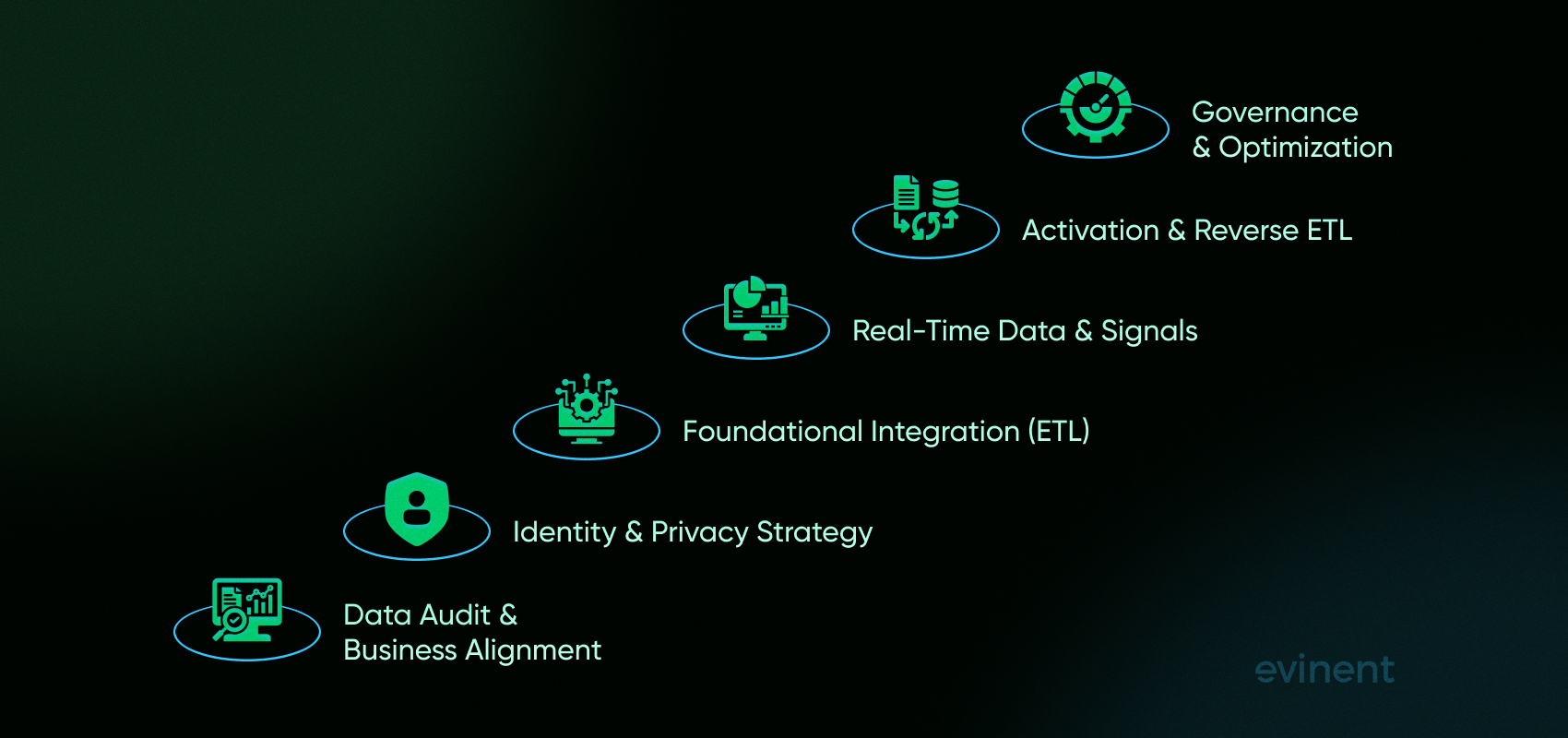
Phase 2: Identity Strategy and Privacy Design
Identity resolution is not a technical afterthought — it is a strategic design decision.
Executives must decide:
which identifiers are authoritative,
how anonymous and known users are linked,
how consent and privacy constraints apply at every stage.
Key activities
Define deterministic and probabilistic identifiers
Establish consent-aware identity rules
Align legal, security, and data teams
Decide which profiles are activation-eligible
Why this matters
Organizations that redesign identity logic early report customer data accuracy improvements from ~70% to over 90%, dramatically increasing downstream trust and adoption.
Phase 3: Foundational Integration (ETL and Core Systems)
This phase establishes data reliability before speed.
Rather than chasing real-time use cases, successful teams start with:
CRM systems
transactional platforms
core customer databases
Key activities
Build ETL / ELT pipelines
Normalize schemas and naming conventions
Validate historical data quality
Set up monitoring and error handling
Why this matters
Without clean foundations, real-time personalization simply accelerates bad decisions.
Phase 4: Real-Time Data and Behavioral Signals
Once foundations are stable, organizations introduce real-time data flows.
This is where CDP value becomes visible to customers.
Key activities
Integrate web and mobile events via APIs or streaming
Define high-impact behavioral triggers
Enable session-level and profile-level updates
Test latency and fallback behavior
Why this matters
This phase often unlocks the fastest ROI, particularly in eCommerce and subscription models, where personalization directly impacts revenue.
Phase 5: Activation and Reverse Data Flow
Activation is the most underestimated phase — and the most critical.
High-performing organizations ensure CDP insights flow back into:
marketing automation tools,
personalization engines,
CRM and sales platforms,
analytics and BI systems.
Key activities
Implement reverse ETL pipelines
Define data contracts per destination
Align activation logic with business teams
Measure performance continuously
Why this matters
Organizations that activate CDP data across multiple functions achieve 300–800% ROI over time, while those limited to email use cases plateau early.
Phase 6: Governance, Adoption, and Optimization
CDP integration does not end at launch.
Mature teams treat CDPs as living infrastructure.
Key activities
Assign long-term ownership
Establish data governance councils
Train business users continuously
Review KPIs quarterly and refine use cases
Why this matters
More than 90% of CDP users report high satisfaction when governance and adoption are treated as ongoing responsibilities, not launch checklists.
Common Executive Mistakes to Avoid
Across industries, the same patterns repeat:
Starting with tools instead of use cases
Underestimating identity resolution complexity
Over-prioritizing real-time before data quality
Limiting activation to marketing only
Treating CDP as a one-off project
Avoiding these mistakes often matters more than platform selection.
In short
Successful CDP integration follows a clear sequence: align → unify → activate → scale.
Organizations that respect this order consistently achieve faster ROI, higher adoption, and stronger long-term value from customer data.
Those who don’t often conclude incorrectly that “the CDP didn’t work.”
Measuring CDP Integration Success: KPIs, ROI Models, and Executive Dashboards
For most executives, the ultimate CDP question is not architectural.
It is how to prove the investment worked: quickly, credibly, and in a way the board understands.
This is where many CDP programs lose momentum. Data teams track technical metrics. Marketing teams track campaign lift. Finance looks for ROI. Without a shared measurement model, CDP value becomes difficult to defend — even when results exist.
High-performing organizations avoid this by defining measurement frameworks before activation begins.
Why Traditional Metrics Fall Short
CDP integration rarely produces value in a single place.
It influences:
conversion rates,
acquisition efficiency,
retention and churn,
sales velocity,
attribution accuracy,
and customer lifetime value.
Looking at any one metric in isolation underestimates the impact.
That is why organizations that rely only on campaign-level KPIs often conclude, that CDP ROI is unclear.
The Three Layers of CDP Success Measurement
Mature CDP programs track performance across three distinct layers.
1. Foundation Metrics: Is the Data Actually Working?
These metrics validate whether CDP integration is technically reliable and trusted.
Key indicators
Percentage of customer profiles with resolved identities
Data freshness and latency
Error rates in ingestion and activation pipelines
Profile completeness and attribute coverage
Why executives should care
If trust in data is low, adoption collapses — regardless of potential ROI. Organizations that raise identity resolution accuracy above 90% consistently report faster business adoption.
2. Operational Metrics: Is the CDP Being Used?
These metrics measure whether teams are actually activating CDP insights.
Key indicators
Percentage of CDP capabilities actively used
Number of activated segments and journeys
Cross-team usage (marketing, sales, product, support)
Time from data ingestion to activation
Industry benchmarks show that average CDP capability usage sits around 47%. Top-performing organizations push this above 65–70%, which strongly correlates with ROI acceleration.
3. Business Impact Metrics: Is It Moving the Needle?
This is where CDP success becomes executive-relevant.
Primary KPIs
Conversion rate uplift
Customer acquisition cost (CAC) reduction
Retention and churn improvement
Average order value (AOV)
Customer lifetime value (CLV)
Across mature CDP implementations:
conversion rates increase by ~10–15%,
CAC declines significantly (often double-digit reductions),
churn drops by 10–15%,
and ROI reaches 300–800% over time.
These outcomes typically emerge within 6–12 months when integration and activation are done correctly.
Building a Credible ROI Model for CDP Integration
Executives should expect CDP ROI to come from multiple compounding effects, not a single win.
A practical ROI model includes:
incremental revenue from personalization uplift,
cost savings from reduced acquisition spend,
efficiency gains in sales and operations,
avoided costs from better data governance and compliance.
Importantly, true CDP costs often exceed initial licensing:
implementation and integration,
training and enablement,
ongoing optimization.
These typically add 40–60% to initial budgets, but are consistently offset by revenue and efficiency gains when activation expands beyond marketing.
This is why nearly 90% of CDP users report high satisfaction with their investment when ROI is measured holistically.
Executive Dashboards That Actually Work
High-performing organizations avoid overly detailed dashboards.
Instead, they surface a small set of executive indicators, reviewed quarterly:
Time to ROI
CLV-to-CAC ratio
Conversion lift from CDP-driven experiences
Percentage of revenue influenced by CDP activation
Adoption across teams
These metrics align CDP performance with business outcomes, not tool usage.
In short
CDP integration success cannot be measured by dashboards alone.
It must be evaluated as a business system: one that improves decision-making, reduces waste, and compounds customer value over time.
Organizations that define success early can defend CDP investment confidently. Those who don’t often struggle to explain why value feels real, but hard to prove.
Why CDP Integrations Fail and How Executives Prevent It
Most failed CDP initiatives do not fail loudly.
They don’t collapse. They don’t trigger rollbacks. They simply fade into irrelevance: underused, undertrusted, and quietly sidelined while teams revert to old workflows.
Understanding why this happens is essential for executives because the root causes are rarely technical.
Failure Pattern #1: Treating CDP Integration as a Marketing Project
One of the most common mistakes is assigning CDP ownership exclusively to marketing.
While marketing is often the primary beneficiary, CDP integration touches:
data engineering,
IT infrastructure,
legal and privacy teams,
analytics and BI,
sales and customer operations.
When CDPs are framed as “marketing tools,” integration decisions skew toward campaign execution rather than data quality, governance, and long-term scalability.
Executive prevention strategy
Establish shared ownership across marketing, IT, and data leadership
Position the CDP as customer infrastructure, not martech
Tie CDP outcomes to company-level KPIs, not channel metrics
Organizations that do this consistently achieve higher adoption and faster ROI.
Failure Pattern #2: Starting with Real-Time Use Cases Too Early
Real-time personalization is appealing and often oversold.
But when organizations attempt real-time activation before stabilizing identity resolution and data quality, they amplify errors at speed.
The result:
inconsistent personalization,
broken attribution,
declining trust in customer data.
Executive prevention strategy
Sequence integration correctly: foundation before speed
Require data accuracy benchmarks before real-time activation
Treat early real-time pilots as controlled experiments
High-performing organizations earn speed; they don’t assume it.
Failure Pattern #3: Underestimating Identity Resolution Complexity
Executives often hear “single customer view” described as a feature.
In practice, identity resolution is a continuous discipline.
Customer identifiers change. Consent evolves. Devices multiply. Systems drift. Without ongoing attention, profiles fragment again, quietly.
Executive prevention strategy
Fund identity resolution as an ongoing capability
Revisit identity rules quarterly
Align legal, privacy, and data teams early
Organizations that invest here consistently report data reliability above 90% and dramatically higher CDP adoption.
Failure Pattern #4: Weak Governance and No Clear Owner
CDPs often sit between teams, and when something sits between teams, it risks being owned by no one.
Without governance:
data quality degrades,
access becomes inconsistent,
teams lose confidence,
adoption stalls.
Executive prevention strategy
Assign a clear executive sponsor
Define data ownership per domain
Establish governance councils with decision authority
Treat CDP rules as policy, not preference
Governance is not bureaucracy. It is what keeps CDPs operational at scale.
Failure Pattern #5: Limiting Activation to Email and Segmentation
Many CDPs never escape their first use case.
Email segmentation works, but it does not justify enterprise-level investment on its own.
Organizations that stop their plateau quickly and conclude that the CDP “wasn’t worth it.”
Executive prevention strategy
Expand activation into sales, product, and service
Push CDP insights back into operational systems
Measure revenue influence, not just engagement
The strongest ROI emerges when CDP data shapes decisions across the business.
Failure Pattern #6: Measuring Too Late or Too Narrowly
Some organizations measurement until months after launch. Others track only campaign metrics.
Both approaches undermine confidence.
Executive prevention strategy
Define success metrics before integration begins
Track foundational, operational, and business KPIs together
Review CDP performance quarterly at the executive level
Organizations that do this are far more likely to sustain momentum beyond year one.
Why Successful CDP Integrations Look “Boring” from the Outside
The most successful CDP programs rarely feel flashy.
They are:
well-governed,
consistently maintained,
quietly embedded into daily workflows.
And that is precisely why they deliver long-term value.
Failure usually stems from organizational shortcuts, not technical limits.
In Short
CDP integration fails when it is treated as:
a tool purchase,
a marketing experiment,
or a one-time project.
It succeeds when it is treated as:
shared infrastructure,
continuously governed,
and tightly aligned with business decisions.
Executives who understand this distinction dramatically improve their odds of success, regardless of which CDP they choose.
What to Look for in a CDP Integration Partner, and What to Avoid
For most enterprises, CDP success depends less on the platform itself and more on who designs, integrates, and operationalizes it.
This is where many organizations miscalculate.
They evaluate CDP partners based on certifications, vendor alliances, or generic implementation checklists — while overlooking the capabilities that actually determine ROI.
Why CDP Integration Partners Matter More Than CDP Vendors
CDP vendors provide software. Integration partners determine whether that software becomes operational infrastructure or an underused system.
The gap between those outcomes is usually explained by:
architectural decisions made early,
identity resolution logic,
governance design,
and how deeply CDP data is embedded into business workflows.
These are not plug-and-play decisions.
What High-Quality CDP Integration Partners Do Differently
Strong partners consistently demonstrate the following traits.
1. They Start With Business Outcomes, Not Tools
Effective partners begin by asking:
Which decisions should CDP data improve?
Which KPIs will prove success within 6–12 months?
Which teams must adopt the CDP for ROI to materialize?
They treat platform selection as a downstream decision, not the starting point.
Red flag to avoid
Partners who lead with platform demos or feature comparisons before understanding your business model.
2. They Understand Identity Resolution as a Discipline
Identity resolution is where most CDP value is created — and where many implementations silently fail.
Strong partners:
design identity graphs deliberately,
balance deterministic and probabilistic identifiers,
embed consent and privacy logic into identity rules,
plan for identity drift over time.
Red flag to avoid
Partners who describe “single customer view” as a configuration step rather than an ongoing capability.
3. They Design for Integration Depth, Not Speed Alone
Fast implementations look attractive — until they break.
High-performing partners:
prioritize data quality and governance before real-time activation,
sequence integration phases deliberately,
resist pressure to “go live” before foundations are stable.
Red flag to avoid
Promises of full CDP rollout in weeks without clear data validation milestones.
4. They Plan Activation Beyond Marketing From Day One
CDPs that stay confined to email or segmentation rarely justify their cost.
Strong partners:
design reverse ETL and activation pipelines early,
embed CDP data into CRM, sales, and service tools,
define activation ownership across teams.
Red flag to avoid
Partners who equate CDP success with campaign performance alone.
5. They Build Governance Into the Operating Model
Governance is not a post-launch activity.
Effective partners:
define ownership models,
document data contracts,
establish decision rights,
plan enablement and training.
Red flag to avoid
“Hand-off” implementations where governance is left entirely to internal teams with no framework.
Questions Executives Should Ask Before Selecting a Partner
Before committing, leadership teams should ask:
How do you measure CDP success beyond marketing metrics?
How do you approach identity resolution over time?
How do you handle data quality degradation post-launch?
How do you embed CDP insights into non-marketing teams?
What does governance look like after implementation ends?
Partners who answer these questions clearly — without deflection — tend to deliver sustained ROI.
When Internal Teams vs External Partners Make Sense
Some organizations can lead CDP integration internally, but only under specific conditions:
mature data engineering teams,
clear executive sponsorship,
strong governance culture,
experience with complex system integration.
In most cases, a hybrid model works best:
external partners for architecture and early phases,
internal teams for long-term ownership and optimization.
What matters is not who builds the CDP, but who owns its success.
In Short
Choosing a CDP integration partner is not a procurement exercise.
It is a strategic decision that shapes:
speed to ROI,
quality of customer insights,
adoption across teams,
and long-term business value.
The wrong partner can stall even the best CDP. The right partner can turn customer data into a durable competitive advantage.
The Future of CDP Integration: AI, Privacy, and Real-Time Decisioning
CDP integration is no longer evolving in isolation. Its future is being shaped by three forces that are already transforming enterprise data strategies: AI-driven decisioning, tightening privacy expectations, and the demand for real-time responsiveness.
For executives, the question is not whether these forces will affect CDP strategy — but how quickly.
AI Turns CDPs From Data Hubs Into Decision Engines
Historically, CDPs focused on unifying and activating data. Increasingly, they are becoming the foundation for AI-driven customer decisions.
As organizations deploy machine learning across marketing, sales, and operations, a consistent challenge emerges: AI models are only as good as the data feeding them. Fragmented customer data produces unreliable predictions.
This is why CDP integration is now tightly coupled with AI initiatives:
predictive churn and propensity models,
next-best-action and next-best-offer engines,
dynamic personalization and pricing,
intelligent routing for sales and support.
Enterprises that integrate CDPs deeply into AI pipelines report:
faster model deployment,
higher prediction accuracy,
and greater trust in automated decisions.
In this context, CDPs are no longer just data aggregation layers. They are becoming decision orchestration platforms.
Privacy and Consent Are Reshaping CDP Architecture
Privacy regulation is not slowing down. It is becoming more granular, more enforceable, and more global.
This has direct implications for CDP integration.
Future-ready CDP architectures increasingly:
embed consent and preference logic at the identity level,
enforce data minimization by default,
separate activation-eligible profiles from restricted data,
provide auditable data flows across systems.
Executives should expect privacy-by-design to move from a compliance requirement to a competitive differentiator. Organizations that can personalize responsibly — without over-collection or opaque data practices — will retain customer trust as expectations rise.
CDPs that cannot support fine-grained consent enforcement will struggle to remain viable in regulated environments.
Real-Time Decisioning Becomes the Default Expectation
Customers no longer distinguish between channels. They expect experiences to reflect what they are doing right now — not what they did yesterday.
This shifts CDP integration priorities:
lower-latency data ingestion,
event-driven architectures,
tighter coupling between CDPs and execution systems,
real-time feedback loops for AI models.
However, speed alone is not the goal.
High-performing organizations balance real-time activation with strong governance and fallback logic, ensuring that fast decisions remain correct decisions.
The future of CDP integration is not just faster data; it is faster, safer decisions.
The Rise of Composable and Modular CDP Architectures
Another clear trend is the move away from monolithic stacks toward composable architectures.
Instead of relying on a single vendor to handle ingestion, identity, analytics, and activation, enterprises increasingly:
combine best-of-breed tools,
integrate CDPs with data warehouses and AI platforms,
treat CDPs as orchestration layers rather than all-in-one solutions.
This approach offers flexibility — but also increases integration complexity.
Executives pursuing composable CDP strategies must invest more heavily in:
architectural discipline,
integration expertise,
governance frameworks.
The payoff is resilience and adaptability as technologies evolve.
What Executives Should Prepare for Now
Over the next 2–3 years, CDP integration strategies that succeed will share common traits:
AI readiness built on clean, unified first-party data
Privacy and consent embedded into architecture, not layered on later
Real-time capabilities aligned with clear business decisions
Modular designs that can evolve without constant replatforming
Organizations that these shifts risk locking themselves into architectures that cannot support future expectations — from customers, regulators, or AI systems.
In Short
The future of CDP integration is not about more data.
It is about better decisions, made faster, under stricter constraints.
CDPs that evolve into trusted, governed decision layers will remain strategic assets.
Those that remain passive data hubs will be gradually bypassed.
Do You Actually Need CDP Integration? A Decision Checklist for Executives
After architecture, ROI, and implementation mechanics, the final executive question is simple:
Is CDP integration the right move for your organization — now?
Use the checklist below as a practical decision filter.
CDP Integration Is Likely the Right Move If:
Your customer data is spread across multiple disconnected systems
Personalization efforts feel manual, ed, or inconsistent
Marketing, sales, and product teams work from different versions of the customer
CAC is rising while conversion and retention gains are slowing
AI initiatives struggle due to fragmented or unreliable data
Privacy and consent management is becoming operationally complex
You need clearer attribution and ROI visibility across channels
In these cases, CDP integration typically acts as force multiplier, not just a data cleanup exercise.
CDP Integration Is Probably Premature If:
Core customer data quality is poor and ownership is unclear
No teams are ready to activate unified data operationally
Success metrics cannot be defined beyond “better personalization”
Executive sponsorship is weak or fragmented
The initiative is framed as a short-term marketing experiment
In these situations, organizations often benefit from data foundation work first, before introducing a CDP layer.
Executive Reality Check
CDP integration is not mandatory for every organization.
But for companies operating across multiple digital touchpoints, channels, and systems, it is increasingly becoming the most efficient way to turn first-party data into sustained business value — especially as privacy constraints tighten and AI adoption accelerates.
Where Evinent Fits In
CDP integration succeeds or fails at the intersection of architecture, data engineering, governance, and activation. This is where many organizations struggle — not because of tooling gaps, but because of execution complexity.
Evinent works with enterprises at this intersection, supporting:
CDP integration strategy and architecture design
Identity resolution and data unification frameworks
Secure, privacy-aware data pipelines
Activation models across marketing, sales, analytics, and AI systems
Long-term governance and optimization support
Rather than promoting a single platform, the focus is on making CDP integration work inside real, heterogeneous enterprise stacks — and tying it directly to measurable business outcomes.
Frequently Asked Questions About CDP Integration
What is CDP integration in simple terms?
CDP integration is the process of connecting a Customer Data Platform to existing systems (CRM, websites, apps, analytics, ERP, marketing tools) so customer data can be unified, updated in real time, and activated across teams and channels.
How long does CDP integration usually take?
Initial value is often realized within 6–8 months. Foundational integration (data audit, identity design, core pipelines) typically takes several months, while activation and optimization continue over time.
How quickly can companies see ROI from CDP integration?
Industry data shows:
~50% of organizations see ROI within 6 months
~80% within 12 months
Over 90% within 18 months
Speed depends heavily on integration quality and activation scope.
Is a CDP the same as a CRM?
No. A CRM manages known customer relationships and transactions. A CDP unifies customer data across systems, resolves identities, and feeds insights back into CRMs and other tools for activation.
Does CDP integration only benefit marketing teams?
No. While marketing often benefits first, mature CDP integrations support:
sales enablement,
product analytics,
customer support personalization,
AI-driven decisioning,
executive reporting and attribution.
What are the biggest risks in CDP integration?
The most common risks are:
weak identity resolution,
poor data quality,
lack of governance,
limited activation beyond email,
unclear ownership and success metrics.
The CDP software itself is rarely the root cause.
Is CDP integration compatible with strict privacy regulations?
Yes, when designed correctly. Modern CDP architectures embed consent, data minimization, and access controls directly into identity and activation logic.
Do small or mid-sized companies need CDP integration?
Not always. CDP integration becomes most valuable when:
customer journeys span multiple systems and channels,
personalization and attribution matter at scale,
first-party data is a strategic asset.
Final Executive Takeaway
CDP integration is not about collecting more data.
It is about making existing data usable, trustworthy, and actionable across the organization.
When designed well, it delivers faster ROI, stronger customer relationships, and a foundation for AI-driven growth. When approached casually, it becomes another underused system.
The difference is not technology. It is strategy, architecture, and execution.
Share