

What is an On-Premise AI Platform?
An on-premise AI Platform refers to an AI platform that is implemented and running totally within the company's own infrastructure, e.g., local data centers or edge environments, instead of a public cloud. Company-owned hardware can be utilized for all AI workloads, including data processing, model training, inference, and monitoring, allowing internal teams or trusted partners to manage them.
Unlike cloud-based AI platforms, on-premise solutions provide full control over data, infrastructure, security policies, and operational processes. This deployment model is commonly chosen by enterprises that handle sensitive, regulated, or proprietary data, or that require predictable performance and low-latency inference.
Looking at it technically, an on premise AI platform is really a stack of hardware and software components that are coordinated together, rather than a single product. The components typically include compute resources (CPU/GPU servers), storage systems, networking, orchestration layers, and security controls. All of these are set up and run within the organization's firewall and are compatible with the existing enterprise systems.
In this article, we will discuss:
What defines an on-premise AI platform, and how it differs from cloud and hybrid AI deployments
The key benefits and business advantages of running AI on local infrastructure
Common challenges and limitations associated with on-premise AI environments
A comparison of on-premise, cloud, and hybrid AI models and their ideal use cases
Cost considerations, including upfront investment and long-term operational efficiency
Typical implementation steps and criteria for selecting vendors and technology partners
Architectural and integration best practices for building scalable on-premise AI systems
Industry-specific use cases where on-premise AI platforms are most effective
Essential features, best practices, and governance requirements for secure AI operations

Business and Technical Advantages of On-Premise AI
On premise AI platforms provide enterprises with full control over data, infrastructure, and operational processes, making them particularly valuable for organizations with strict regulatory requirements, sensitive or proprietary data, and mission-critical workloads. While implementation involves trade-offs, the advantages in security, compliance, performance, and intellectual property protection often outweigh the limitations.
Key Advantages
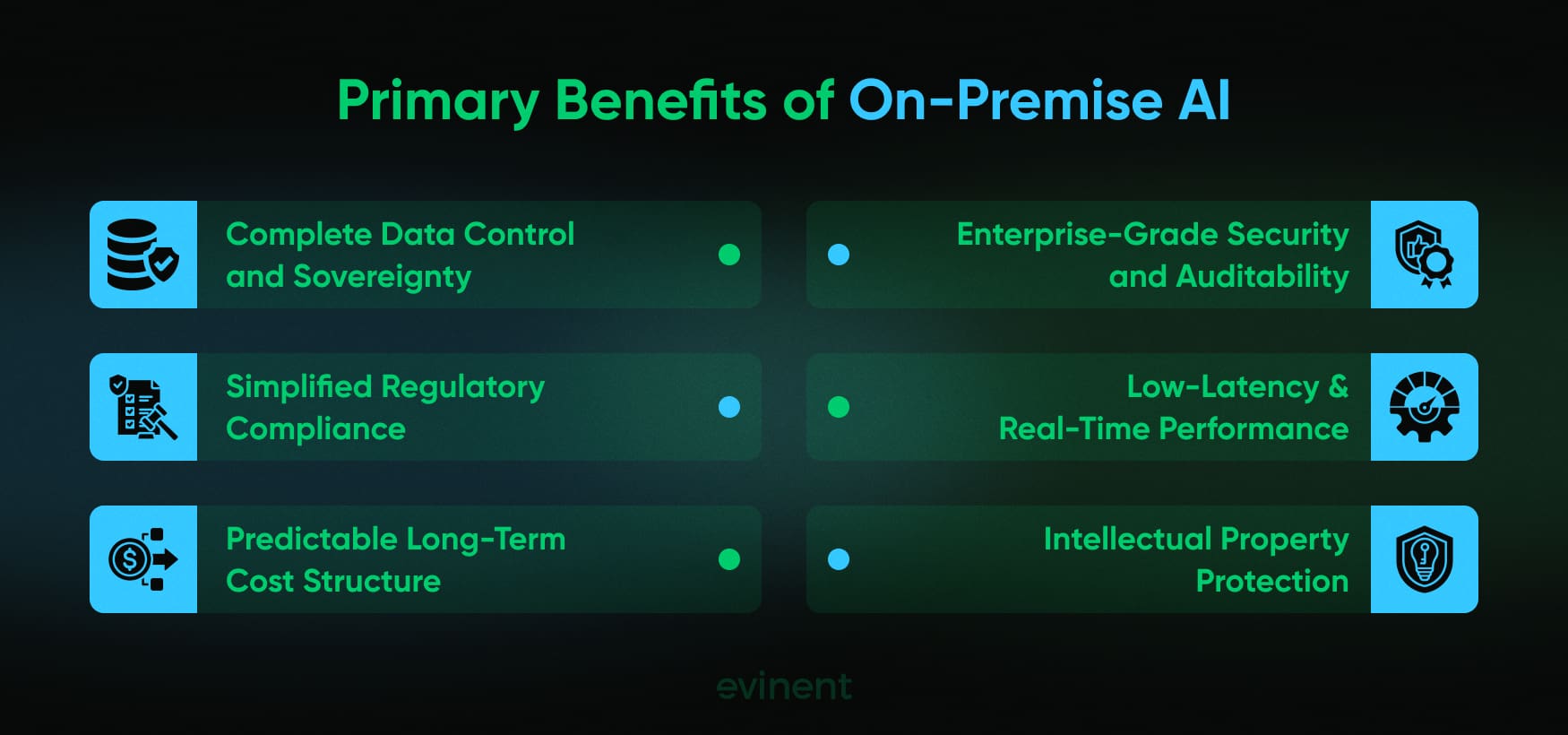
Complete Control and Sovereignty over Sensitive Data
If a business runs AI jobs only on their own on-premises infrastructure, then the full dataset, models, and training artifacts belong to the company. They keep the old data privacy laws around the corner. That is why they keep out the risks of external hacking; on top of that, the companies are free to set and enforce their own internal data governance rules. The enterprises enjoy having clear control over data storage location, data processing, and data access.
Enterprise-Grade Security and Auditability
Self-hosted AI platforms integrate seamlessly with an organization’s existing security tools, including firewalls, role-based access control (RBAC), audit logging, and workload traceability systems. This enables consistent enforcement of security policies across all AI operations, ensures that sensitive models and datasets are protected, and provides detailed logs for compliance audits or forensic analysis. Internal teams can immediately respond to potential threats without relying on external providers.
Simplified Regulatory Compliance
By keeping AI infrastructure under local control, enterprises can more easily comply with stringent regulatory frameworks such as GDPR, HIPAA, and industry-specific standards. Detailed audit trails, workload monitoring, and policy-driven access control allow organizations to demonstrate compliance during inspections or reporting processes. This local control reduces the risk of accidental cross-border data transfers and simplifies governance over highly sensitive or regulated datasets.
Low-Latency and Real-Time Performance
Since the data and computing resources are located on the premises, the inference and analytics workloads can get low-latency performance that is crucial for real-time decision-making. It is especially crucial in cases where operations, such as robotic control, supply chain optimization, and automated trading, are so tightly coupled that even a small can alter the outcome. Enterprises get stable, reliable performance that does not depend on the availability of the external network or cloud services.
Predictable Long-Term Operational Costs
Deploying on-premise does need more money upfront, but it can make the operational spending quite predictable over time. Companies do not have to deal with the pricing models of cloud providers that are based on variable usage, so they can set accurate budgets and do financial planning. This cost stability is particularly beneficial for big companies that have continuous workloads or operate AI systems at a large scale, as fluctuating cloud bills in such cases can pose a financial risk.
Protection of Intellectual Property
All AI models, training data, and fine-tuning pipelines are still directly controlled by the organization; it is the algorithms and confidential datasets that are protected from being exposed. In this way, the company's valuable intellectual property does not get outside the company's walls, and the company keeps its competitive advantage. Installation on a premise permits safe testing and modifying of models without the risk of leaking one's innovations to third-party platforms.
Limitations and Trade-Offs
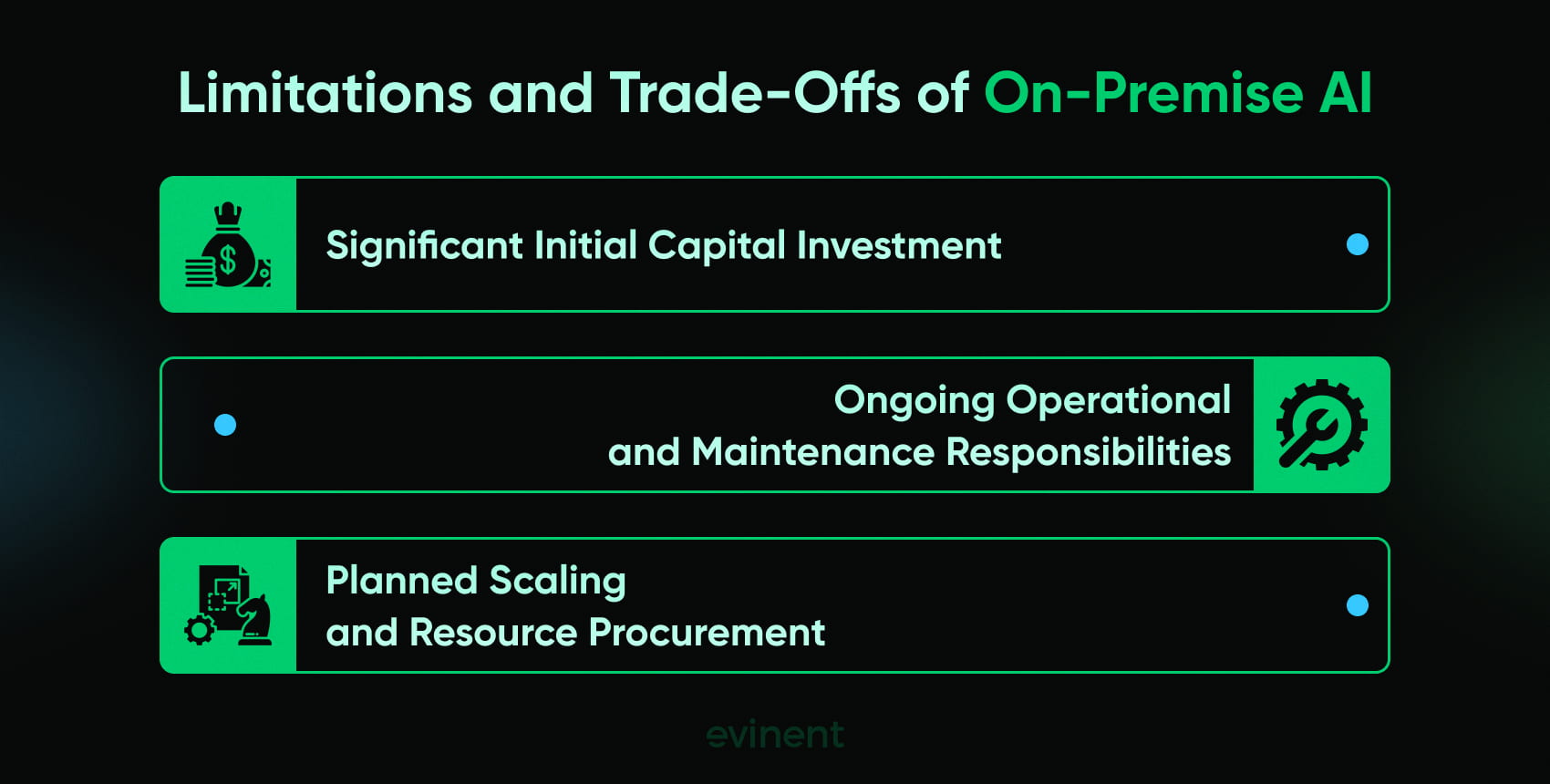
High Upfront Capital Requirements
Implementing an on-premise AI platform requires substantial investment in servers, storage, networking, and supporting infrastructure. Organizations must plan budgets carefully to account for initial costs, including specialized hardware such as GPUs for AI workloads. While these costs are often offset by long-term benefits, the initial financial barrier can be a significant consideration for smaller enterprises or those with constrained capital.
Operational and Maintenance Responsibility
Opposite to fully managed cloud solutions, on-premise platforms are dependent on internal teams or trusted partners to manage maintenance, software updates, hardware lifecycle management, and security monitoring continuously. This raises operational overhead and requires staff to have the necessary skills to handle complex infrastructure, orchestration tools, and AI workloads efficiently.
Scaling Requires Planning and Procurement
Increasing compute or storage capacity in an on-premise environment usually takes more time than in cloud deployments. Scaling involves accurate forecasting, purchasing, and installing new resources. Organizations are required to foresee their future requirements and incorporate flexibility in their infrastructure so that they can continue to grow without bottlenecks.
In summary, on-premise AI platforms provide strong control over sensitive data, enterprise-grade security, regulatory compliance, and predictable performance, making them ideal for mission-critical workloads.
While they require higher upfront investment and internal operational management, these trade-offs are often justified for organizations that handle proprietary data, rely on real-time AI decision-making, or need seamless integration with legacy systems. Overall, on-premise AI enables both technical reliability and strategic business advantage, offering a foundation for long-term innovation and data governance.
Choosing Between On-Premise, Cloud, and Hybrid AI Platforms
Where and how to deploy AI can be very different for each company and picking the right model is usually a mix of an organization's regulatory requirements, performance needs, budget, and existing infrastructure. This section performs a comparison between on-premise, cloud, and hybrid AI platforms by discussing their respective strengths, limitations, and perfect use cases. It also aims to help organizations make informed decisions.
Comparison Table
Feature/Aspect | On-Premise AI | Cloud AI | Hybrid AI |
Data privacy and sovereignty | Full control; data never leaves local infrastructure | Data stored externally; compliance depends on provider policies | Sensitive data on-premise, less sensitive workloads in the cloud |
Regulatory compliance | Easier to enforce with internal policies and audit controls | Provider-dependent; may be challenging for highly regulated industries | Flexible; critical compliance on-premise, other workloads in the cloud |
Performance and latency | Low-latency, real-time inference is possible | Depending on the network, latency can impact real-time workloads | Critical workloads on-premise; other workloads leverage cloud elasticity |
Cost structure | High upfront capital investment; predictable operational costs | Pay-as-you-go; variable costs; can spike under heavy usage | Mixed: capital investment for on-prem, flexible cloud consumption for other workloads |
Business continuity and disaster recovery | Requires internal DR planning and backup strategy | High availability managed by the provider; DR is built in | Sensitive workloads are protected on-premise; the cloud provides a failover for other workloads |
Integration with legacy systems | Direct integration; fewer compatibility issues | May require API bridges or system re-architecture | Sensitive systems integrated on-premise; cloud handles modern apps and analytics |
Hardware and scalability | Proprietary hardware; scaling requires planning and procurement | Virtually unlimited, cloud-managed resources | Combination of planned on-premise resources + elastic cloud scaling |
Edge deployments | Fully supported; workloads can be placed on-site | Limited; primarily cloud-to-edge connectivity | Flexible; edge workloads on-premise, analytics, or storage in the cloud |
Choosing between on-premise, cloud, and hybrid AI platforms requires balancing control, cost, performance, and compliance. On-premise AI is best for organizations with strict regulatory requirements, proprietary data, and low-latency or mission-critical workloads. Cloud AI offers flexibility and near-infinite scalability for less sensitive workloads, while hybrid models provide a best-of-both-worlds approach, placing critical workloads on-premise and leveraging cloud resources for elasticity and non-sensitive tasks. Selecting the right deployment model ensures efficient, secure, and future-proof AI operations.
Financial Trade-Offs and Deployment Costs of On-Premise AI Platforms
Deploying an on-premise AI platform entails major financial planning for upfront capital expenditure (CapEx), operational costs (power, cooling, maintenance, staffing) on a recurrent basis, as well as budgeting for the upgrade and lifecycle management over the long run. In this section, the author compares these costs with the cloud-based ones and points out the cases when on-premise can be cheaper or more expensive depending on the user's profile.
1. Core Cost Categories and Typical Prices
Cost Category | On-Premise | Cloud AI | Explanation/Why It Matters |
GPU hardware cost | $25,000–$40,000 per H100 GPU (retail) | $1.49–$6.98 per GPU-hour (cloud rental) | On-premises requires CapEx for GPU purchases; cloud costs are OpEx-based on usage. |
Server + networking | $79,000–$335,000+ per AI server (typical clusters) | Included in rental | On-premise hardware stacks add servers, switches, and interconnects; cloud abstracts this into hourly pricing. |
Power and cooling | $35,000–$50,000/year for 8× H100 system | Included in rental price | GPUs draw significant energy; on-premise organisations bear electricity and cooling costs. |
Maintenance and upgrades | 10–15% of CapEx per year is typical | Covered by the provider | On-premises environments must provision support and upgrades; cloud providers include these in their services. |
Staff and operations | $75,000–$300,000+ per year | Covered | Skilled engineers for infrastructure management are usually needed on-premises. |
The bulk of on-premise cost lines comes from the capital investment and the dedicated operational staff, while cloud pricing changes all expenses into usage-based billing that covers infrastructure and management overhead.
2. GPU Cost Breakdown – On-Premise vs Cloud
GPU Type | On-Premise Cost | Cloud Rental (Hourly) | Typical Use Case |
NVIDIA H100 80GB | $25,000–$40,000 MSRP per unit | $1.49–$3.90/hr per GPU | HPC training, large LLM inference |
NVIDIA A100 80GB | $10,000–$15,000 | $1.19–$3.67/hr | Balanced AI training & inference |
Inference-optimized GPUs (e.g., L40S) | $7,000–$10,000 | Varies widely; ~$1–$3/hr | Lower cost inference tiers |
The price of renting a GPU in the cloud has dropped substantially in 2025. Some vendors, for instance, have put the price of H100 GPUs at only around $1.49–$1.99/hr thanks to aggressive competitive pricing and the availability of spot markets.
3. Total Cost of Ownership (TCO): Cloud vs On-Prem Over Typical Lifecycle
Scenario | On-Premise (3 Yr TCO) | Cloud Equivalent (Assuming High Utilisation) | Notes |
Entry-level (1 GPU) | $8,676 total | $43,800 (cloud @ $2/hr) | On-premise is cheaper if GPU utilization is high and continuous. |
Mid-range (4 GPUs) | $46,908 | $210,240 (cloud @ $2/hr) | Own hardware becomes more cost-effective with a consistent workload. |
Enterprise-scale (8 GPUs) | $444,564 | $420,480 (cloud @ $2/hr) | Break-even point depends on utilisation and electricity costs. |
In the case of heavy GPU usage (ex: continuous inference or training), the infrastructure that is bought gets amortized faster, thus lowering the per-hour cost as compared to cloud rental. A break-even point normally happens when there is over ~30-50% utilisation of the hardware lifecycle. (aihardwareindex, 2026)
Comparing the finances, the on-premise AI infrastructure comes with hefty initial costs — mainly because GPUs and facility overheads supporting them are expensive — however, it can yield a lower total cost if used for periodic, steady workloads. Cloud AI is best suited for changing demand, fast scaling, and short-term testing because of its pay-as-you-go characteristic. Companies having a constant requirement and being under regulations may think about on-premise models as a more economical option within 3-5 years, whereas cloud is still the best option for irregular or investigative workloads.
On-Premise AI Deployment Roadmap and Vendor Selection Strategy
An on-premise AI platform cannot be seen as a technical task only, but rather a multi-stage transformation process that involves infrastructure planning, AI stack design, governance, and long-term vendor partnerships. The section is broken down into two parts:
Implementation Steps — the typical approach of organizations to design and deploy an on-premise AI platform.
Vendor Selection — a guide to choosing technology partners and the reason why the vendor decision affects delegates, security, and returns.
Implementation Steps for an On-Premise AI Platform
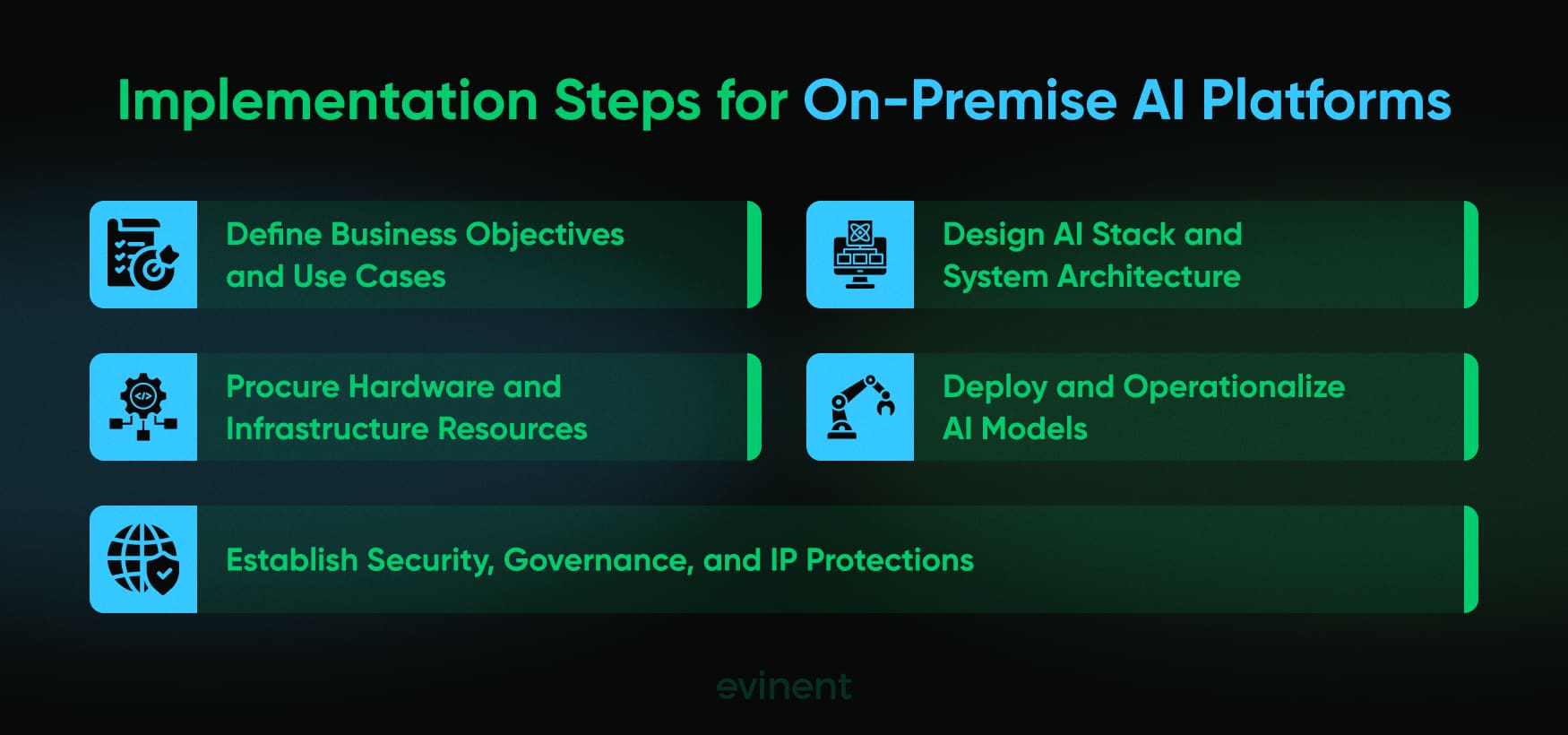
1. Define Business Use Cases and AI Objectives
Before hardware or software decisions are made, organizations must clearly articulate why an on-premise AI platform is needed. Typical drivers include IP protection, regulatory constraints, predictable performance requirements, or the need to integrate AI into existing core systems. Defining concrete use cases (e.g., internal copilots, real-time inference, sensitive data analytics) determines architectural choices across the entire AI stack and prevents over-engineering or misaligned investments.
2. Design the AI Stack and Architecture
Typically, an on-premise AI stack comprises compute (CPUs, GPUs), networking, AI storage solutions, orchestration tools, model deployment pipelines, and security layers like AI gateways and RBAC. At such a point, the choices have to be based on the workload nature (training vs inference), data locality, scalability, and future expansion. The errors in the architecture at this point will be very costly to fix later, so having early design expertise is extremely important.
3. Hardware and Resource Procurement
Hardware procurement goes beyond buying GPUs. Organizations must consider server form factors, networking bandwidth, redundant storage, and power/cooling constraints. Procurement timelines, vendor lock-in risks, and compatibility with AI frameworks all influence long-term viability. For AI workloads, storage performance (for example, flash-based systems optimized for AI) often becomes a bottleneck if underestimated.
4. Model Deployment and Operationalization
Having set up the infrastructure, an equally important step is the secure and dependable deployment of AI models. Such a process encompasses versioning, workload isolation, monitoring, and restricted access via AI gateways. Leading on-premise projects consider AI systems as production systems rather than experiments - thus, significantly focusing on observability, audit logging, and lifecycle management right from the start.
5. Security, Governance, and IP Protection
On-premise AI platforms are sometimes specially selected due to the protection of intellectual property and data sovereignty. The step involves access control enforcement, workload traceability assurance, model artifact security, and compliance with internal policies. Governance mechanisms should be part of the platform inherently rather than being implemented later as an afterthought.
Vendor Selection — How to Choose the Right Technology Partner
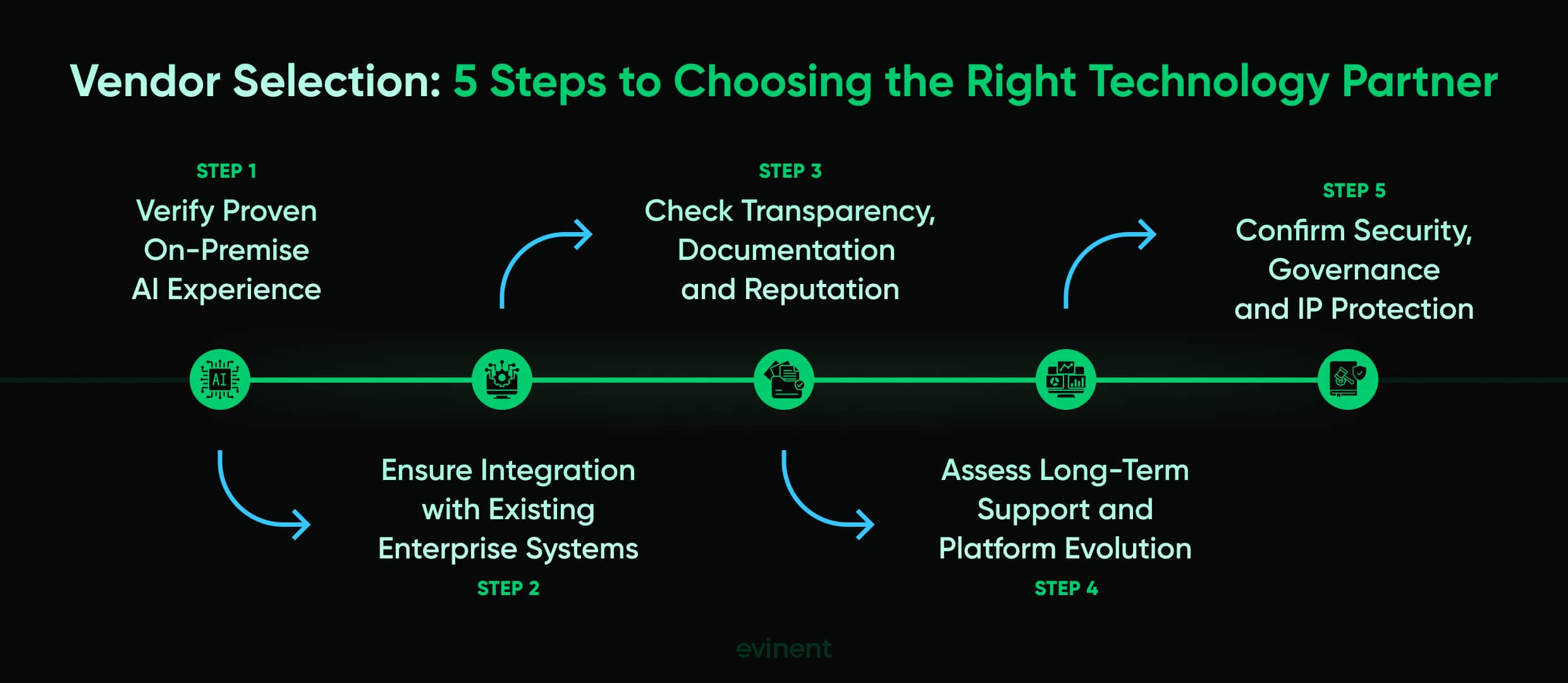
1. Proven Experience with On-Premise AI Initiatives
Some AI vendors do not have substantial on-premise experience. A lot of them focus mainly on cloud solutions and have difficulty handling local infrastructure constraints. A reliable vendor should be able to show that they have carried out comprehensive on-premise AI projects, which involve hardware procurement, AI stack integration, and production-grade model deployment — not just proof-of-concept projects.
2. Ability to Integrate with Existing Enterprise Systems
Provider products should be compatible with old systems, in-house data sources, and current security setups. This also implies that they have to interact smoothly with enterprise networking, identity management, and storage platforms. Vendors who base their products on inflexible, cloud-centric assumptions usually create friction rather than speed up the process.
3. Transparency, Documentation, and Vendor Reputation
Review platforms, which are independent of the vendors, e.g. Clutch, TrustRadius, GoodFirms, and DesignRush, can be quite helpful to how reliable the vendor is, the quality of their delivery, and the support after implementation. As each platform evaluates vendors in quite a different way, a business should verify the comments on more than one platform instead of taking one source as a fact. When the feedback is positive consistently over a number of independent market places, a vendor is therefore quite likely to be mature and capable of delivering on their promises.
4. Long-Term Partnership and Platform Evolution
On-premise AI platforms typically take years rather than months to evolve. Vendors should be able to provide support for upgrades, new model architectures, and changing performance requirements without requiring a complete redesign of the solution. A reliable partner considers the future even after the initial deployment and integrates the decisions concerning the platform with the organization's long-term AI roadmap.
5. Security, Governance, and IP Protection
On-premise AI platforms are often chosen specifically for intellectual property protection and data sovereignty. This step includes enforcing access control, ensuring workload traceability, securing model artifacts, and aligning with internal compliance policies. Partnering with experienced vendors, such as Evinent, can help organizations implement these measures effectively, providing expert guidance on architecture, secure deployment, and ongoing governance, while ensuring that IP and sensitive data remain protected within the enterprise environment.
Embedding AI within an on-site environment effectively requires not only a planned, step-by-step implementation process but also a wise selection of vendors. Defining the problem, creating an AI architecture, and running the production-level governance are the technical bases of the whole initiative. However, the vendor is the one to figure out if the whole thing can be scaled up reliably for the long run. Such companies that approach the vendor selection as a strategic decision and not just a procurement box-ticking are much more likely to harvest the enduring value of on-premise AI solutions.
Best Practices for Architecture and Integration
Architecting and integrating strategy of on-premise AI platform deployment equally matter with choosing proper hardware and software components. Leveraging the recognized best practices helps in building a platform that lasts, is scalable, reliable, and can be easily maintained throughout its life.
1. Modular and Scalable Architecture
A modular architecture allows components such as compute, storage, networking, and AI orchestration tools to be scaled independently. By separating these layers, organizations can add GPUs, increase storage, or expand networking capacity without disrupting the entire system. Modular design also facilitates future upgrades and ensures that evolving AI workloads, including LLMs or multimodal models, are supported efficiently.
2. GPU-Aware Scheduling and Orchestration
Effective utilization of resources highly depends on intelligent scheduling. By allowing workload placement to be done automatically on the hardware that is most suitable through GPU-aware orchestration platforms combined with Kubernetes-native management, it results in less idling and higher inference performance. The adjustment of the pipelines and the workload-specific orchestration assure the high flow for both training and real-time inference.
3. High-Performance Storage Solutions
AI workloads place a heavy demand on storage. To make sure that there is a quick access (low latency) to larged datasets, one needs to implement dedicated, high-performance storage systems, for example, flashblade arrays optimized for AI. In the data pipeline, there should be redundancy and tiered storage, so that the most frequently used (hot) datasets can be on fast storage, whereas the older data can be archived on slower, but more cost-efficient media. Storage planning done right also grants a safeguard of intellectual property and sensitive data sets.
4. Seamless Integration with Existing Enterprise Systems
On-premise AI platforms rarely operate in isolation. Ensuring smooth integration with legacy systems, internal databases, and enterprise identity frameworks is critical for consistent operations. This includes API design, secure connectors, and role-based access control (RBAC) to maintain compliance and operational efficiency. Integration should also account for hybrid workloads, where some processes may remain in the cloud while critical operations stay on-premise.
5. Observability, Monitoring, and Governance
Constant observation is a must to keep the system in good shape and to follow the rules. Use combined and integrated observability tools for logging, performance measurements, and audit trails. This guarantees workload traceability, instant detection of anomalies, and simplified regulatory reporting. Partnering with seasoned vendors such as Evinent can facilitate the implementation of governance best practices right from the beginning, thus making security, compliance, and operational monitoring a natural part of the architecture.
6. Planning for Upgrades and Lifecycle Management
Artificial intelligence platforms change rapidly. Hence, the system should be architected in such a way that minor hardware upgrades and software updates could be carried out without major downtime. Create a lifecycle plan for GPUs, storage, and orchestration tools, and keep system architecture performance under regular review in relation to the workloads that are continually evolving. Thinking ahead will bring a long-term gain on investment and cut down a costly re-do of the system layout in the future to a minimum.
A robust on-premise AI architecture balances performance, modularity, and maintainability while integrating seamlessly with existing enterprise systems. By following these best practices — from modular design and GPU-aware orchestration to observability, governance, and lifecycle planning — organizations can build a secure, scalable, and efficient AI platform. Partnering with experienced vendors such as Evinent ensures that these best practices are implemented correctly and sustainably, minimizing risk while maximizing performance and compliance.
Industry Use Cases
On-premise AI platforms have proven their worth in industries where the factors of data sensitivity, integration with legacy systems, performance, and compliance control the decision-making. Some of the actual and well-known sectors are listed below, where the local deployment is either already the case or is moving fast.
1. Clinical and Radiological AI at Healthcare Institutions
In medical imaging and diagnostics, on‑premise AI is being adopted because patient data and regulatory compliance (HIPAA, GDPR) demand that models run inside hospital infrastructure rather than in third‑party cloud environments. Tools such as MONAI (Medical Open Network for AI) are designed specifically to support on‑site deep learning pipelines for segmentation and diagnostic tasks, allowing rapid processing of radiological scans within a secure clinical IT ecosystem.
Another example is Aidoc, a company whose AI‑powered diagnostic algorithms (stroke, pulmonary embolism, intracranial hemorrhage) are deployed in hundreds of hospitals worldwide. Although specific deployment architectures vary, many healthcare systems integrate such AI modules locally within their imaging infrastructure for real‑time decision support without sending sensitive data externally.
2. Supply Chain Optimization and Real‑Time Forecasting
Major corporations such as Amazon and Lenovo operate on-site AI systems for the main supply chain operations. These are robotic warehouse automation, predictive inventory placement, and real-time routing, among others, which help them cut down on shipping s, enhance forecast accuracy, and reduce their operational costs. Such systems depend heavily on connections with an internal ERP, WMS, and robotic control systems; hence, on-premise architectures are preferable for low-latency optimization and proprietary process automation.
3. Algorithmic Financial Trading and Risk Analytics
In finance, hedge funds and investment firms employ AI platforms that run locally to scan markets, simulate scenarios, and adjust portfolios in real time. For example, tools such as BlackRock’s Aladdin provide real‑time risk analytics and scenario planning where data security and latency are critical. In many implementations, these systems are maintained on proprietary infrastructure to avoid exposing sensitive trading models and market data to external cloud providers.
4. Robotics Control and Industrial Automation
Manufacturing plants and industrial operations increasingly integrate AI with robotics for quality inspection, predictive maintenance, and control systems. Real‑time processing demands and legacy control systems (PLCs, SCADA) often prevent cloud‑first solutions, making on‑premise or edge‑deployed AI a better fit for vision‑based inspection and robot motion optimization in high‑throughput environments. Industry conferences and reports show that these real‑time, closed‑loop control systems thrive on local AI deployments that can interact directly with industrial networks.
5. Legacy Systems and Secure Enterprise Integration
For many enterprises with deep legacy internal systems — from ERP to specialized operational backends — on‑premise AI platforms are necessary to integrate advanced analytics without rearchitecting foundational IT stacks. Academic frameworks propose methods for embedding ML capabilities into existing production systems in a way that minimizes disruption and maintains operational continuity.
Across these examples — healthcare diagnostics, supply chain optimization, financial analytics, robotics and industrial control, and legacy enterprise integration — on‑premise AI platforms unlock value where data privacy, compliance, real‑time responsiveness, and systems integration are paramount. In such scenarios, deploying AI locally reduces data exposure risk, meets regulatory requirements, enables deterministic performance, and allows seamless integration with existing business processes — advantages often unattainable with centralized cloud‑only solutions.
Key Capabilities and Best Practices for On-Premise AI Platforms
It is a mistake for enterprises to only look at compute capacity when choosing an on-premise AI platform. They should concentrate on a more balanced set of architectural and operational capabilities as well. The following best practices point out the characteristics that significantly affect the performance, scalability, governance, and the ability of on-premise AI systems to be maintained over time.
Dedicated GPU Servers and Thoughtful Hardware Selection
On-premise AI platforms should rely on dedicated GPU servers selected according to workload characteristics rather than peak specifications alone. Best practice involves considering GPU memory size, interconnect bandwidth, and power efficiency in relation to training, fine-tuning, and inference needs. Proper hardware selection minimizes bottlenecks, improves utilization rates, and reduces unnecessary capital expenditure caused by over-provisioning.
GPU-Aware Scheduling and Hardware Orchestration
Efficient GPU utilization requires scheduling mechanisms that are aware of memory constraints, model placement, and workload priorities. GPU-aware scheduling, combined with hardware and GPU orchestration, enables multiple teams and applications to share infrastructure safely without degrading performance. Kubernetes-native orchestration is commonly used to automate workload placement, scaling, and isolation across on-premise clusters.
High-Performance AI Storage Systems
Many AI workloads are constrained by data access speed rather than raw compute power. High-performance storage systems, including flash-based architectures optimized for AI workloads, provide low-latency access to large datasets during training and inference. Best practices include isolating AI storage from general-purpose systems and implementing redundancy to protect proprietary data and model artifacts.
Fine-Tuning Pipelines and Model Lifecycle Management
Among the features of a mature, on-premise AI platform are structured fine-tuning pipelines that are clearly versioned, reproducible, and auditable. Such pipelines coordinate datasets, model checkpoints, and configuration changes, thus making it possible to trace and verify updates. The approach enables fast experimentation, while maintaining the necessary governance, which is particularly important in regulated or mission-critical environments.
LLM Gateways and Modular API Design
An LLM gateway serves as a controlled entry layer that separates applications from AI models and controls access by validating users, limiting the number of requests, and following policy-based rules. Modular APIs additionally separate AI functions from the systems that use them, thus organizations can change or replace models without affecting the applications that depend on them. This architecture greatly enhances flexibility and makes it easier to maintain over time.
Integrated Observability and Operational Monitoring
Running AI workloads in a production environment necessitates a high level of observability. Built-in monitoring must support performance metrics, GPU utilization, logs, and audit trails presented in a single view. This makes it possible to fix issues more quickly, optimize the system without waiting for problems to arise, and demonstrate compliance by showing workload traceability and having historical records.
Support for Multi-Modal AI Workloads
Companies are adopting multi-modal AI models that integrate text, vision, audio, and structured data. Hence, platforms should be capable of handling different processing patterns. One of the best practices is to test the multi-modal performance early, and also make sure that the compute, storage, and networking layers can support mixed workloads without sacrificing latency or reliability.
A successful on-premise AI platform can be characterized through a mixture of a strong infrastructure, smart orchestration, and well-disciplined operational practices. When an organization concentrates on the deployment of dedicated GPU resources, GPU-aware scheduling, top-notch storage, well-organized fine-tuning pipelines, secure access layers, and integrated observability, that organization is basically setting itself up to create AI platforms that are capable of providing high-performance consistency, good governance, and operational efficiency over the long run.
Security, Compliance, and Data Governance in On-Premise AI
On-premise AI platforms are often selected precisely because they offer maximum control over security, compliance, and data governance. Unlike cloud-based deployments, local AI environments allow organizations to enforce internal policies, meet strict regulatory requirements, and maintain full ownership of sensitive data and models. This section outlines the key security and governance considerations that define a production-ready on-premise AI platform.
Enterprise-Grade Security as a Baseline
Security in on-premise AI starts at the infrastructure level and extends through the entire AI stack. This includes hardened servers, isolated networks, firewalls, and secure access to GPUs and storage. Compliance with standards such as FIPS 140-3 for cryptographic modules is often required in government, defense, and regulated enterprise environments. A strong security baseline ensures that models, datasets, and inference workloads are protected against both external threats and internal misuse.
Regulatory Compliance and Industry Standards
Many industries operate under strict regulatory frameworks such as GDPR (EU data protection), HIPAA (healthcare data), and PCI-DSS (payment data). On-premise AI platforms make it easier to align with these regulations by keeping data within controlled environments and enabling fine-grained enforcement of internal and external standards. Local deployment simplifies audits, reduces ambiguity around data handling, and supports compliance with evolving regulatory requirements.
Data Sovereignty and Residency Control
Data sovereignty and data residency laws are about keeping specific types of data within certain geographic or organizational limits. Using on-premise AI platforms gives you clear control over the location of data storage, processing, and backup, thus making it possible to meet the requirements of local laws as well as contracts. Such a degree of control is highly valuable for those firms that handle confidential data, power grids, or have to deal with cross-border regulations.
Role-Based and Policy-Based Access Control
Proper governance needs to be able to regulate which individuals can access what parts of an AI platform. Role-based access control (RBAC), together with policy-based access mechanisms provide the means for organizations to set permissions for users, squads, models, datasets, and workloads, and thus limit the risk of unauthorized access, facilitate the division of work, and fit AI operations to security policies and compliance standards of a company.
Audit Logging and Workload Traceability
Traceability of workload and audit logging play an essential part in security investigations as well as regulatory reporting. On-premise AI platforms need to capture comprehensive logs about model access, data usage, changes in configuration, and inference operations. With this, companies can track the origin of their decisions to certain models and data, provide evidence of compliance in audits, and efficiently handle the investigation of anomalies or security breaches.
Governance as an Operational Capability
Data governance is more than just a one-time setup; it is an ongoing operational capability. Data retention policies, model lifecycle management, access reviews, and incident response need to be continuously implemented in daily operations. When the system is deployed on-premise, these governance practices can be deeply aligned with enterprise support processes, internal controls, and risk management frameworks.
Security, compliance, and data governance are crucial for the successful implementation of on-premise AI platforms. Organizations that implement on-premise AI solutions have the advantage of controlling the infrastructure, data location, access policies, and auditability completely.
In such a way, they are able to satisfy even the most stringent regulatory requirements while at the same time keeping their intellectual property and proprietary information safe. An enterprise that thoroughly manages its on-premise AI environment can significantly ramp up the use of AI with full security and compliance guarantees, which are integrated into the system by default and not considered as add-ons.
How Evinent Can Help With Implementation On-Premise AI Platforms
Evinent has a long-standing track record of helping enterprises design and implement complex, secure, and scalable data-driven platforms. As organizations increasingly adopt on-premise AI and Private LLMs to retain ownership of proprietary data and comply with regulatory requirements, Evinent acts as a reliable partner across the entire lifecycle — from early architecture planning to production-grade implementation and long-term operation.
Our focus goes beyond deploying models or infrastructure in isolation. Evinent embeds on-premise AI and Private LLM capabilities directly into real business workflows, integrating internal data from multiple sources and enabling AI-driven insights without exposing sensitive information to public cloud services or third-party data processing risks. The result is AI systems that are secure, reliable, and aligned with measurable business outcomes.
Why Organizations Choose Evinent for On-Premise AI and Private LLM Implementation
15+ years of software and analytics engineering for complex eCommerce environments
20M+ active users interacting daily with our recommendation engines and decision systems
100% project delivery success rate, including large, multi-regional deployments
78% of our portfolio is focused on enterprise eCommerce across the US, EU, and MENA
Evinent Private AI in practice
Large enterprises very often experience the issues of fragmented HR data stored across different internal systems, the candidate-to-vacancy matching processes being slow, and screening workflows lacking automation, on top of which, they are bound by strict data privacy regulations that do not allow them to use external AI services.
As a result, Evinent has set up a completely isolated Private AI environment based on open-source LLMs and containerized agent architecture. The platform is capable of integrating internal HR data, performing semantic matching, and applying rule-based validation, as well as facilitating candidate screening and recommendation workflows without making any external API calls. The solution is hosted on the enterprise infrastructure, where RBAC, encryption, and monitoring are used to ensure that the data is fully controlled and the organization is ready for compliance.
Evinent Capabilities for On-Premise AI and Private LLM Projects
Private LLM architecture design
We design and implement secure on-premise AI architectures. This includes our selection and deployment of open-source LLMs (for example, LLaMA-based models), setting up scalable inference pipelines, and building infrastructures optimized for private workloads.
Secure data ingestion and retrieval
Our solutions include embedding internal knowledge sources into vector databases, facilitating retrieval-augmented generation (RAG), private AI assistants, and domain-specific chatbots. All these models will be running in tightly controlled environments, operating fully locally.
Enterprise-grade security and compliance
We help organizations from the ground up with implementing and ensuring the effectiveness of encryption, role-based access control, and audit logging aligned with their internal policies as well as their position with external regulatory bodies. In other words, balancing compliance and user-friendliness.
Operational reliability and lifecycle support
Support services in areas like monitoring, performance tuning, model refreshing, and infrastructure maintenance in a way that is least disruptive to the client’s operations. It means that users have their AI systems running at a stable level without needing to reach for external help very often.
Custom-built, not off-the-shelf solutions
Each on-premise AI platform is a reflection of a company’s data sensitivity, compliance needs, and AI vision for the future. No one-size-fits-all solutions, no reliance on a closed ecosystem.
Evinent isn't just handing out common AI tools. We create and carry out uniquely customized on-premise AI and Private LLM platforms that fit a company's security stance, data governance model, and business objectives perfectly. Through a merge of enterprise engineering rigor and leading-edge AI functionalities, Evinent aids enterprises in setting up private AI systems that they can rely on, manage, and grow with assurance.
Key Takeaways
On-premise AI platforms are defined by full local control over infrastructure, data flows, and AI model lifecycle.
They fundamentally differ from cloud and hybrid models in governance, risk profile, and operational predictability.
The primary advantages are data security, compliance, and IP protection, especially for regulated enterprises.
Key limitations include higher upfront investment and operational complexity, though these are manageable with proper planning.
Cloud, hybrid, and on-premise AI each fit different business scenarios, depending on performance, regulatory, and scalability needs.
Cost efficiency depends on workload stability and time horizon, not just initial infrastructure expenses.
Implementation success relies on structured deployment steps and experienced vendor participation.
Architecture and integration choices determine long-term scalability, observability, and maintainability.
On-premise AI is most effective in industries with sensitive or proprietary data, such as finance, healthcare, manufacturing, and R&D.
Security, compliance, and data governance are foundational requirements, not optional features, for sustainable on-premise AI operations.
Share