

How do lenders detect mortgage fraud? Mortgage fraud is rarely obvious. Most fraudulent applications look legitimate on the surface, pass basic credit checks, and include professionally prepared documents. The risk only becomes visible when subtle inconsistencies across identity, income, property data, and transaction behavior are connected: something traditional rule-based systems and manual reviews often fail to do at scale.
In 2026, detecting mortgage fraud requires more than red flag checklists. It demands a combination of:
Early identification of high-risk patterns
Cross-verification of borrower, property, and financial data
Real-time monitoring across the mortgage lifecycle
AI-driven anomaly detection supported by human judgment
“While mortgage delinquencies are currently low across the U.S., the market is ripe for an increase in fraud because of the continuing high interest rates, slow housing market, and other increasing costs of homeownership like insurance affordability,” said Matt Seguin, Sr. Principal, Fraud Solutions. “If market conditions continue to challenge sellers, risks like misrepresented down payments, inflated prices, and straw buyers could increase dramatically.”
This article explains what mortgage fraud looks like today, how lenders actually detect it in practice, and which detection strategies reduce losses without slowing origination. It is written for C-level leaders, heads of risk, compliance executives, and lending decision-makers who need clarity — not theory — in an environment where fraud tactics change faster than regulations.
What Is Mortgage Fraud?
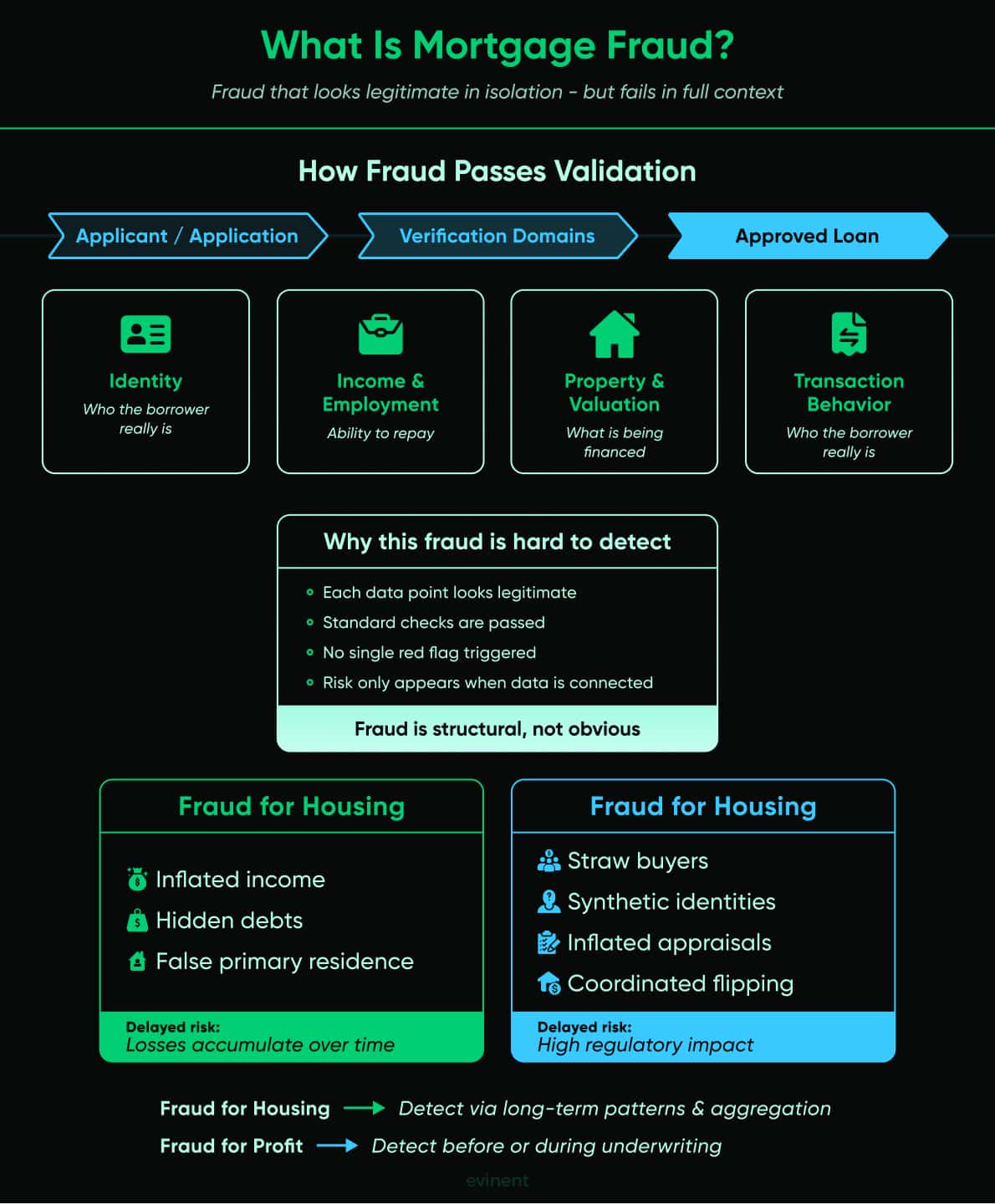
Mortgage fraud is any intentional misrepresentation, omission, or manipulation of information used to obtain a mortgage loan under false pretenses.
In practice, this means that a borrower, broker, appraiser, title agent, or third party submits information that appears legitimate when reviewed in isolation, but becomes materially false once examined across the full lending context.
From a lender’s risk perspective, mortgage fraud is not a single bad data point. It is a systemic failure of verification across four interconnected domains:
Identity – who the borrower actually is
Income and employment – how repayment capacity is established
Property and valuation – what is being financed and at what true value
Transaction behavior – how funds, documents, and participants interact
Modern mortgage fraud exploits the gaps between these domains. Individually, each data element may pass validation. Collectively, they often tell a very different story.
This is why many fraudulent loans are approved despite compliant processes; the fraud is structural, not obvious.

The Two Main Types of Mortgage Fraud
Mortgage fraud is typically classified into two categories. The distinction matters because detection timing, loss patterns, and regulatory consequences differ significantly.
Understanding which type you are dealing with determines how early you must detect it and how much risk it introduces into your portfolio.
Fraud for Housing
Fraud for housing occurs when an applicant misrepresents information to qualify for a mortgage they intend to repay, at least initially.
Common examples include:
Inflating income or overstating employment stability
Concealing existing loans, guarantees, or informal debt
Misstating occupancy status (claiming a primary residence instead of an investment property)
This type of fraud is often rationalized by borrowers as “temporary” or “necessary to qualify.” As a result, it frequently passes manual review and rule-based checks.
However, fraud for housing creates latent portfolio risk:
Repayment ability is weaker than modeled
Default probability increases sharply under economic stress
Losses accumulate gradually rather than triggering immediate alarms
During periods of rising interest rates, layoffs, or property price corrections, these loans disproportionately migrate into delinquency, making fraud for housing a ed but scalable threat.
Fraud for Profit
Fraud for profit is organized, deliberate, and designed to extract value, not to sustain repayment.
Typical schemes involve:
Straw buyers acting on behalf of undisclosed parties
Synthetic or stolen identities engineered to pass onboarding checks
Appraisal inflation disconnected from real market conditions
Rapid, coordinated property flipping with artificial price escalation
Collusion between borrowers, brokers, appraisers, notaries, or title agents
These schemes are often repeatable, automated, and networked across multiple applications and properties.
Fraud for profit represents the highest financial and regulatory risk for lenders because:
Losses materialize quickly, often immediately after funding
Recovery rates are low or nonexistent
Regulatory scrutiny is more severe
Reputational impact extends beyond individual loans
In 2024–2025, fraud for profit has increasingly incorporated AI-generated documents, synthetic identities, and coordinated digital behavior, making it harder to detect with traditional controls.
Why This Distinction Matters for Detection
The most important operational takeaway is this:
Fraud for housing must be detected through risk aggregation and long-term behavioral signals
Fraud for profit must be detected before or during underwriting and not after funding
Institutions that fail to distinguish between the two often apply the wrong controls at the wrong stage, detecting fraud only after losses have already occurred.
This is why modern mortgage fraud detection focuses less on individual red flags and more on connected analysis across applications, participants, and time — a topic we examine in the next section.
Why Mortgage Fraud Is Escalating in 2024–2025
Mortgage fraud has always existed, but several structural shifts have accelerated risk over the past three years.
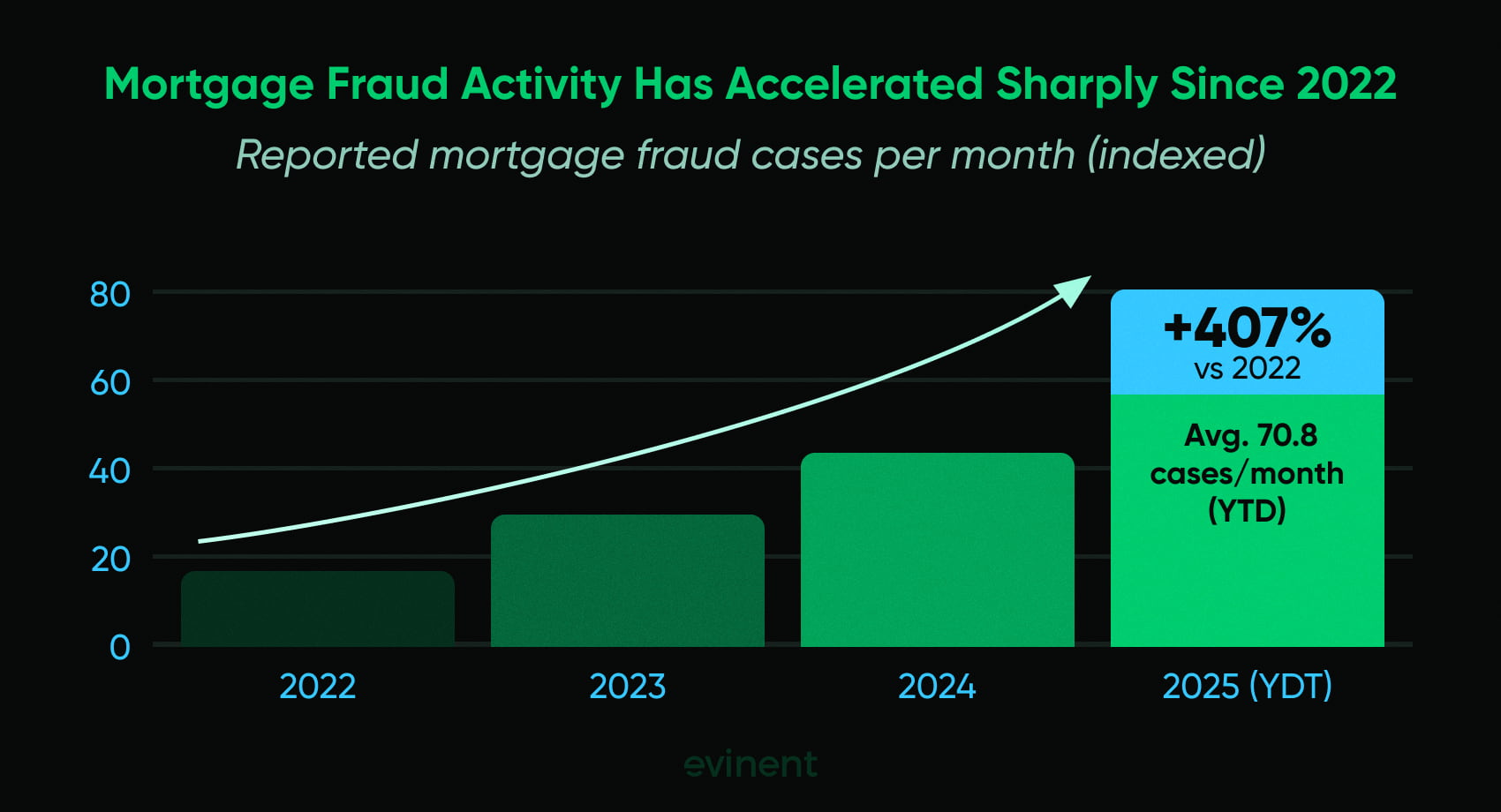
According to industry data, mortgage fraud risk rose 7.3% year-over-year in Q1 2025, affecting approximately 1 in every 116 applications nationwide. At the same time, reported mortgage scam incidents increased 407% since 2022, driven primarily by digital impersonation and phishing-based schemes.
Three forces are driving this surge:
1. Digitized Origination at Scale
Remote onboarding, automated underwriting, and document uploads reduce friction, but also remove many of the informal verification signals lenders historically relied on.
2. AI-Enabled Fraud Toolkits
Fraudsters now use:
AI-generated pay stubs and bank statements
Deepfake IDs and facial images
Scripted social engineering for brokers, notaries, and title agents
3. Fragmented Verification Systems
In many institutions, identity, income, property, and transaction risk are still evaluated in silos, allowing coordinated fraud to slip through undetected.
Why Mortgage Fraud Is Hard to Detect Early
One of the biggest misconceptions is that mortgage fraud is easy to spot if reviewers “pay attention.” In reality, modern mortgage fraud is engineered to pass surface-level checks.
Fraudulent applications often:
Use real personal data mixed with fabricated elements
Include professionally formatted, AI-generated documents
Pass credit scoring and basic KYC checks
Appear “normal” when reviewed in isolation
Fraud becomes visible only when lenders examine:
Relationships between applicants, properties, and intermediaries
Behavioral patterns across multiple applications
Timing, sequencing, and reuse of documents and devices
Subtle inconsistencies that do not violate rules individually but do collectively
This is why lenders relying only on manual review or static rule sets detect fraud late, often after funds have already been disbursed.
Why Mortgage Fraud Detection Is a C-Level Issue
Mortgage fraud is often treated as an operational or compliance problem. In reality, it is a strategic business risk with direct executive implications.
For leadership teams, mortgage fraud affects:
Credit portfolio performance
Capital adequacy and provisioning
Regulatory standing and audit outcomes
Brand trust with investors and partners
Long-term scalability of digital lending models
As fraud volumes and sophistication increase, executives are being held accountable not just for reacting to fraud, but for demonstrating proactive, measurable prevention.
This shift is why regulators, auditors, and boards increasingly ask:
How early is fraud detected?
What percentage is stopped before funding?
How are detection models governed and validated?
How do humans and AI collaborate in decisions?
These questions shape the modern approach to mortgage fraud detection, which we explore next.
Mortgage Fraud Trends and Statistics in 2025–2026: What the Data Shows
Mortgage fraud risk accelerated sharply through 2025 and continues to intensify heading into 2026. What stands out in recent data is not only the growth in volume, but the breadth of fraud types now affecting standard mortgage transactions, including loans that previously appeared low-risk.
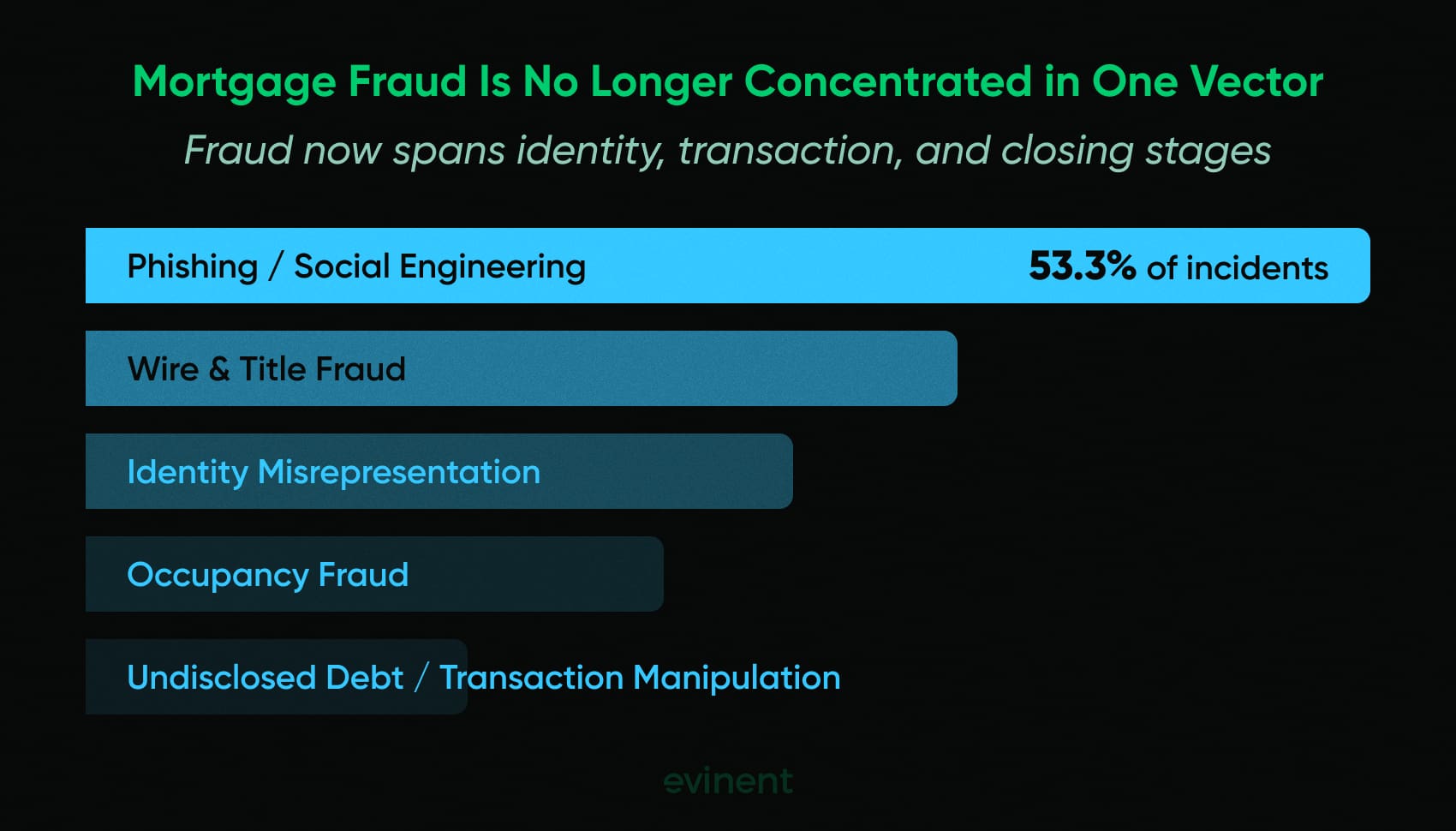
Industry-wide reporting shows that fraud is no longer concentrated in edge cases or fringe lending segments. It is increasingly embedded in mainstream origination flows, particularly where digital onboarding, wire transfers, and third-party coordination intersect.
A Sharp Rise in Reported Fraud Activity
By mid–2025, mortgage scam reports had increased 407% compared to 2022, averaging 70.8 reported cases per month year-to-date. Total documented losses exceeded $1.3 million, though this figure reflects only cases where financial impact was formally reported — meaning actual losses are materially higher. (Source: National Mortgage Professional, Loan Fraud Up a Staggering 407%)
Phishing-based schemes accounted for 53.3% of incidents, highlighting a shift toward social engineering and identity manipulation rather than crude document falsification. These attacks increasingly target borrowers, settlement agents, and internal lender staff simultaneously, creating confusion during time-sensitive transactions.
At the portfolio level, Cotality’s Mortgage Fraud Risk Index reported a 7.3% year-over-year increase in Q1 2025, followed by:
6.2% growth in transaction fraud in Q2
12% increase in undisclosed real estate debt
(Source: Cotality, Mortgage fraud increased across the United States in the second quarter of 2025)
This pattern indicates sustained momentum rather than a one-quarter spike.
Wire and Title Fraud: The Fastest-Growing Risk Vector
Wire and title fraud emerged as the most volatile category in 2025.
In Q3, nearly 46.6% of mortgage transactions reviewed across a $90 billion portfolio were flagged for wire or title-related issues, representing a 35% increase quarter-over-quarter. These flags did not necessarily indicate ed fraud, but they revealed material process breakdowns that fraud actors actively exploit.
A particularly concerning signal was the rise in CPL (Closing Protection Letter) validation failures:
10.52% of transactions showed CPL errors in Q3
Errors included mismatched borrower names, incorrect property data, or missing coverage
This represented a 12.69% quarter-over-quarter increase
From a risk leadership perspective, this data suggests that closing-stage controls — historically viewed as procedural — are now a frontline fraud defense.
(Source: FundingShield, Q3 – 2025 – Fraud Analytics With Commentary From FundingShield’s CEO Ike Suri)
Identity, Occupancy, and Undisclosed Debt Trends
Beyond transaction fraud, borrower-level misrepresentation continues to rise.
Identity misrepresentation increased 5.6% year-over-year from 2024 into 2025
Occupancy fraud has tripled since 2020, driven in part by tighter underwriting for investment properties
One in every 123 mortgage applications showed signs of fraud in 2024, a ratio that continues to worsen in 2025
(Source: Cotality, 2025 Fraud Report)
A major accelerant is the availability of AI-generated documentation:
Synthetic pay stubs and employment letters
Bank statements engineered to mimic real cash-flow patterns
Identity documents that pass visual review but fail behavioral or metadata analysis
These trends disproportionately affect digital-first lenders and high-volume originators, where speed-to-decision limits manual intervention.
Geographic Hotspots: Risk Is Shifting, Not Concentrating
Mortgage fraud risk is not evenly distributed — but it is also no longer confined to historically high-risk states.
Metropolitan and State-Level Trends
New York metro areas led mortgage fraud risk rankings in Q1–Q2 2025
Georgia and Florida recorded the highest aggregate losses from reported mortgage scams
California and New York both experienced double-digit fraud increases, particularly among first-time buyers using high-LTV products
In Q3, national analysis found that nearly half of all reviewed transactions contained multiple fraud indicators, with an average of 3.1 risk issues per transaction. This clustering effect reinforces the need for connected risk analysis, rather than isolated checks.
What the Data Means for Executives
Three conclusions matter at the executive level:
Fraud is becoming multidimensional
Identity, wire, title, and property risks increasingly overlap within the same transaction.
Late detection is no longer acceptable
Many of the fastest-growing fraud types — wire redirection, CPL failures, straw buyer coordination — cause losses immediately at closing.
Digital scale without adaptive controls magnifies exposure
Speed-focused origination models amplify fraud impact unless paired with real-time monitoring and cross-domain verification.
The data makes one point clear: mortgage fraud is no longer an operational nuisance or a compliance afterthought. It is a predictable, data-visible risk, and institutions that fail to adapt their detection strategies will absorb disproportionate losses.
7 Common Mortgage Fraud Schemes Lenders See Today
Mortgage fraud in 2025–2026 is not dominated by a single tactic. Instead, lenders face a portfolio of repeatable schemes that exploit different stages of the mortgage lifecycle: from application to closing.
What makes these schemes dangerous is not novelty, but execution quality. Most are designed to look operationally normal, comply with surface-level rules, and evade detection until funds are disbursed.
Below are the most common mortgage fraud schemes lenders encounter today, along with how they typically appear in real underwriting environments.
Identity and Synthetic Identity Fraud
Identity-based mortgage fraud has evolved far beyond stolen Social Security numbers or obvious impersonation.
What it looks like today:
Borrowers with thin but “clean” credit profiles
Recently established identities with consistent, believable histories
IDs and selfies that pass visual review but fail behavioral correlation
Multiple applications linked by shared devices, IPs, or document templates
Real-world pattern:
A synthetic identity is built using a mix of real and fabricated data. The borrower initially behaves “perfectly,” making timely payments before escalating loan size or defaulting strategically.
Why it’s hard to detect:
Traditional KYC checks validate identity attributes, not identity behavior over time. Without cross-application and device-level analysis, synthetic identities often look lower risk than real borrowers.
Income and Employment Misrepresentation
Income fraud is no longer about crude falsification. In 2025, it is document-perfect.
Common tactics include:
AI-generated pay stubs with correct formatting and tax logic
Shell companies posing as legitimate employers
Employment verification phone numbers controlled by fraud rings
Bank statements engineered to simulate salary deposits
Real-world pattern:
A borrower appears self-employed or contractor-based, submits consistent income documents, and passes automated checks — but employer entities dissolve or become unreachable post-funding.
Why it works:
Manual reviewers are trained to spot inconsistencies, not statistically improbable patterns across thousands of applications.
Appraisal Inflation and Property Valuation Fraud
Property-based fraud increasingly involves coordination, not isolated bad appraisals.
Red flags lenders now see:
Comparable sales clustered around related entities
Appraisals disconnected from micro-market trends
Repeated use of the same appraiser across unrelated transactions
Rapid resale without material renovation
Real-world pattern:
Properties are flipped between connected parties at inflated prices, creating artificial comparables that legitimize future overvaluation.
Risk impact:
When market conditions tighten, these loans default with loss severity far above expectations.
Straw Buyer Schemes
Straw buyers are still one of the most damaging — and misunderstood — fraud mechanisms.
How they operate:
A borrower with strong credit applies on behalf of another party
Down payment funds are indirectly sourced
Occupancy intent is misrepresented
Control of the property and payments sits elsewhere
Real-world pattern:
A first-time buyer appears in a high-value transaction with no logical geographic, employment, or lifestyle connection to the property.
Why lenders miss it:
Each data point looks acceptable in isolation. The fraud only emerges when relationship networks are analyzed.
Occupancy Fraud
Occupancy fraud has surged as underwriting standards tightened for investment properties.
Typical signals:
Primary residence claims contradicted by rental listings
Borrowers owning multiple properties with overlapping “primary” declarations
Rapid tenant placement post-closing
Real-world pattern:
Borrowers seek owner-occupied rates while planning short-term rental or resale strategies.
Why it matters:
Occupancy fraud materially understates default risk and distorts capital modeling.
Wire Fraud and Closing Manipulation
Wire fraud is now one of the fastest-growing mortgage fraud vectors.
Common methods:
Email compromise of borrowers, title agents, or lenders
Last-minute wire instruction changes
Fake escrow accounts with near-identical credentials
Real-world pattern:
Funds are redirected at closing, losses occur instantly, and recovery is rare.
Executive risk:
This type of fraud bypasses underwriting entirely, making closing-stage controls critical.
Collusion Across Mortgage Participants
The most severe fraud cases involve multiple insiders or semi-insiders.
Participants may include:
Brokers
Appraisers
Title agents
Notaries
Shell service providers
Real-world pattern:
The same professionals appear across unrelated transactions, each individually compliant but collectively abnormal.
Why this is dangerous:
Collusion defeats rule-based systems that assume participant independence.
Why These Schemes Are Increasing — Not Disappearing
These fraud schemes persist because they exploit structural realities:
Digital lending prioritizes speed
Verification systems are fragmented
Controls focus on compliance, not behavior
Manual review cannot scale
Fraud actors adapt faster than policies, and they reuse what works.
What This Means for Detection Strategy
The takeaway for lenders and executives is clear:
Red flags are no longer enough
Single-point verification is insufficient
Fraud must be detected through connected analysis across people, properties, and transactions
This is why leading institutions are shifting from static rules to AI-driven pattern detection, combined with targeted human review, a topic we examine next.
Key Red Flags That Signal Mortgage Fraud (And Why They’re Often Missed)
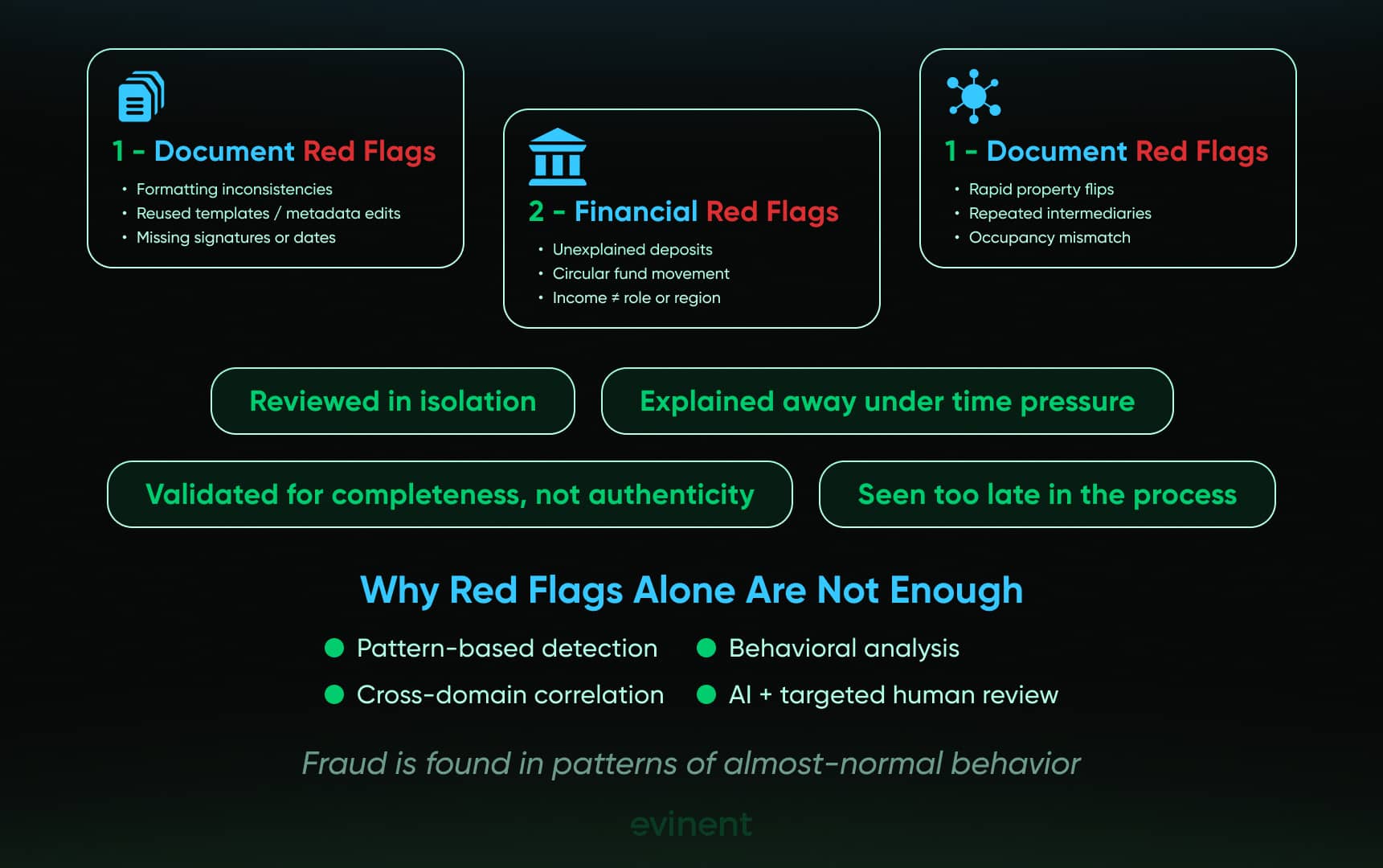
Mortgage fraud rarely announces itself through a single obvious signal. Instead, it reveals itself through small inconsistencies across documents, finances, and transaction behavior that only become meaningful when examined together.
Modern fraud detection focuses on identifying these signals early — before funding — by combining manual verification with AI-driven pattern analysis. This approach aligns with enterprise fraud risk management frameworks, which show that organizations failing to detect fraud early lose an average of 5% of annual revenue to fraudulent activity.
The challenge is not the absence of red flags. It is that most red flags appear explainable in isolation, allowing sophisticated fraud to pass traditional reviews.
Document Red Flags
Document manipulation remains one of the most common — and most underestimated — indicators of mortgage fraud.
What Lenders Commonly See
Mismatched fonts or formatting across bank statements, tax returns, and employment letters
Inconsistent spacing or alignment in W-2s and pay stubs
Blurry or low-resolution logos, especially on tax and payroll documents
Round income figures repeated across multiple documents without natural variation
Missing signatures, dates, or official stamps on applications or disclosures
In more advanced cases, documents appear visually perfect but fail deeper checks:
Metadata indicates repeated editing or template reuse
File creation dates conflict with stated employment timelines
Identical document structures appear across unrelated borrowers
Why These Red Flags Are Missed
Manual reviewers are trained to validate completeness, not authenticity at scale. When documents look professional and internally consistent, they often pass review, especially in high-volume origination environments where speed is prioritized.
AI-generated documents have made visual inspection alone unreliable.
Financial Indicators
Financial red flags often provide the earliest warning signals, but they are also the most frequently rationalized.
Common Financial Red Flags
Unexplained large deposits shortly before application
Down payment funds sourced from newly opened or dormant accounts
Circular fund movements that simulate savings accumulation
Income levels that do not align with job role, industry norms, or geographic benchmarks
Self-employment income without verifiable tax history or inconsistent filings
Credit report discrepancies, including liabilities not reflected in declared expenses
These signals are especially common in:
Straw buyer arrangements
Income inflation schemes
Synthetic identity constructions
Why These Red Flags Are Missed
Many financial anomalies can be individually justified:
“Gift from a family member”
“Bonus or commission”
“Seasonal income fluctuation”
Without behavioral analysis and cross-application comparison, these explanations often go unchallenged — even when the underlying pattern is statistically improbable.
Transaction and Property Signals
Transaction-level behavior often exposes organized or repeat fraud, particularly in fraud-for-profit schemes.
High-Risk Transaction Patterns
Rapid property flipping without corresponding renovation activity
Multiple mortgage applications tied to the same borrower, device, or intermediary
Overlapping refinances across related entities
Appraisals exceeding local market trends or recent comparable sales
Repeated use of the same appraiser, broker, or title agent across unrelated deals
Investment properties financed as primary residences
These patterns frequently indicate:
Collusion between participants
Appraisal inflation networks
Occupancy fraud
Undisclosed real estate debt
Why These Red Flags Are Missed
Transaction risks are often reviewed late in the process or in isolation by separate teams. Without a unified view of:
Borrower relationships
Property histories
Professional network overlaps
…fraud patterns remain invisible until losses occur.
Why Red Flags Alone Are Not Enough
The most important insight for lenders is this:
Fraud is rarely detectable through a single red flag. It is detectable through patterns of “almost normal” behavior.
Traditional rule-based systems focus on threshold violations. Modern fraud avoids thresholds entirely.
This is why leading lenders now rely on:
Cross-domain signal correlation
Behavioral anomaly detection
AI-driven document forensics
Targeted human review triggered by risk clustering
These methods reduce false positives while surfacing the fraud that legacy controls miss.
Executive Takeaway
Red flags still matter, but only when they are:
Connected across identity, financial, and transaction data
Interpreted in behavioral context
Evaluated early enough to prevent funding
Organizations that continue to rely on isolated checks will detect fraud, but too late to avoid losses.
Manual Verification vs. Automated Detection: What Actually Works in 2026
As mortgage fraud has become more sophisticated, many lenders have asked the wrong question: “Should we rely on manual review or automation?”
In 2026, the answer is neither — it’s how the two are combined.
Institutions that still rely primarily on manual verification detect fraud too late. Those that over-automate without governance create blind spots, regulatory risk, and false confidence. The most effective fraud prevention strategies treat manual and automated controls as complementary layers, each used where they deliver the most value.
Where Manual Verification Still Works Best
Human review remains essential — but only in specific, high-impact areas.
Strengths of Manual Verification
Manual checks are most effective when they involve:
Contextual judgment that cannot be fully codified
Exception handling for non-standard borrower profiles
Escalation decisions where risk tolerance must be weighed
Relationship-based intelligence, such as knowledge of repeat intermediaries or local market nuances
Experienced reviewers can identify subtle inconsistencies in narratives, intent, or documentation that models may flag but cannot fully interpret.
Where Manual Review Fails at Scale
Manual verification struggles when:
Application volumes are high
Fraud patterns span multiple cases
Signals are weak individually but strong in aggregate
Decisions must be made in near real time
In these situations, human reviewers face cognitive overload, ation bias, and time pressure — all of which fraud actors exploit.
The result is not poor performance by individuals, but structural limitations of manual-only processes.
Where Automated Detection Outperforms Humans
Automated and AI-driven systems excel precisely where humans do not.
Strengths of Automated Detection
In 2026, automated fraud detection systems are most effective at:
Analyzing thousands of variables simultaneously
Detecting cross-application patterns invisible to individual reviewers
Identifying document reuse, template similarity, and metadata anomalies
Correlating identity, device, network, and transaction behavior
Monitoring activity in real time across the mortgage lifecycle
Machine learning models do not get tired, rushed, or influenced by surface credibility. They evaluate probability and pattern, not plausibility.
What Automation Cannot Do Alone
Automation has limits:
It cannot understand business context without guidance
It may surface risk signals without explaining intent
It requires governance, monitoring, and retraining
It can amplify errors if poorly designed or unchecked
This is why automation without human oversight creates a different kind of risk — especially in regulated lending environments.
Why “Either/Or” Approaches Fail
Institutions that choose one approach over the other typically experience one of two outcomes:
- Manual-heavy models
Low false positives
High fraud leakage
Late detection after funding
- Automation-heavy models without governance
High volumes
Reviewer fatigue
Regulatory and explainability challenges
Neither approach delivers sustainable fraud prevention.
What Actually Works in 2026: A Layered Model
Leading lenders now use a layered fraud detection architecture:
1. Automated Screening at Scale
AI systems continuously assess:
Identity integrity
Document authenticity
Financial behavior patterns
Transaction and network risk
Low-risk applications flow through with minimal friction. High-risk clusters are flagged early.
2. Targeted Human Review
Human expertise is applied only where it matters:
Cases with correlated anomalies
Edge scenarios models cannot fully interpret
High-value or high-impact loans
This preserves reviewer capacity and improves decision quality.
3. Feedback and Learning Loops
Outcomes from human decisions feed back into models:
Improving accuracy
Reducing false positives
Adapting to new fraud tactics
This closed-loop approach is what separates mature fraud programs from reactive ones.
Executive Takeaway
In 2026, mortgage fraud detection is no longer about choosing between people and technology.
It is about:
Letting machines find patterns humans cannot
Letting humans make judgments machines should not
Designing governance that connects the two
Organizations that get this balance right detect fraud earlier, lose less capital, and scale without sacrificing trust or compliance.
How AI Detects Mortgage Fraud in Practice (Models, Signals, and Real-Time Monitoring)
AI detects mortgage fraud by analyzing documents, behavioral patterns, and transaction data simultaneously, rather than evaluating each element in isolation. Machine learning models trained on historical fraud cases assign real-time risk scores to mortgage applications, flagging anomalies early in the lifecycle — often before an application is formally submitted.
Unlike rule-based systems, which trigger s only when predefined thresholds are crossed, AI evaluates probability and pattern. This allows lenders to identify fraud that looks “normal” at the surface level but deviates statistically when viewed in full context.
In production environments, platforms such as Resistant AI or Amazon Fraud Detector process applications in seconds, generating continuous risk scores (for example, on a 0–1000 scale) that determine whether a loan proceeds automatically, requires human review, or is stopped outright.
Core AI Models Used in Mortgage Fraud Detection
Modern mortgage fraud systems rely on multiple model types working together, rather than a single algorithm.
Supervised Machine Learning Models
These models are trained on labeled historical loan data, including ed fraud cases, to predict the probability that a new application is fraudulent.
They are particularly effective at detecting:
Income and employment misrepresentation
Straw buyer patterns
Repeated participant involvement (brokers, appraisers, title agents)
As fraud tactics evolve, these models are continuously retrained to maintain accuracy.
Anomaly Detection Models
Anomaly detection models do not rely solely on known fraud patterns. Instead, they identify statistical deviations from expected behavior.
They are used to surface:
Unusual deposit timing or cash-flow behavior
Rare combinations of borrower attributes
Abnormal transaction sequencing
Outlier property valuations relative to micro-market data
This makes them especially valuable for detecting previously unseen fraud tactics.
Intelligent Document Processing (IDP)
AI-driven document analysis combines machine learning and computer vision to validate document authenticity at scale.
IDP systems can:
Detect forged or altered pixels in IDs and pay stubs
Identify reused templates across unrelated applications
Analyze metadata inconsistencies (creation dates, edit history)
Cross-check values across documents for logical coherence
This capability has become critical as AI-generated documents increasingly bypass visual inspection.
Hybrid Models: AI + Business Rules
Most production systems use hybrid architectures that combine machine learning with deterministic rules.
For example:
AI assigns a dynamic risk score
Business rules define escalation thresholds
Low-risk applications proceed automatically
Medium-risk cases route to human review
High-risk cases are blocked or investigated
This structure improves explainability and regulatory acceptance while preserving AI’s detection power.
Key Detection Signals AI Evaluates
AI systems do not look for “red flags” in isolation. They evaluate signal clusters across multiple dimensions.
Document-Level Signals
Pixel-level tampering in IDs and financial documents
Formatting and structural similarities across unrelated files
Metadata inconsistencies suggesting manipulation or reuse
Behavioral Signals
Device and network fingerprints reused across applications
Unnatural typing or form-completion patterns
Linguistic inconsistencies in self-reported information
Financial and Transaction Signals
Deposits inconsistent with income history or employment type
Circular fund movements simulating savings accumulation
Down payment sources linked indirectly to third parties
Network and Relationship Signals
Repeated involvement of the same intermediaries
Hidden relationships between borrowers, properties, and professionals
Correlated risk patterns across time and geography
These signals are difficult for humans to connect manually — but AI detects them naturally through correlation.
Real-Time Monitoring Across the Mortgage Lifecycle
One of the most important advantages of AI is continuous monitoring, not point-in-time checks.
Pre-Submission Monitoring
AI evaluates:
Application behavior before submission
Identity and device integrity
Early indicators of synthetic identity construction
This allows lenders to intervene before formal underwriting begins.
Underwriting and Decisioning
During underwriting, AI continuously updates risk scores as new data arrives:
Employment verification
Document uploads
Property valuation inputs
Risk profiles evolve dynamically rather than being locked at submission.
Closing and Post-Approval Monitoring
At closing, real-time monitoring is critical for preventing:
Wire fraud
Escrow manipulation
CPL validation errors
Systems analyze transaction changes as they happen, issuing instant s when anomalies appear.
Large-scale deployments — such as Fannie Mae’s analytics initiatives — demonstrate how analyzing millions of borrower and property data points enables proactive fraud detection rather than post-loss investigation.
Explainability and Human Decision Support
Modern AI systems increasingly incorporate explainable AI (XAI) features that show:
Which signals contributed most to a risk score
Why an application was escalated
What differentiates borderline cases
This reduces underwriter fatigue, improves trust in automated decisions, and supports regulatory review.
Executive Takeaway
AI does not detect mortgage fraud by replacing judgment.
It detects fraud by seeing patterns no individual or ruleset can — and surfacing them early enough for action.
In practice, AI enables lenders to:
Detect fraud earlier in the lifecycle
Reduce false positives
Scale origination without scaling risk
Shift fraud prevention from reaction to prevention
The next challenge is not whether AI works — but how it is governed, integrated, and trusted across the organization, which we address next.
Fraud Governance, Oversight, and Model Risk Management in Mortgage Lending
As mortgage fraud becomes more automated, networked, and AI-enabled, the limiting factor in fraud prevention is no longer technology — it is governance.
In 2026, regulators, investors, and boards expect lenders to demonstrate not only that fraud is detected, but that fraud risk is actively governed, monitored, and controlled across the entire loan lifecycle. This applies equally to human processes and AI-driven systems.
Fraud governance in mortgage lending requires comprehensive programs for detection, reporting, escalation, and mitigation, as mandated by regulators such as Federal Housing Finance Agency (FHFA) in its oversight of secondary-market participants including Fannie Mae and Freddie Mac.
At the same time, governance frameworks must adapt to new realities: AI-based detection, cyber-enabled fraud schemes, and real-time decisioning at scale.
Governance Frameworks: From Policy to Operating Discipline
Mortgage fraud governance is no longer limited to compliance checklists. It is an enterprise risk discipline that spans origination, underwriting, closing, servicing, and secondary-market exposure.
Regulatory Expectations
Regulators require lenders to:
Maintain documented fraud detection and prevention programs
File Suspicious Activity Reports (SARs) for ed or suspected fraud
Demonstrate proactive identification of emerging fraud risks
Maintain accountability for third-party and vendor-driven exposure
FHFA guidance emphasizes that fraud risk in the secondary market is systemic, not isolated — meaning failures at the lender level propagate downstream.
Internal Governance Structures
Leading lenders operationalize governance through:
Pre-funding quality assurance (QA) controls focused on high-risk loans
Employment and income reverification for elevated-risk profiles
Red-flag escalation protocols with clear ownership and timelines
Enterprise-wide fraud training that evolves with threat patterns
Crucially, governance programs now explicitly cover AI usage, including:
Where AI models are deployed
What decisions they influence
How outcomes are reviewed and challenged
This ensures fraud prevention remains defensible under regulatory scrutiny.
Oversight Mechanisms: How Control Works Day to Day
Governance defines what must happen. Oversight determines whether it actually does.
In 2026, effective oversight blends human judgment and automated intelligence, rather than positioning them as alternatives.
Hybrid Human–AI Oversight
Most lenders now use hybrid oversight models in which:
AI systems continuously score risk across applications
Borderline or high-impact cases are routed to human analysts
Explainable risk factors accompany every
These “cognitive copilot” models reduce analyst burnout while preserving accountability — underwriters see why a case was flagged, not just that it was.
Real-Time Risk Visibility
Oversight teams rely on live dashboards that monitor:
High-risk transactions in progress
Repeat exposure to specific brokers, appraisers, or title agents
Wire activity and closing-stage anomalies
Sudden shifts in fraud patterns or volumes
Enhanced due diligence (EDD) is triggered automatically when thresholds are breached, ensuring identity, documents, and funds are revalidated before commitment.
Cross-Functional Oversight and External Coordination
Fraud oversight is no longer siloed.
Effective programs involve:
Risk, compliance, legal, and operations teams
Regular internal audits and third-party reviews
Information sharing with law enforcement and industry bodies
This coordination enables proactive prevention, not reactive investigation.
Model Risk Management (MRM) for AI-Driven Fraud Detection
As AI becomes central to fraud detection, Model Risk Management (MRM) has become a board-level concern.
Mortgage lenders increasingly adapt existing MRM frameworks — historically used for credit and capital models — to fraud detection AI.
Core MRM Requirements for Fraud Models
In 2026, lenders are expected to demonstrate that fraud models:
Are validated against historical fraud outcomes
Perform consistently across borrower segments
Do not introduce unfair bias or disparate impact
Remain explainable to regulators and auditors
This includes validating AI performance against:
Synthetic identity scenarios
Coordinated fraud rings
Emerging document-forgery techniques
Managing Model Drift and Bias
Fraud tactics evolve faster than credit behavior, making model drift a critical risk.
Leading MRM practices include:
Continuous performance monitoring
False-positive and false-negative analysis
Periodic retraining using recent fraud cases
Bias testing in behavioral and linguistic models
Hybrid rule-and-ML approaches are often used to maintain stability while allowing models to adapt.
Integration with KYC, AML, and Compliance Systems
Fraud detection models do not operate in isolation.
MRM frameworks increasingly require:
Alignment with KYC and AML controls
Consistent risk scoring across customer lifecycle stages
Unified audit trails linking AI decisions to outcomes
This integration reduces regulatory friction and strengthens defensibility during examinations.
Why Governance Determines Whether AI Actually Reduces Risk
The most important executive insight is this:
AI reduces mortgage fraud only when governance, oversight, and MRM are mature.
Without them:
Automation amplifies errors
Models drift unnoticed
Bias risks grow
Regulatory exposure increases
With them:
Fraud is detected earlier
Human review is targeted and effective
False positives decline
Trust in automation increases
Governance is not a constraint on fraud innovation — it is what makes innovation safe to scale.
Building a Modern Mortgage Fraud Detection Strategy: Architecture, ROI, and Executive KPIs
A modern mortgage fraud detection strategy is no longer a single tool or control. It is an end-to-end operating system that integrates AI-driven models, real-time data pipelines, human oversight, and cloud-scale infrastructure.
The objective is not just fraud prevention — it is measurable risk reduction at speed, aligned with the institution’s risk appetite and growth targets.
Leading lenders now design fraud detection as a strategic capability, not a defensive afterthought.
Strategy Architecture: How Modern Fraud Systems Are Built
In 2026, effective mortgage fraud detection follows a layered, modular architecture that supports real-time decisions without sacrificing governance or explainability.
1. Data Ingestion and Document Intelligence
The pipeline begins with broad, automated ingestion:
Loan applications and borrower data
Bank statements, pay stubs, tax returns, IDs
Property records and appraisal data
AI-powered OCR and Intelligent Document Processing (IDP) extract structured data while simultaneously evaluating document authenticity, not just content.
This allows lenders to detect:
Forged or AI-generated documents
Template reuse across unrelated applications
Metadata and timeline inconsistencies
2. Feature Extraction and Risk Modeling
Extracted data feeds machine learning models that generate dynamic fraud risk profiles.
Most modern systems combine:
Supervised ML models trained on historical fraud cases
Anomaly detection models identifying rare or abnormal patterns
Generative AI components that continuously update borrower risk context
For example, services such as Amazon Web Services–based fraud engines assign continuous risk scores (e.g., 0–1000) rather than binary outcomes, enabling more precise decisions.
3. Hybrid Decisioning: AI + Business Rules
Pure automation is rarely defensible in regulated mortgage lending. Instead, lenders use hybrid decisioning layers:
AI models generate probability-based risk scores
Business rules define escalation thresholds
- Outcomes are routed into:
Accept (low risk)
Challenge (human review)
Deny (high confidence fraud)
This structure balances speed, accuracy, and regulatory explainability.
4. Real-Time Monitoring and Transaction Control
Real-time streaming infrastructure (e.g., event-based pipelines using in-memory processing) enables continuous monitoring across:
Application behavior
Underwriting updates
Closing and wire instructions
This is critical for preventing last-mile fraud, where losses materialize instantly.
5. End-to-End Lifecycle Coverage
The strongest strategies span the entire mortgage lifecycle:
Pre-submission behavior analysis
Underwriting and appraisal review
Closing-stage transaction monitoring
Post-funding pattern analysis
This prevents fraud from slipping through stage-specific silos.
ROI: How Executives Measure Financial Impact
A modern fraud detection program must justify itself economically — and in 2026, the ROI case is well established.
Direct Financial Impact
Across the industry:
Fraud costs average ~5% of revenue without advanced controls
AI-driven systems consistently deliver 2–5× ROI
Large-scale deployments have demonstrated:
Millions saved annually through early detection
Significant reduction in wire and identity fraud losses
High-profile implementations — such as secondary-market analytics programs supporting Fannie Mae in collaboration with Palantir — illustrate how large portfolios benefit from proactive, data-driven fraud prevention.
Operational Efficiency Gains
Beyond loss reduction, AI systems generate ROI through:
80%+ faster underwriting decisions
30–50% reduction in false positives
Lower staffing pressure during volume spikes
Reduced rework and investigation costs
Many lenders achieve payback within 6–12 months from targeted use cases such as document fraud detection alone.
How to Calculate ROI Internally
Executives typically measure ROI using pre- and post-implementation comparisons:
Fraud detection rate uplift (often +20–40%)
Reduction in fraud losses and charge-offs
Underwriting throughput and cycle-time improvements
Compliance cost avoidance (fewer post-funding findings)
Executive KPIs: What Leadership Should Actually Track
To govern fraud detection effectively, executives need clear, stable KPIs that reflect both risk and performance.
Core Risk KPIs
- Fraud loss as % of revenue
Target: ;1%
ed fraud rate per applications
Detection accuracy by fraud type
Decision Quality Metrics
- False positive rate
Typical target: 20–30% reduction YoY
- Decision distribution
Accept: ~73–79%
Challenge: ~18–25%
Deny: ~2–4%
These ratios help ensure the system aligns with risk appetite rather than over-blocking growth.
Operational KPIs
- Mean time to detect fraud
Target: under 1 minute for real-time scenarios
Manual review rate per 1,000 applications
Underwriter productivity per FTE
Customer and Experience Metrics
- Application abandonment rate
Target: ;5%
Average time to decision
Friction introduced by fraud controls
Governance and Model Health Metrics
Model drift indicators
quality trends
Bias and fairness testing outcomes
Coverage of emerging fraud typologies
Quarterly executive dashboards should link these metrics directly to regulatory expectations and internal risk thresholds.
Executive Takeaway
A modern mortgage fraud detection strategy succeeds when:
Architecture supports real-time, lifecycle-wide visibility
ROI is measurable in both loss reduction and efficiency gains
KPIs reflect risk appetite, not just volume
In 2026, the question for leadership is no longer whether to invest in advanced fraud detection, but how to operationalize it responsibly, profitably, and at scale.
Implementation Roadmap: How Lenders Move from Legacy Controls to Modern Fraud Prevention
Moving from legacy, manual fraud controls to modern, AI-driven prevention is not a single technology upgrade. It is a controlled transformation of process, data, and decision-making.
The most successful lenders do not attempt a “big bang” replacement. Instead, they adopt a phased migration strategy that delivers early value, reduces operational risk, and builds internal trust in automation.
In 2026, this approach has become essential as mortgage fraud volumes, synthetic identities, and AI-generated forgeries outpace the capacity of traditional review models.
Why Legacy Fraud Controls Break Down at Scale
Legacy mortgage fraud prevention frameworks were designed for a slower, more manual lending environment.
Structural Limitations of Legacy Controls
Traditional approaches rely on:
Static checklists and policy-driven reviews
Manual document inspection by junior or overloaded staff
Periodic audits rather than continuous monitoring
Rule-based systems that trigger s only when thresholds are crossed
In high-volume origination environments, these controls fail predictably.
Studies across financial services show that rule-based fraud systems generate 60–70% false positives, creating fatigue, ed investigations, and inconsistent outcomes. Meanwhile, truly fraudulent cases increasingly bypass controls entirely — especially those involving AI-forged documents or coordinated networks.
Why These Weaknesses Still Matter
Many of the vulnerabilities exposed during pre-2007 mortgage booms — such as weak broker oversight, siloed data, and limited information sharing — remain relevant today when systems are not modernized.
Without connected data and adaptive detection, legacy controls:
Miss cross-application patterns
Detect fraud too late in the lifecycle
Scale costs linearly with volume
Create operational bottlenecks under pressure
This makes modernization not optional, but unavoidable.
Step-by-Step Migration: How Lenders Modernize Safely
Leading institutions follow a phased implementation roadmap that balances speed with control.
Step 1: Assess Current-State Gaps
Before deploying new tools, lenders must map:
Where fraud is detected today
Where it is missed
Which stages generate the most false positives
Which processes rely heavily on manual judgment
This assessment typically reveals that document validation and income verification are the highest-impact starting points.
Step 2: Pilot AI in High-Risk, High-Return Areas
Most lenders begin with targeted pilots rather than enterprise-wide rollout.
Common pilot use cases include:
Document fraud detection using OCR and ML anomaly detection
Income and employment verification
Identity validation for digital-first applications
These pilots deliver quick wins:
Measurable fraud detection uplift
30–50% reduction in false positives
Payback often within 6–12 months
This phase builds confidence internally and generates data for broader rollout.
Step 3: Integrate AI with Legacy Systems
Modern fraud prevention does not require ripping out core lending platforms.
Instead, lenders:
Integrate AI services via APIs
Stream application and transaction data in near real time
Layer AI risk scores on top of existing workflows
Hybrid scoring models (for example, continuous risk scores on a 0–1000 scale) allow lenders to phase out manual reverifications gradually rather than abruptly.
Step 4: Train Teams and Redesign Workflows
Technology alone does not reduce fraud — people using it correctly do.
Successful implementations include:
Training underwriters and investigators on new dashboards
Redefining escalation and review thresholds
Introducing explainable risk indicators alongside scores
Updating KYC, MFA, and identity controls where friction is highest
This step is critical for reducing resistance and preventing over-reliance on automation.
Step 5: Expand to Network and Ecosystem Risk
Once core detection is stable, lenders extend coverage beyond individual borrowers.
This includes:
Broker and intermediary risk scoring
Participation in shared fraud intelligence networks
Vetting third parties beyond basic registries
Information-sharing initiatives and broker vetting frameworks — increasingly encouraged by regulators such as Financial Conduct Authority — help surface repeat offenders and coordinated activity earlier.
What “Modern” Implementation Looks Like in Practice
By full rollout, modern fraud prevention programs include:
Multi-layered defenses across identity, documents, behavior, and transactions
Behavioral analytics tracking device and interaction patterns
Generative AI to maintain dynamic borrower risk profiles
Cloud-based platforms that scale automatically during volume spikes
Platforms built on services such as Amazon Web Services enable:
End-to-end automation from application to closing
Processing times reduced from days to seconds
Full audit trails for compliance and examinations
Continuous model retraining ensures detection adapts to emerging threats such as synthetic identities, forged pixels, and linguistic manipulation.
Measuring Progress During Rollout
Modernization must be governed through metrics, not optimism.
Lenders track:
Fraud detection uplift (+20–40% is common)
False positive reduction
Mean time to detect fraud
Underwriter productivity
ROI against baseline losses
These metrics are reviewed quarterly and tied directly to executive KPIs and risk appetite.
Executive Takeaway
Lenders do not modernize fraud prevention by replacing people with AI.
They modernize by letting AI do what humans cannot scale, and reserving human judgment for what machines should not decide alone.
The institutions that succeed in 2026 are those that:
Migrate in phases
Start with fast, defensible wins
Integrate rather than replace
Govern automation as rigorously as credit risk
Modern fraud prevention is not a project. It is an operating capability.
How Evinent Supports Modern Mortgage Fraud Detection
Building a resilient mortgage fraud detection program requires more than tools. It requires system design, integration expertise, and governance discipline — especially when AI becomes part of core decisioning.
This is where Evinent supports lenders, fintechs, and mortgage platforms transitioning from legacy controls to modern, AI-driven fraud prevention.
Evinent does not offer a one-size-fits-all fraud product. Instead, the company helps organizations design, integrate, and operationalize fraud detection architectures tailored to their risk appetite, regulatory environment, and scale.
What Evinent Delivers in Practice
Evinent supports mortgage fraud initiatives across four critical dimensions:
1. Fraud Detection Architecture & Integration
Design of end-to-end fraud detection pipelines across the mortgage lifecycle
Integration of AI fraud engines, document verification tools, and KYC/AML systems
Real-time data streaming and event-driven architectures for transaction monitoring
Secure API-based integration with legacy core lending platforms
This enables lenders to modernize without disrupting existing operations.
2. AI & Advanced Analytics Enablement
Implementation of machine learning–based fraud models (supervised, anomaly detection, hybrid)
Intelligent Document Processing (IDP) for income, identity, and bank statement validation
Behavioral and network analytics to detect coordinated fraud patterns
Explainable AI (XAI) layers to support underwriting and regulatory review
Models are designed to support human-in-the-loop decisioning, not black-box automation.
3. Governance, Model Risk, and Compliance Alignment
AI Model Risk Management (MRM) frameworks adapted for fraud use cases
Model validation, drift monitoring, and bias testing
Auditability and traceability for regulatory exams
Alignment with mortgage fraud guidance from regulators and secondary-market stakeholders
This ensures that advanced detection remains defensible, explainable, and compliant.
4. Scalable, Cloud-Native Delivery
Cloud-first architectures built for volume spikes and real-time decisions
Secure data handling and role-based access controls
KPI dashboards aligned with executive and board reporting
Ongoing optimization based on fraud trends and portfolio performance
The result is fraud prevention that scales with growth, not against it.
When Organizations Typically Engage Evinent
Mortgage lenders and fintechs typically engage Evinent when they need to:
Reduce fraud losses without increasing customer friction
Replace manual reviews and static rules with adaptive detection
Integrate multiple fraud tools into a coherent system
Prepare for regulatory scrutiny around AI-driven decisions
Modernize fraud controls without rebuilding their entire tech stack
FAQ
Below are the most common questions lenders, executives, and risk teams ask — written for direct Google search visibility.
What is the most common type of mortgage fraud today?
The most common forms of mortgage fraud today include income and employment misrepresentation, occupancy fraud, and wire fraud at closing. Fraud-for-profit schemes involving straw buyers and synthetic identities are less frequent but cause the highest losses.
Can mortgage fraud be detected before funding?
Yes. Modern AI-driven fraud detection systems can identify risk before funding by analyzing document authenticity, behavioral signals, and transaction patterns in real time. Early detection is critical, as post-funding recovery rates are typically low.
How accurate is AI in detecting mortgage fraud?
When properly governed, AI systems significantly outperform rule-based controls. Lenders typically see 20–40% higher fraud detection rates and 30–50% fewer false positives, especially for document and identity fraud.
Does AI replace human underwriters in fraud detection?
No. Effective systems use hybrid human–AI models. AI identifies risk patterns at scale, while human experts review complex or borderline cases. This improves accuracy while reducing reviewer workload and burnout.
What data is used to detect mortgage fraud?
Fraud detection systems analyze:
Identity and KYC data
Income and employment records
Bank statements and transaction histories
Property and appraisal data
Device, behavioral, and network signals
The value comes from connecting these data sources, not reviewing them in isolation.
How long does it take to modernize mortgage fraud detection?
Most lenders begin seeing results within 6–12 months, starting with targeted pilots such as document fraud detection. Full lifecycle coverage typically evolves over 12–18 months using a phased rollout approach.
What KPIs should executives track for fraud detection?
Key executive KPIs include:
Fraud loss as a percentage of revenue
False positive rate
Fraud detection rate by type
Mean time to detect fraud
Customer abandonment due to friction
ROI and payback period
These metrics ensure alignment with risk appetite and growth objectives.
Is AI-based fraud detection acceptable to regulators?
Yes, provided it is explainable, governed, and auditable. Regulators increasingly expect lenders to use advanced detection methods, but they also expect strong model risk management and human oversight.
Final Takeaway
Mortgage fraud in 2026 is predictable, data-visible, and preventable — but only for organizations that move beyond legacy controls.
Lenders that combine:
AI-driven detection
Human expertise
Strong governance
Measurable executive oversight
…will detect fraud earlier, lose less capital, and scale with confidence.
Share