

What is Sovereign AI?
Essentially, sovereign AI is a kind of artificial intelligence strategy wherein businesses keep complete authority over their data, models, infrastructures, and governance procedures. When it comes to companies, this idea is mainly about making AI models work only in the locations, laws, and business limits of the given company and not depending altogether on foreign platforms or infrastructure controlled by foreign entities.
Unlike traditional AI deployments that depend heavily on global public cloud platforms and externally managed services, sovereign AI prioritizes operational independence, data sovereignty, and architectural control. Enterprises implementing this approach design their AI environments so that sensitive data, model training processes, and inference pipelines remain under their direct oversight.
“It codifies your culture, your society’s intelligence, your common sense, your history — you own your own data.” — Jensen Huang, speaking about sovereign AI at the World Governments Summit.
At its core, sovereign AI combines several layers of control:
Data sovereignty ensures that enterprise data is stored, processed, and governed according to local legal frameworks and organizational policies. This is particularly important for regulated sectors such as finance, healthcare, and public infrastructure.
Infrastructure sovereignty refers to the ability to run AI workloads on infrastructure that the organization can govern directly. This often includes on-premises systems, private cloud environments, or nationally controlled sovereign cloud platforms.
Model sovereignty focuses on control over the AI models themselves. Instead of relying exclusively on externally hosted models, enterprises may deploy custom-built models that are trained, fine-tuned, and operated within controlled environments.
Governance sovereignty ensures that the rules governing AI usage—such as access policies, auditing mechanisms, and compliance procedures—are defined and enforced by the organization rather than by external service providers.
All these layers combined help enterprises to ensure they have architectural control over their digital infrastructure. As a result, AI systems can operate while they comply with regulations, keep sensitive information safe, and limit reliance on external providers.
In fact, sovereign AI doesn't mean a total ban on the use of cloud services. What it does is stress the point of having independent operations and the capability of architecture, thus empowering the organizations to mix their own private infrastructure, sovereign cloud environments, and well-managed external services, if need be.
What this article will cover
In the following sections, we will examine the main aspects of sovereign AI for enterprises, including:
The strategic benefits and business importance of sovereign AI
How organizations address regulatory compliance and data governance
The role of security and risk management in sovereign AI environments
practical implementation strategies and architectural approaches
Industry use cases across regulated and critical sectors
The importance of ecosystem collaboration and partnerships
Broader national and economic considerations related to AI sovereignty
And finally, how Evinent can help enterprises design and implement sovereign AI systems.

Core Principles and Architecture
Sovereign AI is built on a set of foundational principles that ensure organizations maintain control over how artificial intelligence systems are designed, deployed, and governed. In enterprise environments, these principles shape both technical architecture and operational policies, allowing AI systems to operate securely, comply with regulatory frameworks, and remain independent from external infrastructure dependencies.
Collectively, these principles describe the way enterprises create sovereign AI systems at all layers, from infrastructure and data to governance of models and oversight of operations.
Data Sovereignty
One of the main aspects of sovereign AI is data sovereignty, which basically means that enterprise data used for training, fine-tuning, and inference is kept within the legal and governmental boundaries of the organization or the country where it is operating.
In practice, this means that sensitive datasets are stored and processed within controlled environments such as on-premises systems, private cloud environments, or regionally governed sovereign cloud platforms. Organizations can therefore enforce data residency requirements, comply with local regulatory frameworks, and prevent unauthorized cross-border data transfers.
Data sovereignty maintenance demands the implementation of stringent governance mechanisms such as access control policies, encryption, and tracking of data usage throughout the AI lifecycle.
Infrastructure Sovereignty
Infra-structure sovereignty officially means the capability of an establishment to manage its AI workloads through compute, storage, and network facilities.
Instead of relying entirely on external platforms, enterprises build AI infrastructure that can operate within trusted and locally governed environments. This may include dedicated data centers, hybrid deployments, or sovereign cloud providers operating under national or regional regulatory frameworks.
Infrastructure sovereignty is a concept that guarantees that AI operations such as training pipelines, inference services, and model orchestration don't get affected or stopped even if there are geopolitical issues, vendor lock-ins, or restrictions on external services.
Model Sovereignty
Control over the development, deployment, and lifecycle management of AI models is what model sovereignty is all about. Typically, enterprises that are implementing sovereign AI rely on either custom-built models or locally hosted models that are not only capable of being trained and adapted but also audited within controlled environments. This type of AI allows organizations to:
protect proprietary knowledge and intellectual property
customize models for domain-specific tasks
avoid reliance on externally managed black-box systems
Allowing model sovereignty, on the other hand, also means that an organization can tailor the AI responses according to its own internal policy, codes of ethics, and regulations.
Governance Sovereignty
Governance sovereignty means that the rules for using AI are made and controlled by the organization only.
This includes establishing internal frameworks for:
model validation and monitoring
risk assessment and compliance checks
auditing and transparency
access management for AI systems and datasets
Well-established governance systems are one of the best means of ensuring that organizations stay responsible for their AI choices, as well as that the systems correspond to the legislative and moral criteria.
Sovereign AI Architecture
These principles naturally lead to a layered architecture that allows for safe and controllable deployment of AI. Generally, a sovereign AI architecture is composed of several connected parts:
Infrastructure layer
Provides compute and storage resources through on-premises infrastructure, private cloud environments, or sovereign cloud providers.
Data layer
Manages data storage, access policies, and data processing pipelines while ensuring compliance with data sovereignty requirements.
Model layer
Supports the training, fine-tuning, and deployment of AI models within controlled environments.
Governance and security layer
Implements monitoring, auditing, access management, and compliance mechanisms across the entire AI stack.
When enterprises structure AI systems based on these layers, they can keep architectural oversight of their digital infrastructure while allowing for scalable and secure AI adoption.
Enterprise Benefits and Strategic Value of Sovereign AI
For enterprises, sovereign AI is not only a technological concept but also a strategic capability that enables organizations to maintain control over their AI systems while meeting regulatory, security, and operational requirements. By designing AI environments that prioritize governance, infrastructure independence, and trusted deployment models, companies can reduce external dependencies and build resilient digital capabilities.
Adopting sovereign AI enables enterprises to bring their AI projects in line with their overall business strategy, risk management structures, and compliance requirements. Besides, it encourages innovation even in tightly regulated environments, so companies can create cutting-edge AI systems without exposing confidential information or jeopardizing business continuity.
Below are several key strategic benefits that sovereign AI can provide to enterprises.
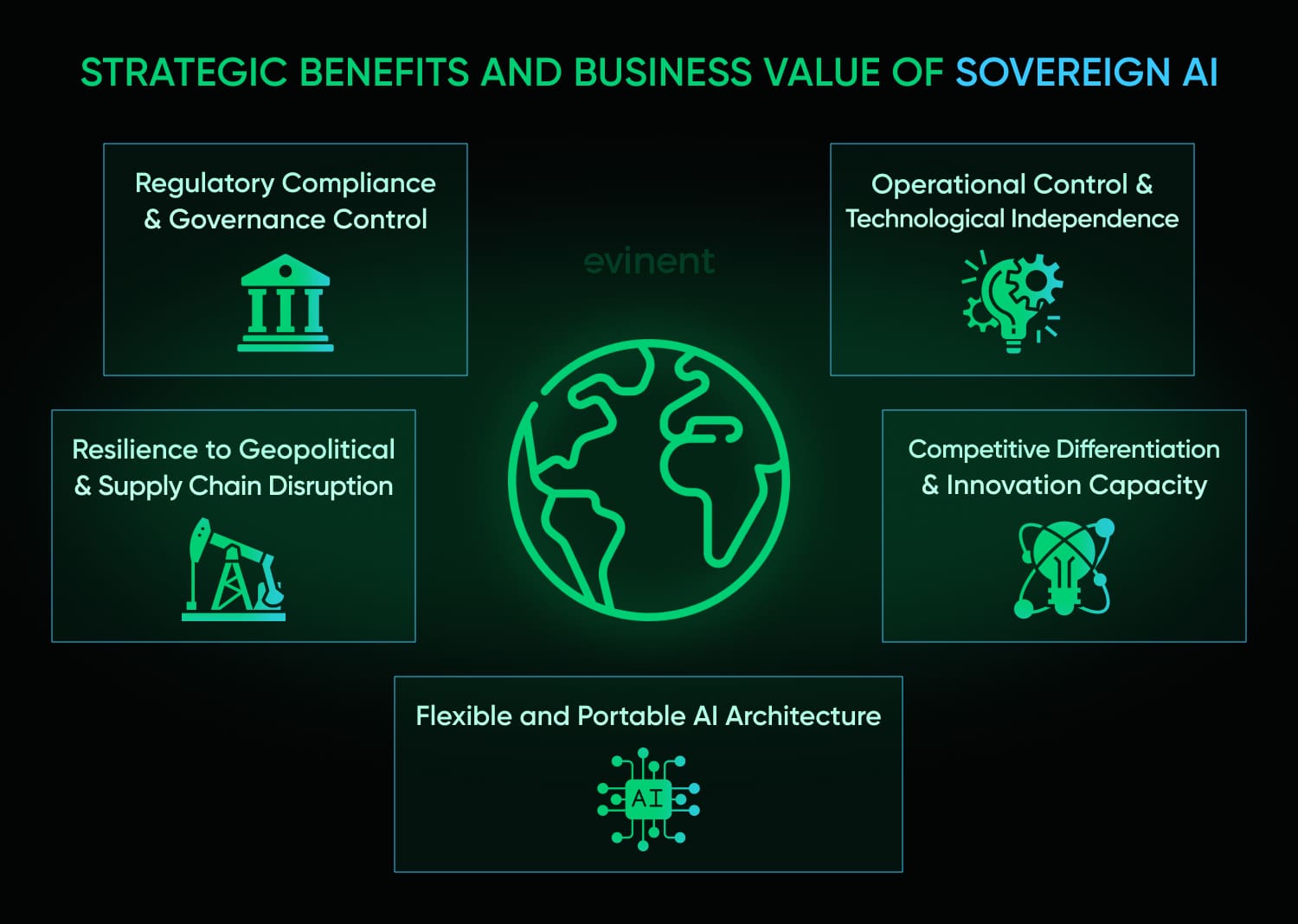
Regulatory Compliance and Governance
One of the primary drivers behind sovereign AI adoption is the ability to comply with evolving regulatory requirements and data governance frameworks. Many industries operate under strict rules regarding data residency, data protection, and auditability.
Through the use of AI systems in controlled settings, for instance, private infrastructure or sovereign cloud platforms, companies can set up exclusive compliance layers that regulate the processing, storage, and access to data. In this way, businesses can comply with laws while at the same time allowing for transparency and traceability throughout the AI lifecycle.
Operational Control and Strategic Autonomy
Sovereign AI empowers companies with enhanced ability to monitor and direct their AI-related activities and infrastructure. Without having to depend solely on third-party platforms or international services, businesses are able to handle their AI infrastructure internally and decide the deployment and updates of their models.
Being in control of such a degree means that companies can have strategic autonomy, which implies that they can operate their AI systems continuously even in the case when external providers change their policies, pricing structures, or service availability.
Resilience Against Geopolitical and Supply Chain Risks
Global technology supply chains and cloud infrastructures could be impacted by geopolitical issues, regulatory limitations, or leisure disruptions. Sovereign AI is a solution that helps enterprises lessen these risks by giving them the ability to run AI workloads on the infrastructure they directly control. Constructing tough AI environments with the help of a trusted stack and indigenous infrastructure, an organization will be in a position to secure the availability of its essential AI functions even if they are subject to external disruptions.
Competitive Advantage and Innovation
Companies that manage their AI infrastructure and models not only have more control but are also able to innovate in a way that gives them a competitive edge. By having a sovereign AI system, businesses can create very specific types of models that suit their line of work, keep their intellectual properties safe, and even test new AI applications without the risk of their sensitive data getting exposed to the outside world. Moreover, sovereign AI is also a great way to promote local innovation since it facilitates partnerships with local universities, startups, and technology providers that form the wider innovation ecosystem.
Flexible and Portable AI Architecture
Another great advantage is the ability to create a portable, sovereign AI system that functions seamlessly across diverse infrastructure types. Companies can mix and match private data centers, local cloud platforms, and hybrid setups without the fear of depending on a single vendor only. Changing the AI system's architecture gives an organization the ability to balance performance, cost, and security while maintaining uniform governance of its AI systems.
In conclusion, essentially sovereign AI allows companies to be in charge of their AI systems, data, and models while at the same time they are able to improve their resilience, comply with regulations, and have strategic autonomy in the long run.
But to get these benefits, you need good governance and a clear alignment with the regulations. In fact, the next part is about how sovereign AI can assist companies with meeting regulations and data controls, especially when there are strong data protection and legal obligations.
Compliance and Data Governance in Sovereign AI
Enterprises operating in regulated environments inevitably see compliance and data governance as key issues when deploying AI systems. Sovereign AI equips the organizations to be in the driver's seat of the data lifecycle in terms of data collection, processing, and usage, at the same time that it keeps the AI activities in line with the local legal frameworks, the regulatory obligations, and the ethical standards.
Through the fusion of the controlled infrastructure and the robust governance, sovereign AI becomes the tool with which enterprises can roll out AI systems that honor data sovereignty, shield sensitive information, and stay in line not only with the local but also with the global regulatory requirements.
Data Sovereignty and Localization
One of the fundamental aims of sovereign AI is to make sure that enterprise data stay within the domain of the organization or country where it is operating. This is often the case with data localization policies that require the storing and processing of certain categories of data within the national or regional boundaries.
Running AI workloads inside tightly controlled environments like a sovereign AI cloud or private infrastructures makes it possible for organizations to follow these rules while at the same time they can oversee and have control over the movement of data. Such an approach lessens the dangers related to the transfer of data across borders and the processing of data by external entities.
Alignment with Local Legal Frameworks
Deployments of AI have to function in highly complex and constantly changing regulatory environments. Sovereign AI allows businesses to use their AI capabilities in a way that complies with the local laws and regulations, including those governing privacy, cybersecurity, and specific industry requirements. When companies build AI systems that do not rely on foreign laws, they are able to make sure that the management of their data complies with the legal requirements of their own country.
Governance Frameworks and Dynamic Controls
Proper data governance depends on well-organized supervision and explicit governance policies being in place throughout the AI lifecycle. Usually, sovereign AI environments set up a detailed governance framework that specifies data access, processing, and monitoring. Such frameworks are underpinned by changing controls and governance means, like automated surveillance, role-based access control, and policy enforcement systems that uphold compliance at each step of training pipelines, model deployment, and inference processes.
Security and Data Protection Measures
Strong security controls are necessary for keeping compliance and safeguarding sensitive enterprise information. Sovereign AI setups usually have security features such as completely encrypted data, secure identity management, and strict operating security policies. These measures ensure that the data is protected at all stages of the AI lifecycle, from the point of collection and processing to training the models and making predictions.
Transparency, Auditing, and Accountability
Organizations are expected to display the operation of their AI systems and the usage of data to comply with regulatory requirements. Along with this, sovereign AI architectures help companies comply with these rules by providing audit features that highlight any changes and allow the tracing of the flow of data. Having these audit mechanisms, companies can follow the progress of model training, check who has worked with sensitive data, and have trustworthy documents ready during regulatory inspections or their own governance procedures.
In a nutshell, sovereign AI effectively assists companies to build governance models that guarantee adherence to data localization laws, meet regulatory standards, and support internal governance systems, at the same time giving companies a strong grip on their most sensitive information and AI activities.
Still, simply being compliant with regulations is not enough to remove the risks connected with AI systems on a large scale. The following part looks into how companies go about minimizing security threats and managing risks when installing sovereign AI environments.
Security Risks and Mitigation in Sovereign AI Environments
Security and risk management are critical components of sovereign AI deployments, especially for enterprises operating in regulated industries or managing sensitive data. Because sovereign AI systems often run within controlled infrastructure and handle proprietary models or confidential datasets, organizations must implement strong safeguards across the entire AI lifecycle.
Such sets of protective measures usually encompass a blend of secure hardware, strong access limitation, data confidentiality tools, and open administration of rules. Using a well-arranged system of risk identification and handling helps organizations stay ahead in their defense against AI systems being used by criminals, disallow the intruders, and guarantee that AI's running is in compliance with the company's governance and external regulatory standards.
The table following includes a brief presentation of the typical security risks related to sovereign AI systems, along with the tools that organizations rely on to handle them.
Risk Area | Description | Security Approach in Sovereign AI |
|---|---|---|
Cybersecurity threats | External attacks targeting AI infrastructure, model repositories, or data pipelines | Hardened AI infrastructure, network segmentation, and continuous cybersecurity monitoring |
Unauthorized access | Users or automated agents gaining access to models, data, or AI services beyond their permissions | Identity-aware gateways and least-privilege scopes to restrict access to only necessary resources |
Data protection and privacy | Exposure of sensitive enterprise data during training, inference, or storage | Strong data protection policies, encryption, and privacy-preserving data processing |
Metadata leakage | Unintended exposure of sensitive metadata during AI workflows | Secure pipelines, controlled logging practices, and restricted metadata access |
Model misuse or uncontrolled agents | AI systems or automated agents are being used outside their intended operational boundaries | Governance controls, activity monitoring, and strict access policies |
Lack of transparency | Limited visibility into how AI systems operate and use data | Comprehensive audit trails, monitoring systems, and transparent reporting mechanisms |
Operational disruption | Infrastructure failures or network restrictions affecting AI operations | Offline multi-layer safety and resilient infrastructure that supports operational independence |
Governance and accountability gaps | Difficulty assigning responsibility for AI decisions or system actions | Structured oversight processes and clear accountability mechanisms |
It is necessary to handle security risks properly so that people can trust sovereign AI systems. Enterprises can use multiple lines of defense, enforce strict governance, and maintain transparency in monitoring to not only reduce risks of operation but also protect sensitive data and AI assets.
Strategies for implementation and ways for adoption are discussed in the following section that brings real-life examples of the organization's methods to construct and roll out sovereign AI environments.
Implementing Sovereign AI in Enterprises
For businesses, using sovereign AI isn't just about rolling out a piece of technology; it's a whole process of changing the AI setup. Agencies should coordinate the infrastructure, governance, and operational workflows so that AI systems will still be compliant and secure as well as being independently operational.
Generally, the introduction of sovereign AI requires crafting adaptable system designs, creating regulated compute settings, and setting up governance controls that enable AI systems to function under different infrastructure scenarios. To reach their goals, organizations can implement a gradual method where they make use of hybrid infrastructure strategies, cloud-agnostic technologies, and ecosystem evolution for the long term.
Designing a Sovereign AI Infrastructure
The first step in implementing sovereign AI is establishing the necessary AI infrastructure capable of supporting model training, deployment, and data processing within controlled environments. Enterprises often combine in-country compute infrastructure, private data centers, and sovereign AI cloud platforms to create a reliable and compliant computing environment. This infrastructure forms the foundation of the enterprise AI stack, supporting data pipelines, model development tools, and secure inference systems.
Cloud-Agnostic and Hybrid Deployment Strategies
To avoid dependency on a single provider, many organizations design cloud-agnostic deployments that allow AI workloads to operate across multiple environments. A common approach involves hybrid strategies, where sensitive data and critical models run within private or sovereign infrastructure, while less sensitive workloads can use external cloud services. This flexibility enables enterprises to maintain control over critical systems while still benefiting from scalable computing resources.
Governance Portability and Operational Flexibility
To build efficient sovereign AI environments, you need governance mechanisms that work consistently regardless of the infrastructure environment. Portability of governance means that security policies, access controls, compliance rules, and auditing mechanisms operate uniformly across the whole enterprise AI stack. This way, organizations can have consistent control even in case the workloads get shifted between on-premises infrastructures, cloud sovereign platforms, or hybrid environments.
Procurement and Architecture Guidelines
When it comes to implementing sovereign AI, enterprises need to be very thorough in defining their procurement policies and architectural standards before choosing their technology vendors and infrastructure providers. Well-documented procurement policies and architectural standards guide the organizations in building their AI systems using trustworthy components, technologies that can work together, and infrastructure that is secured. Besides, these guidelines also minimize the chances of the organizations being stuck with only one vendor and ensure that the architectural flexibility is maintained for the long-term.
Offline and Resilient AI Deployments
Some industries require AI systems that are capable of functioning without an ongoing connection to external networks. Hence, sovereign AI architectures facilitate offline deployments, allowing models and applications to work in isolated or through limited communication environments. Such a feature is very critical for areas like vital infrastructure, military, or remote industrial activities where self-sufficiency and uninterrupted operation are a must.
Building a Long-Term Strategic Roadmap
Implementing sovereign AI is an ongoing process that requires long-term planning. Enterprises typically define a strategic roadmap that outlines infrastructure investments, governance frameworks, talent development, and ecosystem partnerships. In many cases, organizations collaborate with government institutions, research centers, and technology partners through public-private partnership models. These collaborations help strengthen national AI capabilities while supporting enterprise innovation.
Investments in STEM education and workforce development also play a role in sustaining sovereign AI initiatives by ensuring that organizations have access to skilled AI engineers, data scientists, and infrastructure specialists.
The successful enactment of sovereign AI needs coordinated endeavors in the areas of infrastructure design, governance policies, and long-term strategic planning. Through the use of cloud-agnostic architectures, resilient infrastructure, and unambiguous governance frameworks, businesses can develop AI models that are not only secure and compliant but also operationally independent.
The following part of the article discusses the industry use cases and showcases in which ways sovereign AI is implemented in sectors like healthcare, finance, and critical infrastructure.
Real-World Applications of Sovereign AI Across Industries
Sovereign AI is increasingly adopted across multiple sectors where data sovereignty, regulatory compliance, and operational control are critical. Governments, healthcare providers, telecom operators, and regulated enterprises are deploying AI systems within sovereign environments to maintain control over sensitive data while still leveraging advanced analytics and generative AI capabilities.
These real-world applications demonstrate how sovereign AI enables organizations to address sector-specific challenges—such as protecting national infrastructure, supporting local languages, or ensuring compliance in highly regulated industries.
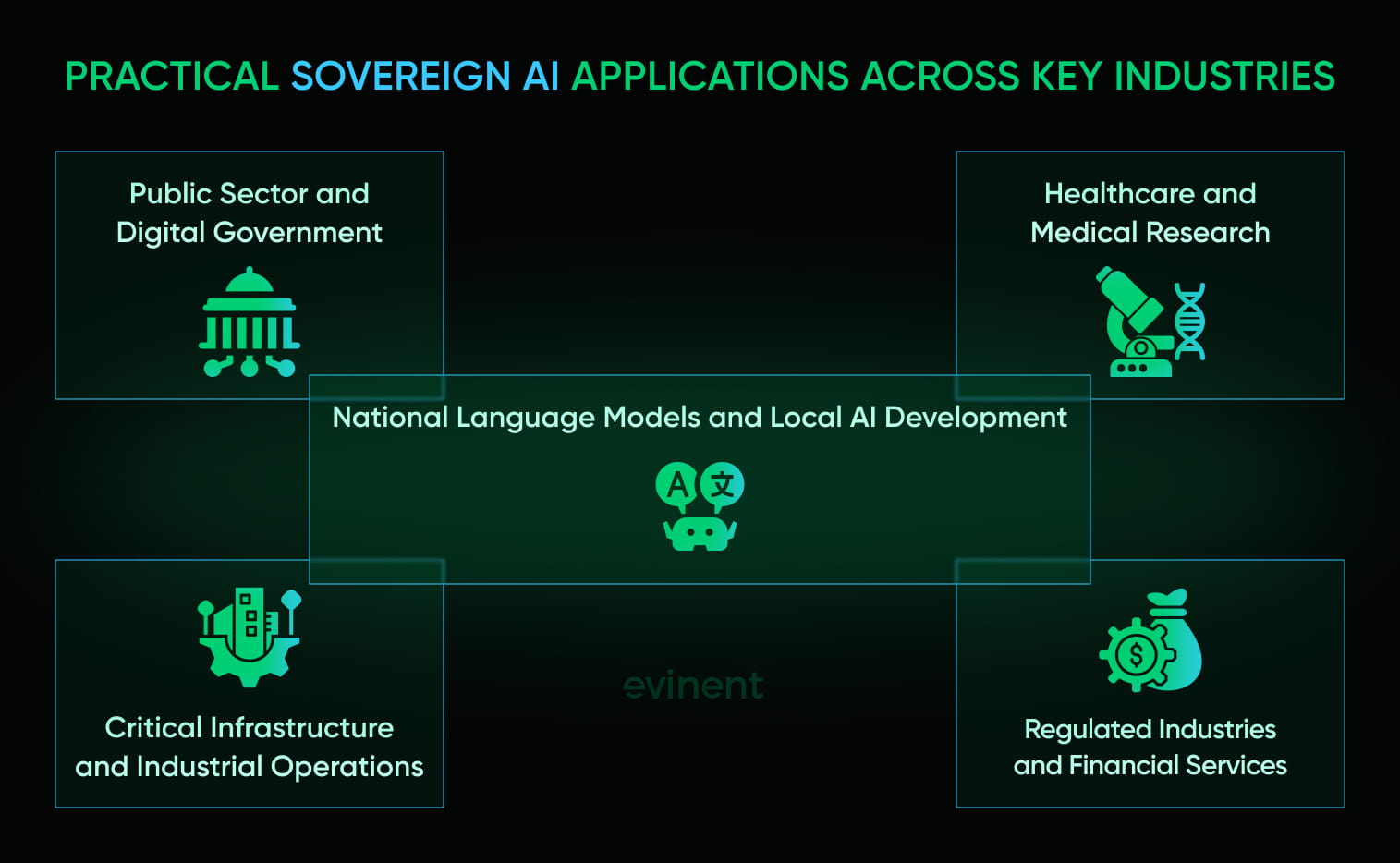
Sector and Digital Government
Governments are among the first users of sovereign AI since they handle vast amounts of highly confidential personal data. Sovereign AI keeps data under national control and at the same time, allows public sector institutions to make use of AI applications. A case in point is that Germany has been working on a sovereign AI platform for the public sector through a partnership with SAP and OpenAI. The platform's primary purpose is to deliver AI capabilities to government bodies while complying with data sovereignty and EU personal data processing regulations.
Through the use of such programs, public administrations will be able to roll out generative AI technologies like document handling, analysis of the policy, and automation of the administrative processes, while the rights of public confidential data will not be compromised by its exposure to external infrastructures. (TechRadar, 2025)
Healthcare and Medical Research
More and more, healthcare providers are incorporating AI for purposes such as diagnostics, drug discoveries, and analyzing patient data. That being said, medical information is very confidential and subject to very stringent regulations. Certain nations are directing their efforts towards sovereign AI projects that enable healthcare research with locally controlled data and facilities. For example, the sovereign investment fund of Bahrain has teamed up with the AI company SandboxAQ to speed up AI-based drug discovery through the use of regional health data, while at the same time keeping intellectual property and research skills within the country.
Sovereign AI can similarly be used for medical image processing, clinical recommendations, and healthcare diagnostics, yet it can also guarantee that patient data are preserved under the national healthcare rules. (Reuters, 2025)
National Language Models and Local AI Ecosystems
One more increasing use for sovereign AI is making national or regional AI models specifically considering local languages and cultural contexts. In India, the AI company Sarvam AI is working on large language models capable of understanding multiple Indian languages. The company is cooperating with the government under the IndiaAI Mission, which is intended to help create domestic AI infrastructure and foundational models.
Such models make it possible to develop AI apps capable of translating, voice assistants, and multilingual public services reflecting local languages and cultural values that are usually not very well represented in global AI models.
Critical Infrastructure and Industrial Systems
Industries providing essential infrastructure like energy, telecommunications, and transportation need AI systems capable of functioning securely without depending on external cloud services. Sovereign AI architectures make it possible to run AI models in air-gapped or isolated environments where infrastructure operators can use operational data to perform analysis, predict equipment failures, and carry out maintenance work automatically without the risk of exposing sensitive industrial data to external networks.
These kinds of systems are of vital importance, especially in sectors where the disruption of infrastructure may result in severe consequences from the point of view of the economy or national security.
Regulated Industries and Financial Services
Banks, insurance companies, and financial institutions operate under strict regulatory oversight and data governance requirements. Sovereign AI allows these organizations to deploy customizable AI models within controlled environments while ensuring that financial data remains protected.
Typical use cases include fraud detection, risk analysis, regulatory compliance monitoring, and customer service automation. Operating these systems within sovereign environments allows financial institutions to maintain compliance with strict regulatory frameworks while benefiting from AI-driven analytics.
These cases demonstrate that sovereign AI is already at work in areas where data control, regulatory compliance, and operating independently without external help are critical. Besides public administration and healthcare, there have been uses of national language models and critical infrastructure through which organizations utilize sovereign AI architectures to provide state-of-the-art AI functionalities while preserving complete management of data and systems.
With the increase in adoption, sovereign AI is turning into one of the fundamental elements of the larger AI ecosystems and cross-industry collaboration. The following part discusses the joint efforts of organizations, governments, and technology partners in creating these ecosystems and promoting the rise of sovereign AI.
Building a Sovereign AI Ecosystem
Creating sovereign AI is not just about setting up hardware or designing software in one company. Actually, sovereign AI is a product of a networked and well-coordinated ecosystem that links business, infrastructure providers, regulators, research centers, and technology partners. Usually, putting such an ecosystem together is a stepwise effort, and both organizations and governments progress through different levels, which include setting up infrastructure, governance framework, and collaborative innovation networks.
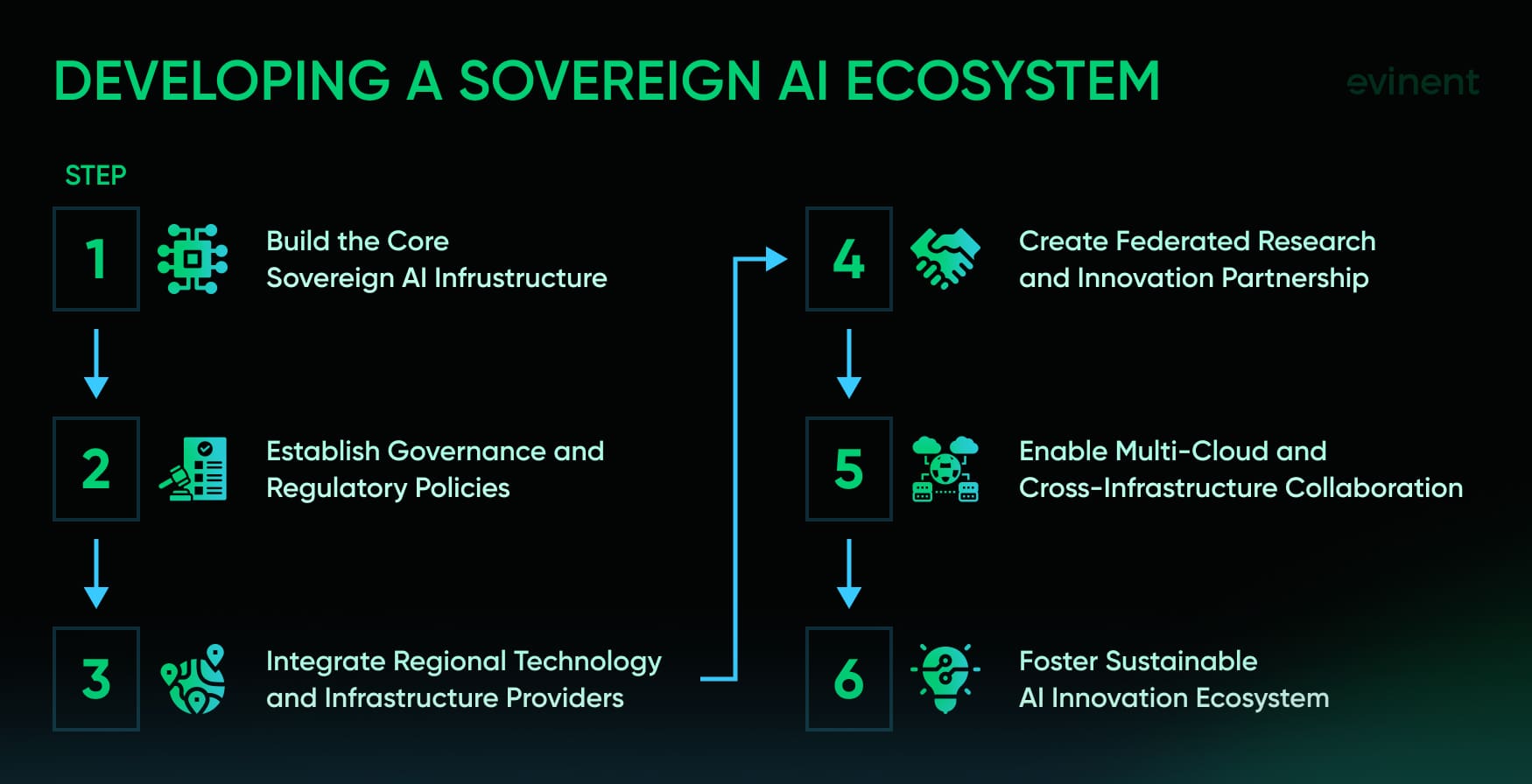
Step 1: Establish Sovereign AI Infrastructure
The first step is creating a reliable infrastructure foundation that can support sovereign AI workloads. This usually includes sovereign AI cloud platforms, regional data centers, and in-country compute infrastructure capable of handling model training and inference. At this stage, organizations focus on building secure infrastructure environments that support AI workloads while complying with national regulatory frameworks and data sovereignty requirements.
Step 2: Define Governance and Regulatory Frameworks
Once infrastructure is in place, organizations and regulators must establish governance frameworks that define how AI systems operate within the ecosystem.
These frameworks typically include policies for data governance, agent governance, identity management, and regulatory oversight. They also address how cross-border data flows are managed and how organizations maintain compliance with local and international regulations.
Step 3: Enable Collaboration with Local Providers
The next step is to bring local and regional technology providers on board the sovereign AI ecosystem. These providers could consist of cloud operators, infrastructure companies, and specialized AI tech firms. Partnering with regional providers not only cuts down dependence on foreign infrastructure but also helps in upgrading the technology capabilities of the country and in promoting the emergence of locally governed AI services.
Step 4: Build Federated Research and Innovation Networks
A mature sovereign AI ecosystem requires strong collaboration between industry and research institutions. Organizations often establish federated consortia and open innovation networks that connect universities, AI startups, and enterprise technology teams. These partnerships accelerate research, allow organizations to share technical expertise, and support the development of interoperable AI technologies while preserving control over proprietary data.
Step 5: Develop Multi-Cloud and Cross-Infrastructure Collaboration
As ecosystems evolve, businesses extend their operations over several types of infrastructures. Multi-cloud collaboration opens the way for enterprises to spread their AI tasks not only onto a separate cloud platform but also onto private infrastructures and specialized computing environments. This measure guarantees the operational side and increases efficiency. At the same time, it allows companies to stay away from a lock-in with their infrastructure and to keep consistent governance policies across the whole ecosystem.
Step 6: Create Sustainable Innovation Ecosystems
The final step focuses on building a long-term innovation ecosystem that supports the continuous development of sovereign AI capabilities. This often involves public-private partnerships, industry collaboration programs, and coordinated investments in AI research and workforce development. Such symbiotic innovation ecosystems allow enterprises, governments, and research institutions to collaborate while maintaining sovereignty over critical infrastructure and data.
Creating a sovereign AI ecosystem is a complex project that merges the building of technical foundations, setting up the rules of the AI game, and collaborating across different sectors. Through a planned process, players in the field can establish lasting AI ecosystems that not only spur creativity but also ensure technological freedom and keep up with regulations.
Further, the article discusses the issues of nations and economies and sheds light on the role of sovereign AI in technology independence, economic growth, and national AI plans.
Strategic and Economic Implications of Sovereign AI
The emergence of sovereign AI signals the changing attitude of nations and companies towards artificial intelligence, seeing it as a crucial skill to be mastered instead of only being a technological tool. In fact, governments and organizations are not only seeing that access to AI infrastructure, data, and research capability directly affects the economy, national security, and technological independence, but they are also taking steps to control these aspects.
These changes led to sovereign AI projects being used, in many cases, as a way to bring enterprise innovation in line with national goals. Domestic AI infrastructures can be developed, research ecosystems can be made stronger, and skilled workforces can be trained by the country through its sovereign AI projects, which essentially are building resilient AI ecosystems supporting the country's economy and the country's strategic autonomy for the long term.
Strengthening National AI Infrastructure
One major element of sovereign AI strategies is building national AI infrastructure, such as data centers, supercomputing facilities, and sovereign cloud platforms. Such investments facilitate countries in developing their AI capabilities without relying on foreign technology providers. Also, enterprises with access to AI infrastructures located in the country may safely implement AI systems that are in line with local laws and data sovereignty requirements.
Supporting Domestic AI Industries
Sovereign AI initiatives are frequently focused on boosting the domestic AI industry by promoting local innovation as well as helping technology startups, research institutions, and infrastructure providers. With the help of properly directed investments and RDI (research, development, and innovation) schemes, governments can not only trigger the emergence of novel AI technologies but also pave the way for enterprises to team up with local partners and research facilities.
Managing Geopolitical and Supply Chain Risks
Artificial intelligence is becoming more and more reliant on complex global supply chains that comprise semiconductors, cloud infrastructure, and specialized computing hardware. In such a scenario, disturbances in these supply chains or the escalation of geopolitical tensions may limit the availability of essential technologies.
Governments' own AI plans are one way of addressing these concerns because they contribute to technological self-sufficiency, enhance the capacity of local infrastructures, and reconfigure supply chains for greater diversity. Besides that, this method will also secure the continuity of the operations of those who depend on AI systems for their essential business functions.
Advancing National Security and Critical Infrastructure Protection
AI technologies are playing a crucial role in national security, especially in fields like cybersecurity, intelligence analysis, and management of critical infrastructures. Through the deployment of AI systems in sovereign environments under tight control, governments and businesses are capable of safeguarding sensitive data and ensuring that strategic systems continue running on trusted infrastructure and under governance frameworks.
Developing Talent and Workforce Capabilities
Developing a long-term sovereign AI heavily relies on having a powerful and talented workforce. Hence, several national policies have labor development, educational, and research training initiatives as major investments. These initiatives focus on training AI engineers, data scientists, and infrastructure specialists capable of designing, operating, and governing sovereign AI systems both in the public and private sectors.
International Cooperation and Strategic Partnerships
Although sovereign AI emphasizes technological autonomy, it does not imply complete isolation. Many countries pursue international cooperation to share research insights, coordinate standards, and build collaborative innovation initiatives. These partnerships can include cross-border research programs, joint infrastructure investments, and coordinated public-private partnership models that support the global development of secure and responsible AI technologies.
Many countries are making viable AI sovereignty a cornerstone of their technological development plans. They understand that besides enhancing the capacities of enterprises through AI, the move also contributes to the growth and security of the whole nation. To continue this progress, a lot of money is being spent on AI hardware, setting up a good research environment, and preparing people for the new jobs that this technology will create.
How Evinent Can Build Sovereign AI for Enterprises
At Evinent, we assist organizations in developing and implementing secure and independent AI environments that are housed solely within the client's premises. At the same time, these facilities meet the strictest security, compliance, and operational control standards of the enterprises. We concentrate on constructing trustworthy AI systems that can be naturally combined with other platform components for enterprises. And we also make sure that highly sensitive data, models, and workflows remain completely under the organization's control.
Rather than depending on external AI services or public APIs, we assist businesses in establishing private, manageable AI ecosystems that suit their everyday business needs. With this, firms can access highly sophisticated AI capabilities while maintaining full control over data sovereignty, infrastructure, and regulatory compliance.
Why Organizations Choose Evinent for Sovereign AI Development
15+ years of experience in enterprise software engineering
Delivering complex platforms for industries that require security, reliability, and long-term scalability.Expertise in secure infrastructure and data governance
Designing AI systems that operate within private environments and comply with strict internal and regulatory security requirements.Strong integration capabilities across enterprise systems
Connecting AI solutions with internal databases, business applications, and operational workflows.Proven delivery of complex, enterprise-scale solutions
Supporting organizations through discovery, development, pilot implementation, and scalable production deployment.
Relevant Experience: Private AI Assistant for Enterprise Recruitment
Challenge
A Europe-based retail company was looking for a secure artificial intelligence (AI) set-up to support automation of candidate, vacancy matching involving thousands of open positions at the same time, without giving up on the confidentiality of sensitive recruitment data. On top of that, the company was not allowed to use external AI providers or third-party APIs according to the internal security rules and compliance requirements.
What we delivered
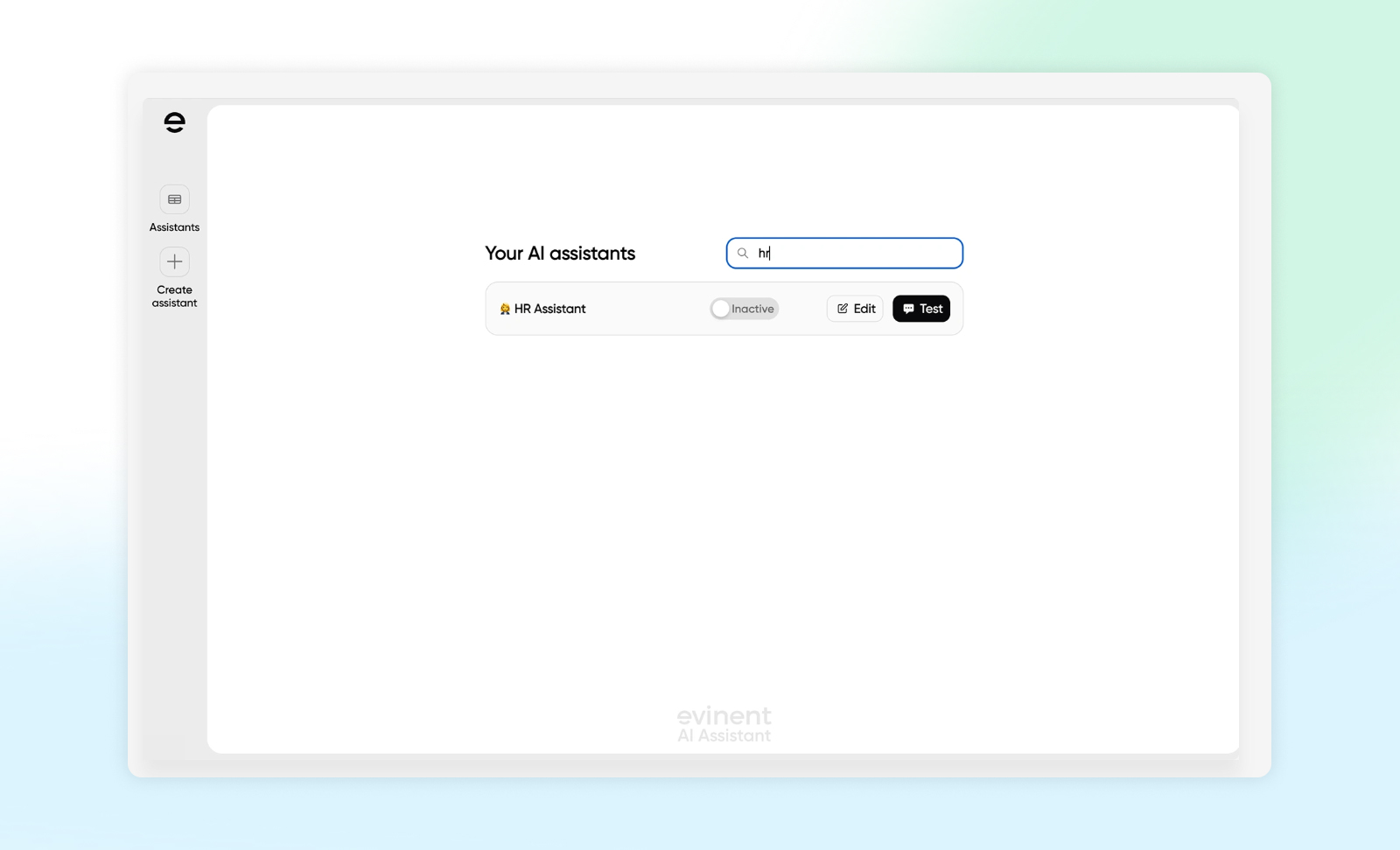
Evinent developed an isolated AI assistant platform designed to operate entirely within the client’s infrastructure. The solution included multiple AI agents responsible for specific tasks such as candidate search, vacancy matching, and response generation.
The system ended up being deployed via a containerized architecture in which each agent ran in its own environment, and thus, their responsibilities were strictly separated and data leakage was prevented. Internally hosted open-source language models were used by the platform, which meant that there was no need for external LLM providers; at the same time, the platform still had complete control over AI behavior and data processing.
Outcome
Through the pilot, the company illustrated that enterprise AI systems could work well in a completely controlled environment. The HR teams managed to speed up the candidate screening process, lessen the manual work and focus on the relevancy of shortlists, all the while being strict with data protection and keeping the operation independent from any outsourcing of AI services.
Evinent Sovereign AI Capabilities
Private AI infrastructure design
Deployment of AI systems within on-premises environments, private clouds, or sovereign cloud infrastructure.Isolated AI agent architectures
Implementation of modular AI agents with clearly defined responsibilities for secure and predictable system behavior.Integration with enterprise data systems
Connecting AI models with internal databases, business applications, and knowledge bases while preserving data sovereignty.Secure access control and monitoring
Role-based access control, encrypted data exchange, logging, and monitoring for full transparency and compliance readiness.Flexible multi-model AI environments
Deployment of open-source LLMs and specialized models tailored to enterprise use cases such as document analysis, semantic search, and workflow automation.Scalable enterprise architectures
Containerized and modular infrastructures that allow organizations to expand AI capabilities across multiple departments and business functions.
Evinent is not a company that provides generic AI products. Instead, we develop tailor-made sovereign AI platforms that are perfectly matched to the infrastructure, security policies, and operational goals of each organization.
Key Takeaways
Sovereign AI lets enterprises keep giving orders to their AI systems. When an organization controls everything from data to infrastructure to models, isolated environments are a way for them to keep operational independence and their secret information safe.
Data sovereignty and infrastructure control are the basics. Enterprises that put sovereign AI into operation generally use private infrastructure, local sovereign cloud platforms, or hybrid environments where processing of data is still a concern of their governance.
Regulatory compliance and data governance play a major role in the decision to use sovereign AI. Organizations that have proper governance frameworks, data localization policies, and auditing mechanisms in place can easily fulfill the demands of regulators and industries at the same time.
Security architecture and risk management belong in the list of things that matter most for enterprise AI systems. Apart from the standard security layers, security mechanisms based on identifying who the user is and continuous monitoring protect AI systems from cyber threats, unauthorized access, and data leakage.
A well-planned and enforced infrastructure and governance program are a must for any project to succeed. Enterprises in the region generally go for hybrid or cloud-agnostic types of architectures, containerized deployment, and a set of clearly defined procurement and architecture guidelines.
Sovereign AI is already being implemented in different sectors. Public sector organizations, healthcare providers, financial institutions, and critical infrastructure operators are among those adopting sovereign AI for a better mix of innovation with strict data protection requirements.
Strong ecosystems are needed to help create more sovereign AI. Enterprises, infrastructure providers, research institutions, and regulators working together with each other will help in creating sustainable AI ecosystems and networks of innovation.
Sovereign AI carries with it strategic and economic implications on a large scale. Strengthening technological autonomy is actually in line with long-term economic growth if investments in domestic AI infrastructure, workforce development, and research capabilities are made.
Private enterprise AI instances show the side of sovereign AI that is related to feasibility. Besides security, compliance, and operational control, they also give organizations a chance to build AI systems that are entirely within their own infrastructure for deployment.
Technology partners help a lot in building the first sovereign AI environments. Enterprises hiring their engineering teams for help designing secure architectures, reusing their AI systems' code integration with their existing systems, and scaling their AI capabilities across the whole organization are just examples of what can be done in this case.
Share