

What is Data Governance?
Data governance represents an organized framework consisting of policies, responsibilities, and procedures that regulate the management and control of data within an organization. It identifies the data owners, describes the mechanisms for making data-related decisions, and illustrates the ways in which data is leveraged securely and uniformly in both business and technical settings.
Essentially, data governance is concerned with making sure that data is trustworthy, available to the authorized personnel, safeguarded against abuse, and in line with legal standards.
“Every company has big data in its future, and every company will eventually be in the data business.”
— Thomas H. Davenport, analyst and professor at Babson College
How Data Governance Works in Practice
In practice, data governance operates through defined roles such as data owners and data stewards, supported by governance frameworks and tools. These mechanisms monitor data quality, enforce access controls, and document metadata and data lineage.
This coordinated approach allows organizations to maintain control over complex data environments while supporting operational and analytical needs.
Why Organizations Implement Data Governance
Organizations implement data governance to improve data quality, reduce operational and regulatory risks, and enable trustworthy decision-making. Governance helps prevent data misuse, supports compliance, and creates a shared understanding of how data should be handled across the organization.
Without governance, data becomes fragmented, inconsistent, and difficult to manage at scale.
In this article, we will discuss:
Challenges and pitfalls in AI data governance;
Differences between AI data governance and traditional data governance.
Core components and technologies supporting AI for data governance;
Ethical and regulatory considerations;
Implementation strategies and best practices;
The importance and benefits of AI data governance.
Integration of AI with data governance practices.
Key principles and governance frameworks;
Real-world use cases of AI in data governance;
Organizational roles and responsibilities.
Challenges and Pitfalls in AI Data Governance
There are several issues with managing the data that is used for AI systems, which are not only more numerous but also more complex than the issues in traditional data governance. Large-scale, dynamic, and often unstructured data are what AI models rely on; at the same time, they are subjected to increasing regulatory and ethical scrutiny. The mix of these factors gives rise to several risk vectors that can only be mitigated through proper AI governance.
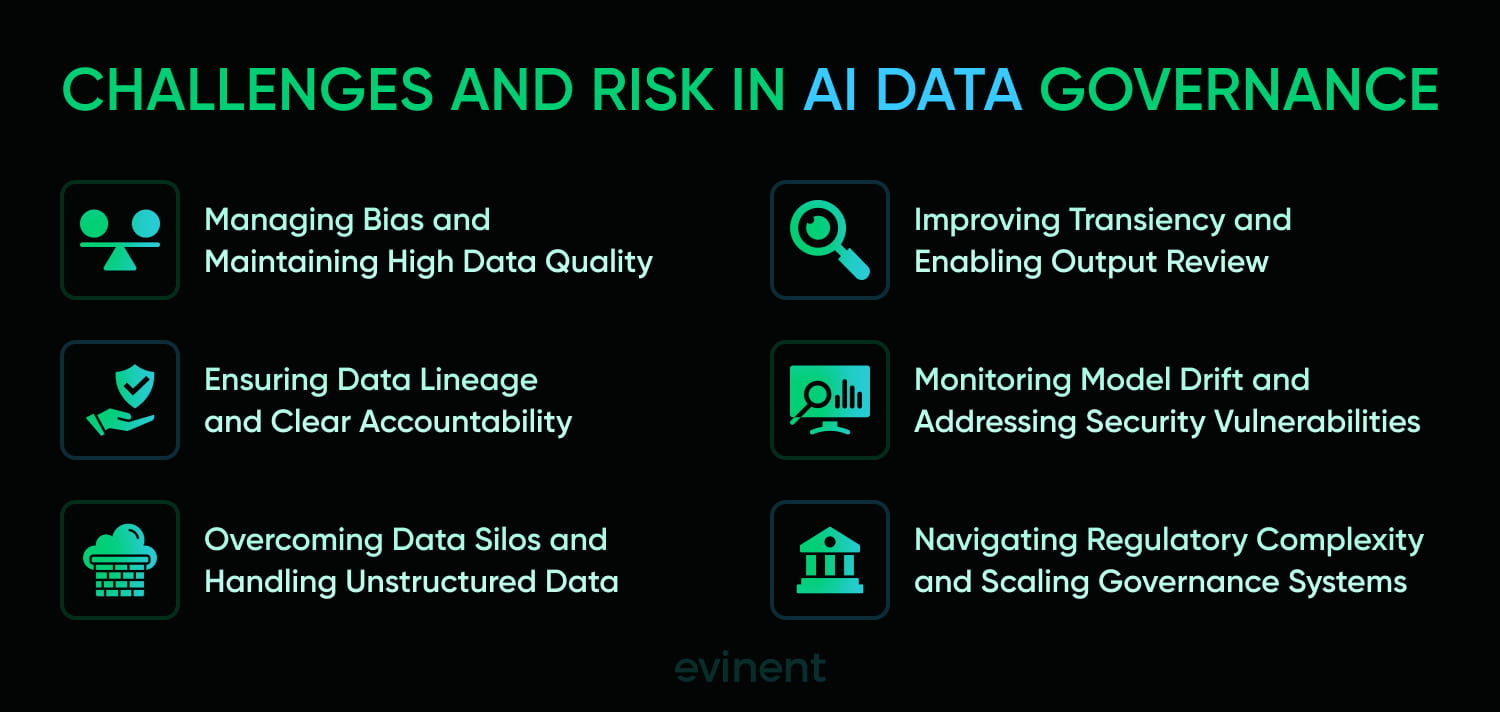
1. Algorithmic Bias and Data Quality Issues
Algorithmic bias is arguably the most prominent risk in AI systems, and it is typically at the root of poor data quality. Incomplete, unrepresentative, or biased data reflecting past biases or societal prejudices can be the source of the training data. Models, when trained on such data and without being properly controlled, can systematically generate unfair or incorrect results, and it becomes quite challenging to detect and fix bias after the models have been rolled out.
2. Lack of Data Lineage and Accountability
Many organizations struggle to maintain end-to-end data lineage across AI pipelines. Without clear traceability from data sources to model outputs, it becomes challenging to explain decisions, investigate errors, or demonstrate compliance. Weak data stewardship further complicates accountability, as ownership of data assets and governance decisions is often unclear.
3. Data Silos and Unstructured Data Complexity
AI projects often require access to data that is scattered across different systems, teams, and platforms. Data silos hinder transparency and uniformity, and on top of that, enormous amounts of unstructured data, like text, images, or logs, are hard to classify and regulate with traditional methods. All these factors make it more likely that the controls will be inconsistent and that data will be used without management.
4. Transparency Gaps and Output Contesting Limitations
AI systems often lack transparency, making it difficult to understand how specific outputs are generated. This creates challenges for output contesting, particularly in regulated or high-stakes environments where decisions must be explainable. Without governance mechanisms that support transparency, organizations may struggle to justify AI-driven outcomes to users, auditors, or regulators.
5. Model Drift, Hidden Vulnerabilities, and Security Risks
Over time, changing data patterns can cause the model to become less accurate and reliable, which is referred to as model drift. On the other hand, unprotected flaws in AI systems like injection or unintentional data leakage render them vulnerable to misuse or attack. Identifying such problems entails constant monitoring and costly tests, the latter of which are hardly manageable without established governance mechanisms.
6. Regulatory Complexity and Scalability Challenges
Data governance AI operates within a rapidly evolving regulatory landscape. Failure to align data practices with legal requirements can result in regulatory violations and enforcement actions. As AI systems scale across business units and regions, enforcing consistent policies and controls becomes increasingly complex, especially in environments with heterogeneous data and infrastructure.
Over time, changing data patterns can cause the model to become less accurate and reliable, which is referred to as model drift. On the other hand, unprotected flaws in AI systems like injection or unintentional data leakage render them vulnerable to misuse or attack. Identifying such problems entails constant monitoring and costly tests, the latter of which are hardly manageable without established governance mechanisms.
Importance and Benefits of AI Data Governance
AI data governance is a foundational capability for organizations seeking to use artificial intelligence at scale. Because AI systems are highly dependent on data quality, context, and control, governance directly influences model performance, compliance, trust, and long-term business value. Effective AI data governance aligns data lifecycle management, accountability, and transparency with responsible and sustainable AI adoption.
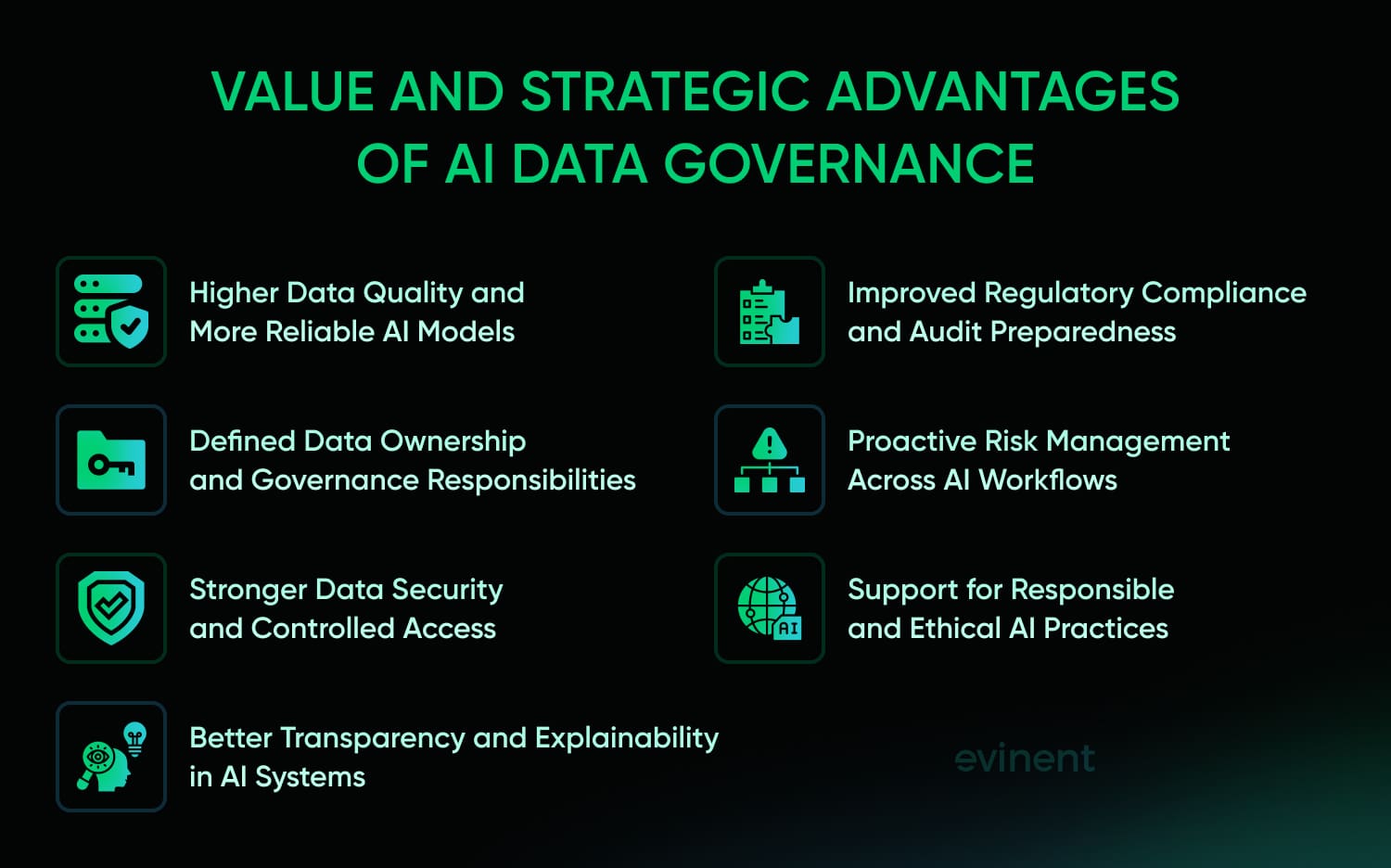
1. Improved Data Quality and Model Reliability
AI and data governance ensure the consistent management of data quality throughout the data lifecycle, thus minimizing errors and inconsistencies that may adversely influence model behavior. Quality data results in stable training, accurate predictions, and enhanced overall model performance.
2. Clear Data Ownership and Stewardship
By defining data ownership and data stewardship, AI data governance establishes accountability for data assets used in AI systems. This clarity enables faster decision-making, more effective issue resolution, and consistent application of data policies across teams and platforms.
3. Stronger Regulatory Compliance and Audit Readiness
AI data governance supports regulatory compliance by documenting how data is collected, processed, and used in AI systems. Governance mechanisms provide traceability and evidence required for audits, reducing the risk of non-compliance and regulatory penalties.
4. Enhanced Data Security and Access Control
It is through governance policies that such security measures can be applied by organizations, as well as the management of the access given to sensitive data. The potential of the company being exposed to a data breach or facing the use of their data in the wrong way in AI model development or deployment would thus be greatly limited.
5. Greater Transparency and Explainability
With the help of smart data lineage, an organization can see exactly what happened to the data starting from the source, through changes, and all the way to the model outputs. Being transparent in this way aids explainability, stakeholder trust, and the overall understanding and justification of AI-based decisions.
6. Effective Risk Mitigation Across AI Systems
AI in data governance enables early identification and mitigation of data-related risks, such as bias, drift, and misuse. When governance is integrated with model management processes, businesses are able to diminish both the operational disruptions and the surprise AI behaviors.
7. Support for Responsible AI Initiatives
Responsible AI depends on controlled, well-governed data. AI data governance provides the structural foundation for ethical AI practices by aligning data usage with organizational values, fairness objectives, and risk management frameworks.
The benefits of AI data governance extend far beyond compliance. It strengthens data quality, reduces risk, improves transparency, and enables responsible AI at scale. Organizations that treat AI at data governance as a strategic priority are better equipped to achieve sustainable AI success and maintain trust in AI-driven outcomes.

Comparison of AI Data Governance and Traditional Data Governance
Before we compare traditional data governance and AI data governance, first of all, it is necessary to clarify the concepts of governance that are related, since people often mix up these terms, although they refer to different layers of controls.
Traditional data governance focuses on managing data assets across their lifecycle through data policies, defined ownership, quality controls, and compliance mechanisms. Its primary objective is to ensure data consistency, security, and regulatory adherence.
Data governance and AI extend these principles to data used in AI systems. It addresses how data quality, data lineage, and data policies directly influence model behavior, outcomes, and risk exposure throughout the AI lifecycle.
AI governance operates at a broader level and encompasses organizational oversight of AI systems as a whole, including ethical use, accountability, and decision-making structures. Within this scope, model governance focuses specifically on controlling model development, deployment, monitoring, and performance over time.
The different layers of governance are very closely linked, but they are not the same. Before looking at how AI-powered environments alter the conventional data governance methods, it is necessary to grasp the differences between these layers. The table below helps to see these differences and similarities in a clear manner.
Comparative overview: traditional data governance vs. AI data governance
Dimension | Traditional Data Governance | AI Data Governance |
|---|---|---|
Primary scope | Enterprise data assets used for reporting, analytics, and operations | Data used for training, validating, deploying, and monitoring AI models |
Data characteristics | Mostly structured, stable, and well-defined | Large-scale, dynamic, and often unstructured data |
Governance focus | Data quality, access control, data policies, and compliance | Data quality, lineage, bias prevention, and impact on model behavior |
Risk management | Operational and regulatory risks related to data misuse or errors | AI-specific risks requiring continuous AI risk assessments tied to data inputs |
Transparency requirements | Documentation of data sources and usage | End-to-end traceability from data sources to model outputs |
Compliance approach | Compliance with data protection and industry regulations | Compliance extended to AI regulations and responsible AI principles |
Governance structure | Often, centralized governance frameworks | Frequently federated data governance to support scale and autonomy |
Tooling and automation | Data governance tools for cataloging, quality checks, and access control | Advanced tools supporting lineage, monitoring, and integration with model governance |
Traditional data governance is the base where AI data governance take their roots. However, AI systems bring new challenges that cannot be overcome just by traditional frameworks. Since the data highly influence the model results, the governance mechanisms must be changed accordingly to guarantee accountability, transparency, and compliance at scale.
Next, we discuss the ways organizations tackle these issues through the development of governance frameworks, the use of technologies, and the integration of data governance into the overall AI governance and responsible AI practices.
Core Components and Technologies in AI Data Governance
It is the use of a network of organizational elements and empowering technologies that together work to ensure that data are controlled, traceable, secure, and suitable for AI systems, which is the essence of AI data governance. AI-driven data ecosystems not only need scalable architectures, automation, and continuous oversight to handle dynamic data flows and changing risks, but also require approaches that are quite different from the traditional environments humans are used to. Here, we detail the main components and technologies that underpin good AI data governance.
Core Components and Enabling Technologies
Component/Technology | Purpose in AI Data Governance | Governance Value |
|---|---|---|
Data Architecture | Defines how data is stored, integrated, and accessed across platforms, including data lakes and distributed systems | Provides structural consistency and supports scalable AI data pipelines |
Data Lakes | Centralized or federated repositories for structured and unstructured data used in machine learning | Enable flexible data access while requiring strong governance controls |
Metadata Management | Captures technical, business, and operational metadata across data assets | Improves data discoverability, understanding, and governance oversight |
Automated Data Classification and Tagging | Uses machine learning to identify, classify, and label data based on content and sensitivity | Supports compliance, data security, and policy enforcement at scale |
Data Lineage | Tracks data movement and transformations from source to AI model outputs | Enables transparency, explainability, and regulatory traceability |
Data Quality Controls | Monitor the accuracy, completeness, and consistency of data used in AI systems | Reduces training errors and improves model reliability |
Data Security Mechanisms | Enforce access control, encryption, and protection of sensitive data | Minimizes risk of misuse, breaches, and regulatory non-compliance |
Technology Infrastructure | Cloud platforms, pipelines, and tooling that support AI workloads | Enables scalability and integration of governance across AI environments |
Risk Management Capabilities | Identify, assess, and monitor data-related risks affecting AI systems | Align governance with organizational risk tolerance and controls |
Data Governance Maturity Assessment | Evaluates the organization’s current governance capabilities and gaps | Guides prioritization and phased improvement of AI data governance |
Each of these components depends on the other for its functioning. The data architecture and technology infrastructure are the ground that is laid, and on top of it, the metadata management, lineage, and data quality controls give us the means to see things and have power over them. Automatic security and classification methods make it possible to be in line with the rules as much as one wants, and maturity assessments are there to constantly check the progress of improvement as the use of AI is developing.
All these technologies and components working together become the governance layer that is integrated, and it, therefore, supports the machine learning projects while still being able to handle the risk, the compliance, and the operational complexity.
Ethical, Legal, and Regulatory Foundations of AI Data Governance
AI data governance straddles the boundary of ethics, law, and technology. Since AI systems are becoming more and more involved in decisions that have an impact on individuals and organizations, the governance framework should guarantee that data is used in a manner that is responsible, legal, and consistent with the agreed-upon ethical principles. It also entails ensuring that the day-to-day data operations are in line with the international ethical standards, data privacy laws, and the latest AI-related policy changes.
The following part provides a brief overview of the ethical and legal bases that dictate the governance of data for AI systems.
1. Ethical Principles Guiding AI Data Governance
Ethical use of AI is grounded in principles such as fairness, accountability, transparency, and respect for individual rights. Frameworks such as the ethical guidelines for trustworthy AI and the AI ethics guidelines by the IEEE emphasize the need to control how data is sourced, labeled, and used to prevent harmful or unintended outcomes.
2. Accountability and Governance Responsibility
Ethical AI data governance depends on setting up a clear accountability framework. A company needs to specify the roles of those making data-related decisions, deciding on risks, and ensuring that rules are followed. Without accountability, the ethical principles will remain something to aspire to and, hence, cannot be embedded into AI systems.
3. Data Privacy and Protection Regulations
Regulations such as GDPR and CCPA impose strict requirements on how personal data is collected, processed, and retained. AI data governance ensures that data privacy is embedded into AI workflows through consent management, data minimization, and lawful processing, reducing the risk of regulatory violations.
4. Bias Detection and Fairness Testing
Ethical AI governance should be aimed at detecting and removing bias in data and models. Bias detection and fairness testing provide valuable tools through which organizations can analyze if data distributions and model outputs lead to unequal impacts on different groups, thus facilitating the realization of fair AI outcomes.
5. AI Risk Assessments and Regulatory Alignment
AI risk assessments serve the purpose of connecting ethics with regulations through showing how the data-related risks harm individuals, organizations, and society. They provide a basis for figuring out which kinds of control, record-keeping, and supervision are suitable for the level of risk of AI utilization cases.
6. Security Standards and Responsible Data Use
Ethical and regulatory requirements also depend on strong security standards. Protecting data from unauthorized access, leakage, or manipulation is essential to maintaining trust and ensuring responsible AI operation. Security controls reinforce both ethical commitments and legal obligations.
Ethical and regulatory considerations are not separate from AI data governance—they define its boundaries and objectives. By embedding ethical principles, data protection regulations, and risk-based oversight into governance practices, organizations can build AI systems that are compliant, trustworthy, and aligned with societal expectations.
Implementing AI Data Governance: Strategy, Phases, and Best Practices
Implementing AI data governance is a structured transformation initiative that combines policy design, technical enablement, regulatory alignment, and organizational change. Because AI systems operate in dynamic, distributed data environments, governance must be embedded in infrastructure, processes, and decision-making structures from the outset. A phased and risk-based approach ensures sustainable adoption while maintaining compliance and operational efficiency.
1. Conduct Governance Readiness and Risk Assessment
Organizations should begin with an evaluation of existing data practices, infrastructure maturity, and compliance exposure. This includes identifying high-risk AI use cases and aligning governance priorities with compliance requirements such as the AI Act. A structured risk-based approach ensures that controls are proportional to the potential impact of AI systems.
2. Define Governance Framework and Roles
A formal governance framework should clearly define policies, decision rights, escalation paths, and roles and responsibilities. Fragmented AI data governance happens when accountability structures for each team are not explicitly set; thus, control is lost, and operational risk is increased.
3. Align Infrastructure and Architecture With Governance Controls
Technical implementation requires integrating governance mechanisms into data lake architectures, centralized data repositories, and tiered data storage models. Cloud-based platforms often serve as the backbone for scalable governance, enabling consistent enforcement of data quality and trustworthiness across distributed AI environments.
4. Embed Compliance and Policy Enforcement Mechanisms
Governance controls must be directly connected to compliance requirements, ensuring that data access, retention, and usage policies are automatically enforced. This reduces regulatory exposure and provides audit-ready documentation across AI pipelines.
5. Launch Pilot Projects Before Full-Scale Rollout
By conducting pilot projects, organizations can that their governance mechanisms work effectively in small, controlled AI initiatives. Such pilots serve as a test for policy enforcement, integration, and training processes, as well as cross-functional collaboration, that can be implemented on a larger scale later on.
6. Integrate Governance Into AI Lifecycle Operations
Data governance for AI should not be limited to the rollout phase but should also cover ongoing monitoring, retraining, and operational oversight. Embedding this into the model workflows ensures that governance stays up-to-date as AI systems evolve.
7. Enable Continuous Improvement and Capability Building
Continuous training, improvement of controls, and periodic reassessment of governance maturity are all important for long-term success. As the use of AI becomes more widespread, governance mechanisms will have to be made compatible with new risks, technologies, and regulatory demands.
Effective AI data governance implementation is not a one-time project but a structured, phased transformation. By combining governance frameworks, scalable infrastructure, compliance alignment, and controlled rollout strategies, organizations can embed durable governance practices that support responsible and scalable AI adoption.
Integration of AI with Data Governance Practices
The integration of AI into traditional data governance practices transforms governance from a largely manual and reactive function into an automated, predictive, and continuously monitored system. Rather than replacing governance structures, AI enhances them by improving data discovery, policy enforcement, privacy management, and compliance monitoring. A structured, step-by-step approach ensures that AI strengthens governance without introducing uncontrolled risk.

Step 1. Assess Governance Processes Suitable for AI Augmentation
Organizations should begin by identifying governance activities that are repetitive, data-intensive, or difficult to scale manually. Common candidates include metadata documentation, data discovery, classification, compliance monitoring, and auditing. This assessment ensures that AI integration supports measurable efficiency gains rather than adding unnecessary complexity.
Step 2. Implement Automated Data Discovery and Classification
AI technologies enable automated data discovery and cataloging across structured and unstructured environments. Through automated classification and machine learning data governance algorithms, systems can identify sensitive data, categorize assets, and detect anomalies at scale. This foundational step improves visibility and prepares the environment for stronger policy enforcement.
Step 3. Deploy AI-Driven Privacy and Compliance Controls
AI-powered privacy tools, as well as AI-driven data privacy management solutions, are equipped to automatically monitor the processing of personal and sensitive data. By pinpointing non-compliance, consenting, and policy breach ing, these systems promote conformity with laws and regulations. Flagging functionalities help the organization respond to potential governance problems.
Step 4. Enable Dynamic Policy Enforcement and Monitoring
Dynamic policy enforcement, fueled by AI, can take traditional static policies to the next level. Governance frameworks have the potential to self-regulate by, for example, changing access controls, identifying the signs of risky behavior, and hence, implementing the necessary corrective measures without . This not only lessens the dependency on human supervision but also deepens the inherent capability of systematic auditing.
Step 5. Integrate Predictive Analytics and Risk Detection
Predictive analytics opens a new channel for governance teams, letting them not just respond to problems but actually anticipate and manage risks beforehand. AI-based models have the ability to predict compliance risks, discover new anomalies, and recognize patterns that could be indicative of policy violations. Integrating this predictive technology will boost the strength of the overall governance system.
Step 6. Automate Governance Workflows with RPA
Robotic Process Automation (RPA) supports the operational execution of governance tasks such as report generation, access reviews, audit documentation, and escalation procedures. By integrating RPA with AI-powered data governance frameworks, organizations can streamline governance workflows while maintaining oversight.
Step 7. Establish Continuous Monitoring and Improvement
Integrating AI is not merely a single upgrade but an unfolding feature. By constantly tracking, assessing the performance, and regularly adjusting machine learning models, governance automation can be kept accurate, unbiased, and compliant with the regulators' requirements.
Integrating AI into data governance practices enhances automation, scalability, and decision-making capabilities. By following a structured step-by-step approach—starting with targeted automation and progressing toward predictive and dynamic governance—organizations can modernize governance operations while maintaining control, compliance, and accountability.
Key Principles and Frameworks for AI Data Governance
Effective AI data governance starts with a set of well-articulated principles that are then codified into organizational policies and practices through a structured framework. Technology certainly plays a role by allowing for automated control and continuous monitoring; however, viable governance is human-centered, built on responsibility, openness, and clearly defined roles. Mature governance models alongside industry frameworks offer form, thus enabling AI systems to be controlled, interpretable, and compliant. This part goes over the basic principles as well as the major frameworks that help in the effective implementation of AI data governance.
Foundational Governance Principles
The core principles of AI data governance are the fundamental elements that must be focused on for reliability and trust to be developed. One of the factors for data transparency is the knowledge about the collection and processing of data as well as the usage of data by AI systems. Data stewardship and organizational data stewardship set the path for data ownership and accountability at different levels of the department. When roles and responsibilities are well-defined, governance gaps and decision ambiguity are prevented. Data quality insights guarantee that AI models are based on data that is accurate, complete, and relevant.
Encryption and access control mechanisms are the measures that prevent unauthorized access to sensitive information, whereas explainable AI refers to the ability of model outputs to be interpreted and rationalized. These principles, together, constitute the legal base of responsible AI governance.
Risk Management and Accountability Structures
Structured accountability mechanisms need to be integrated into AI governance to address operational and regulatory risks. Cross-functional governance committees bring together leaders from legal, compliance, IT, data science, and business departments to oversee AI initiatives collectively.
Through formal accountability mechanisms, it is ensured that the decision-making authority, oversight responsibilities, and escalation paths are officially captured. Embedding governance controls within the framework of enterprise risk management not only tightens oversight but also lessens the risk of unforeseen consequences. Such a well-organized system helps to shift the perception of governance from being merely a technical issue to one that involves the entire organization.
Established Governance Frameworks
Recognized frameworks provide structured guidance for implementing AI for data governance at scale. The CDO Council’s Data Governance Framework offers enterprise-level governance structure and stewardship models.
The NIST AI Governance Framework outlines risk-based AI management principles focused on trustworthiness and accountability. FAIR principles emphasize findability, accessibility, interoperability, and reusability of data assets. The Unified Control Framework (UCF) helps harmonize compliance requirements across regulatory regimes. These frameworks do not replace internal policies but provide reference architectures that support consistent and measurable governance maturity.
Operationalizing Governance Through Organizational Design
Principles and frameworks become effective only when embedded in operational structures. Organizations must formalize data stewardship programs, establish policy documentation processes, implement governance reporting mechanisms, and define measurable performance indicators.
Governance maturity assessments help evaluate gaps and prioritize improvements. By aligning governance policies with enterprise data architecture and oversight mechanisms, organizations ensure that AI initiatives remain transparent, compliant, and strategically aligned with business objectives.
AI data governance, at its ethical and operational core, derives from such fundamental principles as transparency, stewardship, accountability, and security. Well-structured frameworks offer a roadmap, and an appropriately designed organizational structure effectively implements theories into tangible and enforceable practices. In combination, these factors enable the formation of a scalable and firm governance base that can facilitate the responsible and reliable AI rollout.
Practical Applications of AI in Data Governance
AI enhances traditional data governance through automation of discovery, elevating quality control, predictive risk forecasting, and simplifying the monitoring process. Here are actual examples of the industry practitioners' and academic researchers' work, with credible referential links provided where possible.
Use Case | Example Technology/Tool | Governance Benefit | Source |
|---|---|---|---|
AI-Powered Data Catalogs and Metadata Generation | Alation Data Catalog | Automated discovery of metadata, beyond that, more accurate data lineage, significantly increased transparency, and easier to find | |
Anomaly Detection for Data Quality Monitoring | Snowflake ML Anomaly Detection | Instantly identifying data quality issues and irregular patterns, monitoring proactively | |
AI Model Validation and Monitoring | LinkedIn Tiger | Detects model drift and performance degradation, ensuring long-term model reliability | |
Predictive Data Governance and Risk Forecasting | Academic AI Governance Frameworks | Anticipating potential risks to compliance and data quality, changing governance from reactive to proactive | |
AI-Driven Incident Response and Remediation | AI Governance Automation (Industry Implementations) | Automates incident classification, triggers s, enables faster remediation, and provides audit-ready documentation | |
Synthetic Data Generation for Safe Model Training | Synthetic Data Platforms | Enables privacy-compliant model training/testing, reduces exposure to sensitive data, and supports regulatory compliance |
Using AI for data governance is a reality, not a sci-fi fantasy. Scientific projects and articles demonstrate the use of machine learning and AI techniques in the enhancement of metadata management, anomaly detection, predictive governance, model validation, incident response, and privacy-aware data provisioning.
Role Distribution and Organizational Structures in AI Data Governance
Successful data governance in AI-driven organizations requires defined roles, structured accountability, and a culture supportive of responsible data use. Even the best governance frameworks fail if there is no clarity in ownership and collaboration. The roles below are grouped by function to illustrate how responsibilities align throughout the organization.
Executive and Strategic Leadership
Who they are:
Board members, C-level executives (e.g., Chief Data Officer, CIO, CTO), and senior leadership.
Core responsibilities:
Define the strategic vision for data governance and AI adoption.
Approve and sponsor governance frameworks and policies.
Ensure alignment between business objectives and data strategy.
Oversee risk management related to AI, privacy, and regulatory compliance.
Promote accountability and transparency at the highest level.
Cultural role:
Leaders set the tone. Their visible commitment drives cultural readiness and signals that responsible data management is not optional — it is a strategic priority.
Governance and Oversight Bodies
Who they are:
Data governance councils, steering committees, compliance officers, and risk management teams.
Core responsibilities:
Develop and maintain data governance policies.
Conduct data governance maturity assessments.
Establish standards for data architecture and quality.
Define data lifecycle management processes.
Monitor compliance and audit adherence.
Cultural role:
They reinforce structure and consistency, ensuring governance is systematic rather than reactive.
Data Management and Stewardship Teams
Who they are:
Data stewards, data owners, data architects, data engineers, and data custodians.
Core responsibilities:
Maintain data quality and integrity.
Manage data lineage and documentation.
Oversee data lifecycle management from creation to archival or deletion.
Implement federated data governance models where appropriate.
Ensure proper metadata management and classification.
Cultural role:
These teams operationalize governance. Their discipline builds trust in data across the organization.
Technical and AI Development Teams
Who they are:
AI engineers, machine learning specialists, developers, and system architects.
Core responsibilities:
Design and maintain secure data architecture.
Ensure models use reliable, well-governed data sources.
Document training data sources and model inputs (data lineage).
Address bias, explainability, and ethical considerations.
Collaborate with governance teams on risk mitigation.
Cultural role:
They translate governance into technical safeguards and responsible AI implementation.
Business Units and Cross-Functional Teams
Who they are:
Product managers, marketing teams, operations staff, legal advisors, HR, and other stakeholders.
Core responsibilities:
Engage in cross-functional collaboration around data initiatives.
Define business requirements for data usage.
Report data issues and participate in stewardship efforts.
Ensure AI solutions meet operational and ethical standards.
Cultural role:
Active stakeholder engagement ensures governance is practical and aligned with real-world needs.
Organizational Culture and Shared Accountability
Beyond formal roles, effective data governance requires a culture built on:
Shared accountability — everyone understands their role in protecting and managing data.
Transparency — clear documentation, traceable decisions, and open communication.
Continuous improvement — regular maturity assessments and process refinement.
Education and awareness — ongoing training in data ethics, security, and compliance.
A strong governance culture does not rely solely on policies. It depends on behavioral norms, leadership examples, and consistent reinforcement across departments.
When different roles are clearly defined, the same work will not be done twice, there will be no misunderstanding, and there will be less risk. If the top management, governance bodies, technical teams, and business stakeholders collaborate jointly, AI systems can function securely, ethically, and effectively.
How Evinent Enables Enterprise AI Governance and Secure Private AI Implementation
Evinent helps the Enterprise AI Governance and Secure Private AI Implementation by isolating infrastructure design, governance-aligned architecture, and controlled AI deployment models.
Rather than embedding compliance, security, and accountability into AI systems after they are developed, the approach from the start ensures that artificial intelligence will be a tool for good corporate governance and not a source of uncontrolled risk.
1. Governance-First AI Architecture
Evinent starts all engagements by aligning with governance. AI workflows are overlaid with data ownership models, compliance requirements, and internal security policies that are already in place.
This includes:
Data flow and lifecycle assessment
Access model validation
Risk exposure analysis
Infrastructure boundary definition
The objective is to design AI systems that integrate into enterprise governance frameworks instead of bypassing them.
2. Private and Isolated AI Deployment
Enterprise AI Governance and Secure Private AI Implementation demand very tight restrictions on data movement and model operation.
Evinent designs AI systems that:
Operate fully inside the corporate infrastructure
Require no external API calls to public LLM providers
Use containerized environments for each AI agent
Keep embeddings, logs, and inference processes internal
As a result of this architecture, data exposure risks associated with third parties are completely removed, and it makes the environment compatible with GDPR and ISO.
3. Embedded Compliance and Security Controls
Security is implemented at the architectural level.
Core controls include:
Role-Based Access Control (RBAC)
Encrypted internal data communication
Isolated AI instances per department or role
Custom logging and monitoring modules
Audit-ready transparency mechanisms
By doing so, it guarantees that AI systems are kept in line with enterprise compliance policies as well as internal IT governance standards.
s as well as internal IT governance standards.
Practical Example: AI HR Assistant for Secure and Efficient Enterprise Recruitment Pilot Implementation
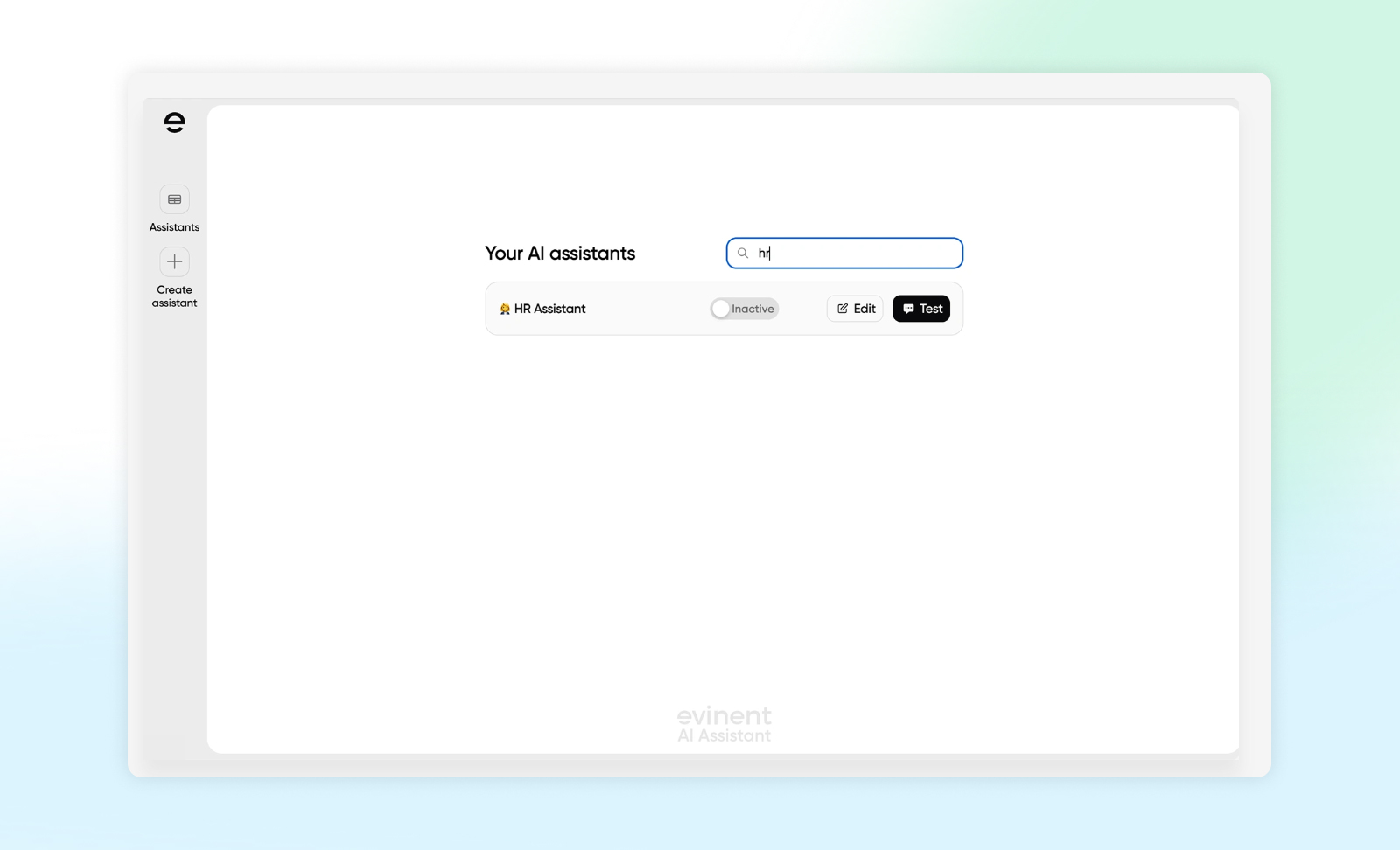
Example of the AI assistant interface from Evinent
The AI HR Assistant for Secure and Efficient Enterprise Recruitment was validated through a structured 4–6 week Proof of Concept for a large European retail enterprise.
The AI HR Assistant for Secure and Efficient Enterprise Recruitment introduced two isolated AI agents — one for recruiters and one for candidates — each operating within dedicated containerized environments.
Security architecture included:
Role-Based Access Control (RBAC)
Encrypted internal communication
Internal database connectors only
Controlled sandbox rollout
An atomic agent structure to reduce hallucination risk
Operational outcomes demonstrated that the AI HR Assistant for Secure and Efficient Enterprise Recruitment accelerated candidate filtering, reduced manual screening workload, and maintained stable AI behavior without external dependencies.
Why Organizations Choose Evinent for Enterprise AI Governance and Secure Private AI Implementation
15+ years in healthcare and enterprise software
Proven delivery of secure, scalable platforms in regulated environments
Strong integration expertise across clinical systems and complex data flows
Consistent execution of multi-phase, enterprise-grade development programs
Evinent thus becomes a dependable ally for companies in need of tightly controlled, compliant AI implementations through these features.
Key Takeaways
AI data governance is the foundation of safe and trustworthy AI implementation. It allows organizations to have control over the methods of data collection, processing, and usage in AI systems.
AI governance basically takes over the role of conventional data governance. Besides, it brings in model monitoring, bias detection, and explainability as some of the new features.
Excellent data that is also properly documented can drastically change AI results for the better. Data quality, lineage, and transparency are the main factors that determine how trustworthy an AI model is.
Compliance with regulations and ethical use of AI are two things that cannot be separated. When implementing AI, the organization must take into consideration issues of privacy, fairness, and security.
Automation and governance tools are the key to limitless growth. Tools like data catalogs, lineage tracking, and automated classification make it easier for governance to be done on a large scale.
Decisions surrounding AI at the enterprise level have to be made on a secure and well-regulated infrastructure. Private and secluded AI environments are one way of achieving data protection and ensuring compliance with laws.
Share