

Why do so many enterprises struggle to turn AI into real business value?
That’s one of the most searched variations executives type into Google right now. Not “what is ChatGPT?” Not even “how to use generative AI.” The times have shifted, so has the question.
Why does AI adoption rise, yet enterprise impact remains uneven?
By 2026, AI is no longer experimental. According to BCG's AI Radar 2026, corporations plan to increase AI spending to roughly 1.7% of total revenues, up from 0.8% just a few years earlier. Globally, that translates to hundreds of billions in annual investment. At the same time, BCG reports that over 50% of large enterprises are actively scaling AI initiatives — and yet only a small portion describe their results as “enterprise-wide impact.”
So what’s happening?
Here’s the tension. On paper, AI looks inevitable. Adoption numbers are climbing. And in software teams, we finally have something better than vibes to point at: a Communications of the ACM case study on GitHub Copilot matched 2,631 developer survey responses to IDE telemetry and reported an average 27% suggestion acceptance rate, with a mean daily completions-per-user metric in excess of 312 during the study window, plus a useful nuance most exec decks miss: the biggest productivity lift wasn’t “perfect correctness,” but whether suggestions were useful as a starting point that kept people moving. Now zoom out from engineering. In customer operations, McKinsey-reported outcomes (shared via industry reporting) include a 5,000-agent deployment where issue resolution increased by 14% per hour and average handle time dropped by 9%, good, measurable movement, but still very dependent on workflow design and guardrails. And in risk-heavy domains like fraud detection and predictive analytics, “AI pays back” can be very real: a Nucleus Research ROI case study reported 366% ROI with a payback period under a year for an AI/ML implementation — exact results vary by scope, but it shows why some teams see triple-digit returns while others stall at the pilot stage.
McKinsey’s broader AI research consistently shows that while a large majority of organizations report “measurable results” from AI initiatives, only a smaller subset attributes a significant share of operating profit to AI. The gap isn’t about model quality. It’s about orchestration.
AI works locally. Strategy works globally.
And the two don’t naturally converge.
This is where corporate AI strategy stops being a technology conversation and becomes a management discipline.
By 2026, AI budgets are rising sharply. BCG reports that companies plan to nearly double AI-related investment as a share of revenue, with top-performing firms increasing tech budgets by more than 10% annually. At the same time, regulatory scrutiny is tightening. The EU AI Act introduces formal risk classifications and compliance requirements that shift responsibility squarely onto deployers of high-risk systems.
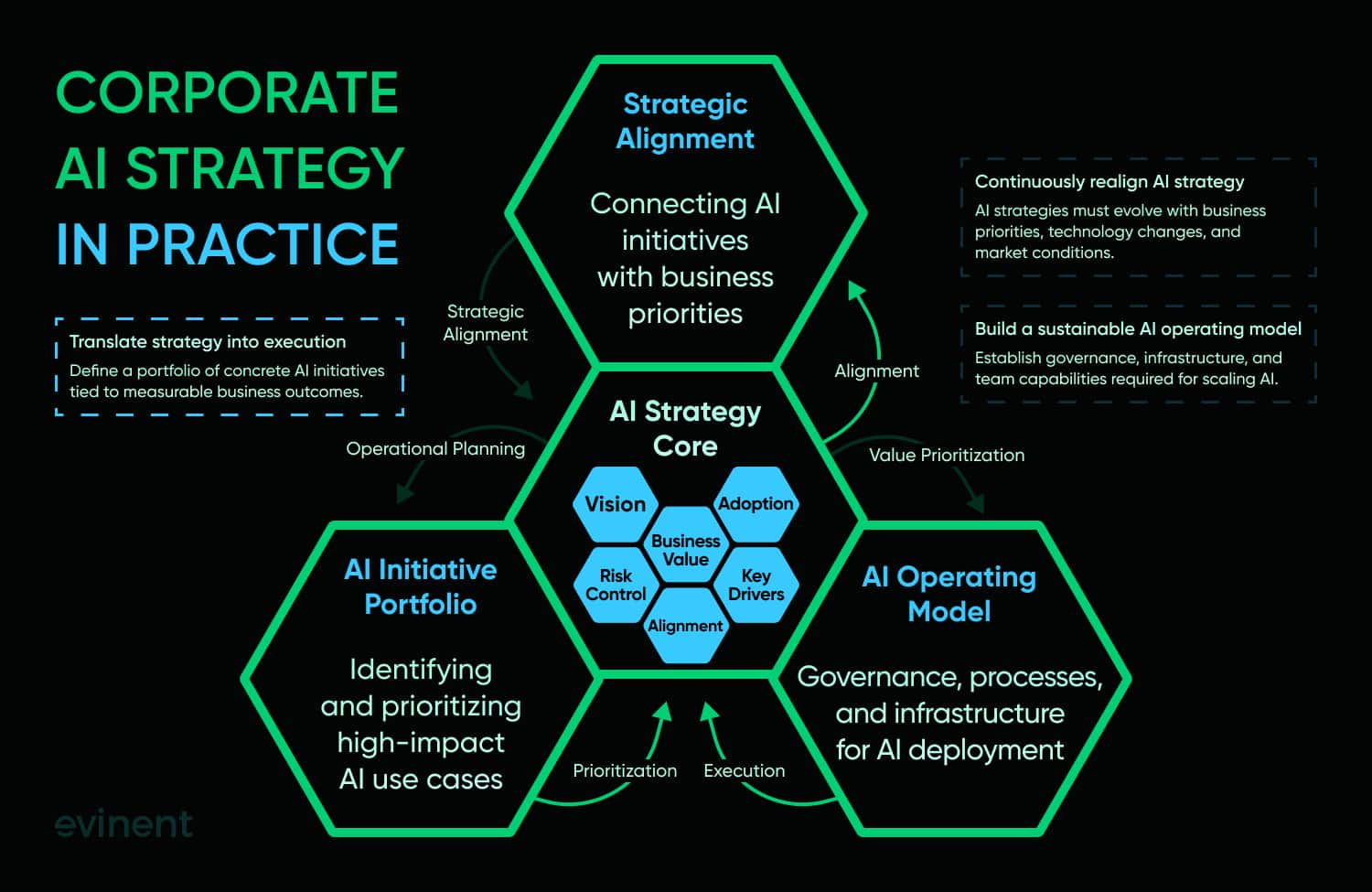
So organizations are caught between acceleration and accountability.
Move too slowly, and you lose ground to competitors. Move too quickly, and you expose yourself to compliance, bias, and governance failures.
Technology managers feel this tension most directly. They are asked to:
Integrate generative AI into production systems
Protect proprietary data and intellectual property
Monitor hallucinations and model drift
Ensure explainability under regulatory standards
Deliver measurable cost savings or revenue lift
Do all of it without disrupting core operations
That’s not a tooling problem. That’s a structural one.
A true corporate AI strategy answers questions that pilots never touch:
How does AI align with enterprise-wide strategic priorities?
Which use cases deserve capital allocation?
What governance framework prevents reputational risk?
How do we measure adoption beyond vanity metrics?
Who owns accountability when models influence decisions?
These aren’t theoretical concerns. They show up in procurement cycles, risk committee meetings, and quarterly earnings calls.
And there’s another shift happening quietly: CEOs are stepping in.
BCG’s 2026 CEO research notes that leading companies increasingly treat AI as a core strategic lever rather than an innovation side project. One executive described it bluntly: “AI is now a capital allocation decision.” That framing changes how projects are evaluated. It forces AI initiatives to compete with infrastructure upgrades, M&A activity, and product investments.
Once AI sits at that table, experimentation alone isn’t enough.
The organizations that extract durable value from AI tend to share a pattern:
They align AI with business objectives before selecting tools.
They invest in data infrastructure before scaling models.
They implement governance before exposure forces them to.
They define KPIs that tie directly to financial performance.
They treat adoption metrics as seriously as model accuracy.
Enterprises with strong data foundations, for example, consistently deploy AI initiatives faster and with fewer compliance setbacks than those operating on fragmented systems. The difference often isn’t algorithmic sophistication. It’s readiness.
And readiness is the invisible layer beneath every “successful AI transformation” headline.
So when someone searches “what is AI strategy for business?” they’re not looking for a definition of machine learning. They’re looking for a blueprint.
What Is Corporate Private AI?
If generative AI is powerful, and public AI tools are easily accessible, the next logical question becomes:
Why are enterprises increasingly investing in private AI environments instead of relying solely on public models?
Corporate Private AI refers to AI systems deployed within a controlled enterprise environment, where the organization governs the data, infrastructure, access controls, and operational policies.
A Practical Definition
Corporate Private AI is:
An AI system deployed in a controlled infrastructure environment (private cloud, on-premises, VPC, or isolated tenant)
Integrated with internal enterprise data sources (ERP, CRM, document repositories, transaction systems)
Governed under enterprise-level security, compliance, and audit requirements
Configured so proprietary data is not reused for external model training
Monitored for performance, drift, bias, and explainability
In simple terms:
Public AI optimizes for scale and accessibility and private AI optimizes for control and accountability.
Why Public AI Alone Is Insufficient for Many Enterprises
Public generative AI platforms are optimized for broad usage. They deliver fast value in ideation, drafting, coding assistance, and general reasoning tasks.
But enterprise environments operate under constraints that public platforms are not designed to solve by default:
Data residency regulations (for example, under the EU AI Act and GDPR)
Industry-specific compliance (finance, healthcare, insurance)
Intellectual property protection
Auditability requirements
Integration with sensitive operational systems
Long-term governance obligations
A tool that works for individual productivity may not be suitable for enterprise-wide decision systems.
This is where the distinction becomes critical.
The Regulatory Driver
The regulatory landscape in 2026 is materially different from 2023. The EU AI Act formally categorizes AI systems by risk level and imposes documentation, transparency, and monitoring requirements on high-risk deployments. Enterprises are not just consumers of AI — they are considered deployers and are therefore accountable for outcomes.
That accountability changes architecture decisions.
Organizations must answer:
Where is the model hosted?
What data is transmitted externally?
How are outputs logged?
Can decisions be explained months later?
Who has administrative access?
These questions cannot be resolved with usage policies alone. They require infrastructure design.
The Data Control Imperative
One of the most consistent enterprise concerns around public AI tools is data exposure.
Even when providers state that enterprise inputs are not used for training, the perception of risk remains — especially in sectors managing:
Financial transaction data
Healthcare records
Proprietary product designs
M&A documentation
Legal materials
Private AI environments allow organizations to:
Restrict outbound data transmission
Apply internal encryption standards
Log interactions centrally
Segment user access
Enforce data retention policies
In highly regulated sectors, these controls are not optional. They are prerequisites for deployment.
Architecture Models of Corporate Private AI
Corporate Private AI typically follows one of several patterns:
Isolated Model Hosting
The organization deploys models within its own infrastructure (cloud VPC or on-premises), ensuring no external data dependency.Hybrid Architecture
Public foundational models are accessed via secured APIs, but sensitive data is processed through retrieval systems that keep enterprise data internal.Composable AI Stack
The enterprise separates orchestration, retrieval, storage, model inference, and monitoring layers — allowing modular governance.Private AI Agents
Task-specific AI agents operate within controlled systems, integrated directly into enterprise workflows such as fraud detection, risk assessment, or document automation.
Each model balances performance, cost, compliance, and scalability differently. The right architecture depends on risk profile and strategic intent.
Private AI Is Not About Fear. It’s About Scale
There is a misconception that Private AI is driven by fear of public tools.
In reality, it is driven by the need to scale AI responsibly.
Early pilots often begin with public tools because speed matters. But once AI systems start influencing:
Credit decisions
Insurance underwriting
Medical documentation
Supply chain optimization
Customer risk scoring
— the organization must treat AI as operational infrastructure.
And infrastructure must be governed.
The Strategic Advantage of Private AI
When implemented correctly, Corporate Private AI delivers more than compliance.
It enables:
Safer integration of proprietary datasets
Custom fine-tuning aligned with business objectives
Workflow-level automation rather than surface-level assistance
Continuous retraining aligned with operational KPIs
Enterprise-wide adoption without shadow IT risks
In other words, it transforms AI from a productivity enhancer into a strategic capability.
A useful way to make “Private AI” concrete is to look at what it takes to deploy LLM-style automation inside the enterprise perimeter. In one Evinent pilot for an undisclosed European enterprise retailer, the goal was to automate vacancy–candidate matching across thousands of roles without sending any data outside the client’s infrastructure, explicitly avoiding external model APIs. The solution used two role-specific assistants (recruiter-facing and candidate-facing) and ran each capability in an isolated environment with role-based access controls. To reduce hallucinations and keep behavior predictable, the system applied an “atomic agent” approach, separating search, matching, and summarization into bounded components that are easier to monitor and tune.

Overcoming Implementation Challenges
AI strategy fails less often because of bad algorithms — and more often because of structural friction.
Most enterprises don’t struggle with whether AI works. They struggle with scaling it beyond pilots. The obstacles are predictable: fragmented data, legacy infrastructure, unclear governance, skill shortages, compliance uncertainty, and executive impatience around ROI.
This section breaks down the most common barriers to enterprise AI adoption — and what actually helps organizations move past them without creating new risks.
Data Quality and Access Constraints
AI systems are only as reliable as the data they ingest. Yet many enterprises operate with siloed systems, inconsistent labeling, outdated databases, and limited interoperability across departments.
Common issues include:
Insufficient access to relevant and high-quality data
Inconsistent data schemas across business units
Poor metadata documentation
Incomplete historical records
Manual processes that never digitized critical inputs
When AI models are trained or ed on fragmented datasets, the result isn’t just lower performance — it’s operational instability.
Strategy to overcome:
Conduct enterprise-wide data audits before scaling AI
Establish centralized data governance policies
Invest in data cleaning, labeling, and enrichment
Create unified data access layers via APIs
Assign clear ownership for data domains
Organizations that treat data infrastructure as a strategic asset consistently deploy AI faster and with fewer rework cycles.
Legacy Systems and Infrastructure Limitations
Many enterprises still rely on legacy systems not designed for AI integration. These systems may lack:
API connectivity
Real-time processing capabilities
Cloud compatibility
Scalable compute environments
Attempting to layer AI onto outdated infrastructure often leads to brittle integrations and operational bottlenecks.
Strategy to overcome:
Introduce composable architecture layers
Use middleware or API gateways to connect legacy systems
Prioritize incremental modernization rather than full replacement
Design hybrid environments where AI modules interact through secure interfaces
AI adoption does not require full system replacement — but it does require integration planning.
Compliance and Regulatory Complexity
In 2026, regulatory exposure is no longer theoretical.
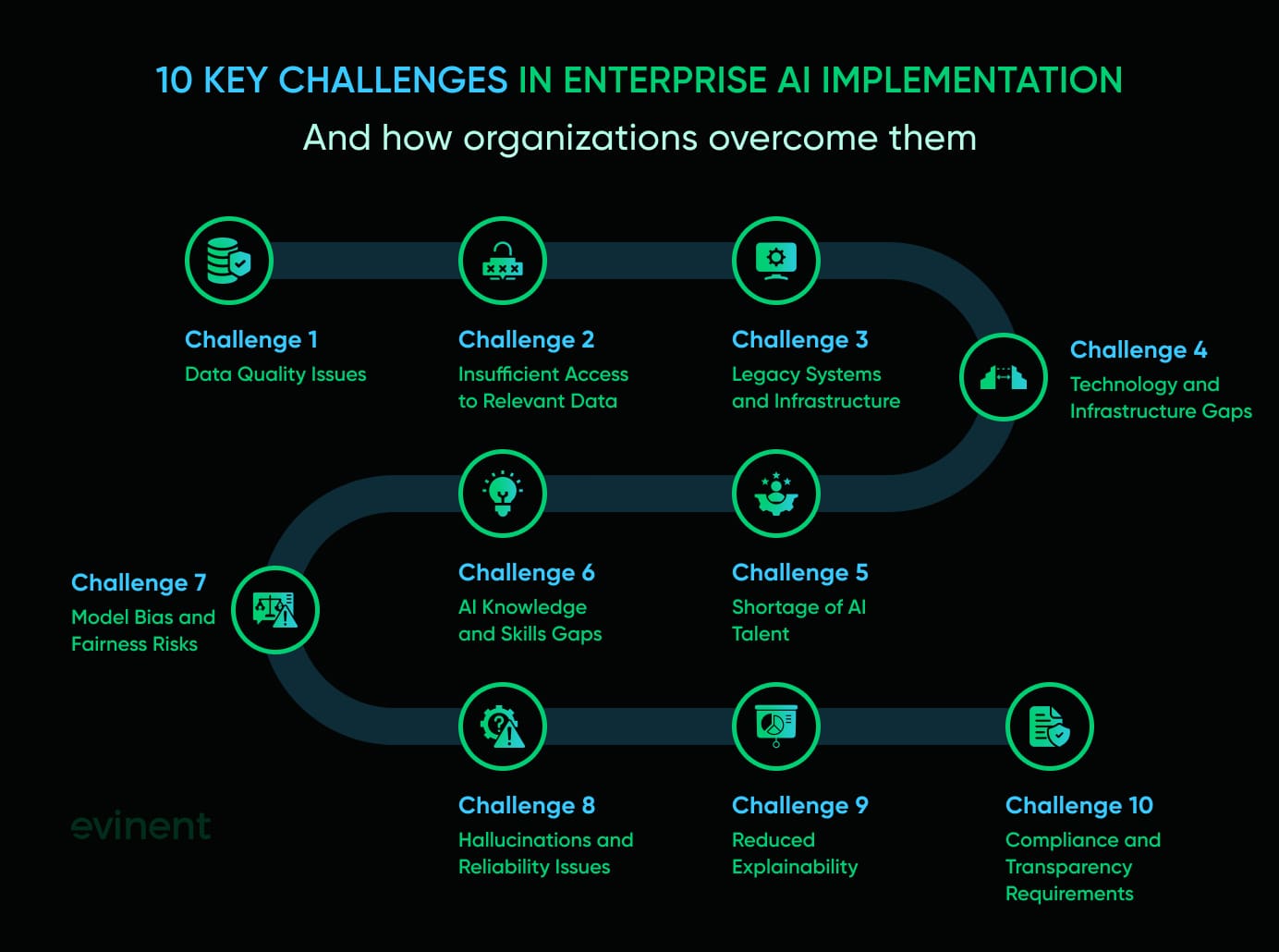
AI systems operating in finance, healthcare, insurance, and public sectors must address:
Transparency requirements
Reduced explainability concerns
Audit trails
Risk classification
Data residency obligations
Failing to embed compliance into AI design creates downstream legal and reputational risk.
Strategy to overcome:
Involve legal and compliance teams early in AI planning
Document model design decisions and training data sources
Implement monitoring systems for bias and drift
Create internal AI governance committees
Maintain logs of model inputs and outputs
Compliance is not a blocker, but it must be operationalized, not treated as a documentation afterthought.
Model Bias and Reduced Explainability
AI systems can amplify existing biases in data or introduce unintended distortions. Additionally, large language models and deep learning systems can reduce explainability, especially in high-stakes decisions.
Common risks include:
Model bias in customer scoring or hiring systems
Opaque reasoning chains
Hallucinations in generative outputs
Inconsistent results across demographic segments
When AI influences decisions, transparency becomes a strategic requirement.
Strategy to overcome:
Deploy bias detection and fairness testing tools
Use human-in-the-loop validation for high-risk workflows
Favor interpretable models where required
Implement explainability layers for model outputs
Establish review protocols for generative systems
AI systems must be observable, auditable, and challengeable.
Shortage of AI Talent and Skills Gaps
Even well-funded organizations encounter a shortage of AI talent. The issue is not just hiring machine learning engineers — it’s broader:
Lack of AI knowledge among executives
Skills gaps in data engineering
Limited MLOps expertise
Insufficient AI literacy among end users
Without internal capability, organizations become dependent on vendors or stall after pilot deployment.
Strategy to overcome:
Upskill internal teams with structured AI education programs
Create cross-functional AI working groups
Pair domain experts with technical specialists
Invest in MLOps capability early
Define clear ownership roles for AI lifecycle management
Successful AI adoption is as much a cultural shift as a technical one.
Technology and Infrastructure Governance
Shadow AI usage is rising inside enterprises. Employees experiment with external tools without centralized oversight. While innovation is valuable, unmanaged AI deployment increases risk.
Uncontrolled environments can lead to:
Data leakage
Inconsistent model versions
Redundant tool spending
Security exposure
Strategy to overcome:
Provide sanctioned AI environments internally
Establish approved tool lists
Create clear AI usage policies
Monitor access and usage patterns
Implement centralized orchestration platforms
Governance reduces fragmentation and improves scalability.
Managing Hallucinations and Reliability Risks
Generative AI systems can produce hallucinations — outputs that appear confident but contain incorrect information.
In enterprise environments, hallucinations can:
Introduce factual errors in documentation
Affect customer communications
Create legal risk
Undermine user trust
Strategy to overcome:
Use retrieval-augmented generation (RAG) to ground outputs in internal data
Implement response validation layers
Apply confidence scoring
Require human validation for critical outputs
Monitor error rates continuously
Reliability must be engineered — not assumed.
The Pattern Behind the Barriers
Most AI implementation challenges fall into three broader categories:
Structural (data quality, legacy systems, infrastructure)
Human (skills gaps, lack of AI knowledge, resistance to change)
Governance (compliance, bias, transparency, explainability)
Organizations that address only one dimension tend to stall.
Those who treat AI adoption as a coordinated transformation across technology, governance, and culture are more likely to achieve sustainable ROI.
AI is not difficult because models are weak.
It is difficult because enterprises are complex.
And complexity requires structure.
Continuous Adaptation and Strategic Realignment
AI strategy is not a one-time roadmap.
It is a living system.
What worked in 2024 may be inefficient in 2026. Models improve. Regulations evolve. Infrastructure matures. Competitive pressure shifts. And internal adoption either compounds value — or quietly decays.
Organizations that treat AI strategy as static documentation fall behind. Those who treat it as an adaptive capability continue to extract value.
This section outlines how enterprises maintain momentum through continuous iteration, hypothesis testing, and strategic realignment.
AI Strategy as a Dynamic Operating Model
Unlike traditional IT rollouts, AI deployments change behavior inside the organization. They influence workflows, decision patterns, data dependencies, and risk exposure.
That means the AI strategy must evolve along with:
Advancements in gen AI tools
Emergence of AI agents in operational systems
Changes in compliance frameworks
Shifts in business priorities
Improvements in data infrastructure
The goal is not constant reinvention. It is structured evolution.
Measuring What Actually Matters
Many AI initiatives fail not because models underperform, but because success is poorly defined.
Enterprises need two categories of metrics:
System metrics
Accuracy
Latency
Drift
Acceptance rate
Reliability
Hallucination frequency
Business metrics
Cost reduction
Revenue impact
Time-to-value
Adoption rate
Productivity gains
Customer satisfaction
AI adoption metrics must extend beyond “model performance.” They should measure how AI influences outcomes inside real workflows.
Organizations that regularly review both system and business metrics are better positioned for strategic realignment when signals weaken.
Hypothesis Testing Over Assumption
AI strategy should be structured around testable hypotheses.
Instead of declaring:
“AI will improve fraud detection.”
Frame it as:
“If we integrate AI agents into fraud triage workflows, we expect a 15% reduction in false positives within 6 months.”
This enables:
Controlled rollout
Measurable evaluation
Clear continuation or pivot decisions
Hypothesis testing reduces emotional attachment to pilots. It anchors decisions in evidence.
Monitoring Trends and Competitive Shifts
Trend monitoring is no longer optional.
New model architectures, agent-based systems, and orchestration frameworks emerge rapidly. Enterprises must evaluate:
Whether newer gen AI tools outperform current deployments
Whether AI agents can automate multi-step workflows
Whether competitors are using AI offensively (growth, innovation) or defensively (cost reduction, risk control)
AI strategy increasingly includes both:
Offensive strategies
Using AI to create new revenue streams, differentiated products, and predictive insights.
Defensive strategies
Using AI to protect margins, reduce fraud, improve compliance, and enhance operational resilience.
Balanced organizations evaluate both continuously.
Responsible AI as an Iterative Discipline
A responsible AI approach is not static compliance documentation.
It requires:
Ongoing bias audits
Drift monitoring
Transparency reviews
Explainability validation
Updated governance policies
As models evolve, so must guardrails.
Regulatory expectations are tightening. Internal governance frameworks must keep pace.
Continuous adaptation ensures that compliance does not become reactive.
Sustaining Stakeholder Buy-In
Initial enthusiasm often fades after the pilot phase. Sustained AI adoption depends on:
Clear communication of results
Visible ROI reporting
Executive sponsorship
Training programs
Transparent risk management
Stakeholder buy-in is not guaranteed. It must be maintained through demonstrated value and operational stability.
AI leaders who communicate measurable impact build trust.
Trust accelerates scale.
Strengthening Data Infrastructure Over Time
AI maturity is tightly coupled with data infrastructure maturity.
As AI systems expand, organizations must:
Improve data quality pipelines
Expand real-time access
Refine metadata governance
Integrate new data sources
Modernize legacy components incrementally
Strategic realignment often begins with infrastructure adjustments.
Without strong data foundations, iteration slows.
From Static Plans to Adaptive Capability
The most advanced enterprises no longer ask:
“Do we have an AI strategy?”
They ask:
“Is our AI strategy learning?”
Continuous adaptation transforms AI from a project into a capability.
It aligns:
Technology with evolving business goals
Governance with regulatory shifts
Adoption metrics with operational impact
Innovation with risk management
In 2026, competitive advantage does not come from early experimentation alone. It comes from disciplined iteration.
AI compounds when it is observed, measured, and refined.
And organizations that build that feedback loop into their operating model are the ones that turn AI from tactical productivity gains into structural advantage.
AI Governance, Ethics, and Enterprise Risk Architecture
An AI strategy without governance is operational exposure.
As AI systems move from experimentation into production — influencing credit decisions, underwriting, diagnostics, hiring, fraud detection, and automated communication — the question shifts from “Does it work?” to “Is it accountable?”
Governance, ethics, and risk management are not abstract policy topics. They are structural requirements for the adoption of sustainable AI.
This section outlines how enterprises design governance architectures that balance innovation with regulatory discipline, transparency, and long-term trust.
Accountability for AI Governance: Clear ownership structures
One of the most common enterprise failures is unclear accountability for AI governance.
When responsibility is fragmented between IT, legal, data science, and business units, oversight gaps emerge. Governance must be anchored in defined ownership.
Effective models include:
A centralized AI governance committee
Defined risk owners for each deployed AI system
Clear escalation pathways for model failures
Board-level visibility into high-risk AI use cases
Accountability for AI governance is not symbolic. It defines who answers when systems fail.
Without ownership, governance becomes documentation. With ownership, it becomes operational discipline.
Data Governance Framework: Protecting proprietary data sources
AI systems often depend on proprietary data sources — financial records, internal research, transaction histories, customer data, or sensitive documentation.
A robust data governance framework ensures:
Controlled access permissions
Data lineage tracking
Encryption standards
Retention policies
Monitoring of outbound data transmission
In regulated industries, weak data governance is not only a technical flaw — it is a legal liability.
Organizations must define where data originates, how it is transformed, and how it is used within AI systems.
Governance begins with visibility.
Bias and Fairness Controls: Managing systemic risk
AI models reflect patterns present in training data. If historical data are biased, models may amplify that bias.
Risk areas include:
Credit scoring
Hiring recommendations
Insurance underwriting
Risk profiling
Bias is not always intentional, but unmanaged bias creates regulatory and reputational exposure.
Responsible AI principles require:
Bias detection testing
Fairness audits across demographic groups
Human oversight in high-risk decisions
Documentation of mitigation steps
Ethical guidelines must translate into measurable safeguards.
Model Explainability and Transparency Practices: Making decisions defensible
Reduced explainability is a major regulatory concern, particularly under frameworks such as the EU AI Act.
Enterprises must be able to answer:
Why did the system generate this output?
What data influenced the decision?
Can the reasoning be reconstructed months later?
Model explainability can be supported through:
Interpretable model architectures are feasible
Explanation layers for complex models
Logging of model inputs and outputs
Documentation of training processes
Transparency practices protect both the organization and its stakeholders.
An AI system that cannot explain itself becomes difficult to defend.
Managing Hallucinations and Reliability Risk: Containing generative instability
Generative AI introduces a new risk profile: hallucinations.
Confident but incorrect outputs can create:
Legal exposure
Reputational damage
Customer misinformation
Compliance violations
Mitigation strategies include:
Retrieval-augmented generation (RAG) using trusted proprietary data sources
Confidence scoring mechanisms
Response validation layers
Human review for critical decisions
Continuous monitoring of output quality
Governance must account for probabilistic behavior.
Reliability is engineered — not assumed.
Critic Agents and Oversight Mechanisms: Building internal checks
Advanced enterprises increasingly deploy critical agents — AI systems designed to evaluate or challenge the outputs of other models.
These oversight layers can:
Detect inconsistencies
Flag potential bias
Validate factual grounding
Monitor policy compliance
While not a replacement for human review, critic agents introduce additional guardrails in high-volume environments.
Layered oversight reduces systemic risk.
Integrated Risk Management: Aligning AI with enterprise risk frameworks
AI risk management should integrate with broader enterprise risk management systems.
This includes:
Mapping AI risks to corporate risk registers
Classifying systems by impact level
Conducting regular risk assessments
Embedding AI into audit cycles
Aligning with cybersecurity and compliance teams
AI governance cannot operate in isolation from broader risk management.
It must be embedded within corporate control systems.
From Ethical Principles to Operational Architecture
Many organizations publish responsible AI principles. Fewer operationalize them.
Effective governance requires:
Translating ethical guidelines into measurable controls
Defining thresholds for acceptable risk
Implementing transparency practices
Documenting decision pathways
Maintaining ongoing oversight
Governance is not anti-innovation. It enables sustainable innovation.
Without risk architecture, AI adoption remains fragile.
With governance embedded, AI becomes a defensible, scalable infrastructure.
Strategic Use Case Identification and Prioritization
AI fails less often because the technology is weak — and more often because organizations choose the wrong problems.
Deploying AI without disciplined use case prioritization leads to scattered pilots, inflated expectations, and stalled ROI. The organizations that extract enterprise value treat use case selection as a strategic exercise, not a brainstorming session.
This section outlines a structured approach to identifying, evaluating, and prioritizing AI initiatives aligned with measurable business objectives.
Start With Business Objectives, Not Technology: Aligning AI with strategic intent
The first mistake many enterprises make is starting with tools.
Instead, begin with clear business objectives:
Increase revenue
Reduce operating costs
Improve risk detection
Enhance customer experience
Accelerate product development
Improve decision accuracy
AI should serve defined outcomes. It is not a goal in itself.
Executive alignment at this stage ensures that AI initiatives compete for capital allocation based on expected value generation — not novelty.
Conduct Structured Department Head Interviews: Surfacing real operational pain points
High-impact AI use cases are rarely discovered in innovation workshops alone.
They emerge through structured conversations with department leaders across:
Operations
Finance
Risk
Customer contact center
Sales
Compliance
IT
Key questions include:
Where are bottlenecks slowing down workflows?
Which decisions rely heavily on manual data analysis?
Where does process optimization have a measurable financial impact?
Which tasks are repetitive but high-volume?
This approach surfaces operational workflow changes that AI-powered automation can realistically improve.
Map Use Cases With an AI Use Case Matrix: Evaluating actionability and feasibility
Once potential initiatives are identified, they must be evaluated systematically.
An AI use case matrix typically scores initiatives across two primary dimensions:
1. Expected Value Generation
Revenue potential
Cost savings
Risk reduction
Productivity improvement
2. Actionability and Feasibility
Data availability
Data integration complexity
Infrastructure readiness
Compliance exposure
Talent requirements
High-value, high-feasibility initiatives become immediate candidates for pilot deployment.
High-value but low-feasibility initiatives may require infrastructure investment first.
This structured evaluation prevents misaligned prioritization.
Differentiate Between AI Assistants and AI Agents: Matching capability to complexity
Not all use cases require full automation.
Enterprises should distinguish between:
AI assistants
Support human decision-making
Provide recommendations
Summarize data
Enhance productivity
AI agents
Execute multi-step workflows autonomously
Trigger actions across systems
Integrate with operational processes
For example:
In a customer contact center, AI assistants may provide real-time suggestions to agents.
AI agents may autonomously triage tickets, route cases, or resolve simple inquiries.
The maturity of data infrastructure and governance often determines whether assistant-level augmentation or agent-level automation is appropriate.
Prioritize Process Optimization Over Novelty: Target measurable impact
Early AI enthusiasm often gravitates toward visible, customer-facing tools.
However, some of the strongest returns come from internal process optimization, such as:
Automated document classification
Fraud detection enhancements
Predictive maintenance
Intelligent demand forecasting
AI-powered data analysis pipelines
These use cases may lack public visibility but generate measurable operational improvements.
Enterprise AI strategy should balance innovation with pragmatic value.
Assess Data Integration Requirements Early: Avoid hidden blockers
Many promising use cases stall due to underestimated data integration complexity.
Before prioritizing an initiative, assess:
Are the required datasets centralized or fragmented?
Is real-time access necessary?
Are APIs available for system connectivity?
Does data require cleaning or enrichment?
AI success often depends more on integration readiness than on model sophistication.
Feasibility scoring must include infrastructure realities.
Define Measurable Hypotheses for Each Use Case: Establish evaluation criteria
Every prioritized initiative should include:
A defined performance baseline
Clear success metrics
Timeline expectations
Adoption targets
Risk thresholds
For example:
“If we deploy AI-powered automation in invoice processing, we expect a 25% reduction in processing time within 4 months.”
This transforms AI from abstract experimentation into structured execution.
The Strategic Pattern
Organizations that succeed at AI prioritization follow a consistent pattern:
Align AI initiatives with business objectives.
Identify real workflow bottlenecks through structured interviews.
Score opportunities using an AI use case matrix.
Differentiate between assistant-level and agent-level automation.
Validate data integration feasibility early.
Define measurable hypotheses before deployment.
This discipline prevents the two most common enterprise pitfalls:
Chasing AI for visibility rather than value.
Overcommitting to technically impressive but operationally misaligned projects.
AI adoption is not about deploying more models.
It is about deploying the right ones — in the right workflows — at the right time.
Building and Adapting the AI Roadmap
Identifying strong use cases is only the beginning. Without a structured AI roadmap, even high-potential initiatives remain isolated pilots.
An effective AI roadmap translates strategy into execution. It defines sequencing, measurable goals, ownership structures, infrastructure evolution, and adoption targets. More importantly, it remains adaptable as AI capabilities evolve and business priorities shift.
The most resilient organizations treat their AI roadmap not as a static document, but as a managed portfolio of concrete initiatives aligned with enterprise KPIs.
Below is a structured framework for building and continuously adapting an AI roadmap.
1. Conduct an AI Maturity Assessment and Define the Target Operating Model h4
Before sequencing initiatives, organizations must understand their current state.
An AI maturity assessment evaluates:
Data infrastructure readiness
Talent and skills gaps
Governance and compliance controls
Integration capabilities
Existing AI deployments
Cultural readiness and leadership alignment
This baseline clarifies whether the organization is in experimentation, scaling, or optimization mode.
From this assessment, leadership defines the target AI operating model — answering questions such as:
Will AI capabilities be centralized or embedded across business units?
Who owns model lifecycle management?
How will governance be enforced?
How will AI initiatives integrate into the broader IT and data strategy?
Defining the AI operating model early ensures structural clarity before scaling begins.
2. Sequence Concrete Initiatives with Measurable Goals h4
An AI roadmap should resemble a portfolio plan rather than a wish list.
Each initiative included in the roadmap must define:
Clear KPIs tied to business outcomes
System metrics (accuracy, latency, drift, reliability)
Adoption targets across user groups
Defined time-to-value milestones
Budget and infrastructure requirements
Sequencing matters.
High-feasibility, high-impact initiatives should be prioritized to generate early wins and strengthen executive Buy-in. More complex transformations — such as agent-based automation across multiple departments — may follow once foundational infrastructure and governance are stabilized.
The roadmap should explicitly connect each initiative to measurable goals. If success cannot be quantified, prioritization becomes subjective.
Portfolio management discipline prevents AI efforts from fragmenting across departments.
3. Design for Adaptation and Continuous Strategic Realignment h4
AI capabilities evolve rapidly. New gen AI tools, orchestration frameworks, and AI agents continuously shift what is technically and economically viable.
A static AI roadmap quickly becomes outdated.
To remain adaptive, organizations should:
Review KPIs and adoption metrics quarterly
Reassess infrastructure readiness as workloads grow
Monitor emerging AI capabilities for strategic relevance
Rebalance the AI portfolio based on performance data
Conduct periodic strategic realignment workshops
Roadmap governance should include defined checkpoints for:
Expanding successful initiatives
Sunsetting underperforming pilots
Updating risk management protocols
Adjusting adoption targets
Continuous refinement ensures that the AI roadmap remains aligned with evolving business objectives, regulatory expectations, and technological advancements.
Adaptation is not instability — it is strategic discipline.
A well-structured AI roadmap does three things simultaneously:
It translates long-term AI strategy into sequenced, executable steps.
It connects initiatives to measurable KPIs and adoption targets.
It embeds flexibility to adjust as infrastructure, compliance requirements, and AI capabilities evolve.
Enterprises that manage AI as a structured portfolio — rather than a collection of experiments — are more likely to convert early pilots into sustained competitive advantage.
Measuring Value and ROI of AI
AI enthusiasm is easy.
Proving business impact is harder.
Many enterprises report success in experimentation — improved model quality metrics, promising pilots, and positive user feedback. Yet boards and CFOs ask a different question:
Where is the measurable return?
Measuring the value and ROI of AI requires connecting system performance to financial outcomes. It demands clarity on cost savings, incremental revenue, risk mitigation, improved margins, and even long-term company valuations.
This section outlines how organizations move from technical validation to demonstrable business value.
Model quality metrics — accuracy, precision, recall, and latency — are necessary but insufficient.
An AI system can improve accuracy by 4% and still fail to generate a measurable business impact.
ROI measurement must translate technical performance into:
Cost savings
Efficiency gains
Incremental revenue
Improved margins
Risk reduction
For example:
A 15% reduction in false fraud s translates into reduced manual review hours.
A 10% increase in customer resolution speed translates into operational cost reduction.
AI-powered personalization may increase average order value and incremental revenue.
Technical metrics are inputs. Financial outcomes are outputs.
AI value materializes only if people use it.
Organizations should monitor:
Usage frequency per team
Adoption rates across departments
Retention rates of AI-assisted workflows
Percentage of decisions influenced by AI
Acceptance rates in assistant-style tools
High-quality systems with low adoption produce negligible business impact.
Adoption metrics are leading indicators of ROI.
If usage stagnates, value generation will likely follow.
Every AI initiative should be tied to key performance indicators (KPIs) defined at the outset.
Examples include:
Reduction in processing time
Increase in customer conversion rate
Decrease in churn
Lower operating expenses
Faster decision turnaround
Improved customer satisfaction scores
KPIs must be:
Quantifiable
Time-bound
Directly linked to business objectives
Without predefined KPIs, ROI evaluation becomes subjective and vulnerable to bias.
Operational metrics bridge technical performance and business outcomes.
These may include:
Throughput per employee
Time-to-resolution
Automated task percentage
Error rate reduction
Workflow cycle time
Operational improvements often precede visible financial gains.
Tracking both layers ensures early detection of value creation or stagnation.
Not all AI value appears in revenue increases.
Risk mitigation can produce a significant financial impact by:
Preventing fraud losses
Reducing compliance penalties
Detecting anomalies earlier
Avoiding operational downtime
Quantifying avoided losses requires estimating baseline risk exposure and comparing it to post-AI implementation outcomes.
Though harder to calculate, risk mitigation contributes meaningfully to improved margins and long-term stability.
Efficiency gains must translate into tangible economic value.
For example:
If AI reduces processing time by 30%, what does that mean in labor cost?
If automation eliminates manual review steps, how many FTE hours are saved?
If predictive analytics improves forecasting accuracy, how does that reduce inventory carrying costs?
Cost savings calculations should consider:
Infrastructure costs
Model maintenance
Licensing expenses
Talent investments
True ROI accounts for both gains and expenditures.
Some AI initiatives generate incremental revenue by:
Improving customer targeting
Enhancing product recommendations
Accelerating product innovation cycles
Enabling new AI-powered services
In growth-focused organizations, AI may influence company valuations by signaling to investors the maturity of innovation and operational sophistication.
While harder to isolate, strategic lift can significantly impact long-term enterprise value.
Leading enterprises build AI dashboards that integrate:
Model quality metrics
Operational metrics
Adoption rates
Financial KPIs
Risk indicators
This centralized visibility allows leadership to:
Monitor business impact in real time
Identify underperforming initiatives
Reallocate investment across the AI portfolio
Strengthen executive Buy-in
Transparency sustains momentum.
The Core Principle
AI does not create value by existing.
It creates value when it changes measurable business outcomes.
Organizations that define success narrowly — through model performance alone — risk overstating impact. Those that connect AI initiatives to financial, operational, and strategic metrics build defensible ROI narratives.
In 2026, capital allocation increasingly depends on demonstrable AI returns.
Careful measurement of value is no longer optional. It is the foundation of sustainable AI investment.
Organizational Transformation and AI Capability Development
AI adoption is not just a technical upgrade. It is an organizational shift.
Even the most advanced AI roadmap will stall without cultural readiness, leadership alignment, and skill development. Sustainable AI implementation requires building internal capability, strengthening governance structures, and embedding a culture of innovation around AI.
This section explores how enterprises evolve their organizational model to support long-term AI adoption.
Building AI Literacy Across the Organization: Democratizing understanding
AI literacy is no longer limited to engineers.
Executives must understand strategic implications. Managers must interpret AI-driven insights. Operational teams must trust and use AI outputs. Without shared understanding, adoption slows.
Organizations should invest in:
Executive AI briefings focused on risk and opportunity
Department-level workshops explaining AI capabilities
Internal training programs covering AI fundamentals
Clear communication about AI limitations (including hallucinations and bias risks)
AI literacy reduces resistance and builds informed adoption.
Developing AI Engineering Skills and Talent Pipelines: Closing capability gaps
The shortage of AI talent remains a constraint in 2026. Enterprises must balance hiring with internal development.
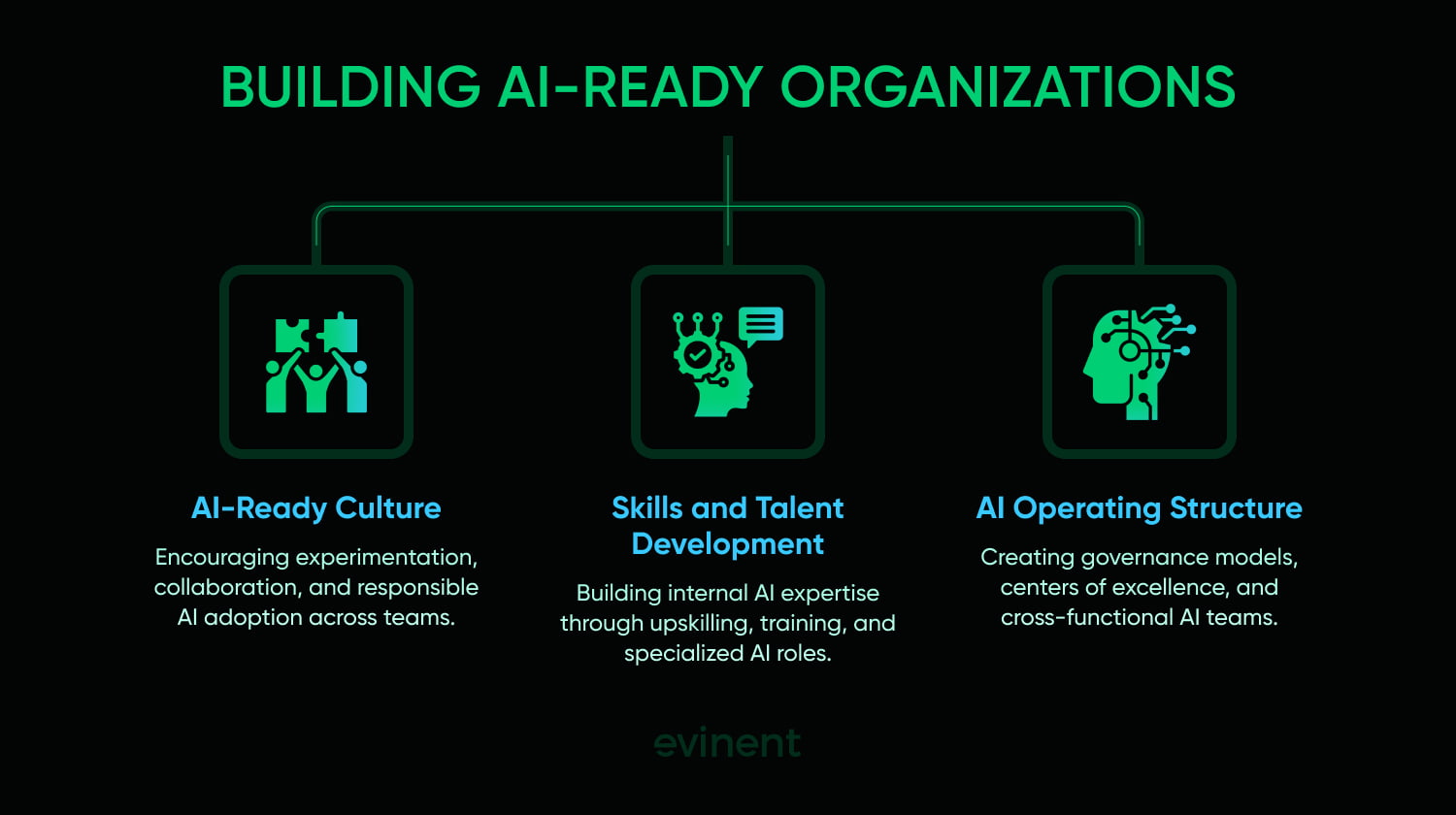
Effective strategies include:
Upskilling AI teams in MLOps and model lifecycle management
Creating rotational programs for data and engineering roles
Partnering with universities to build a long-term talent pipeline
Encouraging cross-functional collaboration between domain experts and technical teams
AI engineering skills must expand beyond model development to include data governance, system monitoring, and infrastructure design.
Capability depth determines scalability.
Establishing Centers of Excellence: Creating structural leverage
Many organizations formalize AI expertise through centers of excellence (CoEs).
A well-structured AI CoE provides:
Centralized expertise
Governance oversight
Best practice standardization
Cross-department knowledge sharing
Support for business unit deployments
The center of excellence model prevents fragmented experimentation while allowing distributed execution.
Aligning Governance and Organizational Structure: Embedding Oversight
AI governance cannot sit outside organizational design.
Enterprises must define:
Reporting structures for AI initiatives
Clear ownership of the model lifecycle
Escalation pathways for risk management
Integration with compliance and cybersecurity teams
An objective assessment of your organization’s AI maturity should inform structural decisions.
The right organizational model balances innovation with control.
Fostering a Culture of Innovation Around AI: Encouraging Responsible Experimentation
Culture determines whether AI becomes a strategic asset or a stalled initiative.
A culture ready for AI adoption:
Encourages hypothesis testing
Accepts iterative improvement
Promotes collaboration with engaged leaders
Balances experimentation with responsible AI principles
Leaders play a critical role in signaling that AI initiatives are strategic priorities — not temporary experiments.
Change management is as critical as model performance.
Strategic Alignment With Business Goals
AI without alignment is noise.
Corporate AI initiatives must connect directly to enterprise-wide strategy. Without clear alignment, AI becomes siloed experimentation, detached from measurable business outcomes.
This section outlines how organizations ensure bidirectional alignment between AI initiatives and overall strategic priorities.
Defining a Clear AI Vision: Establishing direction
An AI vision articulates:
Why the organization invests in AI
What competitive advantage AI should enable
How AI supports long-term business objectives
The AI vision must be communicated across C-level stakeholders and operational leaders.
Clarity prevents initiative drift.
“As the adoption of AI models spreads, so do the consequences of relying on commoditized insights. After all, companies that use generic inputs will produce generic outputs, which lead to generic strategies that, almost by definition, lead to generic performance or worse.” — McKinsey, 2025
Ensuring Bidirectional Alignment: Integrating AI into enterprise strategy
Alignment is not one-directional.
Business strategy should guide AI initiatives. AI capabilities should inform evolving strategic priorities.
For example:
AI-powered analytics may reveal new revenue opportunities.
Operational insights may shift investment priorities.
Data infrastructure improvements may unlock new strategic options.
Bidirectional alignment ensures that AI informs decision-making at the highest level.
Integrating AI Into the AI Operating Model and Portfolio: Managing as infrastructure
AI initiatives should be managed as part of a structured AI portfolio.
This portfolio should:
Align with enterprise-wide strategy
Map initiatives to key performance indicators (KPIs)
Integrate with data and analytics strategy
Coordinate with technology infrastructure planning
The AI operating model defines how projects are initiated, governed, scaled, and evaluated.
Without integration into enterprise systems, AI remains peripheral.
Collaborating With C-Level Stakeholders: Sustaining executive ownership
AI transformation requires visible executive sponsorship.
C-level stakeholders must:
Approve resource allocation
Participate in governance oversight
Review KPI performance
Support organizational change initiatives
Stakeholder collaboration reduces friction and accelerates strategic realignment.
Alignment at the top enables execution at scale.
How Evinent Can Support Corporate AI Implementation
Turning an AI strategy into real operational systems requires more than experimenting with models or deploying generic AI tools. Enterprises need secure environments, clear governance, reliable data pipelines, and AI systems that can integrate with existing infrastructure and workflows.
This is where implementation partners play a critical role. Evinent helps organizations design and deploy corporate Private AI systems that operate securely within enterprise environments while delivering measurable business outcomes.
A practical example of this approach is the AI HR Assistant for secure enterprise recruitment developed by Evinent.
Many organizations want to use AI to automate candidate screening, resume analysis, and applicant communication. However, recruitment workflows contain highly sensitive data: personal information, employment histories, and internal hiring decisions. Sending that data to public AI services creates legal and compliance risks.
To address this challenge, Evinent designed a Private AI recruitment assistant deployed within the company’s infrastructure.
The system included two primary AI components:
• Recruiter assistant — helps HR teams analyze resumes, shortlist candidates, summarize applicant profiles, and compare candidates against job requirements.
• Candidate assistant — interacts with applicants, answers questions about positions, guides them through the application process, and collects structured information before interviews.
The architecture followed a controlled multi-agent structure, where different AI modules handle specific tasks such as search, candidate matching, summarization, and communication. This separation improves transparency and reduces the risk of unreliable responses.
Most importantly, the system operates within a private AI environment, meaning sensitive HR data never leaves the organization’s infrastructure.
This approach allows enterprises to benefit from AI automation while maintaining control over:
proprietary HR data
access permissions and role-based visibility
model behavior and response transparency
compliance with internal security policies
Beyond improving efficiency, the system significantly optimized recruitment workflows.
Instead of manually reviewing hundreds of applications, HR specialists can focus on evaluating qualified candidates identified by the AI assistant. The result is faster hiring cycles, improved candidate communication, and better decision support for HR teams.
This example illustrates a broader lesson about corporate AI adoption: the real challenge is the secure integration of AI into enterprise systems and processes.
Organizations that successfully deploy AI typically do three things well:
build private, controlled AI environments
integrate AI into existing operational workflows
measure performance through clear business metrics
With experience in AI development, enterprise software engineering, and legacy system modernization, Evinent helps companies move from AI experimentation to production-ready AI systems that deliver measurable business value.
FAQ
What is a corporate AI strategy?
A corporate AI strategy defines how an organization integrates artificial intelligence into its business objectives, governance framework, operating model, and infrastructure to generate measurable value while managing risk.
How does Private AI differ from public AI tools?
Private AI operates within controlled enterprise environments, protecting proprietary data and enabling compliance with regulatory requirements. Public AI tools prioritize accessibility and scale but may lack enterprise-level governance controls.
How do you measure ROI for AI initiatives?
ROI is measured by linking model quality metrics to business outcomes, including cost savings, efficiency gains, incremental revenue, improved margins, and risk mitigation. Adoption rates and operational metrics must also be tracked.
Why do many AI initiatives fail to scale?
Common barriers include poor data quality, legacy infrastructure, lack of AI talent, weak governance structures, and misalignment with business objectives. Scaling requires structural readiness, not just technical capability.
What organizational changes are needed for AI adoption?
Successful AI adoption requires building AI literacy, developing engineering skills, establishing centers of excellence, embedding governance frameworks, and fostering a culture that supports responsible experimentation.
How often should an AI roadmap be updated?
AI roadmaps should be reviewed at least quarterly to account for technological advancements, regulatory changes, adoption metrics, and evolving business priorities.
Share