

What Is Private AI Enterprise Search
Private AI Enterprise Search refers to the use of AI in an organization's internal search to give smart access to the company's knowledge while fully complying with security, data governance, and privacy needs.
Private AI Enterprise Search is specifically focused on working with the internal data of the enterprise only, such as corporate documents, knowledge bases, intranet portals, databases, and other secured content repositories. Different from public search engines or general-purpose AI assistants, it operates completely within the enterprise trust boundary and observes the existing access controls, data security policies, and compliance constraints.
A core characteristic of private enterprise search is its ability to understand both user intent and enterprise content. By leveraging natural language understanding and semantic search techniques, the system goes beyond traditional keyword matching and interprets the meaning of queries in context. This enables more accurate retrieval across heterogeneous and poorly structured datasets that are common in large organizations.
Equally important is the private-by-design AI architecture. Generative AI, vector search, and inference workflows are deployed in controlled environments where enterprise data is not exposed to external or public models. Content used for indexing and retrieval remains isolated, ensuring that sensitive information is neither leaked nor reused outside the organization’s governance framework.
“Enterprise AI search platforms enable retrieval and synthesis of information across enterprise repositories and serve as foundational tools for both people and AI agents to find and act on knowledge efficiently.” — Gartner definition of enterprise AI search platforms
At the end of the day, Private AI Enterprise Search is the knowledge access layer that unifies.
On one hand, it aggregates diverse knowledge sources and existing content repositories, and on the other hand, it provides users with a single, smooth search interface to find relevant information while maintaining security boundaries and ownership rules.
In the following sections, this article will cover:
The business benefits and organizational impact of AI-powered enterprise search.
The core features and capabilities of modern AI search platforms.
Integration patterns and deployment models in enterprise environments;
Key technical and operational considerations for successful implementation;
Real-world use cases and application scenarios;
And how Evinent enables Private AI Enterprise Search in practice.
Business Benefits and Organizational Impact of AI Enterprise Search
AI-powered enterprise search has a significant effect on employee productivity, how well decisions are made, and the optimal use of company knowledge. In this way, search is no longer just a supporting tool but has become a strategic enterprise capability.
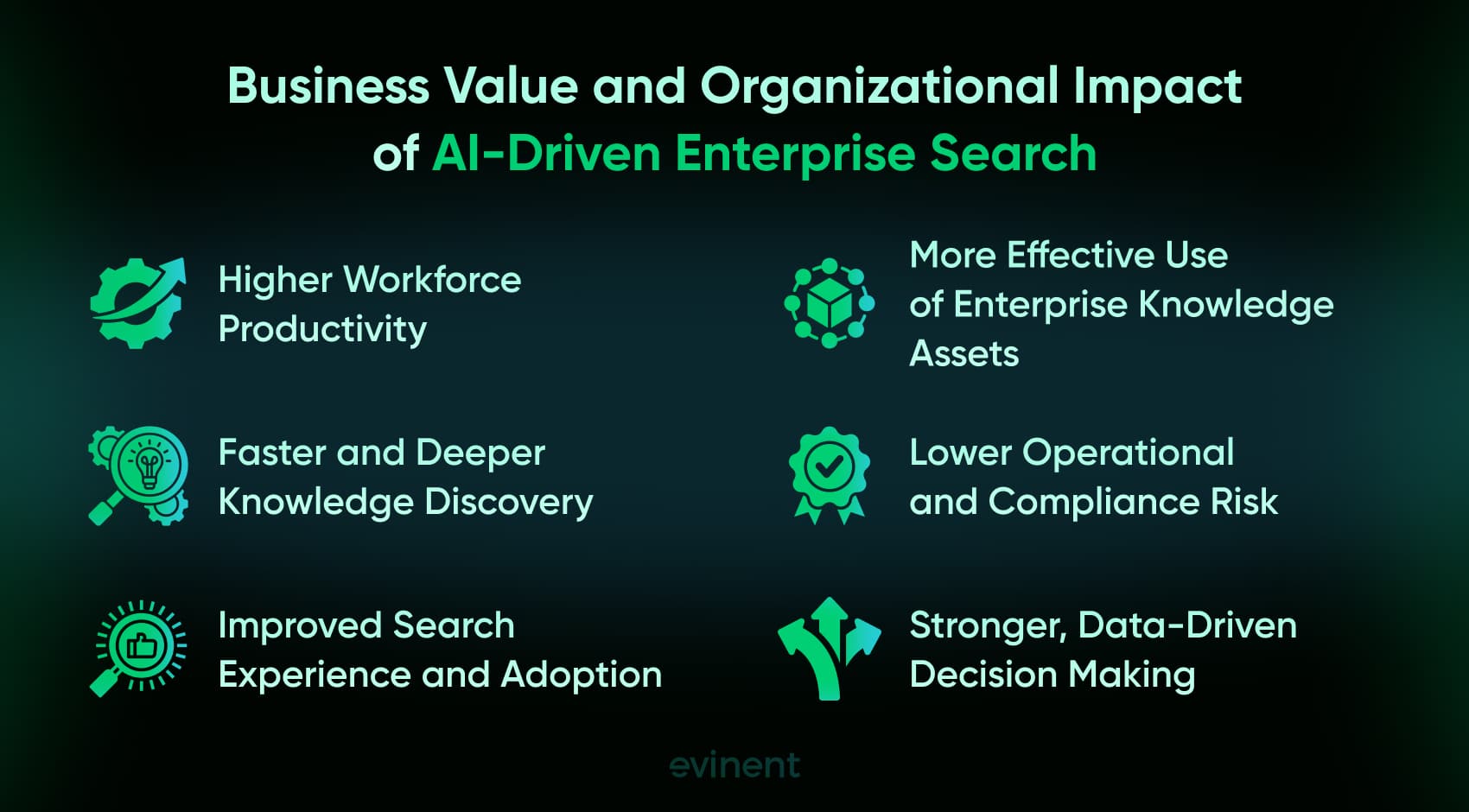
Improved organizational productivity
AI enterprise search reduces the time employees spend searching for information across disconnected systems and repositories. Personalization, intelligent recommendations, and adaptive query rules ensure that users receive relevant results aligned with their roles and context. This significantly shortens time-to-knowledge and allows employees to focus on higher-value tasks instead of manual information retrieval.
Accelerated knowledge discovery
Semantic and vector searches allow quickly finding of the most pertinent information and significant connections between documents and data sources. This facilitates discovering hidden knowledge, reusing previous work, and linking insights across different organizational departments, even if the content is unstructured or poorly organized.
Enhanced user experience
The ability to make natural language queries, contextual understanding, and faceted browsing all greatly enhance the search experience and make it more intuitive and accessible. People are more likely to adopt these systems if they can interact with enterprises in such a manner as to reflect their own thought and work processes, thus resulting in more trust towards the search results, i.e., higher adoption rates and greater trust in search results.
Better utilization of enterprise knowledge
AI-powered enterprise search enhances the accessibility and reusability of corporate knowledge assets across teams and departments. When existing information is made easier to find and use, companies waste less time on redundant work and get more value from their knowledge repositories.
Reduced operational and compliance risks
Enterprise search systems enforce role-based access control, document-level security, and governance policies across all indexed content. This ensures that sensitive information is only accessible to authorized users and helps organizations meet internal security standards and regulatory requirements without limiting knowledge accessibility.
Improved decision-making quality
AI enterprise search contributes to better and faster decision-making at all levels of operation and strategy through granting quick access to accurate, relevant, and context-aware information. A decision-maker can trust there will always be a reliable and consistent knowledge source instead of having to rely on fragmented or outdated information.
AI enterprise search generates a quantifiable business value through improving employee productivity, speeding up knowledge discovery, and minimizing operational risk. If done right, it revolutionizes enterprise search from a mere utility to a fundamental capability that facilitates better decision-making, more robust governance, and more effective use of organizational knowledge.
Core Features and Capabilities of AI Search Platforms
Modern AI enterprise search platforms provide technical capabilities that enable high accuracy, scalability, and intelligent processing of corporate data across complex enterprise environments. These capabilities allow organizations to efficiently find, understand, and act on information stored across multiple repositories.
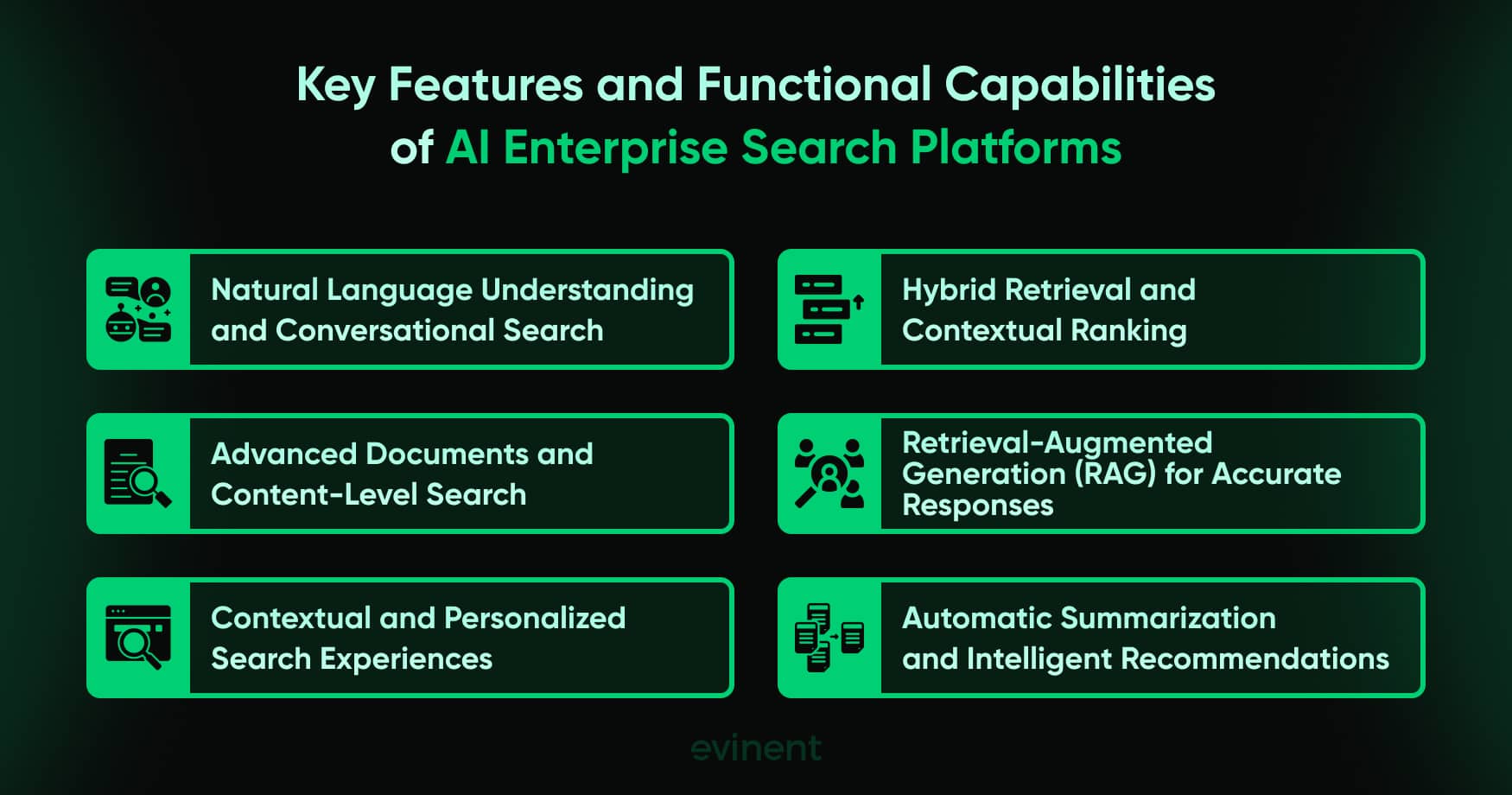
Natural Language and Conversational Search
AI search platforms understand natural-language user queries rather than relying solely on keywords. Natural language understanding interprets intent, context, and meaning, which improves relevance. Conversational search maintains context across multiple interactions, allowing users to refine questions, ask follow-ups, and explore content naturally. This results in a more intuitive and productive search experience.
Hybrid Retrieval and Ranking
Modern AI search platforms combine multiple retrieval methods to balance precision and recall. Keyword search provides exact matching, vector search captures semantic similarity, and hybrid search integrates both approaches. Reranking mechanisms refine results further based on context, intent, and user behavior, ensuring higher-quality results across structured and unstructured data.
Retrieval Augmented Generation (RAG)
RAG facilitates AI in producing answers based on enterprise data, not just on the model's training data. The system fetches relevant documents from the internal repositories, which are then used to supplement the AI-generated responses. In this way, factual accuracy is ensured, answers remain context-relevant, and internal data policies are complied with.
Advanced Document and Content Search
Platforms offer deep search capabilities at the document, paragraph, and metadata levels. Doc-level security guarantees that confidential material is only made available to authorized users. Features such as advanced filtering, faceted browsing, and semantic ranking give users the power to locate particular information quickly.
Context-Aware and Personalized Search
Search platforms personalize results based on the user's context, previous activity, and preferences. Personalization is a way to prioritize the most relevant content for each user that leads to higher adoption, engagement, and ultimately knowledge utilization throughout the organization.
Summarization and Recommendations
AI platforms have the capability of summarizing very long documents automatically and suggesting additional related content. Knowledge discovery is sped up, and staff are able to gain actionable insights fast, even if they do not read the whole document.
Modern AI enterprise search platforms offer a robust set of capabilities that transform information retrieval into a strategic enterprise asset. By combining natural language understanding, hybrid search, RAG workflows, and personalized, context-aware experiences, these platforms improve productivity, knowledge discovery, and decision-making while maintaining security and governance standards.
Enterprise AI Search: Integration and Deployment Strategies
Flexible integration and deployment options help organizations to adopt enterprise AI search in a manner that is consistent with their existing IT infrastructure, security requirements, and operational goals. These approaches guarantee that the company's data is thoroughly indexed, can be searched, and is accessible securely.
Content Source Integration
AI search platforms can connect to a wide variety of enterprise content sources, including content management systems (e.g., SharePoint, Confluence), databases (e.g., Oracle, SQL Server), intranet portals, and document repositories. This integration ensures that all relevant corporate knowledge—structured or unstructured—is available for search, while access controls and permissions are strictly enforced.
Data Ingestion Points and Pipelines
Configurable ingestion workflows enable enterprises to extract, transform, and load content from various digital repositories and intranet sites. These pipelines standardize data formats, enhance metadata, and get content ready for indexing, thereby providing accurate and context-aware search results over heterogeneous datasets.
Deployment Architectures
AI enterprise search can be deployed across diverse environments: on-premises for maximum data control, cloud-based for scalability and reduced infrastructure management, or fully managed serverless solutions for elastic performance. Hybrid deployments are also possible, enabling sensitive data to remain on-premises while leveraging cloud resources for compute-intensive AI tasks.
Stateless and Scalable Design
Stateless architecture is the key to elastic scaling, fault tolerance, and efficient resource usage, and that is why most modern platforms are built on it. By removing the application state from the server, the stateless design makes it easier to maintain and scale the system horizontally. Besides, it can handle a large number of queries without affecting its performance or availability.

Security, Compliance, and Governance Integration
Deployment models incorporate enterprise-grade security features, including role-based access control, document-level permissions, encryption in transit and at rest, and adherence to regulatory compliance frameworks. Integration with identity providers and governance policies ensures that sensitive information is accessed only by authorized users, maintaining trust and minimizing operational risk.
Thoughtfully planned integration and deployment strategies are instrumental in enabling AI enterprise search to reach its full potential. When well-managed content integration, scalable ingestion pipelines, adaptable deployment architectures, and stringent security and compliance measures are combined, organizations can build a single, secure, and highly efficient knowledge access layer that catalyzes employee productivity, data-driven decision-making, and the organization's overall intelligence.
Security, Privacy, and Compliance in Private AI Enterprise Search
A private AI enterprise search is centered on the firm's security, privacy, and compliance principles to ensure that sensitive corporate data, depending on these principles, stays protected. At the same time, it is still accessible to authorized users. The following table outlines the main aspects and how they are handled in a private AI search system.
Area | Description | Practical Implementation |
Data Isolation and Ownership | Enterprise data must remain fully isolated within the organization’s trust boundary. No data should be shared with or reused by external or public AI models. | Dedicated environments (on-premises or private cloud), isolated storage, and controlled AI inference pipelines ensure data ownership is preserved. |
Access Control and Authorization | Search results must respect existing access rights and security policies at all times. Users can only see what they are authorized to access. | Role-based access control (RBAC), document-level permissions, and integration with enterprise identity providers (SSO, IAM). |
Privacy by Design | Privacy requirements are embedded into the system architecture from the outset rather than added later. | Minimization of data exposure, restricted indexing scopes, anonymization or masking where required, and controlled logging of queries. |
Encryption and Secure Data Handling | Data must be protected both during storage and transmission. | Encryption at rest and in transit, secure key management, and hardened network configurations. |
Auditability and Traceability | Organizations must be able to trace how data is accessed and how AI-generated results are produced. | Audit logs, query tracking, access history, and explainability mechanisms for AI-assisted responses. |
Regulatory Compliance | Enterprise search must align with legal and regulatory frameworks applicable to the organization and its industry. | Support for GDPR, ISO 27001, SOC 2, and industry-specific regulations through policy enforcement and compliance controls. |
Governance of Generative AI | AI-generated answers must be trustworthy, explainable, and aligned with internal governance rules. | Retrieval-Augmented Generation (RAG), source attribution, content grounding, and governance policies for AI outputs. |
Security, privacy, and compliance are not add-on features in Private AI Enterprise Search; they are the core. Through a mix of data isolation, tight access controls, privacy-by-design, robust encryption, auditability, and regulated generative AI workflows, businesses can both safely tap the treasure of their internal knowledge and meet their regulatory requirements as well as retain the trust of the whole enterprise.
Operational and Technical Considerations for Implementing Enterprise AI Search
Implementing AI enterprise search successfully is basically about carefully paying attention to the technical, organizational, and operational factors throughout the lifecycle of the solution. Considerations like these lead to a sustainable search quality, user trust, and finally, business value over time.
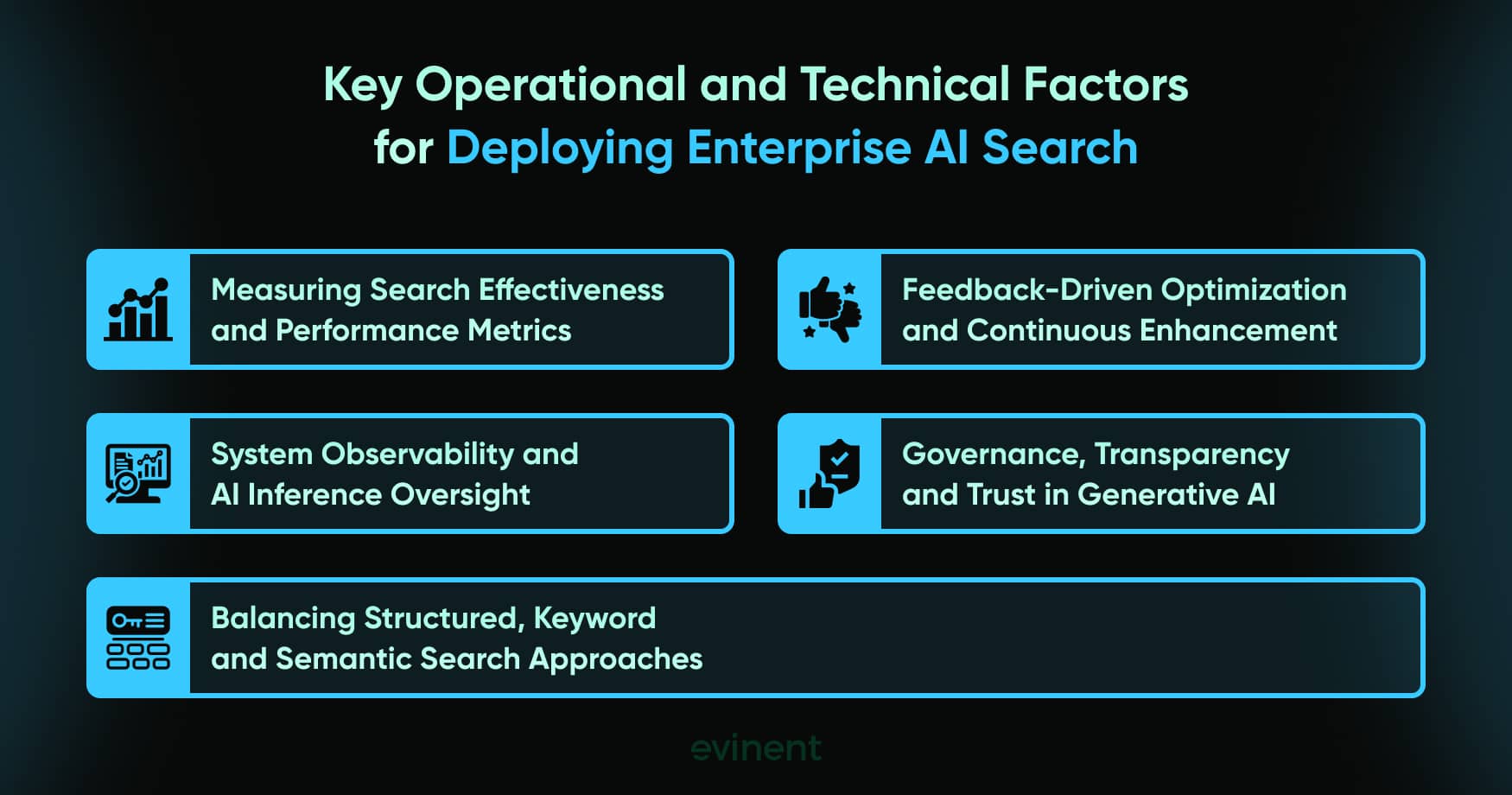
Search Quality Measurement and Analytics
Continuous evaluation of search effectiveness is essential. Organizations should define and track relevance metrics, query success rates, click-through behavior, and time-to-answer indicators. Analytics provide visibility into how users interact with search and help identify gaps in content coverage or ranking logic.
User Feedback and Continuous Improvement
Feedback loops are the key to continuous development of the quality of the search. By collecting user input, search ratings, and the submission of issues, the identification of lack of accuracy, content that is missing, or queries that are unclear can be facilitated. This kind of feedback serves as a basis for the repeated enhancement of the ranking algorithms, the addition of metadata, and the methods of content acquisition.
Observability and AI Inference Monitoring
Enterprise AI search systems necessitate having a complete overview of the indexing, retrieval, and inference workflows. By tracking model performance, latency, throughput, and error rates, the operations can be kept stable, and the users' experience can be predictable. Besides, inference monitoring allows identifying model drift and degradation over time.
Structured vs. Vector Search Trade-offs
Effective enterprise search balances traditional structured and keyword-based search with semantic and vector-based approaches. Structured search provides precision and control, while vector search improves recall and contextual relevance. A hybrid strategy allows organizations to optimize relevance across both well-structured and unstructured data sources.
Governance and Trust in Generative AI
Generative AI introduces new governance requirements related to transparency, explainability, and control. Enterprises must ensure that AI-generated responses are grounded in verified internal data, include source attribution, and follow defined usage policies. Strong governance frameworks are essential to maintain user trust and prevent misuse.
To deploy enterprise AI search at scale, it is fundamental to focus on operational and technical issues. In order to create a dependable, trustworthy, and constantly enhancing search function that generates a positive business impact over time, organizations have to go through quality measurement, use feedback for improvement, have strong observability, apply balanced retrieval strategies, and implement rigorous generative AI governance.
Use Cases and Real-World Application Scenarios
The real-world, authoritative use cases of AI-powered enterprise search that you see here come from independent industry analysis and enterprise IT sources rather than from vendor marketing or competitors' blogs. Citations are provided to allow you to verify the statements.
Verified Real-World Use Cases for AI Enterprise Search
Internal Knowledge Retrieval and Productivity Gains
Many companies turn to AI search to provide their employees with quick access to internal knowledge, e.g., policy documents, project artifacts, and SOPs. This helps them spend less time searching and thus be more productive. Independent analyses have identified productivity improvement and faster access to relevant internal information as the main uses of the tool. (techtarget)
Customer Support and Issue Resolution
By using AI enterprise search, sectors such as banking and telecommunications can uncover relevant customer histories, troubleshooting documents, and support knowledge. This can be one of the ways to help reduce the time to resolution and increase customer satisfaction, especially if natural language understanding is able to interpret queries more accurately than keyword search. (techtarget)
Compliance, Audit, and Risk Management
In regulated industries (e.g., finance, healthcare), search systems help compliance teams find relevant regulatory documents, audit trails, and risk policies quickly. This reduces compliance cycle times and improves visibility over internal controls. (linkedin)
Data Discovery and Business Insight
Companies have AI search engines at their disposal, which they employ to combine unstructured and structured data for analysis. This allows analysts and decision-makers to discover trends, patterns, and insights hidden in data silos. This, in turn, supports the activities of strategic decision-making and business intelligence.
HR and Talent Management
Enterprise search can index HR systems, skills databases, and resumes to help recruiters and internal mobility teams find qualified candidates more effectively. This real use case is recorded in definitions and analyst descriptions of enterprise search benefits.
Self-Service Support Culture
Instead of employees constantly having to depend on support tickets, organizations shift their focus by empowering employees to answer their own questions through AI search with support from internal knowledge bases. As a result, helpdesks are freed to work on complex issues, while employees handle routine queries on their own.
Enhanced Security and Controlled Access
Enterprise search frameworks that enforce role-based access control ensure that sensitive data (e.g., HR records, financial documents) is only exposed to users with appropriate permissions. This is critical in corporate governance and reduces the risk of unauthorized access.
Examples of real-life cases that are reported by free and trustworthy sources show that AI-driven enterprise search is not an experimental technology anymore but a proven, mission-critical capability across various industries. Companies use it to fix real issues: cutting down time lost when searching for information, enhancing support quality, tightening compliance processes, facilitating data-driven decisions, and granting secure knowledge access at scale.
The thing that unites these AI adoption scenarios is not the AI technology itself, but the business results it helps to achieve: increased productivity, better quality of decisions, lowering of operational risks, and more efficient use of already existing knowledge resources. If AI enterprise search is set up within a closed, safe, and well-managed framework, it can become the essential layer of the foundation that a modern digital enterprise is built on, which supports daily business activities as well as the achievement of strategic objectives.
How Evinent Enables Private AI Enterprise Search
Evinent offers the architectural and technological basis for constructing Private AI Enterprise Search that marries strong security guarantees, intelligent retrieval, and real-world operational readiness. Evinent's work is based on hands-on experience with enterprise data, search relevance, and AI-driven decision support.
1. Private and Secure AI Search Architecture
Evinent designs search solutions that operate fully within the enterprise trust boundary. All indexed data, embeddings, and AI inference workflows remain isolated in controlled environments—on-premises, private cloud, or approved enterprise infrastructure. Access control, data ownership, and governance rules are enforced end-to-end, ensuring that sensitive corporate information is never exposed to external or public AI models.
2. Enterprise-Grade Integration Capabilities
Evinent search solutions harmonize with existing enterprise systems and repositories, such as document management systems, intranet portals, databases, and vertical-specific platforms. This enables enterprises to meld disjointed knowledge sources without altering their operational or security procedures, hence forming a unified, consistent knowledge access layer throughout the enterprise.
3. Advanced AI Search and RAG Workflows
Evinent implements modern AI search techniques, including semantic search, vector-based retrieval, and Retrieval-Augmented Generation (RAG). These workflows ensure that AI-generated responses are grounded in verified internal content rather than generic model knowledge. As a result, users receive accurate, context-aware answers with clear traceability to enterprise data sources.
4. Operational Readiness and Observability
Evinent puts production readiness front and center. The search platforms come with monitoring, analytics, and observability tools that record query performance, relevance quality, system latency, and AI inference behavior. This makes it possible to regularly optimize, scale predictably, and operate reliably in mission-critical enterprise environments.
5. Evinent Search for E-Commerce: A Proven AI Search Capability
In addition to enterprise knowledge search, Evinent Search demonstrates Evinent’s applied expertise through a production-ready AI search solution for e-commerce platforms. Unlike generic search plugins, Evinent Search is purpose-built around e-commerce data, product discovery, and customer behavior analytics, with a direct focus on measurable revenue impact.
Evinent Search can identify customers' language by recognizing patterns of synonyms, related terms, slang, abbreviations, typos, and natural language queries. Its relevance engine guarantees that users get the right products even when their queries are incomplete, imprecise, or ambiguous.
Key capabilities include:
Lightning-fast integration via API with no internal engineering effort required
AI-driven personalization and self-learning ranking algorithms
Continuous adaptation to customer behavior, seasonal trends, and demand shifts
Advanced autocomplete with filters and preview
Faceted search, typo tolerance, morphology, and multilingual support
Voice search for mobile users
Custom search UI and promotion tools
Deep analytics covering top queries, zero-result searches, CTR, and demand trends
These capabilities help shoppers find relevant products faster, reduce friction, and directly improve conversion rates—demonstrating how Evinent’s search technology performs in high-load, revenue-critical environments.
Evinent enables Private AI Enterprise Search by combining secure-by-design architecture, deep enterprise integration, advanced AI retrieval, and operational maturity. Its enterprise search approach is reinforced by proven real-world implementations such as Evinent Search for e-commerce, where intelligent search directly drives business outcomes. Together, these capabilities position Evinent as a practical and reliable partner for organizations seeking secure, intelligent, and value-driven AI search solutions.
Share