

What is CDP personalization, and why are so many companies investing in it now?
This question sits at the top of Google searches for a reason. Over the past few years, personalization has shifted from a “nice-to-have” marketing tactic to a core business capability that directly impacts revenue, retention, and customer trust. At the same time, the rules of the game have changed. Third-party cookies are disappearing. Privacy regulations are tightening. Customers expect brands to recognize them instantly, across channels, without crossing ethical or legal lines.
That combination of pressure and opportunity is exactly where Customer Data Platforms (CDPs) come in.
CDP personalization is not about sending better emails or showing a few product recommendations. It’s about turning fragmented customer data into real-time, decision-ready intelligence that every system, like marketing, eCommerce, sales, support, can act on consistently. When done right, a CDP becomes the backbone of how a company understands intent, predicts behavior, and delivers relevant experiences at scale.
For C-level leaders, this is no longer a technical discussion. CDP personalization affects how fast your organization can respond to customers, how efficiently it uses data, and how resilient it is to regulatory and platform shifts. Companies that treat it as a strategic capability gain a measurable edge. Those that don’t often find themselves stuck with expensive tools, siloed data, and personalization that looks impressive on slides but delivers little business impact.
This article breaks down what CDP personalization really means in 2026, how it works under the hood, where most initiatives fail, and how executives can approach it as a long-term growth lever rather than another marketing experiment.
What Is CDP Personalization
At its core, CDP personalization is the ability to use a unified, continuously updated customer profile to make real-time, context-aware decisions about what experience each individual should receive across every digital and physical touchpoint.
That definition matters because much of the confusion around CDPs comes from what they are mistaken for.
CDP personalization is not email personalization
Adding a first name to a subject line or sending a campaign to a predefined segment does not qualify as CDP-driven personalization. Those tactics rely on static data snapshots and ed execution. A CDP operates on live behavioral signals, not yesterday’s exports.
CDP personalization is not CRM segmentation
CRMs are designed to manage known contacts and sales processes. They are excellent systems of record, but poor systems of decision-making. CDPs, by contrast, are built to ingest high-volume behavioral data, resolve identities across devices and channels, and activate insights instantly.
CDP personalization is not analytics
Analytics platforms tell you what happened. A CDP tells your systems what to do next. The difference is actionability. Without activation, insights stay locked in dashboards and never reach the customer.
What CDP personalization actually enables
When implemented correctly, a CDP allows organizations to:
Recognize a customer or visitor in real time
Understand intent based on current and historical behavior
Decide the next best action within milliseconds
Deliver that action consistently across web, app, email, messaging, paid media, or assisted sales
This shift from reporting to decisioning is why CDP personalization has become strategically important at the executive level.
Why the definition evolved after 2022
Earlier generations of personalization depended heavily on third-party cookies, isolated tools, and rule-based logic. That model no longer holds. Privacy regulation, browser changes, and rising customer expectations forced a transition toward first-party, consented, and explainable personalization. CDPs emerged as the only category purpose-built for that reality.
In practical terms, CDP personalization means that every customer interaction is informed by the same source of truth, updated continuously, and governed centrally. Marketing, eCommerce, customer support, and sales no longer operate on different versions of the customer; they act on one.
For executives, this distinction is critical. A CDP is not a channel tool and not a campaign engine. It is infrastructure. And personalization is the most visible and measurable business outcome that infrastructure enables.

Why CDP Personalization Became a Board-Level Priority
The rapid rise of Customer Data Platforms is not driven by hype; it is driven by measurable business impact. Over the past few years, CDPs have moved from experimental martech investments to core revenue infrastructure, and the data behind that shift is hard to ignore.
The global CDP market is projected to reach $23.66 billion, growing at a 33.9% CAGR, making it one of the fastest-growing segments in enterprise software. That growth is not fueled by tooling curiosity, but by organizations looking for a reliable way to monetize first-party data in a post-cookie environment while staying compliant with privacy regulation. (Source: The Business Research Company, Customer Data Platforms Global Market Report 2025)
What makes CDP personalization particularly compelling for executives is not adoption volume, but return on investment.
Adoption Is High — Execution Is the Real Challenge
Today, approximately 72% of businesses use CDPs specifically for personalization, ing that personalization is the dominant use case, not an edge scenario. At the same time, adoption alone does not guarantee success:
63% of marketing leaders report difficulties executing CDP-driven personalization at scale
59% use CDPs for campaign-level personalization
56% rely on CDPs for audience segmentation
65% of CDP use cases are concentrated in front-office functions such as real-time personalization, eCommerce optimization, and customer engagement
This gap between adoption and execution explains why CDP discussions increasingly involve CIOs, CDOs, and CEOs, not just marketing teams. The challenge is no longer whether to use a CDP, but how to operationalize it across systems, teams, and decision flows.
ROI and Revenue Impact: What the Numbers Actually Show
When CDPs are implemented with clear business objectives and proper data integration, the financial impact is substantial.
Across industries, CDPs deliver average ROIs of around 300%, with some organizations significantly exceeding that benchmark. One frequently cited retail example is CZC.cz, which reported a 762% ROI over three years after deploying CDP-driven loyalty and personalization programs. While individual results vary, the underlying pattern remains consistent: unified customer data enables faster, more precise decisions, and those decisions compound financially.
Independent research reinforces this trend. McKinsey has found that fast-growing companies generate up to 40% more revenue from personalization than their slower-growing peers. Importantly, this uplift is not limited to marketing performance; it extends to customer lifetime value, retention, and operational efficiency.
From a financial perspective, CDP personalization contributes to growth in several ways:
Higher conversion rates through real-time targeting and behavioral relevance
Increased average order value driven by intelligent upsell and cross-sell recommendations
Lower customer acquisition costs through precise audience targeting and paid media suppression
Shorter sales cycles enabled by better intent recognition
Improved retention and reduced churn through consistent, personalized journeys
Retail and eCommerce companies tend to see the fastest visible impact, but similar patterns appear in financial services, healthcare, travel, and subscription-based businesses — anywhere customer relationships extend beyond a single transaction.
The Metrics Executives Actually Care About
From a C-level perspective, CDP personalization is only valuable if it moves core business metrics. The most commonly affected KPIs include:
Metric | Impact from CDP Personalization |
Conversion Rates | Increase through dynamic segmentation and real-time targeting |
Customer Lifetime Value (CLV) | Growth via tailored journeys, loyalty logic, and predictive engagement |
Ad Spend Efficiency | Lower CPA through audience suppression and relevance-based targeting |
Retention | Improvement driven by 360° customer profiles and predictive analytics |
What matters here is not isolated uplifts, but compounding effects. A modest increase in conversion rate combined with higher CLV and lower acquisition costs can materially change a company’s growth trajectory within 12–18 months.
Why the Value Is Strategic, Not Tactical
CDP personalization creates value because it changes how decisions are made, not just which messages are sent. It replaces fragmented, channel-specific logic with a centralized decision layer informed by real-time data. That shift explains why consulting firms such as Boston Consulting Group increasingly frame CDPs as enablers of enterprise-wide personalization, rather than marketing tools.
For executives, the takeaway is clear: CDP personalization is no longer about optimizing campaigns. It is about building an operating model where customer intelligence flows continuously into revenue-driving decisions.
How CDP Personalization Works Under the Hood
To understand why CDP personalization delivers such an outsized impact and why so many implementations fall short, it helps to look at how a CDP actually operates at a system level. From the outside, personalization may look like recommendations or targeted messages. Under the hood, it is a tightly coordinated sequence of data, identity, and decisioning processes that must run continuously and in real time.
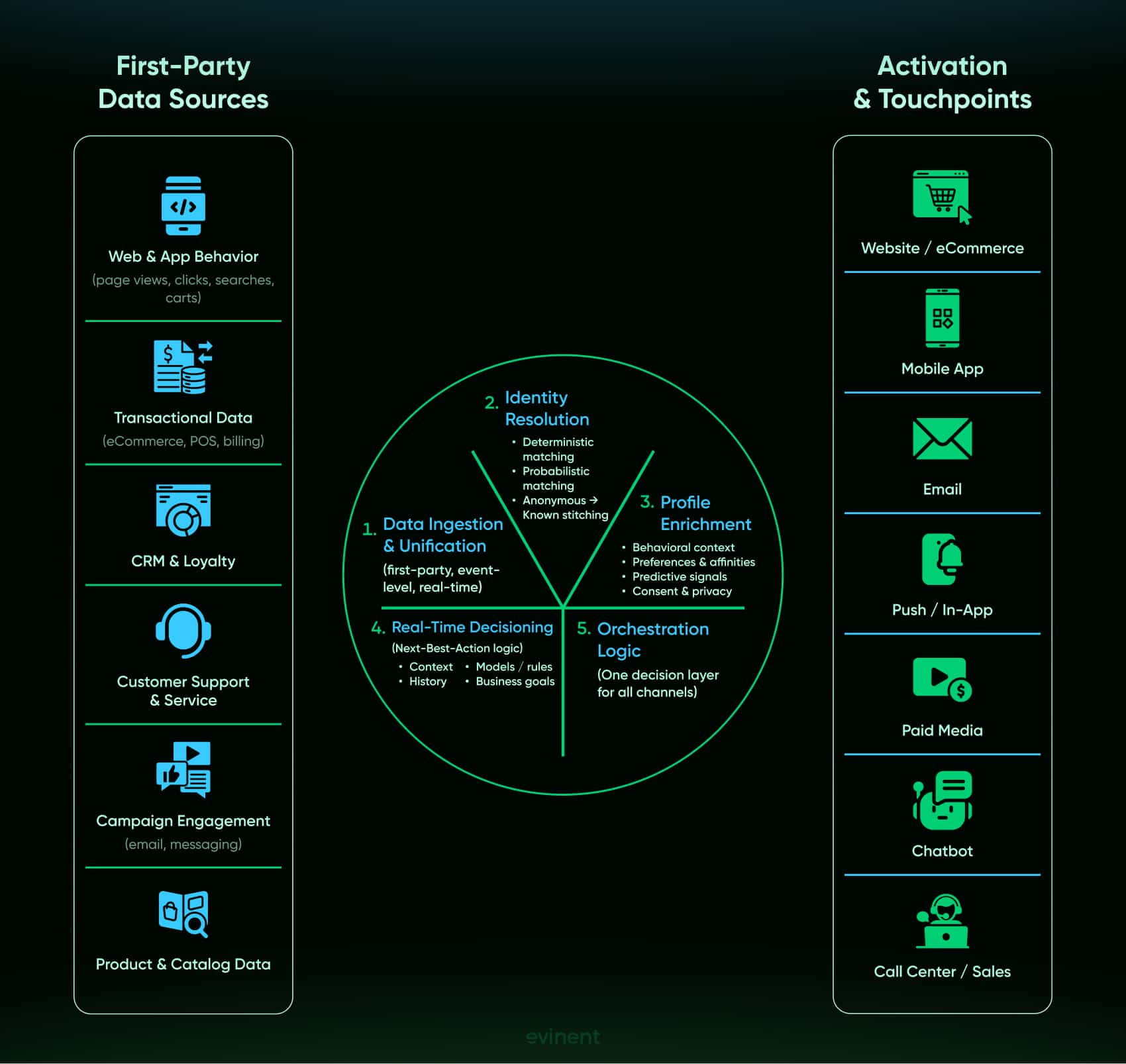
This is where CDPs fundamentally differ from traditional marketing or analytics tools.
1. Data Ingestion: Building a First-Party Data Foundation
CDP personalization starts with first-party data ingestion. Unlike platforms that rely on third-party cookies or pre-aggregated datasets, CDPs are designed to collect raw, event-level data directly from enterprise systems.
Typical data sources include:
Website and mobile app behavior (page views, clicks, searches, cart actions)
Transactional data from eCommerce, POS, or billing systems
CRM and loyalty program data
Customer support and service interactions
Email, messaging, and campaign engagement
Product and catalog metadata
In some cases, offline or assisted sales interactions
What matters is not the volume of data, but its freshness and granularity. CDP personalization depends on understanding what a customer is doing right now, not just who they were last quarter.
This is also where architectural decisions matter. Enterprises with fragmented legacy systems often struggle here, not because CDPs cannot ingest the data, but because the underlying systems were never designed to expose it cleanly or in real time.
2. Identity Resolution: Turning Events into People
Raw data alone does not enable personalization. CDPs must resolve events, devices, and identifiers into a single, unified customer profile.
This process — known as identity resolution — typically combines:
Deterministic matching (email, customer ID, loyalty number)
Probabilistic matching (device, behavior, context patterns)
Anonymous-to-known user stitching once authentication occurs
The outcome is not a static profile, but a living identity graph that updates continuously as new data arrives.
This step is critical for personalization accuracy. Without reliable identity resolution, organizations risk fragmented experiences where a customer is treated as “new” on one channel and “returning” on another. From an executive standpoint, this directly impacts trust, conversion, and perceived brand competence.
3. Profile Enrichment: Context, Not Just Attributes
Once identities are resolved, CDPs enrich profiles with contextual and behavioral intelligence. This goes far beyond demographic fields.
A well-designed CDP profile may include:
Behavioral frequency and recency indicators
Product affinities and category preferences
Predicted intent or propensity scores
Lifecycle stage and churn risk
Channel responsiveness patterns
Consent and privacy preferences
This enrichment layer is what enables personalization to move from “segment-based” to individual-level decisioning. Instead of asking “Which segment is this user in?”, the system evaluates “What is the most relevant action for this person, in this moment?”
4. Real-Time Decisioning: Where Personalization Actually Happens
This is the most misunderstood and most valuable part of CDP personalization.
Modern CDPs function as decision engines, not just data repositories. When a customer interacts with a touchpoint, the CDP evaluates:
Who this person is (identity)
What they have done before (history)
What they are doing now (context)
What similar customers tend to do next (models or rules)
What the business wants to optimize (conversion, retention, margin)
The result is a next-best-action decision, generated in milliseconds and delivered to the activation layer.
According to Gartner, real-time decisioning is now a defining capability of enterprise CDPs, distinguishing them from batch-based personalization systems that cannot respond to live intent.
5. Omnichannel Activation: Consistency at Scale
A CDP’s value only materializes when decisions are activated consistently across channels.
This may include:
Personalized on-site content or search results
Product recommendations in eCommerce flows
Triggered emails or messages
Push notifications or in-app experiences
Audience updates for paid media
Context-aware guidance for sales or support teams
The key is that all channels draw from the same decision logic and customer profile. This eliminates the common enterprise problem of conflicting messages, duplicated offers, or disconnected journeys.
From a leadership perspective, this consistency is not just a UX improvement, but a governance win. It allows organizations to centralize rules, privacy controls, and optimization goals while still executing at scale.
Why Architecture Determines Outcomes
At every step — ingestion, identity, enrichment, decisioning, activation — the effectiveness of CDP personalization depends on data architecture and integration quality. This explains why two companies using the same CDP vendor can see dramatically different results.
As Forrester notes, most CDP failures are not caused by the platform itself, but by fragmented data pipelines, legacy constraints, and unclear ownership of personalization logic.
Understanding how CDP personalization works under the hood clarifies an important reality: success is less about tools and more about how well an organization aligns data, technology, and decision-making.
Why Waiting Became a Strategic Risk After 2022
Until recently, many organizations treated personalization as an incremental optimization, something to improve once core systems were “good enough.” That mindset no longer holds. Since 2022, a series of structural shifts has turned CDP personalization from an opportunity into a competitive requirement.
What changed is not a single technology, but the environment in which customer data operates.
The Collapse of Third-Party Data as a Growth Strategy
For more than a decade, personalization at scale depended heavily on third-party cookies and external data brokers. That model is now reaching its end.
Browser changes led by Google and others have accelerated the deprecation of third-party cookies, while mobile platforms and privacy-first browsers have dramatically reduced cross-site tracking. As a result, many organizations are discovering that their targeting, attribution, and personalization models no longer work as expected.
The practical implication for executives is simple: Growth can no longer rely on rented data. First-party data is now the only sustainable foundation for personalization, and CDPs are the systems designed to operationalize it.
Regulation Turned Data Into a Board-Level Responsibility
Privacy regulation did more than add compliance overhead. It fundamentally changed who owns customer data strategy inside the enterprise.
Frameworks such as GDPR, CCPA, and the EU Digital Markets Act introduced strict requirements around consent, data usage transparency, and customer rights. Non-compliance now carries real financial and reputational consequences. But beyond penalties, regulation exposed a deeper issue: most organizations lacked a clear, centralized view of their customer data flows.
This is why CDP personalization increasingly appears in discussions involving legal, IT, and executive leadership, not just marketing. A CDP provides a governed data layer where consent, identity, and activation logic can be managed centrally rather than enforced retroactively across dozens of disconnected tools.
Customer Expectations Reset, Permanently
At the same time, customer expectations have moved in the opposite direction. Users now expect experiences that are:
Immediately relevant
Consistent across channels
Context-aware, not repetitive
Respectful of privacy without feeling generic
Research from Salesforce shows that a majority of customers expect brands to recognize them across interactions, yet are quick to disengage when personalization feels intrusive or disconnected.
This creates a narrow path forward: companies must personalize more intelligently, not more aggressively. CDP-driven personalization enables this balance by grounding decisions in first-party data and real-time context rather than opaque tracking.
The Cost of Inaction Is No Longer Neutral
Before 2022, ing personalization often meant slower growth. Today, it means falling structurally behind.
Organizations without a CDP-centered approach increasingly face:
Rising acquisition costs due to inefficient targeting
Declining conversion rates as relevance drops
Fragmented customer experiences across channels
Increased operational cost from manual segmentation and campaign logic
Higher compliance risk due to scattered data ownership
Meanwhile, competitors that invest in CDP personalization build compounding advantages. Their models improve over time. Their data becomes cleaner. Their decision cycles shorten. And their ability to respond to market shifts increases.
This is why consulting firms such as Accenture frame personalization maturity as a proxy for digital resilience and not only marketing sophistication.
Why Timing Matters More Than Ever
The strategic risk is not that CDP personalization is complex. The risk is that it takes time to do right.
Building clean data pipelines, resolving identities, aligning teams, and embedding real-time decisioning into operations cannot be rushed. Organizations that wait until performance declines or regulations force change often find themselves implementing under pressure, with higher costs and weaker outcomes.
In contrast, companies that treat CDP personalization as a long-term capability, rather than a short-term initiative, gain flexibility. They can start with focused use cases, prove value, and expand methodically.
Understanding why CDP personalization became urgent sets the stage for the next question executives inevitably ask: What separates successful CDP initiatives from those that stall or fail?
That distinction lies not in the software, but in execution, and that’s where most organizations struggle.
Why Most CDP Personalization Initiatives Fail (and What Successful Companies Do Differently)
By now, the value of CDP personalization is well established. Yet despite high adoption rates and strong ROI potential, a large share of initiatives fail to deliver meaningful business impact. The reason is not a lack of technology. It is a mismatch between strategic intent and operational reality.
Understanding these failure patterns is critical for executives because most of them are predictable and avoidable.
Mistake #1: Treating the CDP as a Marketing Tool
One of the most common failure modes is positioning the CDP as “advanced marketing software.”
When CDPs are owned solely by marketing teams, several problems quickly emerge:
Personalization logic becomes campaign-centric instead of customer-centric
Data integration priorities skew toward channels, not systems of record
Long-term data quality and governance are deprioritized
IT and data teams are brought in too late or not at all
This leads to superficial wins (better emails, nicer dashboards) but no structural advantage.
Successful organizations frame CDPs as enterprise decision infrastructure, not a martech add-on. Ownership is shared across marketing, IT, data, and compliance, with clear executive sponsorship.
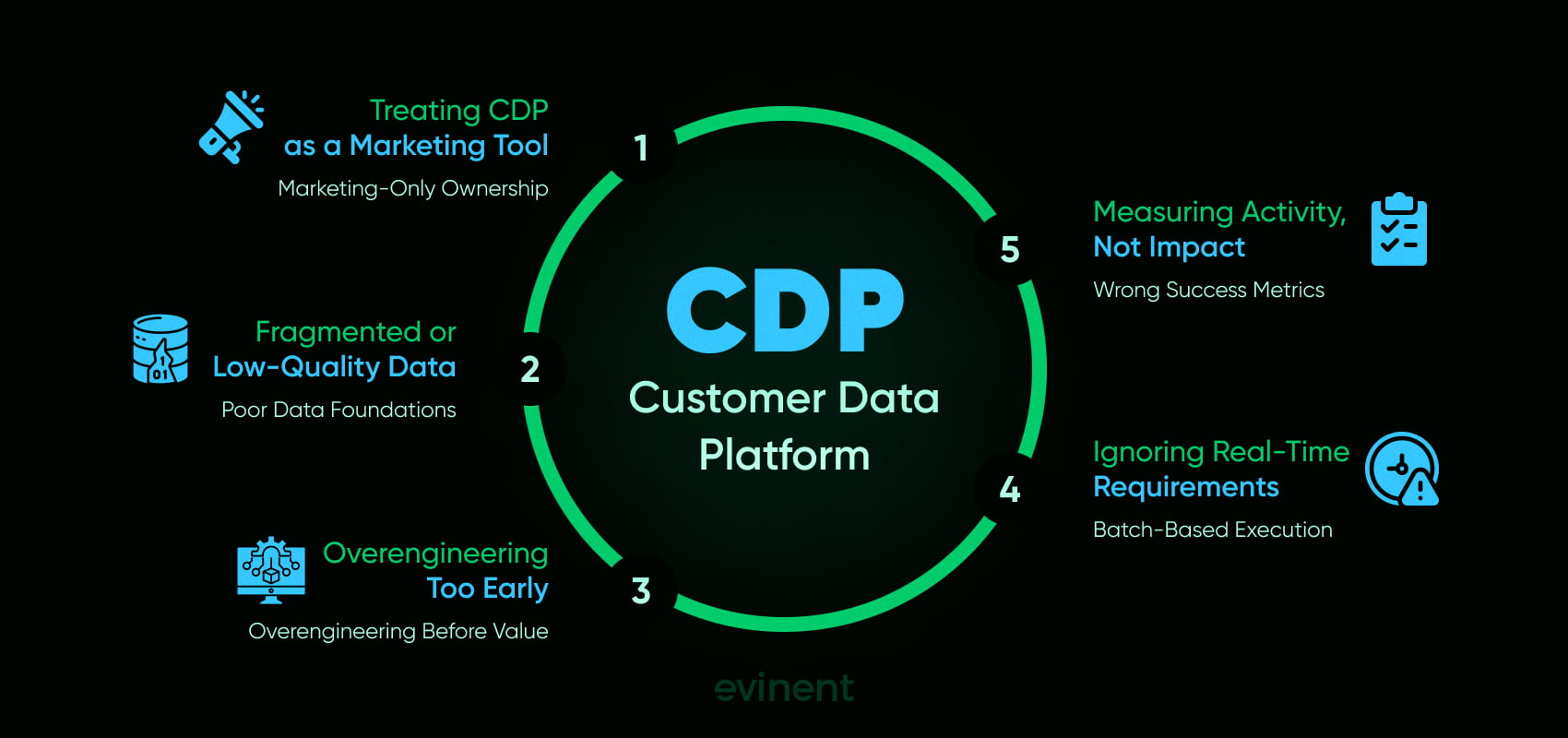
Mistake #2: Building on Fragmented or Low-Quality Data
CDPs do not magically fix poor data foundations.
Many implementations fail because they ingest:
Inconsistent identifiers across systems
ed or batch-based data feeds
Incomplete transactional histories
Unreliable consent signals
As a result, personalization decisions are made on partial or outdated information, undermining relevance and trust.
According to Forrester, data quality and integration issues remain the top blockers of CDP ROI, outweighing platform limitations or skill gaps.
High-performing companies invest early in data normalization, identity hygiene, and real-time pipelines before scaling personalization use cases.
Mistake #3: Overengineering Before Proving Value
Another frequent mistake is attempting to “boil the ocean.”
Organizations launch CDP projects with dozens of use cases, complex rule trees, and advanced AI models, before validating a single revenue-driving flow. This increases cost, s time to value, and erodes stakeholder confidence.
Successful CDP programs start small but strategic:
One or two high-impact personalization scenarios
Clear KPIs tied to revenue, retention, or cost reduction
Rapid testing and iteration
This approach builds internal trust and creates momentum for expansion.
Mistake #4: Ignoring Real-Time Requirements
Personalization loses power when it operates on .
Many organizations claim to do CDP personalization, but still rely on:
Nightly data syncs
Weekly segment refreshes
Static audiences pushed to channels
From a customer’s perspective, this feels irrelevant or repetitive, especially in eCommerce and mobile-first environments.
Modern CDP personalization depends on real-time or near-real-time decisioning. Without it, the system becomes another reporting layer rather than an execution engine.
Mistake #5: Measuring Activity Instead of Business Impact
Finally, many CDP initiatives stall because success is measured in operational outputs:
Number of segments created
Campaigns launched
Profiles enriched
Instead of outcomes:
Incremental revenue
Conversion uplift
CLV growth
Churn reduction
As Boston Consulting Group notes, personalization programs fail most often when KPIs are disconnected from business value.
High-performing organizations define success in financial terms and hold CDP initiatives accountable to those metrics.
What Successful CDP Programs Have in Common
Across industries, successful CDP personalization efforts share a consistent set of characteristics:
Executive sponsorship and cross-functional ownership
Strong data foundations and real-time architecture
Clear prioritization of high-impact use cases
Incremental rollout with measurable ROI
Governance embedded from day one
The takeaway for leadership is straightforward: CDP personalization is not hard because the technology is immature. It is hard because it forces organizations to align data, decisions, and accountability.
A Practical CDP Personalization Roadmap for Executives
Once organizations understand why CDP initiatives fail, the next challenge is knowing how to move forward without repeating the same mistakes. For C-level leaders, the goal is not to design a perfect system on day one, but to build a scalable personalization capability that delivers value early and compounds over time.
The most successful CDP programs follow a phased, outcome-driven roadmap.
Phase 1: Executive Alignment and Use-Case Prioritization
Every effective CDP personalization initiative starts with clarity at the top.
At this stage, executives should align on three questions:
What business outcome are we optimizing for first?
Examples: conversion uplift, retention, reduced acquisition cost, higher CLV.
Which customer moments matter most?
Not all touchpoints deserve personalization. Focus on moments where relevance clearly affects revenue or loyalty.
Who owns personalization decisions across the organization?
Clear ownership prevents CDPs from becoming “marketing-only” tools.
High-performing organizations deliberately limit initial scope. Instead of launching dozens of use cases, they select one or two high-impact personalization scenarios that are easy to measure and hard to dispute.
Typical starting points include:
Abandoned-browse or abandoned-cart recovery
Personalized product recommendations on high-traffic pages
Loyalty or repeat-purchase reactivation
Paid media audience suppression to reduce wasted spend
Phase 2: Data Readiness and Architecture Assessment
Before activating personalization, executives must that the data foundation can support real-time decisions.
This phase focuses on:
Mapping all customer data sources (online, offline, transactional, behavioral)
Evaluating data freshness and latency
Identifying identity gaps and inconsistent identifiers
Assessing consent and privacy signal availability
This is often where legacy systems surface as hidden blockers. Older platforms may store valuable data but lack APIs, event streams, or consistent identifiers. Addressing these constraints early through data normalization or lightweight modernization prevents costly rework later.
Organizations that skip this step often end up “personalizing on partial truth,” which undermines trust and performance.
Phase 3: Identity Resolution and Unified Profiles
With data flowing, the next priority is identity resolution.
Executives should expect the CDP to:
Combine known and anonymous interactions into unified profiles
Support deterministic and probabilistic matching
Update profiles continuously as new signals arrive
This phase directly impacts customer experience consistency. When identity resolution works, customers feel recognized across channels. When it fails, personalization becomes fragmented and sometimes contradictory.
A key leadership decision here is how much identity confidence is required before activating personalization. Successful programs define clear thresholds to balance relevance and risk.
Phase 4: Activation of Real-Time Personalization Use Cases
Only after data and identity foundations are in place should organizations activate personalization logic.
At this stage:
Rules or ML-driven decisions are defined centrally
KPIs are tied directly to business outcomes
Personalization is activated across a limited set of channels
The emphasis is speed-to-learning, not sophistication. Executives should expect early results within weeks, not months, if scope is controlled.
According to McKinsey, companies that deploy personalization in iterative waves outperform those that attempt large, one-time transformations.
Phase 5: Measurement, Governance, and Scaling
Once initial value is proven, CDP personalization can expand.
This phase introduces:
More advanced decisioning models
Cross-channel orchestration
Predictive personalization
Tighter integration with analytics and finance systems
Equally important is governance:
Centralized consent enforcement
Clear approval flows for personalization logic
Regular audits of data usage and model behavior
This is where CDP personalization becomes a durable enterprise capability rather than a collection of experiments.
What This Roadmap Achieves at the Executive Level
For leadership teams, this phased approach delivers three strategic benefits:
Reduced risk: Value is proven early, before large-scale investment
Faster ROI: High-impact use cases demonstrate financial impact quickly
Long-term scalability: Architecture and governance support future growth
Most importantly, it reframes CDP personalization as a business transformation with technology as an enabler, not the other way around.
With a roadmap in place, the remaining question becomes: How does CDP personalization reshape specific functions, especially eCommerce and digital revenue engines, where impact is most visible?
That is where we turn next.
CDP Personalization in eCommerce: Where Impact Becomes Visible
While CDP personalization applies across many industries, eCommerce is where its impact is most immediate, measurable, and commercially visible. The reason is simple: digital commerce environments generate dense behavioral signals and allow personalization decisions to influence revenue in real time.
For executives, eCommerce often becomes the proving ground where CDP investments either justify themselves or don’t.
Why eCommerce Responds Faster to CDP Personalization
eCommerce combines three conditions that make CDP personalization especially powerful:
High-frequency customer interactions
Every click, search, scroll, and transaction generates intent signals.
Short feedback loops
Personalization decisions affect conversion within minutes, not months.
Direct revenue attribution
Changes in experience can be tied directly to orders, AOV, and CLV.
This makes eCommerce the ideal environment to validate CDP-driven decisioning before extending it to other functions such as sales enablement or customer support.
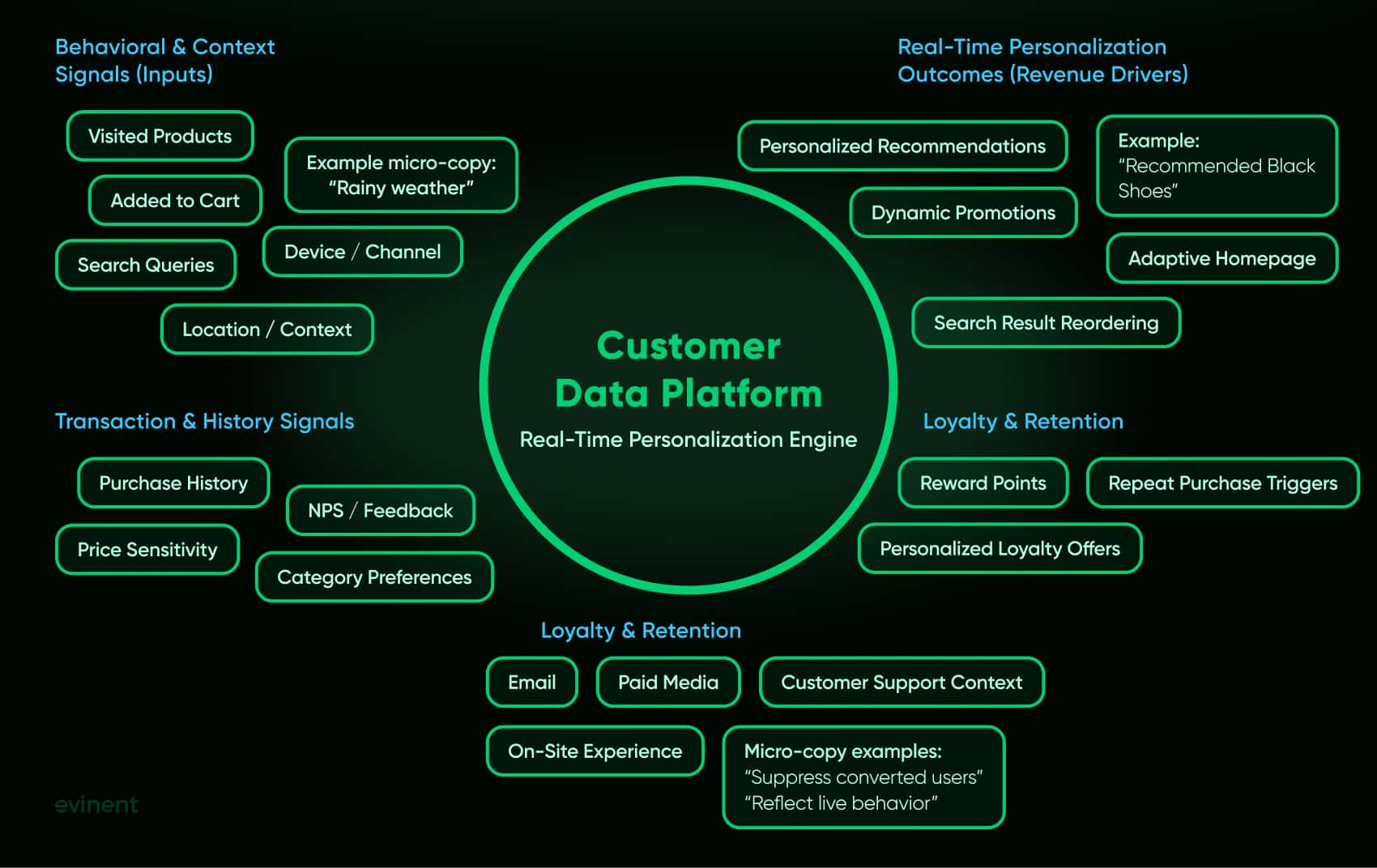
Core eCommerce Use Cases Powered by CDPs
Successful eCommerce organizations rarely start with exotic AI models. Instead, they focus on fundamental decision points where relevance has an outsized effect on outcomes.
Personalized Product Recommendations
CDP-driven recommendations differ from traditional “people also bought” widgets. They incorporate:
Real-time browsing behavior
Historical purchase patterns
Category and price sensitivity
Inventory and margin constraints
Contextual signals (device, channel, timing)
This allows recommendations to adapt instantly as intent changes, rather than relying on static associations.
According to McKinsey, personalized product recommendations alone can account for up to 35% of eCommerce revenue when implemented effectively.
Adaptive On-Site Experiences
Beyond recommendations, CDPs enable dynamic adjustment of:
Homepage layouts
Category sorting
Promotional visibility
Messaging tone and urgency
Instead of showing the same experience to every visitor, the site responds to who the customer is and what they are likely to do next.
Search Personalization and Intent Interpretation
Search is one of the strongest intent signals in eCommerce and one of the most underutilized.
When search behavior is fed into a CDP:
Results can be reordered based on individual preferences
Filters and suggestions adapt to prior behavior
Zero-result searches become actionable signals
This turns search from a utility feature into a personalization engine.
Loyalty and Repeat-Purchase Optimization
CDPs excel at identifying high-value customers and tailoring experiences accordingly:
Personalized loyalty offers
Early access or exclusive pricing
Frequency-based reminders
Cross-category expansion strategies
Retailers using CDP-driven loyalty logic consistently report higher customer lifetime value and lower churn.
Omnichannel Consistency: The Hidden Revenue Lever
One of the most overlooked advantages of CDP personalization in eCommerce is cross-channel consistency.
Without a CDP:
Email promotes products already purchased
Ads retarget customers who have already converted
On-site experiences ignore offline or support interactions
With a CDP:
Paid media suppresses converted customers automatically
Email reflects current on-site behavior
On-site content adapts to campaign exposure
Support and sales teams see the same customer context
This coordination reduces friction and waste, both of which quietly erode margins at scale.
What High-Performing eCommerce Leaders Do Differently
Organizations that extract real value from CDP personalization in eCommerce share several practices:
They treat personalization as a revenue system, not a UX feature
They prioritize use cases tied directly to conversion and CLV
They integrate CDPs deeply with product, pricing, and inventory systems
They continuously test and refine decisions instead of “setting and forgetting.”
As Forrester observes, eCommerce leaders that embed personalization into their operating model, not just their website, outperform peers on both growth and efficiency metrics.
Why eCommerce Success Shapes Enterprise Adoption
For many enterprises, eCommerce becomes the internal proof point that unlocks broader CDP adoption. Once leadership sees measurable revenue uplift, lower acquisition costs, and cleaner customer journeys, CDP personalization expands naturally into:
Customer support
Assisted sales
Mobile apps
Subscription and renewal flows
Offline and hybrid experiences
This is why eCommerce is not just a use case; it is often the strategic entry point for enterprise-wide personalization.
CDP Personalization and AI: From Segments to Real-Time Decisions
As CDPs mature, the conversation inevitably shifts from data unification to intelligence. This is where artificial intelligence enters the picture, not as a replacement for CDPs, but as a force multiplier that changes how personalization decisions are made.
For executives, the critical distinction is understanding what AI actually does inside a CDP, and where human control must remain.
From Static Segments to Dynamic Decisioning
Traditional personalization relied on predefined segments:
“High-value customers”
“New visitors”
“Abandoned cart users”
These segments were typically refreshed daily or weekly and applied uniformly across channels. While useful, this approach breaks down in fast-moving digital environments.
AI-enabled CDP personalization replaces static segmentation with dynamic intent evaluation. Instead of assigning customers to fixed groups, the system continuously evaluates:
Recent behavior and frequency
Context (time, channel, device)
Propensity to convert, churn, or respond
Similarity to past successful journeys
This enables decisions to be made per interaction, not per segment.
According to Gartner, enterprises are increasingly shifting from “segment-based personalization” to real-time decisioning models driven by machine learning, particularly in eCommerce and digital services.
What AI Actually Does in CDP Personalization
AI inside a CDP is typically applied in three practical areas:
1. Prediction
AI models estimate likelihoods such as:
Probability of purchase
Risk of churn
Expected lifetime value
Responsiveness to offers or channels
These predictions help prioritize actions, not automate them blindly.
2. Recommendation
Rather than hard-coded rules, AI identifies:
Products most likely to convert
Content most likely to engage
Offers most likely to retain margin
Importantly, recommendations are contextual, they adapt as behavior changes.
3. Optimization
AI continuously tests and adjusts:
Timing of messages
Channel selection
Frequency and suppression logic
Content sequencing
This allows personalization strategies to improve over time without constant manual tuning.
Research from McKinsey indicates that organizations combining AI with personalization outperform peers not just in revenue growth, but also in marketing efficiency and speed of execution.
Why AI Without a CDP Rarely Works
Many organizations attempt to apply AI directly on top of fragmented data sources. The result is often disappointing.
AI models are only as good as the data they consume. Without a CDP:
Data is incomplete or ed
Identities are fragmented
Consent signals are inconsistent
Outputs cannot be activated consistently
This leads to impressive prototypes that fail in production.
A CDP provides the clean, unified, governed data layer that AI requires to deliver reliable personalization at scale. In that sense, CDPs are not replaced by AI they are what make AI operationally viable.
The Executive Trade-Off: Automation vs Control
As AI-driven personalization becomes more powerful, a legitimate concern emerges at the leadership level: loss of control.
High-performing organizations address this by drawing clear boundaries:
AI proposes actions, humans define constraints
Business rules set guardrails around pricing, compliance, and brand tone
Models are monitored, audited, and adjusted regularly
This “human-in-the-loop” approach preserves accountability while still benefiting from automation.
According to Forrester, enterprises that balance automation with governance achieve higher trust internally, and better customer outcomes externally.
Why This Matters Strategically
The combination of CDPs and AI signals a broader shift:
From campaigns to continuous optimization
From audience thinking to individual decisioning
From manual execution to adaptive systems
For executives, this is not about chasing AI trends. It is about building organizational reflexes, systems that sense, decide, and respond faster than competitors, without sacrificing governance or trust.
CDP Personalization, Privacy, and Trust: Getting Governance Right
As personalization becomes more data-driven and AI-powered, privacy stops being a legal checkbox and becomes a core business constraint. For executives, the challenge is no longer choosing between personalization and compliance, but designing systems that can deliver both simultaneously.
This is where CDP personalization has a structural advantage over fragmented tool stacks.
Why Privacy Broke Traditional Personalization Models
Before 2022, many personalization strategies relied on:
Third-party cookies
Opaque data enrichment
Channel-specific consent handling
Post-hoc compliance fixes
That approach no longer works.
Regulations such as GDPR, CCPA, and the Digital Markets Act introduced strict requirements around:
Explicit, purpose-bound consent
Data minimization and proportionality
The right to access, correct, and delete data
Transparency in automated decision-making
At the same time, enforcement became real. Fines, audits, and public scrutiny turned privacy failures into reputational and financial risks, not just legal ones.
The result is a simple executive reality: Personalization without governance is now a liability.
Why CDPs Are Better Suited for Privacy-First Personalization
CDPs are uniquely positioned to support privacy-aware personalization because they operate at the data orchestration layer, not the channel layer.
A properly implemented CDP allows organizations to:
Centralize consent signals across systems
Enforce usage rules consistently across channels
Limit data activation based on purpose and permission
Maintain auditable records of data access and decisions
This shifts compliance from a reactive process to a built-in capability.
According to Forrester, enterprises that centralize customer data governance through CDPs reduce compliance risk while improving personalization effectiveness, because decisions are made on trusted, consented data.
Consent as an Input to Decisioning, Not a Barrier
One of the most common misconceptions among executives is that stricter privacy controls limit personalization potential. In practice, the opposite is often true.
When consent is treated as a dynamic input, CDPs can:
Personalize differently based on permission level
Suppress channels or data types automatically
Adapt experiences without breaking journeys
For example:
A user who consents to on-site personalization but not email still receives relevant experiences
A customer who revokes consent is excluded instantly, without manual intervention
Anonymous users receive contextual personalization without identity-level tracking
This flexibility is only possible when consent is embedded directly into the decisioning layer.
Explainability and Executive Accountability
AI-driven personalization introduces another governance requirement: explainability.
Executives are increasingly accountable for:
Why did a customer see a specific offer
How pricing or recommendations were determined
Whether automated decisions could be discriminatory or misleading
CDPs help address this by:
Centralizing logic and rules
Logging decision paths
Supporting human review of models and outputs
As Boston Consulting Group notes, explainable personalization is becoming a prerequisite for enterprise-scale AI adoption, not just a technical nice-to-have.
Trust as a Revenue Multiplier
Privacy is often framed defensively, but its strategic impact is offensive.
Customers who trust brands with their data:
Share more first-party information
Engage more frequently
Stay longer
Are more receptive to personalization
Research consistently shows that trust amplifies the ROI of personalization, while mistrust destroys it, sometimes permanently.
From a leadership perspective, CDP personalization offers a way to institutionalize trust:
One source of truth
One set of rules
One accountable system
The Executive Takeaway
Personalization, AI, and privacy are no longer separate conversations. They converge at the CDP layer.
Organizations that treat governance as a foundational design principle, not an afterthought, gain three advantages:
Lower regulatory risk
Higher customer trust
More sustainable personalization ROI
With governance in place, the final strategic question emerges: Should organizations build CDP capabilities internally, buy platforms, or combine both, and what really determines success?
That decision, more than vendor selection, defines long-term outcomes.
Build vs Buy: How Executives Should Decide on CDP Personalization Strategy
Once leadership teams align on the value of CDP personalization, the conversation almost always lands on one question:
Should we buy a CDP, build our own, or combine both?
This decision has long-term consequences. Not because one option is universally better, but because most failures come from choosing the right tool for the wrong operating model.
Below is a practical, executive-level comparison that reflects how CDP personalization works in real enterprises, not vendor slide decks.
CDP Personalization Strategy Comparison
Approach | What It Looks Like in Practice | Strengths | Limitations | Best Fit For |
Buy (Out-of-the-Box CDP) | Implement a commercial CDP platform with predefined data models, connectors, and activation features | Fast time to market, vendor support, mature features, and compliance tooling | Limited flexibility, vendor lock-in, difficult legacy integration, and customization costs | Organizations with clean data, modern stacks, and standardized processes |
Build (Custom CDP) | Internal data platform combining data lake, identity resolution, decisioning, and activation layers | Full control, tailored logic, deep legacy integration, cost efficiency at scale | Longer time to value, higher upfront effort, requires strong data engineering | Enterprises with complex legacy systems and strong internal tech teams |
Hybrid (Platform + Custom Layer) | Commercial CDP augmented with custom data pipelines, decisioning, or activation logic | Balance of speed and flexibility, scalable, future-proof | Requires architectural discipline, integration expertise | Most large enterprises and mature mid-market organizations |
Why “Buy Only” Often Underperforms at Scale
Many organizations assume that purchasing a CDP automatically delivers personalization capability. In reality, platforms do not replace architecture.
Common issues with buy-only approaches:
Legacy systems cannot expose real-time data cleanly
Custom business logic is hard to encode into vendor rules
Performance bottlenecks appear at scale
Data governance becomes constrained by platform limitations
As Gartner has noted, enterprises that rely solely on packaged CDPs often struggle to extend personalization beyond marketing into product, pricing, and operations.
Why “Build Only” Is Rarely the Fastest Path
On the other end of the spectrum, fully custom CDPs promise maximum flexibility, but often fail to deliver value quickly.
Typical pitfalls:
Reinventing commodity features (connectors, UI, consent tooling)
Overengineering before validating use cases
Difficulty maintaining long-term tooling internally
Unless personalization is already a core engineering competency, pure build approaches tend to ROI and increase internal friction.
Why the Hybrid Model Is Becoming the Default
For most enterprises, the most resilient approach is hybrid.
This model typically looks like:
A commercial CDP for data ingestion, profile management, and consent
- Custom-built layers for:
Legacy system integration
Real-time pipelines
Business-specific decisioning logic
Advanced personalization use cases
This allows organizations to move quickly without locking strategic capabilities into vendor constraints.
Consulting firms such as McKinsey increasingly recommend hybrid architectures for personalization, particularly in organizations with complex system landscapes.
What Actually Determines Success (Regardless of Model)
Across build, buy, and hybrid approaches, successful CDP personalization initiatives share the same execution principles:
Clear executive ownership of personalization decisions
Strong data foundations and identity resolution
Real-time architecture where it matters
Governance embedded into design
Continuous measurement tied to business KPIs
The platform choice matters, but far less than how the organization operationalizes personalization.
Executive Takeaway
The right question is not “Which CDP should we buy?” It is “Which parts of personalization must remain strategic assets under our control?”
Answering that question clearly is what separates CDP investments that compound in value from those that stall after the initial rollout.
The final section brings everything together: what CDP personalization means for executive leadership, and how to treat it as a long-term growth capability, not a one-off initiative.
How to Treat CDP Personalization as a Long-Term Growth Capability
At this point, one conclusion should be clear: CDP personalization is not a marketing trend, a martech upgrade, or an AI experiment. It is an operating capability that determines how effectively an organization converts customer data into revenue, loyalty, and resilience.
For executive teams, the real shift is conceptual.
CDP personalization changes:
How customer decisions are made
How quickly the organization can respond to intent
How consistently data, compliance, and experience are aligned
How scalable personalization becomes without linear cost growth
Organizations that succeed do not ask “How do we personalize more?” They ask “How do we institutionalize better decisions?”
That mindset explains why CDPs increasingly sit at the intersection of:
Revenue strategy
Data governance
AI adoption
Customer trust
And why leadership, not tooling itself, determines outcomes.
What High-Maturity Organizations Do Consistently
Across industries and regions, companies that extract sustained value from CDP personalization follow the same executive principles:
They anchor personalization to business outcomes
Conversion, CLV, retention, margin not vanity engagement metrics.
They centralize decision logic
One source of truth, one set of rules, many activation channels.
They invest in foundations before scale
Identity, data quality, real-time pipelines, and consent.
They combine AI with governance
Automation with guardrails, not black-box decisioning.
They treat personalization as infrastructure
Built to evolve, audited continuously, and owned cross-functionally.
This is why CDP personalization increasingly appears on transformation roadmaps, not campaign calendars.
How Evinent Helps Organizations Succeed with CDP Personalization
At Evinent, we approach CDP personalization not as a product rollout, but as a business capability build.
Our work focuses on helping organizations move from fragmented personalization experiments to decision-driven, enterprise-scale personalization.
What Makes Evinent’s Approach Different
Vendor-agnostic strategy
We help you choose, extend, or integrate CDPs based on your architecture—not vendor promises.
Hybrid architectures that scale
Combining commercial CDPs with custom data, identity, and decision layers where needed.
Real-time, AI-ready foundations
Built to support advanced personalization without sacrificing governance.
Enterprise-grade governance by design
Consent, explainability, and compliance embedded from day one.
Business-first delivery
Every use case is tied to measurable outcomes: conversion, CLV, retention, efficiency.
Typical Engagements Include
CDP strategy and readiness assessment
Build vs buy decision support
Data and identity architecture design
Real-time personalization implementation
AI-driven decisioning and optimization
Governance and compliance integration
Whether you are launching your first CDP use case or modernizing an existing personalization stack, Evinent helps ensure that personalization becomes a compounding advantage, not another disconnected system.
Final Thought for Executives
The future of personalization is not louder messages or more channels. It is better decisions, made faster, on trusted data.
CDP personalization is how leading organizations build that capability, and how they turn customer intelligence into long-term growth.
FAQ
What is CDP personalization in simple terms?
CDP personalization is the use of a Customer Data Platform to unify customer data across systems and use it to deliver relevant, real-time experiences across channels, based on who the customer is, what they do, and what they are likely to do next.
How is a CDP different from a CRM or DMP?
A CRM focuses on known customers and sales interactions. A DMP focuses on anonymous, third-party audiences.
A CDP unifies first-party data across known and anonymous users, supports real-time decisioning, and activates personalization across systems and campaigns.
Is CDP personalization only for large enterprises?
No. While large enterprises see the biggest structural benefits, mid-market companies also gain value, especially in eCommerce and subscription models. The key is starting with focused use cases, not scale.
How long does it take to see ROI from CDP personalization?
Organizations that start with well-defined use cases often see measurable impact within 8–12 weeks. Full enterprise maturity takes longer, but early ROI is achievable when scope is controlled.
Does CDP personalization require AI?
No, but AI significantly increases impact. CDPs work without AI using rules and segmentation. AI enables prediction, optimization, and scale, but only when built on clean, unified data.
Is CDP personalization GDPR and privacy compliant?
Yes, when implemented correctly. CDPs support consent management, purpose limitation, and auditable data usage. In practice, they reduce compliance risk compared to fragmented personalization stacks.
What are the biggest risks executives should watch for?
Treating CDPs as marketing tools
Poor data quality and identity resolution
Overengineering before proving value
Lack of executive ownership
Measuring activity instead of business impact
Share