

When "Review Everything Manually" Stops Being a Strategy
At 10 suppliers, manual review is manageable. At 20, it's tight. At 50, the math becomes brutal: 50 suppliers submitting 10 new products per week means 500 submissions landing in someone's queue every single week. That's before accounting for resubmissions, revision requests, and the back-and-forth that follows every unclear rejection.
Most marketplace operations teams face this problem, not because they are unwilling to work, but because they never made a new process when the old one failed. Manual checking increases linearly: if you have more suppliers, you will need more reviewers, more hours, and more coordination with overhead. The team expands to keep pace until it is impossible for them to do so anymore.
These signs are predictable. Review queues get longer from days to weeks. Instead of making real quality decisions, moderators mostly end up fixing formatting mistakes and finding the missing fields. Rejection reasons become quite divergent as different team members impose different standards. Suppliers begin to communicate via email for status updates since the portal remains silent to them.
The operational cost of staying manual compounds quickly. McKinsey found that 60% of employees could save 30% of their time by automating routine tasks — and marketplace content review workflow is among the most repetitive operations in marketplace management. About two-thirds of companies that implemented automation reported improvements in quality control, customer satisfaction, and reductions in operating expenses. The pattern is consistent: manual processing doesn't become more efficient under volume; it becomes more expensive. (McKinsey, 2025)
The instinct is to hire. But adding reviewers to a broken process produces more of the same output at a higher cost. The difference becomes structural:
Parameter | Manual Review | Structured Workflow |
Suppliers before breakdown | 20–30 | 200+ |
Average time to publish | 5–7 days | 1–2 days |
Supplier communication | Email threads | Inline, per-product |
Team scaling requirement | Linear | Logarithmic |
The issue is not with those who do the review. What is missing is a system that divides what humans are required to decide and what a process can do automatically. This distinction is the beginning of scalable moderation, and it goes back to how submissions are first introduced to the workflow.
What this article covers:
Reasons why manual moderation poses challenges when a company works with over 20-30 active suppliers, and what the indicators of this problem are before the situation gets out of hand.
The division of tasks submission, auto-validation, manual review, and supplier notification, done through a four-stage workflow.
Product content moderation by AI: the scope of the decision-making that AI can take over and the points at which human input is crucial.
Supplier communication that lacks organization leads to one's email inbox being overwhelmed. Here's how the use of inline comments turns things around.
Five failure modes that systematically disrupt moderation processes without triggering any kind of response from anyone, going as far as escalation.
Key performance indicators that show the workforce whether or not the management system functions properly.
The Four Stages of a Working Moderation Workflow
Increasing product volume doesn't simply make moderation a review task anymore; it actually leads to throughput problems. The main limiting factor is not human resources but the absence of systematization of the flow of submissions in the system. A lot of teams tend to solve this problem by recruiting more reviewers, but it only escalates the cost and not the efficiency. At the end of the day, everything goes to the same queue, and each piece still needs human attention even when it's not necessary. A scalable moderation system is not about speeding up the review process; it's about deciding in advance what is worthy of review.
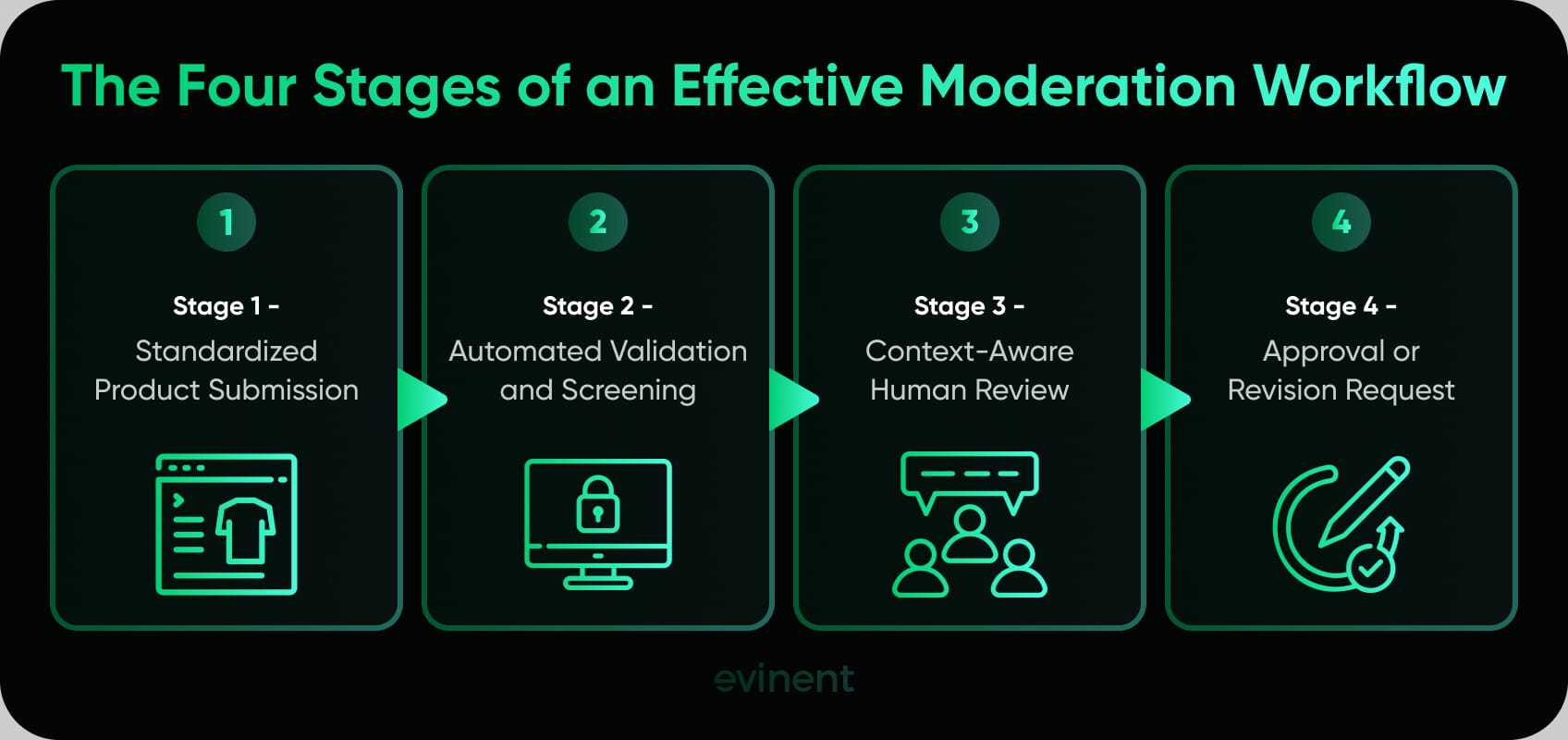
Stage 1 — Structured Submission
In order for a product to be listed in the system, it is necessary that it has a clear structure. The submissions that lack mandatory fields such as title, SKU, images, price, and category attributes will simply be rejected. The products that do not fulfill the minimum requirements are not even considered for review, as they are immediately sent back to the supplier along with a detailed violation explanation. This prevents the system from wasteful processing of partial or erroneous data and ensures that no clutter gets through at the first instance.
Stage 2 — Automated Pre-Check
Once a submission passes structural validation, it goes through automated checks that handle everything deterministic. The system verifies completeness, image format and quality, detects duplicates across SKU and title, and performs basic content analysis for obvious issues. Anything that fails is automatically returned to the supplier with a specific reason, while valid submissions move forward. The purpose of this stage is to remove everything that does not require human judgment before it reaches a reviewer.
Stage 3 — Human Moderation with Inline Context
At this stage, only edge cases remain. Moderators work directly inside a structured interface where every field can be reviewed in context. Feedback is attached to specific fields rather than sent via email or external ticketing systems. This eliminates ambiguity and ensures that suppliers receive precise instructions rather than vague rejection messages. The focus shifts from identifying obvious errors to making contextual decisions that require human judgment.
Stage 4 — Publish or Request Changes
Every submission completes in one of two states: either a published version or a revision required. If modifications are necessary, the vendor gets detailed feedback, modifies only the impacted fields, and resubmits the item. In this way, the procedure doesn't begin anew. The submission is brought back to the same workflow with all history still intact, resulting in a continuous circle and not a disjointed set of tries.
Adding more people to a moderation system is not how it scales. A system scales when it self-filters, organizes, and directs the work that finally requires human intervention. The factor that separates a defect from a scalable workflow is not speed but control. After the submissions have turned into a regulated flow rather than an unfiltered queue, moderation will not be a bottleneck but a reliable system.

What AI Actually Does in Product Content Moderation
Automated moderation is a bit overhyped. The typical sales talk is something like "AI goes through your catalog", which doesn't really explain to an operations team how things work, what is detected, and what is left for human review. What actually happens is quite different, and in fact, more beneficial.
AI in product content moderation marketplace works reliably when the task is definable: does this field have a value, does this image meet resolution requirements, has this SKU appeared before? These are pattern-matching and rule-based problems. They don't require judgment, which is exactly why automation handles them well at scale.
Task | Who handles it | What happens on fail |
Completeness scoring | AI | Submission blocked, supplier notified with missing fields listed |
Image format and resolution check | AI | Submission returned, specific requirement shown |
Duplicate detection (SKU, text) | AI | Flagged for review, not auto-rejected |
NLP description check (spam, gibberish) | AI | Submission blocked, description flagged for rewrite |
Category compliance and edge cases | AI flags → Human decides | Moderator reviews the flag, approves or rejects with a comment |
When a submission ends up with a human moderator, the big structural issues have already been removed. So, what's left is the stuff that genuinely needs a human touch: is a product description correctly describing its category? Has a technically compliant image been visually misleading? Does a rare case follow the catalog's logic, or is a judgment call needed?
Where AI Creates a False Sense of Control
The line between the capabilities of AI and what is beyond its reach is the place where most moderation systems fail silently, without a trace.
Duplicate detection is by far the simplest example. For instance, if two different sellers offer functionally identical products, but have slightly different SKUs or descriptions, then an algorithm may either completely fail to detect the duplicate or identify the two legitimate, distinct listings as in conflict. Both scenarios lead to working either on the junk in the catalog or on the unnecessary catalog moderation system.
Natural Language Processing (NLP), of course, runs into the same problem. A product description can be free from spam and gibberish filters, yet it can be wrong, misleading, or completely misplaced in the category. The model only looks at the composition and vocabulary; it does not check the truthfulness of the statement or whether the style is in line with the platform's rules.
Non-standard categories expose the third gap. Validation rules are only as good as the categories they were built for. A new product type without established field requirements will pass automated checks by default — not because it's compliant, but because no rule exists yet to catch it.
This is why human-in-the-loop isn't a temporary workaround until AI gets better. It's a structural requirement. AI handles volume. Humans handle judgment. A moderation system that confuses the two ends up with either a bottleneck or a catalog full of content that technically passed every check.
Communication Between Suppliers and Moderation Teams
Without structured communication, moderation doesn't just slow down — it turns into an email thread nobody can find when it matters. The fix isn't a better email template. It's removing email from the moderation loop entirely.
This is an example of the workflow with inline commenting: The supplier submits their work, and then the moderator puts a comment on the exact area that changed. As a result, the supplier understands precisely what to do, and then they resubmit. No one needs to guess, and there shouldn't be any clarifying clarifications back and forth.
Here is what that eliminates in practice.
Rejection With No Field-Level Context
A generic rejection email tells the supplier something failed — not what, not where. The supplier guesses, fixes the wrong thing, and resubmits. The moderator reviews again. The cycle repeats without moving forward. Inline commenting makes the feedback specific by design: the comment lives on the field, not in a separate message.
Resubmission Of The Wrong Version
When feedback is unclear, suppliers interpret it in their own way. They changed the product name when, in fact, the problem was with the description. They put in a new secondary image when it was the primary one that was flagged. Each incorrect fix creates the need for a completely new review cycle. Comments at the field level clarify the ambiguity that leads to such situations.
Moderation History is Split Across Tools
Part of the thread is in email, part in Slack, part in a shared spreadsheet that three people have edited. When someone needs to understand the history of a submission, there is no single place to look. A structured commenting system tied to the product record keeps everything in one place, in sequence.
No Audit Trail When Disputes Arise
A supplier contests a rejection. The moderator is certain the feedback was clear. Neither has a timestamped record of what was requested, what was changed, and when. Inline commenting creates that record automatically — every comment, every resubmission, every resolution is attached to the product and visible to both sides.
New Moderator With No Prior Context
A team member jumps into a queue halfway through the cycle. They check a submission that has been rejected twice, and since they are not given any details, they can't figure out what was asked, what was tried, or why it failed again. With inline commenting, the entire history is on the product rather than in someone's inbox.
Each of these failures adds at least one full revision cycle. Across hundreds of active submissions, they account for a significant share of time-to-publish s that have nothing to do with content quality and everything to do with how feedback is structured.
Where Moderation Workflows Break Down: Five Failure Modes
Many moderation issues don't appear as failures initially. Instead, they resemble slowdowns. For example, a queue that ends up taking a bit more time than originally planned. A supplier who, without a doubt, continues to resubmit, however, is not getting closer to being approved. A moderator who is not very sure whether a product corresponds to their category. The system continues to operate, yet poorly, and more expensively.
Gartner data shows that only 48% of operational projects fully meet or exceed their targets, and moderation workflows are no exception. The failures are usually structural, not accidental. Here are the five most common ones. (Gartner)
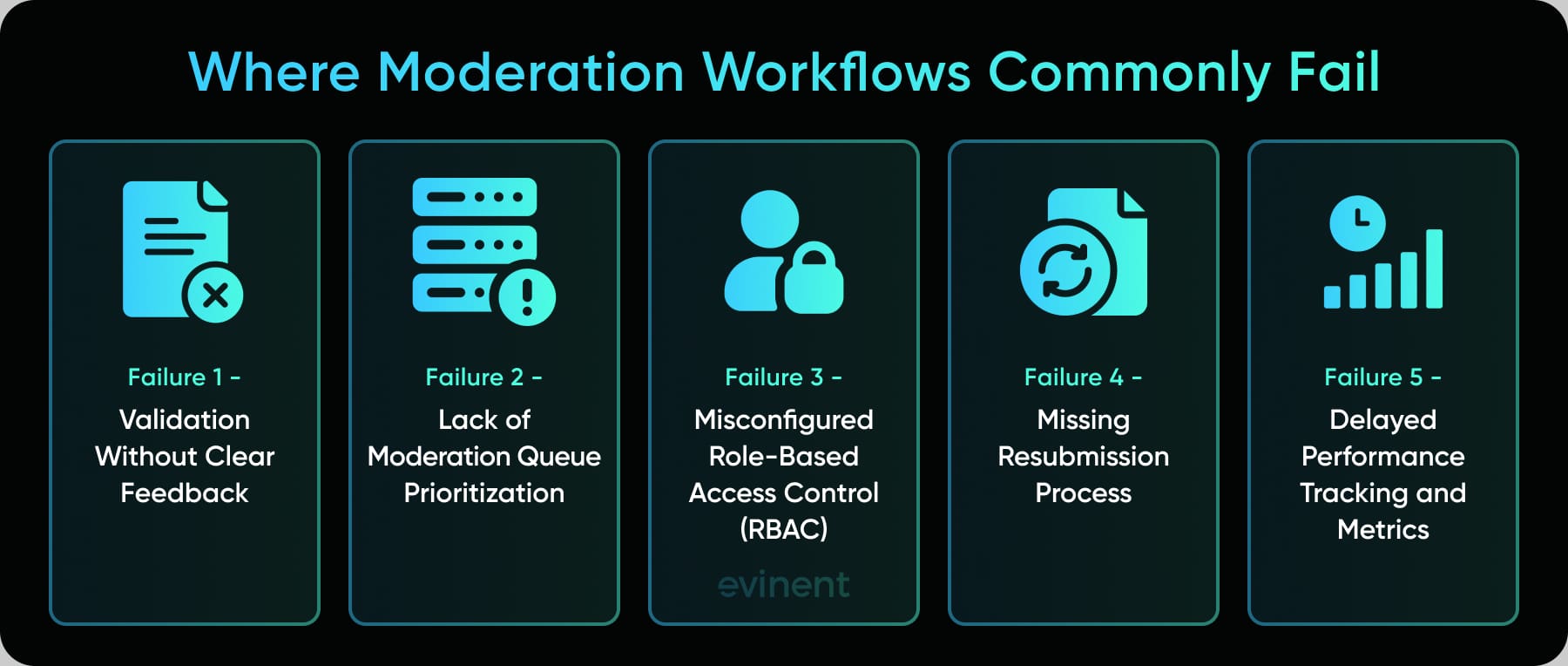
Validation Without Feedback
The automated layer rejects a submission. The supplier receives a notification that a failure occurred, but there are no details about what or where. They guess, fix the wrong field, and resubmit. The moderator reviews again. The cycle continues without resolution. The fix isn't smarter AI; it's making rejection reasons specific and field-level, so the supplier knows exactly what to correct on the first attempt.
Unprioritized Moderation Queue
Every submission enters the same queue and waits in order. An urgent product relaunch sits behind a first test submission from a new supplier. There's no triage logic, no way to surface time-sensitive reviews, no visibility into what's waiting or why. The result is that the queue optimizes for nothing in particular — not speed, not business priority, not supplier compliance history.
RBAC is Misaligned With Real Roles
For example, a moderator in charge of a product category is given edit privileges for another category. They make a change to a correct one in their view, which, however, leads to a conflict in a category that is not their own. The audit trail only indicates the action but does not give the context. McKinsey mentions redesigning work processes as a must for operational AI content validation ecommerce to deliver dependable results. Part of this redesign also involves access control. If the authorities given are not in line with the real responsibilities, the mistakes will accumulate unnoticed. (McKinsey, 2025)
No Resubmission Path
A product gets rejected. The supplier has no structured way to send it back through the workflow — no resubmit button, no queue re-entry, no status update. They resort to email. The moderator receives the email, manually re-opens the review, and the product re-enters the process outside of any tracked flow. Every step from that point on is invisible to reporting and metrics.
Metrics Tracked Too Late
Time-to-publish is measured after a supplier complains. Revision cycles are counted at the end of a quarter, not in real time. By the time the data surfaces a problem, it has already affected dozens of supplier listing approval and several supplier relationships. The issue isn't a lack of data; it's that the metrics aren't connected to the workflow as it runs. Proactive measurement means tracking revision cycles per submission, queue age by category, and first-pass approval rates continuously — not as a post-mortem.
Each of these is a design decision — or the absence of one. None of them requires a platform overhaul to fix. They require explicit choices about how the workflow is structured, what triggers what, and who owns which decisions.
Measuring Moderation Efficiency: Metrics That Matter
Perhaps a moderation workflow appears quite functional on the surface, yet it is failing silently behind it. Therefore, queues are moving, products are being published, and suppliers are resubmitting; however, without the proper metrics, there is no way of knowing whether the system is actually performing or merely running. For those in charge of operations, the manifestations of such a difference are time-to-publish s, supplier churn, and catalog quality issues that only get noticed after they have caused damage.
These are the five metrics that give a real picture of moderation health.
Metric | What It Measures | Benchmark Range |
Time to publish | Speed from submission to live listing | 24–48 hrs with automation |
First-pass approval rate | Submission quality from suppliers | 60–80% is healthy |
Revision cycles per listing | Communication efficiency | 1.5 cycles |
AI pre-filter rate | % submissions stopped before human review | 70–90% |
Supplier compliance rate | % suppliers without repeat errors | Trending up over 90 days |
Time to publish is the most visible metric and the most commonly tracked, too late. When it's measured only after a supplier escalates, it's already a symptom. Tracked continuously, it surfaces bottlenecks by stage: is the in the automated product validation pre-check, in the human review queue, or in supplier resubmission time?
First-pass approval rate measures how often a submission clears review without requiring revision. A rate below 60% is rarely a moderation problem — it's a supplier onboarding problem. It means suppliers are entering the workflow without a clear understanding of what's required. The metric points to where the fix belongs.
Revision cycles per listing are a measure of how many times a product is sent back for changes before it finally gets published or discarded. If your average number is above 1.5 cycles, this is a sign that you have a problem with the communication system, either the feedback you're getting is not direct enough, or the way you have to submit changes again is complicated and leads to extra rounds.
AI pre-filter rate shows what share of submissions the automated layer catches before they reach a human reviewer. A rate below 70% means either the validation rules are too loose or suppliers are submitting incomplete content that should have been blocked at the structured submission stage.
Supplier compliance rate is the only metric with a directional benchmark; rather than a fixed range it shall trend upward over 90 days. If it doesn't, the moderation workflow is not operating as a feedback loop. Suppliers do not know what is expected from them, and therefore, the same errors keep getting into the queue.
When combined, not only do these metrics quantify the level of efficiency, but they also pinpoint the places in the workflow where the system fails. A decrease in the first-time approval rate indicates the need to focus on the training process. A sharp increase in the number of revision cycles is a sign of communication problems. The compliance rate that is not changing indicates the level of feedback quality. Each metric is a diagnostic tool, along with its being a number.
How Evinent Built a Moderation System That Scales
Building a moderation workflow that holds at scale isn't a configuration task — it's an architecture decision. Most platforms reach a point where the process that worked at 20 suppliers visibly breaks at 80. The question is whether the team recognizes it as a structural problem before it becomes an operational crisis.
Why Do Customers Choose Evinent?
15+ years building marketplace and e-commerce platforms
Experience across mid-sized businesses and enterprise clients in retail, logistics, and e-commerce
85% of clients return for follow-up projects — because we design for operational reality, not just technical requirements
Real-Life Case Study: Scalable E-Commerce Platform for a Fast-Growing Eastern European Retailer
The Challenge
A fast-growing Eastern European retailer came to Evinent with a catalog system that had outgrown its own infrastructure. Product data updates were slow and error-prone. There was no structured process for validating incoming supplier content, access to critical catalog functions wasn't controlled by responsibility, and suppliers had no clear resubmission path. The moderation team applied inconsistent standards with no audit trail to fall back on.
The Solution
Evinent developed the catalog management layer around a set of structured four-stage moderation flow: validated submission intake, automated pre-checks, role-separated human review, and supplier notification with inline feedback. Moving to Elasticsearch allowed for catalog changes to be updated almost instantly. Fine-grained RBAC was used to match the levels of permissions very closely with the actual roles. Instead of using email, commenting inline was used as the feedback layer, comments were linked to particular fields, kept even after resubmissions, and visible to both sides.
The Results
The structural changes produced measurable outcomes:
23% increase in search result conversion from improved catalog data quality
320% increase in online sales over
2.5-month peak demand period — absorbed without expanding the moderation team.
Manual review is limited. And every marketplace inevitably reaches that limit; the only difference is how much harm is done by the time the team identifies it as a procedural problem rather than a human one. A moderation workflow with four stages and AI validation, supplier communication that is well structured, and up-to-date statistics don't simply shorten review time. Firstly, it transforms the bottleneck of catalog quality into a competitive advantage.
Those suppliers who are enabled by the platform to get their products to the market more quickly, with fewer iterations of revisions and with feedback that is clear, are the ones who actually continue to remain. The one platform that makes this possible is the one that actually grows, and that platform is not in front of the moderation queue, but starts with the architecture behind it.
FAQ
How Many Suppliers Does it Take Before Manual Product Review Breaks Down?
Most marketplace operations teams start feeling the strain at 20–30 active suppliers. At that point, submission volume outpaces what a small review team can handle without dedicated processes, and the symptoms appear: growing queues, inconsistent rejection reasons, moderators spending time on formatting errors instead of quality decisions. With 50+ suppliers submitting 10 products per week, manual review becomes mathematically unsustainable without either a structured workflow or significant headcount expansion.
What Does an Automated Content Moderation Workflow for E-commerce Look Like Step by Step?
A functioning moderation process involves four main steps. The first step is a structured submission intake with the help of mandatory field validation. This means that incomplete submissions are blocked before even entering the queue. The second step involves the use of automated tools to pre-check whether the submissions are complete, if the images meet the format requirements, if the SKUs are duplicates, and if the descriptions are of good quality.
At this point, the submissions that pass these checks are forwarded, while the ones that do not pass are sent back to the suppliers with a clear indication of the reason. The third step is the human review of only the material that the automation has flagged but cannot resolve, such as category compliance, edge cases, and contextual accuracy. The fourth step is to either publish the content or make revision requests with field-level inline comments and supplier notification, along with a clear resubmission path back into the queue.
What Specific Tasks Can AI Handle in Product Listing Moderation — And What Still Requires a Human?
AI product listing quality control is great at taking care of those things that can be very precisely defined and done over and over again: for example, calculating completeness scores, checking if the image is of the required format and resolution, finding duplicates based on SKU and text, and even doing NLP checks for spam or gibberish product descriptions.
But what really needs a human is making decisions in the category compliance, content that is contextually misleading and can pass technical checks, non-standard product types without established validation rules, and the final decision on what gets published. The distinction is crucial: AI acts as a first filter of the volume, and humans do the filtering based on judgment. Mixing these two up either creates a bottleneck or a catalog filled with content that has technically passed every check but might not be of good quality.
What Is a Realistic Time-to-Publish Benchmark for Marketplace Product Listings?
With a well-organized moderation procedure and automated pre-validation, the realistic publication time is around 24-48 hours after submission. In contrast, without automation, it usually takes about 5-7 days for the same process, and even longer when there are revision cycles. The metric is really valuable only if it is monitored on an ongoing basis at each stage and not as a total: bottlenecks in automated pre-check, human review queue, and supplier resubmission time each indicate different solutions.
How Do You Structure Communication Between Suppliers And Moderation Teams Without Email Chains?
The fix is inline commenting tied directly to the product submission, not a separate message, not a rejection email. The moderator leaves a comment on the specific field that failed. The supplier opens the submission, sees exactly what needs to change, fixes it, and resubmits through the same flow. Every comment, every resubmission, and every resolution is attached to the product record and visible to both sides. This eliminates ambiguous rejections, wrong-version resubmissions, split conversation threads, missing audit trails, and context loss when a new moderator takes over the queue.
Key Takeaways
When a manual product review uncovers the last 20-30 active suppliers, then the remaining problem is the process rather than the people.
A working moderation workflow goes through a four-stage process: a structured submission, an automated pre-validation, a human review, and finally, publishing or revising with the supplier's notification.
AI can be relied on to perform completeness scoring, formatting checks, duplicate detection, and spam filtering; still, humans make the judgment calls on category compliance and edge cases.
Inline commenting tied to specific fields eliminates the email back-and-forth that turns moderation into a communication bottleneck.
Five structural failures quietly break moderation workflows: feedback-free rejections, unprioritized queues, misaligned RBAC, missing resubmission paths, and metrics tracked too late to act on.
Time-to-publish, first-pass approval rate, revision cycles, AI pre-filter rate, and supplier compliance rate are the five metrics that show whether a workflow is actually performing.
A moderation system designed for the actual running of a business, not just for meeting technical requirements, is key to a marketplace increasing its supplier base without increasing the review team's size at the same rate.
Share