

What Is an AI Software Development Life Cycle?
An artificial intelligence software development life cycle (AI lifecycle) is a formal, step-by-step process used for creating, deploying, and managing AI-powered systems. It covers all activities from problem identification and data preparation to model development, production deployment, and ongoing model performance monitoring.
Traditional software development is different from AI development in that, in the first, behavior is programmed explicitly, while in the second, data-driven models are relied on. This implies that results may be indeterministic and can change as the underlying data changes. Hence, the AI lifecycle supports continuous learning, feedback loops, and ongoing optimization instead of a one-time release.
Artificial intelligence development means the wider activities of designing and producing systems that can perform tasks traditionally considered as requiring human intellect, such as predicting, recognizing patterns, and decision-making. Building AI not only helps to write code, but also involves handling data, choosing algorithms, training models, testing them, and embedding models into the practical world environment.
The AI lifecycle can be primarily defined by its repetitiveness. It is through regularly updating and upgrading data, models, and deployment methods that the team succeeds in incrementally improving accuracy, trustworthiness, and business impact in the long run.
What this article will cover
How AI changes the way software is planned, built, and maintained compared to traditional development
Why data quality, availability, and governance directly determine system performance
How AI models are designed, trained, and evaluated in real-world conditions
What it takes to reliably deploy AI systems and keep them stable in production
Where the biggest efficiency gains come from when using AI in development workflows
What risks emerge from non-deterministic systems, and how to manage them
How organizations need to adapt their teams, processes, and culture for AI adoption
Why are responsible AI practices (transparency, fairness, accountability) critical
How do all these elements connect into a continuous, evolving development cycle
Phases of the AI Software Development Lifecycle: Key Stages of AI Development
The AI software development lifecycle is a methodical chain of stages, very iterative in nature, transforming raw data into functional intelligent systems. The phases of AI development, contrary to conventional development, are so tightly connected that one cannot even discern their order. For example, data determines the model's behavior, models lead to the deployment results, and the actual use of the system constantly changes the new improvements.
Hence, the AI lifecycle is continually cycling and not a straightforward pipeline where each phase influences the total system performance as well as the business value.
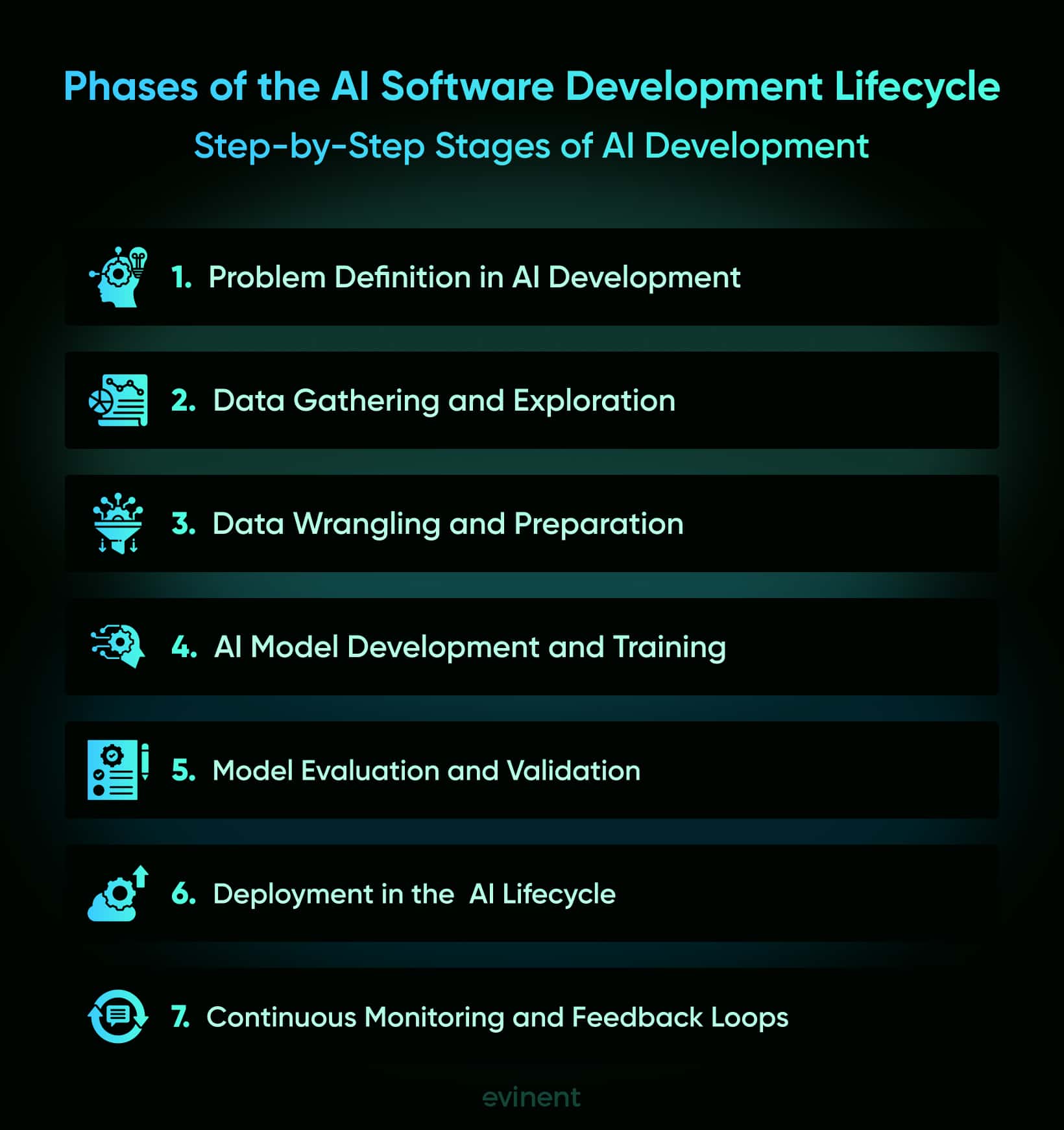
Problem Definition in AI Development
This phase is all about making sure you understand the problem and how it fits with the overall business goals. It involves analyzing the stakeholders, pinpointing the use cases, and setting up quantifiable metrics of success. A badly formulated problem is one of the main reasons why AI solutions fail, even if the models themselves are of high quality.
Data Gathering and Exploration in AI Projects
Properly consented and compliant data from several sources are collected. Initial data exploration reveals patterns, inconsistencies, and gaps that potentially impact the effectiveness of subsequent modelling.
Data Wrangling and Preparation
Raw data is processed through cleaning, transferring, and formatting to form usable datasets. These processes are accompanied by designing data flows, holding data to quality standards, and using data versioning to ensure stability and the ability to reproduce results over time.
AI Model Development and Training
During this phase, models are created and trained via prepared datasets. Besides, it covers the selection of suitable algorithms, feature engineering, and training process optimization in order to obtain good generalization performance.
Model Evaluation and Validation
Models are evaluated using validation datasets and performance metrics. This step ensures that the model performs reliably and helps detect issues such as overfitting or poor generalization to unseen data.
Deployment in AI Lifecycle
The trained model is incorporated into production environments. This might be through cloud, on-premise, or edge deployment and could be linked with CI/CD pipelines for automating releases and updates.
Continuous Monitoring and Feedback Loops
After deployment, model performance is continuously monitored in real-world conditions. Model drift and performance degradation are identified, and feedback loops are used to retrain and improve the system over time.
The AI lifecycle is a continuous, evolving process rather than a one-time implementation. Each stage depends on the others, and success in AI development comes from managing these dependencies effectively. Organizations that continuously refine their data, models, and deployment strategies are better positioned to build reliable, scalable, and high-performing AI systems.
Data Management in AI Projects: Data Collection, Governance, and Quality
Data is a crucial ingredient for any AI building process. Truly, the capabilities, trustworthiness, and equitableness of AI systems can be traced directly back to the ways in which data is gathered, transformed, and stored during the entire process of AI development.
On the contrary to traditional software, which is basically a set of instructions that determine how the program behaves, AI systems acquire knowledge from data. This alone makes data management a fundamental part of an AI lifecycle that must be subject to rigorous controls with respect to quality, compliance, and consistency.
Key Components of Data Management in AI
Area | What It Covers | Why It Matters |
Data Collection and Data Consent | Gathering data from internal and external sources, ensuring user consent and legal compliance | Poor-quality or illegally obtained data renders the model unusable and creates legal risks |
Data Governance and Data Privacy | Policies, standards, and regulatory compliance (e.g., data protection laws) | Ensures trust, security, and responsible AI usage |
Data Pipelines and Data Integration | Data ingestion, transformation, and movement across systems | Enables scalable and automated data processing |
Data Quality and Data Versioning | Cleaning, validation, labeling, and version control of datasets | Directly impacts model accuracy and reproducibility |
Data Drift and Data Lineage | Tracking changes in data over time and understanding data origins | Helps detect performance degradation and maintain transparency |
A good data management practice is not a one-off activity but a continuous operation throughout the AI lifecycle. Excellent, well-managed data will help a model to perform well, will minimize risks, and will guarantee compliance statements. Groups that allocate resources to strong data pipelines, comprehensive governance standards, and regular tracking will have a leading edge in creating dependable and expandable AI systems.
AI Model Development and Evaluation: From Model Design to Performance Metrics
Turning data into working predictive systems is a prime step in the AI lifecycle, known as the AI model development life cycle. It judges the behavior of an AI system in real-life situations, i.e., its accuracy, dependability, and the extent it can generalize beyond the training data. Since AI models extract patterns from data, unlike regular software that follows hard-coded instructions, their behavior becomes very sensitive to data quality, training configuration, and evaluation methods.
Model Architecture and Machine Learning Algorithms
Model selection depends on the problem type, data structure, and operational constraints. Simpler models (linear models, tree-based methods) are often used for structured data due to interpretability and efficiency. Deep learning models are preferred for unstructured data like images or text. Choosing overly complex architectures without need increases cost, slows training, and makes deployment harder. Good practice is balancing performance, interpretability, and system constraints rather than following trends.
Feature Engineering and Training Data
Feature engineering transforms raw data into meaningful inputs that improve model learning. This includes selecting variables, encoding categories, scaling values, and creating derived features. Training data quality is critical. If data is biased, incomplete, or unrepresentative, the model will fail in production even if training metrics look strong. More data is not always better ー better data is what matters.
Hyperparameters and Loss Functions
Hyperparameters are responsible for shaping the learning mechanisms of the model, whereas the loss function outlines the meaning of "error". Both have a direct impact on how stable the training process is and the level of performance achieved. Inadequate tuning may result in a learning process that is so slow that it hardly progresses, erratic or even diverging output, and overfitting. The chosen loss functions need to be aligned with the business objectives and not merely with technical precision. More often than not, working on the wrong metric results in models that are not fit for use.
Model Selection and Benchmark Evaluations
For the purpose of comparing multiple models, standardized metrics like accuracy, F1-score, or ROC-AUC are used, depending on which one fits the task the best. But choosing a model is not only about the highest score. Other factors such as latency, scalability, and resource cost are important too. A very slightly less accurate model can be chosen if it is much better in production conditions.
Overfitting, Model Drift, and Validation Dataset
Validation datasets are used to check how well the model generalizes beyond training data. Overfitting happens when the model memorizes noise instead of learning patterns. Even after deployment, models can degrade due to model drift, when real-world data changes over time. This requires monitoring and periodic retraining to maintain performance.
Developing Artificial Intelligence models involves not only creating models that work perfectly during training tests but also ones that can be relied on in real environments. It is a balancing act between accuracy, efficiency, and stability. The main things to focus on to be successful are having good data, picking the right model, conducting the evaluation correctly, and being mindful of the long-term changes of behavior, such as drift.

Deployment and Monitoring of AI Systems: MLOps, CI/CD, and Model Monitoring
Deployment is the point at which an AI model transitions from the experimental phase to actual operational use. In the AI lifecycle, this step involves much more than just unveiling the model; it is also about making certain that the model operates consistently, can be scaled well, and keeps on supplying benefits in the long run. Here, MLOps strategies such as automation, monitoring, and regular updating, gain utmost importance.
Model Deployment in Production Environments
Model deployment is the phase after validation wherein a model gets into a production environment facilitating it to serve real users or systems. Cloud platforms, on-site infrastructure, and edge devices are some options, which are chosen based on latency, security, and scalability requirements. Each choice is accompanied by pros and cons. While cloud deployment allows for flexible, scalable solutions, deploying at the device or the edge is local, interactive and fast but with limited computing resources. One of the biggest challenges in this scenario is how to keep training and production environments consistent.
CI/CD Pipelines and Containerization Technologies
AI systems cannot do without the support of CI/CD pipelines that help them automate testing, integration, and deployment. This way, the human factor is almost ousted, and releases are not only faster but also more reliable. Containerization technologies (like Docker) facilitate the packaging of models along with their dependencies so that the behavior remains the same regardless of the environment. If there is no proper automation and packaging, then deployments will be fragile and hardly reproducible.
Integration Testing and Deployment Environments
Before the model is deployed for real use it should be tested in the context of the entire system. Integration testing makes sure that the model is able to interact properly with the API's, databases and other services. Staging environments are most commonly used for producing a close-to-production scenario. Not performing this step may result in failure of the product which may not be discovered until after release and at that time it may be very expensive to fix.
Model Monitoring and Monitoring Tools
Following the deployment, it is necessary to conduct continuous monitoring in order to follow the performance of the model in an actual environment. Among the metrics, there are prediction accuracy, latency, error rates, and data distribution changes. Monitoring tools are very helpful in identifying problems like deterioration of performance or behavior that is different from what is expected at an early stage. Omitting monitoring, models may fail without anyone noticing whilst still seeming to be functioning correctly
Scalability and Continuous Monitoring
AI systems must handle varying loads and evolving data. Scalability ensures that the system can maintain performance as usage grows, while continuous monitoring ensures that it adapts to changes over time. This includes detecting model drift, triggering retraining pipelines, and maintaining system stability. Systems that are not designed for scalability and monitoring often degrade quickly in production.
Deployment is not the end of the AI lifecycle—it is the beginning of real-world operation. Reliable AI systems depend on strong MLOps practices, including automation, testing, monitoring, and scalability. Teams that treat deployment as an ongoing process, rather than a one-time step, are better equipped to maintain performance and adapt to changing conditions.
AI’s Impact on Traditional SDLC: Automation, Code Generation, and Adaptive Testing
Artificial intelligence is radically transforming the traditional software development life cycle (SDLC). Developers no longer depend on manual labor and set instructions only, but they integrate AI into the development of their software to automate operations, speed up production, and make better decisions at all stages. As such, the SDLC automation evolves from a predominantly linear process into a complex and adaptive one that leverages feedback loops, automation, and smart tools to constantly enhance development.
AI Copilots and AI-Assisted Development
Developers get assistance from AI copilots in many ways. They come up with code ideas, clarify reasoning, and accelerate repetitive activities. These programs cut down on the amount of time looking for or writing basic code, freeing developers for more creative tasks and problem-solving. Even though using them gets you more done, they should be regularly monitored as the coder outputted by the AI might have mistakes or be less than ideal in some aspects.
Code Generation and Automation of Repetitive Tasks
AI enables automated code generation, documentation, and refactoring. Repetitive tasks such as writing standard functions, test cases, or configuration files can be handled with minimal human input. This improves efficiency and shortens development cycles, but over-reliance on automation can lead to reduced code understanding and hidden technical debt if not reviewed properly.
AI-Powered Bug Detection and Autonomous Validation
AI systems can analyze codebases to detect bugs, vulnerabilities, and performance issues earlier in the development process. Some tools can also perform autonomous validation by running tests and identifying anomalies without manual intervention. This leads to faster feedback and improved code quality, but results still need validation, as AI may produce false positives or miss edge cases.
Adaptive Testing and Iterative Development Cycles
Through the use of AI, testing is further improved as it can create test cases that are dynamically adjusted according to the modifications in code and user behavior. It is indeed a much more effective and focused way of testing than using static test suites. Consequently, the process of development is more iterative with the help of rapid feedback cycles and ongoing progress. On the other hand, it is still quite difficult to keep tests relevant and adequately covered.
Agentic AI and Autonomous Agents in Development
Agentic AI introduces systems capable of performing multi-step development tasks with limited human input. These autonomous agents can plan actions, generate code, test it, and refine results. This represents a shift toward partially autonomous development workflows. While promising, these systems are still evolving and require strong control mechanisms to ensure reliability and accountability.
Artificial intelligence is changing the traditional software development lifecycle (SDLC) by bringing in automation, speeding up processes, and making them more flexible. It used to take lots of manual work before, but now, with AI help, things can get done quicker and more efficiently. Still, developers don't have less work they really concentrate on supervision, checking, and thinking about the whole system. Human knowledge and AI together is a winning formula, and such teams are the ones to benefit most from this change.
Benefits and Value of AI in Software Development: Productivity and Continuous Adaptation
AI is changing software development fundamentally as it enhances processes, decreases manual work, and supports ongoing changes. The worth of AI lies not only in enabling faster coding but also in helping better decision-making, raising software quality, and swiftly adjusting to new requirements.
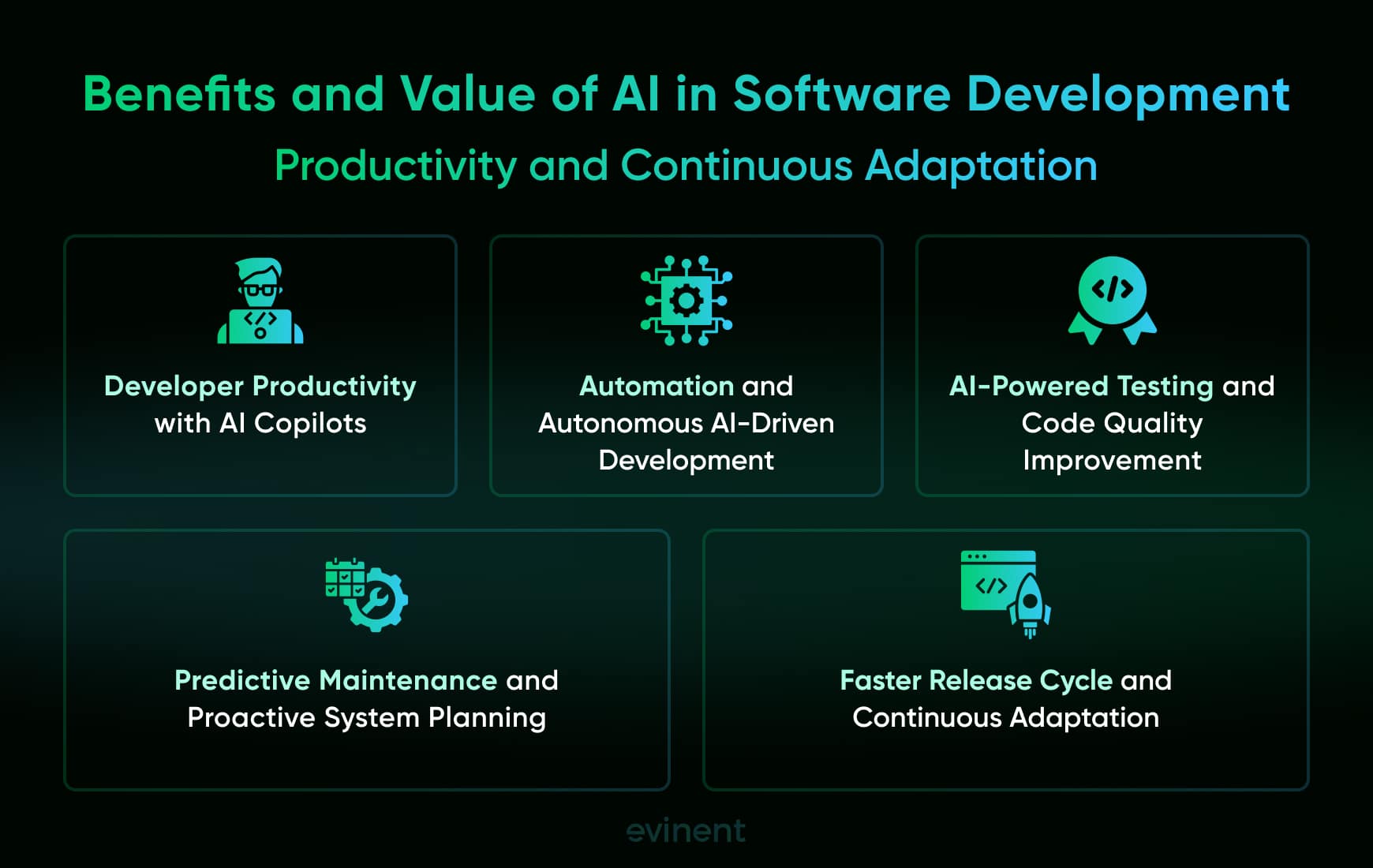
Developer Productivity and AI Copilots
As a result of AI copilots enhancing developer efficiency, coders are able to work more quickly and spend less time on mundane tasks. With a controlled study, it was found that developers who relied on GitHub Copilot could finish their work 55% faster. (GitHub & Microsoft Research, 2023)
Automation and AI-Autonomous Development
AI is a great tool to automate repetitive development tasks such as code generation, documentation, and testing. McKinsey even points out that generative AI has the potential to significantly improve software engineering productivity, possibly impacting 20-45% of development effort. (McKinsey & Company, 2023)
AI-Powered Testing Tools and Quality Improvement
As a result of facilitating automated testing and bug detection, AI enhances the quality of code. More than 50% of developers revealed in a Google developer survey that their code quality got better after they used AI tools. (Google Developer Research, 2024)
Predictive Maintenance and Proactive Planning
AI helps in predictive maintenance. It finds out about system problems even before they cause users any inconvenience. IBM states that companies that use AI-driven predictive maintenance can lower downtime by as much as 30-50%. (IBM, 2025)
Reduced Release Cycle Times and Continuous Adaptation
One of the ways AI speeds up software development is by cutting down developers' time on repetitive tasks and making workflows more efficient. JetBrains research shows that, on an average, developers who work with AI-assisted tools end up saving about 1 hour per week. (JetBrains Developer Ecosystem Report, 2025)
AI delivers measurable value in software development through increased productivity, automation, and faster iteration. Its strongest impact comes from reducing routine work and enabling teams to focus on higher-value tasks. However, real benefits depend on proper integration and human oversight—AI works best as an accelerator, not a replacement.
Challenges and Risks in AI SDLC: Non-Determinism, Edge Cases, and Compliance Gaps
The software development lifecycle is further complicated by AI. Traditional systems are static, but AI models depend on data, have probabilistic behavior, and are subject to environmental changes. As a result, risks become less predictable, testable, and controllable, particularly when scaling. Knowing these risks inside out is the key to creating dependable and trustworthy AI systems.
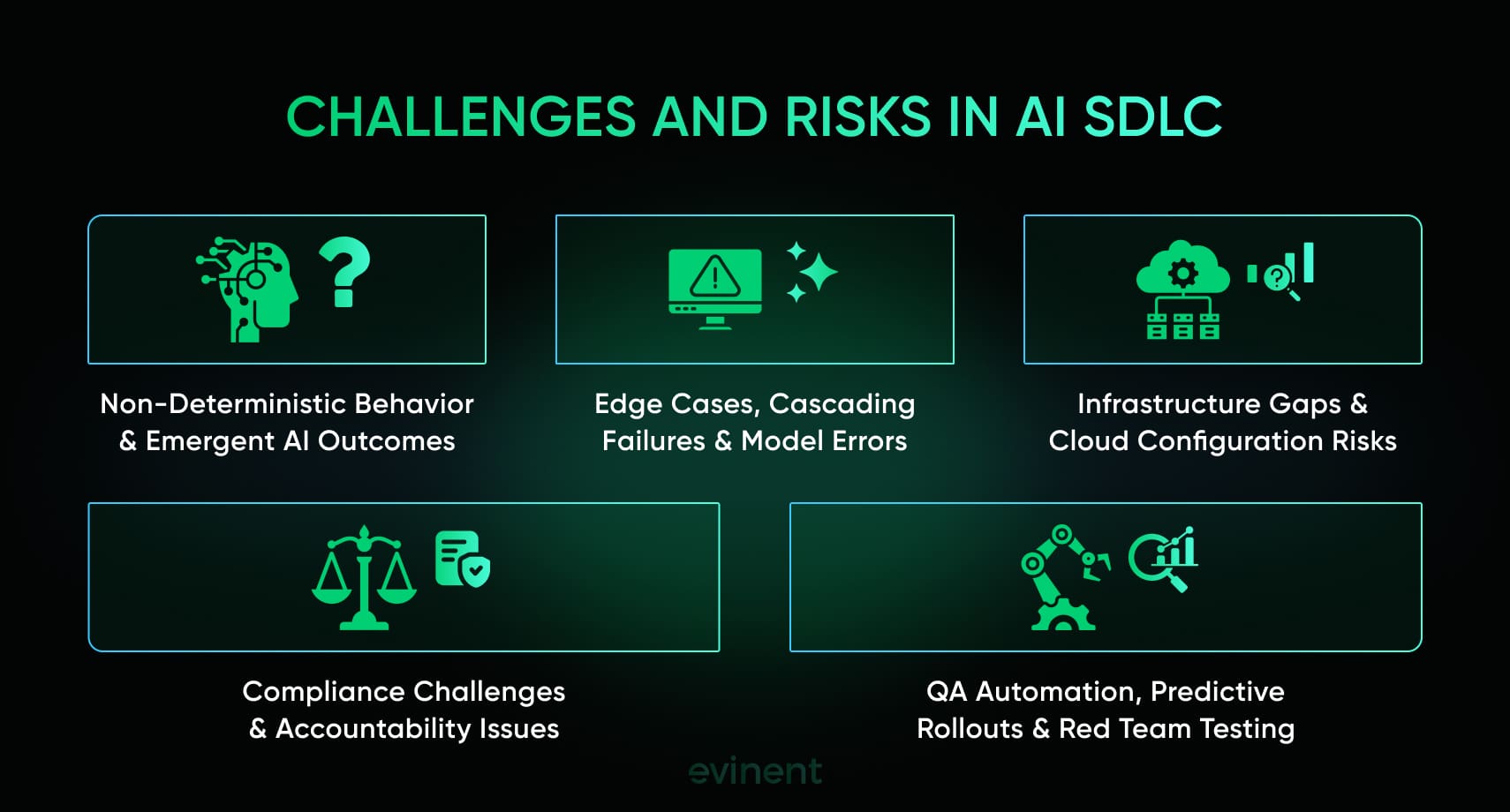
Non-Deterministic Outcomes and Emergent Behaviors
AI systems do not always produce the same output for the same input, especially in systems based on large language models or probabilistic algorithms. This non-determinism makes debugging and validation significantly harder compared to traditional software. Emergent behaviors—unexpected capabilities or failures that arise from complex model interactions—can appear without explicit design. These behaviors are difficult to anticipate during development and may only surface in production, making strong monitoring and fallback strategies essential.
Edge Cases, Cascading Errors, and Model Failures h3
AI models often perform well on average but fail in rare or unseen scenarios. These edge cases can trigger cascading errors, where one incorrect prediction leads to a chain of failures across the system. This is particularly dangerous in integrated environments where AI outputs are used as inputs for other components. Without robust validation and error handling, small inaccuracies can escalate into critical system failures.
Infrastructure Incompatibility and Cloud Misconfiguration
Deploying AI systems introduces infrastructure challenges, including mismatches between training and production environments. Differences in hardware, dependencies, or data pipelines can lead to inconsistent model behavior. Cloud misconfigurations, such as incorrect scaling rules or resource allocation, can cause performance degradation, increased costs, or system instability. AI workloads are often resource-intensive, making infrastructure reliability a key risk factor.
Compliance Gaps and Accountability Issues
AI systems need to adhere to data protection laws, industry regulations, and internal governance standards. Unfortunately, the intricacy of AI models often hampers transparency and accountability. This is why opaque decision-making processes, lack of explainability, and minimal documentation most likely result in compliance lapses. To handle legal and ethical risks, it is vital that organizations set responsibility limits and establish governance frameworks.
QA Agents, Predictive Rollouts, and Red Team Testing
Teams employ a mix of advanced validation methods including automated QA agents, phased rollouts, and red team exercises when they want to respond efficiently to AI risks. These techniques lead to finding security issues, prejudices, and unusual behaviors that might be hidden until full deployment.
Predictive rollouts are a method that permits running the models in real-life conditions but with limited exposure to the users so that any failure can be directly contained. Red team testing is done under adversarial conditions to detect vulnerabilities which normal testing might not identify.
AI systems pose a new range of risks beyond those usually associated with traditional software. Unpredictability, dependency on data, and the complexity of AI systems call for new methods in testing, releasing, and managing. Organizations who take the lead on these risks proactively by monitoring, validating, and organizing their processes will be the ones building more reliable, safer, and trustworthy AI solutions.
Adapting Organizations to AI-Driven Development Processes
A change to AI powered software development is not merely a matter of implementing new technology, but a deep transformation of organizational functioning. In order for AI-led development to be successful, it is necessary to align the human, procedural and technical elements to the particular AI lifecycle requirements. In contrast to conventional development, AI brings about ambiguity, ongoing learning, and heavy reliance on data. To a great extent, companies will need to change their organizational frameworks, cultures, and modes of decision making so as to extract full value of AI.
AI Capability Maturity and AI Workforce Development
Organizations need to build internal AI capabilities step by step, moving from basic experimentation to fully integrated AI systems. This includes developing skills in data engineering, machine learning, and MLOps. Workforce development is critical. Teams must be trained not only to use AI tools, but to understand their limitations, validate outputs, and manage risks. Companies that invest in structured upskilling programs are more likely to scale AI successfully.
AI Development Tools and AI Pod Model
AI development requires specialized tools for data processing, model training, and deployment. Standard development environments are often insufficient without extensions for handling data pipelines and experimentation. Many organizations adopt an AI pod model, where cross-functional teams include data scientists, engineers, and domain experts. This structure improves collaboration and accelerates decision-making, especially in complex AI projects.
Engineering Culture and Continuous Intelligence
AI powered companies move the core of their operations from one-and-done development lifecycle to ever-changing feedback-loops of continuous learning. Instead of relying on certain, fixed notions, more and more decisions get made based on data-derived insights. This changes everything from a culture standpoint: not only teams but also individuals have to be comfortable with trying things out, being uncertain, and changing their minds all the time. Continuous intelligence, the very idea that both systems and human teams are n learners from data, becomes the major skillset.
Domain-Trained Agents and Intelligent Systems
To achieve the best results, AI systems must be customized to particular areas. Agents who are trained in a specific domain utilize specialized data and context to provide outputs that are both more precise and relevant. Firms that commit to domain-specific AI are the ones who stand out in the market, however, this also means the systems becoming more complex. Running these systems is no easy task without continuous data updates and domain knowledge.
AI Consulting and Stakeholder Analysis
Aligning technical teams and business stakeholders is key to successful AI adoption. Conducting stakeholder analysis is one of the ways to establish goals, limitations, and definition of success at the very beginning of the process. AI consulting is a popular choice for many enterprises to help them in decision-making, recognizing potential mistakes, and carrying out solution deployments at faster pace. Insured clear and frequent communication between all parties involved will help to ensure that AI projects generate tangible worthwhile outcomes for the business.
Changes in skills, structure, and mindset are what adapting to AI-driven development calls for, not just new tools. Organizations have to invest in their workforce, adopt iterative methods, and develop systems that can continually learn and evolve. Those who manage to synchronize technology and organizational change stand a much better chance of making AI adoption scalable and sustainable.
Responsible and Ethical AI in the AI Lifecycle: Governance, Trust, and Compliance
With AI systems being deeply embedded in the main processes of the business, the question "How to use AI successfully?" cannot be answered without consideration of responsibility the responsible development and use of these systems must be ensured. Ethical risks that accompany AI development are a biased system without transparency and accountability, which will finally result in legal, financial, and reputation damages.
Responsible AI should never come after the completion of the development stage as a separate phase, but it should be considered as an element that covers the entire AI lifecycle and calls for governance structures, continuous checking, and human control at all phases.
Key Components of Responsible and Ethical AI
Area | What It Focuses On | Why It Matters |
AI Governance and Accountability Layers | Defining roles, responsibilities, and decision ownership across AI systems | Prevents accountability gaps and makes sure that everyone knows who is responsible for what outcome. |
Explainable AI (XAI) and Transparency | Making model decisions understandable and traceable | Builds trust and enables validation of AI behavior |
Ethical Impact Assessment and Bias Testing | Identifying bias, fairness issues, and unintended consequences | Reduces ethical risks and improves system fairness |
Regulatory Compliance and AI-Focused Legislation | Adhering to laws, standards, and industry regulations | Avoids legal penalties and ensures responsible deployment |
Human Oversight and Risk Management | Keeping humans involved in critical decisions and monitoring | Stops over-dependence on automated systems and reduces the effects of failures. |
Responsible AI is one of the pillars of modern AI systems and not a bonus. In the absence of governance, transparency, and oversight, even the AI models that work very well from a technical perspective may lead to serious risks. Companies that incorporate the ethical principles in the AI cycle at an early stage are in a better position to design reliable, compliant, and eco-friendly AI systems.
How Evinent Uses AI in the Software Development Life Cycle
The first and foremost cause why AI efforts fail is not due to the AI technology itself, but poor integration into the AI software development lifecycle- especially in terms of data management, deployment, governance, and real-world usage. Evinent sees AI development as a complete lifecycle and ensures that all the stages of AI development, from problem discovery to tracking, meet the business needs.
Rather than treating AI as a separate feature, Evinent integrates it into current development workflows and merges AI model development, MLOps, and organizational change to produce stable and scalable systems.
Case Study: AI-Driven HR Automation with Controlled Deployment
Recruitment firm in Europe handling high volumes of candidate applications was experiencing significant inefficiencies in their screening and matching activities. Their hiring team was manually going through numerous resumes, which not only slowed down the hiring process but also resulted in a random selection of candidates. Earlier tries of implementing AI didn't go far as the main reasons were worries about data privacy, unpredictability of model behaviour, and potential risks of rolling out AI in a live environment.
Key Risks Identified in the AI Lifecycle
Before implementation, several critical risks across the AI lifecycle were identified:
Data privacy and regulatory compliance risks when handling sensitive candidate information
Low-quality and unstructured data (resumes, job descriptions) affecting model performance
Non-deterministic outputs and hallucination risks in AI-generated responses
Deployment risks due to lack of controlled infrastructure and monitoring
Low trust and adoption among HR teams
Evinent’s AI Lifecycle Approach
Evinent designed the solution to address risks at every stage of the AI software development lifecycle:
Data Management: Data remained fully within the client’s infrastructure, ensuring privacy and compliance
Model Development: AI agents were designed with narrow, well-defined tasks to reduce unpredictability
Deployment: The system was deployed in isolated, containerized environments to ensure stability and control
MLOps and Monitoring: Continuous monitoring ensured consistent performance and early detection of issues
Organizational Integration: The system was aligned with real HR workflows to ensure usability and adoption
Closing Perspective
At the heart of Evinent's method is the notion of failure risk mitigation over the whole AI development lifecycle, not simply enhancing model performance. Through the integration of excellent data handling, regulated rollout, and ongoing observation, AI systems transform into dependable elements of enterprise infrastructure rather than mere experimental instruments. Thanks to the lifecycle orientation, the organization has the ability to transform AI pilot projects from a few isolated ones into broad, scalable, and production-ready systems.
Key Takeaways
The AI software development lifecycle is iterative, not linear ー continuous feedback, monitoring, and improvement are essential for long-term success.
Data is the foundation of AI systems; poor data quality or governance will limit performance regardless of model sophistication.
Strong AI model development and evaluation practices are critical to ensure models generalize well and remain reliable in real-world conditions.
Deployment is not the final step ー MLOps, monitoring, and scalability determine whether AI systems actually work in production.
AI significantly improves productivity and automation, but requires human oversight to validate outputs and manage risks.
AI introduces unique challenges such as non-determinism, edge cases, and compliance risks that must be addressed proactively.
Successful AI adoption requires organizational change, including new skills, processes, and engineering culture.
Responsible AI practices ー governance, transparency, and accountability ー are essential for trust and long-term sustainability.
Integrating AI across the full lifecycle, rather than as a standalone feature, is key to building scalable and reliable systems
Share