

What is Private RAG (Retrieval-Augmented Generation)
Private Retrieval-Augmented Generation (Private RAG) is an AI technique that works by fusing large language models (LLMs) with enterprise data sources, making sure all stages of data retrieval and processing occur in a tightly controlled and secure setting.
By contrast to the usual RAG systems that mostly depend on external APIs or third-party infrastructures, Private RAG isolates confidential info, like company source files, databases, or user records, in private or dedicated environments (e.g., on-premises or private cloud). That way, companies can have complete control over data access, use, and compliance.
The key difference lies in data ownership and security. While traditional RAG focuses on improving model responses with external knowledge, Private RAG is designed specifically for scenarios where privacy, compliance, and data protection are critical.
In fact, the "private" attribute is most crucial for those entities handling sensitive or regulated information. It acts as a safeguard against data leakage, aids in meeting compliance regulations (like GDPR, HIPAA), and, most significantly, keeps delicate data from being shared with third-party service providers.
“You want to cross‑reference a model’s answers with the original content so you can see what it is basing its answer on.” — Luis Lastras, Director of Language Technologies at IBM Research, on the core value of Retrieval‑Augmented Generation: grounding model outputs in verifiable data rather than relying solely on learned weights.
What This Article Will Cover
Next, we will discuss the main points for designing and implementing Private RAG systems:
When to use Private RAG vs alternative approaches (e.g., private LLMs or commercial APIs).
Industry use cases and real-world applications.
Technical architecture and core system components.
Step-by-step implementation process and best practices.
Privacy risks and mitigation strategies.
Security, compliance, and data protection considerations.
Tools, frameworks, and platforms for building Private RAG.
Limitations and trade-offs of Private RAG systems.

Private RAG vs Private LLMs vs Commercial APIs: How to Choose
How you pick the AI method depends on your needs for control, security, and customization, in that order. The most typical three choices, Private RAG, Private LLMs, and Commercial APIs, fulfill different requirements and entail different compromises.
Factor | Private RAG | Private LLM | Commercial APIs |
Data usage | Uses internal data via retrieval | Encodes knowledge into the model | Data sent to external providers |
Latency | Medium (retrieval + generation) | Low (no retrieval step) | Low to medium |
Cost | Medium (infra + storage + compute) | High (training/fine-tuning) | Pay-per-use |
Control | High | Very high | Limited |
Security | High (data stays internal) | Very high (fully self-contained) | Depends on the provider |
Fresh data | Yes (dynamic retrieval) | Limited (requires retraining) | Limited |
Setup time | Medium | Long | Very fast |
When to Use Each Approach
Private RAG: Opt for this when you require answer retrieval from internal data (e.g., a set of documents, knowledge bases) and at the same time, you want to keep a high level of security, but also have the flexibility to change things around.
Private LLMs: These can be used if you have very niche and specific tasks, where the most relevant information will be part of the model; and maximum control is a prerequisite.
Commercial APIs: They would be a good fit if you want to have the feature ready quickly, and are in the early stages of development, or if the cases are not sensitive, and for you, the speed and the simplicity are the most important factors over the level of control.
Key Decision Factors
When choosing between these approaches, focus on:
Latency: How fast do you need the replies? Would a due to the retrieval process be acceptable?
Cost: Do you primarily need to minimize your initial expenditure or your running costs?
Control: To what extent would you like to be able to tailor the system and look under its hood?
Security: Is your data subject to such stringent isolation and compliance requirements that it cannot be commingled with other data?
Different approaches, Private RAG, private LLMs, and commercial APIs, focus on different aspects, such as speed and ease of use, or control and security. Usually, Private RAG is the most suitable way of working with internal and regularly updated data, however, it is not without extra complexity and operational burden. It is very important to understand the trade-offs before making an architectural decision, which is why in the next section we are going to explore the major limitations of Private RAG systems and how they affect deployments in the real world.
Trade-offs and Limitations of Private RAG
Private RAG is a wonderful tool for those companies that wish to get accurate AI answers from their own data in a safe and secure manner. The idea behind it is to join a search method and large language models so that the content of the answer is verified by the knowledge of the company. Still, although it provides more control and flexibility advantages, it shouldn't be seen as flawless. Recognizing these disadvantages is necessary if one wants to decide wisely on architectural, deployment, and upkeep issues.
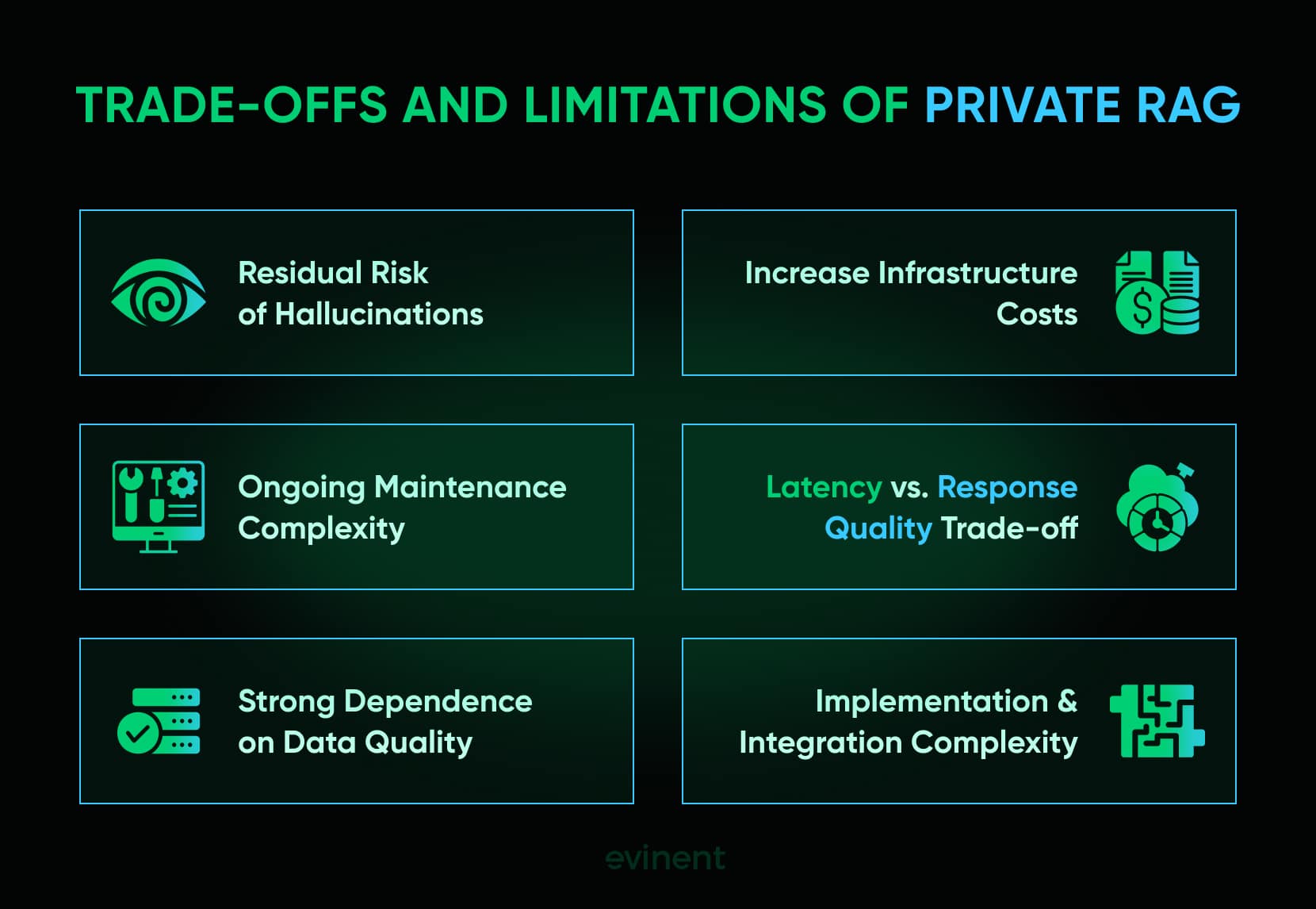
1. Hallucinations Are Still Possible
Despite the use of retrieval-augmented context, models are still capable of generating inaccurate or misleading content. In instances where the fetched documents happen to be incomplete, one way to think of an LLM is as if it were a person who might guess the missing leftovers with some (possibly wrong) info. This makes it especially worrying in sectors such as healthcare or legal services, where a mistake might lead to a chain of very bad consequences.
2. Higher Infrastructure Costs
Deploying Private RAG requires dedicated hardware resources such as GPUs for model inference, storage for document embeddings, and vector databases for fast retrieval. Unlike commercial APIs, which charge per request, Private RAG shifts costs to a mix of upfront investment and ongoing operational expenses. Organizations need to plan for electricity, maintenance, and scaling as data volumes grow.
3. Maintenance and Operational Complexity
A Private RAG system is not unchanging. In order to keep data accurate, it must be updated regularly, re-indexing will have to be done, and you will need to keep an eye on retrieval pipelines. Also, crews will have to change embedding models, make ranking algorithms even more effective, and adjust s as time goes on. If one doesn't do the maintenance regularly, the quality of the system could get worse, thus the reliability would be reduced.
4. Latency vs. Quality Trade-off
Every time a query is made, obtaining and processing internal data contribute to the latency. If you retrieve more documents or use larger context windows, you will get better quality responses but at a slower pace. If you want to get the right answers quickly, you will have a hard time balancing speed and accuracy of answers, and you might have to make compromises, e.g., when you are dealing with time-sensitive applications such as customer support chatbots.
5. Dependence on Data Quality
Private RAG is very dependent on the quality of internal knowledge. If your documents are not well structured, inconsistent, or even out-of-date, the accuracy of the generated responses will be reduced. For example, if the financial reports are with errors or incomplete records, the system may give misleading analysis even if the retrieval mechanism is working properly.
6. Implementation Complexity
Building a Private RAG pipeline is complex. It involves integrating multiple components, including data ingestion pipelines, embedding models, vector search engines, orchestration layers, and the LLM itself. Teams need expertise in AI engineering, DevOps, and data management. This complexity can increase the time and effort required to move from concept to production-ready system.
Private RAG offers a compelling balance of security, flexibility, and access to internal knowledge, making it suitable for enterprises handling sensitive or regulated data. However, organizations must carefully weigh their trade-offs: ongoing infrastructure costs, operational complexity, latency, dependency on data quality, and the risk of hallucinations. By acknowledging these limitations upfront, teams can plan more effectively and deploy Private RAG systems that are reliable, scalable, and aligned with business goals.
Real‑World Applications of Private RAG
Private RAG has moved beyond being a niche experimental technology; it is now one of the main enterprise AI patterns for organizations needing safe, precise, and context-aware responses that are based on their own data. Besides adoption rates and industry use cases, RAG is reshaping the way that businesses make use of their own knowledge. Recent market data indicates that about 45 % of enterprise AI implementations will integrate RAG structures in 2025, which is a significant increase from the 15 % in 2023. This rise is fueled by the tangible enhancements in productivity and return on investment. (Gitnux, 2026)
1. Healthcare — Enhanced Clinical Support and Records Access
For instance, in healthcare, Private RAG allows linking of EHR, clinical guidelines, imaging reports, and research literature together, enabling doctors to use natural language to ask questions and receive well-supported, relevant answers. This application not only cuts down on manual searching across different platforms but also has an ability to speed up the making of clinical decisions while potentially enhancing their quality. More than 50% of health tech RAG users have witnessed their diagnostic workflows becoming more efficient and having quicker access to vital information. (Gitnux, 2026)
2. Legal — Faster Legal Research and Contract Analysis
Law firms and in‑house legal teams use Private RAG to index contracts, internal policies, precedents, and regulatory texts so lawyers can quickly retrieve relevant clauses or summaries. This dramatically decreases the time needed for research and review compared with traditional keyword search, especially when dealing with large corpora of unstructured legal documents. Adoption in legal tech is among the strongest, with many firms integrating RAG into internal tools and document management systems. (Gitnux, 2026)
3. Enterprise Search and Knowledge Management
One of the challenges for big companies is knowledge silos, where different departments have their own separate documentation, manuals, and SOPs. Private RAG can help close these gaps by allowing semantic search across all internal corpora so that employees receive brief, contextually relevant answers no matter where the source content is located. According to reports, RAG is the main architecture for production enterprise search systems and supports over 70 % of internal AI knowledge tools. (Hakia, 2025)
4. Customer Support Automation
Customer support teams implement Private RAG to integrate support tickets, product documentation, FAQs, and policy texts into AI assistants that retrieve relevant context before generating responses. This improves first‑contact resolution rates and shortens response times while preventing sensitive information from being exposed to external providers. In 2024, customer support applications captured more than 31 % of the total RAG market revenue, demonstrating broad enterprise investment in this use case. (Research Intelo, 2024)
5. Finance — Risk, Compliance, and Decision Intelligence
Financial institutions use RAG to analyze internal reports, compliance filings, transaction logs, and risk models. Having their own private deployment means that PII and sensitive financial data can be kept safe. RAG helps in fraud detection, automated compliance checks, and accelerated due diligence review so that decision support can be more efficient and trusted, not only basic rule-based systems. (Gitnux, 2026)
Across various sectors such as healthcare, legal, enterprise search, customer support, finance, and research, Private RAG allows AI systems to provide accurate, context-aware answers from proprietary sources without compromising the security of sensitive data. Adoption numbers indicate that RAG is quickly establishing itself as a fundamental element in enterprise AI, not merely a point solution, but serving as the basis for a wide variety of mission-critical applications.
Technical Architecture of a Private RAG System
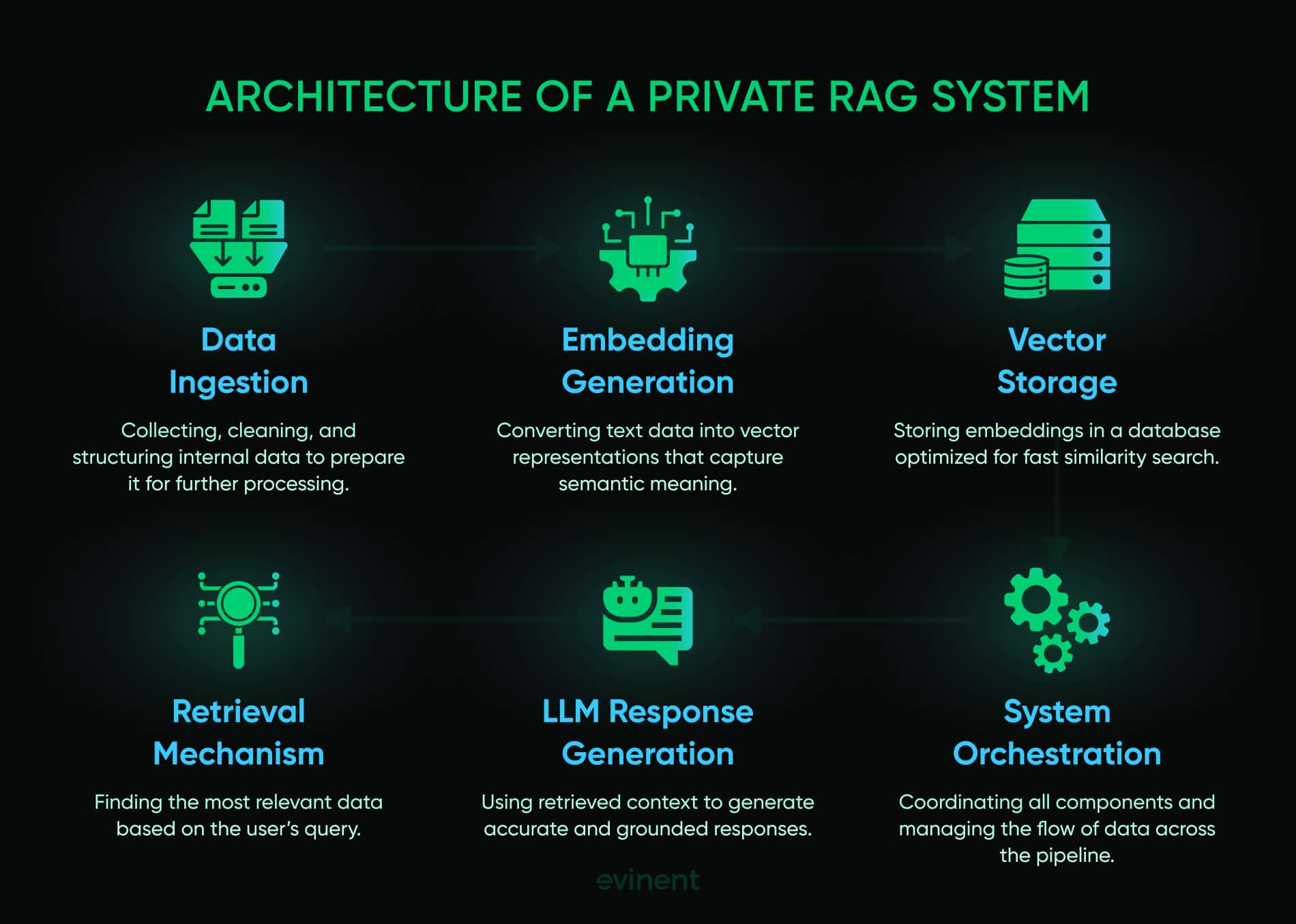
A Private RAG system is designed as a multi-stage pipeline that links internal data sources with a language model to produce context-aware responses. Each part has its distinct function in converting raw data into meaningful answers.
1. Data Ingestion
The process begins by collecting data from internal sources, such as documents, databases, knowledge bases, and APIs. This data is then cleaned, normalized, and split into smaller chunks to facilitate processing and retrieval. Proper ingestion is critical, as it directly impacts the quality of downstream results.
2. Embeddings
Once the data is prepared, it is converted into vector representations using an embedding model. These embeddings capture the semantic meaning of the text, allowing the system to perform similarity-based search rather than simple keyword matching.
3. Vector Database
The generated embeddings are stored in a vector database, which is optimized for fast similarity search. This component enables efficient retrieval of relevant documents based on user queries, even across large datasets.
4. Retrieval
When a user submits a query, it is also converted into an embedding and compared against stored vectors. The system retrieves the most relevant documents or text chunks, which will later be used as context for the language model.
5. LLM Inference
The language model is supplied with the retrieved context along with the user query. The model then produces a response based on the given information, which makes the response more accurate and less hallucinatory than the one generated by standalone LLMs.
6. Orchestration
An orchestration layer that is capable of coordinating all elements of the system. It controls the movement of data between ingestion, retrieval, and generation, takes care of construction, implements business logic, and makes sure that the system runs efficiently and without failure.
Actually, the effectiveness of a Private RAG system is really dependent on the integration of all these layers, not even a single component. Therefore, even slight improvements in retrieval quality or data preparation can have a great influence on the final output.
How to Build a Private RAG System: Step-by-Step Guide
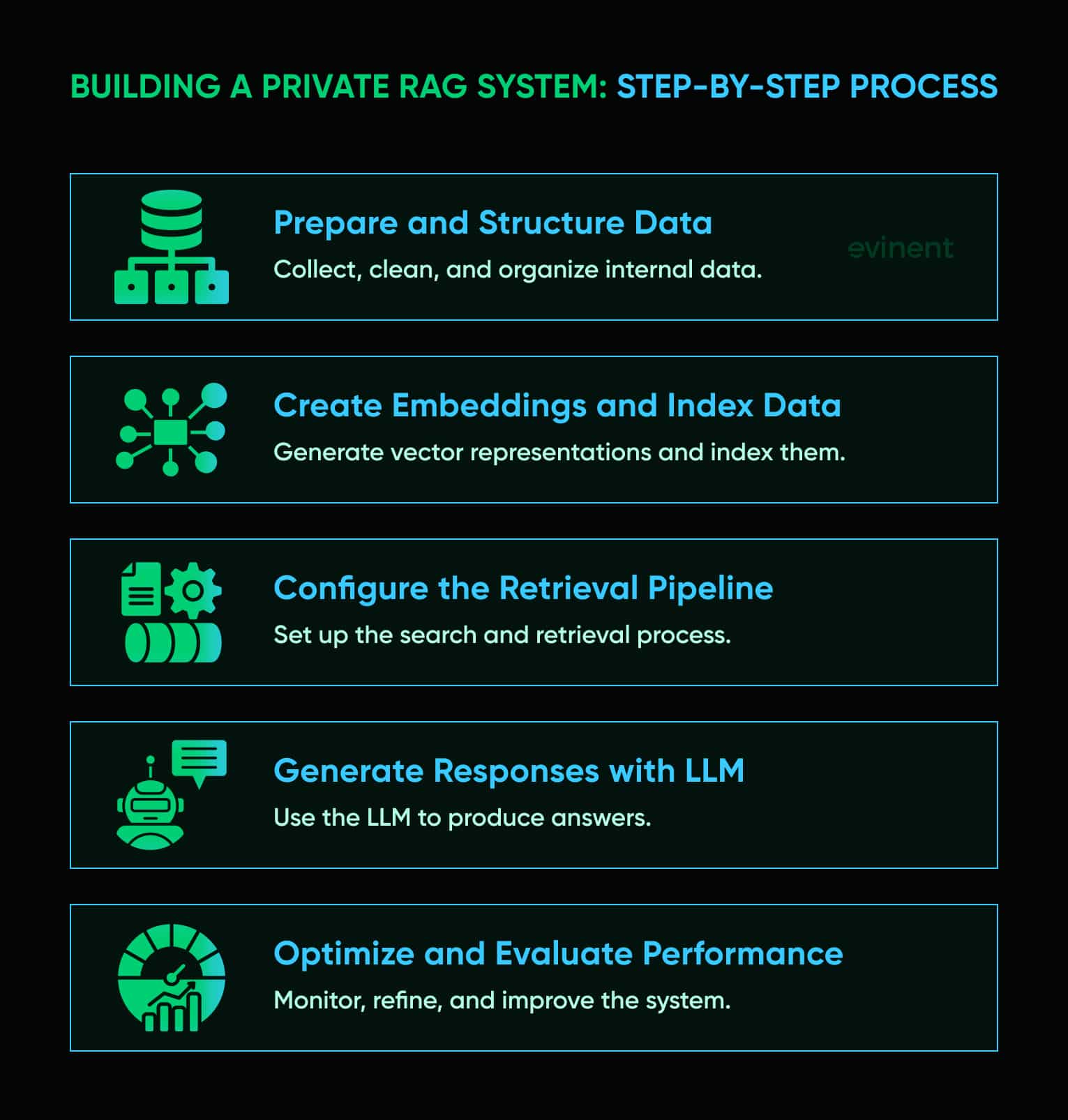
Implementing a Private RAG system is a systematic method of transforming raw internal data into a complete AI pipeline. Every step relies on the previous one, which is why any errors made at the beginning stages can greatly affect the final system output.
Step 1: Prepare and Structure Your Data
The process starts by collecting data from internal sources, such as documents, databases, and knowledge bases. This data must be cleaned, standardized, and split into smaller chunks. Chunking is critical because it directly affects retrieval quality. Well-structured and properly segmented data makes it much easier for the system to return relevant results.
Step 2: Generate Embeddings and Build the Index
Next, the prepared data is converted into vector representations using an embedding model. These embeddings capture the semantic meaning of the content. The vectors are then stored in a vector database, creating an index that allows the system to perform fast and accurate similarity searches.
Step 3: Set Up the Retrieval Pipeline
User questions are first turned into embeddings, which are then matched with the saved vectors. The system identifies the data parts that are most related to the query. Usually, at this point, ranking and filtering are applied to make sure that only the most appropriate context proceeds.
Step 4: Generate Responses with the LLM
Retrieved context and the user query are combined and sent to the language model. design is a key factor at this stage as it determines how the model will work with the given information. A properly set generation step guarantees the answers are based on actual data and not on the model's internal assumptions.
Step 5: Optimize and Evaluate the System
When the pipeline is functioning, the attention naturally moves to making it more effective. The optimization techniques may involve minimizing , caching, and quality judgment of the responses. The teams often monitor factors like correctness, suitability, and duration of the output, and their development efforts are always based on actual usage and user input.
In reality, developing a Private RAG system involves going through several rounds of revisions and corrections. How good the final output will be heavily rely on how each step, from data preparation to retrieval and generation, is carried out and gradually refined. Sometimes, tiny enhancements in data organization or retrieval methods can work wonders.
Once the main process has been set up, the question of how personal information should be dealt with in the system naturally comes up. Next, we will discuss the major privacy threats in Private RAG and ways to deal with them.
Privacy, Security, and Compliance in Private RAG
Since Private RAG systems use sensitive and proprietary data, privacy and security become the top concern at every step of the process. Risks may emerge at various points from raw data and embeddings to infrastructure and access control; hence, a well-structured approach is needed for risk mitigation by the organizations.
Risk | Where It Occurs | Why It Matters | Mitigation |
Source data leakage | Data ingestion/retrieval | Sensitive documents may be exposed directly in responses | Data classification, redaction, and access filtering before retrieval |
Embedding leakage | Embedding storage | Embeddings can encode sensitive information and be reverse-engineered | Encryption, restricted access, self-hosted embedding models |
leakage | Query/ layer | User inputs or system s may contain confidential data | sanitization, no logging of sensitive inputs, isolation from third-party APIs |
Over-retrieval of data | Retrieval pipeline | Too many or irrelevant documents increase the risk of exposing sensitive info | Top-k limits, relevance ranking, context filtering |
Unauthorized access | Application layer | Users may retrieve data outside their permission scope | RBAC/ABAC, document-level permissions, identity-aware retrieval |
Data exposure (in transit / at rest) | Infrastructure | Data can be intercepted or accessed if not properly secured | End-to-end encryption (TLS), encrypted storage |
Lack of auditability | System monitoring | No visibility into who accessed what data and when | Audit logs, monitoring, anomaly detection |
Regulatory non-compliance | System-wide | Violations of GDPR, HIPAA, etc., can lead to legal and financial risk | Data governance policies, PII handling, compliance reviews |
What Actually Matters in Practice
In fact, when it comes to field deployments, the biggest errors cannot be blamed on technical issues. The truth is, the greatest blunders are architectural ones:
Failure to implement access control at the retrieval stage → as a result, users get to see documents they are not supposed to
Embedding-based trust at face value → one assumes that the embeddings are "safe," whereas they are actually not
Keeping logs of everything → which also includes sensitive s and responses
Running third-party APIs without isolation → careless data exposure
Highly secure management handles retrieval as an operation that involves permissions rather than mere similarity search.
Deployment and Compliance Considerations
Security depends largely on the deployment of a Private RAG system:
On-premises / private cloud. By doing so, you have maximum control of your data. This will not only make it easier for you to if you want to enforce strict access policies and ensure regulatory compliance, but also to maintain hardware, storage, and network isolation.
Public cloud. If you want to maintain the same level of security, then you will need to be very careful with your configuration. You will need to ensure strong isolation, identity and access management (IAM), encryption at rest and in transit, and monitoring to prevent accidental exposure.
For industries subject to regulation, compliance frameworks such as GDPR or HIPAA add further requirements:
Maintaining confidentiality of personally identifiable information (PII)
Having well-defined data retention and deletion policies
Providing a detailed audit trail of who accessed what data and when
It is very important to pick the right deployment strategy and put in place strong compliance measures in order to protect confidential information and steer clear of legal and financial issues.
Privacy and security in Private RAG cannot just be addressed through a single tool or layer alone. They need a set of coordinating controls to be implemented across data, retrieval, and infrastructure. The key standpoint here is: if the retrieval part is left insecure, then the rest of the system is, in fact, insecure.
Considering this factor while designing is precisely what differentiates experimental RAG systems from production-ready enterprise solutions.
Tools and Platforms for Building Private RAG Systems
Deploying a Private RAG system is not just about the physical hardware; it's about the combination of tools, frameworks, and infrastructure choices as well. In fact, it is most probably the combination of these that needs to be decided to achieve the desired performance, scalability, and security levels.
1. Vector Databases
Vector databases store embeddings and allow for quick similarity search, which is at the center of any RAG pipeline. Some of the most popular choices are:
Chroma – lightweight and developer-friendly, ideal for small to medium datasets.
Qdrant – optimized for high-performance vector search at scale.
Weaviate – includes built-in ML modules and semantic search capabilities.
Such databases help in efficient extraction of relevant documentation even among a large number of documents, and are frequently combined with well-known embedding models.
2. Frameworks
Frameworks make it easier to build Private RAG pipelines by supplying ready-made components for embedding, retrieval, and orchestration. Major examples:
LangChain – a modular framework to connect LLMs with retrieval pipelines.
LlamaIndex (formerly GPT Index) – allows easy indexing of documents and integration with embeddings.
TensorFlow/Hugging Face Transformers – provide embedding models and inference support for custom pipelines.
Besides, frameworks help teams get things done faster, with less writing of template code, and more focus on business-specific features rather than on the low-level details of the implementation.
3. Deployment Options: Cloud vs On-Premises
The range of deployment platforms mostly determines the aspects of control, security, and compliance:
On-Premises – Offers full control over data, hardware, and network. Ideal for organizations with strict regulatory requirements.
Private Cloud – Provides flexibility while maintaining strong isolation and compliance controls.
Public Cloud – Easier to scale but requires careful configuration to protect sensitive data. Encryption, access controls, and audit logs are critical in this setup.
Carefully picking the deployment setting will ensure the system fulfills performance criteria and security demands as well.
Constructing a Private RAG system involves more than just the model; it is a matter of assembling the appropriate vector database, framework, and deployment environment. The right combination of tools guarantees fast data retrieval, precise AI answers, and the protection of confidential information.
How Evinent Helps Build Secure Private RAG Systems
Implementing a Private RAG system is much more than just hooking up a language model; it involves thorough planning of data pipelines, retrieval mechanisms, infrastructure, and security. That is why Evinent helps companies transform RAG from just an idea to a dependable production system.
Why Organizations Choose Evinent
Experience in enterprise and regulated environments
Strong background in building secure systems where data protection and compliance are criticalEnd-to-end system design
From data ingestion and structuring to retrieval pipelines and LLM integrationFocus on real-world performance
Not just working demos, but systems optimized for latency, accuracy, and scalabilityIntegration expertise
Connecting internal data sources, APIs, and existing enterprise systems into a unified pipeline
Relevant Experience: Private AI for Secure HR Automation
Evinent Private AI solution was developed for a European enterprise to automate their recruitment workflows, at the same time ensuring strict data isolation. The system is capable of finding the right candidates for each vacancy by using very large internal datasets and without depending on external AI providers.
The solution introduced separate AI agents for different user roles. A recruiter assistant handled the search for and filtering of candidates based on skills, experience and availability, whilst a candidate assistant helped applicants find relevant job vacancies. All processing took place within the client’s secure infrastructure, without any external API calls.
To ensure reliability, Evinent implemented an atomic agent architecture, where each component was responsible for a specific task such as search, matching, or summarization. This approach reduced hallucinations and made system behavior more predictable and easier to control.
Security was an essential feature. The system was installed in a completely isolated environment, with role-based access control, encrypted data flows, and sensitive information such as CVs and job data only being processed internally. The design of the architecture was made to match the security standards of the enterprise and to be compliant with frameworks like GDPR.
As a result, the client was able to test a scalable Private AI approach for HR automation, improving matching efficiency while maintaining full control over sensitive recruitment data.
What Evinent Delivers
Evinent assists organizations in creating and putting into operation Private RAG systems that are specifically customized to their data, infrastructure, and compliance needs:
Secure data ingestion and preparation pipelines
Embedding and vector search implementation
Retrieval optimization and ranking strategies
LLM integration with controlled ing
Access control and data governance mechanisms
Deployment in private cloud or on-prem environments
Primarily, the aim is to develop systems that are functional and at the same time maintainable, auditable, and in line with business needs.
Our Approach
Rather than proposing a standard solution, Evinent collaborates with individual organizations to:
Our approach
Private RAG has great potential to add value; however, it is only capable of fully realizing this potential when it is well thought-out and harmoniously integrated with the current systems. Evinent assists enterprises to shift from trials to full deployment, developing safe and scalable RAG solutions that are based on actual data and real-world limitations.
Key Takeaways
Private RAG combines LLMs with internal data to deliver context-aware responses while keeping sensitive information under full organizational control.
It offers a balanced alternative to private LLMs and commercial APIs—providing better data freshness and flexibility without fully sacrificing security or control.
Architecture matters more than the model: data preparation, retrieval quality, and system design have a bigger impact on results than the choice of LLM alone.
Implementation is a multi-step process, requiring structured data pipelines, embedding strategies, retrieval optimization, and continuous evaluation.
Private RAG is widely used across industries, including healthcare, legal, finance, enterprise search, and customer support, where internal knowledge is critical.
It comes with real trade-offs, including higher infrastructure costs, increased complexity, latency considerations, and dependence on data quality.
Privacy and security must be built into the system, not added later—risks exist at the data, embedding, , and infrastructure levels.
Tooling and infrastructure choices are critical, including vector databases, frameworks, and deployment strategy (on-prem vs cloud).
Successful systems are iterative, requiring continuous tuning, monitoring, and alignment with business goals.
Private RAG delivers the most value in production when it is properly integrated, secured, and optimized for real-world use cases.
Share