

Why are so many companies suddenly redesigning their entire technology stack around AI?
For many executives, the answer comes down to one uncomfortable realization: the AI tools they experimented with a year ago simply cannot scale across the organization.
A single chatbot or predictive model is easy to deploy. Running dozens of AI systems across departments, while keeping data secure, compliant, and reliable, is a completely different challenge. That challenge is exactly what enterprise AI architecture is designed to solve.
And the urgency is real.
According to McKinsey’s The State of AI in 2025: Agents, Innovation, and Transformation, over 88% of organizations now use AI in at least one business function, nearly double the adoption rate seen just a few years ago. Meanwhile, Gartner predicted that more than 80% of enterprises will deploy generative AI APIs or models by 2026, compared with less than 5% in 2023.
The rapid expansion of generative AI, autonomous agents, and large-scale data pipelines has pushed companies into unfamiliar territory. What began as isolated machine learning experiments is quickly turning into an enterprise infrastructure that must operate with the same reliability as cloud platforms or financial systems.
That shift is already reshaping budgets and strategy.
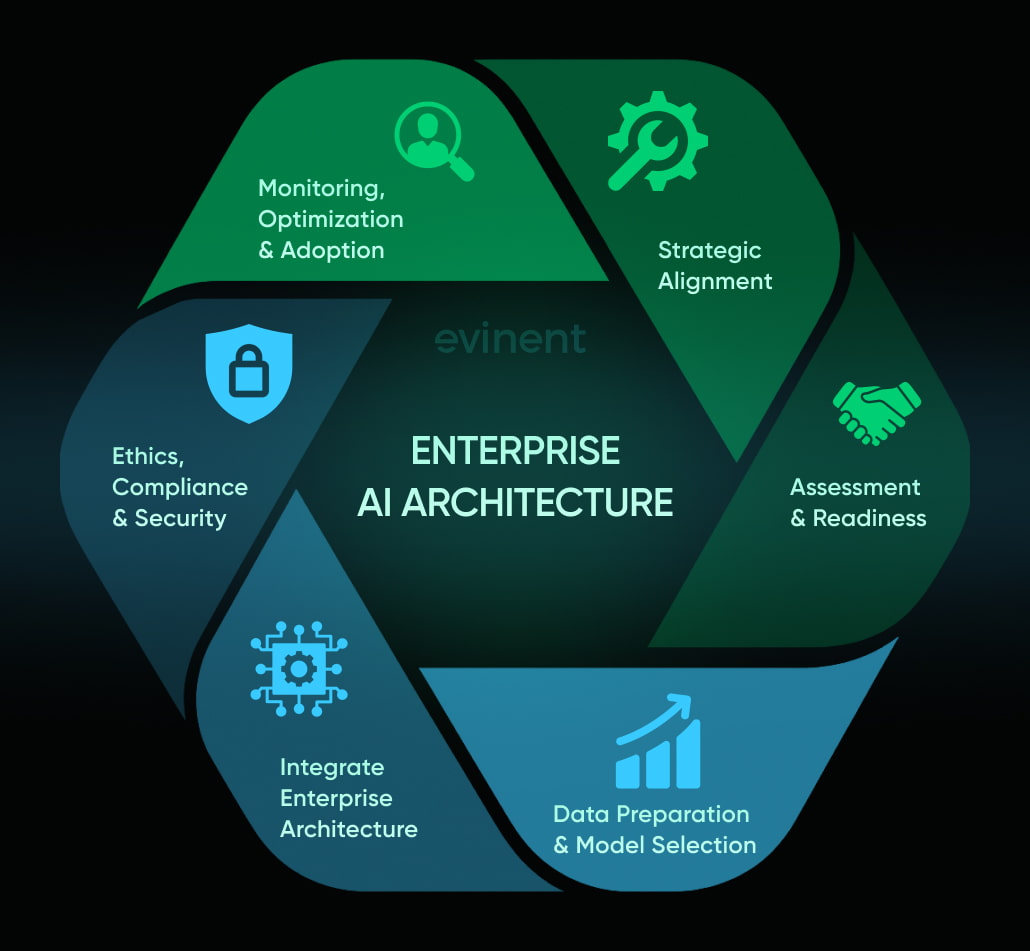
Research from Mordor Intelligence estimates that the enterprise AI market reached roughly $273.08 billion by 2031, reflecting nearly 19% annual growth. Organizations are investing not just in AI models but in the underlying systems that allow those models to function safely and consistently across departments.
Yet many companies are discovering that deploying AI tools without a clear architecture creates more problems than solutions.
Data pipelines break. Models drift. Compliance teams struggle to audit automated decisions. Infrastructure costs spiral as GPU workloads expand.
As Andrew Ng, founder of DeepLearning.AI, has often emphasized:
“Just as electricity transformed almost everything 100 years ago, today I actually have a hard time thinking of an industry that I don’t think AI will transform in the next several years.”
But electricity only became transformative once companies built the infrastructure to distribute it reliably.
AI is reaching the same moment.
Today, enterprise leaders are realizing that AI success depends less on the model itself and more on the architecture surrounding it: the systems that manage data, the training pipelines, the governance controls, and the real-time deployment.
Another perspective comes from Gartner analyst Erick Brethenoux, who notes:
“AI is moving faster than ever. AI techniques should bring adaptability to an uncertain world in constant flux. However, despite its extraordinary power and early promises, AI has not been leveraged to its full potential.”
That architecture must connect data platforms, machine learning pipelines, security frameworks, and business applications into a single coordinated environment.
Without it, AI remains an experiment.
With it, AI becomes a core capability that drives automation, decision-making, and the development of new products across the entire organization.
In this guide, we’ll break down how enterprise AI architecture works, what components modern systems include, and why companies across industries, from finance to healthcare, are investing heavily in building these platforms today.

What is Enterprise AI Architecture?
If AI is becoming core infrastructure for modern companies, then a simple question follows: What exactly is enterprise AI architecture?
At its simplest, enterprise AI architecture is the structured system that allows artificial intelligence to operate reliably across an entire organization. It connects data platforms, machine learning models, applications, and governance policies so that AI services can be deployed, monitored, and improved continuously.
Instead of building isolated models for individual departments, companies create a shared foundation that supports multiple AI workloads simultaneously. That foundation usually includes data pipelines, model development environments, APIs, monitoring systems, and security controls. Together, these components form what many technology leaders now call the enterprise AI platform.
A useful way to think about it is to compare AI to transportation infrastructure. A single car can drive without highways, traffic rules, or maintenance systems. But a national transportation network requires coordinated planning across roads, regulations, fuel supply, monitoring systems, and safety standards.
Enterprise AI works the same way. Individual models may work in isolation, but large organizations need an architecture that coordinates everything around them.
A practical definition
Most industry frameworks define enterprise AI architecture as a layered system that integrates data, models, infrastructure, and governance. The goal is simple: allow AI systems to run across business processes without creating technical chaos.
Microsoft’s enterprise architecture guidance for AI describes it this way:
“You can incorporate AI into applications to do functions or make decisions that traditional logic or processing can't handle effectively. As an architect who designs solutions, you need to learn about the AI and machine learning landscape and how you can integrate Azure solutions into your workload design.”
This architectural approach ensures that models can move safely and efficiently from experimentation to production.
Without it, companies often experience the same pattern: promising prototypes that never scale.
Why traditional AI systems struggled to scale
Early AI deployments inside companies were usually built for a single use case.
A fraud detection model might run inside the finance department. A recommendation system might operate inside an e-commerce platform. A chatbot might serve customer support.
Each system often had its own data pipeline, development process, and infrastructure. Over time, these separate tools created a patchwork of disconnected AI systems.
Several problems typically emerged:
Data silos prevented teams from sharing insights
Model duplication increased development costs
Infrastructure inefficiencies drove cloud spending upward
Compliance teams struggled to audit automated decisions
These limitations explain why many organizations began redesigning their AI systems around a more unified architecture.
Enterprise AI architecture solves this by introducing shared platforms and standardized processes for data management, model development, deployment, and governance.
Key layers of enterprise AI architecture
Most enterprise AI systems follow a layered design. Each layer handles a different stage of the AI lifecycle.
While the exact implementation varies between companies, the architecture generally includes several core layers.
Data layer
The data layer collects and prepares the information that AI systems rely on. This includes both historical datasets and real-time operational data.
Typical components include:
data lakes and data lake storage systems
real-time ingestion pipelines
data integration services connecting enterprise systems
data quality and cleansing pipelines
metadata repositories
These systems create a centralized environment where AI teams can access consistent and reliable datasets.
Strong data architecture is essential because the quality of AI models depends directly on the quality of the underlying data.
Model and machine learning layer
This layer contains the tools used to build and train AI models. It includes the environments where data scientists experiment with algorithms and deploy production models.
Typical components include:
machine learning development platforms
feature engineering pipelines
automated machine learning workflows
foundation models and fine-tuned task-specific models
model evaluation frameworks
Most companies now combine these capabilities with machine learning operations (MLOps) platforms that automate testing, deployment, and lifecycle management.
MLOps has become a defining element of modern enterprise AI architecture because it enables organizations to manage hundreds of models without constant manual oversight.
Application layer
Once models are trained, they need to deliver value through applications and services.
The application layer integrates AI capabilities into operational systems such as:
enterprise resource planning platforms
CRM systems
supply chain management tools
customer support platforms
analytics dashboards
In modern architectures, these services are usually deployed as AI microservices. Each service exposes a specific capability, such as classification, prediction, or natural language processing, through APIs that other systems can call.
This modular approach allows companies to scale individual AI services independently without redesigning the entire system.
Integration and orchestration layer
AI systems rarely operate alone. They interact with many other software platforms.
The integration layer connects AI services with the rest of the enterprise technology stack. It manages communication between data sources, applications, and AI services.
Common integration tools include:
API gateways
event-driven architecture systems
data pipeline orchestration tools
message queues and streaming platforms
This layer allows organizations to move from batch processing toward real-time AI decision systems, where models respond instantly to new data.
Governance and security layer
AI systems introduce new risks related to privacy, bias, and regulatory compliance. The governance layer addresses these challenges.
It typically includes:
access controls and identity management
audit logging and monitoring systems
encryption and secure data storage
bias detection and ethical AI guidelines
real-time compliance monitoring
Governance frameworks ensure that AI models operate responsibly while meeting industry regulations.
For sectors such as healthcare, banking, and insurance, these controls are essential.
From experimentation to enterprise capability
One of the most important roles of enterprise AI architecture is supporting the transition from experimentation to production.
Many companies begin their AI journey with small pilot projects. A data science team trains a model, runs a few experiments, and demonstrates promising results.
But deploying that model across an organization requires something much more complex.
The model must integrate with production data pipelines. Security teams must verify that it complies with privacy regulations. Infrastructure teams must ensure that it scales under heavy workloads.
Enterprise AI architecture provides the framework that allows this transition to happen reliably.
Why the architecture matters more than the model
There is a common misconception that the most advanced AI models automatically produce the best results.
In reality, many organizations discover that architecture determines success more than algorithms.
A powerful model running on fragmented infrastructure often fails to deliver consistent results. Meanwhile, a moderately complex model operating within a well-designed architecture can generate enormous value.
As Martin Fowler, a well-known software architecture expert, once observed:
“Any fool can write code that a computer can understand. Good programmers write code that humans can understand.”
Enterprise AI architecture is essentially that discipline applied to artificial intelligence, creating systems that remain manageable even as the number of models, datasets, and applications continues to grow.
The architecture of AI in practice
In real organizations, enterprise AI architecture often combines multiple technologies working together:
cloud platforms and hybrid infrastructure
data lakes and semantic layer tools
vector databases for generative AI systems
feature stores for machine learning pipelines
orchestration systems for model routing and deployment
These technologies form what many analysts call the modern AI stack.
It is this stack that enables companies to deploy not just a single AI system, but entire ecosystems of AI services that support operations, analytics, and customer experiences across the enterprise.
And as AI adoption accelerates, the importance of this architecture will only grow.
AI Infrastructure and Platform Selection
Once organizations understand what enterprise AI architecture looks like, the next question usually becomes a practical one: where should all these systems actually run?
Infrastructure decisions determine whether AI systems remain manageable or slowly turn into expensive technical puzzles. Models may work perfectly during development but struggle when deployed across departments, large datasets, and real-time applications.
Selecting the right infrastructure means choosing the environments, platforms, and operational tools that allow AI workloads to run reliably at scale. In enterprise settings, this almost always involves a combination of cloud platforms, hybrid infrastructure, and specialized AI development environments.
Companies rarely rely on a single deployment model anymore. Instead, they design infrastructure that supports different workloads depending on performance requirements, security constraints, and regulatory obligations.
Let’s look at the main architectural options.
Cloud platforms for enterprise AI workloads
Cloud infrastructure remains the most common foundation for enterprise AI systems. It provides flexible computing resources, managed machine learning environments, and built-in integrations with analytics platforms.
Most organizations rely on services offered by major cloud providers such as Microsoft Azure, AWS, or Google Cloud. These ecosystems provide specialized tools for model development, training, deployment, and monitoring.
For example, Azure Machine Learning offers a full development environment where teams can train models, track experiments, deploy APIs, and manage machine learning operations through automated pipelines. Tools like Azure Databricks Runtime for Machine Learning combine scalable Spark environments with machine learning libraries, allowing data engineers and scientists to collaborate on large datasets without building infrastructure from scratch.
Platforms such as the Databricks Data Intelligence Platform extend this capability further. They combine data engineering, AI development, and analytics inside a unified environment connected to centralized data lake storage.
This kind of platform integration matters because enterprise AI systems rarely operate in isolation. Models depend on data pipelines, governance frameworks, and application integrations. A unified infrastructure environment reduces friction between these components.
Still, cloud platforms alone rarely satisfy all enterprise requirements.
Hybrid and multi-cloud environments
Many companies choose multi-cloud operation rather than relying on a single vendor. The approach allows organizations to distribute workloads across multiple platforms while avoiding vendor lock-in.
In practice, multi-cloud architecture can look like this:
training large models on GPU clusters in one cloud environment
storing enterprise datasets in another cloud provider
deploying AI applications closer to users through regional infrastructure
This flexibility becomes particularly valuable for global organizations that must comply with regional data regulations.
Hybrid environments extend this approach even further by combining cloud infrastructure with on-premise systems. Some workloads remain inside private data centers for security or compliance reasons, while others run in cloud environments where large-scale compute resources are available.
Financial institutions, healthcare providers, and government organizations frequently rely on hybrid infrastructure because sensitive data cannot always leave controlled environments.
The result is a distributed AI architecture where workloads move between cloud and private systems depending on requirements.
Edge deployment options
Not all AI workloads belong in centralized cloud infrastructure. Some applications require decisions to be made close to where data is generated.
This is where edge deployment enters the picture.
Edge AI systems process data locally on devices, industrial equipment, or regional servers before sending aggregated information to central platforms.
Typical use cases include:
computer vision in manufacturing facilities
predictive maintenance for industrial equipment
real-time monitoring in transportation systems
smart retail environments
Edge infrastructure reduces latency and minimizes the amount of raw data that must travel across networks. Instead of transmitting massive datasets to the cloud, systems analyze information locally and share only the results.
Enterprise AI architectures often combine edge processing with centralized analytics platforms that aggregate insights across thousands of devices.
AI development platforms and tools
Infrastructure alone does not create effective AI systems. Development platforms provide the environments where data scientists and engineers design, train, and deploy models.
These platforms typically include:
model training environments
experiment tracking systems
collaborative workspaces for AI teams
deployment pipelines and monitoring tools
Many organizations now standardize on dedicated AI development platforms and tools to simplify collaboration between data scientists, software engineers, and infrastructure teams.
Tools such as Databricks, MLflow, and cloud-native machine learning services help organizations manage the entire lifecycle of AI models—from experimentation to production.
Without standardized development environments, enterprise AI projects often become fragmented across teams and technologies.
Data infrastructure and real-time analytics
AI models depend on a high-quality data infrastructure. That infrastructure must support both historical data processing and real-time analytics.
Most enterprise architectures include centralized data lake storage systems that store raw and processed datasets for access by machine learning pipelines.
From there, data flows through pipelines that perform tasks such as:
data cleansing
feature engineering
real-time ingestion from operational systems
transformation into machine learning features
Real-time analytics capabilities allow organizations to analyze streaming data and update predictions instantly. This becomes essential for use cases such as fraud detection, demand forecasting, and automated operational decisions.
A growing number of companies also implement semantic layer tools on top of their data infrastructure. These systems create a consistent business vocabulary across datasets, making it easier for AI models and analytics platforms to interpret enterprise data correctly.
Without semantic structure, organizations often struggle with inconsistent definitions of metrics, customers, or products across departments.
Machine learning operations (MLOps)
Another crucial infrastructure component is machine learning operations, often referred to as MLOps.
MLOps frameworks automate many of the tasks required to run AI systems reliably in production. These include:
model deployment pipelines
performance monitoring
automated retraining
version control for models and datasets
In enterprise environments where hundreds of models may run simultaneously, manual management quickly becomes impossible. MLOps platforms ensure that models remain accurate, secure, and observable throughout their lifecycle.
They also provide governance mechanisms that track model usage, performance changes, and potential risks.
Building the foundation for enterprise AI systems
Selecting the right infrastructure is less about choosing a single tool and more about designing an ecosystem that supports the entire AI lifecycle.
A mature enterprise AI infrastructure usually combines several layers:
cloud AI development environments
hybrid or multi-cloud compute resources
centralized data lake storage
machine learning operations platforms
semantic data layers
real-time analytics pipelines
Together, these systems create the operational backbone of enterprise AI architecture.
When designed carefully, this infrastructure allows organizations to deploy AI capabilities across departments without losing control over performance, cost, or governance.
And as AI workloads continue to grow, from predictive analytics to generative models and intelligent agents, the importance of this foundation only increases.
Collaboration, Knowledge Management, and Democratization
Even the most sophisticated enterprise AI architecture can fail if knowledge stays locked inside technical teams.
That might sound surprising at first. After all, AI is often seen as a technology problem, something handled by data scientists and infrastructure engineers. But once AI begins influencing real decisions across finance, operations, marketing, and customer experience, the human side becomes just as important as the technical one.
Enterprise AI works best when domain experts, analysts, engineers, and executives collaborate around the same data and models. Architecture alone cannot create that collaboration. Organizations also need systems that capture knowledge, distribute insights, and allow non-technical teams to interact with AI tools safely.
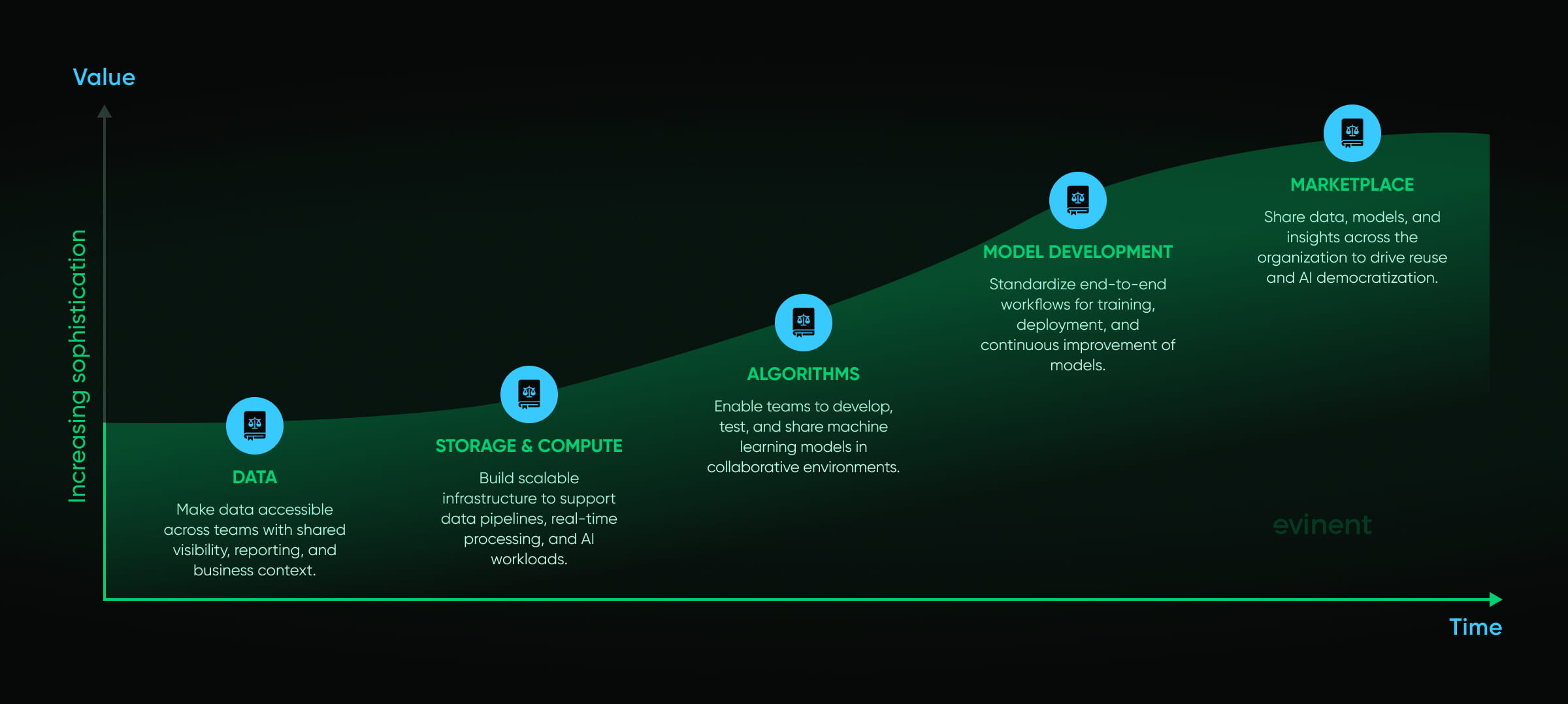
This is why modern enterprise AI platforms increasingly include collaboration layers designed to support knowledge management and broad access to AI capabilities.
These systems focus on three goals:
capturing expert knowledge from across the organization
structuring that knowledge so AI systems can use it
making AI tools accessible to teams that are not machine learning specialists
The result is what many organizations call AI democratization, expanding access to AI capabilities beyond a small group of technical specialists.
Collaborative AI application development
Building enterprise AI applications usually involves more than one type of expertise. Data scientists understand algorithms, engineers understand infrastructure, and business teams understand the problems that need solving.
Collaborative development environments bring these groups together.
Many AI platforms now provide shared workspaces or hub workspaces where multiple teams can work on the same projects. Within these environments, developers can build models, analysts can explore data, and business teams can review outputs.
Collaborative AI application development environments typically include:
shared code repositories
experiment tracking dashboards
dataset catalogs
model versioning tools
integrated feedback channels
These shared environments make it easier for organizations to move AI projects from experimentation to production. Instead of passing models between isolated teams, development occurs within a coordinated workspace where everyone can contribute.
Over time, this collaborative approach helps organizations develop reusable AI components that support multiple projects across departments.
Knowledge graphs and domain ontology
One of the biggest challenges in enterprise AI is translating human knowledge into formats machines can understand.
Every company has its own vocabulary, workflows, and relationships between concepts. Finance, marketing, and logistics teams may use the same terms in completely different ways.
Knowledge graphs help resolve this problem.
A knowledge graph represents relationships between entities, such as customers, products, suppliers, and transactions, in a structured network. By mapping these relationships, organizations create a unified view of how their data connects across systems.
These graphs often rely on domain ontology, which defines the vocabulary and rules used to represent knowledge inside the system.
For example, a domain ontology might define relationships such as:
customer → purchases → product
supplier → delivers → component
employee → manages → department
Once these relationships are structured, AI systems can analyze them more effectively. Knowledge graphs also help integrate data from multiple departments without losing context.
This approach becomes especially valuable when organizations deploy generative AI systems that need to reason about complex business relationships.
Retrieval-augmented generation and enterprise knowledge
Generative AI models are powerful, but they have a limitation: they do not automatically understand an organization’s internal knowledge.
Retrieval-augmented generation (RAG) addresses this challenge by connecting language models with enterprise data sources. Instead of relying only on training data, the model retrieves relevant information from internal knowledge bases before generating responses.
A typical RAG architecture includes:
document ingestion pipelines
vector databases storing document embeddings
search systems retrieving relevant information
language models generating responses based on retrieved context
This approach allows organizations to build AI assistants that answer questions using internal documentation, research reports, or operational data.
For example, an internal AI assistant might help engineers locate technical documentation or help customer support teams retrieve product policies instantly.
Because RAG systems retrieve real company data before generating responses, they also reduce the risk of hallucinated or inaccurate answers.
AI-powered data validation
Another key aspect of collaboration is maintaining trust in the data used by AI systems.
Poor data quality quickly undermines AI adoption. If teams cannot rely on predictions or analytics results, they stop using the tools.
AI-powered data validation systems help address this issue. These systems analyze datasets automatically to detect anomalies, inconsistencies, and missing values.
They can monitor incoming data streams and flag potential problems such as:
unexpected changes in data distributions
duplicate or incomplete records
anomalies that may indicate system errors
By identifying issues early, organizations maintain data quality across departments and ensure that AI models operate on reliable inputs.
Annotation and feedback capabilities
Enterprise AI systems also improve over time through user feedback.
Many AI platforms now include annotation and feedback capabilities that allow employees to review model outputs and provide corrections. These corrections can then feed back into training pipelines to improve accuracy.
For example:
customer service agents might label incorrect chatbot responses
analysts might annotate data points used for predictive models
domain experts might validate AI-generated reports
This feedback loop creates a continuous learning cycle where AI systems gradually incorporate the expertise of human users.
Over time, these feedback mechanisms help organizations build more accurate models and maintain trust in automated decisions.
Natural language interfaces and AI accessibility
One of the most visible signs of AI democratization is the rise of natural language interfaces.
Instead of interacting with complex analytics dashboards or writing queries in specialized languages, users can now ask questions in plain language.
For example:
“What were our highest-margin products last quarter?”
“Which suppliers are causing the most delivery s?”
“Show me sales trends for the last six months.”
Generative AI systems interpret these questions and translate them into database queries or analytics operations.
This type of interface dramatically lowers the barrier to entry for non-technical teams. Employees who may not understand data pipelines or machine learning models can still benefit from AI-driven insights.
Natural language interfaces, therefore, play a major role in expanding AI adoption across the enterprise.
Semantic harmonization and the semantic layer
A persistent challenge in large organizations is inconsistent data definitions.
Different teams often interpret key metrics differently. For example, marketing might define “active customer” differently from finance or operations.
To solve this problem, many enterprise AI platforms implement a semantic layer.
The semantic layer acts as a translation system between raw data and business concepts. It defines standardized metrics, relationships, and definitions that remain consistent across reports and models.
Semantic harmonization ensures that:
analytics dashboards use consistent definitions
machine learning models access standardized datasets
generative AI systems interpret data correctly
Without this layer, AI systems often produce conflicting results because they rely on inconsistent data definitions.
Democratizing AI across the organization
When collaboration systems, knowledge graphs, semantic layers, and natural language interfaces work together, something interesting happens.
AI is no longer a specialized tool used only by technical teams.
Instead, it becomes a shared capability available across the organization.
Executives can explore strategic insights. Analysts can experiment with predictive models. Customer service teams can access knowledge instantly. Engineers can retrieve documentation without searching through dozens of systems.
This democratization of AI capabilities is one of the most important shifts happening in enterprise technology today.
Organizations that succeed with AI rarely rely on a single powerful model. They build ecosystems where knowledge flows freely, teams collaborate effectively, and AI tools support decision-making across the entire enterprise.
And as AI adoption continues to grow, these collaboration and knowledge management systems will become just as important as the infrastructure that powers the models themselves.
Core Components and Design of Enterprise AI Architectures
Once organizations begin building AI systems at scale, architecture quickly becomes less about individual models and more about how different components interact across the entire technology stack. Enterprise AI platforms must process large volumes of data, support multiple models, and integrate with existing business systems without introducing instability or security risks.
To achieve that balance, modern enterprise AI architectures rely on modular building blocks. These components work together as a coordinated system that supports data ingestion, model development, application integration, and continuous operations.
In practice, most enterprise architectures revolve around three major design pillars: data infrastructure, modular AI services, and model intelligence layers. Each pillar addresses a different part of the AI lifecycle but remains tightly connected to the others.
Data pipelines and integration infrastructure
Every enterprise AI system begins with data. Models cannot generate reliable insights without consistent, well-structured datasets flowing through the organization.
Data pipelines form the backbone of this process. These pipelines collect information from operational systems, such as ERP platforms, CRM databases, IoT sensors, or customer applications, and move it into centralized storage environments. Along the way, the pipelines perform transformations that prepare data for machine learning workflows.
A typical enterprise AI data infrastructure includes several elements:
data integration services connecting enterprise applications and external data sources
automated data pipelines responsible for ingestion, transformation, and validation
centralized metadata repositories that track dataset origins, structure, and ownership
feature engineering pipelines are used to generate model-ready variables
Feature engineering is particularly important in enterprise AI. Instead of building models directly from raw data, organizations create structured features that represent meaningful patterns within datasets. These features can then be reused across multiple machine learning models.
Another emerging component is the semantic layer, which standardizes business definitions across datasets. By aligning data structures with business terminology, the semantic layer helps ensure that analytics tools and AI models interpret information consistently.
Many organizations also maintain taxonomy and ontology management platforms (TOMS) to manage classification systems and maintain consistent domain vocabulary across departments.
Together, these systems provide the structured data environment that enterprise AI models rely on.
AI microservices and DevOps-driven architecture
Once data pipelines are established, the next challenge is deploying AI capabilities in a way that remains flexible and maintainable.
This is where AI microservices become essential.
Instead of building a single monolithic AI application, enterprises divide AI functionality into smaller services. Each microservice performs a specific task, such as predicting customer churn, generating product recommendations, or analyzing text.
These services communicate through APIs and can be scaled independently. If demand increases for one AI service, say a recommendation engine during peak e-commerce traffic, the infrastructure can scale that component without affecting the rest of the system.
Microservice architectures also work closely with DevOps capabilities that automate deployment, testing, and monitoring. DevOps pipelines allow development teams to update models quickly while maintaining system stability.
In an enterprise AI environment, DevOps workflows typically include:
automated model testing before deployment
continuous integration pipelines for AI services
infrastructure monitoring tools
version control for both code and models
This combination of microservices and DevOps processes ensures that AI systems remain resilient even as the number of models and applications continues to grow.
Another advantage of modular architecture is interoperability. AI services can integrate with existing enterprise systems without requiring a complete system redesign. For organizations with legacy infrastructure, this flexibility is critical.
Model intelligence layer: foundation models, vector databases, and knowledge systems
At the top of the architecture sits the model intelligence layer—the components responsible for generating predictions, insights, and automation.
Modern enterprise AI systems rarely rely on a single model. Instead, they use a combination of foundation models, specialized machine learning models, and knowledge systems.
Foundation models, such as large language models, provide general reasoning and language capabilities. Organizations often fine-tune these models for specific tasks such as document analysis, customer support automation, or research assistance.
Supporting these models are specialized data structures designed for modern AI workloads.
One example is vector databases, which store high-dimensional embeddings used in semantic search and retrieval-augmented generation systems. These databases enable AI applications to quickly locate relevant information within massive document collections.
Another key component is the graph database, which models relationships among entities such as customers, suppliers, and products. Graph databases are particularly useful for fraud detection, supply chain analysis, and recommendation systems because they model complex relationships between data points.
Enterprise AI platforms also maintain structured object models that describe how data entities relate to each other within applications. These models help ensure that AI services interact with enterprise systems consistently.
Together, foundation models, vector databases, and graph-based knowledge systems form the intelligence layer that powers advanced AI applications across the organization.
When these three architectural pillars, data infrastructure, microservice deployment, and intelligent model layers, are combined within a coordinated system, organizations gain something that isolated AI projects cannot provide.
They gain a scalable architecture capable of supporting dozens or even hundreds of AI services across the enterprise.
Such architectures allow companies to integrate predictive analytics, generative AI, and automation tools into everyday business processes while maintaining reliability, security, and governance.
Cost Management and Resource Optimization
As enterprise AI systems scale, a new challenge appears: cost control.
Training large models, running inference pipelines, storing massive datasets, and maintaining GPU infrastructure can quickly drive operational costs upward. In many organizations, AI infrastructure becomes one of the fastest-growing items in the technology budget.
Yet high spending does not always translate into better results. Companies often discover that inefficient architectures, poorly monitored workloads, or unnecessary model complexity generate significant waste.
This is why enterprise AI architecture increasingly includes dedicated cost management and resource optimization strategies. These mechanisms help organizations allocate computing resources intelligently while maintaining model performance and reliability.
Effective cost management usually focuses on three areas: infrastructure governance, model efficiency, and operational monitoring.
AI gateways, budget controls, and usage monitoring
One of the most effective ways to manage enterprise AI spending is to control how models are accessed across the organization.
Many companies implement an AI gateway, a centralized layer that manages requests sent to AI services. Instead of allowing applications to interact directly with models, all requests pass through this gateway.
The gateway can enforce policies such as:
rate limiting to prevent excessive requests
usage monitoring that tracks model consumption across departments
budget controls that restrict spending thresholds
authentication and access management
This centralized approach provides visibility into how AI resources are used. Teams can analyze usage patterns and identify workloads that generate high costs.
For example, a company might discover that an internal chatbot generates thousands of unnecessary queries because automated processes repeatedly request the same data. With usage monitoring in place, such inefficiencies can be detected and corrected.
AI gateways, therefore, act as both cost-control systems and governance mechanisms, ensuring that AI services remain sustainable as adoption grows.
Efficient compute provisioning and resource scaling
Another critical cost factor is how infrastructure resources are allocated.
Large AI models require specialized hardware, often GPU clusters that consume significant energy and computing capacity. Running these resources continuously, even when demand is low, can generate unnecessary expenses.
Modern enterprise architectures address this challenge through dynamic compute provisioning.
Instead of maintaining fixed infrastructure capacity, organizations allocate resources based on real-time demand. Systems automatically scale computing resources up or down depending on workload intensity.
Key techniques include:
automated resource scaling based on usage patterns
scheduling GPU workloads during off-peak hours
distributing workloads across hybrid or multi-cloud infrastructure
separating environments for experimentation and production
Another important consideration is the balance between training and inference workloads.
Training large models requires intensive computing resources but occurs relatively infrequently. Inference, the process of generating predictions or responses, happens continuously once models are deployed.
Optimizing inference workloads often yields the largest cost savings because inference typically accounts for the majority of long-term operational costs.
Model optimization techniques
Infrastructure efficiency alone cannot control AI costs. The design of the models themselves also plays a major role.
Many organizations now apply optimization techniques that reduce computational requirements without significantly affecting model accuracy.
One common approach is model fine-tuning. Instead of training large models from scratch, companies start with foundation models and adapt them to specific tasks using smaller training datasets. This approach reduces both training time and infrastructure usage.
Another widely used technique is model quantization, which compresses models by reducing numerical precision. Quantized models require less memory and computational power, making them easier to deploy in production environments.
Enterprises also implement model routing strategies. Rather than sending every request to the most powerful and expensive model, the system determines which model is appropriate for each task.
For example:
simple classification tasks may use lightweight models
complex reasoning tasks may use larger language models
This routing strategy dramatically reduces average compute costs.
Optimization can also occur at the interaction level. -level optimizations reduce token usage when interacting with generative models, lowering inference costs for large language models.
Finally, architectures built around retrieval augmented generation (RAG) often reduce computational load. Instead of generating responses from scratch each time, RAG systems retrieve relevant information from enterprise knowledge bases and use that context to produce accurate responses with fewer model operations.
Together, these techniques allow organizations to maintain strong AI performance while minimizing infrastructure consumption.
Cost management is sometimes overlooked during early AI experimentation. When companies deploy only a few models, infrastructure costs may appear manageable.
However, once AI systems expand across departments to support analytics, automation, and generative AI applications, the financial impact becomes significant.
Organizations that embed cost governance mechanisms directly into their enterprise AI architecture are far better positioned to maintain sustainable AI operations. By combining infrastructure monitoring, dynamic resource allocation, and model optimization strategies, companies can ensure that AI investments deliver measurable business value without creating uncontrolled operational costs.
Data Governance, Security, and Compliance
As enterprise AI systems expand across departments, governance and security become as important as algorithms and infrastructure. AI models rely on large volumes of sensitive data: customer records, financial transactions, operational metrics, and sometimes confidential intellectual property. Without strong governance frameworks, the risks increase quickly.
A modern enterprise AI architecture, therefore, includes structured governance mechanisms that control how data is collected, processed, and used by AI systems. These mechanisms protect data integrity, ensure compliance with regulatory requirements, and reduce the risk of biased or unsafe automated decisions.
Unlike traditional data governance, AI governance must also address issues such as model transparency, accountability for automated decisions, and continuous monitoring of model behavior. The combination of these practices helps organizations maintain trust in AI-driven operations while protecting sensitive information.
Data quality and lifecycle governance
Reliable AI systems begin with reliable data. Poor-quality datasets introduce bias, distort model predictions, and undermine confidence in automated decisions.
To prevent these problems, enterprise AI architectures typically include structured data governance frameworks that monitor data throughout its lifecycle, from ingestion to model training and deployment.
Key governance processes include:
data cleansing pipelines that remove duplicates, incomplete records, and inconsistencies
continuous data quality monitoring that detects anomalies in datasets
standardized data classification policies for sensitive information
metadata management that tracks the origin and ownership of datasets
Another important element is semantic harmonization. Large organizations often store similar data across multiple systems, but each department may define metrics or entities differently. The semantic layer resolves these inconsistencies by providing unified definitions for core business concepts.
For example, terms like "active customer" or "revenue event" must have consistent definitions across analytics platforms and AI models. Without this harmonization, different teams may train models using conflicting interpretations of the same data.
Maintaining consistent data definitions helps ensure that AI models generate results that are both reliable and interpretable across the enterprise.
Security architecture and access controls
Enterprise AI systems often interact with critical business data and operational systems. As a result, strong security architecture is essential.
Most organizations implement layered security controls designed to protect both the data and the AI models that rely on it.
Common security mechanisms include:
access controls that restrict who can view or modify datasets and models
identity management systems that verify user credentials
role-based permissions for data scientists, analysts, and application developers
encryption protocols that protect data during storage and transmission
Encryption plays a particularly important role when data moves between systems. Sensitive datasets must remain protected not only in storage but also when transferred between services, applications, or cloud environments.
Many enterprise architectures also implement API governance frameworks. These systems monitor how AI services are accessed through APIs and enforce security policies such as authentication, request validation, and rate control.
API governance helps prevent unauthorized systems from interacting with AI services and protects organizations from potential misuse or data exposure.
Audit trails and regulatory compliance
For many industries, especially finance, healthcare, and insurance, AI systems must meet strict regulatory requirements.
Regulators increasingly require organizations to demonstrate how automated decisions are made and how AI systems use data. This makes auditability a core requirement of enterprise AI architecture.
Organizations address this challenge through detailed monitoring and logging systems.
Typical governance tools include:
audit logging systems that record interactions with AI models
detailed audit trails documenting data usage and model decisions
automated reporting tools for compliance verification
These records allow compliance teams to review how AI systems operate and investigate potential issues. If an AI-driven decision affects a customer, for example, a loan approval or fraud detection , the organization must be able to explain how the model arrived at that outcome.
Modern architectures increasingly include real-time compliance monitoring systems. These tools continuously evaluate model behavior against regulatory policies, identifying potential violations or anomalies as soon as they occur.
This proactive monitoring reduces the risk of regulatory breaches and helps organizations respond quickly when issues arise.
Ethical AI and bias mitigation
Another important aspect of governance involves ethical considerations. AI systems trained on historical data can unintentionally reproduce existing biases present in those datasets.
To address this challenge, organizations implement bias mitigation strategies during model development and deployment.
These strategies often include:
fairness evaluation during model training
bias detection tools that analyze model outputs across demographic groups
continuous monitoring of decision outcomes
review processes for sensitive AI applications
Many enterprises also establish internal ethical AI guidelines that define acceptable uses of artificial intelligence. These guidelines often address issues such as transparency, fairness, accountability, and responsible automation.
Ethical governance does not eliminate bias entirely, but it provides mechanisms for identifying and correcting problems before they affect customers or operations.
Building trust in enterprise AI systems
Security, governance, and compliance frameworks may seem less exciting than new AI models or advanced analytics. Yet in enterprise environments, these components often determine whether AI initiatives succeed or fail.
Organizations that invest in strong governance systems gain several advantages:
improved trust in AI-driven decisions
stronger protection of sensitive data
reduced regulatory risk
clearer accountability for automated systems
In other words, governance transforms AI from an experimental technology into a reliable enterprise capability.
As artificial intelligence becomes more deeply integrated into business operations, the importance of governance frameworks will only increase. Future enterprise AI architectures will likely include even more sophisticated compliance monitoring systems, stronger security mechanisms, and more transparent models that can explain their decisions.
Without these safeguards, scaling AI across the enterprise would simply be too risky.
Future Developments and Trends in Enterprise AI Architecture
Enterprise AI architecture is evolving rapidly. What worked for machine learning deployments just a few years ago is already being redesigned to support generative AI systems, autonomous agents, and increasingly complex data ecosystems.
Organizations are moving away from experimental deployments toward fully integrated AI platforms that operate continuously across business processes. As these systems expand, several emerging design principles are beginning to shape the next generation of enterprise AI architecture.
These trends reflect both technological progress and changing expectations from business leaders. Companies no longer view AI as a standalone analytics capability. Instead, they expect AI to power automation, decision-making, and operational intelligence across the entire enterprise.
The following developments are likely to define the future architecture of enterprise AI systems.
Multi-model AI ecosystems
In the early stages of enterprise AI adoption, organizations often relied on a single dominant model or algorithm. Today, enterprises operate in what many analysts describe as a multi-model world.
Instead of deploying one general-purpose AI system, organizations increasingly combine multiple models designed for different tasks.
For example:
fine-tuned task-specific models handle specialized applications such as document classification or fraud detection
large language models support natural language interactions and generative tasks
predictive analytics models forecast operational trends
recommendation engines personalize customer experiences
These models often operate simultaneously within the same architecture, communicating through shared infrastructure and APIs.
This shift toward multi-model environments requires more sophisticated orchestration systems capable of routing tasks between models and optimizing performance across the architecture.
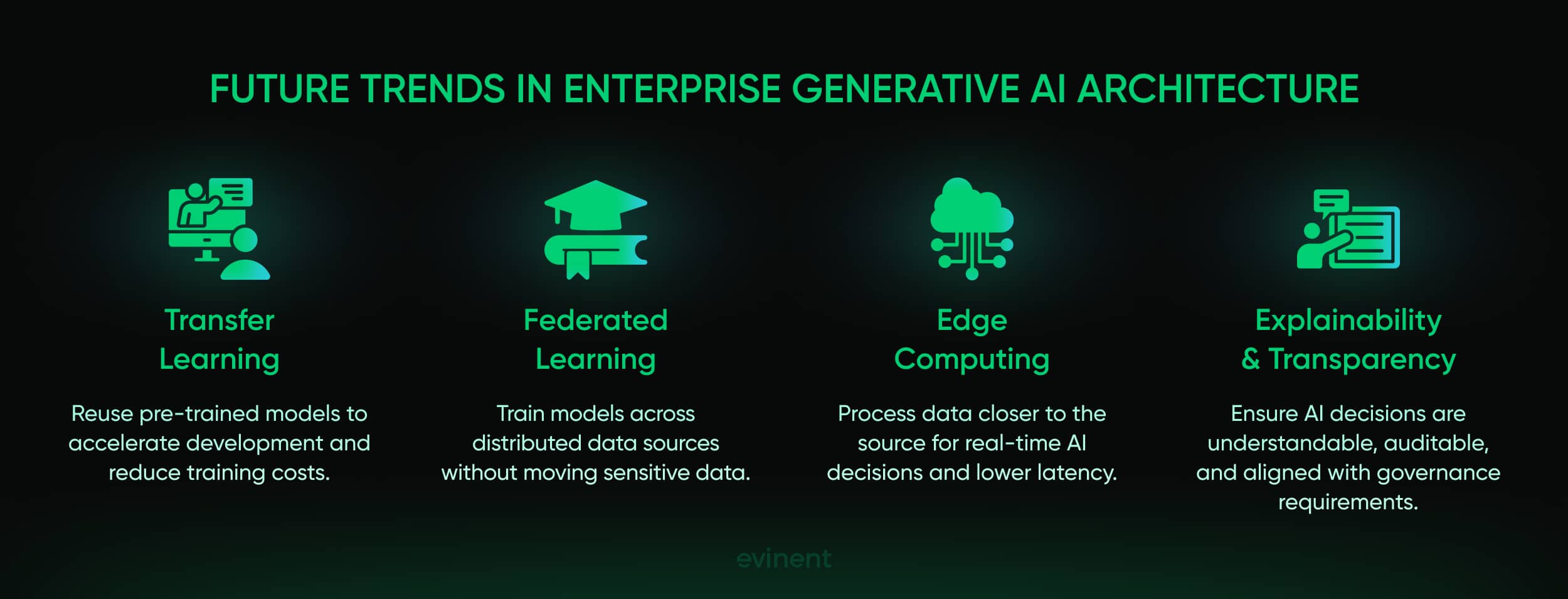
The rise of the modern AI stack
As AI adoption grows, the technology ecosystem supporting AI is becoming more standardized.
Many organizations now refer to their infrastructure as a modern AI stack: a layered combination of tools and platforms that support the entire AI development and deployment lifecycle.
A typical modern AI stack includes:
a centralized data layer built on scalable data lake infrastructure
data pre-processing engines that prepare datasets for analytics and machine learning
model development environments for training and experimentation
orchestration systems managing inference and workflow execution
monitoring platforms that track model performance and operational metrics
The stack continues to evolve as new technologies emerge, including vector databases, semantic data layers, and generative AI frameworks.
Over time, the modern AI stack will likely become as standardized as the cloud infrastructure stacks that preceded it.
Real-time processing and continuous data enrichment
Traditional analytics systems often relied on batch processing. Data was collected, processed overnight, and used to generate reports the following day.
Enterprise AI architectures are increasingly shifting toward real-time processing.
In this model, AI systems analyze incoming data streams continuously and generate predictions or decisions within seconds. This capability is critical for applications such as fraud detection, logistics optimization, and customer personalization.
Real-time systems also support continuous data enrichment. As new data enters the system, it is automatically integrated with existing datasets and used to refine model predictions.
Continuous enrichment improves model accuracy over time while ensuring that AI systems remain responsive to changing conditions.
Intelligent workflow automation
Another major trend is the integration of AI directly into operational workflows.
Instead of generating insights that employees must interpret manually, AI systems increasingly trigger automated actions within enterprise applications.
This process is often referred to as intelligent workflow automation.
Examples include:
automatically routing customer service requests to appropriate teams
detecting anomalies in financial transactions and initiating investigations
optimizing supply chain operations based on predictive analytics
These automated workflows connect AI systems directly with enterprise software platforms, allowing organizations to act on insights instantly rather than waiting for manual intervention.
Serverless architectures and scalable infrastructure
Infrastructure design is also evolving. Traditional AI systems required dedicated computing environments that remained active even when workloads were low.
Emerging architectures increasingly rely on serverless infrastructure.
In serverless environments, computing resources are allocated dynamically in response to demand. AI workloads run only when needed, reducing operational costs and improving resource efficiency.
Serverless architectures work particularly well for AI inference workloads, where request volumes can fluctuate dramatically with user activity.
As cloud providers continue to expand serverless capabilities, more enterprise AI systems are likely to adopt this model.
AI governance platforms
As AI becomes more integrated into business operations, governance frameworks must evolve as well.
Future architectures will likely include specialized AI governance platforms that monitor model behavior, enforce policy compliance, and track the lifecycle of AI systems.
These platforms typically provide:
centralized monitoring of AI models and services
policy enforcement for regulatory compliance
audit tools for automated decision systems
dashboards for evaluating model performance and fairness
AI governance platforms help organizations maintain visibility into increasingly complex AI ecosystems while ensuring that ethical and regulatory standards are maintained.
AI-driven transition roadmaps
Finally, many enterprises are developing structured AI-driven transition roadmaps.
Rather than deploying AI technologies in isolated projects, companies are mapping long-term strategies for integrating AI capabilities across their entire digital infrastructure.
These roadmaps typically include:
modernization of legacy data systems
expansion of AI-powered analytics capabilities
integration of automation tools into operational workflows
development of AI literacy programs across the workforce
By aligning technology investments with long-term strategy, organizations can build architectures that evolve gradually rather than requiring disruptive redesigns.
Enterprise AI architecture will continue to evolve as new technologies emerge and business expectations grow. But one pattern is already clear: successful organizations are building systems that treat AI not as an isolated tool but as a foundational capability integrated across the enterprise technology stack.
The next generation of enterprise AI architectures will therefore emphasize adaptability, scalability, and responsible governance—ensuring that AI systems remain both powerful and trustworthy as they become central to modern business operations.
Implementation Challenges and Best Practices
Designing a robust enterprise AI architecture is only part of the journey. The real challenge begins when organizations attempt to implement these systems across complex technology environments and operational workflows.
Many companies discover that deploying AI at scale introduces technical and organizational obstacles that were not visible during early experimentation. Integrating AI with existing systems, ensuring reliable data pipelines, and aligning teams with the new capabilities can prove significantly more difficult than training the models themselves.
Enterprise AI initiatives frequently encounter issues such as integration complexity, fragmented data environments, and shortages of specialized talent. Addressing these challenges requires not only strong technical architecture but also clear implementation strategies and proven design practices.
Below are some of the most common implementation challenges organizations face, along with best practices to overcome them.
Integration complexity and legacy system compatibility
One of the most significant barriers to enterprise AI deployment is the difficulty of integrating new AI systems with existing technology environments.
Large organizations often operate a mix of cloud and on-premise systems, legacy applications, and modern microservice-based platforms. These systems were rarely designed to work with advanced machine learning pipelines.
As a result, enterprises frequently face integration complexity when attempting to connect AI services to operational systems.
Typical challenges include:
incompatible data formats between systems
outdated APIs or limited connectivity options
legacy software that cannot support real-time data processing
fragmented infrastructure across multiple environments
Ensuring interoperability between systems becomes essential. AI services must be able to exchange data with enterprise applications without disrupting existing workflows.
A common best practice is to implement data integration services and middleware layers that standardize communication between systems. These services act as translators, allowing AI applications to interact with older systems while maintaining modern architectural standards.
Organizations also benefit from designing flexible system architectures that gradually modernize legacy environments instead of attempting large-scale system replacements all at once.
The data aggregation problem and data silos
Another frequent obstacle in enterprise AI projects is data aggregation.
Many organizations store data across dozens, or even hundreds of independent systems. Marketing platforms, finance databases, operational software, and analytics tools may all maintain their own datasets with limited coordination between them.
These data silos prevent AI systems from accessing the complete information needed for accurate predictions.
When data remains fragmented, organizations struggle to:
train models using comprehensive datasets
maintain consistent definitions of business metrics
share insights across departments
Addressing this challenge requires building centralized or federated data environments where information from different systems can be combined and analyzed.
Best practices include:
implementing enterprise-scale data integration services
creating unified data platforms that aggregate datasets from multiple sources
establishing governance frameworks that standardize data definitions across departments
Solving the data aggregation problem often delivers benefits beyond AI. Organizations gain improved analytics capabilities and stronger collaboration between teams.
Talent gaps and organizational readiness
Even with the right technology infrastructure, enterprise AI initiatives depend heavily on skilled professionals.
However, many organizations face a shortage of specialists who understand both machine learning technologies and enterprise systems architecture.
Common talent gaps include:
machine learning engineers
data platform architects
AI governance specialists
engineers experienced in large-scale distributed systems
These shortages can slow AI adoption and limit the effectiveness of new initiatives.
Organizations increasingly address this challenge through a combination of internal training programs and cross-functional collaboration. Instead of relying solely on highly specialized AI experts, companies are building teams that combine expertise from multiple domains—data engineering, software development, operations, and business analysis.
This multidisciplinary approach helps ensure that AI systems align with real business needs rather than remaining purely technical experiments.
Enterprise AI platform standardization
Another important best practice is the adoption of standardized enterprise AI platforms.
Without a unified platform, different teams may deploy AI models using different tools, frameworks, and infrastructure. This fragmentation creates operational inefficiencies and makes governance more difficult.
Standardized AI platforms provide shared environments for:
model development and experimentation
data access and processing
deployment pipelines
performance monitoring
By centralizing these capabilities, organizations create consistent processes for building and managing AI systems.
A unified platform also simplifies collaboration between teams and reduces the risk of duplicated work across departments.
Proven design patterns and system blueprints
Finally, organizations can reduce implementation risk by adopting proven design patterns and architectural blueprints.
These patterns provide standardized solutions for common challenges in enterprise AI environments.
Examples include:
modular architectures based on microservices
layered data platforms separating ingestion, storage, and analytics
scalable model deployment frameworks
orchestration systems managing complex AI workflows
Emerging systems increasingly incorporate AI agent orchestration patterns that coordinate interactions among multiple AI services and automated agents.
These orchestration frameworks allow organizations to manage complex workflows where multiple models collaborate to complete tasks, such as analyzing documents, generating reports, and triggering automated business actions.
Using established system blueprints helps organizations avoid architectural mistakes and accelerate implementation timelines.
Enterprise AI architecture promises enormous opportunities, but successful implementation requires more than technical innovation. Organizations must address integration challenges, unify fragmented data environments, develop new skills within their workforce, and adopt reliable architectural patterns.
Companies that approach AI adoption strategically, combining strong architecture with thoughtful implementation practices, are far more likely to transform experimental AI initiatives into sustainable enterprise capabilities.
Integration of Generative AI and Advanced AI Technologies
Generative AI has fundamentally changed how enterprises think about artificial intelligence architectures. Earlier enterprise AI systems focused primarily on predictive analytics, forecasting outcomes, detecting anomalies, or optimizing operations based on historical data.
Today, organizations are integrating generative AI technologies, including large language models (LLMs), multimodal systems, and autonomous AI agents, into enterprise applications. These systems can generate text, code, reports, recommendations, and complex insights in real time.
However, integrating generative AI into enterprise environments requires more than simply connecting a model API. Organizations must design architectures that manage data access, ensure reliable outputs, and integrate generative capabilities into existing workflows without introducing security or compliance risks.
This section explores several architectural patterns that enable enterprises to deploy generative AI safely and effectively.
Large language models and enterprise AI services
Large language models (LLMs) have become the foundation for many modern enterprise AI applications. These models power conversational assistants, document analysis systems, automated reporting tools, and knowledge discovery platforms.
Unlike traditional machine learning models that solve narrowly defined tasks, LLMs can interpret natural language and generate complex responses across multiple domains. This flexibility makes them attractive for enterprise use cases.
However, deploying LLMs inside corporate systems introduces architectural challenges. Enterprises must ensure that these models interact safely with internal data and integrate with existing applications.
Typical enterprise deployments rely on cloud deployment patterns that combine LLM inference services with internal data pipelines and governance controls. Instead of operating as standalone tools, LLMs function as components within a broader enterprise AI architecture.
To manage these systems effectively, organizations often adopt reference architectures that define standardized ways to deploy and scale generative AI services.
Retrieval-augmented generation and enterprise knowledge systems
One of the most widely adopted architectural patterns for enterprise generative AI is retrieval-augmented generation (RAG).
RAG systems connect language models with internal knowledge sources. Instead of relying solely on the model’s training data, the system retrieves relevant information from enterprise databases, documents, or knowledge graphs before generating a response.
A typical RAG architecture includes several key components:
document ingestion pipelines that convert internal knowledge into searchable formats
vector databases that store document embeddings for semantic retrieval
retrieval systems that locate relevant context
LLM inference services that generate responses using retrieved information
This architecture helps ensure that generative AI systems provide accurate answers grounded in real enterprise data.
RAG also improves security and governance. Instead of exposing sensitive data directly to external models, organizations control which information can be retrieved and used in responses.
Agentic AI setups and orchestration systems
Another emerging trend in enterprise AI architecture is the rise of agentic AI setups.
Agentic systems consist of multiple AI agents working together to perform complex tasks. Each agent specializes in a specific function, such as retrieving data, generating analysis, or interacting with external systems.
For example, a workflow automation system might include:
an agent that retrieves financial data
an agent that analyzes trends using predictive models
an agent that generates a summary report
an agent that sends results to relevant stakeholders
To coordinate these systems, organizations implement orchestration layers that manage communication between agents and ensure that tasks are executed in the correct sequence.
These orchestration frameworks often rely on an event-driven architecture, in which system events trigger automated workflows across multiple AI services.
Agentic architectures allow enterprises to automate complex processes that previously required manual coordination between multiple teams.
Management and validation layers
As organizations deploy generative AI systems, managing s becomes an important architectural concern.
s determine how language models interpret tasks and generate responses. Poorly designed s can lead to inaccurate outputs or inconsistent behavior.
To address this issue, many enterprises implement structured management systems. These systems store standardized s, track their performance, and allow teams to update them as models evolve.
management often works alongside validation layers that review model outputs before they reach users or downstream systems.
Validation layers can perform tasks such as:
verifying factual consistency with internal datasets
filtering inappropriate or unsafe responses
checking compliance with organizational policies
These safeguards ensure that generative AI systems remain reliable even when handling complex tasks.
Integration patterns for enterprise generative AI
Finally, enterprises must determine how generative AI services integrate with the broader technology stack.
Several integration patterns are becoming common in enterprise environments.
One pattern involves embedding generative AI capabilities directly into existing applications such as CRM systems, analytics platforms, or internal productivity tools.
Another pattern uses AI as a centralized service layer accessed through APIs. In this architecture, multiple enterprise applications can call generative AI services when needed.
Some organizations are also experimenting with tools sometimes described as AI architecture generators, platforms that help design and configure AI system architectures automatically based on organizational requirements.
Regardless of the specific pattern, the goal remains the same: to integrate generative AI into enterprise systems in a way that maintains security, scalability, and governance.
Generative AI technologies are expanding the possibilities of enterprise AI architectures. Systems that once focused primarily on prediction can now generate insights, automate complex workflows, and interact with users through natural language.
Yet the value of these technologies depends heavily on architecture. Without structured integration patterns, validation layers, and knowledge retrieval systems, generative AI can introduce risks alongside its benefits.
Organizations that design their architectures carefully will be best positioned to harness the full potential of generative AI while maintaining control over data, security, and operational reliability.
Lifecycle Management, Monitoring, and Maintenance
Building an enterprise AI architecture is not a one-time engineering effort. AI systems continue evolving after deployment because the data they rely on changes, business requirements shift, and models gradually lose accuracy over time.
This is why enterprise AI platforms must support full lifecycle management. From model development and deployment to monitoring, retraining, and optimization, every stage of the AI lifecycle requires structured processes.
Without these processes, AI systems can silently degrade. Models may produce inaccurate predictions, generative systems may generate unreliable responses, and operational workflows may break when underlying data changes.
Modern enterprise AI architectures, therefore, include dedicated mechanisms for deployment, observability, monitoring, and continuous improvement.
Deployment frameworks and automated machine learning
Enterprise AI lifecycle management begins with structured deployment processes.
During development, data scientists experiment with models, perform feature engineering, and optimize algorithms through techniques such as hyperparameter tuning. Once models demonstrate acceptable performance, they must be integrated into production systems.
The deployment layer of an enterprise AI architecture manages this transition.
Deployment frameworks typically include:
automated pipelines for packaging and deploying models
integration with application services and APIs
configuration management for model versions
rollback mechanisms that allow rapid recovery if new deployments fail
Many organizations now rely on automated machine learning (AutoML) tools to streamline parts of the development process. AutoML platforms can automate tasks such as feature selection, hyperparameter tuning, and model evaluation, allowing teams to experiment with multiple model configurations quickly.
As AI architectures expand, deployment systems must also support agent frameworks and generative AI services, ensuring that new capabilities can be integrated into existing applications without disrupting operations.
Monitoring, observability, and model performance
Once AI systems are deployed, monitoring becomes critical.
Enterprise environments require continuous visibility into how models behave in real-world conditions. Monitoring systems track performance metrics such as prediction accuracy, response latency, and resource usage.
A key challenge in AI operations is model drift.
Model drift occurs when the statistical properties of incoming data change over time. For example, consumer behavior patterns may shift, financial markets may fluctuate, or operational processes may evolve. When this happens, models trained on historical data may gradually become less accurate.
Monitoring platforms detect drift by analyzing incoming data streams and comparing them with the datasets used during model training.
In generative AI systems, observability becomes even more complex. Organizations must track how language models respond to s, evaluate the accuracy of generated outputs, and ensure that responses remain aligned with internal policies.
This has led to the emergence of LLM observability tools designed specifically for monitoring large language models.
These tools analyze factors such as:
effectiveness and response quality
token usage and inference costs
response consistency across different contexts
LLM observability systems provide insights that help teams refine strategies and maintain reliable generative AI performance.
Model routing, orchestration, and real-time data flows
Enterprise AI architectures increasingly include multiple models operating simultaneously. Managing these systems requires orchestration mechanisms to coordinate how models interact.
Model routing and orchestration frameworks determine which models should handle specific tasks.
For example:
lightweight models may handle routine classification tasks
larger language models may process complex natural language requests
specialized predictive models may analyze operational data streams
Routing systems direct requests to the appropriate model based on task complexity and resource availability.
Another important component is real-time data ingestion.
Modern AI systems rely on continuously updated datasets. Streaming data pipelines feed new information into analytics platforms and AI models as soon as it becomes available.
This allows organizations to make decisions based on the most current information rather than relying solely on historical datasets.
Real-time data ingestion also supports dynamic workflows where AI systems trigger automated actions in response to changing conditions.
Retraining, maintenance, and long-term optimization
AI systems require regular maintenance to remain effective.
One of the most important maintenance practices is periodic retraining.
Retraining involves updating models using new datasets that reflect recent patterns or changes in operational conditions. Without retraining, model accuracy often declines over time.
Enterprise AI platforms usually schedule retraining cycles automatically. These cycles may be triggered by events such as:
detection of model drift
availability of new training data
performance metrics falling below defined thresholds
Maintenance processes also include optimization for generative AI systems. Through structured management, teams refine the instructions given to language models to improve response accuracy and consistency.
Over time, these improvements help organizations build more reliable AI systems while minimizing operational disruptions.
Lifecycle management ensures that enterprise AI systems remain accurate, efficient, and trustworthy long after initial deployment.
Organizations that invest in structured monitoring, observability, and maintenance practices are better equipped to scale AI across multiple business functions. Instead of treating AI as a static technology, they manage it as a continuously evolving system: one that adapts alongside the data, processes, and decisions it supports.
Role of the Enterprise AI Architect and Organizational Change
As artificial intelligence becomes a core part of enterprise infrastructure, organizations are discovering that technology alone cannot ensure success. AI initiatives require coordination between engineering teams, business leaders, compliance officers, and operational departments. Without strong architectural leadership, these efforts often become fragmented.
This is where the role of the enterprise AI architect becomes essential.
An enterprise AI architect is responsible for designing the overall structure of AI systems within an organization and ensuring that those systems align with business strategy, governance requirements, and operational realities. Unlike traditional data scientists or software engineers, AI architects focus on how models, infrastructure, data systems, and workflows work together across the entire enterprise.
The role is evolving quickly as organizations adopt generative AI, agent-based systems, and increasingly complex data ecosystems. Alongside these technical responsibilities, AI architects help organizations manage the cultural and operational changes required to support AI-driven transformation.
Enterprise AI architects as system designers
The primary responsibility of an enterprise AI architect is designing the technical foundation that supports AI systems at scale.
This involves defining architectural frameworks that coordinate data infrastructure, machine learning pipelines, and application services. Architects create system blueprints that guide the integration of AI technologies with existing enterprise systems.
Key responsibilities often include:
defining integration approaches that connect AI services with enterprise applications
designing scalable platforms capable of deployment at scale
establishing standards for AI model management across the organization
coordinating infrastructure architecture with engineering teams
Enterprise AI architects also design complex multi-agent architectures in which multiple AI agents collaborate to automate workflows or perform advanced analytical tasks.
These architectures must be carefully structured to ensure reliability, maintainability, and security as the number of AI services grows.
Governance, responsible AI, and policy frameworks
Another major responsibility of enterprise AI architects is establishing governance frameworks.
AI systems often operate in regulated environments and interact with sensitive data. Organizations, therefore, require structured governance policies that ensure responsible use of AI technologies.
Architects help define these frameworks by collaborating with compliance, legal, and risk management teams.
Governance responsibilities may include:
establishing governance policies for data usage and model deployment
implementing responsible AI by design principles
ensuring transparency and accountability in automated decision systems
designing systems that support continuous observability of AI models
Responsible AI frameworks help organizations identify potential bias, maintain ethical standards, and comply with regulatory requirements.
Embedding these policies directly into system architecture ensures that governance is not treated as an afterthought but as a core design principle.
Collaboration with AI stakeholders
Enterprise AI initiatives rarely succeed without strong collaboration between technical teams and business stakeholders.
AI architects, therefore, play an important role as cross-functional coordinators. They work closely with executives, product teams, data scientists, and operational managers to align AI capabilities with organizational goals.
This collaboration often involves:
identifying business opportunities for AI adoption
evaluating potential AI use cases
translating business requirements into technical architectures
coordinating development across multiple teams
Architects must understand both the technical constraints of AI systems and the operational needs of the business.
This dual perspective allows them to design solutions that are technically feasible while delivering meaningful business value.
The architecture operating system
As enterprise AI ecosystems become more complex, many organizations are adopting what some experts describe as an architecture operating system.
This concept refers to a structured framework that governs how architecture decisions are made across the organization. Instead of isolated design choices made by individual teams, the architecture operating system establishes consistent rules and standards.
Within this framework, enterprise AI architects oversee areas such as:
infrastructure standards
data management policies
model deployment practices
security and compliance requirements
The architecture operating system helps ensure that AI initiatives remain aligned with broader enterprise technology strategies.
Organizational change and AI adoption
Successful AI implementation often requires significant organizational change.
AI systems can alter workflows, redefine job responsibilities, and introduce new decision-making processes. Without careful planning, these changes may encounter employee resistance or cause operational disruptions.
Enterprise AI architects often work alongside leadership teams to support change management strategies that help organizations adapt to AI-driven transformation.
Common change management initiatives include:
educating employees about AI capabilities and limitations
establishing cross-functional AI teams
integrating AI tools into existing workflows gradually
promoting a culture of experimentation and data-driven decision-making
These strategies help organizations build trust in AI systems while ensuring that employees understand how the technology supports their work rather than replacing it.
Skills required for modern enterprise AI architects
Because the role spans multiple domains, enterprise AI architects require a broad skill set.
Successful architects typically combine expertise in:
machine learning systems
distributed infrastructure and cloud platforms
enterprise data management
software architecture principles
regulatory compliance and AI governance
They must also possess strong communication skills, enabling them to bridge the gap between technical teams and executive leadership.
As AI ecosystems grow more complex, this combination of technical depth and organizational awareness becomes increasingly valuable.
Enterprise AI architecture is ultimately not just a technology challenge but an organizational one. The systems that power AI must be designed thoughtfully, governed responsibly, and integrated into the workflows of real teams.
Enterprise AI architects sit at the center of this transformation. By guiding both technical design and organizational change, they help ensure that AI initiatives move beyond isolated experiments and become sustainable capabilities embedded across the enterprise.
How Evivnent Builds Enterprise AI Architecture
Designing enterprise AI architecture requires more than selecting the right tools or models. Organizations must modernize existing systems, integrate fragmented data environments, and implement scalable infrastructure to support advanced AI workloads.
This is where Evinent helps companies translate AI strategy into operational architecture.
With over 15 years of experience in enterprise software development, Evinent specializes in transforming legacy systems into scalable digital platforms and integrating modern AI capabilities into existing infrastructures.
Rather than replacing systems abruptly, Evinent typically focuses on incremental architecture modernization, upgrading data infrastructure, integrating AI-powered services, and optimizing performance while maintaining business continuity.
Below are several ways Evinent supports organizations in building enterprise AI architectures in practice.
Modernizing legacy systems to support AI infrastructure
Many organizations struggle to deploy enterprise AI because their existing infrastructure was not designed for modern data pipelines or machine learning workloads.
Legacy platforms often contain:
fragmented databases
slow monolithic applications
limited integration capabilities
outdated security frameworks
Evinent addresses these issues through legacy system modernization, transforming outdated software into flexible architectures that support AI services.
Typical modernization initiatives include:
restructuring legacy databases for better performance
migrating monolithic applications into scalable architectures
transitioning on-premise infrastructure to cloud or hybrid environments
integrating AI-powered analytics tools into existing platforms
These transformations allow organizations to introduce predictive analytics, automation, and generative AI capabilities without disrupting ongoing operations.
Evinent’s modernization approach focuses on eliminating redundant data structures, improving scalability, and enabling systems to handle real-time analytics and AI workloads.
Case example: AI-powered sales assistant platform
A practical example of enterprise AI architecture can be seen in Evinent’s Sales Assistant platform.
The system supports retail environments by providing sales representatives with real-time product insights, recommendation tools, and customer information during in-store interactions.
The platform integrates several architectural components:
decision-tree-based product recommendation systems
customer profile data integrated with loyalty programs
real-time product comparison and pricing information
cross-sell and up-sell recommendation tools
integration with e-commerce systems for browsing history
These capabilities allow sales teams to access structured product knowledge, compare items instantly, and generate personalized recommendations for customers.
The architecture behind the system includes:
mobile applications operating on Android and iOS devices
backend services capable of running on both Windows and Linux environments
integration with retail databases and online stores
security mechanisms across device, network, and user layers
This architecture enables retailers to unify customer data, product catalogs, and sales analytics within a single intelligent platform.
In practice, this type of architecture demonstrates how AI-driven tools can enhance frontline operations while remaining integrated with broader enterprise systems.
AI integration within enterprise platforms
Beyond individual applications, Evinent frequently integrates AI capabilities into large enterprise platforms.
For example, in healthcare and enterprise software environments, Evinent implements machine learning systems that support:
predictive analytics for operational insights
intelligent automation of workflows
integration of AI models into existing enterprise applications
These systems connect AI models with existing platforms such as electronic health records, telemedicine applications, or CRM systems. The goal is not only to introduce AI functionality but also to ensure seamless interoperability between new technologies and legacy software environments.
Healthcare сторінка
By embedding AI capabilities directly into operational systems, organizations can improve decision-making, automate repetitive tasks, and generate real-time insights from enterprise data.
A structured enterprise AI architecture approach
Evinent typically approaches enterprise AI architecture development through several stages.
Architecture assessment and strategy
Existing systems are analyzed to identify performance bottlenecks, data fragmentation issues, and opportunities for AI integration.
Infrastructure modernization
Legacy systems are upgraded to support scalable architectures, cloud environments, and modern data pipelines.
Data integration and migration
Enterprise datasets are consolidated and migrated into unified data platforms while maintaining regulatory compliance and data integrity.
AI capability implementation
Machine learning models, analytics systems, and AI services are integrated into enterprise applications.
Operational optimization and scaling
AI systems are monitored, optimized, and expanded across departments as adoption grows.
This structured approach allows organizations to implement AI architectures gradually while minimizing operational disruption.
Building scalable AI ecosystems
Enterprise AI architecture ultimately requires balancing innovation with reliability.
Companies must integrate modern AI technologies without compromising security, performance, or compliance requirements. This challenge becomes especially complex when organizations operate across multiple platforms, departments, and geographic regions.
Evinent’s expertise in system modernization, data architecture, and enterprise software development allows companies to navigate this transition effectively.
By combining infrastructure modernization with AI integration, organizations can transform fragmented legacy systems into scalable platforms that support advanced AI technologies.
The result is not simply a collection of machine learning models, but a fully integrated enterprise AI ecosystem: one that supports automation, analytics, and intelligent decision-making across the entire organization.
FAQ
What is enterprise AI architecture?
Enterprise AI architecture refers to the structured design of systems, infrastructure, and processes that allow organizations to deploy artificial intelligence at scale. It typically includes data platforms, machine learning pipelines, model management tools, and integration layers that connect AI services to business applications.
Unlike isolated AI experiments, enterprise AI architecture supports production-level AI workloads, enabling organizations to integrate predictive analytics, automation, and intelligent decision systems into everyday operations.
Why do companies need enterprise AI architecture?
Organizations adopt enterprise AI architecture to ensure that AI initiatives are scalable, secure, and aligned with business goals.
Without a structured architecture, AI projects often remain isolated prototypes that cannot be deployed across the enterprise.
A well-designed architecture helps organizations:
integrate AI models with existing enterprise systems
maintain governance and regulatory compliance
scale AI applications across departments
ensure consistent data quality and accessibility
In practice, enterprise AI architecture turns experimental AI projects into reliable operational systems.
What are the core components of enterprise AI architecture?
Most enterprise AI architectures include several foundational layers:
Data layer – data lakes, warehouses, and pipelines used to collect and process enterprise data
AI platform layer – machine learning platforms, development tools, and training environments
Model layer – machine learning models, foundation models, and generative AI systems
Integration layer – APIs and microservices connecting AI systems with enterprise applications
Governance and security layer – monitoring, compliance controls, and risk management systems
These layers work together to support the full lifecycle of enterprise AI systems.
What challenges do companies face when implementing enterprise AI architecture?
Many organizations encounter similar obstacles when implementing AI architectures.
Common challenges include:
fragmented enterprise data stored across multiple systems
integration complexity between legacy platforms and modern AI tools
lack of internal expertise in machine learning infrastructure
governance and compliance requirements around sensitive data
Overcoming these challenges often requires both technical modernization and organizational change.
How do generative AI and large language models fit into enterprise AI architecture?
Generative AI and large language models (LLMs) are increasingly becoming components of enterprise AI architecture.
Organizations integrate these technologies through architectural patterns such as:
retrieval-augmented generation (RAG) for combining enterprise data with LLM responses
vector databases for semantic search and knowledge retrieval
validation and security layers to control model outputs
These approaches allow organizations to deploy generative AI while maintaining governance and data protection.
How can companies start building enterprise AI architecture?
Most organizations begin by evaluating their existing data infrastructure and identifying areas where AI can deliver measurable business value.
A typical implementation roadmap includes:
assessing current data platforms and infrastructure
modernizing legacy systems and data pipelines
implementing AI development platforms and machine learning tools
integrating AI models into business applications
establishing governance, monitoring, and lifecycle management processes
This phased approach helps organizations adopt AI gradually while minimizing operational risk.
How does Evinent help companies implement enterprise AI architecture?
Evinent helps organizations design and implement enterprise AI architectures by combining expertise in system modernization, data engineering, and AI integration.
Typical services include:
legacy system modernization to support AI workloads
development of scalable data platforms and AI pipelines
integration of AI models into enterprise applications
implementation of governance, monitoring, and compliance mechanisms
Through this approach, companies can evolve existing systems into scalable, AI-enabled platforms that support analytics, automation, and intelligent decision-making.
Share