

What is GDPR?
The General Data Protection Regulation (GDPR) is the primary law governing how organizations collect, process, and protect personal data of individuals in the European Union (EU) and the European Economic Area (EEA). The regulation became applicable on 25 May 2018 and establishes strict requirements for handling personal data and protecting individuals’ privacy.
“The GDPR provides for a preventive risk-based approach, focused on data protection by design and by default.”
— Prof. Giovanni Sartor, European University Institute, study for the European Parliament (STOA)
GDPR is indeed relevant to companies based in the EU/EEA, but it doesn't stop there. It also covers businesses that are located outside the region that either provide goods or services to EU citizens or track their online behavior. Due to its extraterritorial nature, this leads to quite a number of worldwide digital services and AI platforms being forced to follow GDPR guidelines when dealing with personal data.
According to GDPR, personal data is defined as any detail that can be used to identify a person, either directly or indirectly. Typical examples include names, identification numbers, location data, IP addresses, or even behavioral data gathered through analytics and AI systems.
What This Article Covers
GDPR principles relevant to AI
How AI technologies intersect with data protection requirements
Data protection and management techniques used in AI systems
Transparency and explainability in AI decision-making
Individual rights related to automated decisions
International data transfers in AI applications
Best practices for GDPR-compliant AI development
The future of AI regulation, including the role of the AI Act
How Evinent helps implement AI and GDPR
GDPR Principles Relevant to AI
The General Data Protection Regulation (GDPR) establishes several core principles that govern how personal data must be processed. These principles are defined primarily in Article 5 of the regulation and form the foundation of data protection compliance in the European Union.
These principles are very significant, especially for organizations that are designing or implementing artificial intelligence systems. AI technologies generally depend on big data, automatic working, and intricate decisions. So, firms need to be sure that the gathering, using, and storing of personal data in AI systems are in line with the GDPR rules from the very first steps of the system's design. Here are the main GDPR principles that are most closely related to the creation and use of AI.
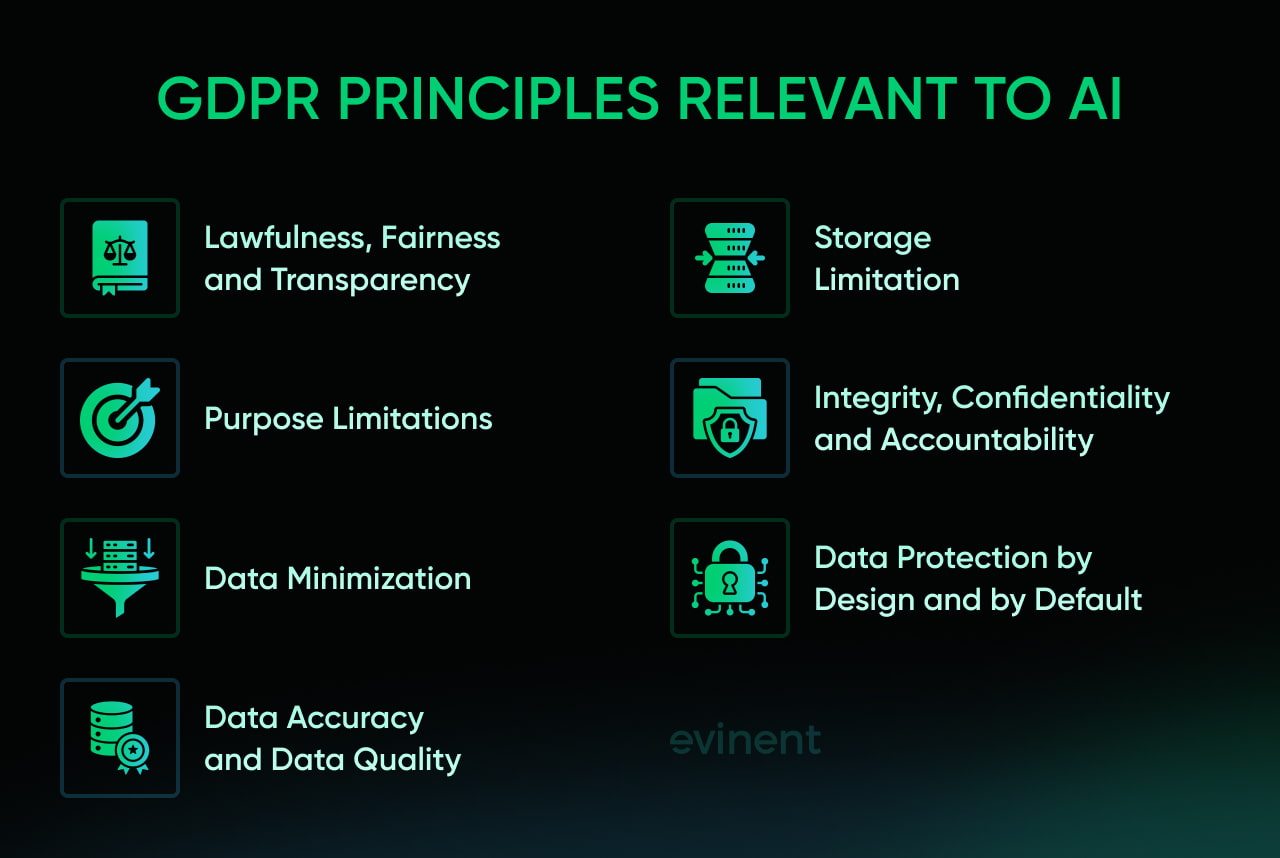
Lawfulness, Fairness, and Transparency
AI systems processing personal data need to have a legal ground for processing according to GDPR, for instance, consent given explicitly, the necessity of a contract, or legitimate interest. Besides, organizations have to make sure that their data processing is fair and does not result in any kind of unjustified discrimination or bias in automated decision-making.
Being open and honest about privacy is one more very important rule. People should be told about the ways in which their personal data will be used, particularly when AI systems take part in decision-making. This means giving understandable privacy statements and an explanation of the purposes of data handling.
Purpose Limitation
The purpose limitation principle dictates that personal data should only be obtained for particular, clear, and lawful purposes. After the data has been gathered, it shouldn't be repurposed for different goals unless another legal basis is provided.
From the AI perspective, this principle matters as data collected, for instance, through customer interactions may be later used for other purposes like training an AI model, conducting data analysis, or developing new features. These organizations would then need to verify that these new activities are still consistent with the initial rationale behind data collection.
Data Minimization
Under the data minimization principle, organizations should only collect and process the amount of personal data that is necessary for a specific purpose. AI development sometimes encourages the use of large datasets to improve model accuracy. However, GDPR requires developers to carefully evaluate whether all collected data is actually needed for training or operating the system. Techniques such as data filtering, anonymization, or synthetic datasets can help reduce unnecessary data processing.
Accuracy
The accuracy principle requires that personal data be kept accurate and up to date. Organizations must take reasonable steps to correct or delete inaccurate information. In AI systems, inaccurate or outdated data can lead to incorrect predictions, biased outcomes, or unfair automated decisions. Maintaining high data quality is therefore essential not only for compliance but also for the reliability of AI models.
Storage Limitation
The GDPR mandates that personal data should only be retained for the duration that is strictly necessary for the original purposes of collection. AI systems, which keep historical datasets, training data, or user records, need to establish explicit data retention timelines. Data that is not required anymore, from this point onwards, should be erased, anonymized, or securely stored in a different way.
Integrity, Confidentiality, and Accountability
Organizations must implement appropriate technical and organizational measures to protect personal data against unauthorized access, loss, or misuse. This includes measures such as encryption, access controls, and internal security policies. At the same time, GDPR introduces the principle of accountability, meaning that the data controller must be able to demonstrate compliance with all ai data protection obligations. In AI environments, this often involves maintaining documentation, audit logs, and risk assessments throughout the system lifecycle.
Data Protection by Design and by Default
GDPR also requires organizations to implement data protection by design and by default, ensuring that privacy considerations are integrated into systems and processes from the earliest stages of development. For AI solutions, this means incorporating privacy safeguards directly into the architecture of algorithms, datasets, and data processing workflows. Examples include limiting the amount of personal data collected, restricting access to sensitive datasets, and ensuring that privacy-friendly settings are applied by default.
The GDPR principles mentioned above are the core legal basis for ethical data processing in AI systems. Demands like lawfulness, transparency, minimal data use, and accountability help make sure that organizations use personal data in ways that safeguard people's rights and, at the same time, build confidence in the use of digital technology.
On the other hand, it is not always easy to implement these principles because AI systems often depend on big data, automatic decision-making, and very complicated processes of data handling. That is why it is very important to grasp the connection between these legal rules and the latest technologies in AI.
In the next section, we examine how GDPR requirements intersect with AI technologies and the practical challenges organizations face when deploying AI systems that process personal data.
Intersection of GDPR and AI Technologies
AI systems typically depend on gathering, storing, and automatically analyzing massive volumes of individual data. This leads to a very direct encounter with the General Data Protection Regulation (GDPR) that establishes the legal conditions for data processing, safeguards fundamental human rights, and requires that organizations responsible for data control be held to account.
Key points of intersection include:
High-risk AI systems: AI systems that process sensitive personal data or perform automated decision-making in critical areas (e.g., credit scoring, employment filtering, predictive policing) are subject to stricter GDPR obligations, including risk assessments and Data Protection Impact Assessments (DPIAs).
Explainability: GDPR requires that individuals receive meaningful information about the logic and consequences of automated decisions affecting them. AI developers must ensure their models provide a degree of transparency while protecting proprietary methods.
Fundamental and individual rights: AI must respect rights such as data access, correction, and objection to automated processing. Systems like real-time remote biometric identification or social scoring carry particular ethical and legal concerns under GDPR.
Privacy and ethical concerns: Organizations must integrate privacy by design and ongoing risk management processes into AI development to minimize potential harm and ensure compliance.
Conformity assessments: Under the emerging AI gdpr Act, organizations may also need to perform conformity checks to demonstrate compliance with GDPR and AI-specific requirements.
The interplay of GDPR and AI technologies demonstrates how difficult it can be to promote innovation and ensure data protection at the same time. AI systems possess powerful skills; the use of personal data, particularly sensitive or high-risk data, calls for a thorough respect of GDPR principles like transparency, accountability, and protecting individual rights.
Next, we will explore down-to-earth data management and protection methods that companies can use to make sure their AI development complies with GDPR, both in terms of the technical safeguards and the organizational practices.

Technical and Organizational Data Protection Measures for AI
Responsible handling of personal data in AI development is a practice very much reliant on the combination of technical and organizational changes. Such methods help AI systems comply with the principles of the GDPR, such as minimization of data processing, integrity, confidentiality, and accountability, while not compromising their performance and reliability.
Contemporary AI often relies on large datasets that may contain sensitive personal information. Implementing strong data protection safeguards is a way of reducing potential legal and ethical dilemmas, at the same time, prohibiting the exposure of data to unauthorized persons, and building trust in the usage of automated decision-making systems.
Technique | Description | GDPR Relevance / Purpose |
|---|---|---|
Access Control | Restrict access to data to authorized personnel only. | Ensures confidentiality and accountability. |
Anonymization | Remove all identifiers so individuals cannot be identified. | Supports data minimization and reduces the risk of personal data exposure. |
Pseudonymization | Replace identifiers with pseudonyms while preserving analytical value. | Mitigates identification risk while allowing processing; facilitates privacy by design. |
Data Minimization | Collect only the data necessary for a specific purpose. | Core GDPR principle: reduces the processing of unnecessary personal data. |
Encryption | Encrypt data in transit and at rest to prevent unauthorized access. | Ensures integrity and confidentiality. |
Data Retention Periods | Define how long data is stored; delete when no longer needed. | Supports the storage limitation principle. |
Data Validation | Maintain accuracy and quality of datasets. | Ensures the accuracy principle; reduces risks of biased or incorrect AI outcomes. |
Synthetic Data | Use artificial datasets for AI training instead of real personal data. | Maintains privacy while allowing model development. |
Impact Assessments (DPIAs) | Evaluate and mitigate risks of personal data processing in AI systems. | Required under GDPR for high-risk processing; enhances accountability. |
Data Protection by Design and by Default | Integrate privacy measures from early development stages. | Embeds GDPR principles directly into AI system architecture. |
These methods offer effective ways to keep personal data safe in AI systems, at the same time allowing the preservation of main GDPR requirements, such as 'privacy by design, ' data minimisation, and accountability. Through the use of both technical and organizational measures, companies will be able to lessen risks, keep trust, and get ready for the next compliance requirements. Later, we will examine the best GDPR-compliant AI development practices, mainly focusing on continuous monitoring, auditing, and governance strategies.
Transparency and Explainability Requirements for AI Systems
AI decision-making poses serious questions about transparency and accountability, particularly when personal data is the input to the system. The organizations are required by the General Data Protection Regulation (GDPR) to ensure that individuals know how their data is being used and how those automatically made decisions can have an impact on them.
AI systems are called by some as "black boxes", i.e., their internal reasoning is hardly understandable. That poses a problem for organizations willing to obey the GDPR provisions concerning transparency, explainability, and safeguarding individual rights.
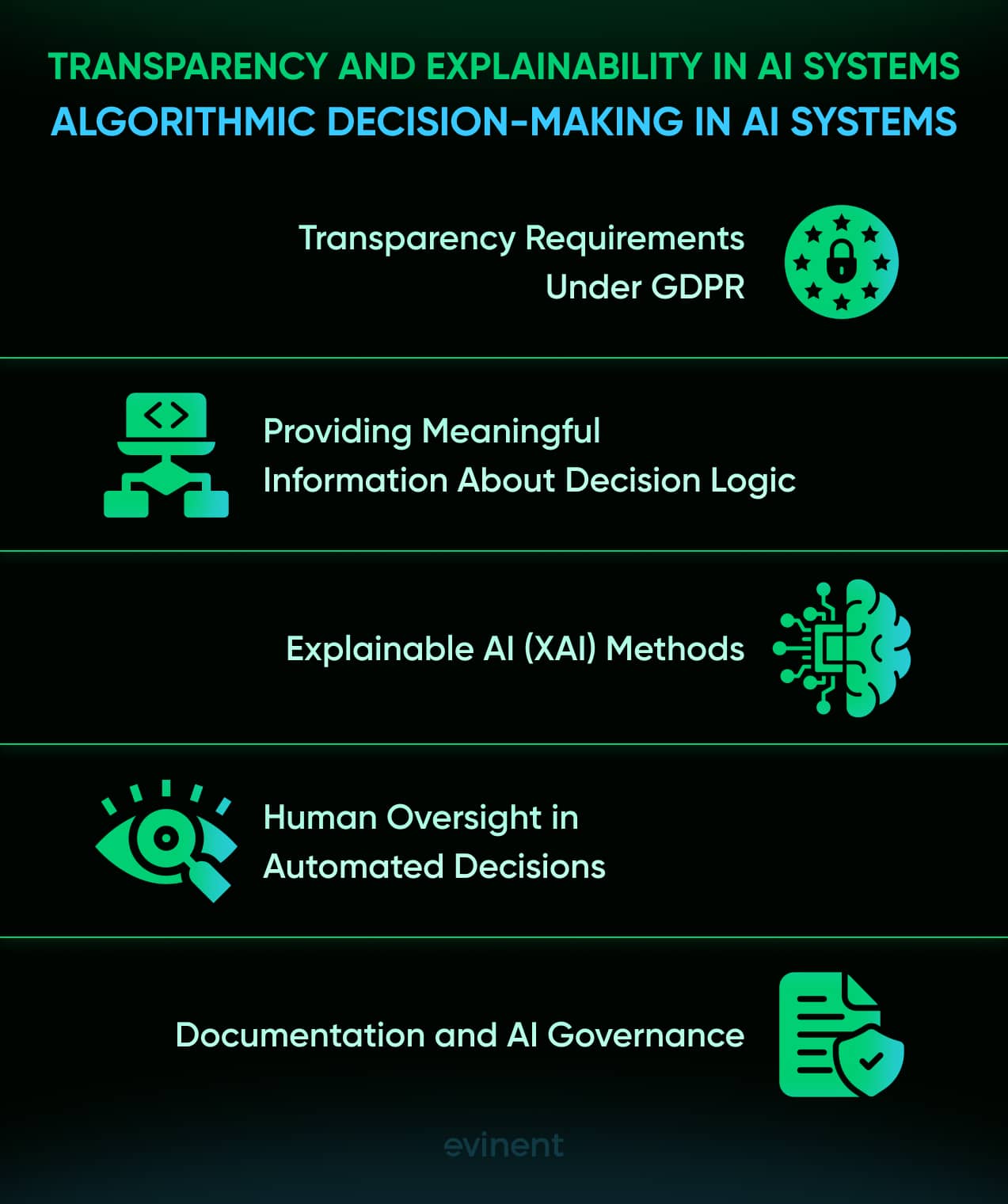
Algorithmic Decision-Making
AI systems often work by algorithmic decision-making, where models examine the data and make forecasts or classifications. When such systems are used to impact the outcomes of people, the organizations have to be sure that the handling of personal data is legal and well-recorded.
Transparency Obligations
GDPR requires organizations to be very explicit to the individuals whose personal data they are processing about how exactly they are doing it. That means they have to reveal the objective of the processing, the kinds of personal data concerned, and whether the decision-making will be carried out automatically, with the risk of resulting in a certain outcome.
Meaningful Information About the Logic Involved
Organizations need to inform people in a clear and understandable way about what kind of logic is behind the decisions, and if automated processing has a substantial impact on people. At the same time, this doesn't mean disclosing the secret algorithms, but only providing a kind of explanation of how decisions are made in terms that the average person can comprehend.
Explainable AI Techniques (XAI)
Explainable AI (XAI) methods can assist developers in understanding how a model works and help them provide reasons for predictions. Tools like feature importance analysis, interpretable models, and visualization techniques can contribute to making AI systems transparent and simpler to audit.
Human Oversight
GDPR points out that we need human scrutiny when automated systems are involved in decision-making. Companies have to make sure that humans can verify decisions, intervene when necessary, and also prevent the harmful consequences of errors or biases in the algorithms.
Documentation and Governance
Organizations should maintain documentation covering the full software development life cycle (SDLC) of AI systems, including model design, training data sources, testing, and monitoring. Strong data governance standards help demonstrate compliance and support accountability.
Transparency and explainability are key to building trustworthy AI systems that not only comply with GDPR requirements but also gain users' trust. Organizations should disclose information clearly when processing is automated, use AI techniques so that the reasons for the decisions can be explained, and not let algorithms run by themselves without human supervision.
Right after, we will study the rights of individuals in case of automated decisions, including the safeguards against decisions made solely by automated processing.
Individual Rights in AI-Driven Decision-Making
AI systems are most of the time based on automated processing of personal data. This processing may have a significant impact on individuals. The GDPR provides that individuals have several rights as data subjects, which apply even when decisions are made by AI systems.
These rights enable individuals to control how their personal data is processed and to safeguard themselves from unfair or non-transparent automated decision-making.
Right | What it Means | Example in AI Systems |
|---|---|---|
Right not to be subject solely to automated decisions | Individuals have the right to avoid decisions made entirely by automated processing if those decisions significantly affect them. | AI automatically rejects a job application without human review. |
Right to access and portability | Individuals can request access to their personal data and receive it in a portable format. | A user requesting all personal data used by an AI recommendation system. |
Right to object to profiling | Individuals may object to the use of their data for profiling or automated analysis. | A person opting out of targeted advertising based on behavioral AI models. |
Right to rectification | Individuals can request correction of inaccurate personal data. | Correcting incorrect data used in a credit scoring AI system. |
Right to be forgotten | Individuals can request deletion of their personal data under certain conditions. | A user is asking for their historical data to be removed from an AI analytics platform. |
Automated Decision-Making and Article 22
A key provision related to AI is Article 22 of the GDPR, which protects individuals from decisions based solely on automated processing, including profiling, when those decisions significantly affect them.
Examples of such decisions may include:
Credit scoring systems
Automated job application filtering
Predictive policing algorithms
AI systems analyzing sensitive data
Organizations in such circumstances need to put certain measures in place, for example, they should have human oversight, run-through explanations of the logic for the processing, and provide opportunities for people to dispute the results of automation.
AI that works with personal data should be very careful in respecting the rights of the people whose data is being used. For instance, they should allow people to see their data, to refuse profiling, and to contest decisions that have been made automatically without human intervention. Such safeguards are critical for making sure that the development of AI does not come at the expense of people's rights and that people are not treated unfairly.
In our next topic, we will discuss international data transfers in AI systems and the regulatory requirements that apply when personal data moves across borders.
Cross-Border Data Transfers in AI Systems
AI systems are typically quite dependent on distributed infrastructures such as cloud platforms, global data pipelines, or third-party APIs. Therefore, if a PC is being used by an AI system, it is possible that the information (personal data) is being sent to different countries or regions. To make sure that personal data is protected when it leaves the EU and the EEA, the General Data Protection Regulation (GDPR) has laid down very strict rules for these kinds of international data transfers.
That means that those who are putting AI to work must have in place legal and technical measures when they are sending personal data beyond their country's borders.
Adequate Safeguards
In accordance with GDPR, personal data can only be exported to countries outside the EU/EEA if there are suitable and sufficient safeguards ensuring that the receiving country offers a level of data protection equivalent to that of the EU. In practice, these safeguards are typically implemented through contractual protections, by means of regulatory frameworks, or through organizational compliance measures.
Cloud Infrastructure and AI Services
It is a known fact that the majority of AI platforms are dependent on cloud servers which are located in various geographical regions. In the process of training models, storing datasets, or even during the time of processing the user inputs, personal data might be transferred across different jurisdictions. Hence, it is very important for organizations to make sure that cloud providers have in place the security controls that are of a highest level. Besides, they must also ensure that the data transfers are in compliance with the GDPR regulations.
Security Reviews and Risk Assessments
Before transferring personal data internationally, organizations should conduct security reviews and risk assessments to evaluate potential privacy risks. This includes reviewing data handling practices, access controls, and encryption measures used by third-party services. These assessments help demonstrate compliance and support accountability obligations under GDPR.
Role of Data Protection Officers (DPOs)
Organizations that process significant amounts of personal data may appoint a Data Protection Officer (DPO) responsible for monitoring GDPR compliance. In the context of AI systems, the DPO may review cross-border data transfers, evaluate risks, and ensure that appropriate safeguards are implemented.
In today's AI systems, it is quite common that data is transferred internationally; however, such transfers need strong safeguards to offer at the very least the same level of protection for personal data in different jurisdictions. Besides legal protections and risk evaluation of infrastructures, strong governance practices are also part of the comprehensive approach that firms require when transferring data worldwide.
Afterwards, we will explore how the best practices of the GDPR can be used to make AI systems that are compliant through governance strategies, monitoring, and continuous compliance measures.
GDPR Compliance Strategies for AI Systems
When it comes to designing AIs that handle personal data, the development team is expected to embed data protection habits at every stage of the AI. The GDPR prefers a risk-oriented method, which means organizations are expected to, in a forward-looking way, identify the DR processing by AI-related hidden risks, and come up with measures to minimize them.
Establishing a well-organized management system helps enterprises not only reduce their legal exposure but also respect individual rights and provide verifiable evidence of their accountability in using AI tools.
According to the Internal Audit FOUNDATION, organizations that integrate structured privacy programs are significantly more prepared for regulatory audits and data protection challenges.
Privacy by Design and by Default
A key GDPR requirement is the principle of privacy by design and by default (Article 25). This principle calls for companies to integrate data protection measures into the very structure of their systems right at the earliest phase of development.
In the context of AI, these measures could mean limiting the volume of personal data that is employed to train the models, keeping the datasets' access closed, and putting in place very strong data security provisions.
Research from the IBM Cost of a Data Breach Report 2023 found that organizations with mature security and governance practices reduce the average cost of a data breach by approximately 39%, demonstrating the value of proactive privacy engineering.
Data Protection Impact Assessments (DPIAs)
One of the cases where AI may trigger such a compliance requirement is where it involves processing high-risk data. Under that situation, companies will need to work on their Data Protection Impact Assessments (DPIAs) to identify potential privacy risks before deploying the systems.
DPIAs help organizations:
Identify risks to individuals’ rights and freedoms
Evaluate data processing practices
Implement mitigation strategies before launching AI systems
The European Data Protection Board recommends DPIAs, particularly for technologies involving automated decision-making or large-scale data processing.
Human Oversight and Accountability
Even when AI systems perform complex tasks automatically, human intervention is still a key safeguard. Human review of system outputs, human intervention capability, and ways to handle potential biases or errors should be guaranteed by organizations.
Keeping track of activities, keeping records, and implementing control measures are ways of showing that one is operating in accordance with GDPR accountability requirements.
Continuous Compliance Monitoring
GDPR compliance is not a one-time process. Organizations must continuously monitor their AI systems to ensure that data processing remains lawful and secure.
This includes:
maintaining privacy notices
monitoring data security controls
reviewing logs and audit trails
updating risk management processes
A survey by the European Union Agency for Cybersecurity indicates that continuous monitoring and governance significantly improve organizational resilience against data protection risks.
Implementing structured GDPR compliance strategies enables organizations to responsibly implement AI technologies, safeguarding personal data and minimizing regulatory risks. Including privacy protection measures, performing impact assessments, and keeping continual monitoring are key components of developing reliable AI systems.
After that, we'll look at how new laws like the EU AI Act work with GDPR and influence the direction of AI regulation in Europe.
Future AI Regulation in the EU and the Role of GDPR
AI technologies keep evolving, and regulators are now drafting new laws capable of tackling risks related to the use of AI systems. The General Data Protection Regulation (GDPR) still remains the main cornerstone in the protection of personal data; however, new laws are coming in to broaden the control requirements over the whole cycle of AI development and deployment.
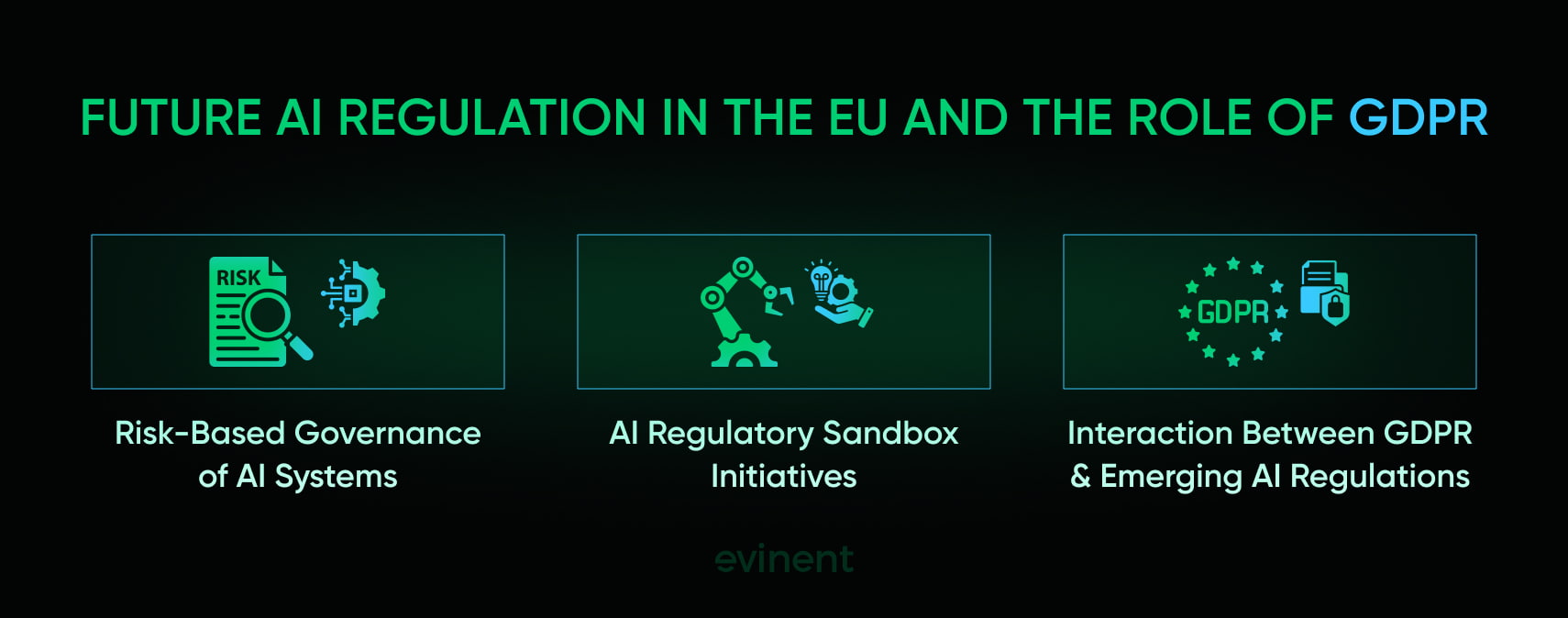
A major breakthrough is the EU AI Act, which sets forth a risk-based approach for regulating AI systems that are being used in the EU market. (European Commission – Artificial Intelligence Act)
Risk-Based Regulation of AI Systems
The AI Act divides AI systems into several risk groups based on the level of threat they pose: minimal risk, limited risk, high risk, and unacceptable risk. The high-risk category includes AI systems operating in critical infrastructures, making employment decisions, biometric identification, etc. These systems are subject to very rigorous rules such as risk management measures, documentation, and conformity assessment. (European Parliament – Artificial Intelligence Act overview)
AI Regulatory Sandboxes
EU authorities are introducing AI regulatory sandboxes to help innovation and at the same time, make sure the companies stay within the rules. Such enclosed environments will help organizations experiment with their AI systems under the eye of the regulators, while at the same time, data protection and safety requirements will not be compromised. (European Commission – AI regulatory sandboxes guidance)
Interaction Between GDPR and AI Regulation
The enactment of the AI Act has added fresh management demands, but GDPR is still the main point in the defense of personal data among AI systems. The developers, again carrying on the processing of personal data, must be well aware of the GDPR principles, namely lawfulness, transparency, and data minimization, that should be complied with.
In Europe, the further development of AI legislation is foreseen to be in line with the current GDPR, whereby the latter will remain the key instrument for the protection of personal data, and new laws on AI will mainly deal with risks from algorithms, safety, and accountability issues.
The regulatory landscape in Europe for artificial intelligence is changing very fast. Although GDPR remains the main tool for safeguarding personal data, new programs like the AI Act impose further demands on risk management, transparency, and monitoring of AI systems.
In the following section, we will outline the main points that companies need to consider while creating AI products that are in line with both the present and the future regulations of the EU.
How Evinent Can Help With Implementation of GDPR AI Platforms
Developing AI systems that process personal data entails dealing with complex regulatory and technical challenges.
Compliance with the General Data Protection Regulation (GDPR) is more than just a legal issue; it also means putting data protection measures in place practically throughout the entire AI lifecycle.
Evinent supports organizations in designing and implementing AI platforms that align with modern data protection standards and regulatory expectations.
AI Architecture With Privacy by Design
Successfully embedding Privacy by Design (PbD) principles into AI system design is a challenge for many teams. Evinent has expertise in this area and can therefore assist companies with, for example, configuring data pipelines, limiting unnecessary data collection, and setting well-protected processing environments for AI training and inference.
Secure Data Management
Effective AI systems require reliable data governance. Evinent assists organizations in implementing secure data storage, encryption mechanisms, and access control systems that protect sensitive information throughout the AI lifecycle.
Compliance-Focused Development
The AI solutions that Evinent makes are built with a solid development methodology that helps fulfill regulatory requirements, such as proper record keeping, traceability, and defining data processing steps unambiguously.
Ongoing Governance and Monitoring
Regulatory compliance is not something that stops after the deployment. Evinent supports companies to put in place the monitoring procedures, control systems, and record-keeping practices that are essential for maintaining ongoing GDPR AI compliance.
Organizations creating AI solutions should find a way to balance innovation and robust data protection measures. Incorporating privacy protections, safe infrastructure, and development methods focused on compliance, firms will be able to construct AI platforms satisfying both technical and legal standards.
Key Takeaways
The General Data Protection Regulation establishes the core legal framework governing how personal data can be processed, including in artificial intelligence systems.
Organizations developing AI solutions must follow key GDPR principles such as lawfulness, transparency, data minimization, and accountability when collecting and processing personal data.
AI technologies introduce additional challenges for data protection, including automated decision-making, profiling, and the use of complex algorithmic models that may lack transparency.
Implementing technical safeguards such as anonymization, encryption, access control, and secure data governance helps reduce privacy risks in AI systems.
Individuals have important rights under GDPR, including the right to access their data, object to profiling, and in some cases, avoid decisions made solely through automated processing.
Cross-border data transfers in AI platforms must comply with GDPR safeguards to ensure that personal data remains protected outside the EU and EEA.
New regulatory frameworks, including the EU AI Act, are expanding governance requirements for AI systems and complement existing GDPR obligations.
Organizations building AI platforms should adopt privacy-by-design practices, risk assessments, and continuous compliance monitoring to ensure that AI innovation aligns with data protection standards.
Share