

What are Clinical Trial Management Systems?
What is a Clinical Trial Management System (CTMS)? A CTMS is a tailored software platform that helps to organize, record, and control clinical trials from start to finish. It brings together the data related to operations, finance, and regulations and thus allows sponsors, CROs, and research sites to align their activities, keep track of progress, and quickly comply with the requirements.
CTMS solutions help pharmaceutical, biotech, and CRO organizations manage the increasing complexity of clinical trials by consolidating disparate tools and manual processes with a single system of record. They enable close monitoring of study timelines, site performance, participant recruitment and retention, and trial finances, which in turn facilitates better risk management, cost control, and faster study execution.
CTMS solutions help pharmaceutical, biotech, and CRO organizations manage the increasing complexity of clinical trials by consolidating disparate tools and manual processes with a single system of record. They enable close monitoring of study timelines, site performance, participant recruitment and retention, and trial finances, which in turn facilitates better risk management, cost control, and faster study execution.
Why is CTMS essential today:
As clinical trials become more global, data-driven, and highly regulated, traditional tools such as spreadsheets or disconnected systems are no longer sufficient. Clinical trial management software provides the structure, automation, and transparency required to manage multiple stakeholders, comply with regulatory requirements, and make informed, real-time decisions.
In this article, we will cover:
The key benefits of implementing CTMS and how they improve trial efficiency
The business impact and ROI of CTMS for sponsors, CROs, and research organizations
How ctms software compares to other solutions, such as EDC systems and manual tools
Compliance and regulatory considerations supported by CTMS
How to choose the right CTMS based on organizational needs
Core features commonly found in modern CTMS platforms
Practical CTMS use cases across different stakeholder roles
The value of unified and integrated CTMS solutions
Integration and interoperability with other clinical and enterprise systems
How Evinent supports the development of effective CTMS solutions
5 Benefits of Implementing CTMS
CTMS systems deliver quantifiable enhancements in areas such as trial operations, data quality, compliance, collaboration, and cost control. Implementation of CTMS is the next step in the trail of digital eClinical platforms that mainly benefit sponsors, CROs, and sites in speeding up trials and cutting down on risk.
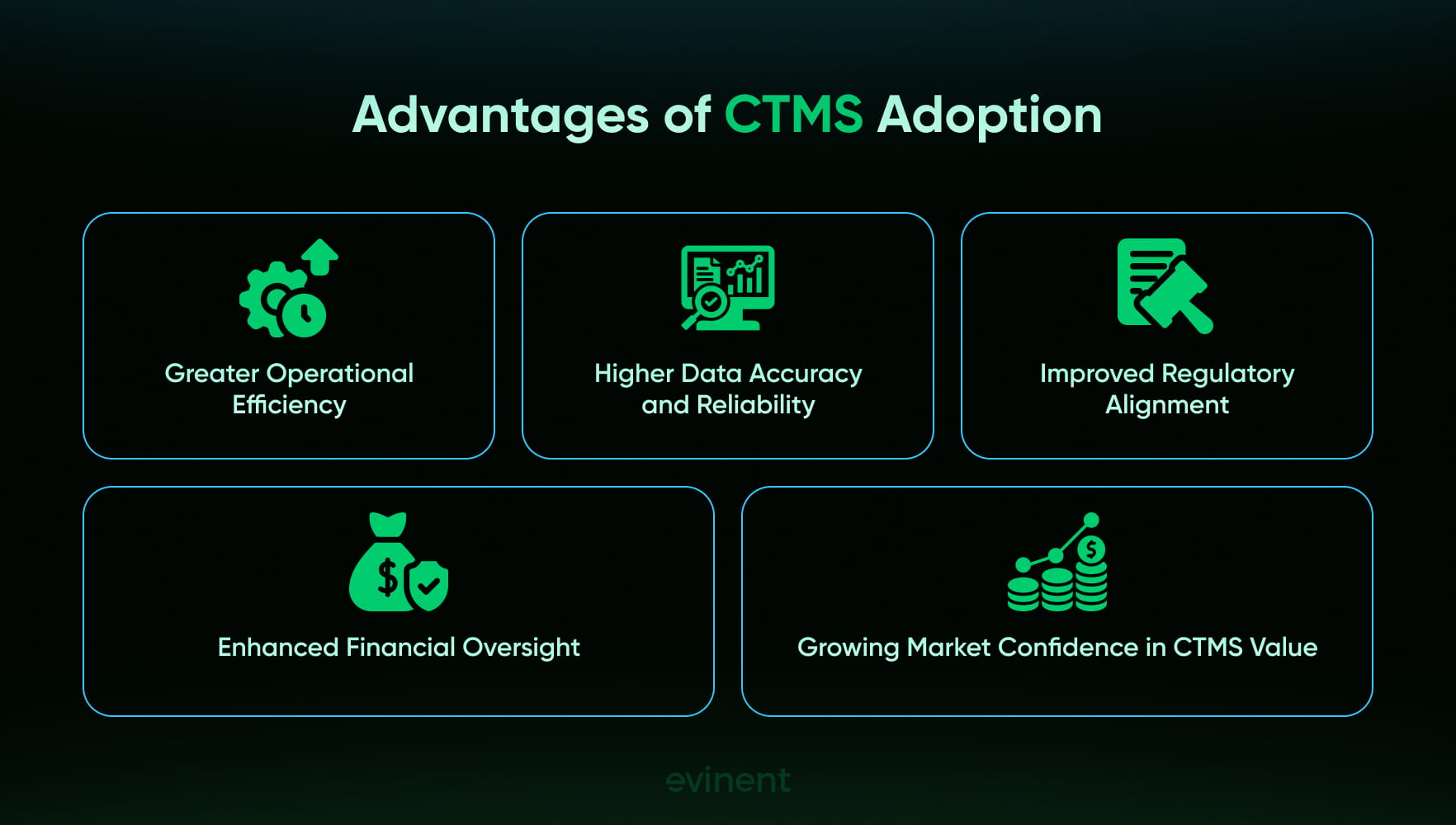
Improved Operational Efficiency
CTMS bring together the research planning, tracking, and workflows in one place, which in turn lessens the volume of manual tasks and the burden of administration. As a result, research teams can be more productive during all phases of the study, from start-up to close-out. Up-to-date trial performance dashboards allow teams to identify atogenecks and s quickly.
Enhanced Data Quality and Integrity
Automating validations and consolidating data in a single system through a CTMS help to minimize human error as well as inconsistencies in data. This results in more dependable trial outcomes which, in turn, lead to greater confidence in analytics and reporting. (AVS Life Sciences)
Stronger Regulatory Compliance
CTMS supports regulatory compliance by enforcing standardized processes, role-based access, and traceable workflows. Automated compliance controls and transparent audit trails simplify inspections, reducing the risk of findings related to documentation, deviations, or billing accuracy.
Optimized Financial Management
By linking study activities with financial management processes, CTMS clinical trial improves budget tracking, sponsor invoicing, and payment accuracy. Better visibility into study costs helps organizations control spending, avoid budget overruns, and optimize resource allocation across multiple trials.
Market Growth Reflects Value Perception
The worldwide CTMS market is growing fast, which is a clear sign of the increasing how efficient trial software is in the demand of. The market is expected to hit close to the USD 3.5 billion mark by 2025, registering a CAGR of ~14 %. The main driving factors are the requirements for improved data handling, real-time access, and cross-platform integration. (Market Research Intellect, 2024)
Clinical trial management systems (CTMS) have essentially evolved into the backbone of clinical operations for users of trials. They integrate the various study, site, financial, and compliance process components into a single operating model, thus eliminating the use of disparate tools and manual workflows.
Used in this way, CTMS becomes an excellent tool for improving laboratory efficiency, visibility of the data, and regulatory control, besides contributing to better cost management and scalability. When properly synchronized with the business requirements of the department and embedded in the overall clinical environment, CTMS can generate significant business and operational benefits.
Business Impact and ROI of CTMS
Сlinical trial management systems can impact business value by increasing operational efficiency, deepening financial insight, and thereby assisting in the reduction of clinical trial timelines and risk. Even if independent entities do not frequently disclose the return on investment (ROI) exclusively for the CTMS, corresponding studies are coming out of Tufts CSDD, McKinsey, and Deloitte, which demonstrate that the digital clinical operations and the integrated trial technologies (among which are CTMS features) bring a quantifiable value to the sponsors and research organizations.
Reduction in Trial Complexity and Timelines
Tufts CSDD notes that protocol complexity and operational inefficiencies are key drivers of longer clinical trial durations, with increasing endpoints and procedural requirements slowing progress. Modern digital trial technologies — including centralized management platforms — are associated with reduced cycle times and improved operational performance, which directly relate to cost savings. (Applied Clinical Trials Online, 2025)
Financial Value of Digital Improvements in Clinical Development
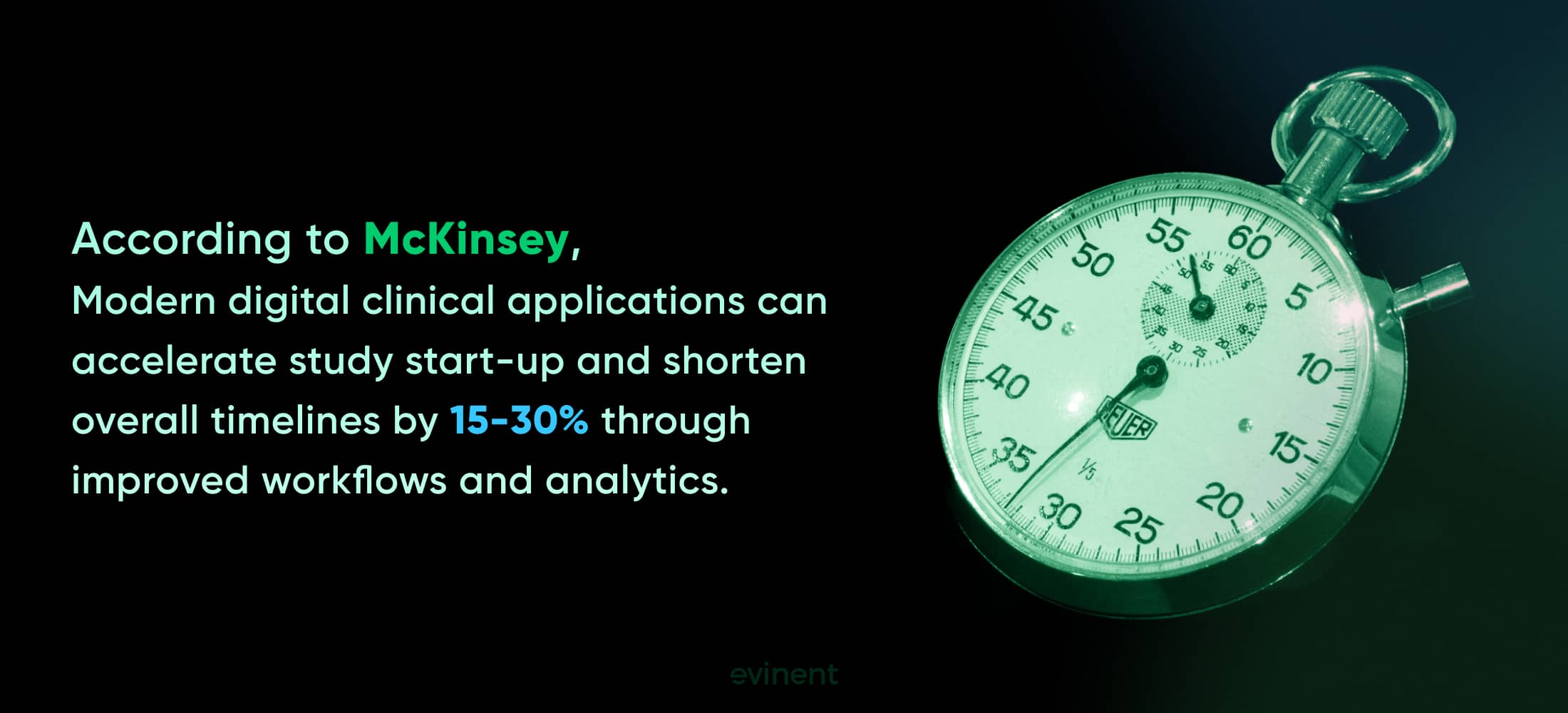
According to McKinsey, modern digital clinical applications can accelerate study start-up and shorten overall timelines by 15–30 % through improved workflows and analytics. Shorter development timelines result in higher net present value (NPV) for portfolios, as earlier market entry increases revenue potential and reduces ongoing costs. (McKinsey & Company, 2025)
Broader Evidence on Decentralized Clinical Trial Benefits
Independent research shows decentralized clinical trials (which rely on digital tools, including management platforms) delivering net financial benefits of 5x–14x versus traditional approaches due to shorter timelines and lower operational friction. Although this is not CTMS alone, it reflects the value of the digital trial management infrastructure that CTMS helps enable. (American Pharmaceutical Review, 2025)
Measurable Business Effects Linked to Digital Trial Management
Shorter timelines lead to faster patient recruitment and data collection, reducing cycle times and associated costs. McKinsey indicates accelerated start-up and execution with digital clinical operations. (McKinsey & Company)
Improved resource allocation and workflow standardization help reduce manual rework and oversight s. Independent reports highlight operational benefits of integrated digital systems. (Applied Clinical Trials Online)
Greater financial visibility supports better budget control and forecasting, reducing uncertainty and risk. While hard ROI figures specific to CTMS are rare, the direction of impact is consistent across neutral research. (McKinsey & Company)
Studies from independent sources in the sector provide evidence that technologies for the digitalization of clinical operations and trial management — the fundamental features of CTMS — lead to reduced timelines, enhanced operational efficiency, and tangible financial gains. These results — faster initiations, optimized processes, and more effective decision-making, to name a few — represent the rationale for the return on investment of those implementing formalized trial management systems.
CTMS vs Alternative Trial Management Approaches
Here we look at how CTMS stands against other solutions in clinical research such as Electronic Data Capture (EDC) systems, as well as traditional devices like Excel. The paper underlines the unique functions, advantages, and weaknesses of each method with special reference to operational scope, compliance, integration, and financial management.
Comparison of CTMS, EDC, and Excel-Based Approaches
Aspect
CTMS
EDC Systems
Excel / Manual Tools
Primary purpose
End-to-end clinical trial operations, site management, and financial oversight
Collection and validation of clinical trial data
Ad hoc tracking and manual coordination
Core focus
Study management, site management, research billing, and sponsor invoicing
Case report forms (CRFs) and patient data capture
Task lists, timelines, and basic logs
Regulatory compliance
Strong support through audit trails, archival policy enforcement, and role-based access
Compliance focused on data integrity only
High risk due to lack of audit trails and access controls
Financial management
Built-in support for research billing and sponsor invoicing
Typically not supported
Manual calculations, error-prone
Document management
Integrated document management tools with version control
Limited to studying documents related to data collection
File-based, no version or access control
System integration
API services enable integration with EMRs, eIRBs, eRegulatory management systems, and EDC systems
Often integrates with CTMS, but is not a replacement
No native integration; creates disparate systems
Workflow automation
Supports automated workflows across trial operations
Limited to data workflows
None
Scalability
Designed to scale across multiple studies and sites
Scales for data volume, not operations
Poor scalability
Real-time visibility
Centralized operational and financial insights
Data-centric reporting only
No real-time insights
CTMSs are not intended to take over EDC systems; rather, they work together by the CTMS taking care of the operational, financial, and compliance processes that are not directly linked to data capture. A big advantage of CTMS over Excel-based approaches is that they greatly reduce risk simply by doing away with disparate systems, thus allowing better traceability and system-level integrations across the clinical ecosystem.
How to Choose a Clinical Trial Management System
Choosing a suitable CTMS is a crucial move that influences production efficiency, compliance, and expenses in the coming years. Following a step-by-step method will assist you in being certain that the system fits the organizational needs, meets the desires of the stakeholders and the agreement with regulations while it is scalable and safe.
Growth through improved workflows and analytics Step 1. Assess Organizational and Stakeholder Needs
Begin by systematically identifying and assessing stakeholders' needs from different areas such as clinical operations, finance, regulatory, and IT teams. Lay out the manner in which the CTMS will be instrumental in site monitoring, budget tracking, reporting capabilities, and the day-to-day trial execution. This maneuver averts situations where the purchased functionality is either more or less than what is actually needed.
Step 2. Define Functional and Technical Requirements
Specify the features needed, for example, live reporting, available customization options, support for workflows, and the ability of the system to grow. In this step, make sure you discuss what you want from the monitoring of the location, the performance dashboards, and the degree of data transparency at both the study and the portfolio levels.
Step 3. Evaluate Regulatory Compliance and Security
Make sure that the CTMS complies with the set of regulations that are relevant to your trials and regions. Security controls, role-based access, audit readiness, and data protection mechanisms should be reviewed, as they not only have an impact on the inspection results but also on the level of operational risk.
Step 4. Review Vendor Capabilities and Maturity
Run a well-organized vendor evaluation that is concentrated on the stability of the product, its roadmap, and the vendor’s knowledge of clinical environments. Review the presence of training materials, the extent of the implementation support, and the vendor’s capability of tailoring the system to changing trial models.
Step 5. Analyze Total Cost of Ownership
Rather than just looking at the licensing fees, it would be wise to assess the complete cost of ownership that covers aspects such as configuration, customization, training, maintenance, and scalability in the long run. Robust budget monitoring and financial transparency features assist in explaining the decision to invest and in managing the continuing costs.
Step 6. Validate Reporting and Decision Support
Ensure the CTMS provides comprehensive reporting and analytics, including real-time insights into site performance, study progress, and financial metrics. Effective reporting enables data-driven decision-making at both operational and executive levels.
Step 7. Plan for Adoption and Long-Term Use
Develop a clear adoption and change management strategy. Include training resources, user onboarding plans, and ongoing support to ensure consistent usage across teams and sites. A well-implemented CTMS maximizes ROI and operational efficiency over time.
The decision to go for a CTMS needs a well-organized, gradual assessment that weighs the operational requirements, the conformance to regulatory demands, the technical features, and the total cost of ownership. A system that is aligned with the stakeholders, endowed with powerful reporting, scalability, and continuous vendor support over a long period, is more likely to generate lasting value and enable the increasing clinical trial portfolios to thrive over time.
Key Features of Clinical Trial Management Systems
Nowadays, a wide array of features is being offered by modern CTMS platforms to assist clinical trial operations in improving their efficiency, thereby generating more reliable data, meeting compliance regulations, and enabling better decision-making. The diagram below illustrates the essentials and the roles they play in clinical research.
Feature
Description
Participant Management
Enables tracking and management of study participants, including enrollment, visit schedules, subject tracking, and retention strategies. Supports site monitoring and workflow coordination.
Document Management
Centralized management of study documents, regulatory files, and version-controlled materials. Integrates with audit trails and role-based access control to maintain compliance and ensure traceability.
Workflow Automation
Automates routine trial processes such as task assignments, notifications, and milestone tracking. Reduces manual effort, minimizes errors, and improves operational efficiency.
Reporting and Analytics
Provides real-time dashboards, operational and financial metrics, and customizable reports. Supports decision-making for sponsors, CROs, and site teams.
Integration Capabilities
API integration with EDC, EMR, eIRB, eRegulatory systems, and other enterprise platforms. Facilitates data consolidation, interoperability, and centralized visibility.
Audit Trail
Tracks all changes to data and documents to maintain accountability and compliance with regulatory requirements.
Financial Management
Manages study budgets, payments to sites, sponsor invoicing, and overall trial cost tracking. Ensures financial visibility and control.
Regulatory File Management
Organizes and tracks regulatory submissions, approvals, and documents. Supports role-based access and ensures compliance readiness.
Role-Based Access Control
Provides user-specific access permissions to sensitive data and functionality, maintaining security and regulatory compliance.
Site and Study Tracking
Monitors site performance, enrollment progress, and study milestones across multiple locations and trials.
Task Management
Assigns, tracks, and manages operational tasks across the trial team, improving accountability and efficiency.
A CTMS includes a complete set of features to streamline the trial activities, improve data accuracy, and ensure regulatory compliance. The integration of participant management, document control, workflow automation, reporting, and system integrations within a single platform facilitates the efficient running of trials by sponsors and sites, allows error reduction, and supports informed decision-making at every stage of the study.
Unified and Integrated CTMS Solutions
This section compares the advantages of unified and integrated CTMS platforms, showing that both methods centralize data and simplify trial processes. However, even though the end goal is to increase operational efficiency and facilitate decision-making, the two differ in scope and the manner of implementation.
Unified CTMS Solutions
Unified CTMS platforms are comprehensive platforms that integrate the management of clinical trial operations, participant data, document management, financial tracking, and regulatory files in one single system. The main benefits are:
Centralized data management and a single source of information for stakeholders.
Automated workflows that reduce manual effort and errors.
Real-time analytics and role-based dashboards for performance monitoring.
AI-powered platform capabilities for predictive insights.
Strong system customization to align with organizational processes and trial-specific needs.
Simplified data migration and centralized access across teams.
A unified CTMS curtails the fragmentation problem by integrating all clinical trial operations in a single platform, thereby enhancing visibility, decision-making capabilities, and overall efficiency.
Integrated CTMS Solutions
Integrated CTMS combines a central trial management platform with external systems like CRM, ERP, EMR, analytics, and BI platforms. Major features consist of:
Seamless integration with external platforms for enhanced data exchange.
Support for process-driven solutions and consistent workflows across multiple systems.
Centralized reporting on performance data while maintaining interoperability.
Role-based dashboards and real-time analytics without losing data integrity.
Enables stepwise adoption of new tools without replacing existing systems.
Integrated CTMS concentrates on things like interoperability, giving the organizations the flexibility to continue using the systems that they already have and change their trial management processes step by step without disrupting the operations at the same time.
Unified and integrated, both function to improve the efficiency ctms systems for clinical trials, enhance the visibility of data, and ensure compliance; however, they address different needs slightly. Unified platforms provide single consolidated solutions that are ideal for streamlined operations, while integrated solutions focus on interoperability and gradual modernization, thus allowing organizations to get the most out of their current systems while also centralizing essential trial information.
CTMS Use Cases by Stakeholder
Clinical trial management system examples assists different stakeholders involved in clinical trials by facilitating role-based workflows, providing centralized data access, and encouraging cross-functional collaboration. Below is a table that shows how each role gains from the system in their everyday work.
Stakeholder Role
Use Case Description
Clinical Operations
Manage overall trial execution, track study progress, allocate resources, and monitor site performance. Uses automated workflows to coordinate cross-functional teams efficiently.
Site Coordinators
Handle participant management, schedule visits, maintain study documentation, and ensure protocol adherence. Role-based access ensures they see only relevant trial data.
Sponsors
Monitor study milestones, review financials, track enrollment and retention metrics, and ensure regulatory compliance. Real-time dashboards provide visibility across multiple sites and trials.
CRO Workflows
Coordinate multiple sites and studies, manage task assignments, track regulatory submissions, and facilitate communication between sponsors and sites. Centralized platform supports standardized processes.
Billing Teams
Oversee research billing, sponsor invoicing, and budget tracking. Integration with financial modules ensures accurate cost allocation and reporting.
Regulatory Teams
Maintain regulatory documentation, track approvals, and ensure audit readiness. Role-based dashboards and centralized document management support compliance.
CTMS makes it possible for all stakeholders in a clinical trial to efficiently fulfill their roles by providing a central source of data, access based on roles, and fostering collaboration among different functions. Moreover, being a system of workflows, it supports coordination, compliance, and the operational performance across the whole study lifecycle.
CTMS Integration and Interoperability with Clinical Systems
This partexamines the interrelation between CTMS platforms and the rest of clinical as well as enterprise systems that not only simplifies the operations, but also improves the data flow and allows automation. Good integration facilitates real-time reporting, site and study monitoring, patient recruitment, and workflow management.
Key Points
AI-Driven Platform and Analytics: The CTMS is capable of integrating with analytical and AI-powered tools to deliver predictive insights, detect bottlenecks, and help in data-driven decision-making.
Workflow Automation: Automated work delegation, s, and milestone tracking can be done through the integrated systems, thus reducing the manual workload and mistakes.
Data Migration and System Customization: Old trial data may be brought into the CTMS, and integration flows can be adjusted to fit the company's processes and reporting requirements.
Document Management: Centralized document repositories are connected with eRegulatory, EDC, and EMR systems, thus ensuring version control and compliance.
Patient Recruitment and Site Monitoring: The integration of recruitment platforms and monitoring tools enables enrollment optimization through continuous performance tracking.
Real-Time Reporting: Connected systems deliver dashboards and reports that offer stakeholders a quick view of study progress, resource utilization, and financial metrics.
Integration and interoperability not only broaden the capabilities of CTMS but also link it with other clinical and enterprise systems. This guarantees a seamless data flow, automated operations, and real-time visibility, which, in turn, improves the efficiency of operations, compliance, and overall trial management.
How Evinent Can Help With Clinical Trial Management Software Development
Evinent has been a reliable technology partner for sponsors and CROs for a long time as they develop scalable and compliant CTMS platforms. Our main focus is on unifying, connecting, and making the fragmented processes auditable to create workflows that not only enhance management oversight but also significantly reduce the manual work involved in the studies.
Why Organizations Choose Evinent for CTMS Development
15+ years in healthcare and enterprise software
Proven delivery of secure, scalable platforms in regulated environments
Strong integration expertise across clinical systems and data flows
Consistent execution on complex, multi-phase development programs
Relevant Experience: Secure Integration Ecosystem for Clinical Research
Challenge:
A U.S. clinical research organization needed a secure integration layer connecting multiple systems used across trial operations — including data capture, regulatory workflows, and participant coordination. Manual processes and disconnected platforms created data silos, security risks, and s in study execution.What we delivered:
Evinent designed and implemented an interoperability framework with role-based access, encrypted data exchange, and automated synchronization between operational and clinical systems. The solution ensured consistency across sites, reduced manual reconciliation, and enabled controlled data flow suitable for monitored clinical environments.Outcome:
The organization has established a dependable integration backbone that enables it to conduct long-term research programs, enhancing the transparency of studies, reducing redundant data entry, and ensuring better security and audit compliance.
Evinent CTMS Capabilities
Configurable study & site management modules
Secure participant and document workflows
Integration with EDC, eCOA/ePRO, EMR, billing, analytics
Automated notifications, dashboards, workflow orchestration
Scalable architectures for global and multi-study environments
We do not sell a packaged CTMS we create sustainable platforms customized for your research requirements.
Key Takeaways
CTMS centralizes study operations, documentation, sites, and financial workflows, reducing fragmentation and improving operational control.
Efficient implementation strengthens data quality, audit readiness, and cross-functional visibility — not by replacing existing systems, but by connecting them.
Platforms deliver business value when they shorten timelines, reduce manual work, and provide real-time insight for decision-making.
CTMS complements — not duplicates — EDC and other tools; the differentiator is orchestration, workflow automation, and integration.
Selecting the right platform requires aligning system capabilities with study complexity, compliance requirements, resource constraints, and long-term scalability needs.
Unified and integrated architectures turn CTMS from a repository into an operational backbone, enabling consistent processes across global portfolios.
Real-world use cases vary by stakeholder — clinical operations, sites, regulatory teams, finance — but the shared goal is structured coordination and fewer operational bottlenecks.
The value of integrations grows as digital ecosystems mature; interoperability is no longer optional for data consistency, monitoring, and automation.
A capable development partner brings experience with security, regulated environments, and scalable architectures — ensuring CTMS supports growth rather than constraining it

Share