

The PIM Default: Why Marketplace Product Content Management Deserves A Better Answer
You're creating a marketplace. Suppliers are signing up. Product data varies widely from one another, moderation is becoming a limiting factor, and a team member says, "We need a PIM." It's a good thought. However, this is probably the wrong decision, and this piece of writing details why.
The majority of suggestions for multi-vendor catalog management ultimately boil down to one prescription: get a PIM. This phrase continues to be echoed on vendor blogs, analyst reports, and procurement checklists until finally, it ceases to be a decision and turns into a default option. But deciding on a tool without aligning it with your actual architecture is not a strategy; it's just a knee-jerk reaction. And for a marketplace, that knee-jerk reaction may result in an annual licensing cost of over €40, 000 for a solution that completely misses the point.
PIM was made for a particular way of working: an editorial team in one place preparing product data before it goes to market. That way of working assumes one company controls the whole content pipeline. A marketplace with a supplier-driven catalog is based on the contrary assumption that many independent vendors input their own data, and it is the platform's responsibility to raise quality levels by the 'outside in' approach. Normal PIMs are fundamentally incompatible with this. Getting one for a supplier-driven marketplace is like buying a CMS when what you really need is a workflow engine.
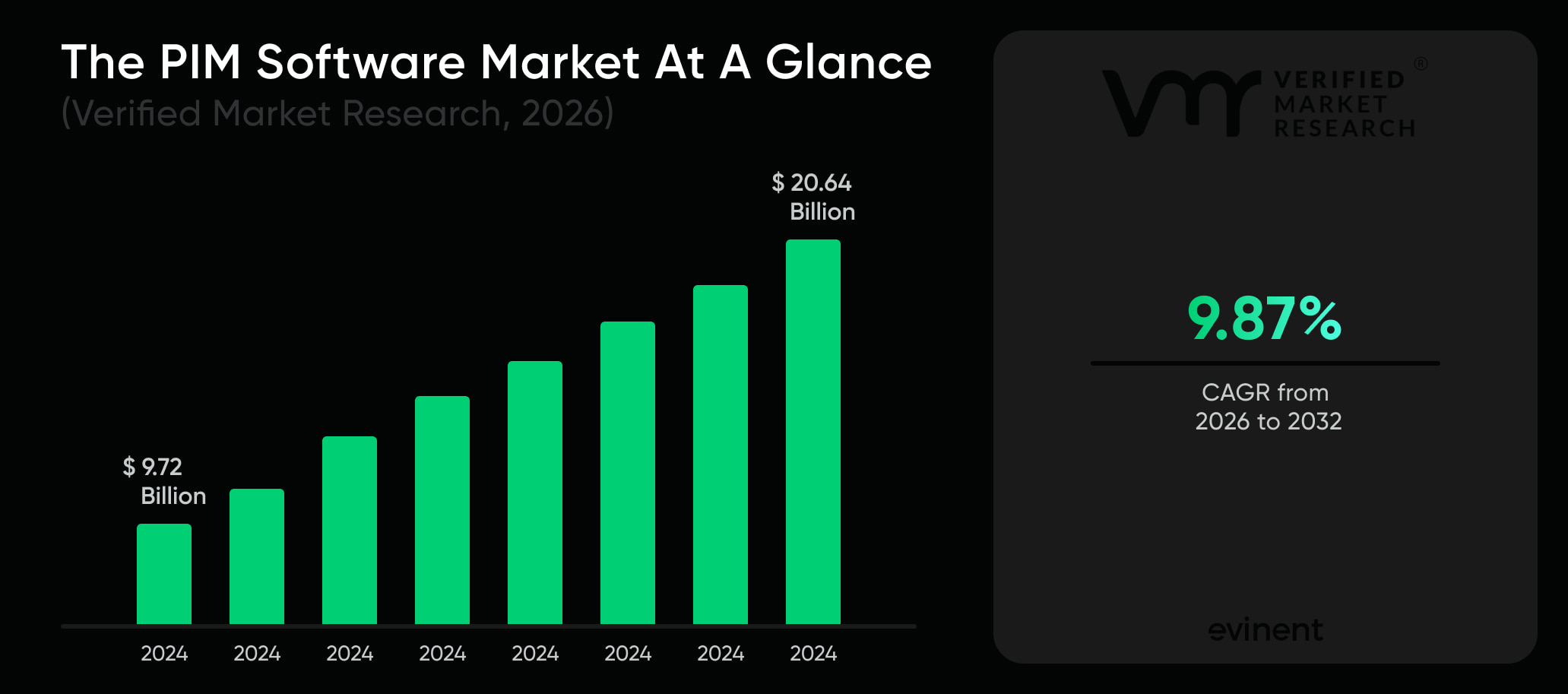
The scale of PIM investment makes this worth getting right. Shopify merchants handling more than 10,000 SKUs experienced a 23% revenue loss when product information was incomplete — a number that makes catalog quality feel urgent. But urgency drives teams toward the most visible solution rather than the most appropriate one. The PIM software market was valued at USD 9.72 billion in 2024, and vendors are well-funded, well-marketed, and actively selling into exactly this moment of pressure. For a marketplace, that pressure deserves a more precise response than a category purchase. (Mordor Intelligence, 2026) (Verified Market Research, 2026)
"The real challenge for a marketplace isn't enriching product data centrally — it's enforcing quality standards across dozens of independent suppliers without a central editorial team."
The big difference, enrichment vs. enforcement, is what this article is chiefly exploring. Here's what it looks like in practice:
The reason why the difference between PIM features and marketplace needs is deeply rooted as a problem that only a configuration change can solve.
Directly comparing features of separate PIM and supplier portal with focus on the requirements that really matter.
The parts of the trio that stand for PIM in the catalog model run by suppliers, and what is the consequence of missing each one?.
When a standalone PIM genuinely is the right call.
How Evinent built PIM-equivalent functionality for an e-commerce marketplace without a third-party licence.
What A Marketplace Actually Needs vs What PIM Provides
It is easier to select a tool if one understands clearly the problem that is to be addressed. At first glance, the requirements of a multi-vendor marketplace and a single-brand retailer may seem the same; they both need structured product data, quality control, and channel distribution. However, the business model behind each is very different. The table below compares the main features of a marketplace with what a single PIM alternative marketplace can offer.
Requirement | Standalone PIM | Supplier Portal and Workflow |
Centralized team enrichment | Core use case | Not the model |
Supplier self-service submission | Limited or requires customization | Built for this |
Per-vendor access control (RBAC) | Not native, costly to configure | Native multi-vendor isolation |
Submission moderation workflow | Requires third-party or custom build | Defined states: submitted → review → approved/rejected |
Inline supplier feedback on rejection | Not supported natively | Contextual, no email dependency |
AI pre-validation before human review | Vendor-dependent, often add-on | Custom logic: completeness, format, duplicates |
Duplicate listing detection | Enterprise tier only | Configurable per catalog rules |
Mandatory field enforcement at entry | Configurable but not supplier-facing | Enforced at the submission layer |
Typed attribute validation | Strong | Strong |
Image requirement enforcement | DAM integration required | Native to the submission form |
CMS sync | Requires an integration layer | Native sync |
Audit trail per listing | Partial, focused on data versioning | Full submission history per vendor |
Implementation timeline | 12–18 months enterprise | 3–4 months MVP |
Ongoing licence cost (50 vendors) | $45K–$110K+/year | $0 licence, full code ownership |
The overlap between the two approaches is genuine but very limited. Both are good at dealing with typed attributes and data structures. Also, they can enforce mandatory fields and support enrichment logic at the data model level. In the case of a marketplace that has an internal editorial team dedicated to writing descriptions, managing translations, and producing rich media, a PIM is covering this central work effectively. It's the point where these two approaches really share some common ground.
The critical gap appears everywhere the supplier is the actor, not the platform. Moderation workflows, per-vendor access isolation, inline rejection feedback, and submission-level validation none of these are all native to PIM architecture because PIM was never designed around an external content contributor model. Configuring a standalone PIM to handle marketplace product content management the way a purpose-built supplier portal does isn't a customization project — it's a rebuild. At that point, the licence cost compounds on top of the implementation cost, and the result is still a system optimized for the wrong operational model.
The Three Components That Replace PIM In A Marketplace
This is not a "PIM is dead" statement. PIM addresses a real issue; however, not the one a supplier-driven marketplace really has. Considering a marketplace model where vendors are the ones managing their own product information and the platform regulates the quality from the outside, these three elements essentially provide the same functionalities but in a more effective, more flexible way, without an enterprise licensing burden.
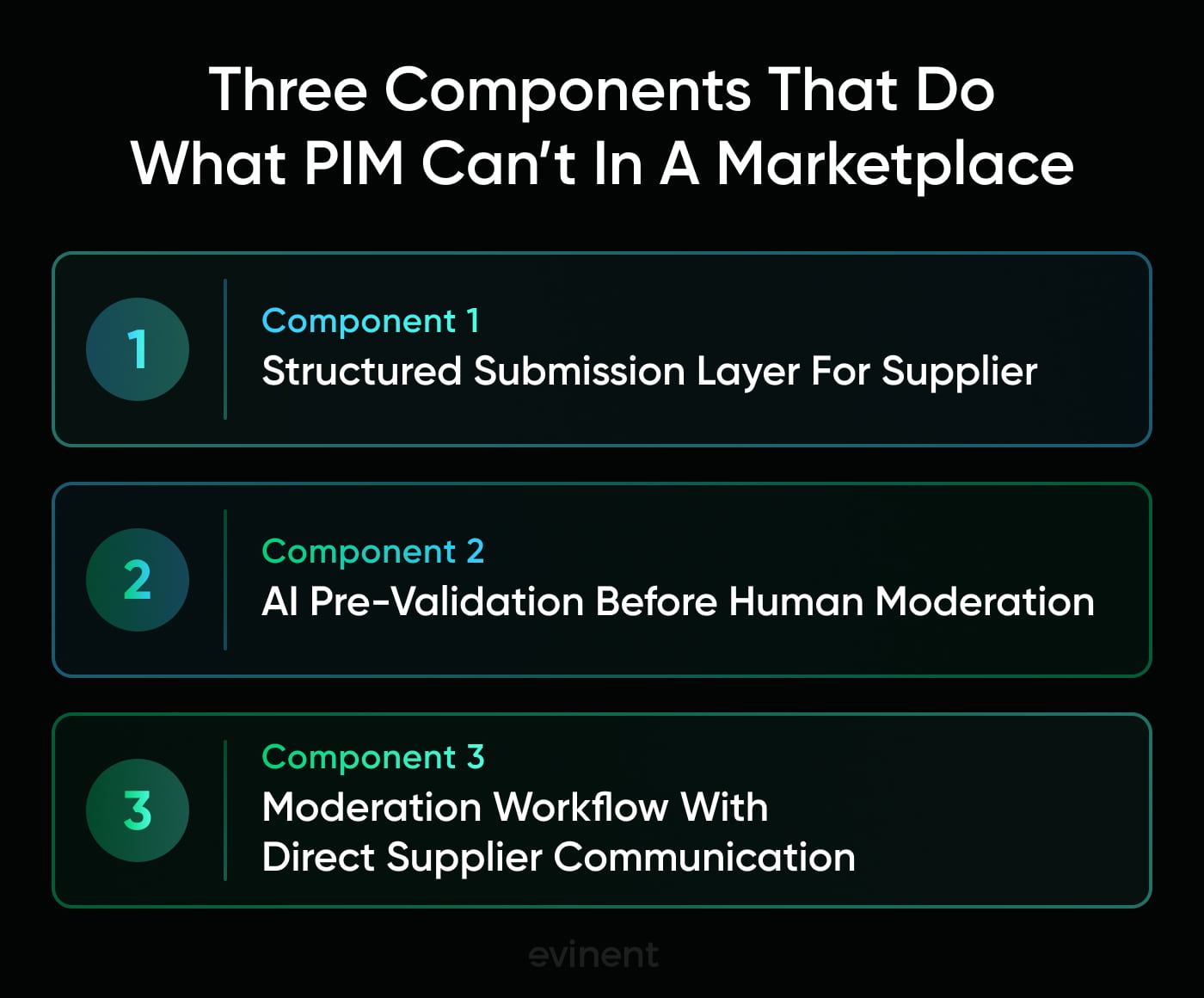
Component 1 — Structured Supplier Submission Layer
A structured submission layer replaces centralized data entry by moving enforcement to the point of input. Suppliers fill forms with mandatory fields, typed attributes, enumerated values, and image requirements validated before submission is even possible. Inline validation catches format errors immediately rather than routing them through a moderation queue.
Without this layer, the catalog inherits every inconsistency a supplier introduces. Free-text fields and optional attributes create thirty different ways to describe the same product category by vendor thirty. Every new vendor added makes the normalization problem harder, not easier.
Component 2 — AI-Based Pre-Validation Before Human Review
Before a submission is sent to the moderation queue, AI-driven pre-validation performs several checks: completeness checks, format validation, duplicate detection, and a layer that acts as a first-pass filter. Completeness checks ensure that no required field is left blank. Format validation checks if the attributes are of the right types and within valid ranges. Duplicate detection identifies listings that are very similar to existing catalog entries. This layer is like a first-pass filter that addresses straightforward content issues before a moderator views the submission. Thus, human review is reserved for decisions that truly require the human context and judgment.
Layering such a marketplace content management system is necessary because otherwise, the moderation queue will be full of problems that can be fixed by pattern-matching alone. Besides, when there are over 50 vendors, the review cycles become longer, supplier onboarding slows down, and the bottleneck cannot be solved by hiring, since the problem is the process architecture, not headcount.
Component 3 — Moderation Workflow With Inline Communication
A specially designed moderation process clearly indicates the different item submission stages: submitted, under review, approved, or rejected, with the reason documented. Suppliers are able to get the current listing status instantly. Rejection reasons are directly attached to particular and contextual information, not misplaced in a messy email conversation. Each change of state is recorded, thus forming a complete audit trail for each vendor and each listing.
This is a serious missing piece without which there is no way of keeping a reliable record of what was submitted, when it was reviewed, or what feedback was given. Also, inline communication is not a mere facilitation feature; in fact, it is the very method that links the feedback circle between the platform standards and supplier behavior, and that is how catalog quality will continuously get better.
These three components solve multi-vendor catalog management without PIM more efficiently and can produce well-organized, checked, and regularly controlled product data. However, the system doesn't require a central team to be actively involved in the process. That being said, we shouldn't automatically consider this as a one-size-fits-all solution. To be fair, we need to consider the times when a separate PIM is indeed the best option.
When You Actually Do Need A Standalone PIM
Some marketplaces, however, shouldn't shun PIM. It's not that PIM is inherently a wrong tool that should be discarded everywhere; rather, the key question is whether the operational model is compatible with PIM. In fact, there are four scenarios where the decision should be acknowledged, and the truth revealed in each case matters significantly compared to the persuasive argument on either side.
Scenario 1 — Editorial-First Marketplace
If the platform runs its own editorial team that independently enriches content, writes descriptions, manages translations, handles SEO optimization, and produces rich media, PIM is justified. That's the centralized enrichment model PIM was designed for. The supplier provides raw data; the platform transforms it into polished catalog content. When that transformation happens internally at scale, a PIM's workflow tools, versioning, and enrichment pipelines earn their license cost.
Scenario 2 — Enterprise Scale, 500K+ SKU
At this volume, the requirements shift from workflow management to data governance. Versioning, localization pipelines, master data management, taxonomy governance across product families, regulatory compliance data — these are enterprise infrastructure problems, not submission workflow problems. A custom supplier portal vs PIM can be scaled, but replicating enterprise-grade MDM and governance tooling from scratch requires an infrastructure investment that starts to approach PIM licence costs anyway. At 500K+ SKUs, PIM earns its place.
Scenario 3 — Omnichannel Distribution To Multiple External Channels
If marketplaces share product information not only with their own stores but with retailers, comparison engines, print catalog publishers, and wholesale partners, all at the same time, a PIM's syndication layer is really the right tool. Dealing with formatting rules for channels, mapping of attributes for each receiving system, and updating in sync a dozen downstream systems are precisely the tasks for which PIM syndication was designed. Supplier portals are for controlling inbound content; they do not replace the infrastructure for outbound distribution.
Scenario 4 — Highly Regulated Product Categories
Medical devices, pharmaceuticals, food and beverage, and electronics with mandatory compliance requirements, these product categories must have required data fields, audit trail provisions, and regulatory documentation that are quite beyond normal catalog and marketplace product content management.
PIM systems embedded with compliance modules are in a position to cover structured regulatory data, certificate management, and audit-ready versioning very well, while a custom submission layer could require a heavy investment to mimic these capabilities. In case the catalog is basically compliance-driven rather than content-driven, then PIM remains the most reasonable choice.
All four scenarios show a similar pattern: PIM is a good choice when the platform itself is handling the content transformation, distribution, or compliance tasks. On the other hand, if these tasks are the supplier's responsibility and the platform's role is only to enforce and provide quality control, then the supplier portal model would be a more suitable architecture.
Actually, the majority of growing marketplaces with 10 to 200 vendors and a supplier-driven content model do not fit any of these four categories. This approach aims to address that gap.

Two Deployment Scenarios Where the Decision Becomes Clear
A suitable architecture for managing product content in a marketplace is not determined simply by the number of vendors. It really depends on where the platform is in its growth cycle and what decisions have been made so far. These two scenarios represent the most typical points of change: one marketplace laying the foundation from zero, and another marketplace that has outgrown its current method and is looking to scale without completely revamping. They both arrive at the same architectural outcome; however, the route and the priorities at each stage differ.
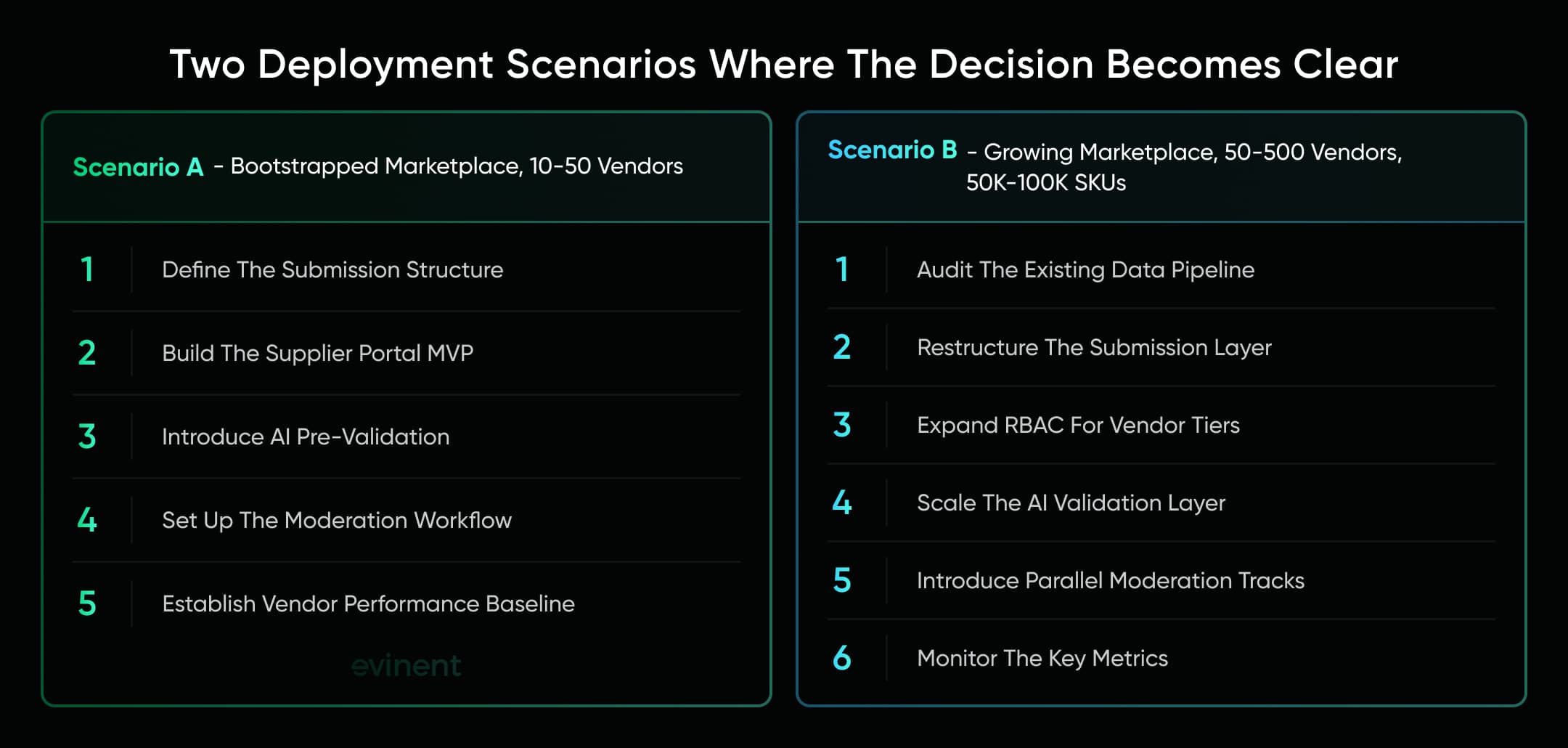
Scenario A — Bootstrapped Marketplace, 10–50 Vendors
In this case, the PIM reflex is even more dangerous. The catalog is small enough that the issue appears manageable, only to become unmanageable later on. Ten vendors with different data and no submission standard cause a normalization problem that, step by step, makes the catalog so large as to be impossible to fix manually.
Step 1 — Define The Submission Structure
Before you onboard even one vendor, you should define which fields are mandatory, what type of attributes each product category should have, and the requirements for pictures for each product category. A decision like this, made when you have only 10 vendors, can save a lot of work when you have 50. The main cause of all catalog normalization issues at large scale is the presence of free-text fields and optional attributes, and it's practically impossible to fix them retroactively without going through the supplier onboarding process again.
Step 2 — Build The Supplier Portal MVP
A purpose-built supplier portal with structured submission forms, per-vendor access isolation, and inline validation at the point of entry. Full code ownership from day one means no ongoing licence dependency and no vendor lock-in as the platform grows. Delivery timeline: 3–4 months. Cost: significantly below a $45K–$110K annual PIM licence before implementation costs are added.
Step 3 — Introduce AI Pre-Validation
Before any submission reaches a human moderator, automated completeness checks, format validation, and duplicate detection run against the submission. Routine errors are flagged and returned to the supplier without consuming moderation capacity. This layer is what keeps the moderation workload from growing linearly with vendor count.
Step 4 — Set Up The Moderation Workflow
Eliminating the old-fashioned way of emailing back and forth, different submission stages (submitted, under review, approved, rejected with reason) are clearly defined, and the suppliers get notified of their change of situation via a new non- email channel. A record is kept of each time the status is changed. Rejection reasons are not only given to the supplier, but at the same time and in the same place as the listing, i.e., they are embedded. Instead of an email thread that may or may not get read, suppliers use structured feedback to make their next submissions better.
Step 5 — Establish Vendor Performance Baselines
Monitor the rejection rate of each vendor, the turnaround time of one moderation cycle per submission, and the lifespan of new listings from the first day. These figures serve as a warning system for quality issues in the catalog and a standard to compare the system's return on investment as the platform grows.
Scenario B — Growing Marketplace, 50–500 Vendors, 50K–100K SKUs
At this point, the lack of good architecture starts to hurt us in real operations. If you don't have AI checking first, a moderation queue is just a bottleneck that you can't fix, even if you hire more people. On the other hand, a catalog without a proper submission workflow is a data quality issue that even a lot of manual cleaning cannot solve forever.
Step 1 — Audit The Existing Data Pipeline
Map where product data enters the system, where validation currently happens, and where moderation breaks down. At this scale, the bottlenecks are almost always in one of three places: unstructured supplier input, absent pre-validation, or email-based rejection communication with no audit trail.
Step 2 — Restructure The Submission Layer
Should there be free-text fields, substitute them with typed attributes and enumerated values. Also, if the enforcement of mandatory fields is not done at the entry stage, then make sure it is done. This, by far, is the most disruptive step within this phase, as not only do you need to re-onboard the existing suppliers against a new submission standard, but also it's the only way to prevent catalog inconsistency from further compounding.
Step 3 — Expand RBAC For Vendor Tiers
At 50+ vendors, a flat access model breaks down. High-volume suppliers, new suppliers in probationary status, and verified partners need differentiated permission levels — different submission quotas, different moderation priority, and different visibility into catalog analytics. Per-vendor access control configured at this stage prevents permission management from becoming a manual overhead problem at 200 vendors.
Step 4 — Scale The AI Validation Layer
Expansion of the validation rules to cover the entire attribute set for all active product categories is required. Introduce category-specific completeness thresholds; a listing of electronics has different mandatory fields than a listing of fashion. Tune the duplicate detection settings to differentiate between genuine product variants and actual duplicates.
Step 5 — Introduce Parallel Moderation Tracks
High-volume suppliers with strong submission quality histories move through an accelerated review track. New suppliers and those with high rejection rates go through full moderation. This tiered workflow keeps overall moderation capacity focused where editorial judgment is actually needed, rather than distributed evenly across all submissions regardless of risk profile.
Step 6 — Monitor The Key Metrics
Moderation cycle time per submission, rejection rate by vendor, and time-to-live for new listings are the three metrics that determine whether the system is scaling correctly. If the moderation cycle time grows as the vendor count grows, the pre-validation layer needs to be extended. If rejection rates cluster around specific vendors, those vendors need structured onboarding support rather than continued moderation overhead.
The difference between Scenario A and Scenario B is not just in the scale; it's also about the price of making a wrong architectural choice. Listing 10 vendors without a submission structure wouldn't be a major issue. Whereas 500 vendors would result in a catalog of poor quality affecting various business aspects, i.e., content moderators, changing suppliers, search algorithms' relevance, and customer conversion.
The above stages are not a straight to-do list; they are the architectural choices that decide whether the platform grows in a controlled way or grows despite a lack of control. Doing them right from the start makes each new vendor a source of power to the system. Doing them wrong makes every new vendor a source of problems.
How Evinent Delivered PIM-Level Catalog Control Without A PIM Licence
Building catalog quality into a marketplace without a standalone PIM isn't a configuration task — it's an architecture decision. Most platforms reach a point where the process that worked at 20 suppliers visibly breaks at 80. The question is whether the team recognizes it as a structural problem before it becomes an operational crisis.
Why Do Customers Choose Evinent?
15+ years building marketplace and e-commerce platforms
Experience across mid-sized businesses and enterprise clients in retail, logistics, and e-commerce
85% of clients return for follow-up projects — because we design for operational reality, not just technical requirements
Case Study: Catalog Management Overhaul For A Fast-Growing Eastern European Retailer
The Challenge:
A fast-growing Eastern European retailer came to Evinent with a catalog system that had outgrown its infrastructure: no structured supplier validation, no role-based access control, no resubmission path, no audit trail. The instinct was to solve it with a PIM purchase. Instead, the team chose to solve it with architecture.
The Solution:
Evinent built the supplier-driven catalog management layer around the three components described above: structured submission intake, automated pre-checks, and a four-stage moderation workflow with inline supplier feedback. Fine-grained RBAC matched permissions to actual roles. Elasticsearch replaced a slow catalog update pipeline. Full code ownership, no third-party PIM licence.
The Results
23% increase in search result conversion from improved catalog data quality
320% increase in online sales over a 2.5-month peak demand period — absorbed without expanding the moderation team
Manual review cannot be scaled indefinitely, and every product data management marketplace will hit this limit at some point. That said, the difference lies in how much operational damage has been done by the time the team realizes that it is a structural problem rather than a headcount one.
With a structured submission by suppliers, an AI pre-validation, and a moderation workflow using inline communication, the possibility of reducing the review cycle time is not the only benefit; the transformation of catalog quality from being a bottleneck to a controllable and measurable system is also attained.
Only those suppliers who can release products and get them to the market in a shorter time, with fewer revision cycles and clear rejection feedback, will be the ones who continue on the platform. The design that enables this is not in front of the moderation queue, but behind it.
FAQ
Do E-commerce Marketplaces Need A PIM System?
No, not automatically. PIM is the right kind of tool when a platform has a centralized editorial team that works on enriching product content independently, writing descriptions, handling translations, making rich media, etc. If it is a marketplace where suppliers maintain their own listings, and the platform merely enforces quality standards, then a supplier portal designed for structured submission, with AI pre-validation and moderation workflow, covers pretty much the same functions but without the cost of an enterprise license. Essentially, the choice comes down to who will do the content transformation: the platform or the supplier.
What Is The Difference Between A PIM And A Supplier Portal For A Marketplace?
PIM is primarily meant for centralized data enrichment, that is, one team controlling the whole content pipeline. A supplier portal is meant for decentralized content submission, that is, several independent vendors entering their own data, with the platform enforcing quality from the outside. PIM is quite good at enrichment, versioning, and syndication. On the other hand, a supplier portal natively is able to provide multi-vendor access control, submission moderation, and inline supplier communication. For a marketplace with a supplier-driven catalog model, these are different architectural problems, and PIM solves the wrong one.
What Happens To Product Quality When Suppliers Manage Their Own Listings?
The lack of structure makes things go downhill: random features, absence of mandatory fields, duplicate entries, non-compliant pictures. A proper setting, on the other hand, enables supplier self-service to enhance catalog quality since product validation takes place at the entry point rather than afterward. Required fields made compulsory in a structured submission interface, AI pre-validation before human verification, and a rejection process with inline feedback form a feedback loop that results in better supplier submission quality over time. The platform doesn't improve the data it just applies the standard.
When Should A Marketplace Use A Standalone PIM vs A Custom Supplier Portal?
A standalone PIM should be used only in four specific cases: if the platform runs its own editorial enrichment team, if the catalog contains more than 500K SKUs and requires enterprise data governance, if the platform distributes product data to several external channels simultaneously, or if it covers highly regulated product categories with mandatory compliance data requirements. Outside these four cases, especially for supplier-driven marketplaces with 10 to 200 vendors, a custom supplier portal with AI validation is the best and most cost-effective solution.
How Much Does Marketplace Product Content Management Cost Without A PIM?
The price of a single PIM licence for a 50-vendor marketplace is usually between $45K and $110K annually, not counting implementation costs. A supply portal MVP specially designed for supplier needs can be developed within 3-4 months, granting the buyer full code ownership and no licence fees in the future. Depending on the extent and intricacy of the task, the overall cost may vary, but the fundamental difference lies in the fact that a custom portal is a one-off production that the platform fully owns, whereas a PIM licence is a periodic expense that depends on the vendor's pricing model. In most cases for expanding marketplaces, the build-vs-licence calculation leads to the custom mode of operation at this level.
Key Takeaways
PIM was designed for centralized editorial teams, not for supplier-driven marketplaces. In fact, it addresses an entirely different problem, and does so very expensively.
What a multi-vendor marketplace really needs is mechanisms to ensure quality of products coming from the independent suppliers, not a centralized data enrichment.
A supplier-driven model requires three things to replace a PIM, namely: a structured submission layer, AI pre-validation, and a moderation workflow with inline communication. Without any one of these, there will be a specific failure mode.
There are four instances when a PIM is appropriate: an internal editorial team, 500K+ SKUs, omnichannel syndication, regulated product categories. In other cases, a custom approach prevails.
There is a structural difference in costs: $45K, $110K/year for licensing as compared to a one-time development with full code ownership.
Architectural choices made at the first 10 vendors will affect the operational costs at the 100th. It's less costly to get it right early than to rebuild under pressure.
Share