

What is fraud detection and prevention?
Fraud detection and prevention is the process of identifying, stopping, and reducing fraudulent activity before it causes financial, operational, or reputational damage. In 2026, it matters more than ever because fraud is no longer isolated, manual, or slow; it is automated, AI-powered, and embedded across digital systems.
That single definition explains why fraud has moved from a back-office control function to a board-level business risk.
In today’s environment, fraud does not look like a suspicious transaction flagged after the fact. It looks like a normal customer journey, until it isn’t. Synthetic identities pass onboarding. Account takeovers use valid credentials. Deepfake voices authorize real payments. DeFi exploits drain liquidity pools in seconds, not days.
The scale reflects this shift. Businesses lose around 5% of annual revenue to fraud on average, while consumer fraud losses exceeded $12.5 billion in 2024 alone, according to recent regulatory and industry data. In healthcare, governments continue to uncover multi-billion-dollar fraud schemes involving stolen identities and AI-generated documentation. In financial services, account takeover attacks are accelerating faster than most detection teams can adapt. In decentralized finance, fraud is often irreversible by design.
“Fraud is a silent but costly threat that continues to translate into significant financial losses every year.” — Deloitte, Corporate Forensic Services, 2025
The core problem is not that organizations lack fraud tools.
It’s that most fraud prevention strategies were designed for a world where:
Attacks were predictable
Systems were centralized
Fraud happened after a transaction, not during it
That world no longer exists.
Modern fraud operates across legacy systems, cloud platforms, APIs, identity providers, payment rails, and decentralized networks simultaneously. It exploits fragmentation, slow decision-making, and governance gaps more than it exploits technical weaknesses.
As a result, fraud detection and prevention in 2026 is no longer about adding another rule, model, or verification step. It is about whether an organization’s systems, data architecture, and governance model are capable of responding to adaptive, intelligent threats in real time.
This article explains:
What has fundamentally changed in fraud since 2020
How AI-driven fraud detection actually works in practice
Why false positives remain one of the most expensive hidden risks
How healthcare, finance, and DeFi approach fraud differently
Why governance and system design matter as much as machine learning
In short, fraud prevention is no longer a technology problem alone. It is a systems, strategy, and leadership problem, and the organizations that recognize this are the ones that lose less money, detect fraud earlier, and protect trust at scale.
What Has Changed in Fraud Detection Since 2020?
Fraud detection has shifted from rule-based, transaction-level controls to AI-driven, behavior-based systems designed to stop fraud in real time rather than investigate it after losses occur.
Since 2020, three structural changes have reshaped fraud permanently:
Fraud became faster than human review
Attackers adopted AI and automation
Enterprise systems became more fragmented, not less
As a result, traditional fraud prevention models no longer scale.

What fraud detection looked like before 2020
Before 2020, most fraud prevention strategies were built around a predictable model:
Fraud followed known patterns
Attacks reused similar techniques
Detection happened after a transaction
Human analysts reviewed s in batches
Rule-based systems worked because fraud evolved slowly.
If an attack method became common, teams added new rules. If fraud spiked in one channel, controls were tightened there. This approach was imperfect but manageable.
Why that model broke after 2020
Fraud detection stopped working the moment fraud became adaptive.
Three changes accelerated this breakdown:
1. Digital acceleration compressed fraud timelines
E-commerce, digital banking, telemedicine, and DeFi adoption removed friction for customers and criminals. Fraud now happens in seconds, not days.
2. AI lowered the cost of fraud
Criminals began using:
AI-generated identities
Automated credential stuffing
Deepfake audio and video
Scripted transaction testing
Fraud became scalable, not manual.
3. Systems became more complex
Modern enterprises now operate across:
Legacy platforms
Cloud services
Third-party APIs
Payment processors
Identity providers
Decentralized protocols
Each system sees only part of the story.
“AI-generated financial fraud and deepfake identities have made detection and attribution harder, forcing organizations to adopt real-time fraud monitoring.” — Deloitte Romania, 2025

What modern fraud looks like in practice
Modern fraud no longer announces itself.
It blends into legitimate behavior until the moment damage is irreversible.
Examples include:
Synthetic identities that pass onboarding and transact normally for months
Account takeovers using valid credentials and normal devices
Authorized Push Payment (APP) scams where users approve real transfers
DeFi exploits that abuse protocol logic rather than steal credentials
The attack is the journey, not the transaction.
How fraud detection approaches changed as a result
The core shift is simple:
Fraud detection moved from “Is this transaction suspicious?” to “Does this behavior make sense?”
That shift changed everything.
Old vs modern fraud detection models
Dimension | Pre-2020 Fraud Detection | Fraud Detection in 2026 |
Detection logic | Static rules | Adaptive AI models |
Focus | Individual transactions | Behavioral sequences |
Speed | Post-transaction | Real-time / pre-authorization |
Data scope | Single channel | Cross-channel & cross-system |
False positives | High but accepted | Actively minimized |
Human role | Manual review | Oversight & escalation |
What role AI plays — and what it does not
AI did not replace fraud teams. It replaced assumptions.
Modern AI-based fraud detection:
Learns normal behavior continuously
Detects deviations in context, not isolation
Adapts to new fraud patterns without new rules
What it does not do:
Eliminate governance requirements
Remove the need for explainability
Automatically reduce risk without system integration
AI is effective only when embedded into systems that can act on its decisions.
Why false positives became a critical business problem
In older models, false positives were tolerated.
In modern digital environments, they are costly.
High false positive rates lead to:
Abandoned transactions
Locked customer accounts
Increased support costs
Brand trust erosion
Industry data shows that many organizations still experience 60–70% false positive rates, despite advanced tools.
In 2026, false positives are no longer a technical nuisance; they are a revenue and retention problem.
Why governance now matters as much as detection
As fraud became more complex, ownership became less clear.
Common gaps include:
Fraud is owned by compliance, but executed by engineering
Security teams are detecting issues that product teams can’t act on
AI models producing s without clear escalation paths
Modern fraud detection only works when:
Accountability is clearly defined
Decision rights are explicit
Technology, risk, and product teams collaborate
This is why leading organizations treat fraud prevention as a governance discipline, not a toolset.
In short: Fraud detection changed after 2020 because fraud became faster, automated, and behavior-based. Static rules and siloed systems can no longer keep up. Modern fraud prevention relies on AI-driven behavioral analysis, real-time decisioning, and strong governance to stop fraud before losses occur.
Why Traditional Fraud Prevention Systems Fail
Why don’t traditional fraud prevention systems work anymore?
Traditional fraud prevention systems fail because they rely on static rules, fragmented data, and ed decision-making, while modern fraud is adaptive, cross-channel, and happens in real time.
In short, today’s fraud evolves faster than yesterday’s controls.
What “traditional fraud prevention” actually means
Traditional fraud prevention typically includes:
Rule-based engines (if–then logic)
Threshold checks (amounts, frequency, location)
Blacklists and whitelists
Manual reviews after s are triggered
These systems were designed for a world where:
Fraud patterns changed slowly
Channels were limited
Human review could keep up with volume
That context no longer exists.
The five core reasons traditional systems break down
1. Static rules cannot adapt to adaptive fraud
Rule-based systems only detect what they are explicitly told to look for.
Modern fraud:
Changes tactics rapidly
Tests controls automatically
Avoids known thresholds by design
Once a rule becomes effective, attackers simply route around it.
Result: constant rule inflation, declining accuracy, and growing maintenance cost.
2. Fragmented data hides the fraud story
Most legacy systems analyze fraud in silos:
Payments see transactions
Identity systems see logins
CRM sees customers
Support sees complaints
No single system sees behavior across the entire journey.
Fraud, however, operates across all of them.
Result: each system sees “normal,” while the combined pattern is clearly fraudulent.
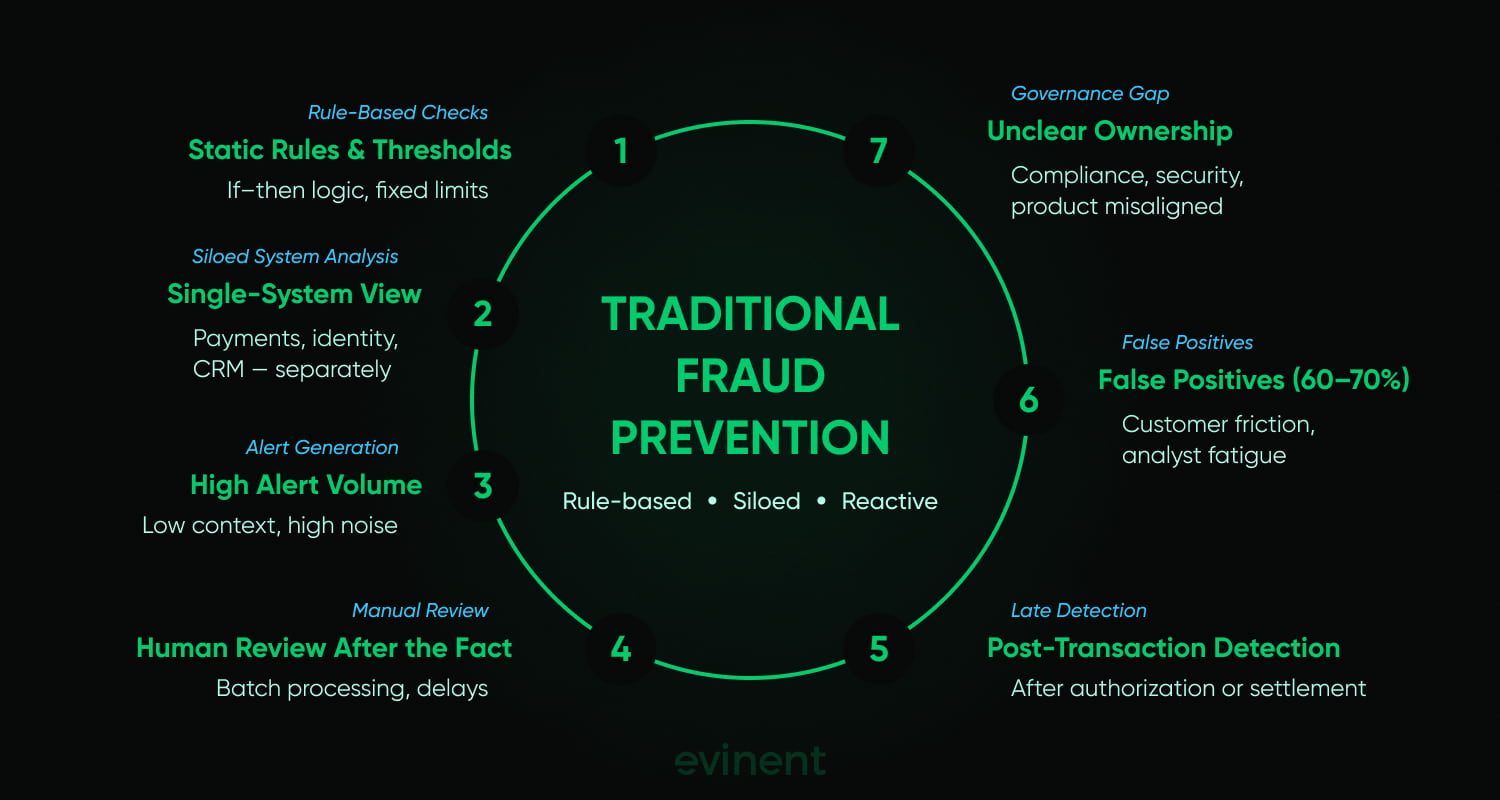
3. Detection happens too late
Traditional fraud systems often detect fraud:
After authorization
After settlement
After customer complaints
At that point:
Money is already gone
Chargebacks are unavoidable
Trust is already damaged
In high-velocity environments like fintech and DeFi, late detection is equivalent to no detection at all.
4. False positives overwhelm real risk
Legacy systems generate s by being conservative.
This leads to:
False positive rates of 60–70%
Analyst fatigue
Slower response to real fraud
Poor customer experience
The paradox:
The more rules you add, the less effective detection becomes.
5. Governance is unclear or missing
In many organizations:
Compliance owns fraud policy
Security owns detection
Product owns user experience
Engineering owns systems
When fraud spans all four, no one owns the outcome.
This results in:
s without action
Conflicting priorities
Slow escalation
Inconsistent decisions
Fraud prevention fails not because teams are incapable, but because ownership is fragmented.
Is rule-based fraud detection still useful?
Yes, but only as a supporting layer. Rule-based controls are effective for known patterns and regulatory requirements, but they are insufficient on their own against adaptive, AI-driven fraud.
Old assumptions vs modern reality
Assumption | Why It No Longer Holds |
Fraud repeats patterns | Fraud mutates constantly |
One system can detect fraud | Fraud spans multiple systems |
Manual review can scale | Volume exceeds human capacity |
More rules = better security | More rules = more noise |
Detection is enough | Prevention must happen earlier |
Why adding more tools doesn’t fix the problem
A common response to rising fraud is to add:
Another verification step
Another fraud vendor
Another review workflow
This often increases friction without reducing losses.
Why?
Because tools added to broken architectures inherit the same limitations:
Siloed data
ed action
Unclear accountability
Fraud prevention is constrained by system design, not tool count.
What modern fraud prevention requires instead
Effective fraud prevention in 2026 requires:
Cross-system data visibility
Real-time behavioral analysis
Adaptive risk scoring
Clear decision ownership
Governance aligned with technology
This is a systems problem, not a feature gap.
In short, traditional fraud prevention systems fail because they rely on static rules, siloed data, and late detection. Modern fraud is adaptive, cross-channel, and behavior-driven, requiring real-time analysis, integrated systems, and clear governance to stop losses before they occur.
How AI-Driven Fraud Detection Actually Works in 2026
How does AI improve fraud detection in 2026?
AI improves fraud detection by analyzing behavior, context, and relationships in real time, allowing organizations to detect fraud before transactions are completed, not after losses occur.
Unlike traditional systems that evaluate isolated events, AI-driven fraud detection evaluates patterns over time, across users, devices, sessions, and systems.
What AI-driven fraud detection really means
AI-driven fraud detection is often misunderstood as “using machine learning instead of rules.”
In practice, it means something more specific:
Decisions are based on probability, not binary rules
Risk is evaluated continuously, not at fixed checkpoints
Signals are combined across multiple systems, not one channel
AI does not replace fraud logic.
It redefines how risk is calculated and acted upon.
Core components of AI-driven fraud detection
AI-based fraud prevention systems rely on four foundational layers.
1. Behavioral analytics (the foundation layer)
Behavioral fraud detection analyzes how users interact with systems, not just what actions they perform.
Instead of asking:
“Is this transaction suspicious?”
The system asks:
“Does this behavior make sense for this user right now?”
Behavioral signals include:
Navigation patterns
Interaction speed and rhythm
Session flow and sequencing
Device and environment consistency
Because behavior is difficult to fake consistently, it is one of the strongest fraud indicators available.
What is behavioral fraud detection?
Behavioral fraud detection identifies fraud by monitoring deviations from normal user behavior, such as unusual navigation patterns, interaction speed, or session sequences, rather than relying solely on transaction details.
2. Machine learning models (risk estimation layer)
Machine learning models estimate the likelihood that an action is fraudulent based on historical and real-time data.
In mature systems, multiple models operate together.
Common model types:
Model Type | What It’s Used For | Key Limitation |
Supervised ML | Known fraud patterns | Needs labeled data |
Unsupervised ML | Unknown anomalies | Requires tuning |
Semi-supervised ML | Hybrid detection | Higher complexity |
Deep learning | High-dimensional data | Explainability challenges |
No single model is sufficient.
Accuracy comes from orchestration, not model choice.
3. Graph and network analysis (relationship layer)
Graph-based fraud detection focuses on relationships rather than individuals.
This is critical for detecting:
Synthetic identity rings
Mule networks
Coordinated attacks
DeFi wallet clusters
Instead of evaluating one account, graph models analyze:
Shared devices
Shared credentials
Shared transaction paths
Repeated behavioral links
This approach is particularly effective in financial services and DeFi, where fraud rarely occurs in isolation.
Why is graph analysis important for fraud detection?
Graph analysis helps detect fraud networks by identifying hidden relationships between accounts, devices, or wallets that may appear legitimate when viewed individually.
4. Real-time decision orchestration
Detection without action does not prevent fraud.
Modern AI-driven systems must:
Score risk in milliseconds
Trigger decisions before authorization
Apply proportional responses
Examples of real-time actions:
Step-up authentication
Transaction or rejection
Session termination
Human review escalation
This orchestration layer is where many organizations fail — not because AI is weak, but because systems cannot act fast enough.
Why AI reduces false positives
High false positives are not caused by “bad AI.” They are caused by insufficient context.
AI reduces false positives by:
Evaluating behavior over time, not one event
Weighing multiple weak signals instead of one strong rule
Adjusting thresholds dynamically based on risk
When properly integrated, AI systems:
Block fewer legitimate users
Escalate fewer low-risk cases
Allow fraud teams to focus on real threats
What AI cannot do on its own
AI-driven fraud detection has limits.
AI cannot:
Fix fragmented data architectures
Replace governance and ownership
Guarantee regulatory compliance without explainability
Compensate for ed system responses
This is why AI effectiveness depends on system design and integration, not just model quality.
AI in regulated and decentralized environments
Different industries apply AI differently:
Healthcare: privacy-preserving and explainable models
Financial services: real-time scoring with auditability
DeFi: on-chain analytics and automated response logic
In all cases, AI must operate within clear governance boundaries to remain effective and compliant.
In short: AI-driven fraud detection works by analyzing behavior, relationships, and context in real time. It replaces static rules with adaptive risk scoring, reduces false positives, and enables earlier intervention, but only when integrated into systems that can act on its decisions.
Fraud Detection by Industry — Healthcare, Finance, and DeFi
How does fraud detection differ by industry?
Fraud detection differs by industry because fraud exploits the weakest points in each sector’s systems, incentives, and regulatory constraints.
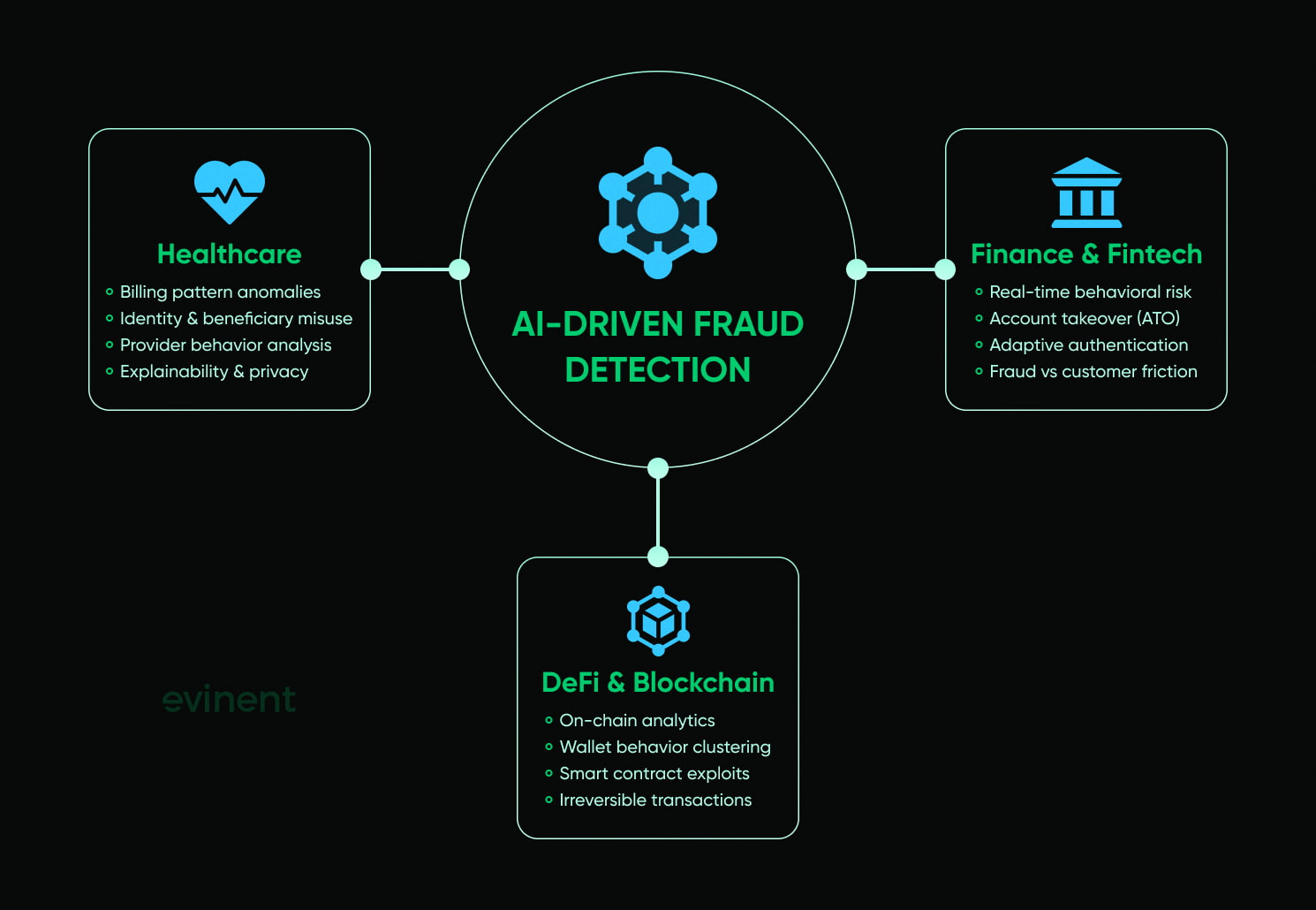
Healthcare fraud targets billing and identity gaps. Financial fraud exploits speed and trust. DeFi fraud abuses protocol logic and irreversibility.
While the underlying principles of AI-driven fraud detection are consistent, implementation and priorities vary significantly by sector.
Fraud Detection in Healthcare
How is fraud detected in healthcare systems?
Healthcare fraud detection focuses on identifying abnormal billing patterns, identity misuse, and documentation inconsistencies across highly regulated, data-sensitive systems.
Healthcare fraud is often low-visibility but high-impact, accumulating over time rather than triggering immediate alarms.
Common healthcare fraud schemes in 2026
Duplicate or inflated billing
Phantom procedures
Identity theft and beneficiary misuse
AI-generated medical documentation
Provider–patient collusion
Unlike payment fraud, these schemes often:
Appear operationally “normal”
Involve legitimate providers
Exploit fragmented legacy systems
How AI improves healthcare fraud detection
AI is particularly effective in healthcare because of pattern density.
Key techniques include:
Claims anomaly detection across providers
Behavioral profiling of billing practices
Temporal analysis of treatment sequences
Identity correlation across claims and records
Healthcare authorities now use AI to block fraudulent claims before payment, not merely investigate after losses.
Why is healthcare fraud hard to detect?
Healthcare fraud is difficult to detect because it often involves legitimate providers, complex billing rules, and ed visibility into abnormal patterns across multiple systems.
Key constraint: privacy and explainability
Healthcare fraud detection must balance:
Effectiveness
Patient privacy
Regulatory compliance
This makes explainable AI and secure system architecture mandatory, not optional.
In short:
Healthcare fraud detection relies on AI-driven pattern analysis across claims, identities, and providers, with a strong emphasis on explainability, privacy, and system integration.
Fraud Detection in Financial Services and Fintech
How do banks and fintechs detect fraud in 2026?
Financial institutions detect fraud using real-time behavioral analysis, transaction risk scoring, and adaptive authentication to stop fraud before funds move.
Speed is both the opportunity and the risk.
Dominant fraud types in finance
Account takeover (ATO)
Authorized Push Payment (APP) scams
Payment fraud and chargeback abuse
Credential stuffing
Insider-enabled fraud
Many attacks use valid credentials, making traditional controls ineffective.
What modern financial fraud detection focuses on?
Rather than blocking transactions outright, modern systems:
Continuously score session risk
Adjust authentication dynamically
Combine behavior, device, and transaction data
Minimize friction for low-risk users
This approach allows institutions to:
Reduce false positives
Protect customer experience
Meet regulatory expectations
Why do valid credentials still lead to fraud?
Because credentials can be stolen, reused, or socially engineered, modern fraud detection focuses on behavior and context rather than credentials alone.
Key challenge: customer trust vs security
Overly aggressive controls lead to:
Abandoned transactions
Customer churn
Support overload
Effective fraud detection balances security and usability, not one at the expense of the other.
In short: Financial fraud detection prioritizes real-time behavioral risk scoring and adaptive responses to stop account takeovers and payment fraud without harming legitimate users.
Fraud Detection in DeFi and Blockchain Systems
How is fraud detected in DeFi?
DeFi fraud detection relies on on-chain analytics, graph models, and protocol-level monitoring because transactions are irreversible and attackers are pseudonymous.
There is no central authority to reverse mistakes — prevention is the only defense.
Common DeFi fraud vectors
Smart contract exploits
Governance attacks
Liquidity pool manipulation
Rug pulls and exit scams
Flash loan abuse
These attacks exploit logic, not users.
How AI and analytics are applied in DeFi
DeFi fraud detection focuses on:
Transaction graph analysis
Wallet behavior clustering
Abnormal contract interaction patterns
Real-time anomaly detection
Because everything is public, data availability is high, but action windows are extremely small.
Why is fraud prevention harder in DeFi?
Fraud prevention is harder in DeFi because transactions are irreversible, attackers are anonymous, and exploits can execute automatically at machine speed.
Key limitation: enforcement
Even when fraud is detected:
Funds may already be gone
Mitigation depends on protocol design
Governance response may be slow
This makes secure system architecture and monitoring at design stage critical.
In short: DeFi fraud detection depends on real-time on-chain analytics and protocol-level safeguards, because post-transaction recovery is often impossible.
Cross-Industry Insight
Despite differences, one conclusion holds across all sectors:
Fraud detection succeeds or fails based on system design, data integration, and governance — not industry alone.
Organizations that modernize fragmented systems and embed fraud prevention into architecture consistently:
Detect fraud earlier
Lose less money
Reduce false positives
Protect trust
In short:
Healthcare focuses on billing and identity patterns, finance prioritizes real-time behavioral risk, and DeFi relies on on-chain analytics. Different threats — same requirement: integrated, AI-driven systems with clear governance.
Fraud Governance, Oversight, and Organizational Accountability
What is fraud governance, and why does it matter in 2026?
Fraud governance is the framework that defines who owns fraud risk, how decisions are made, how incidents are escalated, and how accountability is enforced across the organization.
In 2026, it matters because even the best fraud detection technology fails without clear ownership and decision authority.
Fraud resilience does not start with algorithms.
It starts with leadership.
Why fraud became a governance problem — not just a technical one
As fraud grew more sophisticated, it stopped fitting neatly into one function.
Today:
Fraud involves risk, security, product, engineering, legal, and customer experience
Decisions must be made in real time
Trade-offs between security and usability are unavoidable
When governance is unclear, organizations experience:
s without action
Conflicting priorities
ed responses
Inconsistent customer outcomes
Technology detects risk. Governance decides what happens next.
How poor governance undermines fraud prevention
Even organizations with advanced AI tools struggle when:
Fraud ownership is split across teams
Escalation paths are undefined
Decision rights are unclear
KPIs reward growth over risk control
In these environments, fraud prevention becomes reactive and fragmented — regardless of tooling.
Who should own fraud prevention in an enterprise?
Fraud prevention should be owned at executive level, typically under a Chief Risk, Compliance, or Security leader, with clear cross-functional authority and board oversight.
What effective fraud governance looks like
High-performing organizations treat fraud as a strategic risk domain, not an operational nuisance.
Key characteristics include:
Board-level visibility into fraud exposure and trends
Executive ownership with authority to act across teams
Clear escalation models for high-risk events
Defined decision thresholds for automated vs human action
Governance aligns detection, response, and accountability into a single operating model.
The role of leadership and “tone from the top”
Leadership sets the boundaries within which fraud prevention operates.
When executives:
Prioritize short-term growth over controls
Penalize friction without context
Treat fraud losses as “cost of doing business”
Fraud risk compounds silently.
In contrast, organizations with strong fraud cultures:
Encourage early escalation
Invest in system resilience
Accept short-term friction to prevent long-term loss
Fraud resilience is a leadership decision.
Governance operating model
A mature fraud governance model typically includes:
Layer | Responsibility |
Board | Risk appetite, oversight |
Executive leadership | Ownership, prioritization |
Fraud & risk teams | Detection strategy |
Engineering & product | System implementation |
Operations | Incident response |
Legal & compliance | Regulatory alignment |
No single team can succeed in isolation.
Why governance maturity correlates with lower fraud losses
Industry research consistently shows that organizations with:
Clear governance structures
Defined escalation paths
Integrated systems
Detect fraud earlier and lose significantly less money than peers with fragmented oversight.
Early detection is not luck — it is governance in action.
Governance challenges unique to AI-driven fraud detection
AI introduces new governance requirements:
Model explainability
Bias monitoring
Auditability
Accountability for automated decisions
Without governance:
AI decisions become opaque
Regulatory exposure increases
Trust erodes internally and externally
AI does not remove responsibility — it raises the bar for it.
In short, fraud governance defines ownership, decision-making, and accountability for fraud risk. In 2026, strong governance is as critical as AI technology because detection without clear authority and escalation fails to prevent losses.
How to Build a Modern Fraud Prevention Architecture
What is a modern fraud prevention architecture?
A modern fraud prevention architecture is a system-level design that integrates identity intelligence, behavioral analytics, AI decisioning, and governance controls to prevent fraud in real time across all channels.
Unlike traditional setups that bolt fraud checks onto isolated systems, modern architectures are designed for fraud by default.
Why architecture matters more than tools
Many organizations invest in advanced fraud tools and still struggle.
The reason is structural.
Fraud prevention fails when:
Data is fragmented across systems
Decisions are ed by architecture
AI insights cannot trigger action
Ownership is unclear at runtime
Architecture determines whether fraud detection can actually prevent fraud.
Core principles of modern fraud prevention architecture
Before looking at components, mature organizations align on four principles:
Real-time by design
Fraud decisions must happen before authorization, not after settlement.
Behavior-first, not transaction-first
Systems must evaluate sequences of actions, not isolated events.
Cross-system visibility
Identity, payments, devices, and sessions must be correlated.
Governance-aware automation
Automated decisions must align with risk appetite and escalation rules.
The five-layer fraud prevention architecture model
Most effective enterprise architectures follow a layered approach.
1. Identity and device intelligence layer
Purpose: establish who (or what) is interacting with the system.
This layer aggregates:
Identity attributes
Device fingerprints
Network and environment signals
Historical risk context
It provides baseline trust scoring — not final decisions.
2. Behavioral analytics layer
Purpose: detect intent through behavior.
This layer analyzes:
Session flow
Interaction timing
Navigation patterns
Inconsistencies over time
Behavioral analytics is critical because credentials and devices can be stolen — behavior is harder to fake consistently.
3. Risk scoring and AI decision layer
Purpose: translate signals into probabilistic risk.
This layer:
Combines identity, behavior, and transaction data
Applies multiple AI models
Produces dynamic risk scores
Adjusts thresholds in real time
Risk scoring must be continuous, not checkpoint-based.
4. Decision orchestration and response layer
Purpose: act on risk immediately and proportionally.
Possible responses include:
Step-up authentication
Transaction s or limits
Session termination
Escalation to human review
This layer is where many architectures fail — not because AI is weak, but because systems cannot respond fast enough.
5. Governance, audit, and feedback layer
Purpose: ensure accountability, learning, and compliance.
This layer supports:
Explainability and audit trails
Model performance monitoring
Bias and drift detection
Continuous improvement loops
Without this layer, fraud prevention becomes opaque and unsustainable.
What is the most important layer in fraud prevention architecture?
There is no single most important layer. Fraud prevention only works when identity, behavior, AI decisioning, response mechanisms, and governance operate together as one system.
Why legacy architectures struggle to support this model
Legacy systems typically:
Store data in silos
Operate in batch mode
Depend on manual escalation
Cannot support real-time orchestration
As a result:
AI insights arrive too late
Fraud decisions are ed
Losses occur despite detection
This is why modern fraud prevention often requires system modernization, not just tool adoption.
Build vs integrate: a strategic decision
Organizations face two paths:
Incremental integration into existing systems
Architectural modernization to support fraud natively
Incremental approaches work short-term. Modernized architectures win long-term.
The right choice depends on:
Fraud exposure
System complexity
Regulatory environment
Growth trajectory
In short: A modern fraud prevention architecture integrates identity intelligence, behavioral analytics, AI risk scoring, real-time response, and governance into a single system. Architecture — not tools alone — determines whether fraud detection can actually prevent losses.
Measuring Fraud Prevention ROI: What Executives Should Track
How do executives measure the ROI of fraud detection and prevention?
Executives measure fraud prevention ROI by tracking how effectively the organization reduces losses, detects fraud earlier, minimizes false positives, and protects customer trust, not by counting how many fraud s are generated.
In 2026, ROI is about business impact, not technical activity.
Why traditional fraud metrics mislead leadership
Many organizations still report:
Number of s generated
Rules triggered
Cases reviewed
These metrics say nothing about:
Money saved
Customers retained
Risk avoided
Trust preserved
Fraud prevention ROI must be measured in outcomes, not effort.
The four ROI dimensions that matter
Effective fraud leaders evaluate ROI across four interconnected dimensions.
1. Fraud loss reduction
What it measures: How much financial loss is prevented or avoided over time.
Key indicators:
Net fraud losses (absolute and percentage of revenue)
Losses prevented before authorization
Reduction in repeat fraud
Why it matters:
Direct impact on profitability
Clear signal of prevention effectiveness
2. Detection speed and intervention timing
What it measures: How early fraud is detected in the attack lifecycle.
Key indicators:
Time to detection
Percentage of fraud stopped pre-authorization
Time from anomaly to action
Earlier detection consistently correlates with:
Lower financial losses
Fewer chargebacks
Reduced regulatory exposure
3. False positives and customer friction
What it measures: How often legitimate customers are incorrectly flagged or blocked.
Key indicators:
False positive rate
Customer complaints related to fraud controls
Abandoned transactions due to friction
Support tickets triggered by fraud checks
High false positives are not “acceptable trade-offs” — they are hidden revenue leaks.
4. Operational efficiency and scalability
What it measures:
How effectively fraud teams operate as volume increases.
Key indicators:
s per analyst
Automation rate
Manual review reduction
Cost per case
AI-driven systems should reduce manual workload without increasing risk.
Executive KPI snapshot
KPI | Why It Matters to Leadership |
Net fraud loss | Direct financial impact |
Fraud loss as % of revenue | Risk normalization |
False positive rate | Customer experience |
Time to detection | Prevention effectiveness |
Cost per fraud case | Operational efficiency |
Repeat fraud rate | Control durability |
What is a good fraud detection ROI benchmark?
A strong fraud prevention program shows declining fraud losses, faster detection times, and decreasing false positive rates as transaction volume grows — not flat or rising costs.
Why ROI improves only after architecture and governance changes
Organizations often invest heavily in fraud tools but see limited ROI.
The reason is structural.
ROI improves only when:
Systems can act in real time
AI insights trigger decisions
Governance aligns incentives
Data flows across platforms
Without these foundations, detection improves — but prevention does not.
Connecting fraud ROI to broader business outcomes
Mature organizations link fraud metrics to:
Customer lifetime value
Conversion rates
Churn
Brand trust
Regulatory performance
Fraud prevention becomes a growth enabler, not just a loss control.
In short: Fraud prevention ROI is measured by loss reduction, detection speed, false positive reduction, and operational efficiency. Executives should focus on outcomes that protect revenue, customers, and trust — not volume.
Fraud Trends to Watch in 2026–2027: What Leaders Should Prepare For
What fraud trends will shape the next two years?
Between 2026 and 2027, fraud will become more automated, more personalized, and more difficult to distinguish from legitimate activity, driven primarily by AI, system complexity, and regulatory pressure.
The most important shift is this: Fraud is no longer just evolving; it is co-evolving with detection systems.
1. AI-vs-AI fraud escalation
What’s changing:
Attackers now use AI not only to execute fraud, but to probe, learn, and adapt to fraud detection systems.
Examples include:
Automated testing of transaction thresholds
AI-generated behavior that mimics legitimate users
Rapid mutation of attack patterns once controls are detected
This creates an arms race where:
Static models degrade quickly
Continuous learning becomes mandatory
Model governance becomes as important as model accuracy
Implication for leaders:
Fraud prevention must be treated as a living system, not a deployed solution.
2. Deepfake-enabled social engineering at scale
What’s changing:
Deepfake audio and video are no longer rare or expensive. They are becoming accessible and convincing enough to bypass traditional verification processes.
Emerging risks include:
Executive impersonation for payment authorization
Fake customer support interactions
Synthetic “trusted voices” in internal workflows
These attacks target human trust, not system vulnerabilities.
Implication for leaders:
Fraud controls must extend beyond technical checks to include process design and verification workflows.
3. Synthetic identity fraud dominance
What’s changing:
Synthetic identity fraud is increasingly becoming the default form of identity fraud, not an edge case.
Key characteristics:
Blends real and fake data
Passes onboarding checks
Behaves “normally” for extended periods
Produces losses over time, not instantly
Because these identities mature before monetization, detection requires longitudinal behavioral analysis, not point-in-time checks.
Implication for leaders:
Short-term metrics will miss long-term fraud exposure unless behavior is tracked across lifecycle stages.
4. Fraud shifting earlier in the customer journey
What’s changing:
Fraud is moving upstream — from transactions to onboarding, engagement, and account changes.
Targets include:
Account creation
Credential recovery
Payment method updates
Privilege escalation events
Organizations focused only on transaction monitoring will consistently detect fraud too late.
Implication for leaders:
Fraud prevention must be embedded across the entire customer lifecycle, not just payments.
5. Increased regulatory scrutiny of AI-driven decisions
What’s changing:
As AI becomes central to fraud prevention, regulators are paying closer attention to:
Explainability
Bias and fairness
Decision accountability
Auditability
This applies especially to:
Financial services
Healthcare
Cross-border platforms
AI that cannot explain or justify decisions creates regulatory and reputational risk, even if it performs well technically.
Implication for leaders:
Fraud prevention strategies must balance effectiveness with transparency and governance.
6. Architecture and modernization are becoming risk factors
What’s changing:
Legacy and fragmented architectures are increasingly recognized as risk amplifiers, not neutral infrastructure.
Organizations with:
Batch processing
Siloed data
Manual escalation paths
Will struggle to:
Act in real time
Apply AI decisions consistently
Scale without rising losses
Implication for leaders:
Fraud resilience will increasingly depend on system modernization, not incremental controls.
Will fraud losses continue to grow despite better technology?
Yes, unless organizations modernize systems and governance. Fraud losses grow when detection improves but prevention cannot act fast enough.
What leaders should do now
To prepare for 2026–2027, executives should focus on:
Architecture readiness for real-time decisions
Governance frameworks for AI-driven controls
Cross-functional ownership of fraud risk
Long-term behavioral monitoring capabilities
Fraud prevention is no longer a defensive function — it is a strategic resilience capability.
In short: Future fraud will be AI-driven, behavior-based, and increasingly human-targeted. Organizations that fail to modernize systems, governance, and architecture will detect fraud, but too late to prevent losses.
Final Takeaways for Executives: How to Build Fraud-Resilient Organizations
What should executives take away from modern fraud detection and prevention?
Fraud resilience in 2026 is not achieved by deploying better tools. It is achieved by building systems, governance, and architectures that can adapt faster than fraud itself.
This is the defining shift.
The five truths leaders must internalize
Fraud is now a systemic risk, not an operational issue
Fraud impacts revenue, customer trust, regulatory exposure, and brand equity. Treating it as a back-office function guarantees ed responses and avoidable losses
Detection without prevention is failure
Identifying fraud after funds move or trust is broken is no longer sufficient. Value is created only when systems can act before damage occurs
AI is necessary — but not sufficient
Machine learning improves detection accuracy, but without real-time orchestration, integrated data, and governance, AI insights arrive too late to matter
False positives are a business liability
Every unnecessary block, challenge, or account lock erodes customer trust and revenue. Reducing fraud losses while increasing friction is not a success. Organizations with fragmented systems and unclear ownership consistently lose more to fraud, regardless of tooling.
What fraud-resilient organizations do differently
Fraud-resilient enterprises share a common operating model:
Fraud risk is owned at executive level
Governance defines decision rights and escalation paths
Systems are designed for real-time, cross-channel visibility
AI decisions are explainable, auditable, and accountable
Fraud prevention is embedded across the entire customer lifecycle
They modernize systems not to “fight fraud,” but to remove the conditions that fraud exploits.
Is fraud prevention a technology problem or a leadership problem?
Fraud prevention is both, but leadership determines whether technology can succeed. Without governance, ownership, and architectural readiness, even advanced AI systems fail to prevent losses.
The strategic reframing that matters most
The most important mindset shift for executives is this:
Fraud prevention is not about stopping criminals. It is about designing organizations that remain resilient under constant attack.
In an environment where fraud is automated, adaptive, and persistent, resilience — not perfection — is the goal.
In short:
Fraud-resilient organizations combine AI-driven detection, real-time system architecture, and strong governance. Executives who treat fraud as a strategic systems problem — not a tooling gap — detect fraud earlier, lose less money, and protect trust at scale.
How Evinent Supports Fraud Detection and Prevention Initiatives
Evinent helps enterprises strengthen fraud detection and prevention by modernizing the systems and architectures that fraud exploits most often.
Rather than positioning fraud as a standalone tool problem, Evinent approaches it as a systems, data, and governance challenge.
Across industries such as financial services, healthcare, and digital platforms, Evinent supports organizations by:
Modernizing legacy systems that prevent real-time fraud decisions
Integrating fragmented data sources into unified, behavior-aware architectures
Enabling AI-driven risk analysis within regulated, auditable environments
Designing scalable platforms that support fraud prevention across the full customer lifecycle
Evinent’s work typically focuses on infrastructure readiness, system integration, and architectural resilience, ensuring that AI-driven fraud detection can operate effectively — not just exist as an isolated capability.
For executive teams, this means:
Faster detection-to-action cycles
Lower false positives due to better context
Clearer ownership and governance alignment
Fraud prevention that scales with growth, not against it
Ready to Assess Your Fraud Resilience?
If your organization is detecting fraud but still absorbing losses, the issue may not be your tools — it may be your systems, architecture, or governance model.
Evinent works with enterprise teams to assess fraud readiness, modernize fragmented systems, and enable real-time, AI-driven fraud prevention that aligns with regulatory and business realities.
Start with a focused fraud resilience assessment to understand:
Where detection breaks down before action
Which architectural gaps increase fraud exposure
How governance impacts fraud response speed and accuracy
Share