

Hiring at enterprise scale used to be a staffing problem. Now it is also a systems problem.
A single high-profile role can attract hundreds of applicants. Graduate programs can attract tens of thousands of applicants. For some of the biggest employers, the numbers get absurd fast: Goldman Sachs received 315,126 applications for its 2024 internship program. That kind of volume breaks the logic of manual hiring. No serious leadership team can expect recruiters to read everything, compare everyone fairly, keep response times short, and still produce a hiring process that feels thoughtful to candidates.
That is where the enterprise AI recruitment platform enters the picture. Not as a magic hiring robot, and not as a replacement for recruiters, but as a structured way to handle the boring, repetitive, high-volume parts of hiring with more speed and more consistency. The stronger versions do something else, too: they keep sensitive hiring data within a controlled environment rather than shipping résumés, interview notes, and internal scorecards through public AI tools with vague boundaries and messy governance. That distinction matters more every quarter. In the EU, AI systems used to analyze, filter, or evaluate candidates are classified as high-risk under the AI Act. In the US, the EEOC has been explicit that existing anti-discrimination laws still apply when employers use AI in recruiting and hiring.
So yes, AI is changing hiring. But the real shift is not "HR now uses algorithms." The real shift is that enterprise hiring is turning into a governed data workflow. And once you see it that way, private AI stops looking like a nice add-on and starts looking like the adult choice.
What Is an AI Recruitment Platform?
An enterprise AI recruitment platform is a hiring system that uses artificial intelligence to help companies manage large volumes of candidates more quickly, with greater consistency and better visibility across the hiring funnel.
That sounds simple enough. But in practice, these platforms do much more than scan resumes for keywords.
A modern AI recruitment system can parse CVs, extract skills, compare candidates against job requirements, rank applicants, support recruiter decisions, and surface hiring insights that would be hard to spot manually. In enterprise environments, that usually happens inside a broader setup that includes ATS integrations, hiring workflows, permissions, analytics dashboards, and compliance controls.
So the real value is not just automation for its own sake. It is structured hiring support at scale.
Beyond Resume Screening
A lot of people still hear “AI hiring platform” and picture a tool that sorts resumes into yes, no, and maybe.
That is only part of it.
Stronger enterprise platforms help recruiters move through the entire process faster — from candidate intake and skill extraction to ranking, talent matching, interview coordination, and pipeline analytics. Some also support internal mobility, allowing companies to identify qualified people already within the business before starting another expensive external search.
That matters because enterprise hiring rarely breaks at a single point. Usually, the friction is everywhere: too many applicants, too many manual steps, too many handoffs, and not enough time to review every profile carefully.
What Makes It Enterprise
Not every AI recruiting tool is built for enterprise use.
An enterprise AI recruitment platform is designed for complexity. That means high candidate volume, multiple business units, different hiring workflows, cross-region compliance requirements, and integration with systems like Workday, SAP SuccessFactors, Oracle HCM, or a custom ATS stack.
In other words, these platforms are not built for a ten-person startup trying to fill one sales role. They are built for organizations where hiring is constant, distributed, and operationally heavy.
That usually includes capabilities such as:
AI resume screening for large applicant pools
AI candidate ranking based on required skills and role fit
AI talent matching across external and internal candidates
recruitment automation software for scheduling, communications, and workflow routing
enterprise hiring analytics for recruiter performance, funnel speed, and quality metrics
Why Private AI Matters

This is where the conversation gets more serious.
In consumer-grade tools, AI often works as a convenience layer. In enterprise hiring, it becomes part of a sensitive decision-making process that touches personal data, internal hiring criteria, compensation logic, and sometimes regulated workflows.
That is why many companies are moving toward private AI recruitment software rather than relying on public AI tools. A private AI hiring system gives the business more control over where candidate data lives, how models are used, who can access outputs, and how hiring decisions can be reviewed later.
And honestly, that changes the whole equation.
Without that level of control, an AI recruitment system may be fast, but it can still create legal, security, and trust problems. With the right architecture, though, the platform becomes something much more useful: a secure operating layer for enterprise hiring automation.
What It Actually Does
At their best, enterprise AI recruitment platforms help hiring teams do three things better.
First, they reduce manual screening time.
Second, they improve candidate matching beyond surface-level keyword checks.
Third, they give leadership clearer visibility into how hiring actually works — and where it slows down.
That is why the category keeps growing.
The point is not to remove recruiters from the process. It is to remove unnecessary drag from the process, while keeping human judgment where it matters most.
Key Challenges in Enterprise Recruitment
Enterprise hiring gets complicated long before the interview stage.
On paper, the process looks straightforward: publish a role, review applicants, shortlist strong candidates, move quickly, hire well. In reality, large organizations are juggling volume spikes, skill shortages, slow decision-making chains, inconsistent screening, and compliance pressure simultaneously. That combination is exactly why hiring teams have been leaning harder on automation and AI. LinkedIn’s Future of Recruiting 2024 report says the market for in-demand skills is increasingly competitive, while SHRM reports that 75% of organizations struggled to fill full-time roles, largely due to technical and soft-skill gaps among applicants.
And there is another pressure point: sheer scale. The World Economic Forum noted that Google received more than 3 million applications, and McKinsey received more than 1 million. At that level, recruitment is no longer just a people problem. It becomes an operational bottleneck.
Too Many Applicants
A bigger applicant pool sounds like an advantage. Sometimes it is. But once volume passes a certain point, more applications do not automatically mean better hiring.
They usually mean more duplicate profiles, more irrelevant submissions, more recruiter fatigue, and more qualified candidates buried under the pile. Ashby reported a 2.6x to 3x growth in job applications at the start of 2024, and talent teams told them that managing inbound volume became one of their top challenges.
That kind of overload affects quality: recruiters are forced to move faster through early screening, which makes decisions more rushed and often more inconsistent. The irony is hard to miss: the more applicants a company gets, the easier it becomes to miss the right one.
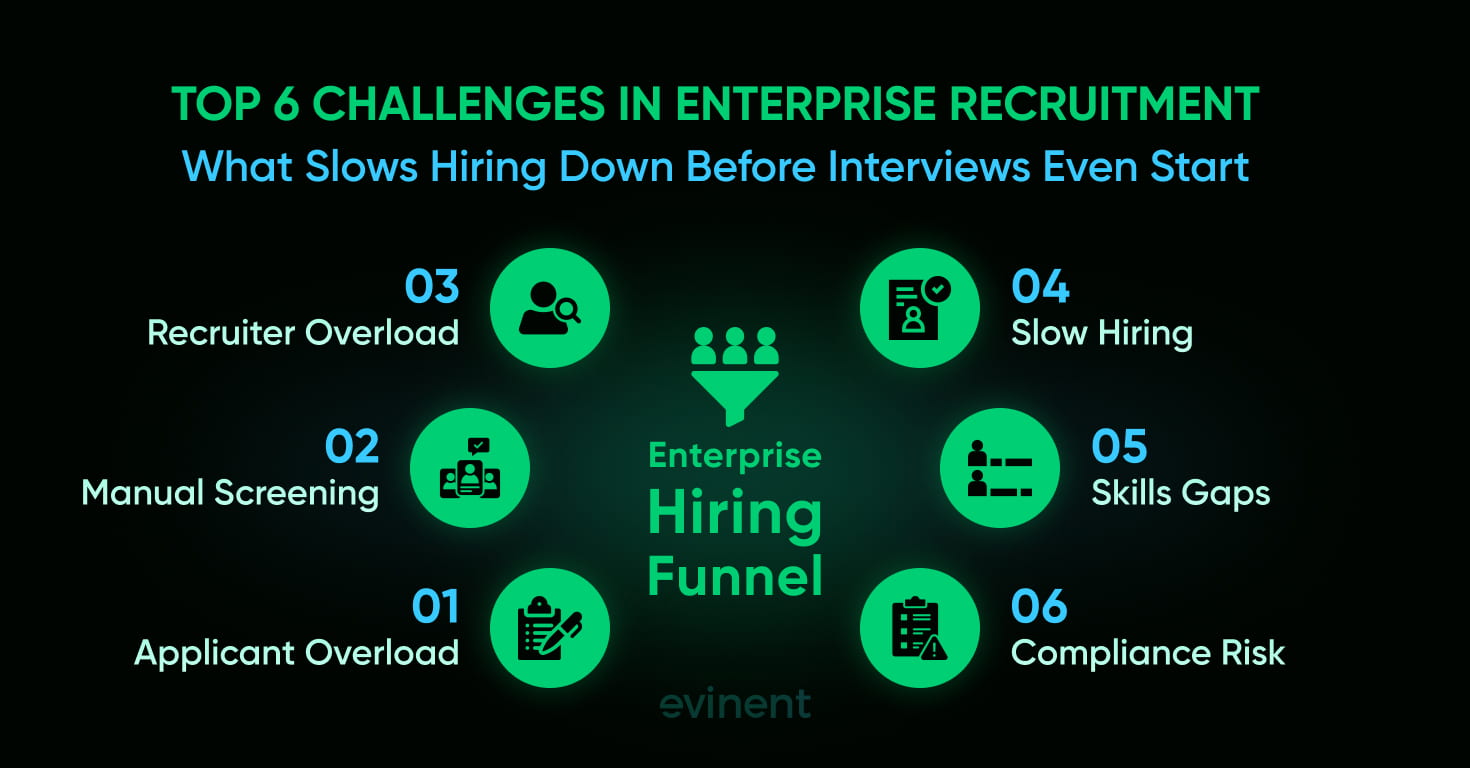
Manual Screening Breaks
This is where many enterprise hiring teams start to crack.
Manual CV review still exists in many organizations, especially where workflows have grown over time and technology has lagged behind. But once hiring volume grows across regions, teams, or job families, manual screening becomes slow, repetitive, and hard to standardize. SHRM’s 2024 AI findings show that nearly half of HR professionals said AI increased the number of applications they had to review manually, and around half also said it reduced the time it takes to fill open positions.
That statistic says a lot without trying too hard. Even HR teams already using AI are still reacting to a process that has become too heavy for manual handling.
Recruiter Overload
Hiring teams are being asked to do more, often with fewer layers of support.
Ashby found that recruiting coordinators per organization have dropped since 2022, leaving talent acquisition teams to handle more scheduling and administrative work themselves. Within the same broader set of trends, application growth continued to climb, meaning recruiters were managing both more candidates and more process friction at once.
This is one reason speed has become such a dominant concern. In the 2024 Employ Recruiter Nation Report, 47% of talent acquisition decision-makers said making the hiring process faster was the top way their organizations were trying to become more flexible, and 44% said they were incorporating AI-powered technologies, up from 34% the year before.
That jump matters. It suggests AI is not being adopted just because it is trendy. It is being pulled in because recruiter workload and hiring friction are already too high.
Slow Hiring Costs More
When hiring drags, the damage is not limited to recruiter frustration.
Open roles stay vacant longer, and hiring managers lose patience. Internal teams cover the gap and start burning out. SHRM reported that the average time to fill open roles fell from 48 days in 2023 to 41 days in 2024, which sounds like progress, but it still means many companies are taking nearly six weeks to close a role.
And that is the average: specialized or regulated roles can take much longer, especially when the process includes multiple stakeholders, technical reviews, compliance checks, and region-specific approval steps.
Skills Gaps Change the Game
Another challenge is that older hiring filters are not working as well as they used to.
Job titles are messy. Degree requirements are losing their grip. Career paths are less linear. A candidate may be highly capable and still look “nonstandard” on paper. LinkedIn’s 2024 report argues that skills-based hiring is gaining traction for exactly this reason, and its 2025 skills-based hiring research found that relying on skills can expand the available talent pool, with especially meaningful gains for workers without bachelor’s degrees and stronger representation gains for women in AI roles.
That creates a real enterprise dilemma. Companies want faster hiring, but they also want better matching. Traditional keyword scans often help with speed and hurt with nuance. Human review can add nuance, but it slows everything down. That tension sits right at the center of enterprise recruitment.
Compliance Gets Harder
Then comes the part many teams underestimate.
Enterprise recruitment is not only about filling roles quickly. It also has to be defensible. Screening logic needs to be consistent across recruiters, roles, geographies, and candidate groups. Once AI enters the process, that scrutiny gets sharper. The EEOC has made clear that existing anti-discrimination laws still apply when employers use AI for activities such as resume screening, candidate evaluation, and chatbot-based application support. In the EU, AI systems used to analyze or filter job applications are classified as high-risk under the AI Act. Challenge is not merely operational. It is structural. Enterprises need to move faster, yes, but they also need systems that can be monitored, explained, and governed.
Why AI Fits Here
Taken together, the pattern is pretty clear.
Enterprises are not adopting AI recruitment platforms just because hiring teams want a shinier dashboard. They are responding to a stack of problems that manual hiring processes are ill-equipped to solve: too many applications, too much recruiter admin work, slow screening, inconsistent candidate review, skill-based matching challenges, and growing compliance pressure. That is why enterprise AI recruitment platforms continue to gain traction. They are becoming less of an experiment and more of a response to operational reality. The section should naturally move into how these platforms actually work — because once the pain points are clear, the workflow starts to make much more sense.
How AI Recruitment Platforms Work
Once the hiring pain becomes obvious, the next question is practical: what does an AI recruitment platform actually do, step by step?
The short answer is that it turns messy hiring inputs into structured decisions and workflows. The longer answer is more interesting. A modern enterprise AI recruitment platform does not just “read resumes.” It collects candidate data from multiple sources, organizes it, compares it against role criteria, helps recruiters prioritize the strongest matches, and then feeds the results into reporting and workflow automation. That is one reason adoption keeps climbing. HR.com’s 2024 research found that the share of firms incorporating AI into recruitment rose from 26% in 2023 to 53% in 2024, while applicant tracking systems remain one of the most common parts of the HR tech stack, used by 73% of organizations.
In enterprise settings, this process usually unfolds across five connected layers.
Data Intake
The first step is data capture.
Candidates apply through career sites, job boards, referrals, internal mobility portals, sourcing tools, or recruiter outreach. The AI recruitment system gathers those inputs and converts unstructured information into a format the platform can actually use. That includes work history, titles, dates, certifications, locations, languages, education, and often skill signals pulled from the wording of the resume itself.
This sounds basic, but it matters more than people think. If the intake layer is sloppy, everything downstream becomes less reliable. A system that misreads roles, misses equivalent skills, or treats formatting quirks as weak signals will rank people badly, no matter how polished the AI sounds.
Skill Extraction
After parsing comes interpretation.
The system identifies skills, experience patterns, and qualifications, then normalizes them into a structured profile. This is where a strong platform starts to outperform simple keyword matching. Instead of treating every resume like a word search puzzle, it can group related skills, recognize adjacent experience, and connect different ways candidates describe the same capability.
That matters because enterprise hiring is increasingly skills-driven. LinkedIn’s recruiting research has repeatedly highlighted the shift toward skills-based hiring, and its recent reporting shows recruiters using AI-assisted tools are more likely to make quality hires. In LinkedIn’s 2025 recruiting materials, companies whose recruiters use AI-Assisted Messaging are 9% more likely to make a quality hire.
That does not mean messaging tools magically fix hiring. It does suggest something useful, though: when AI is added in the right places, quality need not drop just because speed goes up.
Candidate Ranking
Once the system has structured candidate profiles, it can compare them against a specific role.
This is the ranking layer. The platform weighs fit based on required skills, preferred experience, certifications, seniority, industry background, geography, language, compensation fit, or other role-specific criteria. In some enterprise setups, recruiters can adjust those criteria manually. In more mature environments, the logic also reflects internal job architecture, role families, or historical hiring patterns.
This is usually the moment people imagine when they hear “AI hiring automation.” And yes, it is one of the most visible parts of the workflow. But it should not be treated like a final judgment. It is triage. It helps recruiters decide where to look first.
That distinction is important because ranking works best when it shortens review time without pretending to replace human evaluation. The 2024 Employ Recruiter Nation Report found that 89% of recruiters who use AI to augment recruiting use it frequently or very frequently, suggesting that AI ranking and support tools are becoming part of day-to-day recruiter operations, not occasional experiments.
Talent Matching
This is where enterprise AI platforms start to feel much more useful than basic recruiting software.
Instead of screening only new applicants for a single open role, the system can search across prior applicants, internal candidates, silver-medalist pools, talent communities, and adjacent-role matches. That is often called candidate rediscovery or talent matching. It helps companies avoid the absurd situation where a strong candidate already exists in the system but gets overlooked because no one has time to review older records.
This matters for large organizations because external hiring is no longer the only game in town. Internal mobility, redeployment, and cross-functional movement are becoming part of workforce planning. Some of the leading enterprise platforms are built around that idea, which is one reason talent lifecycle tools keep showing up in enterprise buying conversations.
And there is a simple business reason for this layer too: recruiter attention is expensive. If the system can surface a solid shortlist from known profiles rather than forcing teams to restart sourcing from scratch, hiring becomes faster and less wasteful.
Workflow Automation
After ranking and matching, the platform can trigger actions.
It can route candidates to recruiters, move applicants between stages, launch assessments, support interview scheduling, trigger communications, or flag missing information. Some systems also include chatbots for candidate Q&A, reminders for hiring managers, and AI-generated summaries of candidate profiles or recruiter notes.
This is where the operational payoff starts to show up. Recruiters are not only reviewing candidates; they are also chasing feedback, scheduling interviews, updating statuses, and coordinating with stakeholders. Those repetitive tasks eat time fast. HR.com’s 2025–26 recruitment technologies research recommends using AI analytics to track time savings, screening efficiency, and candidate engagement, which reflects how central workflow automation has become to recruiting performance.
The point is not to make the process feel robotic. Actually, it is often the opposite. When automation handles repetitive admin work, recruiters get more time for the parts of hiring that still need judgment, nuance, and human conversation.
Hiring Analytics
The final layer is measurement.
A strong enterprise AI recruitment platform does not stop at screening and matching. It also shows what is happening across the funnel: time-to-screen, time-to-shortlist, interview conversion rates, source quality, recruiter workload, response bottlenecks, and sometimes hiring manager responsiveness.
That visibility matters because many recruiting teams are still operating with fragmented reporting. The 2024 Employ Recruiter Nation Report found that 84% of recruiting teams use analytics, yet 87% still use spreadsheets to track key data and outcomes. That combination tells its own story. Teams want better visibility, but many are still stitching it together manually.
An enterprise AI recruitment platform is supposed to reduce exactly that kind of friction. It gives leaders a way to see not only whether hiring is happening, but how it is happening — where candidates drop off, where decisions get ed, and where recruiter time is being spent inefficiently.
Why This Flow Works
Taken together, these layers explain why enterprise AI recruitment platforms are gaining ground.
They do not solve hiring by waving a wand over a stack of resumes. They solve it by turning scattered hiring activity into a system: structured intake, skill extraction, candidate ranking, talent matching, workflow automation, and measurable analytics. That is also why enterprise buyers care so much about integration and architecture. If the platform cannot connect to ATS, HRIS, internal mobility systems, and reporting workflows, it becomes yet another disconnected tool.
So when people ask how AI recruitment platforms work, the most accurate answer is this: they reduce hiring chaos by converting high-volume recruiting into a controlled, data-driven workflow. And for large organizations, that shift is no longer a nice-to-have. It is becoming the only realistic way to keep up.
Key Features of Enterprise AI Recruitment Platforms
Once you get past the buzzwords, the strongest enterprise AI recruitment platforms tend to stand on four core capabilities: AI resume screening, candidate ranking, talent matching, and hiring analytics.
That mix is not random. It shows where enterprise hiring teams lose the most time and need the clearest signals. Recent research points in the same direction. HR.com’s 2025–26 recruitment technology report says 53% of organizations now incorporate AI into recruitment, up from 26% in 2023, while 73% of firms use applicant tracking systems. In other words, the market is not asking whether recruiting should be digital. It already is. The question now is which AI features actually improve outcomes.
AI Resume Screening
AI resume screening is usually the first feature enterprises notice, and for good reason. It helps recruiters process large volumes of applications without reading every CV line by line.
At its simplest, the system parses resumes, extracts structured data, identifies required qualifications, and flags likely matches or mismatches against the job requirements. Better systems go further. They recognize related skills, account for different ways candidates describe the same experience, and reduce the dependence on rigid keyword matching.
This matters because manual screening does not scale well. SHRM reports that more than 1 in 3 HR professionals say using AI in recruiting helps reduce recruiting, interviewing, or hiring costs, and nearly 1 in 4 say AI has improved their ability to identify top candidates. That is not a miracle story. It is a workload story. Screening eats time, and AI helps reduce the drag.
There is another reason this feature matters now: application quality is getting harder to judge at first glance. SHRM noted in late 2025 that an estimated 40% to 80% of job applicants are using AI to write resumes, cover letters, or prepare for interviews. That makes early-stage screening both more important and trickier, because recruiters are seeing more polished applications that can look stronger than the underlying fit really is.
Candidate Ranking
Once candidate data is structured, the next feature is ranking.
Candidate ranking systems score or prioritize applicants based on fit signals such as required skills, role history, seniority, certifications, location, language, or other job-specific criteria. For enterprise teams, this helps answer a practical question fast: who should we review first?
That sounds almost too obvious, but it matters a lot in high-volume recruiting. The 2024 Employ Recruiter Nation Report found that 89% of recruiters who use AI to augment recruiting are using it frequently or very frequently. That suggests AI-assisted ranking and prioritization are becoming part of the normal recruiter workflow, not some side experiment used once a quarter. The same report found that 47% of talent acquisition leaders said making the hiring process faster was the main way their organizations were trying to become more flexible. Ranking supports exactly that goal.
Of course, ranking is only useful when recruiters can trust it. In enterprise settings, that means score logic needs to be understandable, adjustable, and reviewed over time. A ranked list should be a starting point, not a verdict.
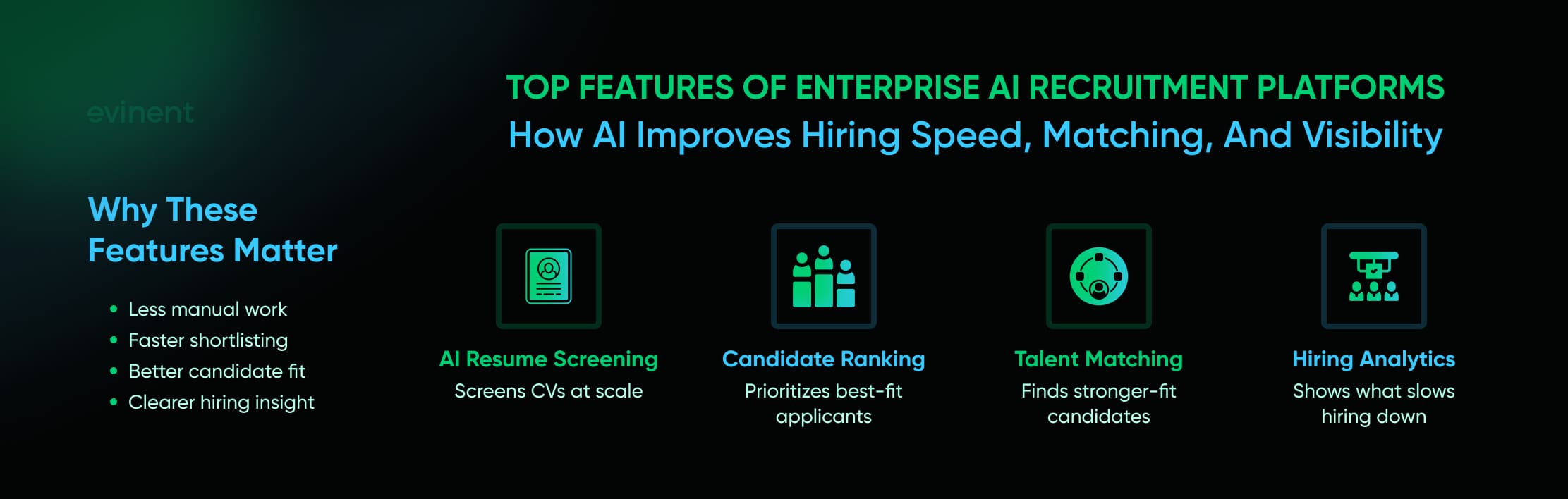
Talent Matching
Talent matching is where enterprise AI recruitment platforms start to feel genuinely smarter.
Instead of screening applicants for a single open job, the system compares candidate profiles against broader hiring needs. It can match people to adjacent roles, rediscover past applicants, surface internal talent, and identify candidates whose experience fits the work even if their titles do not look like a perfect match.
This feature matters more than ever because hiring is shifting toward skills-based thinking. LinkedIn’s 2024 recruiting report says focusing on skills can increase talent pools by 10x. That is a huge number, and it points to a real enterprise problem: traditional title-based filtering leaves too much talent on the table.
Talent matching is also important because enterprises are trying to reduce avoidable external hiring. Platforms such as Eightfold and similar talent lifecycle systems are often discussed not just as recruiting tools but as systems for internal mobility and talent rediscovery. That fits broader HR priorities as well. SHRM’s 2025 reporting notes that recruiting remains a top HR priority, while employee intent to leave is strongly tied to experience and growth, which makes internal mobility more relevant to hiring strategy than many companies used to admit.
So this feature is not just about filling jobs faster. It is also about using the talent you already know more intelligently.
Hiring Analytics
Hiring analytics might be the least flashy feature in the product demo and the most useful one in the boardroom.
Enterprise AI recruitment platforms generate reporting on time-to-screen, time-to-shortlist, source effectiveness, conversion by stage, recruiter workload, candidate drop-off, and sometimes hiring manager response times. That visibility turns recruiting from a black box into a measurable operating process.
And many teams still need that badly. The 2024 Employ Recruiter Nation Report found that 84% of recruiting teams use analytics, yet 87% still use spreadsheets to track key data and outcomes. That is a strange mix, but a familiar one: companies want better recruiting insight, yet their reporting is still patched together manually.
Analytics also help justify investment. If a company can show that AI screening reduced review time, improved shortlist quality, or cut s between stages, the platform starts looking less like a software expense and more like process infrastructure.
Why These Features Matter
Each feature is useful on its own. Together, they are what make an enterprise AI recruitment platform actually work.
Resume screening reduces the initial manual effort. Candidate ranking helps recruiters focus. Talent matching widens the field beyond obvious title matches. Hiring analytics show whether the process is getting better or just getting faster in messy ways.
That full stack matters because enterprise hiring problems rarely live in one place. Volume, speed, fit, visibility, and governance are all tangled together. The best platforms do not fix one step and ignore the rest. They help turn hiring into a more coherent system.
Benefits of AI Recruitment for Enterprises
The appeal of enterprise AI recruitment platforms is not hard to understand. Hiring teams are under pressure to move faster, handle more applicants, improve match quality, and still keep the process fair, traceable, and manageable.
That is a lot to ask from a mostly manual workflow.
The real benefit of AI in enterprise hiring is not that it makes recruiting feel futuristic. It is that it reduces friction in places where traditional hiring systems tend to slow down or break down. Recent research shows that this is already happening in practice. Insight Global’s 2025 AI in Hiring report found that 98% of employers using AI in hiring reported improved efficiency, while 93% still said human involvement remains important. That balance is telling: companies want speed, but they do not want hiring to turn into a black box.
Faster Hiring
This is usually the first win leadership notice.
When AI handles first-pass screening, ranking, matching, and parts of coordination, recruiters spend less time sorting through raw volume and more time moving qualified candidates forward. That shortens the early stages of the funnel, where s often pile up.
And those s are expensive. SHRM reported that the average time to fill a role was 41 days in 2024. That is an improvement over the year before, but it still means many companies take nearly six weeks to close a position. In specialist, technical, or regulated roles, it can stretch much longer.
This is why speed matters so much in enterprise hiring. Good candidates do not wait forever. Hiring managers do not stop needing the role filled. The business cost continues to run even while the requisition remains open.
Less Recruiter Drag
AI recruitment platforms not only speed up candidate review. They also cut the administrative burden around the process.
That matters because enterprise recruiters are rarely just screening candidates. They are also coordinating interviews, chasing feedback, updating statuses, syncing with hiring managers, and keeping multiple pipelines moving at once. Ashby’s research on recruiting productivity found that application volumes rose sharply while support ratios, including coordinator support, declined. In plain English, recruiters are handling more moving parts with less operational backup.
This is one reason AI adoption is climbing. HR.com’s research found that the share of organizations incorporating AI into recruitment rose from 26% in 2023 to 53% in 2024. That kind of jump does not happen because teams want shiny software. It happens because the workload is already too heavy for older workflows.
Better Candidate Fit
Speed is useful, but speed alone is not enough. Enterprises also need to make better hiring decisions.
This is where AI talent matching and ranking can help. A well-designed system can compare skills, role history, adjacent experience, and internal mobility options more consistently than a rushed manual review. It can also surface people who would have been missed by strict title matching or simplistic keyword scans.
That matters because skills-based hiring is becoming an increasingly important priority. LinkedIn’s Future of Recruiting 2024 found that focusing on skills can expand talent pools by up to 10x. That is a huge advantage in a market where technical capability gaps remain one of the biggest barriers to filling roles.
So the value is not only that AI helps teams review more candidates. It is that it can help them review the right candidates more intelligently.
More Consistent Screening
Human judgment is valuable. Human inconsistency is not.
In large organizations, different recruiters or hiring teams can interpret the same background in different ways, especially under time pressure. AI recruitment systems can introduce more consistency at the top of the funnel by applying the same screening logic across roles, regions, or candidate pools.
That does not mean AI is automatically fair. It is not. But consistency still matters, and it is one reason enterprises are formalizing AI-assisted workflows rather than leaving screening entirely to manual variation. The EEOC has made it clear that employers remain responsible for discrimination risks when AI is used in hiring. That means structured, reviewable screening processes are not just operationally helpful; they are legally smarter.
Stronger Internal Mobility
One of the more underrated benefits of enterprise AI recruitment platforms is their ability to support internal mobility, not just external hiring.
Instead of treating every open role like a brand-new search, companies can use AI to surface employees whose skills or experience fit adjacent opportunities. That can reduce hiring costs, improve retention, and shorten time-to-fill, especially when external talent is scarce.
This is becoming more relevant as companies reassess workforce planning. LinkedIn’s recruiting research shows that organizations are paying closer attention to skills gaps and AI capability needs, which naturally pushes internal talent discovery higher on the agenda. If the business already has strong people hidden inside complex org charts and outdated talent databases, AI matching can help bring them back into view.
Clearer Leadership Visibility
Recruiting teams have always had metrics. The problem is that many teams still collect them in fragmented ways.
Enterprise AI recruitment platforms improve visibility by turning hiring activity into structured analytics: screening speed, stage conversion, source quality, recruiter throughput, candidate drop-off, and hiring bottlenecks. That gives leaders something far more useful than anecdotal updates.
And many teams still need that clarity. The 2024 Employ Recruiter Nation Report found that 84% of recruiting teams use analytics, yet 87% still rely on spreadsheets to track key data and outcomes. That is a strange setup for such an important business function, but a common one. AI platforms help reduce the patchwork of reporting models.
For C-level leaders, that matters because hiring is no longer just an HR process. It affects growth plans, delivery capacity, customer operations, and labor costs. If leadership cannot see where the funnel slows down or where quality drops, they are managing hiring on instinct.
More Human Recruiters
This is a softer benefit, but it matters.
When repetitive screening and coordination tasks are reduced, recruiters can spend more time on candidate conversations, stakeholder management, offer strategy, and judgment calls that truly require human judgment. Insight Global’s 2025 survey captured this tension well: employers reported efficiency gains from AI, but most still emphasized the importance of keeping people involved.
That is probably the healthiest way to frame AI's value in recruitment. It is not there to replace the relationship side of hiring. It is there to reduce the operational clutter around it.
Why the Gains Add Up
Individually, these gains are useful. Together, they change how enterprise hiring functions.
Faster cycles reduce vacancy costs. Lower recruiter workload improves throughput. Better matching strengthens quality. Consistent screening supports governance. Internal mobility reduces unnecessary external search. Analytics give leadership clearer control.
That is why enterprise AI recruitment platforms are getting serious attention now. They do not just make recruiting more automated. They make it more manageable.
Why Data Security Matters in AI Recruitment
Hiring data is not ordinary business data. That is the first thing enterprises need to keep in mind.
A candidate record can include work history, salary expectations, location, contact details, assessment results, interview notes, visa status, references, and sometimes disability-related accommodation information or other especially sensitive data. Put all of that together, and recruitment becomes one of the most exposed AI use cases in the enterprise. If the system is badly governed, the risk is not theoretical. It is immediate.
That is exactly why data security has become a central issue in AI recruitment, not a side note for legal teams to sort out later.
Sensitive Hiring Data
Many enterprise workflows involve confidential information. Recruitment is different because it combines personal data with high-stakes decision-making.
The EEOC’s 2024 guidance makes clear that AI can be used throughout the hiring process, including résumé screening, job advertising, chatbot interactions, recorded interviews, and other employment decisions. That means risk does not lie in a single narrow feature. It runs through the full hiring pipeline.
And when AI is used in these contexts, employers are still responsible for the outcome. Existing anti-discrimination laws do not disappear because a model helped make the recommendation. The same EEOC materials warn that even neutral-looking tools can create unlawful discrimination if they disadvantage protected groups.
So this is not only about cybersecurity. It is also about fairness, legal exposure, and trust.
The Risk of Public AI
This is where many organizations get sloppy.
A recruiter pasting a resume into a public AI tool to summarize it may feel harmless. But that one action can expose candidate data to systems that were never approved for hiring workflows, never mapped into retention policies, and never reviewed against internal privacy requirements.
Once that happens, several questions appear quickly:
Where did the candidate data go?
Was it logged?
Was it retained?
Was it used to improve an external model?
Can the company explain that processing to regulators or candidates later?
If the answers are vague, the workflow is already a problem.
The UK ICO said in 2024 that organizations considering AI in recruitment need to ask providers clear data protection questions and get assurances that the tools are being used lawfully and fairly. The ICO also published a separate update saying its intervention in AI recruitment tools led providers to improve transparency, fairness, and security for job seekers.
That is a strong signal. Regulators are not treating AI hiring as a harmless experiment. They are already pressing on the weak spots.
A New Compliance Reality
The regulatory direction is getting clearer, not fuzzier.
The European Commission describes the AI Act as the first comprehensive legal framework for AI, and employment-related AI systems are classified as high risk when used for recruitment, targeted job ads, application filtering, or candidate evaluation. Annex III explicitly includes these employment uses.
That classification matters because high-risk systems entail additional obligations regarding risk management, documentation, traceability, human oversight, accuracy, robustness, and cybersecurity. And the timeline is not abstract either. Guidance related to the Act notes that the requirements for these employment tools will take effect on August 2, 2026.
For enterprise buyers, that changes the conversation. AI recruitment software is no longer just a productivity purchase. It is also a governed system that may need auditability and compliance evidence from day one.
Why Private AI Wins
This is why private AI recruitment software is gaining real traction.
A private AI recruitment system keeps models, s, outputs, and candidate data inside an environment the company can control. That usually means role-based access, internal hosting or approved cloud boundaries, audit logs, retention policies, processor agreements, and tighter integration with HR systems.
Those controls matter because trustworthy AI is not just about whether the model is smart. NIST’s AI Risk Management Framework states that organizations need to manage risks associated with the design, development, use, and evaluation of AI systems, with trustworthiness as a core concern. NIST also frames trustworthy AI around characteristics such as validity, reliability, safety, security, resilience, accountability, transparency, explainability, privacy enhancement, and fairness.
That maps neatly onto enterprise hiring. If a company cannot show who used the system, what data it processed, what it recommended, and how people reviewed those outputs, it is not operating a mature hiring platform. It is improving.
Security as a Buying Factor
This is where vendor evaluation gets more serious.
When enterprises assess AI recruiting platforms, they should not only compare sourcing features, ranking models, or analytics dashboards. They should also ask:
How candidate data is stored and segregated
Whether s and outputs are logged
What third parties receive any hiring data
Whether retention and deletion rules can be configured
How human review is built into the workflow
What documentation exists for bias monitoring and model performance
Whether access controls match internal HR and security policies
The ICO’s recruitment guidance specifically points organizations toward these kinds of checks, including clarity over controller and processor roles, lawful processing, fairness, and contractual responsibilities.
Honestly, this is one of the clearest dividing lines between lightweight AI tools and enterprise-grade systems. One is optimized for convenience. The other is designed to survive scrutiny.
Trust Matters Too
There is also a human side to this.
Candidates are already uneasy about opaque hiring systems. If they believe their data is being processed by black-box tools with no accountability, trust drops quickly. And once trust drops, so does employer brand.
That is why secure AI hiring architecture matters beyond compliance language. It protects the company, yes, but it also protects the credibility of the process itself. Hiring is one of the few enterprise functions where people hand over a large amount of personal information before any formal relationship even exists. Mishandle that, and the damage is bigger than one bad workflow.
This is exactly where private AI changes the enterprise equation. It gives companies a way to use AI for hiring without treating candidate data like disposable input.
AI Recruitment Platform by Evinent
It is one thing to talk about enterprise AI recruitment in abstract terms. It is another to picture what the system actually looks like when it is built for a real business.
A practical enterprise setup usually does not start with a flashy AI layer. It starts with workflow friction. Too many applications. Too much manual sorting. Weak visibility into candidate pipelines. Disconnected systems. Hiring data is scattered between email, spreadsheets, recruiter notes, and an ATS that only solves part of the problem.
That is exactly the kind of environment where a private AI recruitment platform makes sense.
What It Looks Like
Based on Evinent’s recruitment solution materials, a real-world platform in this category would combine several functions into one governed hiring environment: a custom recruitment website, job boards and filters, ATS and CRM integration, automated resume parsing, candidate tracking, analytics dashboards, and AI-driven hiring features such as chatbots or predictive hiring support.
That matters because enterprise hiring rarely fails in just one place. Usually, the problem sits between systems. Applications come in through one channel, recruiter activity lives in another, reporting is handled somewhere else, and candidate communication becomes yet another disconnected thread. Evinent’s recruitment materials frame the solution around exactly those gaps: connecting the website layer with ATS and recruitment CRM systems, automating resume parsing and tracking, and making recruitment KPIs visible through analytics dashboards.
So, in practical terms, the system is not just “AI that screens resumes.” It is a hiring workflow built as a coherent platform.
Where Private AI Fits
The private AI part becomes useful once the platform starts handling real candidate volume and sensitive data.
In this kind of architecture, AI can be applied to first-pass resume analysis, skill extraction, candidate shortlisting, recruiter support, and hiring insights, while the underlying environment remains controlled. That is consistent with Evinent’s broader positioning, which focuses on modernizing rigid systems, optimizing data workflows, and building secure, scalable infrastructures for enterprise and mid-sized businesses. Its positioning materials also emphasize audits, realistic planning, security analysis, cost efficiency, and adaptable architecture rather than quick-fix automation.
That is an important distinction. A private AI recruitment system is not just smarter software. It is AI placed inside a hiring environment where access, integrations, workflows, and system behavior can actually be governed.
What the Platform Handles
A platform built along these lines can help enterprises:
collect candidate data through branded recruitment websites and job boards
connect hiring workflows with ATS and CRM systems
automate resume parsing and candidate tracking
surface candidate data through recruiter dashboards and KPI reporting
support AI-driven hiring flows such as chatbot interaction or predictive matching
scale the system over time without rebuilding the whole hiring stack
That combination is what makes the case-study angle relevant. The value is not only in AI scoring or chatbot automation. The value lies in building a hiring system where automation, integration, and control work together rather than collide.
Why This Example Matters
This is the bigger point.
Enterprise buyers are not usually looking for a shiny recruiting widget. They are looking for a system that can reduce hiring friction without introducing new risk. Evinent’s recruitment and positioning materials suggest a model built around customization, integrations, analytics, AI-driven features, and long-term system support rather than one-size-fits-all tooling. The same materials also emphasize scalable architecture and the ability to modernize outdated, fragmented environments, which is often the real obstacle in enterprise recruitment.
Future of AI in Recruitment
The next phase of AI in hiring will not be about stuffing more automation into the funnel. It will be about making hiring systems more predictive, more skills-aware, and more tightly governed.
That shift is already underway. LinkedIn’s Future of Recruiting 2025 reports that talent acquisition professionals using generative AI save an average of 20% of their workload — roughly a full workday each week — and the number of people learning AI literacy skills has more than doubled year over year.
So yes, AI in recruitment is still about efficiency. But the future is starting to look a bit different. Less “automate one task.” More “rethink how hiring decisions are supported from start to finish.”
Recruiter Copilots
One of the clearest trends is the rise of recruiter copilots.
These tools do not replace recruiters. They assist them — drafting job descriptions, summarizing résumés, suggesting candidate outreach, preparing interview notes, surfacing missing information, and helping hiring teams move faster through routine decisions. Deloitte’s 2025 talent acquisition trend note points directly to this shift, describing AI-driven copilots, real-time chatbots, and AI agents that augment recruiter productivity.
That framing matters. The likely future is not a fully autonomous recruiter. It is a recruiter working with an AI layer that handles repetitive analysis and coordination while the human still manages judgment, context, and relationships.
Predictive Hiring
Right now, many companies still use hiring analytics to describe what has already happened: time-to-fill, source quality, stage conversion, and drop-off.
The next step is predictive hiring analytics. That means using historical hiring data, candidate behavior, job requirements, and funnel performance to anticipate where a requisition may stall, which candidates are more likely to convert, where quality of hire may be stronger, or when internal talent should be prioritized before launching a fresh external search.
HR.com’s Future of Talent Acquisition 2025 reports that 58% of organizations expect AI to play a useful role in talent acquisition in the coming years, specifically citing predictive analytics as part of that shift.
For enterprise leaders, that is important because the real value of AI is not only faster screening. It provides earlier visibility into hiring risks and missed opportunities.
Skills-First Matching
This is another trend that looks durable.
Recruitment is moving away from rigid proxies like degree requirements and exact title matches, and toward skills, adjacent capability, and long-term potential. LinkedIn’s 2025 recruiting report continues to emphasize quality of hire and skills-based hiring as top priorities, arguing that organizations are focusing more seriously on long-term value and better fit rather than pure speed.
That makes AI more useful, not less. A strong AI recruitment system can identify relevant capability patterns at scale in a way manual filtering often cannot. It can also surface candidates who do not look perfect on paper but have the right skills for the role or the right potential for adjacent roles.
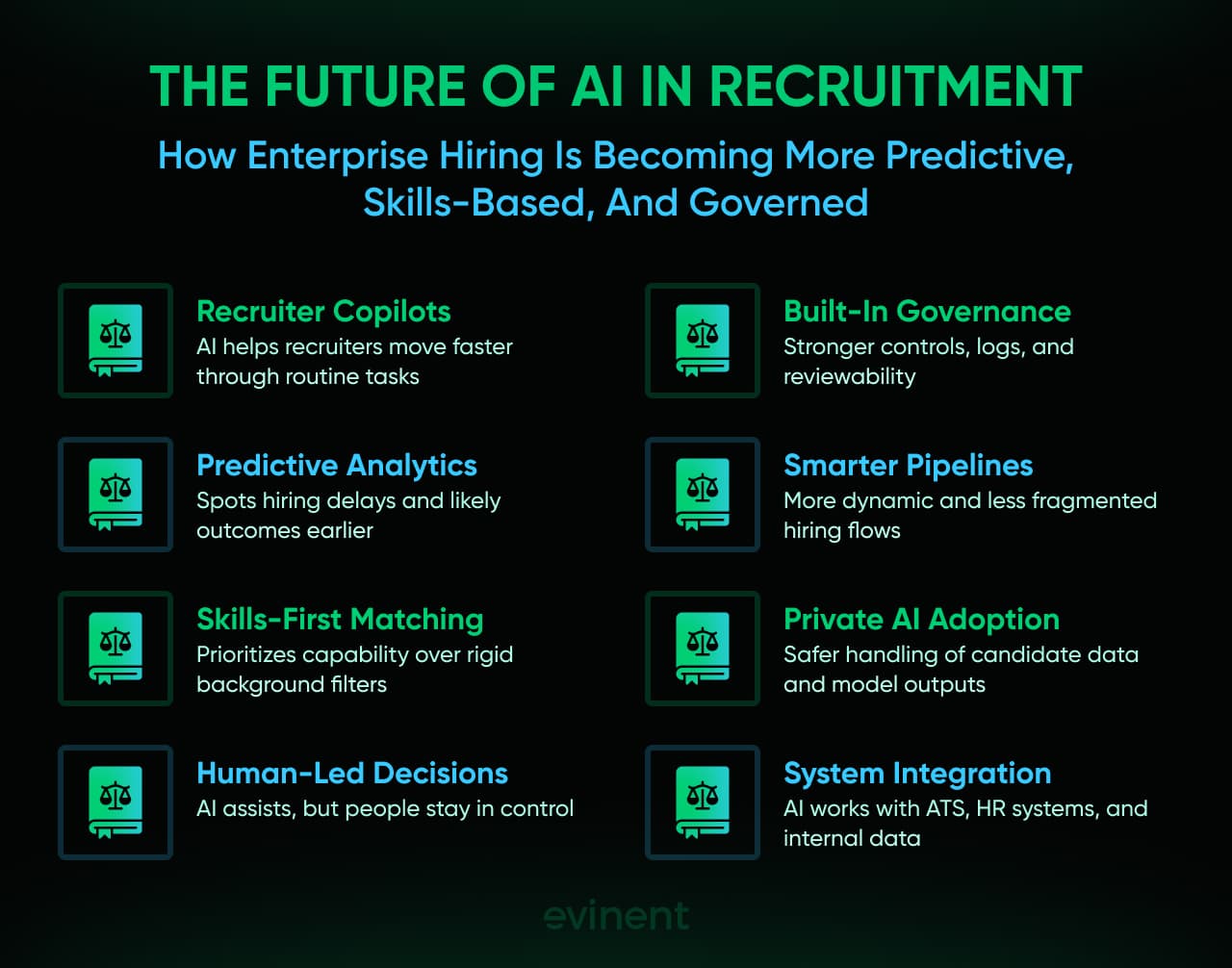
Human Oversight
For all the excitement around automation, the future of AI hiring is still human-led.
The World Economic Forum argued in 2025 that the future of hiring lies in human-AI collaboration, not replacement. Its analysis suggests conversational AI can work well as an early filter, while recruiters remain essential for judging softer factors such as communication style, nuanced fit, and decision quality.
That is probably the healthiest direction for enterprise hiring. The more AI enters the process, the more important it becomes to define where human review sits, how overrides work, and how decisions can be explained afterward.
Governance by Design
This may be the least glamorous trend, but it is the one enterprises will care about most.
As AI hiring tools become more capable, governance will move closer to the center of product design. That includes traceability, audit logs, model documentation, access controls, retention rules, fairness checks, and clearer boundaries around which workflows can be automated.
This is not only a matter of caution. It is a response to regulatory and enterprise-buying realities. High-volume hiring systems are increasingly expected to show that their outputs can be reviewed, monitored, and defended — especially when candidate evaluation is involved. That is one reason private AI recruitment software is likely to gain ground over public, loosely governed AI usage.
Smarter Pipelines
Another trend worth watching is the gradual automation of candidate pipelines.
Not fully autonomous pipelines — that idea still runs ahead of reality — but more dynamic workflows that can trigger outreach, launch assessments, rediscover past applicants, recommend internal candidates, and move profiles through early screening steps with less manual intervention.
The likely shape of the future is not one giant AI decision-maker. It is a collection of connected AI functions that make hiring workflows less fragmented and less reactive.
That is also where enterprise architecture matters most. The companies that benefit most from AI in recruitment will not necessarily be the ones with the fanciest model. They will be the ones that connect AI to ATS data, internal talent systems, security controls, and clear operating rules.
What Leaders Should Watch
The future of AI in recruitment is becoming clearer.
Recruiter copilots will become normal. Predictive analytics will gain traction. Skills-based matching will keep growing. Human oversight will stay essential. Governance will move from a compliance appendix to a product requirement.
And that is probably a good thing. Hiring is too important, and too sensitive, to be handed over to vague automation.
How Companies Can Implement AI Recruitment
This is the part where many enterprise teams hesitate. The idea sounds clear enough — use AI to reduce screening time, improve matching, and make hiring easier to manage. But implementation is where good intentions usually collide with reality.
The strongest rollouts do not begin with a tool demo. They begin with workflow analysis, governance decisions, and a very honest look at where hiring is already breaking. That approach lines up with current industry guidance. HR.com’s 2025 research recommends aligning talent acquisition technology with business priorities, piloting advanced tools before wider rollout, and training recruiters on new AI capabilities rather than dropping the software into the process and hoping for the best.
Start with the Workflow
Before choosing an AI recruitment system, companies need to map the hiring process as it actually works.
That means identifying where the biggest s and inefficiencies sit: first-pass screening, sourcing, interview scheduling, candidate rediscovery, hiring-manager feedback, or reporting. If those bottlenecks are not clear, the AI layer will often automate the wrong thing. This sounds obvious, but it gets skipped all the time. HR.com’s 2025 talent acquisition report explicitly recommends using a broader recruitment tech stack — including ATS, CRM, job boards, analytics, chatbots, and screening tools — tailored to business needs rather than treating AI as a standalone fix.
Set AI Boundaries
The next step is setting boundaries.
Not every part of hiring should be automated. Some tasks are ideal for AI: resume parsing, skill extraction, first-pass ranking, scheduling support, candidate summaries, and pipeline analytics. Others need tighter human control, especially where judgment, compliance, accommodations, or nuanced role fit are involved. LinkedIn’s Future of Recruiting 2025 frames AI as a tool to augment human judgment rather than replace it, and Deloitte’s 2025 guidance points in the same direction with recruiter copilots and AI agents that support, rather than displace, the recruiter role.
That distinction matters because blurry boundaries create risk. Clear boundaries create trust.
Design Around Existing Systems
Enterprise AI recruitment platforms work best when they fit into the company’s real hiring stack.
That usually means integrating with the ATS, HRIS, career site, internal mobility tools, analytics dashboards, identity management, and security controls. If the AI layer sits off to the side, disconnected from the systems where hiring actually happens, adoption usually drops, and manual work creeps right back in. HR.com’s research specifically recommends a comprehensive tech stack and warns that purchases of talent acquisition technology should support broader workforce planning, candidate experience, and employer-brand goals.
This is also where private AI becomes important. If candidate data is moving through multiple systems, the company needs clear control over access, data flows, retention, and auditability.
Governance First
Here is where enterprise implementation usually becomes either mature or messy.
Governance should not arrive after the pilot. It should be part of the rollout plan from the start. NIST’s AI Risk Management Framework says AI systems should be designed, developed, used, and evaluated with trustworthiness in mind, while the NIST AI RMF Playbook recommends connecting AI governance to existing organizational governance and data controls, especially when sensitive data is involved.
For recruitment, that means defining who can access candidate data, how model outputs are reviewed, what gets logged, how overrides are handled, how retention works, and how fairness or performance issues will be checked. It is not glamorous work. It is still the work that makes enterprise AI viable.
Pilot Before Scaling
A full rollout across the whole business sounds efficient. Usually, it is not.
A better approach is to start with one business unit, one role family, or one hiring pain point. That could be high-volume frontline hiring, technical recruiting, internal mobility, or candidate rediscovery. HR.com’s 2025–26 guidance specifically recommends piloting tools such as recruitment analytics dashboards, video interviewing, and skills assessments before broader adoption.
Pilots are useful because they surface the real questions quickly:
Is the ranking logic actually useful for these roles?
Are recruiters trusting the recommendations?
Are candidates moving faster through the funnel?
Does the system create more admin work anywhere else?
Are there fairness or quality issues that need tuning?
Without a pilot, companies usually learn those lessons too late.
Train the Recruiters
One of the easiest mistakes is to implement AI as if it were just another background tool.
It is not. AI changes how recruiters review candidates, interpret rankings, document decisions, and explain the process to hiring managers. HR.com’s report recommends hands-on training for recruiters on new talent acquisition technologies, including AI features and analytics. That matters because adoption depends less on whether the platform is technically impressive and more on whether recruiters can use it with confidence.
LinkedIn’s 2025 research also suggests this skill shift is already happening: recruiters are increasingly expected to develop both AI fluency and stronger advisory skills.
Measure What Matters
Implementation is not finished when the system goes live. It is finished when the company can show that hiring has improved.
That means tracking a small set of outcomes that leadership actually cares about: screening time, time-to-shortlist, qualified-candidate yield, candidate response speed, source efficiency, recruiter workload, and hiring-manager turnaround. HR.com’s guidance explicitly calls for using AI analytics and predictive analytics to improve hiring decisions and long-term talent acquisition performance. SHRM also reports that over 1 in 3 HR professionals say AI in recruiting helps reduce recruiting, interviewing, or hiring costs, while nearly 1 in 4 say it improves identification of top candidates. Those are useful benchmarks for what a good rollout should start to influence.
Keep Humans in the Loop
This last point is simple, but it matters more than most rollout decks admit.
AI recruitment works best when it reduces friction around human decision-making, not when it tries to eliminate it. LinkedIn’s 2025 report says AI is speeding up recruiting tasks, allowing recruiters to spend more time on strategic activities like relationship-building and advising hiring managers. That is the healthier model. AI handles the heavy repetition; people handle the judgment.
That balance is also what makes implementation sustainable. Recruiters will trust the system more. Hiring managers will understand it better. Legal and compliance teams will panic less. And honestly, that is half the battle in enterprise rollouts.
FAQ
What is AI recruitment software?
AI recruitment software is hiring technology that uses artificial intelligence to support tasks such as resume parsing, skill extraction, candidate ranking, talent matching, chatbot interactions, and hiring analytics. In enterprise settings, it usually works alongside systems like ATS, HRIS, and internal reporting tools rather than replacing them. The goal is to reduce manual workload and help recruiters move through high-volume hiring more efficiently.
How does AI resume screening work?
AI resume screening works by converting CVs and applications into structured data, identifying relevant skills and experience, and comparing those signals against the requirements of a role. More advanced systems go beyond simple keyword matching and try to recognize related skills, adjacent experience, and patterns that suggest role fit. This is one reason AI screening has become more attractive as applicant volume rises and manual review becomes harder to sustain.
Is AI recruitment secure?
It can be, but security depends heavily on architecture and governance. Public AI tools can create hiring risks if candidate data is processed outside approved systems or without clear retention, access, and audit controls. Private AI recruitment software is generally a better fit for enterprise use because it allows companies to keep candidate data inside controlled environments with stronger oversight, documentation, and security boundaries. Regulators such as the ICO, the EEOC, and EU authorities have all signaled that AI in hiring requires careful governance, not casual experimentation.
What are enterprise AI recruitment platforms?
Enterprise AI recruitment platforms are AI-powered hiring systems designed for large organizations with complex recruiting needs. They typically support high candidate volume, recruiter collaboration, ATS and HRIS integration, analytics, workflow automation, and compliance requirements across multiple teams or regions. Unlike lightweight recruiting tools, they are meant to operate inside a broader enterprise hiring infrastructure.
How do companies use AI for hiring?
Most companies start by using AI for repetitive, high-volume tasks such as resume screening, candidate ranking, sourcing support, scheduling, and pipeline reporting. More mature organizations also use it for internal mobility, candidate rediscovery, predictive analytics, and recruiter copilot functions. Current recruiting research shows that enterprises are increasingly using AI to improve speed and efficiency while still keeping human judgment in the loop.
Share