

Challenges and Gaps in AI Governance
Despite the rapid adoption of artificial intelligence, most organizations struggle to maintain control over their AI initiatives. The issue is not the technology itself, but the lack of structured governance around it. AI evolves faster than organizational processes, policies, and accountability models, creating a gap between innovation and control. This gap is where most risks originate.
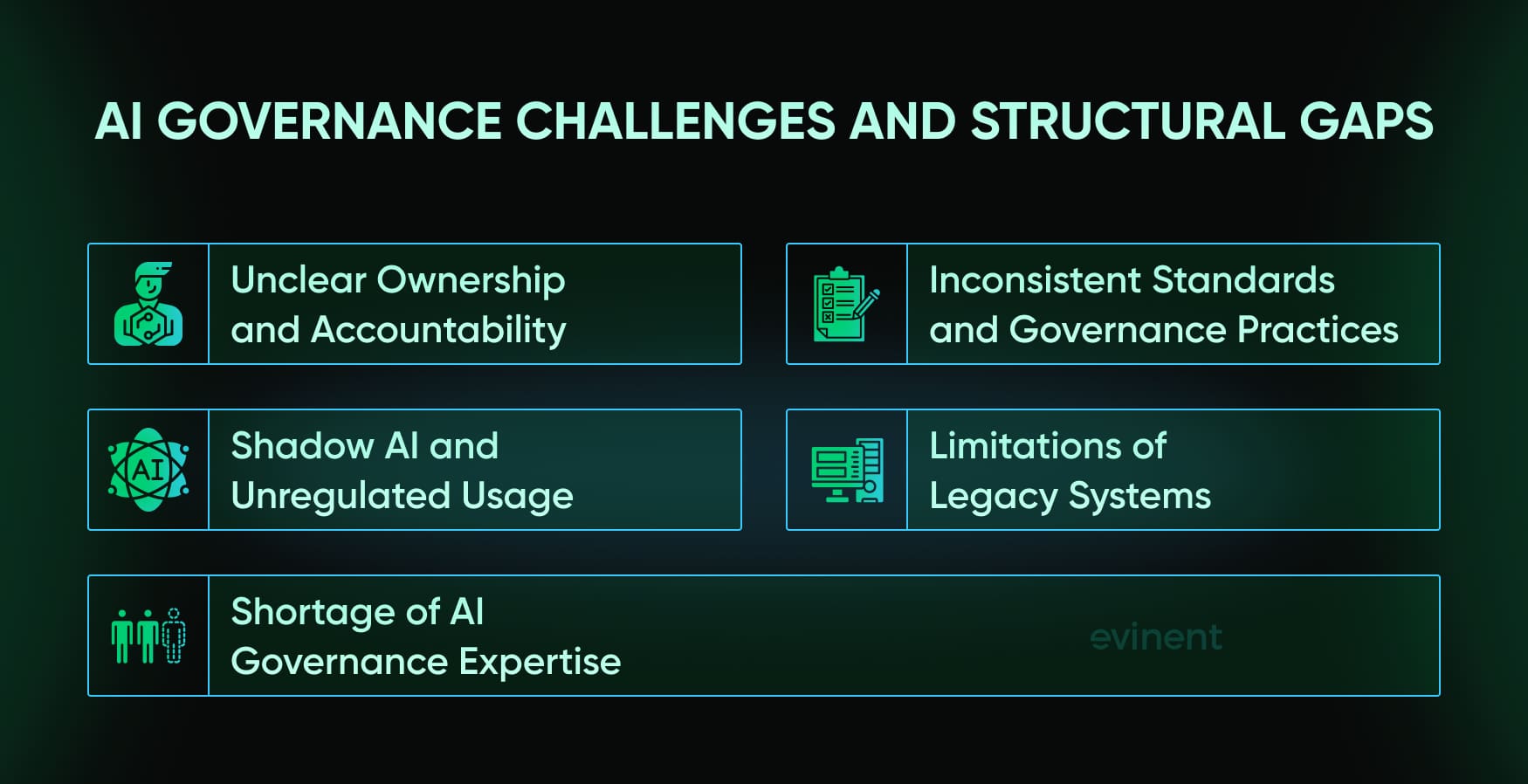
1. Lack of Clear Ownership and Accountability
In many organizations, there is no clearly defined owner of AI systems. Responsibilities are spread across business units, IT, and data teams, but without a single accountable party. As a result, models are deployed without full oversight, and when issues arise, it is unclear who is responsible for addressing them.
2. Fragmented Standards and Governance Practices
Different teams often follow their own approaches to model development, validation, and monitoring. Without standardized governance practices, the quality, reliability, and transparency of AI systems vary significantly across the organization. This fragmentation makes governance inconsistent and difficult to scale.
3. Shadow AI and Uncontrolled Usage
The accessibility of AI tools has led to the rise of “shadow AI” — employees independently using AI solutions without formal approval or oversight. While this can improve short-term productivity, it introduces serious risks, including data leakage, policy violations, and unreliable decision-making.
4. Legacy System Constraints
Many organizations attempt to implement AI on top of outdated IT infrastructure that was not designed for modern data processing or real-time model integration. This limits the ability to enforce governance mechanisms, including monitoring, auditing, and centralized control.
5. Talent and Expertise Gaps
Effective AI governance requires a combination of technical expertise, risk management knowledge, and understanding of regulatory requirements. Such cross-functional expertise is scarce. As a result, organizations either underestimate the complexity of governance or rely on teams that are not equipped to manage it properly.
Without clear ownership, standardized practices, and controlled usage, AI systems quickly become unmanaged. In this state, AI shifts from being a competitive advantage to a source of operational and strategic risk.

Core Pillars and Frameworks for AI Governance
To move from fragmented AI initiatives to a controlled and scalable system, organizations need a clear governance framework. This framework is not a single policy or tool, but a set of interconnected pillars that collectively ensure reliability, transparency, and accountability. Each pillar addresses a specific layer of the AI lifecycle, and only their integration creates a functioning governance system.
1. Data Governance and Integrity
AI systems are only as reliable as the data they are built on. Data governance ensures that data is accurate, consistent, and properly managed throughout its lifecycle. This includes data quality controls, lineage tracking, access management, and stewardship. Without this foundation, even the most advanced models will produce unreliable outcomes.
2. Model Governance and Lifecycle Management
Model governance refers to the controls that manage AI systems from development through deployment and beyond. It involves validation, testing, versioning, monitoring, and retraining. A model governance lifecycle approach helps to ensure that models do not degrade unnoticed in production environments but remain accurate, relevant, and compliant over time.
3. Risk and Compliance Integration
Risk management must be embedded directly into AI processes, not treated as an afterthought. This involves identifying potential risks (technical, operational, regulatory), assessing their impact, and implementing controls to mitigate them. Integration with compliance frameworks ensures that AI systems meet both internal policies and external regulatory requirements.
4. Ethical and Explainable AI
Trust in AI relies heavily on transparency and fairness. Ethical governance prevents models from being biased, discriminatory, or generating harmful results. Explainability tools enable companies to comprehend and explain AI decisions, which is very important for both internal responsibility and gaining trust from stakeholders.
5. Human Oversight and Accountability
Even extremely automated systems need human control, particularly in major scenarios. Human-in-the-loop methods guarantee that important decisions can be checked, changed, or reviewed. This component strengthens responsibility and stops dependence on automation.
Pillar | Key Responsibilities | Governance Mechanisms | Business Impact |
Data | Data quality, lineage, and access control | Data validation, stewardship, lineage tracking | Reliable inputs higher decision accuracy |
Model | Model validation, versioning, and monitoring | Model audits, performance tracking, retraining pipelines | Stable and predictable model performance |
Risk | Risk identification and mitigation | Risk scoring, controls, and incident management | Reduced operational and regulatory exposure |
Ethics | Bias prevention, transparency, fairness | Bias testing, explainability tools, and review boards | Increased trust and compliance readiness |
Board and Executive Roles in AI Governance
AI governance is more than just workflows or software safeguards; it is essentially a leadership duty. Often, governance breakdowns in organizations are not due to the models or algorithms, but rather to undefined roles, inadequate monitoring, and the absence of involvement of senior executives.
Here, we look at the various players involved in AI governance, starting with the board of directors and going down to the technical staff. Having a clear picture of the division of strategic oversight, tactical control, and operational execution is a must for developing an efficient governance system.
We will highlight the decisions made at different leadership levels, the tools and mechanisms used to maintain control, and the accountability for AI-related risks. This approach provides a comprehensive view of governance and prevents situations where AI oversight becomes merely a formality with little real impact on the business.
Governance Layer | Role/Function | Core Responsibilities | Decision Authority | Governance Mechanism and Tools | Risk Accountability |
Board of Directors | Strategic Oversight | Define AI strategy Set enterprise risk appetite Ensure alignment with business objectives | Approves major AI initiatives, risk thresholds, and governance frameworks | Board reports, risk summaries, executive dashboards | Enterprise-level AI risk, regulatory compliance |
Executive Leadership (CEO, CIO, CTO, CDO) | Governance Ownership | Implement board directives Establish a governance framework Assign ownership to teams | Operational and strategic execution decisions | Governance dashboards, KPI tracking, and internal policies | Operational and strategic AI risks |
AI Governance Committee | Cross-Functional Control | Review AI use cases Enforce governance standards Assess risks and compliance | Approves or rejects AI deployments and projects | Review frameworks, approval workflows, and audit logs | Compliance and use-case level risk |
Chief AI Officer/AI Risk Lead | Dedicated AI Leadership | Coordinate AI governance across teams Define best practices Monitor execution of governance policies | Sets governance processes and escalation paths | Model inventories, risk frameworks, and reporting systems | Model-level and systemic AI risks |
Data & Technical Leaders | Execution and Monitoring | Develop, validate, deploy, and monitor models Ensure compliance with governance policies | Technical decision-making on models and data pipelines | Monitoring tools, validation systems, data pipelines | Technical integrity, performance, and operational risks |
AI governance can really perform well if top, middle, and first-line management are clearly given responsibilities, authority, and accountability. Otherwise, it will be just a theory that won't control the risk of AI or affect the business results.
Step-by-Step AI Governance Implementation
Implementing AI governance requires a structured, multi-phase approach. Most organizations fail when they try to enforce governance across all AI initiatives simultaneously, without understanding their current capabilities, classifying risks, or establishing clear responsibilities.
This roadmap provides a detailed, step-by-step approach for practical AI governance implementation. It ensures that policies, ownership, and controls are applied consistently, risks are managed, and governance becomes an integral part of AI operations rather than a theoretical exercise.
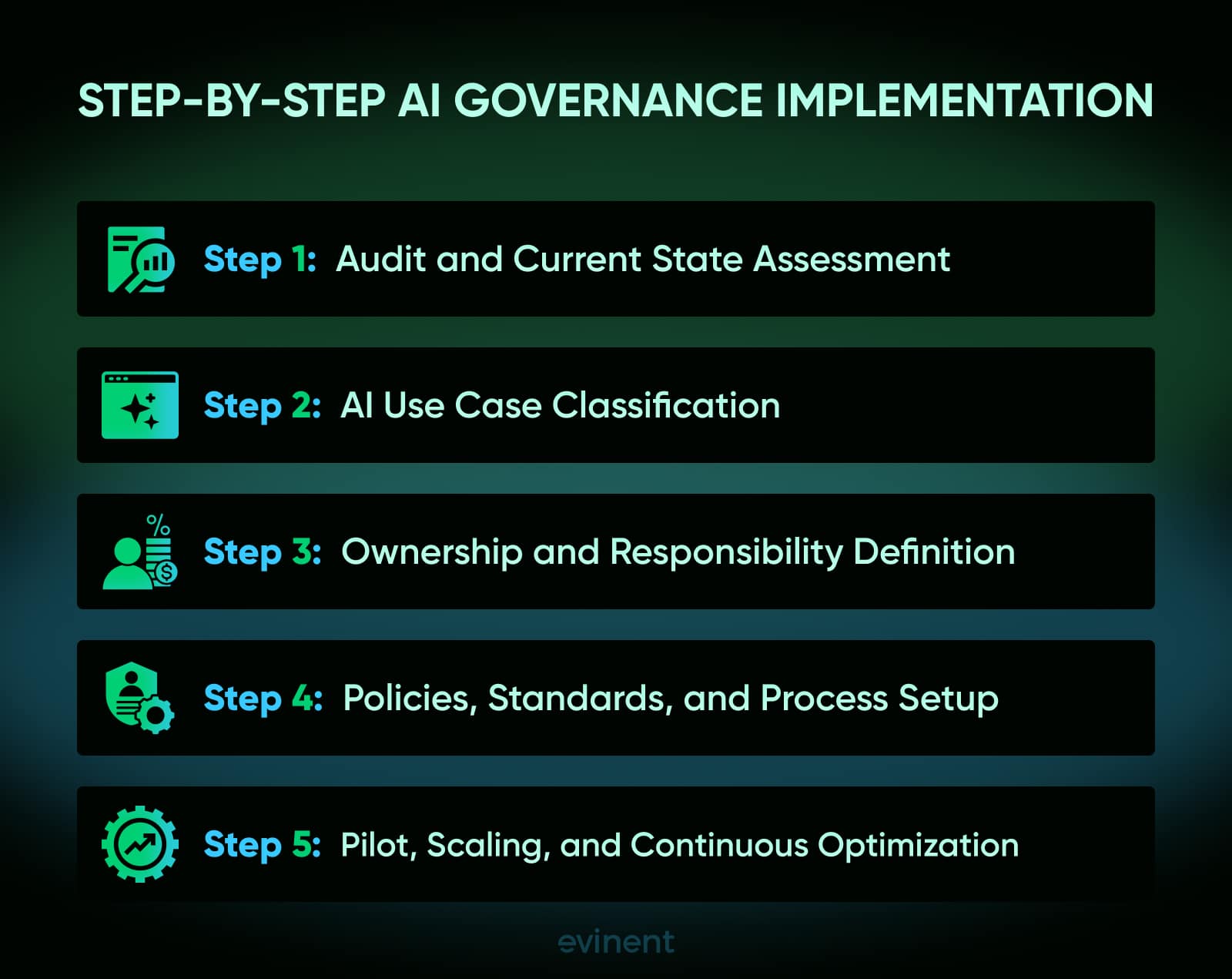
Phase 1: Audit — Assess the Current State
Make an exhaustive list of every AI project, instrument, and framework throughout the company.
Review present management systems, data integrity, and adherence to regulations.
Uncover areas lacking accountability, disclosure, and control mechanisms.
Outline the risk potential for AI applications having major effects or employed in critical situations.
Record results and set initial standards for levels of governance.
Result: An insight into the deficiencies of the governing system and how ready the company is for rolling out.
Phase 2: Use Case Classification h
Sort AI projects according to their business impact and risk levels (low, medium, high).
Locate key models that need extra monitoring or regulatory compliance.
Figure out AI systems suitable for pilot governance testing.
Balance risk exposure and strategic importance when selecting initiatives for governance rollout.
Ensure that both business objectives and compliance requirements are reflected in classification.
Result: Risk-driven plan for the deployment of governance across projects.
Phase 3: Define Ownership and Responsibilities
Assign clear accountability at the board, executive, and operational levels for each AI initiative.
Define roles for AI governance committees, the Chief AI Officer, data scientists, and IT teams.
Establish escalation paths for risk or compliance issues.
Integrate responsibilities into existing workflows and performance metrics.
Communicate roles and expectations to all stakeholders.
Result: Transparent accountability and reduced ambiguity in governance ownership.
Phase 4: Establish Policies, Standards, and Processes
Develop organization-wide policies for model development, deployment, monitoring, and auditing.
Define standards for data quality, model validation, bias assessment, and explainability.
Create operational procedures for approvals, exception handling, and reporting.
Implement automated controls where possible (dashboards, s, compliance checks).
Train teams on policies, standards, and tools to ensure consistent adoption.
Result: A standardized, enforceable framework for AI governance.
Phase 5: Pilot, Scale, and Optimize
Start with a few pilot projects involving governance on some chosen AI initiatives.
Assess the results, spot the hindrances, and tweak the procedures before a big rollout.
Roll out governance in all AI systems, making sure it very closely aligns with business operations.
Use dashboards and audits to regularly check performance, compliance, and risk levels.
Continue tweaking rules, responsibilities, and tools by learning through experiences and keeping up with regulations.
Result: A robust and flexible governance framework that facilitates AI on a large scale.
AI governance can make a meaningful difference only if it is rolled out in well-defined and methodical phases. Each step will be predicated on the last one, such as when you start with auditing and categorizing usage and then move on to setting up measures, determining who is responsible, implementing standards, and finally broadening governance.
This orderly way of doing things ensures that the governance is actually implemented in the real world; it also helps in risk reduction and turns governance into a dynamic, functioning system instead of a mere paperwork exercise.
Regulatory and Compliance Considerations
AI governance is more and more influenced by the regulatory pressure coming from outside. The things that were tied to the internal risk control and best practices just by the way are now defined by the formal requirements, legal obligations, and industry standards. Treating governance as optional is something that organizations cannot do anymore it must be in line with the changing regulatory frameworks in different jurisdictions.
This part presents the main regulatory factors, demonstrates the influence of risk-based classification on governance decisions, and points out the operational expectations for auditability, documentation, and cross-border compliance. Getting a grip on these elements is a must for designing governance systems that are not only effective but also law-abiding.
1. Key Regulations and Standards
Regulation around AI is changing very fast. For example, the EU AI Act and GDPR, along with other global standards, outline the ways in which AI systems should be created, used, and overseen. These laws call for things like making the workings of the system clear to users, taking responsibility for the outcomes, and having ways in place to control and limit the harms. This is particularly so for AI systems that can have big effects on people or society.
Businesses have to bring their oversight lanes in line with these. Aside from keeping abreast of the rules, they need the capacity to turn them into internal guidelines and practical measures.
2. Risk-Based AI Classification
Modern regulatory approaches are built around risk-based classification. AI systems are categorized based on their potential impact — from low-risk applications to high-risk systems that affect critical decisions such as finance, healthcare, or employment. This classification determines the level of governance required, including documentation, human oversight, and validation processes. Organizations must implement mechanisms to classify AI use cases correctly and apply proportional controls, ensuring that high-risk systems receive the highest level of scrutiny.
3. Auditability and Documentation
Regulators are furthermore imposing the demand for organizations to show the way their AI systems function and the manner in which decisions are made. Therefore, it is necessary to keep well-documented records of model-building, data sources, validation techniques, and time changes. In addition, auditability means that an organization should be able to monitor the model's actions in production, keep a record of decisions, and offer explanations upon request. In the absence of such features, organizations will not be able to demonstrate compliance even if they have technically flawless systems.
4. Cross-Jurisdiction Challenges
Working in several countries at the same time makes things even harder for companies, because the regulations are not the same everywhere. What is allowed in one country can be totally forbidden or very strictly regulated in another one. Therefore, it is hard to have one universal set of rules for the whole company, to decide how information can be shared, and to guarantee that the law is followed everywhere. Businesses should come up with governance structures that are capable of changing according to the laws of different regions but at the same time keep the essence of a global one.
5. Continuous Compliance and Regulatory Adaptation
AI regulation is not static — it evolves alongside technology. New laws, updates to existing frameworks, and changing enforcement practices require organizations to continuously adapt their governance models. This means implementing processes for ongoing monitoring of regulatory changes, updating policies and controls, and ensuring that governance systems remain aligned with current requirements. Organizations that treat compliance as a one-time effort will quickly fall behind.
Regulation is no longer merely a limiting factor; in fact, it shapes the entire creation and operation of AI governance. Companies that embed compliance within their governance structures receive not only the benefit of legal safeguarding but also a well-organized and robust method for handling AI on a large scale.
Business Value and Strategic Impact of AI Governance
People often regard AI governance merely as a set of restrictions, something that holds back innovation and adds layers of complexity. Actually, it is the main driver of business value. Many organizations invest in AI without seeing substantial change in the business, and governance is the element that really decides whether AI will generate tangible benefits or continue to be limited to the experimentation phase. Here, you will find the reasons why regulated governance will result in business growth, increase ROI, diminish risk, and help businesses to grow AI capabilities while at the same time sustaining trust and control.
1. Alignment with Business Goals
One major cause for AI project failures is the lack of linkage with the core business objectives. Even though the teams work with model and tool prototypes, if they are not explicitly mapped to strategic priorities, the output of these activities will be hard to quantify. Organizations with strong governance frameworks always ensure that a definite business impact is determined for each AI use case, whether it is generating more income, reducing expenses, or enhancing productivity. Such a mindset assists the CEOs and the co to their liking with who the whole being and measuring success dia.
2. ROI and Performance Improvement
One of the biggest issues in AI adoption is the gap between investment and return. While AI has clear potential, many organizations struggle to realize tangible benefits. According to (McKinsey & Company 2024), 78% of organizations report using AI in at least one business function, yet only a small share have successfully scaled AI to generate enterprise-wide impact. This highlights a critical gap between adoption and value creation. However, this value is not evenly distributed — companies that successfully scale AI are significantly more likely to achieve strong financial outcomes.
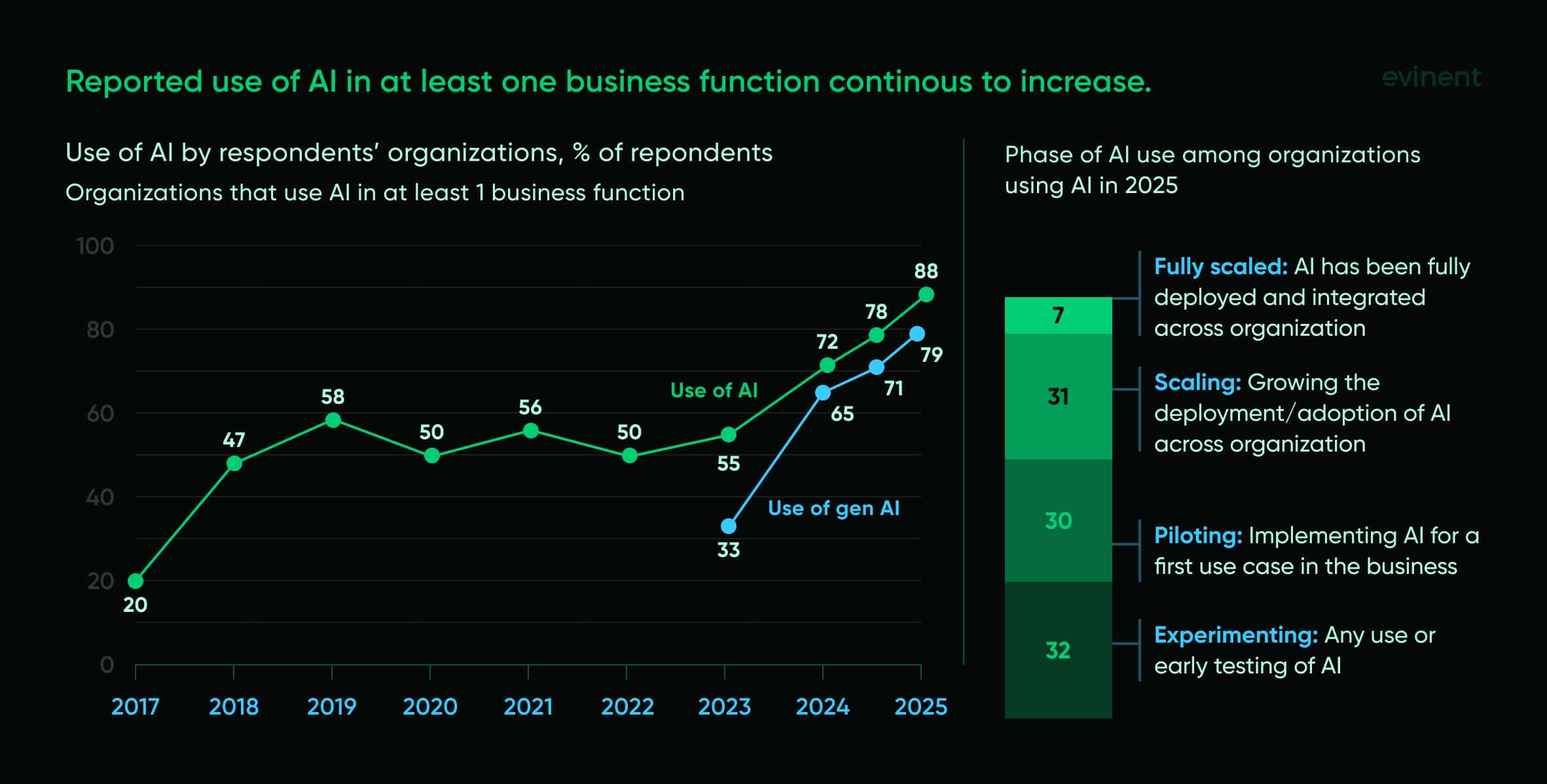
88% of organizations use AI in at least one business function (up from 78% last year)
Meanwhile, other research reveals the contrary: over half of CEOs say they have not realized any return on investment from AI. Only a small group manages to reduce operating costs and increase revenues. This discrepancy brings out a major issue: AI by itself is not a source of value; it is management and implementation that create value. (Tom's Hardwares, 2026)
3. Risk Reduction and Cost Control
AI introduces new categories of risk, including model errors, bias, compliance violations, and data leakage. Without governance, these risks translate directly into financial losses. Industry data shows that many organizations experience real financial losses linked to AI deployment, often due to governance failures such as poor validation, lack of controls, or compliance issues. Governance reduces these risks by introducing validation processes, monitoring systems, and accountability structures. This not only prevents losses but also stabilizes operations and reduces long-term costs associated with errors and regulatory exposure.
4. Trust, Transparency, and Stakeholder Confidence
Trust is an essential element for embracing AI in a company, both inside and outside. Workers must believe in AI technologies to be able to leverage them properly. Besides, customers and regulators need clarity in the decision-making processes. The establishment of governance models with features such as explainability, auditability, and ethical controls will boost trust in AI technologies.
Consequently, this will result in greater acceptance, improved decision-making, and diminished opposition from various stakeholders. In the absence of governance, even highly capable AI solutions might be rejected due to the lack of trust or issues related to fairness and accountability.
5. Scalability and Sustainable AI Growth
One of the most challenging aspects of implementing artificial intelligence is not experimentation, but scaling. Although many organisations are actively implementing artificial intelligence, only a few are able to integrate it into key business processes. (According to McKinsey & Company 2025), 88% of organizations use AI in at least one business function, yet nearly two-thirds have not scaled AI across the enterprise, with only a minority achieving meaningful enterprise-wide impact.
This gap highlights a structural issue: deploying AI is relatively easy, but embedding it into workflows, decision-making, and performance systems is significantly more complex. Without governance, initiatives remain fragmented and fail to deliver sustained value.
AI governance, far from being a cost center, actually serves as the tool for transforming AI from a mere pilot project to a process yielding concrete business outcomes. Businesses that put money into governance have a much higher chance of getting returns on their investments, lowering risks, and efficiently deploying AI. On the other hand, those who sideline it end up with disjointed efforts resulting in little overall benefit.
Future Trends in AI Governance
AI governance is changing its phase again as a result of the quick development of autonomous systems, multi-agent architectures, and more stringent regulations. The old ways of governance, concentrating on models, data, and compliance, are not enough anymore.
Governance has become more about the behavior, decisions, and interactions of AI systems. This change is going on because there is agentic AI, enterprises are adopting AI more and more, and the gap between AI capabilities and governance maturity is getting wider. In fact, knowing about these changes is a must if you are to create governance frameworks that will be capable of governing the AI systems of the future.
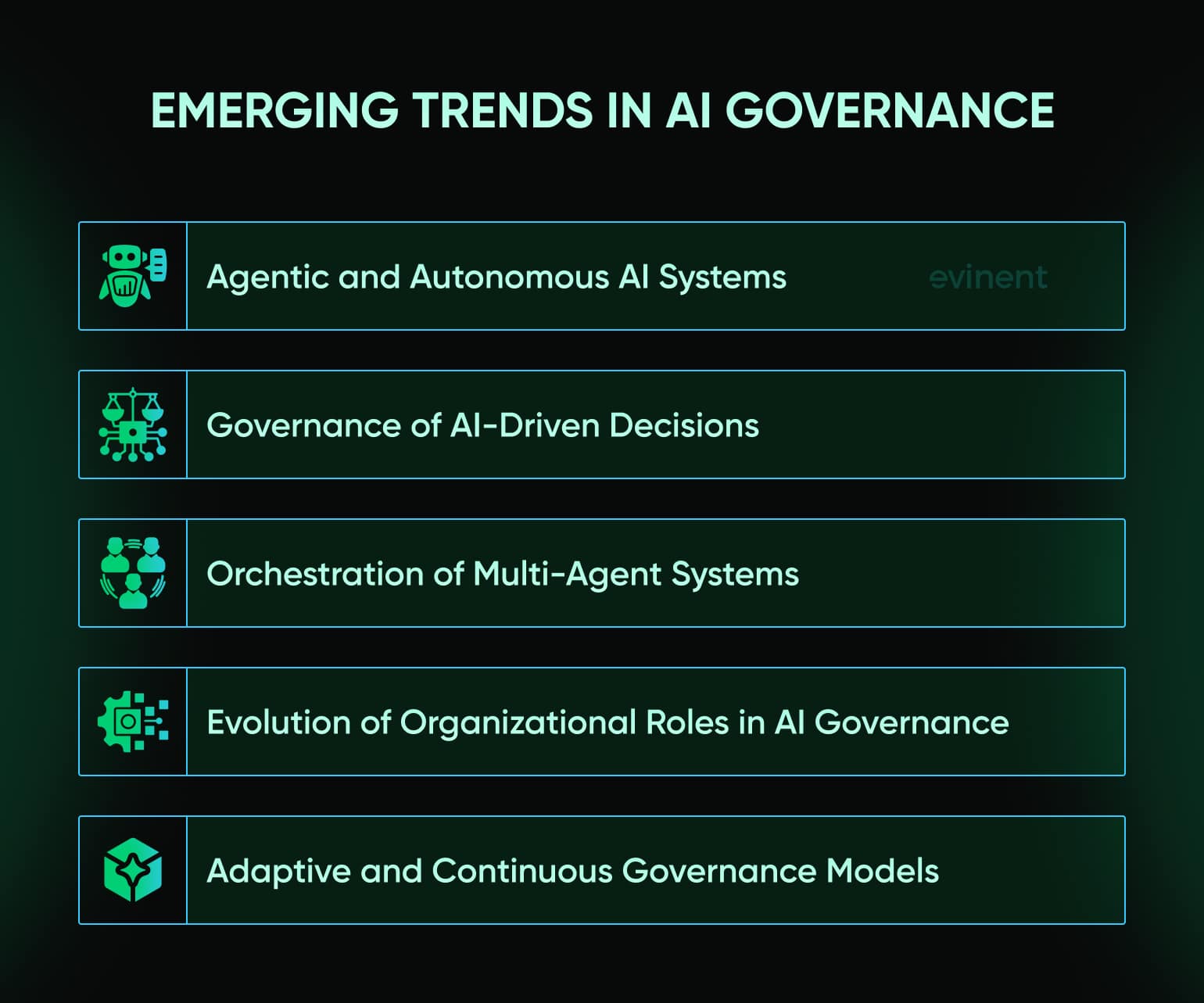
1. Agentic AI and Autonomous Systems
AI is rapidly evolving from passive tools to active systems capable of reasoning, planning, and executing tasks independently.
According to Info-Tech Research Group (2025), 64% of organizations are already experimenting with agentic AI, yet fewer than 25% have implemented formal monitoring or control mechanisms
This is a major change that brings to light new and serious challenges for governance. Agentic systems differ from traditional ones in that they can even operate independently of human intervention; control must be not only the final results but also the behavior, the way of actions, and the confines of decisions. So, governance protocols have to be changed to incorporate instant surveillance, procedures of , and management strata for self-governing implementation.
2. Governance of Decision-Making Systems
Within AI governance, the change is going on from model validation to controlling decision-making processes. The question is no longer only "is the model accurate?" but also "is the decision acceptable, explainable, and in line with business rules?" The main reason for this change is the growth of AI in making decisions with high impacts, such as pricing, hiring, risk scoring, and operations. When AI is part of decision flows, governance has to keep a record of how decisions are made, not only track the models.
This means that a new array of tools, such as decision traceability, explainability layers, and outcome monitoring, needs to be developed, in fact, changing governance from just a technology oversight system to a decision oversight system.
3. Agent Orchestration and Multi-Agent Systems
The future of AI is not just a single model, but rather a network of multiple agents working together in harmony. Currently, many business organizations are using AI tools as independent entities, and instead, they are moving towards interconnected systems that will allow them to carry out complicated and multi-step workflows among business functions. According to Gartner (2023), by 2026, more than 80% of enterprises will use generative AI APIs or deploy AI-enabled applications, up from less than 5% in 2023. This rapid growth is a key driver behind the emergence of multi-agent architectures and orchestration layers in enterprise environments.
At the same time, the shift toward distributed AI systems introduces a new level of governance complexity. Organizations must manage not only individual agents, but also their interactions, dependencies, and collective behavior across workflows. As AI becomes embedded in operational processes, coordination failures can directly impact business outcomes.
4. Emergence of New Organizational Roles
As AI systems become more complex, traditional roles are no longer sufficient to manage governance. Organizations are introducing new roles focused specifically on AI oversight, risk, and system coordination. At the same time, 68% of leaders now identify AI risk governance as a top operational priority, reflecting the growing importance of structured oversight. (Info-Tech Research Group, 2025)
Some of the newly created roles in the sector consist of AI Risk Officers, Agent Operations Managers, and Governance Architects, individuals who will ensure the integration of technical, operational, and regulatory aspects. The change points to a wider evolution: governance is turning into a fundamental organizational skill as opposed to merely a supporting function.
5. Adaptive and Continuous Governance Models
AI is evolving too quickly for static governance frameworks to remain effective. Organizations must move toward adaptive governance models that continuously update policies, controls, and oversight mechanisms.
Research shows that only 19% of organizations have fully implemented AI governance frameworks, despite widespread adoption. This gap highlights the need for dynamic governance systems that can evolve alongside technology. These systems must incorporate continuous monitoring, real-time risk assessment, and rapid policy updates in response to regulatory and technological changes. Governance is shifting from a fixed framework to a living system that adapts in real time. (Info-Tech Research Group, 2025)
The focus of AI governance is shifting from merely controlling models to also controlling behavior, decisions, and autonomous systems. Those companies that embrace this change, by adding new roles, managing agent ecosystems, and adopting adaptive governance, are the ones who will be able to trustingly and practically use AI in scale, thus, the next generation of intelligent systems.
How Evinent Can Help With AI Governance Implementation
Evinent supports organizations in moving from fragmented AI initiatives to structured, scalable governance systems. We focus on aligning AI with business objectives, introducing clear accountability, and embedding governance into real operational workflows — not just policies.
Our approach is built around making AI systems transparent, controllable, and auditable, while reducing operational friction and enabling sustainable scaling across the enterprise.
Why Organizations Choose Evinent for AI Governance
15+ years in enterprise and regulated software development.
Proven delivery of secure, scalable platforms in complex environments.
Strong expertise in system integration across data, AI, and business workflows.
Consistent execution of multi-phase, transformation-level programs.
Deep understanding of risk, compliance, and operational accountability.
Relevant Experience: AI Governance in Practice
To move from theory to practice, organizations need governance mechanisms embedded directly into AI systems. One example is Evinent’s implementation of a private AI solution for enterprise HR workflows.
We developed an AI-powered HR assistant designed to automate candidate matching while ensuring full control, security, and predictable behavior — key requirements for AI governance in regulated environments.
The solution was built using an isolated architecture, where AI agents operate entirely within the client’s infrastructure, without any external API calls to third-party models. This eliminated data leakage risks and ensured full compliance with internal security policies.
A key design principle was the use of atomic agent architecture, where each agent performs a single, well-defined function (search, match, summarize). This approach significantly reduced hallucinations, improved consistency, and made system behavior easier to monitor and audit.
To support governance requirements, the system included:
Role-based access control (RBAC) for secure and segmented usage
Encrypted data processing within internal networks
Configurable logic and response behavior aligned with business rules
Monitoring and logging capabilities for transparency and audit readiness
As a result, the client achieved faster candidate screening, reduced manual workload, and improved data security — while maintaining full control over AI behavior and decision logic.
This case demonstrates a core principle of AI governance: effective control is achieved not through policies alone, but through system architecture, isolation, and operational design.
AI Governance Capabilities
Setting up governance that is consistent with overall business strategy and meeting regulatory requirements.
Classifying the AI use cases and control mechanisms by the level of risk involved.
Ensuring human-in-the-loop for critical decision-making.
Maintaining a clear audit trail and transparency through logs and report generating systems.
Developing systems that can grow and support multi-model and multi-agent environments.
Ongoing vigilance and enhancements to governance procedures.
We have no generic governance frameworks on offer at all. What we do is make tailored, scalable AI governance systems that tie in and complement your organization's operations and progress alongside your AI ventures.
Key Takeaways
AI governance is not optional — it is a core business capability.
As AI adoption accelerates, organizations without structured governance face increasing operational, regulatory, and strategic risks.The main challenge is not adoption, but control and scalability.
Most companies already use AI, but only a minority successfully scale it across the enterprise due to lack of governance, ownership, and integration.Governance must operate across all layers — data, models, decisions, and workflows.
Effective governance is not limited to model validation; it includes data integrity, decision oversight, risk management, and operational accountability.Clear ownership and leadership involvement are critical.
Without defined roles at the board and executive levels, governance remains theoretical and fails to influence real business outcomes.AI risks are systemic and need to be managed in an organized manner. From bias and data leakage to regulatory exposure, unmanaged AI results in risks that directly affect financial performance and trust.
Regulation is moving, making governance a major priority. Work such as the EU AI Act is encouraging the development of more formal, auditable, and risk-based governance practices.
The future of governance is shifting toward controlling behavior, not just technology.
With the rise of agentic AI and multi-agent systems, organizations must govern decisions, interactions, and autonomous actions — not only models.A phased rollout is crucial for a successful governance introduction. Great companies introduce governance gradually through a series of steps: first audit, then classification, next ownership and policies, finally scaling and optimization.
Governance can be a driver of value and not a cost center. Doing it the right way, it can help increase the ROI, lower the risks, raise the trust level, and provide the basis for the long-term development of AI.
Share