

What is AI Security Posture Management in AI Infrastructure
This section describes AI Security Posture Management. It details its function in protecting AI infrastructure and highlights its integration with model development, DevSecOps, and identity-based authentication.
Definition of AI Security Posture Management
AI Security Posture Management (AISPM) is a security framework that ensures visibility, risk assessment, and control of AI systems continuously. It is especially concerned with the security of the entire AI stack, such as models, data pipelines, and runtime environments. Unlike the traditional security methods, AISPM is meant to tackle the risks that are unique to AI, for instance, model misuse, data poisoning, and shadow AI.
Role in AI Infrastructure and Model Development
AISPM encompasses the entire lifecycle of AI, guaranteeing that security is part of every stage from creation to implementation.
Specifically, it includes:
Model training and fine-tuning
Data ingestion and processing pipelines
Deployment environments and inference endpoints
Runtime monitoring and behavior analysis
When built into AI infrastructure, AISPM makes sure that models remain, beyond mere functionality, also secure, compliant, and resistant to attacks.
What This Article Covers
This article explores the key aspects of AI Security Posture Management, including:
Risks introduced by AI systems, such as model misuse and data leakage
Methods for achieving visibility through AI discovery and inventory
Governance, compliance, and data security requirements
Core AISPM features like monitoring, attack path analysis, and remediation
Risk management strategies across the AI lifecycle
Comparison with CSPM, DSPM, and other security posture management solutions
Best practices based on DevSecOps and Zero Trust concepts
Real-world use cases and implementation scenarios
Risks Introduced by AI: Model Misuse, Data Leakage, and Shadow AI
In this part, we look at the main security and operational risks that AI systems bring along with them, such as adversarial attacks, data exposure, exploiting the model, and new issues related to shadow AI.
AI-Powered Cyberattacks and Adversarial Attacks
Because AI systems are based on probabilistic behavior rather than deterministic logic, they give rise to fundamentally new attack vectors. Thus, they become vulnerable to manipulations through the inputs, carefully crafted influence model weaknesses.
Adversarial Inputs
Adversarial inputs are intentionally modified data designed to mislead AI models while appearing normal to humans. These attacks exploit how models interpret patterns, allowing attackers to manipulate outputs without triggering obvious alarms.
Manipulated inputs that alter predictions
Evasion attacks that bypass detection systems
injection in generative AI systems
Such attacks can cause incorrect classifications, bypass security filters, or generate unsafe responses, making them particularly dangerous in production environments.
Data Leakage and Data Poisoning
Any artificial intelligence system needs data as its base, and so it becomes one of the most important areas susceptible to attack. The system may be exposed to dangers during both its training sessions and its execution.
Data Leakage
Data leakage happens when sensitive information is exposed through model behavior or insecure infrastructure. This can occur when models unintentionally reproduce training data or when APIs allow excessive access to internal information.
Common scenarios include:
Exposure of sensitive training data through model outputs
Insecure data pipelines that allow unauthorized access
Improper handling of inference requests
Data Poisoning
Data poisoning is the act of putting maliciously biased data into training datasets. As models get familiar with data patterns, poisoned inputs can have a lasting impact on model behavior.
Consequences include:
Biased or manipulated predictions
Degradation of model accuracy
Hidden backdoors that can be triggered later
Model Misuse, Model Extraction, and Model Corruption
Artificial intelligence models themselves constitute valuable assets and might even become targets of direct attack or exploitation.
Model Extraction
Attackers may be able to piece together a model by making repeated inquiries and analyzing the answers. Such a method enables them to duplicate a source code that is proprietary, even if they have no direct access.
This leads to:
Intellectual property theft
Loss of competitive advantage
Unauthorized redistribution of models
Model Corruption
Model corruption means that a model changes without approval, either during training or when it has already been deployed. Such situations could be deliberate (evil tinkering) or accidental (problems with the pipeline).
Impacts include:
Loss of model integrity
Unreliable or unsafe outputs
Degraded performance over time
Shadow AI and Model Sprawl
AI adoption often happens outside formal governance structures, especially with the rise of accessible AI tools.
Shadow AI
Shadow AI stands for employing artificial intelligence resources, such as tools, models, or APIs, without getting authorization from the security or IT departments. That results in security monitoring blind spots.
Typical risks:
Unmonitored data usage
Exposure of sensitive information
Lack of policy enforcement
Model Sprawl
When companies increase the usage of AI, they end up having a lot of models very quickly in different departments and places. If they are not well managed, it may result in breakdown and non-standard security measures.
This results in:
Lack of visibility into deployed models
Duplicated or outdated models in use
Inconsistent access controls
Misconfigurations and Compliance Violations
Actually, a lot of AI systems get compromised not due to sophisticated hacking but mostly because of negligence in setting them up properly.
Misconfiguration Errors
Wrong configuration in AI services, storage, or APIs could inadvertently reveal the essential parts.
Examples include:
Publicly accessible endpoints
Overly permissive access controls
Unsecured storage of training data
Compliance Violations
Artificial Intelligence or AI tools commonly deal with sensitive or regulated information; hence, ensuring compliance becomes a major necessity.
Failure to comply can result in:
Legal and regulatory penalties
Financial losses
Reputational damage
AI brings about a completely different set of risks that not only concern infrastructure and data but also have implications on model behavior and decision-making. Moreover, these risks tend to be interrelated, and most of the time, without specific controls, it is quite challenging to identify them. To properly manage these risks, organizations should start by gaining complete visibility and discovery over their AI systems.

Visibility and Discovery: AI Discovery and Inventory Management
This part discusses the role of AI Security Posture Management (AISPM) in providing complete visibility across AI environments through the process of discovery and inventory management, which lays the basis for security, governance, and risk control that are both effective.
AI Discovery and Inventory Across AI Infrastructure
Effective security starts with identifying all AI assets across the organization. This includes models, datasets, services, and pipelines distributed across different environments. AI inventory management consolidates this information into a unified view, allowing organizations to understand where AI components are deployed and how they are connected. This eliminates blind spots and defines the real AI attack surface.
AI Landscape Visibility and Continuous Monitoring
Since AI systems are constantly changing, visibility should be an ongoing process rather than a one-off event. Continuous monitoring enables immediate understanding of how models behave, who is accessing them, and what changes are made to their configurations. This way, anomalies can be spotted early, and the control of transforming AI environments can be maintained.
Detection of Shadow AI Models
Shadow AI refers to the use of AI tools, models, or services without formal approval or oversight. This often occurs when teams independently adopt AI technologies to accelerate development or experimentation, bypassing established governance processes. AISPM enables the detection of such unauthorized usage by analyzing system activity, integrations, and infrastructure patterns. By identifying shadow AI, organizations can bring these assets under governance, reduce hidden risks, and ensure that all AI usage aligns with security and compliance requirements.
AI Data Pipelines and AI Lineage
Data pipelines are a core component of AI systems, and understanding how data flows through these pipelines is essential for both security and accountability. AI lineage provides traceability by linking data sources, transformations, and models. This traceability allows organizations to determine where data originates, how it has been modified, and how it influences model behavior. It is particularly important for audits, regulatory compliance, and incident investigations. Without lineage, it becomes difficult to explain model decisions or identify the source of errors and vulnerabilities.
Identification of Misconfigurations
Misconfiguration is one of the most underestimated and frequent security risks in AI environments. They may happen in APIs, storage systems, access controls, or deployment settings. AISPM constantly checks how configurations are set up in order to recognize the insecure ones, like the ones that allow too much access to users, public endpoints, or data storage that is not properly secured. Locating these types of issues and fixing them is less likely to lead to exploitation, and the overall security posture of AI systems will be stronger.
Securing AI systems really starts with making what you have visible and getting it found. This will give you a full and up-to-date picture of your assets, behavior, and risks. Having this kind of deep insight will enable organizations to put governance, compliance, and data security controls in place effectively.
Governance, Compliance, and Data Security in AI Systems
Here, you can learn about the different governance, compliance, and data security measures that help maintain accountability, meet regulatory requirements, and secure sensitive information when working with AI systems.
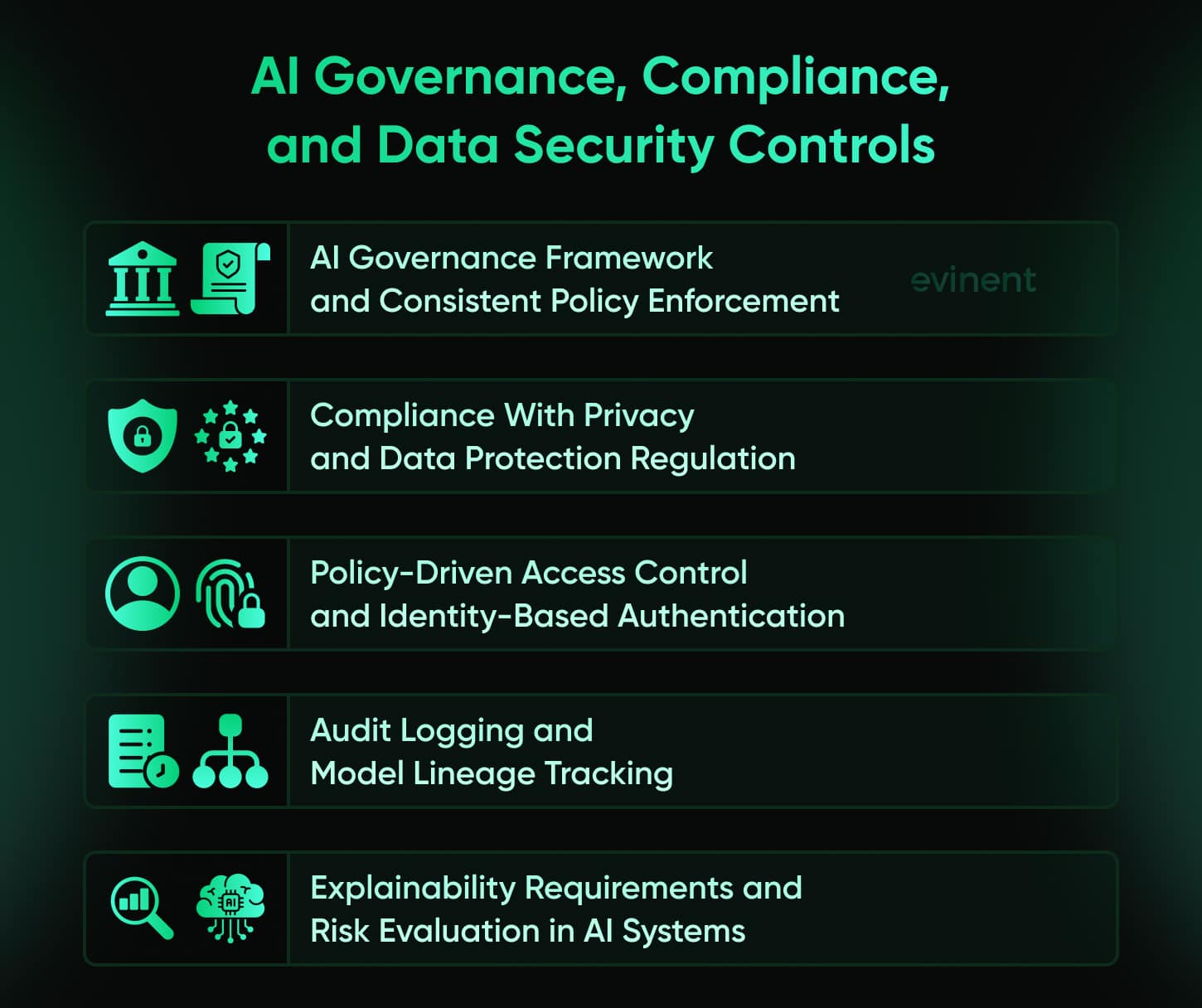
Governance Framework and Policy Consistency
AI governance describes the management of models, data, and pipelines through their complete lifecycle. It guarantees that security policies and regulations on usage are continuously enforced, no matter where AI systems are located. A disjointed governance structure is what will lead companies to experience fragmentation, lose control of their systems, and have an elevated risk.
Compliance with Privacy Regulations
Compliance is a fundamental requirement since AI systems frequently handle sensitive or regulated data. The organizations should be equally sure that the data used for training and making predictions satisfy the regulatory standards, along with other restrictions on data usage and auditability requirements. This should be followed as non-compliance may result in not only legal but also financial and reputational consequences.
Policy-Driven Access Controls and Identity-Based Authentication
Access to AI systems must be tightly controlled to prevent unauthorized use and data exposure. This is achieved through role-based access controls and identity-based authentication mechanisms that ensure only verified users and services can interact with models and data. Proper access control reduces the risk of misuse and limits the impact of potential breaches.
Audit Trails and Model Lineage
Behind every AI system lie the requirements for total traceability in order to bolster security, compliance, and incident response. An audit trail is a chronological record of system activities detailing user actions and changes in configurations, whereas model lineage reveals the source of models, the data used in training, and the development of models throughout. Such a level of transparency plays a vital role in discerning behavior and carrying out investigations.
Explainability Requirements and Risk Analysis
AI decisions must be transparent enough to be understood and justified, especially in regulated or high-risk scenarios. At the same time, organizations need structured risk analysis to identify vulnerabilities across data, models, and operations. Together, explainability and risk analysis support accountability and informed decision-making.
Governance and compliance set the rules and controlling mechanisms for AI, but actually enforcing the controls needs special security capabilities. This is the topic that the next section deals with.
Key Features and Capabilities of AI Security Posture Management
This piece explains the main features of AI Security Posture Management (AISPM) and how these help to maintain oversight, identify dangers, and take actions in AI settings. Rather than listing features one by one, this piece groups them together in a chart-like form so that the reader can see how AISPM works as a single system.
Core AISPM Capabilities
Capability | Description | What It Covers | Security Outcome |
AI Inventory Management | Centralized discovery and tracking of AI assets | Models, datasets, pipelines, services | Eliminates blind spots and enables asset control |
Full-Stack Visibility | Unified view across AI infrastructure and workflows | Development, training, deployment, runtime | Complete awareness of AI environment |
Continuous Monitoring | Ongoing observation of AI systems' behavior | Model activity, access patterns, and configuration changes | Early detection of anomalies and threats |
Runtime Detection | Identification of threats during model execution | Inference behavior, abnormal outputs, and misuse patterns | Real-time threat detection |
Attack Path Analysis | Analysis of how attacks can propagate across systems | Dependencies between models, data, and infrastructure | Identification of high-risk exposure paths |
AI Model Scanning | Detection of vulnerabilities in models and configurations | Model structure, endpoints, configurations | Reduced attack surface |
Built-in AI Configuration Rules | Predefined security rules for AI environments | Access settings, deployment configurations | Prevention of misconfigurations |
Policy Enforcement | Automated application of security policies | Identity, access, and data usage controls | Consistent security across environments |
Automated Remediation | Automatic correction of detected issues | Misconfigurations, policy violations | Faster risk mitigation |
Incident Response | Structured handling of security incidents | Detection, ing, and resolution workflows | Reduced response time and impact |
AISPM capabilities collectively help continuously keep an eye on AI systems, detect risks in a proactive way, and perform an automated response to threats. Having these capabilities is a prerequisite for organizations to counter the security problems retrospectively to an organized risk management throughout all stages of the AI lifecycle.
Risk Management and Mitigation in AI Lifecycle
Here, we are going to look at some major steps that a company should follow to control and reduce the risks of AI systems for the whole life of AI systems. This will be done via AISPM, starting from the first finding to the continuous checking and reaction.
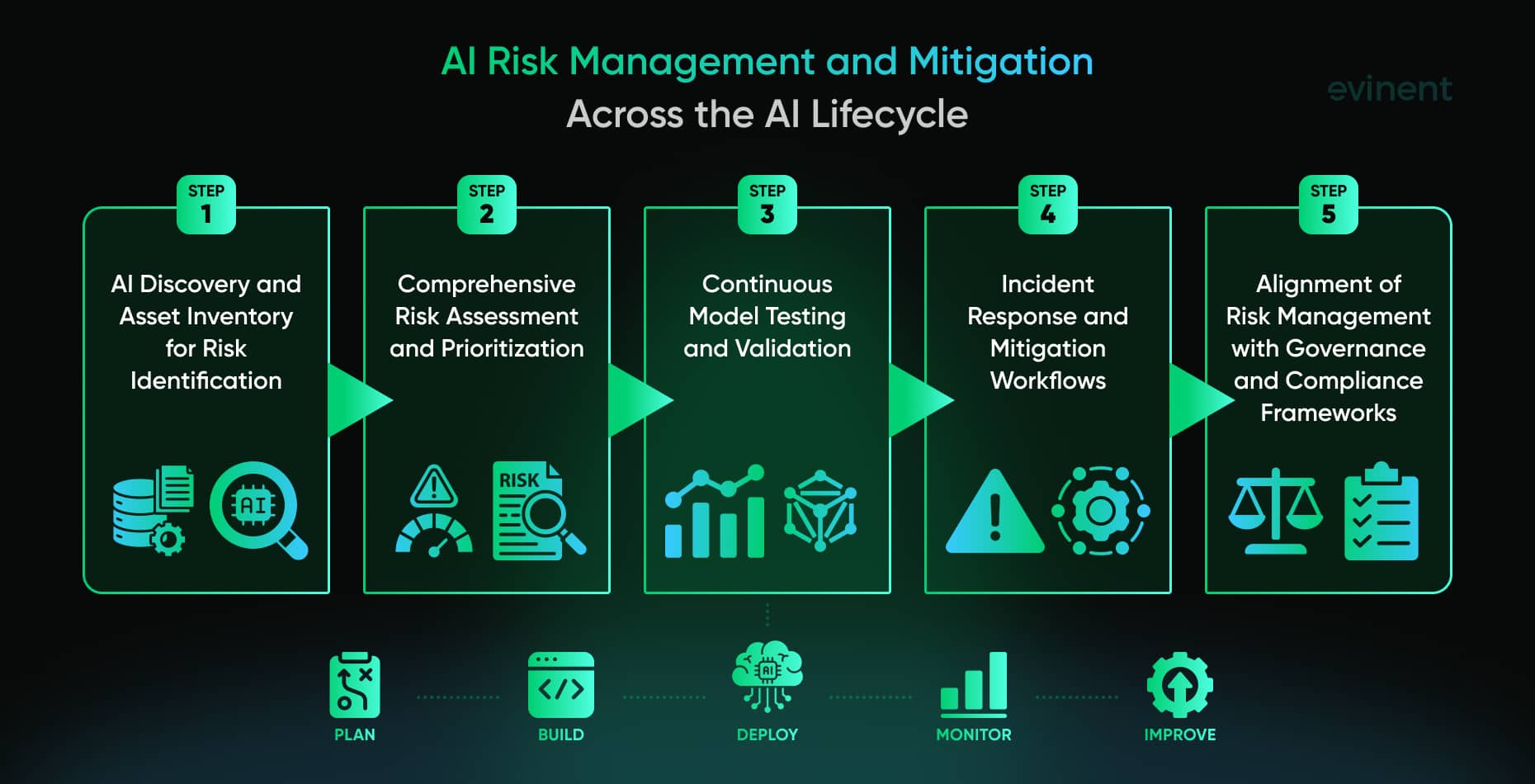
Step 1. Establish AI Discovery and Inventory for Risk Identification
Step one is to pinpoint every single AI resource throughout the enterprise. These resources entail models, datasets, workflows, and services, along with their interconnections and dependencies. An incomplete listing of assets will make it quite challenging, if not impossible, to estimate security threats with any degree of accuracy or to get a comprehensive picture of the potential attack scenarios.
Step 2. Perform Comprehensive Risk Assessments
Once assets are identified, risks must be evaluated based on severity, potential impact, and exposure. This includes analyzing vulnerabilities in models, weaknesses in data pipelines, and gaps in access control. Prioritization at this stage is critical to focus on the most significant threats.
Step 3. Implement Regular Model Testing and Validation
AI models should be regularly tested to verify they operate as expected and stay secure over time. This involves not only validating results but also detecting anomalies and uncovering vulnerabilities, such as being prone to adversarial inputs or data drifting.
Step 4. Establish Incident Response and Mitigation Workflows
Organizations need to establish well-defined procedures to tackle identified risks and incidents. It involves recognizing the problem, controlling the consequences, and implementing remedial measures. Automation of the corrective actions is one way to speed up the whole process and minimize the time of response.
Step 5. Align Risk Management with Governance and Compliance
Risk management processes should be merged with governance frameworks and compliance requirements. This is to verify that risk reduction measures align with the organization's policies and regulatory requirements, and that every step is well-documented and subject to audit.
Effective risk management in AI systems requires a structured, continuous approach that combines visibility, assessment, testing, and response. Once these processes are in place, organizations can better understand how AISPM compares to other security posture management solutions.
Comparison with CSPM, DSPM, and ASPM Solutions
The following part mainly compares AI Security Posture Management (AISPM) to other types of security posture management methods, such as CSPM, DSPM, and ASPM. These approaches focus on securing the environment, data, and applications, but cannot completely handle the risks coming from AI, such as model abuse, pipeline vulnerabilities, and runtime behavior. This comparison serves to show how AISPM goes beyond the normal security models to cater to the distinct features of AI systems.
Comparative Analysis of Security Posture Management Approaches
Area | AISPM | CSPM | DSPM | ASPM |
Primary Scope | AI systems, models, pipelines | Cloud infrastructure | Data storage and movement | Applications and code |
Visibility | Full AI lifecycle visibility (models, pipelines, runtime) | Infrastructure-level visibility | Data-level visibility | Application-level visibility |
AI Model Security | Built-in model protection and analysis | Not supported | Not supported | Not supported |
AI Pipeline Security | Covers data pipelines and model workflows | Not supported | Limited (data only) | Not supported |
Runtime Monitoring | Monitors model behavior and outputs in real time | Limited to infrastructure | Not supported | Limited |
Attack Path Analysis | Includes AI-specific attack paths across models and data | Infrastructure-focused | Not supported | Partial |
Misconfiguration Detection | AI-aware configuration analysis | Cloud configuration checks | Data access misconfigurations | Application misconfigurations |
Data Security | Integrated with model and pipeline context | Indirect | Core focus | Partial |
Shadow AI Detection | Detects unmanaged AI usage and models | Not supported | Not supported | Not supported |
Model Scanning | Identifies vulnerabilities in models | Not supported | Not supported | Not supported |
Governance and Compliance | AI-specific governance and lifecycle tracking | Infrastructure compliance | Data compliance | Application compliance |
Coverage Gap | — | No model or AI visibility | No model or runtime context | No AI-specific controls |
CSPM, DSPM, and ASPM focus on different levels of the security stack individually; however, they are not equipped to deal with the complexity of AI systems. AISPM takes security posture management to the next level in the AI domain by including models, pipelines, and runtime behavior, thereby connecting infrastructure, data, and application security.
Best Practices and Recommendations: DevSecOps and Zero Trust Concepts
This section presents practical tips for implementing AI Security Posture Management (AISPM) in real-world settings. The key points of discussion revolve around integrating security measures into AI workflows using DevSecOps practices and Zero Trust principles for securing, controlling access, protecting data, and minimizing risks throughout AI systems.
Integration with DevSecOps Practices
AISPM should be integrated directly into AI development and deployment pipelines rather than applied after deployment. This means security controls must be embedded into data ingestion, model training, validation, and release processes. By aligning AISPM with DevSecOps practices, organizations ensure that vulnerabilities, misconfigurations, and policy violations are detected early, before they reach production.
Applying Zero Trust Concepts to AI Systems
Again, the concept of Zero Trust implies maximum skepticism so that neither any user, service, nor system is trusted by default. When it comes to AI settings, this principle becomes very important as the models, pipelines, and APIs are frequently exposed via several infrastructure layers. Thus, every request to an AI system must be checked, permitted, and, if possible, reassessed, thereby greatly lowering the risk of unauthorized access and lateral movement.
Managed Identity for AI Service Accounts
AI systems are particularly dependent on service accounts for their operations with data sources, pipelines, and external services. Replacing static credentials with managed identity methods goes a long way in cutting down the chances of credential theft and unauthorized use. Besides that, it makes the handling of access easier, and it is compatible with the centralization of the management of authentication policies.
Agentless Technology for AI Security
Organizations have the option of deploying AISPM solutions with agentless approaches that enable the monitoring of AI environments without the need to install additional software on each component. This not only simplifies the deployment but also decreases the operational overhead and facilitates the scaling of security controls across distributed AI systems.
Ensuring Data Confidentiality and Policy Consistency
Data that powers AI systems should be safeguarded at every step of the lifecycle. This means strictly abiding by the data protection rules at all times, even when changing from one environment to another, such as from development to testing and production. Keeping the policies always the same will help you to avoid loopholes in security, and at the same time, it will guarantee that the handling of the sensitive data is compliant with both the regulatory and organizational rules.
The utilization of DevSecOps and Zero Trust methodologies guarantees that AISPM, apart from being deployed, is thoroughly ingrained in AI activities. The security of the AI pipeline remains uniform when these methods are used. Besides this, being equipped with these practices, a company can roll out AISPM in actual contexts and cases.
Use Cases and Implementation Scenarios in AI Security
This section presents real-world AISPM use cases backed by recent industry data and research. It shows how organizations apply AISPM to protect generative AI, detect vulnerabilities, secure pipelines, and monitor runtime behavior in production environments where AI threats are already widespread and rapidly evolving.
Generative AI Application Security
Generative AI systems are currently one of the most vulnerable attack surfaces. injection has evolved from a theoretical problem into a widespread operational issue. In real-world deployments, AISPM is used to monitor input and output data, ensure policy compliance, and detect anomalous model behaviour. This is critical because generative AI systems may inadvertently disclose confidential data or execute unintended instructions when manipulated using specially crafted s. (IBM, 2026)
Detection of Model Vulnerabilities and Adversarial Inputs
More and more, AI models are being hit straight. The recent study on agent-based AI systems reveals that over half of the harmful s manage to bypass even the most advanced protections, resulting in an aggregate attack success rate of over 50% for certain setup scenarios. AISPM is applied here to continuously test models, simulate adversarial scenarios, and detect abnormal behavior patterns before they are exploited in production. (Arxiv, 2025)
Securing Deployment Pipelines and Development Environments
AI pipelines are a critical attack surface because they connect data ingestion, model training, and deployment processes. Weak controls at any stage can introduce vulnerabilities that propagate into production systems. Common issues include insecure APIs, improper access controls, and a lack of visibility into dependencies between models and data sources.
These weaknesses can be exploited to perform data poisoning, extract sensitive information, or compromise models before deployment. AISPM mitigates these risks by providing end-to-end visibility into pipelines, tracking how models and data are connected, and enforcing consistent configuration and security policies across development and deployment environments.
Runtime Monitoring and Continuous Observation
Continuous monitoring of AI systems is necessary as threats not only get introduced at deployment but also develop during runtime. A large proportion of hackers, precisely 82%, are leveraging AI in their workflows, which has resulted in more rapid and widespread attacks, as highlighted in recent security data. What's more, attacks that leverage AI are becoming quicker and more automated, to the extent that certain operations now only take seconds instead of hours.
AISPM tackles this challenge by continuously monitoring the behavior of the model, detecting anomalies, and recognizing patterns of misuse as events unfold, which is crucial for autonomous systems or those that have interactions with the external environment. (CyberSecStats, 2026)
Explainable AI and Security Recommendations
A major challenge in AI security is not just detecting issues, but understanding them. Organizations increasingly require explainability to support audits, compliance, and trust. At the same time, AI-related incidents are becoming nearly universal. Reports indicate that up to 99% of organizations with AI deployments experienced at least one AI-related attack in 2025.
AISPM helps security teams understand, trust, and effectively use the decisions of AI models. It explains why a behavior occurred by referring to the data and configurations behind it. Also, AISPM creates recommendations to security teams for risk-mitigating actions. (TheHGtech, 2025)
Actual data from the real world that AI threats have already spread everywhere, are very effective, and are changing at a fast pace. AISPM is not a discretionary extra but a compulsory control mechanism that helps organizations identify, comprehend, and counteract risks throughout the entire AI lifecycle, thus paving the way for the large-scale implementation of these capabilities in real environments.
How Evinent Implements AI Security Posture Management
Putting in place AI Security Posture Management isn't merely installing additional controls; rather, it calls for bridging visibility, governance, and risk management to actual AI workflows. Evinent assists companies in making AISPM a practical, working system rather than merely a theoretical document.
Why Organizations Choose Evinent
Evinent brings experience in building complex systems where stability, control, and scalability are critical. This is directly relevant for AISPM, where fragmented implementation leads to security gaps.
Key strengths include:
15+ years of software development and analytics engineering
100% project completion rate across enterprise environments
Experience with high-load systems and AI-driven decision platforms
Up to 35% reduction in IT costs through infrastructure optimization
Relevant Experience: Private AI for Secure HR Automation
Evinent developed a Private AI solution for a European enterprise to automate recruitment while maintaining strict control over sensitive data.
The system deployment was entirely internal to the infrastructure, so it was ensured that data wasn't exposed to any external AI providers. For better control and transparency, different roles were divided across components, and system behavior was made easier to track and audit through the architecture.
Key implementation aspects:
Isolated environment with full data control
Multi-agent architecture for the separation of responsibilities
Atomic design to improve predictability and auditability
Role-based access control and encrypted data flows
What Evinent Delivers
Evinent seeks to turn AISPM concepts into something that can be actually used and adhered to in the industry sector environments. Instead of single tool solutions, the company develops fully integrated systems where ease of use, control and security are aligned.
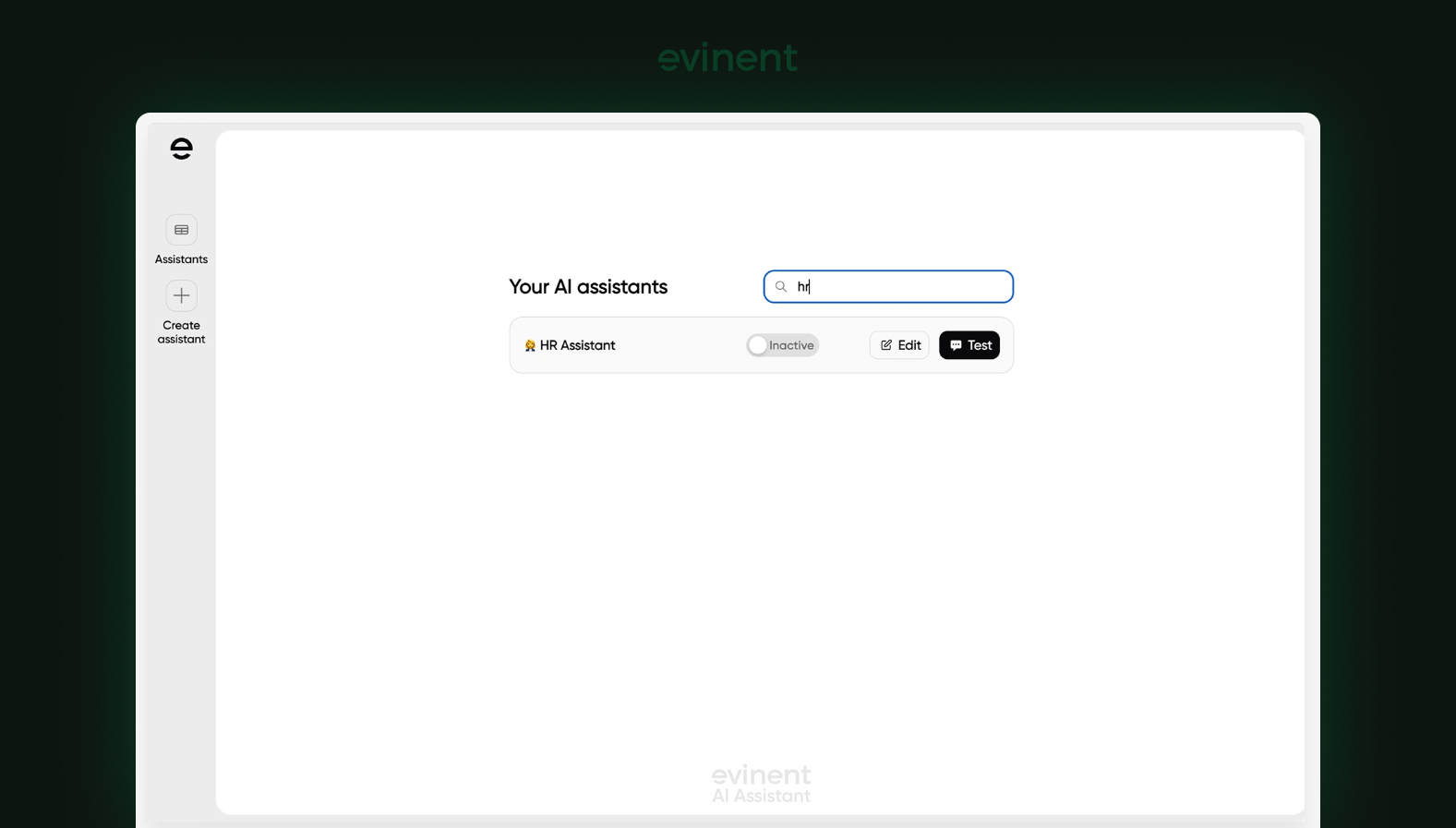
Complete Transparency In AI Components, Models, And Pipelines
Evinent shows everything associated with AI, including models, datasets, pipelines, and services across environments. This not only helps to get rid of the blind spots but also allows one to figure out how these systems are intertwined.
Regulation Of Data Usage And Model Performance
Access is granted only after successful identification and authorization based on roles. This way only authorized users and services get to interact with AI systems whereas model behavior is also secured within set security policies.
Ongoing Surveillance And Hazard Recognition
AI systems are continually monitored in order to to fraud, wrong configurations, and strange behavior. Therefore, risks can be identified at an early stage, before they get out of hand.
Meeting Governance And Regulatory Requirements
Security protocols are put in place as a means to uphold governance policies and regulatory standards, thus facilitating audit, traceability, and compliance.
Our Approach
Evinent integrates AISPM into existing infrastructure and workflows, ensuring that security controls are not only defined but actually applied.
The approach is based on:
Embedding security into development and deployment pipelines
Aligning controls with business and regulatory requirements
Designing systems that scale across teams and environments
CTA
“Ready to implement AI Security Posture Management that works in production?
Evinent can help you design, integrate, and scale a system aligned with your AI infrastructure, data, and security requirements.”
Key Takeaways
AI Security Posture Management (AISPM) offers ongoing transparency and enables control over the entire AI lifecycle, from models and data pipelines to runtime environments.
Traditional security approaches like CSPM, DSPM, and ASPM do not fully address AI-specific risks such as model misuse, injection, and shadow AI.
The most serious potential dangers of AI are: data leakage, data poisoning, adversarial attacks, model extraction, and uncontrolled use of the AI across various teams and tools.
Visibility and discovery are the foundation of AISPM, enabling organizations to identify all AI assets, detect shadow AI, and understand data and model relationships.
Governance, compliance, and data protection help keep AI systems running according to established policies, satisfying regulatory demands, and being open for auditing.
Core AISPM capabilities include inventory management, continuous monitoring, attack path analysis, configuration control, and automated remediation.
Managing risks effectively in AI requires adopting a lifecycle approach, which comprises discovery, assessment, testing, monitoring, and incident response.
DevSecOps and Zero Trust principles are essential for integrating security into AI systems rather than treating it as an external layer.
Real-world use cases show that AISPM is essential for securing generative AI, protecting pipelines, and ensuring safe runtime behavior in production environments.
Organizations like Evinent implement AISPM as an integrated system, combining visibility, control, and compliance into a scalable operational framework.
Share