

What is an AI Governance Framework
Artificial Intelligence governance broadly means the rules, methods, and hierarchy that are implemented to monitor every phase from the design to the final exit of the AI systems, such as designing, developing, launching, and live monitoring.
A typical framework includes:
Principles — such as fairness, transparency, and accountability
Processes — model development, validation, deployment, and monitoring
Roles and responsibilities — clearly defined ownership and decision-making authority
Control mechanisms — audits, risk assessments, and compliance checks
Simply put, it sets the rules and framework for the usage of AI in a company.
Why AI Governance Matters
Without proper governance, AI systems can introduce significant risks:
Model failures — inaccurate or unstable outputs
Regulatory violations — non-compliance with laws and standards
Reputational damage — caused by bias or lack of transparency
Financial losses — due to poor or uncontrolled AI decisions
A solid governance framework also allows for:
getting more trusting by users, clients, and regulators
less operational and compliance risks
quicker and more efficient getting the AI out there
large-scale and long-term use of AI
“Companies need a real commitment to building AI trust and governance capabilities.” — Jorge Amar, Senior Partner at McKinsey
Key Components of a Framework
Four essential elements form the basis of an impactful AI Governance Framework:
Policies and Standards
Setting up guidelines for AI creation, data handling, and model conduct
Risk Management and Control Encompassing Practices
For tracking, auditing, and evaluating risks:
Technology and Tools
For model supervision, interpretability, and safety:
Resources
The proper synchronization of these four elements is essential for successful governance. AI Governance should be seen as a continual system to guarantee that AI is used responsibly and safely throughout the organization, not as a single effort.
In this article, we will cover:
The core principles of responsible AI
Ethical foundations and governance practices
Global regulations and compliance requirements
Risk management and AI security approaches
Organizational structures and governance models
Practical steps for implementation
Monitoring, auditing, and continuous improvement
Real-world AI governance case studies
How organizations can build and scale effective AI governance systems
Core Principles of Responsible AI Governance
Responsible AI governance is based on a core principle framework to safeguard fairness, transparency, accountability, and security of AI systems. AI governance principles describe how organizations handle risks and establish trust in AI processes from end to end.
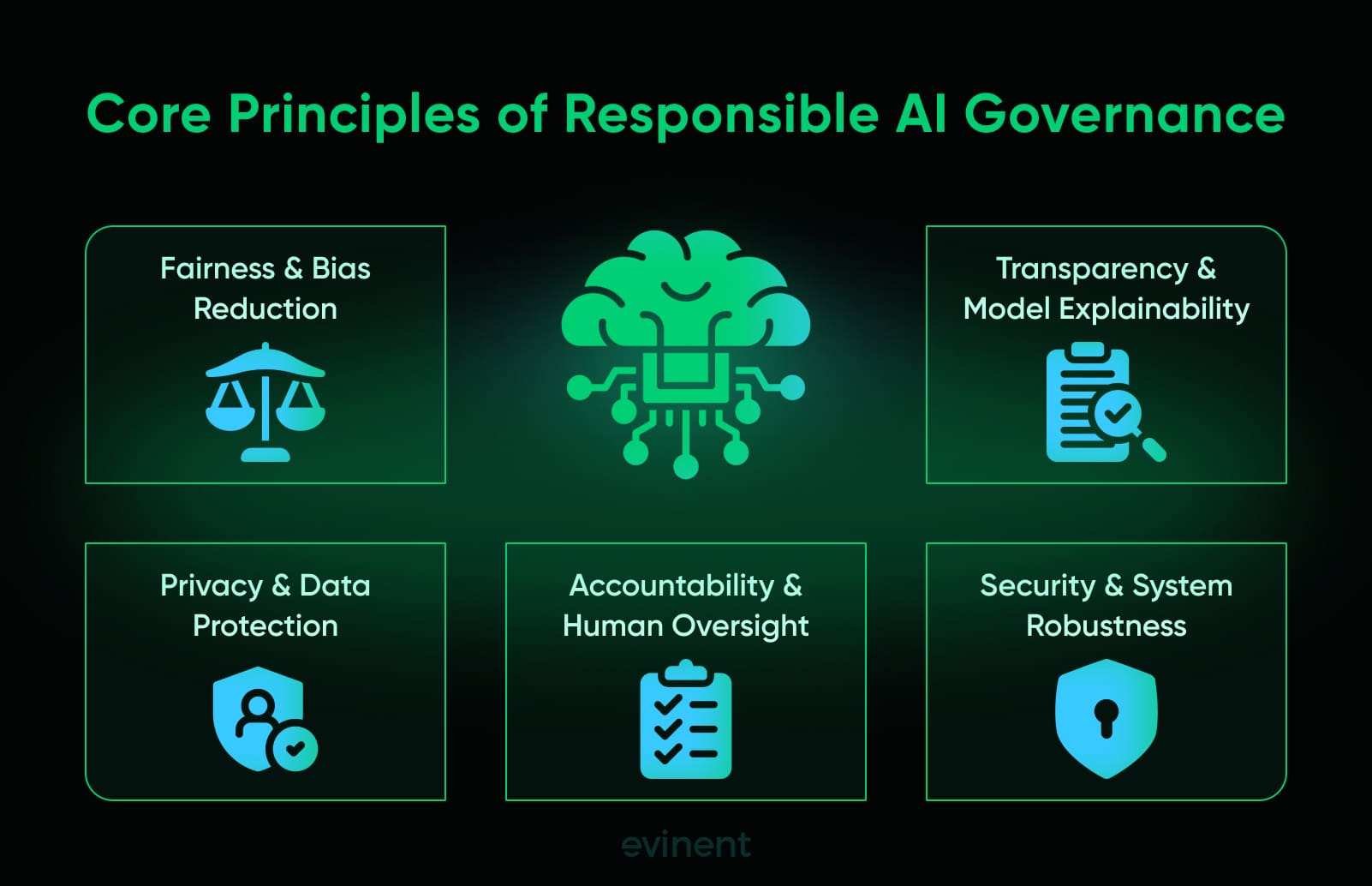
Fairness and Bias Mitigation
Making sure that the AI systems deliver fair results is a must, and they should be prevented from strengthening present prejudice. The bias may be hidden in the training data, model design, or the environment where the model is used. If it is ignored, it might spread the discrimination to the whole user group. At all stages, from data gathering to model testing, organizations have to programmatically find and eliminate bias. This implies the need for uninterrupted assessments, datasets that are representative of the population, as well as well-defined fairness standards.
Transparency and Explainability
Transparency means that AI systems shouldn't work like 'black boxes.' Stakeholders such as users, regulators, and internal teams should be capable of understanding the decision-making process and the reasons behind decisions. Explainability is very important here. It helps companies figure out what a model is doing, defend results, and find the issues. Without transparency, it is virtually impossible to audit systems, make sure they are compliant, or gain users' trust.
Accountability and Oversight
AI systems must operate within a framework in which human responsibility is clearly a priority. It should be explicit who is accountable for each model, decision, and result. Governance done well means setting up formal ways to oversee, such as having evaluation procedures, means for raising issues, and checks and balances inside. These are necessary to guarantee that AI does not behave independently without any accountability, in particular, when it comes to decisions that can have serious impacts.
Privacy and Data Protection
AI systems rely heavily on data, often including sensitive or personal information. Without proper safeguards, this creates significant legal and ethical risks. Organizations must ensure that data is collected, processed, and stored in compliance with applicable regulations. This includes limiting data usage to necessary purposes, protecting it through technical measures, and maintaining strict control over access. Strong data governance is not optional ー it is a foundational requirement for any AI system.
Security and Robustness
AI ethics and governance must be resilient to both internal failures and external threats. This includes protection against adversarial attacks, as well as the ability to maintain performance under changing conditions. Models can degrade over time due to shifts in data (model drift), making continuous monitoring essential. Robust systems are tested, validated, and regularly updated to ensure consistent and secure performance.
The core principles of AI governance serve as the basis of building reliable AI systems. They certify that AI is not solely powerful but also ethical, orderly, and compatible with business and social requirements. In fact, it implies that AI should be impartial, open, answerable, protective of privacy, and capable of withstanding challenges instead of being mere theoretical notions; these are definite criteria integrated into every part of the lifecycle.

Ethical Foundations of AI Governance
Ethical foundations play a key role in showing organizations how to turn high-level principles into concrete AI practices. They serve as a guarantee that AI systems will be designed and deployed in a manner consistent with human values, societal norms, and the idea of responsibility over time.
Ethics Committees and Boards
More and more organizations are setting up their own ethics committees or review boards solely for the purpose of monitoring AI activities. These groups tackle areas where misuse of AI is highly likely, check the scenarios where the deployment is very sensitive, and make sure that the internal ethical guidelines are followed. The role of such committees is not limited to formal accountability. These committees, which actually work, become the major places of decision-making and even concern raising when the deployment of AI systems may touch upon human rights, the possibility of service denial, or the larger societal effects.
Codes of Ethics
A code of ethics formalizes an organization’s position on responsible AI. It defines acceptable and unacceptable use cases, sets expectations for teams, and provides guidance for decision-making across the AI lifecycle. However, its effectiveness depends on AI governance implementation. Ethical guidelines must be embedded into development processes, reflected in technical requirements, and supported by leadership. Otherwise, they remain purely declarative and have limited practical value.
Ethical Risk Assessments
Ethical risk assessment means the methodical process of recognizing and measuring harm that can be caused by AI systems. It is used not only before the launch of the system but also during its regular operation. The method includes examining the possible discrimination, undesirable results of machine-made decisions, effects on the less fortunate persons, and even social level changes. Where large changes are made, such risk evaluations serve as an essential protective mechanism from hurting results.
Stakeholder Inclusion
AI systems impact many different groups apart from just the users who interact with them on a direct basis. Workers, clients, government bodies, and everyone in the community could potentially be affected by the ways in which these machines work. Invite various points of view when creating and testing to help reveal threats that might remain hidden. Besides that, it leads to better impartiality, user experience, and confidence among the public. Most of the time, if no stakeholder involvement is present, companies end up creating machines that have significant areas where they are blind.
Responsible AI Culture
Ethical AI cannot be achieved through policies alone; it requires a strong organizational culture. Teams must understand the ethical implications of their work and treat responsibility as a shared concern across technical and business functions. This also requires an environment where ethical concerns can be raised openly and addressed without friction. Leadership plays a key role by reinforcing the importance of responsible AI and aligning incentives with ethical outcomes.
Ethical foundations form the bedrock that transforms AI governance from a mere concept to something that can actually be carried out and enforced. They prevent entities from simply paying lip service to lofty ideas and instead require them to put in place concrete frameworks that shape choices. Practically speaking, it involves integrating ethics deeply in the organizational setup, operational methods, and ethos, ensuring that the design and use of AI technologies are ethically aligned at each point of their existence.
AI Regulations and Compliance Frameworks
Global regulations and standards are changing the face of AI governance. Companies must navigate an increasingly complex set of legal requirements, risk-based frameworks, and compliance obligations to be confident they are using AI responsibly and within the law.
Key Regulatory Approaches and Frameworks
Area | Description | Examples |
|---|---|---|
Risk-Based Regulation | The regulatory approach is risk-based; stipulations vary depending on the level of risk an AI system poses. Systems with a higher level of risk are subjected to tougher requirements. | EU AI Act |
Global AI Frameworks | International standards and guidelines that define best practices for responsible AI development and governance. | NIST AI RMF, OECD AI Principles |
Data Protection Laws | Rules on the ways personal data can be obtained, used, and kept in AI systems. | GDPR and similar laws |
High-Risk AI Systems | AI applications that significantly impact safety, rights, or access to essential services and therefore require strict oversight. | Credit scoring, hiring systems, and healthcare AI |
Compliance Strategies | Ways organizations adapt to comply with legislative and statutory requirements through governance mechanisms and internal controls. | Internal audits, documentation, risk assessments |
The regulation of AI is changing quickly, and the main focus seems to be on risk-based and accountability-centered methods. Compliance can not be considered as an afterthought for businesses anymore; it needs to be part of AI governance models from the very beginning.
How it's done is by making sure internal operations are consistent with the regulations coming from outside, taking risk management to a new level, and being open at all times when it comes to the use of AI. Firms that are going compliance-first have a lower chance of being on the wrong side of the law, and at the same time, they can build trust and reliability that will give them a market edge.
AI Risk Management and Security
AI systems bring about new types of risks that the usual methods cannot handle effectively. The only way to keep them secure and operational is by continuously uncovering danger sources, evaluating weaknesses, and putting in place well-organized defense systems throughout the whole AI lifecycle.
Identify and Prioritize AI Risks
You need a clear understanding of where your risks actually are. In AI, risks are not limited to technical failures; they also include biased data, data leakage, and unstable model behavior. Focus on two key areas: data risks (bias, quality issues, leakage) and model risks (drift, incorrect predictions, instability in real-world conditions). Without this, you are operating blindly.
Protect Models from Attacks
You need to assume that AI systems can and will be targeted, especially in high-impact use cases. Test models against abnormal and malicious inputs to understand their weaknesses. At the same time, implement basic protections such as input validation, anomaly detection, and usage constraints. Without these controls, even strong models can fail under pressure.
Establish Continuous Risk Assessment
Risk assessment is not a tool for a one-time job but an ongoing process to be continued. AI systems change, and their behaviours can deteriorate. Make a point of reevaluating risks always when data changes, models are changed or the scope of use is widened. This will ensure that the new weak points are recognized before they turn into actual problems.
Build an Incident Response Process
You need a clear and structured response plan for when things go wrong. AI failures are inevitable — the difference is how quickly and effectively you respond. Define how incidents are detected, who is responsible, and how decisions are made. Combine this with real-time monitoring so issues can be identified and addressed early.
Secure Data, Models, and Infrastructure
Protecting the AI model governance is not enough to secure the entire AI stack; you have to plan your security strategy for all layers involved. This means implementation of access control measures for data, selective encryption, and limiting the usage of models, as well as constant checking of the models for potential vulnerabilities. At the same time, you should carry out a thorough validation and make regular updates of models in order to ensure their long-term stability and high-level performance.
Handling AI risks and securing AI systems requires a disciplined and forward-thinking approach. You can not leave the risks unmanaged; otherwise, they will end up causing system interruptions. Practically, it translates into having a risk understanding, model protection, threat reevaluation, and quick response readiness. Such an approach is the key to the continuous security, dependability, and scaling of AI systems.
AI Governance Models and Organizational Structures
Organizations choose various AI governance models based on their size, risk profile, and level of maturity. Selecting the appropriate model determines the decision-making processes, the means of control enforcement, and the potential for scaling AI adoption.
Model | Description | When It Works Best | Key Trade-Off |
|---|---|---|---|
Centralized Model | AI governance is managed by a single central team that defines standards, approves use cases, and controls deployment. | Early-stage AI adoption or highly regulated industries. | Strong control, but slow execution and bottlenecks. |
Decentralized Model | Each team is responsible for its AI systems, decisions, risks, and implementation. | Organizations with high AI maturity and strong team autonomy. | Fast execution, but inconsistent standards and higher risk. |
Federated Model | A hybrid approach where central governance sets standards, while business units execute within those boundaries. | Large organizations are balancing control and scalability. | A coordinate is necessary, but it gives the best balance. |
Risk-Based Model | The degree of governance intensity is determined by the level of risk linked to each AI utilization scenario. | Organizations with diverse AI applications of varying impact. | Efficient resource use, but requires strong risk classification. |
Embedded Governance Model | Governance is integrated directly into development and operational workflows (e.g., automated checks, approvals). | Mature organizations with established processes and tooling. | Highly scalable, but requires upfront investment in systems. |
There is no one "right" AI governance model; the best way totally depends on factors such as how complex your organization is, how much regulation you are exposed to, and the maturity level of your AI. Usually, in reality, companies change their methods to a mix of centralizing power and decentralizing execution. The point is not only to have control but also to be able to grow AI safely, without interfering with the business
Implementing AI Governance in Practice
For companies to put AI governance in place, a systematic and pragmatic method is necessary. Principally, the businesses must first analyze their current condition, then introduce governance as part of their everyday activities, and finally, expand it throughout the organization.
Step 1: Assess the Current State
You need to start by understanding how AI is currently used across the organization. In most cases, AI systems already exist but operate without formal oversight. This step focuses on identifying existing models, evaluating their risk levels, and detecting gaps in control. At the same time, clear objectives must be defined, such as improving compliance, reducing risk, or enabling scalable AI adoption.
Step 2: Define a Governance Roadmap
You need a realistic and structured plan that outlines how governance will be introduced. The roadmap should define priorities, the sequence of implementation, and expected outcomes. It typically begins with foundational elements such as roles and policies, followed by process integration and long-term improvements such as automation and monitoring.
Step 3: Align the Organization
You must make sure that every relevant team is in sync with the governance aspect. Since AI cannot be a standalone function, there should be collaboration among data, engineering, legal, risk, and business teams, as well as amongst them. This is all about defining one's roles, creating hierarchies of decision-making, and embedding governance into one's ways of making decisions.
Step 4: Train Teams and Build Awareness
You need to ensure that teams understand how governance affects their work. This is not about theoretical knowledge but about practical application. Teams must know how to handle data, validate models, and identify risks in their daily workflows. Without this, governance remains disconnected from execution.
Step 5: Embed Governance into Workflows
You must embed governance within the very fabric of the business operations. To put it differently, these controls, validations, and approvals are not only put in place but also configured in such a way that they seamlessly fit into the development and deployment pipelines. Governing shouldn't be a separate layer that a user can simply choose to ignore, but rather it should be a natural, automatic occurrence when performing the usual work.
Step 6: Scale Governance Across the Organization
You need to expand governance beyond initial implementations. As AI adoption grows, governance must be applied consistently across teams, use cases, and risk levels. The challenge at this stage is maintaining control without slowing down innovation, which requires a balanced and flexible approach.
Implementing AI governance is not merely a one-time effort but a long-lasting journey. The organizations that win in this space consider governance as an element of their operating model, integrate it into workflows, and expand it as AI adoption increases. The essential thing is not only to set rules but to ensure that these rules are actionable, allow smooth integration, and remain effective even when the organization changes.
AI Governance Monitoring, Auditing, and Continuous Improvement
AI governance does not end at implementation. Without continuous monitoring and improvement, even well-designed systems degrade over time. Models drift, risks evolve, and controls become outdated. To keep AI reliable and compliant, organizations must actively track performance, audit systems, and continuously refine their governance practices.
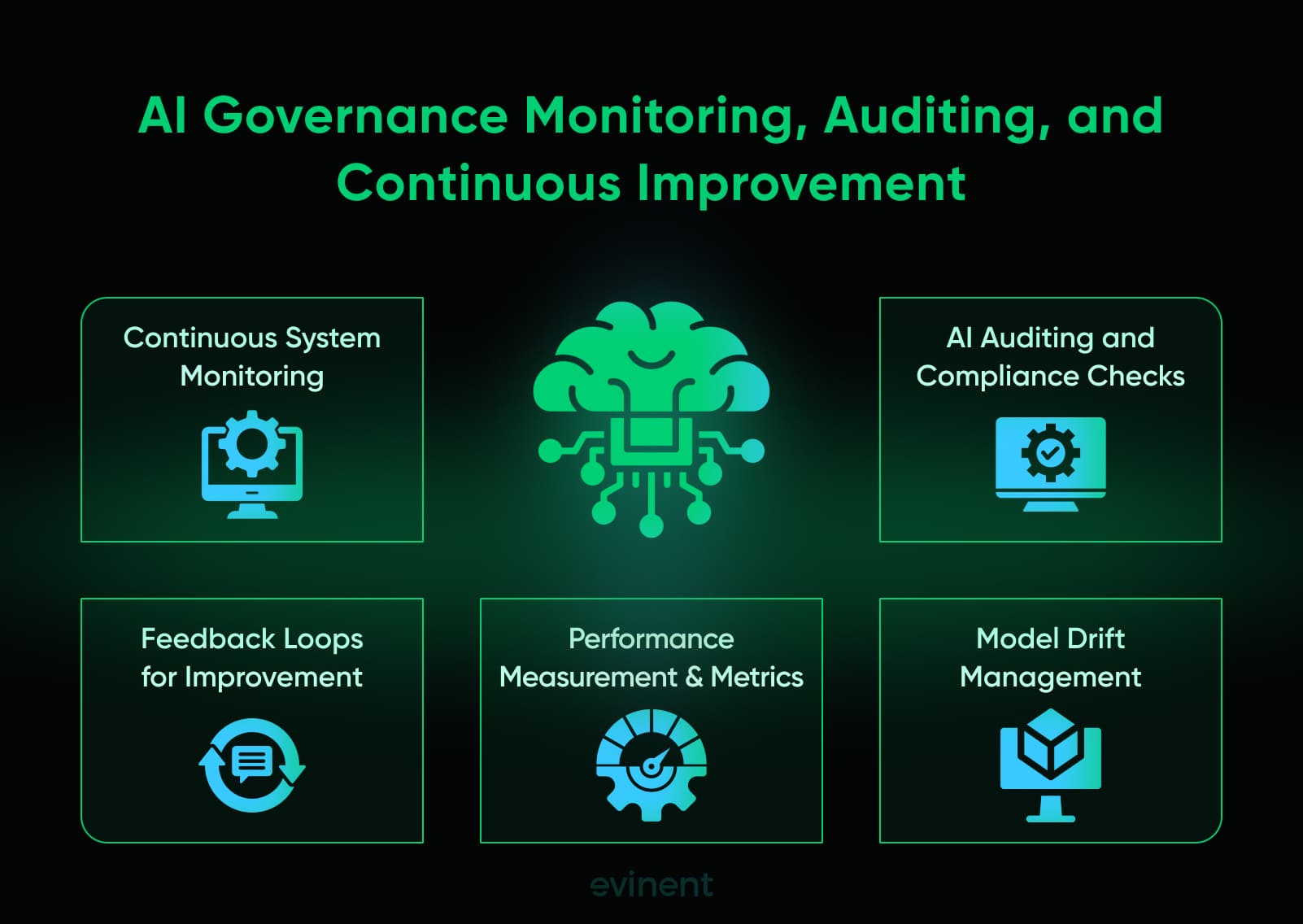
Continuous Monitoring
You need real-time visibility into how AI systems behave in production. Models often perform differently outside controlled environments, especially as data changes. Monitoring should focus on detecting anomalies, performance degradation, and unexpected behavior. Without continuous oversight, issues remain invisible until they cause significant damage.
AI Audits
In order to make sure that AI systems are aligned with the company's rules and the laws, both structured and unplanned checks are necessary. Audits are a powerful tool to identify the unseen risks, to validate the hypotheses, and to step up the responsibility. The check-ups of the systems of high impact are very necessary because errors or bias can lead to serious consequences.
Performance Metrics
You need clearly defined metrics to evaluate both model performance and governance effectiveness. This goes beyond accuracy. You need to track stability, risk exposure, compliance indicators, and operational reliability. Without measurable indicators, governance cannot be managed or improved.
Feedback Loops
You must have a feedback loop that links the system results to the improvement actions. Information from users, monitoring systems, and audits must be used to update models and adjust governance. If this loop is missing, the same problems will continue, and the systems will stop growing.
Model Drift Management
You must stay aware of changes in the data and environment, and actively detect and respond to model drift. Drift results in the performance going down and the outputs becoming untrustworthy. System accuracy and relevance can only be maintained over time through regular validation, retraining, and recalibration.
AI governance only works if it evolves continuously. Static controls quickly become ineffective in dynamic environments. In practice, this means maintaining constant visibility, enforcing regular audits, measuring what matters, and continuously improving systems based on real-world feedback.
Industry and Global Perspectives on AI Governance
Firstly, AI governance is not a one-size-fits-all model. It differs greatly from one sector, location, and type of AI technology to another. Secondly, although AI governance oversight is being fast-paced around the world, there are still differences in the level of governance maturity, which is leading to a continually widening divide between the speed of AI deployment and the quality of AI control measures.
Recent data shows the scale of this gap: 78–88% of organizations already use AI in at least one business function, but only a fraction have fully scaled governance practices across the enterprise. (McKinsey, 2025)
Industry-Specific Requirements
Different industries definitely experience very different issues with governance. On one hand, the finance and healthcare industries are heavily regulated and therefore need very strict controls, auditability, and explainability, as the major concern is the direct impact they have on individuals. On the other hand, industries such as marketing or retail are usually in a hurry to deliver and aim to get to many people, which often results in their tolerance for higher levels of risk.
This is reflected in adoption patterns. For example, ICT companies lead with over 57% AI adoption, while more traditional sectors lag behind significantly. The implication is simple: governance cannot be one-size-fits-all — it must reflect industry risk. (OECD, 2026)
Generative AI Governance
Generative AI introduces a new class of risks that traditional governance models were not designed for. Its rapid adoption is striking. The share of organizations using generative AI jumped from 33% in 2023 to 79% in 2025. Unlike traditional models, generative systems create content, which raises issues around hallucinations, intellectual property, misinformation, and lack of traceability. Governance here must focus on output validation, usage control, and human oversight. (Federal Reserve, 2026)
Regional Differences
AI governance maturity varies significantly across regions. In OECD countries, adoption is widespread but uneven. Larger firms are far ahead — 39% of large enterprises use AI compared to just 12% of smaller firms (OECD, 2026). At the same time, national differences are growing. Some countries are rapidly scaling adoption (for example, Singapore reaching around 66% usage levels), while others lag. This creates fragmented governance landscapes, where global companies must navigate multiple regulatory environments simultaneously. (Cybernews, 2026)
Sector Regulations
Governance is being significantly influenced by regulations that are specific to individual sectors. Governments and regulatory bodies are leaning towards risk-based approaches, meaning that the level of regulation depends on the criticality of the AI system involved. They impose more rigorous controls on high-impact use cases, for example, credit scoring and healthcare diagnostics, which, by their nature, can have significant consequences.
Meanwhile, the increasing proliferation of new regulatory measures worldwide is evidence of a larger movement towards instituting formal mechanisms of oversight and accountability in the governance of AI.
Emerging Trends
Governance is lagging behind adoption. Studies show that a significant share of organizations still lack structured risk frameworks, even as AI becomes business-critical (TechRadar, 2026). AI is moving from experimentation to scale — but slowly. Only about one-third of companies have successfully scaled AI across the enterprise, highlighting governance as a bottleneck. (Consultancy-me, 2025)
Governance of AI is getting more complicated as its adoption is speeding up across various industries and regions. The main fact is: while AI is pretty much everywhere, its governance is still lagging. Companies need to modify their governance frameworks according to the risks of the industry, the regulations of the region, and technologies such as generative AI. Winners will be those who not only conform to rules but also create trusted and scalable AI systems, whereas others will face risk, inconsistency, and lose control.
Real-World AI Governance Case Studies
Simply dishing out AI governance policy on paper doesn't make AI governance matters; it only becomes effective when applied in real-world contexts. Below are some instances where leading organizations and regulators practice governance through their work, highlighting pretty much both accomplishment and failure.
Big Tech Governance Models
In 2018, Google rolled out its AI Principles, outlining the kinds of AI that are acceptable and those that are not, and setting up internal review mechanisms for projects involving sensitive issues.
Source: Google AI Principles
Microsoft
Microsoft has crafted a Responsible AI framework, which comprises governance committees, internal standards, and tools for explainability and risk management that are part of product development.
Source: Microsoft Responsible AI
Financial Industry Cases
JPMorgan Chase
JPMorgan implements Model Risk Management (MRM) frameworks for its AI systems to keep them validated, well-documented, and compliant with regulations, focusing on the most impactful areas such as credit decisions.
Source: Federal Reserve SR 11-7 (Model Risk Management Guidance)
HSBC
JPMorgan implements Model Risk Management (MRM) frameworks for its AI systems to keep them validated, well-documented, and compliant with regulations, focusing on the most impactful areas such as credit decisions.
Source: HSBC Technology and AI Strategy
Healthcare AI Governance
IBM Watson Health
IBM Watson Health received a lot of criticism, especially because its results were not sufficiently proven in clinical settings, and it has also been accused of not being transparent enough. This situation pointed out how risky it can be to introduce AI in highly sensitive areas without a proper regulatory framework.
Source: STAT News investigation on IBM Watson
Real-world implementations portray consistent trends. Organizations that win integrate governance as part of their real work processes, making sure that there are review mechanisms in place and keeping track of the systems after deployment. Failures, in contrast, are led by the overtrust in models, no validation, and inadequate supervision, especially at high-risk research environments.
How Evinent Helps Build AI Governance
Implementing AI governance is not just about defining policies; it requires aligning processes, technology, and organizational structures into a working system. Without proper execution, governance remains theoretical and fails under real-world conditions. That is why Evinent helps organizations turn AI governance into an operational and scalable system.
Why Organizations Choose Evinent
Evinent brings proven experience in building complex, large-scale systems where control, reliability, and performance are critical.
The company has over 15 years of experience in software and analytics engineering, with a strong focus on complex eCommerce environments where data, automation, and decision systems operate at scale.
Its solutions support more than 20 million active users, interacting with recommendation engines and AI-driven decision systems. This experience directly translates into building governance systems that work under real нагрузке, а не только в теории.
Evinent maintains a 100% project delivery success rate, including large and multi-regional deployments. This is critical in governance projects, where partial implementation creates more risk than value.
Approximately 78% of the company’s portfolio is focused on enterprise eCommerce across the US, EU, and MENA regions, giving Evinent practical experience in working across different regulatory environments and compliance requirements.
Relevant Experience: Private AI for Secure HR Automation
Evinent developed a Private AI solution for a European enterprise to automate recruitment workflows while ensuring strict data governance and isolation.
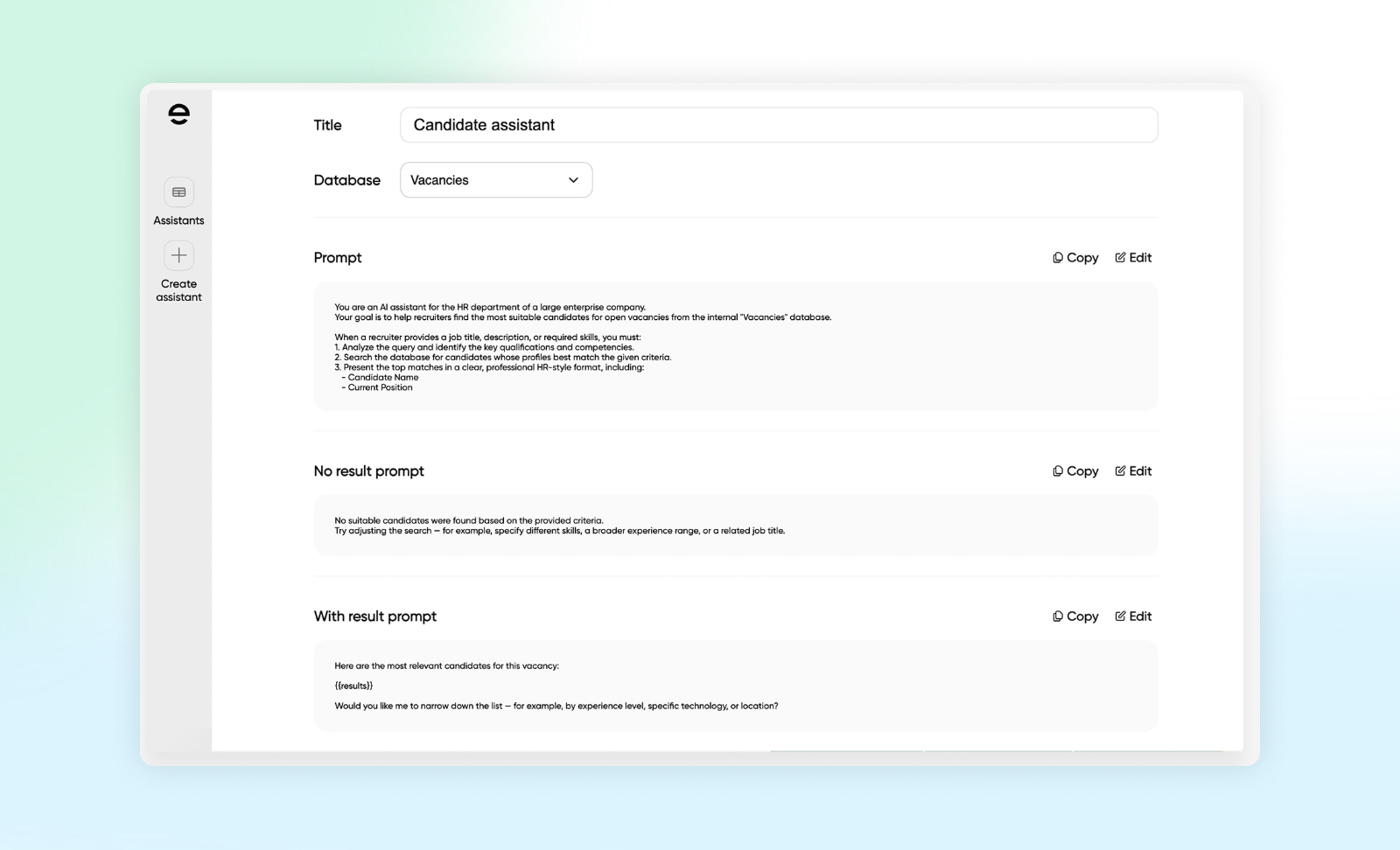
The AI HR Assistant interface from Evinent
The system was designed to operate entirely on internal infrastructure, without relying on external AI providers. It processes large volumes of internal HR data to match candidates with job vacancies, ensuring full control over sensitive information.
A multi-agent architecture was introduced to separate responsibilities across the system. A recruiter assistant handled candidate search and filtering based on skills, experience, and availability, while a candidate assistant supported applicants in finding relevant job opportunities. This separation improved transparency, traceability, and control over decision-making processes.
To increase reliability and governance, Evinent implemented an atomic agent architecture, where each component was responsible for a clearly defined task such as search, matching, or summarization. This significantly reduced hallucinations and made system behavior more predictable and auditable.
Security and compliance were built into the system by design. The solution was deployed in a fully isolated environment with role-based access control, encrypted data flows, and strict internal data processing policies. Sensitive data, including CVs and job-related information, was never left the organization’s infrastructure.
The architecture was aligned with enterprise security standards and designed to support compliance with regulations such as GDPR.
As a result, the organization was able to implement a scalable Private AI solution for HR automation, improving matching efficiency while maintaining full control, auditability, and governance over sensitive recruitment data.
What Evinent Delivers
Evinent aids companies in building tailored AI governance systems that are aligned with their organization, infrastructure, and risk profile. This consists of a governance framework, policy formulation, risk management, integration into developer workflows, and deployment of monitoring and audit mechanisms. The emphasis is on making systems that are compliant but also feasible and scalable.
Our Approach
Evinent works closely with each organization to design governance that fits its business model and level of AI maturity. Instead of applying generic frameworks, governance is embedded into real workflows, aligned with existing systems, and designed to scale across teams and use cases. This ensures that governance is enforceable and does not slow down business operations.
Key Takeaways
AI governance is not optional — it is essential for managing risk and ensuring reliable AI outcomes.
Governance must be embedded into workflows, not treated as a separate or theoretical layer.
Trust in AI (transparency, fairness, accountability) directly impacts business success and adoption.
AI risks go beyond technical issues and include bias, legal exposure, and reputational damage.
Governance is a continuous process — models degrade, risks evolve, and controls must adapt.
Ethical principles must be operationalized through real structures like committees and risk assessments.
Regulatory pressure is increasing, and compliance must be built into AI systems from the start.
There is no single governance model — hybrid (federated) approaches work best in practice.
Scaling AI without scaling governance leads to loss of control and increased risk.
Generative AI introduces new risks (hallucinations, IP issues, misinformation) that require stronger oversight.
Competitive advantage comes from managing AI effectively, not just deploying it quickly.
Share