

What is AI business integration, and why are so many companies suddenly treating it as a growth priority instead of a side experiment?
Because the conversation has changed. A year or two ago, many businesses were still testing isolated AI pilots — a chatbot here, a forecasting model there, maybe a flashy internal demo that impressed leadership for a week and then quietly faded out. Now the pressure is different. Leaders are being pushed to connect AI to actual business results: lower costs, faster operations, better decisions, stronger customer experience, tighter fraud controls, and more resilient systems. That shift is showing up in the numbers. Stanford’s 2025 AI Index found that 78% of organizations reported using AI in at least one business function in 2024, up from 55% the year before. It also found that 71% reported using generative AI in at least one business function, more than double the previous year’s level. AI is no longer sitting on the innovation fringe. It is moving into the operating core.
But adoption alone does not mean value. In fact, that is where things get messy. IBM’s 2025 CEO study found that only 25% of AI initiatives have delivered the ROI companies expected, and just 16% have scaled enterprise-wide. That gap tells a more honest story than the hype does. Plenty of companies are using AI. Far fewer are integrating it well. IBM put it bluntly: many leaders are increasing investment, yet their pace has also created “disconnected technology.” That phrase lands because it describes the real problem. AI often enters the business faster than the business can adapt around it.
This is why AI business integration matters more than AI adoption. McKinsey’s 2025 research makes the point in one sharp line: “The value of AI comes from rewiring how companies run.” Not from buying access to a model. Not from launching a pilot and writing a celebratory LinkedIn post. From changing workflows, connecting data, redesigning decision paths, and putting governance in place around systems that now influence real operational outcomes. McKinsey found that, among 25 organizational attributes it tested, workflow redesign had the greatest effect on whether generative AI produced an EBIT impact. In other words, the winners are not just experimenting with AI; they are rebuilding parts of the business around it.
And the urgency is not likely to fade. The World Economic Forum’s Future of Jobs Report 2025 found that 86% of employers expect AI and information-processing technologies to transform their businesses by 2030. That expectation is especially relevant in sectors where speed, accuracy, compliance, and decision quality carry real financial weight — healthcare, insurance, fraud detection, retail, logistics, and enterprise operations among them. For these businesses, AI integration is not about adding novelty. It is about deciding where AI should assist, where it should automate, where it should flag risk, and where human judgment still needs to stay firmly in control.
So the real question is not whether businesses should use AI. That part is already happening. The harder question — and the one that actually separates firms that deliver returns from those that collect pilots — is how to integrate AI into business systems, workflows, and strategy in a way that creates a measurable advantage rather than adding extra complexity. That is the problem this guide is built to answer.
What is an AI Business Integration?
AI business integration is the process of embedding AI into the systems, workflows, and decisions that already run a company, so it improves how the business operates rather than sitting off to the side as a disconnected tool.
That distinction matters more than it sounds. A standalone chatbot, a one-off forecasting model, or a pilot tucked inside one department may show that the technology works. It does not mean the business has integrated AI. Real ai business integration starts when AI is connected to core platforms like ERP, CRM, internal knowledge bases, analytics environments, customer service systems, fraud monitoring tools, supply chain software, or industry-specific operational platforms. At that point, AI stops being a novelty layer and starts affecting cycle times, service quality, cost structure, forecasting accuracy, and decision-making speed. McKinsey’s 2025 research makes the point clearly: the biggest gains come not from simply deploying generative AI, but from redesigning workflows around it.
Put simply, ai integration in business means the model is not working alone. It is connected to data, triggered by real events, governed by clear rules, and tied to an operational outcome. That outcome might be routing support tickets faster, flagging suspicious transactions in real time, helping clinicians retrieve the right information more quickly, improving product recommendations, reducing manual document work, or helping managers spot demand shifts before they become expensive problems. Stanford’s 2025 AI Index shows why this shift matters now: AI use has moved well beyond experimentation, with 78% of organizations reporting use in at least one business function in 2024.
A useful way to think about it is in three layers.
The first layer is the interface. This is what people see: copilots, assistants, chat interfaces, smart dashboards, or AI-powered search. It is the visible part, so it gets most of the attention.
The second layer is workflow. This is where the real business value usually appears. AI classifies, predicts, recommends, extracts, compares, summarizes, prioritizes, or triggers the next action inside an existing process. This is where companies start seeing efficiency gains, lower handling time, or better service consistency.
The third layer is infrastructure and governance. This includes APIs, data pipelines, permissions, monitoring, audit trails, security controls, retraining logic, and human oversight. It is not glamorous, but honestly, this layer often determines whether AI scales or stalls. NIST’s AI Risk Management Framework and ISO/IEC 42001 both reflect that same reality: organizations need structured controls around AI if they want it to operate reliably in production.
That is why integrating AI into business is not the same as “using AI at work.” A team that occasionally asks a model to draft emails is using AI. A company that connects AI to live data, business rules, internal systems, and measurable KPIs is integrating AI. The first can save a bit of time. The second can change how the business runs.
It is also worth clearing up one common misunderstanding: AI business integration does not automatically mean replacing people. In many of the most credible studies, AI works best as an amplifier, not a full substitute. The value often comes from helping employees make faster, more informed decisions, especially in high-volume or information-heavy environments. That is one reason enterprise leaders are paying closer attention to augmentation, oversight, and process design rather than to claims of pure automation.
So, if we strip the phrase down to its essentials, AI business integration means this: connecting AI to the business's real machinery so it supports business objectives, operates within operational constraints, and produces measurable results.

AI Tools and Applications for Businesses
The AI software market is crowded now. Almost too crowded. Every week seems to bring another assistant, automation layer, analytics add-on, or industry-specific platform claiming it can change how a business works. Some of these tools are genuinely useful. Some are just old software with a new label on top. So when business leaders look at AI business integration, the better question is not “Which AI tool is popular right now?” but “Which category of tool actually solves an operational problem we already have?”
That is the lens that matters. A retail company may need personalized product recommendations and smarter search. A healthcare organization may need secure document handling, anomaly detection, or decision support tied to strict compliance rules. A mid-sized business may start much smaller, using prebuilt models or chatbot tools to reduce repetitive work in customer service. The SBA’s guidance for small businesses reflects this practical view: AI can be used to improve customer service, automate call routing, support marketing, and reduce routine administrative work rather than forcing a full-scale reinvention on day one.
At the same time, the market is maturing fast. Stanford’s 2025 AI Index found that 78% of organizations reported using AI in at least one business function in 2024, which means these tools are no longer sitting at the edges of business operations. They are already being folded into service, analytics, operations, and internal workflows. The challenge now is choosing tools that fit the business model, integrate with existing systems via APIs, and can be properly governed once in production.
Chatbots and customer service tools
This is still the most familiar entry point for many businesses, and for good reason. AI chatbots can answer common questions, route requests, assist with orders, draft replies, and reduce pressure on support teams. For smaller companies, that can mean faster response times without immediately expanding headcount. For larger organizations, it can mean providing external support to support teams during high-volume periods while keeping humans focused on escalations and more nuanced issues. The SBA specifically points to website chatbots and AI-assisted phone routing as practical uses for small businesses, which tells you how mainstream this category has become.
AI search, recommendation, and personalization tools
Some of the most commercially valuable tools are the ones customers barely notice. AI-powered search, product discovery, and personalized product recommendations help users find what they need faster and increase the chances that they actually buy it. In eCommerce, this can affect conversion, basket size, and bounce rate. In internal enterprise settings, the same logic applies to document retrieval, knowledge search, and recommendation engines for employees who need answers quickly. These tools are especially effective when they are connected to behavioral data, product attributes, and real-time inventory or availability data through APIs.
Predictive analytics and decision support tools
This category includes forecasting engines, lead-scoring tools, demand-prediction systems, fraud-detection models, sentiment-analysis tools, and software that helps teams spot patterns earlier than they could with manual review alone. These tools are often less visible than chat interfaces, but they can have a bigger effect on planning, resource allocation, and risk reduction. For businesses dealing with inventory management, financial controls, claims review, or customer churn, predictive tools can help move decisions from reactive to anticipatory. That is usually where AI business impact starts to show up in numbers rather than in demos.
Workflow automation and document intelligence tools
A lot of useful AI lives in the boring middle of the business. Invoice handling. Contract comparison. onboarding. Claims intake. Ticket classification. Report summarization. Compliance checks. Document extraction. These tools may not always look exciting, but they can remove a large amount of repetitive work from operational teams. That matters because automation is not only about speed. It is also about consistency. When AI handles routine sorting, extraction, or summarization, employees have more room for exceptions, judgment calls, and customer-facing work that should stay human.
Industry-specific AI platforms
Some businesses can get real value from general-purpose tools. Others need something much more specialized. Healthcare, financial services, logistics, manufacturing, and insurance often require platforms built around domain rules, sector data, and stricter governance. A healthcare fraud detection system, for example, cannot be treated like a generic chatbot layer. It may need anomaly detection, secure patient data handling, auditability, and integration with claims workflows or clinical systems. That is where domain-focused AI vendors tend to matter more than broad consumer-facing tools.
Pre-built models, APIs, and AI development platforms
Not every company needs to build its own model stack. In many cases, the smarter move is to use prebuilt models via APIs and focus internal efforts on software integration, workflow design, and governance. This approach is often more realistic for mid-sized organizations and small businesses that want faster deployment without having to build a full data science function from scratch. It also gives companies more flexibility when testing use cases before committing to heavier infrastructure. The trade-off, of course, is control. The less you build yourself, the more you depend on external vendors for reliability, pricing, data handling, and feature changes.
AI consulting, integration, and managed support services
Sometimes the key tool is not a tool at all. It is external expertise. Many businesses need AI consulting help before they need another platform license. They need someone to assess readiness, map use cases, connect tools to existing systems, define governance rules, and build an architecture that will not collapse when the first pilot needs to scale. This is especially true for organizations with legacy systems, fragmented data, or limited in-house AI experience. Managed support can also make sense when internal teams are stretched thin and need help with monitoring, optimization, and vendor coordination.
Training and employee upskilling tools
This category is often overlooked, which is a mistake. AI adoption does not stick just because software is available. People have to know when to trust it, when to check it, and when to ignore it. NIST’s AI Risk Management Framework emphasizes structured risk management for AI systems, and in practice, this depends partly on AI literacy within the organization. Training and upskilling employees programs matter because they reduce misuse, improve adoption, and make job displacement concerns easier to address honestly. The better companies tend to treat AI literacy as part of deployment, not as an optional afterthought.
So when businesses evaluate AI tools and applications, the real goal is not to assemble the biggest stack. It is to choose the mix of tools, platforms, APIs, and external support that fits actual operating needs. Some companies will begin with chatbots and pre-built models. Others will need specialized platforms tied to fraud detection, inventory management, or customer personalization. Either way, the principle is the same: the best AI tools are the ones that fit the workflow, connect cleanly to the business, and make the work meaningfully better.
Benefits and Competitive Advantages of
The benefits of AI tend to get described in broad, fuzzy terms — faster work, smarter decisions, better customer experience, stronger growth. All true. But a C-level audience usually needs something more concrete than that. The real value of AI business integration shows up when AI improves how the company operates day to day: how quickly teams respond, how accurately they forecast, how consistently they serve customers, how efficiently they allocate people and capital, and how well they spot risk before it turns into a loss. That is why the strongest ai business strategies are usually tied to measurable business outcomes rather than to technology adoption for its own sake.
The scale of the opportunity is not theoretical. Stanford’s 2025 AI Index found that AI adoption is now widespread across business functions, while McKinsey’s latest research shows that the biggest economic gains come when companies redesign workflows around AI rather than layering tools onto old processes. At the same time, IBM’s 2025 CEO study found that many firms still struggle to convert experimentation into enterprise-wide returns, meaning the advantage is no longer merely in using AI. It is in integrating it better than competitors do.
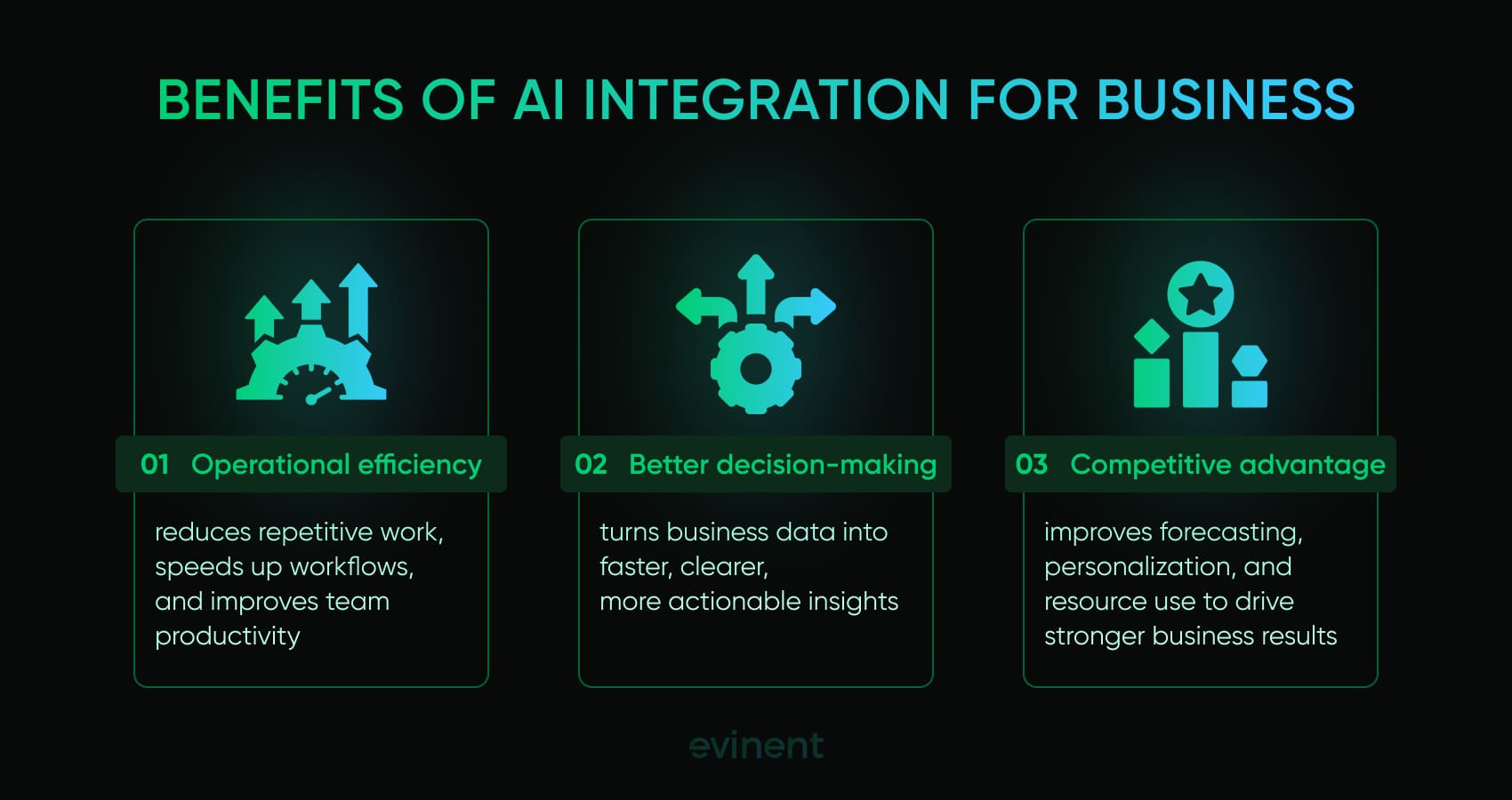
Greater operational efficiency
This is usually the first benefit companies notice. AI can reduce the time spent on repetitive work such as document review, ticket triage, report summarization, support routing, data extraction, and internal knowledge retrieval. That does not mean every process becomes fully automated. More often, it means people spend less time on low-value manual tasks and more time on judgment-based work. Research backs that up. In a large field study of customer support agents, the National Bureau of Economic Research found that access to generative AI increased productivity by 14% on average, with the largest gains going to less-experienced workers.
Better decision-making through AI-driven insights
AI is useful not only because it can generate content or respond in natural language, but because it can detect patterns faster than humans working manually across large datasets. Predictive analytics, sentiment analysis, demand forecasting, anomaly detection, and recommendation engines all help managers act earlier and with more context. In finance, that may mean flagging suspicious transactions sooner. In retail, it may mean adjusting stock levels before demand spikes. In healthcare, it may mean surfacing relevant patterns faster for review. This is where AI-driven insights become commercially important: they shorten the gap between signal and decision.
Lower costs and smarter resource allocation
Cost savings are one of the clearest business arguments for AI, but they need to be framed carefully. The biggest savings often come from process optimization and better resource allocation rather than from headcount reduction alone. AI can reduce avoidable rework, improve planning accuracy, lower service-handling costs, and help businesses allocate time, labor, and budget more effectively. IBM’s 2025 CEO study shows why this matters: even though adoption is rising, leaders are increasingly focusing on AI initiatives that can prove ROI, not just generate enthusiasm. That means AI-as-a-service solutions, pre-built models, and workflow-specific tools are often judged by whether they reduce operational drag or improve margin in a visible way.
More personalized customer experiences
Personalization has been a business goal for years, but AI makes it far more dynamic. Instead of broad customer segments and static campaigns, businesses can use AI to recommend products, adapt search results, prioritize offers, tailor messaging, and respond in real time to behavioral signals. That matters in eCommerce, subscription services, banking, travel, and any customer environment where relevance affects conversion and retention. When personalization works well, it does not feel like a gimmick. It simply reduces friction and helps people make the right choice faster.
Stronger forecasting and predictive capabilities
Some of the most valuable uses of AI are quiet. Demand prediction. Churn forecasting. predictive maintenance. Claims anomaly detection. Inventory planning. Lead scoring. These applications rarely receive the same attention as generative AI tools, but they can have a greater impact on operations. Better forecasting improves procurement, staffing, logistics, and cash-flow planning. Better maintenance prediction reduces downtime and costly disruptions. Better risk prediction can protect revenue before losses pile up. This is one reason AI business integration often produces its best returns in the background, not just at the interface level.
Faster innovation without rebuilding everything from scratch
AI can also increase the rate at which companies test new ideas, improve products, and respond to market shifts. That does not always mean radical reinvention. Sometimes it means shortening research cycles, surfacing customer pain points faster, generating early prototypes, or giving teams quicker access to internal knowledge. McKinsey’s 2025 research is useful here because it shifts the conversation from novelty to operating advantage: companies that get more value from AI are not simply buying better tools; they are changing how work flows through the business. That is where innovation becomes practical instead of performative.
Higher productivity, but not in every context
This is worth saying plainly because a lot of AI content skips the nuance. AI can significantly raise productivity, but the effect is uneven. In the Harvard Business School field experiment with BCG consultants, people using AI completed more tasks, worked faster, and produced higher-quality output on tasks within AI’s capability range. But when the task fell outside that range, performance declined. That is an important detail. AI is not equally strong across all work. The real advantage comes when leaders understand where it helps, where it misleads, and where human review still needs to stay central.
Competitive advantage through workflow redesign
This is where all the other benefits come together. AI becomes a real competitive advantage when it changes the company’s operating model in a way rivals cannot easily copy overnight. Faster service. Better fraud controls. More accurate forecasts. Smarter personalization. More efficient operations. Better use of internal knowledge. Those outcomes are not isolated wins. Together, they can improve margin, customer loyalty, and response speed across the business. McKinsey’s latest findings make this point directly: workflow redesign had the strongest relationship with whether generative AI produced EBIT impact. So the competitive advantage is not just the model. It is the business change around the model.
That is the broader pattern leaders should keep in mind. The benefits of AI in business are real, but they are not automatic. They tend to appear when AI is connected to operational priorities, backed by usable data, and integrated into real workflows rather than left as a standalone experiment. When that happens, AI stops being a promising tool and starts becoming part of how the business wins.
Case Studies and Real-World Examples
It is easy to talk about AI in abstract terms. It is much harder — and much more useful — to look at what actually happens when companies put AI into production, connect it to real workflows, and measure what changed. That is where the conversation gets more honest. Some projects improve customer service. Some tighten logistics. Some help teams retrieve internal knowledge faster. Some improve personalization, fraud detection, or customer feedback evaluation. But the strongest use cases usually follow the same pattern: they start with a well-defined business problem, proceed through a phased approach, and focus on measurable returns rather than novelty.
That pattern shows up in enterprise research, too. OpenAI’s enterprise guide notes that 62% of AI’s value lies in core business functions, which is a useful reminder that AI tends to create more value when it is tied to the actual machinery of the business rather than parked in a side lab. McKinsey’s 2025 findings point in the same direction, showing that workflow redesign is one of the biggest factors separating AI experiments from real EBIT impact. Morgan Stanley: AI for knowledge retrieval and advisor productivity
Morgan Stanley is one of the clearest examples of AI integration built around internal knowledge work rather than flashy external automation. The firm worked with OpenAI to help financial advisors retrieve information faster, summarize research, and support client conversations more effectively. According to OpenAI, 98% of Morgan Stanley advisors use OpenAI every day, and access to relevant documents rose from 20% to 80%, with sharply reduced search time. OpenAI also describes the rollout as grounded in a robust evaluation framework, which matters because this was not just a pilot dropped into production without controls. The lesson here is simple: not every high-value AI use case needs to face customers directly. Sometimes the strongest return comes from helping employees find the right information faster and make better decisions with less friction.
Klarna: AI-powered chatbots and customer service at scale
Klarna’s customer service deployment remains one of the best-known examples of AI-powered chatbots tied to measurable operational outcomes. The company said its AI assistant handled 2.3 million conversations in its first month, accounted for two-thirds of customer service chats, reduced repeat inquiries by 25%, and cut average resolution time from 11 minutes to under 2 minutes. Those are meaningful numbers, not vanity metrics. They show what happens when AI is integrated into customer service functions, with clear operational targets. Is this use case useful for other businesses, or is it not the scale alone? It is the structure. Klarna did not frame the assistant as a gimmick. It tied it to service speed, resolution quality, and workload handling. That is the difference between a pilot project and a business system.
UPS: AI-driven logistics and route optimization
AI-driven logistics is a good example of how AI can create value in the background without looking dramatic on the surface. UPS says it uses AI and machine learning to map better delivery routes and save 10 to 14 miles per driver per day. In its 2024 annual reporting, the company also said AI powers its network planning tools to optimize package flows, reduce costs, and avoid disruptions across its integrated network. a strong reminder that AI business integration is not only about generative interfaces. In logistics and supply chain environments, it often means better route planning, stronger data analytics, improved network visibility, and better resource allocation. The output is less glamorous than a chatbot demo, but the business impact can be substantial.
Swarovski: personalization, marketing performance, and service efficiency
Swarovski offers a strong example of AI being used across personalization, localization, and support. Google Cloud says the company’s AI-personalized email campaigns achieved 17% higher open rates and 7% higher click-through rates, while campaign localization became 10 times faster through AI-assisted translation and asset adaptation. Google also notes that customer service workflows have become faster and more intelligent, with AI assisting with ticket triage and agent support. case matters because it shows AI working across multiple layers at once: personalization for growth, automation for speed, and internal support for better service execution. It is not one giant moonshot. It is a stack of connected improvements.
What these examples have in common
These cases come from different industries, but the pattern is surprisingly consistent.
First, the companies targeted a specific use case: knowledge retrieval, customer service, logistics optimization, or personalization. They did not start with “let’s add AI everywhere.”
Second, they built around business outcomes: faster search, lower handling time, fewer repeated inquiries, stronger campaign performance, and lower operational drag.
Third, they treated integration seriously. These were not isolated tools floating outside the business. They were tied into workflows, data sources, and decision paths.
And fourth, they used some form of phased approach. That may have included evaluation frameworks, pilot projects, workflow testing, human oversight, or gradual rollout. That matters because scaling AI without controls usually creates more risk than value.
What business leaders should take from these examples
The most useful takeaway is not that every company should copy Klarna, Morgan Stanley, UPS, or Swarovski. It is that successful AI integration usually starts with a narrow, high-value use case and then expands outward.
A company dealing with fraud risk might begin with anomaly detection and cybersecurity risk assessment. A retailer might begin by evaluating search, personalization, and customer feedback using Google Analytics and behavioral data. A service business might start with support automation and sentiment analysis across customer interactions. The entry point changes. The underlying logic does not.
That is why case studies matter in this discussion. They move AI out of the realm of broad promises and into operational reality. They show that value tends to appear when the use case is specific, the workflow is clear, the rollout is disciplined, and the business is willing to measure what changed rather than assume the technology speaks for itself.
Future Trends and Economic Impact of AI
The next phase of AI in business will not be defined by whether companies use AI. That question is already fading. The more important question is how deeply AI gets woven into business operations, how responsibly it is governed, and whether it produces lasting economic value rather than a short burst of experimentation. That shift is already visible. Stanford’s 2025 AI Index shows that business adoption has moved quickly, while McKinsey’s 2025 research shows that the strongest returns come when companies redesign workflows around AI instead of layering AI onto old processes. So the future of AI is not just about better models. It is about more deliberate, strategic AI integration across the enterprise.
AI will move from tools to operating systems
For many companies, AI started as a tool employees could open in a browser tab. Helpful, yes, but still separate from the real flow of business. That is changing. The trend now is toward embedding AI into the systems that already shape work: CRM platforms, ERP environments, service desks, commerce stacks, analytics layers, security tooling, and internal knowledge systems. McKinsey’s 2025 findings point in exactly that direction, arguing that the real value comes from “rewiring” how the company runs, not from isolated deployment. That means AI will increasingly act less like a helper on the side and more like a decision-support layer inside day-to-day operations.
AI-enhanced customer interactions will get more contextual
Customer-facing AI is also shifting. Early business deployments often focused on simple automation: answering FAQs, routing inquiries, or generating basic responses. The next stage is more contextual and more connected. AI-enhanced customer interactions will increasingly combine purchase history, browsing behavior, support history, sentiment analysis, and real-time context to produce more relevant assistance. That creates opportunities for better personalization, stronger service consistency, and faster resolution. It also increases the need for transparency, because the more systems influence the customer experience, the more important it becomes to understand what data is used and how decisions are shaped. Regulatory frameworks like the EU AI Act reflect that pressure toward explainability and accountability.
Predictive analytics will quietly create some of the biggest gains
A lot of the economic impact of AI will not come from visible chat interfaces. It will come from predictive analytics running behind the scenes. Forecasting demand, detecting anomalies, identifying churn signals, spotting fraud, improving inventory management, and supporting predictive maintenance are all areas where AI can impact margins with little public attention. This is one reason AI-powered insights matter so much to operations leaders. Better predictions improve timing, reduce waste, and help businesses avoid costly mistakes. McKinsey’s 2024 survey found that organizations were already seeing revenue increases and cost reductions from AI in areas such as supply chain, inventory management, and service operations.
Economic pressure will force companies to focus on measurable value
The economics of AI will push the market toward more disciplined adoption. For a while, many companies could afford to fund pilots without demanding much proof. That period is ending. IBM’s 2025 CEO study found that only 25% of AI initiatives delivered expected ROI and only 16% scaled enterprise-wide. That is a pretty direct signal from the market: enthusiasm alone is not enough. As AI spending grows, boards and executive teams will want clearer evidence around cost reduction, efficiency improvement, new revenue opportunities, and risk control. The companies that can show those outcomes will keep investing. Those who cannot will start trimming back experimentation that never became operational.
Workforce augmentation will matter more than simple replacement
There is still a tendency to frame AI as a job loss story first. That is too narrow. In practice, many enterprise deployments are moving toward workforce augmentation, in which AI handles routine analysis, summarization, drafting, pattern detection, or triage while people focus on oversight, exception handling, and judgment-heavy work. The World Economic Forum’s Future of Jobs Report 2025 says that 86% of employers expect AI and information processing technologies to transform their businesses by 2030, while also showing a growing demand for skills such as analytical thinking, resilience, leadership, and technological literacy. In other words, AI will change jobs, but it will also change the mix of human skills that businesses value most.
Governance and transparency will become competitive issues
Governance used to be treated as a brake on innovation. That framing is getting weaker. As AI systems become more deeply integrated into fraud prevention, healthcare analytics, customer interactions, financial operations, and internal workflows, transparency becomes part of business credibility. NIST’s AI Risk Management Framework and ISO/IEC 42001 both point toward a future in which structured oversight, documentation, monitoring, and accountability are normal parts of enterprise AI. This is not just about avoiding fines or reducing legal exposure. It is also about building enough internal trust for AI systems to scale safely across teams and functions.
The broader economic effect will favor businesses that integrate early and well
The wider economic impact of AI will likely be uneven. Some businesses will see real gains in productivity, data analytics, customer relevance, and operating speed. Others will spend heavily and struggle to show returns. That unevenness is already visible in the research. Stanford shows that adoption is rising fast, but IBM shows how hard it still is to convert adoption into enterprise-wide value. That gap is where competitive advantage will increasingly be won or lost. Businesses that treat AI as part of strategy, architecture, process design, and workforce planning are more likely to create durable gains. Businesses that treat it as a disconnected tech trend may end up with expensive fragmentation instead.
So the long-term story is not just that AI is getting better. It is that AI is becoming more economically consequential. More embedded. More measurable. More regulated. And, for companies that integrate it well, more capable of shaping growth, resilience, and operational performance in ways that competitors will struggle to catch up with.
Implementation Steps and Best Practices
This is the part where AI projects usually become real — or quietly stall out.
On paper, most implementations look straightforward. Pick a use case, choose a model, connect it to a system, launch a pilot, measure the result. In practice, it is rarely that clean. AI touches data quality, software integration, governance, employee habits, security, and workflow design all at once. That is why so many companies can point to active pilots but far fewer can point to sustained business impact. IBM’s 2025 CEO study found that only 25% of AI initiatives had delivered expected ROI and only 16% had scaled enterprise-wide, while McKinsey’s 2025 research found that workflow redesign had the strongest relationship with EBIT impact from generative AI. So the lesson is pretty clear: implementation is not just a technical rollout. It is an operating change.
Define the business objective first
A lot of AI work starts in the wrong place. The company gets interested in a tool, a model, or a vendor before it defines the actual business problem. That usually leads to vague outcomes and weak ownership. A better starting point is an objective definition. What exactly needs to improve? Faster claims handling? Better fraud detection? Higher conversion? Lower service costs? Better forecast accuracy? Less manual document work?
This matters because an AI strategy only works when it is tied to a business metric that leadership already cares about. That metric might be cost savings, revenue growth, efficiency gains, or customer retention. But it needs to be specific. “Use AI in support” is not a business goal. “Reduce average handling time by 20% while keeping satisfaction stable” is. Once the objective is clear, everything else gets easier: use-case prioritization, software integration choices, budget justification, and performance monitoring. McKinsey’s 2025 research supports this logic by showing that the highest-value deployments are tightly linked to workflow redesign rather than broad experimentation.
Start with one high-value workflow, not a dozen pilots
There is a temptation to spread AI across many teams at once. It feels ambitious. It also creates chaos fast. A better approach is to start with one workflow that is important enough to matter and structured enough to improve. Customer support triage, internal search, document processing, inventory forecasting, fraud review, onboarding, or recommendation engines are common starting points because they are repetitive, measurable, and operationally important.
Pilot projects still have value, but only when they are designed to answer a real business question. Can this use case reduce costs? Can it improve accuracy? Can it shorten a that is hurting the customer experience? If the pilot cannot answer one of those questions, it may not deserve to scale. OpenAI’s enterprise materials make a useful point here: AI tends to create the most value when it is connected to core business functions, not when it sits in experimental isolation.
Build around data and software integration
This is where many promising ideas hit a wall. AI can only work well in production if it is connected to the systems where the business already lives. That usually means APIs, internal databases, cloud services, ERP platforms, CRM systems, analytics tools, content repositories, or sector-specific applications. In other words, the real challenge is often not the model. It is workflow integration and software integration.
Poor data quality, fragmented ownership, and weak interoperability are still among the biggest reasons AI programs fail to scale. McKinsey’s 2024 survey found that 70% of generative AI high performers had experienced data-related difficulties, which says a lot. Even the stronger operators are still dealing with messy foundations. That is why implementation planning should include data access, permissions, refresh cycles, API dependencies, and fallback logic from the beginning rather than treating them as technical cleanup later.
Put governance and risk controls in early
This part is less exciting than the model demo, but it is one of the most important. Once AI starts influencing customer interactions, financial decisions, operational priorities, or sensitive records, governance ceases to be optional. Teams need clear rules for access control, logging, human review, escalation, model evaluation, and data handling. They also need to know who owns what. Who approves deployment? Who reviews errors? Who decides whether a workflow is safe to automate further?
NIST’s AI Risk Management Framework was built for exactly this kind of challenge. It provides organizations with a structure for managing AI-related risk across design, deployment, and ongoing operations. That matters because AI systems do not just create output. They create operational consequences. And if those consequences are not properly monitored, the cost of scaling can rise quickly.
Train employees and make adoption part of the rollout
Even strong AI systems underperform when people do not know how to use them well. This is one of the most underestimated parts of implementation. Employee training should not be treated like a side note after the technical launch. It should be part of the core rollout plan.
That means teaching teams what the tool is for, where it is reliable, where it is weak, how to review output, how to escalate edge cases, and how their own roles may shift. The World Economic Forum’s Future of Jobs Report 2025 found that 86% of employers expect AI and information-processing technologies to transform their businesses by 2030, making upskilling more than a nice extra. It is part of whether adoption actually sticks. The best implementations support workforce augmentation, not blind dependency.
Measure performance continuously
AI deployments should not be judged by launch alone. They need performance monitoring over time. That includes operational KPIs such as response time, error rate, resolution rate, fraud accuracy, conversion lift, or productivity improvement. It may also include qualitative measures such as user trust, customer satisfaction, or escalation quality. The exact mix depends on the use case, but the principle stays the same: if you are not measuring what changed, you are guessing.
This is also where feedback collection matters. Teams should collect input from users, employees, and managers to understand where the workflow is improving and where it is causing friction. Sometimes the model output is the issue. Sometimes the problem is the process around it. Sometimes the integration point is simply wrong. Continuous measurement helps separate those issues rather than treating the rollout as either a success or a failure in a single dramatic sweep.
Expect iteration, model retraining, and process refinement
Many AI implementation plans still assume a straight line: build, deploy, benefit. Real deployments are usually more circular than that. Models may need retraining. s or rules may need revision. Thresholds may need adjustment. Workflows may need to be redesigned once teams see how the system behaves under real conditions.
This is especially true in environments where data changes quickly, customer behavior shifts, or risk patterns evolve. In those cases, model retraining is not a sign that something went wrong. It is part of responsible operation. The same goes for process refinement. A system that works well in a limited pilot may still need changes before it can support broader scale or stronger revenue growth targets.
Scale only after the use case proves itself
Once a workflow shows results, then it makes sense to extend the model, connect additional systems, or replicate the pattern across departments. But scaling too early is one of the easiest ways to create disconnected AI programs that cost more than they return. IBM’s 2025 CEO study is useful here again because it shows how often companies invest ahead of operational readiness. Scale works best when the first use case has already shown measurable value, reliable controls, and enough internal trust to support broader adoption.
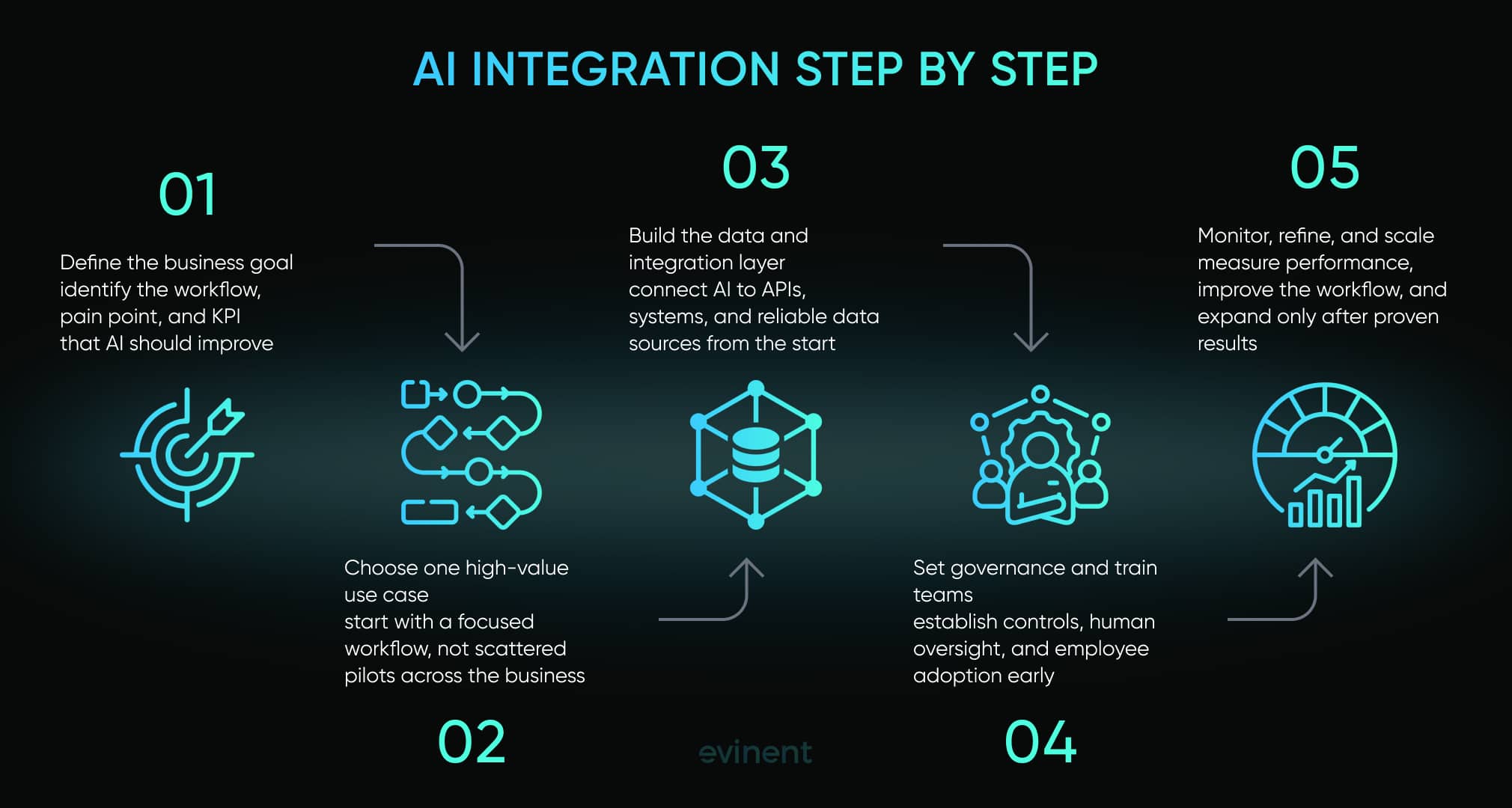
So the practical implementation sequence looks something like this: define the objective, choose one workflow, prepare the data and integration layer, set governance rules, train employees, monitor performance, refine the system, and scale only when the business case is real. It is not flashy. But honestly, that is why it works.
Overcoming Challenges and Misconceptions
AI sounds straightforward when it is presented in a polished demo. Clean interface, fast answers, impressive outputs, maybe a few reassuring numbers on a slide. Real implementation is messier. Businesses face poor data quality, security concerns, unclear ownership, budget constraints, legacy systems, employee skepticism, and unrealistic expectations about what AI can actually do. None of that means AI is not worth pursuing. It means AI-driven transformation has to be handled like an operational change, not a software impulse buy.
That distinction matters because the gap between interest and impact is still wide. IBM’s 2025 CEO study found that only 25% of AI initiatives delivered the ROI companies expected, and only 16% scaled enterprise-wide. McKinsey’s 2025 research points to a related issue: organizations see stronger returns when they redesign workflows around AI rather than simply attaching AI to old processes. So the common obstacles are not random. They are usually symptoms of weak integration, vague priorities, or an underestimation of how much business change is involved.
“We need AI everywhere” is usually the wrong starting point
One of the most common misconceptions is that AI works best when rolled out broadly from the start. It sounds ambitious, but it often creates complexity faster than value. A better starting point is one high-impact use case with clear objectives, defined ownership, and measurable results.
This matters because AI does not create value simply by being part of the tech stack. It creates value by improving a workflow that already matters to the business. If leaders cannot explain what the system is supposed to improve — cost, speed, accuracy, service quality, fraud detection, forecasting, or something equally concrete — the project is already on shaky ground. McKinsey’s research repeatedly points back to the same issue: value comes from workflow redesign, not from broad, unfocused experimentation.
Poor data is still one of the biggest blockers
This is not the most glamorous problem, but it is one of the most destructive. AI systems are only as useful as the data they rely on. If information is fragmented, outdated, inconsistent, poorly labeled, or trapped in isolated systems, the model may still produce output, but that does not mean the output is trustworthy.
Poor data is one of those problems companies often discover too late. McKinsey’s 2024 survey found that 70% of generative AI high performers had experienced data-related difficulties. That says a lot. Even companies doing relatively well are still wrestling with basic data quality, access, and integration issues. So before leaders worry about advanced features, they usually need to assess the condition of their existing infrastructure, data pipelines, and system interoperability.
Security and compliance cannot be treated as cleanup work
Another mistake is assuming security can be added later, once the AI use case proves itself. That is risky, especially in sectors such as healthcare, insurance, finance, and enterprise operations, where sensitive data and regulated decisions are part of daily work.
The more AI is connected to real business systems, the more serious the security question becomes. Who can access the model? What data can it see? What gets logged? How are outputs reviewed? What happens when the model makes a wrong call? NIST’s AI Risk Management Framework exists because these are not edge cases. They are normal operating questions. In parallel, the EU AI Act is pushing businesses toward stronger documentation, accountability, and transparency across higher-risk use cases. So security is not just a technical issue. It is part of whether the organization can trust the system enough to scale it.
Cost concerns are real, but they are often framed badly
Yes, AI projects can become expensive. Especially when companies stack licenses, infrastructure costs, consulting fees, and internal implementation effort without a clear business case. But the cost problem is often less about AI itself and more about weak prioritization.
A smaller, tightly scoped deployment with clear objectives is often more accessible than a broad transformation effort with vague promises. That is why many businesses begin with practical applications such as support automation, document processing, search, or forecasting before expanding further. The key question is not “How much does AI cost?” but “What business problem is expensive enough that solving it would justify the investment?” Once that question is answered, cost becomes easier to evaluate in a rational way.
Job displacement concerns need honest handling
This is one of the most sensitive parts of any rollout, and pretending otherwise usually makes it worse. Employees often hear “AI” and assume it means replacement, surveillance, or shrinking opportunities. Sometimes leaders unintentionally reinforce that fear by talking only about efficiency and cost.
The reality is more mixed. Some tasks will be reduced or automated. Some roles will change. But much enterprise AI is moving toward workforce augmentation rather than full replacement. The World Economic Forum’s Future of Jobs Report 2025 shows both the pressure and the opportunity: AI is expected to reshape work significantly, but demand is also rising for analytical thinking, technological literacy, leadership, and other human skills that work alongside automation. That is why change communication and training matter. If people do not understand how AI fits into their work, adoption will be slower, and resistance will be stronger.
Accuracy is not the same as usefulness
This misconception causes a lot of confusion. Leaders sometimes ask whether a model is “accurate,” as if that alone settles the question. But an AI system can be reasonably accurate in a lab setting and still be unhelpful in production if it enters the workflow at the wrong point, lacks context, or creates more review work than it saves.
So the better question is usually: Does the system improve the business process in practice? Does it reduce manual effort without increasing errors? Does it help people make better decisions faster? Does it improve service quality or reduce loss? Accuracy matters, of course, but usefulness in the workflow matters just as much. That is one reason pilot design and performance monitoring are so important. A technically decent model can still fail as a business tool if the operating fit is weak.
Resource limitations do not rule AI out
Some organizations assume AI is only realistic for giant enterprises with large budgets, mature data science teams, and dedicated AI platforms. That is not really true anymore. Many practical tools are now available through APIs, managed services, and pre-built models, which lowers the barrier to entry. The SBA explicitly frames AI as something small businesses can use for customer service, marketing, and administrative support, not just something reserved for tech giants.
That said, resource limitations do shape which kinds of AI adoption make sense. A mid-sized company with a small IT team should probably not start by building custom foundational models. It should start with a narrower use case, clearer software integration path, and stronger vendor evaluation. Accessibility has improved, but discipline still matters.
Existing infrastructure can either support AI or quietly sabotage it
Legacy systems, disconnected applications, brittle APIs, and fragmented ownership structures can make AI integration far harder than expected. This is one reason so many organizations discover that the real challenge is not model selection. It is getting the model to work inside a business that was never designed for it.
When existing infrastructure is weak, AI ends up isolated. It cannot access the right data, trigger the right actions, or be monitored properly. That is why modernization work often becomes part of the AI roadmap, even when the original plan was just to add a new capability. Businesses that ignore this usually end up with disconnected tools and frustrated teams.
The best way through is usually less dramatic than expected
When companies run into these obstacles, the solution is rarely a grand reset. More often, it is a sequence of smaller corrections: define clearer objectives, narrow the scope, improve the data layer, fix the integration point, introduce governance earlier, involve employees more directly, and measure what actually changes.
That may sound almost too practical. But that is usually the point. Most AI challenges are not solved by bigger claims. They are solved by better operating discipline.
So the real takeaway here is this: the biggest barriers to AI are usually not proof that AI does not work. There are signs that the business needs a more grounded implementation path. With clear objectives, stronger data, realistic scope, and attention to security, infrastructure, and people, most of these challenges become manageable. Without that discipline, even promising AI initiatives can turn into expensive complexity.
Strategic Integration of AI in Business
This is where the conversation gets more serious.
Using AI in isolated tasks can save time. Strategically integrating AI into business is different. It means deciding where AI should influence the operating model, how it should support business objectives, which decisions it can improve, and what controls must be in place before it becomes part of day-to-day execution. The companies getting the strongest returns are not simply adopting more tools. They are connecting AI to how the business plans, serves customers, manages risk, allocates resources, and improves performance over time. McKinsey’s 2025 research makes that point clearly: AI creates more value when organizations rewire workflows around it rather than dropping it into old structures unchanged.
That is why strategic integration starts with a shift in mindset. AI is not just a software layer. It is an operating capability. And once you treat it that way, the questions become sharper. Which business goals matter most? Where can predictive analytics improve planning or execution? Where does workflow automation make sense, and where would it create too much risk? Which decisions require explainable AI for compliance, customer trust, or internal accountability? And how do you keep the technology useful without letting it outrun governance?
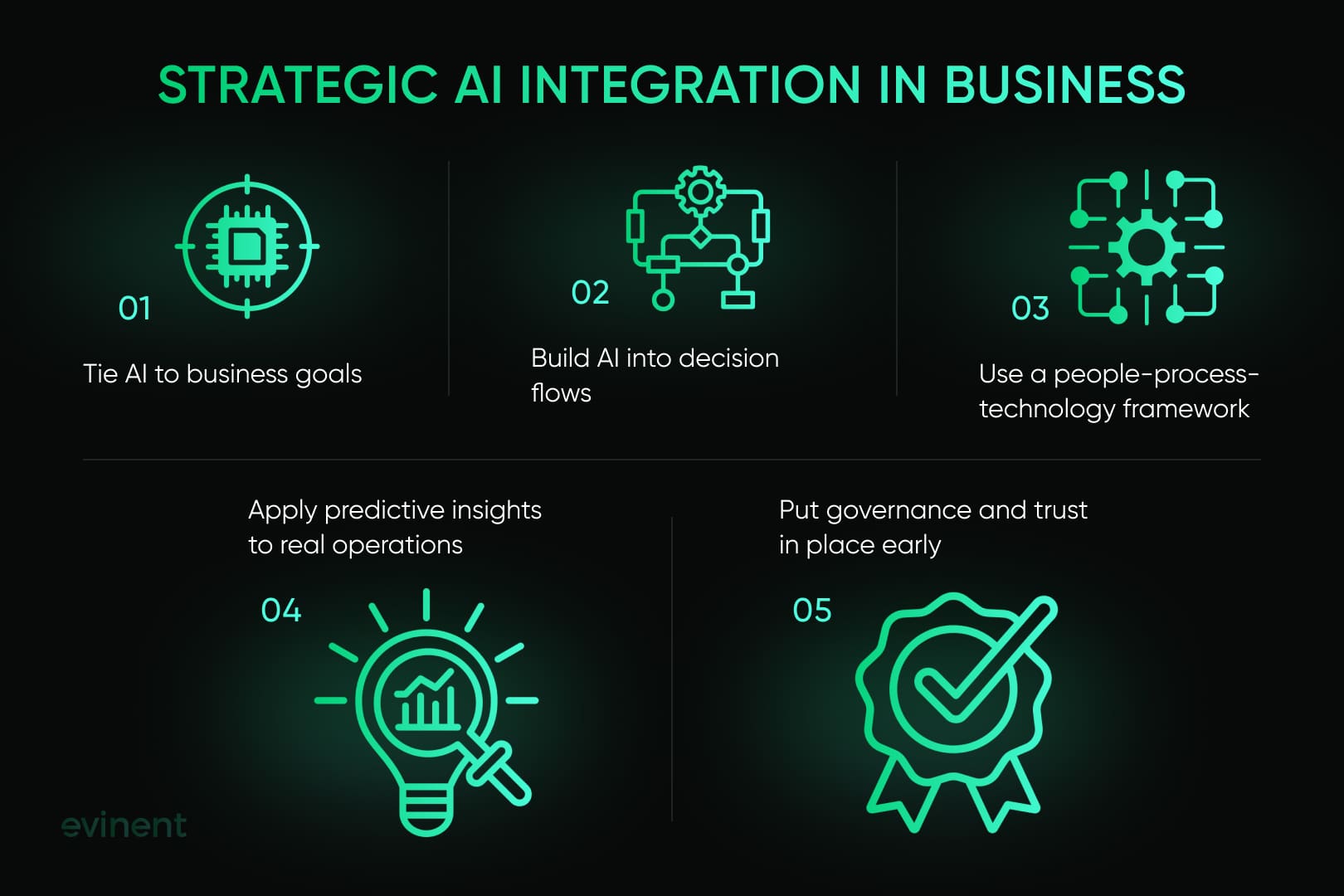
Tie AI directly to business objectives
A surprising number of AI projects still begin with the tool instead of the goal. That is backward. Strategic integration starts with business objectives: reduce fraud losses, improve service speed, increase conversion, cut handling costs, improve forecast accuracy, strengthen retention, or support better data-driven decision-making across the company.
This sounds obvious, but it changes everything. Once the objective is explicit, the organization can decide whether AI chatbots, predictive models, recommendation systems, or workflow automation are the right fit. It also becomes much easier to justify investment, define ownership, and measure whether the initiative is delivering anything beyond activity. IBM’s 2025 CEO study shows why this matters: leaders are increasingly concentrating on AI investments that can prove ROI, not just generate internal excitement.
Use a people-process-technology framework
This is one of the least flashy ideas in AI strategy, and one of the most useful.
Strategic integration usually works best when leaders evaluate AI through a people-process-technology framework.
People mean skills, trust, incentives, ownership, and change management. Who uses the system? Who reviews output? Who is accountable when it fails? What kind of AI literacy programs are needed so employees know when to rely on the tool and when to challenge it?
Process means workflow design. Where does AI enter the sequence? Does it summarize, predict, classify, recommend, or automate? Does it escalate exceptions? Does it replace a step or just support one? This is where business value tends to live.
Technology means models, APIs, integrations, data pipelines, security controls, monitoring, logs, and retraining mechanisms. This is the part companies often focus on first, even though it should usually come after the people and process questions are clearer.
McKinsey’s findings strongly support this structure because they show that workflow redesign has a greater impact than model deployment alone.
Build AI into decision flows, not just interfaces
Many AI programs stop at the interface layer. They produce a chatbot, a dashboard, or a smart assistant, but do not meaningfully change how decisions are made. Strategic AI integration goes further. It places AI inside the decision flow itself.
That might mean predictive models that influence pricing or inventory decisions, fraud engines that trigger review paths, AI chatbots that route requests based on urgency and customer history, or internal copilots that support faster knowledge retrieval before a manager approves the next step. In all of these cases, the value does not come from the interface alone. It comes from how the AI affects speed, quality, consistency, and timing inside the workflow.
Prioritize explainable AI where trust matters
Not every AI use case needs the same level of explainability. But in many business contexts, it matters a great deal. If AI is helping prioritize claims, assess fraud, shape credit decisions, support healthcare operations, or influence other sensitive outcomes, leaders need to know how decisions are being reached and how they can be reviewed.
This is where explainable AI becomes part of a strategy rather than just technical vocabulary. It supports trust, auditability, and better risk management. It also helps businesses respond to growing expectations around transparency. NIST’s AI Risk Management Framework and the EU AI Act both point toward a future where governance, documentation, and oversight are central to responsible enterprise AI deployment.
Combine predictive analytics with operational action
Predictive analytics often looks impressive in presentations, but the real question is whether it changes anything operationally. A forecast that sits in a dashboard is interesting. A forecast that changes staffing, procurement, campaign timing, maintenance planning, or fraud response is strategically useful.
That is why the best integrated systems connect predictive analytics to action. Predictive models should not just describe what might happen. They should support better resource allocation, better timing, and better operational decisions. This is where AI shifts from analysis to leverage. And honestly, that is the point most companies are trying to reach, even if they do not always phrase it that way.
Make risk management part of the strategy, not a separate conversation
Cybersecurity risk assessment, access control, model monitoring, data permissions, and escalation rules are often treated like supporting concerns. In reality, they are central to strategic integration. The deeper AI moves into business operations, the more risk management becomes part of the design itself.
This is especially true when AI touches sensitive customer data, financial activity, healthcare records, or operational systems, where mistakes can cascade quickly. Strategic integration means leaders do not wait for scale before considering controls. They put governance in early enough that growth does not create avoidable exposure.
Invest in AI literacy programs, not just tools
One of the easiest ways to weaken an AI strategy is to assume employees will naturally adapt once the software is available. They usually do not. Or rather, they adapt unevenly. Some rely on it too much. Some avoid it completely. Some use it well but never share what they have learned.
That is why AI literacy programs matter. Employees need a working understanding of what the system does, where its limits are, how to review output, and what role human judgment still plays. The World Economic Forum’s Future of Jobs Report 2025 highlights growing demand for technological literacy and analytical thinking as AI adoption expands, making this a strategic issue, not just a training detail.
Shape AI around the business model, not the other way around
This may be the most important point in the whole section. Strategic integration does not mean forcing every department to adapt to whatever the newest AI tool happens to do well. It means shaping AI around the company’s actual business model, customer reality, regulatory environment, and operating constraints.
For one company, that may mean personalized business strategies built on customer behavior, recommendation engines, and retention analysis. For another, it may mean workflow automation in finance or service operations. For another, it may mean predictive models tied to maintenance, fraud, or demand planning. The form changes. The principle stays the same: AI should serve the business model, not distort it.
That is what separates strategic AI integration from opportunistic adoption. One chases tools. The other builds capability. And over time, that difference becomes visible in the numbers — not just in adoption rates, but in efficiency, resilience, and the ability to make better decisions faster than competitors.
How Evivnent can help with AI Business Integration
For many companies, the biggest obstacle to integrating AI into business is not a lack of interest. It is the condition of the systems underneath. Data is scattered, workflows are brittle, legacy applications are hard to connect, and infrastructure costs keep rising even before any serious AI layer is added. That is exactly the kind of environment where Evinent is positioned to help. According to Evinent’s own positioning materials, the company focuses on modernizing outdated systems, optimizing data workflows, rebuilding rigid architectures into scalable ones, and reducing operational inefficiencies that hold back growth.
That matters because successful AI integration usually starts before the model. It starts with the foundations: cleaner data, stronger architecture, better interoperability, more reliable infrastructure, and clearer workflow design. Event’s positioning emphasizes legacy system modernization, cost-efficient infrastructure migration, development process optimization, scalable architectures, and transparent delivery — all of which are highly relevant for businesses seeking to move from fragmented pilots to production-grade AI capabilities.
Evinent can modernize the systems that AI depends on
Many businesses want AI, but what they actually need first is modernization. Evinent’s legacy modernization materials describe work such as database normalization, migration from relational to non-relational structures, code refactoring, cloud migration, microservices adoption, and cross-platform integration. The same materials also note example outcomes such as cutting database query times by 50% for a healthcare provider and reducing infrastructure costs by 40% for a retail company through migration to a more cost-efficient cloud platform.
That is not incidental to AI. It is often the prerequisite for AI. Predictive models, recommendation engines, anomaly detection, workflow automation, and internal copilots all depend on systems that can expose clean data, connect through APIs, and support reliable monitoring. When those foundations are weak, AI tends to remain on the edge of the business rather than improve core operations.
Evinent can connect AI to operational workflows, not just interfaces
Evinent’s legacy application modernization materials are useful here because they emphasize integration rather than rebuilding. The company describes connecting outdated platforms with third-party solutions, cloud applications, and AI-driven tools to support real-time data synchronization, automation, and improved decision-making. It also highlights work on workflow automation, data governance, and system consolidation to reduce inefficiency and improve operational continuity.
That is important because AI business integration works best when it changes the workflow, not merely the interface. A chatbot on top of a broken process is still a broken process. But an AI layer connected to the right systems, business rules, and escalation paths can improve speed, consistency, and decision quality in ways that are actually reflected in operations.
Evinent has relevant healthcare modernization and integration experience
Healthcare is one of the clearest examples of where AI needs strong infrastructure, strong security, and careful integration. Evinent’s healthcare materials describe experience with secure, scalable healthcare platforms, EHR and telemedicine integrations, patient portals, healthcare CRM, and legacy systems modernization. They also note a security-first approach, expertise in healthcare integrations, and support for AI/ML use cases such as predictive analytics and patient monitoring. The same materials say 78% of Evinent’s projects are enterprise-level and reference experience building systems that scale while protecting sensitive patient data.
For a healthcare organization, that means Evinent is not approaching AI as a standalone feature. The value lies in building the surrounding environment: interoperable systems, secure data flows, workflow support for staff and patients, and modernization efforts that make future AI layers practical rather than risky.
Evinent also brings productized analytics, personalization, and fraud-monitoring capability
Beyond services, Evinent’s portfolio includes Evinent Analytics, a machine-learning-based platform for predictive analytics, customer data analysis, segmentation, campaign reporting, personalized communications, recommendation systems, and anomaly detection. The platform materials mention customer profile data, purchase history, site behavior tracking, RFM reports, correlation analysis, comparative analytics, predictive analytics for product and category targeting, and fraud-monitoring functions that can detect anomalies across transactions, loyalty cards, spending, and other business processes. They also describe integrations with CRM, ERP, online stores, and accounting systems.
That makes this especially relevant for businesses exploring AI in commerce, loyalty, marketing analytics, and fraud prevention. Instead of treating AI as a vague future capability, Evinent can point to a portfolio that already includes predictive and recommendation-oriented systems tied to operational data and measurable business processes.
Evinent’s value is strongest where AI meets legacy complexity
Some vendors are strongest at model experimentation. The event appears strongest where AI must coexist with legacy applications, fragmented systems, security constraints, and operational pressure. Its positioning emphasizes cost efficiency, realistic planning, infrastructure optimization, and sustainable modernization rather than just feature delivery. That is a good fit for enterprise AI integration because the hardest part is often not choosing the model. It is making the business environment ready for AI to produce useful, governable results at scale.
So, in practical terms, Evinent can help businesses with AI integration by:
Assessing legacy systems and identifying what blocks AI adoption
Modernizing databases, infrastructure, and applications so AI can work on better foundations
Connecting AI-driven tools to ERP, CRM, analytics, and customer-facing systems
Building predictive, recommendation, and anomaly-detection capabilities into operational workflows
Improving security, scalability, and performance so AI can move beyond pilot status
Supporting a phased rollout that ties technology choices to business goals and measurable outcomes
Conclusion
AI business integration is no longer a side project for innovation teams. It is becoming a core business discipline.
That shift matters because the gap between adoption and value is still wide. Many companies are already using AI in at least one function, but far fewer have connected it to the systems, workflows, governance, and business goals needed for lasting impact. Stanford’s 2025 AI Index shows how fast adoption has grown, while IBM’s 2025 CEO study shows how difficult it still is to turn that momentum into expected ROI at enterprise scale. That tension is the real story. AI is moving quickly, but operational maturity is moving much slower.
The companies that will get the most from AI are not necessarily the ones running the most pilots or buying the most tools. More often, they are the ones asking tougher questions early: Which workflow actually matters? What business objective are we improving? Is the data good enough? Can the system be governed? Do employees know how to use it well? Can we prove the result in cost, speed, quality, or revenue? McKinsey’s 2025 research points in the same direction by showing that workflow redesign has the strongest relationship with EBIT impact from generative AI.
That is also why modernization and integration matter so much. AI does not produce much value when it is layered on top of disconnected systems, poor data, and brittle workflows. It produces value when it is embedded into how the business actually runs. For some companies, that means AI chatbots, personalization, and smarter service operations. For others, it means predictive analytics, fraud detection, secure data handling, or internal knowledge tools. The entry point varies. The principle does not.
So the real opportunity is not just using AI in business. It is integrating AI into business in a way that supports strategy, improves operations, and creates an advantage that is hard to copy quickly. That is where AI stops being an experiment and starts becoming part of how the company grows.
FAQ
What is AI business integration?
AI business integration is the process of embedding AI into core systems, workflows, and decision paths so it improves real business outcomes such as efficiency, speed, accuracy, service quality, or risk control. It goes beyond isolated pilots or standalone tools. Instead, AI becomes part of how the company operates day to day.
Why is AI business integration important?
Because adoption alone does not create value. Many companies are already using AI, but far fewer have scaled it successfully. IBM’s 2025 CEO study found that only 25% of AI initiatives had delivered expected ROI and only 16% had scaled enterprise-wide, which shows how important integration, governance, and workflow fit really are.
What are the biggest benefits of AI in business?
The main benefits usually include faster operations, better decision-making, stronger personalization, lower manual workload, smarter forecasting, and improved resource allocation. In many organizations, the biggest gains come from automation of repetitive tasks and better predictive insights rather than from flashy front-end features alone.
What is the difference between using AI and integrating AI?
Using AI can mean employees occasionally rely on a standalone tool for drafting, summarizing, or answering questions. Integrating AI means connecting it to business systems, data, workflows, governance rules, and measurable goals so it affects operations in a consistent, scalable way.
Which business functions benefit most from AI integration?
Common high-value areas include customer service functions, fraud detection, forecasting, search, personalization, document processing, inventory management, risk analysis, and internal knowledge retrieval. The best starting point is usually a workflow that is repetitive, measurable, and financially relevant.
Why do so many AI projects fail?
Many AI projects fail because the objective is vague, the data is weak, the workflow is poorly designed, or governance is treated as an afterthought. McKinsey’s research shows that the strongest impact comes when businesses redesign workflows around AI instead of simply attaching AI to old processes.
Does AI integration always reduce jobs?
Not necessarily. In many cases, AI supports workforce augmentation rather than full replacement. It can reduce routine manual work while increasing the need for human judgment, oversight, and higher-level analytical skills. The World Economic Forum’s 2025 report suggests AI will reshape work significantly, but also increase demand for technological literacy and analytical thinking.
How should a company start with AI business integration?
Start with one clear business objective and one high-value workflow. Then assess data quality, integration needs, governance requirements, employee readiness, and performance metrics before scaling further. That tends to produce better results than broad, unfocused experimentation.
Share