

What Is AI Resume Screening and Why It Matters Now
AI resume screening refers to the application of machine learning and natural language processing technologies to automatically parse, analyze, and rank job applications based on how closely they fit the job requirements. Unlike traditional ATS systems that simply match keywords, modern AI screening interprets the context, understands that different phrases can describe the same experience, and transforms candidate data into comparable signals.
More and more companies are implementing this technology since the recruiting teams are not only handling a larger number of applications but are also required to change the time-to-hire. The technology is at a level of maturity that it can be part of production workflows and is no longer limited to pilot projects. However, after the implementation, many companies realize a difference between the expected and the actual results. This is not because AI is faulty in concept, but rather that it relies on data quality, system integration, and process design, which are very often inconsistent in real environments.
In this article:
Why AI resume screening often fails to deliver the ROI promised in vendor demos
What modern AI screening actually does, and what it cannot reliably evaluate
The three operational failure points in real ATS environments
What “good” infrastructure looks like for accurate screening results
Why recruiters' trust breaks, even when the system appears to work
When to use a resume screening AI agent — and when not to
How to make AI resume screening work with your existing ATS (including legacy systems)
What practical steps improve accuracy, adoption, and time savings in production
The Number That Doesn't Show Up in the ROI Calculator
AI resume screening is typically touted as a high-return-on-investment automation tool that can cut the manual screening work by 70-90%, according to pilot test settings. Yet, in live applicant tracking systems (ATS), companies often find much smaller improvements in efficiency because of data quality issues, integration weaknesses, and resume parsing errors. Studies of human resource technology always reveal that more companies are using AI for resume screening, but confidence in and actual performance vary widely when these systems are scaled up from pilot to full enterprise settings (Gartner, 2025).
This section explains why that gap exists and what structural factors in ATS ecosystems are responsible for it.
1. Structural reasons for underperformance in production
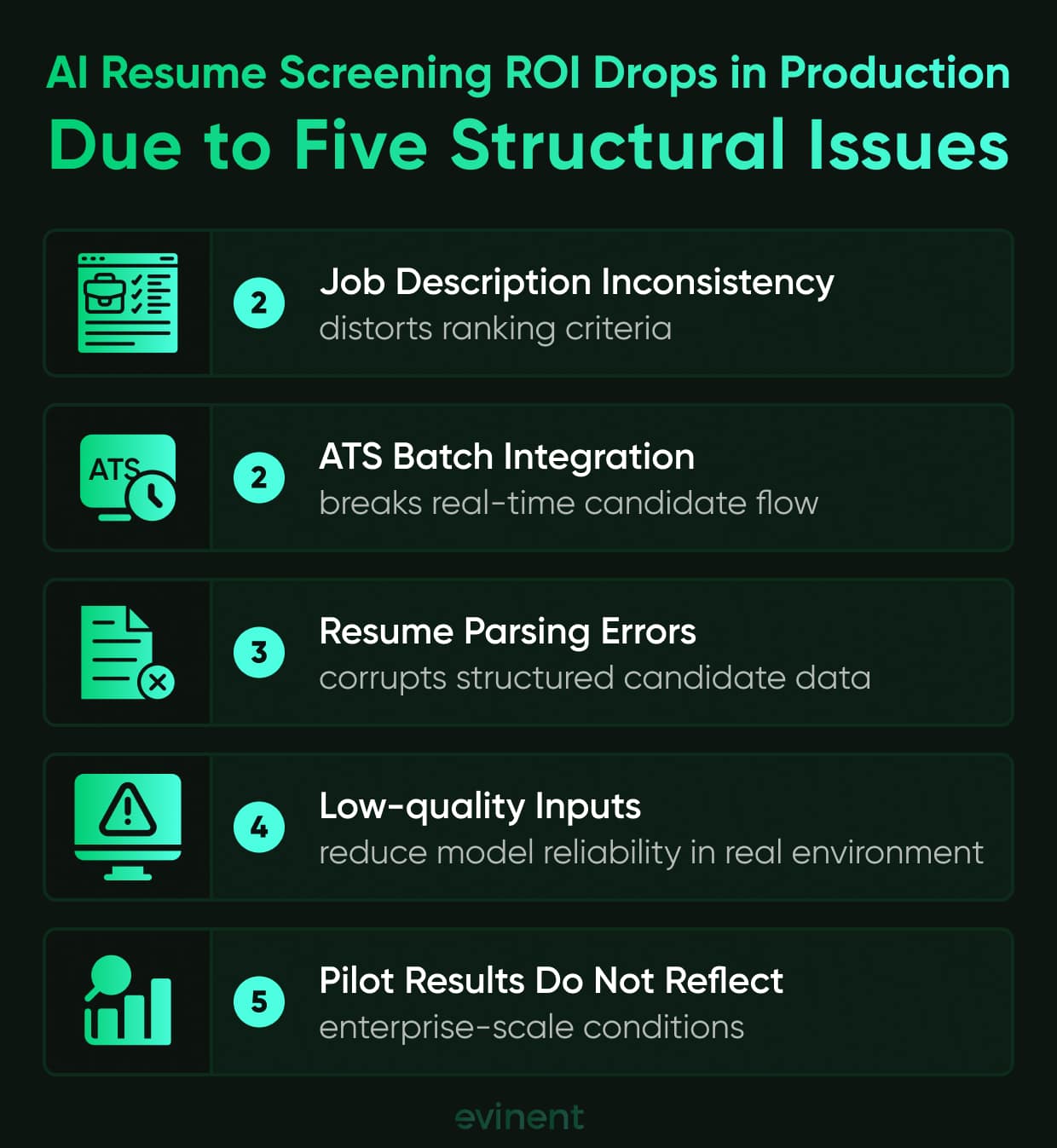
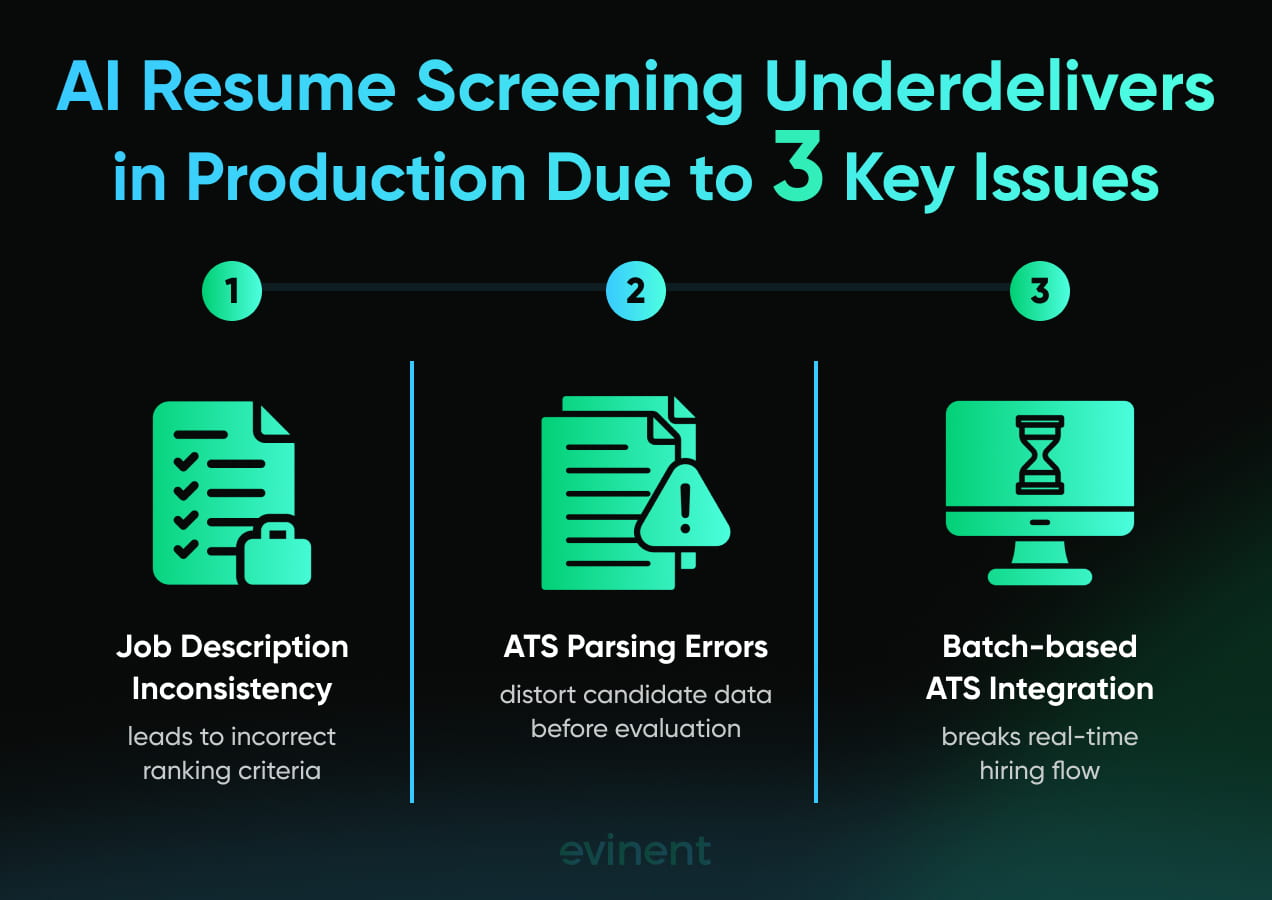
Within production ATS settings, AI resume screening is constrained by three fundamental structural aspects:
Firstly, the unreliability of ranking models is caused by job description inconsistency, which essentially remains the main issue. Secondly, the majority of ATS systems use batch-based or ed synchronization methods instead of real-time candidate streaming. Thirdly, the quality of resume parsing highly depends on the format and the structure of the input documents. These limitations are recognized in the HR technology field as the main factors causing fluctuations in AI hiring achievements.
2. Demo vs production reality
Vendor demonstrations usually showcase the best scenarios where job descriptions are clear, ATS databases are fresh, and resume layouts are such that parsing is reliable. However, real-life scenarios tend to be quite different. Various stakeholders create job descriptions at different times, leading to a lack of standardization. ATS systems store mistakes that have been made over time. Applicants present their resumes in various formats, including scanned PDFs and multi-column layouts that negatively influence the accuracy of parsing.
3. ROI claims vs real-world outcomes
Vendors typically claim a 70–90% reduction in screening time in controlled pilot environments. However, real-world enterprise outcomes are more conservative. A widely cited industry benchmark from the iCIMS Talent Trends Report 2024 shows that organizations using AI in resume screening workflows report meaningful efficiency improvements, but not at vendor-pilot levels, with most gains clustering significantly lower in production-scale deployments.
In practice, many enterprise deployments stabilize around 30–40% time savings when operating on legacy ATS systems and inconsistent job data.
4. Parsing reliability and data quality degradation
Resume parsing is one of the most failure-prone components of AI screening pipelines. According to SHRM research on AI in hiring (2024), organizations report persistent challenges in extracting structured data from unstandardized resumes, particularly when dealing with scanned documents and non-standard formatting. Across enterprise implementations, parsing error rates of 15–25% are commonly observed in mixed-format datasets. These errors affect structured fields such as skills, tenure, and job titles, directly impacting ranking accuracy.
5. Micro-scenario: how trust breaks in practice
A system crash is hardly the failure shown here. Instead, the problem is showing as an inconsistency. A recruiter opens a list sorted by AI and sees that a very qualified candidate is not listed at all or ranked very low. After checking the ATS manually, the candidate is not only found but also fits the bill perfectly. The problem is identified as parsing or extraction errors. After the recruiter finds more such discrepancies, they start manually validating AI outputs, essentially taking the system out of decision-making and making it a secondary filter.
AI resume screening does not fail because the underlying models are weak. It fails when production conditions diverge from pilot assumptions. Real ROI depends on three structural conditions: standardized job descriptions, high-quality resume data, and real-time ATS integration that reflects live candidate pipelines rather than batch snapshots. Without these conditions, organizations rarely achieve the advertised 70–90% efficiency gains and instead settle into partial adoption, where AI supports screening but does not drive hiring decisions.
3. What AI Resume Screening Actually Does — and What It Doesn't
AI resume screening is a contextual natural language processing system that transforms unstructured resumes into structured signals and compares them with job requirements. This tool enhances consistency when hiring a large number of people, but what it can produce is only the information that is directly contained in the text.
What AI does well | What it doesn’t handle reliably |
Extracts structured data from resumes (skills, roles, experience, education) | Fails on scanned PDFs, images, and complex multi-column layouts due to parsing/OCR degradation |
Understands semantic similarity between phrases (e.g., “P&L responsibility” = “managed budget”) | Cannot interpret employment gaps or their context (career break vs freelancing vs study) |
Recognizes synonyms and equivalent skill descriptions across industries | Struggles with non-linear career paths (career switching, hybrid roles, fragmented experience) |
Ranks candidates against explicit job description criteria | Cannot evaluate motivation, intent, or why a candidate applied |
Processes large volumes of applications consistently without fatigue | Cannot assess cultural fit or team compatibility beyond textual proxies |
Normalizes experience levels across different phrasing styles | Cannot make subjective judgments requiring human interpretation or external context |
AI resume screening is particularly good at organizing and comparing clear data on a large scale, especially when the job descriptions and resumes are consistent and properly formatted. But, the limits of AI are deep-rooted: it simply fails to understand intent, context beyond the text, or other human elements that are subject to interpretation, such as motivation and getting along with the company culture, etc. Therefore, AI performance is highly tied to the quality and organization of data rather than the power of the model itself, and whenever input data becomes unstructured or inconsistent, results change for the worse.
4. The Three Reasons AI Resume Screening Underdelivers on Your Stack
AI resume screening fails when it is rolled out to live production, not because the model is wrong, but because it relies on inputs and system conditions that are very different and inconsistent across most enterprise ATS environments. The deviance between the assumption and the reality results from three patterns of failure that can be repeated: vague job descriptions, unstable resume parsing, and the integrative helping AI in staying connected with the live hiring workflow being disconnected.
1. Job description inconsistency makes the model rank against the wrong criteria
Focus:
AI resume screening ranks candidates against the job description. If the job description is weak, the output is weak.Contrast:
A vague description, such as “team player” or “strong communication skills,” provides no measurable signal for ranking. A specific description that defines responsibilities, scope, and required experience gives the model concrete criteria to evaluate against.Key point:
AI does not fix inconsistencies across job descriptions. It amplifies it. Roles with clear, structured descriptions produce accurate rankings, while roles with vague descriptions produce unreliable results.Conclusion:
Job description standardization is not an optimization step. It is a prerequisite for AI resume screening to work.
2. ATS data format breaks the parser
Focus:
AI resume screening depends on a pipeline where resumes are converted into structured data before ranking. The reliability of this pipeline depends on the input format.Contrast:
Resumes in DOCX or standard PDF formats with clear sections are parsed correctly. Scanned PDFs, multi-column layouts, and design-heavy CVs introduce extraction errors that distort structured data.Key point:
When parsing fails, the model ranks candidates based on incomplete or incorrect information.Impact:
Incorrect extraction leads directly to incorrect ranking. Recruiters who compare AI output with actual resumes detect these mismatches, which reduces trust in the system.Fix:
Introduce a fallback review queue for low-confidence parses and provide candidates with clear resume formatting guidance to improve input consistency.
3. ATS integration is one-way and batch-synced
Focus:
Most AI resume screening tools are integrated into ATS systems through one-way data flow and batch synchronization.Problem:
The system operates on ed snapshots of candidate data instead of the live pipeline.Scenario:
A candidate applies after the last sync cycle and is not visible to the AI system until the next update. A recruiter reviewing the ATS directly sees the candidate immediately and takes action manually, bypassing the AI system.Result:
Over time, AI becomes a secondary tool used after the fact rather than part of the decision flow.Fix:
Real-time API integration with bidirectional data flow, allowing the AI system to operate on live candidate data and update the ATS directly.
AI resume screening fails to deliver when it's used on inconsistent job data, unreliable resume inputs, and ed system integrations. These are not edge cases but rather the typical conditions in most enterprise ATS environments. Therefore, until these issues are fixed, AI screening tools will not serve as the main decision systems and will only be secondary layers that assist, but do not lead, hiring decisions.
5. What “Good” AI Resume Screening Infrastructure Looks Like h2
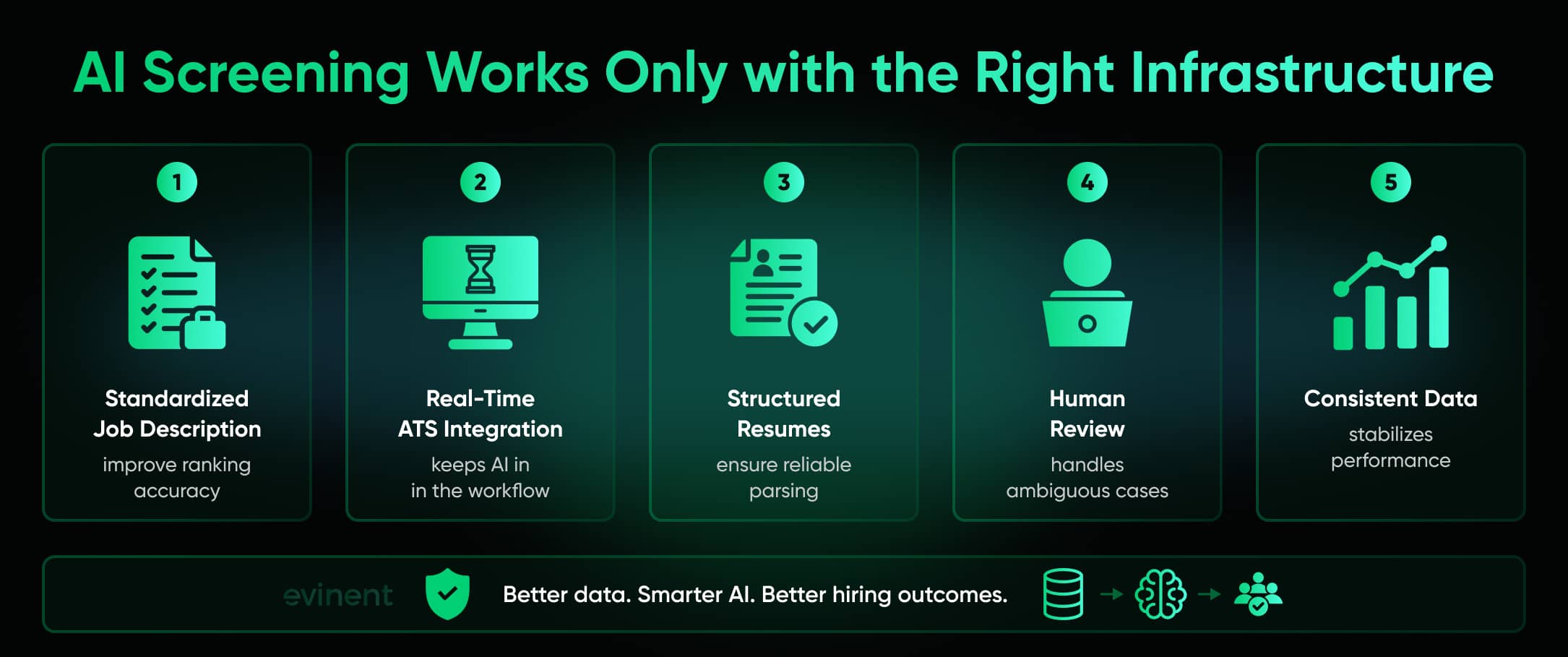
AI resume screening delivers its promised ROI only when the surrounding infrastructure supports consistent inputs, reliable parsing, and real-time decision-making. In most organizations, underperformance is not caused by the model itself, but by gaps in job data, resume quality, and ATS integration.
Job Description Standardization
Standardizing job descriptions is the single most effective thing one can do to ensure high-accuracy AI screening results. Since the candidate is ranked by the model based on the criteria in the job description, any vague or inconsistent descriptions will lead to poor outputs. If job descriptions are transformed into a series of specific, quantifiable requirements, then the accuracy of the shortlists of top candidates is generally improved by a factor of 2, 3 times or more in the real world. The main point is that AI is limited by the standards it receives.
Real-Time ATS Integration
Real-time ATS integration determines whether AI operates on the actual hiring pipeline or on outdated data. The system must process candidates as they apply, not after a scheduled batch sync. Modern ATS platforms support real-time APIs, while legacy systems often rely on ed exports. When integration is batch-based, recruiters act on candidates before AI processes them, breaking the workflow. Batch integration effectively turns AI into a lagging system instead of a decision layer.
Resume Format Control
Controlling the resume format is pretty much one of those really easy, effective things that you can do. What a resume parser outputs will largely be determined by the resume format with which the document was first saved. Well-known formats such as DOCX or PDFs that are basically just text with marked sections are handled very well, but complex page layouts result in reduced extraction quality. Despite being so straightforward, people often skip this step, yet it delivers an instant return on investment.
Human-in-the-Loop Model
A human-in-the-loop model helps to keep the confidence of people in AI screening results. The best way is to divide the decisions into three types: definite matches, definite mismatches, and uncertain cases. AI is capable of dealing with the first two accurately, while the back-and-forth cases need a human. Thoroughly mechanized systems have a hard time incrementally dealing with ambiguities, thus diminishing trust in them. A combination of human and AI at work achieves both speed and precision.
End-to-End Data Consistency
Consistency throughout the entire data pipeline is a must for the stable performance of a model. There should be a structural alignment between job descriptions, resume inputs, and ATS data flows. When a pipeline part is inconsistent, the model output becomes unreliable. Companies that view AI screening as an infrastructural layer and not a standalone tool get more predictable as well as scalable results.
Simply having the technology is not enough for effective AI resume screening; it largely depends on the infrastructure. With standardized job descriptions, real-time integration, strictly formatted input, and a human-in-the-loop design, AI is placed in an environment where it can consistently add value. However, it's important to note that without these features, even the most sophisticated models struggle to yield trustworthy results.
6. Why Recruiters Stop Trusting AI Screening Results
AI screening of resumes can be technically accurate, but still not work in practice. The problem is trust. If the recruiters lose trust in the system, it will no longer be used as a decision-making tool, and its ROI will fall dramatically.
How Trust Breaks in Practice
Trust breaks through simple verification. A recruiter reviews an AI-generated shortlist, spot-checks candidates, and finds mismatches between ranking and actual qualifications. A strong candidate is missing or incorrectly ranked. After a few such cases, the recruiter starts double-checking all results instead of relying on the system.
Why Small Error Rates Are Unacceptable
Even low error rates can be a big barrier to adoption. Resume screening is a decision layer rather than just a reporting tool. A hiring mistake like missing out on a strong candidate or giving them a lower rank entails a direct cost, so the acceptable level of error is very low, unlike in most analytics systems.
The Cost of Getting It Wrong
The impact of errors is asymmetric. Correct decisions go unnoticed, but mistakes are highly visible and carry immediate consequences. A single missed high-quality candidate is remembered more than multiple correct rankings, which makes the system feel unreliable even if most outputs are accurate.
The Behavioral Shift in Recruiter Usage
When trust falls, recruiters shift their usage of the system. They no longer depend on AI for ranking and see it as a tool that must be checked. They deem manual review as standard and dismiss the AI results as not always accurate.
From Decision Tool to Assistant
Over time, AI screening shifts from a decision engine to a support tool. It continues to be used for formatting and basic filtering, but not for ranking or prioritizing candidates. The core function that drives ROI is effectively abandoned.
One may say that AI resume screening only fails when the model refuses to work anymore. However, the truth is that it fails when the recruiters do not trust the model anymore. When manual checking overtakes the decision of a machine, there will be no efficiency improvement anymore. The system would still be active, but the value it is expected to create would no longer be there.
7. Resume Screening AI Agent: When to Go Beyond Simple Screening
AI resume screening tools and AI agents are different layers of the hiring process that they cover. Screening mainly deals with assessment and ranking, whereas agents go further by performing the tasks, communicating with candidates, and updating systems. This difference becomes very significant when the number of hires and the level of automation keep growing.
Capability comparison
Capability | Basic AI Screener | AI + Scheduling Layer | Full AI Agent |
Resume evaluation & ranking | Evaluates and ranks candidates | Evaluates and ranks candidates | Evaluates and ranks candidates |
Candidate outreach | Not supported | Sends interview invitations after selection | Fully automated communication flows |
Interview scheduling | Not supported | Automates scheduling via calendar tools | Fully autonomous scheduling and rescheduling |
ATS synchronization | Read-only or export-based | Partial updates (status changes) | Full bidirectional ATS updates |
Candidate interaction (Q&A) | Not supported | Not supported | Handles basic candidate questions and routing |
System access level | No ATS write access | Limited-scoped permissions | Full ATS write access required |
Progression from a screening tool to an AI agent is not just a feature upgrade, but a change in who is responsible for the operation. Each new level offers more capabilities, and at the same time, brings additional complexity in integration and the need for governance. The right level will be based on the extent to which the hiring process is standardized and high-volume.
8. How Evinent Deploys AI Resume Screening That Works on Your ATS
In fact, the failure of AI resume screening in many large companies lies not in the technology itself but in the gaps in integration, irregular job data, and inefficient resume parsing. Evinent substantially contributes to the solution by incorporating AI screening within the entire hiring system rather than employing it as a standalone instrument.
Why Organizations Choose Evinent
15+ years of software development and analytics engineering
100% project delivery rate across enterprise environments
Experience with high-load systems and AI-driven workflows
Deep expertise in ATS integration and data pipeline design
Integration with Existing ATS — Including Legacy Systems
Evinent integrates AI screening directly into the client’s ATS, including systems without modern APIs.
What this includes:
Real-time candidate processing instead of batch sync
Bidirectional data flow between AI and ATS
Automatic updates of candidate records after screening
Elimination of workflow lag where recruiters bypass AI
Job Description Audit Before Deployment
Evinent validates job descriptions before deploying AI screening to ensure the model has usable ranking criteria.
What this includes:
Identification of vague or inconsistent job descriptions
Standardization into structured, measurable requirements
Alignment between hiring criteria and screening logic
Reduction of ranking noise caused by weak inputs
Private Deployment for Sensitive Candidate Data
Evinent supports private AI deployment for organizations with strict data security requirements.
What this includes:
Full deployment inside the client infrastructure
No external API calls to third-party AI providers
Secure processing of resumes and candidate data
Compatibility with internal compliance and governance policies
Relevant Experience: Private AI for HR Automation
Evinent set up a private AI solution for a European company that helped them automate recruitment workflows while keeping sensitive candidate data completely under their control. The goal was to increase the effectiveness of matching candidates to vacancies within an extensive hiring system, but without outsourcing the use of AI to external providers.
Solution Architecture
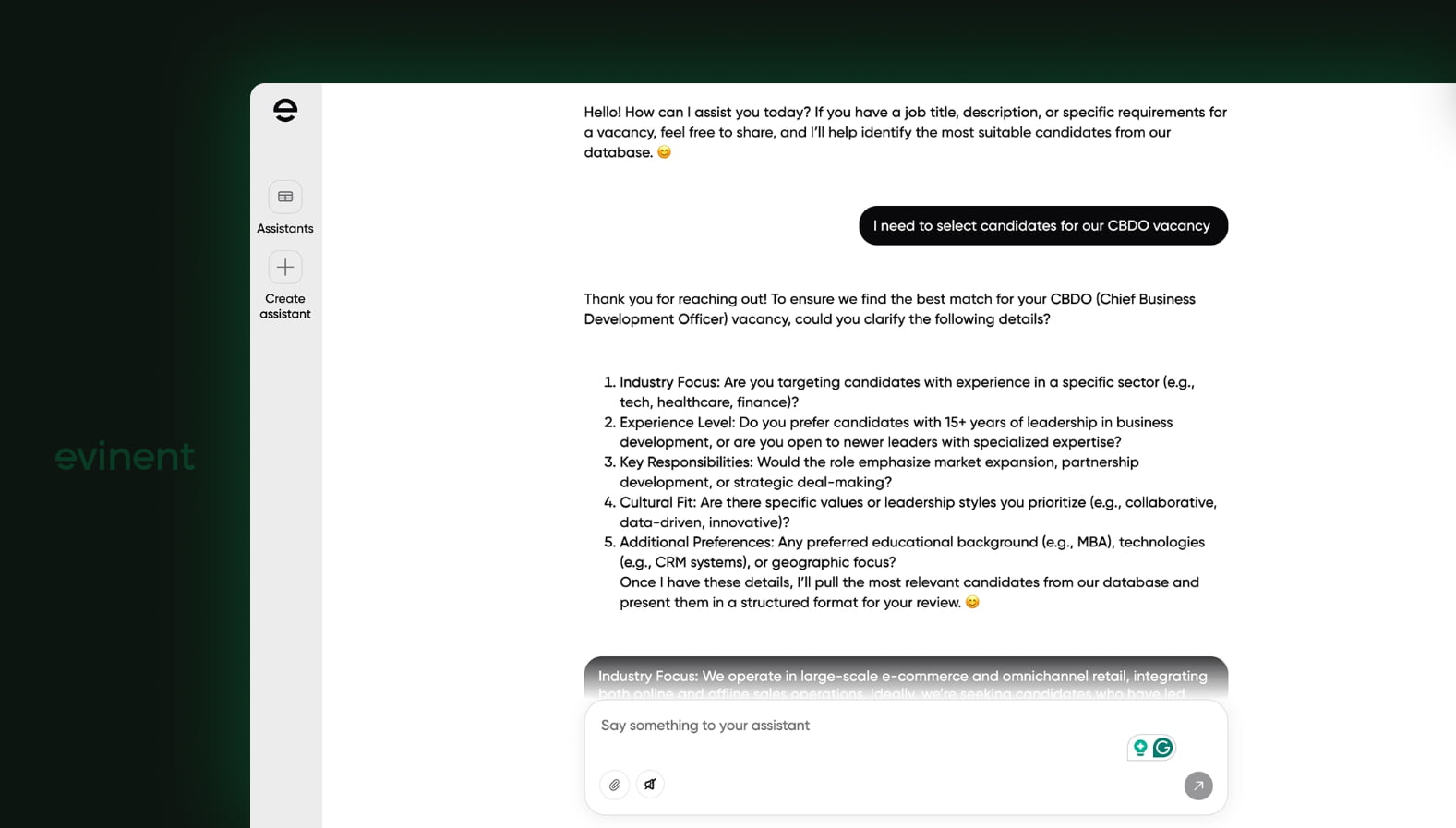
The system was built around two dedicated AI agents operating inside an isolated environment integrated with internal HR databases:
Recruiter Assistant — filters and ranks candidates by experience, skills, and availability
Candidate Assistant — matches applicants to relevant vacancies based on their profile
This setup allowed both sides of the hiring process to be automated without exposing data externally.
Key Implementation Decisions
To make sure that Evinent would behave the same in a production environment each time, they decided to use a very basic atomic agent structure of the system. Each agent was dedicated to performing only one function, which was clearly defined, such as search, matching, or summarization. This eliminated overlapping logic, reduced hallucinations, and made outputs easier to validate and audit.
Security & Data Control
Role-based access control (RBAC)
Encrypted internal data processing
Isolated execution environments for each agent
Results of the Pilot
The pilot was delivered in 4–6 weeks and validated the Private AI approach in HR workflows.
The client reported:
Faster candidate filtering and matching
Improved shortlist relevance
Reduced manual screening workload
Consistent AI behavior without hallucinations
The system also created a scalable foundation for extending AI automation to other business processes.
Our Approach
Evinent embeds AI directly into hiring workflows so it becomes part of decision-making.
Approach includes:
Working within the existing ATS instead of replacing it
Aligning AI outputs with recruiter workflows
Designing scalable systems across teams and roles
Ensuring stability under real production conditions
Key Takeaways
AI resume screening underdelivers not because of the model, but because of data and integration issues
Vendor demos do not reflect real ATS environments with inconsistent job data and resume formats
AI works well for structured matching, but fails on subjective evaluation and ambiguous cases
Three main failure points: weak job descriptions, parsing errors, and batch ATS integration
Trust breaks quickly when recruiters detect ranking errors, even at low rates
Without trust, AI shifts from a decision tool to an assistant, and ROI collapses
Effective AI screening requires infrastructure: standardized JDs, real-time integration, structured inputs, and human oversight
AI agents extend capability but require deeper integration and governance
Evinent solves the gap by building both the AI layer and the infrastructure it depends on

FAQ
Why doesn’t AI resume screening save as much time as promised?
Vendor benchmarks are based on controlled environments with clean data and real-time systems. In production, inconsistent job descriptions, batch ATS integrations, and resume parsing errors reduce accuracy. Recruiters begin double-checking results, which removes most of the time savings.
What does an ATS need to support AI screening?
An ATS must support real-time data access and bidirectional integration. AI screening systems need to process candidates as they apply and write results back into the pipeline. Batch-based or read-only integrations create s and break the workflow, making AI less useful.
What is the difference between a screening tool and an AI agent?
A screening tool is meant for evaluating and ranking the candidates. Meanwhile, an AI agent is capable of doing much more, making the first contact with a candidate, arranging for an interview, keeping the ATS updated, and handling the candidate communications. To accomplish these features, the agent needs to be more closely linked and have full write permission to the ATS.
How do job descriptions affect accuracy?
AI screening models evaluate candidates by comparing them to the job description. However, if the description is unclear or inconsistent, the model will not have definite standards to measure the candidates against. Properly organized and quantifiable job descriptions greatly enhance the precision of the ranking and the quality of the shortlist.
Can AI screening work without replacing the ATS?
Indeed. It is possible to integrate AI screening with an existing ATS, even legacy ones. Nonetheless, it necessitates bespoke integration to provide instant data flow and structured outputs. If not well integrated, AI is just a disconnected tool, and the hiring workflow remains unchanged.
Share