

What is Agentic Coding and How It Works
Agentic coding is a style of software development in which AI systems can do more than just recommend code; they can think, plan, use different tools, and independently perform complex tasks to a greater extent. Traditional AI autocomplete tools generally answer one only, but coding agents engage in the reason-and-act loop:
First, they study the goal, then decide what to do next, use the tools at their disposal, check the outcome, and keep adjusting until the work is done or they need someone's help.
This changes the role of AI from a passive assistant to an active participant in the development process. Instead of helping only with isolated code snippets, agentic systems can navigate entire codebases, create implementation plans, run tests, fix bugs, review pull requests, and coordinate subagents for specialized tasks. Their effectiveness depends on strong context management, clear control mechanisms, private knowledge grounding, and well-defined boundaries for autonomy.
In this article, we will explore:
How agentic coding works and what makes it different from traditional AI coding assistants.
The key benefits and challenges of using coding agents include efficiency, scalability, and code quality improvements.
Practical use cases of agentic workflows, such as automated bug fixing, test generation, and architecture mapping.
Major security risks, including injection attacks, vulnerable dependencies, and data exposure risks.
Best practices for governance, code review, audit trails, testing requirements, and compliance.
The limitations of agentic coding and situations where autonomous agents should not be used.
How Evinent applies agentic coding in real engineering environments to improve delivery speed, visibility, and development oversight.
Agentic Coding vs Traditional AI Development Tools
Software development already relies heavily on AI-powered tools, but not all of them work in the same way. Traditional AI development tools, such as autocomplete systems and coding assistants, are designed to support developers within a single step of the workflow. They help generate functions, explain syntax, suggest refactoring options, or answer questions in inline chat, but they usually depend on constant human direction.
Agentic coding brings a new model into the picture. Whereas coding agents in a reactive system only respond to a that is present at the moment, here agents can figure out the goals, plan implementation, use different resources, and perform several development steps almost independently. This transition makes AI move from a simple responsive helper to an independent and co-working partner who can take on complicated engineering work in a whole codebase. If one wants to grasp this distinction well, it is helpful to put side by side conventional development processes, AI coding helpers, and full agentic coding systems based on the core aspects.
Aspect | Traditional Development | AI Coding Assistants | Agentic Coding |
Primary role | Manual development by engineers | Supports developers with suggestions | Executes tasks with partial autonomy |
Interaction style | Fully human-driven | -response interaction | Goal-driven execution |
Scope of work | Single task or feature | Single file or local context | Multi-step workflows across repositories |
Planning | Done manually by developers | Minimal or none | Built-in multi-step planning |
Tool use | Humans use tools directly | Limited tool awareness | Active tool use: tests, terminals, PRs, CI |
Context awareness | Based on developer knowledge | Usually, the current file or context | Broader codebase and workflow context |
Code generation | Fully manual | Assisted generation | Autonomous implementation and iteration |
Bug fixing | Manual debugging | Suggests possible fixes | Can detect, test, and resolve issues |
Testing | Human writes and runs tests | Suggests test cases | Can generate, run, and validate tests |
Pull request process | Fully manual | Helps draft PR text | Can prepare and review PR workflows |
Subtask handling | Managed by developers | No subagent coordination | Can delegate to subagents |
Oversight needs | Standard peer review | Human validates suggestions | Requires governance and control mechanisms |
Security risks | Human mistakes | Hallucinated suggestions | Autonomous risky actions if unchecked |
Best use case | Full engineering control | Faster daily coding support | Large-scale workflow automation |
Traditional tools remain essential for precise engineering work, especially in highly regulated or sensitive environments where every action must be manually reviewed. AI coding assistants improve speed and reduce repetitive work, but they still depend heavily on the developer’s direct involvement.
Agentic coding is really helpful when teams want to automate bigger processes like fixing bugs, generating tests, updating dependencies, mapping the architecture, and preparing pull requests, etc. The idea is not that the developers will be replaced totally, but rather that their role will change from them doing the work all the time to higher-level roles like supervising, deciding, and designing the system. It is very important to know which model belongs where to have a productive and safe engineering workflow.
Benefits and Challenges of Agentic Coding
Agentic coding helps engineering teams move beyond simple AI assistance by enabling systems to plan, execute, and improve development workflows with greater autonomy. Instead of supporting only isolated coding tasks, agents can participate in testing, debugging, pull request preparation, and large-scale codebase management.
Such advantages are boosting the speed of execution, scalability, and ensuring better quality of development, which are at a great pace. Nevertheless, when going for a higher degree of autonomy, one also ends up exposing the organization to serious operational risks that come with the need for strong controls. Studying the effectiveness of agentic coding in creating value is possible only through assessing not just its benefits but also its limitations.
Benefits of Agentic Coding
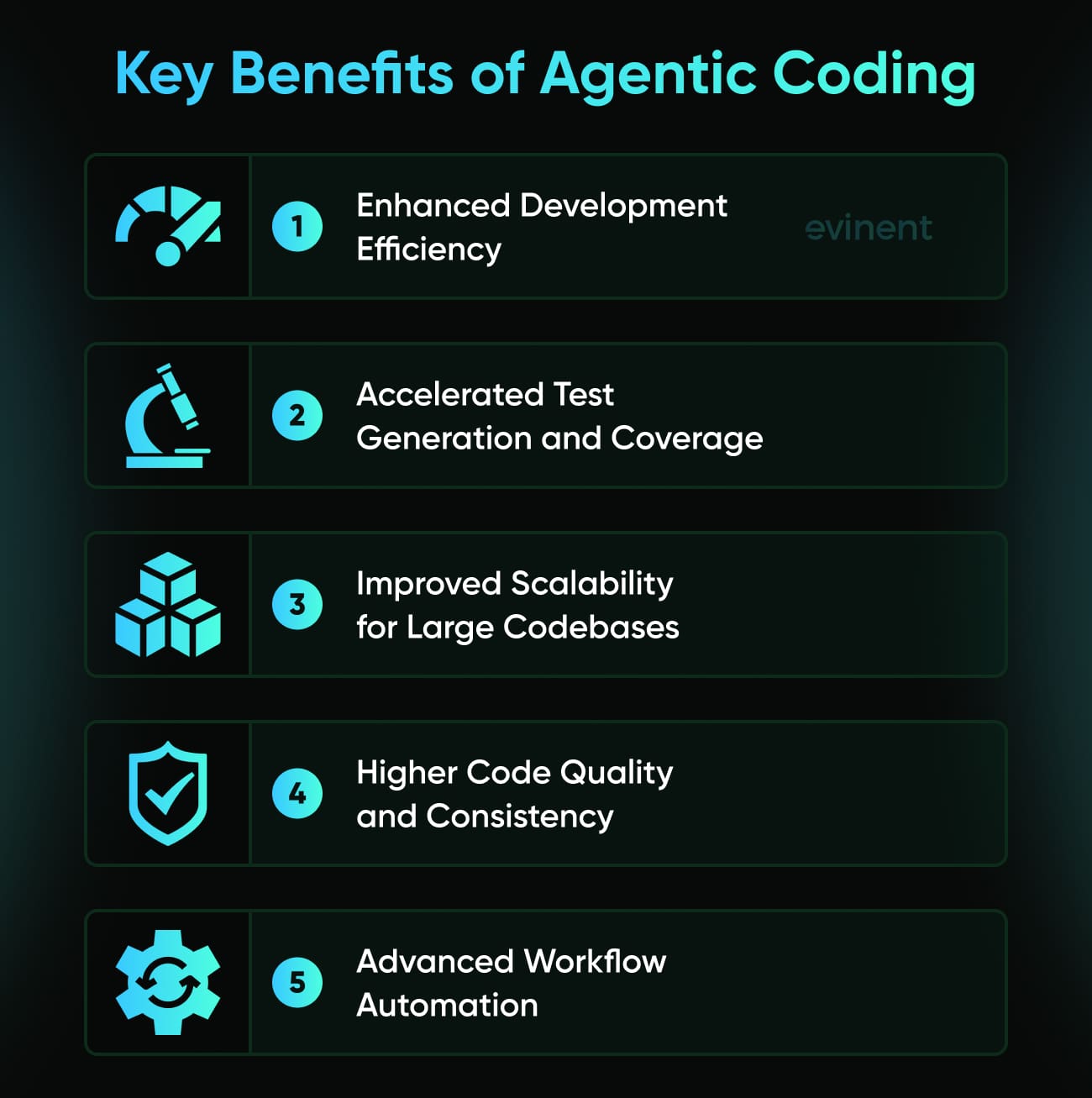
1. Increased Development Efficiency
Programming agents cut down the duration developers spend doing monotonic engineering activities like fixing errors, updating documentation, managing dependencies, and preparing pull requests. Developers will be able to allocate their time more to the architectural and planning aspects rather than to the usual execution activities.
2. Faster Test Generation and Coverage
Agents can generate unit tests on their own, verify implementation logic, and increase test coverage across projects. This enables teams to detect regressions sooner and ensure consistently high quality of output while keeping pace with development speed.
3. Better Scalability Across Large Codebases
Reaching huge volumes of repositories, the labour of manually developing them is not only inefficient but also uncontrollable. Agentic systems can explore extensive codebases, trace dependencies, and support multi-step workflows across various services and teams.
4. Improved Code Quality and Consistency
When integrated with review processes and testing requirements, coding agents help maintain consistent implementation standards. They can detect common mistakes, suggest improvements, and support a stronger engineering discipline.
5. Stronger Workflow Automation
Agentic workflows improve productivity by automating architecture mapping, migration tasks, regression checks, and development coordination. This reduces operational friction and improves delivery speed across the entire engineering lifecycle.
Challenges of Agentic Coding
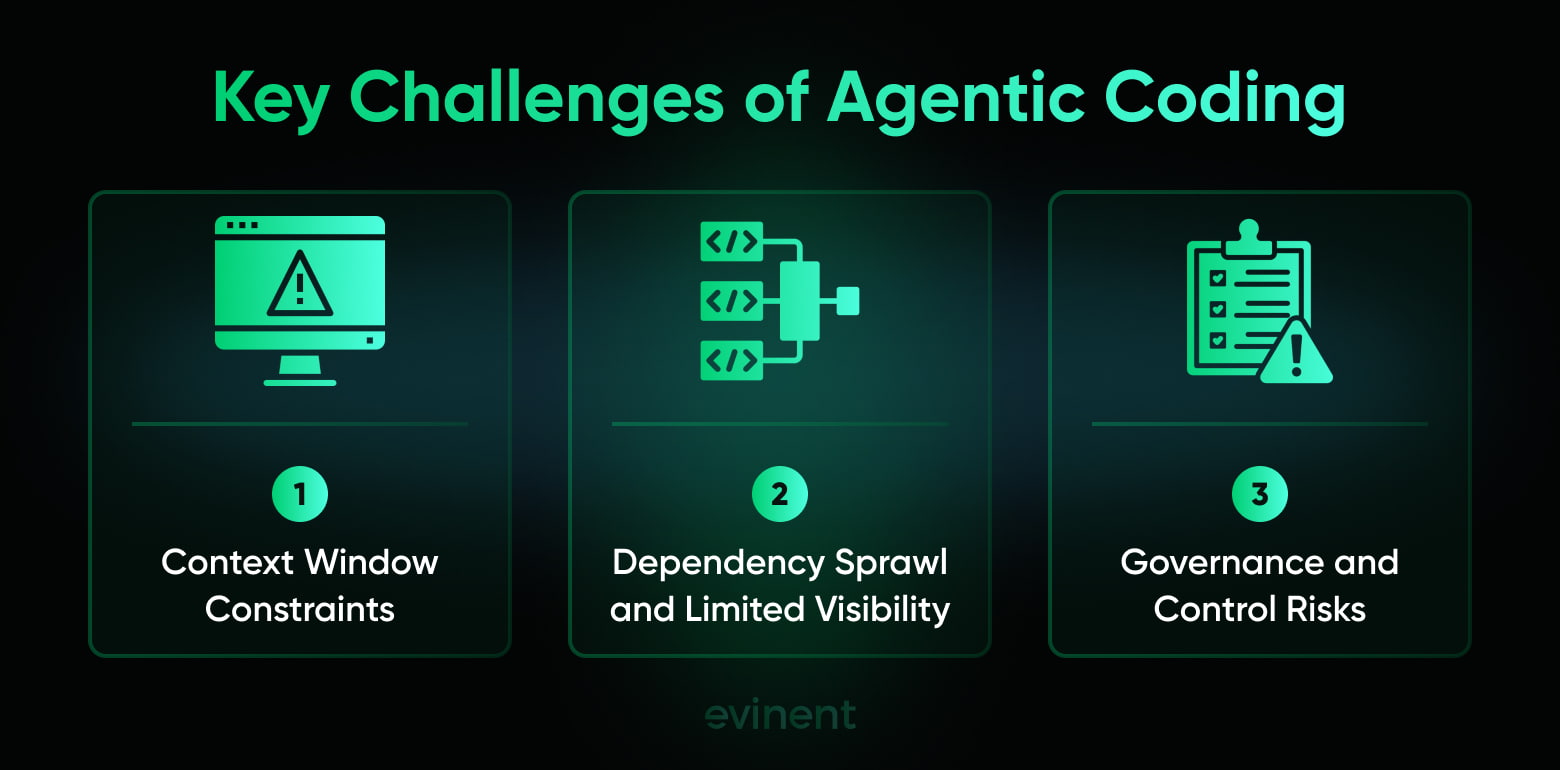
1. Context Window Limitations
Even advanced agents can process only a limited amount of information at once. In large systems with complex architecture, missing context can lead to incorrect assumptions, weak implementation decisions, or repeated errors.
2. Dependency Sprawl and Reduced Visibility
For instance, autonomous agents can add new libraries, change configurations, or restructure things in a way that is not very clear. Then, if there are no proper audit trails, it may be hard for the teams to figure out the reasons behind the decisions.
3. Governance and Control Risks
Higher autonomy requires stronger review mechanisms, access controls, and testing enforcement. Without clear guardrails, agents can create security vulnerabilities, compliance gaps, or unstable code changes that are difficult to trace.
Agentic coding success is a matter of finding a balance. If it is well managed, it can help to increase speed, improve quality, and make the process more scalable. On the other hand, a lack of stringent supervision might turn the very same freedom into additional engineering risk and might even dent folks' faith in the development process.
Real-World Use Cases of Agentic Workflows
Agentic coding will be useful when AI doesn't just give suggestions but also accomplishes full engineering tasks throughout the development lifecycle. Rather than assisting with individual code snippets only, coding agents could work across repositories, coordinate subtasks, run tests, prepare pull requests, and even support entire delivery pipelines with minimal human intervention.
It's no longer just an idea; several big engineering teams are actually using agentic workflows in production in order to speed up feature delivery, cut down incident response time, increase test coverage, and carry out large-scale migrations.
1. Automated Bug Fixing and CI Recovery
One of the most common use cases is autonomous debugging and test recovery. Anthropic describes how Claude Code reads failed test output, fixes the code, reruns the test suite, and continues iterating until all checks pass. It can also monitor GitHub and GitLab CI pipelines and commit fixes automatically. This removes a large amount of repetitive debugging work from developers.
2. Large-Scale Codebase Refactoring and Migration
Agentic systems shine when it comes to multi-file refactors and even migrations. Stripe has rolled out Claude Code to 1,370 engineers, one of whom was part of a team that did a 10, 000-line Scala-to-Java migration in just four days, work that was manually estimated to be at least ten engineer-weeks. Wiz changed a 50,000-line Python library to Go in about 20 hours of active development instead of the estimated two to three months.
3. Faster Incident Investigation
Ramp integrated the Claude Code in their incident response workflows, and as a result, they were able to reduce the time for investigation by 80%. Previously, engineers had to manually trace the failures across the different services. Now, by using the agentic workflows, they can analyze the system behavior, identify the most likely causes, and plan the corrective actions much faster. This not only increases the operational reliability but also leads to lower downtime.
4. Autonomous Feature Delivery Across Large Repositories
Rakuten turned to agentic coding when it came to large-scale implementation tasks that dealt with complex systems. For instance, their engineering group used Claude Code to carry out the vector extraction of activations inside the open-source vLLM library, which has 12.5 million lines of code written in Python, C++, and CUDA. The AI was able to do the complete implementation on its own in just seven hours, and the accuracy of the numerical results hit 99.9%. Besides that, Rakuten noticed that the average time it took to deliver features was shortened from 24 working days to 5.
5. Pull Request Preparation and Review
GitHub introduced enterprise-ready coding agents through GitHub Copilot that can independently write, run, and test code, then move work from issue creation to pull request review and approval. The agent scripting operates similarly to a peer developer rather than a simple assistant. An empirical study of 567 agent-generated pull requests across 157 GitHub projects found that 83.8% were accepted and merged by maintainers, while 54.9% were merged without additional modification.
These instances demonstrate that agentic workflows work best when they automate the most execution-intensive engineering tasks, while developers continue to be in charge of code reviewing, architecting solutions, and making decisions. The objective is not to substitute engineers but to augment the capability of teams to carry out more valuable tasks with the same resources. With the rise in adoption, agentic coding is evolving from being a mere tool for generating faster autocompletions to a platform for assembling independent systems capable of active participation in software delivery. This is where the real value of the operation comes from.
Security Risks and How to Mitigate Them
Agentic coding is increasing the vulnerability of systems since they become capable of decision-making independently, utilize tools, and even change the code themselves. In doing so, they create security loopholes, including injection, insecure dependencies, weak access control, and data exposure. In order to obtain a secure arrangement, companies must have a well-defined series of actions where each layer not only lowers the risk but also raises the level of control.
Step 1: Define Scope and Guardrails
The process begins with strict ограничения. Agents should operate only within clearly defined boundaries: limited repositories, controlled environments, and restricted actions. Early-stage autonomy must be intentionally narrow to prevent unintended system-wide impact.
Step 2: Enforce Access Control
Once the scope is defined, access must be tightly controlled. Agents should follow least-privilege principles, meaning they only receive the minimum permissions required. Separation between read and write access is critical to reduce the risk of destructive actions.
Step 3: Protect Against Injection
All external inputs must be treated as untrusted. Agents should not blindly follow instructions from code, tickets, or external data sources. Isolation between system-level instructions and external content is required to prevent manipulation.
Step 4: Control Tool Usage
Agents use tools like a terminal, CI system, and APIs to interact with the outside world. These interactions should be regulated. Firstly, only authorized tools will be present for the agents to interact with. Secondly, the execution of the commands must be so controlled that the agent is not able to perform harmful operations.
Step 5: Secure Code and Dependencies
Any code generated or modified by agents must go through validation. This includes dependency checks, vulnerability scanning, and alignment with secure coding standards. Automation must not bypass security verification.
Step 6: Prevent Data Exposure
Sensitive information is always required to be kept secure. The agents should not be given absolute rights to the secrets, systems, internal, or proprietary logic. It is necessary to restrict, supervise, and manage data access in order to avoid leakage.
Step 7: Ensure Monitoring and Auditability
Every agent action needs to be logged and made traceable. This ensures the transparency of system behavior and gives the teams a chance to look into problems, hold people accountable, and comply with regulatory requirements.
Step 8: Maintain Human Oversight
Autonomous systems must never be allowed to function independently without human intervention. Any significant alterations in the system should be subject to human examination, primarily before their implementation. Monitoring decisions acts as a safety net and helps identify wrong or harmful choices before it is too late.
Step 9: Perform Continuous Security Testing
Security is not a one-time event but an ongoing process. Systems need to be continuously checked for vulnerabilities, for example, by carrying out simulated injection attacks and examining access policies. This is how one can stay assured that the safeguards are still up to the mark even as systems change.
The way to a secure agentic system isn't a single point of control but layered protection. Every step lessens risk, and altogether they form a system in which autonomy is coupled with accountability and control.
Best Practices and Governance for Agentic Systems
Agentic systems give a level of freedom to the development process, thus traditional engineering controls alone are not enough anymore. If it is not clear who is in charge, agents might end up producing different codes, causing security threats, or making modifications that are hard to trace and justify. Best practices aim to make sure that autonomy is functioning in a controlled, visible, and predictable manner.
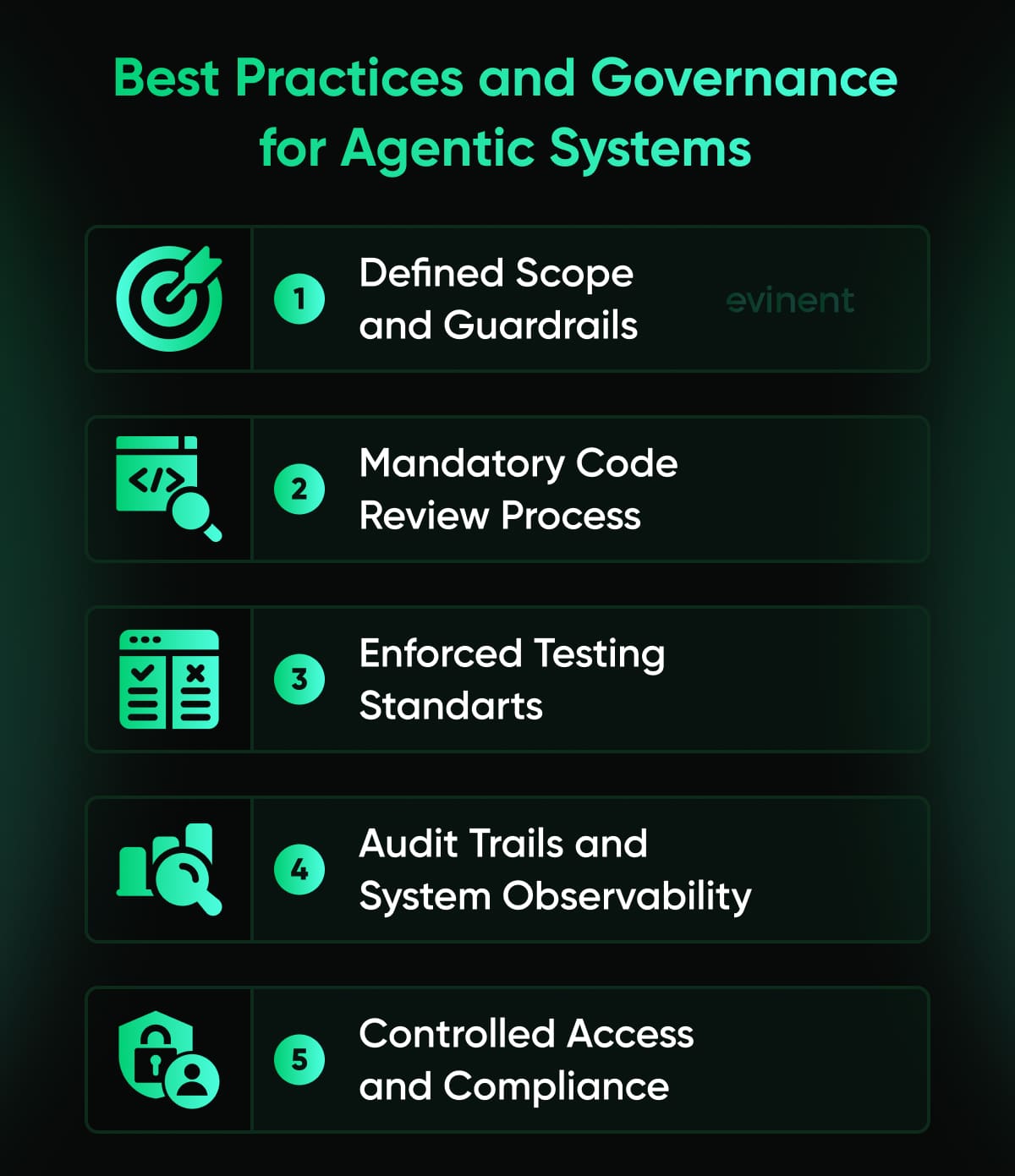
1. Scope and Guardrails
Every agent must operate within explicitly defined boundaries. This includes limiting access to specific repositories, restricting actions such as write or execution permissions, and separating environments like development, staging, and production. Clear guardrails prevent agents from making unintended changes outside their intended scope and reduce the blast radius of potential errors. Well-defined scope is the foundation of safe autonomy.
2. Mandatory Code Review
Agent-generated code must always go through a structured code review process. While agents can produce working implementations, they may still introduce logical errors, architectural inconsistencies, or security issues. Human review ensures that changes align with system design, coding standards, and long-term maintainability. This step preserves engineering accountability and prevents silent failures.
3. Enforced Testing Requirements
Testing needs to be centrally involved in every agent's working process. Agents should be compelled to produce test files, run these tests, and the test results before they accept any change. It also covers unit tests, integration tests, and regression test cases. Making testing compulsory will make sure that changes made independently do not lower the level of system functioning, and it will also help in keeping a uniform quality standard throughout the codebase.
4. Audit Trails and Observability
It is essential to completely log and trace every action by the agent. The tracking of decisions, tool usages, code modifications, and the side of the agent's external system are included in this. A very detailed audit trail lets you see what and why changes have been made, which are necessary for debugging, incident response, and compliance. In the absence of observability, one can neither trust nor regulate the agentic systems.
5. Controlled Access and Compliance
Agents must operate under strict access control policies based on the principle of least privilege. They should only have the permissions necessary to complete their tasks and no more. Additionally, all actions must align with organizational policies and regulatory requirements. Compliance is not optional — systems must be able to provide evidence of correct behavior, especially in regulated environments.
Strong governance is what turns agentic systems into something doable in real-world engineering settings. Autonomy that is out of control will lead to instability and risk; whereas, autonomy that is provided with clear guardrails, visibility, and accountability turns into a very formidable force. Organizations that focus on governance and make it their first priority are the ones that will successfully scale agentic workflows without compromising on reliability or trust.
Limitations and When Not to Use Agentic Coding
Agentic coding can significantly improve development speed and automation, but it is not universally applicable. Like any powerful tool, it has clear technical and operational limits. Ignoring these limits often leads to degraded code quality, security risks, and loss of control over the development process. Just as importantly, there are scenarios where using agentic systems is not the right decision at all. Understanding both aspects, what the system does not do well and where it should not be used, is very necessary for making correct engineering decisions.
Limitations of Agentic Coding
1. Context Window and Context Compaction Limits
Agentic systems can only process a limited amount of information at a time. In large or complex systems, important architectural context may be lost or compressed, which leads to incomplete reasoning and suboptimal decisions. Context compaction techniques help, but they do not fully eliminate this limitation.
2. Dependency Sprawl
Autonomous agents may introduce new libraries, frameworks, or hidden dependencies during implementation. Over time, this can create an increasingly complex and fragile system that is difficult to maintain, audit, and secure. Without strict control, dependency sprawl becomes a long-term engineering risk.
3. Limited Understanding of System Intent
Agents can only utilize the context and instructions provided to them and do not truly comprehend business goals, long-term architecturing, or any unspoken engineering decisions. Therefore, they might come up with solutions that are technically correct but strategically misaligned.
4. Need for Strong Control Mechanisms
Agentic systems require continuous oversight, validation, and enforcement mechanisms. Without them, autonomy can result in inconsistent code, unsafe changes, or violations of internal standards. This increases operational overhead rather than reducing it.
5. Unpredictability in Edge Cases
In complicated situations or where things are unclear, the actions of the agent may not always be consistent. Slight variations in the input or the surrounding circumstances could cause the agent to produce different outputs. This is why it is very difficult to ensure that the results will always be the same in critical systems.
When Not to Use Agentic Coding
1. Highly Regulated or Compliance-Critical Systems
In industries with strict regulatory requirements, every change must be fully controlled, documented, and auditable. Autonomous decision-making can introduce compliance risks that are difficult to justify during audits.
2. Security-Critical Infrastructure
Systems involving cryptography, authentication, financial transactions, or sensitive data processing require deterministic and fully reviewed implementations. Agentic autonomy increases the risk of subtle vulnerabilities.
3. Poorly Defined Requirements
When the problem is not clear in the first place, then agents will only increase this confusion. Instead of producing more work, however, they will most likely come up with solutions that are at times contradictory or not really related to the problem, and that later on will need quite a bit of time to be reworked.
4. Early-Stage Architecture Design
In the initial phases of system design, the choices made typically involve profound human thought and trade-off considerations. Agentic systems excel more at carrying out tasks than specifying core architecture.
5. Environments Without Governance
Introducing agentic coding in an organization that is still working on building up code review, testing, and access control, very effective practices, is really like risking doubling the danger rather than halving the efforts.
Agentic coding is definitely not a "one size fits all" solution, and whether or not it will work for you heavily depends on your situation. You can only really decide to apply it to a particular problem after carefully considering the complexity of the system, how much risk you're willing to take, and the level of your organization's maturity. There is no universal decision that fits all cases.
If you are unsure whether agentic coding is appropriate for your specific scenario, it is worth conducting a structured assessment. For example, companies like Evinent specialize in evaluating engineering workflows, identifying safe adoption paths, and designing governance models tailored to each organization.
How Evinent Uses Agentic Coding in Practice
Implementing agentic coding is not just about adopting new tools—it requires integrating autonomy, control, and visibility into real engineering workflows. Without this alignment, coding agents quickly become unreliable or unsafe. Evinent approaches agentic coding as a system-level capability, where agents are embedded into development processes with clear governance, testing, and operational oversight.
Why Organizations Choose Evinent
15+ years of software development and analytics engineering
100% project completion rate across enterprise environments
Experience with high-load systems and distributed architectures
Proven track record in AI-driven systems and workflow automation
Up to 35% reduction in IT costs through infrastructure optimization
Relevant Experience: AI HR Assistant for Secure Enterprise Recruitment
Evinent created a Private AI system for a European company in the HR Tech field to facilitate recruitment processes without compromising data privacy. The main goal was to use AI for matching candidates with vacancies effectively in a large hiring system, thereby significantly cutting down the manual work of HR teams. Also, the client insisted on total data privacy, meaning no external API calls to third-party AI providers.
The work on this solution was done as a Proof of Concept (PoC) in 4 to 6 weeks by a team of two AI engineers and one project manager/business analyst.
The system was based on an agentic approach, meaning that different specialized agents were performing diverse activities within the workflow.
Two primary agents were created:
Recruiter Assistant — searches and filters candidates based on experience, skills, language, and availability
Candidate Assistant — helps applicants find relevant vacancies based on their profile and preferences
This separation of responsibilities reflects a core principle of agentic coding: breaking complex workflows into smaller, controlled, and specialized agent tasks.
What Evinent Delivers
Full Visibility Across Agent Workflows
Recording all the actions, choices, and interactions of an agent makes everything fully traceable. Therefore, teams can see the way tasks are performed, quickly find problems, and keep control of complicated workflows.
Controlled Autonomy and Governance
Agents operate within clearly defined boundaries, including access control, action limits, and enforced review processes. This ensures that autonomy does not compromise system integrity or compliance.
Integrated Testing and Quality Assurance
Testing is embedded into every stage of the workflow. Agents generate and execute tests automatically, ensuring that all changes meet defined quality standards before being accepted.
Secure Handling of Code and Data
Every operation is done in a controlled environment where the sensitive systems and data can only be accessed by a limited number of people. This lowers the chances of data leakage and unauthorized actions.
Scalable Agentic Architecture
It is a system that can be used by multiple teams and in various kinds of codebases, enabling the support of several different work processes at the same time. And all of this with the system continuing to allow control and consistency.
Agentic coding is capable of producing the highest value only if it is introduced as a part of a properly engineered system rather than a single trial. Evinent is concentrating on helping organizations to a great extent by offering ways to make this transition practical, safe, and scalable.

Key Takeaways
Agentic coding shifts AI from passive assistance to autonomous, multi-step execution.
The biggest value comes from automating repetitive engineering workflows such as testing, bug fixing, and codebase navigation.
Autonomy requires strict control: without guardrails, agent behavior becomes unpredictable and risky.
Context window limitations and context compaction directly affect decision quality in large systems.
Dependency sprawl is a real risk when agents introduce libraries without visibility or governance.
Security must be built in from the start, including protection against injection and data exposure.
Mandatory code review and enforced testing are critical for maintaining reliability.
Not all use cases are suitable for agentic coding should not be applied in highly regulated or security-critical environments without strong controls.
A multi-agent (atomic) architecture improves predictability by separating responsibilities.
Isolated deployment and internal processing are key to enterprise data protection.
There is no universal approach; each implementation must be evaluated individually.
Real-world success depends more on governance and system design than on the AI model itself.
Share