
The Demo Always Works. The Question Is What Happens Next
Three main structural reasons cause AI agents for HR operations to fail in production: Firstly, enterprise HR systems mainly depend on ed synchronization instead of having up-to-date state awareness. Secondly, agent write permissions are either too broad or too limited to safely complete workflows. Thirdly, the logic for handling exceptions is hardly ever planned before the start of deployment. In contrast, an HR chatbot is able to work with stale data. On the other hand, an HR action agent cannot.
That distinction explains why the enterprise market currently has a major pilot-to-production gap. Deloitte’s 2026 Emerging Technology Trends research found that while 68% of organizations are exploring or piloting agentic AI, only 11% have systems running in production. The issue is not whether the models work. It is whether the underlying infrastructure can support autonomous systems acting across real enterprise workflows. (Deloitte Emerging Tech Trends, 2026)
This is a typical scenario: A 400-employee manufacturing company has a successful pilot of an HR digital assistant capable of processing onboarding document requests and answering questions about PTO in a span of eight weeks. When the agent was rolled out across the entire organization, it started approving leave requests based on old payroll data because the HRIS updates the balances only once a night.
Such erroneous approvals kept getting accumulated within a few days, and employee confidence was destroyed with HR finally turning off automated actions altogether. The implementation went back to a read-only mode. The pilot was a fact. The live system was another story.
In this article, we will explore:
Most AI agents for hr operations fail in production for infrastructure reasons, not model limitations.
Real-time data access, scoped write permissions, and exception handling determine whether HR automation can scale safely.
HR agent pilots often succeed because they run on curated workflows and clean data that do not reflect production conditions.
Legacy HRIS environments built around nightly batch synchronization create operational risk for autonomous HR agents.
The biggest deployment failures usually happen at the boundary between HR workflow ownership and IT infrastructure ownership.
Organizations successfully running agentic AI for HR solved integration and governance problems before scaling automation — not after the pilot exposed them.
What AI Agents for HR Actually Need to Function End-to-End
Most enterprise HR systems were designed around eventual consistency, human review cycles, and ed synchronization between systems. AI agents operate very differently: they assume employee data is current, connected systems are continuously available, and workflow decisions can be executed in real time. That mismatch is where most production failures originate.
Real-Time Data Access Across Systems
An AI agent for HR operations makes decisions based on the current state of employee data at the moment an action is executed. A PTO approval agent validating leave balances, an onboarding workflow triggering access provisioning, or a payroll reconciliation process comparing records across systems all depend on synchronized data being accurate in real time.
What the agent needs
Current employee state at decision time
Real-time HRIS, payroll, and PTO synchronization
Consistent system availability across connected workflows
Why most enterprise HR stacks fail here
Most HR environments were assembled over the years through acquisitions, regional payroll additions, and departmental tooling decisions. The result is a fragmented ecosystem where some systems expose modern APIs while others still rely on nightly flat-file exports or ed synchronization schedules.
Many pilots deliberately steer clear of workflows that rely almost entirely on real-time synchronization since demo environments are usually set up with a fixed set of data conditions.
What breaks in production
PTO approvals based on outdated balances
Duplicate onboarding actions
Payroll discrepancies between systems
Contradictory employee records across workflows
Back in the day, enterprise HR systems were focused on managing records and generating consistent reports. Today, AI agents for hr support lean more towards having an understanding of the transactional state.
Scoped Write Access, Not Broad System Permissions
For a demo, having read access would be sufficient. However, in a live environment, the agent is the one who needs to be granted permission to directly make changes to the system.
What the agent needs
Workflow-level write authority
Permission to update statuses and records
Ability to trigger downstream provisioning and ticketing workflows
Why enterprises struggle with this
Most HRIS permission models were built with human operators in mind, rather than autonomous systems. It is common, during pilot phases, for organizations to grant agents a wide range of inherited service-account permissions simply because it speeds up the rollout and prevents any workflow issues.
That shortcut becomes dangerous in production.
What breaks in production
Incorrect record updates propagate downstream
Payroll workflows trigger automatically from bad inputs
Workflow rollbacks require manual reconciliation
Audit reconstruction becomes difficult across systems
Here's a typical example: an onboarding agent mistakes a contractor for a full-time employee due to inconsistent upstream formatting. Compensation setup, payroll creation, and provisioning workflows will all get triggered automatically before someone even realizes the mistake.
It is great to understand that read access is enough to conduct demonstrations. However, only with scoped write access will you be able to determine production automation feasibility.

Exception Handling That Does Not Collapse Back Into Manual HR Work
There are always exceptions in every HR process. It's just the nature of a live environment that more of them get exposed compared to a test or pilot environment.
What the agent needs
Predefined exception-routing logic
Escalation thresholds
Structured handling for predictable edge cases
Why pilots underestimate the problem
Typically, pilots leave out the most exception-heavy workflows on purpose. Most of their attention goes towards standardized onboarding paths, clear PTO policies, or a limited number of employees.
Production environments reintroduce organizational complexity immediately:
Dual contracts;
Mid-pay-period hires;
Split reporting structures;
Regional policy conflicts;
Inconsistent payroll rules.
What breaks in production
The agent escalates too many cases back to HR
HR becomes the exception-processing layer again
Automation ROI collapses under operational overhead
Organizations often discover after go-live that they automated only the “happy path.”
Production environments immediately reintroduce organizational complexity: dual contracts, split reporting structures, regional policy conflicts, and inconsistent payroll rules across systems. Many organizations discover after go-live that they automated only the “happy path,” while ambiguous or cross-system cases continue routing back to HR manually.
Process fragmentation and integration complexity remain two of the toughest barriers to rolling out automation at scale beyond pilot projects, according to Deloitte's Intelligent Automation research, which kept coming back to these two problems. In HR settings, these issues tend to be reflected most obviously through exception handling the situations where policies, systems, and workflows fail to keep behaving in a uniform manner across various departments or even regions.
A Governance and Identity Layer the Agent Operates Within
Human Resources agents powered by AI handle various tasks such as accessing compensation records, leave history, evaluating potential candidates, provisioning permissions, and performance data. Governance in such a context is far more than just compliance. It is, in fact, an operational control mechanism for the autonomous activities of the system.
What the agent needs
Role-based access control (RBAC)
Workflow-scoped identity permissions
Approval thresholds for sensitive actions
Audit logging and action tracing
Why do organizations underestimate this
Governance lapses seldom show up at the testing stage. They emerge via actual employee behavior after the system has been implemented on a large scale.
What breaks in production
Sensitive HR data becomes unintentionally exposed
Inherited permissions leak adjacent records
Agents retrieve data outside the intended workflow scope
Security incidents are discovered by users instead of monitoring systems
One common scenario: an employee asks the agent about compensation ranges for a role transition. The agent retrieves adjacent salary metadata because the underlying service account inherited broader HRIS visibility than intended.
Production-ready HR agents require identity architecture designed for autonomous actions, not just human users.
Production-ready AI agent for hr and it functions are not so much reliant on the capability of the model as on how well the infrastructure is aligned. The agents' ability to safely work across different HR systems hinges on them having real-time data access, write permissions limited to specific scopes, structured exception handling, and governance that can be enforced.
If these basics are not there, the reason pilots succeed is that they are in limited environments. Once production is started, those limits are gone, and the behavior of the system is totally different.
It is not the agent itself that makes the difference between success and failure, but whether the enterprise HR stack was ever designed with the possibility of an autonomous action in mind.
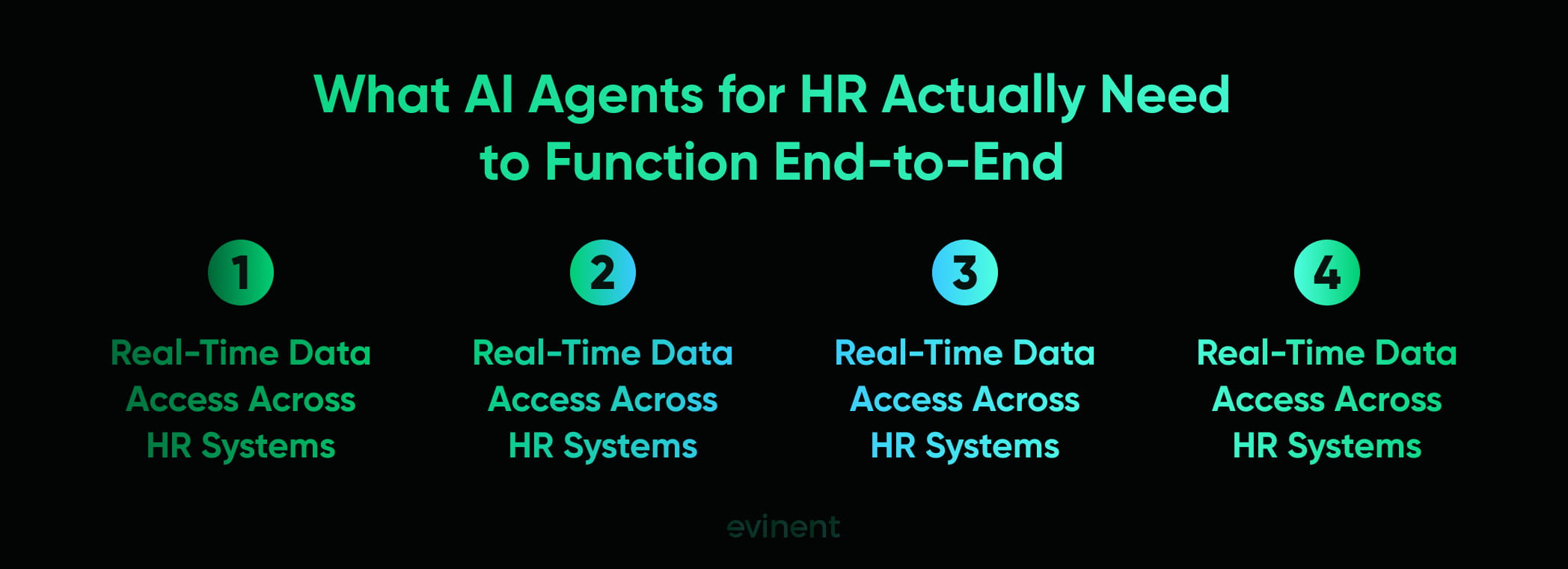
Why Most HR Agent Deployments Fail After Go-Live
Most HR agent deployments don't fail at demos or pilot programs. They actually fail post-launch when independent workflows start touching real employees, payroll systems, policy exceptions, and operational edge cases. The root issue is that a lot of enterprises consider HR agents just as automation features instead of fully-fledged production systems. Consequently, deployments are frequently launched without the necessary operational measures that are crucial for keeping trust intact over time.
Stale Data Creates a Failure Cascade
One of the main causes of failure of HR agent deployments is incorrectly matching data on different linked systems. One of the cases, the agent will allocate the time off against the old PTO balance, and later on, payroll will recalculate the deductions using the new information. At that point, the managers will get the leave information that contradicts their first-hand records; separately, the employees will argue the changes made to their pay, and HR will have to do a manual investigation to find the root of the problem.
Most of the time, the error is made at the beginning and is very minor; however, the aftermath of it can be very complicated, especially when multiple workflows and departments get involved in the process.
Payroll Synchronization Overwrites Critical Adjustments
It is very uncommon for HR systems to be functioning independently. They incessantly share data with payroll, HRIS, job scheduling, and compliance systems. In a lot of cases, auto-sync processes overwrite changes or exceptions based on policy that were manually input by HR teams. This causes operational confusion as employees, managers, and payroll administrators might all be encountering different versions of the very same record. Once payroll precision is doubted, enterprises very soon lose their faith in computer-made decisions.
Lack of Observability Makes Errors Difficult to Contain
Many HR agents are deployed without proper production monitoring. Teams can see the final outcome of a workflow, but they cannot fully trace how the decision was made, which systems influenced it, or where the process failed.
Production-grade HR automation requires action tracing, audit logs, rollback visibility, escalation analytics, failure monitoring, and workflow replay capability. Without these controls, even relatively minor issues become difficult to diagnose and nearly impossible to explain during disputes or compliance reviews.
Trust Erodes Gradually Rather Than Instantly
Initially, most failures in production are hardly disastrous. The deployment rarely gets completely broken by one outage or a wrong approval. The decay of trust is, however, a slow process as inconsistencies keep piling up. It will then come to a point where managers start to regularly check approvals themselves, employees no longer trust automated responses, and HR teams intervene quite often. At the very end, the entire organization will resort to completely disabling autonomous actions and leaving the system just as a read-only assistant. At this point, the original value that the deployment brought to the operation is almost lost.
Organizations Monitor Infrastructure More Aggressively Than AI Decisions
The majority of businesses continuously track infrastructure outages, API failures, authentication errors, and database performance. But, quite a few still run HR agents without the same level of transparency into their autonomous decisions. Companies generally get to know right away when a server stops working; however, they aren't able to clarify the reasons behind the various actions of the HR agent, like the approval of a leave, a change in payroll inputs, or the escalation of a policy exception. This lack of visibility is one of the key reasons why deployments face difficulties post go-live.
Successful HR agent deployments require far more than workflow automation and model accuracy. They require an operational accountability infrastructure that supports autonomous decision-making in production environments.
Systems that work technically, without observability, traceability, and failure management, gradually lose organizational trust. And when trust is gone, most of the time, automation is gone too.
The HR-IT Ownership Problem That Stalls Most Agentic Deployments
Many HR agent deployments stall because ownership is fragmented from the beginning. HR selects the platform after a successful vendor demo. IT later discovers legacy infrastructure constraints, middleware dependencies, flat-file exports, and limited API support. Governance discussions restart, the integration scope expands, and rollout timelines repeatedly slip.
Many vendors choose to demo their software using a state-of-the-art cloud HR stack, yet this is not how the majority of enterprises are running their operations. The issue is not just about technical complexity; it is also about the absence of a well-defined shared responsibility model between HR and IT departments.
Decision Area | HR Owns | IT Owns | Requires Joint Approval |
Use case prioritization | Workflow priority | Technical feasibility | Rollout sequencing |
Workflow exception logic | Business rules | Escalation architecture | Approval thresholds |
Data access scoping | Sensitivity definitions | RBAC enforcement | Governance policy |
Integration architecture | Operational requirements | APIs, middleware, sync models | System dependencies |
Audit logging configuration | Compliance requirements | Logging infrastructure | Retention and review policy |
Agent monitoring and incident response | Escalation ownership | Operational monitoring | Production response workflows |
This division of ownership causes a fundamental difficulty in the deployment planning phase. HR specifies what is considered appropriate behavior: the logic for approvals, rules for workflows, escalation channels, compliance standards, and the experience of the employees. IT is responsible for implementing the technical controls, which are the prerequisite for the behavior to be safe in production, like: data integrations, user access, synchronization models, audit logging, monitoring, and ensuring operational soundness.
Neither party alone is capable of deciding such issues. Governance decisions should not be made one after another, as the limitations of the infrastructure have a direct impact on the features of the policy. The activities that seem to be correct according to HR may be incompatible with the current integration constraints or synchronization s.
Organizations that buy the platform first and solve integrations later often discover that infrastructure constraints invalidate governance assumptions after deployment planning has already begun.
Most agentic HR deployments slow down because ownership boundaries are unclear, not because the underlying AI fails.
Successful deployments establish shared HR-IT accountability early, especially around governance, integrations, monitoring, and operational controls. Without that alignment, implementation complexity compounds quickly after vendor selection.
Three Deployment Models for AI Agents in HR — and When Each One Actually Works
The vendors of most HR agents show only one deployment architecture at their demonstrations, the one that is most probably geared towards a cloud-native, modern HR environment. But the truth of the situation for enterprises is usually much more scattered.
A large number of organizations have a combination of HR ecosystems where they could be using old HRIS platforms, middleware layers, batch synchronization processes, custom approval workflows, and sometimes even modernized infrastructure. Hence, the deployment model is equally important as the AI capability itself.
Model | What It Requires | What It Delivers | Where It Breaks | Best Fit |
Cloud SaaS agentic platform | Modern cloud HRIS, REST APIs, clean structured data | Fastest time-to-value | Legacy HRIS, stale data, undefined exceptions | Workday/SuccessFactors organizations |
Middleware + agent layer | Middleware investment before deployment | Agent capability on legacy infrastructure | Maintenance complexity, connector fragility | Mixed legacy-modern environments |
Isolated/private deployment | Internal infrastructure + AI operations capability | Full operational control and data isolation | Higher deployment effort | Healthcare, finance, and regulated enterprises |
Deployment tradeoffs are a particularly crucial factor when scaling production. Cloud-first platforms are capable of achieving great pilot results in very standardized environments with APIs that are up to date and synchronization that is almost real-time. But, such architectures generally have problems when they come across old, fragmented infrastructure, synchronization that is ed, or quite extensively customized workflows.
Middleware-based approaches provide more flexibility for enterprises operating mixed environments, especially where legacy systems cannot support modern agent frameworks directly. The tradeoff is operational complexity. Connector maintenance, synchronization reliability, and orchestration overhead become long-term operational responsibilities rather than vendor-managed abstractions.
Private or isolated deployments prioritize control, compliance, and data isolation. These models are common in regulated industries where HR data cannot leave internal infrastructure boundaries. While they offer the highest governance flexibility, they also require significantly stronger internal engineering and AI operations capabilities.
Cloud-first deployment model coupled with infrastructure programmed around batch synchronizations is one of the main reasons why HR agent pilots are successful at getting the go-ahead while production runs fail
What Agentic AI for HR Actually Delivers — With Honest Timelines
Most HR agent software vendors present their demos as highly optimized and based on clean datasets, using modern APIs and very controlled workflows. However, production environments are hardly as simple. When it comes to actual deployments, the schedule is determined more by how ready integration is, how complex the workflow is, and how good the infrastructure is, rather than the ability of the AI model itself.
Onboarding Automation
HR agents have the option to use automation tools to help them accomplish onboarding coordination among different departments, such as HR, IT, payroll, and hiring managers. The most common workflows to automate are provisioning requests, collecting documents, sending task reminders, coordinating schedules, and acknowledging policies.
Typical outcomes include:
40–60% reduction in HR coordinator workload;
Faster onboarding completion cycles;
Fewer manual follow-ups across departments.
Realistic deployment expectations:
Modern HRIS environments: 8–14 weeks;
Legacy or mixed environments: 16–24 weeks;
Typical implementation cost: $25,000–$90,000, depending on integration scope.
Exception handling quality is by far the main success factor. Highly customized onboarding workflows usually result in quite a few more weeks of stabilization period.
Employee HR Support
HR support personnel typically handle policy inquiries, vacation time requests, benefits questions, HR processes, and operations related to employee self-service.
Typical outcomes include:
50–70% HR query deflection;
Reduced ticket volume for HR operations teams.
Faster response times for employees.
Realistic deployment expectations:
Modern cloud environments: 6–10 weeks;
Legacy environments with fragmented knowledge systems: 12–18 weeks;
Typical implementation cost: $15,000–$60,000.
The main reliance here is on data freshness. If PTO balances, organizational structures, payroll records, or policy documents are out of sync, agents can become unreliable very quickly.
Recruiting Workflow Automation
Recruiting agents are capable of organizing interview timings, automating communication with candidates, keeping track of the status of workflow updates, helping with the screening process, and minimizing the coordination of work that is repetitive work for recruiters.
Typical outcomes include:
30–50% reduction in recruiter coordination overhead;
Faster scheduling cycles;
Improved hiring workflow consistency.
Realistic deployment expectations:
Standard ATS integrations: 12–20 weeks;
Complex enterprise recruiting environments: 20–30 weeks;
Typical implementation cost: $40,000–$150,000.
Historical recruiting data quality has a major impact on deployment speed. Inconsistent workflow states and fragmented candidate records often create operational instability during rollout.
Payroll Reconciliation
Payroll reconciliation ranks as a great tool that HR agents use to contribute high value; however, it is very dependent on infrastructure. Before a problem directly impacts employees, HR agents can pinpoint payroll discrepancies across multiple payroll systems, leave management platforms, HRIS records, and compensation workflows.
Typical outcomes include:
40–60% reduction in reconciliation workload;
earlier discrepancy detection;
fewer manual audit cycles.
Realistic deployment expectations:
Modern real-time integration environments: 14–24 weeks;
Middleware-heavy or batch-sync environments: 24–40+ weeks;
Typical implementation cost: $60,000–$250,000+, depending on payroll architecture complexity.
The biggest difference is the ability to be synchronized. The situations relying on the regular export of data at night or payroll synchronization to be ed typically have to go through a very large middleware redesign if they want to have a production-safe automation.
Usually, pilots' dates are reckoned by environments handpicked and workflows greatly simplified, while integrations are ideal. Production timelines depend on different factors, including integration readiness, data quality, synchronization reliability, workflow exception volume, and governance complexity.
According to data, companies that start deployment without ing integrations first typically face implementation timeline overruns by a factor of two to three. Usually, it is the infrastructure limitations and not the AI capabilities that cause the deployment s.
The organizations that achieve successful production outcomes are usually the ones that treat HR agent deployment as an operational transformation project rather than a software installation. Realistic timelines, validated integrations, and controlled rollout sequencing matter far more than aggressive vendor estimates shown during early demonstrations
How Evinent Deploys AI Agents for HR That Work in Production, Not Just Demos
Many times, the failure of HR chatbots is not directly due to the inadequacy of the AI component but primarily because the actual enterprise environment around AI is far more complicated than the demo environment that was used during vendor evaluations.
Once rolled out, HR agents would have to interact with several systems, such as old HRIS systems, payroll that is distributed in different locations, ed synchronization models, customized approval workflows, strict compliance requirements, etc. Evinent sees the deployment of HR agents as a problem of infrastructure and operations; a chatbot implementation is just one part of the issue.
Instead of developing discrete AI assistants, Evinent brings the agentic workflows straight into the existing HR activities, governance patterns, and enterprise infrastructure.
Why Organizations Choose Evinent
15+ years of enterprise software development experience;
Expertise in AI-driven workflow automation;
Experience with legacy and modern HR ecosystems;
Deep integration capabilities across HRIS, payroll, and middleware systems;
Production-focused architecture for scalability, monitoring, and compliance.
AI Agents Embedded Into Existing HR Systems
Instead of replacing existing infrastructure, Evinent integrates agents directly into operational HR environments.
Typical integrations include:
Workday and SuccessFactors
PeopleSoft and legacy HRIS platforms
Middleware-based enterprise architectures
Internal approval and payroll workflows
The goal is to make agents operate inside existing business processes rather than creating disconnected automation layers that employees eventually bypass.
Governance Validation Before Go-Live
Evinent checks workflow behavior before deployment goes live in production.
This includes:
Approval logic review
Exception-handling scenarios
Escalation path mapping
Audit and compliance requirements
RBAC and data access boundaries
This helps lower the chances of trust breakdown due to AI decisions that are inconsistent or non-auditable post go-live.
Private AI Deployment for Sensitive HR Data
For regulated enterprises, Evinent supports fully private deployment models inside client-controlled environments.
This allows organizations to maintain:
Internal data isolation
Compliance alignment
Encrypted processing
Controlled access governance
Relevant Experience: AI-Powered HR Workflow Automation
Evinent collaborated with a European corporation that was keen on automating its internal HR processes but also wanted to keep all employee and payroll data within its own infrastructure.
This firm was using a number of HR systems, and the synchronization of employee records, approvals, and support workflows was very inconsistent. The biggest problem wasn't developing the AI component but ensuring that automation was dependable within a setting with legacy integrations and stringent governance requirements.
Evinent deployed a private AI environment integrated directly into the company’s HR ecosystem. Instead of using one large assistant, the system was built around smaller atomic agents responsible for specific functions such as:
Employee HR support
Workflow coordination
Escalation handling
Policy retrieval
The repeated part of the logic was minimized, and the agents' actions were very simple to the point of how the auditors, the monitors, and the stabilizers of the production have behaved.
After HR made the first implementation of a system, the business is now capable of decreasing HR work that needs human intervention, giving faster responses to employee questions, and having the operational side of their view of the automated flows without exposing the confidential HR information outside.
Our Approach
Evinent's main focus is on equipping AI agents with the capability to function effectively within authentic enterprise HR systems. The core idea is to not only ensure smooth demonstrations but also to concentrate on aspects such as integration readiness, governance alignment, observability, and production stability.
FAQ
Why do AI agents for HR work in pilots but fail in production?
In controlled environments where pilots are carried out, data is generally clean, and workflows are simple. On the other hand, when agents are in production, they have to deal with legacy HR systems, asynchronous synchronization, complex approvals, and scattered data. These are the things that typically do not show up in demos but are the main challenges in real life.
What infrastructure does an HRIS need before deploying AI agents?
At minimum, HRIS environments need reliable data synchronization, stable access to employee and payroll records, and clearly defined workflow boundaries. If data is stale, APIs are limited, or processes rely on batch exports, AI agents will require additional middleware and stronger governance layers to operate safely.
How do HR and IT share ownership in agentic HR deployments?
HR spells out the business rules, what is supposed to occur in workflows, approvals, and exceptions. IT specifies the capacity for safe implementation within the scope of current system capabilities, e.g., integrations, security, and system limitations. The most common reason for failure of production releases is when these roles are handled one after another instead of at the same time.
What is a realistic production timeline for AI agents in HR operations?
Timeframes depend on how mature the infrastructure is. With modern HR software, it's possible to go live in the 6-12 week range for simple workflows. When dealing with legacy or mixed systems, it's a common experience to have the implementation period extended to 3-6 months or even longer because of integration, data, and exception handling issues.
When should organizations choose a private HR agent deployment instead of cloud SaaS?
Private deployment is appropriate when HR data cannot leave internal infrastructure, when compliance requirements are strict, or when systems are too customized for standard SaaS integration. This is common in regulated industries like finance, healthcare, or large enterprises with complex legacy HR systems.
Key Takeaways
Most HR agent deployments fail because of infrastructure, integration, and governance problems — not because of weak AI models.
Vendor demos usually assume modern cloud HR environments. Most enterprises operate fragmented ecosystems with legacy HRIS platforms, middleware layers, and batch synchronization.
HR and IT ownership must be defined together from the beginning. Governance decisions and technical constraints directly affect each other.
Production success depends on observability. HR agents require audit logs, action tracing, escalation monitoring, and workflow replay capabilities to maintain organizational trust.
Deployment timelines are integration-dependent, not model-dependent. Organizations that skip integration validation often exceed original timelines by 2–3×.
Cloud-first deployment models work best in modern HR stacks. Legacy-heavy environments usually require middleware or private deployment approaches.
The most successful deployments start with narrow, operationally stable workflows such as onboarding coordination, HR support automation, or recruiting operations.
AI agents become production-ready when they are embedded into existing HR workflows rather than deployed as standalone automation tools.
Share