

Why Vendor Onboarding Is the Silent Killer of Marketplace Growth
You've made the site, and the technology is operational. Customers are coming. But the problem is that your inventory is not expanding rapidly enough, and deep down, you also realize the reason.
Vendors Are Stuck in Onboarding
This is not a small, isolated operational problem. In fact, this problem affects your whole speed of rolling out your marketplace. For example, a vendor idling for three weeks while waiting to be live on the platform is a vendor who is either getting demotivated, thinking about other vendors, or just disappearing from your line without you even being aware of it. Besides, slow onboarding is quite different from a bug in the checkout flow; you will not even notice that it is costing you.
The cost of doing nothing compounds quickly. Manual onboarding runs $35K per vendor on average. Losing a vendor mid-process adds another $20K in reacquisition costs. Across a growing marketplace, that's not an operational inefficiency — it's a structural drag on growth. (Statista, 2026)
The good news: this is a solvable problem. Not with a complete overhaul, and not by removing human judgment from the process entirely. But with the right automation in the right places, activation timelines drop from 30+ days to under a week — and vendor drop-off drops with them. (Digital Commerce 360)
In this article, you will learn:
The specific moments when time is lost in a typical onboarding process, plus an estimate of the cost for each step.
Which portions of onboarding can be automated without the risk of compromising compliance and quality?
Why human review is essential, nevertheless, and how to prevent it from becoming the bottleneck.
The key performance indicators that show you if your onboarding is really effective.
The definition of "good" in reality, and how we handled this challenge when building a marketplace.
The Real Cost of Slow Vendor Activation
Slow onboarding is usually seen as just an operational hassle, something that slows down execution but does not really have a major effect on growth. Actually, it has a direct impact on the economics of the marketplace and the long-term scalability.
Increased vendor onboarding costs
When onboarding cycles are prolonged, teams spend significantly more time on follow-ups, re-validation, and repeated manual processing. This increases overall vendor portal onboarding costs, not because of infrastructure, but because of operational overhead that scales linearly with each new supplier.
Higher vendor churn before activation
The longer a supplier stays in the pipeline without becoming active, the higher the probability of drop-off. Many vendors lose momentum or shift priorities entirely during the process, which leads to increased vendor churn before activation is even completed and reduces overall supplier retention.
Rising supplier acquisition cost
It is necessary to replace every vendor that drops out after the initial recruitment for the continued growth of supply. Here, the supplier onboarding process ecommerce cost increases, as acquisition activities are repeatedly used to make good the losses instead of gearing up growth.
Slower catalog expansion
ed activation contributes to the slower growth of live inventory in a very direct way. If there are no active listings, then relying solely on catalog expansion can be uneven and might force reacting to situations instead of planning. Consequently, the coverage of categories will be limited, and the depth of the marketplace will be reduced.
Reduced marketplace liquidity
A marketplace depends on an active supply to match demand efficiently. When vendor activation is slow, marketplace liquidity decreases, leading to fewer matching opportunities, weaker conversion rates, and reduced transaction efficiency.
Compounding growth constraints
These effects do not remain isolated. A ed supplier activation rate creates cumulative friction across the onboarding funnel, gradually increasing leakage and silently limiting marketplace GMV growth over time.
On their own, each of these problems may seem quite easy to handle. But when combined, these problems form a compounding limit: each ed supplier self-service registration momentally impairs the marketplace's supply growth rate, and the slow supply growth in time directly caps the overall growth of the marketplace GMV.
That is the reason onboarding shouldn't be seen merely as an internal process set up, but rather as the very factor that limits the potential of business growth. To figure out exactly which parts of the onboarding pipeline take the most time, the next part of the essay will do a detailed analysis of the whole process.
Where Time Is Actually Lost in Vendor Onboarding
Most marketplace operators are aware that their onboarding process is slow. Very few, however, pinpoint exactly where the time is wasted. The typical answer is not a huge single mistake but rather a series of five minor errors that accumulate one over the other, each contributing to adding several days to a process that would ideally take a few hours.
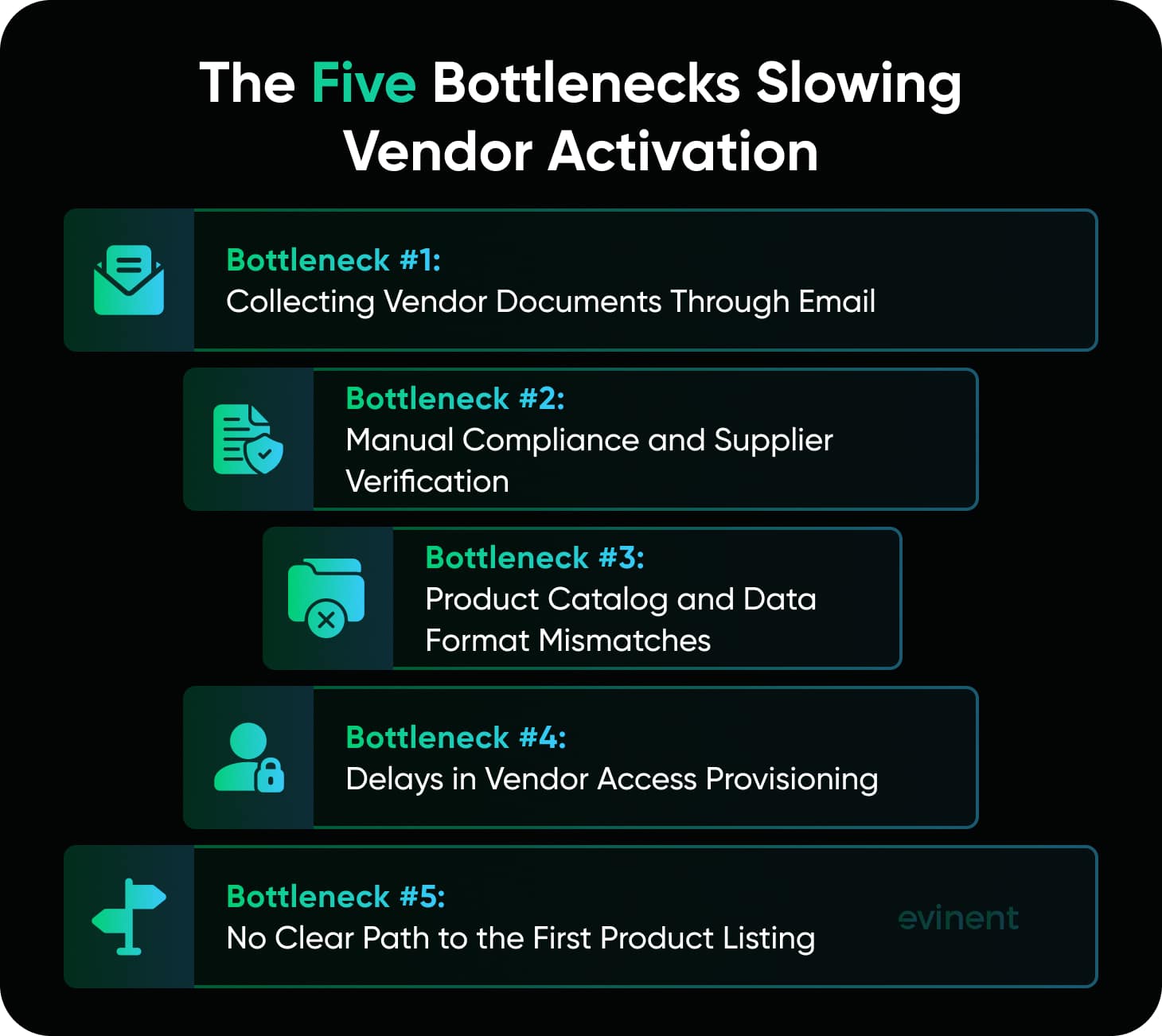
Bottleneck №1: Document Collection Over Email
The typical marketplace vendor registration starts with a request: send us your documents. Business licenses, tax certificates, insurance, bank details — all collected over email, one thread at a time. The vendor sends the wrong format. You reply. They resend. Someone on your team is out. The thread gets buried. What should take an afternoon stretches across a week, with neither side having visibility into where things actually stand. Unstructured onboarding documentation collected over email is responsible for more s than any other single step.
Bottleneck №2: Manual Compliance Verification
Someone must review the documents once they show up. That person has a workload. Supplier verification, for instance, checking registration numbers, making sure vendors meet specific category requirements, doing a compliance check against local laws, all this is very slow if done manually, and definitely can't be performed in parallel without a whole team. For most medium-sized marketplaces, this task by itself s the process by three to five business days. Not because it's difficult work, but simply because it's all manual.
Bottleneck №3: Data Format & Catalog Structure Friction
A supplier shares their product catalog with you, but it doesn't fit your taxonomy. Attributes are missing, categories are incorrect, and the supplier's images are below spec. After your feedback, the supplier makes changes. You check their work again. Supplier data format mismatches like these can easily keep "flipping" four or five times before even one SKU is published. Each back-and-forth adds another two to three days, and the supplier's willingness to continue is slowly deteriorating.
Typically, these types of catalog onboarding problems are not really about the source of the data being bad. They are actually about the failure to provide structured guidance at the very beginning.
Bottleneck №4: Manual Access Provisioning After Approval
The vendor has the approval. So, the next step is for someone to set up their account, allocate roles, determine permissions, and deliver credentials. Generally, in the majority of systems, providing vendor access is a manual activity that gets held up in IT or operations queues, and it's often totally separate from the approval workflow. The vendor has passed all checks and is prepared to sell. They're just waiting for a ticket.
Bottleneck №5: Lack of Guided First Product Submission
Even after access is granted, many vendors stall. They log in, see an unfamiliar interface, and don't know where to start. No checklist, no inline validation, no guided product submission flow. They either submit something incorrectly, triggering another review cycle, or they don't submit at all. This is where vendor drop-off quietly peaks: not during verification, but after it. The manual onboarding steps that got the vendor this far suddenly have nowhere to hand off to.
Five bottlenecks. Not one of these bottlenecks is severe by itself. In combination, they convert a procedure that is supposed to last for three days into one that lasts for three weeks and, by that time, even the most enthusiastic sellers will have already found other opportunities.
The good news is that none of these s requires a platform rebuild to fix. Each bottleneck maps directly to a specific automation — structured intake instead of email threads, automated checks instead of manual queues, triggered provisioning instead of IT tickets. The next section breaks down exactly which automations move the needle and how each one addresses the friction points above.
Automation That Actually Reduces Onboarding Time
Automation gets oversold in this space. "Automate your onboarding" usually means one of two things: a slightly better form, or a promise that AI will handle everything. Neither is true, and neither is the point.
Automation doesn't mean taking people out of the process. Rather, it means getting rid of the admin friction that ends up making people the bottleneck. Document chasing, queue management, manual data checks, and ticket-based provisioning do not require human judgment. It just consumes human time. Below are five fixes that focus on exactly those gaps between steps where momentum fades, and vendors get impatient.

Fix №1 — Structured Vendor Registration with Document Upload
Replace email-based document collection with a structured, vendor-portal self-service flow. Instead of requesting documents via a thread, vendors complete a single registration form that specifies exactly what's needed, in what format, with built-in upload fields. The automated supplier activation process creates a record instantly, attaches all submitted files to it, and moves the application into review without anyone touching an inbox. What previously took a week of back-and-forth takes one vendor session.
Fix №2 — Pre-Review Completeness Validation
Before a human reviewer sees anything, run automated document validation to check whether the submission is complete. Are all required fields filled? Do uploaded files match expected formats? Are there obvious data inconsistencies? This document validation automation filters out incomplete submissions before they enter the review queue — which means reviewers spend their time on actual judgment calls, not on sending "please resubmit" emails.
The next wave of procurement automation is projected to make operations 25–40% more efficient — and pre-review validation is exactly the kind of administrative layer that drives that gain. (Statista, 2025)
Fix №3 — Guided Product Submission with Inline Validation
Instead of letting vendors submit their products via an empty catalog interface, create a step-by-step product submission process that leads vendors through each field with inline instructions, format examples, and instant validation. Mistakes are revealed before submission, not after. The supplier registration system identifies missing attributes, wrong image sizes, or category mismatches instantly, thereby getting rid of the revision cycle where a single catalog submission ends up being made five times.
Fix №4 — Automated Role-Based Access Provisioning
Immediately after an application is approved, the system should automatically do all the work: create the vendor account, assign role permissions correctly, and send out the access credentials, all without any manual intervention. When supplier access provisioning is initiated by approval status, it completely removes the IT queue and also closes the gap between 'approved' and 'active.' For the vendor, this translates to a transition from receiving approval notification to actually accessing the live portal in a matter of minutes rather than days.
Fix №5 — Progress-Based Onboarding Checklist & Nudges
Even with automation in place, vendors stall. A progress-based checklist makes the path to first listing explicit: here's what's done, here's what's next, here's what's blocking you. Paired with automated nudges — triggered reminders when a step has been idle for 24 or 48 hours — this keeps the marketplace activation flow moving without requiring your team to manually follow up on every inactive application.
None of these solutions involves changing your current infrastructure or completely redesigning your onboarding process. They simply add to the workflow you currently have, filling in the gaps where time is lost. Combined, they transform onboarding from being something your team has to keep track of to something that essentially takes care of itself, leaving human intervention only for those decisions that genuinely require it. And that is precisely the topic of the following section.
What Still Requires Human Review and Why It Should Stay That Way
There is a narrative of this discussion, where the word "automation" is considered as the end, where a flawless onboarding process is one that does not need any human intervention. This is the wrong take, and trying to implement it leads to serious problems.
Automation is not a tool for excluding human decision-making. On the contrary, it's a way to safeguard it. If your team is not occupied with endlessly following up on documents, sending format instructions again, and manually unlocking accounts, they will be able to devote their time to decision-making, which most often requires human intervention: situations where context plays a role, where something in a pattern seems strange, where a vendor's profile is somewhat unclear.
Here's where human review doesn't just belong — it's essential.
Fraud detection
Automated systems check for completeness and format. They don't catch intent. A submission can pass every validation rule and still be fraudulent — documents altered just enough to clear automated checks, business registrations that technically exist but don't hold up under scrutiny, vendor identities that don't match the operational reality behind them. Fraud detection in vendor onboarding automation marketplace requires a trained eye and access to context that no validation rule can fully replicate. This is a human job.
Compliance-sensitive categories
It is not true that every product category is equally regulated. Pharmaceuticals, food and beverage, electronics that require safety certifications, and financial products all have their respective compliance checking requirements that not only refer to the document formatting. The reviewer should be able to comprehend the content of the documents, and not only their existence. Automating this stage will not lead to time saving; on the contrary, it will lead to legal issues.
High-risk vendor profiles
Some vendor qualification decisions require judgment that can't be encoded in a rule. A supplier operating from a sanctioned region. A vendor with an unusual ownership structure. A business registration that's three weeks old is applying to sell in a high-value category. These aren't automatic rejections — but they're not automatic approvals either. Hybrid onboarding automation works precisely because it can flag these profiles for human review without slowing down everyone else.
Regulatory constraints
Marketplace compliance regulations differ from one country to another, by product category, and even by transaction amount. In several regions, a few permissions can't be delegated to a bot; in principle, they need a human sign-off from a qualified person as a part of the audit trail. Supplier approval under human oversight is not only a very wise thing to do in such situations. It is actually a legal obligation.
Exception handling
At a certain point, each onboarding workflow is bound to meet a vendor who breaks the usual pattern. A big company that supplies you may have different types of documents than what you are used to. A vendor from a country where the usual certificates do not exist in the same way. An exceptional case for which your registration form was not designed. Machines do the standard work; people do the exception work. This split of tasks is what makes the system strong.
The key shift isn't removing human review, it's restructuring when it happens. Sequential approval queues, where every vendor waits in the same line regardless of risk profile, are the problem. Parallel review changes the dynamic: low-risk applications move through automated validation and get provisioned without , while flagged profiles are routed to a reviewer simultaneously, not after. The result is that manual verification in the marketplace onboarding workflow stops being a bottleneck and becomes what it was always supposed to be: a targeted quality control layer.
Manual vs Automated Onboarding: What Actually Changes
It is usually easier to identify the value that automation brings when you compare these two methods together. The distinction is not only in the pace of work, but also in the responsibilities at each stage and the reliance on the individual. What if that person is not there, has too much work, or is slow?
Onboarding Step | Manual Process | Time | Automated Process | Time |
Document collection | Email threads, follow-ups, and format corrections | 5–7 days | Structured upload form with format validation | Same session |
Completeness check | Ops team reviews the submission manually | 2–3 days | Automated pre-screening before human review | Minutes |
Compliance verification | Manual cross-referencing, dedicated reviewer | 3–5 days | Automated flagging, human reviews exceptions only | 1–2 days |
Access provisioning | IT ticket raised after approval | 1–3 days | Triggered automatically on approval | Minutes |
First product submission | Vendor figures it out alone, errors caught post-submission | 3–5 days | Guided flow with inline validation, errors caught upfront | Same session |
Total time-to-activation | 14–23 days | 3–7 days |
The table reveals something very obvious: the time difference between manual and automated onboarding is not a secret from a single step because it adds up during every handoff, every queue, and every moment when progress depends on one's memory to act. Automation, in fact, doesn't shorten the process; it eliminates the interruptions between steps.
Verification of compliance remains unchanged in both columns. It is the step that gets expedited through automation, but it is still there. Being referred to in the previous part, the touch of human judgment at the right points is not the bottleneck; on the contrary, it is a feature.
Vendor Onboarding Metrics and Performance Benchmarks
You can't enhance something if you haven't first measured it. A majority of marketplace managers only realize that onboarding duration is lengthy; however, if they do not measure the right metrics, they cannot pinpoint exactly the stages of the process where vendors disengage, which vendors are most likely to abandon the platform, or if the modifications implemented bring about the expected results. Here are the top five metrics to focus on.
Time-to-Activation
Time-to-activation measures how long it takes from a vendor's initial registration to the moment they have full access to your platform. It's the single most direct indicator of onboarding efficiency. A long time-to-activation doesn't just frustrate vendors — it directly s the point at which they can contribute listings, and in a catalog-driven marketplace, that has a compounding effect on supply-side depth.
Completion Rate
Completion rate reflects the proportion of vendors who begin the onboarding process and actually finish it. A low completion rate indicates that the process is not smooth; however, it won't tell you at what point. That is the reason you should always monitor completion rate in conjunction with drop-off data for each specific step. The reasons for drop-offs at the document upload stage are different from those that occur after compliance review, and the solutions for both are totally different.
Vendor Drop-Off Rate
Drop-off rate indicates the exact stages in the onboarding funnel at which vendors quit the process. This is the diagnostic metric, the one that reveals to you the areas to fix first. If there is a high drop-off at document submission, it indicates there is a UX or format problem. On the other hand, if there is a high drop-off after approval, it indicates a provisioning or communication failure. Not having this data means optimization will be guesswork.
Activation Rate
Activation rate tells us what portion of vendors who signed up our system finally came on board and started using our maven supplier platform after a certain period, usually 30 days. Besides component metrics, it is a more general indicator of the health of your supplier portal analytics. If the activation rate stays low for a long time, it points to a deep problem: either the onboarding process is too complicated, or the vendors do not get enough help to complete it on their own.
Time to First Listing
Time to first listing measures how long it takes from activation to a vendor's first published product. This metric matters because activation without listing activity is activation in name only. A vendor who completes onboarding but never lists has still churned — just later. Tracking time to first listing reveals whether your guided product submission flow is working or whether vendors are stalling after they gain access.
All of these five metrics collectively form the onboarding funnel: registration → completion → activation → first listing. Any of the steps can lead to a customer dropping out. Medium research indicates that experience-driven companies are able to retain customers at a rate of 1.9 times higher and increase customer lifetime value by 2.1 times compared to their competitors.
What is more, it is the onboarding experience that establishes the retention path. As a matter of fact, a vendor who activates quickly and lists their first product within 48 hours is by far more likely to remain active long-term than a vendor who has to go through a three-week process. (Medium, 2025)
What “Good” Vendor Onboarding Looks Like in Practice
Quick onboarding shouldn't be the primary aim. Consistent onboarding should be.
A seller who usually goes live in seven days is more helpful to your business than a seller who occasionally goes live in three days and the rest of the time in twelve days. Variability in time causes a need for support, decreases trust in the seller, and makes the growth of the catalog in the future very difficult to estimate. The end goal is not speed just for the sake of it; it is a system that provides a steady, smooth experience no matter the vendor's size, category, or level of technology. The following are those that matter the most.
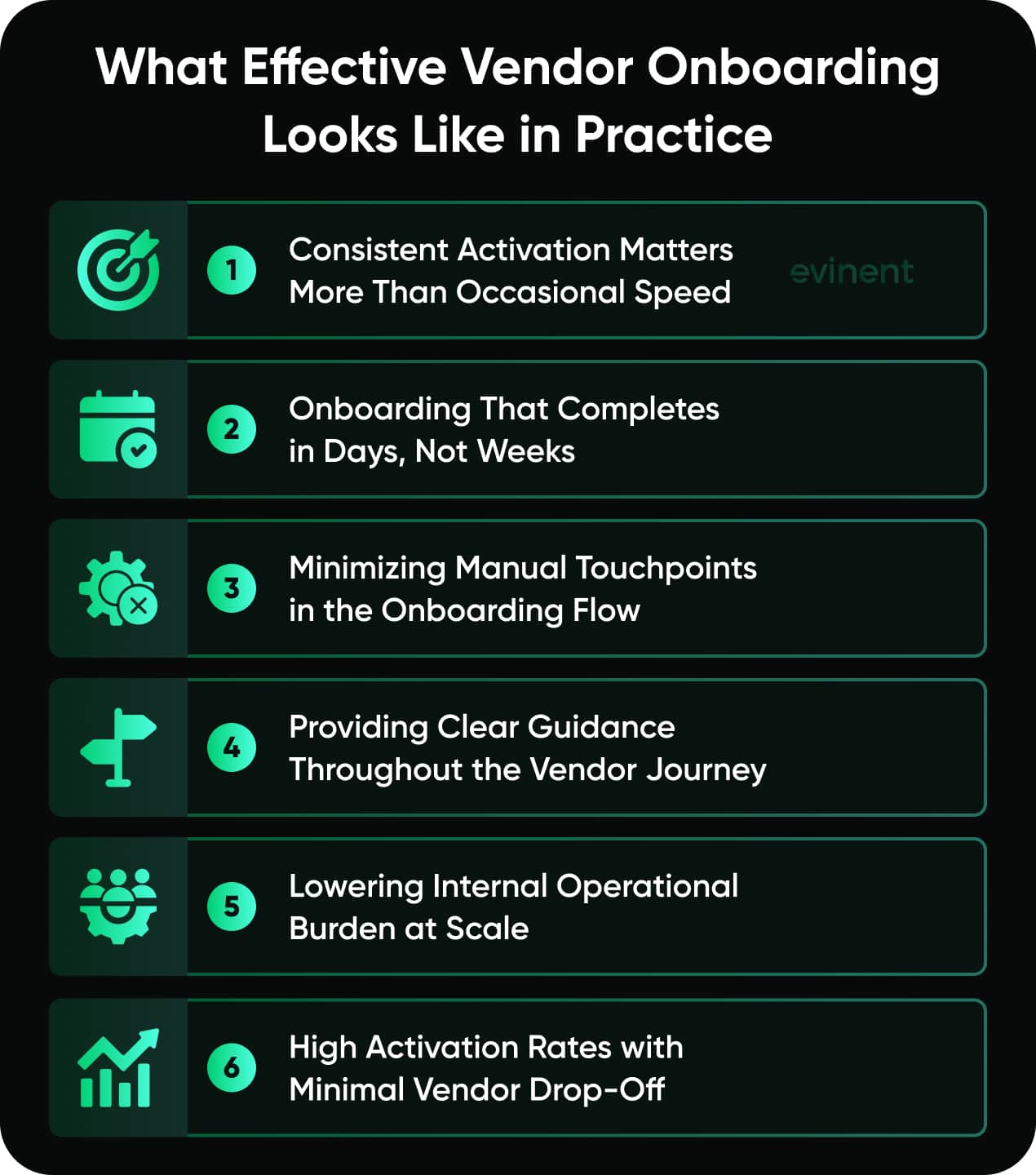
Activation within days, not weeks
Vendor onboarding by manual methods normally spans three to six weeks. Document gathering itself can take a whole week. Compliance checking takes on an additional three to five working days. Access provisioning is waiting in line. When the vendor finally goes live, their first drive is generally gone.
In an optimized, digital-native marketplace onboarding system, the same process takes three to seven days — not because steps are skipped, but because they run in parallel, are guided by structure, and don't depend on someone remembering to follow up. Mirakl's data shows that catalog automation already makes it possible to onboard new products in under 24 hours rather than months — a benchmark that illustrates how far the gap between manual and automated systems has grown.
Minimal manual intervention
Effective onboarding doesn't mean getting rid of human review altogether; rather, it means separating it from the rest of the process. Most of the time, vendor applications are fairly simple: they submit all the required documents, the product falls into a standard category, and there are no signs of risk. Such cases should just fly through the system without being routed to anyone's worklist. Human resources should be directed to handling the outliers, fraud signals, categories subject to compliance, and profiles that pose a high risk, instead of approving the usual cases that an automated workflow is capable of doing quicker and more reliably.
The measure of a well-designed system is how rarely your team needs to intervene on a standard application.
Clear vendor guidance at every step
Vendor drop-off seldom occurs due to overly strict requirements. In fact, it is usually a matter of vendors not being informed about the expectations, unable to identify their stage in the process, and not getting any feedback when things are going awry. The best practices of supplier onboarding always indicate the same remedy: clarify the path. A progress-tracking checklist, real-time validation, and regular status updates require minimal effort to set up and address most of the points at which things get stuck.
A vendor who knows exactly what's needed and can see their progress moving forward will complete onboarding. One who submits documents and hears nothing for four days will not.
Reduced operational load
Onboarding effectiveness should not only be viewed as a vendor experience measure but rather as an internal operations one.
Every message that your folks send to wait for a document, every ticket done to give someone access, every time compliance has to be manually checked for a normal application is an operational costs that increase linearly with the number of vendors.
A good self-service onboarding flow, on the other hand, reverses that situation: the more vendors, the less operational load per vendor, instead of the more.
This is the difference between a process that supports marketplace scaling operations and one that becomes the ceiling on how fast you can grow.
High activation rate, low drop-off
The surest indication that onboarding is effective is a high rate of user activation alongside a low rate of user drop-off. It isn't only those vendors who finish the onboarding process that really matter, but also those who finish it and actually list their first product within 48-72 hours of activation. That time interval is the real challenge. A vendor who activates and lists quickly is really involved. However, one who activates and then goes quiet is already a potential churn.
Good onboarding is invisible to the vendor. They register, submit what's needed, receive clear feedback, get access, and list their first product — without ever feeling like they fought through a process. That's the benchmark. And it's achievable not through a platform rebuild, but through the deliberate elimination of the friction points that accumulate in every manual workflow. The next section shows how we approach this at Evinent.
How Evinent Designs Vendor Onboarding Systems
Better technology is not always the answer to most onboarding challenges. Better structure, on the other hand, can be the solution. There are various tool forms, validation logic, role management, workflow triggers, and we can make good use of them. However, what is lacking most of the time is a clear design philosophy that unifies these different components into a system where every part interacts smoothly with the next one.
For more than 15 years, we have been designing, developing and delivering complex digital products for middle-market and major corporations, and throughout this time, we have witnessed the very same onboarding mistakes being made again and again in every industry: the paperwork mess, the waiting for provisioning, the vendor who did all the steps, and still the product was not being listed. We have created software solutions that have rectified each of these issues; however, these were integrated as parts of a connected architectural system rather than isolated features.
15+ years building marketplace and e-commerce platforms
Experience across mid-sized businesses and enterprise clients in retail, logistics, and e-commerce
85% of clients return for follow-up projects — a number we attribute to how we design for operational reality, not just technical requirements
Here's how we approach vendor onboarding system design.
Structured Supplier Registration
The vendor registration system is first and foremost based on this principle: do not ask for any information that you can not act on right away. Each field in the registration form is there for a reason that is to support a downstream process, whether it's document validation, compliance routing, access provisioning, or catalog setup. We come up with progressive registration flows: gather the necessary information for each stage, and then ask for the next set of information only when it's actually needed.
Document Upload Workflows
Document collection is redesigned as a structured intake process, not a communication channel. The supplier portal design specifies exactly which documents are required, in what format, and why — reducing back-and-forth before it starts. Upload fields are typed: a business registration document is a different field from a tax certificate, which is different from a product liability certificate. This separation makes automated validation possible and makes the human review that follows faster and more focused.
Automated Validation Before Review
Before any application reaches a human reviewer, it passes through an automated completeness and format check. The onboarding automation platform verifies that all required fields are populated, uploaded files match expected formats, and mandatory data relationships are consistent. Applications that fail return to the vendor with specific, actionable feedback — not a generic error. Applications that pass move into the review queue clean, which means reviewers spend their time on judgment, not on basic document hygiene.
Role-Based Access Provisioning
The entire process of giving someone access is separated from manual IT processes. Once an application passes the review stage, role-based vendor access is given automatically according to the vendor's category, geography, and account type, no ticket, no queue, no . The permission model is set in system design first, rather than at the time of approval. Consequently, the provisioning logic is identical, can be audited easily, and runs quickly, no matter who approved the application or when.
Guided First Product Submission
The guided product submission workflow treats the first listing as a distinct onboarding stage, not an afterthought. After access is granted, vendors enter a structured submission flow: category selection with taxonomy guidance, attribute completion with inline examples, image upload with real-time spec validation, and a pre-submission review screen before anything enters the catalog. Errors surface during the process, not after. The goal is a vendor who completes their first listing successfully in a single session — without contacting support.
Onboarding Progress Tracking
Both the vendor and the operations team can see the status of the vendor's onboarding process. The vendor has a progress checklist that shows what is done, what is to be done, and what is preventing them. The ops team gets exposure to that information at a higher level: which applications are not moving forward, which steps are the most frequent point of drop-off, and which areas require intervention.
In the absence of this visibility layer, one would have to rely on one's instinct for optimization. With it, the decision is made on data.
These six components are not separate features; in fact, they are a system. Organized registration serves as a source of clean data for document validation. Validation directs a human review. Review approval sets off automatic provisioning. Provisioning allows guided submission. Final submission ends the onboarding loop.

FAQ
How do you automate vendor onboarding for a marketplace?
Automation works best when applied to the steps that don't require human judgment: document collection, completeness validation, access provisioning, and first-product guidance. A structured vendor portal replaces email-based intake, automated checks filter incomplete submissions before they reach a reviewer, and approval triggers instant role-based access — no manual steps in between. The result is a process where human review is reserved for compliance decisions and exception handling, not administrative tasks.
How long should marketplace vendor onboarding take?
Without the support of an automated system, it usually takes about three to six weeks for a company to onboard a new vendor. By leveraging proper automation, however, the entire operation can be completed within three to seven days, not due to the omission of compliance steps, but because the unnecessary administrative s between the actions have been removed. The goal is not to get activated in the minimum time possible. Rather, it is activation that is steady and foreseeable, and that does not rely on the particular person who happens to be in the queue on that day.
What documents are needed for marketplace vendor registration?
Things needed can change based on different categories of goods or services, location, and the regulatory environment, but a typical vendor registration would at least require a business register/ license, tax registration number, bank account details, and category-specific compliance documents like product liability insurance or safety certification. The main design principle is to clearly state requirements before the vendor starts the process, with detailed information about the format so vendors can get it right the very first time.
How do you reduce vendor drop-off during marketplace onboarding?
Drop-off is almost always a friction problem, not a motivation problem. Vendors abandon the process when they don't know what's expected, can't tell where they are, or submit something and hear nothing back. The fixes are structural: a progress-based checklist that makes the path explicit, inline validation that catches errors before submission, and automated status updates that keep vendors informed at every stage. Removing uncertainty removes drop-off.
What is guided product submission in vendor onboarding?
Guided product submission is a structured first-listing flow that walks vendors through each step of the process after they get platform access, selecting a category, filling out product details, uploading images, and doing the pre-submission review, offering inline instructions and real-time validation at every point. Instead of giving vendors an empty interface and leaving them to figure things out, guided submission is a way to ensure the first listing will be done correctly, all in one session. It's the final stage of onboarding, and the one most platforms overlook when designing.
Key Takeaways
Vendor onboarding goes beyond being an operational concern; it acts as a direct means for catalog expansion, deepening the supply side, and increasing GMV.
In truth, most onboarding s are not caused by a single failure. They result from the accumulation of these five structural bottlenecks: document collection, compliance verification, data format friction, access provisioning, and the lack of a guided submission.
Automation yields maximum benefits when it eliminates administrative friction without removing human judgment. Reviewers' time should be safeguarded, not wiped out.
Though automation can streamline the process, human review is still quite necessary for detecting fraud, handling compliance-sensitive categories, high-risk vendor profiles, and obtaining regulatory sign-off.
The five most important metrics to monitor onboarding health are: time-to-activation, completion rate, vendor drop-off rate, activation rate, and time to first listing.
Efficient onboarding is not only fast, but it should also be predictable, self-service, and low-friction, irrespective of the vendor's size or category.
Six interconnected components make up a well-thought-out onboarding system: structured registration, document upload workflows, automated pre-review validation, role-based access provisioning, guided first product submission, and progress tracking.
Share