

What is Zero Trust AI, and why are security teams suddenly talking about it everywhere?
The question shows up in board meetings, security briefings, and Google searches for a reason. Artificial intelligence is moving from controlled experiments into the core of enterprise operations. Models analyze medical images, detect fraud, approve transactions, generate software code, and assist employees across thousands of daily workflows.
The benefits are obvious, but the security implications are less comfortable.
Most corporate security architectures were designed for predictable systems: databases, applications, and internal networks. AI systems behave differently. They learn from data, change their behavior over time, interact with external APIs, and increasingly operate as autonomous agents.
That combination creates a new attack surface.
According to the IBM Cost of a Data Breach Report 2025, the average global data breach now costs approximately $4.88 million, while organizations using security AI and automation reduce breach costs by nearly $1.9 million on average.
At the same time, the scale of AI adoption is accelerating. According to The State of AI in 2025: Agents, Innovation, and Transformation, more than two-thirds of organizations now report using AI in at least one business function, while a rapidly growing share are deploying AI agents capable of performing multi-step tasks autonomously.
For security teams, this shift changes the nature of enterprise risk. AI systems are no longer passive analytical tools: they are becoming decision-making infrastructure, interacting with internal data, APIs, and external services in real time.
More AI deployments mean more opportunities for mistakes or exploitation.
Security leaders are seeing entirely new threat categories. Large language models can be manipulated through injection. Training datasets can be poisoned. Sensitive information may leak through AI outputs. And employees often experiment with unsanctioned tools without realizing the security risks.
Cybercriminals are adapting quickly to the growing use of AI systems. According to the Varonis State of Data Security Report 2025, nearly 90% of organizations have exposed sensitive data that could be accessed or misused if credentials are compromised. As AI tools gain access to internal documents, APIs, and operational data, poorly controlled permissions and unsecured datasets create an attractive entry point for attackers.
The old assumption that systems inside the corporate network can be trusted no longer holds.
This is where the idea of Zero Trust AI enters the conversation.
The concept builds on the Zero Trust security model first formalized by NIST (National Institute of Standards and Technology). Instead of assuming that internal users or systems are safe, Zero Trust architectures require continuous verification of every request.
Identity must be ed. Access must be justified. Behavior must be monitored.
The principle is simple, though its implications are significant.
As cybersecurity expert John Kindervag, the creator of the Zero Trust model while working at Forrester Research, put it:
"The Zero Trust model is often summarized by the principle 'never trust, always verify.'" This concept is formalized in NIST Special Publication 800-207.
That mindset becomes even more important when organizations rely on systems that learn, adapt, and make decisions automatically.
Another layer of complexity comes from shadow AI, the growing use of unapproved AI tools by employees. According to a 2023 study by Salesforce, more than 50% of workers who use generative AI at work say they do so without formal approval from their IT departments.
Security teams suddenly face a challenge that feels oddly familiar yet entirely new: protecting systems that are constantly evolving.
And the stakes are rising.
Research from Gartner predicted in 2023 that by 2026, more than 80% of enterprises will have deployed generative AI applications or APIs in production environments. In many organizations, those systems will interact with customer data, financial transactions, intellectual property, or healthcare records.
Traditional perimeter security simply cannot keep up with that level of complexity.
Zero Trust AI attempts to solve the problem by changing the starting assumption.
Instead of asking whether a system is inside the network, the architecture asks something far more direct:
Can this interaction be verified right now?
Every , dataset request, API call, and model output becomes subject to verification.
It may sound strict. For modern AI systems, it is quickly becoming necessary.
In the sections that follow, we’ll explore how Zero Trust principles apply to artificial intelligence systems, how organizations implement them in practice, and why security leaders increasingly view this model as the safest path for enterprise AI adoption.
What Is Zero Trust AI?
Artificial intelligence is changing how organizations operate, but it is also changing how they must think about security. Traditional security models assumed that once users or systems were inside the network, they could generally be trusted. That assumption no longer works when AI systems interact with sensitive data, external services, and autonomous agents.
Zero Trust AI applies the principles of Zero Trust architecture directly to artificial intelligence environments. Instead of assuming that AI models, data pipelines, or users are trustworthy by default, every interaction must be verified continuously.
The concept builds on the broader Zero Trust framework defined in NIST Special Publication 800-207, which describes security architectures where no user, device, or system receives implicit trust simply because it operates inside the network. Identity, context, and behavior must be validated each time access is requested.
When applied to AI systems, this philosophy extends verification beyond people and devices. It also applies to models, training datasets, s, APIs, and automated agents that interact with the system.
In practical terms, Zero Trust AI means that every component of the AI pipeline is treated as potentially risky until proven otherwise.
Why AI Changes the Security Equation
AI systems introduce new security challenges that traditional architectures were never designed to handle. Machine learning models constantly evolve as they process new data. Generative AI systems interact with users through natural language s. AI agents increasingly perform multi-step tasks without direct human supervision.
These characteristics expand the attack surface in ways that traditional application security cannot fully address.
Security researchers have already identified several emerging attack vectors specific to AI environments:
injection attacks, where malicious inputs manipulate model behavior
Training data poisoning, where attackers introduce corrupted data into training pipelines
Model extraction, where adversaries attempt to replicate proprietary models
Sensitive data leakage through AI outputs
Because AI systems rely heavily on data and dynamic behavior, even a minor vulnerability can cascade through the entire pipeline.
This is why many organizations are beginning to treat AI infrastructure as a critical security domain rather than just another application layer.

The Core Principle: Continuous Verification
At the center of Zero Trust AI is the idea that trust must be continuously validated.
Rather than granting access once during login or network authentication, Zero Trust architectures evaluate each request based on multiple contextual signals. These signals may include identity verification, device posture, location, behavioral patterns, and access policies.
In AI systems, continuous verification extends further. Security controls may evaluate:
who initiated the request
which dataset is being accessed
whether the contains sensitive information
how the model’s output aligns with expected behavior
whether an AI agent is operating within defined permissions
If any element of the interaction appears suspicious or violates security policy, the system can block the request or trigger additional verification steps.
This approach dramatically reduces the risk that compromised credentials, misconfigured systems, or malicious s will expose sensitive data.
Extending Zero Trust to the AI Pipeline
To understand Zero Trust AI, it helps to look at the full lifecycle of an AI system.
Most enterprise AI deployments involve several interconnected layers:
1. Data ingestion and storage
AI models rely on large datasets collected from internal systems, customer interactions, and external sources.
2. Model training and evaluation
Machine learning models are trained and refined using these datasets.
3. Deployment and inference
Applications or AI agents interact with the trained model to generate predictions or responses.
4. Integration with business systems
AI systems connect to APIs, databases, and enterprise platforms such as CRM, ERP, or analytics tools.
In a Zero Trust AI architecture, security controls are embedded across each stage of this lifecycle.
Access to datasets may require strict identity verification. Model training environments may operate within isolated infrastructure. AI outputs may be monitored for unusual patterns or attempts to reveal confidential information.
Instead of relying on a single security boundary, protection is distributed throughout the system.
How Zero Trust AI Differs from Traditional AI Security
Many organizations already apply standard security practices to their AI environments. These may include encryption, network segmentation, access controls, and vulnerability scanning.
While important, these measures focus primarily on protecting infrastructure.
Zero Trust AI shifts the focus toward protecting interactions.
This difference is subtle but important. AI systems do not simply run inside servers; they constantly interact with users, data sources, and external systems. The risk often lies not in the infrastructure itself but in the way these interactions unfold.
For example:
An employee might accidentally paste confidential information into a generative AI .
A compromised API token might allow unauthorized queries to a model.
A malicious could attempt to bypass safety controls.
Traditional perimeter security might never detect these events. A Zero Trust AI framework, however, continuously evaluates them.
Why Organizations Are Adopting Zero Trust AI
Several trends are pushing organizations toward this approach.
First, AI systems are increasingly integrated into core business operations. Financial institutions use machine learning models to detect fraud. Healthcare organizations analyze medical data with AI. Retail platforms rely on recommendation engines and predictive analytics.
In these contexts, security incidents can directly affect customer trust, regulatory compliance, and financial performance.
Second, regulatory pressure is increasing. Governments and industry regulators are developing new frameworks to govern AI usage, transparency, and risk management. Organizations must demonstrate that their AI systems operate responsibly and securely.
Finally, AI itself is becoming more autonomous. The rise of AI agents capable of executing complex tasks across multiple systems means that access control and monitoring must operate continuously rather than periodically.
Zero Trust AI offers a framework that aligns with these realities.
Instead of trying to predict every possible threat, it creates an environment where every interaction must prove its legitimacy before gaining access to sensitive resources.
The Role of AI Governance
Zero Trust AI does not operate in isolation. It is typically part of a broader governance framework that includes model monitoring, data governance, compliance controls, and security auditing.
Together, these mechanisms help organizations maintain visibility into how AI systems behave, what data they access, and how decisions are made.
As AI adoption continues to expand, this combination of governance and security is becoming essential.
Organizations that fail to implement these controls risk exposing sensitive information, violating regulations, or losing trust in their AI-driven systems.
Zero Trust AI represents one of the most practical ways to address these risks while still allowing AI innovation to move forward.
AI Governance and Risk Management in Zero Trust
As organizations integrate AI into business operations, governance becomes just as important as the technology itself. AI systems increasingly influence financial decisions, customer interactions, operational processes, and security monitoring. Without clear governance structures, the same systems that create efficiency can also introduce serious risks.
A Zero Trust approach to AI governance helps organizations manage these risks by embedding continuous verification, strict access policies, and accountability into every stage of the AI lifecycle. Rather than relying on trust in internal systems or employees, governance mechanisms continuously monitor how AI systems are used, what data they access, and whether their behavior aligns with security policies and regulatory requirements.
Below are the key elements that define effective governance and risk management in Zero Trust AI environments.
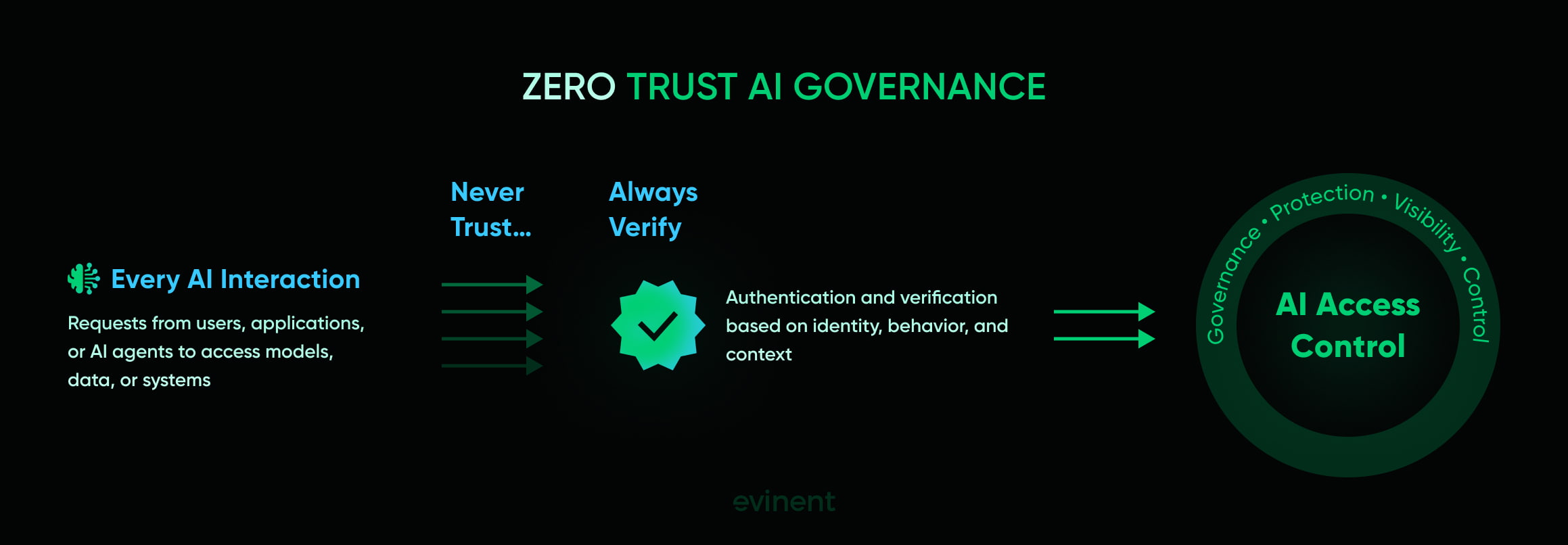
AI-Powered Phishing Attacks
One of the fastest-growing threats associated with AI adoption is the rise of AI-powered phishing attacks. Generative AI tools allow attackers to craft highly convincing messages, automate social engineering campaigns, and mimic legitimate communication patterns.
In a Zero Trust AI governance model, organizations treat every interaction, including internal communication and AI-generated outputs, as potentially malicious until verified. Security teams combine threat intelligence feeds with behavioral monitoring to detect anomalies such as unusual message patterns, suspicious login attempts, or abnormal data requests.
Continuous monitoring reduces the chances that AI-driven phishing campaigns can escalate into full system compromise.
Zero Trust AI Governance Framework
A Zero Trust AI governance framework establishes the policies, responsibilities, and oversight mechanisms that guide how AI systems are developed, deployed, and monitored.
This framework typically defines:
roles responsible for AI oversight
risk classification of AI applications
requirements for monitoring and auditing models
processes for reviewing new AI deployments
Governance frameworks ensure that security principles are applied consistently across all AI initiatives. They also create accountability structures so that teams understand who is responsible for monitoring risks and enforcing compliance.
Access Controls
Access control is a foundational mechanism in any Zero Trust architecture.
In AI systems, access controls determine who can interact with models, modify datasets, initiate training processes, or retrieve outputs. These permissions are often tied to identity management systems and enforced through role-based or attribute-based policies.
Strong access controls help prevent unauthorized use of AI systems and limit the exposure of sensitive data.
Automated Policy Enforcement
Manual security policies are difficult to maintain in large AI environments where models and datasets evolve constantly.
Automated policy enforcement allows organizations to embed security rules directly into the infrastructure. Policies may automatically block unauthorized data access, restrict risky s, or prevent models from interacting with unapproved external services.
Automation ensures that security rules are applied consistently and immediately across AI workflows.
Continuous Verification
Continuous verification is the operational core of Zero Trust.
Every request to an AI system, whether it originates from a user, application, or automated agent, is evaluated in real time. Systems verify identities, device posture, behavioral patterns, and contextual signals before granting access.
This constant validation reduces the likelihood that compromised credentials or malicious s will gain access to sensitive resources.
Incident Response Playbooks
Even with strong governance controls, security incidents may still occur.
Organizations implementing Zero Trust AI often develop incident-response playbookstailored to AI environments. These playbooks define step-by-step procedures for responding to incidents such as model manipulation, data leakage, or unauthorized AI usage.
Clear response procedures allow security teams to react quickly and minimize damage when threats emerge.
Integrity
Maintaining integrity across the AI lifecycle is critical. Integrity refers to the reliability and trustworthiness of both the data and the models that process it.
Zero Trust AI governance frameworks include mechanisms to verify dataset authenticity, monitor training pipelines, and detect unexpected changes in model behavior. These controls help prevent issues such as training data poisoning or unauthorized model modifications.
Least Privilege
The least privilege principle ensures that users and systems receive only the permissions necessary to perform their tasks.
In AI environments, this may involve limiting who can access training data, restricting the ability to deploy new models, or controlling which applications can query AI systems.
Reducing privileges helps contain potential breaches and prevents attackers from moving laterally across the infrastructure.
Responsible AI Implementation
Responsible AI practices focus on ensuring that AI systems operate ethically, transparently, and securely.
Within a Zero Trust framework, responsible AI implementation includes monitoring model outputs for bias or unexpected behavior, maintaining transparency about how models use data, and documenting decisions made by automated systems.
Responsible AI governance strengthens trust in AI-driven decisions while reducing regulatory and reputational risks.
Security Audits
Regular security audits help organizations verify that AI systems comply with governance policies and regulatory requirements.
Audits may review access logs, model training records, policy enforcement mechanisms, and system configurations. These reviews provide visibility into how AI systems are operating and help identify weaknesses before attackers can exploit them.
Security Awareness Training
Technology alone cannot eliminate AI-related risks. Employees must also understand how AI tools can introduce security vulnerabilities.
Security awareness training helps employees recognize phishing attempts, avoid sharing sensitive information with AI tools, and follow approved procedures for interacting with AI systems.
Educated employees form an important layer of defense against both accidental and malicious misuse of AI technologies.
Threat Intelligence
Finally, threat intelligence provides organizations with insights into emerging attack techniques targeting AI systems.
Security teams monitor intelligence feeds to identify trends such as new AI-driven phishing strategies, vulnerabilities in machine learning frameworks, or attempts to exploit generative AI systems.
By integrating threat intelligence into governance frameworks, organizations can adapt their defenses and maintain resilience as AI-related threats evolve.
Together, these governance and risk-management practices allow organizations to apply Zero Trust principles effectively across AI systems. Instead of treating AI security as a separate discipline, they integrate governance, monitoring, and response mechanisms directly into the operational infrastructure.
This integrated approach enables companies to innovate with AI while maintaining strong control over security, compliance, and organizational risk.
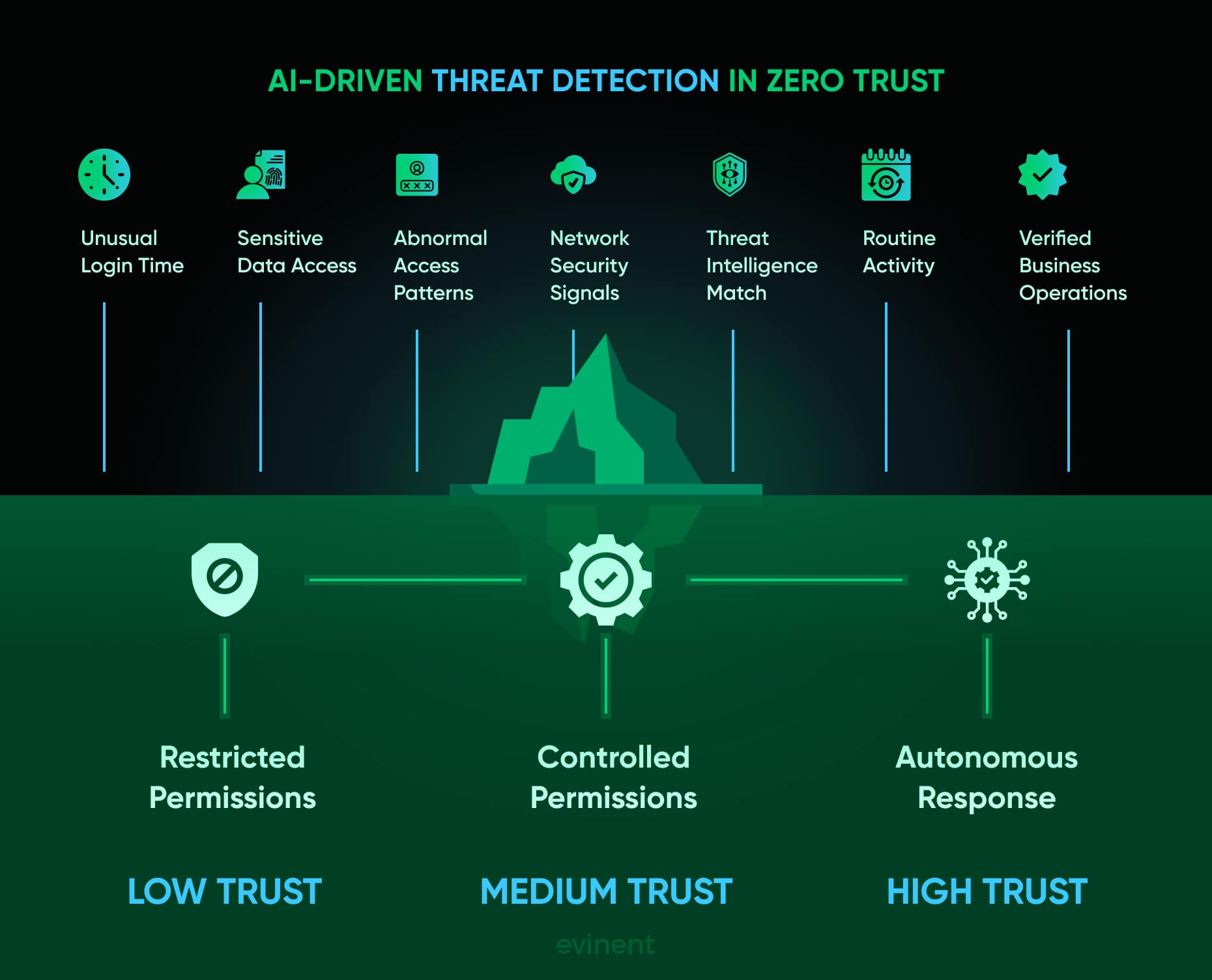
AI-Driven Threat Detection and Response in Zero Trust Environments
Modern cybersecurity environments generate an enormous amount of activity data. Every login attempt, API call, model query, and data transfer produces signals that may indicate either normal operations or the early stages of an attack. Traditional monitoring tools often struggle to analyze this volume of information quickly enough to identify threats before damage occurs.
This is where artificial intelligence becomes valuable for security teams. In a Zero Trust architecture, AI-driven threat detection and response systems analyze large streams of security data in real time, helping organizations detect suspicious behavior earlier and respond faster to potential incidents.
Instead of relying solely on predefined rules, AI systems learn patterns of normal activity across users, devices, applications, and networks. When behavior deviates from these patterns, the system can flag potential threats, trigger s, or initiate automated response actions.
Below are the key mechanisms through which AI strengthens threat detection and response within Zero Trust security environments.
AI-Enhanced Cyberattacks
While AI improves defensive capabilities, it also enables attackers to operate more efficiently. Security researchers increasingly observe AI-enhanced cyberattacks, where adversaries use machine learning and generative AI tools to automate reconnaissance, generate phishing messages, or identify system vulnerabilities.
In response, organizations deploy AI systems that continuously monitor user behavior, system activity, and network patterns. These systems can identify subtle anomalies that would otherwise go unnoticed, such as unusual login patterns or unexpected data access requests.
Recognizing how attackers use AI helps defenders design detection mechanisms that can identify these more sophisticated threats.
SIEM (Security Information and Event Management)
SIEM platforms collect and analyze security data from across the entire infrastructure. This includes logs from servers, applications, network devices, identity systems, and cloud platforms.
When combined with AI analytics, SIEM systems can correlate large volumes of data and identify relationships between seemingly unrelated events. For example, a suspicious login attempt, followed by unusual API requests and unexpected data downloads, may indicate a coordinated attack.
AI-enhanced SIEM tools help security teams detect these patterns more quickly than manual monitoring methods.
UEBA (User and Entity Behavior Analytics)
User and Entity Behavior Analytics (UEBA) focuses on detecting abnormal behavior from users, devices, and applications.
Instead of relying solely on static security rules, UEBA systems build behavioral baselines based on historical activity. These baselines allow the system to identify deviations such as unusual login times, unexpected geographic locations, or atypical access patterns.
Within a Zero Trust environment, UEBA supports continuous verification by constantly evaluating whether user behavior matches expected patterns.
Adversarial Attacks
AI systems themselves can become targets of attack. Adversarial attacks manipulate machine learning models by introducing carefully crafted inputs designed to produce incorrect or misleading outputs.
For example, attackers may attempt to manipulate AI-based fraud-detection systems or to bypass automated security controls.
Monitoring AI models for abnormal input patterns and unexpected outputs helps security teams detect these attempts early and maintain system reliability.
Automated Response Capabilities
Speed is critical when responding to cyber threats. Manual response procedures may take hours or even days to investigate and mitigate incidents.
AI systems enable automated responses, with predefined actionstriggered immediately when suspicious activity is detected. These actions may include blocking suspicious IP addresses, isolating compromised systems, or restricting access privileges.
Automation allows organizations to contain threats quickly while security teams conduct deeper investigations.
Continuous Authentication
In Zero Trust environments, authentication is not a one-time event. Continuous authentication verifies user identity throughout a session by evaluating behavioral signals such as typing patterns, device usage, and network context.
If user behavior suddenly changes in a way that suggests account compromise, the system can require additional verification or temporarily restrict access.
Continuous authentication helps reduce the risk that stolen credentials can be used to access sensitive systems.
Continuous Monitoring
Continuous monitoring ensures that all systems, networks, and applications are observed in real time.
AI analytics platforms continuously analyze system activity, looking for patterns that indicate security threats. Monitoring tools aggregate information from multiple sources, including infrastructure logs, user activity records, and model interactions.
This continuous visibility helps organizations identify emerging threats before they escalate into major security incidents.
Endpoint Data
Endpoints, such as employee laptops, mobile devices, and cloud workloads, are common entry points for cyberattacks.
AI-driven monitoring tools analyze endpoint data to detect suspicious activity such as unusual software execution, abnormal system behavior, or attempts to access restricted resources.
Analyzing endpoint activity provides valuable insight into potential threats and helps security teams detect attacks early in their lifecycle.
Incident Response Playbooks
Even with advanced detection tools, organizations still require clear procedures for responding to security incidents.
Incident response playbooks define the actions security teams should take when a threat is detected. In AI-enabled environments, these playbooks can be partially automated, allowing systems to initiate containment measures while analysts investigate the situation.
Playbooks help ensure that response efforts are consistent, coordinated, and aligned with organizational security policies.
Network Logs
Network logs provide detailed records of communication between systems and services. These logs include information about data transfers, connection attempts, and API requests.
AI systems analyze network logs to identify unusual traffic patterns, suspicious connections, or unexpected interactions between systems. These insights help security teams detect lateral movement within the network or attempts to access restricted resources.
Real-Time Threat Identification
One of the greatest advantages of AI in cybersecurity is the ability to support real-time threat identification.
Machine learning models can process large volumes of data and identify anomalies within seconds. This capability enables organizations to detect threats earlier than traditional monitoring systems, reducing the potential impact of security incidents.
Real-time analysis also supports proactive defense strategies, allowing organizations to block threats before attackers achieve their objectives.
Threat Intelligence Feeds
Effective security strategies rely on awareness of the broader threat landscape.
Threat intelligence feeds provide information about emerging attack techniques, malicious IP addresses, and newly discovered vulnerabilities. AI systems can integrate these feeds with internal monitoring tools, helping organizations detect threats that match known attack patterns.
Combining internal monitoring with external intelligence improves threat-detection accuracy and helps organizations adapt quickly to evolving cyber threats.
AI-driven detection and response systems play an increasingly important role in Zero Trust architectures. By analyzing vast amounts of security data, identifying unusual patterns, and triggering automated responses, these systems allow organizations to detect threats earlier and respond more effectively.
As cyberattacks become more sophisticated and AI-powered themselves, the ability to combine continuous monitoring, intelligent analysis, and automated response will be essential for maintaining secure AI environments.
Adaptive Access Controls and Identity Management in Zero Trust AI Environments
In traditional security architectures, access decisions are usually based on static rules. Once a user authenticates successfully, they often receive access permissions that remain valid for an extended period. This approach may work in relatively stable environments, but it becomes problematic when systems handle sensitive data, dynamic workloads, and autonomous AI agents.
Zero Trust architectures take a different approach. Access is evaluated continuously, and permissions depend on multiple contextual signals rather than a single authentication event. When artificial intelligence is introduced into this process, organizations can implement adaptive access controls that dynamically adjust permissions based on behavior, risk levels, and real-time context.
AI-driven identity management systems analyze patterns across users, devices, and applications to determine whether an access request is legitimate. Instead of relying solely on passwords or tokens, these systems incorporate behavioral signals, environmental context, and identity attributes to strengthen verification processes.
Below are several mechanisms that enable adaptive identity and access management within Zero Trust environments.
AI-Driven Access Control Systems
AI-driven access control systems use machine learning to analyze historical access patterns and detect anomalies in authentication behavior.
For example, if an employee normally logs in from a specific region during business hours, an attempt to access the system from another country at an unusual time may trigger additional verification. AI systems evaluate these contextual signals in real time, allowing organizations to block suspicious access attempts before they escalate into security incidents.
This dynamic decision-making process helps organizations respond more effectively to evolving threats.
Model Context Protocol (MCP) Security
As organizations deploy AI agents and autonomous systems, identity verification must extend beyond human users. AI systems themselves interact with internal APIs, databases, and services.
Model Context Protocol (MCP) security focuses on securing these interactions by verifying the identity and permissions of AI agents before they access resources. Each request from an AI model or agent can be validated against predefined policies that control which datasets or systems it is allowed to access.
This approach helps prevent unauthorized AI activity and ensures that automated systems operate within defined security boundaries.
Adaptive Access Controls
Adaptive access controls adjust authorization decisions dynamically based on contextual signals such as location, device health, network conditions, and user behavior.
Instead of granting permanent permissions, the system evaluates risk levels for each request. Low-risk activities may proceed without interruption, while high-risk situations may trigger additional verification steps, such as multi-factor authentication.
Adaptive access controls enable organizations to maintain security without significantly disrupting legitimate workflows.
Behavioral Analytics
Behavioral analytics plays a central role in adaptive identity verification.
Machine learning models analyze patterns of user behavior, including login frequency, application usage, typing patterns, and interaction sequences. These behavioral baselines allow the system to detect unusual activity that may indicate account compromise.
For example, if a user suddenly begins accessing datasets unrelated to their normal tasks, the system can flag the activity and restrict permissions until the request is verified.
Biometric Data
Biometric authentication methods add another layer of identity verification. Technologies such as fingerprint recognition, facial identification, and voice analysis allow systems to a user’s identity based on physical characteristics.
In Zero Trust environments, biometric data can complement traditional authentication methods. When combined with behavioral analytics and contextual information, biometric verification helps reduce the risk of credential theft or impersonation.
However, organizations must handle biometric data carefully to ensure compliance with privacy regulations and data protection standards.
Contextual Information
Access decisions in adaptive systems rely heavily on contextual information.
This may include factors such as:
device type and security posture
network location and IP reputation
time of access
recent authentication history
ongoing user behavior patterns
AI systems analyze these contextual signals to determine whether an access request aligns with normal activity or indicates potential risk.
Continuous Authentication
Traditional authentication typically occurs once during login. In Zero Trust architectures, identity verification continues throughout the session.
Continuous authentication systems monitor behavioral signals and contextual information during active sessions. If suspicious behavior appears, the system may request additional verification or terminate the session entirely.
This approach helps reduce the risk that stolen credentials can be used to maintain unauthorized access.
Fine-Grained, Identity-Based Policies
Adaptive access systems rely on fine-grained, identity-based policies that specify exactly what actions each identity can perform.
Rather than granting broad permissions, these policies define access at a detailed level. For example, a user may be allowed to view specific datasets but not modify them, or an AI agent may be authorized to query a model without retrieving underlying training data.
Fine-grained policies reduce the likelihood that compromised accounts can access sensitive resources.
Identity-Based Access Controls
Identity-based access controls focus on verifying the identity of the requesting entity before granting access.
These systems integrate with identity providers, authentication services, and security monitoring platforms to ensure that each request originates from a verified user or system.
By linking access permissions directly to identities rather than network location, organizations can maintain consistent security policies across cloud, on-premises, and hybrid environments.
Just-in-Time Access
Permanent administrative privileges create significant security risks. If privileged accounts are compromised, attackers may gain unrestricted access to critical systems.
Just-in-time access addresses this issue by granting elevated permissions only when required for a specific task. Once the task is completed, the privileges automatically expire.
This approach minimizes the window of opportunity for attackers to exploit privileged accounts.
Role-Based Access Controls (RBAC)
Role-based access controls (RBAC) assign permissions based on organizational roles rather than individual users.
For example, data scientists, security analysts, and system administrators may each receive different levels of access based on their responsibilities.
RBAC simplifies permission management and ensures that employees receive access appropriate to their roles while maintaining strong security controls.
Zero Standing Privileges
The principle of zero standing privileges eliminates permanent high-level permissions within the system.
Instead of maintaining persistent administrative rights, organizations grant privileges only when necessary and remove them immediately afterward. This strategy significantly reduces the risk associated with credential compromise and insider threats.
Adaptive access controls and AI-driven identity management are essential components of Zero Trust security architectures. By combining contextual analysis, behavioral monitoring, and dynamic authorization policies, organizations can strengthen identity verification while maintaining flexible access to critical systems.
As AI environments become more complex and autonomous, the ability to evaluate identity and access in real time will play a crucial role in protecting sensitive data and maintaining secure operations.
Advanced Analytics and Anomaly Detection in Zero Trust AI Environments
Modern enterprise systems generate massive volumes of operational and security data. Every login attempt, API request, model query, and network interaction creates signals that may reveal early indicators of compromise. Identifying meaningful patterns within this data is extremely difficult using traditional rule-based security monitoring alone.
Artificial intelligence and advanced analytics enable organizations to analyze this information more effectively. Within Zero Trust environments, AI-powered analytics systems continuously examine user behavior, system activity, and data flows to identify patterns that deviate from expected behavior.
Rather than focusing solely on known attack signatures, these systems build dynamic behavioral models that help detect subtle anomalies. When unusual activity appears, such as abnormal access patterns, unexpected model interactions, or unusual data transfers, security teams receive s that allow them to investigate potential threats early.
Below are several key analytical capabilities that strengthen anomaly detection and risk visibility in Zero Trust architectures.
Data Loss Prevention (DLP)
Data Loss Prevention (DLP) systems are designed to protect sensitive information from unauthorized access or accidental exposure.
In AI-driven environments, DLP tools monitor how data moves across systems, applications, and networks. Machine learning models analyze these data flows to identify suspicious activity such as large transfers of confidential files, attempts to access restricted datasets, or unusual interactions with AI models.
By detecting abnormal data movement patterns, DLP systems help organizations prevent data leakage and maintain control over sensitive information.
Security Information and Event Management (SIEM) Systems
Security Information and Event Management (SIEM) systems collect and analyze logs from across an organization’s infrastructure.
These systems aggregate information from servers, applications, network devices, identity platforms, and cloud services. When combined with machine learning analytics, SIEM platforms can correlate events across multiple sources to identify potential security incidents.
For example, unusual login attempts, suspicious API calls, and abnormal data downloads may indicate a coordinated attack. AI-enhanced SIEM tools help security teams detect such patterns quickly and investigate them before they escalate.
User and Entity Behavior Analytics (UEBA)
User and Entity Behavior Analytics (UEBA) systems focus on identifying abnormal activity among users, devices, and applications.
UEBA platforms build a baseline of normal behavior from historical activity data. Machine learning algorithms analyze patterns such as login frequency, access locations, system usage, and data retrieval behavior.
When activity deviates significantly from these established patterns, the system flags the event as potentially suspicious. Within Zero Trust architectures, UEBA supports continuous verification by constantly evaluating whether user and system behavior aligns with expected norms.
Advanced Persistent Threats (APTs)
Advanced Persistent Threats (APTs) are sophisticated attacks in which adversaries attempt to remain undetected within a network for extended periods.
These attackers often move slowly and carefully, avoiding detection while collecting information or preparing for larger attacks.
AI-driven analytics can detect subtle patterns associated with APTs, such as gradual privilege escalation, unusual data access sequences, or abnormal communication between systems. By identifying these indicators early, organizations can disrupt attacks before they cause significant damage.
Adversarial Attacks
AI systems themselves can become targets of malicious manipulation.
Adversarial attacks involve carefully crafted inputs designed to influence the behavior of machine learning models. Attackers may attempt to manipulate model outputs, bypass automated security systems, or extract sensitive information from AI models.
Monitoring input patterns and model responses helps security teams detect these attacks and maintain the reliability of AI-driven systems.
Automatic Countermeasures
When suspicious activity is detected, security systems may trigger automatic countermeasures.
These actions can include temporarily blocking suspicious connections, isolating compromised devices, restricting access privileges, or requiring additional authentication steps.
Automation helps organizations respond quickly to emerging threats while allowing security teams to investigate incidents more thoroughly.
Baseline for Normal Behavior
A critical component of anomaly detection is establishing a baseline for normal behavior.
Machine learning systems analyze historical activity data to determine what typical operations within the organization look like. These baselines include patterns related to login activity, data access, network traffic, and system interactions.
Once a baseline is established, deviations can be detected quickly, allowing security teams to identify potential threats that may otherwise remain hidden.
Behavioral Biometrics
Behavioral biometrics provide another layer of identity verification and anomaly detection.
These systems analyze patterns such as typing speed, mouse movement, navigation behavior, and device interaction patterns. Because these characteristics are difficult to replicate precisely, they provide valuable signals for detecting account compromise or impersonation attempts.
Behavioral biometrics are often integrated with continuous authentication systems in Zero Trust environments.
Continuous Authentication
Continuous authentication verifies user identity throughout the entire session rather than relying solely on a single login event.
Machine learning models evaluate behavioral signals and contextual information continuously. If suspicious activity appears, such as sudden changes in typing behavior or device usage, the system may request additional verification.
This approach helps prevent attackers from maintaining unauthorized access after initial authentication.
Continuous Monitoring and Auditing
Zero Trust security environments rely on continuous monitoring and auditing to maintain visibility into system activity.
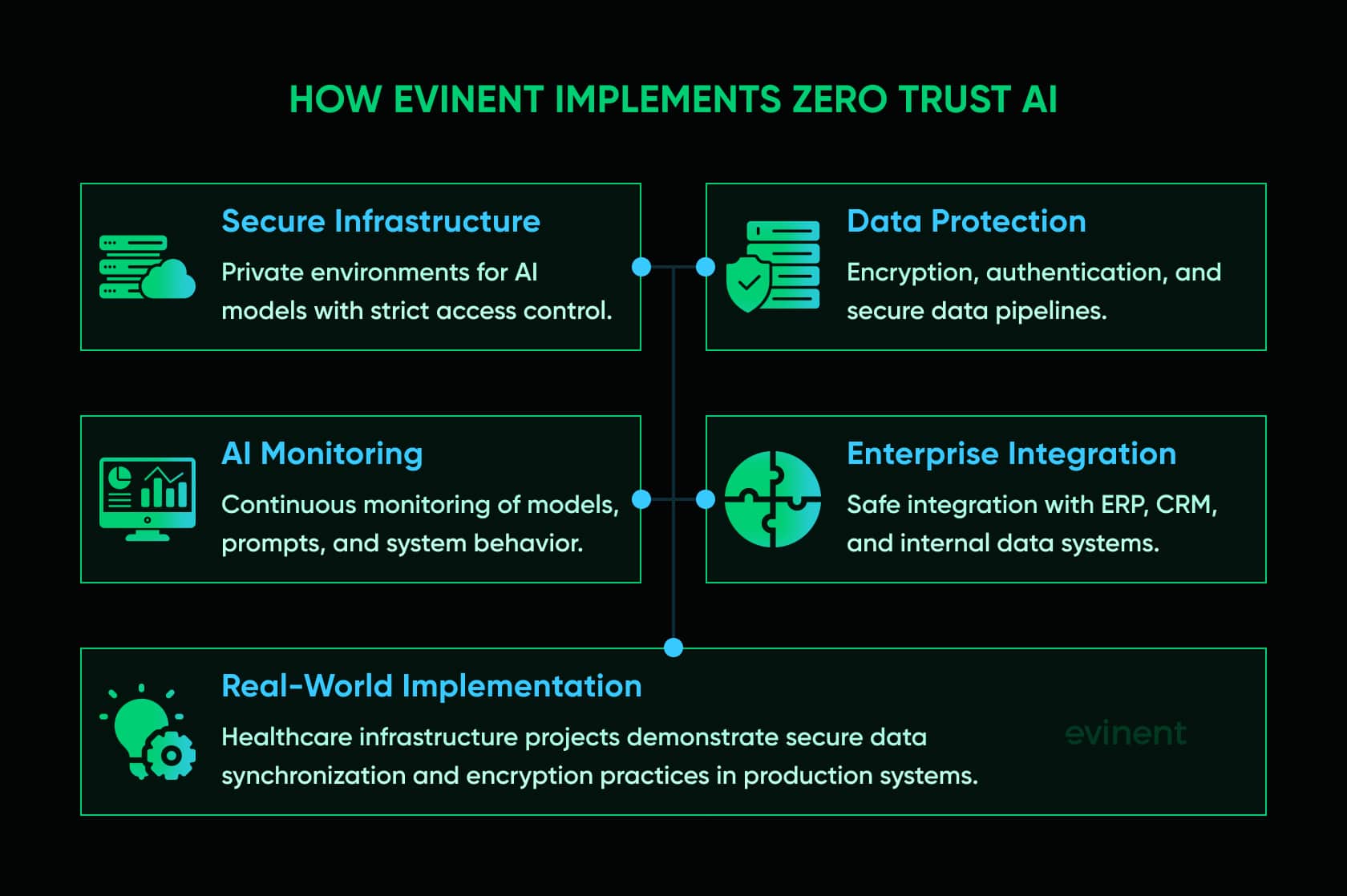
A practical example of a secure data infrastructure can be seen in Evinent’s project, where engineers implemented encrypted data transfers and controlled access mechanisms for sensitive healthcare data across multiple systems.
Security analytics platforms track events across applications, networks, endpoints, and AI systems. These logs provide a detailed record of interactions that security teams can analyze for suspicious behavior.
Continuous auditing also helps organizations demonstrate compliance with regulatory and security standards.
Machine Learning Algorithms
Machine learning algorithms power many modern cybersecurity analytics platforms.
These algorithms analyze large datasets to detect patterns that indicate potential threats. Supervised and unsupervised learning techniques help identify anomalies, classify suspicious events, and predict potential risks.
By learning from historical activity data, machine learning systems become increasingly effective at detecting previously unseen threats.
Model Theft and Inversion Attacks
AI models themselves represent valuable intellectual property and may contain sensitive information derived from training datasets.
Model theft attacks attempt to replicate proprietary models by repeatedly querying them and analyzing their outputs. Model inversion attacks attempt to extract sensitive training data from model responses.
Advanced analytics tools can detect unusual query patterns or excessive model interactions that may indicate such attacks.
Advanced analytics and anomaly detection play a critical role in Zero Trust AI environments. By combining behavioral monitoring, machine learning analysis, and automated response mechanisms, organizations gain deeper visibility into potential security threats.
This analytical layer allows security teams to detect subtle indicators of compromise, respond more quickly to suspicious activity, and maintain stronger protection for sensitive data and AI systems.
Automated Policy Enforcement and Compliance in Zero Trust AI Environments
As organizations expand their use of artificial intelligence, managing security policies and regulatory requirements becomes increasingly complex. AI systems interact with large datasets, automated workflows, and external services, creating numerous points where security controls must operate consistently.
Manually enforcing security policies across these environments is difficult and often unreliable. AI-driven security platforms can help address this challenge by automating policy enforcement and continuously monitoring compliance with internal governance standards and external regulations.
Within a Zero Trust architecture, automation ensures that security policies are applied consistently across every interaction involving users, devices, applications, and AI models. Instead of relying on periodic reviews or manual checks, systems evaluate compliance in real time and automatically enforce rules whenever a request violates policy.
Below are several mechanisms through which automation supports policy enforcement and regulatory compliance in AI-enabled environments.
AI Bill of Rights
The AI Bill of Rights outlines principles designed to protect individuals from harmful or unfair uses of artificial intelligence.
These principles emphasize transparency, fairness, privacy protection, and accountability in AI systems. Within enterprise environments, aligning AI governance frameworks with these principles helps organizations ensure that automated decisions remain responsible and explainable.
In Zero Trust environments, policy enforcement systems can monitor AI models for potential bias or misuse, helping organizations stay aligned with ethical AI standards and regulatory requirements.
AI Pipeline
The AI pipeline includes all stages of AI development and deployment, from data collection and model training to inference and system integration.
Security policies must operate across each stage of this pipeline. Automated monitoring tools can verify that datasets are handled appropriately, model training environments follow security standards, and deployed models operate within defined permissions.
Embedding security controls directly into the AI pipeline ensures that governance policies remain consistent throughout the lifecycle of an AI system.
Access Controls
Effective access controls remain a central element of security policy enforcement.
AI-driven policy engines evaluate access requests in real time based on identity, device posture, contextual signals, and predefined security policies. If a request violates access restrictions, the system can automatically block or restrict the action.
Automating these controls helps organizations maintain consistent security standards across complex infrastructure environments.
Algorithmic Discrimination Protections
AI systems can unintentionally produce biased or discriminatory outcomes if training data or model design introduces systemic bias.
Algorithmic discrimination protections focus on identifying and mitigating these risks. Automated monitoring tools analyze model outputs to detect patterns that may indicate unfair treatment of specific groups.
By integrating fairness checks into AI governance frameworks, organizations can reduce ethical risks and comply with emerging regulatory requirements related to responsible AI use.
Compliance Reporting
Maintaining regulatory compliance requires organizations to document how their AI systems operate and how security policies are enforced.
Compliance reporting tools automatically generate reports that track system activity, access events, policy enforcement actions, and security incidents. These reports help organizations demonstrate compliance with regulatory frameworks and internal governance policies.
Automation simplifies record-keeping and reduces the administrative burden on security teams.
Continuous Verification
A core principle of Zero Trust architectures is continuous verification.
Rather than granting permanent access privileges, systems verify every request in real time. AI-powered policy engines evaluate contextual signals, such as identity, location, device health, and user behavior, to determine whether access should be granted.
Continuous verification ensures that policy enforcement remains active throughout the lifecycle of each session.
Data Anonymization
Organizations must often process sensitive information during the training or deployment of AI systems. Protecting this data is critical for both privacy and regulatory compliance.
Data anonymization techniques remove or mask personally identifiable information from datasets. Automated tools can apply anonymization procedures before data enters AI pipelines, reducing the risk of exposing sensitive information.
This approach allows organizations to use data for analysis while maintaining strong privacy protections.
Encryption Measures
Encryption measures protect sensitive information both during transmission and while stored within systems.
Automated security platforms enforce encryption policies to ensure that data moving through AI systems remains protected from unauthorized access. Encryption also helps organizations comply with regulations that require strong data protection mechanisms.
Identity-Based Security
Identity-based security focuses on verifying the identity of users, devices, and services before granting access to resources.
In Zero Trust environments, identity verification is integrated directly into automated policy enforcement systems. These systems evaluate identity attributes, contextual signals, and behavioral patterns before allowing interactions with AI systems or sensitive data.
Identity-based security helps organizations maintain consistent control across cloud environments, on-premises systems, and hybrid infrastructures.
Policy Enforcement
Policy enforcement ensures that security rules are applied consistently across the entire organization.
Automated policy engines monitor system activity and enforce predefined rules whenever violations occur. For example, the system may block attempts to access restricted datasets, prevent AI models from interacting with unapproved services, or require additional authentication steps for high-risk actions.
Automation allows these controls to operate continuously without relying on manual oversight.
Regulatory Compliance
Organizations operating AI systems must comply with an increasing number of regulatory frameworks on data protection, security, and responsible AI use.
Automated compliance tools help organizations align their operations with these regulations by monitoring system behavior, enforcing security policies, and generating documentation required for regulatory reviews.
Automation helps organizations respond more effectively to evolving regulatory requirements while reducing the operational burden on security teams.
Security Audits
Regular security audits provide an additional layer of accountability within AI governance frameworks.
Automated auditing systems track system activity, policy enforcement actions, and access logs across the entire AI environment. These records allow organizations to review security performance and identify potential weaknesses before they lead to incidents.
Audit trails also provide evidence of compliance for regulators, partners, and internal stakeholders.
Automated policy enforcement and compliance management are essential components of modern Zero Trust architectures. By integrating AI-driven monitoring, automated policy engines, and continuous verification mechanisms, organizations can enforce security standards consistently across complex AI environments.
This automated governance layer enables organizations to maintain strong security controls while continuing to innovate and responsibly deploy AI systems.
Predictive Security and Future Trends in Zero Trust AI
Cybersecurity strategies are gradually shifting from reactive defense to predictive protection. Traditional security systems typically respond after a threat has already been detected. However, as cyberattacks become more complex and AI-driven, organizations increasingly rely on predictive technologies to anticipate risks before they cause damage.
Predictive security uses artificial intelligence to analyze historical activity patterns, identify emerging threats, and forecast potential vulnerabilities. In Zero Trust environments, this approach strengthens continuous verification and monitoring by allowing systems to recognize early warning signals that may indicate future security incidents.
By combining predictive analytics with Zero Trust principles, organizations can develop security strategies that go beyond simple detection to proactive threat prevention.
Below are several capabilities that illustrate how predictive security is shaping the future of AI-driven cybersecurity.
Backup Data
Reliable backup data remains a fundamental component of security resilience. Even with advanced predictive monitoring, organizations must prepare for the possibility that security incidents may still occur.
Automated backup systems ensure that critical data remains available if systems are compromised by ransomware, accidental deletion, or infrastructure failures. Predictive analytics can also monitor backup integrity, verifying that backup processes operate correctly and detecting anomalies that may indicate attempts to tamper with stored data.
Maintaining secure backups strengthens an organization’s ability to recover quickly from potential attacks.
Data Poisoning
One of the emerging risks associated with machine learning systems is data poisoning.
Attackers may attempt to manipulate training datasets by injecting malicious or misleading information. If successful, these changes can alter model behavior and produce inaccurate results.
Predictive monitoring tools analyze datasets and training processes to detect unusual patterns that may indicate tampering. Early detection allows security teams to isolate compromised datasets before they affect deployed AI systems.
Data Privacy Risks
AI systems frequently process large volumes of sensitive information, including customer records, operational data, and proprietary knowledge.
These systems may introduce data privacy risks if sensitive information is exposed through model outputs, misconfigured datasets, or insecure integrations with external systems.
Predictive security tools analyze how data flows across systems and identify patterns that could indicate potential privacy vulnerabilities. Detecting these risks early helps organizations maintain compliance with privacy regulations and protect sensitive information.
Emerging Threats
The cybersecurity landscape evolves continuously as attackers develop new techniques and tools.
Emerging threats may include novel malware variants, AI-assisted phishing campaigns, or new methods for exploiting machine learning systems. Predictive analytics platforms monitor threat intelligence sources and internal activity patterns to identify early indicators of these threats.
This proactive monitoring helps organizations adapt their defenses before new attack strategies become widespread.
Historical Data
Predictive security systems rely heavily on historical data.
Machine learning algorithms analyze past security incidents, user behavior patterns, system activity logs, and network traffic records. These datasets help establish patterns that allow predictive models to forecast potential risks.
By learning from historical security events, AI systems can identify subtle warning signs that may precede future attacks.
Pattern-Matching Ability
One of the strengths of artificial intelligence in cybersecurity is its pattern-matching ability.
Machine learning models can analyze large datasets to identify correlations and anomalies that may be difficult for human analysts to detect. These systems recognize complex relationships between events, helping organizations detect suspicious behavior earlier.
Pattern recognition allows predictive security systems to uncover hidden connections between seemingly unrelated activities.
Persistent Security Monitoring
Persistent security monitoring ensures that systems remain under constant observation.
Predictive analytics platforms analyze network activity, application interactions, and AI system behavior continuously. This persistent monitoring allows organizations to detect unusual activity quickly and respond before attackers can escalate their actions.
Continuous visibility across infrastructure environments is essential for maintaining strong Zero Trust security practices.
Predictive AI
Predictive AI refers to machine learning systems designed to forecast future events based on existing data.
In cybersecurity, predictive AI analyzes behavioral patterns, threat intelligence, and system activity to anticipate potential attack scenarios. These predictions allow organizations to strengthen defenses before threats materialize.
Predictive AI can also prioritize risks, helping security teams focus on the vulnerabilities most likely to be exploited.
Predictive Security
The concept of predictive security combines predictive analytics with automated security controls.
Instead of responding only after an attack occurs, predictive security systems analyze signals across networks, endpoints, and AI systems to anticipate risks in advance. When potential threats are detected, automated security mechanisms can strengthen monitoring, adjust access controls, or restrict risky activities.
This proactive approach allows organizations to maintain stronger security postures while reducing response times.
Real-Time Threat Detection
While predictive models analyze long-term patterns, security systems must also support real-time threat detection.
Real-time monitoring tools analyze system activity continuously and trigger s when suspicious behavior appears. When combined with predictive analytics, these tools allow organizations to respond both to immediate threats and to emerging risks.
Real-time detection remains a critical layer of defense in modern Zero Trust architectures.
Security Posture
An organization’s security posture reflects its overall ability to protect systems, data, and infrastructure from cyber threats.
Predictive analytics tools provide continuous insights into the organization’s security posture by analyzing vulnerabilities, user behavior, and system configurations. These insights help security teams identify weaknesses and implement improvements before they lead to incidents.
Maintaining a strong security posture requires continuous monitoring and proactive risk management.
Vulnerabilities
All digital systems contain vulnerabilities that attackers may exploit.
Predictive analytics platforms scan systems, applications, and infrastructure environments to identify vulnerabilities and evaluate their potential impact. By analyzing patterns across historical attack data and known exploit techniques, these systems can estimate which vulnerabilities are most likely to be targeted.
Prioritizing these risks allows organizations to allocate resources more effectively and strengthen their overall defenses.
Predictive security represents one of the most significant developments in modern cybersecurity strategy. By combining predictive analytics, continuous monitoring, and Zero Trust principles, organizations can move beyond reactive security models and develop proactive defenses that anticipate emerging threats.
As artificial intelligence continues to evolve, the integration of predictive analytics with Zero Trust architectures will likely play an increasingly important role in protecting complex digital environments.
Applying Zero Trust to AI Systems
Artificial intelligence systems introduce new layers of complexity into enterprise security environments. Unlike traditional applications, AI systems often rely on large datasets, dynamic models, automated agents, and interconnected pipelines that interact with multiple services across an organization’s infrastructure.
Applying Zero Trust principles to these environments means extending security controls beyond users and devices to include AI models, agents, training data, and inference pipelines. Instead of assuming that AI components operating within internal systems are trustworthy, Zero Trust architectures require verification for every interaction across the AI lifecycle.
This approach helps organizations reduce risks associated with data exposure, model manipulation, and unauthorized access to sensitive AI resources.
Below are several ways Zero Trust security concepts apply specifically to AI and machine learning systems.
AI Agents
AI agents are increasingly used to automate tasks such as data analysis, customer inquiry response, workflow execution, and interaction with internal systems.
Because these agents can operate autonomously and interact with multiple resources, they must be treated as active entities within the security architecture. Zero Trust environments apply identity verification and policy enforcement to AI agents just as they would to human users.
Each agent may receive a unique identity and operate within strict permission boundaries, ensuring that automated systems can access only the resources necessary for their tasks.
AI Pipelines
An AI pipeline includes the full lifecycle of an AI system, from data ingestion and model training to deployment and inference.
Each stage of this pipeline introduces potential security risks. Training datasets may contain sensitive information, model artifacts may represent valuable intellectual property, and inference endpoints may be exposed to external users.
Zero Trust architectures introduce verification checkpoints across the pipeline. Access to datasets, training environments, and model deployment systems is controlled through identity-based permissions and continuous monitoring.
These controls help prevent unauthorized access and maintain the integrity of AI workflows.
BYOAI Deployments
Many organizations now face a growing trend known as BYOAI (Bring Your Own AI). Employees may integrate external AI tools or services into internal workflows without formal approval from security teams.
While these tools may improve productivity, they also introduce significant security risks. Sensitive company data may be transmitted to external AI systems without adequate protection.
Zero Trust architectures help mitigate this risk by enforcing strict access controls, monitoring outbound data transfers, and restricting interactions with unapproved AI services.
Large Language Models (LLMs)
Large language models (LLMs) are widely used for content generation, code assistance, customer support, and knowledge retrieval.
Because LLMs often process natural-language s that may contain confidential information, they require robust governance and security controls.
Zero Trust principles ensure that interactions with LLMs are monitored and controlled. Access to models may be restricted based on identity, while s and outputs can be analyzed for potential exposure of sensitive data.
These controls help organizations prevent accidental or malicious disclosure of confidential information.
Zero Trust Architecture
The broader Zero Trust architecture provides the framework for securing AI systems.
Rather than relying on network boundaries, Zero Trust architectures enforce security policies based on identity verification, contextual signals, and continuous monitoring.
When applied to AI environments, these principles ensure that access to models, datasets, APIs, and AI-driven services is evaluated continuously.
Adversarial Attacks
AI systems may be targeted by adversarial attacks, where attackers attempt to manipulate model inputs or outputs.
These attacks can cause machine learning models to misclassify data, bypass security systems, or reveal sensitive information.
Zero Trust architectures mitigate these risks by monitoring model inputs, analyzing unusual query patterns, and enforcing strict access policies for AI inference endpoints.
Data Leakage
AI systems frequently process sensitive information, including proprietary data, customer records, and internal knowledge bases.
Without proper safeguards, AI models may inadvertently expose confidential information through their outputs.
Zero Trust environments reduce the risk of data leakage by controlling access to datasets, monitoring model interactions, and implementing automated data protection policies.
Data Poisoning
Data poisoning occurs when attackers manipulate training datasets to influence model behavior.
If malicious data enters the training process, the resulting model may produce incorrect or manipulated outputs.
Zero Trust architectures protect against this risk by enforcing strict controls over dataset access and verifying data integrity throughout the training process.
Identity-Based Access
Identity-based access control plays a central role in Zero Trust AI security.
Each entity interacting with AI systems, whether a human user, application, or AI agent, is assigned a verifiable identity. Access permissions are then granted based on this identity rather than network location.
This approach ensures that every interaction with AI systems is authenticated and authorized before access is granted.
Least Privilege
The principle of least privilege ensures that users and systems receive only the permissions necessary to perform their tasks.
In AI environments, this may involve restricting access to specific datasets, limiting the ability to modify models, or controlling which systems can query AI services.
Reducing unnecessary permissions helps minimize the impact of compromised accounts or malicious activity.
Overlay Architecture
Many organizations implement Zero Trust security using an overlay architecture.
Rather than replacing existing infrastructure, security controls are layered on top of current systems. Identity verification, monitoring tools, and policy engines operate across networks, applications, and AI environments.
This approach allows organizations to adopt Zero Trust principles gradually while maintaining compatibility with existing systems.
Zero Trust Security Model
The Zero Trust security model provides the foundation for securing modern AI environments.
By requiring continuous verification, strict access controls, and ongoing monitoring, this model helps organizations maintain stronger security across complex AI infrastructures.
As AI systems become more integrated into business operations, applying Zero Trust principles will be essential for protecting data, maintaining model integrity, and ensuring the safe deployment of AI technologies.
Operational Efficiency and Scalability Through AI in Zero Trust Environments
As organizations expand their digital infrastructure, security operations become increasingly complex. Modern enterprises operate across cloud platforms, edge devices, and on-premises systems, all while managing large volumes of users, applications, and automated workflows. Maintaining consistent security controls across these environments can be difficult using traditional manual processes.
Artificial intelligence offers a way to manage this complexity more effectively. AI-driven systems can automate routine security tasks, analyze operational data at scale, and coordinate responses across distributed infrastructure. When combined with Zero Trust principles, these capabilities help organizations maintain strong security controls while improving operational efficiency.
Instead of relying solely on human intervention, AI systems support scalable security architectures that continuously enforce policies, monitor activity, and coordinate responses across interconnected environments.
Below are several ways AI technologies contribute to operational efficiency and scalability within Zero Trust implementations.
AI Factories
Large-scale AI environments are sometimes described as AI factories, where data pipelines, machine learning models, and automated systems work together to generate insights and operational decisions.
These environments require robust orchestration and monitoring to ensure that AI systems operate securely and efficiently. AI-driven management tools help coordinate workflows across data pipelines, compute infrastructure, and security controls.
Within Zero Trust environments, AI factories benefit from continuous monitoring and automated policy enforcement that ensures all components operate within defined security boundaries.
NVIDIA BlueField
Technologies such as NVIDIA BlueField illustrate how hardware innovation can support scalable security architectures.
BlueField data processing units (DPUs) allow organizations to offload networking, security, and storage tasks from the central CPU to specialized hardware. This approach improves performance while enabling advanced security capabilities, such as encrypted-traffic inspection and infrastructure-level monitoring.
When integrated with Zero Trust architectures, hardware-assisted security can strengthen identity verification, network segmentation, and policy enforcement without slowing application performance.
Robotic Process Automation (RPA)
Robotic Process Automation (RPA) enables organizations to automate repetitive operational tasks.
In cybersecurity operations, RPA can assist with tasks such as reviewing security s, managing access requests, updating policy rules, and generating compliance reports. Automation reduces the administrative workload for security teams and allows them to focus on higher-value tasks such as threat investigation and strategic planning.
Within Zero Trust frameworks, RPA tools can also help enforce identity verification processes and automate responses to suspicious activity.
Xage Fabric
Platforms such as Xage Fabric demonstrate how distributed security architectures can scale across complex infrastructure environments.
Xage Fabric uses blockchain-inspired technology to maintain a decentralized identity and access management system. This approach allows organizations to enforce Zero Trust policies across industrial systems, IoT devices, and distributed networks.
Such architectures help maintain security even in environments where connectivity may be intermittent or infrastructure is geographically distributed.
Detecting Anomalous User Actions
AI systems are particularly effective at detecting anomalous user actions that may indicate compromised accounts or insider threats.
Machine learning algorithms analyze patterns of user behavior across applications, devices, and network activity. When unusual activity appears—such as unexpected data access patterns or abnormal login sequences—the system can trigger s or restrict access.
Automating anomaly detection allows organizations to respond quickly to suspicious activity while maintaining visibility across large user populations.
Securing Cloud, Edge, and On-Prem Environments
Most modern organizations operate across cloud, edge, and on-prem environments, each with its own infrastructure and security requirements.
AI-driven security platforms help unify monitoring and policy enforcement across these environments. By analyzing system activity and contextual signals across distributed infrastructure, AI systems maintain consistent security policies regardless of where resources are located.
This unified visibility helps organizations enforce Zero Trust principles consistently across hybrid and multi-cloud environments.
Identity-Based Security
Identity-based security underpins Zero Trust architectures.
AI-powered identity management systems continuously verify user identities, evaluate behavioral patterns, and dynamically adjust access permissions. These systems can analyze contextual information such as device health, location, and login behavior to determine whether an access request should be allowed.
Automating identity verification helps organizations maintain secure access controls even as their infrastructure scales.
Least Privilege
The least privilege principle ensures that users and systems receive only the permissions necessary to perform their tasks.
AI-driven policy engines can automatically adjust permissions based on role changes, behavior patterns, or evolving risk levels. If suspicious activity is detected, access privileges may be temporarily restricted until additional verification occurs.
Automated privilege management helps reduce the risk associated with compromised accounts and insider threats.
Multi-Agent Workflows
AI environments increasingly rely on multi-agent workflows, where multiple AI systems collaborate to perform complex tasks.
For example, one AI agent may collect data, another may analyze it, and a third may trigger operational actions. Managing security across these workflows requires coordination between multiple systems and services.
Zero Trust architectures ensure that each AI agent operates with verified identity and restricted permissions, preventing unauthorized access or misuse of resources.
Protect Surfaces
The concept of protect surfaces focuses on identifying the most critical assets within an organization, such as sensitive datasets, core applications, and key infrastructure systems.
Zero Trust strategies prioritize securing these protect surfaces by implementing strict access controls, monitoring interactions, and limiting unnecessary exposure.
AI-driven analytics help identify these critical assets and monitor their access across the organization.
Secure Orchestration
Managing security across distributed systems requires effective secure orchestration.
AI-powered orchestration tools coordinate security policies, automate response procedures, and ensure that monitoring systems operate consistently across environments. These tools help organizations enforce Zero Trust principles across complex infrastructure without overwhelming security teams.
Unified AI Control
As AI adoption expands, organizations require centralized visibility into how AI systems operate across the enterprise.
Unified AI control platforms provide oversight across models, agents, pipelines, and infrastructure. These platforms allow security teams to monitor system activity, enforce governance policies, and detect anomalies across the entire AI ecosystem.
Centralized visibility helps organizations maintain operational control as AI deployments scale.
Artificial intelligence plays a critical role in improving both the efficiency and scalability of Zero Trust security architectures. By automating routine operations, analyzing system activity across distributed environments, and coordinating security policies across AI systems, organizations can maintain strong security controls while supporting growing infrastructure demands.
As AI technologies continue to evolve, integrating intelligent automation with Zero Trust principles will be essential to maintaining resilient, scalable cybersecurity strategies.
How Evinent Supports Zero Trust AI Implementation
Adopting Zero Trust principles in AI environments requires more than simply adding new security tools. Organizations must redesign how identities are verified, how models interact with data, and how policies are enforced across complex infrastructure. For many companies, the challenge is not understanding the concept of Zero Trust, but implementing it effectively across existing systems, AI pipelines, and business workflows.
This is where Evinent can support organizations building secure AI platforms.
Evinent works with companies that operate complex digital environments, platforms where data, applications, and AI models interact across multiple systems. The goal is not only to introduce new AI capabilities, but also to ensure that these systems operate securely, reliably, and in compliance with governance requirements.
Below are several ways Evinent helps organizations implement Zero Trust AI architectures in practice.
Designing Secure AI Architectures
Zero Trust AI begins with architecture. AI systems must be designed so that every interaction between users, models, agents, and data sources, is verified continuously.
Evinent helps organizations design AI architectures where:
identities are verified before accessing models or datasets
data pipelines include integrity checks and monitoring
AI agents operate within clearly defined permission boundaries
access policies apply consistently across cloud and on-prem systems
Instead of treating AI as a separate layer, security controls are embedded directly into the AI infrastructure.
Securing AI Pipelines and Data Flows
AI systems depend on data pipelines that collect, process, and transform large volumes of information. These pipelines often integrate with databases, analytics platforms, APIs, and third-party services.
Evinent helps organizations secure these pipelines by implementing:
identity-based access controls for datasets
encryption and monitoring of data transfers
anomaly detection for unusual pipeline activity
verification mechanisms that prevent data poisoning or unauthorized data access
By securing each stage of the pipeline, organizations can protect both their data and the models trained on that data.
Integrating Zero Trust with Existing Systems
Many organizations already operate complex infrastructures that include legacy systems, cloud platforms, and internal applications. Implementing Zero Trust AI often requires integrating new security capabilities without disrupting existing workflows.
Evinent’s engineering teams focus on gradual integration strategies, allowing organizations to adopt Zero Trust principles while maintaining operational continuity.
Typical integration work may include:
connecting identity providers with AI platforms
introducing policy engines for access control
integrating monitoring systems with AI services
enabling secure orchestration across distributed environments
This approach allows companies to strengthen security without rebuilding their entire infrastructure.
Enabling AI-Driven Security Monitoring
Zero Trust environments rely heavily on continuous monitoring and analytics. AI-driven monitoring tools can analyze system activity, user behavior, and data flows to detect anomalies or potential security risks.
Evinent helps organizations implement monitoring systems capable of:
analyzing logs and network activity
detecting unusual AI model interactions
identifying suspicious access patterns
supporting automated security response workflows
These capabilities allow organizations to identify threats earlier and maintain visibility across complex AI environments.
Case Study: Modernizing Enterprise Systems with Secure AI Integration
One example of Evinent’s approach comes from a modernization project involving legacy enterprise infrastructure.
In this case, the client operated a large software platform built on outdated technology. The system contained critical business data but lacked modern security and monitoring capabilities. The company also wanted to introduce AI-driven analytics to improve operational insights.
Evinent’s team helped modernize the platform while implementing stronger security controls. The project involved:
migrating legacy components to a more secure architecture
improving identity verification and access control mechanisms
integrating monitoring tools capable of analyzing system activity
enabling analytics capabilities while protecting sensitive data
This modernization effort allowed the organization to adopt AI-driven insights without compromising security or operational stability.
Supporting Responsible AI Adoption
Beyond technical implementation, organizations must also address governance, compliance, and ethical considerations when deploying AI systems.
Evinent supports responsible AI adoption by helping organizations implement:
governance frameworks for AI systems
monitoring for bias or unexpected model behavior
documentation and audit trails for AI decisions
security policies aligned with regulatory requirements
These practices help ensure that AI systems operate transparently and responsibly while maintaining strong security controls.
Building Secure and Scalable AI Platforms
As AI adoption continues to grow, organizations must ensure that their systems remain secure and scalable. Zero Trust architectures provide a strong foundation for this goal, but successful implementation requires careful planning, integration, and ongoing monitoring.
By combining software engineering expertise with AI development experience, Evinent helps organizations build secure AI platforms where innovation and security evolve together.
Instead of choosing between security and technological progress, organizations can design AI systems that support both security and technological progress.
FAQ
What is Zero Trust AI?
Zero Trust AI is the application of Zero Trust security principles to artificial intelligence systems, including machine learning models, data pipelines, and AI agents. Instead of assuming that internal systems are trusted, Zero Trust AI requires continuous verification of identities, data access, and system interactions. Every request to an AI model, dataset, or infrastructure component must be authenticated, authorized, and monitored.
This approach helps organizations protect sensitive data, prevent unauthorized access to AI systems, and reduce the risk of model manipulation or data leakage.
Why is Zero Trust important for AI systems?
AI systems often process sensitive data and interact with multiple services across distributed environments. Without strict access controls and monitoring, these systems can become entry points for cyberattacks.
Zero Trust helps mitigate risks by ensuring that:
access to models and datasets is verified continuously
users and systems receive only the minimum permissions required
unusual activity is detected and investigated quickly
AI pipelines remain protected from data manipulation or unauthorized changes
By enforcing these controls, organizations can safely scale AI adoption while maintaining strong security practices.
What risks does Zero Trust AI help prevent?
Zero Trust AI architectures help organizations address several emerging security risks related to artificial intelligence, including:
data leakage from training datasets or s
model theft or reverse engineering
data poisoning attacks that manipulate training data
unauthorized access to AI systems or APIs
malicious injection attacks
By verifying every interaction and monitoring system behavior, organizations can detect threats earlier and limit the potential impact of attacks.
How does identity-based access work in Zero Trust AI?
Identity-based access control ensures that every user, application, or service interacting with an AI system is authenticated and authorized before access is granted.
Instead of relying on network location or implicit trust, Zero Trust AI environments verify:
who is requesting access
what resource they want to access
whether the request aligns with defined security policies
Permissions are often granted using least privilege principles, meaning users only receive the access necessary to perform their tasks.
Can Zero Trust AI work with existing enterprise infrastructure?
Yes. Most organizations implement Zero Trust AI gradually rather than rebuilding their entire infrastructure. Security controls can be integrated with existing systems such as identity providers, cloud platforms, analytics tools, and enterprise applications.
Typical implementation steps include:
integrating identity-based access controls
securing data pipelines and model access
introducing monitoring and anomaly detection tools
applying security policies across cloud and on-prem environments
This phased approach allows companies to strengthen security while maintaining operational stability.
What industries benefit most from Zero Trust AI?
Zero Trust AI is particularly valuable in industries that handle sensitive or regulated data, including:
healthcare
financial services
retail and e-commerce
government and public sector
telecommunications
In these sectors, protecting customer data, preventing fraud, and maintaining regulatory compliance are critical priorities.
How can organizations start implementing Zero Trust AI?
Organizations typically begin by evaluating how their AI systems interact with data, users, and infrastructure. This assessment helps identify potential vulnerabilities and areas where stronger security controls are needed.
Common starting points include:
mapping AI data flows and model interactions
implementing identity-based access controls
securing training datasets and AI pipelines
introducing monitoring systems to detect anomalies
Working with experienced engineering teams can help organizations design and implement Zero Trust AI architectures that align with both technical requirements and business goals.
Share


