

What is E-commerce Search Bar?
The e-commerce search bar is a must-have feature of any online store, a tool that customers can use quickly and easily to find the products they are looking for. Besides simplifying product discovery, it also elevates the user experience to the next level and is instrumental in conversions. A tightly-knit search bar goes beyond being a mere query input box — it operates as a tactical instrument that effectively facilitates customer-product interaction, therefore, lowering the customer journey friction and revealing shopper behavior and market demand trends.
Having a robust e commerce search function is like having a fast lane for users where they find what they want in no time, thus, they will stay longer on the site and are more likely to convert.
In This Article, We Will Explore:
Definition and Functionality of E-commerce Site Search – how search engines operate behind the scenes
Importance and Benefits of E-commerce Search Bars – the impact on user experience, conversions, and business performance
Best Practices for Search Bar Design and Placement – tips for visibility, layout, labeling, and s
Key Features and Functionalities of Smart Search Solutions – AI capabilities, autocomplete, filtering, and typo handling
Personalization and User Experience in Site Search – tailoring results to individual customer behavior and intent
Reporting and Analytics for E-commerce Site Search – KPIs, search insights, and optimization strategies
Search Bar Optimization Techniques – dynamic ranking, autocomplete, query categorization, and zero-result recovery
Overview of E-commerce Site Search Solution Providers – market leaders and solution comparisons
How Evinent Can Help with Site Search Implementation – integration process, AI personalization, and measurable outcomes
Best Practices for E-commerce Search Bar Design and Placement
In case users are not able to quickly identify the ecommerce search box, they leave the site. The three main factors that form the basis of an efficient search UX are visibility, clarity, and usability. By means of correct positioning, easy-to-understand hints, and helpful search features, customers are made to get their requirements fulfilled with least possible work.
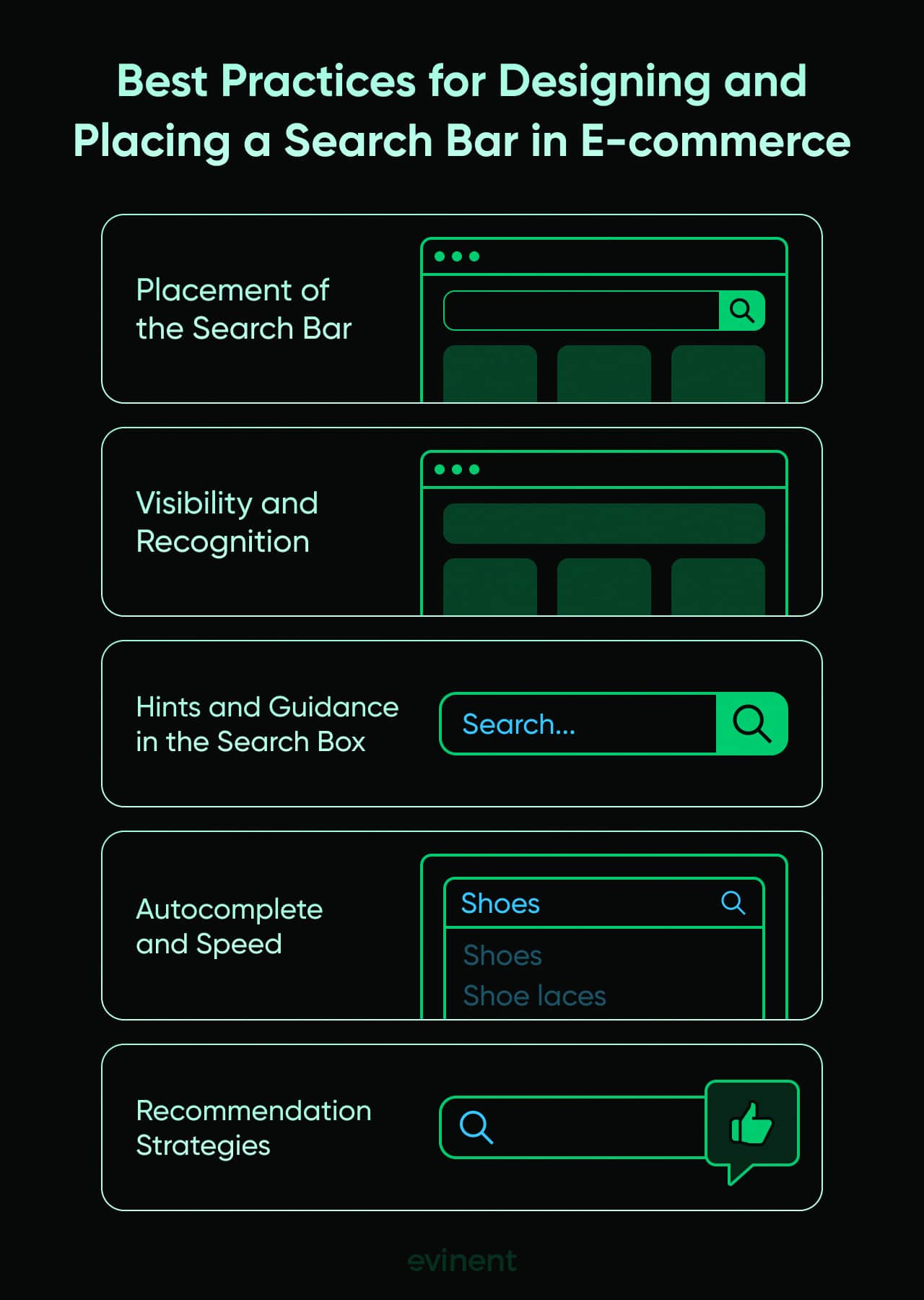
Placement
Top navigation or hero section would be the ideal location for the search bar to be placed, as this is where users would naturally look for it. Specifying a search area distinctly makes it easier for visitors to find what they want quickly, lowers the interaction effort, and thus, the most interested users are navigated directly towards product discovery.
Search bar visibility
It doesn’t need to be full-width, but it must stand out visually. Adequate search box width, contrast, and spacing ensure the field is seen immediately. A recognizable icon, thoughtful search button labeling, and consistent styling enhance usability.
s and guidance
Hints in the search box—like “Search by product, SKU, or category”—give the users an idea of the features of the tool. Intelligent s additionally motivate the users to experiment with filters, product attributes, or SKU-based searches.
Autocomplete and speed
Autocomplete is a factor that contributes to both the speed and the decision-making of a person. When a website's ecommerce search tools are equipped with features such as spell correction, recommended terms, and instant suggestions, users can get the items they are looking for more quickly. If filtering choices are also available in the autosuggest, then a user can further narrow down his or her search with minimal effort.
Recommendation strategies
Integrating recommendation strategies into the search experience—such as trending products, popular queries, personalized suggestions, or category shortcuts—transforms the search bar into a product discovery engine. These enhancements search more than a utility; they turn it into a dynamic merchandising asset.
To sum up, a properly designed search bar ponders upon the aspects of being seen, easy to use, and having smart features which help users find what they need quickly, and hence leads to more users checking out the rest of the website without direct navigation.
Definition and Functionality of E-commerce Site Search
An up-to-date online shop search engine is not only about matching keywords. It takes in product data, SKUs, attributes, synonyms, misspelled words, and user intent to provide quick, precise, and relevant results. Excellent site search turns into the main tool of product discovery and has a significant impact on customer satisfaction and the rate of conversion.
How it works
Systems for site searches usually include indexing of the whole product catalog, that is they take into consideration not only the titles but also the descriptions, categories, SKUs, attributes, and related phrases. Having such a structured index available to the engine enables it to be very fast in terms of returning the most relevant items, even from the big catalogs.
UX connection
Search directly affects user experience. When search is missing, slow, or poorly configured, users quickly lose patience and leave the site. A reliable search bar ecommerce experience keeps visitors engaged and helps them move smoothly through the buying journey.
Search engine as a strategic tool
For major brands, search is more than just a way for users to find their way through the site; it is also a key factor in increasing user engagement and sales. The use of intelligent ranking algorithms, personalization, and promotional options is a powerful tool that can significantly increase the brand's income.
Role of relevance and ranking
E-commerce search is largely dependent on ranking algorithms that assess product quality, textual relevance, popularity, attributes, and behavioral data. The more advanced the ranking logic, the more precise the engine is in grasping the shopper's real intent.
Handling search complexity
Today, search engines are equipped with features like typo tolerance, synonyms, concept search, semantic understanding, and category-aware matching. As a result, these engines can deliver relevant results instead of empty responses for vague or inaccurate queries.
In short, an online store site search is a mix of catalog data, relevance logic, UX principles, and clever algorithms to make the user's product search quick and efficient. Properly set up, it turns into a great instrument for both customer delight and company expansion.
Importance and Benefits of E-commerce Search Bars
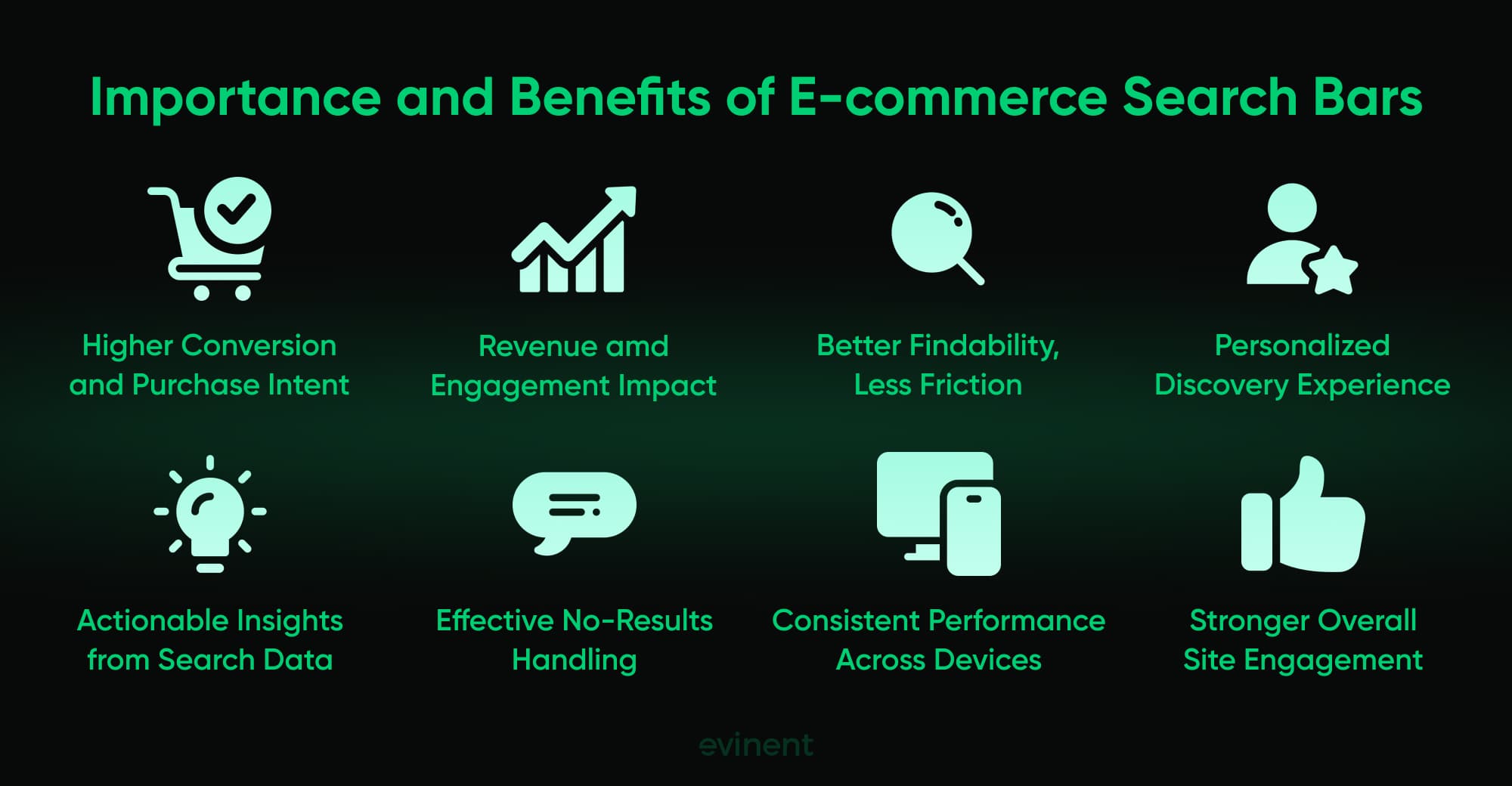
1. Higher Conversion Potential and Stronger Buying Intent
Visitors who use internal search typically show much clearer purchase intent than those who only browse categories. A refined search box — with strong visibility, fast responses, and relevant suggestions — helps these users reach the exact product faster, increasing the likelihood of completing a purchase.
2. Disproportionate Impact on Revenue and Engagement
It's true that not every visitor uses the search function. However, those who actually use it tend to add more products to their carts, view more items, and make a purchase decision more quickly. Consequently, optimizing the search box is a tactical move that should be at the top of the list of revenue teams, rather than just a simple UX enhancement.
3. Improved Findability and Reduced Frustration
A strong search experience ensures that users quickly locate specific products, SKUs, variations, or attributes. It reduces friction, prevents dead-end journeys, and minimizes the frustration that occurs when customers cannot find what they need — especially on large catalogs. Poor search experiences lead to frustration: 12% of users will bounce to a competitor after unsatisfactory search results, and 68% of users report frustration with search when it fails to return accurate results.
4. Personalized User Experience and Smarter Discovery
Contemporary site search solutions integrate user personalization, recommendation methods, and ranking algorithms that modify results according to each user's preferences. Thus, users obtain a customized experience, relevancy is heightened, and users are incentivized to browse the product catalog further.A large proportion of consumers (70%) are more likely to complete a purchase when search results are personalized
5. Actionable Business Insights from Search Behavior
Search queries reveal what shoppers are actively looking for — including terms, brands, attributes, and sizes. Monitoring no results pages and repeated search refinements helps uncover catalog gaps, indexing issues, and opportunities to improve ecommerce product search data or add new items.
6. Better Control Over No-Results Scenarios
Nowadays, most sophisticated search engines have features such as spell correction, synonym handling, and fallback logic to ensure that users are not stuck in a dead end. In case of a no-hit query, rather than displaying a blank page, they display alternatives, popular items, or relevant suggestions to keep the session alive and lower the abandonment rate.
7. Enhanced Performance Across Devices, Especially Mobile
Good search design supports usability on all screen sizes. Clear search box visibility, easy tapping areas, and mobile-friendly predictive suggestions make the path to purchase faster and reduce drop-offs during mobile shopping sessions.
8. Stronger Overall Site Engagement
When shoppers find relevant items quickly, they explore more categories, interact with filters, and make more informed decisions. High-quality search encourages further browsing and reduces the number of users who leave the site after a single interaction.
A well-designed ecommerce search bar significantly enhances both user satisfaction and business performance. It improves findability, creates a more personalized and efficient shopping journey, and provides essential insights for ongoing optimization. When supported by strong search UX, clear visibility, and smart relevance logic, the search bar becomes a central driver of conversions, revenue, and long-term customer retention.
Key Features and Functionalities of E-commerce Search Solutions
By using AI, semantic understanding, and user-focused capabilities, a robust e-commerce search engine can provide quick, accurate, and personalized product discovery. Here are the key, game-changing features that a contemporary search system must be able to support.
Feature | Description |
AI-powered ranking | Machine learning adjusts result order based on behavior, conversions, and product performance to surface the most relevant items. |
Autocomplete & instant suggestions | Predicts queries, offers suggestions, and displays instant product previews to accelerate discovery. |
Semantic search & NLP | Understands intent, meaning, synonyms, plurals, and conversational queries instead of relying on simple keyword matching. |
Typo & spell correction | Automatically fixes misspellings and near matches, preventing unnecessary zero-result pages. |
SKU & attribute-based search | Supports SKU lookups and recognizes attributes such as color, size, brand, and material within user queries. |
Faceted filtering | Helps users refine results through essential filters like brand, size, color, price, and category. |
Dynamic re-ranking | Adjusts results in real time based on availability, popularity, trends, or personalization signals. |
Merchandising controls | Enables teams to boost products, manage ranking rules, and highlight promotional items. |
Personalized recommendations | The firm modifies the outcome by browsing through history, buying habits, and client segments. |
Zero-result recovery | Suggests alternative queries, related products, or corrections to keep users engaged. |
Search analytics | Tracks searches, zero-result terms, CTR, and conversions to guide continual improvement. |
Such a search engine is a tremendous facilitation for customers to browse through the catalog. They can quickly and easily find the items that are relevant to them, with less than a handful of clicks. As a result, the navigation is more user-friendly, customers are more involved, and the online store enjoys better overall results.
Overview of E-commerce Site Search Solution Providers
Choosing the correct site search tool is a must if you want to enhance product discovery, e-commerce user experience, and conversion rates. There are both heavy-duty engines and simple, quick-to-launch instruments available in the market. Here is the current review of the most talked-about solutions — beginning with Evinent Search — and the features that distinguish each.
Evinent Search — multi-functional ecommerce site search
Evinent Search is designed to help ecommerce stores add robust search without programming. It integrates with your online store in minutes, provides faceted filters out of the box, and adapts to business needs with customizable search algorithms. The solution supports voice search, synonyms, customized autocomplete suggestions, product recommendations, and UI customization based on store preferences. Evinent’s infrastructure can manage millions of search requests, and the service includes technical support throughout setup and use.
Algolia — API-first search and discovery platform
Algolia is known for providing lightning-fast search operations and having a robust developer ecosystem. The system supports highly advanced keyword suggestions, has strong ranking and recall algorithms, and also allows for very flexible relevance tuning. Merchandisers are able to implement very detailed boosting rules, whereas UX teams get the advantage from the tools, which make the search box more visible and help to keep the indexing consistent even if the catalog is large.
Elastic (Elasticsearch) — flexible, scalable search engine
Elastic offers a scalable site search solution for complex catalogs. It supports deep filtering options, item number search, synonym handling, and multilingual queries. With detailed analytics, teams can identify low-performing searches and improve overall findability, ensuring a smoother site search experience across product and content pages.
Bloomreach — enterprise ecommerce search and personalization
Bloomreach offers a unified commerce experience platform powered by AI that features site search, merchandising, personalization, and analytics. The company focuses on using behavioral data and personalization techniques to deliver search results and product recommendations. Bloomreach is good for big catalogs and intricate UX personalization requirements.
Klevu — semantic ecommerce search with AI-based relevance
Klevu delivers a strongly automated and personalized site search experience. It includes self-learning relevance models, dynamic product recommendations, autocorrect, and rich faceting filters. The platform is popular among mid-size brands aiming to improve UX performance without extensive technical resources.
Ecommerce search providers differ in the features they emphasize and the functionalities they offer. For instance, Evinent Search is a solution that focuses on quick integration and customizable search logic with faceting and UI options that are ready for use. While Algolia and Elastic position themselves as extremely scalable and developer-friendly platforms, Bloomreach and Klevu are marketing the most attractive personalization and semantic relevance features. The correct decision of a solution depends on the complexity of the catalog, the required performance, the UX goals, and the need for analytics.
Personalization and User Experience in Site Search
Personalized site search changes results for each user by using signals such as search history, browsing history, and customer data. Various levels—from simple keyword suggestions to complex audience segmentation and intent-based ranking—have a different impact on relevance, engagement, and conversion. The following table compares these different personalization levels.
Level | What It Includes | How It Works | User Impact |
Basic Personalization | • Keyword suggestions based on popular queries • Simple search history recall • Generic product recommendations (bestsellers, trending) | Uses minimal customer data, mostly on-site behavior from the current session | Faster navigation, reduced effort, but still not tailored to individual preferences |
Intermediate Personalization | • Browsing history-based ranking • Query refinement using basic ranking algorithms • Category-aware suggestions | Combines past visits with session behavior to adjust site search results | More relevant products, higher chance of finding items within fewer clicks |
Advanced Personalization | • Adaptive audience segments • Implicit personalization with behavioral modeling • Intelligent product recommendations tied to user journey | Uses deeper signals from customer data + behavioral patterns across the entire customer journey builder | Very customized outcomes that seem natural; considerably more engagement and conversions |
AI-Driven Personalization | • Predictive search intent understanding • Real-time dynamic re-ranking • Contextual suggestions across devices and sessions | Learns from long-term behavior, cross-device patterns, and large data sets | Perfectly smooth “the site knows what I want” experience; highest possible relevance with the least user input |
Website tailored searches changes the way a customer navigates a site. Using behavioral signals, segmentation, adaptive relevance, and predictive assistance simultaneously, brands create search journeys that appear to be natural, time-saving, and specially made for each shopper.
Reporting and Analytics for E-commerce Site Search
Knowing the way visitors interact with the search bar is a must if you want to upgrade the shopping experience. The data discloses the things users seek, the level of efficiency with which they find them, and the spots where the search might be malfunctioning. Such knowledge allows companies to implement data-driven strategies for improving product discovery, making the navigation user-friendly and boosting conversions.
Reason 1: Identify Most Searched Products
Monitoring most searched products helps teams understand customer priorities and inventory demand. Insights from on-site search reports allow merchandising teams to optimize listings, adjust merchandising rules, and ensure high-demand items are prominently featured.
Reason 2: Improve Ranking and Relevance
Analyzing search performance supports better ranking of the results. Using ML algorithms or historical commerce data, stores can refine algorithms to surface more relevant items, reduce zero-result queries, and enhance the overall personalized search experience.
Reason 3: Understand Customer Journey
These search analytics are a great tool to understand the exact way that users go through the customer journey. Noticing when people use the search box, what they click on, and the queries they make gives a clear idea of their intent as well as their pain points. Therefore, stores will be able to top up with UX and smooth the purchasing process if they consider this information.
Reason 4: Support Personalization
Personlization strategies are powered by search data. Companies can customize product suggestions and enhance predictive search functions by analyzing search queries with NLP and user behavior. This way, they make results more relevant and engaging for each customer.
Reason 5: Optimize Marketing and Business Decisions
Integrating Google Analytics and internal reporting allows companies to correlate search behavior with conversions, revenue, and engagement. This empowers data-driven decisions about promotions, inventory, and merchandising, aligning search optimization with broader business goals.
Regularly analyzing site search analytics empowers businesses to refine relevance, enhance personalization, and make strategic decisions. Clear insights from search activity directly improve user satisfaction, product discovery, and overall conversion performance.
Search Bar Optimization Techniques
Search bar optimization is a repeated cycle that gradually eases the process of finding a product and leads users to make quicker decisions. Basically, every move in this list is targeted at lessening the work, making the results more accurate, and stopping situations where users cannot find what they are looking for and hence leave the site.
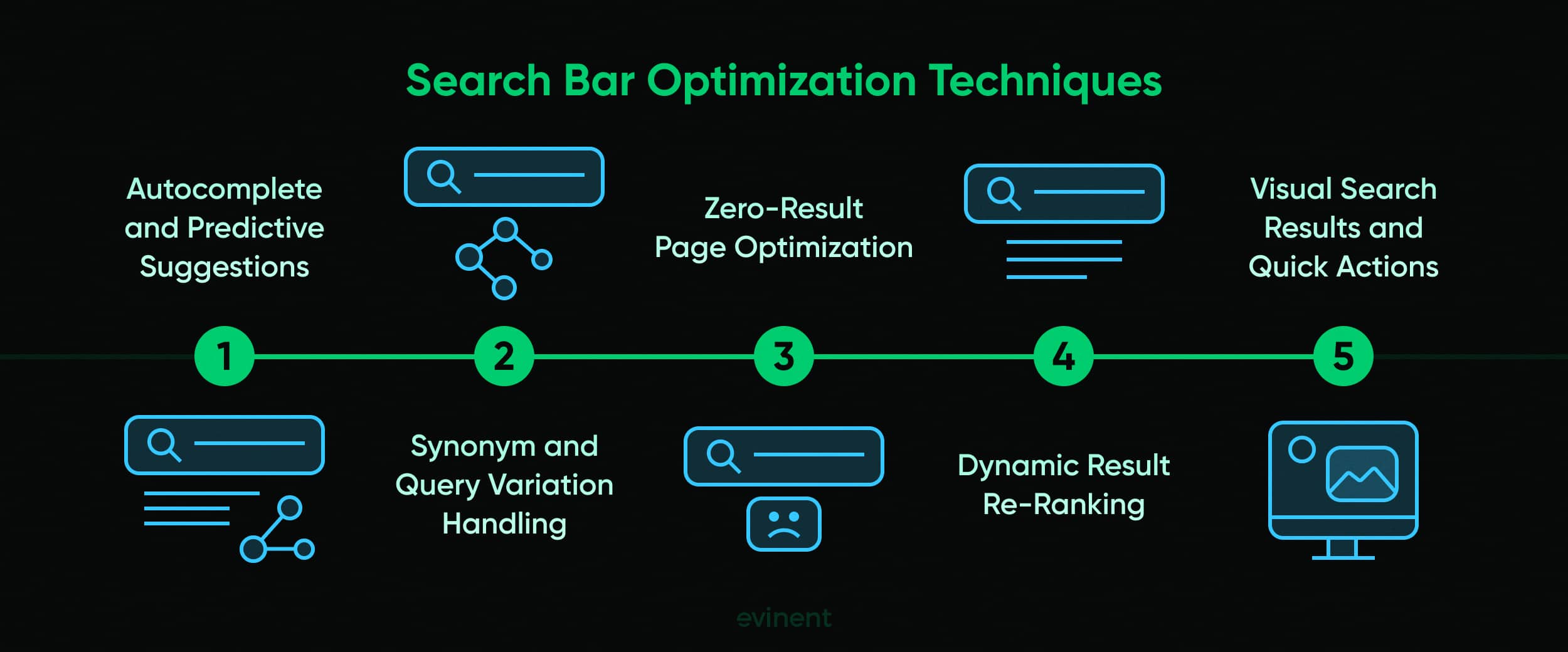
Step 1: Enable Autocomplete and Predictive Suggestions
Implement autocomplete and advanced search autocomplete features to help users complete queries faster and reduce typing effort. Predictive suggestions should include popular products, categories, and support query categorization to clarify intent early.
Step 2: Handle Synonyms and Query Variations
Support Synonyms, plurals, and alternative phrasing to ensure consistent results regardless of how a user formulates a query. This prevents missed matches and improves overall relevance, especially for long-tail searches.
Step 3: Optimize Zero-Result Pages
Ideally, zero-result pages that are carefully designed in a proper manner should not be final pages at all. To maintain the interest of users and lead them back to the products that might be of their use, you can offer them other choices, give them related categories, and allow them to use the filtering options.
Step 4: Reorganize and Re-rank Search Results Dynamically
Implementing dynamic re-ranking and search results restructuring according to popularity, availability, and user behavior. This guarantees that the most relevant items are the ones to appear first and also brings result personalization in line.
Step 5: Enhance Results with Visuals and Actions
Include images in search queries, visible pricing, and clear add-to-cart buttons directly in search results. This reduces clicks, speeds up decisions, and keeps users on on-brand pages throughout the search experience.
A stepwise method of search optimization changes the search bar into an effective conversion tool. The use of eCommerce teams to combine predictive input, intelligent ranking, recovery strategies, and visual clarity can greatly increase usability, engagement, and revenue generated by the search.
How Evinent Can Help with Site Search Implementation on Your Site
Evinent works with eCommerce businesses to change site search into a growth driver that can be measured. By having thorough technical knowledge and a product that is designed for quickness, accuracy, and large volume, we keep it simple for advanced search to go live, under your control, and yielding results from the very first day.
Why Choose Evinent
Evinent is not a simple vendor you can plug-and-play with generic features. We are a technology partner focused on high-load online commerce and delivering real business results.
15+ years of software and analytics engineering for complex eCommerce environments
20M+ active users interacting daily with our recommendation engines and decision systems
100% project delivery success rate, including large, multi-regional deployments
78% of our portfolio is focused on enterprise eCommerce across the US, EU, and MENA
Such experiences equip us to create search solutions that not only function consistently at large scale but also are flexible with typical business limitations.
What Evinent Search Delivers
Evinent Search is a clever, multi-functional site search solution aimed at making product discovery easy and increasing revenue.
Helps increase eCommerce sales by up to 30% by returning more relevant results
Improves conversion by guiding customers to the right products from their very first query
Enhances customer understanding to support more personalized and value-driven experiences
Works with high request volumes without performance degradation
Evinent Search is a clever, multi-functional site search solution aimed at making product discovery easy and increasing revenue.
How We Implement Search
We remove technical friction and handle the full implementation process.
Quick integration: Adding site search is a matter of minutes; no complex setup or custom development is needed
Full technical ownership: the installation, configuration, and validation are managed by our team
Customized search algorithms: the relevance logic is adjusted to your catalog structure, business rules, and customer behavior
Continuous tuning: search efficiency is getting better all the time due to the increasing number of user interactions
This approach ensures that search works reliably from launch and evolves with your store.
Built for Growth and Conversion
Evinent Search is designed to support fast decision-making and reduce user effort.
Accurate handling of spelling corrections and imperfect queries
Intelligent result ordering aligned with business priorities
Search results that encourage faster engagement and confident purchases
A consistent, high-quality user experience across devices and markets
Evinent blends time-tested engineering skill with a down-to-earth, outcome-focused search product. When you pick Evinent, you don't simply get a search bar; rather, you acquire a scalable search system that makes your eCommerce growth sustainable as it enhances relevance, increases conversions, and promotes the continuity of eCommerce over the long term.
Learn how Evinent Search makes it easy for your customers to locate the products they want. Initiate a free trial or schedule a demo.
Key Takeaways
We clarified that an e-commerce search bar is not just a navigation element but a core conversion tool for high-intent shoppers.
Search users convert faster, spend more, and generate a disproportionately large share of revenue compared to browsing-only visitors.
We explored how site search works by indexing product catalogs, attributes, SKUs, synonyms, and misspellings to return relevant results.
Search bar visibility, placement, and usability directly affect whether users stay on the site or leave.
We reviewed how modern smart ecommerce search features like autocomplete, typo tolerance, and result previews reduce friction and speed up purchasing decisions.
Personalization improves search UX by aligning results with user intent, behavior, and preferences.
We examined how search analytics reveal demand patterns, zero-result failures, and opportunities to optimize merchandising and content.
Ongoing search optimization turns the search bar into a fast conversion path rather than a support feature.
We compared search solution providers based on relevance quality, performance, control, and analytics depth.
We concluded that a structured implementation approach, such as Evinent’s, helps search evolve into a long-term growth driver.

Share