

What Is Customer Data Collection?
Customer data collection is the organized approach that seeks to obtain detailed information about users' identities, their purchasing methods, their likes, and their interactions with digital platforms. Data is no longer a mere supporting element in today's e-commerce; rather, it has become the main business asset. The competition among companies is not solely based on who offers a better product range or lower prices; it's about which company has a deeper understanding of its customers and can make the most precise predictions of their needs.
Business data collection means the acquisition of demographic details, lifestyle patterns, purchase activities, feedback, and customer engagement from various digital channels. After the data is dissected, the companies get a chance to work out efficient user journeys, offer personalized suggestions, and estimate the upcoming demand.
Data is like the main fuel for strategic moves, one-to-one marketing, specific campaigns, and regular performance checks. By means of the data, a company is able to determine its ROI, diversify segmentation, and foresee changes in customer behavior. Without the data, business can't carry out these activities.
In this article, we will cover:
How data supports accurate business decision-making and performance analysis
Methods and tools used for collecting customer information across channels
Improved targeting, segmentation, and marketing personalization
Optimization of internal data operations and secure data management
Development of personalized user experiences and predictive recommendations
Trust, transparency, and compliance with data privacy standards
A deeper understanding of behavioral patterns and customer intent
Legal and ethical obligations tied to data use and storage
Core business and benefits of data collection for consumers
Business Decision-Making and Performance Analysis
Why do companies collect information about consumers? Customer data enables businesses to evaluate their actions objectively rather than reactively. By tracking user behavior, purchase frequency, and funnel movement, teams understand where revenue grows or declines. This turns analytics into a basis for revising pricing, improving product structure, and adapting communications. Data replaces assumptions with verifiable indicators, ensuring every strategic shift is grounded in measurable performance outcomes.
Data-Backed Decision Making
Data-backed decision-making means using measured, verified performance metrics to drive business actions rather than just going by intuition. Companies look at conversions, return rates, and engagement depth to figure out which tactics generate real, measurable value. The process helps to lower risks, make the planning more accurate, and get different departments on the same page with shared, measurable goals. The decision-making process, thus, gets transformed from being a spontaneous or market-trend dependent one to a more structured, documented, and repeatable one.
KPI Monitoring and Performance Dashboards
KPI monitoring helps identify correlations between behavior and results in real time. Dashboards consolidate average order value, churn indicators, cost per acquisition, and segment movement to provide an immediate operational snapshot. This visibility helps detect early inefficiencies before they escalate, adjust budgets, and correct campaigns. Stable KPI observation supports consistent performance oversight and controlled long-term growth scaling.
Forecasting and Historical Data Analysis
History is a source of understanding for future results. When the records of category peaks, repeat buyer cycles, and seasonal purchasing are kept, forecasting gets its foundations from the user activity that has occurred prior. Predictive models are instrumental in inventory adjustment, promotion alignment with demand windows that have been verified, and overspending avoidance during periods of low conversion. Consequently, this method diminishes the level of variation, raises the precision of cost prediction, and is conducive to solid financial planning going across departments and quarters.
Customer Segmentation as a Strategic Tool
Segmentation transforms raw data into structured customer groups defined by value, activity, timing, and intent. Targeting then becomes precise rather than broad, reducing advertising waste and increasing relevance. High-value segments receive differentiated messaging and retention programs, while early-stage buyers get onboarding support. Segmentation ensures resources are distributed proportionally to potential revenue impact, strengthening operational efficiency and personalization depth.
Reporting and ROI Tracking
ROI tracking makes it clear which moves create lasting value and which just consume resources. Reporting brings together cost, audience quality, retention speed, and profit contribution into one consolidated overview. Departments juxtapose channels, tweak budget levels, and optimize acquisition routes. This openness gets rid of the uncertainty and brings to the fore those touchpoints that yield the highest returns. Hence, marketing gets structured and geared towards income generation rather than being a mere trial.
Structured performance analysis ensures that growth decisions are not reactive but predictable and measurable. By combining KPIs, segmentation, forecasting, and ROI tracking, ecommerce data collection companies develop a continuous improvement cycle grounded in verified results. Data transforms strategy from assumption-driven to outcome-driven, leading to clear prioritization, optimized spending, and sustained competitive positioning.
Data Collection Methods and Tools
E-commerce companies depend heavily on the systematic collection of data to understand user behavior, their purchase patterns, and their response to digital experiences. So, how to analyze customer data? Here are a few methods: Direct tracking, user feedback, and automated systems, when used together, open up the avenue for the large-scale capture of behavioral and engagement data. These approaches safeguard precision, lessen the chances of manual inconsistencies, and offer a dependable base for subsequent analysis, refinement, and the assessment of performance over time.
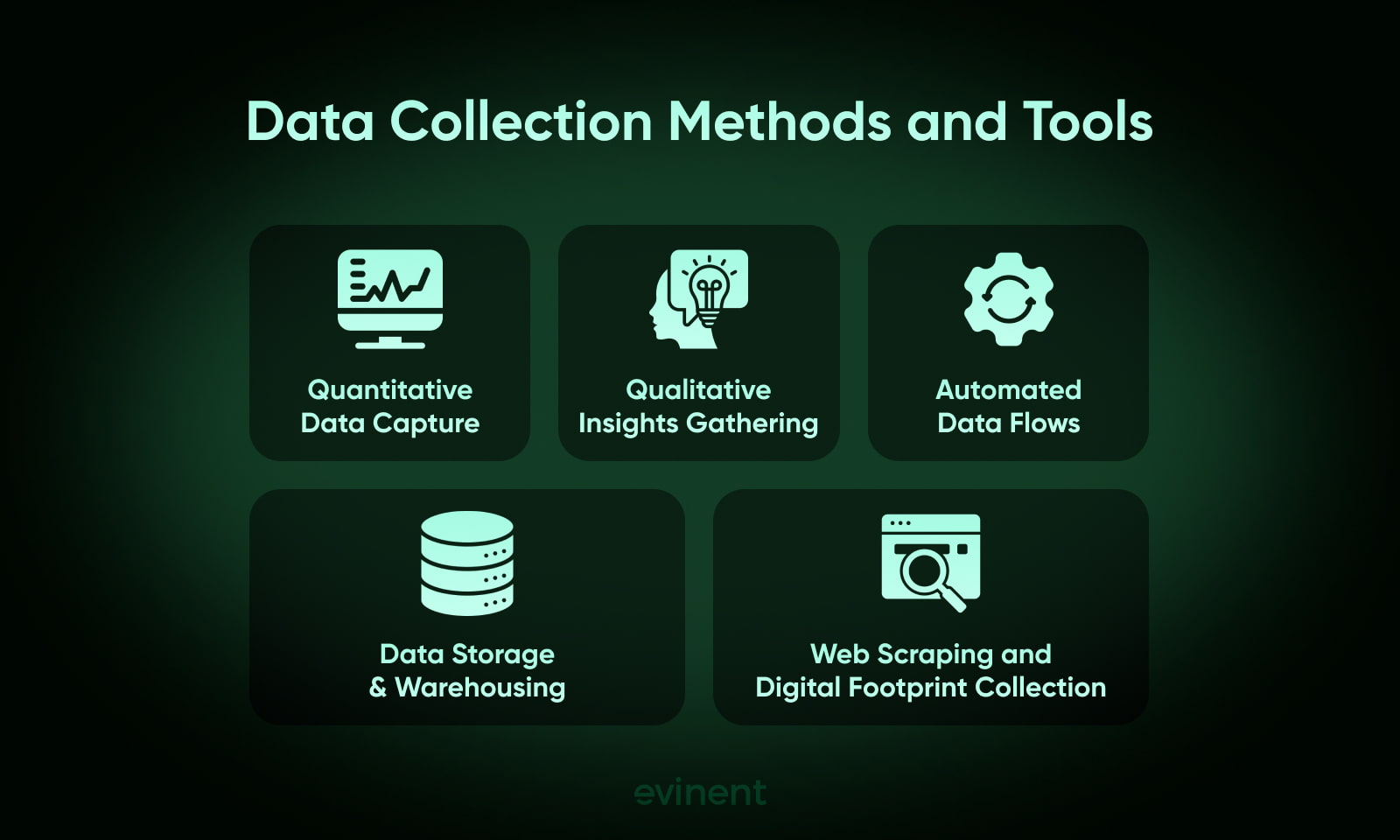
Quantitative Data Collection
Quantitative data reflects measurable behavior on digital platforms. Clickstream reports show navigation sequences and browsing interruptions, while transactional logs highlight purchase frequency, average order value, and product affinity. Heatmaps visualize cursor hesitation and areas that are abandoned. By examining these numeric indicators, companies detect conversion gaps and interpret which interface elements support motivation versus which cause disengagement or s in the checkout journey.
Qualitative Data Collection
Qualitative data reveales human perception and reasonings behind the numerical data. Surveys show satisfaction levels, interviews reveal the factors that influence decisions, and focus groups disclose the most common expectations. User feedback is the clearest way to understand the feeling that is behind the phenomenon of abandoned carts or low product interaction. These revelations point to the reasons that are beneath the behavioral patterns and give the teams a way to understand the mood, trust levels, and friction points without the need of conversion scores and dashboard outputs.
Automated Data Pipelines
Automated pipelines standardize incoming records, remove duplicates, and ensure consistent formatting for analysis. They handle session logs, engagement signals, and purchase data without manual extraction. This structure prevents loss of behavioral insights caused by fragmented systems and allows analysts to run queries faster. Pipelines also support model training and attribution accuracy by maintaining uninterrupted data flow between collection tools and storage environments.
Data Warehousing and Storage
Information warehouses are the main storage units of the past interaction records, transactional results, and engagement metrics. They keep a stable structure, secure retention periods, and controlled access rules. Well storage enables departments to do period comparison, trend mapping, and retrospective segmentation. Thanks to organized retention, businesses are saved from overwrite conflicts, losing records, and double extraction, thus they can be sure of their forecasting and performance benchmarking.
Scraping Tools and Digital Exhaust
Scraping utilities and digital exhaust capture public behavioral traces, such as product mentions, competitor interaction, or external browsing habits. These tools expand context beyond owned platforms, showing how customers evaluate alternatives before making a purchase. Combined with first-party logs, scraping inputs reveal awareness triggers and external influence points. This helps companies detect demand shifts earlier and adapt campaigns before conversion impact occurs.
Five methods—quantitative tracking, qualitative feedback, automated pipelines, warehousing, and digital exhaust extraction—form a complete and reliable customer data ecosystem. Together, they reveal behavior, motivation, external influence, and operational issues. This balanced approach strengthens accuracy, supports forecasting, and ensures that performance decisions are informed by both human interpretation and structured measurement, not limited assumptions or isolated analytics snapshots.
Optimizing Marketing with Customer Insights
Reset of the day: targeting is not a 'who clicked the banner' guessing game anymore. Ecommerce customer data and analytics track customers' behavior through identifiers, put them in demographic clusters, and use real-time engagement signals to deliver the offers to the exact place where the consumer is ready to buy. The main idea behind it is not to pump up the volume of the message, but to make the match more accurate: less budget, more relevant, and with a return that can be measured.
From Mass Ads → Precision Influence
Old Logic | Data-Driven Logic |
Blast everyone with the same promo | Tailor message variants to value segments |
Budget spread thin across channels | Spend concentrated where conversion probability spikes |
Guessing user interest | Proof-based targeting via clickstream + purchase history |
This shift keeps reach wide but relevance narrow, which is where conversion, not noise, grows. |
Who Gets What and Why
First-time visitors → soft onboarding, expectation shaping
Returning browsers → nudge logic and timed reminders
Category-loyal buyers → curated drops and exclusives
Discount-driven users → price elasticity s
VIP lifetime buyers → retention luxury, not acquisition spend
Segmentation stops describing audiences and starts directing investment.
When Targeting Becomes Timing
A shopper views sneakers three times without adding to cart → price-anchored alternatives appear.
A premium buyer lingers over limited editions → scarcity-driven release s.
A loyalty member browses accessories post-purchase → add-on bundles emerge automatically.
This isn’t personalization as decoration — it is persuasion aligned with micro-behavioral triggers.
Message Variants That Shape Demand
Customer Behavior | Data Cue | Response Strategy |
High clicks, no checkout | friction detected | reassurance scripts, free return banners |
Cart abandon | pricing sensitivity | flexible offers, phased discounting |
Multiple repeats on specs | product curiosity | deeper details + expert review modules |
Social engagement spikes | emotional appeal | narrative-led brand ads |
Copy stops being universal and becomes situational through analytics. |
ROI: Attribution as Budget Weapon
Better targeting is of importance only if it results in a money flow: i.e., the tracing of which campaign firstly touched, which convinced, and which finally converted the buyer. Attribution changes marketing from being a cost into a controlled revenue-generating activity - this means that every tactic is tagged, every segment is measured, and every dollar spent is accounted for.
Marketing that is effective and well-targeted depends heavily on the ability to convert gathered data into feasible and quantifiable steps. Through the use of segmentation, behavioral signals, personalization, and attribution tracking, companies become capable of delivering each message to the most suitable audience at the optimal time. Such a strategy goes beyond just increasing the ROI; it also elevates the customer relationship, lowers the budget that is wasted on ineffective channels, and ensures that the campaigns are in line with the revenue generated from them.
Optimizing Internal Processes of Data Collection
Why do companies collect data? Efficient data collection goes beyond the mere gathering of information—it is essentially about designing processes that help the company to function better from within, lessen the number of mistakes, and facilitate the growth of the organization. Here are some of the ways to optimize your data workflow, maintain compliance, and make the most of business intelligence.
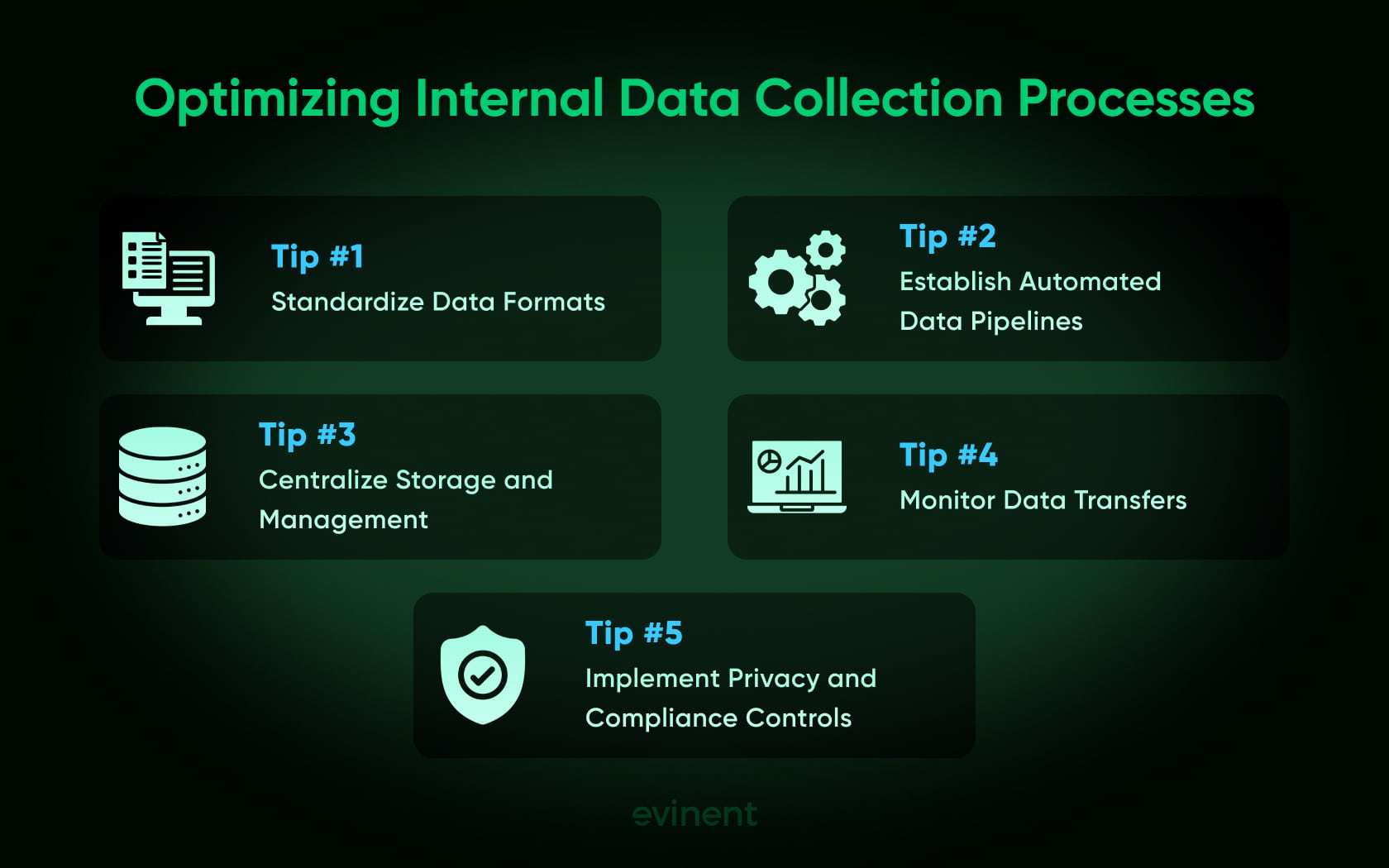
Tip №1 – Standardize Data Collection
Implement clear data standards and normalization rules across all touchpoints. Consistent formats for names, addresses, product SKUs, and behavioral logs reduce duplication, simplify integration, and support reliable reporting. Standardization also enables faster algorithm training and ensures that downstream analytics receives clean, structured inputs.
Tip №2 – Build Robust Data Pipelines
Put in place automated data pipelines that upload data from sources to storage and analysis platforms. In this way, manual mistakes are lessened, the whole process is sped up, and access to data that is properly contextualized is made in time. Efficient pipelines provide the possibility of sharing data among different departments, make it easy to use predictive modeling, and give the opportunity of using customer data and business intelligence in real-time.
Tip №3 – Centralize Storage and Management
Deploy centralised databases and data warehouses to keep the data safe and neat. Centralising the data makes it more accessible to the in-house teams, is attractive to market research and talent intelligence functions, and also gives better control over backups and retention policies. Moreover, central hubs facilitate the implementation of privacy rules.
Tip №4 – Monitor Data Transfer Processes
Regularly review data transfer protocols between systems to avoid loss, corruption, or latency. Automated checks and logging ensure that behavioral, engagement, and transactional data is accurately captured across tools and platforms. This supports algorithm training, reporting, and ROI analysis without disruptions.
Tip №5 – Integrate Privacy and Compliance Controls
Embed data privacy policies and security standards into every step of collection and storage. Contextualized user consent, encryption, and access control not only protect customer information but also safeguard the company's reputation. Compliance integration reduces operational risk while maintaining high-quality, actionable datasets.
By optimizing internal data processes, companies guarantee that information is easy to flow, accurate, and can be used immediately for analysis. A scalable infrastructure that supports both operational efficiency and strategic decision-making is created through standardization, pipelines, centralized storage, monitored transfers, and privacy compliance.
Enhancing User Experience Through Data
By collecting and analyzing customer data, online businesses can develop customer experiences that seem individually tailored to each user. Personalization raises customer engagement, lowers customer problems, and makes them happy, which in turn leads to a higher level of loyalty that can be tracked and business results that can be quantified. These are the key advantages of using data for personalization.
1. Higher Conversion Rates
Tailored recommendations, deals, and content basically double the chance that users will end up making a purchase. Displaying products that are consistent with the user's browsing behavior or previous purchases eliminates the user's doubts and saves them from decision fatigue, thus, more visitors are converted into buyers. Personalization has the potential to raise conversion rates by as much as 10-15% which is largely dependent on the manner of implementation.
2. Increased Average Order Value (AOV)
By suggesting complementary or higher-value items based on a customer’s history and behavior, businesses encourage upsells and cross-sells. Targeted product recommendations guide users toward purchases they may not have considered independently, raising the overall order value and maximizing revenue per transaction.
3. Stronger Customer Retention and Loyalty
Users who are understood and continuously get relevant experiences are most probably going to return. Personalization builds up both liking and trust; thus, customers will be more willing to make repeat purchases and keep their long-term engagement. Enterprises adopting data-driven personalization usually experience a significant retention rate and customer lifetime value increase.
4. Improved User Satisfaction and Experience
Adjusting interfaces, content, and communication to individual's tastes helps the interaction to be more natural and the user to be more satisfied. Making the user experience simple by removing the friction in navigation, search, and checkout is a way to let the user have a smooth journey. Happy users will, in fact, increase the business through their engagement, feedback, and become brand ambassadors, thus, perception and revenue potential are further enhanced.
5. More Efficient Marketing and Better ROI
Personalized campaigns target only the segments most likely to respond, reducing wasted spend on uninterested audiences. Using engagement and purchase data to prioritize messages ensures marketing dollars generate measurable returns, and attribution can clearly link actions to revenue. This improves campaign effectiveness and overall profitability.
Personalization based on data brings real benefits of collecting customer data: more conversions, increased order value, better retention, higher satisfaction, and a more efficient marketing budget. Using behavioral, demographic, and historical insights, e‑commerce companies build a user-centric experience that is favorable to both customers and the company's profits, thus creating a competitive advantage that can be maintained over time.

Building Trust Through Ethical Data Practices
Responsible data collection is not only a regulatory requirement but also a core element of long-term customer loyalty. When users understand how their information is gathered, stored, and applied, they are more willing to share personal data and engage with the brand. Transparent communication, clear consent flows, and respectful handling practices reduce uncertainty and signal that the company prioritizes the user’s interests rather than exploiting their behavior.
1. Establish Clear Consent and Opt-Out Options
First, explain what data is being collected, why it is necessary, and how it will be used. Then, provide straightforward opt-out mechanisms and ensure that preference settings are always available. When clients have the power to decide the disclosure of their data and the number of communications, they get a sense of being appreciated and are more willing to keep in touch.
2. Communicate Privacy Policies in Plain Language
Do not use terms unknown by the average citizen. Brief explanations, graphic summaries, and question-and-answer-type sections make it very easy for the users to comprehend the time periods for data retention, the security measures to be taken, the involvement of the third party, and the rules of the processing. Being clear helps to build trust as well as to lower the number of complaints.
3. Prioritize Secure Storage and Encrypted Transfers
Data processing operations have to be implemented via encrypted transfer channels, in secure storage locations, with access logs, and role-based permissions. An open map of how security is implemented in reality shows that it is not a mere symbolic promise but a well-organized system of protection.
4. Uphold Ethical Use, Not Just Legal Compliance
Regulations such as GDPR and CCPA offer limits, but ethical businesses extend beyond these limits. Do not indulge in an overabundance of behavioral profiling, secret third-party sharing, or the use of personalization as a means of coercion. By showing that they have control over the situation, companies can maintain their reputation and also benefit from a trust advantage which is difficult for rivals to copy.
5. Make Transparency a Continuous Policy, Not a One-Time Notice
Keep updates public when changes are made to practices, inform users about new tracking technology, and keep a revision archive. Continuous transparency makes data collection a shared good rather than a hidden process of taking.
Brands that treat privacy, consent, and secure data management as strategic assets, rather than compliance checkboxes, consistently strengthen loyalty and reduce user resistance. Transparent communication builds confidence, ethical restraint prevents misuse, and balanced policies demonstrate that personalization can coexist with dignity, autonomy, and genuine respect for customer data. If trust is maintained at every stage—from acquisition to storage and use—data becomes not just a resource but a foundation for durable customer relationships.
Decoding Customer Behavior for Improved UX and Revenue Outcomes
How might a company use the consumer data it collects? Behavioral data is the main source of information to reveal the thoughts of users and their way of navigation, searching, hesitation, and finally, conversion within a digital environment. By monitoring on-site activities, recording purchase intentions over time, noting browsing contexts, and tracking interaction signals, organizations become capable of discovering patterns that have a direct effect on the rearrangement of UX, the positioning of the product, and the increase in commercial outcomes.
1. Behavioral Interaction Mapping
Heatmaps, scroll friction zones, click sequences, and session replay analytics expose attention flow and behavioral blind spots. This helps detect design overload, identify ignored elements, surface conversion triggers, and reconstruct layouts based on real decision paths rather than assumed UX logic.
2. First-Party Engagement Signals
First-party tracking that includes search logs, category dwell time, cart velocity, promo response, and last-click intent is the most accurate and compliant source of behavioral data. It is the foundation of customer clustering, genuine buyer persona modeling, and the elimination of third-party cookies that are unstable due to data loss and regulatory restrictions.
3. Identity and Context Markers
Device fingerprinting, browser specifics, session continuity, screen ratios, network quality, and geo-range data clarify how context (not just identity) impacts conversion. This uncovers differences between mobile hesitation vs. desktop intent, revealing conditions where UX adjustments drastically increase completion rate.
4. Behavioral + Transaction History Correlation
Purchase recency, repeat frequency, assortment interest, and return triggers only become really explanatory when they are paired with browsing movement. Behavioral correlations transform raw orders into predictive retention signals, enabling companies to identify which visitors are casual and which are high-value, recurring segments based on their actual interaction rhythm.
5. Conversion Behavior Modeling
Path-to-purchase patterns, exit escalation points, scroll decay, and banner visibility saturation form a measurable system of behavioral probability. Modeling these trajectories enables accurate drop-off explanation, identifies when recommendation density becomes counterproductive, and isolates the exact moment where messaging must shift.
Understanding behavior goes beyond merely tracking clicks - it changes incoherent signals into a systematic explanation of the rationale behind users' actions. Just imagine if user paths, device context, and past buying trends were to combine into one consistent model, UX would not be for show anymore, but responsive, segmentation would be real instead of just a theory, and revenue flows would be measurable rather than unplanned.
Benefits of Customer Data Collection
Collecting customer data is like handing e-commerce businesses the steering wheel to control their growth, performance, and customer experience. Here are the fundamental advantages outlined in a manner that can be measured and organized — but without the use of statistics.
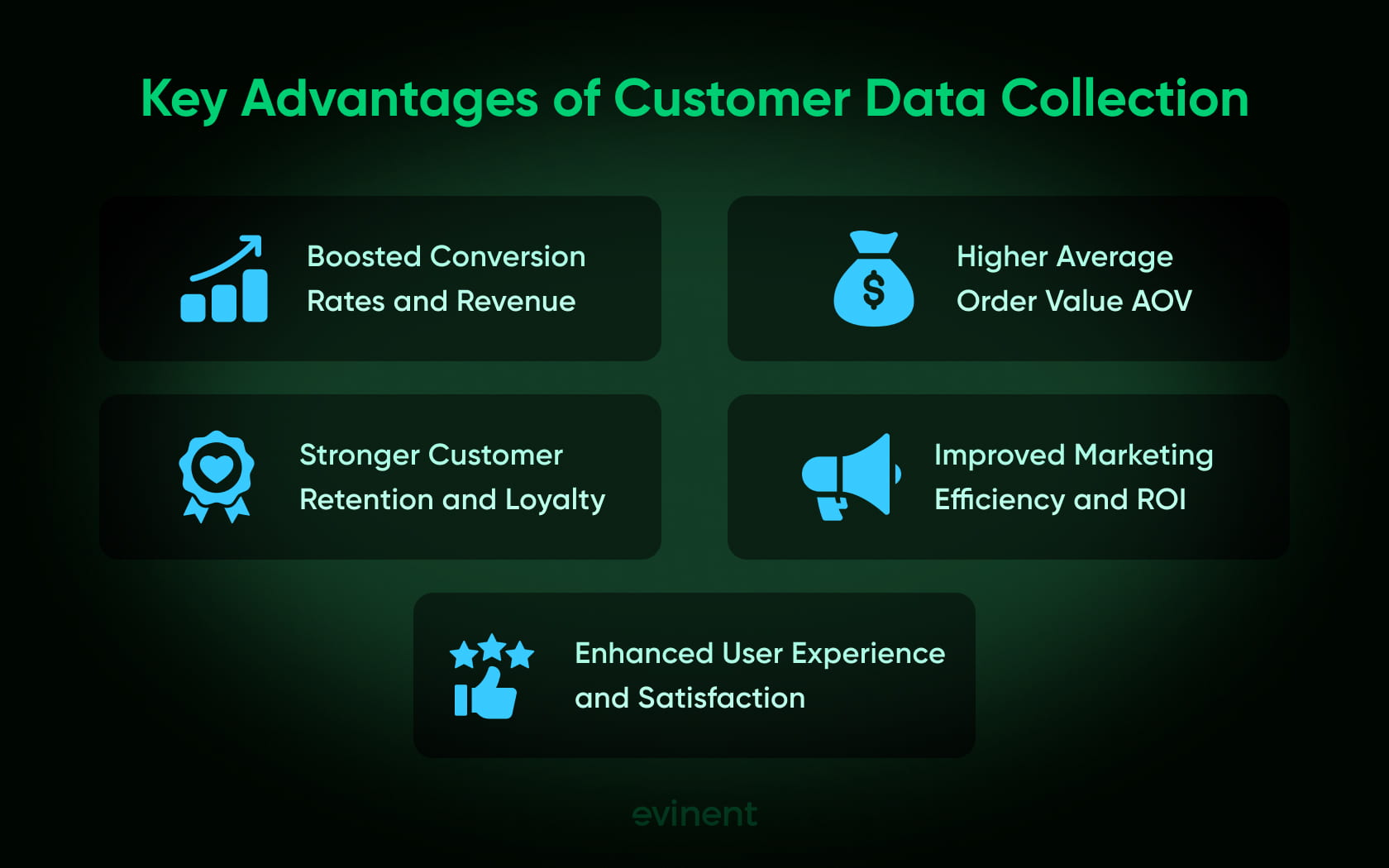
1. Higher Conversion Rates and Revenue
If companies know the way consumers behave, what they like, and which factors influence their choices, they can give them more appropriate offers. A benchmark report informs that a lot of retailers experience a rise in conversion rates by about 45% after making use of personalization based on customer data. The customer journey becomes more fluid and profitable; thus, the company can count on a continuous rather than volatile sales pattern besides making profits of increasing one-off sales.
2. Increased Average Order Value (AOV)
Data allows brands to present smarter cross-sell and upsell offers, recommend complementary products, adjust pricing strategies, and curate shopping bundles. Personalized product recommendations and tailored offers often raise AOV by 10–30% compared to generic promotions. As a result, customers see exactly what matches their needs, which naturally raises the value of each transaction.
3. Improved Customer Retention and Loyalty
When users consistently receive tailored messages, curated selections, and individualized support, they develop long-term loyalty to the brand. Personalized experiences reduce churn, create stronger emotional ties, and help businesses maintain continuous relationships rather than chase new customers every cycle.
4. Better Marketing Efficiency and ROI
Customer insights help eliminate wasted marketing spend by replacing broad, generic outreach with segmented messaging. Knowing who needs what and when means better targeting, more meaningful interactions, and clearer calculation of campaign effectiveness and return on investment.
5. Enhanced User Experience and Satisfaction
Users are less likely to feel that they are being "marketed at" when platforms take into consideration their personal needs, interests, browsing patterns, and behavior history. This results in the brand being more accessible, easier to discover products, getting relevant recommendations, and the alignment of messaging. As a result, users reach out to the brand more frequently and with less friction.
Capturing user data completely changes the online business model from simply mass selling to becoming a very accurate, customer-centric interaction, which is also responsive. With the help of such techniques, brands can increase their income, create customer loyalty, make more efficient use of their budget, and provide customer experiences that are not based on the assumption of human behavior, but rather on the actual behavior of humans.
How Evinent can help with Customer Data Collection on your site
Evinent is far from being just a software vendor — we are a data intelligence partner who changes the way businesses see the market by turning raw customer inputs into measurable profit. Our strategy is centered around predictive accuracy, stable integrations, and data-driven personalization at enterprise scale.
Why Businesses Choose Evinent
15+ years of software and analytics engineering for high-load online commerce
20M+ active users interacting with our recommendation engines and decision systems
100% project delivery success rate, including complex multi-regional deployments
78% of our portfolio involves enterprise eCommerce across the US, EU, and MENA
We are not focused on theory — what really matters to us are the measurable improvements in conversions, retention, and product relevance.
Evinent Analytics: Turning Data into Revenue
Evinent Analytics program is a very effective tool in the conversion of customer data into personalized product recommendations, purchase triggers to be used in real-time, and predictive insights. As the system comes with fully automated segmentation, recommendation modules, and behavior tracking, it raises the rate of sales and customer engagement at the level of the organization or the brand without the need for manual control.

Real-World Impact
Higher relevance of product blocks on product pages
Increased checkout completion due to predictive recommendations
Stronger campaign ROI due to accurate segmentation
Reduced marketing spend through targeted outreach
3 Steps to Increase E-Commerce Sales with Evinent Analytics
Step | Action | Outcome |
01 – Data Analysis | We collect and structure historical purchase data | Build accurate purchase profiles per customer |
02 – Behavioral Analysis | We track browsing paths, clicks, time on page, and product interest | Understand intent signals and drop-off patterns |
03 – Recommendation Engine | We deliver AI-based products and bundle suggestions | Drive personalized conversions and reduce decision friction |
Evinent is not limited to just dashboards. We make data gathering a money-making tool, a precise forecasting tool, and a tool for stable personalization at a large enterprise level. Our track record for success, artificial intelligence-powered recommendation systems, and experience with high-load integrations are proof that customer data turns into a regulated resource — not a messy storage.
By partnering with Evinent, you are essentially turning every click, session, and transaction into business understanding, accuracy, and growth that can be quantified.
Key Takeaways
Customer data drives business growth – understanding preferences and behavior enables smarter marketing, personalization, and ROI measurement.
Continuous data collection cycle – acquisition → storage → analysis → application ensures insights are always actionable.
Four core data types – personal (PII/non-PII), behavioral, engagement, and attitudinal. Each provides unique value for targeting, segmentation, and experience optimization.
Data informs decisions – KPIs, dashboards, BI analytics, and historical data support reporting, forecasting, and strategic planning.
Multiple collection methods – quantitative (clickstream, transactions, heatmaps), qualitative (surveys, interviews, focus groups), and automated tools (CDPs, data warehouses, digital exhaust) capture comprehensive insights.
Marketing becomes smarter – segmentation, hyper-personalized ads, product recommendations, and messaging personalization increase conversions and customer engagement.
Internal operations are optimized – standardized data, privacy-by-design, storage/transfer efficiency, and normalization improve internal workflows and SLA adherence.
Personalized UX – predictive analytics, recommendation engines, and virtual assistants allow individualized customer journeys, boosting satisfaction and retention.
Trust and compliance matter – user consent, transparent policies, and ethical handling of data build consumer trust while aligning with GDPR/CCPA principles.
Behavioral insights – device fingerprinting, session replay, heatmaps, and first-party data combined with purchase history help anticipate needs, refine products, and improve user experience.
Share