

What is Customer Centric Marketing
What is customer centric marketin? This is an approach in which every marketing decision, message, channel, and experience is built around the real needs, expectations, and behaviors of the customer. It shifts the focus from pushing products to creating value at every touchpoint, strengthening long-term relationships, and increasing loyalty.
The commitment to delighting customers in this way necessitates knowing the customers really well, through customer insights, CX research, feedback loops, and data, and then leveraging that knowledge to provide more relevant, personalized, and meaningful interactions.
Traditional Marketing vs. Customer Centric Marketing
Traditional Marketing | Customer Centric Marketing |
|---|---|
Company → Product → Customer | Customer → Needs → Solution |
Focus on selling products | Focus on solving customer problems |
Short-term campaigns | Long-term relationships and CLV |
Mass messaging and broad segmentation | Personalized experiences and micro-segments |
Decisions based on internal assumptions | Decisions driven by customer insights and VoC |
Product features as the core message | Customer outcomes are the core value |
Siloed teams and fragmented CX | Cross-functional alignment around the customer |
Limited feedback loops | Continuous feedback, data, and CX optimization |
What You Will Learn in This Article
What consumer centric marketing is and why it matters today.
The key benefits of this approach include loyalty, CLV growth, and stronger brand advocacy.
The organizational barriers that prevent companies from becoming truly customer-centric.
The role of employee experience as a foundation for a customer-centric culture.
How to collect and use customer data, feedback, and VoC insights effectively.How brands co-create products and innovation together with customers.
Step-by-step guidance on building a customer centric marketing strategy.
Real-world examples of customer centric marketing companies and what sets them apart.
Metrics and methods for measuring and optimizing customer-centric initiatives.
How technology, AI, and digital platforms enable personalization at scale.How to deliver value and personalized experiences across every stage of the customer journey.
How Evinent helps organizations implement and scale customer centric marketing.
7 Benefits of Customer Centric Marketing
A customer-focused strategy is a source of real, quantifiable, and lasting value by harmonizing the whole business with the needs, tastes, and habits of the customers.
“You must win at every interaction the customer has with your organization. Every department must play its part in a coordinated fashion.” — Olive Huang, Research Director, Gartner
As a result of such an investment in customer understanding and experience, companies reap the benefits of customer loyalty, increased customer lifetime value, customer acquisition at a lower cost, and the differentiation to compete effectively.
The Forrester report shows that improvements in customer experience and customer-centric analytics lead to growth in retention, CLV, and referrals.
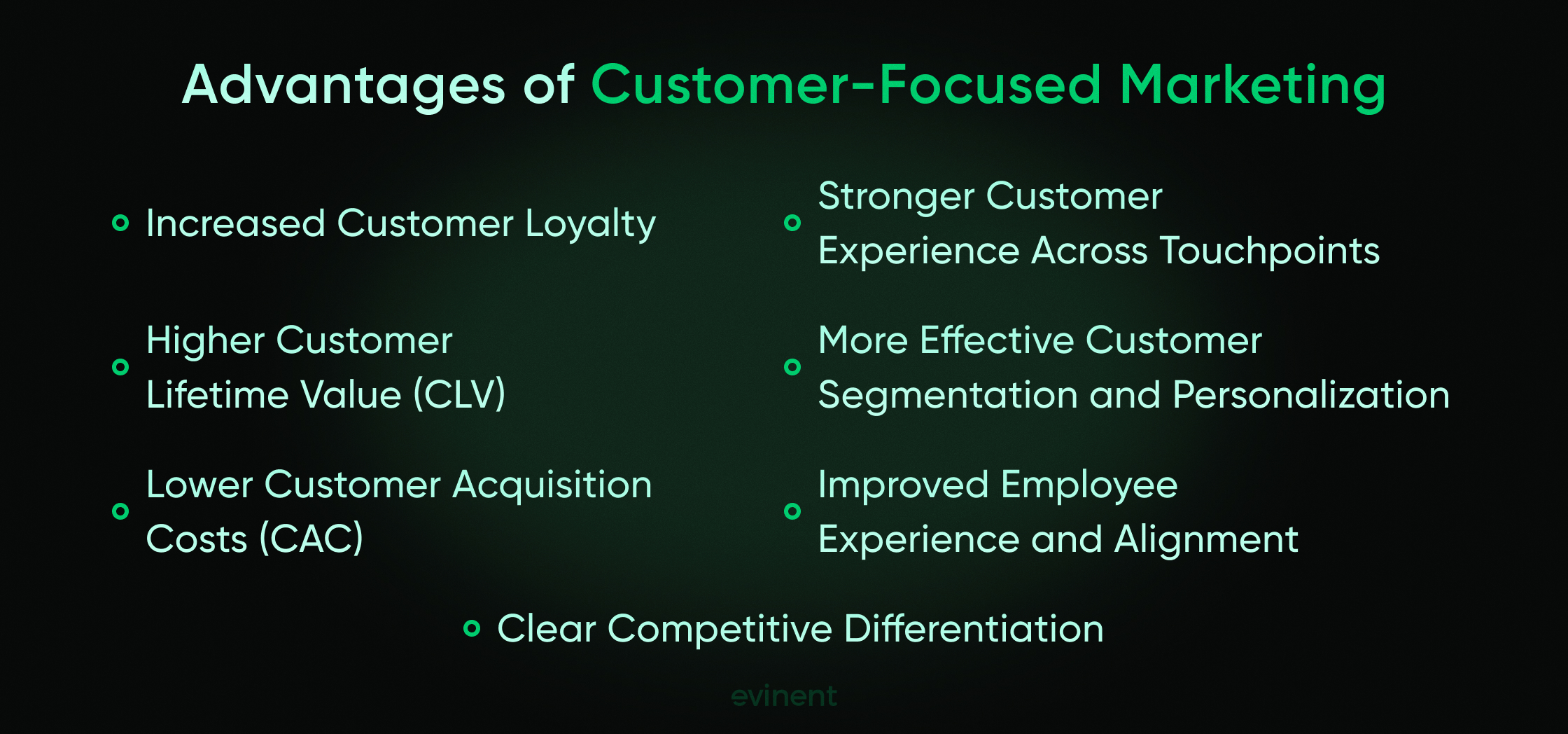
Increased Customer Loyalty
When customer needs consistently guide decisions, customers feel understood and valued—driving repeat purchases, a stronger emotional connection, and long-term loyalty. This directly improves customer retention and reduces churn.
Higher Customer Lifetime Value (CLV)
Gartner also publishes that Customer Lifetime Value (CLV) is one of the key indicators for growing companies, demonstrating that customer focus is directly linked to profitability. Personalized experiences, relevant communication, and seamless omnichannel interactions encourage customers to stay longer, buy more often, and upgrade more easily. This boosts overall lifetime value and revenue per customer segment.
Lower Customer Acquisition Costs (CAC)
Happy customers turn into brand advocates who write reviews, bring in new customers, and create a brand presence without the need for paid marketing. Good customer comments and word-of-mouth make the cost of acquiring new customers cheaper and deepen the digital relationship between the brand and its target audience.
Stronger Customer Experience Across Touchpoints
Customer-centric companies design every interaction—from support to onboarding—to be smooth, intuitive, and human-centered. A better customer experience improves satisfaction, drives retention, and fuels long-term growth.
More Effective Customer Segmentation and Personalization
With deeper knowledge of customer behavior, brands can better define their target audience and provide them with personalized content, offers, and customer journeys. The result of this is greater customer engagement and improved conversion rates.
Improved Employee Experience and Alignment
If a company's culture is such that the customers are always at the center of the business, then the staff will be in a position to provide the service with a good conscience since they will be full of information, energy, and inherently driven to do the work. The customer experience gets to a new level as the existing synergies pool inside the company, thus becoming the source of a single brand experience.
Clear Competitive Differentiation
Such companies which keep on offering good, personalized and thoughtful customer experiences are the ones that become distinguishable in the saturated markets. Customer-centric enterprises are the victors since they bring such value that their rivals cannot copy easily.
Investing in customer centric marketing creates a compounding effect: better experiences lead to stronger loyalty, stronger loyalty increases customer lifetime value, and higher CLV drives sustainable growth. According to a Gartner study, 92% of CX leaders (those whose CX programmes truly meet customer needs) reported revenue growth in the following financial year.
By focusing on personalization, segmentation, employee alignment, and a unified omnichannel experience, companies build meaningful relationships that set them apart from competitors. In today’s market, customer-centricity is no longer optional — it’s a core driver of long-term success.
Challenges and Barriers to Customer Centric Marketing
While customer-centric marketing brings great value over the long term, numerous companies face both structural and cultural barriers in their attempts to deploy it. Such difficulties can impede the advancement of work; however, they are insignificant when compared to the strong benefits of creating a customer-focused business.
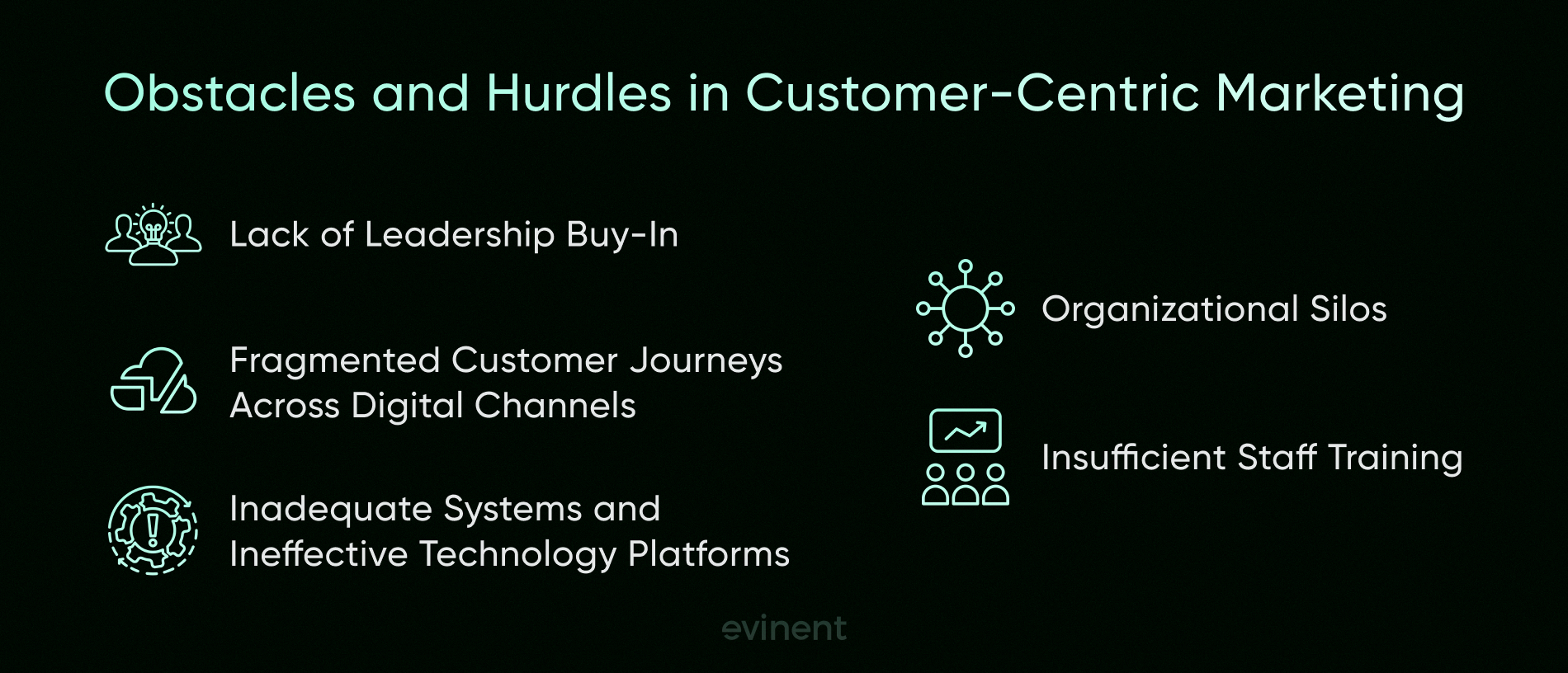
Lack of Leadership Buy-In
A customer-centric approach needs a very strong backing from the top executives. When leadership is not fully on board, different units find it difficult to work together towards common objectives, obtain the necessary funding, and change the customer experience interaction points. The change in culture always begins from the highest level.
Organizational Silos
When marketing, sales, customer support, and product teams operate in isolation, the result is a fragmented customer journey. Silos block collaboration and prevent the organization from building a centralized view of the customer across digital channels.
Inadequate Systems and Ineffective Technology Platforms
Antiquated instruments, legacy CRMs, and inefficient technology platforms hinder a company from combining data, carrying out customer data analysis, and maximizing touchpoints. Contemporary customer-centric strategies depend on integrated systems and instant insights.
Insufficient Staff Training
Employees need guidance, education, and ongoing development to deliver consistent, customer-centric experiences. Without proper staff training, teams cannot effectively handle support interactions, manage the return process, or contribute to CX improvements.
Fragmented Customer Journeys Across Digital Channels
When customers cannot get a seamless flow of their experiences across websites, apps, social media, and support channels, they can actually feel the friction. A disconnection between different channels leads to inconsistent customer touchpoints and lowers their satisfaction.
These challenges are real but manageable. With aligned leadership, unified systems, cross-functional collaboration, and proper training, organizations can overcome obstacles and unlock the full value of customer-centric transformation.
Employee Experience as the Foundation of Customer Centricity
A truly customer-centric organization starts from within. Employee experience—the satisfaction, engagement, and empowerment of staff—directly shapes the quality of customer interactions and overall customer experience (CX). When employees feel supported, informed, and motivated, they deliver more consistent, empathetic, and effective service at every touchpoint.
Key Points
Employee Experience Drives CX
Employees who are satisfied and deeply involved in their work will thus be more positive in their interactions, and this is a way to guarantee that customer needs are fulfilled in a quick and considerate manner.
Staff Empowerment Enables Action
Employees when empowered, they are able to fix problems on their own initiative, tailor experiences, and adjust to customer feedback without a lot of bureaucracy.
Service Mindset Across the Organization
Having a service mindset in every role constantly makes it clear that all teams, which are not only the frontline staff, but also the rest of the company, are the ones who really deliver customer satisfaction and loyalty.
Internal Culture Shapes Customer-Centricity
A focused customer-centric culture adjusts the company's internal rewards, communication, and processes to be in line to provide value at every customer experience interaction.
Training and Development
Continuous learning is what keeps employees in a position to be able to meet ever-changing customer expectations, make good use of technology, and be a part of a single internal CX that is cohesive.
Investing in employee experience is not optional—it is a strategic prerequisite for sustainable customer-centric marketing. When employees are engaged, empowered, and aligned with customer-centric values, organizations achieve stronger loyalty, better retention, and more meaningful customer relationships.
How to Collect and Use Customer Data and Feedback
Understanding customer behavior and expectations requires structured, continuous data collection. Customer-centric companies use qualitative and quantitative insights to personalize experiences, improve service quality, and anticipate customer needs before they are expressed.
1. Start by Capturing Direct Customer Feedback
Employ customer surveys, VoC programs, and NPS responses to gather clear and direct feedback regarding satisfaction, experience gaps, and expectations. This is the purest form of the "customer voice".

2. Build a Unified Customer Profile Through a CDP
Centralize loyalty program data, purchase history, website analytics, support tickets, and intent signals in a customer data platform. A unified profile enables consistent personalization across all touchpoints.
3. Analyze Behavioral and Intent Data to Identify Needs
Use the website analytics tools, search behavior, funnel progression, and intent data to understand the motivations, decision patterns, and friction points of customers who may not speak these things.
4. Mine Qualitative Feedback for Deeper Insight
Leverage customer reviews, support tickets, and perform text analysis on call transcripts to identify emotional drivers, secret frustrations, and system-wide problems.
5. Involve Customers in Idea Generation and Co-Creation
Directly involve customers with idea platforms (for example, My Starbucks Idea), beta groups, and innovation feedback loops. Working together with customers brings up deeply valuable changes and serves as a tool for concept validation before they are launched in the market.
A consistent, structured approach to collecting and using customer data transforms raw information into personalization, stronger CX, and smarter decision-making. When these steps work together, companies gain not just insights — they gain a competitive advantage.
How to Co-Create Products and Experiences With Your Customers
Co-creation is a customer-centric marketing tool that is very powerful but is most simply overlooked. Typically, in a traditional product development scenario, companies come up with a solution internally and then “push” it to the market. However, co-creation gets customers involved in the innovation process right from the start.
Here is a detailed explanation of the significance of co-creation, the functioning of the process, and how brands deploy customer insight programs, innovation platforms, and feedback loops to create products that customers really want. It does not treat customer centric marketing as a single brand but rather as a collaborative ecosystem where the customer and the brand co-create value.
Why This Matters
customer-driven marketing shifts the mindset from
“We think customers need this” → “Customers help us define what the market actually needs.”
It leads to:
faster product-market fit
reduced innovation risk
higher customer loyalty (people support what they helped build)
more relevant, human-centric solutions
stronger brand advocacy and word of mouth
This is the next evolution of customer centricity: not personalization alone, but collaboration.
1. Build Structured Innovation Platforms
Customer-focused businesses establish special places for their customers to bring up ideas, vote, and work together. Companies such as My Starbucks Idea and LEGO Ideas are good examples of how open participation can be used to convert community creativity into feasible business solutions. A well-organized platform gathers all the inputs, visualizes the trends, and guarantees that the ideas coming from customers are evaluated in a systematic manner rather than in an informal or inconsistent way.
2. Integrate Customers Into Every Stage of the Innovation Cycle
Co-creation works only when customer involvement is continuous, not episodic. Leading brands invite users into early concept validation, prototype testing, beta programs, and post-launch refinement. By embedding customer feedback at each stage, companies reduce development risk, shorten iteration cycles, and ensure that final solutions align with real user expectations.
3. Use Human-Centric Research to Uncover Deeper Needs
Purely quantitative data is hardly capable of revealing the reasons behind people’s behavior. That is the very point where human-focused methods such as ethnographic interviews, usability diaries, contextual observation, and Voice of the Customer programs come in and have a decisive effect. These methods uncover the rationale, the feelings, and the aspects of the consumer experience that the users have not yet realized and therefore cannot express, thus leading to more substantial innovation.
4. Develop Customer Partner Communities
Some customers demonstrate higher expertise, enthusiasm, or niche knowledge. Instead of treating them as occasional survey respondents, companies build structured communities: advisory councils, creator groups, pilot cohorts, and insight panels. These partners contribute deeply to feature shaping, usability design, and product refinement, creating solutions that reflect real ownership and real collaboration.
5. Turn Co-Creation Into a Visible Part of the Brand
When customers see that their input leads to real outcomes, their engagement and loyalty increase. Successful brands communicate the impact of customer involvement—highlighting co-created features, recognizing contributors, or sharing behind-the-scenes stories. This transparency builds trust, strengthens advocacy, and positions the brand as genuinely customer-driven, not merely customer-aware.
This part shows how a customer centric marketing in marketing goes beyond just personalization or targeted communication. By co-creation, customers become those people who have the power to change the strategy, product development, and experience design. If firms decide to innovate with customers instead of doing it for them, they get a quicker adoption, a more loyal customer base, and products that are always in line with the needs of the customers.
A Step-by-Step Guide to Developing a Customer Centric Marketing Strategy
Delighting customers through a customer centric marketing strategy is not an easy feat. It entails carefully planned steps, involvement of various departments, and the establishment of processes that focus on the customer at every phase. The manual explains the necessary measures to conceive and carry out a plan in which customers experience more satisfaction, loyalty and as a result, the business grows.
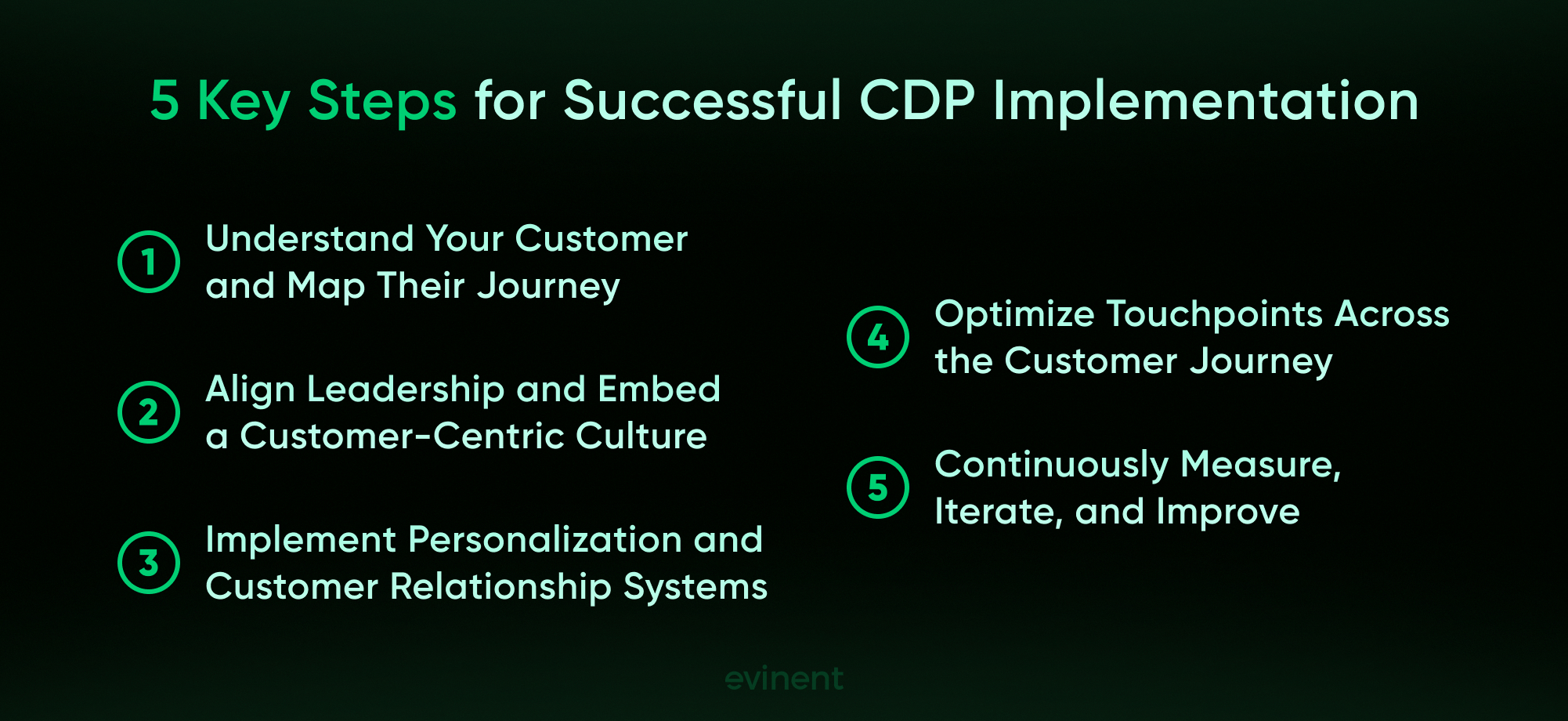
Step 1: Understand Your Customers and Map Their Journey
Actionable Steps:
Conduct in-depth research to identify customer segments, behaviors, and needs.
Gather and analyze customer feedback through surveys, VoC programs, and support tickets.
Map the full customer journey across all touchpoints to identify friction points and opportunities for improvement.
Document key insights to serve as the foundation for all strategic decisions.
Outcome: A clear view of who your customers are, what they value, and how they interact with your brand, forming the baseline for a customer-centric strategy.
Step 2: Align Leadership and Embed a Customer-Centric Culture
Actionable Steps:
Secure leadership involvement to champion customer-centric values across the organization.
Implement customer-focused hiring practices to ensure new employees prioritize the customer experience.
Develop training and personnel development programs that equip staff to make decisions aligned with customer needs.
Foster a company-wide customer-centric culture where every team member understands their role in enhancing the customer journey.
Outcome: Employees are empowered and aligned, creating a consistent experience that strengthens brand loyalty and reinforces a customer-focused organizational culture.
Step 3: Implement Personalization and Customer Relationship Systems
Actionable Steps:
Leverage a customer relationship management (CRM) platform to centralize customer data and track interactions.
Use insights from customer feedback and journey mapping to deliver personalized communications, relevant offers, and tailored engagement at every touchpoint.
Continuously monitor and refine personalization strategies to reflect evolving customer needs.
including customer centric advertising campaigns to ensure messaging resonates with each audience segment.
Outcome: Scalable systems enable consistent, personalized experiences that deepen relationships and increase customer satisfaction.
Step 4: Optimize Touchpoints Across the Customer Journey
Actionable Steps:
Analyze all customer touchpoints to identify gaps or friction points that could impact loyalty.
Implement changes in marketing, sales, product, and support processes to enhance the overall experience.
Use digital tools and analytics to continuously monitor touchpoint performance and iterate on improvements.
Outcome: Every interaction is designed to meet customer needs, improving retention, satisfaction, and brand advocacy.
Step 5: Continuously Measure, Iterate, and Improve
Actionable Steps:
Define KPIs related to customer satisfaction, engagement, retention, and lifetime value.
Regularly collect and analyze data from VoC programs, CRM platforms, and journey analytics.
Adjust strategy and processes based on feedback and measurable outcomes to maintain a customer-centric approach.
Outcome: A dynamic, adaptive strategy that evolves with customer expectations, ensuring sustainable customer-centricity and long-term business growth.
An effective customer-centric approach involves combining insights gained from the customer, aligning the organization, having personalized systems in place, and continually optimizing. When implementing such a strategy, enterprises are able to permeate a customer-centric culture in all departments, deliver impactful and uniform customer experiences at every interaction, and enhance customer loyalty. The outcome is, in fact, greater customer satisfaction and retention, alongside a durable competitive advantage in a market where customers are becoming the main decision-makers.
Real-World Examples of Leading Customer-Centric Brands
Customer-centricity is not just a buzzword — it’s increasingly becoming a core business priority. According to recent data, 86% of customer service leaders across industries say improving customer experience is a significant priority in 2024.
Below are five real-world examples of leading brands that have successfully embedded customer-centric strategies into their operations — including personalization, CRM, customer data, customer support, and a customer-first culture.
Top 5 Customer-Centric Companies
1. Amazon
Strategy: Amazon positions itself as “the Earth’s most customer-centric company,” and its operations fully reflect that promise.
Personalization: Sophisticated algorithms employ the information about customers to make the recommendation systems the main contributors to sales.
CRM & Customer Data: Amazon creates detailed customer profiles and studies the behavior to perfect the offers anywhere the customers’ journey crosses.
Customer Support: Easy, adaptable returns and various helpful and reactive support means are at the core of Amazon’s customer value proposition.
Customer-Centric Culture: One of the major aspects of the leadership principles is to consider the customer first and create new solutions for them.
2. Starbucks
Personalized Loyalty: Starbucks’ mobile app collects customer data and delivers tailored offers, rewards, and product suggestions.
Customer Experience: The brand focuses on creating a “third place” — a comfortable, welcoming environment beyond home and work.
Employee Engagement: Baristas are trained to deliver friendly, personalized service, reinforcing customer-centric values.
Brand Values: Transparency, sustainability initiatives, and ethical sourcing strengthen trust and customer loyalty.
3. Zappos
Exceptional Support: Zappos is famous for empowering customer support agents to do whatever it takes to help — even if calls last hours.
Long-Term Customer Relationships: Emotional bonds are the main focus of their CRM strategy; as a result, customers are turned into brand advocates.
Employee Engagement: The energetic internal culture provides employees with independence and supports the company's pledge to customer delight.
Customer-Centric Values: The core values of the company, which are also the guiding principles, are empathy, generosity, and authenticity for all the interactions.
4. Nordstrom
High-Touch Customer Experience: Nordstrom delivers luxury-level service through attentive associates and seamless omnichannel experiences.
Personalization: The business can use the data of the customers to offer the most suitable suggestions, as well as to guide the customer in the shopping process, which has been curated.
Customer Support: The support that is given to the customer, either in a store or through the internet, is made in such a way that the expectations are not only met but also exceeded, and the issues are solved in a very short time.
Training & Engagement: Staff get thorough training through which they become more like style advisors and less like the traditional sales staff.
5. Hilton
Customer Experience Excellence: Hilton focuses heavily on hospitality details — from personalized greetings to loyalty-based room preferences.
CRM & Data Usage: The guest history, likes, and previous stays are recorded through their CRM system, which is used to create personalized experiences.
Customer Support & Empowerment: Employees are given the green light to step in and solve problems without waiting for instructions.
Customer-Centric Principles: Hilton creates a durable loyalty network through the delivery of essentials like trust, ease, and an unvarying high standard of service.
Customer-centric companies share one defining characteristic: they place the customer at the heart of every decision. Whether through advanced personalization, CRM systems, empowered employees, or seamless customer support, these organizations use customer insights to build stronger relationships and deliver exceptional experiences. As expectations continue to rise, brands that embrace customer-centric values will be better positioned to grow, innovate, and earn long-lasting loyalty.
Measuring and Optimizing Customer Centric Initiatives
Customer-centric initiatives are best measured through a structured framework that identifies changes in customer behavior, the quality of their experience, and the resulting business impact. The present manual illustrates the ways companies can leverage CRM platforms, customer data platforms (CDPs), predictive analytics, and Voice of the Customer (VoC) insights to not only maintain optimal performance but also elevate the standard of the customer experience.
Step 1: Establish Business-Wide KPIs That Reflect Customer Value
Actionable Steps:
Define measurable business-wide KPIs such as customer satisfaction score (CSAT), churn rate, retention rate, and long-term customer value.
Connect these metrics to your CRM platform or CDP to create a unified view of performance.
Ensure leaders and teams understand how these KPIs reflect customer-centric success.
Outcome: Clear, organization-wide metrics that align teams around customer value and make it possible to evaluate progress objectively.
Step 2: Track Customer Experience Through VoC and Support Metrics
Actionable Steps:
Gather the customer feedback through the Voice of the Customer (VoC) programs, surveys, social listening, and support interactions.
Analyze the customer support metrics like the resolution time, first-contact resolution, and sentiment trends.
Use both qualitative feedback and quantitative indicators to identify the uncovered experience gaps.
Outcome: A comprehensive understanding of customer experience quality, based on both data and real customer voices.
Step 3: Analyze Engagement Metrics and Personalization Performance
Actionable Steps:
Keep an eye on engagement metrics such as click-through rates, repeat visits, product usage patterns, and interaction depth across channels.
Assess the impact of personalization on engagement by studying the behavioral data in your CRM or CDP.
Find out which messages, experiences, or touchpoints lead to higher relevance and customer satisfaction.
Outcome: Insight into what resonates with customers and which personalization strategies meaningfully improve engagement.
Step 4: Use Predictive Analytics to Identify Risks and Opportunities
Actionable Steps:
Employ predictive analytics to forecast churn, find negative behavior patterns, and discover customers that are going to disengage.
Utilize models to anticipate new needs or valuable high-priced opportunities.
Decide on the most effective proactive measures, like personalized recommendations, loyalty promotions, or targeted support activities for contacting the customer.
Outcome: Early detection of customer risks and opportunities, enabling smarter decisions and proactive retention.
Step 5: Build a Continuous Improvement System
Actionable Steps:
Create a repeated cycle that includes review of KPIs, VoC feedback, engagement performance, and predictive insights.
Introduce minor fast experiments to enhance the deteriorated touchpoints and adjust customer journeys.
Immerse the learnings deeply in your CRM workflows, personalization rules, and cross-team processes.
Outcome: A dynamic, continuous improvement system that keeps customer-centric initiatives evolving and prevents stagnation.
One of the main aspects of a customer-centric strategy is measurement, and the subsequent optimization of the initiatives taken in this respect must be a continuous process. Unified data, actionable insights, and iterative improvement fuel this process. Companies that integrate CRM platforms, CDPs, predictive analytics, and VoC programs get the necessary transparency to improve customer experiences, lower churn, and maintain customer value over time.
The Role of Technology and Digital Tools in Customer Centric Marketing
Without a doubt, it is technology — chiefly contemporary AI-powered systems and integrated digital platforms — that enable businesses to extend personalized experiences, deliver interactions in real-time, and create flawless customer journeys at every point of contact. The following segment describes how the use of sophisticated instruments fosters marketing focused on customers, improves the quality of decisions made, and cuts down on the restrictions brought about by old technologies.
Table: How Technology and Digital Tools Power Customer Centricity
Focus Area | What It Enables | Integrated Concepts & Tools |
|---|---|---|
AI-Driven Personalization | Delivers tailored experiences at scale by analyzing behavior, preferences, and intent in real time. | AI-driven personalization, predictive analytics, and artificial intelligence models |
Unified Data & Insight Platforms | Combines customer data from all digital channels into one view for accurate decisions and segmentation. | Customer data platforms (CDPs), Nordstrom analytics platform, and social data |
Proactive Listening & Customer Understanding | Identifies emerging needs and pain points through automated monitoring and text interpretation. | Sprout’s AI-powered listening tool, voice AI, and social listening |
Automation & Real-Time Support | Enhances speed and quality of service through automated workflows and instant assistance. | Messaging automation, real-time chat support, and self-service portal |
Modernization of Internal Systems | Replaces inadequate systems and outdated technology with scalable, flexible tools. | Legacy technology, omnichannel strategies, CRM integrations |
Digital tools and AI cannot be considered as optional anymore. They are the core elements of client centric marketing structurally. The use of unified data, intelligent automation, and real-time insight generation by brands enables them to create customer experiences that are not only personal but also customer-friendly and customer expectation-consistent without any effort.
Creating Value Through Personalized Customer Experiences
If a business wants to give real value to its customers through the whole journey, it is not enough to send generic messages. They need to use customer data smartly, remove support silos, and create omnichannel experiences that customers can relate to and see as human. Contemporary AI, digital intimacy methods, and sophisticated personalization tactics open the way for brands to approach their customers in a manner that is not only applicable and personal but also a real help at every customer interaction.
1. Making Personalization Feel Human and Contextual
True value begins with relevance. Brands use customer data and AI to understand intent, behavior patterns, and emotional context, ensuring personalized engagement feels human rather than mechanical. This creates communication that aligns with real needs instead of pushing generic promotions.
2. Creating Value at Every Customer Touchpoint
By simply sharing the data across channels, each and every moment in the customer journey can be turned into a value-added interaction opportunity. Therefore, removal of customer support silos as well as unification of touchpoints guarantees that customers get the same, well-educated responses in both their digital and physical experiences.
3. Building Digital Intimacy Through Omnichannel Experiences
Digital intimacy is all about giving the customers the feeling that they are recognized, understood, and remembered, no matter where they interact with the brand. An omnichannel experience links the conversations one has in different apps, websites, emails, social channels, and support environments, thus not breaking the flow and giving a continuous sense of interaction.
4. Using AI to Drive Smarter Personalization Strategies
AI can find patterns that are not visible to humans, can forecast what will be needed, and can even make it easier for the most relevant content to be found at the right time. With the help of AI, companies are no longer confined to simple segmentation but can use clever personalization techniques that change according to the situation and increase both the level of engagement and the feeling of satisfaction.
5. Delivering Interactions That Provide Real, Tangible Value
Personalization should be such that it simplifies the life, lessens the effort, and foresees the obstacles before they arrive. A real value to the customer through interaction is giving help, solutions, and pertinent content that makes the customers move forward without being interrupted by a continuous stream of messages.
Adding value and personalization basically focuses on producing customer journeys that constantly recognize customer needs, do not waste their time, and strengthen the relationship further. Using AI, unified customer data, and a well-designed omnichannel channel, brands initiate conversations that customers feel as if the brand is very close to them, is intentional and, therefore, being at the customer centricity marketing core.
How Evinent Can Help With the Implementation of Customer Centric Marketing
Even the strongest customer centered marketing strategy fails without the right technology behind it. Many companies struggle not because they lack insights or motivation, but because they are blocked by legacy systems, fragmented customer data, siloed support tools, and the inability to personalize experiences at scale. This is where Evinent becomes essential.
Case: Modernizing a Legacy E-Commerce Platform to Enable Customer-Centric Growth
The front line consumer electronics retailer from Central Asia was facing a big problem with their e-commerce platform, which was too old to support real-time pricing, omnichannel experiences, or personalized engagement. They had customer data spread across different systems, the site was slowing down during peak seasons, and the marketing teams lacked the right tools to run customer-centric campaigns.
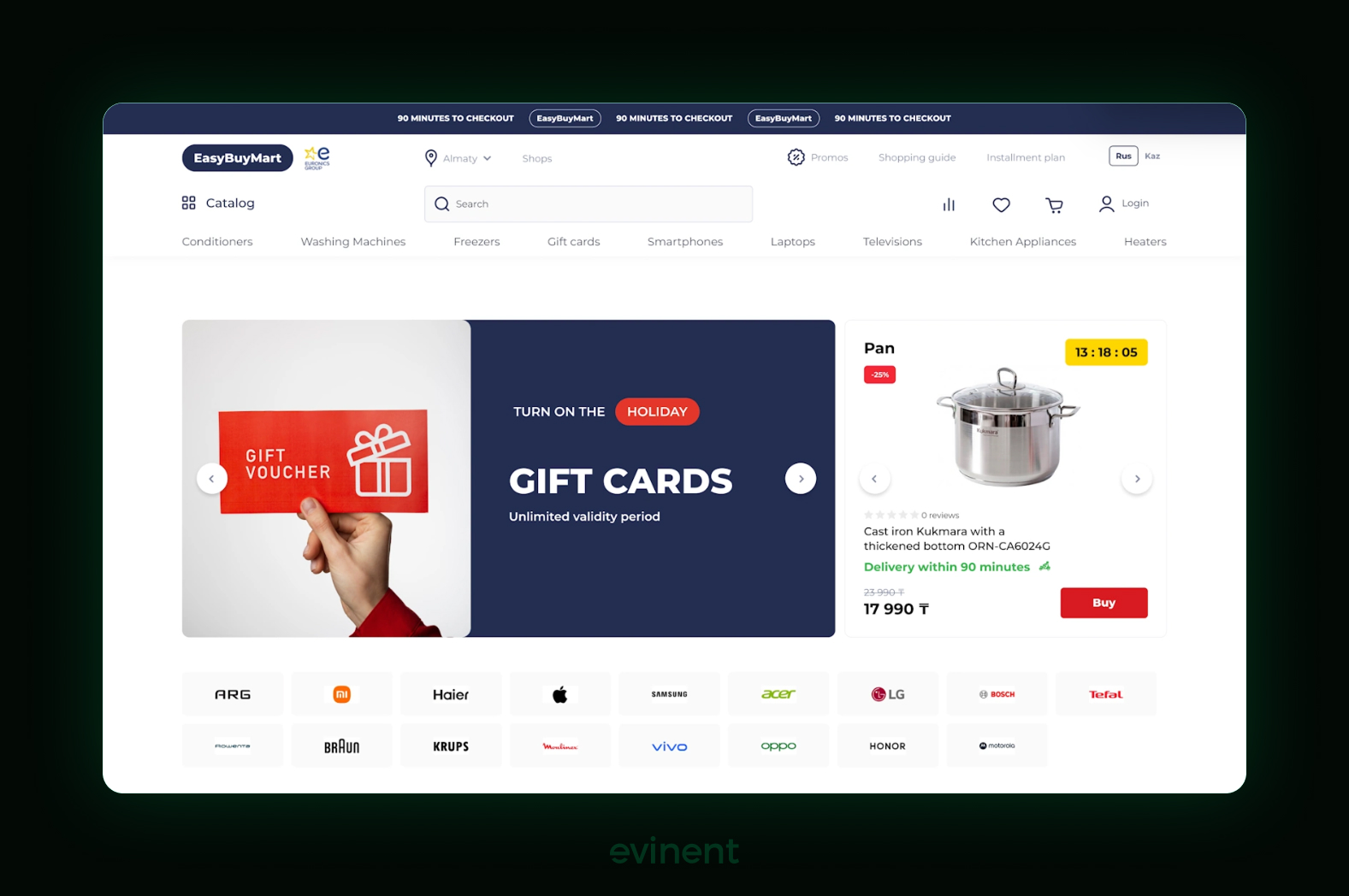
Our Solution:
Evinent modernized the retailer’s legacy architecture, built a unified data foundation, and integrated real-time inventory and pricing updates. We added advanced search, AI-powered personalization, multiple payment integrations (including instant credit comparisons), and optimized performance for high-traffic periods while ensuring enterprise-grade security.
The Outcome:
The retailer gained a scalable, customer-centric digital ecosystem with consistent omnichannel experiences, faster page loads, tailored recommendations, and reliable real-time data. As a result, customer satisfaction increased, conversions improved, and the brand strengthened its position as one of the top e-commerce platforms in the region.
To learn more, read: Scaling e-commerce for a leading central asian retailer
1. Modernizing Legacy Systems to Support Customer-Centric Operations
Being customer-centric needs quick access to data, insights in real-time, and workflows that are adaptable. This cannot be done by platforms that are old. Evinent is the way forward for organizations to upgrade their systems or completely change their old to keep:
unified customer data flow
faster processing of customer touchpoints
seamless integration with CRM, CDP, and CX platforms
stable, scalable infrastructure for digital experiences
Result: marketing, sales, and support teams finally operate on systems that don’t limit customer experience.
2. Building Custom Platforms Around the Customer Journey
Standard tools most of the time are not able to show the specific customer journey of a company. Evinent tailors custom software solutions to:
specific customer behaviors and needs
industry-specific touchpoints
personalization workflows
omnichannel communication logic
service or support processes that require automation
Result: the company gets a platform built around the customer, not around generic templates.
3. Creating Centralized Customer Data Environments
Customer centric marketing depends on accurate, accessible data. Evinent builds unified environments that consolidate:
CRM data
support tickets
behavioral analytics
purchase history
omnichannel interactions
product usage data
loyalty program activity
Result: every team sees the same customer picture — reducing silos and enabling personalized engagement at scale.
4. Integrating AI and Automation for Personalization
By the use of AI models, automation tools, and smart decision systems we empower their businesses to get these companies:
real-time recommendations
predictive analytics
automated communication flows
smart routing of customer requests
personalized content delivery
Result: personalization becomes systematic, fast, and scalable — not manual and inconsistent.
Evinent is not a substitute for marketing departments - we strengthen them. As a result of upgrading the hardware, standardizing data, and building tailor-made digital ecosystems, we provide companies with the technological framework that they require in order to carry out consumer oriented marketing in reality, rather than just making the marketing talk.
Share