

How many fraudulent transactions slipped through your systems today — without anyone noticing?
Most companies have no idea. Fraud today isn’t just a stolen card number or a spoofed email. It’s infiltration, identity manipulation, and AI-generated personas slipping through digital cracks that enterprises never thought to guard.
As The Hacker News warned in a 2025 security analysis, “The modern con isn’t a malicious link in your inbox; it’s a legitimate login inside your organization.”
And that shift — from phishing to full identity-level intrusion — explains why fraud losses continue to rise even as traditional defences expand.
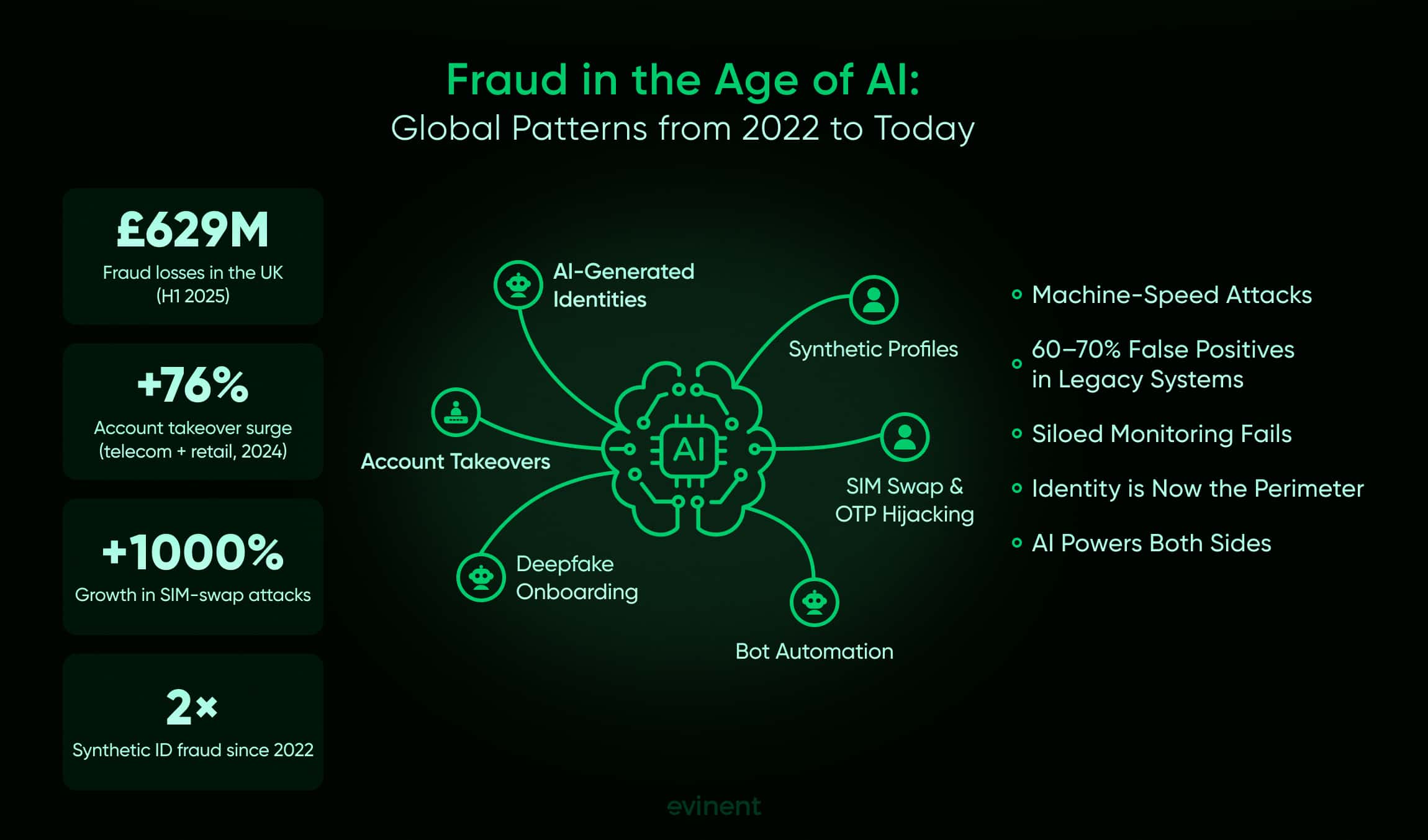
In the UK alone, businesses lost £629 million to fraud in just the first half of 2025. Synthetic identities have doubled since 2022, account takeover fraud keeps accelerating, and outdated detection systems still drown teams in false positives — sometimes 60–70% of all s.
Meanwhile, attackers operate at machine speed. Deep-learning fraud models now reach 92% accuracy, and enterprises using predictive analytics report detection speeds improving by more than 80%. Yet many organizations remain stuck with siloed systems, slow reviews, and tools built for a threat landscape that no longer exists. (CoinLaw, Banking Fraud Detection Statistics 2025)
The question for leaders is no longer “Is fraud happening?” It’s “How quickly can we detect it — and how much damage occurs before we do?”
This guide explains how fraud works today, why legacy controls fail, and what C-level teams must do to build a modern, AI-driven fraud-prevention strategy.
Fraud in the Age of AI: Global Patterns from 2022 to Today
Financial fraud is no longer a background operational risk, but it has become one of the fastest-evolving threats to enterprise value, trust, and regulatory compliance. Between 2022 and the present, several macro-trends have fundamentally reshaped how fraud is executed, detected, and monetized. The rise of AI-enabled crime, synthetic identities, large-scale account takeover operations, and remote-work infiltration have collectively expanded the attack surface beyond what traditional fraud-management frameworks can handle.
Below, we break down the most critical developments that enterprise and financial-sector leaders must understand today.
Fraud Volumes Are Rising Across Sectors
Despite stronger authentication and greater regulatory oversight, fraud volumes continue to climb year after year.
UK & EU Trends
The UK recorded £629 million in fraud losses in the first half of 2025, a 3% increase YoY — a clear sign that existing controls are being outpaced (BBC, Over £620 million lost to fraud in first half of 2025)
Fraud filings to the UK National Fraud Database rose slightly by 1% in early 2025, reaching 217,000+ cases in just six months
Identity fraud continues to dominate the landscape, with over 249,000 reported cases in 2024, representing the highest share of all digital fraud categories
Telecom and online retail sectors saw a dramatic 76% increase in account takeover (ATO) incidents in 2024, followed by another surge entering 2025 (Fraudscape's Report, 2025)
Global Patterns
Globally, 3.3% of all digital transactions are now estimated to face fraud-related attacks or probing attempts
Payment card fraud remains a major concern, representing roughly 35% of all global fraud cases
Synthetic identity fraud, often driven by AI-assisted profile creation, has doubled since 2022, posing a severe challenge to banks and lenders as onboarding becomes increasingly digital
ATO fraud targeting online retailers has risen by 30%, leading to widespread chargebacks, loyalty-program abuse, and compromised customer accounts (CoinLaw, Digital Payment Fraud Statistics 2025: Essential Data and Prevention Measures)
The data reflects a clear pattern: more channels, more automation, and more opportunities for fraudsters to bypass traditional controls.
Enterprise Fraud Exposure Is Worsening
Banks, fintechs, and large enterprises face escalating pressure.
Over 50% of banks and fintechs report an increase in business fraud attempts compared to previous years.
Fraudsters increasingly rely on AI-generated identities, automated bots, and deepfake interviews to bypass onboarding checks — as highlighted by recent high-profile infiltration campaigns in the US and EU.
Remote-work environments have eliminated physical hiring safeguards, making it easier for attackers to impersonate employees, contractors, or vendors.
As The Hacker News noted in 2025:
“The modern con isn’t a malicious link — it’s a legitimate login inside your organization.”
This identity-level infiltration means enterprises must treat fraud not only as a transactional threat, but as an organizational integrity risk.
Fraud Detection Systems Are Failing in Critical Areas
Despite better tools and more awareness, many organizations still rely on outdated fraud-detection architectures.
High False Positive Rates
Traditional systems produce alarmingly high levels of false s:
- Many organisations still experience 60–70% false positive rates, leading to
fatigue
operational backlogs
customer friction
and missed genuine fraud signals buried in noise.
This is one of the biggest contributors to undetected fraud in enterprises.
Siloed Monitoring
Fraud commonly spans:
payments
onboarding
lending
mobile apps
loyalty programs
internal access systems
Yet most enterprises monitor these in isolation. Without cross-channel intelligence, subtle fraud patterns, like multi-platform credential testing or cross-system behavior anomalies, go undetected.
Slow Detection and Escalation
Many fraud events remain unnoticed until:
Chargebacks occur
Audits reveal discrepancies
Or customers report suspicious activity
This ed detection increases direct losses and exposes organizations to regulatory risks.
The Good News
Modern analytics and ML models deliver significant performance gains:
Deep-learning fraud models now reach 92% accuracy in high-risk transaction scenarios.
Predictive analytics improve detection speed by up to 85%
AI-driven systems lower false positives by up to 30%, improving customer experience and investigative efficiency (CoinLaw, Banking Fraud Detection Statistics 2025)
In eCommerce, some AI-adaptive models achieve false positive rates as low as 0.00091%, showing what is possible when behavioural and contextual data are leveraged at scale.
The Bad News
Fraudsters are also using AI:
AI-generated identities support scalable synthetic-ID creation.
LLM-powered phishing and impersonation campaigns are increasingly realistic and automated.
Deepfake interviews and voice-spoofing make remote hiring fraud easy to operationalize.
Bot-based credential-stuffing attacks test thousands of compromised accounts simultaneously.
The resulting environment is asymmetric: fraudsters innovate faster than most enterprise security teams can adapt.
Why These Trends Matter for C-Level Leaders
For board members, CEOs, CFOs, CISOs, and CROs, the implications are clear:
Fraud is no longer a “technical issue”; it is an enterprise-level strategic threat.
Losses are rising despite increased spending on security tools.
Attackers no longer rely on cheap tactics; they use AI, automation, and legitimate-looking identities.
Regulatory expectations around fraud risk, customer protection, and identity verification are tightening worldwide.
The cost of false positives is now as dangerous as undetected fraud; both erode trust and revenue.
The 2022–2025 period marks a turning point. Fraud is evolving too quickly for organisations to rely on legacy rules, siloed systems, or reactive investigations. What’s required now is a unified, analytics-driven, AI-powered fraud-prevention approach that operates at the same speed as attackers.
In short: Fraud has grown faster than enterprise defenses. Losses rose globally, synthetic identities doubled, account takeovers surged, and UK businesses lost £629M in early 2025. Legacy systems still generate 60–70% false positives, miss cross-channel attacks, and detect fraud too late.
AI now drives both sides: advanced ML models reach 92% accuracy and cut false positives, while attackers use AI-generated identities, deepfakes, and automated credential attacks.
Bottom line: Fraud is now an identity-level, enterprise-wide threat. Organizations need unified, real-time, AI-driven prevention, legacy controls can’t keep up.
Major Fraud Typologies & How They’re Evolving
Fraud today is no longer limited to stolen cards, phishing emails, or opportunistic scams. It has evolved into a complex ecosystem of identity manipulation, AI-powered impersonation, multichannel infiltration, and highly coordinated financial attacks. The lines between cybercrime, social engineering, and organizational compromise have blurred, and the result is a threat landscape that moves faster than any legacy rule engine can follow.
Below are the critical fraud categories every enterprise must understand, and how each has transformed between 2022 and today.
Identity Fraud & Synthetic Identities (Now the Dominant Fraud Type)
Identity fraud remains the largest and most damaging fraud category worldwide, but its composition has radically changed.
Synthetic Identity Fraud: The New Criminal Standard
Synthetic identity fraud, where criminals combine real customer data with fabricated details to create realistic but fake identities, has exploded.
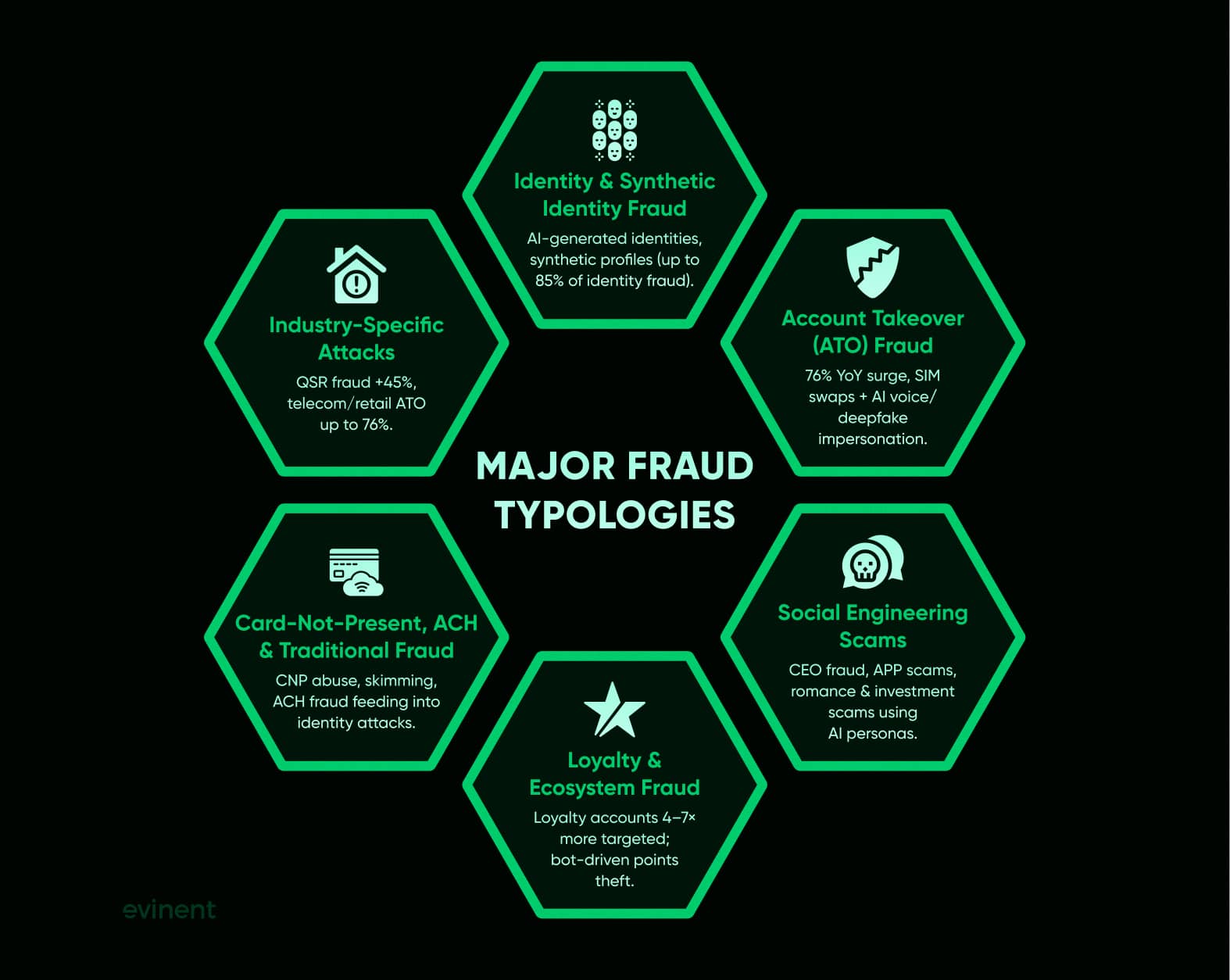
In some regions, synthetic IDs now represent up to 85% of all identity fraud cases.
These identities are used to open bank accounts, secure loans, access credit, launder money, and pass digital onboarding checks.
Why this matters: Synthetic identities are extremely difficult to detect using traditional verification, because the “person” doesn’t truly exist, and therefore cannot dispute transactions or trigger s. AI has made synthetic identity production scalable, cheap, and almost indistinguishable from legitimate onboarding flows.
Account Takeover (ATO) Fraud — Fueled by AI Impersonation
Account takeover attacks continue to accelerate at record levels:
ATO fraud surged by 76% in 2024 across telecom and online retail, and continues growing into 2025
SIM-swap fraud climbed by more than 1,000%, allowing attackers to intercept OTPs and bypass multi-factor authentication
AI-generated voices, deepfake videos, and LLM-produced scripts make impersonation dramatically easier (Mishcon de Reya, Fraud trends in 2025)
Common ATO entry points include:
Credential stuffing
Malware-enabled session hijacking
Password reuse across platforms
Social-engineering support agents
SIM swaps and stolen mobile identities
The result is a wave of unauthorized transactions, loyalty-point theft, subscription fraud, and payment method abuse, often before companies detect any anomaly.
Social-Engineering-Based Scams
While digital fraud grows, human-focused manipulation remains highly profitable, and increasingly AI-assisted.
Key Scam Categories Growing Today:
CEO Fraud / Executive Impersonation:
Attackers mimic senior executives to pressure staff into urgent transfers or data sharing.
Bank Employee & Police Impersonation:
Criminals impersonate authority figures to extract OTPs, account access, or money under “security checks.”
Investment Scams:
Driven by fake crypto opportunities, fabricated trading platforms, and AI-generated marketing content.
Romance Scams:
AI-generated messages and personas make emotional manipulation more persuasive and scalable.
Online Purchase Scams:
Fake eCommerce storefronts, fraudulent listings, and account takeovers drive losses.
Authorized Push Payment (APP) Fraud:
Losses exceed £450 million in the UK alone, as victims are tricked into transferring funds voluntarily.
Criminals recruit money mules through social media, often using influencer-style or gamified tactics targeting younger users.
These scams increasingly combine deepfake audio, AI-generated personas, and real-time social engineering, making them far harder to detect with traditional methods.
Loyalty Points & Ecosystem Fraud (An Emerging High-Risk Category)
A fast-growing but underrecognized trend is the rise of ecosystem-level attacks:
Loyalty programs are 4–7 times more likely to be targeted than payment accounts.
Attackers use ATO, phishing, and bot-driven credential testing to steal or manipulate reward points.
These points are then converted into gift cards, merchandise, or resold on dark-market exchanges.
Why this matters: Loyalty systems often lack strong KYC, behavioural analytics, and fraud controls, making them easy targets despite containing significant monetary value.
Card-Not-Present (CNP) Fraud, Skimming & Traditional Schemes
Traditional fraud forms remain highly active and have adapted to new technologies.
CNP fraud continues to rise as online shopping volumes expand.
Skimming attacks (at ATMs, POS terminals, fuel pumps) remain widespread due to inexpensive, easily concealed skimming devices.
ACH fraud and mail theft persist, often feeding into identity theft or check fraud schemes.
Phishing and credential theft remain foundational entry points for both payment and identity fraud.
These methods increasingly integrate with modern attacks, for example, stolen card or ACH data feeding into synthetic identity creation or ATO attempts.
Industry-Specific Fraud Patterns Emerging in Present
Certain sectors experience unique spikes in fraud as attackers test new models.
Quick Service Restaurants (QSRs) — +45% Fraud Increase
Fraud targeting QSRs rose by 45%, with:
Over 85% of attempts coming from repeat offenders
Bot-driven attacks on mobile ordering apps
Loyalty account abuse
Chargeback fraud
QSRs are vulnerable due to high transaction volume, low friction, and limited identity checks (Help Net Security, The fraud trends shaping 2025)
Telecom & Online Retail
As noted earlier, ATO incidents rose 76%, creating downstream costs across payment disputes, inventory loss, and customer churn.
Fraudsters Are Scaling With AI, Faster Than Enterprises Can React
AI is the defining factor in modern fraud evolution:
How criminals use AI
Generate realistic fake identities at scale
Produce deepfake voice and video to pass KYC or interviews
Craft convincing phishing content using LLMs
Automate credential-stuffing attacks
Generate fake documents, bank statements, invoices, and compliance paperwork
Criminals can now run fraud as a high-speed, automated operation, not a manual scheme.
How enterprises fight back
AI also powers modern defenses:
Deep-learning models achieve 92% accuracy in high-risk scenarios
Predictive analytics improve detection speed by 85%
False positives drop by up to 30% with behavioural analytics
eCommerce models can hit 0.00091% false positives with adaptive machine learning
The challenge: Most organizations lag in adoption, using siloed legacy systems that cannot respond at the speed of modern threats.

What This Means for Now and Beyond
Fraud typologies are converging:
Identity fraud is merging with ATO
AI-generated personas fuel investment and romance scams
Social engineering drives APP fraud
Loyalty ecosystems are emerging as high-value soft targets
QSR and retail apps face automation-level attacks
CNP and ACH fraud link back to synthetic identities
The common thread:
Fraud is now a multi-channel, multi-vector ecosystem driven by identity manipulation and AI automation. Static rules or isolated monitoring tools cannot keep up.
What enterprises need is clear: adaptive machine learning, unified intelligence, cross-channel analysis, and real-time anomaly detection of new patterns as quickly as they emerge.
Why Traditional Controls Fail (and What Enterprises Must Change Now)
For many organisations, fraud controls haven’t changed materially in over a decade, but fraud has. Legacy systems were built for a world where criminals worked manually, used predictable patterns, and relied on stolen cards or phishing emails. Now, fraud is automated, AI-enhanced, identity-based, and coordinated across multiple platforms. Yet many enterprises still depend on rules engines, siloed monitoring tools, and fragmented workflows that cannot match the speed or sophistication of modern attacks.
Below are the core reasons legacy fraud-prevention architectures fail today, and what C-level leaders must do differently.
Legacy Fraud Systems Rely on Static Rules (Attackers Don’t)
Rules engines were once effective, but fraud today evolves too quickly.
Why static rules fail
Fraudsters adjust behaviour instantly to bypass fixed thresholds.
Rules become obsolete within days or weeks.
Overly strict rules generate false positives; looser rules miss real threats.
Rules engines excel at catching yesterday’s patterns but fail with:
synthetic identities
AI-generated behaviour patterns
multi-step attacks across systems
coordinated bot activity
social engineering–driven fraud
Modern fraud requires continuous behavioural learning, not static if/then logic.
Siloed Monitoring Creates Blind Spots Across Channels
Most enterprises still monitor fraud in separated systems:
payments
onboarding
mobile apps
loyalty programs
internal access controls
lending systems
CRM and ERP platforms
The result
No system sees the full picture, and fraudsters exploit this.
For example:
A synthetic identity passes onboarding…
…makes small test purchases…
…redeems loyalty points…
…links external accounts…
…and executes a large fraud event weeks later.
Each system sees a “normal” behaviour slice.
Only unified cross-channel detection identifies the pattern.
High False Positive Rates Cripple Fraud Teams
Legacy detection models commonly generate 60–70% false positives.
Consequences
Analysts become overwhelmed ( fatigue).
Genuine fraud hides inside noise.
Customers face unnecessary friction.
Operational costs spike from wasted manual reviews.
False positives are now as damaging as false negatives:
They increase churn.
They reduce conversion rates.
They create compliance issues.
They block legitimate transactions.
AI-driven behavioural analytics dramatically reduce these rates, but only if organisations replace their outdated systems.
Fraud Is No Longer Just Transactional, It’s Identity-Level
Traditional fraud controls were built around money movement:
card-not-present
ACH
wire transfers
chargebacks
But modern fraud happens before the transaction:
AI-generated job applicants pass interviews
Deepfake employees pass onboarding
SIM swap victims lose MFA protections
Stolen loyalty accounts are drained
Fraudsters infiltrate internal systems through fake contractors
Synthetic identities open accounts with no real person behind them
This shift from transactional fraud to identity fraud breaks traditional controls entirely.
As The Hacker News noted:
“The modern con isn’t a malicious link — it’s a legitimate login inside your organization.”
Identity is now the perimeter, and legacy systems don’t defend it.
Legacy Systems Don’t Detect Multi-Step, Multi-Vector Attacks
Modern Fraud Pattern (Multi-Step Attack Chain) | Why Legacy Systems Fail | How AI-Driven Models Detect It |
|---|---|---|
From Phishing to Credential Testing and Account Takeover | Each event is analysed separately; no link is made between login anomalies, unusual device behaviour, and credential-testing patterns. | Behavioural analytics connect login velocity, device fingerprints, and user patterns to detect early ATO signals. |
From Synthetic ID to Small Transactions to Loyalty Abuse and High-Value Fraud | Rules trigger only on big transactions, missing low-value "probing" activity. Loyalty fraud sits outside payment monitoring. | AI evaluates behavioural progression over time — identifying synthetic profiles, abnormal points usage, and sudden spending spikes. |
From App Exploitation to SIM Swap to OTP Interception and Wire Transfer | Legacy tools cannot correlate telecom events, device changes, and payment behaviour. MFA breakdowns are seen as isolated failures. | AI models track device shifts, network anomalies, SIM changes, and OTP behaviour to flag coordinated attacks. |
From Onboarding Fraud to Internal Infiltration and Payroll/Invoice Manipulation | Fraud controls stop at onboarding; internal system access is rarely monitored with behavioural modelling. | AI monitors identity behaviour continuously, detecting abnormal internal activity and privilege misuse. |
AI-powered models analyse behaviour over time, not in isolated events, enabling detection of long-tail, slow-burning fraud patterns.
Manual Review Teams Cannot Keep Up With Automation
Fraudsters now automate:
identity generation
phishing
credential stuffing
bot-based checkout attacks
fake-app downloads
mule recruitment
scam message creation
Manual analysts simply cannot match this speed.
Legacy workflows break down because:
They rely on human pattern recognition
They take too long to escalate threats
They cannot process the volume of micro-transactions
Fraudsters operate 24/7 with machine-speed attack cycles
Modern fraud-prevention requires machine-speed detection and automated decisioning, supplemented — not replaced — by human analysts.
Traditional Controls Overlook “Low-Value, High-Volume” Attacks
Fraud isn’t always a big transfer.
Attackers increasingly use:
micro-transactions
loyalty redemptions
small refunds
digital wallet drips
promotions abuse
coupon/discount exploitation
QSR app fraud (up 45% in 2025)
These low-value events accumulate into massive losses — but they rarely trigger legacy rules, which focus on large payments.
Advanced analytics evaluate patterns, not just transaction size.
Legacy Systems Cannot Stop AI-Generated Fraud
Fraudsters now use AI to create:
synthetic identities
deepfake interviews
realistic phishing campaigns
voice clones for call-centre impersonation
fake invoices and financial documents
“employees” that pass remote onboarding
Outdated fraud systems cannot detect AI-generated anomalies because:
They lack contextual behavioural baselines
They cannot detect linguistic patterns or voice inconsistencies
They cannot validate digital identity provenance
They cannot distinguish human behaviour from automated scripts
AI-driven fraud requires AI-driven defence.
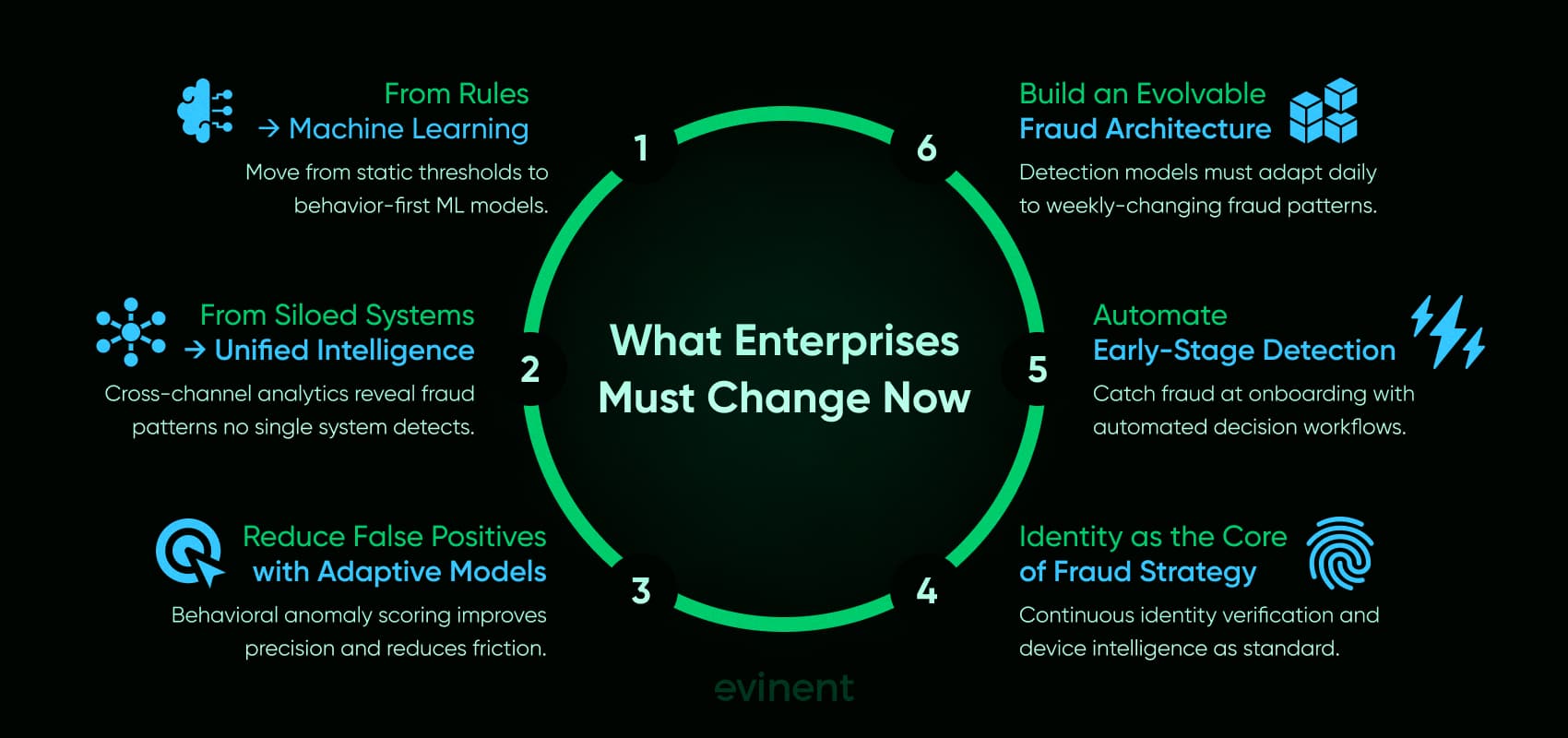
What Enterprises Must Change Now
1. Move from rules to machine learning (behaviour-first models)
AI models must augment or replace static thresholds.
2. Replace siloed detection with unified intelligence
Cross-channel analytics uncover patterns no single system can see.
3. Reduce false positives with adaptive anomaly detection
Behavioural scoring reduces friction and improves accuracy.
4. Elevate identity to the core of fraud strategy
Implement continuous identity verification, device intelligence, and behavioural biometrics.
5. Automate early-stage detection
Automated workflows catch fraud at onboarding, not after losses occur.
6. Build a fraud architecture that can evolve
Modern fraud evolves weekly, so your detection models must evolve daily.
Building an AI-Driven Fraud Prevention Framework
As fraud accelerates and becomes increasingly identity-centric, multi-vector, and AI-enhanced, enterprises must move beyond incremental improvements and build a holistic, intelligence-driven fraud architecture. Modern fraud prevention is not a single tool or model; it is a coordinated ecosystem of data, machine learning, identity analytics, automation, and continuous monitoring across every customer and employee touchpoint.
Below is a practical, C-suite-oriented blueprint for designing a fraud-prevention framework capable of operating at the same speed as attackers.
Core Principles of Modern Fraud Prevention
1. Behaviour Over Rules
Fraud patterns evolve too quickly for static rules to keep up.
ML models detect behavioural anomalies, not predefined patterns.
2. Identity as the New Perimeter
Every fraud scenario — ATO, synthetic ID, APP scams, insider threats — ultimately relies on compromised or fabricated identity.
3. Real-Time Decisioning
Fraud prevention must happen before authorisation, not during investigations or chargeback cycles.
4. Unified Intelligence Across Channels
Fraud must be analysed across payments, onboarding, loyalty, devices, internal systems, and communications.
5. Continuous Model Evolution
Models must retrain against new data — weekly or daily — not once per quarter.
The AI-Driven Fraud Prevention Architecture
Below is a layered architecture that reflects industry best practices and aligns with modern fraud realities.
Layer 1 — Unified Data Foundation
A modern fraud engine starts with data consolidation.
Key components:
Customer identity data
Transaction history
Device fingerprints
Behavioural biometrics (typing speed, navigation patterns, gesture models)
Telecom and SIM-swap signals
Geolocation and IP intelligence
Loyalty activity
Internal access logs
Dark-web exposure signals
Why it matters: Fragmented data means fragmented intelligence, and Unified data means behavioural connections that reveal multi-step fraud.
Layer 2 — Real-Time Behavioural Analytics
Behavioural modelling is at the heart of modern fraud prevention.
Core capabilities:
Baseline normal user behaviour
Detect deviation patterns
Correlate behaviour across devices and channels
Score risk using ML vs. fixed rules
Identify synthetic/automated activity
Examples of behavioural indicators:
Login velocity from multiple geos
Navigation anomalies
Unusual loyalty-point redemptions
Inconsistent session biometrics
Abnormal spending trajectory
Device resets or fingerprint mismatches
Behaviour-driven scoring drastically reduces false positives and catches fraud long before transactions occur.
Layer 3 — Machine Learning & Advanced Anomaly Detection
AI must replace large portions of rule engines.
ML use cases:
Detecting synthetic identities
Predicting ATO likelihood
Real-time transaction scoring
Clustering unusual customer profiles
Identifying coordinated fraud rings
Flagging abnormal internal access patterns
Why ML succeeds where rules fail:
Learns new fraud behaviour automatically
Detects patterns invisible to humans
Identifies low-value, high-volume fraud
Scales to millions of events per second
Modern ML models (including deep learning) deliver:
Up to 92% accuracy in high-risk scenarios
85% faster detection speeds
30% fewer false positives
Source: CoinLaw, Banking Fraud Detection Statistics 2025
Layer 4 — Adaptive Identity Verification
Identity is now the main attack surface.
Key components:
Document verification (AI-enhanced)
Liveness checks
Device binding
SIM-swap intelligence
Voice/face deepfake detection
Behavioural biometrics
Velocity checks across identity attributes
This layer prevents synthetic ID onboarding, deepfake interview fraud, SIM-swap attacks, and employee impersonation.
Layer 5 — Real-Time Decisioning Engine
This layer orchestrates fraud responses.
Capabilities:
Approve
Decline
Challenge (step-up authentication)
Route for investigation
Lock accounts
Trigger s
Link cases across systems
Real-time orchestration ensures fraud is blocked before funds move or accounts are compromised.
Layer 6 — Automated Prevention & Remediation
Automation reduces operational load and enables instant responses.
Automated workflows include:
Blocking transactions or sessions
Re-verifying identity
Resetting compromised credentials
Locking affected loyalty accounts
Updating internal access permissions
Pushing s to analysts
Feeding data back into ML models
Automation eliminates minutes — or hours — of analyst that fraudsters rely on.
Layer 7 — Human-in-the-Loop Investigations
AI boosts analysts — it doesn’t replace them.
Investigators need:
Explainable AI models
Case-linking visualizations
Fraud ring mapping
Access to cross-channel datasets
Automated recommendations
Timeline views of multi-step attacks
This hybrid approach delivers both accuracy and operational efficiency.
Implementation Roadmap for C-Level Leaders
Phase 1 — Infrastructure & Data Consolidation
Centralize data sources
Build a unified fraud lake
Integrate identity and device intelligence
Phase 2 — Deploy Behavioural & ML Models
Begin anomaly detection
Replace high-noise rules
Reduce false positives
Phase 3 — Automate Decisions & Actions
Introduce real-time orchestration
Automate common fraud scenarios
Build step-up authentication workflows
Phase 4 — Expand to Full Enterprise Intelligence
Integrate onboarding verification
Add loyalty, internal access, QSR apps, telecom data
Add ML retraining pipelines
Phase 5 — Continuous Optimisation
Collect fraud feedback loops
Train models weekly/daily
Monitor model drift
Expand detection to new fraud typologies
What Success Looks Like
When fully implemented, an AI-driven fraud framework delivers:
Dramatically fewer false positives
Real-time fraud detection
Improved customer conversion & reduced friction
Early detection of identity fraud and ATO
Stronger protection of internal systems
Full visibility into multi-channel attacks
Automated fraud operations
Lower fraud losses and regulatory risk
Most importantly, it transforms fraud prevention from a reactive function into a strategic, competitive advantage.
TL;DR
Modern fraud is too fast, too complex, and too identity-driven for legacy systems to handle. An effective modern fraud-prevention strategy requires unified data, behavioural analytics, adaptive identity verification, real-time ML decisioning, and automated responses across all channels where fraud can occur. AI models outperform rule engines by catching multi-step attack chains, reducing false positives by up to 30%, and identifying anomalies long before a transaction happens. The result is a proactive, machine-speed defence that protects customers, revenue, and internal systems while reducing operational load.
The Business Benefits of AI-Driven Fraud Prevention
Enterprises don’t adopt AI-driven fraud systems simply because fraud is evolving; they adopt them because the business impact is immediate, measurable, and strategically significant. AI-powered detection is a competitive advantage, a customer-experience differentiator, and a cost reducer. Below are the core business benefits that C-level leaders can expect from deploying a modern, AI-driven fraud-prevention strategy.
Significant Reduction in Fraud Losses
AI models detect patterns that rule-based systems cannot, preventing both high-value attacks and long-tail, low-value fraud that accumulates into millions of dollars over time.
Key outcomes:
Real-time detection stops fraud before authorisation, eliminating downstream chargebacks.
Synthetic identities, ATO, SIM swaps, and APP scams are identified earlier in the kill chain.
Fraud losses drop dramatically as attack chains are disrupted at the behavioural level.
Across financial services, retail, telecom, and fintech sectors, enterprises report:
Up to 85% faster detection
More than 90% accuracy in high-risk scenarios
A measurable decline in both transactional and identity-based losses
Dramatically Lower False Positive Rates
High false positives have long been a hidden cost of fraud prevention.
AI reduces noise by analysing behaviour, not just static rules, letting legitimate customers move without friction.
Impact on the business:
Less customer frustration for higher retention
Increased approval rates mean more revenue
Fewer manual reviews lead to lower operational costs
Analysts focus on real threats instead of false alarms
eCommerce AI models now achieve false positive rates as low as 0.00091%, a benchmark previously considered unattainable.
Improved Customer Experience & Conversion Rates
Fraud systems traditionally caused friction by blocking or challenging legitimate customers.
AI reverses that dynamic.
Benefits include:
Fewer unnecessary verifications
Seamless onboarding experiences
Faster checkout authorisations
Higher payment acceptance rates
For digital-first businesses, this translates directly into higher conversion and increased lifetime value.
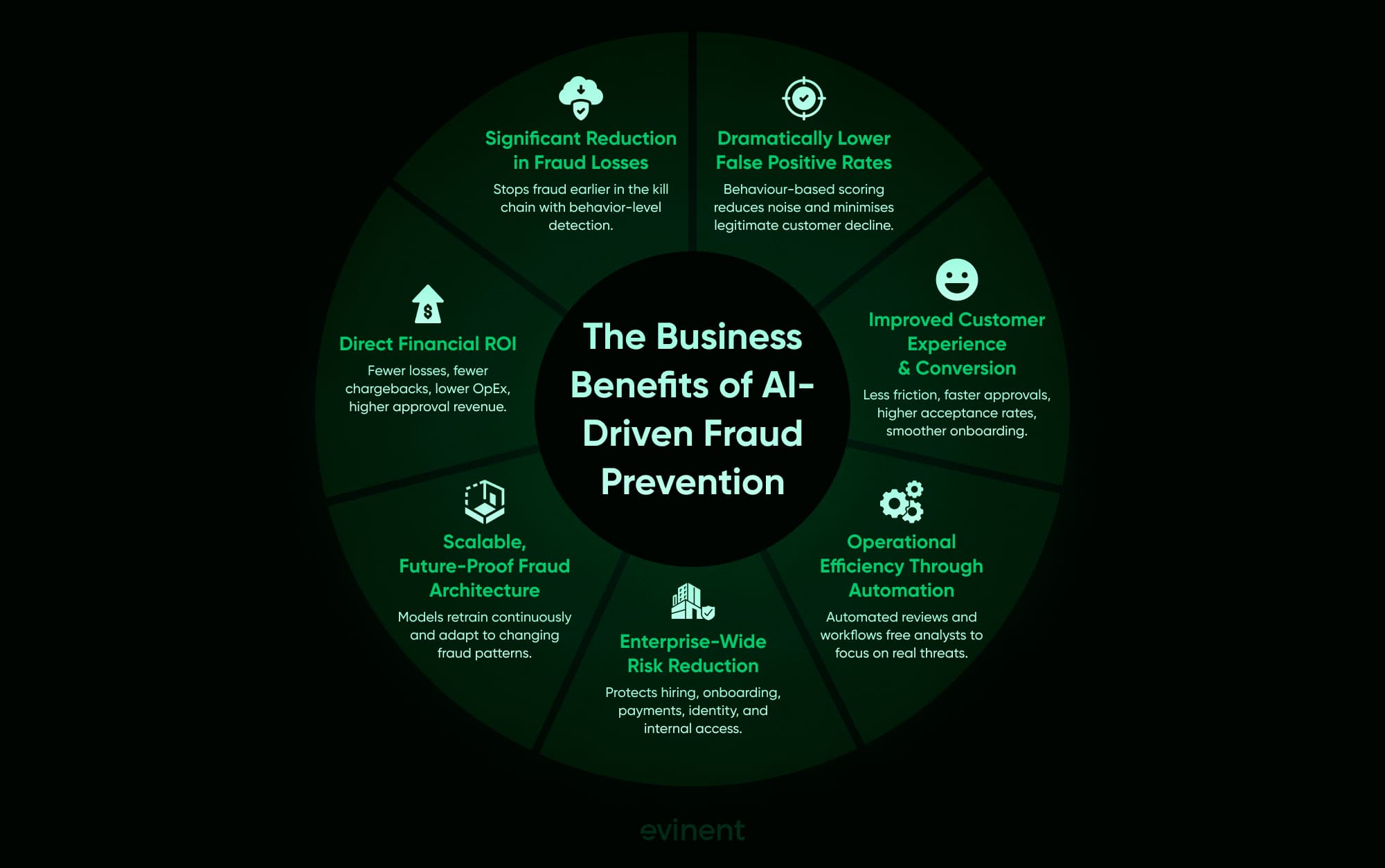
Operational Efficiency Through Automation
AI-driven automation eliminates the bottlenecks of manual review queues.
Efficiency gains:
Automatic challenge/approval workflows
Automated account locking and re-verification
Intelligent routing for high-risk cases
Reduced time-to-resolution for investigations
Scalable fraud operations without adding headcount
Fraud teams become strategic analysts, not overworked first responders.
Enterprise-Wide Risk Reduction
AI strengthens not only transactional security but also organisational integrity.
AI protects against:
Remote hiring fraud
Insider privilege misuse
Account takeovers
Synthetic onboarding
Business email compromise
Mule recruitment on social networks
QSR, loyalty, and ecosystem fraud
This reduces:
Regulatory exposure
Compliance risk
Brand damage
Litigation and recovery costs
Identity-first fraud protection is now a board-level concern, and AI addresses it holistically.
Scalable, Future-Proof Fraud Architecture
Fraud evolves weekly. AI evolves daily.
With AI-driven prevention, enterprises gain:
Continuous model retraining
Automatic adaptation to new fraud patterns
Ability to process millions of signals per second
A shared intelligence layer across all business units
Instead of reacting to attacks, organisations anticipate and neutralize them.
AI-driven fraud frameworks improve over time, unlike static systems that decay.
Direct Financial ROI
Modern fraud-prevention systems deliver fast and clear returns:
Fewer losses — retained revenue
Fewer chargebacks — lower processing fees
Fewer manual reviews — reduced staffing costs
Higher approval rates — increased transactions
Improved customer satisfaction — higher CLV
Even conservative models show ROI within months, not years.
TL;DR
AI-driven fraud prevention is not just about blocking threats. It’s about enabling safer growth, creating trust, unlocking revenue, reducing operational cost, and future-proofing the entire organisation. Enterprises that deploy AI-powered systems operate faster, safer, and more confidently than those relying on legacy tools — and the performance gap widens every year.
Evinent Analytics: AI-Powered Fraud Intelligence in Action
As fraud becomes more identity-driven, multi-step, and AI-enhanced, enterprises need systems capable of analysing behaviour across millions of data points, detecting anomalies in real time, and linking events across transactions, devices, users, internal systems, and loyalty programs. Evinent Analytics was built precisely for this environment — leveraging machine learning, Big Data, and cross-channel intelligence to prevent financial losses long before they appear on the balance sheet.
Unlike legacy tools, Evinent Analytics operates as a unified fraud-intelligence platform, combining predictive analytics, behavioural modelling, correlation analysis, and anomaly detection across every business process where fraud can emerge: sales, loyalty, internal operations, website behaviour, payments, and employee activity.
Cross-Channel Anomaly Detection Across Sales, Loyalty & Operations
Evinent Analytics uses machine learning to uncover anomalies across:
transactions
loyalty programs
discount systems
internal expenses
fuel purchases
sales plans
office supplies and procurement
Use Case: Detecting Anomalies in Loyalty Program Abuse
A retail chain integrated Evinent Analytics to monitor loyalty-card usage across 200+ stores. Within days, anomaly detection identified:
unusually high point redemptions
repeated usage from a single device across multiple customer accounts
abnormal velocity in point transfers
correlated patterns between returns and bonus redemptions
These signals enabled the retailer to uncover a coordinated loyalty fraud ring that had previously gone undetected because data was siloed across POS systems, CRM, and internal accounting.
Outcome: Fraud losses were reduced, and the retailer implemented automated s for similar anomalies.
Real-Time Correlation Analysis to Detect Internal & External Fraud
Evinent’s correlation and dependency analysis engine allows enterprises to uncover hidden relationships between:
product groups
customer segments
purchasing patterns
employee-led transactions
suspicious cross-category behaviour
Use Case: Identifying Fraud in Sales-Plan Manipulation
A regional pharmacy network used Evinent Analytics to correlate:
transaction timestamps
discount-card usage patterns
employee sales activity
product-category dependencies
The system detected an employee consistently overriding discounts for non-eligible products and manipulating sales targets. Traditional monitoring had missed this because each action looked normal in isolation.
Outcome: Evidence-based fraud reporting was sent to internal security, enabling immediate response.
Website Behaviour and Transaction Data to Prevent Account Takeovers
Because Evinent Analytics tracks detailed website behaviour, including:
product views
category activity
add-to-cart events
search-query behaviour
non-authorized user activity linked to anonymized IDs
…it becomes a powerful defence against account takeovers, bot attacks, and suspicious multi-device activity.
Use Case: Stopping ATO Attempts Using Behavioural Signals
A large eCommerce retailer integrated Evinent Analytics with their online store and POS/ERP systems. The platform detected:
sudden login attempts from unusual geolocations
velocity anomalies in product views
repeated failed login patterns
abnormal behaviour following successful logins
The system automatically matched this behaviour to prior anonymous activity, exposing automated credential-testing patterns used by bots.
Outcome: The retailer implemented automatic session challenges and blocked compromised accounts before fraudulent orders occurred.
Predictive Analytics to Prevent Future Fraud Events
Evinent’s predictive engine is used not only for marketing or sales forecasting but also for fraud prediction, analysing future outcomes based on historical behavioural sequences.
Use Case: Predicting Suspicious Purchase Sequences
In the pharmaceutical sector, Evinent Analytics revealed that certain medication purchases were consistently followed by unusual high-value purchases in unrelated categories — a sign of coordinated fraud or controlled-substance resale activity.
The system’s time-dependency dashboard flagged these patterns automatically.
Outcome: The client built targeted monitoring rules and saw a measurable reduction in controlled-product diversion.
Multi-System Integration Enables Full Fraud Visibility
Evinent Analytics integrates with:
CRM
ERP
POS
eCommerce stores
loyalty systems
accounting systems
This unified architecture enables the detection of fraud patterns that span multiple systems.
Use Case: Corporate Procurement Fraud Detection
A mid-sized enterprise used Evinent Analytics to combine procurement data with employee profiles and accounting systems.
The platform surfaced:
inconsistent supplier invoicing
abnormal repeat purchases
overuse of discretionary budgets
suspicious correlations between employee actions and supply orders
Outcome: The company prevented recurring procurement fraud and implemented automated “red flag” triggers.
Why Evinent Analytics Is Uniquely Positioned for Modern Fraud
Based on documented platform capabilities, Evinent Analytics offers:
Cross-channel, cross-system visibility
Advanced anomaly detection powered by machine learning
Predictive forecasting of irregular behaviour
Correlation analysis across sales, loyalty, internal data
Behavioural monitoring from website to checkout
Real-time s to security or risk teams
Integration with enterprise ecosystems (CRM, ERP, POS, accounting)
Fraud detection across both customer-facing and internal operations
This makes it a complete fraud-intelligence solution designed for enterprises facing modern AI-driven fraud threats.
Implementation Roadmap: How Enterprises Deploy AI Fraud Systems Successfully
Building an AI-driven fraud ecosystem is a phased transformation that touches data architecture, identity management, operations, model governance, and cross-departmental workflows. Successful enterprises follow a structured roadmap that ensures quick wins early on while building a scalable foundation for long-term fraud intelligence.
This section provides a clear, actionable roadmap based on industry best practices and Evinent’s experience implementing advanced analytics and fraud-monitoring systems for large retailers, financial organizations, and enterprise-level platforms.
Phase 1 — Data Consolidation & Infrastructure Setup
The foundation of AI-driven fraud detection is clean, unified, accessible data. Most organizations fail at fraud prevention not because of insufficient models, but because their data is fragmented across dozens of systems.
Key Actions:
Identify all fraud-relevant data sources: CRM, ERP, payments, POS, loyalty, HR, onboarding, telecom, web analytics.
Build a central fraud data lake or warehouse.
Clean duplicate, incomplete, and conflicting records.
Establish real-time ingestion pipelines and event streams.
Set up identity resolution and device/behaviour tracking.
A fraud engine that sees the entire picture, enabling behavioural modelling and anomaly detection across channels.
Phase 2 — Behavioural Analytics & Machine Learning Integration
Once data is centralized, enterprises can introduce behaviour-first detection models.
Key Actions:
Deploy ML models for anomaly detection, clustering, and predictive scoring.
Build behavioural baselines for users, devices, and internal identities.
Replace brittle static rules with adaptive risk scoring.
Introduce model governance: retraining schedules, drift monitoring, performance testing.
Early detection of identity fraud, ATO, and multi-step attacks, long before financial transactions occur.
Phase 3 — Real-Time Decisioning Engine
AI-driven fraud detection must operate at authorization speed, not batch-processing speed.
Key Actions:
Implement real-time scoring for transactions, logins, onboarding, loyalty events, and internal actions.
Deploy automated decision workflows (approve, decline, challenge, escalate).
Integrate step-up authentication (document checks, OTP, biometrics).
Route high-risk cases directly into fraud queues with full context.
Fraud is blocked before it reaches the balance sheet.
Phase 4 — Intelligent Automation of Fraud Operations
Automation is essential for scale. Fraud teams must stop firefighting and start supervising automated systems.
Key Actions:
Automate common fraud responses: account locking, session killing, password resets.
Build workflows for high-frequency fraud types (ATO, synthetic ID signals, coupon abuse).
Use webhooks and APIs to integrate with internal systems and customer communication channels.
Automatically re-verify identity when anomalous behaviour occurs.
A fraud operations function that can handle 10× the volume with the same team.
Phase 5 — Identity-Centric Security
Following trends highlighted by The Hacker News, enterprises must shift from perimeter security to identity security.
Key Actions:
Implement continuous identity verification (behaviour, device, geolocation).
Introduce Zero Standing Privileges (ZSP) for internal systems.
Add SIM-swap intelligence, device binding, and session anomaly monitoring.
Integrate deepfake and voice-spoof detection for remote onboarding.
Employees, contractors, customers, and vendors are continuously authenticated, drastically reducing APP fraud, remote hiring fraud, and insider misuse.
Phase 6 — Enterprise-Wide Visibility & Reporting
Fraud prevention becomes exponentially more effective when business leaders understand trends, costs, and risk exposure.
Key Actions:
Build dashboards for fraud KPIs, model accuracy, losses avoided, and anomaly volumes.
Implement real-time risk heatmaps across channels.
Enable drill-down views for executives, security teams, and compliance auditors.
Integrate audit-ready reporting for PCI DSS, PSD2, GDPR, FFIEC, and banking regulators.
Fraud becomes a measurable, manageable, executive-level risk category, not an invisible operational problem.
Phase 7 — Continuous Model Evolution & Optimization
Fraud evolves weekly. Your models must evolve daily.
Key Actions:
Maintain automated model retraining pipelines.
Monitor model drift, false positives, and long-tail anomalies.
Expand the system to new fraud typologies as they emerge (loyalty, QSR, telecom, APP fraud).
Add threat intelligence feeds, dark-web monitoring, and external signals.
Integrate new channels and devices as the business expands.
A fraud ecosystem that gets smarter, more accurate, and more adaptive every month.
Fast Wins: How Enterprises See Results in the First 60 Days
Even complex fraud ecosystems produce early wins.
Typical first-60-day improvements:
20–35% reduction in false positives
Early exposure of synthetic IDs
Discovery of overlooked ATO attempts
Reduced manual review load
Detection of internal anomalies (procurement, loyalty, discount misuse)
Real-time visibility into cross-channel fraud patterns
These create momentum, enabling the organization to scale AI adoption without internal resistance.
Why Evinent’s Implementation Approach Works
Based on Evinent Analytics case studies and modernization projects stored in your workspace, Evinent delivers:
Deep system integration experience (CRM, ERP, POS, eCommerce, accounting)
Hands-on transformation of legacy applications into modern AI-ready platforms
Full analytics suite (RFM, correlation, anomaly detection, predictive forecasting)
Fraud monitoring built on Big Data infrastructure
Fast implementation cycles due to modular architecture
Consistent 100% project completion rate across enterprise clients
This makes Evinent a strong partner not only for deploying fraud analytics, but also for future-proofing data ecosystems so AI can operate at full potential.
FAQ
What is financial fraud today?
Financial fraud today refers to multi-channel, AI-enhanced schemes that target identities, transactions, loyalty systems, internal workflows, and onboarding processes. It includes synthetic identities, account takeovers, social-engineering scams, APP fraud, and AI-generated impersonation attacks.
How does AI improve fraud detection?
AI improves fraud detection by analysing behavioural patterns instead of static rules. Machine-learning models detect anomalies, score real-time risk, reduce false positives by up to 30%, and identify multi-step fraud chains that legacy systems cannot see.
Why do traditional fraud systems fail?
Traditional systems fail because they rely on static rules, siloed monitoring, and manual reviews.
They cannot detect synthetic identities, multi-step attacks, AI-generated impersonation, or behaviour anomalies across channels such as onboarding, loyalty, QSR apps, and internal systems.
What is synthetic identity fraud?
Synthetic identity fraud occurs when criminals combine real and fabricated personal data to create new identities. These identities pass onboarding checks, build credit histories, and later execute high-value fraud. In some regions, synthetic IDs now account for up to 85% of all identity fraud.
What is account takeover (ATO) fraud?
Account takeover fraud occurs when attackers gain control of a user’s account through stolen credentials, phishing, malware, or SIM-swap techniques. ATO incidents rose 76% in 2024 and remain one of the fastest-growing fraud types worldwide.
Why are false positives so high in legacy systems?
False positives are high (often 60–70%) because legacy systems depend on rigid thresholds and isolated rules. Without behavioural analytics and unified intelligence, they mistake legitimate anomalies for fraud and miss sophisticated attacks entirely.
How does AI reduce false positives?
AI reduces false positives by learning user behaviour over time. Instead of blocking every deviation, models evaluate context, device patterns, transaction history, and behavioural signals — lowering false s by up to 30%.
Which industries are most affected by modern fraud?
Industries facing the highest fraud growth include financial services, eCommerce, telecom, QSRs (45% increase), retail loyalty programs (4–7× higher attack rates), healthcare, and marketplaces relying on remote onboarding.
What is an AI-driven fraud-prevention framework?
An AI-driven framework is a multilayered system that unifies data across channels, builds behavioural models, verifies identity continuously, scores transactions in real time, automates fraud decisions, and evolves with new patterns. It replaces rules-based detection with adaptive intelligence.
How fast can enterprises see results from AI fraud systems?
Most enterprises see measurable impact within 30–60 days:
Lower false positives
Reduced manual reviews
Early detection of ATO and synthetic IDs
Insights into cross-channel fraud
Increased approval rates and fewer chargebacks
What makes Evinent Analytics suitable for fraud prevention?
Evinent Analytics provides unified data ingestion, behavioural modelling, anomaly detection, predictive analytics, RFM segmentation, cross-system integration, and real-time s, enabling enterprises to detect complex fraud patterns across sales, loyalty, payments, and internal operations.
Conclusion
Financial fraud has entered a new era. Between 2022 and present, the threat landscape expanded beyond simple transactional abuse and evolved into a complex ecosystem of synthetic identities, AI-generated impersonation, multi-step behavioural attacks, and internal infiltration attempts. Legacy tools — built for a slower, simpler world — cannot protect modern enterprises from these AI-enabled threats.
What businesses need now is a unified, adaptive, behaviour-driven fraud-prevention strategy capable of operating at machine speed. AI-powered analytics are no longer an optional upgrade: they are the foundation of secure growth, regulatory readiness, and long-term customer trust.
Evinent Analytics was designed for this reality. With real-time anomaly detection, predictive modelling, cross-channel data integration, identity intelligence, and automated workflows, it gives enterprises the tools they need to spot fraud early, respond instantly, and prevent losses proactively — across every system where financial, customer, and operational data flows.
Whether you are modernizing legacy systems, strengthening risk controls, reducing false positives, or building a future-ready fraud architecture, Evinent’s team brings 15+ years of enterprise engineering experience, a 100% project completion rate, and real success stories across eCommerce, retail, healthcare, finance, and more.
Share